nueva página del texto (beta)
 Inglés (pdf)
 Artículo en XML
 Referencias del artículo

 Traducción automática
 Enviar artículo por email
 Citado por SciELO
 Similares en
SciELO

 Permalink

The Urology Service of the Hospital General de México (HGM) was inaugurated by Aquilino Villanueva Arreola on October 30, 1930, seeking as goals the training of human resources of excellence, the care and timely management of urinary tract diseases to the neediest sector of society, as well as to promote research so scarce in this area; without forgetting one of the fundamental principles of the HGM and that has characterized it over time, the humanistic vision of medicine and the treatment of our patients with these principles.
Our service is traditionally characterized by a high demand for care by the low-income population of the country, who do not have the protection of any social security service, providing around 30 thousand consultations a year, being the diseases with the highest frequency of attention: obstructive prostate growth, urinary tract lithiasis and oncological conditions of the organs of the genitourinary system. which implies the performance of about 3000 surgeries per year.
During these 95 years of life, pavilion 105-A has been directed by great urologists and excellent teachers, Dr. Aquilino Villanueva Arreola (1930-1960), Dr. Javier Longoria Porras (1960-1970), Dr. Raúl López Engelking (1970-1976), Dr. Jaime Woolrich Domínguez (1976-1982), Dr. David Jiménez Velasco (1982-1988), Dr. Carlos García Irigoyen (1988-1997), Dr. Francisco Antonio Gutiérrez Godínez (1997-2005), Dr. Hugo Arturo Manzanilla García (2005-2015). Dr. Mateo Leopoldo Garduño Arteaga (2015-2018), and Dr. Jorge Jaspersen Gastélum (2019-2024), always seeking to transmit the sense of belonging to our service and our general hospital of Mexico. Currently, the Urology Service has been directed since November 01, 2024, by Dr. Jesús Emmanuel Rosas Nava, who graduated from unit 105-A and has dedicated himself to teaching laparoscopic and robotic surgery in Mexico; he completed a master’s degree in medical sciences and a doctorate in senior management, and also has extensive experience in the academic, healthcare and organizational field of medical societies of great relevance in Mexico.
With the aim of providing an excellent service for our patients, the group of affiliated doctors work by highly specialized sections, thus having experts in each area; divided into care of uro-oncological conditions, currently in charge of Drs. Hugo Arturo Manzanilla García, Dr. Eduardo Montiel Delgado, and Dr. Edson David Rodríguez Valle, where tumors of the kidney, adrenal, ureter, bladder, prostate, penis, and testicle are managed. The second section is aimed at the care of lithiasis of the urinary tract, in charge of Drs. Mario Silvino Almanza González, Dr. Juan Carlos Moreno Cabrera, and Dr. Anuar Daniel Berber Deseusa, where they perform open and endourological procedures for the resolution of these conditions. A third section aimed at the care of urogynecological conditions, pelvic floor alterations, and reconstructive surgery of the urinary tract is currently in charge of Drs. Guillermo René Soria Fernández, Dr. Miguel Ángel Reyes Gutiérrez, and Dr. Hugo Rivera Astorga, in which open and endoscopic procedures are performed for the resolution of these diseases. As well as a section that is dedicated to minimally invasive surgery, this one includes Dr. Jorge Jaspersen Gastelum, Dr. José Francisco Virgen Gutiérrez, and Dr. Eduardo Jimenez Cisneros.
Due to the fact that the care and academic activities are full-time, in the afternoons, care is offered to patients with prostate problems with the use of state-of-the-art laser technology by Dr. Daniel Arias López, as well as care for urogynecological conditions by Dr. Jennifer Estefania Reyes Alcaraz. The management options for urological diseases are diverse; however, the impact of technological improvements and the acquisition of them in pavilion 105-A, has made it possible to optimize hospital stay times, minimize complications, and thus positively impact the quality of life of the population in question. Thus, endoscopic procedures are performed with the use of laser energy and fluoroscopy, as well as minimally invasive surgeries with laparoscopic approaches for benign and oncological diseases.
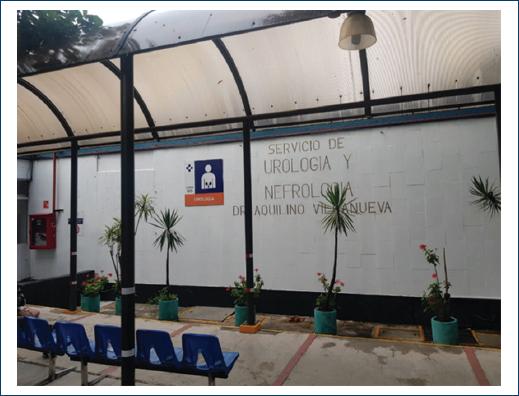
The Urology Service (Fig. 1) is the headquarters of the specialty of urology of the unique program of medical specialties of the faculty of medicine of the Universidad Nacional Autónoma de México (UNAM), having an average of six resident doctors for each generation that is made up of Mexican doctors and doctors from Central and South America, who are eager to acquire the theoretical and practical knowledge found in each of the patients we attend from the consultation external and accompanying them throughout the process until they reach a surgical procedure and its follow-up, thus being a fundamental part of how large and relevant Unit 105-A is.
Continuing with the mystique and tradition that has characterized the Urology Service of the HGM since its creation, pavilion 105-A is one of the few urologist training centers that seek specific training in laparoscopy in urology, being the high specialty course in laparoscopy and robotics in urology with endorsement by the faculty of medicine of the UNAM oldest nationwide, a course taught by Dr. Victor Enrique Corona Montes and Dr. Jesús Emmanuel Rosas Nava, which since its inception has achieved the development of competent urologists for the benefit of patients with urinary tract pathologies in various parts of Mexico and the American continent.
The doctors assigned to the service and professors of the university course encourage in the resident doctors, in addition to the field of care, the importance of the development of research protocols on a constant basis, and in order to lead by example, 60% of the doctors assigned have postgraduate master’s degrees and/or doctorates in medical sciences, hospital administration or senior management. In addition, they are part of various academic organizations such as the Mexican Academy of Surgery, Mexican Society of Urology, Mexican National Council of Urology, and International Associations.
During the last 15 years, there has been an exponential growth in the technological field to favor the management of patients in the Urology Service, including improvements in the physical structure of the unit (remodeling in the hospitalization rooms, the urology auditorium, the meeting room or high performance, and the urology operating rooms), as well as having high-tech equipment, initially with ureteroscopy equipment (semi-rigid and flexible), percutaneous tracts for the treatment of lithiasis, bipolar resection equipment, ultrasound and equipment to perform prostate biopsies, more recently the arrival of urodynamics equipment, holmium laser for enucleation of the prostate, testicular prostheses for young people with testicular cancer, as well as a laparoscopy tower for the management of urological patients. The future of urology in pavilion 105-A of the HGM is linked to technological advances, as history marks, it is our obligation to continue with the implementation of a first-world medical practice in a hospital traditionally characterized by humanism.
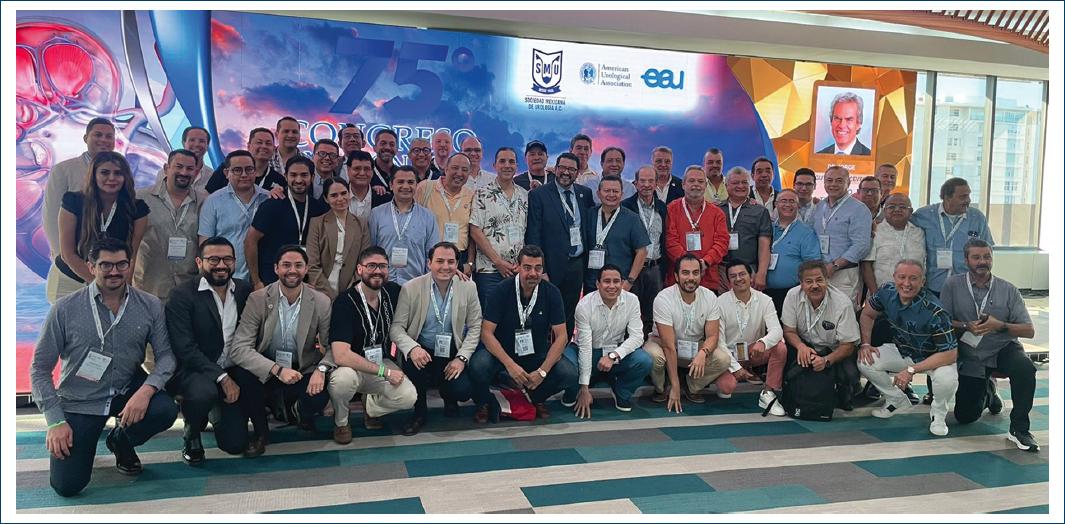
Pavilion 105-A was, is and will be a hotbed of professional men and women in charge of seeking the construction of a better tomorrow, a titanic task that has resonated since its foundation, it is our duty to maintain the relief, comfort and health of the most vulnerable Mexican population who blindly surrender to the knowledge, skills and abilities that all the members of the work team develop. From doctors, nurses, administrators, and social workers work hard day by day within the walls of pavilion 105-A to achieve the best results (Figs. 2 and 3). It is important to remember that the way to predict the future is to work hard and continuously to create it, without forgetting the essence and sense of belonging that the invaluable pavilion 105-A and the HGM have always instilled in each and every one of us who have been academically and humanly trained in them.
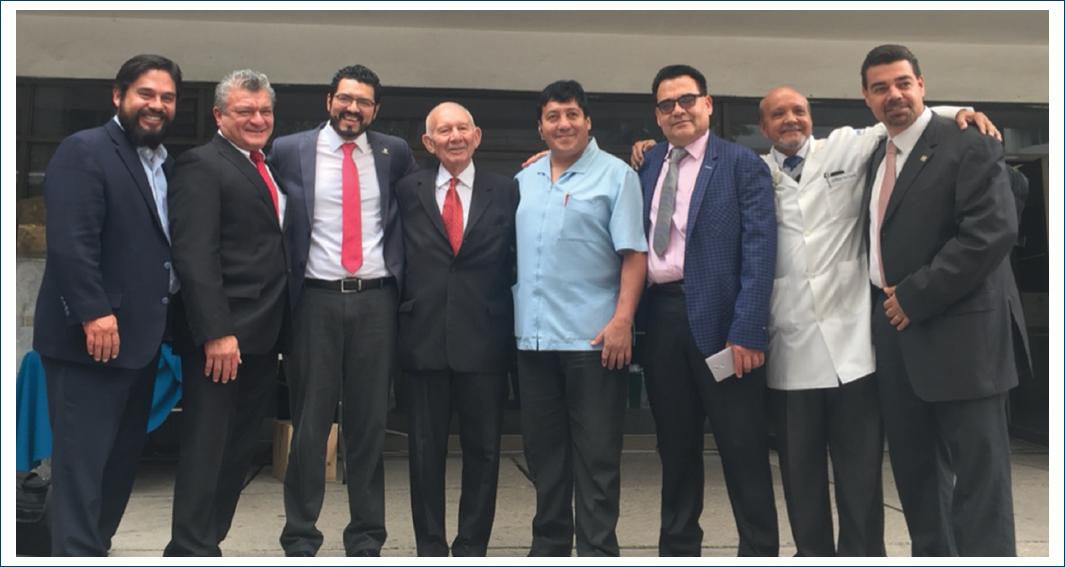
Figure 2 Graduates of the Urology Service of the Hospital General de México Dr. Eduardo Liceaga, during the tribute to the career of Dr. Carlos García Irigoyen. From left to right, Dr. Francisco Barrios, Dr. Hugo Manzanilla, Dr. Emmanuel Rosas, Dr. Carlos García Irigoyen, Dr. Miguel Ángel Reyes, Dr. Miguel Hernández, Dr. Guillermo Soria, and Dr. Alfonso de Silva.