

SciELO - Scientific Electronic Library Online

 
vol.103 número1Regeneración natural de la selva alta perennifolia en cultivos abandonados de café (Coffea arabica L.) en Veracruz, México índice de autoresíndice de materiabúsqueda de artículos
Home Pagelista alfabética de revistas  

Servicios Personalizados

Revista

Articulo

Indicadores

Links relacionados

  • No hay artículos similaresSimilares en SciELO

Compartir


Botanical Sciences

versión On-line ISSN 2007-4476versión impresa ISSN 2007-4298

Bot. sci vol.103 no.1 México ene./mar. 2025  Epub 18-Feb-2025

https://doi.org/10.17129/botsci.3584 

Review

Phylospecies in the Mexican marine algal diversity and the problem of morphospecies

María Luisa Núñez Resendiz1  *  , Conceptualization, Investigation, Writing - original draft, Writing – review & editing
http://orcid.org/0000-0001-6587-2609

Kurt M. Dreckmann1  , Investigation, Writing - original draft, Writing – review & editing
http://orcid.org/0000-0002-8855-0685

Abel Sentíes1  , Investigation, Writing - original draft, Writing – review & editing, Project administration
http://orcid.org/0000-0002-8825-4720

Martha I. Vilchis2  , Investigation, Writing – review & editing
http://orcid.org/0000-0002-3395-9731

Oscar E. Hernández1  , Investigation, Writing – review & editing
http://orcid.org/0000-0002-9453-4438

Sinuhé Hernández-Márquez3  , Investigation, Writing – review & editing
http://orcid.org/0000-0002-3110-4502

María Eugenia Zamudio-Resendiz3  , Investigation, Writing – review & editing, Project administration
http://orcid.org/0000-0001-8306-6766

1Laboratorio de Macroalgas Marinas y Salobres, Departamento de Hidrobiología, Universidad Autónoma Metropolitana-Iztapalapa, Ciudad de México, México.

2Departamento de Botánica, Universidad Autónoma de Yucatán, Mérida, Yucatán, México.

3Laboratorio de Fitoplancton Marino y Salobre, Departamento de Hidrobiología, Universidad Autónoma Metropolitana-Iztapalapa, Ciudad de México, México.


Abstract

Algae constitute a non-natural group of organisms that share morphological, physiological and ecological characteristics due to a complex shared evolutionary history. They live attached to a substrate or floating in a column of fresh or marine water. These latter are classified into macro and microalgae, whose current diversity recorded in Mexico is represented by approximately 1,700 species of macroalgae and 1,500 of microalgae. However, this diversity is based on morphological attributes. The problem of the morphospecies is that it depends on the expression of the genotype in response to the environmental heterogeneity in which these organisms establish themselves, resulting in phenotypic plasticity or morphological monotony, with the consequent overlapping of characters, generating misidentifications with several taxonomical problems associated and unstable classification systems. The molecular characterization of species has generated great taxonomic changes and more robust classifications. Currently, the diversity of Mexican phylospecies is reduced, with only 250 macro and microalgae, representing 12.5 and 2.3 % of the diversity, respectively. However, of the 142 works associated with phylospecies, 82 have led to taxonomic changes and proposals with important implications in the construction of more stable classification systems and a better understanding of Mexican phycofloristic diversity in all groups.

Key words: diversity; macroalgae; microalgae; morphological monotony; phenotypic plasticity

Resumen

Las algas constituyen un grupo no natural de organismos que comparten características morfológicas, fisiológicas y ecológicas resultado de una compleja historia evolutiva compartida. Viven adheridas a un sustrato o flotando en una columna de agua dulce o marina. Estas últimas se clasifican en macro y microalgas, cuya diversidad actual registrada en México, está representada por aproximadamente 1,700 especies de macroalgas y 1,500 de microalgas. Sin embargo, esta diversidad se sustenta básicamente en atributos morfológicos. El problema de la morfoespecie es que depende de la expresión del genotipo en respuesta a la heterogeneidad ambiental en la que estos organismos se establecen, derivando en plasticidad fenotípica o monotonía morfológica, con la consecuente superposición de caracteres, generando identificaciones erróneas con diversas problemáticas taxonómicas asociadas y sistemas de clasificación inestables. La caracterización molecular de las especies ha generado grandes cambios taxonómicos y clasificaciones más robustas. Actualmente, la diversidad de filoespecies mexicanas es reducida, siendo sólo 250 entre macro y microalgas, representando el 12.5 y el 2.3 % de la diversidad, respectivamente. No obstante, de las 142 obras asociadas a las filoespecies, 82 han derivado en cambios y propuestas taxonómicas con implicaciones importantes en la construcción de sistemas de clasificación más estables y un mejor entendimiento de la diversidad ficoflorística mexicana en todos los grupos.

Palabras clave: diversidad; macroalgas; microalgas; monotonía morfológica; plasticidad fenotípica

Within the large group known as algae are grouped a set of organisms, of a very diverse nature, that share numerous similarities in their morphological and functional organization, reproductive processes, environments and distribution intervals, because of several convergences throughout their complex evolutionary history (Leliaert et al. 2014, Restrepo et al. 2016). They constitute an artificial classification, not a natural one; that is, it does not have a common ancestor, but rather a polyphyletic origin with multiple ancestors (Adl et al. 2012). Currently, new classifications based mainly on comparisons of ribosomal RNA sequences (Adl et al. 2012, 2019), support the phylogenetic relationship between a large section of this group (Glaucophyta, Rhodophyceae, and Cholorophyta) with embryophytes, within the supergroup Archaeplastida, being its diagnostic morphological character the acquisition of chloroplasts by primary endosymbiosis (De Clerck et al. 2012). However, other supergroups such as Stramenopiles (specifically the photosynthetic heterokonts of the division Ochrophyta), Alveolata or Excavata, whose chloroplast was acquired by secondary or tertiary endosymbiosis, group another large section of algal diversity such as Phaeophyceae, Diatomea, Dinoflagellata or Euglenida, among other minor groups, within the increasingly disused kingdom Protista (Bringloe et al. 2020). Additionally, within the term algae, the groups in incertae sedis Haptophyta and Cryptophyceae, with mixotrophic metabolism, are also considered (Nozaki et al. 2009, Adl et al. 2019).

Despite its polyphyletic nature, today the concept algae is conserved, with a utilitarian nature, to refer to a group of photosynthetic eukaryotic organisms that share a set of particular morphological, physiological and ecological characteristics that other groups do not present (van den Hoek et al. 1995). They can be unicellular, colonial or multicellular. They live in mainly aquatic environments, attached to a substrate (benthic), floating on the surface (neustonic) or suspended in the water column (planktonic). According to their size, they are also classified into macroalgae (seen with the naked eye) and microalgae (seen under a microscope). They are distributed in a great diversity of environments throughout the world, both continental and marine, being predominant in the latter, where they are responsible for about 50 % of the primary productivity on the planet (Guo et al. 2020). Additionally, they are ecosystem builders and shelters on which the development and nutrition of many vertebrates and invertebrates depend, as well as forming algal proliferations that can be toxic or harmful.

The diversity of marine algae known worldwide ranges from 17,500 to 18,000 species of macroalgae and 3,500 species of microalgae (Guiry 2024); some authors argue that there may even be an approximate diversity of 5,000 species of microalgae (Hernández-Becerril 2014). Although many species currently have a molecular basis that defines their identity and taxonomic independence (phylogenetic species or phylospecies), for the majority, within all algal groups, identification depends exclusively on morphology (morphospecies), resulting in a complicated or practically impossible task for many species, both due to the presence of high phenotypic plasticity and morphological monotony derived from a complex evolutionary history, shared among all of them, which generates overlapping characters, cryptic diversity and misidentifications (Cianciola et al. 2010). The above has not only led to the underestimation and/or overestimation of phycofloristic diversity, but also to several taxonomic problems at all hierarchical levels and, with it, the generation of unstable, not very robust classification systems that do not reflect the phylogenetic relationships between species (Leliaert et al. 2014).

In this regard, phylogenetic studies that incorporate molecular characters in the circumscription and discrimination of species constitute a fundamental component of biodiversity, since they allow their comparison with other specimens around the world and the obtaining of more robust hypotheses of interspecific relationship, without biases of interpretation of characters, allowing a better understanding of their evolutionary history (Preuss & Zuccarello 2024). Through understanding the processes that have produced changes in organisms over time (patterns), due to the action of evolutionary forces that act on genes, it is possible to understand the great biological diversity that we know today (Yi et al. 2023). The application of molecular tools, in all biological groups, has generated more stable classification systems and a better interpretation of the kinship relationships between species, as well as the evolutionary processes that they have faced (Cianciola et al. 2010). In this sense, the use of molecular characters in the study of Mexican marine algal diversity has provided solid evidence, which will be discussed later, to resolve different problems associated with the construction of this diversity exclusively on the morphospecies concept.

Marine algal diversity and the morphospecies problem

Mexico has an approximate coastline of 11,150 km (7,828 km from Pacific Ocean and Gulf of California and 3,294 km from Gulf of Mexico and Mexican Caribbean), plus 5,127 km2 of island edges (Lara-Lara et al. 2008, Pedroche & Sentíes 2020), with a great environmental heterogeneity and sites conducive to the establishment and development of a high diversity of benthic and planktonic marine algae, distributed in 17 coastal states (Dreckmann & Sentíes 2013). Currently, there is knowledge of a phycofloristic diversity made up of nearly 3,200 species of marine algae, recorded in both the Pacific and the Mexican Atlantic, approximately 1,500 species of microalgae (Hernández-Becerril 2014, Escárcega-Bata et al. 2023a) and 1,700 species of macroalgae (Pedroche & Sentíes 2020).

Much of biological work involves the recognition and discrimination of species, in order to achieve a better understanding of the diversity present in a given region. In this sense, the first approach to a phycoflora is based on the recognition of morphospecies, defined as the set of morphological attributes shared between a group of organisms that, generally, also share a geographic region (De Queiroz 2007). Although the number of phylogenetically supported species is increasing, current knowledge of the diversity of marine algae in Mexico, as well as their taxonomic classification, is based mainly on morphology (Pedroche & Sentíes 2003, Zamudio-Resendiz et al. 2022). The problem with morphospecies is that it depends on the phenotype that is expressed, from the genotype, in response to different environmental conditions. However, not all genotypes respond differentially to the environment, or not all environmental changes cause different phenotypes (Schilling & Pigliucci 2004). In this way, we can summarize the alternatives that a genotype has to express morphological variation (Pigliucci 2001) and the consequent problems associated with phycofloristic diversity as follows (Figure 1).
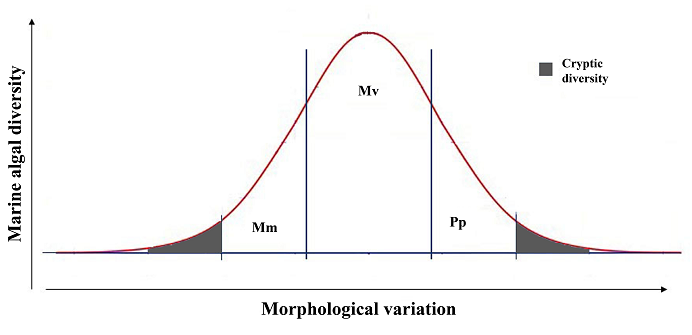
Figure 1 Hypothetical graphic representation of the distribution of marine algal diversity in the spectrum of morphological variation: Morphological Monotony (Mm), Morphological Variability (Mv) and Phenotypic Plasticity (Pp). The spectrum of cryptic diversity is represented in shadow. 

Production of very similar phenotypes, associated with different genotypes. This is the case of phenotypically monotonous species, whose morphological differences are practically imperceptible to the naked eye, so it is common for them to go unnoticed among other similar species, generating an underestimation of phycofloristic diversity. In this interval (Figure 1, far left of the graph) numerous species of algae are found, such as those in the genera Alexandrium Halim, Bryopsis J.V. Lamouroux, Codium Stackhouse, Dictyota J.V. Lamouroux, Digenea C. Agardh, Euglena Ehrenberg, Gelidiella Feldmann & G. Hamel, Ulva Linnaeus or Ralfsia Berkeley, among many others (Pedroche 2001, León-Álvarez et al. 2014a, b, Lozano-Orozco 2014, 2015, 2016, Boo et al. 2018, Tufiño-Velázquez & Pedroche 2019, Vilchis et al. 2022b, Hernández-Becerril et al. 2023, Núñez Rasendiz et al. 2023). The problem of these species is easily detectable through the different floristic studies in which they are commonly reported as widely distributed or cosmopolitan species, since morphologically they are practically identical in all the environments in which they are established (Escárcega-Bata et al. 2022). Although they present certain morphological variations, they are very slight and are only detected until they are studied in detail, even so, the set of diagnostic characters available for their discrimination is limited.

Production of different phenotypes, clearly distinguishable from each other, associated with different genotypes (total genetic structure). This alternative corresponds to the true morphological variation associated with the species, allowing them to be clearly discriminated against each other by their morphological attributes, in any type of environmental conditions throughout their entire distribution range. These are the so-called good species, those that, when supported phylogenetically, can have a robust set of diagnostic characters that allow them to be easily recognized in the field, without confusing them with others (Cain 1956). In this interval we can find many species of seaweed (Figure 1, center of the graph) as in the genera Cymopolia J.V. Lamouroux, Codiophyllum J.E. Gray, Karenia Gert Hansen & Moestrup or Padina Adanson, among others (Díaz-Martínez et al 2016, Núñez Resendiz et al. 2020, Escárcega-Bata et al. 2024).

Production of several phenotypes, clearly distinguishable, associated with the same genotype. This alternative corresponds to phenotypic plasticity, which is the ability of the genotype to produce several phenotypes in response to different, or even the same, environmental conditions. In this way, a large number of organisms associated with the same genotype are often described as independent species or intraspecies on a morphological basis, generating not only the overestimation of biological diversity, but also the existence of several names associated with a species at the level of variety or form, which, on many occasions, after phylogenetic treatment, become part of a long list of names that are out of use, taxonomic synonyms or with uncertain taxonomic status. In this interval (Figure 1, far right of the graph), we find a large number of algae species, among which we can mention the species of the genera Caulerpa J.V. Lamouroux, Levanderina Ø. Moestrup, P. Hakanen, G. Hansen, N. Daugbjerg & M. Ellegaard, Minutocellus G.R. Hasle, H.A. von Stosch & E.E. Syvertsen, Sargassum C. Agardh or Tripos Bory, among many others (Fernández-García et al. 2016, González-Nieto et al. 2020, Hernández-Márquez et al. 2023). These species form large populations very well adapted to different environmental conditions, achieving wide distribution ranges.

Under the aforementioned, the problems of Mexican seaweed species associated with the morphospecies seem to be greater at the extremes of the spectrum of morphological variation (Figure 1), with morphological monotony and phenotypic plasticity being, by themselves, the main causes of underestimation or overestimation of algal diversity. Associated with these extremes, we find the case of cryptic species that are genetically independent but morphologically indistinguishable (Figure 1, shading), which directly contributes to the underestimation of phycofloristic diversity. In this sense, in algae are common cases in which the phenotypic expression between species is so reduced that morphologically they cannot be distinguished from others. A concrete example is found in Centroceras clavulatum (C. Agardh) Montagne in whose morphological spectrum there are 9 genetically independent species, hidden under the same phenotype, which, to this day, still cannot be discriminated as independent species (Won et al. 2009). Another example is found in the genus Pseudo-nitzschia H. Peragallo, from which numerous cryptic (without morphological characters that distinguish them from each other) and/or pseudocryptic (without limited morphological characters that distinguish them from each other, only visible after a morphological study in detail) species have been described (Lundholm & Moestrup 2002, Lundholm et al. 2012, Teng et al. 2015). At the other extreme, there are apparently highly phenotypically variable species, in which it is possible to recognize different phenotypes, even within the same population, so different from each other that they have been described as different species. However, this phenotypic plasticity is shared by other species within their distribution range, generating genetically independent species that express several overlapping phenotypes, so we find a case more similar to morphological monotony, despite the apparent high plasticity. This case is common in species with sympatric (shared) distribution, since the response of the genotype to the environment is the same, producing the phenotypes best adapted to those environmental conditions. Examples of these cases can be found in species of the genera Gracilaria Greville or Eucheuma J. Agardh (Gurgel et al. 2004, Núñez Resendiz et al. 2015, 2019a, Dreckmann et al. 2018, Vilchis et al. 2022a).

Under the theoretical support previously explained, from the use of molecular characters, it is possible to explain the hidden genetic diversity or structure (cryptic diversity) under the morphological monotony or phenotypic plasticity in algal populations, defining phylospecies and solving problems of underestimation and overestimation of marine algal diversity. However, despite its popularity in the last three decades and the fact that it is increasingly easier to obtain molecular sequences from PCR (Polymera Chain Reaction), in Mexico, there are few diversity studies that integrate a molecular support for the determination of phylospecies, or if this evidence is included, it is not discussed; consequently, the morphospecies continues to be weighted.

Phylospecies versus morphospecies in the Mexican phycoflora

Of the diversity of Mexican marine algae currently recorded, nearly 1,700 species correspond to the three groups of marine macroalgae, being the red algae (Rhodophyceae) the most diverse with approximately 1,150 species, followed by the green algae (Chlorophyta) with about 310 species and the brown algae (Ochrophyta: Phaeophyceae) with 240 species (Pedroche & Sentíes 2020). In microalgae, with about 1,500 species recorded, the greatest diversity is concentrated in diatoms (Ochrophyta: Diatomea, Diatomista) with about 800 species, followed by dinoflagellates (Dinophyta: Dinoflagellata) with 650 species, Haptophyta with 58 species and minor groups such as euglenoids (Euglenozoa: Euglenida) with 5 species (Hernández-Becerril 2014, Escárcega-Bata et al. 2023a). The rest of the microalgae in Ochrophyta are not or poorly represented with less than three species (Hernández-Becerril 2014).

Macroalgae. Of the known diversity in Mexico, 87.5 % (1,488 spp) is based exclusively on the morphological basis, with only 12.5 % (211 spp) being those that, in addition to the morphological support, have a molecular identification (Figure 2A, Table S1). The most worked group at the molecular level is red algae, with 126 phylospecies belonging to 13 orders and 28 families (Appendix 1). The most studied groups have been Ceramiales, with sequenced representatives of 6 families, particularly for Ceramiaceae (with 25 phylospecies), followed by Gigartinales with 5 families represented, with Solieriaceae (with 5 phylospecies) being the most studied and Corallinales with 4 families represented, being Spongitidaceae (with 8 phylospecies) the most studied family (Appendix 1). However, the order Gracilariales is another widely studied group of red algae, considering that it is only represented by the Gracilariaceae family (with 13 phylospecies). Of the brown algae, with 50 phylospecies belonging to 4 orders and 5 families (Appendix 1), the most studied group is Dictyotales, family Dictyotaceae (with 24 phylospecies), followed by Fucales, family Sargassaceae (with 21 phylospecies). In green algae, being the least worked group, with 35 phylospecies belonging to three orders and seven families (Appendix 1), the most worked group was Bryopsidales, specifically the Codiaceae (with 12 phylospecies), followed by Halymedaceae (with 11 phylospecies), and Caulerpaceae (with 7 phylospecies).
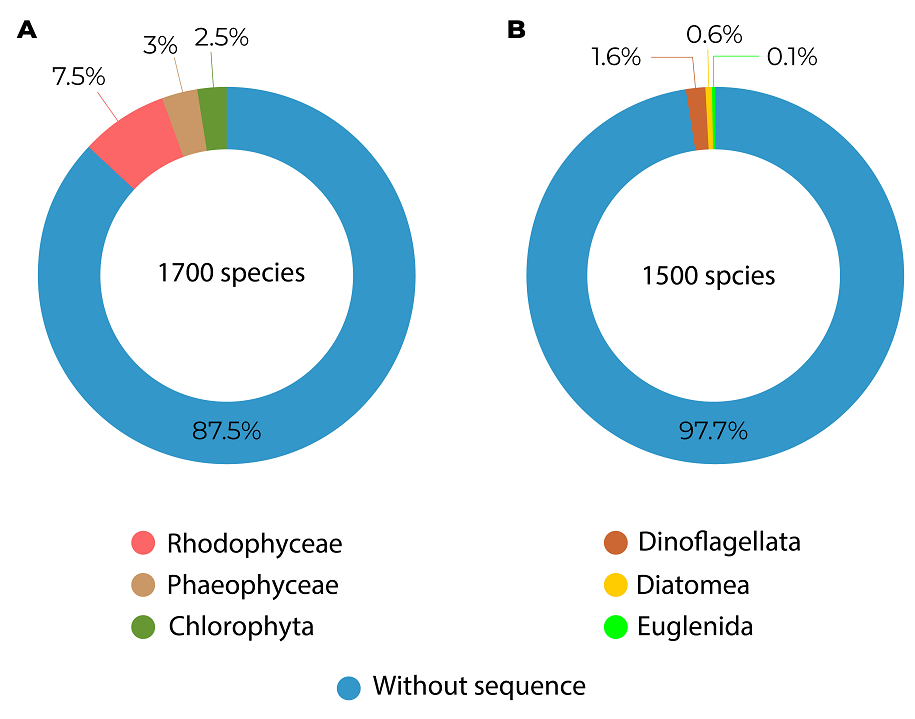
Figure 2 Percentage of phylospecies versus morphospecies in phycofloristic diversity. A. Macroalgae with 1,700 species and the percentage of phylospecies in each group represented by different colors. B. Microalgae with 1,500 species and the percentage of phylospecies in each of the groups represented. 

Microalgae. Of the known diversity in Mexico, 97.7 % (1,465 spp) is based exclusively on morphology, with only 2.3 % (35 spp) being those that, in addition to the morphological support, have a molecular identification that supports them as phylospecies (Figure 2B, Table S1). The best represented group at the molecular level are the dinoflagellates with 25 phylospecies, distributed in 6 orders and 10 families (Appendix 1), with Gymnodiniales, particularly Gymnodiniaceae (with 3 phylospecies), being the most studied. However, despite being represented by only one family, Gonyaulacales, particularly the Pyrocystaceae family (with 8 phylospecies), is the most worked on the group. In diatoms, with 9 phylospecies, belonging to 6 orders and 6 families (Appendix 1), the most worked group is Bacillariales, specifically Bacillariaceae (with 4 phylospecies), followed by the rest of the 5 families represented with only one phylospecies each (Appendix 1). As for the minor groups, there is only one phylospecies for Euglenophyta (Appendix 1, S1), from the order Ploeotiida and family Ploeotiidae. The rest of the phytoplankton groups in Mexico do not have molecularly supported species, they are all morphospecies.

In both macroalgae and microalgae, phylogenetic studies have been carried out throughout the 17 coastal states of Mexico, sometimes with more than one specimen sequenced in different states for the same species and by different authors (Supplementary material Table S1), concentrating the most of them in the states of the Gulf of California, Gulf of Mexico and Mexican Caribbean region (Figure 3). In this sense, in the Mexican Pacific the states with the highest number of sequenced species are Baja California with 66 species, followed by Baja California Sur with 35 species, Guerrero with 17 species, Sonora with 12 species, Nayarit and Oaxaca with 11 species each, and Jalisco with 10 species; the least represented are Colima and Michoacán, both with 7 species, Sinaloa with 6 species and Chiapas with 5 species (Figure 3). In the Mexican Atlantic, the state with the highest number of sequenced species is Quintana Roo with 62 species, followed by Campeche with 44 species, Veracruz with 33 species and Yucatán with 15 species, while Tamaulipas and Tabasco only have one species each (Figure 3). It is notable that the states of the Mexican Atlantic have been worked on in a more homogeneous manner with respect to those of the Mexican Pacific, where a great difference is observed between those from the Gulf of California and the states of Central and Southern Mexico, with the exception of Guerrero, where about 70 % of the diversity of microalgae morphospecies recorded in Mexico is concentrated (Meave del Castillo et al. 2012) and a large number of macroalgae species (Pedroche & Sentíes 2020).
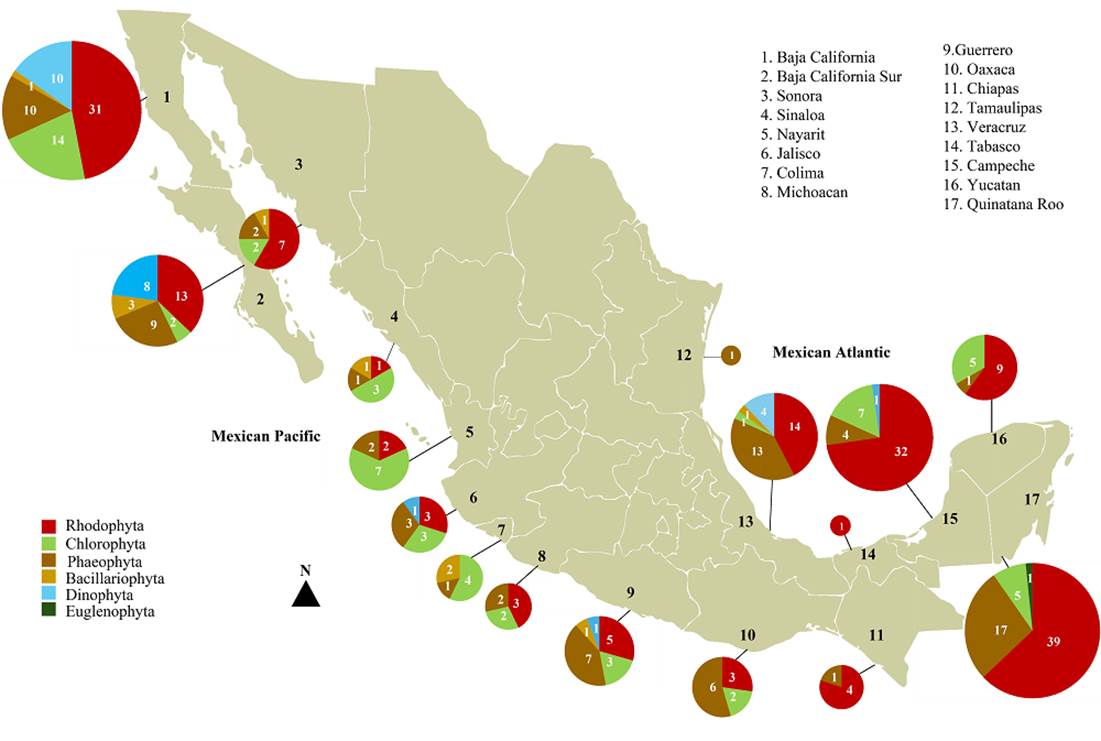
Figure 3 Map of Mexico showing the distribution and number of phylospecies per group of algae (represented with different colors) in each of the 17 coastal states. The difference in size of the graphs by state corresponds to the number of phylospecies it represents, with the largest sizes being those states that contain the greatest number. 

Although some groups such as red, brown algae or dinoflagellates have been more widely studied than others, from a phylogenetic perspective, most of the work concentrates on a few genera of economic importance, both for the compounds of their cell walls such as agars, carrageenans or alginates, and for their ecological importance, as is the case of the Fucales species that constitute ecosystems for large animal species of economic importance, or the microalgae that form potentially toxic blooms. In the case of red algae, all species of the Laurencia J.V. Lamouroux complex, have been widely sequenced throughout the country, although mainly in the Mexican Caribbean region (Fujii et al. 2006, Cassano et al. 2009, Gil-Rodríguez et al. 2009, 2010, Mateo-Cid et al. 2014b, Sentíes et al. 2019). On the other hand, the species of agarophytes of the genus Gracilaria have also been widely studied, but most of the studies are concentrated in the Mexican Atlantic region (Núñez-Resendiz et al. 2015, 2017a, Dreckmann et al. 2018, Vilchis et al. 2022a). In the case of green algae, most studies focus on the genera Codium (Pedroche 2001, 2021), Bryopsis (Tufiño-Velázquez & Pedroche 2019) or Udotea J.V. Lamouroux (Acosta-Calderón et al. 2018), these last two concentrated in the Mexican Atlantic region (Figura 3). For brown algae, the most widely worked genera are Dictyota in the Gulf of California region (Tronholm et al. 2012, Vieira et al. 2021) and Gulf of Mexico (Lozano-Orozco et al. 2014, 2015, 2016), as well as Sargassum in this same region (González-Nieto et al. 2020) and Padina around all the Mexican coasts (Díaz-Martínez et al. 2016). In the case of diatoms, one of the most studied genera with molecular characters has been Pseudo-nitzschia for both the Atlantic and Pacific coasts (Lundholm & Moestrup 2002, Lundholm et al. 2012). In dinoflagellates, the western coast of Baja California has been worked emphatically (Figure 3), with species of the order Gymnodiniales, which contains many potentially toxic species (Escárcega-Bata et al. 2021), although also in Guerrero Karenia has been well worked and contain 8 toxic species from 10 known (Meave del Castillo et al. 2012, Escárcega-Bata et al. 2023a, 2024). However, the diversity represented by phylospecies in the 17 coastal states is notably scarce in contrast to the morphospecies recorded at a general level in each algal group and at a local level, in each of the states of Mexico (Hernández-Becerril 2014, García-García et al. 2020, 2021, Pedroche & Sentíes 2020, Escárcega-Bata et al. 2023a).

The phylospecies in the resolution of the problems of the morphospecies

Pedroche & Sentíes (2003) summarize the problems associated with Mexican marine algal diversity in three main aspects: (1) The limited number of characters for its delimitation, associated with its plastic nature or morphological monotony, which also overlaps with several unrelated phylogenetically groups, given their polyphyletic nature. The above has generated a large number of names that correspond to varieties or forms, or even to species not yet described. (2) The distribution of species based on their affinity for temperate and/or tropical regions and the convergence of this distribution, generating identity problems associated with their biogeography or differential sampling, and, consequently, differential diversity between the different regions. (3) Presence of presumably invasive species and the lack of historical studies that allow evaluating the impact of their introduction to the native flora.

Diversity studies using phylogenetic methods have been successfully implemented for the characterization of phylospecies, directly contributing to a better understanding of algal diversity and its evolutionary relationships, mainly in the species detected in the spectrum of morphological monotony or the phenotypic plasticity, providing a solution to the problem described above. Particularly for the Mexican phycoflora, there are 250 phylospecies within all algal groups, contained in 142 studies carried out throughout the 17 Mexican coastal states (Appendix 1). In general, with the recognition of these phylospecies, it has been possible to strengthen phylogenetic hypotheses through the description of new species (Mateo-Cid et al. 2005, 2012, 2014a, b, Mendoza-González et al. 2011, Lozano-Orozco et al. 2015, 2016, Olivares-Rubio et al. 2017, Sentíes et al. 2014, 2016, 2019, Núñez Resendiz et al. 2017b, 2019a, 2020, 2023, Dreckmann et al 2018, Quiroz-González et al. 2020, 2021a, 2024, Sauvage et al. 2021), description of new genera (Cassano et al. 2012, Núñez Resendiz et al. 2018), new nomenclatural combinations (Díaz-Larrea et al. 2007, Sentíes & Díaz-Larrea 2008, León-Álvarez et al. 2014b, Núñez Resendiz et al. 2019b), cryptic diversity recognition (Hind et al. 2014, Filloramo & Saunders 2018), distribution patterns (Boo et al. 2018, Hernández et al. 2020, 2021), conspecific species with the consequent reduction in diversity (Cassano et al. 2009, Fernández-García et al. 2016, González-Nieto et al. 2020), new records for an area (Lozano-Orozco et al. 2014, Godínez-Ortega et al. 2018, Escárcega-Bata et al. 2021, 2024, Vilchis et al. 2022a, Díaz-Martínez et al. 2023, Hernández-Márquez et al. 2023), resurrection of species (Broom et al. 2002, Cho et al. 2003a, Andrade-Sorcia et al. 2014, León-Álvarez et al. 2014a), expansion or delimitation of distribution intervals (Calderon et al. 2021, Lora-Vilchis et al. 2021, Pedroche 2021, Vilchis et al. 2022b, Hernández-Becerril et al. 2023), confirmation and morphological characterization of previously recorded species (Band-Schmidt et al. 2008, Díaz-Martínez et al. 2016, León-Álvarez et al. 2017, Quiroz-González et al. 2021b, Morquecho et al. 2022, Durán-Riveroll et al. 2023) or detect endemic or introduced diversity (Riosmena-Rodríguez et al. 2012, García-Rodríguez et al. 2013, López-Vivas et al. 2015).

It is important to highlight that, despite the importance of phylospecies in diversity studies, there must be a good morphological characterization that allows their discrimination, since morphology will never be separated from the species, because this is the result of genetic expression and what allows us to recognize species in their natural environment. However, the morphological criterion should not predominate over the genetic one, since it is the genes that determine morphology and as discussed previously, morphology presents different aspects that have generated problems in the current classification systems of all groups of algae. Additionally, is important to be in account that many species present wide ranges of distribution, which correspond with different biogeographic provinces (Spalding et al. 2007, Wilkinson et al. 2009) and, consequently, with heterogeneous environments in which the phenotype is being expressed. In this sense, of the 250 phylospecies presented (Appendix 1 and Table S1), not all have an adequate phylogenetic treatment, that is, many Mexican specimens were sequenced as part of studies whose objective was not the treatment of Mexican species, therefore, no mention is made of their morphological attributes or phylogenetic relationships (Table S1). In this case, 36 of 126 red algae, 7 of 35 green algae and 5 of 50 brown algae were found (Table S1); The rest of the species presented are associated with references that include detailed morphology of the Mexican species, including all microalgae (Appendix 1). In microalgae, it is also common to find in molecular databases sequences from sites in Mexico that were obtained from metagenomics; however, they are not associated with a particular morphology or reference, which is why they were not included in this review. Of the 142 references that incorporate phylogenetically and molecularly supported species, 91 have detailed morphological mentions of the Mexican specimens (Appendix 1). However, it is important to note that, between the literature revised, we detected several cases in which, despite molecular sequences are presented with morphological studies about the Mexican species, these studies do not present phylogenetic interpretations about the results founded, it means, the sequences presented were not compared with those related from the GenBank or phylogenetic relationships were not described (Vázquez-Delfín et al. 2016, Acosta-Calderón et al. 2018, Tufiño-Velázquez & Pedroche 2019); so, although morphological results are accompanied by molecular characterization, without these comparisons species cannot be considered true phylospecies. In this sense, it is necessary to evaluate them and determine their true phylogenetic position. On the other hand, of the 91 references in which the morphology is described in detail, 82 had important changes for the Mexican phycoflora (Appendix 1), referred to above, such as description of new diversity, new records, detection of cryptic species, redefinition of distribution intervals, new combinations and/or arrangements or decrease in diversity. These changes reveal that, with Mexico being such a heterogeneous country in the marine environment, the currently known diversity, based on the morphospecies, is subject to change drastically with the definition of the phylospecies, mainly in terms of estimates and general conception of the Mexican phycofloristic composition.

Final considerations

Although in Mexico there have actually been few morphospecies of marine algae confirmed molecularly, the number of specialists training in this line is increasing. Part of its limited use may be due to the fact that it requires more complicated analysis methodologies for which greater dissemination would be necessary, which could be in the form of refresher courses. On the other hand, there are studies in which large sampling and greater economic investment are required, both due to the number of sequences that are generated and the number of sites that must be sampled, so their development requires the support of large projects; for its financing. However, the use of molecular markers is much cheaper and more reliable as the years go by, and it is relatively easy to obtain sequences at a low cost. Another relevant aspect to consider is that, in the characterization of the phylospecies, we seek to provide explanations for the problems previously exposed, based on the description of the evolutionary processes responsible for their current distribution and relationships. However, in Mexico we are faced with the problem of restricted access, due to security issues, to a considerable proportion of localities that make up the distribution range of many species, which can generate biases in the characterization and phylogenetic interpretations.

Finally, the high number of studies that characterize phylospecies in macroalgae, with respect to microalgae, is notably evident. Much of this difference may be due to the fact that, although phylogenetic evidence has been better incorporated in the definition of macroalgae species, in the case of microalgae the morphological criterion continues to predominate over molecular evidence (Zamudio-Resendiz et al. 2022), therefore, the use of phylogenetic analyzes in these organisms is still limited. In addition, it should be considered that the primers used can be applied to all phytoplankton groups, which does not adequately resolve relationships between species (Escárcega-Bata et al. 2023b). However, it is expected that in the future the characterization of a greater number of phylospecies in studies of marine algal diversity will increase and be uniform in both groups, in order to better understand the principles and processes associated with their establishment and development on the Mexican coastlines and oceans, which allow to implement correct management of this resource and its conservation.

Supplementary material

Supplemental data for this article can be accessed here: https://doi.org/10.17129/botsci.3584.

Supplemental material.

Acknowledgments

We thank to Dr. Alexis Escárcega Bata, the anonymous reviewers and the editor section for their feedback and comments to improve this manuscript. MIV and SHM thank to the Consejo Nacional de Humanidades, Ciencias y Tecnología for the scholarship granted.

Literature cited

Acosta-Calderón JA, Hernandez-Rodriguez C, Mendoza-González AC, Mateo-Cid LE. 2018. Diversity and distribution of Udotea genus J.V. Lamouroux (Chlorophyta, Udoteaceae) in the Yucatan peninsula littoral, Mexico. Phytotaxa 345: 179-218. DOI: https://doi.org/10.11646/phytotaxa.345.3.1 [ Links ]

Adl MS, Simpson AGB, Lane CE, Lukeš J, Bass D, Bowser SS, Brown MW, Burki F, Dunthorn M, Hampl V, Heiss A, Hoppenrath M, Lara E, le Gall L, Lynn DH, McManus H, Mitchell EAD, Mozley-Stanridge SE, Parfrey LW, Pawlowski J, Rueckert S, Shadwick L, Schoch CL, Smirnov A, Spiegel FW. 2012. The revised classification of eukaryotes. The Journal of Eukaryotic Microbiology 59: 429-514. DOI: https://doi.org/10.1111/j.1550-7408.2012.00644.x [ Links ]

Adl SM, Simpson AGB, Lane CE, Lukeš J, Bass D, Bowser SS, Brown MW, Burki F, Dunthorn M, Hampl V, Heiss A, Hoppenrath M, Lara E, Le Gall L, Lynn DH, McManus H, Mitchell EAD, Mozley-Stanridge SE, Parfrey LW, Pawlowski J, Rueckert S, Shadwick L, Schoch CL, Smirnov A, Spiegel FW. 2019. Revisions to the classification, nomenclature, and diversity of eukaryotes. The Journal of Eukaryotic Microbiology 66: 4-119. DOI: https://doi.org/10.1111/jeu.12691 [ Links ]

Andrade-Sorcia G, Riosmena-Rodríguez R, Muñiz-Salazar R, López-Vivas JM, Boo GH, Lee KM, Boo SM. 2014. Morphological reassessment and molecular assessment of Sargassum (Fucales: Phaeophyceae) species from the gulf of California, Mexico. Phytotaxa 183: 201-223. DOI: https://doi.org/10.11646/phytotaxa.183.4.1 [ Links ]

Band-Schmidt CJ, Rojas-Posadas DI, Morquecho L, Hernández-Saavedra NY. 2008. Heterogeneity of LSU rDNA sequences and morphology of Gymnodinium catenatum dinoflagellate strains in bahía Concepción, gulf of California, Mexico.Journal of Plankton Research30: 755-763. DOI: https://doi.org/10.1093/plankt/fbn035 [ Links ]

Barros-Barreto MB, Jaramillo MA, Hommersand MH, Ferreira PCG, Maggs CA. 2023. Phylogenetic analysis of the red algal tribe Ceramieae reveals multiple morphological homoplasies but defines new genera. Cryptogamie, Algologie 44: 13-33. DOI: https://doi.org/10.5252/cryptogamie-algologie2023v44a2 [ Links ]

Boedeker C, Leliaert F, Zuccarello GC. 2016. Molecular phylogeny of the Cladophoraceae (Cladophorales, Ulvophyceae), with the resurrection of Acrocladus Nägeli and Willeella Børgesen, and the description of Lurbica gen. nov. and Pseudorhizoclonium gen. nov. Journal of Phycology 52: 905-928. DOI: https://doi.org/10.1111/jpy.12457 [ Links ]

Boo GH, Le Gall L, Hwang IK, Rousseau F, Yoon HS. 2022. Species Diversity of Gelidium from southern Madagascar evaluated by an integrative taxonomic approach. Diversity 14: 826. DOI: https://doi.org/10.3390/d14100826 [ Links ]

Boo GH, Hughey JR, Miller KA, Boo SM. 2016a. Mitogenomes from type specimens, a genotyping tool for morphologically simple species: ten genomes of agar-producing red algae. Scientific Reports 6: 35337. DOI: https://doi.org/10.1038/srep35337 [ Links ]

Boo GH, Nguye TV, Kim JY, Le Gall L, Rico JM, Bottalico A, Boo SM. 2016b. A revised classification of the Gelidiellaceae (Rhodophyta) with descriptions of three new genera: Huismaniella, Millerella and Perronella. Taxon 65: 965-979. DOI: https://doi.org/10.12705/655.2 [ Links ]

Boo GH, Robledo D, Andrade-Sorcia G, Boo SM. 2018. Genetic discontinuity of Digenea (Rhodomelaceae, Rhodophyta) from Mexico supports recognition of two new species, D. mexicana and D. rafaelii. Algae 33: 231-241. DOI: https://doi.org/10.4490/algae.2018.33.8.20 [ Links ]

Brajogopal S, Kaczmarska I, Ehrman JM. 2020. Auxosporulation in Biddulphia tridens (Ehrenberg) Ehrenberg (Mediophyceae, Bacillariophyta).European Journal of Phycology55: 296-309. DOI: https://doi.org/10.1080/09670262.2020.1716077 [ Links ]

Bringloe TT, Starko S, Wade RM, Vieira C, Kawai H, De Clerck O, Cock JM, SM Coelho, Destombe C, Valero M, Neiva J, Pearson GA, Faugeron S, Serrão EA, Verbruggen H. 2020. Phylogeny and evolution of the brown algae. Critical Reviews in Plant Sciences 39: 281-321. DOI: https://doi.org/10.1080/07352689.2020.1787679 [ Links ]

Broom JE, Nelson WA, Yarish C, Jones WA, Aguilar-Rosas R, Aguilar-Rosas LE. 2002. A reassessment of the taxonomic status of Porphyra suborbiculata Kjellm, Porphyra carolinensis Coll et J. Cox and Porphyra lilliputiana W.A. Nelson, G.A. Knight et M.W. Hawkes (Bangiales, Rhodophyta) based on molecular and morphological data. European Journal of Phycology37: 227-236. DOI: https://doi.org/10.1017/S0967026202003566 [ Links ]

Cain AJ. 1956. The genus in evolutionary taxonomy. Systematic Zoology 5: 97-109. DOI: https://doi.org/10.2307/2411572 [ Links ]

Calderon MS, Bustamante DE, Gabrielson PW, Martone PT, Hind KR, Huber S, Mansilla A. 2021. Type specimen sequencing, multilocus analyses, and species delimitation methods recognize the cosmopolitan Corallina berteroi and establish the northern Japanese C. yendoi sp. nov. (Corallinaceae, Rhodophyta). Journal of Phycology 57: 1659-1672. DOI: https://doi.org/10.1111/jpy.13202 [ Links ]

Cassano V, Diaz-Larrea J, Senties A, Oliveira MC, Gil-Rodriguez MC, Fujii MT. 2009. Evidence for the conspecificity of Palisada papillosa with Palisada perforata (Ceramiales, Rhodophyta) from the western and eastern Atlantic ocean on the basis of morphological and molecular analyses. Phycologia 48: 86-100. DOI: https://doi.org/10.2216/0031-8884-48.2.86 [ Links ]

Cassano V, Oliveira MC, Gil-Rodríguez MC, Sentíes A, Díaz-Larrea J, Fujii MT. 2012. Molecular support for the establishment of the new genus Laurenciella within the Laurencia complex (Ceramiales, Rhodophyta). Botanica Marina 55: 349-357. DOI: https://doi.org/10.1515/bot-2012-0133 [ Links ]

Cembella AD, Durán-Riveroll LM, Tarazona-Janampa UI, Okolodkov YB, García-Sandoval R, Krock B, John U. 2021. Phylogeography and diversity among populations of the toxigenic benthic dinoflagellate Prorocentrum from coastal reef systems in Mexico.Frontiers in Marine Science8: 716669. DOI: https://doi.org/10.3389/fmars.2021.716669 [ Links ]

Cho TO, Fredericq S, Murray SN, Boo SM. 2003a. New insights in the taxonomy of the Ceramium sinicola complex: resurrection of Ceramium interruptum (Ceramiaceae, Rhodophyta). Journal of Phycology 39: 775-788. DOI: https://doi.org/10.1046/j.1529-8817.2003.02161.x [ Links ]

Cho TO, Fredericq S, Boo SM. 2003b. Ceramium inkyuii sp. nov. (Ceramiaceae, Rhodophyta) from Korea: a new species based on morphological and molecular evidence. Journal of Phycology 39: 236-247. DOI: https://doi.org/10.1046/j.1529-8817.2003.02018.x [ Links ]

Cho TO, Boo SM, Hommersand MH, Maggs CA, McIvor L, Fredericq S. 2008. Gayliella gen. nov. in the tribe Ceramieae (Ceramiaceae, Rhodophyta) based on molecular and morphological evidence. Journal of Phycology 44: 721-738. DOI: https://doi.org/10.1111/j.1529-8817.2008.00505.x [ Links ]

Cianciola E, Popolizio T, Schneider C, lane C. 2010. Using molecular-assisted alpha taxonomy to better understand red algal biodiversity in Bermuda. Diversity 2: 946-958. DOI: https://doi.org/10.3390/d2060946 [ Links ]

De Clerck O, Bogaert K, Leliaert F. 2012. Diversity and evolution of algae: primary endosymbiosis. Advances in Botanical Research 64: 55-86. DOI: https://doi.org/10.1016/B978-0-12-391499-6.00002-5 [ Links ]

De Queiroz K. 2007. Species concepts and species delimitation. Systematic Biology 56: 879-886. DOI: https://doi.org/10.1080/10635150701701083 [ Links ]

Díaz-Larrea JA, Sentíes A, Fujii MT, Pedroche FF, Oliveira MC. 2007. Molecular evidence for Chondrophycus poiteaui var. gemmiferus comb. et stat. nov. (Ceramiales, Rhodophyta) from the Mexican Caribbean sea: implications for the taxonomy of the Laurencia complex. Botanica Marina 50: 250-256. DOI: https://doi.org/10.1515/BOT.2007.026 [ Links ]

Díaz-Martínez S, Hernández-Anaya L, Ávila-Ortiz AG, Cabrera-Martínez LI, Zuccarello GC. 2023. Lobophora dispersa (Dictyotaceae: Phaeophyceae), a new record for the coast of Veracruz and insights into Lobophora genetic differentiation in the gulf of Mexico and the Caribbean sea. Revista Mexicana de Biodiversidad 94: e945216. DOI: https://doi.org/10.22201/ib.20078706e.2023.94.5216 [ Links ]

Díaz-Martínez S, Zuccarello GC, Salazar-Chávez GA, Pedroche FF, Ávila-Ortiz AG. 2016. Species of Padina (Dictyotales, Phaeophyceae) in tropical Mexican waters based on molecular-assisted taxonomy. Phycologia 55: 673-687. DOI: https://doi.org/10.2216/16-15.1 [ Links ]

Dreckmann KM. Sentíes A. 2013. Las arribazones de algas marinas en el Caribe Mexicano, evento biológico natural o basura en la playa. Biodiversitas 107: 7-11. [ Links ]

Dreckmann KM , Núñez Resendiz ML, Sentíes A. 2018. Gracilaria microcarpa sp. nov. (Gracilariaceae, Rhodophyta) from the southwestern gulf of Mexico. Botanica Marina 61: 115-125. DOI: https://doi.org/10.1515/bot-2017-0068 [ Links ]

Durán-Riveroll LM, Juárez OE, Okolodkov YB, Mejía-Camacho AL, Ramírez-Corona F, Casanova-Gracia D, Cembella AD. 2023. Morphological and molecular characterization of the benthic dinoflagellate Amphidinium from coastal waters of Mexico.Phycology3: 305-324. DOI: https://doi.org/10.3390/phycology3020020 [ Links ]

Escárcega-Bata A, Núñez Resendiz ML, Ruiz-de la Torre MC, Dreckmann KM , Zamudio-Resendiz ME, Sentíes A. 2023a. Diversidad de dinoflagelados atecados del orden Gymnodiniales (Dinophyceae), con énfasis en aquellos formadores de florecimientos algales nocivos en las costas del Pacífico Mexicano. Acta Botanica Mexicana 130: e2126. DOI: https://doi.org/10.21829/abm130.2023.2126 [ Links ]

Escárcega-Bata A , Núñez Resendiz ML, Zamudio-Resendiz ME, Dreckmann KM , Sánchez-Cuevas E, Sentíes A. 2024. Morpho-molecular and environmental evidence of the occurrence of Karenia longicanalis (Dinophyceae: Kareniaceae) as a bloom former in the Eastern Pacific Ocean.Protist 175: 126022. DOI: https://doi.org/10.1016/j.protis.2024.126022 [ Links ]

Escárcega-Bata A , Ruíz-De la Torre MC, Núñez Resendiz ML, Enríquez-Paredes LM. 2022. An update on the diversity of atecate dinoflagellates (Dinoflagellata) in Bahía Todos Santos, Baja California. Nova Hedwigia 115: 269-305. [ Links ]

Escárcega-Bata A , Ruiz-de la Torre MC, Núñez Resendiz ML, Enríquez-Paredes LM, Dreckmann KM , Sentíes A. 2021. Molecular assessment of athecate dinoflagellates of the order Gymnodiniales (Dinophyceae) in Todos Santos Bay, Baja California México.American Journal of Plant Sciences12: 1926-1944. https://doi.org/10.4236/ajps.2021.1212133 [ Links ]

Escárcega-Bata A , Zamudio-Resendiz ME, Hernández-Rosas A, Núñez Resendiz ML, Dreckmann KM , 2023b. First record of Grammatodinium (Dinophyceae) for the american eastern Pacific coast: Morphological, molecular and ecological confirmation. European Journal of Protistology 87: 125942). DOI: https://doi.org/10.1016/j.ejop.2022.125942 [ Links ]

Fernández-García C, Wysor B, Riosmena-Rodríguez R, Pena-Salamanca E, Verbruggen H. 2016. DNA-assisted identification of Caulerpa (Caulerpaceae, Chlorophyta) reduces species richness estimates for the eastern tropical Pacific. Phytotaxa 252: 185-204. DOI: https://doi.org/10.11646/phytotaxa.252.3.2 [ Links ]

Filloramo GV, Saunders GW. 2018. Assessment of the order Rhodymeniales (Rhodophyta) from British Columbia using an integrative taxonomic approach reveals overlooked and cryptic species diversity. Botany 96: 107. DOI: https://doi.org/10.1139/cjb-2017-0143 [ Links ]

Fontana S, Wang WL, Tseng KY, Draisma SGA, Dumilag RV, Hu ZM, Li JJ, Lai PH, Mattio L, Sherwood AR, Boo SM, Liu SL. 2024. Seaweed diversification driven by Taiwan's emergence and the Kuroshio current: insights from the cryptic diversity and phylogeography of Dichotomaria (Galaxauraceae, Rhodophyta). Frontiers in Ecology and Evolution 12: 1346199. DOI: https://doi.org/10.3389/fevo.2024.1346199 [ Links ]

Fredericq S, Anderson RJ, Lopez-Bautista JM. 2003. Circumscription of some Phyllophoraceae (Gigartinales, Rhodophyta) from the cape region, South Africa, based on molecular and morphological evidence. Proceedings of the International Seaweed Symposium 50: 263-273 [ Links ]

Fredericq S, Freshwater DW, Hommersand MH. 1999. Observations on the phylogenetic systematics and biogeography of the Solieriaceae (Gigartinales, Rhodophyta) inferred from rbcL sequences and morphological evidence. Hydrobiologia 398-399: 25-38. DOI: https://doi.org/10.1023/A:1017077831840 [ Links ]

Fredericq S, Arakaki N, Camacho O, Gabriel D, Krayesky D, Self-Krayeskya S, Reesa G, Richards J, Sauvage T, Venera-Pontona D, Schmidt WE. 2014. A dynamic approach to the study of Rhodoliths: a case study for the northwestern gulf of Mexico. Cryptogamie, Algologie 35: 77-98. DOI: https://doi.org/10.7872/crya.v35.iss1.2014.77 [ Links ]

Fredericq S, Krayesky-Self S, Sauvage T, Richards J, Kittle R, Arakaki N, Hickerson E, Schmidt WE. 2019. The critical importance of Rhodoliths in the life cycle completion of both macro- and microalgae, and as holobionts for the establishment and maintenance of marine biodiversity. Frontiers in Marine Sciences 5: 502. DOI: https://doi.org/10.3389/fmars.2018.00502 [ Links ]

Fujii MT, Guimaràes SMPB, Gurgel CFD, Fredericq S. 2006. Characterization and phylogenetic affinities of the red algae Chondrophycus flagelliferus (Rhodomelaceae, Ceramiales) from Brazil on the basis of morphological and molecular evidence. Phycologia 45: 432-441. DOI: https://doi.org/10.2216/04-33.1 [ Links ]

Gabriel D, Parente MI, Neto AI, Raposo M, Schils T, Fredericq S. 2010. Phylogenetic appraisal of the genus Platoma (Nemastomatales, Rhodophyta), including life history and morphological observations on P. cyclocolpum from the Azores. Phycologia 49: 2-21. DOI: https://doi.org/10.2216/07-99.1 [ Links ]

Gabriel D, Schils T, Neto AI., Paramio L, Fredericq S. 2009. Predaea feldmannii subsp. azorica (Nemastomataceae, Nemastomatales), a new subspecies of red algae (Rhodophyta) from the Azores. Cryptogamie, Algologie 30: 251-270. [ Links ]

Gabrielson PW. 2008a. Molecular sequencing of northeast Pacific type material reveals two earlier names for Prionitis lyalii, Prionitis jubata and Prionitis sternbergii, with brief comments on Grateloupia versicolor (Halymeniaceae, Rhodophyta). Phycologia 47: 89-97. DOI: https://doi.org/10.2216/04-43.1 [ Links ]

Gabrielson PW. 2008b. On the absence of previously reported Japanese and Peruvian species of Prionitis (Halymeniaceae, Rhodophyta) in the northeast Pacific. Phycological Research 56:105-114. DOI: https://doi.org/10.1111/j.1440-1835.2008.00491.x [ Links ]

García-García AME, Cabrera-Becerril E, Núñez Resendiz ML, Dreckmann KM , Sentíes A. 2020. Actualización taxonómica de las algas rojas (Rhodophyta) marinas bentónicas del Atlántico mexicano. Acta Botanica Mexicana 127: e1677. DOI: https://doi.org/10.21829/abm127.2020.1677 [ Links ]

García-García AME , Cabrera-Becerril E, Núñez Resendiz ML, Dreckmann KM , Sentíes A. 2021. Actualización taxonómica de las algas pardas (Phaeophyceae, Ochrophyta) marinas bentónicas del Atlántico mexicano. Acta Botanica Mexicana 128: e1968. DOI: https://doi.org/10.21829/abm128.2021.1968 [ Links ]

García-Rodríguez LD, Riosmena-Rodríguez R, Kim SY, López-Mayer M, López-Vivas JJM, Boo SM. 2013. Recent introduction of Gracilaria parvispora (Gracilariales, Rhodophyta) in Baja California, México. Botanica Marina 56: 143-150. DOI: https://doi.org/10.1515/bot-2012-0177 [ Links ]

Geraldino PJL, Boo GH, Boo SM. 2015. Genetic variability and biogeography of the widespread red alga Hypnea flexicaulis (Gigartinales, Rhodophyta) based on rbcL and cox1 sequences. Botanica Marina 58: 167-174. DOI: https://doi.org/10.1515/bot-2014-0073 [ Links ]

Geraldino PJL, Riosmena-Rodríguez R, Liao LM, Boo SM. 2010. Phylogenetic relationships within the genus Hypnea (Gigartinales, Rhodophyta), with a description of H. caespitosa sp. nov. Journal of Phycology 46: 336-345. DOI: https://doi.org/10.1111/j.1529-8817.2009.00804.x [ Links ]

Gil-Rodríguez MC, Cassano V, Aylagas E, Sentíes A, Díaz-Larrea J, Oliveira CM, Fujii TM. 2010. Palisada flagellifera (Ceramiales, Rhodophyta) from the Canary Islands, Spain: a new record for the eastern Atlantic Ocean based on morphological and molecular evidence. Botanica Marina 53: 31-40. DOI: https://doi.org/10.1515/BOT.2010.010 [ Links ]

Gil-Rodríguez MC, Sentíes A, Díaz-Larrea J, Cassano V, Fujii MT. 2009. Laurencia marilzae sp. nov. (Ceramiales, Rhodophyta) from the canary Islands, Spain, based on morphological and molecular evidence. Journal of Phycology 45: 264-271. DOI: https://doi.org/10.1111/j.1529-8817.2008.00624.x [ Links ]

Godínez-Ortega JL, Cabrera LI, García-Sandoval R, Wynne MJ, Olivares-Rubio HF, Ramírez-García P, Granados-Barba A. 2018. Morphological and molecular characterization of Lobophora declerckii and L. variegata (Dictyotales, Ochrophyta) on the Atlantic coast of Mexico. Phytotaxa 382: 57-73. DOI: https://doi.org/10.11646/phytotaxa.382.1.2 [ Links ]

González-Nieto D, Oliveira MC, Núñez Resendiz MLN, Dreckmann KM , Mateo-Cid LE, Sentíes A. 2020. Molecular assessment of the genus Sargassum (Fucales, Phaeophyceae) from the Mexican coasts of the Gulf of Mexico and Caribbean, with the description of S. xochitlae sp. nov. Phytotaxa 461: 254-274. DOI: https://doi.org/10.11646/phytotaxa.461.4.3 [ Links ]

Guiry MD. 2024. How many species of algae are there? A reprise. Four kingdoms, 14 phyla, 63 classes and still growing. Journal of Phycology 60: 214-228. DOI: https://doi.org/10.1111/jpy.13431 [ Links ]

Guo W, Gong D, Qiao Q. 2020. Research progress and ideas of influence of hydrological regimes on river primary productivity of algae. IOP Conference Series: Earth and Environmental Science 558: 042013. DOI: https://doi.org/10.1088/1755-1315/558/4/042013 [ Links ]

Gurgel CFD, Fredericq S. 2004. Systematics of the Gracilariaceae (Gracilariales, Rhodophyta): a critical assessment based on rbcL sequence analyses. Journal of Phycology 40: 138-159. DOI: https://doi.org/10.1111/j.0022-3646.2003.02-129.x [ Links ]

Gurgel CFD, Fredericq S, Norris JN. 2004. Phylogeography of Gracilaria tikvahiae (Gracilariaceae, Rhodophyta): a study of genetic discontinuity in a continuously distributed species based on molecular evidence. Journal of Phycology 40: 748-758. DOI: https://doi.org/10.1111/j.1529-8817.2004.03070.x [ Links ]

Hernández OE, Dreckmann KM , Núñez Resendiz ML , Sentíes A . 2021. Patrones de distribución de la familia Solieriaceae (Gigartinales, Rhodophyta) en México. Acta Botanica Mexicana 128: e1994. DOI: https://doi.org/10.21829/abm128.2021.1994 [ Links ]

Hernández OE , Dreckmann KM , Nuñez Resendiz ML, Vilchis MI, Sentíes A . 2020. Gracilariopsis lemaneiformis (Gracilariaceae, Rhodophyta) in the Mexican coasts: A case of disjunct distribution?. American Journal of Plant Sciences 11: 111-124. DOI: https://doi.org/10.4236/ajps.2020.112009 [ Links ]

Hernández-Becerril DU. 2014. Biodiversidad de algas planctónicas marinas (Cyanobacteria, Prasinophyceae, Euglenophyta, Chrysophyceae, Dictyochophyceae, Eustigmatophyceae, Parmophyceae, Raphidophyceae, Bacillariophyta, Cryptophyta, Haptophyta, Dinoflagellata) en México. Revista Mexicana de Biodiversidad 85: 44-53. DOI: https://doi.org/10.7550/rmb.32037 [ Links ]

Hernández-Becerril DU, Pichardo-Velarde JG, Alonso-Rodríguez R, Maciel-Baltazar E, Morquecho L, Esqueda-Lara K, Quiroz-González N. 2023. Diversity and distribution of species of the planktonic dinoflagellate genus Alexandrium (Dinophyta) from the tropical and subtropical Mexican Pacific Ocean.Botanica Marina66: 539-557. DOI: https://doi.org/10.1515/bot-2023-0037 [ Links ]

Hernández-Márquez S, Zamudio-Resendiz ME, Núñez Reséndiz ML, Escárcega-Bata A , Sentíes A . 2023. Ultrastructural characterization of Minutocellus polymorphus (Cymatosiraceae, Bacillariophyta) and first record from the eastern Pacific.Botanica Marina66: 141-150. DOI: https://doi.org/10.1515/bot-2022-0052 [ Links ]

Hind KR, Gabrielson PW, Saunders GW. 2014. Molecular-assisted alpha taxonomy reveals pseudocryptic diversity among species of Bossiella (Corallinales, Rhodophyta) in the eastern Pacific Ocean. Phycologia 53: 443-456. DOI: https://doi.org/10.2216/13-239.1 [ Links ]

Hommersand MH, Fredericq S, Freshwater WD, Hughey J. 1999. Recent developments in the systematics of the Gigartinaceae (Gigartinales, Rhodophyta) based on rbcL sequence analysis and morphological evidence. Phycological Research 47: 139-151. DOI: https://doi.org/10.1046/j.1440-1835.1999.00168.x [ Links ]

Hommersand MH, Moe RL, Amsler CD, Fredericq S. 2009. Notes on the systematics and biogeographical relationships of Antarctic and sub-Antarctic Rhodophyta with descriptions of four new genera and five new species. Botanica Marina 52: 509-534. DOI: https://doi.org/10.1515/BOT.2009.081 [ Links ]

Hughey JR, Hommersand MH. 2010. A molecular study of Mazzaella (Gigartinaceae, Rhodophyta) and morphological investigation of the splendens clade from Pacific north America. Phycologia 49: 113-135. DOI: https://doi.org/10.2216/PH08-68.1 [ Links ]

Hughey JR, Miller KA. 2021. Genetic investigation of three type specimens of Osmundea (Rhodomelaceae, Rhodophyta) from the Gulf of California, Mexico and California, USA. Phytotaxa 489: 65-78. DOI: https://doi.org/10.11646/phytotaxa.489.1.5 [ Links ]

Kamiya M, West JA, King RJ, Zuccarello GC, Tanaka J, Hara Y. 1998. Evolutionary divergence in the red algae Caloglossa leprieurii and C. apomeiotica. Journal of Phycology 34: 361-370. DOI: https://doi.org/10.1046/j.1529-8817.1998.340361.x [ Links ]

Kato A, Basso D, Caragnano A, Rodondi G, Le Gall L, Pena V, Hall-Spencer JM, Baba M. 2022. Morphological and molecular assessment of Lithophyllum okamurae with the description of L. neo-okamurae sp. nov. (Corallinales, Rhodophyta). Phycologia 61: 117-131. DOI: https://doi.org/10.1080/00318884.2021.2005330 [ Links ]

Kooistra WHCF, Coppejans EGG, Payri C. 2002. Molecular systematics, historical ecology, and phylogeography of Halimeda (Bryopsidales). Molecular Phylogenetics and Evolution 24: 121-138. DOI: https://doi.org/10.1016/S1055-7903(02)00221-X [ Links ]

Krayesky DM, Norris J, West JA, Fredericq S. 2011. The Caloglossa leprieurii complex (Delesseriaceae, Rhodophyta) in the Americas: the elucidation of overlooked species based on molecular and morphological evidence. Cryptogamie, Algologie 32: 37-62. DOI: https://doi.org/10.7872/crya.v32.iss1.2011.037 [ Links ]

Lagourgue L, Puillandre N, Payri C. 2018. Exploring the Udoteaceae diversity (Bryopsidales, Chlorophyta) in the Caribbean region based on molecular and morphological data. Molecular Phylogenetics and Evolution 127: 758-769. DOI: https://doi.org/10.1016/j.ympev.2018.06.023 [ Links ]

Lara-Lara JR, Arreola-Lizárraga JA, Calderón-Aguilera LE, Camacho-Ibar VF, De la Lanza-Espino G, Escofet-Giansone A, Espejel-Carbajal MI, Guzmán-Arroyo M, Ladah LB, López-Hernández M, Meling López EA, Moreno Casasola Barceló P, Reyes Bonilla H, Ríos Jara E, Zertuche González JA. 2008. Los ecosistemas costeros, insulares y epicontinentales. In: Soberón J., Halffter G, Llorente-Bousquets J. comps. Capital Natural de México. DF, México: Comisión Nacional para el Uso de la Biodiversidad. Pp. 109-134. ISBN: 9786077607021 [ Links ]

Lax G, Lee WJ, Eglit Y, Simpson A. 2019. Ploeotids represent much of the phylogenetic diversity of euglenids.Protist170: 233-257. DOI: https://doi.org/10.1016/j.protis.2019.03.001 [ Links ]

Leliaert F, D'hondt S, Tyberghein L, Verbruggen H, De Clerck O. 2011. Atypical development of Chaetomorpha antennina in culture (Cladophorales, Chlorophyta). Phycological Research 59: 91-97. DOI: https://doi.org/10.1111/j.1440-1835.2010.00604.x [ Links ]

Leliaert F, Verbruggen H, Vanormelingen P, Steen F, López-Bautista JM, Zuccarello GC, De Clerck O. 2014. DNA-based species delimitation in algae. European Journal of Phycology 49: 179-196. DOI: https://doi.org/10.1080/09670262.2014.904524 [ Links ]

Leliaert F, Wysor B, Verbruggen H, Vlaeminck C, De Clerck O. 2008. Phyllodictyon robustum (Setchell et Gardner) comb. nov. (Siphonocladales, Chlorophyta), a morphologically variable species from the tropical Pacific coast of America. Cryptogamie, Algologie 29: 217-233. [ Links ]

León-Álvarez D, Núñez Resendiz ML , Wynne MJ. 2014a. Morphological and molecular studies on topotype material of Neoralfsia expansa (Phaeophyceae) reveal that Asian specimens assigned to this taxon are genetically distinct. Botanica Marina 57: 351-358. DOI: https://doi.org/10.1515/bot-2014-0029 [ Links ]

León-Álvarez D , Núñez Resendiz ML , Ponce-Márquez ME. 2014b. Morphological and molecular characterization of Neoralfsia hancockii comb. nov. (Ralfsiales, Phaeophyceae) from topotype of San José del Cabo, Baja California, Mexico. Botanica Marina 57: 139-146. DOI: https://doi.org/10.1515/bot-2013-0095 [ Links ]

León-Álvarez D , Reyes-Gómez VP, Wynne MJ, Ponce-Márquez ME, Quiróz-González N. 2017. Morphological and molecular characterization of Hapalospongidion gelatinosum, Hapalospongidiaceae fam. nov. (Ralfsiales, Phaeophyceae) from Mexico. Botanica Marina 60: 567-581. DOI: https://doi.org/10.1515/bot-2017-0020 [ Links ]

Li Y, Boonprakob A, Gaonkar CC, Kooistra WH, Lange CB, Hernández-Becerril D, Lundholm N. 2017. Diversity in the globally distributed diatom genus Chaetoceros (Bacillariophyceae): three new species from warm-temperate waters.Plos One, 12: e0168887. DOI: https://doi.org/10.1371/journal.pone.0168887 [ Links ]

Lin SM, Fredericq S, Hommersand MH. 2000. Phylogenetic and taxonomic reassessment of the Delesseriaceae (Ceramiales, Rhodophyta) based on two molecular data sets. Journal of Phycology 36: 44-44. DOI: https://doi.org/10.1046/j.1529-8817.1999.00001-131.x [ Links ]

Lindstrom SC, Hughey JR, Martone PT. 2011. New, resurrected and redefined species of Mastocarpus (Phyllophoraceae, Rhodophyta) from the northeast Pacific. Phycologia 50: 661-683. DOI: https://doi.org/10.2216/10-38.1 [ Links ]

López-Vivas JM, Muñiz-Salazar R, Riosmena-Rodríguez R, Pacheco-Ruíz I, Yarish C. 2015. Endemic Pyropia species (Bangiales, Rhodophyta) from the Gulf of California, Mexico. Journal of Applied Phycoly 27: 1029-1041. DOI: https://doi.org/10.1007/s10811-014-0366-7 [ Links ]

Lora-Vilchis MC, Murugan G, López-Fuerte FO. 2021. Geographical range expansion of Nitzschia volvendirostrata Ashworth, Dąbek & Witkowski, 2016 (Bacillariophyta: Bacillariaceae) based on morphological and molecular analysis.Marine Biodiversity Records14: 1-7. DOI: https://doi.org/10.1186/s41200-021-00212-w [ Links ]

Lozano-Orozco JG, Sentíes A , De Clerck O, Dreckmann KM , Díaz-Larrea J. 2015. Two new species of the genus Dictyota (Phaeophyceae: Dictyotales) from the Mexican Caribbean. American Journal of Plant Sciences 6: 2492-2501. DOI: https://doi.org/10.4236/ajps.2015.615251 [ Links ]

Lozano-Orozco JG, Sentíes A , Díaz-Larrea J , Pedroche FF, De Clerck O. 2014. The occurrence of Dictyota canariensis (Dictyotales, Phaeophyceae) in the Gulf of Mexico. Botanica Marina 57: 359-365. DOI: https://doi.org/10.1515/bot-2013-0111 [ Links ]

Lozano-Orozco JG, Sentíes A , Pedroche FF , Díaz-Larrea J . 2016. Dictyota chalchicueyecanensis sp. nov. (Dictyotales, Phaeophyceae) en el Golfo de México: evidencias moleculares y morfológicas. Hidrobiológica 26: 225-231. DOI: https://doi.org/10.24275/uam/izt/dcbs/hidro/2016v26n2/Lozano [ Links ]

Lundholm N, Bates SS, Baugh KA, Bill BD, Connell LB, Léger C, Trainer BL. 2012. Cryptic and pseudo-cryptic diversity in diatoms with descriptions of Pseudo-nitzschia hasleana sp. nov. and P. fryxelliana sp. nov. Journal of Phycology 48: 436-454. DOI: https://doi.org/10.1111/j.1529-8817.2012.01132.x [ Links ]

Lundholm N, Moestrup Ø. 2002. The marine diatom Pseudo-nitzschia galaxiae sp. nov. (Bacillariophyceae): morphology and phylogenetic relationships.Phycologia41: 594-605. DOI: https://doi.org/10.2216/i0031-8884-41-6-594.1 [ Links ]

MacGillivary ML, Kaczmarska I. 2012. Genetic differentiation within the Paralia longispina (Bacillariophyta) species complex.Botany90: 205-222. DOI: https://doi.org/10.1139/b11-101 [ Links ]

McIvor L, Maggs CA, Guiry MD, Hommersand MH. 2002. Phylogenetic analysis of the geographically disjunct genus Osmundea Stackhouse (Rhodomelaceae, Rhodophyta). Constancea 83: 1-11. [ Links ]

Maggs CA, Le Gall L, Mineur F, Provan J, Saunders GW. 2013. Fredericqia deveauniensis, gen. et sp. nov. (Phyllophoraceae, Rhodophyta), a new cryptogenic species. Cryptogamie, Algologie 34: 273-296. DOI: https://doi.org/10.7872/crya.v34.iss2.2013.273 [ Links ]

Mamoozadeh NR, Freshwater DW. 2012. Polysiphonia sensu lato (Ceramiales, Florideophyceae) species of Caribbean Panama including Polysiphonia lobophoralis sp. nov. and Polysiphonia nuda sp. nov. Botanica Marina 55: 317-347. DOI: https://doi.org/10.1515/bot-2012-0147 [ Links ]

Mateo-Cid LE, Mendoza-González AC, Díaz-Larrea J , Sentíes A , Pedroche FF , Sánchez-Heredia JD. 2012. A new species of Pyropia (Rhodophyta, Bangiaceae), from the Pacific coast of Mexico, based on morphological and molecular evidence. Phytotaxa 54: 1-12. DOI: https://doi.org/10.11646/phytotaxa.54.1.1 [ Links ]

Mateo-Cid LE , Mendoza-González AC, Gavio B, Fredericq S. 2005. Grateloupia huertana sp. nov. (Halymeniaceae, Rhodophyta), a peculiar new prostrate species from tropical Pacific Mexico. Phycologia 44: 4-16. DOI: https://doi.org/10.2216/0031-8884(2005)44[4:GHSNHR]2.0.CO;2 [ Links ]

Mateo-Cid LE , Mendoza-González AC, Gabrielson PW. 2014a. Neogoniolithon (Corallinales, Rhodophyta) on the Atlantic coast of México, including N. siankanensis sp. nov. Phytotaxa 190: 64-93. DOI: https://doi.org/10.11646/phytotaxa.190.1.7 [ Links ]

Mateo-Cid LE , Mendoza-González AC , Sentíes A , Díaz-Larrea J , Acosta Calderón JA. 2014b. Laurencia laurahuertana sp. nov. (Rhodomelaceae, Rhodophyta): An epiphytic species from the Mexican Caribbean. Phycological Research 62: 94-101. DOI: https://doi.org/10.1111/pre.12043 [ Links ]

Mateo-Cid LE , Mendoza-González AC , Sentíes A , Díaz-Larrea J , García-López DY, Martínez-Daranas B. 2016. Description of two new species of Ochtodes (Rhodophyta: Gigartinales) from Caribbean Mexico on the basis of morphological and molecular evidence. Botanica Marina 59: 131-146. DOI: https://doi.org/10.1515/bot-2015-0069 [ Links ]

Matsumoto K, Ichihara K, Shimada S. 2014. Taxonomic reinvestigation of Petalonia (Phaeophyceae, Ectocarpales) in southeast of Honshu, Japan, with a description of Petalonia tenuis sp. nov. Phycologia 53: 127-136. DOI: https://doi.org/10.2216/13-200.1 [ Links ]

Meave del Castillo ME, Zamudio-Resendiz ME, Castillo-Rivera M. 2012. Riqueza fitoplanctónica de la bahía de Acapulco y zona costera aledaña, Guerrero, México. Acta Botanica Mexicana 100: 405-487. DOI: https://doi.org/10.21829/abm100.2012.41 [ Links ]

Melton JT, López-Bautista JM, Collado-Vides L. 2016. Molecular identification and nutrient analysis of the green tide species Ulva ohnoi M. Hiraoka & S. Shimada, 2004 (Ulvophyceae, Chlorophyta), a new report and likely nonnative species in the Gulf of Mexico and Atlantic Florida, USA. Aquatic Invasions 11: 225-237. DOI: https://doi.org/10.3391/ai.2016.11.3.01 [ Links ]

Mendoza-González AC , Sentíes A , Mateo-Cid LE , Díaz-Larrea J , Pedroche FF , Villanueva RA. 2011. Ochtodes searlesii sp. nov. (Gigartinales, Rhodophyta), from the Pacific tropical coast of Mexico, based on morphological and molecular evidence. Phycological Research 59: 250-258. DOI: https://doi.org/10.1111/j.1440-1835.2011.00623.x [ Links ]

Morquecho L, Gárate-Lizárraga I, Gu H. 2022. Morphological and molecular characterization of the genus Coolia (Dinophyceae) from bahía de La Paz, southwest Gulf of California.Algae37: 185-204. DOI: https://doi.org/10.4490/algae.2022.37.9.2 [ Links ]

Muangmai N, West JA, Zuccarello GC. 2014. Evolution of four southern hemisphere Bostrychia (Rhodomelaceae, Rhodophyta) species: phylogeny, species delimitation and divergence times. Phycologia 53: 593-601. DOI: https://doi.org/10.2216/14-044.1 [ Links ]

Müller KM, Cole KM, Sheath RG. 2003. Systematics of Bangia (Bangiales, Rhodophyta) in North America. II. Biogeographical trends in karyology: chromosome numbers and linkage with gene sequence phylogenetic trees. Phycologia. 42: 209-219. DOI: https://doi.org/10.2216/i0031-8884-42-3-209.1 [ Links ]

Nauer F, Gurgel CF, Ayres-Ostrock LM, Plastino EM, Oliveira MC. 2019. Phylogeography of the Hypnea musciformis species complex (Gigartinales, Rhodophyta) with the recognition of cryptic species in the western Atlantic Ocean. Journal of Phycology 55: 676-687. DOI: https://doi.org/10.1111/jpy.12848 [ Links ]

Nelson WA, Broom JES. 2005. Contributions of molecular biology to understanding systematics and phylogeny in the order Bangiales. Natural History Research 8: 1-12. [ Links ]

Nozaki H, Maruyama S, Matsuzaki M, Nakada T, Kato S, Misawa K. 2009. Phylogenetic positions of Glaucophyta, green plants (Archaeplastida) and Haptophyta (Chromalveolata) as deduced from slowly evolving nuclear genes. Molecular Phylogenetics and Evolution 53: 872-880. DOI: https://doi.org/10.1016/j.ympev.2009.08.015 [ Links ]

Núñez Resendiz ML , Dreckmann KM , Sentíes A , Díaz-Larrea J , Zuccarello GC. 2015. Genetically recognizable but not morphologically: The cryptic nature of Hydropuntia cornea and H. usneoides (Gracilariales, Rhodophyta) in the Yucatan peninsula. Phycologia 54: 407-416. DOI: http://doi.org/10.2216/15-009.1 [ Links ]

Núñez Resendiz ML , Zuccarello GC , Dreckmann KM , Sentíes A . 2017a. Phylogeography of Hydropuntia cornea/H. usneoides complex (Gracilariales, Rhodophyta) in the Yucatan peninsula. Phycologia 56: 14-20. DOI: https://doi.org/10.2216/16-46.1 [ Links ]

Núñez Resendiz ML , Dreckmann KM , Sentíes A . 2017b. Meristotheca cylindrica sp. nov. (Solieriaceae, Rhodophyta) from the southern Gulf of Mexico. Phycologia 56: 423-429. DOI: https://doi.org/10.2216/16-116.1 [ Links ]

Núñez Resendiz ML , Dreckmann KM , Sentíes A , Zuccarello GC , León-Tejera H. 2018. Tepoztequiella rhizoidea gen. et sp. nov. (Solieriaceae, Rhodophyta) from the Yucatan peninsula, Mexico. Phycologia 57: 90-99. DOI: https://doi.org/10.2216/17-60.1 [ Links ]

Núñez Resendiz ML , Dreckmann KM , Sentíes A , León-Tejera H. 2019a. Meristotheca spinella (Solieriaceae, Rhodophyta) a new cylindrical species from the southwestern Gulf of Mexico. Cryptogamie, Algologie 40: 63-72. DOI: https://doi.org/10.5252/cryptogamie-algologie2019v40a6 [ Links ]

Núñez Resendiz ML , Dreckmann KM , Sentíes A , Wynne MJ, León-Tejera H. 2019b. Eucheumatopsis isiformis gen. et comb. nov. (Solieriaceae, Rhodophyta) from the Yucatan peninsula, to accommodate Eucheuma isiforme. Phycologia 58: 50-62. DOI: http://doi.org/10.1080/00318884.2018.1517536 [ Links ]

Núñez Resendiz ML , Sentíes A , Dreckmann KM , Hernández OE , Vilchis MI. 2023. Gelidiella papillosa sp. nov. (Gelidiellaceae, Rhodophyta) from Veracruz, Mexico, in the context of the worldwide distribution of G. acerosa. Botanica Marina 66: 1-13. DOI: https://doi.org/10.1515/bot-2023-0033 [ Links ]

Núñez Resendiz ML , Dreckmann KM , Wynne MJ , Sentíes A . 2020. Codiophyllum mexicanum sp. nov. (Halymeniaceae, Rhodophyta), first record of stalked red alga associated with sponges in the western Atlantic. Phycologia 59: 89-98. DOI: https://doi.org/10.1080/00318884.2019.1683318 [ Links ]

Olivares-Rubio HF, Cabrera LI, Godínez-Ortega JL, Salazar-Coria L, Vega-López A. 2017. Halamphora oceanica (Catenulaceae, Bacillariophyta), a new species from the epipelagic region of the southwestern Gulf of Mexico.Phytotaxa317: 188-198. DOI: https://doi.org/10.11646/phytotaxa.317.3.3 [ Links ]

Paredes-Banda P, García-Mendoza E, Ponce-Rivas E, Blanco J, Almazán-Becerril A, Galindo-Sánchez C, Cembella A. 2018. Association of the toxigenic dinoflagellate Alexandrium ostenfeldii with spirolide accumulation in cultured mussels (Mytilus galloprovincialis) from northwest Mexico. Frontiers in Marine Science5: 491. DOI: https://doi.org/10.3389/fmars.2018.00491 [ Links ]

Pedroche FF . 2001. Estudios filogenéticos del género Codium (Chlorophyta) en el Pacifico mexicano. Uso de ADNr mitocondrial. Anales de la Escuela Nacional de Ciencias Biológicas 47: 109-123. [ Links ]

Pedroche FF . 2021. Confirmación de la ausencia del alga marina asiática Codium fragile subsp. fragile (Codiaceae, Chlorophyta) en el Pacífico de México, mediante datos moleculares. Hidrobiológica 31: 245-252. DOI: https://doi.org/10.24275/uam/izt/dcbs/hidro/2021v31n3/pedroche [ Links ]

Pedroche FF , Sentíes A . 2003. Ficología marina mexicana: Diversidad y problemática actual. Hidrobiológica 13: 23-32. [ Links ]

Pedroche FF , Sentíes A . 2020. Diversidad de macroalgas marinas en México. Una actualización florística y nomenclatural. Cymbella 6: 4-55. [ Links ]

Preuss M, Zuccarello GC . 2024. Review of available DNA sequence data: our understanding of macroalgal diversity in New Zealand. New Zealand Journal of Botany 1-11. DOI: https://doi.org/10.1080/0028825X.2024.2330634 [ Links ]

Pigliucci M. 2001. Phenotypic plasticity: beyond nature and nature. Baltimore, USA: MD: Johns Hopkins. University Press. ISBN: 0801867886 [ Links ]

Quijano-Scheggia SI, Olivos-Ortiz A, García-Mendoza E, Sánchez-Bravo Y, Sosa-Avalos R, Salas Marias N, Lim HC. 2020. Phylogenetic relationships of Pseudo-nitzschia subpacifica (Bacillariophyceae) from the Mexican Pacific, and its production of domoic acid in culture.Plos One15: e0231902. DOI: https://doi.org/10.1371/journal.pone.0231902 [ Links ]

Quiroz-González N, Ponce-Márquez ME, Fernández-García C, Rodríguez D. 2020. Gelidium gonzalezii sp. nov. (Gelidiales, Rhodophyta) from the Mexican tropical Pacific based on molecular and morphological evidence. Phytotaxa 459: 124-138. DOI: https://doi.org/10.11646/phytotaxa.459.2.4 [ Links ]

Quiroz-González N, Ponce-Márquez ME, Aguilar-Estrada LG, Ruiz-Boijseauneau I. 2024. A new species of marine algae from the Mexican Atlantic based on morphology and molecular data: Gelidium rodrigueziae sp. nov. (Gelidiaceae, Rhodophyta). Botanica Marina 67: 277-286. DOI: https://doi.org/10.1515/bot-2023-0046 [ Links ]

Quiroz-González N, Ponce-Márquez ME, López-Gómez N, Rodríguez D. 2021a. Morphological and molecular characterization of two species of Gelidium (Gelidiales, Rhodophyta) from Mexico: G. nayaritense sp. nov. and the new record of G. sanyaense. Phytotaxa 527: 161-176. DOI: https://doi.org/10.11646/phytotaxa.527.3.1 [ Links ]

Quiroz-González N, Rivas-Acuña MG, Ponce-Márquez ME. 2021b. Confirmación taxonómica de Gelidium americanum (Gelidiaceae, Rhodophyta) en Tabasco, México, usando un enfoque morfológico y molecular. Acta Botanica Mexicana 128: e1966. DOI: https://doi.org/10.21829/abm128.2021.1966 [ Links ]

Restrepo S, Enciso J. Tabima J, Riaño-Pachón DM. 2016. Evolutionary history of the group formerly known as protists using a phylogenomics approach. Revista de la Academia Colombiana de Ciencias Exactas, Físicas y Naturales 40: 147-160. DOI: http://dx.doi.org/10.18257/raccefyn.277 [ Links ]

Richards JL, Kittle RP, Abshire JR. 2020. Range extension of Mesophyllum erubescens (Foslie) Me. Lemoine (Hapalidiales, Rhodophyta): first report from mesophotic rhodolith beds in the northwestern Gulf of Mexico offshore Louisiana and Texas, including the Flower Garden Banks National Marine Sanctuary. Check List 16: 513-519. DOI: https://doi.org/10.15560/16.3.513 [ Links ]

Richards JL, Saunders GW, Hughey JR, Gabrielson PW. 2021a. Reinstatement of Indian Ocean Porolithon coarctatum and P. gardineri based on sequencing type specimens, and P. epiphyticum sp. nov. (Corallinales, Rhodophyta), with comments on subfamilies Hydrolithoideae and Metagoniolithoideae. Botanica Marina 64: 363-377. DOI: https://doi.org/10.1515/bot-2021-0041 [ Links ]

Richards JL, Schmidt WE, Fredericq S, Sauvage T, Pena V, Le Gall L, Mateo-Cid LE , Mendoza-González AC , Hughey JR, Gabrielson PW. 2021b. DNA sequencing of type material and newly collected specimens reveals two homotypic synonyms for Harveylithon munitum (Metagoniolithoideae, Corallinales, Rhodophyta) and three new species. Journal of Phycology 57: 1234-1253. DOI: https://doi.org/10.1111/jpy.13161 [ Links ]

Riosmena-Rodríguez R, Boo GH, López-Vivas JM, Hernández-Velasco A, Sáenz-Arroyo A, Boo SM. 2012. The invasive seaweed Sargassum filicinum (Fucales, Phaeophyceae) is on the move along the Mexican Pacific coastline. Botanica Marina 55: 547-551. DOI https://doi.org/10.1515/bot-2012-0120 [ Links ]

Ruiz-de la Torre MC, Núñez Resendiz ML , Dreckmann KM , Sentíes A , Zamudio-Resendiz ME, Escárcega-Bata A . 2022. Biecheleriopsis adriatica (Dinophyceae: Suessiaceae): the first record from the eastern Pacific Ocean. Botanica Marina 65: 371-378. DOI: https://doi.org/10.1515/bot-2022-0035 [ Links ]

Sauvage T, Schmidt WE, Suda S, Fredericq S . 2016. A metabarcoding framework for facilitated survey of endolithic phototrophs with tufA. BMC Ecology 16: 8. DOI: https://doi.org/10.1186/s12898-016-0068-x [ Links ]

Sauvage T , Wynne MJ , Draisma SGA, Ortegón-Aznar I, Mateo-Cid LE , Mendoza-González AC , Fredericq S . 2021. Caulerpa wysorii sp. nov., a denuded Caulerpa (Chlorophyta) resembling C. sertularioides when ‘dressed.’ Phycologia 60: 107-119. DOI: https://doi.org/10.1080/00318884.2020.1862563 [ Links ]

Schilling L, Pigliucci M. 2004. Phenotypic evolution: a reaction norm perspective. Mssachusetts, USA: Sinauer Associates. ISBN: 9780878937998 [ Links ]

Schmidt WE, Gurgel CFD, Fredericq S . 2016. Taxonomic transfer of the red algal genus Gloiosaccion to Chrysymenia (Rhodymeniaceae, Rhodymeniales), including the description of a new species, Chrysymenia pseudoventricosa, for the Gulf of Mexico. Phytotaxa 243: 54-70. DOI: https://doi.org/10.11646/phytotaxa.243.1.2 [ Links ]

Sentíes A , Cassano V, Dreckmann KM , Gil-Rodríguez MC, Stein EM, Fujii MT. 2016. Chondrophycus anabeliae (Rhodomelaceae, Ceramiales), a new species in the Laurencia complex from the Mexican Caribbean. Phytotaxa 283: 259-270. DOI: https://doi.org/10.11646/phytotaxa.283.3.2 [ Links ]

Sentíes A , Díaz-Larrea J . 2008. Proporsals for Palisada poiteaui var. gemmifera comb. nov. and Palisada corallopsis comb. nov. (Rhodomelaceae, Rhodophyta). Botanica Marina 51: 69-70. DOI: https://doi.org/10.1515/BOT.2008.004 [ Links ]

Sentíes A , Dreckmann KM , Hernández OE , Núñez Resendiz ML , Le Gall L, Cassano V. 2019. Diversity and distribution of Laurencia sensu stricto (Rhodomelaceae, Rhodophyta) from the Mexican Pacific, including L. mutueae sp. nov. Phycological Research 67: 267-278. DOI: https://doi.org/10.1111/pre.12382 [ Links ]

Sentíes A , Díaz-Larrea J , Cassano V, Gil-Rodríguez MC, Fujii MT. 2011. Laurencia marilzae (Ceramiales, Rhodophyta) from the Mexican Caribbean: a new record for the tropical western Atlantic. Bulletin of Marine Science 87: 681-686. DOI: https://doi.org/10.5343/bms.2010.1094 [ Links ]

Sentíes A , Mendoza-González AC , Mateo-Cid LE , Díaz-Larrea J , Ceballos-Corona GA, Fujii MT. 2014. Osmundea purepecha sp. nov. (Rhodophyta: Ceramiales), from the Pacific Tropical coast of Mexico, based on morphological and molecular data. Pacific Science 68: 295-304. DOI: https://doi.org/10.2984/68.2.9 [ Links ]

Sentíes A , Wynne MJ , Cassano V , Díaz-Larrea J , Gil-Rodríguez MC , Fuji MT. 2015. Yuzurua iridescens (M.J. Wynne & D.L. Ballantine) comb. nov. (Ceramiales, Rhodophyta) from the Caribbean Sea: morphological and molecular evidence. Brazilian Journal of Botany 38: 605-613. DOI: https://doi.org/10.1007/s40415-015-0154-x [ Links ]

Sherwood AR, Sheath RG. 1999. Biogeography and systematics of Hildenbrandia in north America (Rhodophyta, Hildenbrandiales): inferences from morphometrics, rbcL and 18S rRNA gene sequence analyses. European Journal of Phycology 34: 523-532. DOI: https://doi.org/10.1017/S0967026299002164 [ Links ]

Spalding MD, Fox HE, Allen GR, Davidson N, Ferdaña ZA, Finlayson M, Halpern BS, Jorge MA, Lombana A, Lourie SA, Martin KD, McManus E, Molnar J, Recchia CA, Robertson J. 2007. Marine ecoregions of the world: a bioregionalization of coastal and shelf areas. BioScience 57: electrónico. DOI: https://doi.org/10.1641/B570707 [ Links ]

Sutherland JE, Lindstrom SC, Nelson WA, Brodie J, Lynch M, Hwang MS, Choi HG, Miyata M, Kikuchi N, Oliveira MC, Farr TJ, Neefus CD, Mols-Mortensen A, Milstein D, Muller K. 2011. A new look at an ancient order: generic revision of the Bangiales (Rhodophyta). Journal of Phycology 47: 1131-1151. DOI: https://doi.org/10.1111/j.1529-8817.2011.01052.x [ Links ]

Teng ST, Lim PT, Lim HC, Rivera‐Vilarelle M, Quijano‐Scheggia S, Takata Y, Leaw CP. 2015. A non‐toxigenic but morphologically and phylogenetically distinct new species of Pseudo‐nitzschia, P. sabit sp. nov. (Bacillariophyceae).Journal of Phycology51: 706-725. DOI: https://doi.org/10.1111/jpy.12313 [ Links ]

Tronholm A, Leliaert F, Sanson M, Afonso-Carrillo J, Tyberghein L, Verbruggen H, De Clerck O. 2012. Contrasting geographical distributions as a result of termal tolerance and long-distance dispersal in two allegedly widespread tropical brown algae. Plos One 7: E30813. DOI: https://doi.org/10.1371/journal.pone.0030813 [ Links ]

Tronholm A, Steen F, Tyberghein L, Leliaert F, Verbruggen H, Ribera-Siguan MA, De Clerck O. 2010. Species delimitation, Taxonomy, and Biogeography of Dictyota in Europe (Dictyotales, Phaeophyceae). Journal of Phycology 46: 1301-1321. DOI: https://doi.org/10.1111/j.1529-8817.2010.00908.x [ Links ]

Tufiño-Velázquez RC, Pedroche FF . 2019. Las especies del género Bryopsis (Chlorophyta) presentes en las costas del Atlántico mexicano. Revista Mexicana de Biodiversidad 90: e902679. DOI: https://doi.org/10.22201/ib.20078706e.2019.90.2679 [ Links ]

Vázquez-Delfín E, Boo GH, Rodríguez D, Boo SM, Robledo D. 2016. Hypnea musciformis (Cystocloniaceae) from the Yucatan peninsula: morphological variability in relation to life-cycle phase. Phycologia 55: 230-242. DOI: https://doi.org/10.2216/15-118.1 [ Links ]

Verbruggen H, Tyberghein L, Pauly K, Vlaeminck C, Van Nieuwenhuyze K, Kooistra WHCF, Leliaert F, De Clerck O. 2009. Macroecology meets macroevolution: evolutionary niche dynamics in the seaweed Halimeda. Global Ecology and Biogeography 18: 393-405. DOI: https://doi.org/10.1111/j.1466-8238.2009.00463.x [ Links ]

Vieira C, Steen F, D'hondt S, Bafort Q, Tyberghein L, Fernandez-García C, Wysor B, Tronholm A, Mattio L, Payri C, Kawai H, Saunders G, Leliaert F, Verbruggen H, De Clerck O. 2021. Global biogeography and diversification of a group of brown seaweeds (Phaeophyceae) driven by clade-specific evolutionary processes. Journal of Biogeography 48: 703-715. DOI: https://doi.org/10.1111/jbi.14047 [ Links ]

Vilchis MI, Dreckmann KM , Hernández OE , Palma-Ortíz CA, Núñez Resendiz ML , Sentíes A . 2022b. Molecular assessment of the species of Gracilariaceae (Gracilariales, Rhodophyta) from the Yucatan peninsula, Mexico, including two new records for the Mexican Atlantic. Botanical Sciences 100: 493-505. DOI: https://doi.org/10.17129/botsci.2915 [ Links ]

Vilchis MI , Hernández OE , Sentíes A , Dreckmann KM , Núñez Resendiz ML , Ortegón-Aznar I. 2022a. Molecular and morphological characterization of Digenea (Rhodomelaceae, Rhodophyta) in the Mexican Atlantic. Botanica Marina 65: 433-442. DOI: https://doi.org/10.1515/bot-2022-0039 [ Links ]

Wang WL, Liu SL, Lin SM. 2005. Systematics of the calcified genera of the Galaxauraceae (Nemaliales, Rhodophyta) with an emphasis on Taiwan species. Journal of Phycology 41: 685-703. DOI: https://doi.org/10.1111/j.1529-8817.2005.00089.x [ Links ]

West JA, Zuccarello GC , Pedroche FF , de Goër. 2010. Rosenvingea orientalis (Scytosiphonaceae, Phaeophyceae) from Chiapas, Mexico: life history in culture and molecular phylogeny. Algae 25: 187-195. DOI: https://doi.org/10.4490/algae.2010.25.4.187 [ Links ]

Wilkinson T, Wiken E, Benzaury Creel J, Hourigan T, Agardy T, Herrmann H, Janishevski L, Madden C, Morgan L, Padilla M. 2009. Ecorregiones marinas de América del norte. Montreal, Canadá: Comisión para la Cooperación Ambiental. ISBN: 9782923358727 [ Links ]

Won BY, Cho TO. 2011. Ceramium riosmenae sp. nov. (Ceramiaceae, Rhodophyta): a new complete corticated species on Gracilaria from Baja California Sur, Mexico. Algae 26: 289-297. DOI: https://doi.org/10.4490/algae.2011.26.4.289 [ Links ]

Won BY, Cho TO, Fredericq S . 2009. Morphological and molecular characterization of species of the genus Centroceras (Ceramiaceae, Ceramiales), including two new species. Journal of Phycology 45: 227-250. DOI: https://doi.org/10.1111/j.1529-8817.2008.00620.x [ Links ]

Yang EC, Boo SM. 2004. Evidence for two independent lineages of Griffithsia (Ceramiaceae, Rhodophyta) based on plastid protein-coding psaA, psbA, and rbcL gene sequences. Molecular Phylogenetics and Evolution 31: 680-688. DOI: https://doi.org/10.1016/j.ympev.2003.08.014 [ Links ]

Yi S, Zeng C, Li Y, Muangmai N. 2023. Editorial: Population genetics and conservation of aquatic species. Frontiers in Genetics 13:1052740. DOI: https://doi.org/10.3389/fgene.2022.1052740 [ Links ]

Zamudio-Resendiz ME, Escárcega-Bata AJ, Núñez Resendiz ML , Meave del Castillo ME. 2022. Reconocimiento de dos variedades taxonómicas de Pyrodinium bahamense (Gonyaulacales, Dinophyceae): var. bahamense y var. compressum. Acta Botanica Mexicana 129: e1967. DOI: https://doi.org/10.21829/abm129.2022.1967 [ Links ]

Zuccarello GC , West JA . 2002. Phylogeography of the Bostrychia calliptera/B. pinnata complex (Rhodomelaceae, Rhodophyta) and divergence rates based on nuclear, mitochondrial and plastid DNA markers. Phycologia 41: 49-60. DOI: https://doi.org/10.2216/i0031-8884-41-1-49.1 [ Links ]

Zuccarello GC , Sandercock B, West JA . 2002. Diversity within red algal species: variation in world-wide samples of Spyridia filamentosa (Ceramiaceae) and Murrayella periclados (Rhodomelaceae) using DNA markers and breeding studies. European Journal of Phycology 37: 403-417. DOI: https://doi.org/10.1017/S0967026202003827 [ Links ]

Zuccarello GC , Kamiya M, Ootsuki R, de Goer LS, Pedroche FF , West JA . 2012. New records of red algae from mangroves in El Salvador and Pacific Mexico, combining culture and molecular observations. Botanica Marina 55: 101-111. DOI: https://doi.org/10.1515/bot-2011-0075 [ Links ]

Supporting agencies: This work was supported by the projects: UAMI-CBS2023-2026: session 84.22-211222 and UAMI-CA-117, SEP-PRODEP

Appendix

Appendix 1 Summary of the orders and families of Mexican marine algae that have some molecularly confirmed species, including the references to which these species are associated. Of the total references, the number of studies that provide changes to the Mexican phycoflora is indicated prior of the slash. An asterisk (*) indicates the works that include morphological treatments of the sequenced Mexican specimens. Details of the species numbered here are described in Table S1  

Taxa Sequenced species (Table S1) References References with changes to the phycoflora
Rhodophyceae
Bangiales Bangiaceae 9 Broom et al. 2002*, 2010, Müller et al. 2003, Nelson & Broom 2005, Sutherland et al. 2011, Mateo-Cid et al. 2012*, López-Vivas et al. 2015* 3/7
Ceramiales Callithamniaceae 1 Zuccarello et al. 2002 0/1
Ceramiaceae 6 Cho et al. 2003a*, b; 2008*, Won et al. 2009, Won & Cho 2011*, Barros-Barreto et al. 2023* 4/6
Delesseriaceae 4 Kamiya et al. 1998, Lin et al. 2000, Zuccarello et al. 2012*, Krayesky et al. 2011 2/4
Rhodomelaceae 25 McIvor et al. 2002, Zuccarello & West 2002*, 2003, 2006*, Fujii et al. 2006*, Díaz-Larrea et al. 2007*, Cassano et al. 2009*, 2012*, Gil-Rodríguez et al. 2009*2010*, Sentíes et al. 2011*, 2014*, 2015*, 2016*, Mamoozadeh & Freshwater 2012, Mateo-Cid et al. 2014b*, Muangmai et al. 2014, Boo et al. 2018*, Sentíes et al. 2019*, Hughey & Miller 2021, Vilchis et al. 2022a* 16/21
Wrangeliaceae 1 Yang & Boo 2004 0/1
Corallinales Corallinaceae 2 Hind et al. 2014*, Calderón et al. 2021 1/2
Lithophyllaceae 1 Kato et al. 2022 0/1
Porolithaceae 3 Mateo-Cid et al. 2014a*, Richards et al. 2020, 2021a, b, 1/3
Spongitidaceae 8 Mateo-Cid et al. 2014a* 1/1
Erythropeltales Erythrotrichiaceae 1 Sutherland et al. 2011 0/1
Gelidiales Gelidiaceae 6 Quiroz-González et al. 2020*, 2021a*, b*, 2024*, Boo et al. 2022 4/5
Gelidiellaceae 2 Núñez Resendiz et al. 2023*, Boo et al. 2016b 1/2
Pterocladiaceae 1 Boo et al. 2016a 0/1
Gigartinales Cystocloniaceae 3 Geraldino et al. 2010, 2015, Vázquez-Delfín et al. 2016*; Nauer et al. 2019* 1/4
Gigartinaceae 2 Hommersand et al. 1999, Hughey & Hoomersand 2010 0/2
Phyllophoraceae 4 Fredericq et al. 2003, Lindstrom et al. 2011, Maggs et al. 2013 0/3
Rhizophyllidaceae 7 Fredericq et al. 2014, Mateo-Cid et al. 2016* 1/2
Solieriaceae 5 Fredericq et al. 1999*, Sauvage et al. 2016, Núñez Resendiz et al. 2017b*, 2018*, 2019a*, b* 5/6
Gracilariales Gracilariaceae 13 Gurgel & Fredericq 2004*, Gurgel et al. 2004*, García-Rodríguez et al. 2013, Núñez Resendiz et al. 2015*, 2017a, Dreckmann et al. 2018*, Hernández et al. 2020*, Vilchis et al. 2022b* 6/8
Halymeniales Grateloupiaceae 2 Mateo-Cid et al. 2005*, Gabrielson 2008a, b Hommersand et al. 2009 1/3
Halymeniaceae 4 Fredericq et al. 2019, Núñez Resendiz et al. 2020* 1/3
Hildenbrandiales Hildenbrandiaceae 1 Sherwood & Sheath 1999 0/1
Nemaliales Galaxauraceae 3 Wang et al. 2005, Fontana et al. 2024 0/2
Nemastomatales Schizymeniaceae 3 Gabriel et al. 2010 0/1
Nemastomataceae 2 Gabriel et al. 2009 0/1
Peyssoneliales Peyssoneliaceae 2 Fredericq et al. 2014 0/1
Rhodymeniales Rhodymeniaceae 4 Schmidt et al. 2016, Filloramo & Saunders 2018 0/2
Chorophyta
Bryopsidales Bryopsidaceae 1 Tufiño-Velázquez & Pedroche 2019* 1/1
Caulerpaceae 7 Fernández-García et al. 2016, Sauvage et al. 2021* 2/2
Codiaceae 12 Pedroche 2001*, 2021* 2/2
Halimedaceae 11 Kooistra et al. 2002, Verbruggen et al. 2009, Acosta-Calderón et al. 2018*, Lagourgue et al. 2018* 0/4
Cladophorales Boodleaceae 1 Leliaert et. al. 2008 0/1
Cladophoraceae 2 Leliaert et al. 2011; Boedeker et al. 2016 0/1
Ulvales Ulvaceae 1 Melton et al. 2016 0/1
Phaeophyta
Dictyotales Dictyotaceae 24 Tronholm et al. 2010, 2012*, Lozano-Orozco et al. 2014*, 2015*, 2016*, Díaz-Martínez et al. 2016*, 2023*, Godínez-Ortega et al. 2018*, Vieira et al. 2021* 6/9
Ectocarpales Scytosiphonaceae 2 West et al. 2010*, Matsumoto et al. 2014 1/2
Fucales Sargassaceae 21 Riosmena-Rodríguez et al. 2012, Andrade-Sorcia et al. 2014*, González-Nieto et al. 2020* 2/3
Ralfsiales Hapalospongidiaceae 1 León-Álvarez et al. 2017* 1/1
Neoralfsiaceae 2 León-Álvarez et al. 2014a*, b* 2/2
Diatomea
Bacillariales Bacillariaceae 4 Lundholm & Moestrup 2002, Lundholm et al. 2012*, Teng et al. 2015*, Quijano-Scheggia et al. 2020*, Lora-Vilchis et al. 2021* 0/4
Biddulphiales Biddulphiaceae 1 Brajogopal et al. 2020* 0/1
Chaetocerotales Chaetocerotaceae 1 Li et al. 2017* 1/1
Cymatosirales Cymatosiraceae 1 Hernández-Márquez et al. 2023* 1/1
Naviculales Amphipleuraceae 1 Olivares-Rubio et al. 2017* 1/1
Paraliales Paraliaceae 1 MacGillivary & Kaczmarska 2012* 1/1
Dinoflagellata
Akashiwales Akashiwaceae 1 Escárcega-Bata et al. 2021* 1/1
Amphidiniales Amphidiniaceae 4 Durán-Riveroll et al. 2023* 1/1
Gymnodiniales Ceratoperidiniaceae 2 Escárcega-Bata et al. 2021* 1/1
Gymnodiniaceae 3 Band-Schmidt et al. 2008*, Escárcega-Bata et al. 2021* 1/2
Gyrodiniaceae 1 Escárcega-Bata et al. 2021* 1/1
Kareniaceae 2 Escárcega-Bata et al. 2021*, 2024* 2/2
Ptychodiscaceae 1 Escárcega-Bata et al. 2021* 1/1
Gonyaulacales Pyrocystaceae 8 Morquecho et al. 2022*, Paredes-Banda et al. 2018*, Hernández-Becerril et al. 2023* 1/3
Prorocentrales Prorocentraceae 2 Cembella et al. 2021* 1/1
Suessiales Suessiaceae 1 Ruiz-de la Torre et al. 2022* 1/1
Euglenida
Ploeotiida Ploeotiidae 1 Lax et al. 2019* 1/1

Received: August 21, 2024; Accepted: November 10, 2024; Published: December 17, 2024

*Corresponding author: mlnr1034@xanum.uam.mx

Associate editor: Arturo de Nova

Author contributions: MLNR, conceptualization, investigation, writing- original draft preparation, reviewing and editing; KMD, investigation, writing - original draft preparation, reviewing and editing; AS, investigation, writing - reviewing, editing, project administration; MIV, investigation, writing - reviewing and editing; Oscar E. Hernández, investigation, writing - reviewing and editing; SHM, investigation - reviewing and editing; MEZR, investigation - reviewing and editing, project administration.

Conflict of interests: The authors declare that there is no conflict of interest, financial or personal, in the information, presentation of data and results of this article.

Creative Commons License This is an open-access article distributed under the terms of the Creative Commons Attribution License