




 nueva página del texto (beta)
 Inglés (pdf)
 Artículo en XML
 Referencias del artículo
 Traducción automática
 Enviar artículo por email
 Citado por SciELO
  Similares en
SciELO
Similares en
SciELO 
 Permalink

Introduction
Mexico is home to 37 different species of wren, 12 of which are endemic to the country, including nine terrestrial and three insular species (Clements et al. 2025). The Gray-barred Wren (Campylorhynchus megalopterus) is predominantly found in the highlands of the Mexican central plateau, and two subspecies are currently recognised (Márquez-Valdelamar 1998, Brewer 2001, Kroodsma and Brewer 2020). The nominate form (C. m. megalopterus) is found in the Sierra de Colima (Jalisco), extending from northern Michoacán to western Puebla. The smaller race C. m. nelsoni is confined to eastern Puebla, the Sierra Madre in Veracruz, and northern Oaxaca (Márquez-Valdelamar 1998, Brewer 2001, Kroodsma and Brewer 2020). This distinctive wren inhabits a broad spectrum of montane forest types at altitudes between 1800-3230 m asl, including epiphytic forests, tall fir forests, and humid Pine-Oak forests. It occasionally penetrates degraded forest areas, indicating that the species tolerates disturbance to some extent (Márquez-Valdelamar 1998, Brewer 2001, Kroodsma and Brewer 2020).
The ecology of the species remains poorly studied. The Gray-barred Wren is often seen in groups of 6-12 individuals (Brewer 2001), in the medium vertical strata, probing for different invertebrates and rarely descending to the understorey (Márquez-Valdelamar 1998, Brewer 2001). Analysis of stomach contents revealed that the diet consists mainly of insects (larvae, Formicidae, Orthoptera, Lepidoptera, Hemiptera, Diptera and Coleoptera), arachnids and plant parts (seeds and small fruits; Márquez-Valdelamar 1998).
Information about the species' breeding biology is scarce (Márquez-Valdelamar 1998, Kroodsma and Brewer, 2020), with only a few nests documented in the literature (Schaldach 1963, Rowley 1984, Márquez-Valdelamar 1998, Brewer 2001). The main objective of this study was to summarise information on breeding biology of the species by reviewing existing literature, museum records, and citizen science databases. Additionally, the alleged breeding record of the species, based on a single egg set collected by Fred B. Nyc., Jr. and preserved in the Western Foundation of Vertebrate Zoology (WFVZ), was critically reviewed by comparing the egg set with an actual egg of the species preserved in the Colección Nacional de Aves (CNAV), Instituto de Biología, Universidad Nacional Autónoma de México. Finally, the results are compared with those of other congeneric species native to Mexico.
Methods
Literature review
For the literature review, I consulted 14 published records to retrieve breeding data of closely-related species (12 publications), and compared this to data for the Gray-barred Wren (4 publications). I used key words like nest/egg descriptions, breeding biology, wrens Mexico, filtering my results by peer-reviewed publications (journals), grey literature (thesis) and books. For the Gray-barred Wren, the following information was retrieved from literature data: nest and eggs (Márquez-Valdelamar 1998); breeding records, seasonality (Schaldach 1963, Rowley 1984, Brewer 2001).
For the comparative literature review, I considered breeding records published in the literature for seven congeneric species with distribution confined to Mexico. Clarion Wren Troglodytes tanneri: breeding season, nest, eggs and clutch size (Sosa-López et al. 2012), eggs and clutch size (Brattstrom and Howell 1956). Boucard’s Wren Campylorhynchus jocosus: breeding season, nest and eggs (Márquez-Valdelamar 1998, Brewer 2001). Spotted Wren C. gularis: breeding seasonality, nest, eggs, breeding behavior and clutch size (Calderón-Torres 2011, Ceja-Madrigal and Salgado-Ortiz 2013, Ceja-Madrigal 2014). Yucatan Wren C. yucatanicus: breeding seasonality, nest, clutch size, incubation and nestling period (Vargas-Soriano et al. 2010). Sumichrast's Wren Hylorchilus sumichrasti: breeding seasonality, nest description, breeding behavior, clutch size (Pérez-Villafan 1997), eggs, clutch size (Bangs and Peters 1927). Happy Wren Pheugopedius felix: breeding seasonality, nest morphology, clutch size (Grant 1966, Brewer 2001), breeding seasonality, eggs, nest (Márquez-Valdelamar 1998). Sinaloa Wren Thryophilus sinaloa: breeding seasonality, nest morphology, clutch size (Grant 1966), breeding seasonality, eggs, nest (Márquez-Valdelamar 1998), egg size (Schönwetter 1979). No information was found for the Socorro Wren (Troglodytes sissonii) and Nava’s Wren (Hylorchilus navai). Detailed studies are also lacking for the Veracruz Wren Campylorhynchus rufinucha (Bradley et al. 2024) and the Cozumel Wren Troglodytes beani (Juárez and Johnson 2024).
Citizen science databases
I consulted citizen science records on the eBird database (14 photographic records in total), and only considered records as valid which allowed clear species identification, i.e. photos showing Gray-barred Wren adults. I obtained 13 records of photographs of Gray-barred Wren adults either at the nest site or close to it (Figure 1). On nine occasions, adults were observed collecting nest material, and on seven occasions, adults were pictured in close proximity to a nest. On two occasions, adults were observed feeding chicks. While the behavioural notes provided alongside the photographic records could not be confirmed directly, none of the observations appeared unusual, and are therefore presented here as reported by the original authors.
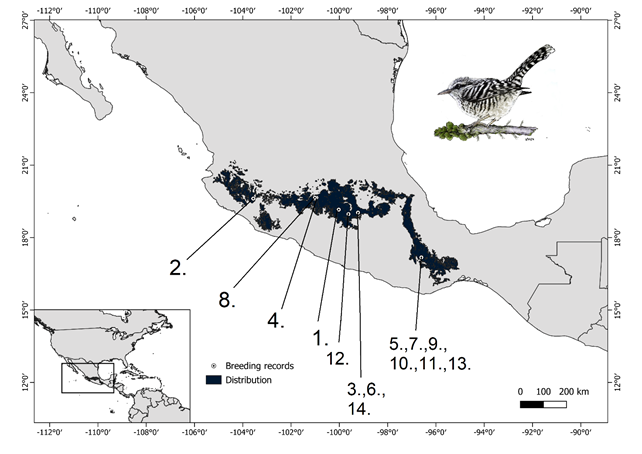
Figure 1 Gray-barred Wren (Campylorhynchus megalopterus) distribution map (after Birdlife Distribution Map Data 2022.02) with the associated breeding records based on citizen science data and the egg set at the Instituto de Biología, Universidad Nacional Autónoma de México (CNAV catalogue number 004917, label number IBUNAM H000141). Numbers correspond to ID records in Table 1. Illustration by Vladislav Marcuk.
Museum records
I also consulted the only known breeding records existing in museum collections. These consisted of a single egg preserved in the Colección Nacional de Aves (CNAV) of the Instituto de Biología, Universidad Nacional Autónoma de México (Hernán Vázquez Miranda pers. comm.), and one alleged clutch preserved in the Western Foundation of Vertebrate Zoology (WFVZ) egg collection (René Corado pers. comm.). However, it is possible that other records in regional or undisclosed collections were overlooked here.
Results
Literature review
Breeding season
According to the literature review, the breeding season of the Gray-barred Wren seems to last from November to August. Nest construction was reported between November and December, and nests containing eggs and chicks were discovered in August (Schaldach 1963, Márquez-Valdelamar 1998). Adults at the nest were observed between December and May, and feeding of the chicks was documented between April and August (Márquez-Valdelamar 1998). Females in breeding condition were collected in April (Brewer 2001), and several nests were located on 8 June and 27 June (Brewer 2001). Juveniles were collected in June, and a nest containing a single chick and egg was found in mid-August in the State of Mexico (Schaldach 1963). The literature also reports an instance in which an adult female was observed feeding three fully grown juveniles on 26 April (Rowley 1984).
Nest
The nest is described as globular or dome-shaped, with a lateral entrance composed of grass, pine needles, twigs, roots and mosses (Márquez-Valdelamar 1998). Literature records indicate that the nest is placed 1.5-18.2 m above the ground in conifers, oaks or mandrono (Arbustus xalapensis) trees (Márquez-Valdelamar 1998). One nest is recorded by Márquez-Valdelamar (1998) as having the following dimensions: total length 71 mm; external diameter 82 × 72 mm; internal diameter 76 × 61 mm; depth 48.5 mm. Another nest was reported to have a diameter of 36 cm and to be open at the top (Edwards and Martin 1955).
Eggs and clutch size
The average egg size reported by Márquez-Valdelamar (1998) is 25.2 × 19.9 mm (n = NA), with no further information given. Little is known of clutch size. One nest found in August contained a single egg and chick (Schaldach 1963), while Rowley (1984) observed a female feeding three fully sized juveniles, indicating that the clutch size at least consists of 2-3 eggs.
Parental behavior
The species was reported as a cooperative breeder by Márquez-Valdelamar (1998). Observations of ten individuals in Quiroga (Michoacán) indicated that at least two individuals assisted with nest construction, while two others rearranged the nest (Edwards and Martin 1955). Further evidence of a cooperative breeding system was obtained from Rowley (1984), who observed three individuals participating in constructing of a nest, which was used as a roosting site. Otherwise, nothing else is known about the breeding biology, and the incubation and nestling periods remain unknown.
Citizen science database
In addition to the available literature, citizen science data expanded the breeding season from 9 November to 16 September (Table 1). Several photographic records supplemented the literature by providing information on breeding season based on months when photographs were taken (Table 1). Photographs also documented various stages of nesting, including nest construction, the presence of adults at the nest, and feeding of nestlings (Table 1).
Table 1 Summary of museum and citizen science (eBird database) breeding data for the Gray-barred Wren (Campylorhynchus megalopterus) with the associated breeding behavior, date, locality, catalogue number or link and collector/photographer. ID = locality number in Figure 1 map; Ind = Individual; Ad = Adult; MID = Misidentified.
| ID | Description of the behavior | Date | Locality | Coordinates | Links/Catalogue number | Collector/Photographer |
| 1 | single egg from a nest | 18 Aug 1988 | Temascaltepec, Valle de Bravo | 19.155, -100.02666 | Catalogue number CNAV 004917 | Moisés Sanchez |
| 2 | 1 Ind collecting nest material | 9 Nov 2016 | Volcán Nevado de Colima, San Gabriel, Jalisco | 19.6137224, -103.5677934 | ML284437521 | Tim Ludwick |
| 3 | 2 Ind at nest, reported bringing material to the 30 cm wide nest for 1 hour | 9 June 2018 | San Jose de la Montaña, Huitzilac, Morelos | 19.0129494, -99.2303127 | ML103872041 | Rafael Rodríguez Brito |
| 4 | 1 Ind collecting moss, report 5 Ind doing this in tree | 20 May 2019 | El Temascal, Charo, Michoacán | 19.6527321, -100.9545171 | ML159960951 | Paul Lewis |
| 5 | 2 Ind near nest | 22 Apr 2019 | Camino La Cumbre, Ixtlán, Oaxaca | 17.1771118, 96.6071078 | ML201644531 | Hervé Jacob |
| 6 | 3 Ind: 2 Ind adding material to a nest and third begging for food, but was not fed | 18 Aug 2019 | San Jose de la Montaña, Huitzilac, Morelos, | 19.012949, -99.2303127 | ML173085591 | Rafael Rodríguez Brito |
| 7 | 1 Ad at ‘communal’ nest | 16 Sep 2019 | Camino La Cumbre, Ixtlán, Oaxaca | 17.1771118, -96.6071078 | ML177688261 | Yve Morrell |
| 8 | 1 Ad collecting nest material | 13 Dec 2021 | Pino Real, Charo, Michoacán | 19.6485895, -101.0142338 | ML398525781 | Paul Lewis |
| 9 | 1 Ad with feather-like material in beak at nest entrance | 28 Feb 2022 | Corral de Piedra, Ixtlán, Oaxaca | 17.1851291, -96.6430978 | ML420936141 | Carlos Gonzalez |
| 10 | 1 Ad at nest, reported as nest building | 6 Mar 2024 | Camino La Cumbre, Ixtlán, Oaxaca | 17.1863, -96.61795 | ML615732300 | Manuel Grosselet |
| 11 | 1 Ad collecting nest material | 10 Mar 2024 | Corral de Piedra, Ixtlán, Oaxaca | 17.1851291, -96.6430978 | ML615901796 | Fátima Santana |
| 12 | 2 Ad at nest, carrying food and feeding chicks | 24 Mar 2024 | Parque Hermenegildo Galeana Tenancingo, Estado de México | 19.0215387, -99.6167114 | ML616656440 | C. Salgado-Miranda and E. Soriano-Vargas |
| 13 | 1 Ad collecting nest material | 10 Nov 2024 | Camino La Cumbre-Este Ixtlán, Oaxaca | 17.163157, -96.5948953 | ML626948020; ML626678913 | Serge Horellou; Manuel Grosselet |
| 14 | 2 Ad at nest, reported nest building | 17 Mar 2025 | Camino Viejo a Coajomulco, Huitzilac | 19.033135, -99.230224 | ML632278345 | Nancy Dunn |
| MID | Clutch of four eggs | 12 May 1956 | Abovaro road, Veracruz | WFVZ Catalogue number EN-145380 | Fred B. Nyc Jr |
Nest construction and nest records
Birds collecting nest material were photographed between 9 November and 20 May (Table 1), with most individuals observed collecting material between November and March. However, as the individuals were not continuously monitored, or at least the details are not documented in the supplementary information, it remains unclear whether a nest was present when the photographs were taken.
Eight photographic records documented birds near a nest (Table 1). Four records documented two birds at or near a nest, frequently reported as nest building (Table 1), although the photographs do not show material in their beaks. On three occasions, one bird was documented at a nest, and on 28 February 2022 one bird was photographed at the nest entrance with feathery material in its beak (Table 1). At least one pair was recorded bringing nest material to a nest, estimated as 30 cm wide, and chasing away a Bronzed Cowbird (Molothrus aeneus) on 9 June (Table 1). At another nest, the presence of at least three individuals in close proximity was documented on 18 August, of which two were actively adding nest material and one was begging for food (Table 1). A recent record stated that a pair was observed collecting nest material and feeding chicks on 24 March 2024 (Table 1). This suggests that eggs and chicks may be produced early in the season, or that multiple broods may be produced, as is known to occur in other Campylorhynchus taxa (Brewer 2001).
Museum records
One egg collected by Moisés Sanchez (CNAV catalogue number 004917) from an active nest in Temascaltepec on 18 August 1983 (Figure 2) measured 26.87 × 19.43 mm (0.02 mm precision digital caliper). The egg was elongated and ovate, and white with pinkish, magenta or light brown spots that were unevenly dispersed over its surface but concentrated more heavily towards the larger end (Figure 2).
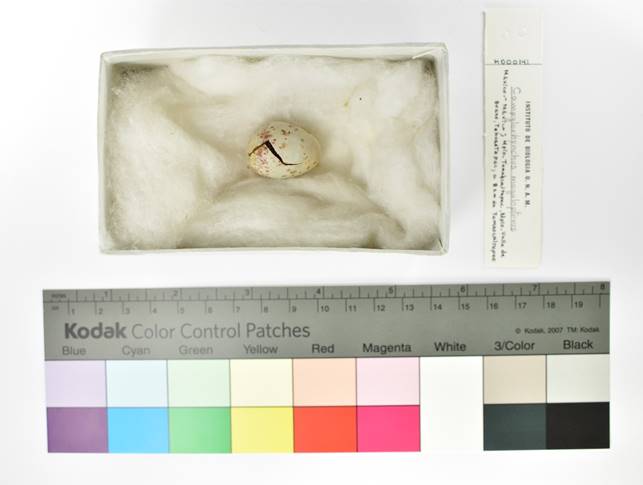
Figure 2 The only known egg of the Gray-barred Wren (Campylorhynchus megalopterus) collected by Moisés Sanchez in Temascaltepec on the 18 August 1983, preserved in the Colección Nacional de Aves of the Instituto de Biología, Universidad Nacional Autónoma de México (CNAV catalogue number 004917, IBUNAM label number H000141). Photo by Violeta Andrade
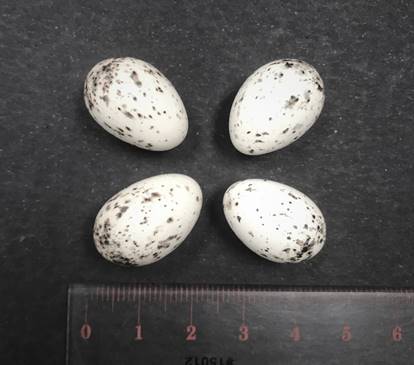
A second presumed egg set (Figure 3), currently preserved at the Western Foundation of Vertebrate Zoology (WVFZ catalogue number EN-145380), was collected on 12 May 1956 by Fred B. Nyc., Jr, at a location one mile south-east of the Abovaro road leading towards the city of Veracruz. According to notes on the specimen label, Fred B. Nyc., Jr found several nests situated in cacti and small bushes, around 4-5 feet above the ground. He described the nests as being dome-shaped with a lateral entrance and composed predominantly of grass and weed stems. They were lined with fine grass, small feathers, and plant down. The clutch size consisted of four eggs, averaging 21.20 ± 0.62 × 15.42 ± 0.07 mm (range: 20.23-21.87 × 15.35-15.53 mm; n = 4; René Corado pers. comm.). The eggs were elongated and ovate with an immaculate white base colour, and have small to large (c. 3-4 mm) clusters or blotches of dark brown, grey or black colouration that are distributed rather irregularly along the egg surface and are more concentrated towards the large egg pole (Figure 3). The collection location, egg morphology, and nest description are inconsistent with reports for the species, therefore this egg set seems to have been wrongly allocated to the Gray-barred Wren.
Comparison with congenerics
I obtained formal and qualitative descriptions of the nest and eggs for six of the nine congeneric endemic wren species (Table 2), with no literature records found for the Socorro Wren and Nava’s Wren, and little information for the Veracruz Wren. Information on nest and eggs of the Gray-barred Wren was obtained from only one Master’s thesis (Márquez-Valdelamar 1998), and the present study (Table 2). Four congeneric Mexican species in the genus Campylorhynchus, the Gray-barred Wren, Spotted Wren, Boucard's Wren, and Yucatan Wren, showed striking similarities in nest and egg morphology and breeding system (Table 2). All four species were recorded to build globular nests, have similar egg colors, and breed in a cooperative system (Table 2). Contrasting nest shapes were reported for congeneric species outside the genera: retort shaped (flask or teardrop) in the Happy and Sinaloa wrens; and cavity nests for the Clarion and Sumichrast's wrens (Table 2). Egg morphology seemed to show similarity in base color, but with more variability in the presence and absence of spot patterns (Table 2). However, the Gray-barred Wren differed from other species by having a smaller clutch size (1-3 eggs), and laying larger eggs (Table 2). Other congeneric species tended to lay 3 to 4 or 5 eggs, although the Spotted Wren may lay 2-4 or 3-5 eggs (Table 2). Nevertheless, records on clutch size of the Gray-barred Wren are far too limited to allow adequate comparability.
Table 2 Comparison of breeding parameters among endemic Troglodytidae taxa in Mexico, for which the nest and eggs are described. No information was found for the Socorro Wren (Troglodytes sissonii) and Nava’s Wren (Hylorchilus navai). Suffix letters indicate literature sources for each species. a: This study, b: Márquez-Valdelamar 1998, c: Bangs and Peters 1927, d; Pérez-Villafan 1997, e: Brewer 2001, f: Grant 1966, g: Sosa-López et al. 2012, h: Ceja-Madrigal and Salgado-Ortiz 2013, i: Schönwetter 1979, j: Vargas-Soriano et al. 2010, k: Brattstrom and Howell 1956, l: Calderón-Torres 2011, m: Ceja-Madrigal 2014.
| Species | Breeding season | Nest form | Clutch size | Egg color | Egg measurements (L x W mm) | Incubation (days) | Fledging (days) | Breeding system |
|---|---|---|---|---|---|---|---|---|
| Gray-barred Wren Campylorhynchus megalopterus a,b | Dec-Aug | globular | 1-3 | White to cream, white ground color with magenta to brownish spots | 26.87 ×19.43 (n = 1) or 25.2 × 19.9 (n = NA) | NA | NA | Cooperative |
| Happy Wren Pheugopedius felix b,f,i | May-Aug | retort shaped (teardrop or flask shaped) | 3-5 | Bluish white | 21.1 × 14 (n = NA) or 20.5 × 14 (18.6-21.8 x 13.9-14.2; 2.88 g estimate, n = 4) | NA | NA | Not cooperative |
| Sumichrast's Wren Hylorchilus sumichrasti b,c,d, | Mar-Jul | cup-shaped in nest-cavity | 3 | White | 23-23.4 × 17 (3.59 g estimated; n = 3) or 25 x 15 | NA | NA | Not cooperative |
| Spotted Wren Campylorhynchus gularis b,h,l,m | Mar-Sep | globular | 2-4 or 3-5? | Buff white, with red-brown spots, concentrated stronger towards the larger egg pole | 20.8 × 16.2 (3.3 g; n = 4) or 23.0 ± 0.41 × 16.5 ± 0.30 (n = 5) | 12 (n = 2) | NA | Instance of cooperative |
| Clarion Wren Thryophilus tanneri b,g,k | Oct-May | nest cavity | 3-4 | Pink to whitish ground colour with small brownish to pink spots concentrated at the larger end of the egg | 17.7 × 14 or 19.8 × 14 | NA | NA | Instance of cooperative |
| Boucard’s Wren Campylorhynchus jocosus b | Apr-Jul | globular | 3-4 | White or pale pink densely covered with grey-brown or reddish-brown speckles, concentrated stronger on the larger egg pole | 22.86 × 16.63 (n = 18) | NA | NA | Cooperative |
| Sinaloa Wren Thryophilus sinaloa b,f,i | May-Sep | retort shaped (teardrop or flask shaped) | 4-5 | Immaculate white | 19 × 13.5; 20 ×14 (1.92 g estimated, n = 2) | NA | NA | Not cooperative |
| Yucatan Wren Campylorhynchus yucatanicus j | May-Jul | ovoid globular | 3 ± 1.5 (1-5; n = 99) | Buff white, less or more densely covered with brown speckles, stronger concentrated on the larger egg pole | NA | 16.0 ± 1.0 (15-17; n = 47) | 16.5 ± 1.9 (14-19; n = 51) | Cooperative |
Discussion
Gray-barred Wren nesting and egg collections
Through a revision of published literature, citizen science database, and museum egg collections, I provide new information on the seasonality, nesting habits, egg morphology, and clutch size of a species whose breeding biology remains poorly understood. This short communication also highlights the importance of carefully evaluating the authenticity of egg and nest sets currently preserved in museum collections, paying particular attention to morphological traits, collection locality, and supplementary information on the specimen label. Investigative work can help confirm or refute species identification and prevent errors in modern literature.
As a result of this evaluation, I conclude there is a high likelihood that the egg set preserved and collected by Fred B. Nyc., Jr (WFVZ catalogue EN-145380) was wrongly allocated to the Gray-barred Wren. This is supported by inconsistencies in the collection location, egg morphology, and nest description. These contradict previous literature records for the species (Márquez-Valdelamar 1998), particularly with regard to nest site, and the vertical placement of the nest. The egg morphology further supports the inconsistencies in species identification, as the egg size and morphology of the WFVZ collection does not resemble the single egg preserved in the CNAV (catalogue number 004917, label number IBUNAM H000141), which is considerably smaller and differs in secondary coloration.
Furthermore, following the chronology of other egg sets that were collected by Fred B. Nyc., Jr on 14 May 1956 in Villahermosa, Tabasco, Mexico (Barred Parakeet Bolborhynchus lineola lineola, WFVZ catalogue number EN-145379, 18.0216666666667, -92.9266666666667), and on 22 May 1956 in Gomez Farias, Tamaulipas, Mexico (Plain Chachalaca Ortalis vetula mccallii, WFVZ catalogue number EN-145393, 29.36, -107.728333333333), there is no doubt that the eggs were in fact collected in Veracruz. The records indicate that Fred B. Nyc., Jr was following the coastal roads and associated sites, not descending to any proximate areas within the native range of the Gray-barred Wren, supporting the proposal that the eggs were wrongly assigned to the Gray-barred Wren. Considering the magnitude of divergence in egg, nest morphology and distance to the actual distribution trajectory of the Gray-barred Wren, it is very likely that the eggs in question belong to the Veracruz Wren, which show strong resemblance in egg morphology and distribution (Bradley et al. 2024). Very little is known about the breeding biology of the Veracruz Wren (Bradley et al. 2024), therefore the WFVZ egg set may provide the first quantitative data on egg and clutch size for the species.
Comparison with congenerics
My literature review highlights that the breeding biology of most endemic species remains poorly studied, except for the closely-related Yucatan Wren, where breeding biology was studied in more detail (Vargas-Soriano et al. 2010, Armiger 2014). For the internationally near-threatened Sumichrast's Wren (Pérez-Villafan 1997) and threatened Clarion Wren (Sosa-López et al. 2012) a more comprehensive description of the nest, eggs and breeding behavior were published only recently. For the Happy Wren and Sinaloa Wren the vast majority of information originated from a single study published decades ago (Grant 1966) and a thesis study (Márquez-Valdelamar 1998).
My comparison of breeding parameters among congeneric species indicated strong similarity among members of the genera Campylorhynchus, where traits are likely to show less variability due to taxonomic affinities (Barker 2007). Cooperative breeding was recorded in all Campylorhynchus taxa, which aligns with the cooperative breeding recorded in many congeneric species in the Neotropics (Rabenold 1990). In general, nest structure showed intra-generic consistency among species of the same genus Campylorhynchus. Although the composition of nests varies, they tend to contain predominantly grass, plant fibres, twigs, leaves or feathers (Márquez-Valdelamar 1998). Evidently, nest and egg morphology can differ to some extent due to differences in environmental and biotic factors.
Breeding seasons showed high variability among species and therefore comparison is difficult. However, the Gray-barred Wren seemed to have an extended breeding season spanning over ten months. A possible cause for such a prolonged breeding season could be due to double brooding, either after successfully fledging a first brood or replacing a clutch after failure, however this remains highly speculative. There is no evidence of double broods in the Yucatan Wren, whereas multiple broods have been recorded in other congeneric species (Brewer 2001). Some wren species also construct nests as dormitories that are used for roosting (Brewer 2001, Bradley et al. 2024), therefore, further research is required to determine whether double broods are present in the Gray-barred Wren.
Notable differences were observed in the egg size and clutch size, although considering the small sample size this needs to be interpreted with caution. Further field data collection is required to understand the true range of clutch size. The egg size, however, is substantially larger in comparison to the Spotted Wren and Boucard’s Wren. The Gray-barred Wren has overall a larger body size (length: 16.6-21.8 cm, mass: 32.92 g; n = 55) in contrast to the Spotted Wren (length: 17.9 cm, mass: 27.08 g; n = 27) and Boucard’s Wren (length: 18.5 cm, mass: 28.82 g, n = 9; Márquez-Valdelamar 1998). These differences in body size could explain the variation in egg size. In fact, if clutch size of the Gray-barred Wren is smaller, it is possible that larger eggs are produced in an overall trade-off.
Facilitating research into the biology of Mexico's endemic wren species remains highly desirable, particularly for species of conservation interest and those that are poorly known. While undocumented museum records, such as the one discussed in detail here, can contribute significantly to our understanding of the breeding biology of lesser-known species, field studies are still essential for revealing different aspects of their biology. Nevertheless, this study highlights the importance of using citizen science and museum specimens to provide fundamental information about poorly known species.

