




 texto en
  Inglés (pdf)
 Artículo en XML
 Referencias del artículo
 Traducción automática
 Enviar artículo por email
 Citado por SciELO
  Similares en
SciELO
Similares en
SciELO 
 Permalink

Introduction
Chapala, a municipality in the state of Jalisco, Mexico, is home to one of the largest American communities in the country. Its roots trace back to a thriving pre-Hispanic settlement from the 12th century. During the colonial period under the Spanish Crown, it was inhabited mainly by indigenous people. In the 19th century, it was part of the territories of La Barca and Guadalajara before receiving the status of a municipality in 1939 (Instituto de Información Estadística y Geográfica de Jalisco [IIEG], 2024).
The Chapala municipality has an estimated population of 55 196 inhabitants distributed across 50 localities, with 11% living in rural areas and 89% in urban areas (Instituto Nacional de Estadística y Geografía [INEGI], 2020). It is located on the shore of the lake of the same name which encompasses eight municipalities: Chapala, Jocotepec, La Barca, Ocotlán, Tuxcueca, Poncitlán, Tizapán el Alto, and Jamay.
In 1985, the Englishman Septimus Crowe built the Montecarlo, Bell, and Josefina villas in Chapala, and he also dedicated himself to spreading the word about the beauty of the climate and landscape. During that period, the president of Mexico made Chapala his vacation spot, popularizing it among the national elite. Furthermore, the advent of the railroad at the beginning of the 20th century facilitated the arrival of national and international elite groups (Zepeda Hernández, 2023).
Despite the increasingly frequent flow of visitors and the gradually growing foreign community during the first half of the 20th century in the Lake Chapala area, it was until the research by Swenson (1974), Holder (1976), and Stokes (1981) that a baseline for understanding the social dynamics and motivations of American retirees was established, concluding that the idyllic natural environment was the main attraction to the lake surroundings.
In the 1990s, the North American Free Trade Agreement (NAFTA) increased American migration to the region, mostly retirees, as they benefited from access to goods and services similar to those in their home country (Truly, 2002). This led to several works trying to understand the profile and motivations for the North Americans’ migration to Lake Chapala (Truly, 2001, 2002; Raditsch, 2015; Sunil et al., 2007). According to this, the main reason for migrating to Mexico was economic, understood as affordability of housing and healthcare (Sunil et al., 2007).
In compliance with Mexico’s immigration policy, a foreigner from North America or Europe can stay as a tourist for up to 180 days (Secretaría de Relaciones Exteriores, 2015). Many individuals remain on the shore for nine months or more, which implies that they register with Mexican authorities and request a Temporary Residential Card (TRT).2 In 2023, a total of 11 088 American and 3 080 Canadian citizens received TRT allowing them to stay in Mexico for up to four years. Additionally, 7 604 Americans and 2 765 Canadians obtained Permanent Residency during the same year (International Organization for Migration [IOM], 2023). By 2024, the number of North American foreigners-comprising residents from the United States and Canada-with a Temporary Resident Card was 11 544, reflecting a decrease compared to 2023 (Unidad de Política Migratoria. Registro e Identidad de Personas [UPMRIP], 2025).
Despite the official information regarding foreigners with formal residence in Mexico, it is difficult to ascertain the true number of temporary-and permanent-residents due to discrepancies between official records from both sending and receiving countries. For example, according to the U.S. Department of State (2022) estimations, out of nine million Americans residing outside the United States, approximately 1.6 million are in Mexico. The U.S. government’s lack of detailed information regarding its citizens abroad complicates statistical accuracy, a situation that is also prevalent in other countries.
Similarly, the municipality of Chapala recorded 344 temporary residency cards and 347 permanent residency cards in 2024 (UPMRIP, 2025), but the 2020 census counted up to 5 384 international residents living in Chapala. Concurrently, the local government and civil organizations estimate up to 17 000 immigrants living in the municipality,3 a much larger number than the official records. One reason for this is that many immigrants enter the country as tourists, even though they stay in Mexico for extended periods of time (Lizárraga-Morales, 2009).
In accordance with the above, Selles (2023) argues that international mobility to Mexico has experienced a significant increase since 2020, largely due to changes in working conditions and “digital nomadism.” Mexico City has seen the arrival of numerous foreign teleworkers who have chosen to temporarily relocate and work remotely (Selles, 2023). After the COVID-19 pandemic, this phenomenon is linked to global trends of early retirement and the rise of digital nomads. In fact, it is estimated that since the pandemic the number of digital nomads has tripled in Mexico, making it the country with the highest number of digital nomads in Latin America (Forbes Staff, 2023).
As previously noted, migratory flows to Mexico are not new. However, the trend, framed by lifestyle mobility toward less developed countries in search of a better quality of life, has become a topic of increasing interest as the Baby Boomer generation approaches retirement age. In this sense, this research seeks to highlight the need to further analyze not just the primary flows such as those involving North Americans, like much of the existing literature focuses on, but also to explore new research lines related to European profiles and their context.
Therefore, this paper aims to identify up-to-date sociodemographic characteristics of foreign residents in the municipality of Chapala, thereby contributing to better understand these migratory flows, their perceptions and motivations, as well as their integration into social life based on a representative sample of this population segment. Consequently, the research question may then become: What are the sociodemographic characteristics, perceptions, and motivations of Chapala’s international community?
A descriptive quantitative study was designed to answer the research question. The instrument was administered face-to-face to 349 members of the international community, who were considered a homogeneous group, allowing for an initial exploration of this resident population in Chapala. The survey was applied during the northern hemisphere’s winter season of 2023-2024. The results are presented in a descriptive research design and analyzed from the perspective of international retirement migration within the framework of lifestyle mobilities. The results highlight the diversity of nationalities converging in Chapala and the range of motivations that drive foreigners to choose Mexico as their country of residence, from economic considerations and personal well-being to social and cultural factors.
This document first presents a conceptual approach to international retirement migration that provides insight into the discussion of the results. Following this, the methodological section is presented, detailing the steps taken for the development of the instrument, the design of the research, and the field application of the instrument. The results from the application of the instrument are, presented in four categories: 1) sociodemographic characteristics, 2) occupation and income, 3) life in Chapala, and 4) reasons for migration.
Literature review
The International Community in Mexico
Studies on immigration in Mexico identify three main periods: the Porfirian era (1877-1910), the post-revolutionary era (1917-1974), and the population laws era (1974-1990) (Meseguer & Maldonado, 2015). The first period was characterized by an open-border policy towards qualified immigration. In contrast, the second period was marked by significant hostility towards foreigners, particularly certain groups and nationalities, with the exception of the late 1930s, when the integration of Spanish exiles into the country was facilitated. Subsequently, a series of legal frameworks established the groundwork for population laws, creating a policy that favored the arrival of skilled individuals who could contribute to Mexico’s economic and social development.
Bringas (2017) highlights the emergence of this mobility phenomenon in the corridor from Tijuana to Rosarito and Ensenada due to its geographic proximity to California-the principal outbound market for this tourist region- and identifies profiles according to social and living characteristics. Before this, the literature from Daniel Hiernaux-Nicolas’s work (2005, 2009, 2010, 2012) made it possible to observe residential tourism from residential tourists’ imaginaries and practices, as well as their approach to real estate consumption, consistent with Aledo et al. (2007).
According to Lizárraga-Morales (2008), there is an observable migratory movement from north to south. These migrants are characterized by their age, which permits them to enjoy leisure time and possess the economic resources necessary to reside outside their country of origin, due to their retired employment status. Migratory movements, both from south to north and, in this instance, in the reverse direction, result from imbalances within the global economic system. This migratory flow predominantly comprises members of the so-called “Baby Boom” generation, born during the post-war period between 1946 and 1964.
Although there is a growing interest in this topic, migration studies have usually paid more attention to the flows of people moving East-West or South-North, displaying little regard to those moving North-South, whose primary purpose of travel is neither working nor escaping from wars (Lizárraga-Morales 2008; Espinosa, 2018). In the case of Mexico, as the presence of foreigners for residential purposes has multiplied, so has the interest in studying and analyzing the social and environmental impacts generated by these movements in beach destinations such as Mazatlan, Puerto Peñasco, and Cabo San Lucas, focusing on the increase in demand for spaces with fragile biodiversity and demographic composition of the migrant population (Lizárraga-Morales 2019).
In the state of Jalisco, the presence of Americans in the Guadalajara metropolitan area became noticeable as early as the 1970s, primarily concentrated in neighborhoods within the municipalities of Zapopan and Tlaquepaque (Holder, 1976). However, the increase in foreign residents, particularly from the United States and Canada, became more evident in Mexico from the 1990s onward (Zepeda Hernández, 2023). Among the main enclaves are Chapala, San Miguel de Allende, Puerto Vallarta, Cancun, Los Cabos, and Mazatlan. Currently, of the 32 federal entities, the three territories with the highest presence of these migratory groups are Mexico City, Jalisco, and Quintana Roo. Together, they account for 49% of the total foreign population residing regularly in the country (IOM, 2023).
Previous studies on mobility to the region of interest have addressed the wealth accumulation process driven by elites in the tourism and real estate sectors (Talavera Salgado, 1982), as well as the motivations and interests of Americans in the lakeside area (Stokes, 1981). Although, it is in Truly’s dissertation (2001) that the relationship between tourism and migration is examined, noting that the local population of Chapala began to perceive uncertainty in the face of new migratory profiles and increasing flows following the implementation of the North American Free Trade Agreement in 1994.
One of the previous studies in the Chapala area that provides the first findings regarding the sociodemographic characteristics of foreigners who have come to live in this region is the one of Sunil et al. (2007), in which they find that over half of migrants in the Lake Chapala area agreed or strongly agreed with the statements, “my decision to move to Mexico was mainly economic” and “I live here because healthcare is affordable.” More than 80% cited housing affordability as a key factor influencing their decision. The study also revealed that retirees’ median income before retirement ranged from 46 000 to 50 000 USD, but after retirement, it fell by half. It also showed that most respondents were renters rather than owners. These findings, along with those of Schafran and Monkkonen (2011), challenge the idea that wealthy or upper-middle-class “amenity seekers” are the primary or sole group of American migrants.
Subsequent research by Banks (2004), Truly (2002, 2006), Sunil et al., (2007), and Croucher (2009) laid the foundation for studying the relationship between new foreign residents and the local population, identifying migratory profiles and groups in the area. These works have become essential references on the subject. Later, studies by Díaz (2013) and Bastos (2013) documented the dispossession of community-owned lands (ejidos) by real estate developers in the region, along with conflicts arising from the invasion of communal lands owned by indigenous groups. Other analyses have focused on the adaptation of retired Americans and their economic and sociocultural transformations (Rojas et al., 2014; Raditsch, 2015).
From an urban perspective, Schafran and Monkkonen (2011) propose a typology of host communities and their settlements using urban-scale impacts as a framework for categorization. These authors observe four types of settlements: the center, the periphery, the compound, and trailer-type. According to these authors, the center communities are typically urban. Also, foreigners who purchase housing in historic areas and/or areas with a high concentration of local population integrate more easily into the community; although they can exert significant pressure on real estate markets and the local territory. Periphery-type settlements are defined as gated and privatized communities where the possibilities for integration with the host community are limited. Compound settlements, on the other hand, refer to residential mega-resorts that become a hybrid between a tourist space and a residential community, with little to no integration with the local population. Trailer settlements are semi-permanent agglomerations of mobile homes, trailers, and small dwellings in isolated rural areas, where a mix of residents and visitors can be found.
More recently, from a sociological perspective, research has explored the social imaginary constructed by the local population regarding the “other,” as well as transnational social fields and the interpretation foreigners -mostly retired people- have of their “Mexican home” beyond the material dimension but the emotional and symbolic aspects, which imply fulfillment, belonging and identity (Ceja, 2021; González-Rojas & Aikin, 2021; Barber, 2022)
Theoretical Background
An initial theorization of international retirement migration was primarily based on the lifestyle migration approach, with additional ideas from the transnational and mobility paradigms (King et al., 2021). This approach has been adopted in an essential part of academic discussions in Ibero-American literature (Hiernaux-Nicolas, 2012; Huete & Mantecón, 2017). One of the initial discussions regarding the term arose in the field of tourism. Thus, the term “residential tourism” emerged from analyzing the convergence between tourism and residence in private homes, generating forms of residential mobility with particular characteristics in various regions of the world (Huete & Mantecón, 2017). Jurdao Arrones (1978) introduced the term in his doctoral thesis Residential Tourism and Colonization, delving deeper into it in his work España en venta, which addresses the economic and social impact of resident tourists in the local communities of the Malaga coast in the Spanish Mediterranean (Jurado Arrones, 1990).
Thus, the academic discussion about these mobilities, situated between migration and tourism, has led to the coining of various terms in the Anglo-Saxon literature, such as second-home tourism, long-stay tourism, lifestyle migration, and retirement migration (Huete & Mantecón, 2017). On the one hand, residential tourism is defined as the temporary or permanent mobility of relatively affluent citizens from mostly western countries to various tourist destinations where they purchase properties (Van Noorloos, 2013).
On the other hand, authors such as Benson and O’Reilly (2009) argue that migration is, in some ways, a matter of “lifestyle.” For some individuals, moving to a place, either part-time or full-time, means a better quality of life. Hence, migration for lifestyle encompasses destinations, desires, and dreams. Within this dominant framework of migration for “lifestyle,” two other theoretical links are also present: firstly, the transnational perspective (O’Reilly, 2000, 2003; Gustafson, 2008) and secondly, the interpretation of international retirement migration through the paradigm of “mobilities” (O’Reilly, 2000; Gustafson, 2002, 2008; Williams et al., 2000).
The continuous or temporary use of second homes by retired individuals has sparked a debate on the relationship between tourism and retirement migration. However, recent literature places international retirement migration at the intersection of two significant sociodemographic trends reshaping the global population: aging and migration. These trends have been scarcely researched empirically, and only recently has there been an attempt to frame international retirement migration within a theoretical context (King et al., 2021).
Therefore, international retirement migration can be seen as a specific example of transnational mobility viewed through the lens of the mobilities paradigm, although some may prefer to focus on other forms of travel and migration, such as tourism (Cresswell, 2006; Urry, 2007; Adey, 2010). Consequently, international retirement migration is an interesting and difficult-to-classify form of international migration mobility, similar to the hybrid term residential tourism (Janoschka & Haas, 2014).
Gustafson (2008) states that retirees typically do not work in the host country and often try to maximize the comforts of both places, regularly moving back and forth. In this same vein, O’Reilly (1995) focuses on the relationship between second homes and international retirement migration and makes an interesting classification of these groups, dividing the group of retired migrants into “permanent,” “temporary,” and “seasonal” based on the duration of their stay.
A multilevel understanding of international retirement migration emerges when situating the phenomenon within a broader conceptual framework of “global social transformation.” This approach highlights the geographical aspects of unequal development and postcoloniality, as well as the dynamics of class, wealth, and privilege on a global scale (Castles, 2010). Additionally, the idea of retirement migration from the wealthy countries of the Global North to the less developed Global South has been developed. This movement reveals the growing global interconnectedness of aging and raises important questions about global inequalities regarding aging, care, wealth, and privilege (Benson, 2013, 2015; Hayes, 2014, 2018; Hayes & Pérez-Gañán, 2017).
Studies have been conducted globally on the North to Global South migration flow to assess the impact of international retirement migration on receiving countries (Croucher, 2015; Horn et al., 2015). According to Hayes and Pérez-Gañán (2017), this type of migration illustrates the evolving political economy within the context of late capitalism. The perspective of Hayes and Pérez-Gañán (2017) aligns with the conception of this type of mobility among privileged groups with spending power and network influence, forming a circulation with transnational connections. This extends beyond mere migration, often driven by crises or systemic challenges faced by retired populations in their countries of origin.
More recently, King et al. (2021) suggest that analyzing international retirement migration requires a detailed evaluation of its two components: international migration and retirement. While the former is easily definable, the concept of retirement is not as straightforward. In its strictest sense, international retirement migration implies that an individual moves abroad upon retiring or shortly thereafter.
Regardless, it has recently been observed that international retirement migration is no longer an elite phenomenon that only relatively wealthy people can afford. Thus, the shift from a logic purely based on lifestyle and comfort to one that also represents a safeguard against precariousness is a new important dimension of this form of migration that needs to be considered (Bender et al., 2018; King et al., 2021). In this sense, climate is often cited as one of the main factors attracting people to establish a new residence. Nonetheless, a good climate can be found in many places which are not necessarily attractive to retirees (Savas et al., 2023).
The most recent literature on international retirement migration highlights that economic factors have been the most critical pull factors associated with international migration, such as the lower cost of living in the host country (Hayes, 2014). However, the determining factors are more oriented toward the attractiveness of the place based on a previous visit; accessibility from the place of origin by land or air; healthcare affordability (Savas et al., 2023) tax benefits; and cheaper labor (Tang & Zolnikov, 2021; Savas et al., 2023).
According to the above, the literature recognizes that international retirement migration involves a lifestyle choice to achieve a better quality of life in an idyllic environment with a lower cost of living in the host country. As this research aims to explore the socio-demographic characteristics of the resident international community in Chapala, as well as its motivations to move to Mexico, the research hypotheses are proposed:
H1. American immigrants are the most motivated group among other nationalities regarding housing affordability in Mexico.
H2. American immigrants are the most motivated group among other nationalities regarding healthcare affordability.
H3. Canadian immigrants are the most motivated group compared to other nationalities in terms of leisure capacity.
Methodology
Study Settings
The study population consists of international residents living in the Chapala region of Mexico. Chapala, located in the state of Jalisco along the shore of Lake Chapala-the largest freshwater lake in Mexico-encompasses an area of 128 km² (IIEG, 2024). In 2020, the estimated total population was approximately 55 196 people (INEGI, 2020). The official record of residents born abroad was 5 384 individuals, this number served as the basis for sample estimation. Utilizing a sample of 349 cases, researchers attained a 95% statistical confidence level with a 5% margin of error as determined by the finite population formula (Hernández-Sampieri & Mendoza, 2018).
Measures
First, the structure and design of the instrument are consulted, along with some elements of previous works (Truly, 2001; Sunil et al., 2007) to allow further comparisons and changes during the last decades. Secondary sources and documentary research are also consulted, specifically those related to statistical yearbooks, census databases, press releases, and other relevant documents referred to during the fieldwork.
The study’s constructs were operationalized using multiple-item scales, and each factor’s constructs were also operationalized through multiple-choice questions and multiple-item scales. The instrument is divided into three parts. The first part collects demographic and socio-economic data, including age, gender, education level, income, marital status, occupation, and nationality. The second part focuses on current living conditions, such as the duration of residence in the Chapala area and housing, as well as the motivations for migrating to Mexico. The last section addresses social integration into the local host community (see Table 1).
Table 1 Items in Survey
| Construct | Item description |
|---|---|
| Demographics | Age, gender, marital status, nationality, education. |
| Socio-economics | Occupation, income, sources of income. |
| Current living conditions | Length of time living in Mexico, housing. |
| Motivations | Reasons for migration to Mexico: economic, natural environment, social factors. |
| Social integration | Integration into host community. |
Source: Own elaboration.
Data Collection
The instrument underwent a pilot testing period that allowed for the necessary adjustments. The pilot test involved administering 12 surveys to foreign members of the Lake Chapala Society-the largest association in the Lake Chapala area-during December 2023. Furthermore, during the application process, wording adjustments were made to enhance clarity and understanding. The final version is the third version of the questionnaire. The instrument was applied from December 2023 to March 2024, when most temporary international residents are in Mexico. Random sampling and face-to-face interviews were conducted at locations frequented by resident foreigners, such as the American Legion, Lake Chapala Society, art forums, and bicultural gatherings.
Data Analysis
Statistical software, mainly Rotator Software V. 35, organized the collected quantitative data. For data analysis, Microsoft Excel was utilized to manage the information and focus separately on each variable according to the construct being studied. Data for each variable was organized based on a frequency distribution, allowing for the observation of a list of scores for each variable. Next, the distribution of scores was standardized, and the frequency distribution was expressed as percentages based on the sample and “nationality” as a crossing variable. Bar graphs were designed to support selected analysis categories, simplifying the statistical analysis and numerically describing the data frequencies.
Results and discussion
Respondent’s Sociodemographic Characteristics
The majority of respondents (81.1%) are aged 60 or older, underscoring the Chapala area’s status as a popular retirement destination. However, a notable younger demographic -between 40 and 60 years old-, representing 15.7% of the sample and 3.1% under 40, is also present. These younger groups may reflect emerging trends such as new forms of mobility, early retirement, and the rise of digital nomadism.
In terms of gender distribution, the vast majority with 80.1% of respondents identified as female, while 16.3% identified as male and 3.6% identified with other gender identities within the spectrum of sexual diversity. Regarding marital status, the most common categories were single, divorced, or widowed, with only 29.5% of respondents reporting being married or in a relationship. This suggests that the predominant family situation among immigrants in Chapala-whether temporary or permanent-is one of living without a partner or companion.
As noted by King et al. (2021), the international retirement migration phenomenon sits at the intersection of two major global trends: aging and migration. The data from this study confirms that Chapala is predominantly inhabited by individuals over 60, with 81.1% of the sample falling into this age group, solidifying its reputation as a retirement hub. At the same time, the presence of a younger cohort, representing approximately 18.8% of respondents, highlights the influence of evolving dynamics such as remote work, early retirement, and the growing phenomenon of digital nomadism in the Lake Chapala area, with 3.1% under 40 and 15.7% from ages 40 to 60.
Nationality
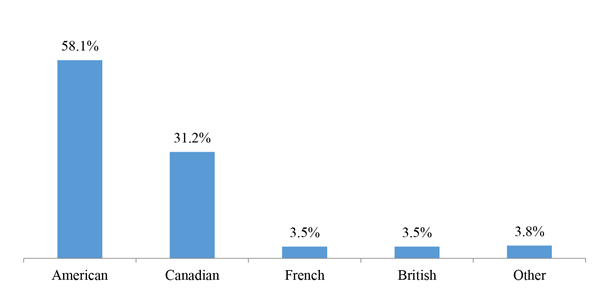
North Americans predominantly live in Chapala, making up 89.3% of the foreign population. Specifically, Americans represent 58.1%, while Canadians account for 31.2%. Other nationalities, such as British and French, also have a notable presence, each comprising 3.5% of the foreign population, despite the absence of direct flights from Guadalajara International Airport to their home countries. The category “other,” which includes Germans and various other European nationalities, constitutes 3.8%.
Previous studies related to migration to Lake Chapala focus on Americans as the primary migrant group in this area. Despite the Americans’ prominence (58.1%), the Canadian community plays an essential role in the international population (31.2%). With a smaller presence, the French, British, and other diverse nationalities have a significant presence, accounting for 10.8% of the international community. Additionally, regarding education, the foreign population in Chapala boasts a high educational level, with 45.7% holding a postgraduate degree. Observing their occupations prior to moving to Mexico reveals that most held professional and corporate positions (see Graph 1).
Occupation and Annual Income
The interviewees were asked about their last occupation before moving to Mexico. The primary occupation of foreigners residing in Chapala before moving to Mexico was professional and corporate roles, accounting for 46.5%, -in congruence with the 45.7% interviewed holding a postgraduate degree-. This is followed by those in education and military or government positions, each comprising just under 14% of the population. The remaining occupations include real estate owners or managers, skilled workers, and, to a much lesser extent, unskilled workers and farmers.
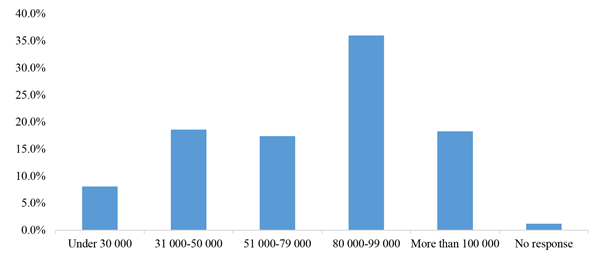
Based on their lifelong economic activities in their countries of origin, 54.3% of foreigners living in Chapala report an annual income exceeding 80 000 USD. In contrast, 8.1% have incomes below 30 000 USD annually, while 36% fall within the average American income range (Graph 2). This implies, on one hand, a good spending capacity, but on the other, reveals a large group of expatriates with lower incomes whose migration motivations might be more influenced by economic factors in their country of origin as a way out of precariousness, in congruence with King et al. (2021).
Current Income and Sources
The source of income can be diverse depending on the economic activity to which the interviewees have dedicated themselves throughout their lives. In this sense, the question about indicating the “two main sources of income” implied obtaining multi-response results and, therefore, a sum greater than 100%. As expected, most of the interviewees cite Social Security as their main source of income, as retirees do, but 7.1% continue to participate in economic activities in Mexico, and 12.9% run a business in their country of origin while in Mexico-making up 20%-which may be consistent with the 18.6% under 60 years old interviewed (see Graph 3), aligning with the notion that retired migrants typically do not work in host countries (Gustafson, 2008).
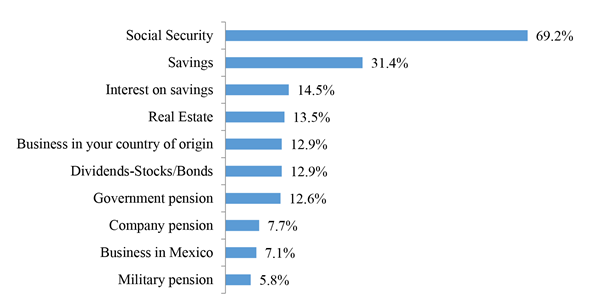
As observed, the economic activity of two out of ten members of the international community in Chapala has not ended. It may increase as the digital nomadism trend grows, a form of unique mobility in which work and lifestyle are integrated in contemporary society. At the same time, it poses challenges to the national taxation system, as digital nomads enter Mexico as tourists, even though they lead their regular lives in the country without the income tax burden.
Life in Chapala: Length of Time Living or Visiting the Chapala Area
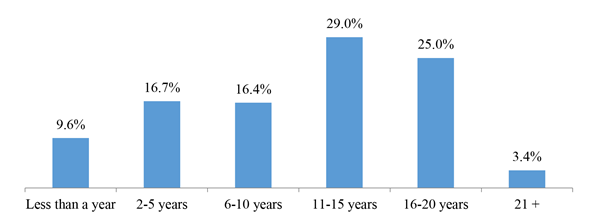
The findings reveal a noteworthy dynamic regarding temporality and residence in the Chapala region. Although the proportion of residents who have lived in the area for over 20 years is the lowest, there is a significant presence of individuals who have frequented the area for more than a decade. This suggest that a crucial segment of the foreign population has established Chapala as their home since the 1990s or the early years of the new century. Nevertheless, approximately 42.7% of respondents have resided in the area for less than ten years, indicating a steady influx of new foreign residents (see Graph 4).
It is striking that most interviewees stay in Chapala for more than nine months a year, which implies registration with the Mexican authorities. A stay of over nine months exceeds the “season” for snowbirds, suggesting a trend towards permanent residency that should be registered in the federal records for Mexico’s National Migration Institute. Nevertheless, these findings contrast with the official records of temporary or permanent residence issued by federal authorities, indicating a discrepancy between the number of foreign residents and government records. This empirical evidence strengthens what other scholars have pointed out (Hiernaux-Nicolas, 2012; Huete & Mantecón, 2017) about the authorities’ unsuccessful efforts to obtain an accurate statistical report on the migrants’ length and characteristics of stay in host countries such as Mexico, Spain, and other popular retirement destinations.
Housing Characteristics
The predominant type of property is privately owned, with 46.6% of respondents claiming to own a house or apartment in the lakeside area. Meanwhile, 37.3% report renting their property. Additionally, 2.8% have unspecified living arrangements, typically meaning they live in someone else’s house or stay with friends or family. As previously mentioned, most residents stay for an extended period, so that it is not surprising that many also own property there. According to the Mexican Constitution (CPEUM, 1917), any property within 100 km of the border cannot be acquired by a foreigner, and for beaches, this limit is 50 km. 4 However, this restriction does not apply to the Lake Chapala area as it is an inland territory, making ownership more appealing.
It is evident that a significant number of residents rent their homes. This diversity in accommodation options indicates that some individuals opt for the flexibility of renting, while others prefer the stability of ownership. For instance, by June of 2023, online platforms such as Airbnb listed 539 units for rent in Chapala, including lofts, apartments, cottages, and houses (Airbnb, 2023). This exemplifies the wide range of options available to temporary migrants, not to mention other less popular platforms like HomeToGo.com, Booking.com, and Facebook. Additionally, real estate companies in the area play a crucial role in managing and renting properties to temporary residents.
Once some of the sociodemographic characteristics have been stated, the following results relate to the motivations for migration to Mexico, and are organized by nationality to highlight differences among them, as each country has its unique economic dynamics and social context that may affect each group’s decisions. In this sense, three dimensions are addressed: economic, natural environment, and social factors.
Economic Dimension
The findings reveal that when prompted with the statement, “My decision to move to Mexico was mainly economic,” 67.7% of Americans and 65.7% of Canadians agreed. Conversely, the British were divided equally in their responses. This discrepancy indicates that Europeans have a broader range of perspectives compared to North Americans. As a result, economic factors appear to primarily motivate North Americans’ migration to Mexico, while less than half of Europeans mention economic reasons as a factor in their move to the country.
With the rise in housing prices in North America (Radosevich & Turner, 2024) and Europe,5 there is a growing question about whether people are choosing to live in Mexico because of its affordability, which is directly tied to economic considerations. Generally speaking, respondents from the United States, Canada, and France tend to agree on this point. In contrast, the British and other nationalities express less consensus (see Graph 5). On the other side, the British are divided on this issue, with a similar proportion agreeing and disagreeing. For instance, migrants from Europe might have a different pattern or diversity of reasons for migrating to Chapala since connectivity is not as easy as for North Americans, and considering the fact that they have nearer options for retiring in suitable climates, such as southern Spain or Italy.
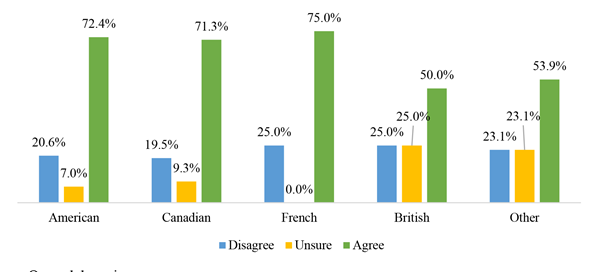
These results highlight the differences in the motivations for migrating to Mexico among Americans, Canadians, British, French, and other diverse nationalities. It is clear that, for most Americans and Canadians surveyed, the primary motivation for relocating to Mexico is economic, with a significant 67.7% and 65.7%-respectively- supporting this assertion, which aligns with the financial reasons identified by Sunil et al. (2007) in previous studies regarding American retirees in the region. Additionally, the findings reinforce the economic factors associated with international migration, such as the lower cost of living (Hayes, 2014) and the affordability of healthcare (Savas et al., 2023).
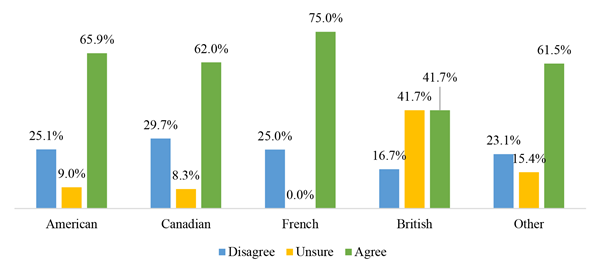
Also, regarding healthcare services, the French respondents have the highest proportion of agreement with the statement that these services are affordable in Mexico, followed by Americans and Canadians. This suggests that for some foreigners, accessibility to healthcare might be a determining factor in their decision to live in Mexico, in accordance with Savas et al. (2023). With all this in mind, there is a clear tendency that supports the idea of economic reasons for migration for all groups studied, but for North Americans, it is still clearer than for others (see Graph 6).
Source: Own elaboration.
Graph 6 Percentage of Foreigners who Consider Healthcare Services Affordable
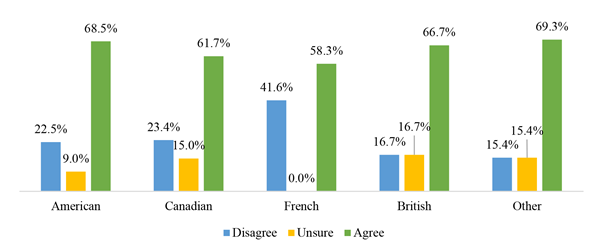
One aspect of subjective well-being pertains to an individual’s leisure time as it may provide personal satisfaction when spending time in activities for relaxation, enjoyment or personal growth, so that it might be an important issue among migrants. In this regard, nearly everyone agreed when asked whether their income allows them to spend more on leisure than in their country of origin. Specifically, American and British respondents predominantly share this opinion (Graph 7).
Natural Environment
One of the standout features of the municipality of Chapala is its scenic beauty, which is attributed to its prime geographical location and favorable climate. When asked whether they reside in Lake Chapala because of its natural environment, Americans, Canadians, and French respondents agree significantly, ranging from 62% to 69%. In contrast, only about half of British respondents cite the natural environment as a reason for living in Chapala. Following this line of thought, another aspect of interest is that related to living near to a lake. In North America, the tradition of enjoying country houses on the shores of bodies of water, known as “cottage culture,” runs deep. The question arises whether these preferences and cultural aspects influence the decision to live in Chapala. At least 50% of respondents from all identified nationalities indicate this is a motivating factor for residing in Chapala (see Graph 8).
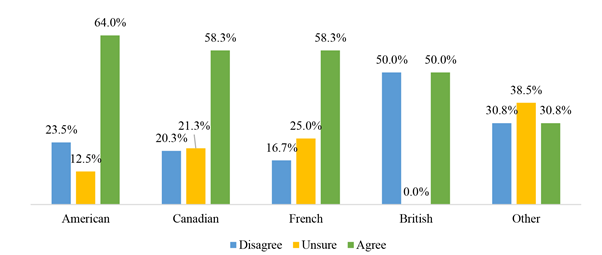
As can be observed, Chapala’s natural beauty and scenic surroundings are attractive factors for foreign residents. Most Americans, Canadians, and French state that they live in the area because of its natural environment. However, the lake’s pollution caused by industry along the river that flows to the lake and the insufficiency of the four publicly owned wastewater treatment plants (INEGI, 2017) might play a principal role in creating a negative perception of the landscape. In this sense, the British show a lower proportion of agreement with the statement that they are living in Chapala because of the natural environment.
Social Factors and Integration into the Host Community
Participating in social and community activities creates a sense of belonging. It is important for mental and emotional well-being, which provides emotional support and creates opportunities for collaboration, personal development and shared experiences, enriching individuals’ lives. Experiencing pleasure also involves engaging in activities that are personally meaningful and fulfilling (Filep, 2014).
Social factors can also play a significant role in the decision to relocate to another country, as evidenced in Chapala, regarding the statement, “I live in Chapala because there is a large international community.” Primarily, the French strongly agree, with a notable 83.3%. This sentiment is echoed to a lesser extent by Americans (63%), Canadians (54.7%), and British (50%).
This perception is closely tied to how the local population is viewed and the alignment of values, contributing to a more unified society. Strengthening interpersonal interactions and relationships can thus foster social cohesion. To explore this, respondents were asked about their perception of the friendliness of the local native population. Notably, British respondents in Chapala showed the highest disagreement with the statement “The people in Chapala are friendly,” with 3 out of 10 expressing that they do not find the native population friendly, a more pronounced sentiment than other nationalities surveyed (see Graph 9).
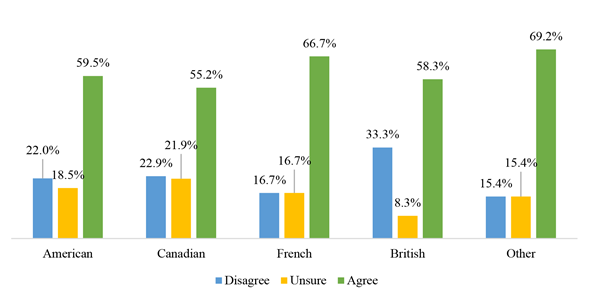
Consequently, it is common to observe social groups comprising Americans, Canadians, French-speaking Canadians, and individuals from France, Germany, and the United Kingdom. This indicates a vibrant foreign community actively engaged in social and cultural pursuits, particularly those related to their origins, as well as in the visual and performing arts, and the promotion of literacy and altruism.
When queried about their willingness to engage and exchange experiences with the local community, Americans exhibited the highest level of readiness at 60.4%, followed by Canadians at 57.9%, and British respondents at 54.5%. Despite that, interactions between local residents and foreigners remain limited, with the participation of the native population in events organized by the international community estimated to be minimal. Reports indicate that instances of integration between locals and foreigners are infrequent (Zepeda Hernández, 2024). From this, it can be inferred that a significant motive for foreign residents relocating to Chapala was the existence of an established international community along the riverbank. While there is a general consensus that the local population is amicable, it appears they do not actively participate in activities organized by immigrant groups.
Conclusions
The findings confirm that the area is predominantly inhabited by people over 60, solidifying its reputation as a retirement destination. However, a younger demographic is emerging, likely due to early retirement, remote work, and digital nomadism. According to the sample, the predominance of female migrants shows that only 3 out of 10 are married. Americans form the largest migrant group (58.1%), followed by Canadians (31.2%), with a minor but notable presence of French, British, and other nationalities (10.8%). These findings indicate the importance of further research among the different groups identified, without solely focusing on one, usually the Americans.
Most migrants had professional and corporate jobs before moving to Mexico. While retirement is the primary income source, 7.1% remain economically active in Mexico, and another 12.9% in their home country, which reinforces the idea of Chapala not only as a retirement destination but also as an increasingly popular spot for digital nomadism. Furthermore, most interviewees stay in Chapala for more than nine months annually, suggesting a trend towards permanent residency that contrasts with official records. This should be a significant concern for Mexican authorities and the implementation of public policies in migration and taxation matters.
The study also reveals dynamic patterns of residency and property ownership in Chapala. A significant portion of the foreign population has resided in Chapala for less than a decade, indicating a continuous influx of new residents that, at the same time, should be reflected in official statistics. Furthermore, property ownership is common among long-term residents, facilitated by the creation of trusts regulated by Mexican law. Renting remains a popular option, with platforms like Airbnb offering a wide range of rental options.
According to the findings, social integration plays a crucial role, primarily with the international community already established in Chapala. Two main factors have been identified for migration to Chapala: one related to economic reasons, such as the affordability of housing and health care services, and the other to social relationships. In this sense, the French group mostly agree that they reside in Chapala due to the large international community available in the area. It is intriguing how social factors play a crucial role in migrating to Chapala, considering that the determining factors are usually associated with economics, affordability, accessibility, tax benefits, and lower labor costs (Savas et al., 2023; Tang & Zolkinov, 2021).
The study also reveals a high willingness among these foreigners to engage socially with the host population. Despite this, Americans show the highest level of disposition at 60.4%, followed by Canadians at 57.9% and British respondents at 54.5%. Moreover, the interaction between native people and immigrants remains poor (Zepeda Hernández, 2024). Considering that Americans are the largest group of foreigners residing in Mexico, followed by Canadians, the initial assumptions were made, from which the following are concluded:
1) Since the French group considers living in Mexico due to housing affordability, with 75%, just over two percentage points above the Americans, there is insufficient evidence to reject or accept hypothesis 1 (H1). Although the null hypothesis is not rejected, conclusive results cannot be obtained since the difference in percentage points is less than the statistical margin of error. Therefore, the results are considered inconclusive.
2) As for housing, hypothesis 2 (H2) is rejected, on account of the French group being more likely to consider living in Mexico due to the affordability of healthcare services (75%) than the Americans (65.9%).
3) Given the harsh climate during the winter months and the snowbird phenomenon in Mexico, Canadians would be expected to consider spending money on enjoying activities in Mexico as a motivating factor for living there. However, they fall behind other nationalities at 61.7%, including British (66.7%) and Americans (68.5%). Therefore, hypothesis 3 (H3) is rejected.
According to the findings, it is surprising that the French group has the greatest clarity regarding their economic motivations for living in Mexico. This finding reveals that, although the flow of North Americans has been continuous in recent decades and they make up the largest group compared to Europeans, it is the latter who live in Mexico, considering the affordability of housing and healthcare. This leads to new reflections on the precariousness of life in countries such as France and England.
There is a need to further investigate not just the primary flows such as North Americans, like much of the existing literature focuses on, but also to explore new research lines related to European profiles and their context. This is particularly relevant given the increasing cost of living in developed countries in recent years, alongside those who are still willing to relocate to more distant destinations like Mexico instead of retiring to other regions with a pleasant climate, for instance, Spain’s Costa del Sol, which may offer better connectivity to their countries of origin.
Furthermore, this raises concerns regarding home ownership, as it identifies a significant demand for housing acquisition among foreigners, encouraged by national laws that provide security for foreign investment. However, these same laws create social contradictions by allowing the inflation of housing costs and transforming small towns into tourist-centric cities that cater to the needs of retired migrants, subsequently altering the economic and social landscape (Zepeda Hernández, 2024).
As a final conclusion, it can be said that contemporary transnational mobilities, including international retirement migration to Mexico, represents a unique form of mobility from the Global North to the Global South within the lifestyle mobilities paradigm. Demographic and economic factors shape this movement and impact social processes within host societies. Studying these mobilities, along with their profiles and motivations, has practical implications for planning national enclaves recognized as international retirement destinations and for developing public policies that enable better management of statistics concerning North American immigrants living in Mexico.

