




Servicios Personalizados
Revista
Articulo
 texto en
 Inglés (pdf)
 Artículo en XML
 Referencias del artículo

 Traducción automática
 Enviar artículo por email
Indicadores
-
 Citado por SciELO
-
 Accesos
Links relacionados
-
 Similares en
SciELO
Compartir

 Permalink

Convergencia
versión On-line ISSN 2448-5799versión impresa ISSN 1405-1435
Convergencia vol.32 Toluca 2025 Epub 09-Mar-2026
https://doi.org/10.29101/crcs.v32i1.25803
Articles
Plan S, “Tansformative” Agreements, and the Commercialization of Knowledge in Latin America

1 Universidad Autónoma del Estado de México, México, uribebrenda13@gmail.com
2 Universidad Autónoma del Estado de México, México, eal123@gmail.com
This paper analyzes the commercialization of knowledge in Latin America through the “transformative” agreements promoted by Plan S, signed by institutions in the region between 2022 and 2024. The analysis focused on three dimensions: characterization of actors and communities participating in the agreements, the identification of the licensing terms that were formalized, and the articulation between the publication scheme promoted by Plan S and scientific evaluation practices oriented toward the “mainstream”. The results show that six institutions in Mexico, Chile and Colombia signed 37 agreements with 25 publishers, with the CC BY license being the most common. The journals in which researchers are allowed to publish are ranked in the top quartiles of the SJR, primarily in the fields of Natural and Exact Sciences. Rather than transforming the commercial scholarly communication system, these agreements reinforce the dominance of large publishing corporations and undermine Latin America's tradition of non-commercial publishing.
Keywords: Transformative agreements; Plan S; Latin America; Open Access; Open Science
Se analiza la comercialización del conocimiento en Latinoamérica mediante los acuerdos “transformativos” promovidos por el Plan S, contraídos por instituciones de la región entre 2022 y 2024. Se consideraron tres ejes: caracterización de actores y comunidades que participan en los acuerdos, identificación de las licencias de uso que se formalizaron, y la articulación entre el esquema de publicación promovido por el Plan S y la evaluación científica orientada hacia la “corriente principal”. Los resultados arrojan que seis instituciones de México, Chile y Colombia firmaron 37 acuerdos con 25 editoriales, siendo la licencia más común la CC BY. Las revistas en las que pueden publicar están en los primeros cuartiles del SJR, principalmente en el área de Ciencias Naturales y Exactas. Los acuerdos no alteran el sistema de comunicación científica comercial, sino que acentúan el control de las “grandes” empresas editoriales y vulneran la tradición de publicación no comercial de Latinoamérica.
Palabras clave: acuerdos transformativos; Plan S; América Latina; acceso abierto; ciencia abierta
Introduction
In the seventeenth century, the first scientific journals appeared in a form close to what we know today (Philosophical Transactions and Journal des Sçavans, both founded in 1665). At that stage, the primary goal of scientific communities was to disseminate research findings, with knowledge remaining under their control and journals being exchanged on a non-profit basis. With some adaptations, scientific publishing remained this way until the mid-twentieth century. After World War II, however, a conceptual shift occurred that profoundly distorted the scientific communication system: certain groups, mainly in the North Atlantic, began to regard scientific publishing as a profitable business and reoriented it toward a commercial perspective. In this shift, knowledge was converted into a commodity, and the processes of privatization and appropriation of the public good took place. “Transformative agreements” can be considered the latest step in this process, which is why it is crucial to study them empirically.
With globalization, new forms of disseminating knowledge emerged, now embedded in a prestige system structured around categories such as “quality” and “internationalization”, and increasingly governed by market logic. The foundations of this new context can be traced back to Robert Maxwell, who in the 1950s founded Pergamon Press. To sustain his publishing house, he lobbied scientific communities to establish specialized journals and publish in them, in exchange for what from then on was recognized as “academic prestige”. Later, Pergamon Press was sold to Elsevier. Subsequently, Benjamin Lewin founded the journal Cell and the publisher Cell Press, which accepted only manuscripts deemed exceptional. In turn, publishing in Cell became synonymous with “prestige” for researchers (Guédon, 2008: 3 ; 2014: 90; Resco, 2021) .
This case exemplifies the conceptual and instrumental turn described above: it was no longer enough to publish; from that point on, it was necessary to publish in a “prestigious” journal, with prestige now defined and determined by the commercial publishing industry. This marked the beginning of a process of “expropriation” of the legitimacy of non-profit journals and universities, whereby the knowledge they produced was subordinated to the prestige conferred by the commercial publishing system of the twenty-first century.
In the 1960s, Eugene Garfield created the Journal Citation Index, which measures the average number of citations received by an article based on a specific set (“the core”) of journals. This innovation was key to consolidating the radical shift in journal publishing: its primary purpose was no longer to disseminate knowledge but to integrate itself into a prestige industry organized around citation systems controlled by the publishing sector itself. In turn, this system established what came to be regarded as “the core”, “the mainstream”, or the “principal current” of science (Guédon, 2008: 6) . In other words, publication ceased to be primarily a means of communication and became the raw material for an evaluation system that was still under construction. Under this model, journals that had already ceased to function as communication organs became the foundation of a new evaluation system and even proxies for the quality of research itself. The main effect of this reconfiguration was the establishment of a new form of evaluation based on citations, references to journals included in “the core” of knowledge. This marked the beginning of the “fetishization of indexing” (Salatino and López-Ruiz, 2021) , which does not align with the interests of the scientific community or the complex global, national, and local challenges it faces, but rather with the interests of the publishing market.
In parallel, a fundamental phenomenon emerged: access to scientific contributions published in these journals was granted only through payment (subscriptions). In other words, the publishing model that took shape as a commodity was a closed one. However, although this was a commercial model, it was legitimized through selection criteria and the “prestige” that became synonymous with “quality”. Yet, alongside these journals there remained a majority of others that also offered “high quality,” but lacked prestige and recognition.
By the end of the twentieth century, it had already become common practice for universities to pay subscriptions to commercial publishers in order to access knowledge considered “high quality”. However, toward the end of that century, the so-called “serials crisis” erupted, characterized by exponential increases in subscription prices and the imposition of “Big Deals”, that is, bundled subscriptions that promoted and included journals of limited recognition but under commercial control (Melero, 2005: 255) . In this way, “the core” was imposed through marketing strategies. Prices became unsustainable for many institutions and governments. Prominent cases included universities in the United States and Western Europe such as Stanford, Harvard, the Massachusetts Institute of Technology, Duke, Cornell, Connecticut, the University of California, and North Carolina State University (Dyer, 2004: 543) . Even the wealthiest universities admitted they could no longer afford access to all the journals they deemed important, and physical space for storing publications became a problem. This situation was a turning point that triggered debates about the need to rethink the commercial model of scholarly communication. At the beginning of the twenty-first century, discussions emerged about the necessity of implementing what came to be known as “Open Access” (OA), a concept born from the effort to overcome economic and subscription barriers that restricted access to scientific publications (Suber, 2012) .
Although regions such as Latin America, though not exclusively, were already communicating their scholarly output under an OA scheme without charging for publishing or access, the official definition of OA was articulated through declarations issued in Europe. These outlined two routes to achieve it: the gold route and the green route (Budapest Open Access Initiative, 2002; Max Planck Society, 2003). The gold route refers to peer-reviewed scientific journals, shifting from subscription fees to publication fees (Article Processing Charges, APCs). The green route refers to the deposit of publications and other contributions, not necessarily peer-reviewed, in repositories intended, among other purposes, to preserve institutional memory and make it available to the communities funding it and to the wider world.
In pursuit of openness, specifically in the European context, strategies were introduced such as the ERC Guidelines for OA established in 2007 (European Research Council, 2007); the Science Europe Principles on OA to Research Publications of 2013, updated in 2015 (Science Europe, 2015); and the 2016 resolution by European science and innovation ministries, gathered at the Competitiveness Council (Schiltz, 2018) . One of the latest strategies proposed by cOAlition S to achieve full openness of academic literature is Plan S.
Plan S is a policy introduced in 2018 by cOAlition S—a consortium of 28 research funding organizations supported by the European Commission and the European Research Council—with the goal of opening access to scientific contributions (cOAlition S, 2018a, 2019). Plan S emerged in a context where funding agencies expressed dissatisfaction with the fact that research results were being published in journals that restricted access to society at large, while institutional repositories had failed to persuade researchers to deposit their peer-reviewed publications there (Hernández-Pérez, 2019: 2) . To achieve its goal, Plan S implemented a variety of strategies, most notably “transformative agreements”, “model transformative agreements”, and “transformative journals”. The present analysis focuses on transformative agreements.
So-called “transformative agreements” are contracts between publishers and institutions, libraries, or consortia that establish the conditions for both access to a bundle of journals (subscriptions) and the publication of articles within them, under fees agreed upon in a single contract and including charges for publication or processing (APCs). The defining feature of such agreements is that payments formerly directed toward subscriptions are redirected toward publication costs (Bieg, 2022; Hinchliffe, 2019) . This constitutes a major change in the publishing system that, under the discourse of openness, refunctionalizes the appropriation of knowledge as a public good. Although there is no universal typology of agreements, at least two types have been documented: Publish & Read agreements, under which publication fees cover both the institution’s authors and reading access to all journals, and Read & Publish agreements, under which the publisher receives one payment for reading and another for publishing under the same contract (Marquez Rangel et al., 2023: 84) .
The ESAC (Efficiency and Standards for Article Charges)1 initiative maintains a registry of agreements and highlights five main characteristics they must fulfill within the Plan S framework: (a) they must be temporary and transitional, (b) they must allow authors to retain the intellectual property of their publications, (c) they must be transparent, and (d) their clauses must be publicly accessible. Their stated objective is to reduce the cost of academic publications and promote greater equity within the academic community (ESAC, n.d.), a purpose that, evidently, has not yet been achieved.
Transformative agreements did not originate with Plan S; rather, Plan S institutionalized and globalized them. Among the earlier transformative agreements, the most prominent are those signed by Springer in 2015 with UK universities (represented by Jisc), and by Elsevier in 2019 with German universities (represented by the Max Planck Digital Library). These were the first large-scale transformative agreements.
In 2015, the Max Planck Society also launched the “OA2020” project with the aim of promoting the global transition of scientific content to open access. This project was highly influential on Plan S and is recognized as the source of the term “transformative agreements”.
The agreements have been approached from different perspectives. Some scholars argue that they represent a fast track to OA, but they are also exclusionary, as they are only available to countries and institutions with sufficient funds to afford them (Shearer, 2022) . Others point out that the lack of transparency in subscription and APC costs makes it difficult to assess whether they actually reduce the overall expenses of scholarly communication (Anglada and Borrego, 2023: 1) . Still others contend that for contracts to be genuinely “transformative”, they must allow unlimited publication without closed lists of journals, and warn that their adoption may sideline alternative approaches that could strengthen the OA publishing ecosystem (Martínez Galindo et al., 2023: 97-98) .
Regarding the Latin American publishing ecosystem, it has a longstanding open and collaborative tradition. The region views knowledge as a public and common good, disseminated through journals that charge neither authors nor readers, with universities serving as the backbone of open access publishing. Latin America has sustained a non-commercial OA model for more than three decades, supported by numerous repositories that freely and openly provide access to research outputs published in regional journals.
One of the key milestones in opening knowledge in Latin America took place from November 27 to 30, 1994, during the workshop “Scientific Publications in Latin America”, held in Guadalajara, Mexico. “One of the most significant outcomes was perhaps the proposal to establish a permanent regional network of scientific editors, one of whose first tasks would be (…) the creation of a database of the region’s scientific journals”. At the same time, however, UNESCO, through Professor Adnan Badran, emphasized a persistent tension: “...the lack of presence in major international indexes” (Cetto, 1993; Cetto and Hillerud, 1995). This marked the consolidation of Latin America’s collaborative and non-commercial openness, leading to the establishment of key information infrastructures. Building on earlier projects such as Biblat (1971), CLASE (1975), Periódica (1978)—all developed by UNAM—and Lilacs (1982) in Brazil, important regional initiatives emerged, including Latindex, SciELO Brazil, and IRESIE in 1997, CLACSO in 1998, Redalyc in 2003, REMERI in 2012, La Referencia in 2013, and AmeliCA in 2019, along with multiple national and institutional repositories.
This situation reveals a persistent and unresolved tension that has marked the uncertainty of the Global South’s publishing system. On the one hand, there is a pressing need to develop regional and national infrastructures that provide visibility to Latin American journals on the global stage. On the other hand, there is the desire to be included in international indexes, albeit under rules defined by impact factors and citation counts. How many thousands of pages have we written lamenting the lack of representation in the “core” or “mainstream”? In doing so, we contribute to our own marginalization. Although most infrastructures (Latindex, CLACSO, Redalyc, and AmeliCA) have opposed this model and published countless critiques, the international mainstream model, legitimized regionally through SciELO, has generated a contradiction we cannot overcome. Hence this warning regarding transformative agreements: national science and technology organizations (ONCyTs) and institutions have “bought into” and aligned their internal processes with the mainstream and ranking models, undermining previous efforts, disregarding non-commercial infrastructures, and perpetually devaluing institutional publishing systems that remain underfunded, except for those included in the “core” or “mainstream”.
Within this specific Latin American context, the strategy promoted by cOAlition S has sparked debate and concern among the region’s academic community. Overall, it has been noted that for the region to integrate into the Plan S model, the plan proposes exemption policies and equitable APC payments. However, this model is unsustainable for the region because it is based on a commercial approach to scholarly communication, in contrast to the non-commercial mechanisms long established in Latin America (Becerril-García, 2019) . Moreover, the solution is not exemption or charity, nor the notion of a “fair price”—if such a thing exists. The issue is the appropriation of a public good which, in the Latin American case, is largely financed with public funds. This is the critical point. For the region, joining the global conversation means abandoning its cooperative model, closely aligned with societal needs, in favor of a commercial model that commodifies knowledge and in which significant academic sectors are inevitably excluded. This is not the way forward.
The strategies proposed by Plan S demonstrate concern for inequity in access to knowledge but fail to address inequity in publication and avoid questioning the problem of control by a small number of powerful publishing houses. Latin American scientific communities have emphasized that Plan S disregards the fact that its strategies negatively affect regions with distinct scholarly communication structures, such as Latin America, where there is a strong tradition of non-commercial publishing. The exemption policies and discounted APCs that Plan S proposes for regions like ours are insufficient mechanisms for opening scholarly communication and do not structurally address the persistent problems of exclusion in both access and publication (Debat and Babini, 2020: 282) .
Other communities in the region have pointed out that while Plan S seeks to eliminate paywalls to achieve open access, it does not aim to reduce the concentration of power and profits enjoyed by a handful of commercial publishers (Aguado-López and Becerril-García, 2020) . In Latin America, the “transformative” strategy promoted by Europe is especially concerning, as it has been argued that it hinders a comprehensive and sustainable transition to open science and undermines the OA models that have operated in the region for decades (Becerril-García and Córdoba González, 2024: 257).
Against this backdrop, it becomes essential to analyze how the Plan S model is being configured in Latin America, a region with a non-commercial scholarly publishing system that has demonstrated sustainability for decades. The Latin American model tends to emphasize the importance of scientific communication as a process of democratization and regional identity-building. Specifically, the objective of this paper is to analyze the Latin American institutions and countries that have entered into “transformative agreements”, identifying the publishing groups with which these agreements were signed and examining their specific conditions: the volume of articles permitted, rights of use and access, and whether the journals included belong to the so-called “core”, “mainstream”, or “principal current” of science.
The study suggests that the adoption of such agreements in Latin America represents the implementation of a model rooted in the commercialization of knowledge, given that the strategy promoted by Plan S: (1) perpetuates commercial practices such as APCs; (2) strengthens the presence and control of a small group of powerful publishers in scholarly communication; (3) does not guarantee that scientific contributions published in this context will not be commercialized in the future; and (4) fails to structurally alter the evaluation and publication culture centered on the “core”, “mainstream”, or “principal current”, since it continues to direct scholarly publishing toward journals with the highest citation-based metrics in this circuit.
Methodology
The research was conducted to analyze the characteristics of the agreements implemented under the Plan S and thereby characterizing the publishing model that is taking shape in Latin America through these agreements. The study universe comprises information on 37 agreements negotiated by six institutions across three Latin American countries:
-
Mexico:
a. Universidad Nacional Autónoma de México (UNAM), 22 agreements.
b. Universidad Autónoma Metropolitana (UAM), 4 agreements.
c. Benemérita Universidad Autónoma de Puebla (BUAP), 2 agreements.
-
Colombia:
a. Consorcio Colombia, composed of 63 institutions (see List 1 8), 3 agreements.
b. Pontificia Universidad Javeriana (PUJ), 2 agreements.
-
Chile:
a. Universidad de Concepción (UdeC), 4 agreements.
It should be noted that PUJ is one of the institutions that make up Consorcio Colombia, and therefore it is already included in the three agreements signed by the consortium. To avoid duplicating information, the analysis of Consorcio Colombia considered its three agreements, while the analysis of PUJ included only the two agreements established independently of the consortium.
The information was collected between November 15, 2023, and January 31, 2024. The data sources were the official websites of each institution, where information regarding the respective agreements was made publicly available (see List 2).
The study analyzes three main aspects:
Identification of actors and communities: This was addressed by analyzing how many agreements each institution has signed, with which publishers, their duration, and the number of scientific articles committed in each contract for publication. Each institution presents its agreement information differently—i.e., there is no standardized way of disclosing data on the agreements. However, in all cases, information was found regarding the aforementioned variables. In some instances, scientific articles were specified as fixed numbers, while in others they were described as “unlimited” production.
-
Usage and reading rights: This part of the analysis focused on identifying the types of licenses for use and distribution of works formalized in the agreements, in order to assess the potential for commercialization of scientific output—specifically, whether the licenses included in each contract allow or prohibit commercial use of academic literature.
Information on the type of license established was available only for UNAM, as provided by the institution itself. For Consorcio Colombia and PUJ, data were obtained from their records in ESAC, since these are the only institutions that have registered their contracts with this initiative (see Table 1) .
This aspect could not be analyzed in the cases of BUAP, UAM, and UdeC, since the information is not publicly available, nor are they registered in ESAC. In total, the agreements excluded from this part of the analysis represent 27% (5.4% BUAP; 10.8% UAM; 10.8% UdeC).
-
Effects on scientific evaluation: This was examined by analyzing the journals in which institutions are allowed to publish according to each publisher’s agreement, their quartile ranking in the Scimago Journal & Country Rank (SJR)9, and their field of knowledge. The purpose of this component was to analyze the influence of evaluation practices oriented toward the so-called “mainstream” on the choice of publishers and journals included in the agreements, as well as to identify potential differences by field of knowledge.
Each institution publishes lists of the journals covered by this agreements10. The fields included in these lists are: journal title, ISSN, publisher, journal link, discipline, quartile, and type of access (hybrid or full open access). These fields allowed the identification of journals.
The journals were then assigned to a field of knowledge, classifying disciplines qualitatively into the categories of Natural and Exact Sciences (NES) or Social Sciences and Humanities (SSH) (see Table 2). Although some lists provide the quartile of journals, they do not specify the database to which the quartile refers. Therefore, the SJR database was consulted to identify, under a standardized approach, whether each journal was indexed in this system and, if so, its quartile. This identification was carried out by searching for each journal’s ISSN in SJR.
The total number of journals in which institutions are allowed to publish under the analyzed agreements is 17,749. After removing duplicates, the total number of unique journals was 10,722. Of these, 7,268 (67.8%) belong to NES and 3,454 (32.2%) to SSH.
It should be noted that BUAP does not provide information on the journals in which its researchers can publish under its agreements, and therefore could not be included in this part of the study. These agreements account for 5.4% of the total. Likewise, UdeC’s journal lists do not include ISSN identifiers, preventing the search of its journals in SJR. Consequently, for this institution, the analysis was limited to the field of knowledge.
Results
The identification of the communities that have formalized agreements aligned with the publishing policy proposed by Plan S indicates that, as of January 2024, the Latin American countries engaged in such agreements are Colombia, Mexico, and Chile. The participating institutions are the Universidad Nacional Autónoma de México (UNAM), Universidad Autónoma Metropolitana (UAM), Benemérita Universidad Autónoma de Puebla (BUAP), Consorcio Colombia, Pontificia Universidad Javeriana (PUJ), and Universidad de Concepción (UdeC).
Transforming: Empowering a Concentrated and Monopolistic System
The agreements reveal a growing adoption in Latin America: 14 were recorded in 2022, 28 in 2023, and by January 2024 a total of 37 had been documented, representing a relative growth of 62.2% in two years. This is part of a broader global trend; for instance, it has been reported that by March 2022 there were 429 agreements established across 39 countries through 101 institutions, libraries, or consortia, while six months later this had increased to 542 agreements in 41 countries and 119 institutions (Godínez-Larios, 2024) . Importantly, what matters in this analysis is not the sheer number, but the emerging trend and, particularly, the significance and influence of the institutions signing these agreements. This is relevant given that a European policy is being adopted by Latin American institutions, disregarding local contexts and the implications of these decisions, which have the potential to slowly and expensively erode the Latin American publishing ecosystem.
In terms of the total number of articles committed for publication, Colombia accounts for 1,660 (1,640 by Consorcio Colombia and 20 by PUJ) and Mexico for 3,872 (UNAM). This total includes only those agreements with fixed numbers of articles, as others stipulate “unlimited”11 publications (UAM and BUAP). UdeC, in contrast, did not provide records of the number of articles negotiated nor whether they are “unlimited”. Figure 1 shows the volume of articles and agreements by country and year of initiation.
From a publishing perspective, the analysis revealed the relationships established between institutions and publishing groups. Figure 2 synthesizes this perspective.
The agreements formalized in Latin America demonstrate links with “major” commercial publishers. Generally, the involvement of these large publishers in negotiations promoted by Plan S has raised concerns about the perpetuation of a system that consolidates their control over the academic community and research institutions. This is especially relevant in a context of concentration and control; for example, it has been documented that since the 2010s, scientific publishing has become concentrated in a small group of commercial publishers, which operate under market logics and contribute to an oligopolistic structure (Larivière et al., 2015: 9-10). Among these major publishers are Elsevier, Wiley, Taylor & Francis, Sage, and Springer Nature, which collectively control around 60% of the scientific publishing industry (Shapiro, 2013: 240) . While the central argument of Plan S is that such agreements will transform scientific publishing into a more open system, it is worth asking whether openness alone is sufficient to change the system. Evidence after several years of implementation suggests that it is not a significant or sufficient factor. This is clearly illustrated in Figure 2, where Elsevier, Springer Nature, Wiley, Sage, and Taylor & Francis—highly profitable and concentrated commercial publishers—account for 24.3% of all agreements.
Concentration becomes even clearer when analyzing the number of articles negotiated: Elsevier, Springer Nature, Wiley, and Taylor & Francis account for 74.3% of the articles committed under these agreements. This is in addition to contracts stipulating “unlimited” numbers of articles, which appear to function more as a commercial strategy to tie institutions to a model where “quality” continues to be defined by the “core”: under this paradigm, what is not part of the “core” has no value, thereby excluding more than 50,000 non-commercial journals. This confirms that the critical issue is not diversity of publishers but the concentration of articles, underscoring the monopolistic characteristics of the dominant commercial system.
The first agreements in Latin America were signed by Consorcio Colombia with three publishers—Elsevier, Springer Nature, and Taylor & Francis—which came into effect on January 1, 2022, with a three-year duration. It was expected that 40%-70% of articles previously published under closed access would transition to OA (Consorcio Colombia, 2021). In total, Consorcio Colombia negotiated 1,640 articles (810 with Springer Nature, representing 49.4%; 650 with Elsevier, 39.6%; and 180 with Taylor & Francis, 11% of the total) (see Figure 3) .
Consorcio Colombia, composed of 63 institutions, divided them into two groups with the aim of, as argued, distributing the articles equitably among its members. Group 1 included institutions with a lower publication record in the publishers with which the agreements were signed and was allocated 25% of the articles. Group 2 comprised institutions with a higher publication record and received 75% (Consorcio Colombia, 2021). Equity, however, seems far from achieved; rather, the quota distribution reinforces disparities and control in Colombia.
In 2023, PUJ signed two additional agreements, one with IOP Publishing and another with Wiley. PUJ prioritizes publication in journals indexed in quartiles 1 and 2 (Pontificia Universidad Javeriana, 2022). It negotiated “unlimited” articles with IOP and 20 articles with Wiley.
UNAM signed agreements starting in January 2022 with seven publishers: Cambridge University Press, The Company of Biologists, De Gruyter, IWA Publishing, the Microbiology Society, Wiley, and the Association for Computing Machinery. In 2023, it added agreements with six more publishers: Rockefeller University Press, Springer Nature, IOP Publishing, PLOS, AIP Publishing, and msp. In 2024, nine additional agreements were established with: American Chemical Society, American Institute of Mathematical Sciences, Bioscientifica, Elsevier, Karger, Oxford University Press, Portland Press, Royal Society of Chemistry, and The Royal Society. The number of articles negotiated per year and publisher, as well as contract durations, are shown in Figure 3.
BUAP signed agreements with two publishers, the Microbiology Society and the Royal Society, starting in 2023 and running until 2025, both allowing for “unlimited” publications (see Figure 3) .
UAM signed four agreements with ACS, IOP Publishing, SAGE, and Wiley, all starting in 2023 and expiring in 2026. Each provides for “unlimited” publications over the duration of the agreement, without specifying fixed annual quotas.
UdeC signed agreements in 2022 with four publishers: IOP Publishing, Cambridge University Press, the European Mathematical Society, and the Microbiology Society. It does not provide information on the number of articles negotiated.
CC BY: The Legal Framework of Appropriation and Commodification
A second dimension of analysis relates to usage and reading rights of scientific contributions published under Plan S. Specifically, this was examined through the legal licenses for use and distribution of scientific articles, as these determine, among other things, ownership, commercial use, and the preservation of patrimonial rights.
Plan S states in its first principle that all publications must carry a Creative Commons Attribution (CC BY) license, in line with the requirements of the Berlin Declaration (cOAlition S, 2018b). The study shows that at least 73% of the agreements formalized this license, while 27% do not specify a license type. In short, evidence indicates that three out of four works may be reused or commercialized by anyone, provided the authors are cited. The critical point to emphasize is that the CC BY license allows commercialization of knowledge, which challenges its treatment as a public good.
In the agreements analyzed, UNAM, PUJ, and Consorcio Colombia all indicated CC BY licenses, and each contract specifies the CC BY options available to authors. For example, as shown in Table 3, UNAM’s contract with Elsevier offers CC BY, CC BY-NC-ND, CC BY-SA, and CC BY-NC-SA options. Similarly, the Consorcio Colombia-Elsevier agreement specifies, CC BY variants (see Table 3) .
The predominance of CC BY licenses suggests that the Plan S framework does not alter conditions that enable the potential privatization, appropriation, and commercialization of knowledge. That is, OA publications can be repackaged into closed, paywalled products. This trend is particularly evident in the distribution of documents committed to publication: of the 5,532 articles under fixed-quantity agreements, virtually all were assigned CC BY licenses. The same applies to “unlimited” agreements, such as those signed with IOP Publishing by UNAM and PUJ (see Table 3) .
The CC BY license permits commercial use of works without requiring additional permission from the author or copyright holder. While this may facilitate knowledge dissemination, it can also lead to loss of control and undermine the mission of public institutions. In other words, there is no guarantee that derivative products will remain OA and not be commercialized, unless licenses such as CC BY-NC-SA are used, as recommended in the Declaración México signed by Latindex, Redalyc, Clacso, and IBICT in 2020.
Several studies have identified CC BY as a commercial license, reinforcing the interpretation that it enables commodification. Creative Commons itself, by promoting the least restrictive licenses as most beneficial for science, contributed to this perception. The motto “As open as possible, as closed as necessary”, similar to the FAIR principles, encapsulates this approach, which ends up privileging total openness without protection—thus enabling appropriation, privatization, and commodification of knowledge, a public good largely financed by society. This view is further supported by current debates on ownership of information in generative artificial intelligence: under CC BY, all licensed content can be legally extracted without recourse.
Recursiveness: Legitimizing the “Core”
A third dimension of analysis concerns evaluation processes and the legitimization of the “core” or “mainstream”. We asked: Are the journals included in the agreements part of the “mainstream”? Are they among the top quartiles?
The study shows that a significant share of journals where institutions can publish are indeed part of the “core”, identified through SJR. Of the 10,722 journals available, 85.9% are indexed in SJR. Moreover, most are in the top quartiles: 43.4% in quartile 1, 18.2% in quartile 2, 12% in quartile 3, 2.8% in quartile 4, 0.1% unspecified, and 14.1% not indexed in SJR. Most of these journals belong to Natural and Exact Sciences (NES), representing 67.8% (see Table 4) .
This indicates that the evaluative culture oriented toward the “mainstream” significantly shapes the publishing model emerging under Plan S: publisher and journal selection is guided by their inclusion in the commercially oriented “core”, in this case, Scopus via Scimago Journal Ranks. In effect, the agreements reinforce the presence of high-prestige commercial journals, paradoxically strengthening the very model they claim to challenge. However, the outlook differs somewhat for Social Sciences and Humanities (SSH), given their lower representation (32.2%). Among SSH journals, 88% are indexed in SJR, distributed as follows: 42.2% in quartile 1, 28.8% in quartile 2, 14.2% in quartile 3, 2.6% in quartile 4, 0.2% unspecified, and 12% not indexed in SJR (see Table 4) .
UNAM provides data for all journals in which it can publish, except those from The Royal Society. It can publish in 7,177 journals, of which 73.2% are NES and 26.8% SSH. Regarding quartiles, 45.5% are in Q1, 26.4% in Q2, 9.9% in Q3, 2.2% in Q4, 0.2% unspecified, and 15.8% not indexed in SJR. Nearly three-quarters (71.9%) fall within Q1 and Q2 (see Table 5) .
Consorcio Colombia’s trend is similar: it can publish in 6,001 journals, of which 41.6% are NES, 30.7% SSH, and 27.7% unspecified (mainly Elsevier). Quartile distribution shows 44.3% in Q1, 29.5% in Q2, 12.4% in Q3, 3.1% in Q4, 0.1% unspecified, and 10.6% not indexed in SJR.
PUJ can publish in 1,972 journals, of which 70.8% are NES, 25.3% SSH, and 3.9% unspecified (e.g., IOP’s 76 journals). Quartile distribution shows 42.7% in Q1, 27.2% in Q2, 11.1% in Q3, 1.8% in Q4, 0.2% unspecified, and 17% not indexed. As with previous cases, more than half belong to the top quartiles.
UAM can publish in 2,079 journals, though more than half (57.8%) do not specify their field (e.g., IOP and SAGE). Of the remainder, 31.1% are NES and 11.1% SSH. Quartile distribution shows 56.2% in Q1, 21.8% in Q2, 8.3% in Q3, 1.7% in Q4, 0.1% unspecified, and 11.9% not indexed.
Finally, UdeC can publish in 520 journals, of which 51.1% are NES and 48.9% SSH. Unlike other cases, this institution shows no significant difference between fields. However, it is notable that in three of its four agreements, no SSH journals were included (IOP, EMS, Microbiology Society).
These findings clearly show that although knowledge openness is being pursued—an undoubtedly important advance—the dominant model remains intact: the “core” is unchanged, and restrictions are even tighter, as emphasis is now placed on Q1 and Q2 journals. It is not enough to be part of the “core”; journals must be in the top two quartiles. Beyond the bias toward NES, English-language dominance, and a Northern orientation, this evidence confirms global trends (Godínez-Larios, 2024) . From this, we can affirm:
Significant progress has been made in openness, a fundamental step.
The model centered on the “core”, largely commercial, persists.
Evaluation, recognition, and assessment processes of contributions across fields remain unchanged, as will be discussed further.
Discussion
The model of scientific communication—particularly through peer-reviewed journals—has been commercialized. A “core” has been established that has replaced them as communication structures and positioned them instead as evaluation structures, based on the citation impact of journals within the “core” and on indicators such as the Impact Factor (IF) or Scimago Journal Rank (SJR). Visibility, quality, and equity are defined in a circular manner by what is contained in the “core”. Their alignment with values and strategies is determined by the “core”, raising the question of whether it can be articulated with values and principles grounded in the idea that knowledge, science, and journals are public goods, and whether institutions from the Global South, and particularly Latin America, are included in this model. At the outset, the answer is no, since the vast majority of these journals are owned by commercial publishers, with the implications previously discussed. The “core”—even when open—is in contradiction with non-commercial OA, science, and journals as public goods. This permanent tension effectively excludes the regional publishing system, and when it participates in the so-called “global conversation”, meaning the “core”, it must pay significant amounts in APCs.
As this model is imposed through evaluation systems based on indicators such as IF-WoS-Clarivate and SJR-Scopus-Elsevier, and despite digital technologies enabling knowledge to be shared as a public good (Budapest Open Access Initiative: Recommendations on its 20th Anniversary, 2022), there emerged a search for a model of OA based on the recognition that there can be no meaningful knowledge without access to global research results. However, and this is the central point of discussion, a key question remains: Is it possible to modify the commercial communication model and return control to universities and research centers in order to achieve the goals of OA—without distortion—as envisioned in Budapest and BOAI20?
This concern has been the subject of extensive debate in initiatives such as the San Francisco Declaration on Research Assessment (DORA, 2012), the Latin American Forum on Scientific Evaluation (FOLEC, 2019), the Leiden Manifesto (Hicks et al., 2015) , the Helsinki Initiative on Multilingualism in Scholarly Communication (Federation of Finnish Learned Societies et al., 2019), and the Barcelona Declaration on Open Research Information (Kramer et al., 2024) , among many others. These initiatives have sought to improve and develop evaluation systems to make them fairer, more transparent, and more effective, although with limited results.
In recent decades, the tension and strategies have centered on the possibility of constructing an alternative model. The North has sought to do so without altering the commercial framework: knowledge resides in the “core”, which must simply be made global and open, later adding “academic ownership” and charging authors through APCs. In contrast, the Global South—especially Latin America—developed a collaborative model funded by universities, later termed the “diamond” model. What are the differences? How do “transformative agreements” affect or potentially undermine this model? Latin America has not only sustained a non-commercial tradition for more than three decades, with specific OA legislation, but has also expanded these policies toward Open Science in line with UNESCO’s Recommendation on Open Science(UNESCO, 2021).
cOAlition S has argued that in Latin America, access to scientific publications has always been open, and while the region was advancing OA correctly, the rest of the world was overtaken by commercial publishers who extracted enormous profits from research communities in the North and the West. Yet, publishers cannot simply be wished away; hence, Plan S engages with them through “transparent” and “transformative” agreements (Rooryck, 2019) . However, as admitted by its own leadership, Plan S’s objectives are inherently limited.
The articulation of cOAlition S clarified the distinction between Plan S and other global OA initiatives. From the Latin American perspective, the goal is for academics to retain control over their own work, not to sustain a for-profit sector. The “transformative agreements” and “transparent pricing” promoted by Plan S reflect the interests of commercial publishers rather than those of the academic community, particularly outside the Global North. Thus, the primary critique of Plan S is accurate: it is a Eurocentric proposal that does not aim to reduce profits or the concentration of power over scholarly publishing held by a few commercial publishers, while leaving the current communication system virtually intact (Aguado-López & Becerril-García, 2019) .
The differences between cOAlition S and the Latin American scientific community persist despite ongoing dialogue. For instance, in 2019 the event Open Talks marked the first activity with the Plan S representative in the region, and in October 2023, during the Global Summit on Diamond OA in Toluca, Mexico, the same tensions reemerged. In the North, a diamond OA model is adopted without excluding commercial publishers, seeking journals that charge neither APCs nor publication fees and remain under academic ownership. In contrast, the South issued the Manifesto on Science as a Global Public Good: Non-Commercial OA (2023), which frames science as a public good, advocating non-exclusion and non-rivalry, and demanding a fully non-commercial approach. This manifesto critiques the commercial OA model—based on APCs and “transformative” agreements—as a distortion of the original purpose of Open Science, proposing the diamond OA model as a viable solution. As of September 2024, it had been signed by 13,902 institutions and individuals across 81 countries.
One critical issue underlying the debate between commercial and non-commercial models is licensing, which defines conditions of use. Latindex, Redalyc, Clacso, and IBICT issued the Declaración México in support of the Latin American non-commercial OA ecosystem, recommending the CC BY-NC-SA license to safeguard regional academic and scientific production in OA (Latindex et al., 2020). This has direct implications for both the immediate use of scientific articles and their derivatives, particularly regarding the appropriation of knowledge funded with public resources. The openness promoted by Plan S and the Global North allows knowledge to be released without restrictions on future appropriation. Consequently, for the sustainability of the diamond model, openness alone is insufficient.
To ensure that science remains a global public good, it is essential to adopt the license proposed by the Declaración México: CC BY-NC-SA. This license prevents appropriation and commercialization, while requiring derivative works to also remain OA without restrictions—except one: the prohibition of private appropriation, thereby ensuring permanent status as a public good. Latin America has pursued this path for over three decades, demonstrating its feasibility and sustainability. Nevertheless, European proposals such as Plan S exacerbate tensions and threaten the regional model.
The purpose of this article has been to show that although still incipient, “transformative” agreements are gaining traction in the region and may have negative consequences—not only due to the financial costs involved but also because they strengthen and legitimize a model directly linked to commercial interests. The evidence shows that the journals included in these agreements: (1) are predominantly from the five largest commercial publishers; (2) are mostly ranked in Q1 and Q2 of the “core”; and (3) although their adoption in Latin America is still limited, they are being led by prestigious universities of recognized quality. This suggests potential long-term, yet highly detrimental, effects for the region, given that the hegemonic evaluation model has already been adopted and these agreements further reinforce its publication directionality. What is new is that the commercial model now seeks legitimacy through openness and the prestige of the “core”.
Knowledge as a public good and human right—if it is to serve as a roadmap, as enshrined in Article 3 of the Mexican Constitution, Section 5, the General Law on Humanities, Sciences, Technologies, and Innovation (LGHCTI, 2023) (Diario Oficial de la Federación, 2023), Colombia’s National Open Science Policy 2022-2031 (2022), the various regulations of Argentina and Peru, and the recent Declaration of the Ibero-American University Council (CSUCA), among others—requires a reconfiguration of the publishing ecosystem in several ways:
Recognizing non-commercial diamond journals as quality outlets, since they are currently excluded from the system.
Evaluating the article itself—the published content—rather than the prestige of the journal in which it appears.
Transforming impact indicators: citations may be one metric, but citations to the article itself, not the journal, and complemented by other elements that reflect whether publicly funded knowledge is contributing to global, regional, national, or local needs.
Ensuring that the means of dissemination—articles, books, and so forth—serve the broader goals of building a more inclusive, democratic, and just society.
Conclusions
Although “transformative” agreements did not originate with Plan S, they were institutionalized and promoted globally through it, thereby becoming an “adequate” policy for international expansion. However, in 2023 cOAlition S announced the end of its financial support for “transformative” agreements, as they failed to achieve the intended shift from subscription-based to open access publishing models. Instead, these agreements risk becoming permanent, thereby perpetuating the hybrid OA model that cOAlition S had consistently opposed (cOAlition S, 2023).
The evidence presented here shows that “transformative” agreements consolidate the commercial pathway of scholarly publishing by placing knowledge in OA while institutionalizing a pay-to-publish mechanism. In Latin America, these agreements have generally promoted publication within the “mainstream”, alongside a tendency toward commercialization through the licenses specified in each contract. The volume of documents committed to each publisher demonstrates that the agreements reinforce commercial logics, leading scientific publishing toward APC-based and oligopolistic schemes.
Commercialization and the loss of control by the academic and scientific community in the realm of scholarly communication intensify when journals—specialized communication outlets—become evaluation structures instead of communication structures. Science thereby loses its original ethos: sharing in order to improve and solve problems. The strategies and debates reviewed here highlight concerns over inequity and inequality in access to knowledge, yet overlook participation and the evaluation of contributions without addressing the issue of control. While science increasingly moves toward Open Access and Open Science, two fundamental questions remain unresolved and will profoundly shape its trajectory: (1) whether the model should follow commercial or non-commercial logics, and (2) who will retain control over the production, circulation, and legitimation of knowledge.
Annexes
List 1 Institutions that make up the Consorcio Colombia
| Universidad Nacional de Colombia |
| Pontificia Universidad Javeriana |
| Universidad de Antioquia |
| Universidad de los Andes |
| Universidad del Valle |
| Universidad del Rosario |
| Universidad del Norte |
| Universidad Industrial de Santander |
| Universidad Pontificia Bolivariana |
| Universidad Antonio Nariño |
| Universidad de Caldas |
| Universidad de la Costa |
| Universidad de la Sabana |
| Universidad de Medellín |
| Universidad del Cauca |
| Universidad El Bosque |
| Universidad Distrital Francisco José de Caldas |
| Universidad Eafit |
| Universidad ICESI |
| Universidad Tecnológica de Pereira |
| Universidad Pedagógica y Tecnológica |
| Universidad de Cartagena |
| Instituto Tecnológico Metropolitano |
| Universidad CES |
| Universidad Cooperativa de Colombia |
| Universidad de La Salle |
| Universidad del Magdalena |
| Universidad del Quindío |
| Universidad del Tolima |
| Universidad Militar Nueva Granada |
| Universidad Santo Tomás |
| Universidad Simón Bolívar |
| Corporación Universitaria Minuto de Dios |
| Fundación Universitaria Konrad Lorenz |
| Universidad Autónoma de Bucaramanga |
| Universidad Autónoma de Occidente |
| Universidad de Pamplona |
| Universidad EAN |
| Universidad Externado de Colombia |
| Universidad EIA |
| Universidad Surcolombiana |
| Universidad San Buenaventura |
| Universidad Santiago de Cali |
| Universidad UNAD |
| Universidad de la Guajira |
| Universidad de los Llanos |
| Universidad Popular del Cesar |
| Universidad Tecnológica de Bolívar |
| Universidad de la Amazonia |
| Fundación Universitaria del Área Andina |
| Fundación Universitaria Luis Amigó |
| Universidad Colegio Mayor de Cundinamarca |
| Universidad de Ciencias Aplicadas y Ambientales |
| Universidad de Ibagué |
| Universidad La Gran Colombia |
| Corporación Universitaria Autónoma del Cauca |
| Universidad del Sinú |
| Institución Universitaria Colegio Mayor de Antioquia |
| Unidad Central del Valle del Cauca |
| Fundación Universitaria Agraria De Colombia (Uniagraria) |
| Agrosavia |
| Instituto Amazónico SINCHI |
| Instituto Nacional de Cancerología |
Fuente: Sitio web del Consorcio Colombia.
List 2 Official pages containing information on the agreements of each institution
| UNAM: https://digitalab-ssie.unam.mx/acuerdos |
| UAM: https://www.bidi.uam.mx/acuerdos/index.html |
| BUAP:https://accucoms.com/transformative-agreements-buap-royal-society-microbiology-society/ |
| Consorcio Colombia: https://www.consorciocolombia.co/acuerdos-transformativos/ |
| PUJ: https://javeriana.libguides.com/c.php?g=1058475&p=9702588 |
| UdeC:https://bibliotecas.udec.cl/recursos/servicios-de-apoyo-a-la-investigacion-y-docencia/ |
Table 1 Source of Agreement Records from the Colombia Consortium and PUJ in ESAC
| Institution | Publisher | Link in ESAC |
| Consorcio Colombia | Elsevier | https://esac-initiative.org/about/transformative-agreements/agreement-registry/els2022co/ |
| Springer Nature | https://esac-initiative.org/about/transformative-agreements/agreement-registry/sn2022co/ | |
| Taylor & Francis | https://esac-initiative.org/about/transformative-agreements/agreement-registry/tf2022co/ | |
| PUJ | IOP Publishing | https://esac-initiative.org/about/transformative-agreements/agreement-registry/iop2023puj/ |
| Wiley | https://esac-initiative.org/about/transformative-agreements/agreement-registry/wiley2023puj/ |
Source: Own elaboration based on information from the official pages of the institutions and ESAC (n.d.).
Table 2 Classification of Disciplines by Knowledge Area
| Institution | Disciplines provided in the journal list | Disciplines provided in the journal list, translated into Spanish | Assigned knowledge area |
| UNAM | Agriculture, Aquaculture & Food Science | Agricultura, Acuicultura y Ciencias de los alimentos | CNyE |
| Chemistry | Química | ||
| Earth, Space & Environmental Sciences | Ciencias de la Tierra, el Espacio y el Medio Ambiente | ||
| Life Sciences | Ciencias de la vida | ||
| Medicine | Medicina | ||
| Physical Sciences & Engineering | Ciencias Físicas e Ingeniería | ||
| Computer Science & Information Technology | Ciencias de la Computación y Tecnología de la Información | ||
| Mathematics & Statistics | Matemáticas y Estadística | ||
| Veterinary | Veterinaria | ||
| Nursing, Dentistry & Healthcare | Enfermería, Odontología y Salud | ||
| Automation & control systems | Sistemas de automatización y control | ||
| Biochemical | Bioquímica | ||
| Biotechnology & applied microbiology | Biotecnología y microbiología aplicada | ||
| Engineering, biomedical | Ingeniería Biomédica | ||
| Oncology | Oncología | ||
| Pharmacology | Farmacología | ||
| Architecture & Planning | Arquitectura y Planificación | CSyH | |
| Humanities | Humanidades | ||
| Law | Derecho | ||
| Art & Applied Arts | Arte y Artes Aplicadas | ||
| Psychology | Psicología | ||
| Business, Economics, Finance & Accounting | Negocios, Economía, Finanzas y Contabilidad | ||
| General & Introductory Linguistics | Lingüística general e introductoria | ||
| Social & Behavioral Sciences | Ciencias sociales y del comportamiento | ||
| UAM | Agriculture | Agricultura | CNyE |
| Chemistry | Química | ||
| Biochemical | Bioquímica | ||
| Engineering, Chemical | Ingeniería química | ||
| Polymer Science | Ciencia de los Polímeros | ||
| Medicine | Medicina | ||
| Environmental Science | Ciencias Ambientales | ||
| Agronomy | Agronomía | ||
| Anatomy | Anatomía | ||
| Anesthesiology | Anestesiología | ||
| Astronomy & Astrophysics | Astronomía y Astrofísica | ||
| Biology | Biología | ||
| Biophysics | Biofísica | ||
| Neurology | Neurología | ||
| Odontology | Odontología | ||
| Ecology | Ecología | ||
| Food science & technology | Ciencias de los alimentos y tecnología | ||
| Optics | Óptica | ||
| Pediatrics | Pediatría | ||
| Robotics | Robótica | ||
| Statistics & Probability | Estadística y probabilidad | ||
| Urology | Urología | ||
| Veterinary | Veterinaria | ||
| Zoology | Zoología | ||
| Economy | Economía | CSyH | |
| Anthropology | Antropología | ||
| Architecture | Arquitectura | ||
| Art | Arte | ||
| Business & Finance | Negocios y Finanzas | ||
| Communication | Comunicación | ||
| Ethics | Ética | ||
| Geography | Geografía | ||
| History | Historia | ||
| Language & Linguistics | Lengua y Lingüística | ||
| International relations | Relaciones Internacionales | ||
| Law | Derecho | ||
| Literature | Literatura | ||
| Music | Música | ||
| Philosophy | Filosofía | ||
| Poetry | Poesía | ||
| Religion | Religión | ||
| Sociology | Sociología | ||
| PUJ | Agriculture | Agricultura | CNyE |
| Biology | Biología | ||
| Chemical | Química | ||
| Life Sciences | Ciencias de la vida | ||
| Mathematics & Statistics | Matemáticas y Estadística | ||
| Medicine | Medicina | ||
| Microbiology | Microbiología | ||
| Neuroscience | Neurociencia | ||
| Nursing, Dentistry & Healthcare | Enfermería, Odontología y Salud | ||
| Optics | Óptica | ||
| Pharmacology | Farmacología | ||
| Engineering | Ingeniería | ||
| Veterinary | Veterinaria | ||
| Art | Arte | CSyH | |
| Architecture & Planning | Arquitectura y Planificación | ||
| Humanities | Humanidades | ||
| Law | Derecho | ||
| Consorcio Colombia | Mathematics & Statistics | Matemáticas y Estadística | CNyE |
| Medicine | Medicina | ||
| Engineering & Technology | Ingeniería y Tecnología | ||
| Bioscience | Biociencia | ||
| Nursing | Enfermería | ||
| Dentistry | Odontología | ||
| Physical Sciences | Ciencias Físicas | ||
| Earth Sciences | Ciencias de la tierra | ||
| Food Science & Technology | Ciencias de los alimentos y tecnología | ||
| Language & Literature | Literatura y lenguaje | CSyH | |
| Humanities | Humanidades | ||
| Geography | Geografía | ||
| International Relations | Relaciones Internacionales | ||
| Economy | Economía | ||
| Education | Educación | ||
| Law | Derecho | ||
| Arts | Artes | ||
| Tourism | Turismo | ||
| Communication | Comunicación | ||
| Politics & International Relations | Política y Relaciones Internacionales | ||
| Tourism | Turismo | ||
| Literature | Literatura | ||
| UdeC | Agronomy | Agronomía | CNyE |
| Agriculture | Agricultura | ||
| Astronomy & Astrophysics | Astronomía y Astrofísica | ||
| Biophysics | Biofísica | ||
| Biology | Biología | ||
| Biotechnology | Biotecnología | ||
| Neurology | Neurología | ||
| Artificial Intelligence | Inteligencia Artificial | ||
| Computer Science | Ciencias de la computación | ||
| Ecology | Ecología | ||
| Medicine | Medicina | ||
| Engineering aerospace | Ingeniería aeroespacial | ||
| Geoscience | Geociencia | ||
| Mathematics | Matemáticas | ||
| Gerontology | Gerontología | ||
| Radiology | Radiología | ||
| Veterinary | Veterinaria | ||
| Robotics | Robótica | ||
| Nutrition | Nutrición | ||
| Physics | Física | ||
| Optics | Óptica | ||
| Anthropology | Antropología | CSyH | |
| Architecture | Arquitectura | ||
| History | Historia | ||
| Humanities | Humanidades | ||
| Education | Educación | ||
| Ethics | Ética | ||
| Geography | Geografía | ||
| Philosophy | Filosofía | ||
| International Relations | Relaciones Internacionales | ||
| Law | Derecho | ||
| Linguistics | Lingüística | ||
| Logic | Lógica | ||
| Music | Música | ||
| Political Science | Ciencias Políticas | ||
| Psychology | Psicología | ||
| Religion | Religión | ||
| Sociology | Sociología |
Fuente: Elaboración propia a partir de información proporcionada por las instituciones en los listados de revistas de cada acuerdo.
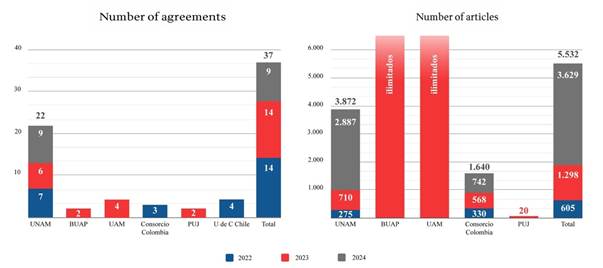
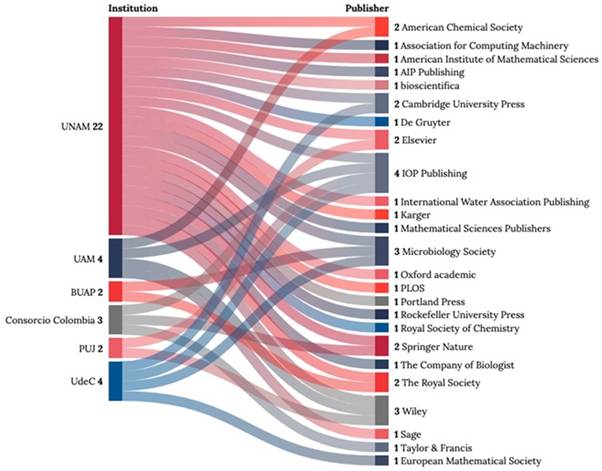
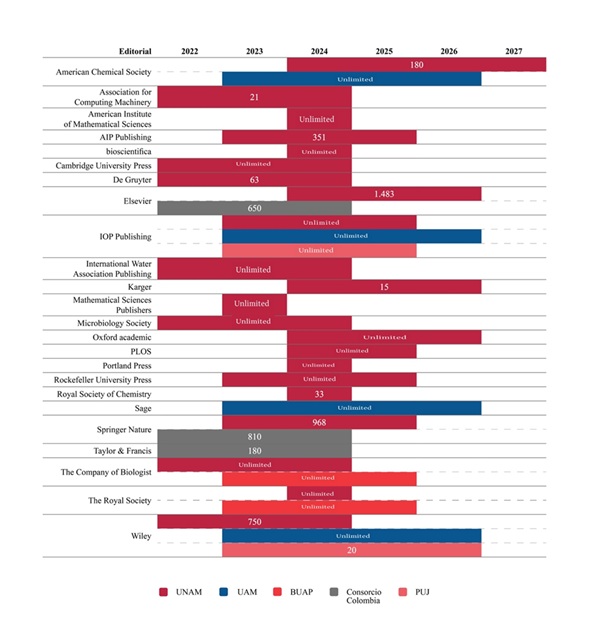
Table 3: License Formalized in Agreements by Publishing Group and Institutions
| Publisher/Institution | UNAM | Consorcio Colombia | PUJ |
| American Chemical Society | CC: BY, BY-NC-ND | ||
| Association for Computing Machinery | CC: BY, BY-NC, BY-ND, BY-NC-ND, BY-SA, BY-NC-SA | ||
| American Institute of Mathematical Sciences | CC: BY, BY-NC, BY-ND, BY-NC-ND, BY-SA, BY-NC-SA | ||
| AIP Publishing | CC: BY | ||
| bioscientifica | CC: BY, BY-NC-ND | ||
| Cambridge University Press | CC: BY, BY-NC, BY-ND, BY-NC-ND, BY-SA, BY-NC-SA | ||
| De Gruyter | CC: BY, BY-NC, BY-ND, BY-NC-ND, BY-SA, BY-NC-SA | ||
| Elsevier | CC: BY, BY-NC-ND, BY-SA, BY-NC-SA | CC-BY variations permitted | |
| IOP Publishing | CC BY | CC-BY preferred, exceptions permitted | |
| International Water Association Publishing | CC BY | ||
| Karger | CC BY-NC | ||
| Mathematical Sciences Publishers | CC BY | ||
| Microbiology Society | CC BY | ||
| Oxford academic | CC: BY, BY-NC, BY-ND, BY-NC-ND, BY-SA, BY-NC-SA | ||
| PLOS | CC: BY, BY-NC, BY-ND, CC BY-NC-ND, BY-SA, BY-NC-SA | ||
| Portland Press | CC: BY, BY-NC, BY-ND, BY-NC-ND, BY-SA, BY-NC-SA | ||
| Rockefeller University Press | CC BY | ||
| Royal Society of Chemistry | CC: BY, BY-NC, BY-ND, BY-NC-ND, BY-SA, BY-NC-SA | ||
| Springer Nature | CC: BY, BY-NC | CC-BY variations permitted | |
| Taylor & Francis | CC-BY variations permitted | ||
| The Company of Biologist | CC BY | ||
| The Royal Society | CC BY, BY-NC, BY-ND, BY-NC-ND, BY-SA, BY-NC-SA | ||
| Wiley | CC: BY, BY-NC, BY-NC-ND | CC-BY required: BY-NC, BY-ND, BY-NC-ND |
Source: Own elaboration based on information from the official websites of each institution and ESAC (n.d.)
Table 4: Total Journals and Quartile Classification According to SJR
| % | Quartile (Q)1 | % | Q2 | % | Q3 | % | Q4 | % | Unspecified Q | % | Not indexed in SJR | % | ||
| Total journals | 10.722 | 4.648 | 43,4% | 2.953 | 27,7% | 1.292 | 12% | 302 | 2,8% | 13 | 0,1% | 1.514 | 14,1% | |
| SSH journals | 3.454 | 32,2% | 1.457 | 42,2% | 994 | 28,8% | 490 | 14,2% | 89 | 2,6% | 9 | 0,2% | 415 | 12% |
| NES journals | 7.268 | 67,8% | 3.191 | 43,9% | 1.959 | 27% | 802 | 11% | 213 | 2,9% | 4 | 0,1 | 1.099 | 15,1% |
Source: Own elaboration based on information from the official websites of each institution and SJR.
Table 5: Number of Journals Negotiated for Publication by Institution/Consortium and Publisher
| Universidad Nacional Autónoma de México | ||||||||||
| Publisher | #Total journals per publisher | # Journals negotiated for publication | NES | SSH | SJR | |||||
| Q1 | Q2 | Q3 | Q4 | Not specified | Not indexed in the SJR database | |||||
| ACS | 89 | 86 | 86 | 0 | 61 | 10 | 12 | 0 | 0 | 3 |
| ACM | 71 | 67 | 67 | 0 | 24 | 24 | 1 | 0 | 0 | 18 |
| AIMS | 31 | 9 | 9 | 0 | 3 | 4 | 1 | 0 | 0 | 1 |
| AIP | 41 | 22 | 22 | 0 | 7 | 7 | 0 | 0 | 0 | 8 |
| bioscientifica | 19 | 4 | 4 | 0 | 2 | 0 | 0 | 0 | 0 | 2 |
| Cambridge | 434 | 380 | 137 | 243 | 158 | 85 | 39 | 7 | 2 | 89 |
| Elsevier | 2.8 | 1.666 | 1.383 | 283 | 1.097 | 399 | 100 | 27 | 4 | 39 |
| De Gruyter | 533 | 287 | 86 | 201 | 31 | 62 | 62 | 23 | 2 | 107 |
| IOP | 109 | 78 | 78 | 0 | 26 | 27 | 6 | 0 | 0 | 19 |
| IWA | 15 | 15 | 15 | 0 | 1 | 6 | 1 | 0 | 0 | 7 |
| Karger | 103 | 95 | 95 | 0 | 26 | 33 | 19 | 3 | 0 | 14 |
| msp | 20 | 9 | 9 | 0 | 5 | 1 | 0 | 1 | 0 | 2 |
| Microbiology Society | 6 | 6 | 6 | 0 | 2 | 2 | 0 | 0 | 0 | 2 |
| Oxford | 500 | 476 | 301 | 175 | 252 | 99 | 30 | 8 | 0 | 87 |
| PLOS | 14 | 14 | 14 | 0 | 7 | 0 | 0 | 0 | 0 | 7 |
| Portland | 7 | 7 | 7 | 0 | 5 | 1 | 0 | 1 | 0 | 0 |
| Rockefeller | 3 | 3 | 3 | 0 | 3 | 0 | 0 | 0 | 0 | 0 |
| RSC | 56 | 47 | 47 | 0 | 33 | 8 | 1 | 0 | 0 | 5 |
| Springer | 3 | 1.996 | 1.46 | 536 | 697 | 616 | 236 | 56 | 0 | 391 |
| The company of biologists | 5 | 5 | 5 | 0 | 5 | 0 | 0 | 0 | 0 | 0 |
| The Royal Society | 11 | Does not make the list of journals public | ||||||||
| Wiley | 2.831 | 1.905 | 1.423 | 482 | 818 | 511 | 213 | 35 | 3 | 325 |
| Total | 7.177 | 5.257 | 1.92 | 3.262 | 1.895 | 721 | 161 | 11 | 1.126 | |
| Universidad Autónoma Metropolitana (UAM) | ||||||||||
| Publisher | #Total journals per publisher | # Journals negotiated for publication | NES | SSH | SJR | |||||
| Q1 | Q2 | Q3 | Q4 | Not specified | Not indexed in the SJR database | |||||
| ACS | 89 | 82 | 82 | 0 | 60 | 10 | 12 | 0 | 0 | 0 |
| IOP | 109 | 73 | Not specified | 24 | 27 | 5 | 0 | 0 | 17 | |
| SAGE Premier | 1.100 | 926 | Not specified | 448 | 234 | 102 | 23 | 1 | 118 | |
| SAGE Gold | 204 | 45 | 64 | 31 | 11 | 0 | 53 | |||
| Wiley | 2.831 | 794 | 564 | 230 | 592 | 119 | 22 | 1 | 1 | 59 |
| Total | 2.079 | 646 | 230 | 1.169 | 454 | 172 | 35 | 2 | 247 | |
| Consorcio Colombia | ||||||||||
| Publisher | #Total journals per publisher | # Journals negotiated for publication | NES | SSH | SJR | |||||
| Q1 | Q2 | Q3 | Q4 | Not specified | Not indexed in the SJR database | |||||
| Elsevier | 2.8 | 1.658 | No especifica | 1.092 | 404 | 101 | 30 | 1 | 30 | |
| Springer Nature | 3 | 2.09 | 1.562 | 528 | 728 | 631 | 246 | 62 | 0 | 423 |
| Taylor & Francis | 3.118 | 2.253 | 937 | 1.316 | 840 | 735 | 399 | 95 | 1 | 183 |
| Total | 6.001 | 2.499 | 1.844 | 2.66 | 1.77 | 746 | 187 | 2 | 636 | |
| Pontificia Universidad Javeriana | ||||||||||
| Publisher | #Total journals per publisher | # Journals negotiated for publication | NES | SSH | SJR | |||||
| Q1 | Q2 | Q3 | Q4 | Not specified | Not indexed in the SJR database | |||||
| IOP | 109 | 76 | Not specified | 25 | 27 | 6 | 0 | 0 | 18 | |
| Wiley | 2.831 | 1.896 | 1.397 | 499 | 817 | 510 | 213 | 35 | 3 | 318 |
| Total | 1.972 | 842 | 537 | 219 | 35 | 3 | 336 | |||
| Universidad de Concepción, Chile | ||||
| Publisher | #Total journals per publisher | # Journals negotiated for publication | NES | SSH |
| IOP | 109 | 55 | 55 | 0 |
| EMS | 26 | 25 | 25 | 0 |
| Microbiology Soc | 6 | 6 | 6 | 0 |
| Cambridge | 434 | 405 | 165 | 240 |
| Total | 520 | 282 | 238 | |
Source: Own elaboration based on information from the official websites of each institution and SJR
REFERENCES
Aguado-López, Eduardo y Becerril-García, Arianna (2019), “AmeliCA before Plan S - The Latin American Initiative to develop a cooperative, non-commercial, academic led, system of scholarly communication”, en LSE Impact Blog. Disponible en: Disponible en: https://blogs.lse.ac.uk/impactofsocialsciences/2019/08/08/amelica-before-plan-s-the-latin-american-initiative-to-develop-a-cooperative-non-commercial-academic-led-system-of-scholarly-communication/ (4 de abril de 2024). [ Links ]
Aguado-López, Eduardo y Becerril-García, Arianna (2020), “The commercial model of academic publishing underscoring Plan S weakens the existing open access ecosystem in Latin America”, en LSE Impact Blog. Disponible en: Disponible en: https://blogs.lse.ac.uk/impactofsocialsciences/2020/05/20/the-commercial-model-of-academic-publishing-underscoring-plan-s-weakens-the-existing-open-access-ecosystem-in-latin-america/ (4 de abril de 2024). [ Links ]
Anglada, Lluís y Borrego, Ángel (2023), “¿Qué transforman (y qué no) los acuerdos transformativos?”, en CLIP De SEDIC: Revista de la Sociedad Española de Documentación e Información Científica, vol. 88. Doi: 10.47251/clip.n88.125. [ Links ]
Becerril-García, Arianna (2019), “AmeliCA vs Plan S: mismo objetivo, dos estrategias distintas para lograr el acceso abierto”, en Voces AmeliCA. Disponible en: Disponible en: http://amelica.org/index.php/2019/01/10/amelica-vs-plan-s-mismo-objetivo-dos-estrategias-distintas-para-lograr-el-acceso-abierto/ (25 de marzo de 2024). [ Links ]
Becerril-García, Arianna y Córdoba González, Saray (2024), “La perspectiva de América Latina frente a la Iniciativa de Acceso Abierto de Budapest veinte años BOAI20”, en Evaluación académica situada y relevante. Aportes y desafíos en América Latina y el Caribe. Disponible en: Disponible en: https://biblioteca-repositorio.clacso.edu.ar/bitstream/CLACSO/249319/1/Evaluacion-academica-situada.pdf (16 de febrero de 2024). [ Links ]
Bieg, Nicola (2022), Negotiating Transformative Agreements at the German National Library of Science and Technology - A “field report” 87th (IFLA World Library and Information Congress, WLIC). International Federation of Library Associations and Institutions (IFLA). Disponible en: Disponible en: https://repository.ifla.org/handle/123456789/1974 (23 de febrero de 2024). [ Links ]
Budapest Open Access Initiative: Recomendaciones en su 20 o aniversario (2022), Budapest Open Access Initiative: Recomendaciones en su 20 o aniversarioDisponible en: Disponible en: https://www.budapestopenaccessinitiative.org/boai20/boai20-spanish-translation/ (30 de marzo de 2024). [ Links ]
Cetto, Ana María (1993) “¿Por qué producir revistas científicas en América Latina?”, en Science International (ICSU), núm. 52, Estados Unidos: Unesco. [ Links ]
Cetto, Ana María y Hillerud, Kai-Inge (1995), “Prefacio”, en Cetto, Ana María y Kai Inge Hillerud (comps.), Publicaciones científicas en América Latina, México: Fondo de Cultura Económica. [ Links ]
cOAlition S. (2018a), About Plan S. Plan S Making full and immediate Open Access a reality. Disponible en: Disponible en: https://www.coalition-s.org/ (9 de enero de 2024). [ Links ]
cOAlition S. (2018b), Plan S Principles. Disponible en: Disponible en: https://www.coalition-s.org/plan_s_principles/ (9 de enero de 2024). [ Links ]
cOAlition S. (2019), Accelerating the transition to full and immediate Open Access to scientific publications. Disponible en: Disponible en: https://www.coalition-s.org/wp-content/uploads/PlanS_Principles_and_Implementation_310519.pdf (9 de enero de 2024). [ Links ]
cOAlition S. (2023), cOAlition S confirms the end of its financial support for Open Access publishing under transformative arrangements after 2024. Plan Sand cOAlition S. Disponible en: Disponible en: https://www.coalition-s.org/coalition-s-confirms-the-end-of-its-financial-support-for-open-access-publishing-under-transformative-arrangements-after-2024/ (15 de noviembre de 2024). [ Links ]
Consorcio Colombia (2021), “La ciencia ahora más cerca a Colombia y de Colombia para el mundo: El Consorcio Colombia logra los primeros acuerdos transformativos de Latinoamérica”, en Consorcio Colombia. Disponible en: Disponible en: https://www.consorciocolombia.co/2021/12/17/la-ciencia-ahora-mas-cerca-a-colombia-y-de-colombia-para-el-mundo-el-consorcio-colombia-logra-los-primeros-acuerdos-transformativos-de-latinoamerica/ (23 de enero de 2024). [ Links ]
Debat, Humberto y Babini, Dominique (2020), “Plan S en América Latina: Una nota de precaución”, en Revista Iberoamericana de Ciencia, Tecnología y Sociedad, vol. 15, núm. 44. Disponible en: Disponible en: http://ojs.revistacts.net/index.php/CTS/article/view/167 (26 de enero de 2024). [ Links ]
Declaration On Research Assessment-DORA (2012). Declaration On Research Assessment-DORA Disponible en: Disponible en: https://sfdora.org/read/read-the-declaration-espanol/ (15 de marzo de 2024). [ Links ]
Diario Oficial de la Federación (2023), Ley General en Materia de Humanidades, Ciencias, Tecnologías e Innovación (LGHCTI). Disponible en: Disponible en: https://www.dof.gob.mx/nota_detalle.php?codigo=5688048&fecha=08/05/2023#gsc.tab=0 (15 de marzo de 2024). [ Links ]
Dyer, Owen (2004), “US universities threaten to cancel subscriptions to Elsevier journals”, en BMJ, vol. 328, núm. 7439. Disponible en: Disponible en: https://www.ncbi.nlm.nih.gov/pmc/articles/PMC381040/ (20 de enero de 2024). [ Links ]
Efficiency and Standards for Article Charges (ESAC) (2024), ESAC Transformative Agreement Registry. Disponible en: Disponible en: https://esac-initiative.org/about/transformative-agreements/agreement-registry/ (23 de enero de 2024). [ Links ]
ESAC (s/f), “Guidelines for Transformative Agreements”, en ESAC. Disponible en: https://esac-initiative.org/about/transformative-agreements/guidelines-for-transformative-agreements/ (23 de enero de 2024). [ Links ]
European Research Council (2007), European Research Council Guidelines for Open Access. Disponible en: Disponible en: https://www.biblioteka.lu.lv/fileadmin/user_upload/lu_portal/biblioteka/projekti/OpenAIRE/048_ScC_Guidelines_Open_Access_revised_Dec07_FINAL.pdf (30 de enero de 2024). [ Links ]
Federation of Finnish Learned Societies et al. (2019), Iniciativa Helsinki sobre Multilingüismo en la Comunicación Científica. Doi: 10.6084/m9.figshare.7887059.v1. [ Links ]
FOLEC (2019), ¿Qué es el FOLEC? Disponible en: Disponible en: https://www.clacso.org/folec/ (28 de abril de 2024). [ Links ]
Godínez-Larios, Sheila (2024), Del big deal al acuerdo “transformativo”: Reconfiguración de la comunicación científica en el capitalismo informacional. Disponible en: Disponible en: https://ridaa.unq.edu.ar/handle/20.500.11807/4615 (30 de agosto de 2024). [ Links ]
Guédon, Jean-Claude (2008), “Open Access and the divide between ‘mainstream’ and ‘peripheral’ science”, en Como gerir e qualificar revistas científicas. Disponible en: Disponible en: http://eprints.rclis.org/10778/ (10 de enero de 2024). [ Links ]
Guédon, Jean-Claude (2014), “3-Sustaining the ‘Great Conversation’: The future of scholarly and scientific journals”, en The Future of the Academic Journal. Doi: 10.1533/9781780634647.85. [ Links ]
Hernández-Pérez, Tony (2019), “El Plan S: hacia el acceso abierto sin revistas híbridas”, en Anuario ThinkEPI, vol. 13. Doi: 10.3145/thinkepi.2019.e13e06. [ Links ]
Hicks, Diana et al. (2015), “Bibliometrics: The Leiden Manifesto for research metrics”, en Nature, vol. 520. Doi: 10.1038/520429a. [ Links ]
Hinchliffe, Lisa Janicke (2019), “Transformative Agreements: A Primer”, en The Scholarly Kitchen. Disponible en: Disponible en: https://scholarlykitchen.sspnet.org/2019/04/23/transformative-agreements/ (7 de marzo de 2024). [ Links ]
Iniciativa de Budapest para el Acceso Abierto (2002). Iniciativa de Budapest para el Acceso Abierto Disponible en: Disponible en: https://www.budapestopenaccessinitiative.org/read (30 de enero de 2024). [ Links ]
Kramer, Bianca et al. (2024), Barcelona Declaration on Open Research Information. Doi: 10.5281/zenodo.10958522. [ Links ]
Larivière, Vincent et al. (2015), “The Oligopoly of Academic Publishers in the Digital Era”, en PLoS ONE, vol. 10, núm. 6. Doi: 10.1371/journal.pone.0127502. [ Links ]
Latindex et al. (2020). Declaración de México en favor del ecosistema latinoamericano de Acceso Abierto no comercial. Disponible en: Disponible en: https://redalyc.org/redalyc/documentos/Declaracion-Mexico.pdf (30 de enero de 2024). [ Links ]
Manifiesto sobre la Ciencia como Bien Público Global: Acceso Abierto No Comercial (2023). Manifiesto sobre la Ciencia como Bien Público Global: Acceso Abierto No Comercial Disponible en: Disponible en: https://globaldiamantoa.org/manifiesto/ (30 de enero de 2024). [ Links ]
Marquez Rangel, Sergio et al. (2023), “La iniciativa del Plan S en la Universidad Nacional Autónoma de México”, en Ibersid: Revista de Sistemas de información y documentación, vol. 17, núm. 1. Doi: 10.54886/ibersid.v17i1.4827. [ Links ]
Martínez Galindo, Francisco et al. (2023), “Presente y futuro de los acuerdos transformativos en España”, en Hipertext.net, vol. 27. Doi: 10.31009/hipertext.net.2023.i27.09. [ Links ]
Max Planck Society (2003), Berlin Declaration on Open Access to Knowledge in the Sciences and Humanities. Disponible en: Disponible en: https://openaccess.mpg.de/Berlin-Declaration (8 de abril de 2024). [ Links ]
Melero, Remedios (2005) “Acceso abierto a las publicaciones científicas: definición, recursos, copyright e impacto”, en El profesional de la información, vol. 14, núm. 4. Disponible en: Disponible en: https://digital.csic.es/bitstream/10261/1486/1/OA1rm.pdf (15 de abril de 2024). [ Links ]
Política Nacional de Ciencia Abierta 2022-2031 (2022). Disponible en: https://minciencias.gov.co/pdf/pdfreader?url=https://minciencias.gov.co/sites/default/files/politica_nacional_de_ciencia_abierta_-2022_-_version_aprobada.pdf (10 de febrero de 2024). [ Links ]
Pontificia Universidad Javeriana (2022), “Cómo publicar en revistas de alto impacto de acceso abierto”, en Biblioguías Javerianas. Disponible en: Disponible en: https://javeriana.libguides.com/c.php?g=1058475&p=9702588#:~:text=Las%20Bibliotecas%20PUJ%20han%20dispuesto,editorial%20como%20%E2%80%9Cacuerdos%20transformativos%E2%80%9D (30 de enero de 2024). [ Links ]
Resco, Víctor (2021), “Los magnates editoriales que impusieron el prestigio en las publicaciones científicas”, en THE CONVERSATION. Disponible en: Disponible en: https://theconversation.com/los-magnates-editoriales-que-impusieron-el-prestigio-en-las-publicaciones-cientificas-174249 (3 de marzo de 2024). [ Links ]
Rooryck, Johan (2019), “Opportunity or threat? What Plan S can contribute to Open Access in Latin America”, en LSE Impact Blog. Disponible en: Disponible en: https://blogs.lse.ac.uk/impactofsocialsciences/2019/12/04/opportunity-or-threat-what-plan-s-can-contribute-to-open-access-in-latin-america/ (26 de mayo de 2024). [ Links ]
Salatino, Maximiliano y López-Ruiz, Osvaldo (2021) “El fetichismo de la indexación. Una crítica latinoamericana a los regímenes de evaluación de la ciencia mundial”, en Revista CTS, vol. 16, núm. 46. Disponible en. Disponible en. http://ojs.revistacts.net/index.php/CTS/article/view/212/188 (9 de enero de 2024). [ Links ]
Schiltz, Marc (2018), “Science without publication paywalls: cOAlition S for the realisation of full and immediate Open Access”, en Plos Biology, vol. 16, núm. 9. Doi: 10.1371/journal.pbio.3000031. [ Links ]
Science Europe (2015), Principles on Open Access to Research Publications. Doi: 10.5281/zenodo.5060017. [ Links ]
Shapiro, Steven (2013), “JSTOR, University Presses, and the Serials Crisis”, en Journal of Electronic Resources Librarianship, vol. 25, núm. 3. Doi: 10.1080/1941126X.2013.813319. [ Links ]
Shearer, Kathleen (2022), Transformative agreements are not the key to open access. Disponible en: Disponible en: https://www.coar-repositories.org/news-updates/transformative-agreements-are-not-the-key-to-open-access/ (31 de enero de 2024). [ Links ]
Suber, Peter (2012), Open Access, Estados Unidos: MIT Press. [ Links ]
Unesco (2021), “Recomendación de la Unesco sobre la ciencia abierta”. Disponible en: Disponible en: https://unesdoc.unesco.org/ark:/48223/pf0000379949_spa (13 de mayo de 2024). [ Links ]
Brenda Itzel Uribe-Martínez. She holds a Bachelor’s Degree in Communication from the Facultad de Ciencias Políticas y Sociales, Universidad Autónoma del Estado de México. She currently works as Research Coordinator at the Sistema de Información Científica Redalyc. Research areas: science communication, open science, science dissemination, open access, and social studies of science.
Eduardo Aguado-López. PhD in Higher Education from CIDHEM, Mexico. He currently serves as Full-Time Professor and Researcher at the Facultad de Ciencias Políticas y Sociales, Universidad Autónoma del Estado de México. He is also Director of Research at the Sistema de Información Científica Redalyc and a Level II member of the Mexican National System of Researchers. Research areas: open science, scholarly communication, open access, epistemology, sociology of science, and information technologies. Recent publications: 1) Godínez-Larios, Sheila y Aguado-López, Eduardo (2024), “Publicación digital y preservación de los comunes: una apuesta tecnológica latinoamericana”, en Culture Machine. núm. 23. Disponible en: https://culturemachine.net/wp-content/uploads/2024/09/CM23_Godinez_Aguado_Publicaciondigital.pdf. 2) Godínez-Larios, Sheila y Aguado-López, Eduardo (2024), “Las políticas globales y las realidades locales y regionales del acceso abierto: el Plan S y Latinoamérica”, en Discursos del Sur, vol. 1, núm. 13. Doi: 10.15381/dds.n13.28086. 3) Aguado-López, Eduardo; Becerril-García, Arianna y Godínez-Larios, Sheila (2024), “La Revista Mexicana de Investigación Educativa: una trayectoria de construcción de comunidades en la educación”, en Revista Mexicana de Investigación Educativa, vol. 29, núm. 100. Disponible en: https://www.comie.org.mx/v5/sitio/wp-content/uploads/2024/01/RMIE_100.pdf
Received: February 10, 2025; Accepted: April 25, 2025
 Este es un artículo publicado en acceso abierto bajo una licencia Creative Commons
