




 nueva página del texto (beta)
 Inglés (pdf)
 Artículo en XML
 Referencias del artículo
 Traducción automática
 Enviar artículo por email
 Citado por SciELO
  Similares en
SciELO
Similares en
SciELO 
 Permalink
1 Introduction
The nonlinear partial differential equations (NLPDEs) have been used extensively for the simulation of many problems of physical nature, whereas, they have exactly described and controlled the behavior of such phenomena. However, such NLPDEs are used frequently for the simulation of problems in fluid mechanics, structural engineering, optical fiber, plasma physics, biology, solid state, and physical sciences. Besides that the techniques for finding the exact solutions to NLPDEs are rare. On the other hand, few handsome strategies have been devised for the solutions of NLPDEs in recent years, however, it is a big miracle in the world of mathematics. Note that the details of such techniques can be found in the literature, e.g. Tan-cot [1, 2], sine-cosine [3, 4, 12], extended trail method [5, 6], new auxiliary equation [7, 8, 9], Jacobi elliptic ansatz [10, 11], Hirota’s direct [14, 15], extended direct algebraic [13, 16, 17], generalizes Bernoulli sub-ODE [18, 19], function variable [20, 21], sub-function [22, 23], and others [24, 25, 26, 27, 28, 29, 30, 31, 32, 33, 34, 35, 36, 37]. Strictly speaking, we categorically emphasized the effectiveness of the two important and modified techniques, i.e. IMSSEM and IGREMM and they are utilized here wisely to produce the solitary wave solutions of the nonlinear improved mKdV equation. These solitary wave solutions of the improved mKdV equation are important in the application of KdV equations in science, engineering, and physics. The improved mKdV equation is:
where the unknown function u(x,t) is the dependent variable and it has varied with x and t. The improved mKdV equation has an extra dispersive term, i.e. the part of Eq. (1) which contains b This modification creates many significant changes in the solution structure. The improved mKdV equation is one of the perfect models useful in electromagnetic and elastic media, whereas, it explains the nonlinear wave propagation in polarity and symmetric systems. Therefore, we focused its solutions on improved and modified algorithms which are very effective and efficient, whereas, they may solve other nonlinear problems of a complex nature in a very easy way and preserve the physical characteristics of the problem.
Furthermore, the article is briefly managed: In Sec. 2, we explained the description of the proposed methodology IMSSEM and IGREMM. In Sec. 3, we applied the IMSSEM and IGREMM to construct the novel exact, most accurate solitary wave solutions of the improved mKdV equation. In Sec. 4, the 2D and 3D graphs are plotted for direct viewing study and in Sec. 5, we outlined the conclusion.
2 Methodology of the proposed improved techniques
Analyze the nonlinear PDEs
where the function u = u(x,t) is an unknown function. At the moment, we introduced the following wave transformation
where
We have solved the above non-linear ODE by using IMSSEM and IGREMM these techniques have the following standard forms:
where, a j (j = 0,1,,2,3,..,N).
The value of N can be determined by balancing the highest order derivative term and the highest order nonlinear term in Eq.
and r = 1,2,3,…
2.1 The enhanced Sardar sub-equation approach
The
where
1. For
2. For
3. The trigonometric hyperbolic solutions are as follows:
4. For
5. For
6. The solutions which have the form of trigonometric functions are presented below:
7. For
8. For
Remember that we have substituted Eqs. (5)-(8) into Eq. (4) and equated all the coefficients of each power of
2.2 The enhanced generalized Riccati equation mapping method
The
where
1. For
2. For
3. For
4. For
Note that we have substituted Eqs. (5) and (26) into Eq. (4) and equated all the coefficients of each power of
3 Improved Modified KdV Equation and its solutions
In this section, IMSSEM and IGREMM are used to find the new exact solitary solution of the improved mKdV equation. The KdV equation describes the development of lengthy waves on the surface of the fluid. The nonlinear and dispersive term in the KdV equation is quantifying the distribution of long waves, which are of small but finite amplitude in dispersive media. The KdV equation comes from a generic model to study weakly non-linear long waves, to incorporate the leading order, non-linearity, and diffusion. The non-linear KdV equation has a vital role to study the dispersion of water waves having a low amplitude in shallow water bodies and the arrangement of long internal ocean waves in separate layers.
Consider the improved modified KdV (1) and it has been usually expressed as:
The modified KdV equation explains nonlinear wave propagation in a polarity symmetric system. The Improved mKdV equation is useful in electromagnetic, wave propagation in size quantized films and elastic media. One of the best models for examining the characteristics and behavior of shallow water waves is the Improved Modified Kortewege de Vries (mKdV) equation. The equation also depicts phenomena that are frequently observed in plasma physics.
Consider the wave variable
We use the wave variable
Integrating once and taking the constant as zero, the above equation becomes
By balancing procedure, we obtained that n = 1, thus the value of " n " is substituted in Eq. (5) and finally we get
3.1 New exact solutions using enhanced Sardar sub-equation method
Now, the Eqs. (8 & 55) are substituted into Eq. (55) and we get
By collecting various power of
The above system has been solved with the help of Maple and finally, we get the coefficients involved in the series (55) as:
Using Eq. (61 - 64) in combination with Eq. (9-25) & (55), we get the following solutions.
1. For
2. For
3. For
3.2 New exact solutions using enhanced generalized Riccati equation mapping method
Now, the Eqs. (26 & 55) are substituted into Eq. (55) and we obtained the following equations with the help of Maple:
By collecting the various coefficients of
Solving the above system of Eq. (83)-(86) with the help of Maple, we get the following coefficients involved in series (55)
Using Eq. (86-90) in combination with Eq. (27), (51) and (55) we get the following solutions
1. For
2. For
4 Figures and discussion of the solutions
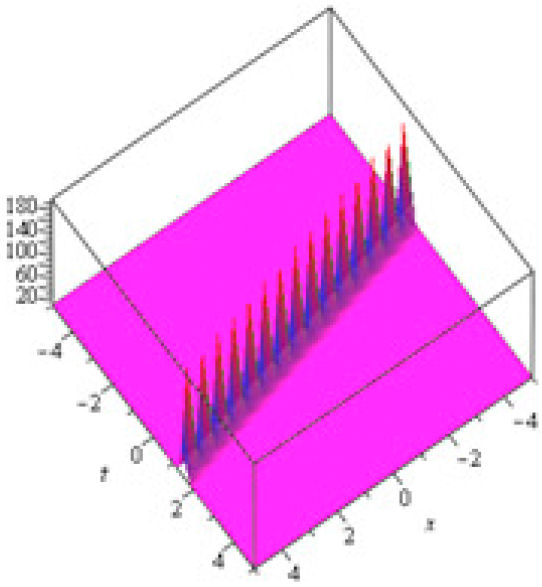
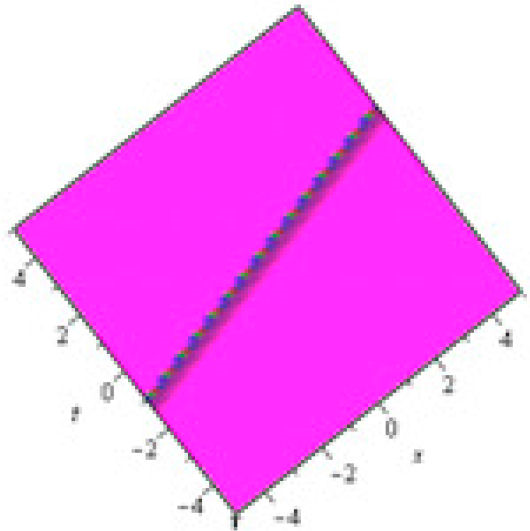
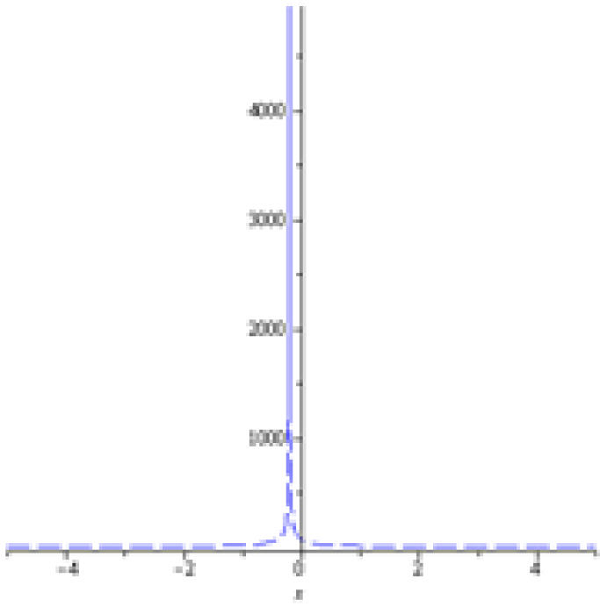
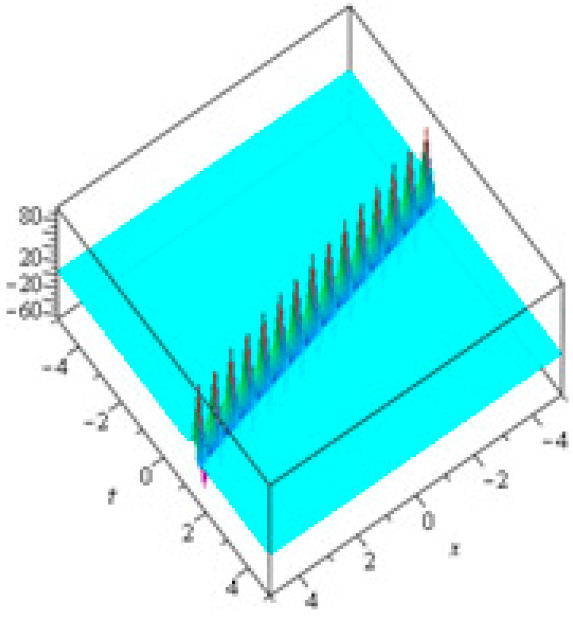
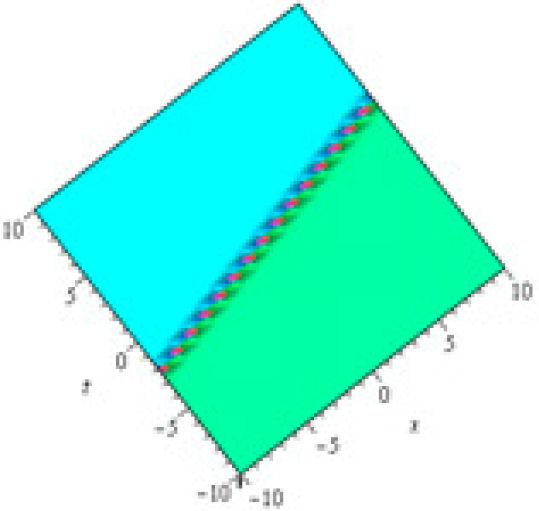
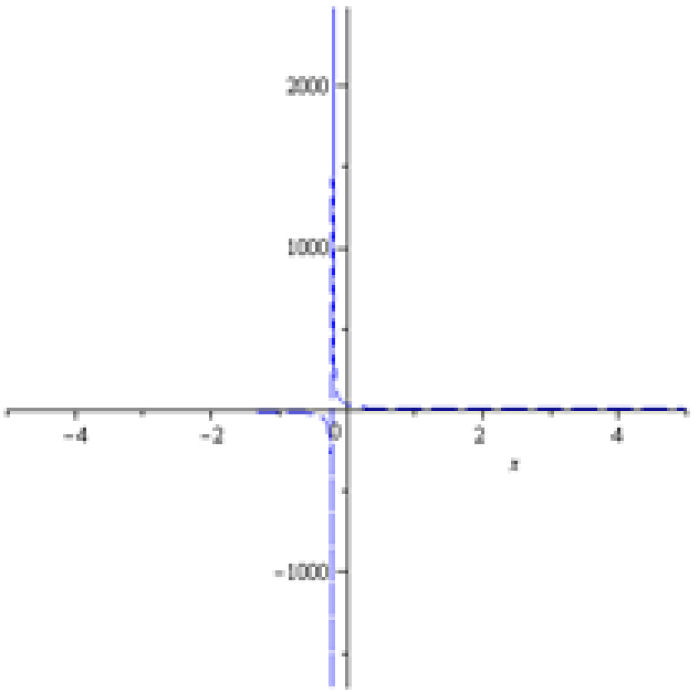
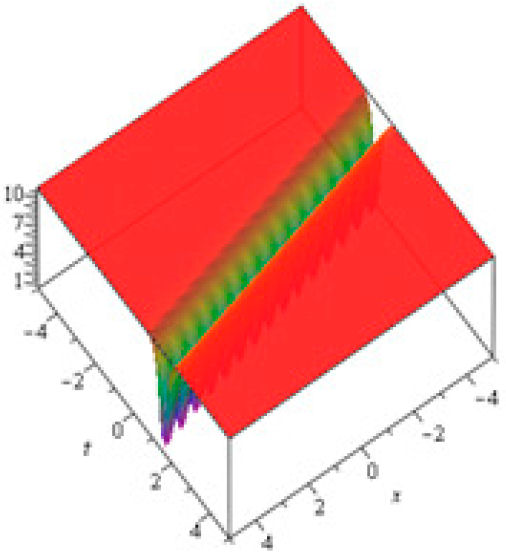
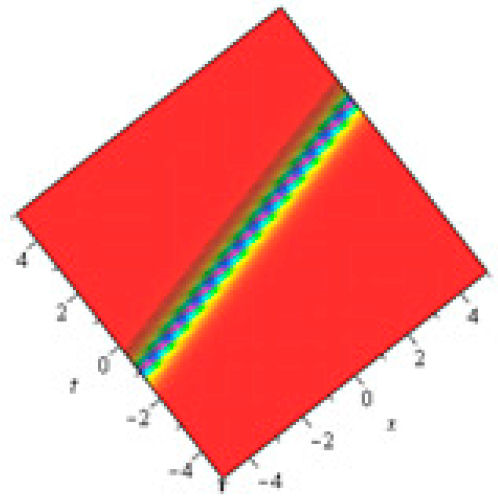
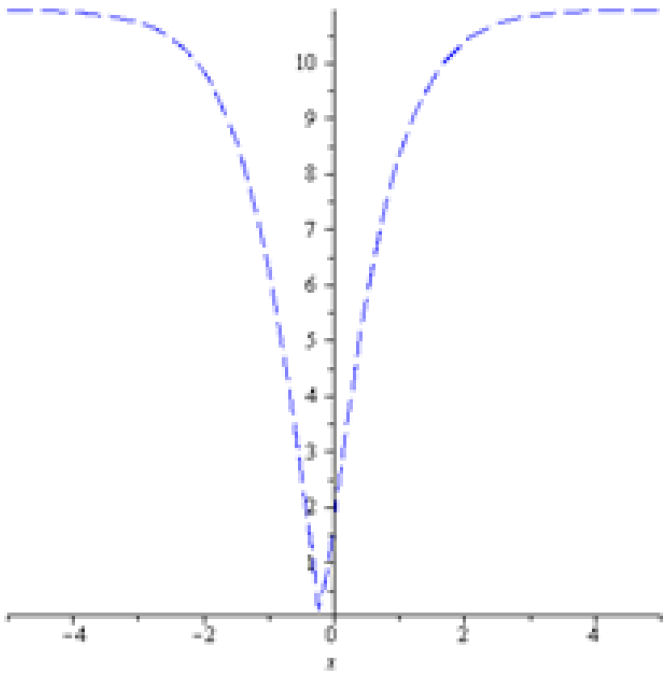
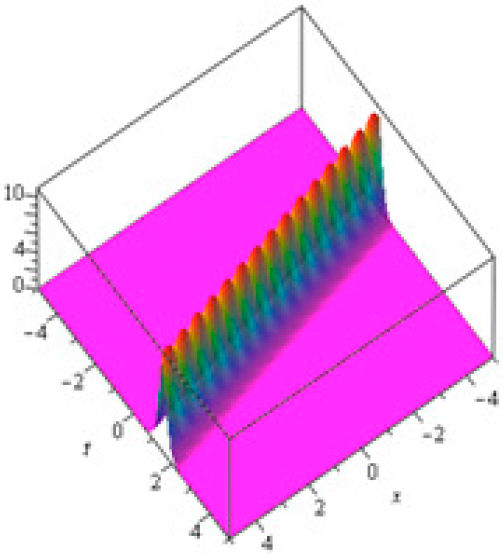
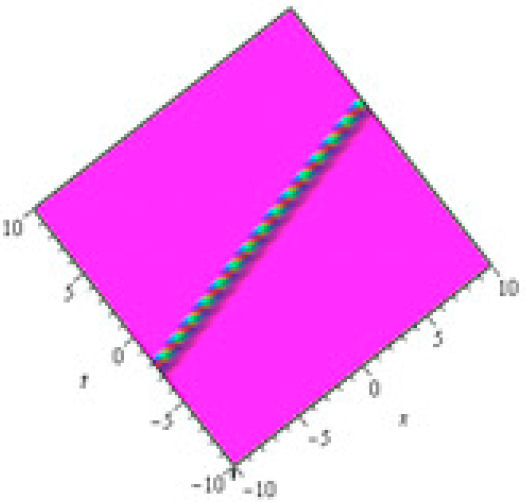
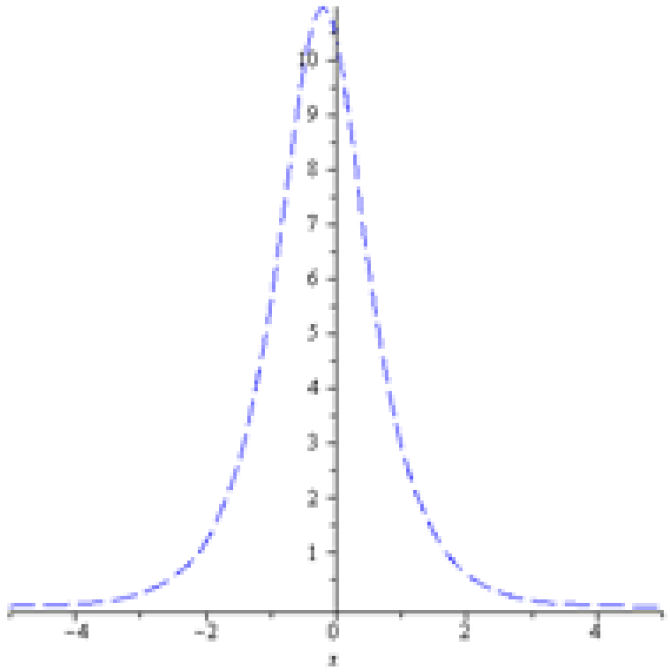
In this section, we have plotted the graphs of the solitary wave solutions. At the moment, we assigned a set of appropriate values to obtain different soliton structures. Moreover, for the Sardar sub-equation solutions, and also for justification, we used
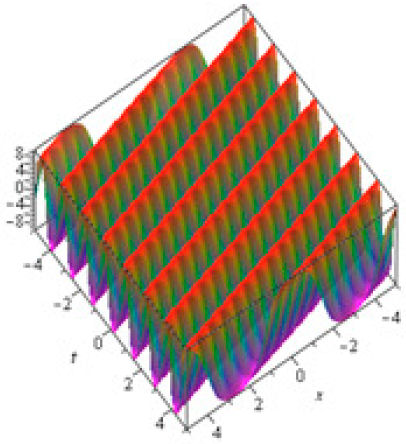
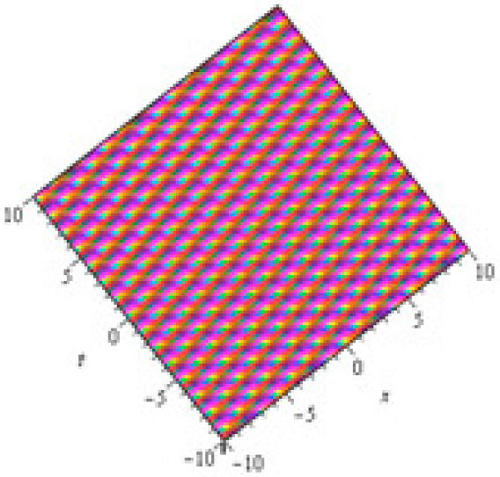
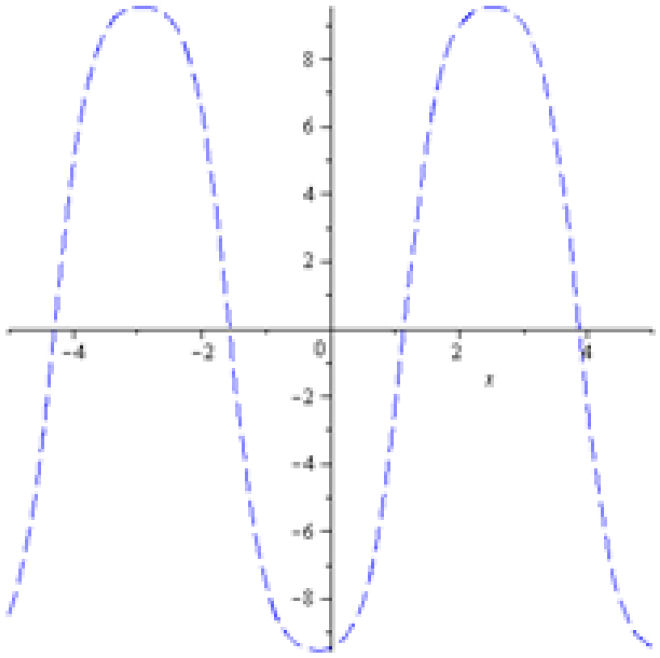
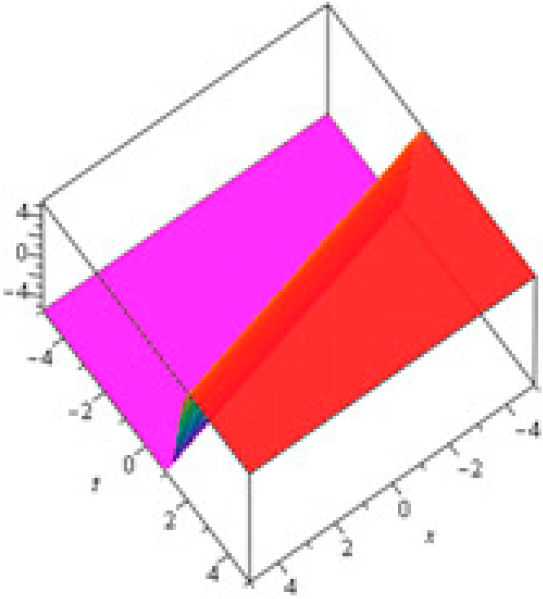
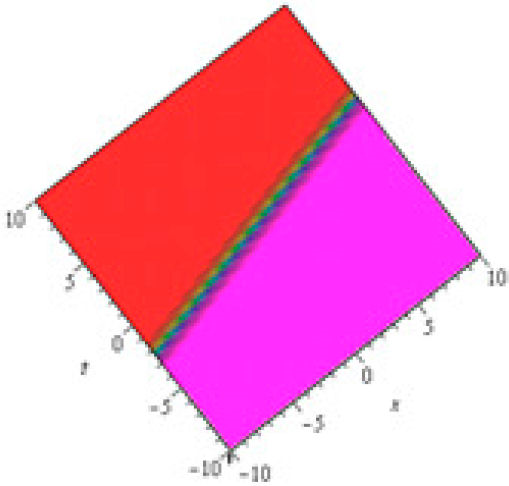
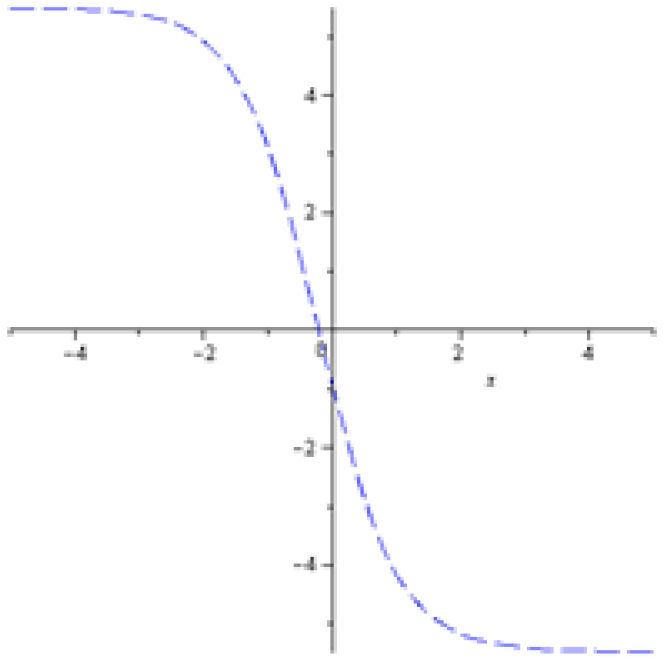
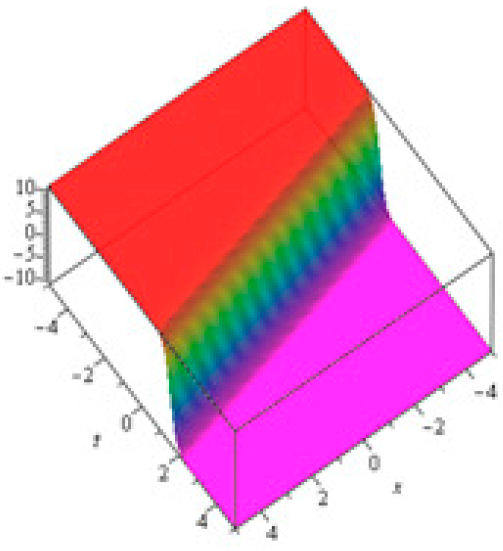
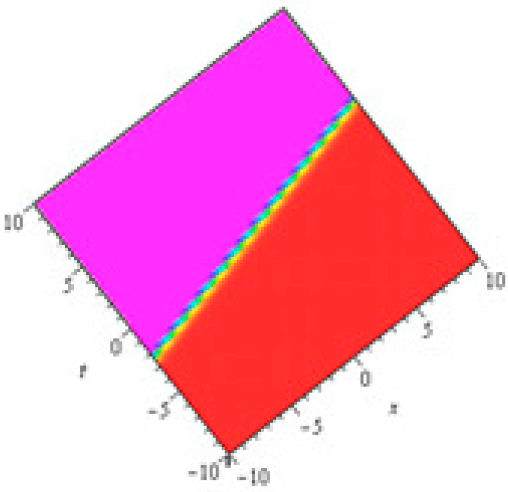
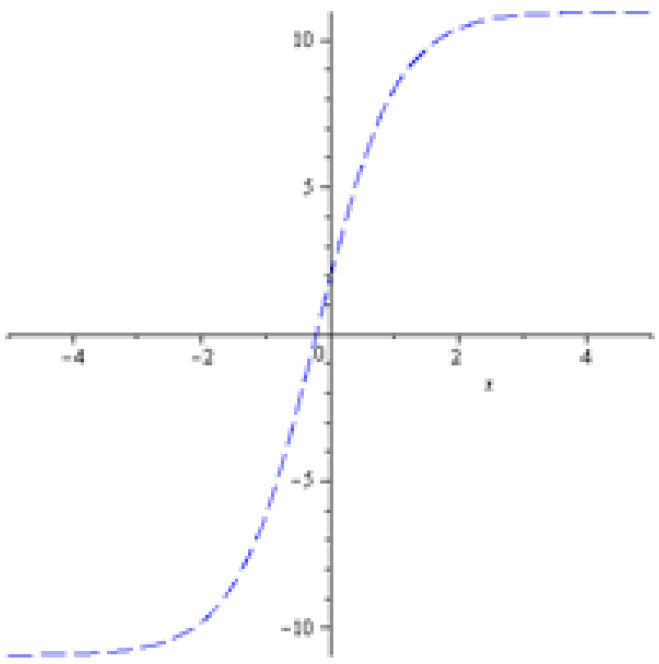
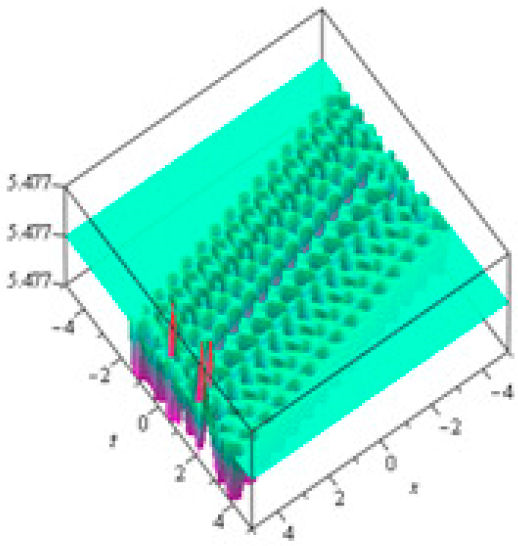
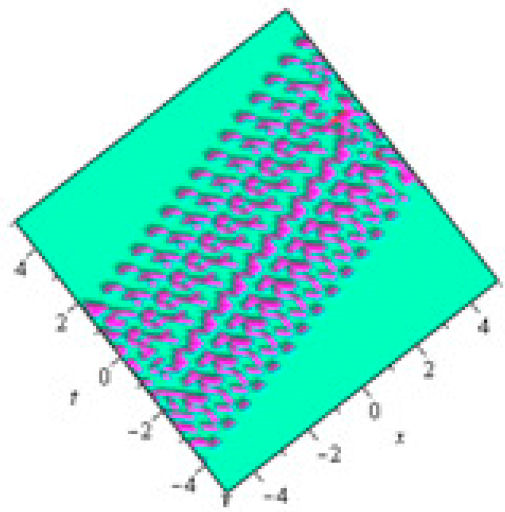
The recovered soliton structures in Figs. 1-24 for both approaches included singular, dark, bright, kink, anti-kink, and mixed solitons. For example, u1(x,t) and u2(x,t) correspond to kink soliton solutions, u3(x,t) corresponds to bright soliton solution, u5(x,t) and u17(x,t) correspond to dark soliton solutions, u6(x,t) and u18(x,t) correspond to singular soliton solutions, u7(x,t) and u19(x,t) correspond Bright-dark soliton solutions, u9(x,t) and u12(x,t) correspond dark-singular soliton solutions, and u10(x,t) corresponds to periodic soliton solutions. The structures in Figs. 1-8 are extremely useful in mathematical physics. Similarly, the same structures and beyond can be obtained using the appropriate values on the solutions derived via the two improved methods.
5 Conclusion
In this paper, we categorically emphasized the effectiveness and generality of the two well-known, well-established, and classified techniques. Therefore, we employed the improved and modified Sardar sub-equation approach and improved generalized Riccati equation mapping method to investigate and analyze the new formats of exact solutions to the nonlinear improved mKdV equation. The techniques have been incorporated gently and applied to this well-known equation. However, the set of solutions, obtained by these techniques, has multiple and popular types of the form, i.e. rational, exponential, trigonometric, and trigonometric hyperbolic solutions of the improved mKdV equation. The methods are quick and highly effective in nature, whereas, in the first phase, we used the wave variable to transform the NPDEs into nonlinear ordinary differential equations (ODEs) with integer order after adapting the most general and simple techniques the IMSSEM and IGREMM are used to construct the novel solutions of the improved mKdV equation. Our findings imply that the approach is a strong, well-defined algorithm that is exceedingly efficient. It is confirmed from the profiles (soliton structures for both approaches) that the novel solutions preserved the qualities of singular, dark, bright, kink, anti-kink, and mixed solitons. Therefore, these methods applicable to solve various nonlinear PDEs arise in different areas of research and soliton. Additionally, these results may be helpful in the KdV equations family and application in engineering and mathematical science. We also presented a direct-viewing analysis by providing both two-dimensional and three-dimensional solution figures. Future studies will also concentrate on several fascinating findings connected to the suggested model, such as the physical feasibility, modulational stability, and the analysis of the lie symmetry of the solutions.

