




 text new page (beta)
 English (pdf)
 Article in xml format
 Article references
 Automatic translation
 Send this article by e-mail
 Cited by SciELO
  Similars in
SciELO
Similars in
SciELO 
 Permalink
1. Introduction
For the first time in humankind’s history, there is a universal call to action to end poverty, protect the planet, and improve everyone’s lives and prospects, everywhere based on the Sustainable Development Goals (UN, 2015). According to BID (2010), in Latin America, the number of people living with less than 10 USD per day increased by 22% in a decade (2000-2010). From 2012 to 2014, two million Mexicans joined the poverty condition. Mexico is within 25% of the countries with the highest income (Iturbide & Quintal, 2020). In Mexico, there are 4’169,677 micro, small, and media enterprises classified in manufacturing, commerce, and non-financial private services (ENAPROCE, 2018). They generate 72% of the total employment and 52% of the gross domestic product. By itself, only the micro-enterprises are 3’959,917 and generate 41.8% of the total employment; the small-enterprises are 174,800 with 15.3% of employability, and the medium-enterprises are 34,960 with 15.9% of such employment (CONDUSEF, 2019). This micro, small, and media enterprises are considered the “economic backbone” of Mexico. The micro-enterprises represent 95% of the country’s productive organizations with several problems in training, management, financing, government support, global value chains, amongst others (ENAPROCE, 2018); in other words, problems based on an apparent lack of a "business model".
According to the OECD (2018a par 3.51), a “business model” includes: “…all core business processes such as the production, logistical, marketing and co-operative arrangements in use as well as the main products that a firm sells, currently or in the future, to achieve its strategic goals and objectives. A firm can use a single business model or several business models simultaneously, for instance, for different product lines or markets. The innovation management literature notes that successful business models combine a method for better meeting users’ needs relative to what competitors can deliver and a profit formula for earning income from delivering utility to customers”.
However, the concept of “inclusive business” (IB) is more than this because it is inspired on the concept of the “base of the pyramid” (BOP) (Hammond & Prahalad, 2004). This concept describes and systematizes experiences from the 2000s to social inclusion relating associative enterprises for poor people into businesses’ value chains. Although this is a business model innovation, there is no single definition because: “… it can vary from partial business model innovations that only affect either a firm’s products or business functions, to comprehensive business model innovations that involve both products and business functions. In many cases, it is difficult to distinguish partial business model innovations from product and business process innovations” (OECD, 2018a, par. 3.52).
The “comprehensive business model innovations” are of greater interest because they can have substantial effects on supply chains and economic production, transforming markets and potentially creating new ones. They can influence how a firm creates utility for users (“product innovation”) and how products are produced, brought to market, or priced (“business process innovations”) (OECD, 2018a, par. 3.53).
The development of competitive IB is crucial to generate employment and income opportunities. It also contributes to improving the quality of agricultural products and their demand. For instance, in the fruit sector, IB can have a real effect on development international growth to increase economic growth and reduce poverty, both in rural and urban areas. However, in order to avoid adverse effects on vulnerable countries and people, it is necessary to have policies and solid strategies to promote IB in the fruit sector (Da Silva et al, 2013).
Based on all mentioned above, this paper is aimed to design a conceptual model of IB for the fruit sector micro-enterprises sector in Mexico as the first steps to reach the sustainable development agenda (UN, 2015).
To achieve it, this work is divided into the explanation of 1) Introduction; 2) The context; 3) Methodology based on two visions: qualitative and quantitative, based on fruit sector experts (professors, consultants and micro-enterprises leaders) to obtain a final IB conceptual model; 4) Literature review; 5) Results; 6) Discussion; 7) Conclusions and 8) References.
2. The Context: the Fruit Sector in Mexico
Mexico has a competitive advantage as a result of its available fertile land, where the possibility, of cultivation of diverse types of crops, in a large scale, exists. Nowadays, Mexico is already one of the main producers and leading exporters of various fruits and vegetables. For example, avocado, tomato, guava, mango, papaya, melon, watermelon, asparagus and frozen orange juice. But weaknesses and threats limit the effective functioning of the Agribusiness sector (Valenzuela-Valdez & Hernández-Pozas, 2017).
According to ITA (2020) states that Mexico is the world’s 11th-largest agricultural and livestock producer, and the third-largest in Latin America. Mexico is a major global producer and exporter of agricultural products, capturing a significant share of the total world exports of citrus and melons (31%), tomatoes (24%), cucumbers (19%), and tropical fruit (22%), including pineapples, mangoes, avocados, and guavas (ITC, 2019). The agriculture and food sector is one of the main engines of Mexico’s rural economy, representing 3.3% of its national gross domestic product (WBK, 2019). The sector has experienced significant growth during the last few years: Production value of crops and livestock increased by 21% and 12%, respectively, between 2012 and 2017 (SIAP, 2018). Mexico’s exports and share in total world exports of agricultural products also increased during the same period. Also, according to FAO (2015), Mexico has increased its arable land since the 1990`s decade. In 2019, the area sown by the agricultural sector in Mexico reached approximately 20.7 million hectares being an important source of employment (411,609 formal jobs) and contribution to GDP at the national level (STATISTA, 2021). Agribusiness in Mexico is currently the most important subsector in the manufacturing sector. In 2013, it contributed to the economy in real terms, with 21.5% of the manufacturing GDP and 3.7% of its total GDP (ITA, 2020). With a rural population living in Mexico approach the 19.8% (or 26,000,000) of inhabitants (INEGI, 2020), the harvest of fruit products in Mexico 2019 was over 22,928,287.56 for an estimated production value of 181,898,055.61 (thousands of Mexican pesos) (SIAP, 2020). Furthermore, this sector has suffered several lag problems over the years, like technology, production, processing, storage, distribution, and marketing (SIAP, 2020; ITA, 2020; ITC, 2019). Mexico keeps its leadership in the fruit sector, mainly with coconut, mango (FAO,2020), papaya, and avocado.
Governments are challenged to develop balanced policies that address immediate needs - such as labor shortages - and to create lasting conditions for the agricultural sector to “rebuild better” (FAO, 2020). About 85% of the growth in world agricultural production in the next decade is projected to come from improved yields derived from increased use of inputs, investments in production technology, better agricultural practices (FAO, 2020b), and business models.
Although the fight against the global COVID-19 pandemic is causing unprecedented uncertainty in global food supply chains, Mexico is expected to maintain a minimal increase in food production in the next decade. Therefore, it is necessary to continue evaluating employment-related indicators, especially when a time of high labor demand is approaching for some countries (CEPAL, 2020).
Despite all the above, the vast majority of Mexican agricultural workers do not receive a fixed salary; this is approximately 3% of the employed population (El Economista, 2019) increasing the gap of poverty and inequality (UN, 2015). To solve this situation, it is necessary to evolve the current business model to an inclusive conceptual business model, as we propose here.
3. Methodology
So far, to apply these concepts, we designed the following methodology stages.
Stage 1. A literature review analyses based on VosViewer software through Scopus and Web of Sciences databases. We analyzed 22 influential papers about the concepts of IB. The technique applied was the content analysis and deduction of concepts through fruit sector experts (professors, consultants, and micro-enterprise leaders). The results were the indicators of the IB conceptual model.
Stage 2. It is denominated qualitative stage involving 6 IB expert professors fruit sector (3 International Business and 3 Marketing professors) were invited to analyze and categorize such Indicators applying Focus-Group and Analytic Hierarchy Process (AHP). Hence, each of the indicators was weighed and compared, obtaining the first list as a first approach. It is the ex-ante IB conceptual model.
Stage 3. -It is denominated quantitative stage, involving 60 IB fruit sector experts (30 consultants, 30 micro-enterprises leaders). It was applied Exploratory Factor Analysis (EFA) based on Rotation Method: VARIMAX with Extraction and complemented with the method: Principal Component Analysis. The result was the grouping of the indicators as support of the IB theoretical framework as a final approach.
Stage 4. Quantitative Survey through direct interview inquiry to the 60 IB fruit sector experts (30 consultants, 30 micro-enterprises leaders) tested during Mar 2109- Mar-2020, as ex-post IB conceptual model.
Stage 5. Data analyses involving:
-Test of validity data was done through the Focus Group-AHP producing the Theoretical Framework
-Cronbach’s Alpha for test confidence
-Exploratory Factor Analysis using Rotation Method: VARIMAX. Extraction Method: Principal Component Analysis
-Results comparisons among.
Stage 6. Discussion and
Stage 7. Conclusion
4. Literature review
In this section, we established the concept of micro-enterprises, the importance of business model innovation and the literature review of inclusive business.
4.1. The concept of micro-enterprises
Both concepts, micro-enterprise, and micro-finance were pioneered in 1976 by Nobel Prize recipient Muhammad Yunus, founder of the Grameen Bank (Bank of the Rural), in Bangladesh. The bank was established to make small loans to the poor (predominantly women) to help them obtain economic self-sufficiency. The fundamental principle behind the Grameen Bank is that credit is a human right. This strategy was highly effective as the bank grew exponentially; from fewer than 15,000 borrowers in 1980, Grameen Bank has over 23 million people with better access to microloans, saving accounts and other financial services, more than 80 social enterprises supporting 170,000 micro-entrepreneurs improving the lives of more than 3 million poor beneficiaries, etc. (Grameen, 2019).
Both terms, micro-business and micro-enterprise often have the same meaning, and internationally, most micro-enterprises are family businesses employing one or two persons. Most micro-enterprise owners are primarily interested in earning a living to support themselves and their families. They only grow the business when something in their lives changes and they need to generate a larger income. See Table 1.
Table 1 Definition of micro-enterprises.
| Source | Concept |
|---|---|
| EU (2003) | Within the Small and Media Enterprises (SME) category, a micro-enterprise is defined as an enterprise which employs fewer than 10 people and whose annual turnover and/or annual balance sheet total does not exceed EUR 2 million. |
| United Kingdom (Young, 2013) | Nearly 95% of all firms are micro-enterprises employing fewer than ten people; 75% have no employees. |
| USA SBA (2019) | A micro-enterprise is defined as a business with five or fewer employees. Many of these businesses have no employees other than the self-employed owners. Additionally, such micro-enterprises generally need less than $35,000 in loan capital and do not have access to the conventional commercial banking sector. The basis of micro-enterprise in the U.S. is entrepreneurship, recognizing a fundamental right of people to apply their individual talents, creativity and hard work to improve their lives. The Micro-enterprise programs, therefore, are built around the philosophy that the unique ideas and skills of entrepreneurs should be provided by business assistance and small amounts of credit to support the development or start-up of a small business, primarily through the U.S. Small Business Administration. Most organizations in the field also focus their services on those microentrepreneurs who, as defined by federal government standards, are low-to-moderate income. By definition, most of these entrepreneurs are minorities, recent immigrants, women, disabled or for other reasons have special challenges that reduce their ability to access traditional credit and other services. |
| México SE (2019) | Micro- enterprises are all those business’ that have less than 10 workers, generate annual sales of up to 4 million pesos and represent 95 percent of the total companies and 40 percent of employment in the country. In addition, they produce 15 percent of the gross domestic product. For the application of public policies, the Small Business Administration (Subsecretaria) for Small and Medium Enterprises (SPYME) has developed the National Micro-enterprise Program. This program supports entrepreneurs with a) group training and on-site consulting, b) homologation of image and c) financing for those who provide the complete legal documents. According to the latest Economic Census published by the National Institute of Statistics and Geography (INEGI), about the universe of economic units in Mexico: a) 95% are microenterprises, b) generate 41.8% of employment, and c) contribute around 15% of the added value of the economy. |
Source: Several sources with own adaptation.
Thereby, is necessary to describe the concept of business model.
4.2. Business Model
A business model is a model of a business. A generally accepted definition of the term “business model” has not emerged yet but we can say that it describes the logic of a “business system” for creating value that lies behind the actual processes (OECD, 2018a). A model, on the other hand, is only an artificial representation of reality. It, therefore, has to detract focus from certain aspects while concentrating on others; it is impossible for all the variables that comprise reality to be adequately and consistently represented, particularly if the goal is to control for effect of certain factors over others. Due to a model can be descriptive or predictive, you would not rely on the outcomes of the model only in your making decisions. This is because a model cannot (and should not) be a complete and precise representation of reality (even for very simple social systems). A business model describes the rationale of how an organization creates, delivers, and captures value, in economic, social, cultural or other contexts (Osterwalder & Pygneur, 2010). Moreover, what is considered to be important for the model depends on the position of the observer (Petrovic et al. 2001). The essence or core competency of the company’s business model is to know how it attracts, creates, storage, transform and deliver value. This logic influences important decisions, although in many cases it is very difficult to clearly and simply communicate their knowledge. This logic of the system, the business model, is based upon a complex mental model and that can only be really changed if the mental representation of the real world is altered first. The mental model can be described as a network of facts and concepts, and its content and structure contain our understanding of social and physical phenomena (Morecroft, 1994). The focus is on internal processes and the design of infrastructure, which enables the firm to create value. The decision elements include product or service delivery, administrative processes, resource flows, knowledge management, and logistic streams. A business model describes how an organization (enterprise, business unit) creates, delivers, and captures value. The process of business model construction is part of the business strategy. The business model must be evaluated against the current state of the business ecosystem (Korpela et al., 2013).
4.3. The Base of Pyramid
The term Base of the Pyramid (BOP) is used to describe people living in poverty in the broad sense in which the poor themselves understand and experience it (Prahalad & Hammond, 2005). In this segment, consisting of two thirds of the population worldwide, there is great potential to earn money, offering sectors poor access to goods and services that they currently cannot access.
In the BOP there is a transformation: the need as a business opportunity (Iturbide & Quintal, 2020). In 20,000 interviews conducted for the World Bank study Voices of the Poor, the poor describe not only a lack of income, but more fundamentally: a lack of access to goods, services, and economic opportunities (Jenkins et al., 2010). Too often, people living at the BOP cannot get key products at the levels of quality and affordability that others rely on. They may lack steady jobs, business opportunities, clean water, electrical power, good roads, modern communications, healthcare, education, or financial services; or, in the absence of efficient, formal markets, they pay more for such services than those living at the top of the pyramid (a phenomenon known as the poverty penalty. Many people view those at the BOP as responsibilities of the state or subjects of charity. But if we stop thinking of the poor as victims or as a burden and start recognizing them as resilient and creative entrepreneurs and value-conscious consumers, a whole new world of opportunity will open up (Jenkins et al., 2010).
4.4. Inclusive Business as Business Innovation
According to OECD (2018a, p. 21), business innovation is: a new or improved product or business process (or a combination thereof) that differs significantly from the firm’s previous products or business processes and that has been introduced on the market or brought into use by the firm.
However, there is a lack of academic consensus on the elements determining a superior business model and the underlying factors influencing the degree of business model innovation in inclusive business (Sánchez & Ricart, 2010). Thus, we aim to contribute to the current debate on business model innovation from a perspective that permits us to systematically observe the set of interactions performed in the firm’s business activities. This aspect is especially critical in inclusive business because the firm’s ecosystem can have a decisive influence on the business model configuration (Sánchez & Ricart, 2010). Hence, we begin by reviewing the inclusive business model to determine the indicators and factors that are involved, reasoning out their applicability to the Mexican context. Finally, we discuss the main implications in the interaction of such factors to propose a final conceptual model of inclusive business for the micro-enterprises. The IB is interesting for companies because it can offer new opportunities for innovation, growth, and competitiveness at the same time as positive social and development impact. It is interesting for bilateral and multilateral donors, foundations, governments, and civil society organizations because it has the potential to drive development impact in self-sustaining, self-multiplying ways that do not require continuous infusions of grant funding. And it is interesting for the poor because it brings greater access, choice, and opportunity in their lives and future (Jenkins et al. 2010).
4.5. Inclusive Business definition
An IB model is a commercially viable model that benefits micro-enterprises by including them in a company’s value chain on the demand side as clients and consumers, and/or on the supply side as producers, entrepreneurs or employees in a sustainable way (UNDP, 2008). The SNV-WBCSD (2011) defines the IB, as: “…an economically profitable, environmentally and socially responsible entrepreneurial initiative, which integrates low-income communities in its value chain for the mutual benefit of both the company and the community. It seeks to improve the livelihoods of low-income populations while increasing returns to the company. An IB offers the company an opportunity for sustainable development and expansion of its market segment to include low-income populations. IB offers poor families a chance to take the opportunities offered by the market and profit from the dynamic nature of the business sector. It involves a relationship between a company (anchor company) and groups of local entrepreneurs or consumers and strives to maximize both the social and economic value of the opportunity. This is where IB differs from other schemes such as philanthropy, which tends to be separate from business activities and does not necessarily seek to generate financial returns or create long-term economic sustainability”. The IB link the companies with all in two ways: 1). By inclusion of groups of micro-enterprises segment within the company value chain as suppliers of raw materials or services or distributors or business partners. Such an inclusion allows the generation of additional employment, incomes, and it accelerates the transfer of capacities to the micro-enterprises. By integrating micro-enterprises populations in the value chain of the companies as consumers by making it possible for them to access the services or products they need at prices they can afford (SNV-WBCSD, 2011). Hence, there are several benefits for each part (company-micro-enterprise) based on different approaches. See Table 2.
Table 2 IB Benefits.
| Partner, supplier or distributor approach | |
|---|---|
| For the Company | For the micro-enterprises |
|
|
|
| Consumer approach | |
| For the Company | For the micro-enterprises |
|
|
|
Source (SNV-WBCSD, 2011) with own adaptation.
As you can see, IB has several opportunities to promote development led by the private sector (SNV-FORD-OMIN, 2015). However, many businesses are not taking advantage of them because market conditions surrounding the micro-enterprises can make doing business risky, difficult, and expensive. Where poverty prevails, the foundations for functional markets are often lacking, excluding the poor from meaningful participation and deterring companies from doing business with them. UNPD (2008), identifies five major market constraints and successful strategies to overcome them (see Table 3).
Table 3 Constraints vs. Strategies.
| Constraint | Strategies |
|---|---|
| Limited market information. | Businesses know too little about the poor (what poor consumers prefer, what they can afford and what products and capabilities they have to offer as employees, producers, and business owners). |
| Ineffective regulatory environments | The markets of the poor lack of regulatory frameworks that allow a business to work. Rules and contracts are not enforced. People and enterprises lack access to the opportunities and protections afforded by a functioning legal system. |
| Inadequate physical infrastructure. | Transportation is constrained by the lack of roads and supporting infrastructure. Water, electricity, sanitation, and telecommunications networks are lacking. |
| Missing knowledge and skills. | Poor consumers may not know the use and benefits of particular products or may lack the skills to use them effectively. Poor suppliers, distributors, and retailers may lack the knowledge and skills to deliver quality products and services consistently, on time and at a set cost. |
| Restricted access to financial products and financial services. | Lacking credit, poor producers and consumers cannot finance investments or large purchases. Lacking insurance, they cannot protect their meager assets and income against shocks such as illness, drought or theft. And in the absence of transactional banking services, their financing is insecure and expensive. |
Source: UNPD (2008).
Poverty reduction is a pending issue in Latin American societies. The concept of IB has been formulated to describe and systematize a set of experiences arisen in the 2000. It is aimed at generating social inclusion through the creation of micro-enterprises as associations of poor people. These micro-enterprises are incorporated into the business value chain, establishing the “need for new conceptual frames regarding poverty is as urgent today as ever” and its impact on poverty alleviation (Lateh et al., 2017; Austin & Chu, 2006). Traditionally, poverty has been conceptualized as a “lack of resources materials” (Gutiérrez & Lobo, 2006). Consequently, the strategies designed to face it they have based on actions aimed at providing those resources to the poor or to develop skills so that they can get them on their own (Gutiérrez & Lobo, 2006). The first type of action, predominantly, by the way, has materialized through various forms of assistance, which currently find their maximum expression in the social plans that are being massively implemented in several Latin American countries. Among the actions of the second type stand out the great training programs for labor insertion, technical assistance aimed at the creation of micro-enterprises or the development of microcredits (Licandro, 2013). In the late 1990s, poverty began to be conceived as the inability to control one’s circumstances, rather than as the lack of material resources. This way of defining it serves to identify the main factors that generate it. In addition to the lack of material resources, the poor have serious difficulties to 1) organize and carry out actions collective 2) network and 3) interact in the public spaces of negotiation, in particular with government institutions (Gutiérrez & Lobo, 2006). It is about a socio-cultural approach, complementary to the economic, in other words, “social inclusion is not possible without economic inclusion”. Hence, the IB consists in (Licandro, 2013): 1) social inclusion requires the transformation of the poor into economic agents integrated within the market economy; 2) becoming integrated economic agents implies that these segments have the possibility of accessing goods and services that improve their quality of life (visualize the poor as consumers) or incorporate to existing production and marketing systems (view the poor as employees or entrepreneurs); 3) to turn them into economic agents integrated, it is necessary to lift the socio-cultural restrictions that limit the ability of these segments to act within the parameters of the market economy (traditional forms of production, work resistance associative, low-quality standards, etc.) and 4) participation of the private sector is essential as the engine of this inclusion process, either through the development of goods and services aimed at improving the quality of life of the poor, as through the incorporation of micro-enterprises to their value chains: suppliers, actors that add value to their products, agents within the distribution chain, etc. The concept of IB has been proposed to designate various experiences of social inclusion, based on the incorporation of BOP people to economic activity by launching a business, starring groups of these segments. These ventures are integrated into productive chains in which they can play various roles: suppliers, agents that add value or commercial agents (sellers and dealers). According to Iturbide & Quintal (2020), in Latin America, the IB is aimed mostly in food.
4.6. Our Inclusive Business Scope
It is often argued that the success at low income markets (BOP) requires innovative and inclusive business models. However, research findings on this have been quite descriptive and generic (Danse et al., 2020). Kaminski (et al., 2020) made a study based on 36 papers about a review of IB models. The scope to which these models helped poor actors overcome specific barriers was evaluated, focusing on how they may ensure or be a risk to inclusiveness through the relations and upgrading opportunities evident in their make-up. The majority of the models focused on economic upgrading over social upgrading. Providing opportunities for the latter is key to achieving the inclusive objectives of IB models. They conclude that greater horizontal coordination among actors can create further economic upgrading opportunities under vertical coordination with other nodes upstream and downstream in a value chain.
As far as social value is concerned, there are experiences that have included the Bottom-of-Pyramid approach, involving low-income customers and/or low-income business partners. However, persists a need to apply multiple-criteria approaches to map, for instance, several kinds of models, such as ecological inclusive business models, and structure their main features in terms of sustainable development (Norese et al., 2020).
Hence, in the fruit sector context, our research’s scope is to design an IB conceptual model for micro-enterprises that gather all horizontal and vertical coordination nodes and several multi-criteria approaches to achieve rather social benefits than economic benefits.
Therefore, our problem is described in to achieve the following general objective (GO): “To determine indicators proposed for an IB model, able to be incorporated in the fruit sector micro-enterprises of Mexico”.
To solve this, it is necessary to propose an IB conceptual construct based on the latest business models related to fruit sector micro-enterprises. To characterize and describe the final model based on qualitative tools, such as a Delphi Panel method and the Analytic Hierarchy Process (AHP) to business’ models’ experts, to achieve the following specific objectives (SO):
SO1: “The definitions and main indicators mentioned in the literature review”
SO2: “A final design of the IB questionnaire”
SO3: “To determine an accumulative effect of the new groups of variables in the model”.
4.7. Searching for the IB conceptual model
To understand better the indicators by author involved in the IB definitions, we gathered in the following Table 4.
Table 4 IB conceptual model definitions and main indicators.
| No. (#) | Authors | Main IB indicators approaching Note: We show in the format (# ABC) the concepts where # is the number of the author and ABC the abbreviation suggested, of the concept described. |
|---|---|---|
| 1 | Iturbide & Quintal (2020) | The Corporate Social Response (1CSR) evolves to Corporate Intelligence Response (CIR) included reputation, risk, and social media as boosters of IB. Private enterprise as a cornerstone of social transformation and co-responsible for social development. Several names of BOP or IB, depending on the approach: consumer, producer, etc. and well known as Linkage Business (1LKB among micro-enterprises and/or SME); Value Chain Development Towards the Poor (1VDP); Making Markets Work for the Poor (1M4P) or Responsible Management of the Supply Chain (1RMS). The IB based on the private enterprise, with a low participation rate due to mainly the lack of information and unconsciousness (1LIU). A guide to design and implement an IB is 1) Identify the potential market (1MKP); 2) Identify critical business competences (1CBC); 3) Choose the target market (1CTM); 4) Identify and recognize knowledge skills of communities within the target market (1KSC); 5) Validate that the company’s competences serve the target market (1BCM); 6) Stablish the business model (1BSM); 7) Choose and commit alliances (1ALL); 8) Choose and commit investors (1INV); 9) Execute (1EXC). Social media (1SOM) as the main factor to generate social value based on smartphones for 2’500,000 BOP people. |
| 2 | KUNAN (2019) | IB as social and environmental ventures (2SEV); social impact (2SOI); business status (2BIS); social business ecosystem (2SBE); innovation (2INN). The 2SEV are understood as those businesses in which a social or environmental mission predominates against to a critical or latent problem. Develop products and services that reverse directly in society and that intentionally help to solve basic human needs, provide market access to segments of population located at the BOP, address social problem solving, or contribute to human development and sustainability through an environmental action (2ENA). Like everything entrepreneurship, are initiatives of private origin that are on the way or are financially sustainable. |
| 3 | CODESPA (2018) | IB with four main characteristics: a) Commercial viability (3CVI); b) Positive social impact about human development (3PSI); c) Environmental impact (3EVI); d) Transversal innovation (3TVI); e) Scalability (3SCY). The new keys of IB are Innovation ecosystems (3IEC); Open innovation (3OIN); Last mile innovation (3LMI); Intersectoral alliance networks and technology (3INT); Sustainability and value generation (3SVG). |
| 4 | Rengifo (2017) | Sustainability criteria: 1) Financial viability (4FNV); 2) Social progress (4SOP); Ecological balance (4EBA). The IB is not subsidies. There are four processes to develop IB: 1) Manufacturing (4MFT); 2) Shopping (4SHP); 3) Distribution (4DST); 4) Design (4DSG). Novelty concept called Inclusive Territorial Development that involves: 1) An insured market (4INM); 2) A committed anchor company (4CAC); 3) A coordinating and articulating entity (4CAE); 4) Trust generation (4TRG); 5) The needs of companies and their sustainability strategy aligned. The anchor company is definitive for IB development. |
| 5 | OECD/EU (2016) | There are six keys to success in designing and delivering inclusive entrepreneurship policies and programs: 1) Develop and deliver inclusive entrepreneurship policies and programs as part of an integrated strategy (5PAP); 2) Define clear objectives and targets for policy intervention (5COT); 3) Use targeted outreach to engage disadvantaged and under-represented groups (5OUR); 4) Use competitive mechanisms to target intensive support on those with the potential to succeed (5CMT); 5) Use specialist trainers and advisers (5STA); 6) Learn from experience (5LFE). The key evaluation criteria are: 1) Relevance (5REL); 2) Effectiveness (5EFF); 3) Efficiency (5EFY); 4) Impact (5SOI); 5) Sustainability (5SUS). |
| 6 | Kelly et al. (2015) | The basic steps for implementing a business model approach are to 1) Appraise the current business model: compare the separate business models of the farmer organization and buyer (6ACB); 2) identify common upgrading priorities: prioritize upgrading needs that are common to both seller and buyer (6PRN); 3) Design an upgraded business model: design interventions that respond to the common upgrading priorities identified (6DSG); 4) Measure progress set indicators to be measured continually (6KPI). The IB model includes 1) Inclusion of existing value chain actors (6VCA); 2) Inclusion of less endowed actors (6IEA); 3) Inclusion of diverse market outlets (6IDM); 4) Inclusion of right partner mix (6IRP). Competitive IB model principles are: 1) Managing a business model strategically (6MBS); 2) Business-to-business coordination (6BBC); 3) Responding to customers’ needs (6RCN). The good practice guidance tips on targeting business model participants are: 1) Select commodities with potential for smallholder commercialization aligned with government priorities (6SHG); 2) Include a significant number of organized farmers capable of supplying target buyer (6NSB); 3) Identify receptive buyers to deal with smallholder suppliers (6IBS); 4). Target smallholders with a clear comparative advantage in the market (6TSM); 5) Work with competent NGOs or apex farmer organizations to facilitate business partnerships and oversee implementation of technical activities (6CSB); 6) Link business model actors to locally accessible financial services and products (6LSF). |
| 7 | SNV-FORD-OMIN (2015) | Solutions for the development are based on: market (7MKT); suppliers (7SPP); consumers (7CON); employees and stakeholders (7EAS); public policies (7PUP); access to financing (7ATF); operative services (7OPS); strategical services (7STS); corporate social responsibility (7CSR); social entrepreneurship (7SEP); share value (7SHV); chain value (7CHV); micro-enterprises (7MIE); base of pyramid projects (7BOP); investments (7INV); social and environment impact (7SEI); motivations (7MOV); public policy (7PPO). IB ecosystem (7IBE) with roles and mechanisms; benefits to the company, community and others, costs; sustainability. |
| 8 | SPRING (2014) | Informal markets are the heart of emerging market economies. By tapping these networks, businesses gain immediate access to customers and can leverage established distribution channels. Use technology (8TEC) to formalize the informal sector to go down-market while upholding quality. Technology is the key to a sustainable scale (8SCY). |
| 9 | Lundy et al. (2014) | IB models understood as those businesses in which smallholding producers are involved as providers (or sellers), represent opportunities for economic and social development for both producers and private actors (or buyers). These models possess the virtue of linking actors more effectively, coherently and transparently when a basic business principle adheres to both sides (sellers and buyers) must win. This IB model is based on 1) The value chain map (9VCM. It is used to understand the macro context of markets and the businesses which link rural producers with buyers); 2) The business model canvas (9CNV) used to understand in more detail each business which links rural producers with buyers. 3) The New Business Model principles (9NBP) used to determine whether each business that links rural producers with buyers is truly inclusive; 4) The prototype cycle (9PTC) used to continuously improve the inclusivity of every business which links rural producers with buyers. |
| 10 | WBSCD (2014) | The scalability (10SCY) is a combination of the number of individuals reached, the geographical footprint and the volume of purchases or sales, depending on the industry in question and the nature of the IB model in question. From this point of view, the scale is also a concept closely related to the notion of return and return on investment threshold, because only commercially viable projects are truly scalable. However, there are constraints: 1). The opportunity cost of the investment with the following solutions: portfolio approach adoption; getting the support of company executives; quantifying the total value perceived by the company; finding external investors (10OPC); 2). Discordance between the strategic and the operational with the following solutions: designing a business plan; leaving from the corporate greenhouse; adjusting the performance objectives; create a company separately (10DSO); 3). Capacity gaps (10CGP). With the next solutions: go to the external partners (EXP); internal capacity availability (10ICA); support professional development (10SPD); create centers of excellence (10COE) |
| 11 | SNV (2014) | IB Toolkit describing an IB modalities: Consumer (11CON); Supplier (11SPP); Distributor/ Entrepreneur (11DEP); Employees (11EMP). |
| 12 | Licandro (2013) | Strategic poverty approaches Assistance(12ASS); Training (12TRN). Note: CSO=Civil Society Organizations. IB and BOP are convergent producing inclusive markets and the BOP people are at the same time consumer and entrepreneur. Two basic principles: reciprocal value (12RVA. Each stage of the process must create relevant value for each of the partners) and the principle of co-creation (12COC. The company’s need to work in equal collaboration with the BOP communities to imagine, create and grow sustainable businesses). Three ways to define a BOP cluster (12CLU. With profitability and social inclusion): 1) Reconceiving products and markets for a better quality of life (12BQL); 2) Redefining productivity within the value chain and (12PVC) 3) Promoting its construction and operation in key local areas (12KLA). Another novelty concept is the BOP ecosystems (12BOE) as an economic community supported by a base of organizations that interact and that revolves around the production of goods and services. It involves co-dependency (12CDP), co-evolution (12COE) and co-learning (12CLR) base of successful IB. |
| 13 | Licandro & Pardo (2013) | ISO 26000 on Corporate Social Response (13CSR) states: The Copenhagen Declaration recognizes the urgent need to address profound social changes, especially poverty, unemployment, and social marginalization. The adoption of IB emerges as an aligned CSR practice. |
| 14 | SNV-WBCSD (2011) | SNV defines as an IB any business initiative that, without losing because of the objective of generating profits, contributes to overcoming poverty through the incorporation of lower-income citizens into the value chain. There are two different parts: The company and the micro-enterprise each-one analyzed from two approaches: 1). Partners, suppliers or distributors (14PSD); 2). Consumers (14CON); 3). It must be pursuing the success factors of IB based on the side of the company: sources of co-financing; the role of the anchor company; the presence of a brokering agent (14BKA); the support must come from the highest level of company management (14HCM). It is necessary to improve access to financing or investment capital sources and market demands (14INV). And based on the side of the micro-enterprise: the role of expectations (14EXP); the regulatory framework (14REF. Inter-institutional alliances), incentives coupled with adequate legal frameworks and institutional conditions. It is necessary to improve in: geographic dispersion and low levels of collaboration (14GDL); methodologies and tools adapted to the cultural and social reality of small-scale suppliers (14MTC); conventional regulatory frameworks (14CRF). To be able to fully take advantage of the great potential represented by IB and to expand its results, there is a path to determine risks and mitigate them through impact evaluation framework (14PMR). Since 2014, the SNV includes a third approach: the employees (14EMP). |
| 15 | Casado (2011) | There are several conceptual tools for analysis, creation and IB Management, such as 1) BOP Protocol 2.0 proposes a model for the IB creation based on understanding local cultural restrictions (15CUR)/ opportunities and knowledge use of local resources and capacities (15OKL); 2) MEINI (Marco para la Evaluación de Impacto de Negocios Inclusivos) composed in four main areas: around the IB: design (15DSG), implementing (15IMP), results (15RES) and governance (15GOV). Finally, four important tools showed as 1) Sectors of opportunity (15SOO); 2) Matrix of strategy vs constraints (15MSC); 3) IB Typology determined by their place in chains of value (15TCV); 4) Map of institutional actors (15MIA). |
| 16 | AVINA (2010) | IB is characterized by three conditions: 1) Be self-sustaining (16BSS); this means, that its viability in the medium and long term cannot depend on subsidies or external support to the logic of the market in which it operates, except at the beginning and only until the moment of its consolidation; 2) Be environmentally responsible (16ENV). This response to the proven fact that the BOP groups are the most affected by the environmental impact of production systems. 3) It generates a real improvement in the quality of life of these groups (16QOL). It is not enough that entrepreneurship allows generating economic income if in the medium and long term the situation of departure of its protagonists is perpetuated. 4) The IB must operate within the market economy and, consequently, they have to be prepared to do it within its rules (16MKE). This condition differentiates the IB of the micro-enterprise creation programs implemented and failed in the 1980s and 1990s. |
| 17 | Jenkins (et al. 2010) | Proposal of IB solutions based on technology and partners as enablers with a description of tactics in five core challenges as 1). Expanding reach (17ERC); 2). Facilitating access to finance (17INV); 3). Changing mindsets and behaviors (17CMB); 4). Designing appropriate products & services (17DPS); 5). Developing pricing & payment policies (17DPP). |
| 18 | SEKN (2010) | Three main characteristics for an IB: 1) Scaling (18SCY); 2) Permanence (18PER) on time and 3) Efficiency and Efficacy (18EFE). Social Value & Economic Value (18SVA). Organizational Ecosystem. Barriers: 1) Logistics (17LOG). 2) Organizational (18ORG); 3) Cultural (18CUL); 4) Scholarship (18SCH). Boosters: 1) Targeted investments (18TGI); 2) Organizational capabilities: 4) Technical preparation (18TEP); 5) Communication & dialog (18CAD); 6) Fair prices (18FPR). |
| 19 | UNPD (2008) | Five strategies based on the entrepreneur´s ingenuity: 1). Adapting products and processes (19APP); 2). Investing to remove market constraints (19IRM); 3). Leveraging the strengths of the poor (19LSP); 4). Combining resources and capabilities with other organizations (19CRC) and, 5). Engaging in policy dialogue with the government (19EPG). The Growing Inclusive Markets strategy matrix (19SMK) as a tool to stimulate and guide that ingenuity, highlighting the crossing of five constraints: 1). Market information (19MKI); 2). Regulatory environment (19REE); 3). Physical infrastructure (19PHI); 4). Knowledge and skills (19KAS); 5). Access to financial services (19AFS). The Growing Inclusive Markets Strategy Matrix (19MSM) relates the five broad constraints to the five core strategies showing how these strategies are most often applied. The strategy matrix can help entrepreneurs and analysts scan possible solutions to the constraints they face. It is crucial to note that successful IB models typically combine several strategies to address several constraints. To get from broad strategies to focused solutions, one must not only identify each local constraint but also understand its dynamics in the market, information that allows a business model to build on a market’s specific strengths. |
| 20 | Austin & Chu (2006) | To find effective solutions, the world’s attention has gradually turned to private enterprise, the sector to which even his detractors recognize his capacity for execution. This is with three conditions (that only fulfills the private company): 1) Scaling (20SCY); 2) Permanence on time (20POT) and 3) Efficiency and Efficacy (20EFE). |
| 21 | WBSCD (2006) | Let´s do business with micro-enterprises in a way that benefits the poor and benefits the company considering: 1) To become the mainstream of thought and activities of the company (21MTA); 2) Do not have a limited and fixed budget (21LFB) and 3) have an immense potential to grow and replicate (21PGR). |
| 22 | Prahalad & Hammond (2005) | The business opportunities regarding the BOP are real and are open to any multinational willing to get involved and learn. The BOP offers three advantages: 1) A demand on goods and services with low prices and good quality producing a great sales potential by volume (22LPQ) 2) Ability to produce at low cost, to be competitive in that market (22LCC). 3) It can push companies to discover creative ways to configure products, finance, and supply chains to boost productivity, which generates new competencies that companies can transfer to their operations in the markets developed (22DCW). |
Source: Several authors with own adaptation.
5. Results
The conceptualization of an IB model is still dispersed and we need to determine the indicators and factors of the study. Therefore, we gathered a group of 6 IB expert professors fruit sector (3 International Business and 3 Marketing professors). This expert group was focused on its experience and attention to determine the main indicators with name factors suggested to be grouped, and the order to be involved in the conceptual model of IB. It was used, qualitative tools to analyze and categorize such indicators applying: Focus Group and Analytic Hierarchy Process (AHP) according to Saaty (1997). AHP represents an accurate approach to quantify the weights of decision criteria. Individual experts’ experiences are utilized to estimate the relative magnitudes of factors through pair-wise comparisons. Each of the respondents compares the relative importance each pair of items using a specially designed questionnaire. Hence, each one of the indicators was weighed and compared obtaining the first list of them as a first approach. The results are shown in Table 5.
Table 5 Focus Group by Delphi Panel and AHP to determine the main groups of indicators of IB under 6 IB expert professors fruit sector. Ex-ante or Ad hoc IB Conceptual Model.
| OBJECTIVE: IB FACTOR | ||||
|---|---|---|---|---|
| INDICATORS | 6 IB EXPERT PROFESSORS FRUIT SECTOR | |||
| VARIABLE SUGGESTED BY EXPERTS | AHP weighed as an: | |||
| Indicator (%) | Alternative | |||
| Alternative Variable 1 | The IB must consider: | CONSUMERS (CON) (SNV, 2014) | 20 | 5 |
| A1. The target market potential (1MKP; 1CTM;1KSC). It is the base of the critical business competencies (1CBC; 1BCM), based on the knowledge skills of communities to stablish the business model (1BSM) | ||||
| A2. The alliances (1ALL; 4CAC); the manufacturing (4MFT8); the shopping (4SHP); the distribution (4DST); the design (4DSG); the insured market (4INM); coordinating and articulating the entities (4CAE); | 20 | |||
| A3.A trust generation (4TRG) responding to the customers’ needs (6RCN); It generates a real improvement in the quality of life of these groups (16QOL). | 20 | |||
| A4. The customers prepay (when they have cash) for goods and services they will use later (17DPP); The customers pay only for the quantity used (17DPP). The differential pricing based on ability to pay (17DPP). | 20 | |||
| A5. The direct subsidy or assistance accessing subsidies available for relevant purchases (17DPP) | 20 | |||
| SUBTOTAL | 100 | |||
| Alternative Variable 2 | The IB must consider: | SUPPLIERS DISTRIBUTORS (SPD) (SNV, 2014) | 15 | 5 |
| A6.A value chain development towards the markets for poor (1VDP; 1M4P;6VCA) with responsible management of the supply chain (1RMS) | ||||
| A7.High participation rate due to mainly the lack of information and unconsciousness (1LIU) | 15 | |||
| A8.The appraisal of the current business model: compare the separate business models of the producer organization and buyer (6ACB) | 15 | |||
| A9.The upgrading needs common to both seller and buyer (6PRN) designing interventions that respond to the common upgrading priorities identified (6DSG) | 15 | |||
| A10.The inclusion of less endowed actors (6IEA) with diverse market outlets (6IDM). Hence, the Inclusion of the right partner mix (6IRP) | 15 | |||
| A11.The management of a business model strategically (6MBS) with business-to-business coordination (6BBC) | 15 | |||
| A12.A significant number of organized manufacturers capable of supplying target buyer (6NSB) to deal with smallholder suppliers (6IBS) | 10 | |||
| SUBTOTAL | 100 | |||
| Alternative Variable 3 | The IB has social and environmental ventures (2SEV) consider: | SUSTAINABLE ECOSYSTEM (SEC) (SNV, 2014) | 15 | 20 |
| A13.Social impact (2SOI) with a report of business status (2BIS) | ||||
| A14.Social business ecosystem (2SBE) with several types of innovation implemented (2INN), such as Innovation ecosystems (3IEC; 3LMI); Open innovation (3OIN); Last mile innovation (3LMI); Transversal innovation (3TVI), etc. | 10 | |||
| A15.Sustainability and value generation (3SVG) for human development through environmental action (2ENA) | 10 | |||
| A16.The corporate social responsibility (7CSR evolving to corporate intelligence response) included reputation, risk, and social media as boosters of IB. The CSR is a solution for development | 10 | |||
| A17.Urgent need to address profound social changes, especially poverty, unemployment and social marginalization (13CSR). | 10 | |||
| A18.An IB ecosystem (7IBE) supported with a value chain map to understand the macro context of markets and the businesses which link producers with buyers (9VCM) | 10 | |||
| A19.The BOP ecosystems (12BOE;18OEC) involving co-dependency (12CDP), co-evolution (12COE) and co-learning (12CLR) to be successful | 10 | |||
| A20.Profitability and social inclusion (12CLU) based on reconceiving products and markets for a better quality of life (12BQL), redefining productivity within the value chain (12PVC) and promoting its construction and operation in key local areas (12KLA) | 10 | |||
| A21.The understanding of local cultural restrictions (15CUR)/ opportunities and knowledge using the local resources and capacities (15OKL) | 10 | |||
| A22.Sectors of opportunity (15SOO) using tools such as a matrix of strategy vs constraints (15MSC); the IB typology determined by their place in chains of value (15TCV); maps of institutional actors (15MIA); be self-sustaining (16BSS); be environmentally responsible (16ENV), etc. | 5 | |||
| SUBTOTAL | 100 | |||
| Alternative Variable 4 | The design of new product or service development with: | SOCIAL ENTREPRENEURSHIP (SEN) (SNV, 2014) | 5 | 10 |
| A23.Commercial viability (3CVI). | ||||
| A24.Positive social impact on human development (3PSI) | 5 | |||
| A25.Environmental impact (3EVI) | 5 | |||
| A26.Scalability (3SCY; 10SCY; 18SCY51;20SCY). | 5 | |||
| A27.The prototype cycle (9PTC) used to continuously improve the inclusivity of every business which links producers with buyers | 5 | |||
| A28.Target smallholders with a clear comparative advantage in the market (6TSM) including analyses of the market (7MKT); suppliers (7SPP;14PSD); consumers (7CON; 14CON); Employees and stakeholders (7EAS); operative services (7OPS); strategical services (7STS) | 5 | |||
| A29.There are several business’ models such a The business model canvas used to understand in more detail each business which links producers with buyers (9CNV); the new business model principles, etc. are used to determine whether each business, which links producers with buyers are truly inclusive (9NBP) | 5 | |||
| A30.The opportunity cost of the investment with the following solutions: portfolio approach adoption; getting the support of company executives; quantifying the total value perceived by the company; finding external investors (10OPC) | 5 | |||
| A31.The discordance between the strategic and the operational issues with the following solutions: designing a business plan; leaving from the corporate greenhouse; adjusting the performance objectives; create a company separately (10DSO); capacity gaps (10CGP); go to the external partners (10EXP); internal capacity availability (10ICA); support professional development (10SPD); Reciprocal value (12RVA); Co-creation (12COC); Cluster. | 5 | |||
| A32.The support must come from the highest level of company management (14HCM) with the role of expectations (14EXP) | 5 | |||
| A33.The improvement in geographic dispersion and low levels of collaboration (14GDL); methodologies and tools adapted to the cultural and social reality of small-scale suppliers (14MTC); conventional regulatory frameworks (14CRF) | 5 | |||
| A34.Expanding its results to determine risks and mitigate them through impact evaluation framework (14PMR) | 5 | |||
| A35.Operation within the market economy and rules (16MKE); designing appropriate products & services (17DPS); permanence on time (18PER;20POT); efficiency and efficacy (18EFE; 20EFE); social value & economic value (18SVA); logistics (17LOG111); cultural issues (18CUL); scholarship (18SCH); targeted investments (18TGI); communication & dialog (18CAD) adapting products and processes (19APP) | 5 | |||
| A36.Investing to remove market constraints (19IRM); combining resources and capabilities with other organizations (19CRC; 18ORG;18OCA); market information (19MKI); physical infrastructure (19PHI); knowledge and skills (19KAS); the growing inclusive markets strategy matrix (19MSM); to become the mainstream of thought and activities of the company (21MTA) | 10 | |||
| A37.Do not have a limited and fixed budget (21LFB); the potential to grow and replicate (21PGR); a demand on goods and services with low prices and good quality producing a great sales potential by volume (22LPQ). The ability to produce at low cost, to be competitive in that market (22LCC) | 10 | |||
| A38.To push companies to discover creative ways to configure products, finance and supply chains to boost productivity, which generates new competencies that companies can transfer to their operations in the markets developed (22DCW) | 5 | |||
| SUBTOTAL | 100 | |||
| Alternative Variable 5 | IB promotes relationships considering: | GOVERNMENT (GOV) (Gutiérrez & Lobo, 2006). | 25 | 15 |
| A39.inkage business (1LKB); commodities with potential for smallholder commercialization aligned with government priorities. (6SHG); the engagement in policy dialogue with the government. (19EPG) | ||||
| A40.The governance as support of the micro-enterprises (15GOV); Social progress (4SOP); ecological balance (4EBA); to develop and deliver inclusive entrepreneurship policies and programs as part of an integrated strategy (5PAP); define clear objectives and targets for policy intervention (5COT); use targeted outreach to engage disadvantaged and under-represented groups (5OUR) | 25 | |||
| A41. The use competitive mechanisms to target intensive support on those with the potential to succeed (5CMT); use specialist trainers and advisers (5STA); learn from experience (5LFE); public policies (7PUP); create centers of excellence (10COE); assistance (12ASS); training (12TRN) | 25 | |||
| A42.The regulatory framework incentives coupled with adequate legal frameworks and institutional conditions. (14REF). Inter-institutional alliances; leveraging the strengths of the poor (19LSP); engaging in policy dialogue with the government (19EPG) | 25 | |||
| SUBTOTAL | 100 | |||
| Alternative Variable 6 | IB must include: A43.To choose and commit investors (1INV); execute (1EXC) providing cash financing or facilitating access to it through a subsidiary or third party (17INV) | ACCESS TO FINANCE (FIN) (Jenkins, et al. 2010) | 25 | 15 |
| A44. The provision of inputs or inventory on credit the productive assets sold upfront with repayment in periodic installments (17INV) | 25 | |||
| A45.Financial viability (4FNV); link business model actors to locally accessible financial services and products (6LSF); access to financing (7ATF; 19AFS); sources of co-financing; the role of the anchor company; the presence of a brokering agent (14BKA) | 25 | |||
| 46. The improvement in access to financing or investment capital sources and the market demands (14INV); regulatory environment (19REE) | 25 | |||
| SUBTOTAL | 100 | |||
| Alternative Variable 7 | IB must consider: | TECHNOLOGY (TEC) (Jenkins, et al. 2010) | 15 | 15 |
| A47.Social media as the main factor to generate social value based on smartphones for 2’500,000 BOP people (1SOM); Intersectoral alliance networks and technology. (3INT) | ||||
| A48.Work with competent NGOs or apex producer organizations to facilitate business partnerships and oversee the implementation of technical activities (6CSB) | 10 | |||
| A49.Use technology to formalize the informal sector to go down-market while upholding quality (8TEC); technology as the key to sustainability scale (8SCY) | 10 | |||
| Expanding reach (17ERC), through: | - | |||
| A50.Distribution channel-sharing | 5 | |||
| A51.Informal channels | 10 | |||
| A52.Business-in-a-box | 10 | |||
| A53.Field agents | 10 | |||
| A54.Hub and spoke | 5 | |||
| Changing the mindsets and behaviors (17CMB), through: | - | |||
| A55.Aspirational marketing | 5 | |||
| A56.Value demonstration | 10 | |||
| A57.Community networks | 5 | |||
| A58.Technical preparation (18TEP) with fair prices (18FPR). | 5 | |||
| SUBTOTAL | 100 | |||
| Alternative Variable 8 | The IB has the key evaluation criteria (15RES) for measuring progress on a continual basis (6KPI) in: | KEY PERFORMANCE INDICATORS (KPI) OECD/EU (2016) | 10 | 15 |
| A59.Relevance (5REL) | ||||
| A60.Effectiveness (5EFF) | 10 | |||
| A61.Efficiency (5EFY) | 10 | |||
| A62.Social impact (5SOI) | 25 | |||
| A63.Sustainability (5SUS) | 25 | |||
| A64.Design (15DSG) | 5 | |||
| A65.Implementing (15IMP) | 5 | |||
| A66.Governance (15GOV) | 10 | |||
| SUBTOTAL | 100 | |||
| TOTAL | 100 | |||
Source: Own.
Therefore, the ex-ante or ad hoc conceptual model comprises eight underlying variables and 66 items that point out to the IB factor, as shown in Figure 1.
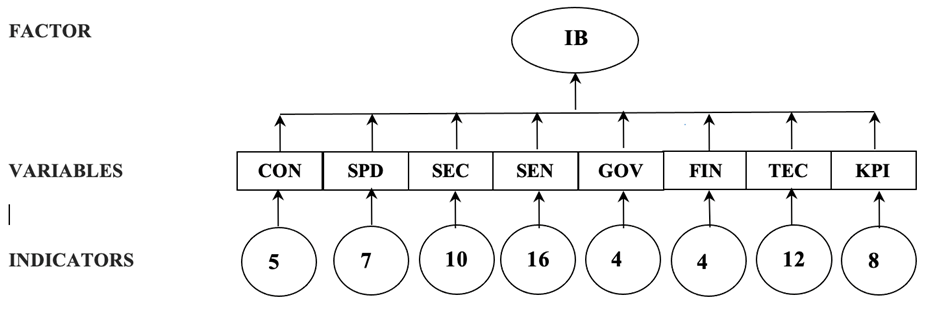
Source: own.
Figure 1 ex-ante or Ad hoc IB conceptual model based on Focus Group and AHP. Notes: IB. Inclusive Business Model: CON. Consumers; SPD. Suppliers and Distributors; SEC. Sustainable Ecosystem; SEN. Social Entrepreneurship; GOV. Government; FIN. Access to Finance; TEC. Technology; KPI. Key Performance indicators
5.1. Searching for the final conceptual model of IB
At this moment, it was started the quantitative analysis to prove the suggested indicators groups as a result of Table 5. This quantitative stage involved the application of a questionnaire asking for the indicators and groups perceived for 60 IB fruit sector experts (30 consultants and 30 micro-enterprises leaders). To accomplish it, it was applied an Exploratory Factor Analysis (EFA) based on Rotation Method: VARIMAX with Extraction Method: Principal Component Analysis. The result was the grouping of the indicators as support of the IB theoretical framework as a final approach, detailed as follows:
5.2. Reliability and Validity test
According to the methodology, the Cronbach’s Alpha reliability test result, using SPSS 20 IBM software, is at an adequate level (Hair et al., 2019), shown in Table 6.
Table 6 Reliability Statistics.
| Cronbach’s Alpha | N of Items |
| .856 | 66 |
Source: IBM SPSS 25 with own adaptation.
The validity test is based on the content shown in the theoretical framework. To measure the validity is necessary to apply a Confirmatory Factor Analysis (CFA) to determine: convergent, discriminant and nomological validities (Hair et al. 2019; Mejía-Trejo, 2019a). These measurements’ purposes are beyond the scope of this article.
5.3. Exploratory Factor Analysis (EFA)
We proceeded to apply the EFA, as a variable reduction tool to determine the variance contribution of each component, variable or (indicator) and hence, demonstrate how these variables (or indicators) are reduced. The use of EFA is looking for the variability in one common variable to another variable. The aforementioned means, that they are linked by an underlying variable. To achieve it, the IBM SPSS 25 assumes (in a principal component analysis mode) that 100% of the variance of each variable is in common variance, so gives each variable a commonality of 1.000. However, when they have extracted the variables, it works out how much of the variability of each variable really can be explained by the extracted elements, and gives an updated value of communality (Hinton et al., 2004, p. 349; Mejía-Trejo, 2019c; Mejía-Trejo, 2019d).
Because of the 66 variables, communalities analyses show values in the range of 0.40 <0.91; we decided that the variables meet acceptable explanation levels. Because of this, the researchers decided to omit the communalities table and proceed with the analysis of total variance explained and rotated component matrix analysis (Hair et al. 2019, 156). Using our criterion of selecting eigenvalues over 1, we can see from the highlighted numbers in the Total Variance Explained table with a group of components, variables (or indicators) have been produced that have eigenvalues greater than this amount (Hinton et al. 2004., p.350; Mejía-Trejo, 2019c; Mejía-Trejo, 2019d). Finally, we obtained 12 underlying factor groups using the Hair (et al.,2019) criteria. See Table 7.
Table 7 Total Variance Explained.
| Exploratory Factor Analysis Conditions: Total Variance Explained | |||||||||
|---|---|---|---|---|---|---|---|---|---|
| Component | Initial Eigenvalue | Extraction Sums of Squared Loadings | Rotation Sums of Squared Loadings | ||||||
| Total | % Of variance | Cumulative % | Total | % Of variance | Cumulative % | Total | % Of Variance | Cumulative % | |
| 1 | 15.105 | 22.886 | 22.886 | 15.105 | 22.886 | 22.886 | 12.788 | 19-376 | 19.376 |
| 2 | 10.646 | 16.130 | 39.016 | 10.646 | 16.130 | 39.016 | 9.920 | 15.030 | 34.406 |
| 3 | 6.327 | 9.586 | 48.602 | 6.327 | 9.586 | 48.602 | 5.569 | 8.437 | 42.843 |
| 4 | 5.615 | 8.508 | 57.110 | 5.615 | 8.508 | 57.110 | 5.189 | 7.863 | 50.706 |
| 5 | 4.915 | 7.448 | 64.558 | 4.915 | 7.448 | 64.558 | 4.992 | 7.564 | 58.271 |
| 6 | 4.455 | 6.750 | 71.308 | 4.455 | 6.750 | 71.308 | 4.208 | 6.376 | 64.647 |
| 7 | 3.500 | 5.303 | 76.611 | 3.500 | 5.303 | 76.611 | 4.180 | 6.333 | 70.988 |
| 8 | 3.233 | 4.898 | 81.509 | 3.233 | 4.898 | 81.509 | 3.713 | 5.626 | 76.606 |
| 9 | 2.665 | 4.037 | 85.546 | 2.665 | 4.037 | 85.546 | 3.625 | 5.493 | 82.099 |
| 10 | 2.069 | 3.134 | 88.681 | 2.069 | 3.134 | 88.681 | 3.074 | 4.658 | 86.757 |
| 11 | 1.537 | 2.329 | 91.010 | 1.537 | 2.329 | 91.010 | 2.633 | 3.990 | 90.746 |
| 12 | 1.169 | 1.771 | 92.781 | 1.169 | 1.771 | 92.781 | 1.343 | 2.035 | 92.781 |
| 13 | .966 | 1.464 | 94.245 | ||||||
| 14 | .828 | 1.254 | 95.500 | ||||||
| 15 | .585 | .886 | 96.386 | ||||||
| 16 | .530 | .803 | 97.189 | ||||||
| 17 | .424 | .643 | 97.831 | ||||||
| 18 | .367 | .556 | 98.388 | ||||||
| 19 | .268 | .407 | 98.795 | ||||||
| 20 | .232 | .352 | 99.146 | ||||||
| 21 | .195 | .296 | 99.442 | ||||||
| 22 | .182 | .276 | 99.718 | ||||||
| 23 | .066 | .100 | 99.818 | ||||||
| 24 | .039 | .060 | 99.877 | ||||||
| 25 | .027 | .040 | 99.918 | ||||||
| 26 | .022 | .034 | 99.952 | ||||||
| 27 | .014 | .022 | 99.974 | ||||||
| 28 | .009 | .013 | 99.986 | ||||||
| 29 | .003 | .005 | 99.991 | ||||||
| 30 | .002 | .004 | 99.995 | ||||||
| 31 | .002 | .003 | 99.998 | ||||||
| 32 | .001 | .002 | 99.999 | ||||||
| 33 | .000 | .000 | 100.000 | ||||||
| 34 | 7.804E-5 | .000 | 100.000 | ||||||
| 37 | 1.273E-15 | 1.929E-15 | 100.00 | ||||||
| --- | --- | --- | --- | ||||||
| 66 | -1.172E-15 | -1.775E-15 | 100.00 | ||||||
Extraction Method: Principal Component Analysis.
Source: IBM SPSS 25 with own adaptation.
The % of the “Variance” column shows how much variance each factor can explain. The “Cumulative % column” shows the amount of variance accounted by each consecutive variable added together. From our example, we can see that factor 1 has an eigenvalue of 15.105, which accounts for “22.886% of the variance”. Our criterion for factor selection is eigenvalues greater than 1, so we, therefore have twelve factors that can explain a cumulative 92.781% of the variance in the data. You can see that the “Extraction Sums of Squared Loadings” values are the same as the “Initial Eigenvalues”, however only the twelve indicators (factors) that have been extracted are shown (Mejía-Trejo, Juan 2019c; Mejía-Trejo, 2019d).
One final result is the rotation method that changes the eigenvalues and variances explained by each factor but keeps the total variance the same. The extracted factors are shown in the “Rotation Sums of Squared Loadings” columns. The rotation has shown that different variables load onto different factors. The factor loading minimum level is from 0.3, and it is selected to be grouped (Hair et al., 2014). See Table 8 the shading rectangles.
Table 8 Rotated Component Matrixa.
| 1 | 2 | 3 | 4 | 5 | 6 | 7 | 8 | 9 | 10 | 11 | 12 | Total | |
| A1 | .368 | -.217 | .088 | .765 | -.091 | .148 | -.040 | -.218 | .023 | .032 | .044 | -.026 | 1 |
| A2 | .295 | -.165 | .151 | .881 | -.057 | .078 | -.174 | -.040 | .003 | .019 | -.060 | .077 | 1 |
| A3 | .874 | -.082 | .159 | .235 | .060 | -.002 | .004 | .085 | -.055 | .041 | .083 | .017 | 1 |
| A4 | .985 | .007 | .026 | -.136 | .001 | .025 | .201 | -.005 | .065 | -.078 | -.089 | -.013 | 1 |
| A5 | .272 | -.109 | .101 | .940 | -.009 | .079 | .060 | -.040 | -.307 | -.502 | -.064 | .005 | 1 |
| A6 | .900 | -.029 | -.004 | .015 | -.048 | .037 | .237 | -.174 | -.018 | .106 | .111 | -.264 | 1 |
| A7 | .963 | -.014 | .020 | -.097 | -.017 | .075 | -.014 | .004 | -.063 | .060 | .003 | -.061 | 1 |
| A8 | -.077 | .759 | -.033 | -.041 | .053 | .144 | -.151 | .201 | .235 | .004 | -.012 | -.282 | 1 |
| A9 | .871 | .111 | .090 | .416 | -.020 | .126 | -.132 | -.005 | .180 | .087 | .209 | -.105 | 1 |
| A10 | .874 | -.082 | .159 | .235 | .060 | -.002 | .003 | .085 | -.052 | .187 | .416 | .017 | 1 |
| A11 | .034 | -.478 | .507 | .181 | .237 | -.475 | -.134 | -.007 | -.164 | .056 | .235 | -.006 | 1 |
| A12 | .276 | .208 | .722 | -.051 | -.014 | .121 | .086 | -.110 | -.067 | -.08 | .181 | .272 | 1 |
| A13 | .335 | .217 | .481 | -.162 | -.151 | -.017 | .133 | -.258 | .078 | .083 | -.014 | .379 | 1 |
| A14 | .026 | -.045 | .911 | -.112 | -.132 | -.084 | .068 | -.058 | .081 | -.089 | -.151 | -.003 | 1 |
| A15 | .090 | -.027 | .901 | .201 | .137 | .030 | .085 | .095 | -.072 | -.064 | -.132 | -.105 | 1 |
| A16 | .181 | .064 | .922 | .075 | .037 | .035 | .062 | -.004 | .087 | .111 | .137 | .042 | 1 |
| A17 | .109 | -.005 | .910 | .120 | .100 | .104 | .108 | .067 | .442 | .003 | -.142 | -.024 | 1 |
| A18 | .092 | -.071 | .690 | .207 | .026 | .032 | .112 | .071 | .512 | .012 | -.184 | -.138 | 1 |
| A19 | .089 | .112 | .741 | .142 | .161 | .019 | .072 | .202 | .345 | .128 | -.150 | -.07 | 1 |
| A20 | .211 | .072 | .662 | .001 | -.085 | .041 | -.060 | -.010 | .088 | -.03 | -.054 | .105 | 1 |
| A21 | .003 | -.060 | .939 | -.125 | -.158 | -.078 | .083 | -.062 | .014 | .003 | -.254 | -.009 | 1 |
| A22 | -.134 | .083 | -.642 | .047 | -.059 | -.502 | -.089 | -.206 | -.044 | .089 | .346 | .128 | 1 |
| A23 | .086 | -.089 | -.092 | -.082 | .822 | .106 | -.064 | -.005 | -.037 | .011 | .117 | -.03 | 1 |
| A24 | .133 | -.064 | .067 | -.001 | .940 | .060 | .111 | .049 | .019 | -.033 | .072 | .003 | 1 |
| A25 | .068 | -.052 | -.026 | .035 | .810 | -.334 | .003 | -.028 | .041 | -.063 | -.063 | .089 | 1 |
| A26 | .085 | -.092 | -.142 | -.015 | .915 | -.130 | .012 | .011 | -.078 | .087 | .076 | .038 | 1 |
| A27 | .062 | -.103 | -.184 | -.106 | .798 | .058 | .034 | -.033 | -.502 | .065 | -.098 | -.027 | 1 |
| A28 | .108 | .063 | -.150 | .027 | .787 | .310 | .056 | -.063 | .106 | .234 | -.064 | .016 | 1 |
| A29 | -.028 | -.021 | -.054 | -.109 | .948 | -.039 | -.054 | -.135 | .060 | .098 | .111 | -.013 | 1 |
| A30 | -.090 | .079 | -.254 | .056 | -.777 | -.218 | -.135 | -.056 | .567 | .349 | .554 | .149 | 1 |
| A31 | .033 | .058 | .315 | .011 | .797 | -.065 | -.103 | -.093 | .098 | .235 | -.321 | .03 | 1 |
| A32 | -.028 | .012 | .127 | -.054 | .926 | -.061 | .031 | -.127 | .011 | .181 | .021 | 0.01 | 1 |
| A33 | -.056 | .798 | -.008 | -.135 | -.060 | .097 | -.035 | -.010 | -.033 | -.335 | .678 | .035 | 1 |
| A34 | -.036 | .015 | .967 | -.103 | -.049 | .073 | .088 | -.015 | -.063 | .238 | -.459 | -.047 | 1 |
| A35 | .005 | .848 | .106 | .031 | .088 | -.205 | .151 | -.023 | .389 | .016 | -.456 | .054 | 1 |
| A36 | -.012 | .966 | .062 | -.035 | .014 | -.055 | .159 | -.020 | .006 | .035 | .239 | .054 | 1 |
| A37 | -.056 | -.044 | .000 | -.128 | .779 | .065 | .026 | -.011 | .187 | .281 | -.340 | .035 | 1 |
| A38 | .243 | .054 | .152 | .230 | .852 | -.307 | .101 | .090 | .023 | -.035 | .567 | .016 | 1 |
| A39 | -.038 | .988 | .006 | -.072 | .016 | -.018 | -.004 | .001 | -.058 | -.003 | .416 | -.006 | 1 |
| A40 | .020 | .310 | .335 | .754 | .044 | -.063 | .235 | .035 | -.086 | .021 | .235 | -.035 | 1 |
| A41 | .368 | -.217 | .088 | .765 | -.091 | .148 | .181 | -.218 | -.475 | .456 | .181 | -.26 | 1 |
| A42 | .295 | -.165 | .151 | .881 | -.057 | .078 | -.051 | -.040 | .137 | -.060 | .567 | .177 | 1 |
| A43 | -.002 | -.082 | .159 | .235 | .060 | .874 | -.162 | .085 | ..021 | -.049 | .088 | .317 | 1 |
| A44 | .025 | .007 | .026 | -.136 | .001 | .985 | -.112 | -.005 | .018 | .088 | .014 | -.013 | 1 |
| A45 | .079 | -.109 | .101 | .272 | -.009 | .940 | .201 | -.040 | .087 | -.112 | -.044 | .005 | 1 |
| A46 | -.037 | -.029 | -.004 | .015 | -.048 | .900 | .103 | -.174 | .065 | .201 | -.037 | -.264 | 1 |
| A47 | . 963 | -.014 | .020 | -.097 | -.017 | .075 | -.060 | .004 | .156 | .103 | .238 | -.061 | 1 |
| A48 | .759 | -.119 | -.033 | -.041 | .053 | .144 | .007 | .201 | .083 | -.060 | .289. | -.282 | 1 |
| A49 | .871 | .111 | .090 | .416 | -.020 | .126 | .032 | -.005 | -.089 | .007 | .011 | -.105 | 1 |
| A50 | -.082 | .874 | .159 | .235 | .060 | -.002 | -.039 | .085 | -.064 | .532 | -.033 | .317 | 1 |
| A51 | .034 | -.478 | .127 | .181 | .237 | -.450 | .011 | -.007 | .111 | -.039 | -.063 | -.006 | 1 |
| A52 | -056 | .798 | -.008 | -.135 | -.060 | .097 | .068 | -.010 | .003 | .011 | .044 | .035 | 1 |
| A53 | -.036 | .967 | .015 | -.103 | -.049 | .073 | -.103 | -.015 | .012 | .068 | .019 | .047 | 1 |
| A54 | .005 | .848 | .106 | .031 | .088 | -.205 | .063 | -.023 | .079 | -.103 | .041 | .054 | 1 |
| A55 | -.012 | .966 | .062 | -.035 | .014 | -.055 | -.021 | -.020 | .058 | -.044 | -.078 | .054 | 1 |
| A56 | -.056 | .779 | .000 | -.128 | -.044 | .065 | .079 | -.011 | .015 | -.037 | -.502 | .035 | 1 |
| A57 | .243 | .852 | .152 | .230 | -.037 | .054 | .058 | .090 | -.097 | .026 | .106 | .016 | 1 |
| A58 | -.038 | .988 | .006 | -.072 | .016 | -.018 | .015 | .001 | .018 | .416 | .060 | -.006 | 1 |
| A59 | .020 | .310 | .335 | .013 | .044 | -.063 | -.097 | .754 | .027 | .235 | -.307 | -.035 | 1 |
| A60 | -.015 | .103 | .029 | -.023 | .054 | -.058 | -.041 | .984 | .167 | .181 | -.018 | -.003 | 1 |
| A61 | -.051 | -.060 | -.016 | -.050 | .048 | -.086 | .416 | .986 | .134 | -.475 | -.063 | -.005 | 1 |
| A62 | .121 | .007 | .070 | .008 | .259 | -.475 | .235 | -.625 | .130 | .137 | .067 | -.211 | 1 |
| A63 | -.152 | .032 | -.047 | .204 | -.148 | .137 | .181 | .785 | .198 | -.097 | .237 | -.005 | 1 |
| A64 | .086 | -.039 | -.051 | -.078 | .220 | -.473 | -.135 | .786 | -.056 | .156 | -.014 | -.166 | 1 |
| A65 | -.049 | .011 | .043 | -.245 | -.149 | .062 | .012 | .881 | .243 | .054 | -.151 | .019 | 1 |
| A66 | .064 | .068 | .089 | -.273 | -.108 | .086 | .023 | .821 | -.038 | .076 | -.132 | .027 | 1 |
| Total | 9 | 14 | 13 | 6 | 12 | 4 | 0 | 8 | 0 | 0 | 0 | 0 | 66 |
Extraction Method: Principal Component Analysis.
Rotation Method: Varimax with Kaiser Normalization.
a. Rotation converged in 16 iterations.
Note: Item A14 and A21 due to its similarity, goes to factor alternative 4 cancelling the factor alternative 6;
Source: IBM SPSS 25 with own adaptation.
We can now look at the highest values of the variables loading onto each factor and choose suitable names for each one of the twelve factors. Hence, each one of the indicators were weighed and compared obtaining the first list of them as a second approach. See Table 9.
Table 9 EFA final questionnaire from 60 IB fruit sector experts. Ex-Post or Post hoc IB Conceptual Model.
| OBJECTIVE: IB FACTOR | ||||
|---|---|---|---|---|
| INDICATORS | 60 IB FRUIT SECTOR EXPERTS | |||
| VARIABLE SUGGESTED BY EXPERTS | AHP weighed as an: | |||
| Indicator (%) | Alternative | |||
| Alternative Variable 1 | 1.(A3). The IB must consider a trust generation (4TRG) responding to the customers’ needs (6RCN); it generates a real improvement in the quality of life of these groups (16QOL) | AWARENESS OF NEEDS (AWN) | 12 | 10 |
| 2.(A4). The IB must consider the customers prepay (when they have cash) for goods and services they will use later (17DPP); the customers pay only for the quantity used (17DPP). The differential pricing based on ability to pay (17DPP) | 12 | |||
| 3.(A6). The IB must consider a value chain development towards the markets for poor (1VDP; 1M4P;6VCA) with responsIBle management of the supply chain (1RMS) | 12 | |||
| 4.(A7). The IB must consider a high participation rate due to mainly the lack of information and unconsciousness (1LIU) | 12 | |||
| 5.(A9). The IB must consider the upgrading needs common to both seller and buyer (6PRN) designing interventions that respond to the common upgrading priorities identified (6DSG) | 12 | |||
| 6.(A10). The IB must consider the inclusion of less endowed actors (6IEA) with diverse market outlets (6IDM). Hence, the inclusion of the right partner mix (6IRP) | 10 | |||
| 7.(A47). The IB must consider social media as the main factor to generate social value based on smartphones for 2’500,000 BOP people (1SOM); intersectoral alliance networks and technology. (3INT) | 10 | |||
| 8.(A48). The IB must consider Work with competent NGOs or apex producer organizations to facilitate business partnerships and oversee the implementation of technical activities (6CSB) | 10 | |||
| 9.(A49). The IB must consider the use of technology to formalize the informal sector to go down-market while upholding quality (8TEC); technology as the key to sustainability scale (8SCY) | 10 | |||
| SUBTOTAL | 100 | |||
| Alternative Variable 2 | 10.(A8). The IB must consider the appraisal of the current business model: compare the separate business models of the producer organization and buyer (6ACB) | MARKETING STRATEGY (MKS) | 5 | 20 |
| 11.(A33). The IB must consider the improvement in geographic dispersion and low levels of collaboration (14GDL); methodologies and tools adapted to the cultural and social reality of small-scale suppliers (14MTC). | 10 | |||
| 12.(A35). The IB must consider the operation within the market economy and rules (16MKE); designing appropriate products & services (17DPS); permanence on time (18PER;20POT); efficiency and efficacy (18EFE; 20EFE); logistics (17LOG111); cultural issues (18CUL); scholarship (18SCH); targeted investments (18TGI); communication & dialog (18CAD) adapting products and processes (19APP) | 5 | |||
| 13. (A36). The IB must consider the investing to remove market constraints (19IRM); combining resources and capabilities with other organizations (19CRC; 18ORG;18OCA); market information (19MKI); physical infrastructure (19PHI); knowledge and skills (19KAS); the growing inclusive markets strategy matrix (19MSM); to become the mainstream of thought and activities of the company (21MTA) | 5 | |||
| 14.(A39). The IB must consider the promotion of relationships considering linkage business (1LKB); commodities with potential for smallholder commercialization aligned with government priorities. (6SHG); the engagement in policy dialogue with the government. (19EPG) | 5 | |||
| 15.(A.50). The IB must consider expanding the reach (17ERC), through distrIBution channel-sharing | 5 | |||
| 16.(A51). The IB must consider expanding the reach (17ERC), through informal channels | 5 | |||
| 17.(A52). The IB must consider expanding the reach (17ERC) through business-in-a-box | 5 | |||
| 18.(A53). The IB must consider expanding the reach (17ERC) through field agents | 5 | |||
| 19.(A54). The IB must consider expanding the reach (17ERC) through the hub and spoke | 10 | |||
| 20. (A55). The IB must consider changing the mindsets and behaviors (17CMB), through aspirational marketing | 10 | |||
| 21.(A56). The IB must consider changing the mindsets and behaviors (17CMB) through value demonstration | 10 | |||
| 22.(A57). The IB must consider changing the mindsets and behaviors (17CMB), through community networks | 10 | |||
| 23.(A58). The IB must consider changing the mindsets and behaviors (17CMB), through technical preparation (18TEP) with fair prices (18FPR). | 10 | |||
| SUBTOTAL | 100 | |||
| Alternative Variable 3 | 24.(A11). The IB must consider the management of a business model strategically (6MBS) with business-to-business coordination (6BBC) | SOCIAL ENTREPRENEURSHIP (SEP) | 5 | 20 |
| 25. (A12). The IB must consider a significant number of organized manufacturers capable of supplying target buyer (6NSB) to deal with smallholder suppliers (6IBS) | 5 | |||
| 26.(A13). The IB have social and environmental ventures (2SEV) considering the social impact (2SOI) with a report of business status (2BIS) | 5 | |||
| 27.(A14). The IB have social and environmental ventures (2SEV) considering the social business ecosystem (2SBE) with several types of innovation implemented (2INN), such as innovation ecosystems (3IEC; 3LMI); open innovation (3OIN); Last mile innovation (3LMI); transversal innovation (3TVI), etc. | 5 | |||
| 28.(A15). The IB have social and environmental ventures (2SEV) considering the sustainability and value generation (3SVG) for human development through environmental action (2ENA) | 5 | |||
| 29. (A16). The IB have social and environmental ventures (2SEV) considering the corporate social responsIBility (7CSR evolving to corporate intelligence response) included reputation, risk, and social media as boosters of IB. The CSR is a solution for development | 5 | |||
| 30. (A17). The IB have social and environmental ventures (2SEV) considering the urgent need to address profound social changes, especially poverty, unemployment, and social marginalization (13CSR). | 10 | |||
| 31.(A18). The IB have social and environmental ventures (2SEV) considering an IB ecosystem (7IBE) supported with a value chain map to understand the macro context of markets and the businesses which link producers with buyers (9VCM) | 5 | |||
| 32.(A19). The IB have social and environmental ventures (2SEV) considering the BOP ecosystems (12BOE;18OEC) involving co-dependency (12CDP), co-evolution (12COE) and co-learning (12CLR) to be successful | 10 | |||
| 33.(A20). The IB have social and environmental ventures (2SEV) considering the profitability and social inclusion (12CLU) based on re-conceiving products and markets for a better quality of life (12BQL), redefining productivity within the value chain (12PVC) and promoting its construction and operation in key local areas (12KLA) | 10 | |||
| 34.(A21). The IB have social and environmental ventures (2SEV) considering the understanding of local cultural restrictions (15CUR)/opportunities and knowledge using the local resources and capacities (15OKL) | 15 | |||
| 35.(A22). The IB have social and environmental ventures (2SEV) consider sectors of opportunity (15SOO) using tools such as matrix of strategy vs constraints (15MSC); the IB typology determined by their place in chains of value (15TCV); maps of institutional actors (15MIA); be self-sustaining (16BSS); be environmentally responsIBle (16ENV), etc. | 10 | |||
| 36.(A34). The IB expanding its results to determine risks and mitigate them through impact evaluation framework (14PMR) | 10 | |||
| SUBTOTAL | 100 | |||
| Alternative Variable 4 | 37.(A1). The IB must consider the target market potential (1MKP; 1CTM;1KSC). It is the base of the critical business competencies (1CBC; 1BCM), based on the knowledge skills of communities to establish the business model (1BSM) | REGULATORY FRAMEWORK (RFR) | 20 | 15 |
| 38.(A2). The IB must consider the alliances (1ALL; 4CAC); the manufacturing (4MFT8); the shopping (4SHP); the distribution (4DST); the design (4DSG); the insured market (4INM); coordinating and articulating the entities (4CAE) | 15 | |||
| 39.(A5). The IB must consider the direct subsidy or assistance accessing subsidies available for relevant purchases (17DPP). Conventional regulatory frameworks (14CRF) | 20 | |||
| 40.(A40). The IB promotes relationships considering the governance as support of the micro-enterprises (15GOV); Social progress (4SOP); ecological balance (4EBA); to develop and deliver inclusive entrepreneurship policies and programs as part of an integrated strategy (5PAP); define clear objectives and targets for policy intervention (5COT); use targeted outreach to engage disadvantaged and under-represented groups (5OUR) | 15 | |||
| 41.(A41). The IB promotes relationships considering the use of competitive mechanisms to target intensive support on those with the potential to succeed (5CMT); use specialist trainers and advisers (5STA); learn from experience (5LFE); public policies (7PUP); create centers of excellence (10COE); assistance (12ASS); training (12TRN) | 15 | |||
| 42.(A42). The IB promotes relationships considering the regulatory framework incentives coupled with adequate legal frameworks and institutional conditions. (14REF). Inter-institutional alliances; leveraging the strengths of the poor (19LSP); engaging in policy dialogue with the government (19EPG) | 15 | |||
| SUBTOTAL | 100 | |||
| Alternative Variable 5 | 43.(A23). The design of a new product or service development considers commercial viability (3CVI). | NEW PRODUCT DEVELOPMENT (NPD) | 5 | 15 |
| 44.(A24). The design of a new product or service development considers positive social impact about human development (3PSI) | 5 | |||
| 45.(A25). The design of a new product or service development considers environmental impact (3EVI) | 15 | |||
| 46.(A26). The design of a new product or service development considers scalability (3SCY; 10SCY; 18SCY51;20SCY). | 10 | |||
| 47.(A27). The design of a new product or service development considering: The prototype cycle (9PTC) used to continuously improve the inclusivity of every business which links producers with buyers | 10 | |||
| 48.(A28). The design of a new product or service development considers the target smallholders with a clear comparative advantage in the market (6TSM) including analyses of market (7MKT); suppliers (7SPP;14PSD); consumers (7CON; 14CON); Employees and stakeholders (7EAS); operative services (7OPS); strategical services (7STS) | 10 | |||
| 49.(A29). The design of a new product or service development with several business models such as The business model canvas used to understand in more detail each business which links producers with buyers (9CNV); the new business model principles, etc. are used to determine whether each business, which links producers with buyers are truly inclusive (9NBP) | 5 | |||
| 50.(A30). The design of a new product or service development considering the opportunity cost of the investment with the following solutions: portfolio approach adoption; getting the support of company executives; quantifying the total value perceived by the company; finding external investors (10OPC) | 10 | |||
| 51.(A31). The design of a new product or service development considering the discordance between the strategic and the operational issues with the following solutions: designing a business plan; leaving from the corporate greenhouse; adjusting the performance objectives; create a company separately (10DSO); capacity gaps (10CGP); go to the external partners (10EXP); internal capacity availability (10ICA); support professional development (10SPD); Reciprocal value (12RVA); Co-creation (12COC); Cluster. | 5 | |||
| 52.(A32). The design of a new product or service development considering the support must come from the highest level of company management (14HCM) with the role of expectations (14EXP) | 5 | |||
| 53.(A37). Do not have a limited and fixed budget (21LFB); the potential to grow and replicate (21PGR); a demand on goods and services with low prices and good quality producing a great sales potential by volume (22LPQ).The ability to produce at low cost, to be competitive in that market (22LCC) | 10 | |||
| 54.(A38). The design of a new product or service development considering to push companies to discover creative ways to configure products, finance, and supply chains to boost productivity, which generates new competencies that companies can transfer to their operations in the markets developed (22DCW) | 10 | |||
| SUBTOTAL | 100 | |||
| Alternative Variable 6 | 55.(A43). To choose and commit investors (1INV); execute (1EXC) providing cash financing or facilitating access to it through a subsidiary or third party (17INV) | ACCESS TO FINANCE (ATF) | 25 | 10 |
| 56.(A44). The provision of inputs or inventory on credit; the productive assets sold upfront with repayment in periodic installments (17INV) | 25 | |||
| 57.(A45). Financial viability (4FNV); link business model actors to locally accessible financial services and products (6LSF); access to financing (7ATF; 19AFS); sources of co-financing; the role of the anchor company; the presence of a brokering agent (14BKA) | 25 | |||
| 58.(A46). The improvement in access to financing or investment capital sources and the market demands (14INV); regulatory environment (19REE) | 25 | |||
| SUBTOTAL | 100 | |||
| Alternative Variable 7 | 59.(A59). The IB have the key evaluation criteria (15RES) for measuring progress on a continual basis (6KPI) in Relevance (5REL) | KEY PERFOMANCE INDICATORS (KPI) | 10 | 10 |
| 60.(A60). The IB have the key evaluation criteria (15RES) for measuring progress continually (6KPI) in Effectiveness (5EFF) | 10 | |||
| 61.(A61). The IB have the key evaluation criteria (15RES) for measuring progress continually (6KPI) in: Efficiency (5EFY) | 10 | |||
| 62.(A62). The IB have the key evaluation criteria (15RES) for measuring progress continually (6KPI) in Social impact (5SOI) | 20 | |||
| 63.(A63). The IB have the key evaluation criteria (15RES) for measuring progress continually (6KPI) in Sustainability (5SUS) | 20 | |||
| 64.(A64). The IB have the key evaluation criteria (15RES) for measuring progress continually (6KPI) in Design (15DSG) | 10 | |||
| 65.(A65). The IB have the key evaluation criteria (15RES) for measuring progress continually (6KPI) in Implementing (15IMP) | 10 | |||
| 66.(A66). The IB have the key evaluation criteria (15RES) for measuring progress continually (6KPI) in Governance (15GOV) | 10 | |||
| SUBTOTAL | 100 | |||
| TOTAL | 100 | |||
Notes: NA. Not Applied.
Source: own.
5.4. The final ex-post or Post hoc IB conceptual model
Hence, the final ex-post or post hoc reduced empirical model comprises seven underlying variables and 66 items that point out to IB factor is showed in Figure 2.
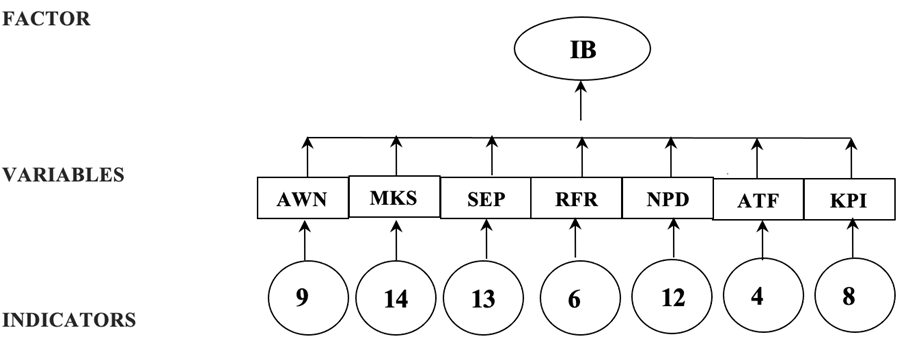
Source: own.
Figure 2 The final ex-post or Post hoc IB conceptual model based on EFA. Notes: IB. Inclusive Business Model; AWN. Awareness of Needs; MKS Marketing Strategy; SEP. Social Entrepreneurship; SEV. Social Environment; RFR. Regulatory Framework; NPD. New Product Development; ATF. Access to Finance; KPI. Key Performance Indicators.
6. Discussion
We observe two different points of view through comparison among Figure 1 and Figure 2. For example, Figure 1ex-ante IB conceptual model based on Focus Group and AHP (66 indicators/8 variables/6 fruit professor expert vision) and Figure 2. ex-post IB conceptual model based on EFA (66 indicators/7 variables/60 fruit vision). AHP represents an accurate approach to quantifying the weights of decision criteria. Individual experts’ experiences are utilized to estimate the relative magnitudes of factors through pair-wise comparisons. Each of the respondents compares the relative importance each pair of items using a specially designed questionnaire. See Table 10.
Table 10 Results comparison of ex-ante or Ad hoc and ex-post or Post hoc variables and indicators of the IB conceptual model.
| Items | Inclusive Business (IB) Conceptual Model ex-ante or Ad hoc | Inclusive Business (IB) Conceptual Model ex-post or Post hoc | |||||||||||||
| Stage | Qualitative | Quantitative | |||||||||||||
| Sample | 6 IB expert professors fruit sector (3International Business and 3 Marketing professors) | 60 IB fruit sector experts (30 consultants, 30 micro-enterprises leaders) | |||||||||||||
| Techniques | Focus Group and Analytic Hierarchy Process (AHP) | Exploratory Factor Analysis (EFA) based on Rotation Method: VARIMAX with Extraction Method: Principal Component Analysis | |||||||||||||
| Variables | CON | SPD | SEC | SEN | GOV | FIN | TEC | KPI | AWN | MKS | SEP | RFR | NPD | ATF | KPI |
| Indicators | 5 | 7 | 10 | 16 | 4 | 4 | 12 | 8 | 9 | 14 | 13 | 6 | 12 | 4 | 8 |
Notes IB ex-ante or Ad hoc : CON. Consumers; SPD. Suppliers and Distributors; SEC. Sustainable Ecosystem; SEN. Social Entrepreneurship; GOV. Government; FIN. Access to Finance; TEC. Technology; KPI. Key Performance indicators.
Notes IB ex-post or Post hoc : AWN. Awareness of Needs; MKS Marketing Strategy; SEP. Social Entrepreneurship; SEV. Social Environment; RFR. Regulatory Framework; NPD. New Product Development; ATF. Access to Finance; KPI. Key Performance Indicators.
6 IB expert professors fruit sector (3 International Business and 3 Marketing.
professors).
60 IB fruit sector experts (30 consultants, 30 micro-enterprises leaders).
Source: Own.
Such a difference is due to the fact of scarce experience, (for both sides: expert professors fruit sector and the fruit sector experts) in the design and implementation of the IB in Mexico. In this sense, we have selected the final ex-post IB conceptual model, because:
1. It is based directly on the experience of the main actors.
2. It is relating the academic indicators previously analyzed and determined in the literature review.
3. It is the result of an empirical grouping based on Exploratory Factor Analysis (EFA).
6.1. Theoretical Implications
Hence, the final ex-post IB conceptual model variables, are explained as follows:
6.1.1. Awareness of Needs (AWN)
Awareness of Needs, is defined here as the ability to directly know and perceive the market needs and how to provide the satisfiers of needs through the IB process. It is the state of being conscious of particular satisfiers features, such as sustainability and sustainability to solve the needs. The IB considers the arise of AWN as a state wherein a subject (the micro-enterprise) is aware of some information that is directly available to bring to bear in the direction of a wide range of behavioral actions. The states of awareness are also associated with the rules of experience. In this sense, the structure represented in awareness it would be based on the expertise (Chalmers, 1977). Therefore here, the IB considers the arise of AWN with a trust generation responding to the customer needs; it generates a real improvement in the quality of life of these groups. The IB considers the arise of AWN with customers prepay (when they have cash) for goods and services they will use later; the customers pay only for the quantity used and the differential pricing based on the ability to pay. (Iturbide & Quintal, 2020; CODESPA, 2018; Kelly et al., 2015).
The IB considers the arise of AWN with a value chain development towards the markets for poor with responsible management of the supply chain with a high participation rate due to mainly the lack of information and unconsciousness. The IB considers the arise of AWN with the upgrading needs common to both seller and buyer designing interventions that respond to the common upgrading priorities identified and the inclusion of less endowed actors with diverse market outlets. Hence, the inclusion of the right partner mix. (Kelly et al., 2015; SPRING, 2014; AVINA, 2010; Jenkins et al. 2010).
The IB considers the arise of AWN with social media as the main factor to generate social value based on smartphones for 2’500,000 BOP people, intersectoral alliance networks and technology. The IB considers the arise of AWN work with competent NGOs or apex producer organizations to facilitate business partnerships and oversee the implementation of technical activities. The IB considers the arise of AWN with the use of technology to formalize the informal sector to go down-market while upholding quality; technology is the key to the sustainability scale (Iturbide & Quintal, 2020; CODESPA, 2018; Kelly et al., 2015).
6.1.2. Marketing Strategy (MKS)
Marketing strategy is a long-term, forward-looking approach to planning with the fundamental goal of achieving a sustainable competitive advantage (Baker, 2008). Therefore here, the IB must consider the MKS as the appraisal of the current business model: comparing the separate business models of the producer organization and buyer. This supports the improvement in geographic dispersion and low levels of collaboration; methodologies and tools adapted to the cultural and social reality of small-scale suppliers. The IB must consider the MKS as the operation within the market economy and rules; designing appropriate products & services; permanence on time; efficiency and efficacy; logistics; cultural issues; scholarship; targeted investments; communication & dialog adapting products and processes. This represents the investing to remove market constraints; combining resources and capabilities with other organizations; market information; physical infrastructure; knowledge and skills; the growing inclusive markets strategy matrix to become the mainstream of thought and activities of the company. The IB must consider the MKS as the promotion of relationships considering linkage business; commodities with potential for smallholder commercialization aligned with government priorities; the engagement in policy dialogue with the government. The IB must consider the MKS as expanding the reach, through several actions like distribution channel-sharing, informal channels, business-in-a-box, field agents, hub and spoke. Also, IB must consider the MKS as changing the mindsets and behaviors, through aspirational marketing, value demonstration, community networks and technical preparation with fair prices. The MKS is a determinant factor in the decision of NPD (Iturbide & Quintal, 2020; Mejía-Trejo, 2019b; Kelly et al. 2015; SNV-WBCSD, 2011; AVINA, 2010; Jenkins et al., 2010; SEKN, 2010; UNPD, 2008; WBSCD, 2006).
6.1.3. Social Entrepreneurship (SEP)
Social entrepreneurship is an approach by start-up companies and entrepreneurs, in which they develop, fund and implement solutions to social, cultural, or environmental issues (PBS Foundation, 2019). This concept may be applied to a wide range of organizations, which vary in size, aims, and beliefs (SEAD, 2019). For-profit entrepreneurs typically measure performance using business metrics like profit, revenues, and increases in stock prices. Social entrepreneurs, however, are either non-profits or blend for-profit goals with generating a positive return to society. Hence, they must use different metrics. SEP typically attempts to further broad social, cultural, and environmental goals often associated with the voluntary sector (Thompson, 2002) in areas such as poverty alleviation, health care, and community development. It is the process by which people develop or transform institutions, systems or governments to provide solutions to social and environmental problems (Santana, 2020). Therefore here, the IB must consider the SEP as the management of a business model strategically with business-to-business coordination. This means, the planning of a significant number of organized manufacturers capable of supplying target buyer to deal with smallholder suppliers. The IB involves the SEP with social and environmental ventures considering several actions like the social impact with a report of business status, a social business ecosystem with several types of innovation implemented, such as innovation ecosystems; open innovation; last-mile innovation; transversal innovation, the sustainability and value generation for human development through environmental action. The IB involves the SEP with corporate social response evolving to corporate intelligence response included reputation, risk, and social media as boosters. CSR is a solution for development with an urgent need to address profound social changes, especially poverty, unemployment, and social marginalization. It is created an ecosystem supported with a value chain map to understand the macro context of markets and the businesses which link producers with buyers. The BOP ecosystems involve co-dependency, co-evolution, and co-learning to be successful. The profitability and social inclusion are based on re-conceiving products and markets for a better quality of life, redefining productivity within the value chain and promoting its construction and operation in key local areas. The IB involves the SEP with social and environmental ventures considering the understanding of local cultural restrictions/opportunities and knowledge using the local resources and capacities. Hence, it is possible to analyze sectors of opportunity using tools such as a matrix of strategy vs constraints and determine the IB typology determined by their place in chains of value; maps of institutional actors; be self-sustaining; be environmentally responsible, etc. The IB involves the SEP, expanding its results to determine risks and mitigate them through impact evaluation framework (KUNAN, 2019; CODESPA, 2018; SNV-FORD-OMIN, 2015; Kelly et al., 2015; Lundy et al., 2014; Licandro & Pardo, 2013; SNV-WBCSD, 2011; Casado, 2011; AVINA, 2010).
6.1.4. Regulatory Framework (RFR)
Some countries enacted a law on the social economy that defines the concept of profit-generating entrepreneurial activities which aim to achieve a certain collective or social goal. Laws on the social economy are broader in scope. Besides establishing a general legal framework for social enterprises, they regulate related policy issues, such as the promotion and development of the social economy in the country. In other countries, the social entrepreneurship concept is introduced through a separate law on social entrepreneurship/social enterprise. These typically describe organizations that operate as SE or introduce special status/legal form for social enterprises. Besides that, some laws may also touch upon the promotion of social enterprises. Another possibility to regulate social entrepreneurship is through the adoption of amendments to the existing laws (ECNL, 2015). Therefore here, the IB must consider the RFR to identify the target market potential as the base of the critical business competencies. It is based on the knowledge skills of communities to the stablish the business model and to stimulate alliances; the manufacturing; the shopping; the distribution; the design; the insured market; coordinating and articulating the entities. The IB must consider the RFR with direct subsidy or assistance accessing subsidies available for relevant purchases conventional regulatory frameworks. The IB promotes with the RFR relationships considering the governance as support of the micro-enterprises with social progress; ecological balance to develop and deliver inclusive entrepreneurship policies and programs as part of an integrated strategy. It defines clear objectives and targets for policy intervention using targeted outreach to engage disadvantaged and under-represented groups. The IB promotes with the RFR relationships considering the use of competitive mechanisms to target intensive support on those with the potential to succeed; use specialist trainers and advisers; learn from experience; public policies; create centers of excellence; assistance; training. Also, is included the regulatory framework incentives coupled with adequate legal frameworks and institutional conditions with inter-institutional alliances; leveraging the strengths of the poor; engaging in policy dialogue with the government (Iturbide & Quintal, 2020; Rengifo; 2017; OECD, 2016; SNV-FORD-OMIN, 2015; WBSCD, 2014; Licandro, 2013; SNV-WBCSD, 2011; UNPD, 2008).
6.1.5. New Product Development (NPD)
The New Product Development covers the complete process of bringing a new product to market. A central aspect of NPD is product design, along with various business considerations. The NPD is described broadly as the transformation of a market opportunity into a product available for sale (Law, 2009). The product can be tangible (something physical which one can touch) or intangible (like a service, experience, or belief), though sometimes services and other processes are distinguished from products. NPD requires an understanding of customer needs and wants, the competitive environment, and the nature of the market (Kahn, 2012). Therefore here, the IB considers the design of NPD is under commercial viability with the generation of positive social impact on human development and environmental impact and scalability. The IB considers the design of NPD involves the prototype cycle used to continuously improve the inclusivity of every business which links producers with buyers. The IB considers the design of NPD involves the target smallholders with a clear comparative advantage in the market, including analyses of the market; suppliers; consumers; employees and stakeholders; operative services; strategical services. Even more, several business’ models are analyzed, at least: The business model canvas is used to understand in more detail each business which links producers with buyers; the new business model principles, etc. and is used to determine whether each business, which links producers with buyers are truly inclusive. Also, The IB considers the design of NPD considers the opportunity cost of the investment, at least, in the following solutions: portfolio approach adoption; getting the support of company executives; quantifying the total value perceived by the company; finding external investors. The strategy and the operational issues with at least, one of the following solutions: designing a business plan; leaving from the corporate greenhouse; adjusting the performance objectives; create a company separately; capacity gaps; go to the external partners; internal capacity availability; support professional development; Reciprocal value; Co-creation; Cluster. The IB considers the design of NPD considers the support from the highest level of company management with role of expectations and does not have, at least: a limited and fixed budget; the potential to grow and replicate; a demand on goods and services with low prices and good quality producing a high sales potential by volume or the ability to produce at low cost, to be competitive in such a market. This situation is pushing companies to discover creative ways to configure products, finance, and supply chains to boost productivity, which generates new competencies that companies can transfer to their operations in the markets developed (CODESPA, 2018 SNV-FORD-OMIN, 2015; Kelly et al., 2015; WBSCD, 2014; Lundy et al. ,2014; Licandro, 2013; SNV-WBCSD, 2011; SEKN, 2010; WBSCD, 2006; Austin & Chu, 2006; Prahalad & Hammond, 2005).
6.1.6. Access to Finance (ATF)
Access to finance is a fundamental prerequisite for the development and creation of micro-enterprises. There are several obstacles in this regard that limit its establishment and growth in several countries; this has resulted in the generation of better public policies based on a reliable base of actions and evidence. Access to financing is a fundamental prerequisite for the development and creation of micro-enterprises. There are several obstacles in this regard that limit its establishment and growth in several countries; this has resulted in the generation of better public policies based on a reliable base of actions and evidence (OECD, 2018b). Therefore here, the IB considers the ATF to choose and commit investors; execute providing cash financing or facilitating access to it through a subsidiary or third party. The IB considers the ATF as provision of inputs or inventory on credit; the productive assets sold upfront with repayment in periodic installments with financial viability; link business model actors to locally accessible financial services and products; access to financing; sources of co-financing; the role of the anchor company; the presence of a brokering agent. The IB considers the ATF as the improvement in access to finance or investment capital sources and the market demands; regulatory environment (Iturbide & Quintal, 2020; Rengifo, 2017; SNV-FORD-OMIN, 2015; Kelly et al., 2015; SNV-WBCSD, 2011; Jenkins et al., 2010; UNPD, 2008).
6.1.7. Key Performance Indicators (KPI)
The Key Performance Indicator is a type of performance measurement that evaluates the success of an organization or of a particular activity (such as projects, programs, products, and other initiatives) in which it engages. KPIs tell you what to do to increase performance dramatically. KPIs represent a set of measures focusing on those aspects of organizational performance that are the most critical for the current and future success of the organization. KPIs are rarely new to the organization. There are seven characteristics of KPIs (Parmenter, 2010): 1. There are nonfinancial measures; 2. There are frequently measured; 3. There are acted on by the CEO and senior management team; 4. They Clearly indicate what action is required by staff; 5. There are measures that tie responsibility down to a team (6. Have a significant impact; 7. They encourage appropriate action. Therefore here, the IB have KPI as key evaluation criteria for measuring progress on a continual basis (among others) in Relevance; Effectiveness; Efficiency; Social impact; Sustainability; Design; Implementing and Governance (OECD, 2016; Kelly et al., 2015; Casado; 2011).
The final design of questionnaire is shown in Table 11.
Table 11 Final IB questionnaire.
| FACTOR: INCLUSIVE BUSINESS (IB) | |
|---|---|
| VARIABLE: AWARENESS OF NEEDS (AWN) | |
| 1 | The IB considers the arise of AWN as a trust generation responding to the customers’ needs; it generates a real improvement in the quality of life of these groups |
| 2 | The IB considers the arise of AWN with customers prepay (when they have cash) for goods and services they will use later; the customers pay only for the quantity used. The differential pricing based on ability to pay |
| 3 | The IB must consider the AWN with a value chain development towards the markets for poor with responsible management of the supply chain |
| 4 | The IB considers the arise of AWN with a high participation rate due to mainly the lack of information and unconsciousness |
| 5 | The IB considers the arise of AWN with the upgrading needs common to both seller and buyer designing interventions that respond to the common upgrading priorities identified |
| 6 | The IB considers the arise of AWN with the inclusion of less endowed actors with diverse market outlets. Hence, the inclusion of the right partner mix |
| 7 | The IB considers the arise of AWN with social media as the factor to generate social value based on smartphones for 2’500,000 BOP people; Intersectoral alliance networks and technology |
| 8 | The IB considers the arise of AWN as a work with competent NGOs or apex producer organizations to facilitate business partnerships and oversee implementation of technical activities |
| 9 | The IB considers the arise of AWN with use of technology to formalize the informal sector to go down-market while upholding quality; technology is the key to sustainability scale |
| VARIABLE: MARKETING STRATEGY (MKS) | |
| 10 | The IB must consider the MKS as the appraisal of the current business model: compare the separate business models of the producer organization and buyer |
| 11 | The IB must consider the MKS as the improvement in geographic dispersion and low levels of collaboration; methodologies and tools adapted to the cultural and social reality of small-scale suppliers |
| 12 | The IB must consider the MKS as the operation within the market economy and rules; designing appropriate products & services; permanence on time; efficiency and efficacy; logistics; cultural issues; scholarship; targeted investments; communication & dialog adapting products and processes |
| 13 | The IB must consider the MKS as the investing to remove market constraints; combining resources and capabilities with other organizations; market information; physical infrastructure; knowledge and skills; the growing inclusive markets strategy matrix; to become the mainstream of thought and activities of the company |
| 14 | The IB must consider the MKS as the promotion of relationships considering linkage business; commodities with potential for smallholder commercialization aligned with the government priorities; the engagement in policy dialogue with the government |
| 15 | The IB must consider the MKS as expanding the reach, through distribution channel-sharing |
| 16 | The IB must consider the MKS as expanding the reach, through informal channels |
| 17 | The IB must consider the MKS as expanding the reach through business-in-a-box |
| 18 | The IB must consider the MKS as expanding the reach through field agents |
| 19 | The IB must consider the MKS as expanding the reach through the hub and the spoke |
| 20 | The IB must consider the MKS as changing the mindsets and behaviors, through aspirational marketing |
| 21 | The IB must consider the MKS as the mindsets and behaviors through value demonstration |
| 22 | The IB must consider the MKS as the mindsets and behaviors through community networks |
| 23 | The IB must consider the MKS as changing the mindsets and behaviors through technical preparation with fair prices |
| SOCIAL ENTREPRENEURSHIP (SEP) | |
| 24 | The IB must consider the SEP as the management of a business model strategically with business-to-business coordination |
| 25 | The IB must consider the SEP as a significant number of organized manufacturers capable of supplying target buyer to deal with smallholder suppliers |
| 26 | The IB involves the SEP with social and environmental ventures considering the social impact with a report of business status |
| 27 | The IB involves the SEP with social and environmental ventures considering a social business ecosystem with several types of innovation implemented, such as innovation ecosystems; open innovation; last-mile innovation; transversal innovation, etc. |
| 28 | The IB involves the SEP with social and environmental ventures considering the sustainability and value generation (3SVG) for human development through environmental action |
| 29 | The IB involves the SEP with social and environmental ventures considering the corporate social response evolving to corporate intelligence response) included reputation, risk, and social media as boosters of IB. The CSR is a solution for development |
| 30 | The IB involves the SEP with social and environmental ventures considering the urgent need to address profound social changes, especially poverty, the unemployment, and social marginalization |
| 31 | The IB involves the SEP with social and environmental ventures considering an IB ecosystem supported with a value chain map to understand the macro context of markets and the businesses which link producers with buyers |
| 32 | The IB involves the SEP with social and environmental ventures considering the BOP ecosystems involving co-dependency, co-evolution, and co-learning to be successful |
| 33 | The IB involves the SEP with social and environmental ventures considering the profitability and social inclusion based on re-conceiving products and markets for a better quality of life, redefining productivity within the value chain and promoting its construction and operation in key local areas |
| 34 | The IB involves the SEP with social and environmental ventures considering the understanding of local cultural restrictions/opportunities and knowledge using the local resources and capacities |
| 35 | The IB involves the SEP with social and environmental ventures consider sectors of opportunity using tools such as a matrix of strategy vs constraints; the IB typology determined by their place in chains of value; maps of institutional actors; be self-sustaining; be environmentally responsible, etc. |
| 36 | The IB involves the SEP expanding its results to determine risks and mitigate them through impact evaluation framework |
| REGULATORY FRAMEWORK (RFR) | |
| 37 | The IB must consider the RFR to identify the target market potential as the base of the critical business competencies. It is based on the knowledge skills of communities to establish the business model |
| 38 | The IB must consider the RFR to stimulate alliances; the manufacturing; the shopping; the distribution; the design; the insured market; coordinating and articulating the entities |
| 39 | The IB must consider the RFR with direct subsidy or assistance accessing subsidies available for relevant purchases Conventional regulatory frameworks |
| 40 | The IB promotes with the RFR relationships considering the governance as support of the micro-enterprises with social progress; ecological balance to develop and deliver inclusive entrepreneurship policies and programs as part of an integrated strategy. It defines clear objectives and targets for policy intervention using targeted outreach to engage disadvantaged and under-represented groups |
| 41 | The IB promotes with the RFR relationships considering the use of competitive mechanisms to target intensive support on those with the potential to succeed; use specialist trainers and advisers; learn from experience; public policies; create centers of excellence; assistance; training |
| 42 | The IB promotes with the RFR relationships considering the regulatory framework incentives coupled with adequate legal frameworks and institutional conditions. inter-institutional alliances; leveraging the strengths of the poor; engaging in policy dialogue with the government |
| NEW PRODUCT DEVELOPMENT (NPD) | |
| 43 | The IB considers the design of NPD must be under commercial viability |
| 44 | The IB considers the design of NPD must generate positive social impact about human development |
| 45 | The IB considers the design of environmental impact |
| 46 | The IB considers the design of NPD with scalability |
| 47 | The IB considers the design of NPD with The prototype cycle to continuously improve and with the inclusivity of every business which links producers with buyers |
| 48 | The IB considers the design of NPD considers the target smallholders with a clear comparative advantage in the market including analyses of the market; suppliers; consumers; employees and stakeholders; operative services; strategical services |
| 49 | The IB considers the design of NPD involves several business’ models, at least: The business model canvas used to understand in more detail each business which links producers with buyers; the new business model principles, etc. and is used to determine whether each business, which links producers with buyers are truly inclusive |
| 50 | The IB considers the design of NPD involves the opportunity cost of the investment, at least, the following solutions: portfolio approach adoption; getting the support of company executives; quantifying the total value perceived by the company; finding external investors |
| 51 | The IB considers the design of NPD with the discordance between the strategic and the operational issues with at least, one of the following solutions: designing a business plan; leaving from the corporate greenhouse; adjusting the performance objectives; create a company separately; capacity gaps; go to the external partners; internal capacity availability; support professional development; Reciprocal value; Co-creation; Cluster. |
| 52 | The IB considers the design of NPD with the support from the highest level of company management with the role of expectations |
| 53 | The IB considers the design of NPD does not have, at least: a limited and fixed budget; the potential to grow and replicate; a demand on goods and services with low prices and good quality producing a high sales potential by volume or the ability to produce at low cost, to be competitive in such a market |
| 54 | The IB considers the design of NPD to push companies to: discover creative ways to configure products, finance, and supply chains to boost productivity, which generates new competencies that companies can transfer to their operations in the markets developed |
| ACCESS TO FINANCE (ATF) | |
| 55 | The IB considers the ATF to choose and commit investors; execute providing cash financing or facilitating access to it through a subsidiary or third party |
| 56 | The IB considers the ATF as the provision of inputs or inventory on credit; the productive assets sold upfront with repayment in periodic installments |
| 57 | The IB considers the ATF as financial viability; link business model actors to locally accessible financial services and products; access to financing; sources of co-financing; the role of the anchor company; the presence of a brokering agent |
| 58 | The IB considers the ATF as the improvement in access to finance or investment capital sources and the market demands; regulatory environment. |
| KEY PERFORMANCE INDICATORS (KPI) | |
| 59 | The IB have KPI as key evaluation criteria for measuring progress on a continual basis in Relevance. |
| 60 | The IB have KPI as key evaluation criteria for measuring progress on a continual basis in Effectiveness. |
| 61 | The IB have KPI as key evaluation criteria for measuring progress on a continual basis in Efficiency. |
| 62 | The IB have KPI as key evaluation criteria for measuring progress on a continual basis in Social impact. |
| 63 | The IB have KPI as key evaluation criteria for measuring progress on a continual basis in Sustainability. |
| 64 | The IB have KPI as key evaluation criteria for measuring progress on a continual basis in Design. |
| 65 | The IB have KPI as key evaluation criteria for measuring progress on a continual basis in Implementing. |
| 66 | The IB have KPI as key evaluation criteria for measuring progress on a continual basis in Governance. |
Source: own.
Hence, to carry out the (GO): “To determine indicators proposed for an IB model, able to be incorporated in the fruit sector micro-enterprises of Mexico” it is achieved when we solve it:
SO1: “The definitions and main indicators mentioned in the literature review” are shown in Table 4 with 22 authors and more than 100 indicators.
Regarding SO2: “A final design of the IB questionnaire”, It is shown in Table 11 with the 66 indicators and seven variables (AWN; MKS; SEP; SEV; RFR; NPD; ATF; KPI) to explain IB.
About SO3: “To determine an accumulative effect of the new groups of variables in the model”.
We found 92.781% of the variance in these eight variables mentioned above, shown in Table 7.
6.2. Practical implications and limitations
This paper aims to propose a conceptual model of inclusive business. It is designed based on experts (30 consultants, 30 micro-enterprises leaders) of the fruit sector micro-enterprises in Mexico experts. It is an attempt that includes all the actors that represent a chance for business, government, and civil society to join together in a common cause. According to Prahalad & Hart (2008), and based on the model, we are pursuing strategies that dissolve the conflict between proponents of free trade and global capitalism on one hand and environmental and social sustainability. This model awaits to be complemented in future studies having several limitations about the coordination of the fruit sectors, the budget, the legal identification of the participants, etc.
7. Conclusions
Here are the main findings:
A methodology based on the qualitative stage that produced the ex-ante IB conceptual model considering 6 IB expert professors fruit sector (3 International Business and 3 Marketing professors, described in Table 5 and Figure 1) and the quantitative stage, considering 60 IB fruit sector experts (30 consultants, 30 micro-enterprises leaders, described in Table 9 and Figure 2) that produced the ex-post IB conceptual model.
Based on the comparison of the variables shown in Table 10, we selected the final ex-post IB conceptual model, because:
-It is based directly on the experience of the main actors.
-It is relating the academic indicators previously analyzed and determined in the literature review.
-It is the result of an empirical grouping, based on Exploratory Factor Analysis (EFA).
The main contributions of this work are:
-The final questionnaire as a new scale proposal to measure the design, the implementation and the assessment of an IB to the fruit sector micro-enterprises. It is possible to adapt each indicator according to the new micro-enterprises necessities of other sectors under study.
-A final simple and clear model based on 7 variables: AWN. Awareness of Needs; MKS Marketing Strategy; SEP. Social Entrepreneurship; SEV. Social Environment; RFR. Regulatory Framework; NPD. New Product Development; ATF. Access to Finance; KPI. Key Performance Indicators. There are 66 detailed and explained indicators grouped with 60 IB fruit sector experts’ vision (30 consultants and 30 micro-enterprises leaders) highly recommended to be designed, implemented and measured in the real micro-enterprises circumstances.
This IB conceptual model would be applied to attempt and solve the goals described in the 17 Sustainable Development Goals by the United Nations (UN, 2015): 1 No poverty and 10 Reduce inequalities.
For future studies they are suggested to do the following multivariate analyses:
-Confirmatory Factor Analysis (CFA) with Structural Equations Modeling (SEM) to determine what underlying dimensions are more meaningful to refine the model.
-Cluster analysis to determine the groups and the size of micro-enterprises practicing the IB process.
-A multidimensional and correspondence analysis to identify what kind of firms per sector, is willing to develop the 7 variables mentioned above.

