




 text new page (beta)
 English (pdf)
 Article in xml format
 Article references
 Automatic translation
 Send this article by e-mail
 Cited by SciELO
  Similars in
SciELO
Similars in
SciELO 
 Permalink

Loneliness has long been studied in the areas of philosophy, theology and literature; however, within scientific studies, its history is more recent (Cacioppo & Hawkley, 2009), its first mention was made by Fromm-Reichmann (1959), and later by Moustakas (1961), both who studied loneliness from a phenomenological and existential perspective. Thus, based on the Attachment Theory (Bowlby, 1976) the conceptualization of loneliness began, where Weiss (1973) defines it as "chronic distress without conciliatory characteristics" (p. 15). Afterwards, Peplau and Perlman (1982) proposed that it is an aversive experience that occurs when a person's social networks are deficient or there is an imbalance between a person's actual social relationships and their needs or desires for social contact, that is, loneliness is a subjective experience, which is not synonymous with objective social isolation. According to these authors, loneliness can be studied from three aspects:
Positivity-negativity: existential loneliness is an inevitable part of the human experience, which implies, on the one hand, periods of personal confrontation and, on the other, the development of personal growth.
Social vs. emotional loneliness: the first is the lack of connection or sense of community, which consists of a mixture of feelings of rejection or unacceptance, along with the sensation of boredom; while the second is based on the absence of a personal and intimate relationship or attachment.
Duration: based on its periodicity, there are three types: 1) common, includes brief and occasional emotional states, 2) transitional, which involves people who had satisfactory relationships until some specific change occurs, e.g., divorce, grief or relocation, and 3) chronic, which persists for long periods.
Among the negative consequences of loneliness are lack of self-control (Baumeister & DeWall, 2005), inability to cope with stressful situations (Cacioppo et al., 2009), impossibility to obtain emotional support in crisis situations (Hawkley & Cacioppo, 2007), and development of depression (Heikkinen & Kauppinen, 2004), among others. While on the physical health side, it has been found that people who feel lonelier tend to consume foods with a high caloric and lipid index and engage in less physical activity (Lauder et al., 2006), which is prone to cardiovascular diseases, diabetes, etc.
Loneliness can be caused by many circumstances, one of them is the breakup of a romantic relationship since this event creates an imbalance between the person's real social relationships and the person's needs or desires, which produces negative loneliness (Perlman, 1988). Breaking up is considered one of the most painful, traumatic and bitter experiences that people can suffer throughout their lives (García & Ilabaca Martínez, 2013). Therefore, specifically within grief, loneliness is a feeling that is frequently expressed in survivors, mainly in those who have lost their partner and were accustomed to a close relationship on a daily basis (Worden, 2018), coupled with the common friends with whom they used to share their relationship.
Both the breakup of a couple and its grief are considered stressful events (Worden, 2018) that are characterized by emotional responses such as sadness, anger, guilt, mental block, anxiety, loneliness, fatigue, helplessness, longing, etc., among the physical sensations, it may be found tightness of the chest or throat, hypersensitivity to noise, shortness of breath, emptiness in the stomach, muscle weakness, dry mouth and palpitations, while among the cognitions there may be thoughts of disbelief; worry; hallucinations; difficulties with attention, concentration, memory or behavior; individuals may dream about the person, sigh, cry, hoard objects, visit places that bring back memories; as well as sleep and eating alteration, etc. (Sánchez Aragón & Retana Franco, 2013).
This stressful event will have to be faced in some way by the individual, who will have more than one strategy to do so (DeLongis et al., 1988). These are defined as actions carried out by the individual to confront and soften, as far as possible, or nullify the effects of threatening situations (Astorga et al., 2019). However, these strategies can be adaptive or maladaptive, and will have an impact on different psychological variables (Simpson et al., 2018). For instance, there are coping strategies that help reduce anxiety and depression, like social support and expressing the problems, while when using less adaptive strategies, such as social withdrawal or avoidance of problems, the individual develops a lower capacity for resilience (Thompson et al., 2018).
In the specific case of couple separation, the coping strategies used by the individual will be vital for the adaptation after the breakup (Berman & Turk, 1981), mainly in the emotional and interpersonal domains (Hetherington et al., 1985). Individuals may use different strategies such as religiosity or spirituality (Zukerman et al., 2017), or in the specific case of the Mexican population, Velasco et al. (2022) found that the strategies used in the event of a breakup are: 1) emotional intelligence that tackles the individual's ability to understand and express their emotions regarding the breakup; 2) support from family or friends, where individuals seek support and accompaniment from family or friends; 3) sense of humor, the use of jokes with friends and about the breakup to cope with it; 4) mental disorganization, inability to concentrate and adequately manage emotions; and 5) adjustment, the acceptance and understanding that the relationship has come to an end.
However, one of the main obstacles to adaptive coping in romantic grief is loneliness (Booth, 1983), because it prevents people from sharing what they feel and receiving social support, in addition to facing their pain by coldly identifying the conditions of the relationship and even giving proportion to their emotion and what happened (Rokach & Brock, 1998). Consequently, it is crucial that research be carried out on the relationship between these variables within the romantic grief scene. For this, it is essential to have tools to evaluate them, as the ones listed below.
The UCLA Loneliness Scale version 3 (Russell, 1996), in which the frequency and intensity of experiences related to loneliness are measured, e.g., "How often do you feel lonely?" or "How often do you feel part of a group of friends?", has robust psychometric characteristics, as the coefficient alpha ranging between .89 and .94, and test-retest reliability over a 1-year period (r = .73); while the convergent validity of the scale was indicated by significant correlations with other measures of loneliness. The scale is conceptualized as unidimensional; however, its factor analyzes have revealed between two and five dimensions. Nevertheless, second-order factor analyzes have shown a single construct of generalized loneliness (Hawkley et al., 2005; Russell, 1996) supporting the theory of a unidimensional measure of loneliness.
Among the multidimensional scales is the Social and Emotional Loneliness Scale for Adults (SELSA) (DiTommaso & Spinner, 1993) composed of 37 items that distinguish between relational deficits in family relationships ("I feel close to my family"), romantic relationships ("I have someone who meets my needs for intimacy") and social or friends relationships ("My friends understand my motives and reasoning"). The three factors explain 52.4% of the variance and all subscales have high internal consistency, with Cronbach's alphas ranging from 0.89 to 0.93. Items are rated on a 7-point Likert-type scale that ranged from 1 (totally disagree) to 7 (totally agree). Years later, a short version (SELSA-S) was created (DiTommaso et al., 2004) composed of 15 items selected from the original scale, distributed in three factors: social loneliness ("I feel part of a group of friends") , family loneliness ("I feel alone when I am with my family") and romantic loneliness ("I have a romantic partner to whose happiness I contribute"). It has levels of internal consistency, ranging from α = .87 to α = .90, and in the confirmatory factor analysis the model shows a good fit.
Later, Granillo Velasco and Sánchez Aragón, based on the Social and Emotional Loneliness Scale for Adults (DiTommaso & Spinner, 1993), carried out the validation for the Mexican population, in which they obtained five factors: friends accompaniment ("My friends understand my motives and my reasoning"), partner accompaniment ("I have a romantic partner to whose happiness I contribute"), family accompaniment ("My family really cares about me"), feelings of emptiness ("I don't feel satisfied with the friends I have") and longing ("I would like to be able to tell someone I love that I love them"), the latter two had not been obtained in the original version. It has an explained variance of 52.05% and a Cronbach's alpha reliability coefficient of .750. The scale has a 5-point Likert-type response format from "Totally agree" to "Totally disagree."
Based on the above, the objectives of this study were: 1) to adapt and validate the Social and Emotional Loneliness Scale of DiTommaso & Spinner (1993) to the context of romantic grief, and 2) to explore the relationship between loneliness and coping strategies during romantic grief.
Method
Participants
We worked with two non-probabilistic quota samples (Hernández Sampieri et al., 2018): 1) for the initial validation analyzes (including the Exploratory Factor Analysis, EFA), the sample was composed of 292 participants from Mexico City, where 40% were men and 60% women, who were between 16 and 34 years old (M=19.47, SD=2.73). Regarding educational level, 31% indicated having high school education and the remaining 69% had a bachelor's degree. 65% of the participants declared themselves heterosexual, while 35% mentioned being homosexual. Regarding the duration of their last relationship, it was from 1 month to 12.5 years (M=19.78, SD=67.90 months), and they had ended that relationship within a time of 1 day to 1.5 years (M=108.31, SD=98.15 days). The relationship was ended 51% of the times by the partner and 49% by the participant via: in person (36%), telephone (17%), in writing (12%) and online (35%). 50% of the participants considered their relationship positive and 50% negative.
For the subsequent statistical analyzes (including Confirmatory Factor Analysis, CFA), there were 291 participants from Mexico City, where 42% were men and 58% women. Their age ranged from 16 to 32 years (M=18 SD=2.52). Regarding their education, 49.5% of the participants had high school and 60.5% had a bachelor's degree, while, regarding sexual preference, 75% indicated being heterosexual and 25% homosexual. The duration of their last relationship was from 1 to 12 months (M=15.08, SD=15.029 months), and a time of ending said relationship ranging from 1 day to 1.2 years (M=112.55, SD=96.08 days). The relationship was ended 48% of the times by the partner and 52% by the participant via: in person (35%), telephone (16%), in writing (11%) and online (38%). 46% of the participants considered their relationship positive and 55% negative.
Instruments
Loneliness scale in romantic grief: based on the literature, the definition of loneliness was taken as the experience of real or perceived aversive absence that occurs when a person's social networks are deficient (Peplau & Perlman, 1982). Subsequently, based on the scales proposed by DiTommaso and Spinner (1993); Granillo Velasco and Sánchez Aragón (2020), and Russell (1996), items were taken and modified for the purposes of this scale2. For example, the item on the couple loneliness scale (Granillo Velasco & Sánchez Aragón, 2020), "I have a romantic partner with whom I share my most intimate thoughts and feelings," was modified to "I lack a romantic partner with whom to share my most intimate thoughts and feelings", or in the case of Russell's scale (1996) the item "How often do you feel like you are no longer close to anyone?" changed to "I feel distant from people". The scale has 41 items in a Likert-type response format with five response options that indicate degrees of agreement (1=totally disagree to 5=totally agree). The items go back to the loneliness that can be felt after the breakup.
Coping Strategies Scale (Granillo Velasco et al., in press), designed to measure the ways and efforts to adapt and cope with the loss of a romantic relationship. The scale has 33 items distributed in 6 factors that explain 53.084% of the variance and obtained a Cronbach's alpha of .944 in a Likert-type response format with five response options that indicate degrees of agreement (1=totally disagree to 5=totally agree). The factors are: 1) Emotional intelligence ((α = .936) with 8 items such as "I analyzed my feelings to know how to react", "I tried to identify my emotions based on what happened", 2) Family support (α = .962) with 7 items such as "I talked to a family member about how I felt", "I got support from a family member", 3) Sense of humor ((α = .936) with 5 items such as "I used humor to have a better time", "I made jokes in order to relieve tension", 4) Friends support ((α = .944) with 5 items such as "I tried to get emotional support from friends", "I let my friends accompany me", 5) Mental disorganization ((α = .828) with 5 items such as "I acted hastily, which made the situation worse", "I got carried away by my emotions" and 6) Adjustment ((α = .796) with 3 items such as "I understood that our time together was over", "I accepted the reality of what happened."
Procedure
Given the current situation experienced throughout the world due to the Covid-19 virus and the health measures of social distancing and biosafety measures, the application was carried out online. Psychology students were trained for field collection through social networks and email. Once participants met the inclusion criteria, they were notified of the informed consent indicating that participation was voluntary, confidential and anonymous. Likewise, they were made generally aware of the objective of the research and that they could withdraw from it at any time if the questions affected their morals or beliefs. On the other hand, it was explained that the data would be used solely for research purposes, so no personal data that would put their identity or privacy at risk would be requested, and all information provided would be treated with the appropriate security measures, in accordance with the principles contained in the Federal Law on Protection of Personal Data Held by Private Parties, its Regulations and the Guidelines of the Privacy Notice of the United Mexican States, which is located in Chapter II of the Principles of Personal Data Protection (2010). In the specific case of minor participants, the authorization of their father/mother or guardian was necessary to be able to collaborate in the study.
Data analysis
For the first step of creating and validating the loneliness scale in romantic grief in the Mexican population, the SPSS programs version 21 was used. The procedure suggested by Reyes Lagunes and García Barragán (2008) and Calleja (in press) was carried out to validate each of the scales presented below.
A frequency analysis of each item was conducted in order to know the response options and whether these were attractive to all participants, and to highlight those that had more than 50% in one of the options.
Skewness and kurtosis scores were obtained to remove items whose values were outside the interval between -1 and +1, because they move away from normal distributions (Ferrando & Anguiano-Carrasco, 2010).
The values of the 25th and 75th percentile were obtained with the purpose of discriminating items by the difference between external groups. A Student's t test was performed based on the percentiles, eliminating all items that had a significance larger than .05.
An internal reliability test was performed using Cronbach's alpha formula. Likewise, the correlation of each of the items with the total squared correlation of the other items (Corrected Homogeneity Index, CHI) was obtained, as well as the modification value of the reliability statistic upon eliminating the item. Those items whose correlation was less than .20 were eliminated.
Finally, an Exploratory Factor Analysis (EFA) was carried out; a Pearson correlation analysis was conducted for the scale items in order to determine what type of rotation would be used in the exploratory factor analysis, which was determined to be varimax type, because the Pearson correlations were low. It was decided to carry out a factor analysis with the Principal Axis extraction method, because the sample distribution was not normal, and those items that did not have a minimum factor loading of .40 were eliminated, to subsequently obtain the Cronbach's alpha and the Omega coefficient (McDonald, 1999) of each of the factors and the total.
To confirm the factor structure of the scale, Confirmatory Factor Analysis (CFA) was executed with the SPSS 21 and AMOS 26 programs.
The multivariate nature of the data was evaluated with the Mardia test. To verify multivariate normality, it is necessary to have the multivariate kurtosis coefficient at less than p(p+2) (Bollen, 1989).
To determine the fit of the model, the following indices were analyzed based on the χ2 goodness-of-fit test proposed by Hu and Bentler (1999) a) ratio between the chi-square value and the degrees of freedom (χ2/df), whose value <3 indicates an adequate fit (Kline, 2005); b) comparative indices as CFI (Comparative Fit Index), IFI (Incremental Fit Index) and NFI (Normed Fit Index), whose values >.90 are considered good; c) variance proportions with the GFI (Goodness of Fit Index) and AGFI (Adjusted Goodness of Fit Index), where the value must be >.90 to be interpreted as an adequate fit; d) error: SRMR (Standardized Root Mean Square Residual) and RMSEA (Root Mean Square of Approximation), which show an adequate fit if their value is <.05 in the first case, and <.08, for the second; e) modification indices (MI) in order to improve the fit of the model.
In relation to the second objective, verifying the relationship between loneliness and coping strategies in romantic grief, a normality test was executed where it was observed that the sample did not meet the distribution criteria to perform parametric statistics (p≤.00, p≤.042). Based on this result, it was decided to use non-parametric statistics, so a Spearman's Rho correlation was executed.
Results
The designated analyzes were carried out on the total of the 41 proposed items, where no item was eliminated due to frequency distribution, asymmetry or kurtosis, nor due to the correlation of each of them with the total squared correlation of the rest of the items. However, in the discrimination of items due to differences between extreme groups using Student's t test, 4 items were eliminated ("I am no longer in love with someone who may be in love with me", "My family is important to me", "I like the people I hang out with", and "I have friends I can turn to for information").
With the remaining items, the exploratory factor analysis (EFA) was performed, with the method of principal axis and varimax type rotation, where three items were eliminated ("I wish my family was more worried about me", "I'm still in love with someone who is no longer in love with me", "There is no one in my family that I feel close to, but I wish there was"). With the remaining items, five factors were formed, with eigenvalues greater than one, which explained 55.902% of the variance (KMO = .926. Bartlett's Test of Sphericity X2 = 6090.756, df = 562, p = .000). The scale obtained a total Cronbach's alpha coefficient of .839 and McDonald's Omega .95 (see Table 1).
Table 1. Factor Structure for the Loneliness Scale in Romantic Grief
| Factor | |||||
|---|---|---|---|---|---|
| 1 Loneliness with a partner |
2 Family accompaniment |
3 Feelings of emptiness |
4 Loneliness with friends |
5 Friends accompaniment |
|
| Items | 11 | 6 | 7 | 5 | 5 |
| Median | 2.90 | 3.19 | 3.82 | 2.00 | 3.82 |
| Standard deviation | .713 | .420 | .686 | .872 | .686 |
| Factor variance | 14.98 | 11.88 | 10.66 | 10.51 | 7.85 |
| Cronbach's alpha | .845 | .896 | .883 | .846 | .839 |
| Omega coefficient | .876 | .847 | .706 | .994 | .999 |
| 05. I need someone who wants to share their life with me*, ** |
.813 | ||||
| 36. I need a romantic partner who will
support and encourage me the way I need*, ** |
.730 | ||||
| 20. I lack someone who makes me happy*, ** | .727 | ||||
| 11. I find myself longing for someone to share my life with*, ** |
.718 | ||||
| 03. I lack someone to make happy*, ** | .703 | ||||
| 32. I have an unmet need for a
close romantic relationship*, ** |
.676 | ||||
| 34. I lack someone to satisfy my intimate needs*, ** | .662 | ||||
| 08. I do not have someone to cover my needs*, ** | .476 | ||||
| 19. I do not have a romantic partner with whom
to share my most intimate thoughts and feelings*, ** |
.448 | ||||
| 31. I would like to have a romantic relationship*, ** | .436 | ||||
| 39. I would like to be able to tell
someone I love that I love them*, ** |
.431 | ||||
| 33. I feel part of my family*, ** | .857 | ||||
| 22. I feel close to my family*, ** | .798 | ||||
| 14. I really belong to my family*, ** | .711 | ||||
| 00. My family really cares about me*, ** | .653 | ||||
| 30. Nobody in my family really cares about me*, ** | .615 | ||||
| 38. I feel alone when I am with my family*, ** | .502 | ||||
| 10. I feel alone even though there are people around me*, ** |
.765 | ||||
| 15. I frequently feel alone*** | .730 | ||||
| 37. I feel distant from people*, ** | .681 | ||||
| 23. I feel excluded*** | .500 | ||||
| 06. What is important to me does not
seem important to the people I know*, ** |
.491 | ||||
| 40. I stopped being an important part of someone else's life* |
.425 | ||||
| 26. I feel like my relationships with others are not meaningful*** |
.439 | ||||
| 28. I don't have a friend who
understands me, but I would like it*, ** |
.782 | ||||
| 29. I don't have a friend who shares my views, but I wish I did*, ** |
.684 | ||||
| 01. I don't have a friend with whom I
can share my views, but I wish I did*, ** |
.609 | ||||
| 24. I am not part of a group of friends, but I would like it*, ** |
.582 | ||||
| 16. I do not feel satisfied with the friends I have*, ** | .486 | ||||
| 35. I have friends with whom I can
talk about the pressure in my life*, ** |
.791 | ||||
| 25. There are people I can turn to in times of need*** |
.681 | ||||
| 07.My friends understand my motives and my reasoning*, ** |
.605 | ||||
| 27. I feel part of a group of friends*** | .537 | ||||
| 12. I feel in "harmony" with
the people around me*** |
.460 | ||||
Note: The scale in Spanish is found in Annex.
Already having a preliminary factorial configuration, the CFA was carried out. When performing the Mardia test, 33,971 was obtained, lower than the limit proposed by Bollen (1989), where for 34 observed items, it would be = 34(34+2) = 1224. This indicates that multivariate normality exists.
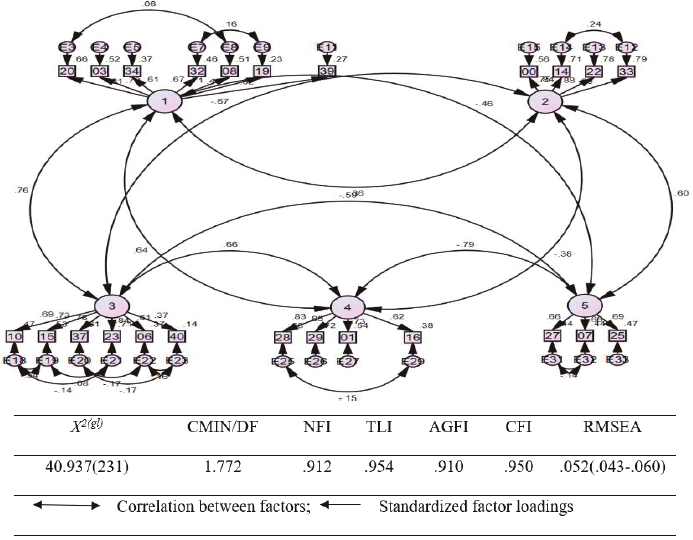
During model fitting, ten items were eliminated ("I need someone who wants to share their life with me," "I need a romantic partner who will support and encourage me the way I need it," "I find myself longing for someone to share my life with," "I would like to have a romantic relationship", "No one in my family really cares about me", "I feel alone when I am with my family", "I feel that my relationships with others are not meaningful", "I am not part of a group of friends, but I would like it", "I have friends with whom I can talk about the pressure in my life", "I feel in "harmony" with the people around me"). The resulting model is shown in Figure 1, where the standardized factor coefficients can be observed along with the fit indices obtained. The fit indices showed satisfactory results (Hu & Bentler, 1999; Kline, 2005): χ2(231) = 40.937; CMIN/DF=1.771; TLI =.954 NFI=.912; IFI=.951, CFI=.950; AGFI= .910, SRMR= .0508; RMSEA= .052(.043 -.060) p.364.
To meet the second objective, the Kolmogorov-Smirnov test was run to check the normality of the sample, and it could not be demonstrated a range of significance that meets the distribution criteria to perform parametric statistics (p ≤ .00, p ≤ .042); consequently, Spearman Brown correlation analyzes were run.
The results showed medium to small correlations indicating that when participants have Friends accompaniment (perception of having people and friends as a support network that can be turned to in times of need), they used more strategies to cope with romantic grief such as Friends support (accompaniment and support from the close group of friends), Emotional intelligence (identification, rebirth and analysis of the feelings and emotions that are being experienced), Adjustment to what happened (understanding and acceptance of the end of the relationship), Family support (accompaniment and support from the family), and Sense of humor (use of humor to face and process the breakup), and to a lesser extent the strategy of Mental disorganization (emotional overload that gets in the way of solving the problem). Similarly, the greater the closeness and belonging to their family (Family accompaniment), the more the participants used the strategies of Emotional intelligence, Family support, Adjustment to what happened and Friends support.
On the contrary, it was found that the more Feelings of emptiness (perception of a deficiency in social relationships), Loneliness with friends (perception of not having a network of friends who understand the individual, and share their opinions, feelings and tastes) and Loneliness with a partner (absence of a partner with whom to share their happiness, satisfy their needs and share their thoughts and feelings), increases the use of the Mental Disorganization strategy, and the use of Emotional Intelligence, Adjustment to what happened, and Friends and Family support decreases.
Table 2. Correlations of loneliness in romantic grief with coping strategies
| Loneliness in romantic grief | ||||||
|---|---|---|---|---|---|---|
| Loneliness with a partner |
Family accompaniment |
Feelings of emptiness |
Loneliness with friends |
Friends accompaniment |
||
| Coping strategies | Emotional intelligence | -.197** | .481** | -.268** | -.266** | .413** |
| Family support | -.198** | .471** | -.293** | -.197** | .270** | |
| Sense of humor | - | - | - | - | .181** | |
| Friends support | -.173** | .239** | -.185** | -.338** | .438** | |
| Mental disorganization | .318** | - | .421** | .227** | -.198** | |
| Adjustment to what happened | -.256** | .285** | -.197** | -.207** | .371** | |
Note: **p<.01
Discussion
Romantic grief is characterized by being an extremely painful experience that people can suffer in their lives (García & Ilabaca Martínez, 2013) and that includes emotions such as anger, regret, uncertainty, loneliness, etc., the latter being one of the most distinctive, due to the imbalance between social relationships and the person's needs (Perlman, 1988). However, the measurement of this construct specifically in the grieving process has been little examined, this study therefore had the objective of adapting and validating the Social and Emotional Loneliness Scale (DiTommaso et al., 2004; Granillo Velasco & Sánchez Aragón, 2020) in the context of romantic grief, and subsequently exploring the relationship between loneliness and the coping strategies.
The Social and Emotional Loneliness Scale in Romantic Grief measures the individual's perception of the absence of a partner and support network (friends and family) that provide understanding, acceptance, affection and needs satisfaction. After carrying out the first analyses, the scale obtained adequate explained variance, Cronbach's alpha and McDonald's omega (Calleja, in press; McDonald, 1999; Reyes Lagunes & García Barragán, 2008) to measure said construct. After the CFA, the fit indices demonstrated satisfactory results (Hu & Bentler, 1999; Kline, 2005) that demonstrate an appropriate model to measure the variable in question through five factors.
The first factor named Loneliness with a partner (7 items) refers to the perception of the absence of a partner with whom to share your happiness, who satisfies your needs, and who shares your thoughts and feelings. The factor reflects a negative evaluation as a result of the end of the relationship since, according to Worden (2018), love grief is characterized by the loneliness experienced by people who have lost their partner and were used to a day-to-day relationship. This will occur to the extent that people adapt to the new situation they are experiencing (Alonso Llácer et al., 2019) in the process of achieving acceptance of what happened (Sánchez Aragón & Martínez Cruz, 2014). It can be said that this factor is opposite to the one found by Granillo Velasco and Sánchez-Aragón (2020) called "partner accompaniment", and the romantic subscale of DiTommaso and Spinner (1993).
The second factor, Family accompaniment (4 items) corresponds to the feeling of belonging, company and concern that the person perceives from the family, particularly in moments as difficult as romantic grief. This is explained from the culture, since in Mexican culture, the family is essential (Díaz Guerrero, 1972) in the lives of its members since it covers the basic needs of individuals as well as fondness, safety, affection among others. Thus, the family is one of the indicators for people's well-being (Castellanos Cereceda, 2013). In fact, Jones (1982) found that individuals with greater interaction with their family tend to report fewer feelings of loneliness. On the other hand, this factor agrees with what was proposed by Granillo Velasco and Sánchez-Aragón (2020) and DiTommaso y Spinner (1993), named family accompaniment and family subscale, both factors speak of the feelings of company and belonging, as well as recognize that the family cares about the participant.
In relation to the third factor, Feelings of emptiness (6 items), it encompasses the perception of living with a deficit in social relationships (whether at a subjective or objective level) (Weiss, 1973), and its concomitant pain due to the lack of understanding, company and acceptance, so it includes items such as frequently feeling alone, feeling alone no matter who is around, as well as feeling distant from people and excluded, and not feeling important to others. This feeling of emptiness occurs when the person's social networks are insufficient or there is an imbalance between what they had with a partner and their current scenario in which they no longer have that significant relationship (Perlman & Peplau, 1984). Feelings of emptiness in grief will not diminish until they stop wanting to be with the ex-partner (Dykstra, 1995). The feelings included in this factor are found in most loneliness scales (De Jong-Gierveld & Kamphuis, 1985; DiTommaso et al., 2004; Granillo Velasco & Sánchez Aragón, 2020; Russell, 1996), since they correspond theoretically to its definition (Perlman & Peplau, 1984; Weiss, 1973).
The fourth factor (4 items) corresponds to Loneliness with friends, which measures the perception of not having a network of friends who provide accompaniment, understanding and with whom one can share experiences, feelings, tastes and opinions. During romantic grief, it is possible that some friendships shared with the ex-partner are lost or stopped; from what has been seen, people in this stage tend to feel lonelier than people who have not been in a relationship for some time (Dykstra, 1995). This factor complements the last factor, named Friends accompaniment (3 items), which corresponds to the perception of having people and friends as a support network that can be turned to in times of need, which provide feelings of belonging and understanding. (DiTommaso & Spinner, 1993; Granillo Velasco & Sánchez Aragón, 2020). In addition to the above, people with more interconnected and dense networks, such as close friendship relationships, tend to feel less alone (Stokes, 1987), since they feel listened to, accepted, comforted, loved, respected and supported, which, in addition, provides them with security and opportunities to carry out other activities that distract and reward them (Barrón López de Roda, 1996). This is why friendships mean so much to someone in romantic grief (Dykstra, 1995).
Regarding the second objective, which was to verify if there is a relationship between loneliness and coping strategies in romantic grief, it was found that participants who have a support network from their friends (Friends accompaniment) and feel companionship when with their family (family accompaniment), face romantic grief by seeking advice and company from them. Friendship in young people is one of the main support networks (Orcasita Pineda & Uribe Rodríguez, 2010) where they can find safety, affection and help in critical moments, therefore, when there is the perception of having support from friends one tends to resort to them frequently (Barrón López de Roda, 1996); on the other hand, when one has a family where affection, company and communication are expressed, the individual usually has enough tools to be able to develop intimate relationships such as those of friends (Castellanos Cereceda, 2013).
Likewise, when accompanied by friends and family, individuals tend to analyze their feelings and identify their emotions (emotional intelligence), understand and accept having ended the relationship (adjustment to what happened), and obtain support from their family and friends; because having these resources with whom to express feelings promotes the understanding of the emotions that the individual is experiencing (Martínez González et al., 2010), and in turn causes acceptance of the facts and being more open with the family about their own emotions. When people are surrounded by warm relationships, they have greater emotional expressiveness and, in addition, present greater clarity, regulation and verbalization of emotions (Páez Rovira et al., 2006).
On the other hand, it was also observed that participants use a sense of humor as a coping strategy, because it allows reducing the impact of stress, generating positive emotions and increasing their own perception of their abilities to overcome the situation (Espinar et al., 2016), friends and family precisely promote the optimal scenario to generate jokes and laughter. Likewise, having a network of friends and family helps to have less mental disorganization and with the emotions that one is experiencing; having the perception of being listened to and supported promotes psychological well-being, which helps to better control impulses, feelings and emotions (Barrón López de Roda, 1996).
The opposite case, if the individual perceives that they do not have a network of friends, has deficiencies in social relationships in general, and perceives the absence of a partner with whom to share important moments, they will use mental disorganization coping strategies. When there is a perception of loneliness, the individual does not have the ability to share their pain (Rokach & Brock, 1998), also face a lack of self-control (Baumeister & DeWall, 2005) and inability to face crisis and stress situations (Cacioppo et al., 2009; Hawkley & Cacioppo, 2007), so they feel that they get carried away by their emotions, it is difficult to concentrate and their feelings interfere when it comes to providing a solution. While, the strategies of Emotional Intelligence, Family and Friends accompaniment, and Adjustment to what happened are not used, since the individual does not have close social networks to have the confidence to express their feelings, emotions and concerns (Rokach & Brock, 1998); equally, when missing your ex-partner it is difficult to adjust to the fact that the relationship is over, since you do not have friends and/or family with whom you can distract yourself and vent.
In conclusion, the research carried out represents a methodological contribution that is applicable in basic and applied research, as well as in the clinical professional field, thus solving problems of daily life. Likewise, it was found that there is a relationship between loneliness and coping strategies; when individuals have solid support networks with family and friends, they tend to use adaptive strategies that allow them to understand their emotions, as well as to use the ability to share their problems and distress; while when they perceive themselves without someone to help or understand them, they use aversive strategies where the emotions they are experiencing are not processed. Among the limitations of the study are that it was not distinguished between the participants who ended the relationship and those whose partner ended it; this data would allow us to observe if the loneliness they are experiencing is something they were looking for and therefore if it changes the coping strategies they use.

