<?xml version="1.0" encoding="ISO-8859-1"?><article xmlns:mml="http://www.w3.org/1998/Math/MathML" xmlns:xlink="http://www.w3.org/1999/xlink" xmlns:xsi="http://www.w3.org/2001/XMLSchema-instance">
<front>
<journal-meta>
<journal-id>0186-1042</journal-id>
<journal-title><![CDATA[Contaduría y administración]]></journal-title>
<abbrev-journal-title><![CDATA[Contad. Adm]]></abbrev-journal-title>
<issn>0186-1042</issn>
<publisher>
<publisher-name><![CDATA[Universidad Nacional Autónoma de México, Facultad de Contaduría y Administración]]></publisher-name>
</publisher>
</journal-meta>
<article-meta>
<article-id>S0186-10422012000200010</article-id>
<title-group>
<article-title xml:lang="en"><![CDATA[The effects of critics reviews on movie demand]]></article-title>
<article-title xml:lang="es"><![CDATA[Impacto de la crítica cinematográfica sobre la demanda de cine]]></article-title>
</title-group>
<contrib-group>
<contrib contrib-type="author">
<name>
<surname><![CDATA[Azuela-Flores]]></surname>
<given-names><![CDATA[José Ignacio]]></given-names>
</name>
<xref ref-type="aff" rid="A01"/>
</contrib>
<contrib contrib-type="author">
<name>
<surname><![CDATA[Fernández-Blanco]]></surname>
<given-names><![CDATA[Víctor]]></given-names>
</name>
<xref ref-type="aff" rid="A02"/>
</contrib>
<contrib contrib-type="author">
<name>
<surname><![CDATA[Sanzo-Pérez]]></surname>
<given-names><![CDATA[María José]]></given-names>
</name>
<xref ref-type="aff" rid="A03"/>
</contrib>
</contrib-group>
<aff id="A01">
<institution><![CDATA[,Universidad Autónoma de Tamaulipas  ]]></institution>
<addr-line><![CDATA[ ]]></addr-line>
</aff>
<aff id="A02">
<institution><![CDATA[,Universidad de Oviedo  ]]></institution>
<addr-line><![CDATA[ ]]></addr-line>
</aff>
<aff id="A03">
<institution><![CDATA[,Universidad de Oviedo  ]]></institution>
<addr-line><![CDATA[ ]]></addr-line>
</aff>
<pub-date pub-type="pub">
<day>00</day>
<month>06</month>
<year>2012</year>
</pub-date>
<pub-date pub-type="epub">
<day>00</day>
<month>06</month>
<year>2012</year>
</pub-date>
<volume>57</volume>
<numero>2</numero>
<fpage>201</fpage>
<lpage>222</lpage>
<copyright-statement/>
<copyright-year/>
<self-uri xlink:href="http://www.scielo.org.mx/scielo.php?script=sci_arttext&amp;pid=S0186-10422012000200010&amp;lng=en&amp;nrm=iso"></self-uri><self-uri xlink:href="http://www.scielo.org.mx/scielo.php?script=sci_abstract&amp;pid=S0186-10422012000200010&amp;lng=en&amp;nrm=iso"></self-uri><self-uri xlink:href="http://www.scielo.org.mx/scielo.php?script=sci_pdf&amp;pid=S0186-10422012000200010&amp;lng=en&amp;nrm=iso"></self-uri><abstract abstract-type="short" xml:lang="en"><p><![CDATA[Most research on the impact of critics on movie attendance behavior has examined aggregated data but the effect on the behavior has not been observed. Our aim is to fll this gap by analyzing if movie reviews increase movie attendance at the individual level. In order to achieve this goal, the cultural demand model of learning-by-consuming-process was extended to incorporate the effects of the movie reviews. Using the information contained in the Survey of Cultural Practice and Habits in Spain, we estimated an ordered probit model. Our empirical results show that reading reviews strongly increases movie attendance frequency. Moreover, it can be seen that no matter whether the review is positive or negative, the frequency of movie attendance always increases. Accordingly with our results, the worst review it is the one that is never made, so we conclude as the popular saying "very bad reviews are the next best thing to good reviews".]]></p></abstract>
<abstract abstract-type="short" xml:lang="es"><p><![CDATA[La mayoría de las investigaciones que analizan los efectos de la información sobre la demanda de cine se han realizado a través de datos agregados; esto es, analizan una serie de películas y su recaudación en taquilla. Sin embargo, desde este análisis, no se observa el comportamiento individual frente a la información especializada. El objetivo de este trabajo consiste precisamente en cubrir este hueco metodológico mediante el análisis de los efectos de las fuentes de información, concretamente de la crítica cinematográfica sobre la asistencia al cine. Para lograrlo, el modelo de la demanda del aprendizaje a través del consumo fue extendido, incorporando los efectos de las críticas cinematográficas. Usando la información contenida en la encuesta de hábitos y prácticas culturales en España, hemos estimado un modelo probit ordenado. Los resultados muestran que la lectura de críticas incrementa la frecuencia de asistencia al cine, no importa si la crítica es positiva o negativa. Según nuestro resultados, concluimos que la peor crítica es la que no se hace y que una mala crítica es lo mejor después de una buena crítica.]]></p></abstract>
<kwd-group>
<kwd lng="en"><![CDATA[critics]]></kwd>
<kwd lng="en"><![CDATA[film reviews]]></kwd>
<kwd lng="en"><![CDATA[consumer behavior]]></kwd>
<kwd lng="en"><![CDATA[taste formation]]></kwd>
<kwd lng="en"><![CDATA[movie demand]]></kwd>
<kwd lng="es"><![CDATA[demanda cultural]]></kwd>
<kwd lng="es"><![CDATA[formación del gusto]]></kwd>
<kwd lng="es"><![CDATA[demanda de cine]]></kwd>
<kwd lng="es"><![CDATA[critica de cine]]></kwd>
<kwd lng="es"><![CDATA[consumidor cultural]]></kwd>
</kwd-group>
</article-meta>
</front><body><![CDATA[  	    <p align="center"><font face="verdana" size="4"><b>The effects of critics reviews on movie demand</b></font></p>  	    <p align="center"><font face="verdana" size="2">&nbsp;</font></p>  	    <p align="center"><font face="verdana" size="3"><b>Impacto de la cr&iacute;tica cinematogr&aacute;fica sobre la demanda de cine</b></font></p>  	    <p align="center"><font face="verdana" size="2">&nbsp;</font></p>  	    <p align="center"><font face="verdana" size="2"><b>Jos&eacute; Ignacio Azuela&#45;Flores<sup>*</sup>, V&iacute;ctor Fern&aacute;ndez&#45;Blanco<sup><a href="#notas">**</a></sup> y Mar&iacute;a Jos&eacute; Sanzo&#45;P&eacute;rez<sup>***</sup></b></font></p>  	    <p align="justify"><font face="verdana" size="2">&nbsp;</font></p>  	    <p align="justify"><font face="verdana" size="2"><i><sup>*</sup> Universidad Aut&oacute;noma de Tamaulipas</i> <a href="mailto:iazuelaf@uat.edu.mx">iazuelaf@uat.edu.mx</a></font></p>  	    <p align="justify"><font face="verdana" size="2"><i><sup>**</sup> Universidad de Oviedo</i> <a href="mailto:vfernan@uniovi.es">vfernan@uniovi.es</a></font></p>  	    <p align="justify"><font face="verdana" size="2"><i><sup>***</sup> Universidad de Oviedo</i> <a href="mailto:mjsanzo@uniovi.es">mjsanzo@uniovi.es</a></font></p>  	    ]]></body>
<body><![CDATA[<p align="justify"><font face="verdana" size="2">&nbsp;</font></p>  	    <p align="justify"><font face="verdana" size="2">Fecha de recepci&oacute;n: 21.09.2010    <br> 	Fecha de aceptaci&oacute;n: 17.01.2011</font></p> 	    <p align="justify">&nbsp;</p> 	    <p align="justify"><font face="verdana" size="2"><b>Abstract</b></font></p>  	    <p align="justify"><font face="verdana" size="2">Most research on the impact of critics on movie attendance behavior has examined aggregated data but the effect on the behavior has not been observed. Our aim is to fll this gap by analyzing if movie reviews increase movie attendance at the individual level. In order to achieve this goal, the cultural demand model of learning&#45;by&#45;consuming&#45;process was extended to incorporate the effects of the movie reviews. Using the information contained in the Survey of Cultural Practice and Habits in Spain, we estimated an ordered probit model. Our empirical results show that reading reviews strongly increases movie attendance frequency. Moreover, it can be seen that no matter whether the review is positive or negative, the frequency of movie attendance always increases. Accordingly with our results, the worst review it is the one that is never made, so we conclude as the popular saying "very bad reviews are the next best thing to good reviews".</font></p>  	    <p align="justify"><font face="verdana" size="2"><b>Keywords:</b> critics, film reviews, consumer behavior, taste formation, movie demand.</font></p>  	    <p align="justify"><font face="verdana" size="2">&nbsp;</font></p>  	    <p align="justify"><font face="verdana" size="2"><b>Resumen</b></font></p>  	    <p align="justify"><font face="verdana" size="2">La mayor&iacute;a de las investigaciones que analizan los efectos de la informaci&oacute;n sobre la demanda de cine se han realizado a trav&eacute;s de datos agregados; esto es, analizan una serie de pel&iacute;culas y su recaudaci&oacute;n en taquilla. Sin embargo, desde este an&aacute;lisis, no se observa el comportamiento individual frente a la informaci&oacute;n especializada. El objetivo de este trabajo consiste precisamente en cubrir este hueco metodol&oacute;gico mediante el an&aacute;lisis de los efectos de las fuentes de informaci&oacute;n, concretamente de la cr&iacute;tica cinematogr&aacute;fica sobre la asistencia al cine. Para lograrlo, el modelo de la demanda del aprendizaje a trav&eacute;s del consumo fue extendido, incorporando los efectos de las cr&iacute;ticas cinematogr&aacute;ficas. Usando la informaci&oacute;n contenida en la encuesta de h&aacute;bitos y pr&aacute;cticas culturales en Espa&ntilde;a, hemos estimado un modelo probit ordenado. Los resultados muestran que la lectura de cr&iacute;ticas incrementa la frecuencia de asistencia al cine, no importa si la cr&iacute;tica es positiva o negativa. Seg&uacute;n nuestro resultados, concluimos que la peor cr&iacute;tica es la que no se hace y que una mala cr&iacute;tica es lo mejor despu&eacute;s de una buena cr&iacute;tica.</font></p>  	    ]]></body>
<body><![CDATA[<p align="justify"><font face="verdana" size="2"><b>Palabras clave:</b> demanda cultural, formaci&oacute;n del gusto, demanda de cine, critica de cine, consumidor cultural.</font></p>  	    <p align="justify"><font face="verdana" size="2">&nbsp;</font></p>  	    <p align="justify"><font face="verdana" size="2"><b>Introduction</b></font></p>  	    <p align="justify"><font face="verdana" size="2">The study of film critique has been very productive, providing alternative interpretation for the determinants of movie success. In this field, research has provided controverted opinions. On the one hand, those who say that reviews have a positive relationship with box office performance (Litman &amp; Kohl, 1989; Wyatt, 1991; Wallace <i>et al</i>. 1993; Sochay, 1994); on the other hand, some authors find no relationship between film reviews and box office performance (Ravid, 1999; Zufryden, 2000). Finally, and following Eliashberg &amp; Shugan&rsquo;s (1997) proposal, reviewers have been observed sometimes as influencers (Basuroy <i>et al</i>. 2003) and other times as predictors of movie success (Eliashberg &amp; Shugan, 1997; Basuroy, Chatterjee &amp; Ravid, 2003; Reinstein &amp; Snyder, 2005). In any case, critics&rsquo; impact is an interesting research field but always focused on an aggregate level because the empirical analysis has been oriented to the effects on box office movie performance. Under these circumstances, analysing how reviews influence the moviegoer&rsquo;s decision process is a key point, and this is just the objective of our paper.</font></p>  	    <p align="justify"><font face="verdana" size="2">We establish this reviews influence on movie attendance in two ways: by reducing the risk associated with watching the movie and by increasing the ability to enjoy the movie consumption. To achieve our aims, we have enlarged the L&eacute;vy&#45;Garboua &amp; Montmarquette&rsquo;s (1996) theoretical demand model based on a learning&#45;by&#45;consuming&#45;approach. In concrete, we have added the effect of an external source of information, film reviews in our case, and we test their influence empirically using Spanish data on individual.</font></p>  	    <p align="justify"><font face="verdana" size="2">The paper has the following structure: first includes a review of the existing literature about the role of film critique and our main hypothesis is formulated. Inmediately presents our theoretical model of demand for cultural goods and their econometric specification. After a brief description of our database. Subsequently, discusses the main results of our empirical analyses. Finally, offers some concluding remarks and managerial implications.</font></p>  	    <p align="justify"><font face="verdana" size="2">&nbsp;</font></p>  	    <p align="justify"><font face="verdana" size="2"><b>Literature Review</b></font></p>  	    <p align="justify"><font face="verdana" size="2">The ability of critics to influence the decision process of individuals through their opinions or critical reviews has been analysed in many different cultural markets, from the gastronomic market (Chossat &amp; Gergaud, 2003), the wine market (Ashen&#45;felter &amp; Jones, 2000) to the performing arts and cultural industries (Verdaasdonk, 1987). But undoubtedly, it has been in the movie market where the effect of critics has been more deeply studied and it is precisely here where our research is focused.</font></p>  	    <p align="justify"><font face="verdana" size="2">Probably, the first interest of the studies on film critique was trying to determine their impact on the box office revenues. The results of these studies are not conclusive. On the one hand, Litman &amp; Kohl (1989); Wyatt (1991), Wallace <i>et al.</i> (1993) and Sochay (1994) found a significant relationship between positive reviews and box&#45;office revenues. On the other hand, Ravid (1999) and King (2007) showed that no correlation exists between the critical ratings of films and gross box office earnings. King (2007) attributes this lack of correlation to a difference in taste between critic and consumers. Finally, Hirschman &amp; Pieros (1985) found evidence of positive reviews having a negative influence on box office performance.</font></p>  	    ]]></body>
<body><![CDATA[<p align="justify"><font face="verdana" size="2">Some papers have compared critics and moviegoers preferences. Holbrook (1999) confirms that both have different ways of valuating movies although also share some preferences; he also establishes that not all the movies positively valuated by the consumers lack artistic value and vice versa. Ginsburgh y Weyers (1999) point out that critics&rsquo; opinion is not time consistent. Finally, Ravid <i>et al</i>. (2006) say that some critics, especially the most famous and reputed, show a statistical bias towards movies from some specifc studios.</font></p>  	    <p align="justify"><font face="verdana" size="2">Former studies have raised some questions: &iquest;do critics and consumers have different judgment and values? This question, in turn, raises another new question: do critics and consumers share the same tastes? The author concludes that these differences and similarities can not be affirmed definitively, not all movies that have been positively valuated by the consumers lack artistic value and vice versa.</font></p>  	    <p align="justify"><font face="verdana" size="2">When studying the critics influence on consumer&rsquo;s behaviour, Eliashberg &amp; Shugan (1997) can be considered a starting point. They define critics as influencers or predictors. The infuencer perspective implies that film reviews directly affect the consumer&rsquo;s decision making process. The predictor perspective suggests that reviews only predict consumer&rsquo;s decisions. To determine which one is the most likely perspective, the authors examine whether the impact of a review is refected in early box office revenue or total revenue. Their results show that reviews correlate positively with the total box office revenue and, therefore, the authors say that critics act as predictors.</font></p>  	    <p align="justify"><font face="verdana" size="2">After this work, many authors have applied Eliashberg and Shugan&rsquo;s classification for different goals. Basuroy <i>et al</i>. (2003) find that positive and negative reviews affect the weekly box office incomes through an eight week period, therefore, critics can be both influencers and predictors. Measuring the impact of positive and negative reviews, they confirm their hypothesis: there is not a symmetrical effect. Negative reviews hurt deeper the box office than the positives can beneft them. Finally, they prove that superstars and big budgets partially compensate the effect of negatives reviews, "big budgets and stars can moderate the blow and perhaps save the executive&rsquo;s job" (p. 116).</font></p>  	    <p align="justify"><font face="verdana" size="2">Reinstein and Snyder (2005) suggest that the critic effect can be different whether the the movie has got a wide or narrow releasing strategy. They focus on the opinion of two specifc critics to deal with the endogeneity between reviews and the intrinsic quality of the movie to conclude that the reviewers play the role of predictors.</font></p>  	    <p align="justify"><font face="verdana" size="2">Gemser <i>et al</i>. (2007) find a different effect of the reviews on art house movies and mainstream movies. In the latter, the review act as predictor, while in former as infuencer. Perhaps this happens because these are low budget films and therefore offer less qualitative information to the consumers. In the case of art house movies, they also found that the positive or negative nature of the review is not important, as Shrum (1991) has pointed out "...even mediocre or negative review are better than no review at all" (p.368).</font></p>  	    <p align="justify"><font face="verdana" size="2">Finally, Boatwright <i>et al</i>. (2007) analyze the relationship between reviews and the intrinsic quality of movies. They discuss if movie success (in terms of large audiences) is due to its quality or to reviewers&rsquo; opinions. They point out that reviewers, as opinions leaders, can affect the diffusion movie process, that is, how fast a movie is received and seen.</font></p>  	    <p align="justify"><font face="verdana" size="2">Nevertheless, all these researches has concentrated in the aggregate analysis of film critique, in others words, how reviews impact on box office revenues. This approach deals with the presence of endogenity problem with the intrinsic quality of movies, as it was already pointed out. In this paper we develop a different approach focused on individual consumer&rsquo;s preferences and choices. We consider film reviews as a relevant source of information and analyse their impact on the individual frequency of movie attendance, together with the study of the individual socioeconomic characteristics and his/her cultural capital.</font></p>  	    <p align="justify"><font face="verdana" size="2">Our hypothesis is that reading film reviews increases the frequency of movie attendance, because they give us information and reduce the movie associated risk (Shrum, 1991).</font></p>  	    <p align="justify"><font face="verdana" size="2">&nbsp;</font></p>  	    ]]></body>
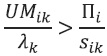
<body><![CDATA[<p align="justify"><font face="verdana" size="2"><b>Film reviews and movie attendance: Theoretical Approach and Empirical Specification</b></font></p>  	    <p align="justify"><font face="verdana" size="2">To describe moviegoers behaviour and find out if critics have a real influence on movie attendance, our paper extends the L&eacute;vy&#45;Garboua &amp; Montmarquette (1996) demand to incorporate the effect of exogenous sources of information, in particular movie reviews. L&eacute;vy&#45;Garboua &amp; Montmarquette (1996) describe demand for cultural goods in a learning&#45;by&#45;consuming process, based on previous consumption experiences, including pleasant and unpleasant surprises. We suggest that this learning&#45;by&#45;consuming process depends as well on the information the consumer collects beforehand.</font></p>  	    <p align="justify"><font face="verdana" size="2">Gathering information and discovering how to use it accurately and proftably along the consumer&rsquo;s decision process, is a slow process that requires a lot of time and money (it involves formal education and cultural background including previous cultural experiences) and obtains its benefts in the long run. Since cultural commodities (including movies) are experience goods, the consumer&rsquo;s choice is always a risky decision. From our point of view, film critique offers new and low cost information that, in the short run, will reduce risk, and in the long run will increase individual&rsquo;s cultural capital and influence his/her taste formation process.</font></p>  	    <p align="justify"><font face="verdana" size="2">Following the L&eacute;vy&#45;Garboua and Montmarquette (1996) discrete choice model, in a context of utility maximization, the first&#45;order condition of consuming <i>i</i> for individual <i>k</i> is</font></p>  	    <p align="center"><font face="verdana" size="2"><img src="/img/revistas/cya/v57n2/a10s1.jpg"></font></p>  	    <p align="justify"><font face="verdana" size="2">Hence, the consumption of a given cultural good <i>i</i> depends positively on his/her marginal utility for zero consumption <i>(UM<sub>ik</sub>)</i> and his/her subjective valuation of this good <i>(s</i><i><sub>ik</sub></i><i>).</i> It also depends negatively on its price (&#928;<i><sub>i</sub></i>) and his/her marginal utility of income (&#955;<i><sub>k</sub></i>). This marginal utility can be linked to some socioeconomic variables (gender, age, etc.) but also to risk. From our point of view, film critique reduces risk and therefore reduces this marginal utility, so they stimulate cultural (movie) consumption.</font></p>  	    <p align="justify"><font face="verdana" size="2">In this context, where the individual chooses between consuming <i>(T=1)</i> or not consuming <i>(T=0),</i> the probability of consuming the good <i>T</i> (movies) will be expressed by the next equation:</font></p>  	    <p align="justify"><font face="verdana" size="2">Prob (T = 1) = Prob (u<sub>k</sub>&gt; &#45;&#946;X<sub>k</sub>)</font></p>  	    <p align="justify"><font face="verdana" size="2">where <i>&#946;</i> is the vector of parameters to be estimated, <i>X<sub>k</sub></i> is the vector of explanatory variables that include the attention that consumers pay to the critics, and <i>u<sub>k</sub></i> is a random disturbance that follows a normal distribution.</font></p>  	    <p align="justify"><font face="verdana" size="2">Our interest is to analyze the effect of film critique on the frequency of movie attendance, that is, whether or not film reviews increase the movie attendance. Since our survey measures movie attendance by a hierarchical and discrete variable, the empirical model to be estimated is an ordered probabilistic<sup><a href="#notas">1</a></sup> one whose general specification is:</font></p>  	    ]]></body>
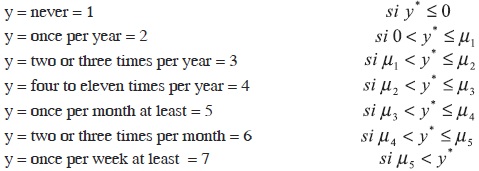
<body><![CDATA[<p align="justify"><font face="verdana" size="2"><i>y<sup>*</sup> = &#946;X+&#949;</i></font></p>  	    <p align="justify"><font face="verdana" size="2">where <i>y<sup>*</sup></i> represent the individual&rsquo;s attendance according to their preferences, <i>X</i> is a vector of explanatory variables and &#949; is a random disturbance that follows a normal distribution with zero means, variance equals one.</font></p>  	    <p align="justify"><font face="verdana" size="2">For movie attendance, the structure of the answers that we can observe in the Survey (our dependent variable) and their relationship with the unobserved preferences are:</font></p>  	    <p align="center"><font face="verdana" size="2"><img src="/img/revistas/cya/v57n2/a10s4.jpg"></font></p>  	    <p align="justify"><font face="verdana" size="2">The &micro; parameters are unknown and most be estimated joint a vector of <i><sup><a href="#notas">2</a></sup></i> parameters. If &micro; parameters are statistical significant, the groups that define differ to each other.</font></p>  	    <p align="justify"><font face="verdana" size="2">The vector of explanatory variables <i>X</i> is composed by the information provided by the critics, the socioeconomic characteristics, the cultural capital of the individuals, the consume of the audiovisual goods (like dvds and TV), and finally by the consumption of cultural goods.</font></p>  	    <p align="justify"><font face="verdana" size="2">We propose that the socioeconomic characteristics could explain, on the one hand, the formation of cultural tastes and, on the other hand, show the free time availability. About the consumer&rsquo;s cultural capital and background we consider it contributes to extend available information and then reduce risks, increasing the probability of movie attendance.</font></p>  	    <p align="justify"><font face="verdana" size="2">At the same time, we consider that both the consumption of audiovisual goods and the cultural consumption in general (attendance to popular music and events such as theatre plays, ballet, opera, zarzuela and classical music concerts) act as additives to the cultural capital and, therefore, we consider that they increase movie attendance.</font></p>  	    <p align="justify">&nbsp;</p> 	    <p align="justify"><font face="verdana" size="2"><i>Data. Survey of Cultural Practice and Habits in Spain</i></font></p>      ]]></body>
<body><![CDATA[<p align="justify"><font face="verdana" size="2">Data were obtained from the 2002&#45;2003. The survey sampled 12,180 individuals older than 15. Information was collected about leisure habits and cultural consumption involving films, performing arts, recorded or live music, lectures and museums, among others things. The survey also provided information about socioeconomic characteristics of the interviewee, such as gender and age.</font></p>  	    <p align="justify"><font face="verdana" size="2">&nbsp;</font></p>  	    <p align="justify"><font face="verdana" size="2"><b>Empirical Results</b></font></p>  	    <p align="justify"><font face="verdana" size="2">In this section, we explain the profle of movie consumers in Spain and how it is affected by information sources, especially by the movie critics. The results of the ordered probabilistic model are shown in <a href="/img/revistas/cya/v57n2/a10t1.jpg" target="_blank">Table 1</a><sup>2</sup>.</font></p>  	    <p align="justify">&nbsp;</p> 	    <p align="justify"><font face="verdana" size="2"><i>Socioeconomic</i></font></p>      <p align="justify"><font face="verdana" size="2">We now discuss the effect of socioeconomic variables (such as gender, age, marital status, city size or relationship with the economic activity) on the frequency of movie consumption.</font></p>  	    <p align="justify"><font face="verdana" size="2">The first impression is that the socioeconomic profle of the Spanish movie consumer resembles that in an earlier study (Fern&aacute;ndez&#45;Blanco <i>et al</i>., 2002). Most Spanish moviegoers are young people, with no family dependants and with higher education.</font></p>  	    <p align="justify"><font face="verdana" size="2">Our model also includes some variables whose aim is capturing the effect of the occupational level. These variables can refect various effects. First, they can be useful as a proxy for income (Towse, 1994). Second, they can be useful to indicate the taste formation process (Prieto&#45;Rodriguez &amp; Fern&aacute;ndez&#45;Blanco, 2000). Finally, these variables can also indicate the individual&rsquo;s time availability. Our results show that employees are more probable to go to the movies than any other of the alternatives (retired, unemployed, students and housewife/househusband).</font></p>  	    <p align="justify">&nbsp;</p> 	    ]]></body>
<body><![CDATA[<p align="justify"><font face="verdana" size="2"><i>Cultural Capital</i></font></p>      <p align="justify"><font face="verdana" size="2">In this paper we include variables related to the individual&rsquo;s specific cultural capital. This kind of capital was measured by the practice <i>(ARTPRACTICE)</i> and/or study <i>(ARTFORMATION)</i> of artistic activities. We observe a positive and significant relationship between practicing those artistic activities (i.e. music, photography, drama, performing arts) and movie attendance.</font></p>  	    <p align="justify">&nbsp;</p> 	    <p align="justify"><font face="verdana" size="2"><i>Audiovisuals</i></font></p>      <p align="justify"><font face="verdana" size="2">We introduce the consumption of other audiovisual products such as DVDs and television in order to test complementary or substituibility relationships. The effects of television were measured in two ways: how many hours the interviewee watches TV, and the consumption of movies on television. We observe that the consumption of television in general acts as a substitutive for movie attendance; this result has been observed in previous research (Fern&aacute;ndez Blanco, 1996; 1998; Fern&aacute;ndez Blanco &amp; Ba&ntilde;os Pino, 1997; Fern&aacute;ndez Blanco <i>et al.,</i> 2002). However, when we examine the effect of movie consumption on television, the effects are inverse so this kind of consumption appears as a complementary good to movie attendance.</font></p>  	    <p align="justify"><font face="verdana" size="2">The relationship between movie attendance and videos is a priori ambiguous because they are considered a substitute by some opinions and a complementary by others (Fern&aacute;ndez Blanco &amp; Ba&ntilde;os Pino, 1997; Fern&aacute;ndez Blanco <i>et al.,</i> 2002). The effects of videos were introduced under three variables: the use of VCR or DVD players, the renting and the bought of videos. All of them are significant and positively related to movie attendance. People who watch, rent and buy videos are the ones who go to movie theatres. To summarize, moviegoers transcends the consumption channel.</font></p>  	    <p align="justify"><font face="verdana" size="2">Finally, new technologies have opened the window of opportunity for entertainment and they may change people&rsquo;s leisure practices, especially among those who are the most frequent movie consumers: young people. For this reason, we introduced some variables measuring new technologies and their role as substitute or complementary of movies. The results were diverse: downloading and listening music on the Web (<i>DOWNMUSIC</i> and <i>LISTEN&#45;E&#45;MUSIC</i>) act as leisure alternatives that compete directly with movie attendance; however, software on videogames (<i>SOFTWAREGAME</i>), a proxy variable for other visual options, has a positive correlation with movie attendance. From these results it is diffcult to get a definite conclusion about the substitutive or complementary effect of new technologies.</font></p>  	    <p align="justify">&nbsp;</p> 	    <p align="justify"><font face="verdana" size="2"><i>Cultural Goods</i></font></p>      <p align="justify"><font face="verdana" size="2">We also wanted to know if the cultural consumption, in general, increases the probability of going to the cinema. The results show a positive and significant relationship between movie attendance and the consumption of performing arts such as theatre (THEATRE) and popular and classical music (<i>CLASICMUSIC and POPMUSIC</i>). Analysis of marginal effects suggests that cultural consumption, in general, increases the probability of going to the cinema more often. Theatre attendance (THEATRE) reduces the probability of not going to the cinema up to 18.2%, while it increases 6.5% the probability of going two or three times per month. In summary, the great movie consumers are omnivorous, they consume not only movies, but also art and culture in general.</font></p>  	    ]]></body>
<body><![CDATA[<p align="justify">&nbsp;</p> 	    <p align="justify"><font face="verdana" size="2"><i>Critics and Other Sources Information</i></font></p>      <p align="justify"><font face="verdana" size="2">The effects of movie critics confirm our assumption: the critic has a great influence on movie attendance, and this is also suggested by the coefficient about reading movies critique (CRITICREAD) which outstands among the highest of the model. In terms of marginal effects we can see that reading film critique in the newspapers affect notably reducing by 10% the probability of not going to the cinemas and increases 3% the probability of monthly attendance. Then critics encourage movie consumption not only increasing its frequency but also reducing the possibility of deserting the cinemas.</font></p>  	    <p align="justify"><font face="verdana" size="2">It is important to highlight that we could not identify the kind of review, and if it was positive or negative. Anyway, the consumers responses in relation to the reviews were always positive. These results suggest that regardless of the kind of review, positive or negative, the more the spectator reads critique, the more they go to the cinema. This indicates that in some or other way, spectators have the critics into account.</font></p>  	    <p align="justify"><font face="verdana" size="2">Our results report that film reviews are an important consume engine for the Spanish people, not only promoting the increase of frequency consumption, but reducing the possibility of deserting the cinemas.</font></p>  	    <p align="justify"><font face="verdana" size="2">Summarizing, the movie&#45;goers are good readers of film critics, which confirms our hypothesis that the critic increase the probability of movie consumption, because helps to reduce the risk, and facilitate the search cost, providing detail and relevant information about the non available characteristics of the movies before their consumption.</font></p>  	    <p align="justify"><font face="verdana" size="2">&nbsp;</font></p>  	    <p align="justify"><font face="verdana" size="2"><b>Conclusions</b></font></p>  	    <p align="justify"><font face="verdana" size="2">Our empirical approach is the first approach which tries to explain the effect of critics on movie attendance. In addition to this, in this work we have added the effects of the cultural capital over the movie attendance.</font></p>  	    <p align="justify"><font face="verdana" size="2">Related to these mentioned contributions and from this work results some conclusions which can be considered a contribution to the empirical study of the critic.</font></p>  	    ]]></body>
<body><![CDATA[<p align="justify"><font face="verdana" size="2">Regarding other additional sources of cultural information, we have observed that, generally speaking, they keep a positive effect on movie attendance. These sources of cultural information, in general, reduce the probability of absence to the cinemas. In conclusion, the consumption of culture in general helps to reduce the risk associated to movie attendance and, at the same time, and due to the same principle as education, the consumption of cultural information reduces the risk associated to the consumption of culture and art in general.</font></p>  	    <p align="justify"><font face="verdana" size="2">One of the main resources to encourage the consumption of experience goods is to increase information and reduce risk. Education, both generic and specifc, and past experiences are commonly considered the main instruments to achieve these goals, but our paper states that access to cultural information in general also plays the same role. In this sense, we have paid attention to movie reviews under the hypothesis that they can help to reduce the associate risk because they show characteristics of the experience before its consumption. We have confirmed the expected positive and significant relation with the attendance: movie reviews not only reduce 10.5% the probability of deserting the movie theatres, but also increase 1.4% the probability of attendance at least once in a week.</font></p>  	    <p align="justify"><font face="verdana" size="2">Taking into account the size of the corresponding coefficients, it can be seen that only education and cultural consumption have stronger impact than reviews. These results were as expected because cultural interest and the taste of arts come mainly from education, the instrument in cultural capital by excellence. Likewise the consumption of another cultural products (theatre plays, "zarzuela", classical and popular music concerts) increases the individual&rsquo;s cultural capital and his/her capacity to appreciate and enjoy any cultural product.</font></p>  	    <p align="justify"><font face="verdana" size="2">Finally, considering simultaneously the effects of reviews, education and other cultural commodities, we conclude that cultural capital is the key point to understand cultural consumption in general and movie attendance in particular. From this point of view, it can be said that the same movie is different for each consumer as they have different cultural background. Cultural capital allows the consumers to have different opinions of the same movie. In this context, any addition to the cultural capital through the reviews not only reduce the risk, but will also increase the capacity to enjoy the movie experience.</font></p>  	    <p align="justify"><font face="verdana" size="2">Every research is likely to be improved. This feature generates limitations of its findings and this work is not an exception. Perhaps, from our point of view, the greatest limitation of our work is the way we approached the cultural capital. In this article cultural capital has been measured through education in arts and arts practice (this abstract measure of cultural capital is not only due to lack of data, but also the result of a fairly generic definition of this concept, which makes it diffcult to treat empirically). In future research, cultural capital could be approximated in different ways and observe their effects on film demand and if it moderates the effects of criticism. Similarly, this work could be improved if it included information that distinguished the effects of positive reviews compared to the negative reviews.</font></p>  	    <p align="justify">&nbsp;</p> 	    <p align="justify"><font face="verdana" size="2"><i>Managerial implication</i></font></p>      <p align="justify"><font face="verdana" size="2">The former conclusions allows us to make some suggestions to the different movie industry participants, especially regarding policy and commercial strategies.</font></p>  	    <p align="justify"><font face="verdana" size="2">First of all, our research provides a extensive profile of Spanish moviegoers that can be useful to the industry in order to focus on the preferences and necessities of the consumers.</font></p>  	    <p align="justify"><font face="verdana" size="2">On the other hand, it has been proved that the critics&rsquo; opinions, no matter if positive or negative, interest the audience. The movie industry must take this into account in their promotional and communication campaigns. Nevertheless, some movie studies penalize those critics with negative reviews of their movies, however, this is a bad strategy from our point of view. According to our results, the worst review is that which is never made: indifference towards the movie is worse that a negative review. We do not recommend to penalize critics for their reviews, quite opposite our recommendation is fomenting the fow of information, talking about a movie. Maybe in the short term it can be bad for a movie but, negative review can better than no one. So we conclude like the popular saying "very bad reviews are the next best thing to good reviews".</font></p>  	    ]]></body>
<body><![CDATA[<p align="justify"><font face="verdana" size="2">&nbsp;</font></p>  	    <p align="justify"><font face="verdana" size="2"><b>References</b></font></p>  	    <!-- ref --><p align="justify"><font face="verdana" size="2">Ashenfelter, O. &amp; Jones, G. (2000). The demand for expert opinion: Bordeaux wine. In M. Pichery, &amp; M. Terraza (Eds.), Oenometrics VI. 6th annual meeting of the Vineyard Data Quantification Society in Ajaccio, Corsica. Cahier Scientifique No. 3 (March 2000), Facult&eacute; des sciences &eacute;conomiques, Universit&eacute; de Montpellier.    &nbsp;&nbsp;&nbsp;&nbsp;&nbsp;&nbsp;&nbsp;&nbsp;[&#160;<a href="javascript:void(0);" onclick="javascript: window.open('/scielo.php?script=sci_nlinks&ref=2233607&pid=S0186-1042201200020001000001&lng=','','width=640,height=500,resizable=yes,scrollbars=1,menubar=yes,');">Links</a>&#160;]<!-- end-ref --></font></p>  	    <!-- ref --><p align="justify"><font face="verdana" size="2">Basuroy, S., Chatterjee, S., &amp; Ravid, A. (2003). How critical are critical reviews? The box office effects of film critics, star power, and budgets. <i>Journal of Marketing (67):</i> 103&#45;117.    &nbsp;&nbsp;&nbsp;&nbsp;&nbsp;&nbsp;&nbsp;&nbsp;[&#160;<a href="javascript:void(0);" onclick="javascript: window.open('/scielo.php?script=sci_nlinks&ref=2233609&pid=S0186-1042201200020001000002&lng=','','width=640,height=500,resizable=yes,scrollbars=1,menubar=yes,');">Links</a>&#160;]<!-- end-ref --></font></p>  	    <!-- ref --><p align="justify"><font face="verdana" size="2">Boatwright, P., Basuroy S., &amp; Kamakura, W. (2007). Reviewing the reviewers: The impact of individual film critics on box office performance. <i>Journal of Cultural Economics</i> (5)<i>:</i> 401&#45;425<i>.    &nbsp;&nbsp;&nbsp;&nbsp;&nbsp;&nbsp;&nbsp;&nbsp;[&#160;<a href="javascript:void(0);" onclick="javascript: window.open('/scielo.php?script=sci_nlinks&ref=2233611&pid=S0186-1042201200020001000003&lng=','','width=640,height=500,resizable=yes,scrollbars=1,menubar=yes,');">Links</a>&#160;]<!-- end-ref --></i></font></p>  	    <!-- ref --><p align="justify"><font face="verdana" size="2">Chossat V. &amp; Gergaud O. (2003). Expert opinion and gastronomy: The recipe for success. <i>Journal of Cultural Economics</i> (27): 127&#45;141.    &nbsp;&nbsp;&nbsp;&nbsp;&nbsp;&nbsp;&nbsp;&nbsp;[&#160;<a href="javascript:void(0);" onclick="javascript: window.open('/scielo.php?script=sci_nlinks&ref=2233613&pid=S0186-1042201200020001000004&lng=','','width=640,height=500,resizable=yes,scrollbars=1,menubar=yes,');">Links</a>&#160;]<!-- end-ref --></font></p>  	    ]]></body>
<body><![CDATA[<!-- ref --><p align="justify"><font face="verdana" size="2">Eliashberg, J. &amp; Shugan, S. (1997). Film Critics: influencers or Predictors? <i>Journal of Marketing</i> (61): 68&#45;78.    &nbsp;&nbsp;&nbsp;&nbsp;&nbsp;&nbsp;&nbsp;&nbsp;[&#160;<a href="javascript:void(0);" onclick="javascript: window.open('/scielo.php?script=sci_nlinks&ref=2233615&pid=S0186-1042201200020001000005&lng=','','width=640,height=500,resizable=yes,scrollbars=1,menubar=yes,');">Links</a>&#160;]<!-- end-ref --></font></p>  	    <!-- ref --><p align="justify"><font face="verdana" size="2">Fern&aacute;ndez Blanco, V. (1996). La demanda de cine en Espa&ntilde;a 1968&#45;1992. <i>Informaci&oacute;n Comercial Espa&ntilde;ola</i> (751): 157&#45;168.    &nbsp;&nbsp;&nbsp;&nbsp;&nbsp;&nbsp;&nbsp;&nbsp;[&#160;<a href="javascript:void(0);" onclick="javascript: window.open('/scielo.php?script=sci_nlinks&ref=2233617&pid=S0186-1042201200020001000006&lng=','','width=640,height=500,resizable=yes,scrollbars=1,menubar=yes,');">Links</a>&#160;]<!-- end-ref --></font></p>  	    <!-- ref --><p align="justify"><font face="verdana" size="2">Fern&aacute;ndez Blanco, V. (1998). <i>El cine y su p&uacute;blico en Espa&ntilde;a. Un an&aacute;lisis econ&oacute;mico,</i> Colecci&oacute;n Datautor, Madrid: Fundaci&oacute;n Autor.    &nbsp;&nbsp;&nbsp;&nbsp;&nbsp;&nbsp;&nbsp;&nbsp;[&#160;<a href="javascript:void(0);" onclick="javascript: window.open('/scielo.php?script=sci_nlinks&ref=2233619&pid=S0186-1042201200020001000007&lng=','','width=640,height=500,resizable=yes,scrollbars=1,menubar=yes,');">Links</a>&#160;]<!-- end-ref --></font></p>  	    <!-- ref --><p align="justify"><font face="verdana" size="2">Fern&aacute;ndez Blanco, V. and Ba&ntilde;os Pino, J. (1997). Cinema demand in Spain: A cointegration analysis. <i>Journal of Cultural Economics</i> (21): 57&#45;75.    &nbsp;&nbsp;&nbsp;&nbsp;&nbsp;&nbsp;&nbsp;&nbsp;[&#160;<a href="javascript:void(0);" onclick="javascript: window.open('/scielo.php?script=sci_nlinks&ref=2233621&pid=S0186-1042201200020001000008&lng=','','width=640,height=500,resizable=yes,scrollbars=1,menubar=yes,');">Links</a>&#160;]<!-- end-ref --></font></p>  	    <!-- ref --><p align="justify"><font face="verdana" size="2">Fern&aacute;ndez Blanco, V., Prieto Rodr&iacute;guez, J., Mu&ntilde;iz Artime, C, &amp; Guti&eacute;rrez del Castillo, R. (2002). <i>Cin&eacute;flos, videoadictos y telespectadores. Los perfiles de los consumidores de productos audiovisuales en Espa&ntilde;a,</i> Colecci&oacute;n Datautor, Madrid: Fundaci&oacute;n Autor.    &nbsp;&nbsp;&nbsp;&nbsp;&nbsp;&nbsp;&nbsp;&nbsp;[&#160;<a href="javascript:void(0);" onclick="javascript: window.open('/scielo.php?script=sci_nlinks&ref=2233623&pid=S0186-1042201200020001000009&lng=','','width=640,height=500,resizable=yes,scrollbars=1,menubar=yes,');">Links</a>&#160;]<!-- end-ref --></font></p>  	    ]]></body>
<body><![CDATA[<!-- ref --><p align="justify"><font face="verdana" size="2">Gemser, G., Van Oostrum M. &amp; Leenders, M. (2007). The impact of film reviews on the box office performance of art house versus mainstream motion pictures. <i>Journal of Cultural Economics</i> (31): 43&#45;63.    &nbsp;&nbsp;&nbsp;&nbsp;&nbsp;&nbsp;&nbsp;&nbsp;[&#160;<a href="javascript:void(0);" onclick="javascript: window.open('/scielo.php?script=sci_nlinks&ref=2233625&pid=S0186-1042201200020001000010&lng=','','width=640,height=500,resizable=yes,scrollbars=1,menubar=yes,');">Links</a>&#160;]<!-- end-ref --></font></p>  	    <!-- ref --><p align="justify"><font face="verdana" size="2">Ginsburgh, V. &amp; Weyers, S. (1999). On the perceived quality of movies. <i>Journal of Cultural Economics</i> (23): 269&#45;283.    &nbsp;&nbsp;&nbsp;&nbsp;&nbsp;&nbsp;&nbsp;&nbsp;[&#160;<a href="javascript:void(0);" onclick="javascript: window.open('/scielo.php?script=sci_nlinks&ref=2233627&pid=S0186-1042201200020001000011&lng=','','width=640,height=500,resizable=yes,scrollbars=1,menubar=yes,');">Links</a>&#160;]<!-- end-ref --></font></p>  	    <!-- ref --><p align="justify"><font face="verdana" size="2">Hirschman, E. &amp; Pieros, A. (1985). Relationship among indicators of success in Broadway plays and motion pictures. <i>Journal of Cultural Economics</i> (9): 35&#45;63.    &nbsp;&nbsp;&nbsp;&nbsp;&nbsp;&nbsp;&nbsp;&nbsp;[&#160;<a href="javascript:void(0);" onclick="javascript: window.open('/scielo.php?script=sci_nlinks&ref=2233629&pid=S0186-1042201200020001000012&lng=','','width=640,height=500,resizable=yes,scrollbars=1,menubar=yes,');">Links</a>&#160;]<!-- end-ref --></font></p>  	    <!-- ref --><p align="justify"><font face="verdana" size="2">Holbrook, M. (1999). Popular appeal versus expert judgments of motion pictures. <i>Journal of Consumer Research</i> (26): 144&#45;55.    &nbsp;&nbsp;&nbsp;&nbsp;&nbsp;&nbsp;&nbsp;&nbsp;[&#160;<a href="javascript:void(0);" onclick="javascript: window.open('/scielo.php?script=sci_nlinks&ref=2233631&pid=S0186-1042201200020001000013&lng=','','width=640,height=500,resizable=yes,scrollbars=1,menubar=yes,');">Links</a>&#160;]<!-- end-ref --></font></p>  	    <!-- ref --><p align="justify"><font face="verdana" size="2">King, T. (2007). Does film criticism affect box office earnings? Evidence from movies released in the U.S. in 2003. <i>Journal of Cultural Economics</i> (31): 171&#45;186.    &nbsp;&nbsp;&nbsp;&nbsp;&nbsp;&nbsp;&nbsp;&nbsp;[&#160;<a href="javascript:void(0);" onclick="javascript: window.open('/scielo.php?script=sci_nlinks&ref=2233633&pid=S0186-1042201200020001000014&lng=','','width=640,height=500,resizable=yes,scrollbars=1,menubar=yes,');">Links</a>&#160;]<!-- end-ref --></font></p>  	    ]]></body>
<body><![CDATA[<!-- ref --><p align="justify"><font face="verdana" size="2">L&eacute;vy&#45;Garboua, L. &amp; Montmarquette, C. (1996). A microeconometric study of theatre demand. <i>Journal of Cultural Economics</i> (20): 25&#45;50<i>.    &nbsp;&nbsp;&nbsp;&nbsp;&nbsp;&nbsp;&nbsp;&nbsp;[&#160;<a href="javascript:void(0);" onclick="javascript: window.open('/scielo.php?script=sci_nlinks&ref=2233635&pid=S0186-1042201200020001000015&lng=','','width=640,height=500,resizable=yes,scrollbars=1,menubar=yes,');">Links</a>&#160;]<!-- end-ref --></i></font></p>  	    <!-- ref --><p align="justify"><font face="verdana" size="2">Litman, B. &amp; Kohl, L. (1989). Predicting financial success of motion pictures: The 80s experience. <i>Journal of Media Economics</i> (2): 35&#45;50.    &nbsp;&nbsp;&nbsp;&nbsp;&nbsp;&nbsp;&nbsp;&nbsp;[&#160;<a href="javascript:void(0);" onclick="javascript: window.open('/scielo.php?script=sci_nlinks&ref=2233637&pid=S0186-1042201200020001000016&lng=','','width=640,height=500,resizable=yes,scrollbars=1,menubar=yes,');">Links</a>&#160;]<!-- end-ref --></font></p>  	    <!-- ref --><p align="justify"><font face="verdana" size="2">Prieto Rodr&iacute;guez, J. &amp; Fern&aacute;ndez Blanco, V. (2000). Are popular and classical music listeners the same people. <i>Journal of Cultural Economics,</i> 24, 147&#45;164.    &nbsp;&nbsp;&nbsp;&nbsp;&nbsp;&nbsp;&nbsp;&nbsp;[&#160;<a href="javascript:void(0);" onclick="javascript: window.open('/scielo.php?script=sci_nlinks&ref=2233639&pid=S0186-1042201200020001000017&lng=','','width=640,height=500,resizable=yes,scrollbars=1,menubar=yes,');">Links</a>&#160;]<!-- end-ref --></font></p>  	    <!-- ref --><p align="justify"><font face="verdana" size="2">Ravid, S. (1999). Information, blockbusters, and stars: A study of the film industry. <i>Journal of Business</i> (72): 463&#45;492.    &nbsp;&nbsp;&nbsp;&nbsp;&nbsp;&nbsp;&nbsp;&nbsp;[&#160;<a href="javascript:void(0);" onclick="javascript: window.open('/scielo.php?script=sci_nlinks&ref=2233641&pid=S0186-1042201200020001000018&lng=','','width=640,height=500,resizable=yes,scrollbars=1,menubar=yes,');">Links</a>&#160;]<!-- end-ref --></font></p>  	    <!-- ref --><p align="justify"><font face="verdana" size="2">Ravid, S., Wald, K. &amp; Basuroy, S. (2006). Distributors and film critics: Does it take two to tango? <i>Journal of Cultural Economics</i> (30): 201&#45;218.    &nbsp;&nbsp;&nbsp;&nbsp;&nbsp;&nbsp;&nbsp;&nbsp;[&#160;<a href="javascript:void(0);" onclick="javascript: window.open('/scielo.php?script=sci_nlinks&ref=2233643&pid=S0186-1042201200020001000019&lng=','','width=640,height=500,resizable=yes,scrollbars=1,menubar=yes,');">Links</a>&#160;]<!-- end-ref --></font></p>  	    ]]></body>
<body><![CDATA[<!-- ref --><p align="justify"><font face="verdana" size="2">Reddy, S., Swaminathan, V. &amp; Motley, C. (1998). Exploring the determinants of Broadway show success. <i>Journal of Marketing Research</i> (35): 370&#45;83.    &nbsp;&nbsp;&nbsp;&nbsp;&nbsp;&nbsp;&nbsp;&nbsp;[&#160;<a href="javascript:void(0);" onclick="javascript: window.open('/scielo.php?script=sci_nlinks&ref=2233645&pid=S0186-1042201200020001000020&lng=','','width=640,height=500,resizable=yes,scrollbars=1,menubar=yes,');">Links</a>&#160;]<!-- end-ref --></font></p>  	    <!-- ref --><p align="justify"><font face="verdana" size="2">Reinstein, D. &amp; Snyder, C. (2005). The influence of expert reviews on consumer demand for experience goods: A case study of movie critics. <i>The Journal of Industrial Economics</i> (53): 27&#45;51.    &nbsp;&nbsp;&nbsp;&nbsp;&nbsp;&nbsp;&nbsp;&nbsp;[&#160;<a href="javascript:void(0);" onclick="javascript: window.open('/scielo.php?script=sci_nlinks&ref=2233647&pid=S0186-1042201200020001000021&lng=','','width=640,height=500,resizable=yes,scrollbars=1,menubar=yes,');">Links</a>&#160;]<!-- end-ref --></font></p>  	    <!-- ref --><p align="justify"><font face="verdana" size="2">Shrum, W. (1991). Critics and publics: cultural mediation in highbrow and popular performing arts. <i>American Journal of Sociology</i> (97): 347&#45;375.    &nbsp;&nbsp;&nbsp;&nbsp;&nbsp;&nbsp;&nbsp;&nbsp;[&#160;<a href="javascript:void(0);" onclick="javascript: window.open('/scielo.php?script=sci_nlinks&ref=2233649&pid=S0186-1042201200020001000022&lng=','','width=640,height=500,resizable=yes,scrollbars=1,menubar=yes,');">Links</a>&#160;]<!-- end-ref --></font></p>  	    <!-- ref --><p align="justify"><font face="verdana" size="2">Sochay, S. (1994). Predicting the performance of motion pictures. <i>The Journal of Media Economics</i> (7): 1&#45;20.    &nbsp;&nbsp;&nbsp;&nbsp;&nbsp;&nbsp;&nbsp;&nbsp;[&#160;<a href="javascript:void(0);" onclick="javascript: window.open('/scielo.php?script=sci_nlinks&ref=2233651&pid=S0186-1042201200020001000023&lng=','','width=640,height=500,resizable=yes,scrollbars=1,menubar=yes,');">Links</a>&#160;]<!-- end-ref --></font></p>  	    <!-- ref --><p align="justify"><font face="verdana" size="2">Towse, R. (1994). Achieving public policy objectives in the arts and heritage, In Peacock, A. &amp; Rizzo, I. (Eds.), <i>Cultural Economics and Cultural Policies,</i> Kluwer Academic Publishers, Dordrecht.    &nbsp;&nbsp;&nbsp;&nbsp;&nbsp;&nbsp;&nbsp;&nbsp;[&#160;<a href="javascript:void(0);" onclick="javascript: window.open('/scielo.php?script=sci_nlinks&ref=2233653&pid=S0186-1042201200020001000024&lng=','','width=640,height=500,resizable=yes,scrollbars=1,menubar=yes,');">Links</a>&#160;]<!-- end-ref --></font></p>  	    ]]></body>
<body><![CDATA[<!-- ref --><p align="justify"><font face="verdana" size="2">Verdaasdonk, H. (1987). Effects of acquired readership and reviewers attention on the sales of new literary works. <i>Poetics</i> (16): 237&#45;253.    &nbsp;&nbsp;&nbsp;&nbsp;&nbsp;&nbsp;&nbsp;&nbsp;[&#160;<a href="javascript:void(0);" onclick="javascript: window.open('/scielo.php?script=sci_nlinks&ref=2233655&pid=S0186-1042201200020001000025&lng=','','width=640,height=500,resizable=yes,scrollbars=1,menubar=yes,');">Links</a>&#160;]<!-- end-ref --></font></p>  	    <!-- ref --><p align="justify"><font face="verdana" size="2">Wallace, W., Seigerman A., &amp; Holbrook, B. (1993). The role of actors and actresses in the success of films. <i>Journal of Cultural Economics</i> (17): 1&#45;27.    &nbsp;&nbsp;&nbsp;&nbsp;&nbsp;&nbsp;&nbsp;&nbsp;[&#160;<a href="javascript:void(0);" onclick="javascript: window.open('/scielo.php?script=sci_nlinks&ref=2233657&pid=S0186-1042201200020001000026&lng=','','width=640,height=500,resizable=yes,scrollbars=1,menubar=yes,');">Links</a>&#160;]<!-- end-ref --></font></p>  	    <!-- ref --><p align="justify"><font face="verdana" size="2">Wyatt, J. (1991). High concept, product differentiation, and the contemporary U.S. film industry, In Austin, B. (Ed.), Current research in film: Audiences, economics and law, Ablex, Norwood: 86&#45;105.    &nbsp;&nbsp;&nbsp;&nbsp;&nbsp;&nbsp;&nbsp;&nbsp;[&#160;<a href="javascript:void(0);" onclick="javascript: window.open('/scielo.php?script=sci_nlinks&ref=2233659&pid=S0186-1042201200020001000027&lng=','','width=640,height=500,resizable=yes,scrollbars=1,menubar=yes,');">Links</a>&#160;]<!-- end-ref --></font></p>  	    <!-- ref --><p align="justify"><font face="verdana" size="2">Zufryden, F. (2000). New film website promotion and box&#45;office performance. <i>Journal of Advertising Research</i> (40): 55&#45;64.    &nbsp;&nbsp;&nbsp;&nbsp;&nbsp;&nbsp;&nbsp;&nbsp;[&#160;<a href="javascript:void(0);" onclick="javascript: window.open('/scielo.php?script=sci_nlinks&ref=2233661&pid=S0186-1042201200020001000028&lng=','','width=640,height=500,resizable=yes,scrollbars=1,menubar=yes,');">Links</a>&#160;]<!-- end-ref --></font></p>  	    <p align="justify"><font face="verdana" size="2">&nbsp;</font></p>  	    <p align="center"><font face="verdana" size="2"><a href="/img/revistas/cya/v57n2/html/a10a.html" target="_blank">Appendix</a></font></p>  	    ]]></body>
<body><![CDATA[<p align="justify"><font face="verdana" size="2">&nbsp;</font></p>  	    <p align="justify"><font face="verdana" size="2"><b><a name="notas"></a>Notas</b></font></p>  	    <p align="justify"><font face="verdana" size="2"><sup>**</sup> El autor agradece la financiaci&oacute;n del proyecto MCINN&#45;08&#45;ECO2008&#45;04659, del Ministerio de Ciencia e Inovaci&oacute;n de Espa&ntilde;a</font></p>  	    <p align="justify"><font face="verdana" size="2"><sup>1</sup> To carry out the econometric specification, the 10th version of the statistical package STATA was used.</font></p>  	    <p align="justify"><font face="verdana" size="2"><sup>2</sup> <a href="/img/revistas/cya/v57n2/a10t1.jpg" target="_blank">Table 1</a> presents three estimates. In the first one (estimate 1) it is compared the theoretical proposal presented in this work, which means that the movie demand is explained by the sociodemographic characteristics of individuals, the supply of films measured by the size of locality, cultural consumption, audiovisual consumption, cultural capital, the use of new technologies and the consumption of information (specifically for film reviews). In the following model (estimate 2), it is assumed that new technologies do not change the movie demand, excluding the variables related to the use of new technologies. Finally, the third model (estimate 3) includes only the significant variables in the estimate 1. This paper uses the results provided by the estimate 1. Alternative models (estimate 2 and 3) do not provide significant changes while maintaining the same levels of significance and slight changes in coeffcients. On the contrary, estimates 2 and 3 sacrifce a lot of information that estimate 1 provides.</font></p>      ]]></body><back>
<ref-list>
<ref id="B1">
<nlm-citation citation-type="confpro">
<person-group person-group-type="author">
<name>
<surname><![CDATA[Ashenfelter]]></surname>
<given-names><![CDATA[O.]]></given-names>
</name>
<name>
<surname><![CDATA[Jones]]></surname>
<given-names><![CDATA[G.]]></given-names>
</name>
</person-group>
<article-title xml:lang="en"><![CDATA[The demand for expert opinion: Bordeaux wine]]></article-title>
<person-group person-group-type="editor">
<name>
<surname><![CDATA[Pichery]]></surname>
<given-names><![CDATA[M.]]></given-names>
</name>
<name>
<surname><![CDATA[Terraza]]></surname>
<given-names><![CDATA[M.]]></given-names>
</name>
</person-group>
<source><![CDATA[Oenometrics VI]]></source>
<year>2000</year>
<conf-name><![CDATA[6 Vineyard Data Quantification Society]]></conf-name>
<conf-date>March 2000</conf-date>
<conf-loc>Ajaccio Corsica</conf-loc>
</nlm-citation>
</ref>
<ref id="B2">
<nlm-citation citation-type="journal">
<person-group person-group-type="author">
<name>
<surname><![CDATA[Basuroy]]></surname>
<given-names><![CDATA[S.]]></given-names>
</name>
<name>
<surname><![CDATA[Chatterjee]]></surname>
<given-names><![CDATA[S.]]></given-names>
</name>
<name>
<surname><![CDATA[Ravid]]></surname>
<given-names><![CDATA[A.]]></given-names>
</name>
</person-group>
<article-title xml:lang="en"><![CDATA[How critical are critical reviews? The box office effects of film critics, star power, and budgets]]></article-title>
<source><![CDATA[Journal of Marketing]]></source>
<year>2003</year>
<numero>67</numero>
<issue>67</issue>
<page-range>103-117</page-range></nlm-citation>
</ref>
<ref id="B3">
<nlm-citation citation-type="journal">
<person-group person-group-type="author">
<name>
<surname><![CDATA[Boatwright]]></surname>
<given-names><![CDATA[P.]]></given-names>
</name>
<name>
<surname><![CDATA[Basuroy]]></surname>
<given-names><![CDATA[S.]]></given-names>
</name>
<name>
<surname><![CDATA[Kamakura]]></surname>
<given-names><![CDATA[W.]]></given-names>
</name>
</person-group>
<article-title xml:lang="en"><![CDATA[Reviewing the reviewers: The impact of individual film critics on box office performance]]></article-title>
<source><![CDATA[Journal of Cultural Economics]]></source>
<year>2007</year>
<volume>5</volume>
<page-range>401-425</page-range></nlm-citation>
</ref>
<ref id="B4">
<nlm-citation citation-type="journal">
<person-group person-group-type="author">
<name>
<surname><![CDATA[Chossat]]></surname>
<given-names><![CDATA[V.]]></given-names>
</name>
<name>
<surname><![CDATA[Gergaud]]></surname>
<given-names><![CDATA[O.]]></given-names>
</name>
</person-group>
<article-title xml:lang="en"><![CDATA[Expert opinion and gastronomy: The recipe for success]]></article-title>
<source><![CDATA[Journal of Cultural Economics]]></source>
<year>2003</year>
<numero>27</numero>
<issue>27</issue>
<page-range>127-141</page-range></nlm-citation>
</ref>
<ref id="B5">
<nlm-citation citation-type="journal">
<person-group person-group-type="author">
<name>
<surname><![CDATA[Eliashberg]]></surname>
<given-names><![CDATA[J.]]></given-names>
</name>
<name>
<surname><![CDATA[Shugan]]></surname>
<given-names><![CDATA[S.]]></given-names>
</name>
</person-group>
<article-title xml:lang="en"><![CDATA[Film Critics: influencers or Predictors?]]></article-title>
<source><![CDATA[Journal of Marketing]]></source>
<year>1997</year>
<numero>61</numero>
<issue>61</issue>
<page-range>68-78</page-range></nlm-citation>
</ref>
<ref id="B6">
<nlm-citation citation-type="journal">
<person-group person-group-type="author">
<name>
<surname><![CDATA[Fernández Blanco]]></surname>
<given-names><![CDATA[V.]]></given-names>
</name>
</person-group>
<article-title xml:lang="es"><![CDATA[La demanda de cine en España 1968-1992]]></article-title>
<source><![CDATA[Información Comercial Española]]></source>
<year>1996</year>
<numero>751</numero>
<issue>751</issue>
<page-range>157-168</page-range></nlm-citation>
</ref>
<ref id="B7">
<nlm-citation citation-type="book">
<person-group person-group-type="author">
<name>
<surname><![CDATA[Fernández Blanco]]></surname>
<given-names><![CDATA[V.]]></given-names>
</name>
</person-group>
<source><![CDATA[El cine y su público en España. Un análisis económico]]></source>
<year>1998</year>
<publisher-loc><![CDATA[Madrid ]]></publisher-loc>
<publisher-name><![CDATA[Fundación Autor]]></publisher-name>
</nlm-citation>
</ref>
<ref id="B8">
<nlm-citation citation-type="journal">
<person-group person-group-type="author">
<name>
<surname><![CDATA[Fernández Blanco]]></surname>
<given-names><![CDATA[V.]]></given-names>
</name>
<name>
<surname><![CDATA[Baños Pino]]></surname>
<given-names><![CDATA[J.]]></given-names>
</name>
</person-group>
<article-title xml:lang="en"><![CDATA[Cinema demand in Spain: A cointegration analysis]]></article-title>
<source><![CDATA[Journal of Cultural Economics]]></source>
<year>1997</year>
<numero>21</numero>
<issue>21</issue>
<page-range>57-75</page-range></nlm-citation>
</ref>
<ref id="B9">
<nlm-citation citation-type="book">
<person-group person-group-type="author">
<name>
<surname><![CDATA[Fernández Blanco]]></surname>
<given-names><![CDATA[V.]]></given-names>
</name>
<name>
<surname><![CDATA[Prieto Rodríguez]]></surname>
<given-names><![CDATA[J.]]></given-names>
</name>
<name>
<surname><![CDATA[Muñiz Artime]]></surname>
<given-names><![CDATA[C]]></given-names>
</name>
<name>
<surname><![CDATA[Gutiérrez del Castillo]]></surname>
<given-names><![CDATA[R.]]></given-names>
</name>
</person-group>
<source><![CDATA[Cinéflos, videoadictos y telespectadores. Los perfiles de los consumidores de productos audiovisuales en España]]></source>
<year>2002</year>
<publisher-loc><![CDATA[Madrid ]]></publisher-loc>
<publisher-name><![CDATA[Fundación Autor]]></publisher-name>
</nlm-citation>
</ref>
<ref id="B10">
<nlm-citation citation-type="journal">
<person-group person-group-type="author">
<name>
<surname><![CDATA[Gemser]]></surname>
<given-names><![CDATA[G.]]></given-names>
</name>
<name>
<surname><![CDATA[Van Oostrum]]></surname>
<given-names><![CDATA[M.]]></given-names>
</name>
<name>
<surname><![CDATA[Leenders]]></surname>
<given-names><![CDATA[M.]]></given-names>
</name>
</person-group>
<article-title xml:lang="en"><![CDATA[The impact of film reviews on the box office performance of art house versus mainstream motion pictures]]></article-title>
<source><![CDATA[Journal of Cultural Economics]]></source>
<year>2007</year>
<numero>31</numero>
<issue>31</issue>
<page-range>43-63</page-range></nlm-citation>
</ref>
<ref id="B11">
<nlm-citation citation-type="journal">
<person-group person-group-type="author">
<name>
<surname><![CDATA[Ginsburgh]]></surname>
<given-names><![CDATA[V.]]></given-names>
</name>
<name>
<surname><![CDATA[Weyers]]></surname>
<given-names><![CDATA[S.]]></given-names>
</name>
</person-group>
<article-title xml:lang="en"><![CDATA[On the perceived quality of movies]]></article-title>
<source><![CDATA[Journal of Cultural Economics]]></source>
<year>1999</year>
<numero>23</numero>
<issue>23</issue>
<page-range>269-283</page-range></nlm-citation>
</ref>
<ref id="B12">
<nlm-citation citation-type="journal">
<person-group person-group-type="author">
<name>
<surname><![CDATA[Hirschman]]></surname>
<given-names><![CDATA[E.]]></given-names>
</name>
<name>
<surname><![CDATA[Pieros]]></surname>
<given-names><![CDATA[A.]]></given-names>
</name>
</person-group>
<source><![CDATA[Journal of Cultural Economics]]></source>
<year>1985</year>
<numero>9</numero>
<issue>9</issue>
<page-range>35-63</page-range></nlm-citation>
</ref>
<ref id="B13">
<nlm-citation citation-type="journal">
<person-group person-group-type="author">
<name>
<surname><![CDATA[Holbrook]]></surname>
<given-names><![CDATA[M.]]></given-names>
</name>
</person-group>
<article-title xml:lang="en"><![CDATA[Popular appeal versus expert judgments of motion pictures]]></article-title>
<source><![CDATA[Journal of Consumer Research]]></source>
<year>1999</year>
<numero>26</numero>
<issue>26</issue>
<page-range>144-55</page-range></nlm-citation>
</ref>
<ref id="B14">
<nlm-citation citation-type="journal">
<person-group person-group-type="author">
<name>
<surname><![CDATA[King]]></surname>
<given-names><![CDATA[T.]]></given-names>
</name>
</person-group>
<article-title xml:lang="en"><![CDATA[Does film criticism affect box office earnings? Evidence from movies released in the U.S. in 2003]]></article-title>
<source><![CDATA[Journal of Cultural Economics]]></source>
<year>2007</year>
<numero>31</numero>
<issue>31</issue>
<page-range>171-186</page-range></nlm-citation>
</ref>
<ref id="B15">
<nlm-citation citation-type="journal">
<person-group person-group-type="author">
<name>
<surname><![CDATA[Lévy-Garboua]]></surname>
<given-names><![CDATA[L.]]></given-names>
</name>
<name>
<surname><![CDATA[Montmarquette]]></surname>
<given-names><![CDATA[C.]]></given-names>
</name>
</person-group>
<article-title xml:lang="en"><![CDATA[A microeconometric study of theatre demand]]></article-title>
<source><![CDATA[Journal of Cultural Economics]]></source>
<year>1996</year>
<numero>20</numero>
<issue>20</issue>
<page-range>25-50</page-range></nlm-citation>
</ref>
<ref id="B16">
<nlm-citation citation-type="journal">
<person-group person-group-type="author">
<name>
<surname><![CDATA[Litman]]></surname>
<given-names><![CDATA[B.]]></given-names>
</name>
<name>
<surname><![CDATA[Kohl]]></surname>
<given-names><![CDATA[L.]]></given-names>
</name>
</person-group>
<article-title xml:lang="en"><![CDATA[Predicting financial success of motion pictures: The 80s experience]]></article-title>
<source><![CDATA[Journal of Media Economics]]></source>
<year>1989</year>
<numero>2</numero>
<issue>2</issue>
<page-range>35-50</page-range></nlm-citation>
</ref>
<ref id="B17">
<nlm-citation citation-type="journal">
<person-group person-group-type="author">
<name>
<surname><![CDATA[Prieto Rodríguez]]></surname>
<given-names><![CDATA[J.]]></given-names>
</name>
<name>
<surname><![CDATA[Fernández Blanco]]></surname>
<given-names><![CDATA[V.]]></given-names>
</name>
</person-group>
<article-title xml:lang="en"><![CDATA[Are popular and classical music listeners the same people]]></article-title>
<source><![CDATA[Journal of Cultural Economics]]></source>
<year>2000</year>
<volume>24</volume>
<page-range>147-164</page-range></nlm-citation>
</ref>
<ref id="B18">
<nlm-citation citation-type="journal">
<person-group person-group-type="author">
<name>
<surname><![CDATA[Ravid]]></surname>
<given-names><![CDATA[S.]]></given-names>
</name>
</person-group>
<article-title xml:lang="en"><![CDATA[Information, blockbusters, and stars: A study of the film industry]]></article-title>
<source><![CDATA[Journal of Business]]></source>
<year>1999</year>
<numero>72</numero>
<issue>72</issue>
<page-range>463-492</page-range></nlm-citation>
</ref>
<ref id="B19">
<nlm-citation citation-type="journal">
<person-group person-group-type="author">
<name>
<surname><![CDATA[Ravid]]></surname>
<given-names><![CDATA[S.]]></given-names>
</name>
<name>
<surname><![CDATA[Wald]]></surname>
<given-names><![CDATA[K.]]></given-names>
</name>
<name>
<surname><![CDATA[Basuroy]]></surname>
<given-names><![CDATA[S.]]></given-names>
</name>
</person-group>
<article-title xml:lang="en"><![CDATA[Distributors and film critics: Does it take two to tango?]]></article-title>
<source><![CDATA[Journal of Cultural Economics]]></source>
<year>2006</year>
<numero>30</numero>
<issue>30</issue>
<page-range>201-218</page-range></nlm-citation>
</ref>
<ref id="B20">
<nlm-citation citation-type="journal">
<person-group person-group-type="author">
<name>
<surname><![CDATA[Reddy]]></surname>
<given-names><![CDATA[S.]]></given-names>
</name>
<name>
<surname><![CDATA[Swaminathan]]></surname>
<given-names><![CDATA[V.]]></given-names>
</name>
<name>
<surname><![CDATA[Motley]]></surname>
<given-names><![CDATA[C.]]></given-names>
</name>
</person-group>
<article-title xml:lang="en"><![CDATA[Exploring the determinants of Broadway show success]]></article-title>
<source><![CDATA[Journal of Marketing Research]]></source>
<year>1998</year>
<numero>35</numero>
<issue>35</issue>
<page-range>370-83</page-range></nlm-citation>
</ref>
<ref id="B21">
<nlm-citation citation-type="journal">
<person-group person-group-type="author">
<name>
<surname><![CDATA[Reinstein]]></surname>
<given-names><![CDATA[D.]]></given-names>
</name>
<name>
<surname><![CDATA[Snyder]]></surname>
<given-names><![CDATA[C.]]></given-names>
</name>
</person-group>
<article-title xml:lang="en"><![CDATA[The influence of expert reviews on consumer demand for experience goods: A case study of movie critics]]></article-title>
<source><![CDATA[The Journal of Industrial Economics]]></source>
<year>2005</year>
<numero>53</numero>
<issue>53</issue>
<page-range>27-51</page-range></nlm-citation>
</ref>
<ref id="B22">
<nlm-citation citation-type="journal">
<person-group person-group-type="author">
<name>
<surname><![CDATA[Shrum]]></surname>
<given-names><![CDATA[W.]]></given-names>
</name>
</person-group>
<article-title xml:lang="en"><![CDATA[Critics and publics: cultural mediation in highbrow and popular performing arts]]></article-title>
<source><![CDATA[American Journal of Sociology]]></source>
<year>1991</year>
<numero>97</numero>
<issue>97</issue>
<page-range>347-375</page-range></nlm-citation>
</ref>
<ref id="B23">
<nlm-citation citation-type="journal">
<person-group person-group-type="author">
<name>
<surname><![CDATA[Sochay]]></surname>
<given-names><![CDATA[S.]]></given-names>
</name>
</person-group>
<article-title xml:lang="en"><![CDATA[Predicting the performance of motion pictures]]></article-title>
<source><![CDATA[The Journal of Media Economics]]></source>
<year>1994</year>
<numero>7</numero>
<issue>7</issue>
<page-range>1-20</page-range></nlm-citation>
</ref>
<ref id="B24">
<nlm-citation citation-type="book">
<person-group person-group-type="author">
<name>
<surname><![CDATA[Towse]]></surname>
<given-names><![CDATA[R.]]></given-names>
</name>
</person-group>
<article-title xml:lang="en"><![CDATA[Achieving public policy objectives in the arts and heritage]]></article-title>
<person-group person-group-type="editor">
<name>
<surname><![CDATA[Peacock]]></surname>
<given-names><![CDATA[A.]]></given-names>
</name>
<name>
<surname><![CDATA[Rizzo]]></surname>
<given-names><![CDATA[I.]]></given-names>
</name>
</person-group>
<source><![CDATA[Cultural Economics and Cultural Policies]]></source>
<year>1994</year>
<publisher-loc><![CDATA[Dordrecht ]]></publisher-loc>
<publisher-name><![CDATA[Kluwer Academic Publishers]]></publisher-name>
</nlm-citation>
</ref>
<ref id="B25">
<nlm-citation citation-type="journal">
<person-group person-group-type="author">
<name>
<surname><![CDATA[Verdaasdonk]]></surname>
<given-names><![CDATA[H.]]></given-names>
</name>
</person-group>
<article-title xml:lang="en"><![CDATA[Effects of acquired readership and reviewers attention on the sales of new literary works]]></article-title>
<source><![CDATA[Poetics]]></source>
<year>1987</year>
<numero>16</numero>
<issue>16</issue>
<page-range>237-253</page-range></nlm-citation>
</ref>
<ref id="B26">
<nlm-citation citation-type="journal">
<person-group person-group-type="author">
<name>
<surname><![CDATA[Wallace]]></surname>
<given-names><![CDATA[W.]]></given-names>
</name>
<name>
<surname><![CDATA[Seigerman]]></surname>
<given-names><![CDATA[A.]]></given-names>
</name>
<name>
<surname><![CDATA[Holbrook]]></surname>
<given-names><![CDATA[B.]]></given-names>
</name>
</person-group>
<article-title xml:lang="en"><![CDATA[The role of actors and actresses in the success of films]]></article-title>
<source><![CDATA[Journal of Cultural Economics]]></source>
<year>1993</year>
<numero>17</numero>
<issue>17</issue>
<page-range>1-27</page-range></nlm-citation>
</ref>
<ref id="B27">
<nlm-citation citation-type="book">
<person-group person-group-type="author">
<name>
<surname><![CDATA[Wyatt]]></surname>
<given-names><![CDATA[J.]]></given-names>
</name>
</person-group>
<article-title xml:lang="en"><![CDATA[High concept, product differentiation, and the contemporary U.S. film industry]]></article-title>
<person-group person-group-type="editor">
<name>
<surname><![CDATA[Austin]]></surname>
<given-names><![CDATA[B.]]></given-names>
</name>
</person-group>
<source><![CDATA[Current research in film: Audiences, economics and law]]></source>
<year>1991</year>
<page-range>86-105</page-range><publisher-loc><![CDATA[Norwood ]]></publisher-loc>
<publisher-name><![CDATA[Ablex]]></publisher-name>
</nlm-citation>
</ref>
<ref id="B28">
<nlm-citation citation-type="journal">
<person-group person-group-type="author">
<name>
<surname><![CDATA[Zufryden]]></surname>
<given-names><![CDATA[F.]]></given-names>
</name>
</person-group>
<article-title xml:lang="en"><![CDATA[New film website promotion and box-office performance]]></article-title>
<source><![CDATA[Journal of Advertising Research]]></source>
<year>2000</year>
<numero>40</numero>
<issue>40</issue>
<page-range>55-64</page-range></nlm-citation>
</ref>
</ref-list>
</back>
</article>