




 nova página do texto(beta)
 Inglês (pdf)
 Artigo em XML
 Referências do artigo

 Tradução automática
 Enviar este artigo por email
 Citado por SciELO
 Similares em
SciELO

 Permalink


1. Introduction
In recent years, sustainability performance and reporting have become strategic tools for companies seeking competitive advantages and enhanced corporate reputation among stakeholders, ultimately contributing to sustainable development. Within this framework, environmental, social, and governance (ESG) criteria have become a standard for evaluating companies’ sustainability practices, particularly in capital markets. Regulatory initiatives now incorporate ESG disclosures to help investors assess sustainability-related risks and opportunities, which has led to increased investment in companies with high ESG performance (Bruna et al., 2022; Gillan et al., 2021; Huang, 2021).
Beyond their informational role, ESG disclosures have been shown to reduce agency costs and meet stakeholders’ expectations (Alsayegh et al., 2020; Albitar et al., 2020). Nevertheless, ESG-based reporting often emphasizes financial materiality-i.e., the financial implications of environmental and social risks-over impact materiality, which focuses on a company’s broader ecological and social contributions. This limitation may cause firms to adopt ESG reporting as a compliance tool rather than a comprehensive sustainability strategy with all key stakeholders (Delgado-Ceballos et al., 2022; Larrinaga, 2023).
ESG performance of listed companies has been the subject of analyses in developed countries and emerging economies, showing a significant impact on their financial performance and the stock market value of their shares. This fact is particularly relevant in companies whose activities generate a substantial environmental and social impact (Ahmad et al., 2024; Cherian & Seranmadevi, 2024; Naeem et al., 2022; Șerban et al., 2022).
In Latin America, the Dow Jones Sustainability MILA Pacific Alliance Index (DJSI MILA) evaluates ESG performance in companies listed in Chile, Colombia, Mexico, and Peru, promoting sustainable business practices in the region (S&P Dow Jones Indices, 2022). However, empirical evidence in countries of the region remains inconclusive. While some studies report a significant relationship between ESG performance and financial results (Díaz-Becerra et al., 2024; Chahuán-Jiménez, 2020; Possebon et al., 2024; Da Silva & Mascena, 2024), others find no such association (Duque-Grisales & Aguilera-Caracuel, 2021; Ospina-Patiño et al., 2023; Palacin-Bossa et al., 2024). These mixed findings highlight the need to examine additional variables that may influence this relationship, such as corporate governance mechanisms.
The influence of corporate governance policies on sustainability performance has been considered important for companies. Implementing environmental and social strategies within an effective corporate governance system strengthens corporate sustainability performance. Thus, economic and sustainability objectives emerge from adequate social responsibility and governance policies to reduce agency costs with investors and satisfy stakeholders’ expectations (Alsayegh et al., 2020; Naciti et al., 2022). Moreover, companies with good sustainability and governance performance and, therefore, better market ESG scores have lower risk and higher investment returns (Chen et al., 2023; Șerban et al., 2022).
In this sense, corporate governance practices, such as diverse and independent boards and sustainability committees, significantly influence financial and sustainability performance. Studies by Ayuso et al. (2014), Galbreath (2018a), Li and Chen (2018), and Nicolò et al. (2022) show that board diversity and committee characteristics positively impact profitability. These findings highlight the critical role of corporate governance in financial outcomes. More recent research indicates that board composition and sustainability committees significantly moderate the relationship between ESG performance and financial results (Albitar et al., 2020; Alahdal et al., 2024; Alodat & Hao, 2025; Bollaín Parra et al., 2022; Rossi et al., 2021).
Despite the growing body of literature, there is a lack of empirical studies in Latin America that examine how governance structures condition the relationship between ESG performance and financial outcomes. This gap is especially relevant in the Latin American Integrated Market (MILA-Mercado Integrado Latinoamericano) region, where companies face increasing pressure to align financial success with sustainability commitments. This paper seeks to provide new knowledge in the Latin American context on the limited empirical research on institutional factors’ influence on boards of directors’ dynamics and their influence on ESG performance and company results.
Therefore, this research proposes, as a theoretical contribution, to consider the moderating effect of the composition of the board of directors on its size, diversity, and independence and the presence of a sustainability committee on this relationship in studies in the context of Latin American countries, as in studies of companies in developed country markets (Albitar et al., 2020; Alodat & Hao, 2025) and emerging economies (Jung, 2024; Sharawi et al., 2024). The research also aims to contribute to studies on the influence of each of the three criteria (environmental, social, and governance) of ESG on the profitability of Latin American companies and contribute to previous studies such as Possebon et al. (2022).
Consequently, this study aims to fill a gap in the existing literature by examining the relationship between ESG performance and the financial performance of companies in Latin America. Specifically, it analyzes how ESG performance scores influence company profitability, as measured by return on assets (ROA) and return on equity (ROE). The study will also consider the moderating effects of board composition and the presence of a sustainability committee among companies listed on the MILA exchange from 2020 to 2022. To achieve this, a panel data regression analysis will be conducted, incorporating fixed effects for both country and year. This research contributes to the academic discussion by providing new insights into how corporate governance can enhance the financial benefits of ESG practices within Latin American capital markets.
2. Theoretical Background
2.1 Influence of ESG Performance on Financial Performance
Companies are increasingly expected to generate value for their shareholders and all stakeholders. In response, many firms adopt sustainable performance strategies and disclose non-financial information that aligns with stakeholder expectations. These practices aim to foster long-term value creation that benefits the organization and its stakeholders. By enhancing transparency and addressing social and environmental concerns, companies can improve resource access, strengthen management practices, and ultimately boost overall performance (Jensen, 2002; Porter & Kramer, 2011; Waddock & Graves, 1997).
Furthermore, studies on the relationship between ESG performance and financial outcomes often rely on agency and stakeholder theories. Agency theory suggests that performance-focused management and ESG disclosure reduce agency costs and asymmetry, boosting shareholder confidence (Alsayegh et al., 2020; Rossi et al., 2021). Stakeholder theory, from an instrumental perspective, posits that firms use ESG performance to address stakeholder demands while improving financial performance (Hussain et al., 2024; Velte, 2017).
Studies on environmental, social, and governance performance and disclosure according to ESG criteria have found a significant impact on firms’ medium- and long-term performance and increased competitiveness. In addition to allowing them to achieve greater competitiveness, better reputation, and better valuation in the stock markets (Ademi & Klungseth, 2022; Alareeni & Hamdan, 2020; Chen et al., 2023).
Research on the relationship between ESG performance and financial performance indicates that companies with stronger sustainability and reporting practices achieve better financial performance as measured by return on assets (ROA) and return on equity (ROE) from studies globally (Ahmad et al., 2024; Alareeni & Hamdan, 2020; Alfalih, 2022; Chen et al., 2023; Hussain et al., 2024; Velte, 2017) and in the Latin American context (Díaz-Becerra et al., 2024; Chahuán-Jiménez, 2020; Da Silva & Mascena 2024). Based on the above background, we propose the following hypotheses:
H1. Social ESG scores have a positive and significant impact on the profitability of MILA-listed companies.
H2. Governance ESG scores have a positive and significant impact on the profitability of MILA-listed companies.
H3. Environmental ESG scores have a positive and significant impact on the profitability of MILA-listed companies.
Studies on the influence of ESG performance and corporate profitability consider corporate control variables for better regression analysis. Considering the control variable of firm size, the studies indicate that companies with greater size and resources have better financial and ESG performance and reporting. Thus, they have a greater chance of seeking legitimacy from stakeholders and reducing costs for their investors (Alodat & Hao, 2025; Hussain et al., 2024).
Regarding the control variable of debt level, the studies reviewed have not evidenced a positive relationship between a higher debt level and better financial performance in the ESG performance analysis. These results are consistent with the postulates of the agency theory (Velte, 2017; Alfalih, 2022). Finally, considering business activity as a control variable, studies indicate that the influence of ESG performance on financial performance varies by industry, being more evident in sectors with high environmental and regulatory sensitivity (Alfalih, 2022; Hussain et al., 2024; Naeem et al., 2022; Qureshi et al., 2020).
2.2 Moderating Effect of Board Composition on the Relationship Between ESG Performance and Profitability
Empirical research on the impact of ESG performance and disclosure on profitability-measured through indicators such as ROA and ROE- has yielded mixed results. While findings remain inconclusive, several studies report a significant and positive relationship between ESG scores and financial performance. For instance, Alareeni and Hamdan (2020) found that higher governance-related ESG scores are associated with improved ROA and ROE, attributing this to enhanced operational and strategic efficiency. Albitar et al. (2020) and Velte (2017) pointed out that this relationship is stronger in companies with solid governance structures that promote proactive sustainability management, especially for long-term value-creation purposes. Finally, Chen et al. (2023) showed that good ESG performance helps to mitigate non-financial risks and take advantage of opportunities, thus strengthening competitiveness and financial results.
Other studies report no significant relationship or adverse effects of ESG performance on profitability, often due to poor sustainability management or the absence of stock market mechanisms that value ESG efforts. In these cases, executives may perceive sustainability as an expense rather than a long-term investment, particularly in emerging markets (Atan et al., 2018; Buallay, 2019; Duque-Grisales & Aguilera-Caracuel, 2021; Sanches Garcia & Orsato, 2020; Narula et al., 2024).
Given the previous inconclusive results and as the main contribution of this study, we propose to analyze the moderating effect of board composition and the presence of a sustainability committee as corporate governance policies on the relationship between ESG scores and company profitability in the context of Latin American stock markets such as MILA.
Research suggests that board characteristics and the presence of sustainability committees moderate the relationship between ESG performance and financial outcomes. Studies show that board diversity, independence, and size positively influence this relationship, as diverse boards aligned with company interests benefit all interest groups according to stakeholder theory. Additionally, the presence of women and independent directors has a significant positive moderating effect on the ESG-financial performance link in developed European markets (Albitar et al., 2020; Alodat et al., 2023; Kahloul et al., 2022; Rossi et al., 2021) and in Asia (Alahdal et al., 2024; Jung, 2024; Sharawi et al., 2024).
Gender diversity and independence on boards have been identified as moderating factors in the relationship between ESG reporting and financial performance that, according to the resource dependency theory, enable them to obtain external knowledge and resources for better performance. Thus, the presence of women and independence on boards strengthen the commitment to sustainability and improve the quality of the disclosed ESG-related information. They also tend to prioritize social and environmental responsibility practices, generating a positive impact on the perceptions of investors and stakeholders (Albitar et al., 2020; Galbreath, 2018b; Kahloul et al., 2022; Qureshi et al., 2020; Rossi et al., 2021).
Based on the above background, we propose the following hypotheses:
H4. Board size significantly and positively moderates the relationship between ESG scores and the financial performance of MILA-listed companies.
H5. Gender diversity significantly and positively moderates the relationship between ESG scores and the financial performance of MILA-listed companies.
H6. Board independence significantly and positively moderates the relationship between ESG scores and the financial performance of MILA-listed companies.
2.3 Moderating Effect of the Sustainability Committee
Finally, several studies have shown that the presence of a sustainability committee within the corporate governance structure has a moderating effect on the relationship between ESG disclosure and financial performance. Alodat and Hao (2025), Elmghaamez et al. (2024), and Uyar et al. (2021) hold that these committees strengthen the commitment to transparency and implementation of ESG strategies, which, in turn, build investor confidence and improve corporate profitability.
Moreover, Baraibar-Diez and Odriozola (2019), Khan et al. (2024), and Orazalin et al. (2024) argue that sustainability committees play a key role in overseeing and aligning ESG and social responsibility initiatives with corporate strategy, ensuring effective environmental, social, and governance practices to manage resources more efficiently, manage sustainability-related risks, optimize strategic decision-making, and respond to stakeholders, positively impacting the firm’s financial performance and the creation of value for shareholders.
Based on the above, we propose the following hypothesis:
3. Methodology
3.1 Sample
Initial study data comprised 65 companies listed in the Dow Jones Best-in-Class MILA Pacific Alliance Index in March 2022 (S&P Dow Jones Indices, 2022), obtained from the Refinitiv database. A representative sample of 56 companies was selected after excluding those that did not present integrated reports during the study period (2020-2022). These companies were listed for 2022 in the Dow Jones Sustainability Index MILA Pacific Alliance with a “Best in Class” rating. The index comprises leading sustainability companies, as determined by the Total Sustainability Score (TSS), identified by RobecoSAM through its annual Corporate Sustainability Assessment (CSA). The benchmark uses a best-in-class approach and selects companies among the top 30% of the universe ranked (S&P Dow Jones Indices, 2017). The index increases the visibility of companies excelling in environmental, social, and governance practices across the Pacific Alliance stock exchanges in Chile, Colombia, Mexico, and Peru. This study data was also applied in other studies, such as that of Díaz-Becerra et al. (2024).
The distribution of companies by country and industry is shown in Table 1, highlighting companies in the manufacturing, financial, and services sectors. Mexico has 22, and Chile has 18. These countries have the highest number of companies with the best scores in the index. In contrast, Colombia and Peru have the lowest number of rated companies, with 10 and 6, respectively (see Table 1).
Table 1 Sample of companies by country and type of activity
| Activity | Chile | Colombia | Mexico | Peru | Total | Frequency |
|---|---|---|---|---|---|---|
| Manufacture | 1 | 2 | 6 | 3 | 12 | 21% |
| Financial | 3 | 4 | 3 | 1 | 11 | 20% |
| Services | 2 | 0 | 4 | 1 | 7 | 13% |
| Food Industry | 3 | 1 | 2 | 0 | 6 | 11% |
| Utilities | 2 | 2 | 1 | 0 | 5 | 9% |
| Mining | 3 | 0 | 1 | 0 | 4 | 7% |
| Real Estate | 1 | 0 | 3 | 0 | 4 | 7% |
| Retail | 1 | 0 | 2 | 1 | 4 | 7% |
| Energy | 2 | 1 | 0 | 0 | 3 | 5% |
| Total | 18 | 10 | 22 | 6 | 56 | 100% |
Source: Prepared by the authors.
3.2 Study Design
The quantitative study applies the multiple linear regression technique in two parts. The first part analyses the influence of ESG scores on MILA market companies’ profitability (measured by ROA and ROE) in 2020-2022, applying two models. The first is a linear regression under the ordinary least squares (OLS) method without fixed effects. The second OLS regression model considers year and country fixed effects; this approach is essential to address unobserved heterogeneities that might vary across countries and years. These heterogeneities may include country-specific cultural, political, economic, and social factors and temporal changes that affect all countries equally. By including country and year fixed effects, the effect of these heterogeneities is isolated and provides a more accurate and solid estimate.
The second part of the regression examines the impact of ESG scores on profitability indicators, considering the moderating effects of board composition variables. A multiple regression is performed with interactions for board size, percentage of women and independent directors, and the presence of a sustainability committee. Both models, with and without fixed effects, control for unobserved heterogeneity by country and year. The OLS regression assesses how board composition moderates the ESG-profitability relationship, altering the intensity or direction of the effect on ROA and ROE. Other researchers have used this approach to analyze the effects of board moderation (Alodat & Hao, 2025; Rossi et al., 2021).
Considering the two parts of the regression and the models without and with fixed effects, we propose the following regression equation:
Where:
Yit represents the financial performance of the company i in year t, measured by ROA or ROE. These correspond to the dependent variables.
ESGit measures the environmental, social, and governance dimensions of corporate sustainability of the company i in year t. These correspond to the independent variables.
(GovCorpitx ESGit) captures the interactive effects of the board size, the proportion of women on the board, the proportion of independent directors, and the presence of a sustainability committee on the relation between ESG scores and financial performance of the company i in year t. These correspond to the moderating variables of the design.
Controlsit-1 is a vector of control variables containing the size and level of indebtedness of the company i in year t-1. In addition, the industry to which the company i belongs is included.
δt represents year-fixed effects to control for macroeconomic shocks standard to all firms in year t.
θi denotes country-fixed effects, adjusting for structural factors specific to each country to which the company i belongs.
εit is the error term of the company i in year t.
Figure 1 shows the theoretical model of independent variables: ESG scores; dependent variables: ROA and ROE; moderator variables: board composition and sustainability committee; and corporate control variables (see Figure 1). This model follows the design of previous studies (Albitar et al., 2020; Alodat & Hao, 2025; Elmghaamez et al., 2024; Jung, 2024; Sharawi et al., 2024).
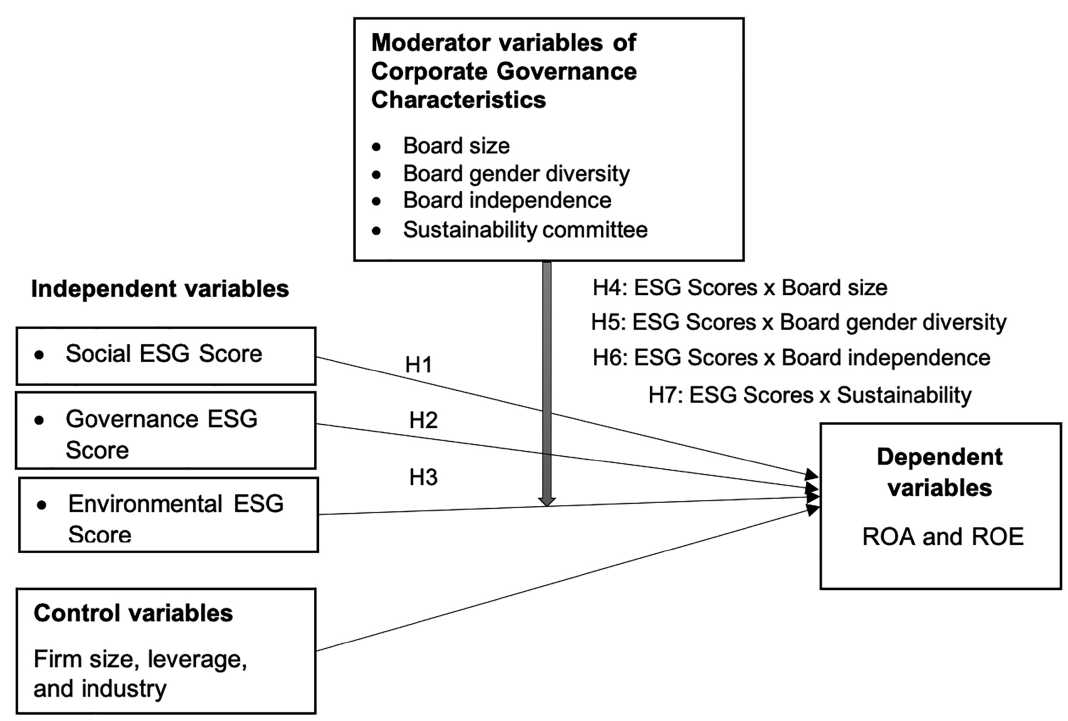
Studies have employed ROA as a key indicator to assess a firm’s efficiency in generating profits from its available resources, highlighting its reliability in measuring operational performance (Alodat & Hao, 2025). Additionally, ROE has been widely used to evaluate the profitability generated on shareholders’ investments (Elmghaamez et al., 2024; Jung, 2024; Sharawi et al., 2024). ROE is particularly sensitive to a firm’s capital structure and financial leverage, which can significantly affect the returns ultimately received by investors.
The definitions, measurement approaches, and sources for all dependent, independent, moderating, and control variables used in this study are presented in Table 2 (see Table 2).
Table 2 Definition and Measurement of Variables
| Variable | Definition and Measurement | Sources |
|---|---|---|
| Dependent | ||
| ROA (return on assets) | Indicator of operating profitability. Measures the efficiency in generating profits from total assets. | Alodat and Hao (2025); Hussain et al., 2024; Keter et al. (2023) |
| ROE (return on equity) | Indicator of financial profitability. Reflects the return generated on shareholders’ investments, considering capital structure and leverage. | Elmghaamez et al. (2024); Sharawi et al. (2024) |
| Independent | ||
| Environmental ESG | Score that evaluates the company’s environmental practices and impacts, measured by a rating from 0 to 100. | Naeem et al. (2022); Ahmad et al. (2024) |
| Social ESG | Score focused on the company’s performance in stakeholder relations, labor, and social practices, measured by a rating from 0 to 100. | Alodat and Hao (2025); Chen et al. (2023); Velte (2017) |
| Governance ESG | Score assessing corporate governance practices, measured by a rating from 0 to 100. | Alareeni and Hamdan (2020); Rossi et al. (2021) |
| Moderators | ||
| Board Size | Number of directors on the board. | Jung (2024); Sharawi et al. (2024) |
| Board Gender Diversity | Percentage of female directors on the board. | Alodat et al. (2023); Galbreath (2018b); Kahloul et al. (2022) |
| Board Independence | Percentage of independent directors on the board. | Jung (2024); Rossi et al. (2021) |
| Sustainability Committee | Dummy variable: 1 if the company has a formal sustainability committee, 0 otherwise. | Alodat and Hao (2025); Elmghaamez et al. (2024) |
| Control | ||
| Firm Size | Total annual assets of the company. | Alodat and Hao (2025); Elmghaamez et al. (2024) |
| Indebtedness Level | Leverage ratio, measured as total liabilities divided by total assets. | Velte (2017); Alfalih (2022) |
| Industry Sensitivity | Dummy variable: 1 if the company belongs to a sustainability-sensitive industry, 0 otherwise. | Sharawi et al. (2024); Jung (2024) |
Source: Prepared by the authors.
The independent variables correspond to the ESG scores-environmental, social, and governance-derived from the Dow Jones MILA Pacific Alliance Sustainability Index (Díaz-Becerra et al., 2024). In addition, studies such as those by Alsayegh et al. (2020) and Alodat and Hao (2025) have analyzed how ESG scores impact financial performance, highlighting their importance in strategic decision-making and the search for attracting investors.
Board characteristics-such as gender diversity, independence, and size-and the presence of a sustainability committee are key governance factors that may moderate the relationship between ESG performance and financial outcomes. These elements play a strategic role in corporate oversight and decision-making. Studies by Jung (2024) and Sharawi et al. (2024) suggest that board composition significantly influences how ESG practices translate into improved financial performance.
Lastly, control variables include firm size, debt level, and industry sensitivity, all of which have been shown in prior studies to affect financial and ESG-related outcomes. The inclusion of these variables ensures greater robustness in the estimation of the models.
4. Results and Discussion
Table 3 shows the descriptive statistics of the study variables over three periods. Slight variations in the means are observed, highlighting an increase in the average presence of sustainability committees, average environmental scores, and average social scores (see Table 3). While the number of board members is maintained, women on boards shows an increase in the study period. The dispersion of data is notable for some variables, particularly environmental, social, and governance scores. Financial indicators, such as ROA and ROE, show fluctuations; some have negative values.
Table 3 Descriptive Statistics of Study Variables
| Year | Statistics | ND | PFD | PID | SC | ESW | SSW | GSW | DEB | SIZE | ROA | ROE |
|---|---|---|---|---|---|---|---|---|---|---|---|---|
| 2020 | Mean | 10.339 | 0.095 | 0.449 | 0.321 | 58.699 | 67.386 | 55.638 | 0.614 | 16.649 | 0.043 | 0.112 |
| SD | 4.201 | 0.118 | 0.288 | 0.471 | 22.624 | 18.188 | 23.824 | 0.164 | 16.846 | 0.041 | 0.115 | |
| Min | 5.000 | 0.000 | 0.111 | 0.000 | 1.690 | 8.690 | 9.730 | 0.387 | 13.691 | -0.031 | -0.074 | |
| Max | 26.000 | 0.600 | 1.000 | 1.000 | 93.220 | 95.060 | 91.900 | 0.925 | 18.244 | 0.251 | 0.754 | |
| 2021 | Mean | 10.054 | 0.112 | 0.440 | 0.429 | 60.147 | 69.464 | 58.110 | 0.625 | 16.700 | 0.044 | 0.124 |
| SD | 3.705 | 0.107 | 0.200 | 0.499 | 22.459 | 16.224 | 21.532 | 0.173 | 16.947 | 0.052 | 0.187 | |
| Min | 5.000 | 0.000 | 0.111 | 0.000 | 1.360 | 13.560 | 11.970 | 0.112 | 13.633 | -0.239 | -0.922 | |
| Max | 25.000 | 0.429 | 1.000 | 1.000 | 95.680 | 95.100 | 91.310 | 0.959 | 18.350 | 0.150 | 0.785 | |
| 2022 | Mean | 10.089 | 0.150 | 0.461 | 0.554 | 61.787 | 70.934 | 59.778 | 0.624 | 16.619 | 0.049 | 0.143 |
| SD | 3.326 | 0.120 | 0.219 | 0.502 | 21.511 | 16.581 | 22.182 | 0.185 | 16.870 | 0.036 | 0.152 | |
| Min | 5.000 | 0.000 | 0.111 | 0.000 | 4.590 | 14.360 | 9.180 | 0.013 | 12.584 | -0.018 | -0.342 | |
| Max | 20.000 | 0.429 | 1.000 | 1.000 | 97.350 | 95.610 | 93.650 | 0.947 | 18.319 | 0.151 | 0.982 |
Source: Prepared by the authors.
Note: Number of directors: ND; Proportion of female directors: PFD; Proportion of independent directors: PID; Sustainability Committee: SC; Environmental Score Weight: ESW; Social Score Weight: SSW; Governance Score Weight: GSW; Indebtedness: DEB; LN(Size): SIZE; ROA: return of assets; ROE: return of equity.
4.1 Influence of ESG Scores on ROA and ROE
4.1.1 Influence of ESG Scores on ROA
As shown in Table 4, social ESG performance has a positive and statistically significant impact on return on assets (ROA) in both regression models. Specifically, the coefficients for Model (1) and Model (2) are 0.145 and 0.148, respectively, indicating that a one-unit increase in the social ESG score is associated with an increase of approximately 0.145 to 0.148 in ROA (see Table 4). These findings support Hypothesis 1 (H1), confirming that social ESG performance enhances operational efficiency, with a significant p-value < 0.05. Moreover, the consistency of results across both models-before and after controlling for year and country fixed effects-demonstrates the soundness of the relationship, suggesting that temporal or country-specific factors do not influence the effect.
Table 4 Results of OLS regression (Model 1) and year and country fixed effects (Model 2) for ROA
| (Model 1) | (Model 2) | |
|---|---|---|
| ROA | ROA | |
| Social ESG | 0.145** | 0.148** |
| (0.120) | (0.123) | |
| Moderating effect | ||
| Social ESG x Number of Directors | 0.0358 | 0.0307 |
| (0.119) | (0.124) | |
| Social ESG x Female Directors | 0.723** | 0.741** |
| (0.357) | (0.362) | |
| Social ESG x Independent Directors | 0.203* | 0.234 |
| (0.191) | (0.198) | |
| Social ESG x Sustainability Committee | 0.640 | 0.611 |
| (0.602) | (0.608) | |
| Governance ESG | 0.982 | 0.894 |
| (0.723) | (0.736) | |
| Moderating Effect | ||
| Governance ESG x Number of Directors | 0.0461 | 0.0367 |
| (0.0528) | (0.0534) | |
| Governance ESG x Female Directors | 0.352** | 0.351** |
| (0.170) | (0.172) | |
| Governance ESG x Independent Directors | 0.130 | 0.215 |
| (0.105) | (0.109) | |
| Governance ESG x Sustainability Committee | 0.332 | 0.427 |
| (0.359) | (0.364) | |
| Environmental ESG | 0.830* | 0.559* |
| (0.333) | (0.521) | |
| Moderating Effect | ||
| Environmental ESG x Number of Directors | 0.133 | 0.561 |
| (0.425) | (0.412) | |
| Environmental ESG x Female Directors | 0.171* | 0.169 |
| (0.206) | (0.212) | |
| Environmental ESG x Independent Directors | 0.884* | 0.103 |
| (0.103) | (0.109) | |
| Environmental ESG x Sustainability Committee | 0.602** | 0.577 |
| (0.429) | (0.430) | |
| Controls | ||
| Size (t-1) | 0.218 | 0.301* |
| (0.249) | (0.298) | |
| Debt (t-1) | 0.166 | 0.294 |
| (0.539) | (0.571) | |
| Industry | 0.095 | 0.101 |
| (0.344) | (0.391) | |
| Constant | 0.186 | 5.971 |
| (0.165) | (61.68) | |
| Year Effect | NO | YES |
| Country Effect | NO | YES |
| N | 168 | 168 |
| R2 | 0.169 | 0.503 |
Standard errors in parentheses
* p < 0.1, ** p < 0.5, *** p < 0.01
Source: Prepared by the authors.
These results are consistent with the studies of Ahmad et al. (2024), Chen et al. (2023), and Velte (2017), in which social performance with stakeholders and improved reputation influence profitability. However, they differ from the results of Alareeni and Hamdan (2020) and Duque-Grisales and Aguilera-Caracuel (2021), showing a negative relationship due to higher social activity costs and a lack of sustainability strategies. The relationship between the social dimension of ESG and financial performance has been found in studies in Latin America, considering stakeholder theory. The relationship with stakeholders in the form of socially responsible behavior-towards employees, suppliers, the community, customers, and others- positively impacts financial performance (Díaz-Becerra et al., 2024; Da Silva & Mascena, 2024).
Regarding the governance dimension, the results indicate a positive but insignificant influence on ROA. In both Model (1) and Model (2), the coefficients for the governance ESG score are 0.982 and 0.894, respectively. However, neither is statistically significant, suggesting that improvements in governance practices do not consistently or directly affect a firm’s operational efficiency. Therefore, we reject hypothesis H2 of the influence of ESG governance performance on ROA.
One of the relevant findings of the study in the Latin American context is the influence of the environmental ESG dimension on ROA. The environmental ESG score shows a positive and statistically significant effect in both Model (1) and Model (2), with coefficients of 0.830 and 0.559, respectively; this means that environmentally responsible practices are closely linked to operational efficiency in MILA-listed firms. Therefore, the third hypothesis, H3, of the significant influence of environmental ESG on ROA is accepted with a p-value < 0.1.
These results are consistent with the studies indicating that environmental ESG performance allows for business operational efficiency and competitive advantages for their activities with greater environmental impact to satisfy stakeholders and the environment, so activities according to ESG criteria, such as saving water and energy, reducing emissions, waste treatment, sustainable supply chains, and regulatory compliance, influence operational performance mainly in companies with a high environmental impact from their operations (Ahmad et al., 2024; Chen et al., 2023; Naeem et al., 2022; Velte, 2017) and in Latin America (Ospina-Patiño et al., 2023; Possebon et al., 2024).
4.1.2 Influence of ESG Scores on ROE
Regarding the impact of ESG scores on ROE, the regression results under the two models are shown in Table 5 (see Table 5). On the one hand, considering the social ESG score, a positive and statistically significant coefficient is observed in Model (1), with a value of 0.711 (p-value < 0.1), indicating a beneficial effect of social ESG on shareholder returns. On the other hand, the effect disappears in Model (2) once the fixed effects are included, where the coefficient becomes statistically insignificant. This suggests that the influence of social ESG on ROE is not responsive to differences across countries and years and may be sensitive to broader macroeconomic or institutional environments that affect how social initiatives translate into profitability for shareholders. Therefore, the H1 hypothesis of the influence of the social ESG score on the ROE is not accepted.
Table 5 Results of OLS Regression (Model 1) and Year and Country Fixed Effects (Model 2) for ROE
| (Model 1) | (Model 2) | |
|---|---|---|
| ROE | ROE | |
| Social ESG | 0.711* (0.441) | 0.127 (0.451) |
| Moderating effect | ||
| Social ESG x Number of Directors | 0.516 | 0.586 |
| (0.435) | (0.454) | |
| Social ESG x Female Directors | 0.143* | 0.161* |
| (0.131) | (0.133) | |
| Social ESG x Independent Directors | 0.197 | 0.315 |
| (0.701) | (0.724) | |
| Social ESG x Sustainability Committee | 0.785 | 0.481 |
| (0.221) | (0.223) | |
| Governance ESG | 0.514* | 0.453* |
| (0.265) | (0.270) | |
| Moderating effect | ||
| Governance ESG x Number of Directors | 0.353* | 0.335* |
| (0.194) | (0.196) | |
| Governance ESG x Female Directors | 0.816 | 0.751 |
| (0.623) | (0.629) | |
| Governance ESG x Independent Directors | 0.287 | 0.183* |
| (0.386) | (0.40) | |
| Governance ESG x Sustainability Committee | 0.814 | 0.235 |
| (0.132) | (0.133) | |
| Environmental ESG | 0.621* | 0.453* |
| (0.368) | (0.823) | |
| Moderating effect | ||
| Environmental ESG x Number of Directors | 0.126 | 0.664 |
| (0.328) | (0.348) | |
| Environmental ESG x Female Directors | 0.846 | 0.207* |
| (0.757) | (0.778) | |
| Environmental ESG x Independent Directors | 0.221 | 0.110 |
| (0.379) | (0.398) | |
| Environmental ESG x Sustainability Committee | 0.387** | 0.232** |
| (0.157) | (0.158) | |
| Controls | ||
| Size (t-1) | 0.211 | 0.294* |
| (0.237) | (0.275) | |
| Debt (t-1) | 0.229* | 0.317** |
| (0.517) | (0.539) | |
| Industry | 0.087 | 0.092 |
| (0.314) | (0.371) | |
| Constant | 0.186 | 5.971 |
| (0.165) | (61.68) | |
| Year Effect | NO | YES |
| Country Effect | NO | YES |
| N | 168 | 168 |
| R2 | 0.159 | 0.423 |
Standard errors in parentheses
* p < 0.1, ** p < 0.5, *** p < 0.01
Source: Prepared by the authors.
On the other hand, the influence of the governance ESG Score on ROE is positive and significant, with coefficients of 0.514 in Model (1) and 0.453 in Model (2). Since ROE reflects the firm’s ability to generate returns on shareholders’ equity, these results suggest that strong governance structures-such as board independence, accountability mechanisms, and transparent practices-may enhance financial performance from the perspective of equity investors. The stability of the coefficient across both models also supports the strength of this relationship despite differences in country-level and temporal contexts. Therefore, the second hypothesis, H2, of the significant influence of governance ESG on ROE is accepted with a p-value < 0.1.
The above means that governance policies are directed to a greater extent to contribute to shareholder investment return and reduce agency costs with ESG performance and disclosure. These results are similar to those obtained by Alareeni and Hamdan (2020), Chen et al. (2023), Naeem et al. (2022), and Velte (2017), who indicate the importance of corporate governance on performance with investors. According to agency theory, the aim is to reduce the asymmetry of accountability with shareholders.
These results on the influence of governance practices are an important contribution in the Latin American context, given that the results differ from those obtained by Da Silva and Mascena (2024) and Palacin-Bossa et al. (2024), who did not find a relationship between ESG governance practices and corporate performance.
For environmental ESG scores, as in the case of influence on the ROA, the coefficients are also positive and significant in both models, with 0.621 in Model 1 and 0.453 in Model 2 (with fixed effects), suggesting a consistent association between environmental performance and shareholder returns. Therefore, we accept hypothesis H3 of the influence of the environmental ESG score on ROE with a p-value < 0.1.
This indicates that firms that align their environmental practices-such as reducing emissions, managing resources sustainably, and addressing climate risks-can improve both their internal performance and external financial outcomes. Environmental care contribution practices are also decisive in shareholder returns. The companies studied consider environmental performance important to improve shareholder returns since it generates trust and reduces investment risks (Hussain et al., 2024; Jung, 2024).
Regarding the control variables, it is observed that firm size is positively associated with higher ROA and ROE. The reason might be that larger firms tend to have better economies of scale, greater access to financing, and a more efficient operating capacity, enabling them to generate higher returns on their assets in their performance (Hussain et al., 2024). Moreover, the debt level only has a positive and significant impact on ROE, i.e., companies with higher financial leverage have higher shareholder investment returns, as opposed to the results of Velte (2017) and Alfalih (2022). Finally, no influence of the type of business activity on performance was found.
4.2 Moderating Effect of Corporate Governance Variables
4.2.1 Moderating Effect in the Relation between ESG Scores and ROA
Regarding the moderation of board composition, Table 4 shows that the number of directors has no significant moderating effects that enhance the relationship between social, governance, and environmental ESG performance and profitability measured by ROA. The strength of the relationship between ESG scores and ROA is not significantly improved. These results do not confirm hypothesis H4 and are different from the study by Rossi et al. (2021), who found a significant moderation of board size.
Considering the moderating effect of the proportion of women on the board of directors, there is a significant and positive moderating effect that improves the relationship between social and governance ESG scores on ROA. The interaction term between social ESG and female directors is statistically significant in both Model (1) and Model (2), with coefficients of 0.723 and 0.741, respectively. Thus, the presence of women on boards strengthens the positive effect of social ESG performance on operational efficiency.
Similarly, for governance ESG, the interaction term with female directors is also significant and positive across both models (0.352 in Model 1 and 0.351 in Model 2), suggesting that board gender diversity enhances the impact of governance practices on ROA. These results remain stable when controlling for year and country fixed effects, supporting the soundness of the moderating role of gender diversity on board. Considering the fixed effects model, we accept hypothesis H5, with a p-value < 0.05, that gender diversity on board significantly and positively moderates the relationship between social and governance ESG scores and the financial performance of MILA-listed companies. No significant moderation of the percentage of women on the board is found between the ESG environmental score and ROA, considering the year and country fixed effects of the regression.
The above confirms the studies based on the resource dependence theory indicating that diversity on boards helps to obtain external knowledge and resources for better sustainability performance and strengthen the commitment to stakeholders in social and governance terms (Albitar et al., 2020; Alodat & Hao, 2025; Galbreath, 2018b; Kahloul et al., 2022). These results point to the importance of the presence of women on boards with greater sensitivity and orientation towards social and governance issues and greater contributions, external resources, and knowledge with impact on financial performance, as pointed out by studies in emerging countries (Alodat et al., 2023; Disli et al., 2022; Mastella et al., 2021; Uyar et al., 2021).
The proportion of independent directors on the board does not significantly moderate the relationship between ESG scores and ROA, even after controlling for year and country fixed effects. As such, Hypothesis H6 is unsupported for MILA companies. These findings contrast with prior research by Alodat and Hao (2025) and Rossi et al. (2021), who reported a positive moderating effect of board independence on ESG and financial performance in European markets, highlighting potential Latin American regional differences in governance dynamics.
No significant moderation of the presence of a sustainability committee is found in the relationship between ESG scores and ROA, considering the year and country fixed effects of the regression. These results do not confirm hypothesis H7. These results are similar to those found by Elmghaamez et al. (2024), who find no moderating effect of the sustainability committee on ESG performance and profitability.
4.2.2 Moderating Effect in the Relation between ESG Scores and ROE
The interaction between social and environmental ESG scores and ROE by female directors is likewise significant and positive in both models, with coefficients of 0.143 and 0.161 and a coefficient of 0.207 in the second model, respectively. Indicating that women’s presence on the board also amplifies the positive effect of social ESG on shareholder returns. Therefore, hypothesis H5 of positive and significant moderation is accepted for the cases indicated.
These results indicate the importance of the presence of women on boards of directors as a corporate governance policy that allows better resources for environmental and social performance as part of strategic objectives and improves shareholder returns (Albitar et al., 2020; Galbreath, 2018b; Kahloul et al., 2022; Rossi et al., 2021).
The results show a significant moderation, for the second fixed effects model, of the number and presence of independent directors in the relationship between governance ESG scores and ROE with positive coefficients of 0.335 and 0.183, respectively. This allows us to accept hypotheses H5 and H6 of significant moderation of board size and independence with a p-value < 0.1.
Thus, larger boards with independent directors influence governance practices to have a greater effect on shareholder returns. Studies indicated that the relationship of ESG governance performance is stronger in companies with solid corporate governance structures that promote proactive sustainability management (Albitar et al., 2020; Velte, 2017).
Finally, we found a positive and significant moderation of the presence of a sustainability committee in the relationship between the environmental ESG score and ROE with coefficients for models 1 and 2 of 0.387 and 0.232, respectively, which allows us to accept H7 with a p-value < 0.05. In other words, the formalization of sustainability strategies and policies within the corporate governance structure through sustainability committees improves the return on equity due to efficient environmental management and greater transparency to investors to reduce agency costs. MILA-listed companies that implement sustainable strategies in a structured way through sustainability committees can optimize their long-term financial performance with their shareholders (Alodat & Hao, 2025; Khan et al., 2024; Orazalin et al., 2024).
5. Conclusions
This study aimed to analyze the relationship between ESG scores and firms’ profitability, with the moderating effect of board composition and the presence of the sustainability committee of MILA-listed companies.
The study’s main findings indicate a significant and positive influence of environmental, social, and governance performance, measured by ESG scores, on the financial performance measured by ROA and ROE for the highest-rated companies in MILA stock markets. This suggests the importance of sustainability in firms’ strategy and management to improve performance with stakeholders, enhance their reputation in sustainable stock markets, and achieve higher operational and financial performance with investors.
This study makes an original contribution to the ESG-financial performance literature by empirically examining the moderating role of corporate governance mechanisms-specifically board composition and the presence of sustainability committees-on the relationship between ESG scores and firm profitability in Latin American companies. While extensive research has been conducted in developed markets, evidence from the MILA region remains scarce and inconclusive, often overlooking institutional factors that shape the ESG-financial performance nexus. By using panel data from “Best in Class” firms listed in the Dow Jones Sustainability MILA Pacific Alliance Index, this study offers robust insights into how environmental, social, and governance dimensions independently and jointly influence ROA and ROE.
In closing an important gap in the literature, the findings underscore that board diversity-particularly gender representation-alongside board independence and committee structures significantly strengthens the financial returns associated with ESG efforts. This evidence suggests that good governance is not merely a complementary factor but a catalyst that enhances the financial materiality of ESG practices. It also responds to the growing demand for region-specific analyses that inform ESG investment decisions and regulatory policies in Latin America.
The implications of this study highlight that it is vital for regulatory institutions and companies’ management and boards to continue to promote and implement public and private policies aligned with regulations and rules based on international standards. These actions seek to encourage corporate sustainability performance and transparency based on efficient corporate governance that promotes diversity on boards and sustainability committees. This would strengthen sustainable strategies and ensure better organizational performance and greater participation in the stock markets.
Future studies should focus on analyzing the influence of sustainability performance and corporate governance policies on the performance and stock market value of listed companies in a greater number of Latin American countries, where the environmental and social context has a significant impact and demands a greater contribution to sustainable development. In this sense, it is essential to address sustainability performance and disclosure not only from a financial materiality perspective focused on shareholders but also considering the impact on different stakeholders, the environment, and climate change.

