




 nueva página del texto (beta)
 Inglés (pdf)
 Artículo en XML
 Referencias del artículo

 Traducción automática
 Enviar artículo por email
 Citado por SciELO
 Similares en
SciELO

 Permalink


INTRODUCTION
Well-being refers to the quality of life, which naturally differs across individuals. It spans accumulated wealth, career or occupational attainment, educational level, preparation of the next generation, and contribution to society. The main forms include physical, psychological, social, and financial well-being (Zemtsov & Osipova, 2016). Financial well-being is a condition that enables people to meet their financial obligations, feel secure in the present and the future, and make choices that allow them to enjoy life (Comerton-Forde et al., 2018, p. 6; 2022, p 137). Low financial well-being can undermine psychological, social, and physical health and may lead to poor efficiency, short-term mistakes, low productivity, and difficulty concentrating (Osman et al., 2018).
Financial well-being is shaped by social-affective and family relationships that guide how income and expenses are managed to maintain balance and avoid internal conflict (Rahman et al., 2021). Family structures have become more complex due to sociodemographic change. Social roles have also differed by gender: women often carry primary responsibility for childcare, the household, and family matters, while men are typically the main providers who work to meet the family’s economic needs. These role patterns influence household financial well-being. At the same time, as homemakers, women are expected to be creative and 5 effective in managing household finances (Gonçalves et al., 2021).
This study places women at the centre of the analysis. Women have substantial potential for advancement, making their financial well-being an important topic to examine (Lawrence, 2022). West Sumatra offers a distinctive setting because it follows a matrilineal kinship system that traces descent through the mother. This sociocultural system places significant responsibilities on women to manage personal and family assets and make economic decisions.
Achieving financial well-being requires the ability to handle financial problems, cope with setbacks, and reach milestones and financial autonomy. Financial management encompasses planning, implementation, monitoring, evaluation, and control of income and its use to maximise financial well-being (She et al., 2024). Individuals who manage their finances well tend to avoid future difficulties and show healthy financial behaviour by setting priorities between needs and wants. A comprehensive view of financial well-being combines control over finances, financial resilience and security, and financial freedom, all of which guide decision-making toward financial goals (García & Félix, 2022).
Sound financial decisions require adequate money-management skills supported by financial literacy, healthy financial behaviour, and prudent spending habits. Together, these factors help prevent problems and support financial well-being (Fan & Henager, 2025). Financial literacy is the understanding of financial concepts and their application in daily life, including the ability to make decisions and recognise the risks associated with those decisions (Faturohman et al., 2024). With advances in information technology, conventional financial literacy needs to be strengthened by digital capabilities.
Rapid developments in information technology have transformed finance. The rise of financial technology has changed how people plan, spend, borrow, and invest (Rahayu et al., 2022). In this environment, users need digital financial literacy, which covers knowledge of digital financial products and services, awareness of digital financial risks, knowledge of digital risk controls, and knowledge of consumer rights and redress procedures (Panos & Wilson, 2020; Morgan & Trinh, 2019; Liew et al., 2020). FinTech offers speed, cost savings, and convenience (Frame et al., 2018), but it can also trigger impulsive and consumptive behaviour that harms financial stability (Panos & Wilson, 2020). Limited knowledge can lead to product choices that do not fit needs. Such behaviour is more likely when individuals make decisions independently without guidance from parents or partners, which can lower financial well-being (Gantulga & Dashrentsen, 2023; Ahmadova & Nabiyeva, 2023). Impulsivity is the tendency to decide spontaneously without careful consideration, often ignoring long-term consequences (Frigerio et al., 2020). Self-efficacy helps regulate impulsivity and supports effective financial management; individuals with higher self efficacy tend to show better self-control and make wiser financial decisions (Dare et al., 2023)
Prudent and responsible decisions reduce dependence on others and support financial autonomy, understood as the capacity to meet financial needs independently without relying on family members, partners, or institutions (Botha et al., 2021). Greater autonomy can empower individuals to make wiser choices and improve financial well-being (Siegfried & Wuttke, 2021). Good financial behaviour reflects rational decision-making, risk management, and commitment to long-term goals (Respati et al., 2023; Sajid et al., 2024). Conversely, impulsive spending and unhealthy debt management can disrupt financial stability and reduce financial well-being (Morris et al., 2022).
This study examines how financial literacy, digital financial literacy, impulsivity, selfefficacy, and financial autonomy relate to financial well-being among women in West Sumatra, with financial behaviour as a mediating variable. The focus on women is urgent because rapid digitalisation expands both opportunities and risks for female financial decision-makers, especially in contexts where women hold formal responsibilities in asset management. The research gap lies in the limited evidence that integrates digital capabilities and psychological factors with financial autonomy to explain women’s financial well-being in Indonesia, particularly in a matrilineal setting. The novelty of this study is an integrated, women-centred model that connects literacy, digital literacy, self-efficacy, impulsivity, autonomy, and behaviour to financial well-being in West Sumatra, offering context-specific insights that can inform strategies aligned with the Sustainable Development Goals on no poverty, good health and well-being, and reduced inequalities by 2030.
THEORETICAL FRAMEWORK
This review is anchored in the Theory of Planned Behaviour, which states that behaviour is shaped by attitudes, subjective norms, and perceived behavioural control (Ajzen, 1991). In our context, financial behaviour is the mechanism that connects what people know and believe with what they actually do, and it is expected to be a direct driver of financial wellbeing. Financial literacy and digital financial literacy provide knowledge and skills that help form favourable attitudes and strengthen perceived control in both conventional and digital settings (Sajid et al., 2024; Rahman et al., 2021; Setiawan et al., 2022; Prasad et al., 2018; Morgan & Trinh, 2019; Panos & Wilson, 2020; Liew et al., 2020). Self-efficacy is a person’s belief in their capacity to organise and execute financial actions and is a core element of perceived control (Bandura, 1991; Tambunan et al., 2024). Financial autonomy reflects the ability to decide and act independently in managing resources and is another source of perceived control that supports responsible choices (Botha et al., 2021). Impulsivity operates in the opposite direction: quick decisions without careful consideration weaken control and lead to choices that do not serve long-term interests (Frigerio et al., 2020; Kumar et al., 2023).
Financial well-being is understood as a condition in which people can meet obligations, feel secure now and in the future, and make choices that allow them to enjoy life (ComertonForde et al., 2018, p. 6; 2022, p. 137). In a rapidly digitalising economy, the pathway from knowledge to well-being increasingly runs through digital channels of saving, spending, borrowing, and investing (Rahayu et al., 2022). For this reason, digital financial literacy is a key capability that shapes behaviour and outcomes. At the same time, psychological factors such as self-efficacy and impulsivity, and structural factors such as financial autonomy, determine whether knowledge is translated into regular saving, careful budgeting, and prudent debt management. These behaviours are the practical steps that improve stability and support well-being, especially for those with limited resources (Rahman et al., 2021; Respati et al., 2023).
The study focuses on women in West Sumatra, a matrilineal society where women hold important roles in asset management and household economic decisions. This setting heightens the relevance of autonomy, capability, and behaviour to women’s financial wellbeing and addresses a gap in the Indonesian evidence base that rarely analyses women as the primary unit in such contexts (Lawrence, 2022; Morgan & Trinh, 2019; Panos & Wilson, 2020). Guided by this framework, the next subsections review the literature for each construct, explain the expected relationships with financial behaviour and financial wellbeing, and state the hypotheses that the empirical model will test.
Financial Literacy, Financial Behaviour, and Financial Well-being
This study draws on the Theory of Planned Behaviour (Ajzen, 1991), in which financial literacy provides the knowledge and skills that shape attitudes and strengthen perceived control, thereby guiding financial behaviour (Sajid et al., 2024; Rahman et al., 2021). Empirical work consistently links higher literacy with better budgeting and lower consumer debt (Ramalho & Forte, 2019), stronger day-to-day money management and access to digital services that support long-term planning (She et al., 2024; Yang et al., 2023), healthier saving, debt management, and planning habits (Setiyani & Solichatun, 2019; Sajuyigbe et al., 2024; Yogantara et al., 2025), and even higher risk tolerance that encourages prudent action (Faturohman et al., 2024; Rahayu et al., 2023). Knowledge translates into outcomes through behaviour: literacy fosters planning and saving that raise well-being (Faturohman et al., 2024; Yeo et al., 2023), and its effect on well-being is strongest when appropriate behaviours are in place (Megananda & Faturohman, 2022; Mousavi & Rasaeimanesh, 2023). In a matrilineal setting, these mechanisms are expected to be salient among women who manage household assets and decisions.
H1: Financial literacy has a significant effect on financial behaviour.
H7: Financial literacy has a significant effect on financial well-being through financial behaviour.
Digital Financial Literacy, Financial Behaviour, and Financial Well-being
Within the TPB, digital financial literacy acts as a catalyst for attitudes, norms, and perceived control in digital settings. It extends conventional knowledge to the ability to navigate digital products and services (Setiawan et al., 2022). DFL improves decision quality in the digital ecosystem (Prasad et al., 2018; Rahayu et al., 2026), shapes adoption of tools such as BNPL when users understand features, benefits, and risks (Juita et al., 2023), and is associated with better saving, spending, and investing behaviour (Setiawan et al., 2022; Rahayu et al., 2022; Aryan et al., 2024). Effects may be nonlinear for some youth who struggle to control digital use (Ali et al., 2024). Most evidence, however, supports DFL as a prerequisite for healthy financial behaviour. Behaviour mediates the link to well-being: DFL strengthens prudent money management that improves well-being (Megananda & Faturohman, 2022), and behaviours such as awareness, saving, and investing have direct effects on well-being, including among women (Chavali et al., 2021; Sabri et al., 2022). High DFL builds favourable attitudes and perceived control that encourage the wise use of digital saving and investing, thereby enhancing well-being (Bushra & Mir, 2024; Morgan & Trinh, 2019; Panos & Wilson, 2020; Liew et al., 2020). In West Sumatra, strengthening DFL is especially important for women who hold key financial roles.
H2: Digital financial literacy has a significant effect on financial behaviour.
H8: Digital financial literacy has a significant effect on financial well-being through financial behaviour.
Impulsivity, Financial Behaviour, and Financial Well-being
In TPB terms, impulsivity weakens attitudes and perceived control, leading to quick decisions without careful consideration. Impulsive tendencies produce less rational choices and unplanned spending (Kumar et al., 2023; Frigerio et al., 2020; Muller et al., 2021), failure to save (Fenton-O’Creevy & Furnham, 2022), and suboptimal choices captured by hyperbolic discounting (Katauke et al., 2023). These effects can persist even when literacy is adequate (Kumar et al., 2023b) and are a driver of overindebtedness (Frigerio et al., 2020). Poor behaviour is the main pathway from impulsivity to lower well-being, including uncontrolled spending and debt accumulation (Jalees et al., 2024; Pupelis & Šeinauskienė, 2023; Kumar et al., 2023). Given women’s central role in household finances in a matrilineal context, mitigating impulsive tendencies is crucial for their financial stability.
H3: Impulsivity has a significant effect on financial behaviour.
H9: Impulsivity has a significant effect on financial well-being through financial behaviour
Financial Self-Efficacy, Financial Behaviour, and Financial Well-Being
Perceived behavioural control in TPB aligns with financial self-efficacy, namely one’s belief in the ability to organise and execute financial actions toward set goals (Bandura, 1991; Tambunan et al., 2024). Self-efficacy supports rational decision-making and better money management among student entrepreneurs (Radianto & Pramudita, 2024) and predicts behaviour related to debt management and planning, sometimes more strongly than literacy or problem-solving skills (Chong et al., 2021). It is linked to saving (Dare et al., 2023) and to women’s investment management and overall financial behaviour (Farrell et al., 2016). Some youth samples show weaker effects, likely due to parental dependence or limited experience (Pramedi & Asandimitra, 2021; Nisa & Haryono, 2022). Self-efficacy also supports well-being by motivating saving and investing (Dewi, 2022) and by improving behaviour that raises well-being (Arquero et al., 2024; Faturohman et al., 2024). These mechanisms are tested among women in West Sumatra.
H4: Financial self-efficacy has a significant effect on financial behaviour.
H10: Financial self-efficacy has a significant effect on financial well-being through financial behaviour.
Financial Autonomy, Financial Behaviour, and Financial Well-being
Financial autonomy strengthens perceived control by enabling independent decision making and resource management, including planning, investing, and risk management (Ajzen, 1991; Botha et al., 2021; Kumar et al., 2023). Greater autonomy improves positive financial behaviour among adolescents (S.Jariwala, 2020) and empowers women to make household saving and investment decisions (Nisar et al, 2022). Evidence shows that autonomy enhances women’s capacity for resource management across settings (Bennett & Sung, 2013; Thankian, 2020), though education and access to resources are important supports. Autonomy raises well-being directly through more rational choices (Kumar et al., 2023) and indirectly by motivating healthy behaviour such as saving and avoiding excessive debt (Jariwala & Dziegielewski, 2017). Financial literacy can further strengthen autonomy and behaviour, improving well-being (Kochar et al., 2022; Aguiar & Zagalaz, 2022). In a matrilineal society, women’s autonomy is expected to be a central lever for well-being.
H5: Financial autonomy has a significant effect on financial behaviour.
H11: Financial autonomy has a significant effect on financial well-being through financial behaviour.
Financial Behaviour and Financial Well-being
Financial behaviour refers to the actions, decisions, and habits used to manage financial resources (Statman, 2008; Sufyati & Lestari, 2022). In the TPB, positive behaviours such as planning, budgeting, and prudent debt management translate beliefs and perceived control into outcomes and are thus central to well-being (Sajuyigbe et al., 2020). Evidence shows that responsible behaviour is a primary driver of well-being, especially for lower-income groups who depend on carefully balancing income and expenses (Rahman et al., 2021; Respati et al., 2023). Saving and spending control improve long-term (Younas, 2019), while budgeting and responsible debt management are linked to both well-being and life satisfaction (Mousavi & Rasaeimanesh, 2023; Oquaye et al., 2022). Behaviour also mediates the effects of literacy on well-being by converting knowledge into concrete practices and outcomes; financial education strengthens these behaviours and, through them, well-being (Megananda & Faturohman, 2022; Chong et al., 2021; Johan et al., 2021). For women in West Sumatra, these behaviours are the operational channel through which capabilities and autonomy translate into financial well-being.
H6: Financial behaviour has a significant effect on financial well-being.
METHODOLOGY
This study employs a quantitative design, using primary data gathered through an online questionnaire administered via Google Forms and distributed via individual networks, WhatsApp groups, Instagram, and among colleagues. All items were rated on a five-point Likert scale from 1 (strongly disagree) to 5 (strongly agree), consistent with the use of Likert scales to measure attitudes, opinions, and perceptions (Sugiyono, 2018). The target population is women residing in West Sumatra. The sample consists of women who meet two criteria, namely residence in West Sumatra and productive age between 15 and 64 years. A non-probability purposive sampling technique was used to reach respondents who satisfied these criteria. The minimum required sample size was determined using Slovin’s formula, with N = 2,856,900 and a 5 per cent margin of error, yielding about 400 respondents (Sugiyono, 2018). The survey received 422 initial responses. After screening for eligibility and completeness, 405 valid cases remained for analysis. Data were first organised in Microsoft Excel, descriptive statistics were produced in SPSS 26.0, and the main analysis used partial least squares structural equation modelling in SmartPLS 4.2.9 to test the conceptual model and hypotheses.
Several constructs in the model are multidimensional, so the study specifies a hierarchical component model and estimates it with a two-stage approach (Hair et al., 2021). In the first stage, first-order constructs are estimated and assessed for measurement quality using indicator loadings, composite reliability, and convergent validity (average variance extracted), as well as discriminant validity based on the Fornell-Larcker criterion and crossloadings (Fornell & Bookstein, 1982; Hair et al., 2021). In the second stage, latent scores from the first-order constructs serve as indicators of the higher-order constructs, which improves model stability and interpretability for complex structures.
Measures were adapted from established sources. Financial well-being follows Kumar et al (2023) and is modelled with two dimensions, financial security and financial stress, capturing the ability to meet needs, plan for the future and emergencies, and the perceived strain from debt or income instability. Financial literacy follows Rahman et al. (2021) across basic knowledge, saving, borrowing, investing, and insurance. Digital financial literacy draws on Kumar et al, (2023) and covers knowledge of fintech products, awareness of fintech risks, knowledge of digital risk controls, and understanding of consumer rights and redress. Financial self-efficacy, as defined by Megananda and Faturohman (2022), includes confidence in planning expenditures, managing money, handling financial challenges, and beliefs about future financial conditions. Impulsivity refers to Powell et al (2023) and includes spontaneity, limited attention to consequences, and a tendency toward hasty purchases. Financial autonomy, according to Jariwala (2020), comprises reflective, emotional, and functional autonomy, encompassing independent financial decision-making and execution. Financial behaviour adapts Dare et al. (2023), and includes daily money management, long-term planning, risk planning, and saving and investing practices. All items were measured on the same five-point Likert scale.
The structural model was evaluated after confirming acceptable measurement quality. Collinearity diagnostics were checked, path coefficients and explained variance were estimated, and statistical significance was assessed using nonparametric bootstrapping in SmartPLS. Indirect effects were tested to assess the mediating role of financial behaviour between the capability and psychological constructs and financial well-being as specified in the conceptual framework (Hair et al., 2021). Participation was voluntary and anonymous, informed consent was obtained before the survey, and only the final screened sample of 405 respondents was used in the analysis.
ANALYSIS AND RESULT
Respondent Profile
Below is the profile of the respondents by age, city of residence, residential status, educational level, occupation, marital status, average income, and spending.
The study analysed 405 women residing in West Sumatra. Nearly four in five respondents were young adults: 15-19 years (15.50%) and 20-29 years (63.45%), followed by 30-39 years (10.86%), 40-49 years (5.18%), 50-59 years (4.19%), and above 60 years (0.74%). More than half lived in Padang City (52.35%), with the remainder distributed across other cities and regencies, including Agam (4.69%), Pesisir Selatan (3.46%), West Pasaman (3.21%), Pasaman (3.70%), and smaller shares elsewhere. Almost half lived with their parents (49.63%), while 20.74% owned their homes, 14.81% lived in boarding/hostel accommodation, 7.65% lived with relatives, and 7.16% rented houses (Table 1).
Table 1 Respondent Profiles
| Category | Frequency | % |
|---|---|---|
| Age | ||
| 15-19 years | 63 | 15.56 |
| 20-29 years | 257 | 63.46 |
| 30-39 years | 44 | 10.86 |
| 40-49 years | 21 | 5.19 |
| 50-59 years | 17 | 4.20 |
| > 60 years | 3 | 0.74 |
| Regency/City of Residence | ||
| Mentawai Islands Regency | 12 | 2.96 |
| Pesisir Selatan Regency | 14 | 3.46 |
| Solok Regency | 11 | 2.72 |
| Sijunjung Regency | 8 | 1.98 |
| Tanah Datar Regency | 12 | 2.96 |
| Padang Pariaman Regency | 11 | 2.72 |
| Lima Puluh Kota Regency | 10 | 2.47 |
| Pasaman Regency | 15 | 3.70 |
| South Solok Regency | 3 | 0.74 |
| Dharmasraya Regency | 11 | 2.72 |
| West Pasaman Regency | 13 | 3.21 |
| Agam Regency | 19 | 4.69 |
| Padang City | 212 | 52.35 |
| Solok City | 8 | 1.98 |
| Sawahlunto City | 8 | 1.98 |
| Padang Panjang City | 7 | 1.73 |
| Bukittinggi City | 13 | 3.21 |
| Payakumbuh City | 7 | 1.73 |
| Pariaman City | 11 | 2.72 |
| Recidential Status | ||
| Recidential Status Parents’ home | 201 | 49.63 |
| Own home | 84 | 20.74 |
| Relatives’ home | 31 | 7.69 |
| Rented house | 29 | 7.16 |
| Boarding/Hostel | 60 | 14.81 |
| Educational Level | ||
| Educational Level Primary school (SD) | 0 | 0.00 |
| Junior high school (SMP) | 4 | 0.99 |
| Senior high school / Vocational HS (SMA/SMK) | 140 | 34.57 |
| Diploma I/II/III | 45 | 11.11 |
| Bachelor’s / Diploma IV | 180 | 44.44 |
| Master’s (S2) | 34 | 8.40 |
| Doctoral (S3) | 2 | 0.49 |
| Occupation | ||
| Student | 135 | 33.33 |
| Civil servant / SOE employee | 61 | 15.06 |
| Entrepreneur | 51 | 12.59 |
| Private-sector employee | 99 | 24.44 |
| Contract employee | 15 | 3.70 |
| Not employed | 44 | 10.86 |
| Marital Status | ||
| Married | 113 | 27.90 |
| Never married | 288 | 71.11 |
| Divorced | 4 | 0.99 |
| Average Monthly Income | ||
| < Rp 2,000,000 | 159 | 39.26 |
| Rp 2,000,000 - Rp 4,000,000 | 86 | 21.23 |
| Rp 4,000,000 - Rp 6,000,000 | 80 | 19.75 |
| Rp 6,000,000 - Rp 10,000,000 | 61 | 15.06 |
| Rp 10,000,000 - Rp 15,000,000 | 11 | 2.72 |
| > Rp 15,000,000 | 8 | 1.98 |
| < Rp 2,000,000 | 183 | 45.19 |
| Rp 2,000,000 - Rp 4,000,000 | 134 | 33.09 |
| Rp 4,000,000 - Rp 6,000,000 | 65 | 16.05 |
| Rp 6,000,000 - Rp 10,000,000 | 19 | 4.69 |
| Rp 10,000,000 - Rp 15,000,000 | 2 | 0.49 |
| > Rp 15,000,000 | 2 | 0.49 |
Source: Own elaboration.
Educational attainment was relatively high: 44.44% held a bachelor’s or diploma IV degree, 8.40% a master’s degree, and 0.49% a doctoral degree; an additional 11.11% completed diploma I-III, 34.57% finished senior/vocational high school, and fewer than 1% reported junior high school as their highest level. In terms of occupation, 33.33% were students, 24.44% private-sector employees, 15.06% civil servant employees, 12.59% entrepreneurs, 3.70% contract employees, and 10.86% not employed. Most respondents were never married (71.11%), while 27.90% were married and 0.99% divorced.
Monthly income clustered at lower to middle brackets: 39.26% earned less than Rp 2,000,000, 21.23% earned Rp 2,000,000-Rp 4,000,000, 19.75% Rp 4,000,000-Rp 6,000,000, and 15.06% Rp 6,000,000-Rp 10,000,000; only 4.70% reported income above Rp 10,000,000. Expenditures showed a similar pattern, with 45.19% spending less than Rp 2,000,000 and 33.09% spending Rp 2,000,000-Rp 4,000,000 per month. Overall, the sample is predominantly young, urban, and relatively well-educated, with incomes and spending concentrated in lower to middle ranges-an appropriate profile for examining women’s financial behaviour and well-being in a digitalising context.
Outer model (first order)
Convergent validity was assessed via outer loadings ≥ 0.50 (Hair et al., 2021). Two indicators were below the threshold: FL1 (0.262) and FL4 (0.485) (Figure 1). These were then removed from the model.
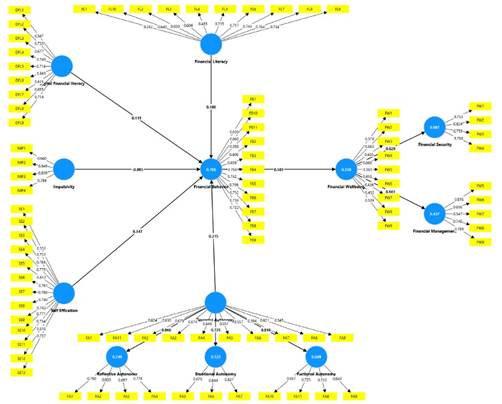
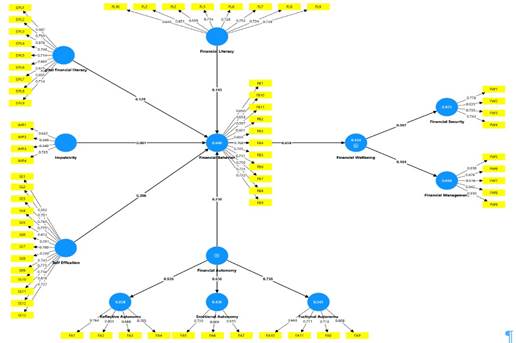
After re-estimation, all retained indicators loaded ≥ 0.50 (see Figure 2; final loadings in Table 1).
Average Variance Extracted (AVE) (first order)
Convergent validity was further evaluated using composite reliability (CR ≥ 0.60; Ghozali & Latan, 2020) and AVE (AVE≥ 0.40; Huang et al., 2013). Across dimensions, CR exceeded 0.60, and AVE exceeded 0.40 (Table 2), indicating acceptable convergent validity- particularly appropriate for complex, hierarchical constructs when CR is adequate.
Table 2 Recapitulation of the validity and reliability test
| Variable | Dimension | Indicator | Factor Loading | Cronbach's Alpha | Composite Reliability | Average Variance Extracted(AVE) |
|---|---|---|---|---|---|---|
| Financial Autonomy | Reflective Autonomy | FA1 | 0,764 | 0,756 | 0,846 | 0,579 |
| FA2 | 0,803 | |||||
| FA3 | 0,686 | |||||
| FA4 | 0,785 | |||||
| Emotional Autonomy | FA5 | 0.730 | 0.692 | 0.828 | 0.617 | |
| FA6 | 0.809 | |||||
| FA7 | 0.815 | |||||
| FA8 | 0.713 | |||||
| Functional Autonomy | FA9 | 0.608 | 0.640 | 0.785 | 0.480 | |
| FA10 | 0.668 | |||||
| FA11 | 0.771 | |||||
| Financial Well-being | Financial Security | FA1 | 0.778 | 0.776 | 0.856 | 0.599 |
| FA2 | 0.835 | |||||
| FA3 | 0.735 | |||||
| FA4 | 0.744 | |||||
| FA5 | 0.818 | |||||
| Financial Manage ment | FA6 | 0.676 | 0.796 | 0.840 | 0.515 | |
| FA7 | 0.616 | |||||
| FA8 | 0.642 | |||||
| FA9 | 0.810 |
Source: Own elaboration.
Discriminant validity (first order)
Discriminant validity met the HTMT criterion (< 0.90). Most HTMT values were < 0.85 (Table 3), indicating that constructs are empirically distinct and non-overlapping”.
Table 3 Heterotrait Monotrait (HTMT)
| Emotional Autonomy | Financial Management | Financial Security | Functional Autonomy | Reflective Autonomy | |
|---|---|---|---|---|---|
| Emotional Autonomy | |||||
| Financial Management | 0.315 | ||||
| Financial Security | 0.647 | 0.187 | |||
| Functional Autonomy | 0.693 | 0.237 | 0.639 | ||
| Reflective Autonomy | 0.540 | 0.188 | 0.438 | 0.855 |
Source: Own elaboration.
Reliability (first order)
Composite reliability ranged from 0.785 to 0.856 and Cronbach’s alpha from 0.640 to 0.796, all above the recommended minimum (Hair et al., 2021), confirming that the first-order measures are reliable. Overall, the first-order measurement model satisfies standard criteria for indicator quality, convergent validity, discriminant validity, and reliability, and is suitable for subsequent higher-order and structural analyses.
Outer model (second order).
We estimated a hierarchical component model using the two-stage approach. After removing two weak first-order indicators in the preliminary step (see Figure 1), all retained secondorder indicators met the loading criterion (outer loadings ≥ 0.50; Hair et al., 2021). As reported in Table 4, internal consistency and convergent validity are satisfactory: Cronbach’s alpha ranges from 0.739 to 0.922 and composite reliability (CR) from 0.678 to 0.933, both above recommended minima (≥ 0.60). Average variance extracted (AVE) falls between 0.463 and 0.659. Although Financial Literacy (AVE = 0.484) and Digital Financial Literacy (AVE = 0.463) are slightly below 0.50, their AVE values exceed 0.40, and both constructs show adequate CR; under complex higher-order specifications, this is acceptable (Huang et al., 2013; Hair et al., 2021). Discriminant validity is supported: all HTMT ratios are < 0.90 (most < 0.85), indicating empirically distinct constructs (Table 4). Collinearity diagnostics do not indicate concern: inner-model VIFs for the structural paths range from 1.000 to 3.177 (Table 5), well below conventional thresholds.
Table 4 Recapitulation of the validity and reliability test (Second order)
| Variable | Indicator | Factor loaading | Cronbach's Alpha | Composite Reliability | Average Variance Extracted (AVE) |
|---|---|---|---|---|---|
| Financial Literacy | FL2 | 0,651 | 0.846 | 0,882 | 0,484 |
| FL3 | 0,595 | ||||
| FL5 | 0,714 | ||||
| FL6 | 0,728 | ||||
| FL7 | 0,753 | ||||
| FL8 | 0,724 | ||||
| FL9 | 0,739 | ||||
| FL10 | 0,646 | ||||
| Digital Financial Literacy | DFL1 | 0,587 | 0.855 | 0,885 | 0,463 |
| DFL2 | 0,733 | ||||
| DFL3 | 0,677 | ||||
| DFL4 | 0,749 | ||||
| DFL5 | 0,714 | ||||
| DFL6 | 0,665 | ||||
| DFL7 | 0,615 | ||||
| DFL8 | 0,655 | ||||
| DFL9 | 0,714 | ||||
| Impulsivity | IMP1 | 0,642 | 0.882 | 0,928 | 0,659 |
| IMP2 | 0,949 | ||||
| IMP3 | 0,840 | ||||
| IMP4 | 0,785 | ||||
| Self-Efficacy | SE1 | 0,553 | 0.922 | 0,933 | 0,521 |
| SE2 | 0,731 | ||||
| SE3 | 0,784 | ||||
| SE4 | 0,775 | ||||
| SE5 | 0,613 | ||||
| SE6 | 0,761 | ||||
| SE7 | 0,780 | ||||
| SE8 | 0,740 | ||||
| SE9 | 0,743 | ||||
| SE10 | 0,771 | ||||
| SE11 | 0,734 | ||||
| SE12 | 0,616 | ||||
| SE13 | 0,737 | ||||
| Financial Autonomy | RA | 0,812 | 0.739 | 0,852 | 0,658 |
| EA | 0,752 | ||||
| FA | 0,866 | ||||
| Financial Behavior | FB1 | 0,601 | 0.891 | 0,910 | 0,481 |
| FB2 | 0,659 | ||||
| FB3 | 0,767 | ||||
| FB4 | 0,745 | ||||
| FB5 | 0,710 | ||||
| FB6 | 0,650 | ||||
| FB7 | 0,751 | ||||
| FB8 | 0,734 | ||||
| FB9 | 0,732 | ||||
| FB10 | 0,658 | ||||
| FB11 | 0,598 | ||||
| Financial Wellbeing | FM | 0,698 | 0.795 | 0,678 | 0,553 |
| FS | 0,974 |
Source: Own elaboration.
Structural model (inner model)
We assessed the inner model with bias-corrected bootstrapping (two-tailed, 5,000 resamples), reporting path coefficients (β), t-values, p-values, and 95% confidence intervals for all direct and indirect effects. Effect sizes (f²) were computed to gauge the substantive impact of each predictor, and predictive relevance (Q²) was examined via blindfolding; we also inspected out-of-sample predictive power using PLSpredict. The model explains substantial variance in Financial Behaviour (R² = 0.715; R²_adjusted = 0.712) and moderate variance in Financial Well-being (R² = 0.430; R²_adjusted = 0.429), aligning with benchmarks for strong, moderate, and weak explanatory power (Ghozali, 2021). Mediation was tested through bootstrapped indirect effects with confidence intervals and variance accounted for (VAF), following current PLS-SEM recommendations. Model fit indices (e.g., SRMR, d_ULS, d_G, NFI, RMS_theta) were inspected to complement the PLS-SEM evaluation and are available upon request. Potential common-method bias was addressed procedurally (anonymity, randomised item order) and diagnostically (e.g., full-collinearity VIF and Harman’s single-factor check), with no indications of a substantive threat.
Table 5 reports standardised coefficients, t-statistics, and p-values from bias-corrected bootstrapping. Financial Behaviour shows a strong and statistically significant effect on Financial Well-being (β = 0.656, t = 18.630, p < 0.001). This confirms the central role of Financial Behaviour as the transmission channel to well-being in the specified model.
Table 5 Path Coefficient Result
| Original sample (O) | T statistics (|O/STDEV|) | P values | |
|---|---|---|---|
| Financial Literacy -> Financial Behaviour | 0,176 | 3,363 | 0,000 |
| Digital financial literacy -> Financial Behaviour | 0,122 | 2,554 | 0,011 |
| Impulsivity -> Financial Behaviour | -0,012 | 0,343 | 0,732 |
| Self-Efficacy -> Financial Behaviour | 0,321 | 6,077 | 0,001 |
| Financial Autonomy -> Financial Behaviour | 0,345 | 7,403 | 0,000 |
| Financial Behaviour -> Financial Well-being | 0,656 | 18,630 | 0,000 |
| Financial Literacy -> Financial Behaviour -> Financial Well-being | 0,116 | 3,202 | 0,001 |
| Digital financial literacy -> Financial Behaviour -> Financial Well-being | 0,080 | 2,601 | 0,009 |
| Impulsivity -> Financial Behaviour -> Financial Wellbeing | -0,008 | 0,343 | 0,732 |
| Self-Efficacy -> Financial Behaviour -> Financial Wellbeing | 0,211 | 5,389 | 0,000 |
| Financial Autonomy -> Financial Behaviour -> Financial Well-being | 0,226 | 6,884 | 0,000 |
Source: Own elaboration
Among the antecedents of Financial Behaviour, Financial Autonomy is the strongest predictor (β = 0.345, t = 7.403, p < 0.001), closely followed by Self-Efficacy (β = 0.321, t = 6.077, p = 0.001). Financial Literacy also exerts a positive effect of smaller magnitude (β = 0.176, t = 3.363, p < 0.001), as does Digital Financial Literacy (β = 0.122, t = 2.554, p = 0.011). Impulsivity is not related to Financial Behaviour in this sample (β = −0.012, t = 0.343, p = 0.732). Substantively, a one-standard-deviation increase in autonomy or self-efficacy is associated with about one-third of a standard deviation increase in prudent financial behaviour, while literacy-based capabilities have smaller but significant associations.
The indirect effects from the capability and psychological constructs to Financial Well-being through Financial Behaviour are significant for Financial Literacy (β_ind = 0.116, t = 3.202, p = 0.001), Digital Financial Literacy (β_ind = 0.080, t = 2.601, p = 0.009), Self Efficacy (β_ind = 0.211, t = 5.389, p < 0.001), and Financial Autonomy (β_ind = 0.226, t = 6.884, p < 0.001). The indirect effect of Impulsivity is not significant (β_ind = −0.008, t = 0.343, p = 0.732). Because the model specifies no direct paths from these antecedents to well-being, their total effects on well-being operate entirely through Financial Behaviour. Overall, the pattern of results aligns with the Theory of Planned Behaviour: perceived control and decision authority, complemented by financial and digital knowledge, translate into healthier financial actions, which in turn improve financial well-being.
DISCUSSION
Financial Literacy, Financial Behaviour, and Financial Well-being
H1 is supported. Financial literacy is positively related to financial behaviour (β = 0.176, t = 3.363, p < 0.001), indicating that greater financial knowledge is associated with more deliberate budgeting, spending control, and planning even after other determinants are included (Ramalho & Forte, 2019; Sabri et al., 2023; She et al., 2024). H7 is also supported. The indirect effect from financial literacy to financial well-being through financial behaviour is significant (β_ind = 0.116, t = 3.202, p = 0.001), confirming that literacy improves wellbeing primarily when it is converted into concrete actions such as preparing a budget, keeping expenditures within targets, saving regularly, and planning for contingencies (Faturohman et al., 2024; Mousavi & Rasaeimanesh, 2023; Sabri et al., 2023; Megananda & Faturohman, 2022). This mechanism accords with the Theory of Planned Behaviour, in which literacy strengthens attitudes and perceived control, and behaviour delivers outcomes (Ajzen, 1991). In this sample of women who are relatively well educated but concentrated in lower to middle income brackets, literacy appears to help convert scarce resources into protective choices that stabilise finances. The literacy coefficient is smaller than that for autonomy and self-efficacy, suggesting that capability building should be paired with confidence and decision authority to shift daily actions. Mixed findings in prior work likely reflect contextual constraints: some studies do not find a significant literacy to behaviour link (Gunawan & Chairani, 2019; Pratama, 2024), while others highlight external limits such as income, access to financial services, and infrastructure that condition whether knowledge can be acted upon (Budastra et al., 2022). Overall, financial literacy functions as an enabling condition whose value for well-being depends on its conversion into regular, disciplined behaviour within the opportunities and constraints women face.
Digital Financial Literacy, Financial Behaviour, and Financial Well-being
H2 is supported. Digital financial literacy is positively and significantly associated with financial behaviour (β = 0.122, t = 2.554, p = 0.011), indicating that stronger digital knowledge and skills relate to more disciplined budgeting, spending, and planning in digital contexts (Rahayu et al., 2022; Respati et al., 2023; Setiawan et al., 2022). In the Theory of Planned Behaviour perspective, digital literacy fosters favourable attitudes toward financial technologies and strengthens perceived behavioural control, which supports intentions to use tools for budgeting, saving, and investing (Ajzen, 1991). The respondent profile helps explain this effect: many are young, well-educated women, often aged 20 to 29, living in Padang City with adequate digital infrastructure and a matrilineal context that assigns women central roles in household finance. These conditions facilitate the translation of digital knowledge into routine use of banking applications, digital payments, and online investments. H8 is also supported. The indirect effect from digital financial literacy to financial well-being via financial behaviour is significant (β_ind = 0.080, t = 2.601, p = 0.009). Digital literacy does not raise well-being on its own; it operates through concrete actions such as consistent saving, planned investing, and disciplined use of credit. Prior research reaches the same conclusion, emphasising the safe and informed use of digital products and cybersecurity practices such as strong passwords and two-factor authentication (Abdallah et al., 2025; Aryan et al., 2024; Bushra & Mir, 2024; Kumar et al., 2023). Taken together, digital financial literacy is an enabling capability that supports healthier behaviour and, through that channel, improves financial well-being.
Impulsivity, Financial Behaviour, and Financial Well-being
Surprisingly, H3 and H9 are not supported. The direct path from impulsivity to financial behaviour is insignificant (t = 0.343, p = 0.732), and the indirect path to financial well-being via behaviour is likewise insignificant. Thus, impulsivity shows no detectable association with day-to-day financial actions in this sample, nor does it translate into well-being, despite descriptive indications of moderate-to-high impulsivity. A plausible explanation lies in the respondent profile: most participants are young, well-educated women in an urban setting, conditions that favour deliberation and planning. Education and the practical demands of city living likely provide cognitive and institutional brakes that temper impulsive urges. Within the Theory of Planned Behaviour, these factors strengthen attitudes and perceived control so that transient impulses do not materialise into behaviour (Ajzen, 1991). The null results are consistent with studies reporting limited effects of impulsivity once financial knowledge and self-regulation are considered (Kumar et al., 2023; Mustikasari and Septina, 2023) and with evidence that impulsivity may not influence well-being through behaviour in certain contexts (Tahir et al., 2021). Other work finds the opposite-impulsivity predicting unplanned spending and over indebtedness, and impatience predicting suboptimal choices (Frigerio et al., 2020; Hastings & Mitchell, 2020; Katauke et al., 2023; Ottaviani & Vandone, 2018), suggesting strong context dependence. Substantively, capabilities and decision authority appear to dominate behaviour formation here, while impulsive tendencies add little explanatory power. Future work should test moderation by education, digital financial literacy, self-efficacy, and autonomy, and consider multi-group or longitudinal designs.
Financial Self-Efficacy, Financial Behaviour, and Financial Well-Being
H4 is supported. Self-efficacy has a positive and significant effect on financial behaviour (β = 0.321, t = 6.077, p = 0.001), indicating that stronger confidence in one’s ability to manage money is associated with more consistent budgeting, spending control, saving, and planning. H10 is also supported. The indirect effect of self-efficacy on financial well-being via financial behaviour is significant (β_ind = 0.211, t = 5.389, p < 0.001), indicating that its contribution to well-being is realised through concrete daily actions. This accords with the Theory of Planned Behaviour, where self-efficacy aligns with perceived behavioural control and facilitates the translation of intentions into behaviour (Ajzen, 1991). Prior studies report similar patterns, including links to money management, saving, and women’s investment behaviour, and downstream effects on well-being (Chong et al., 2021; Dare et al., 2023; Farrell et al., 2016; Faturohman et al., 2024; Handayati et al., 2023; Radianto & Pramudita, 2024). Some work finds weaker or non-significant effects where financial experience is limited, pointing to moderation by experience and literacy (Mardiana et al., 2023; Nisa & Haryono, 2022).
Financial Autonomy, Financial Behaviour, and Financial Well-being
H5 is supported. Financial autonomy exerts a positive and significant effect on financial behaviour (β = 0.345, t = 7.403, p < 0.001) and is the largest antecedent in the model. H11 is also supported. The indirect effect from autonomy to financial well-being via financial behaviour is significant (β_ind = 0.226, t = 6.884, p < 0.001), indicating that autonomy improves well-being by enabling disciplined saving, planned investing, and prudent debt management. In the Theory of Planned Behaviour, autonomy strengthens perceived control and fosters favourable attitudes toward money management, which increases intention and follow-through (Ajzen, 1991). The results align with evidence that greater decision rights and resource control are associated with wiser conduct across contexts, including among women (Botha et al., 2021; Jariwala, 2020; Thankian, 2020), and with the view that autonomy connects capabilities to optimal choices in everyday finance (Kumar et al., 2023a; Kumar et al., 2023b). Impacts can depend on the surrounding environment, as external conditions such as public policy, social support, and income inequality may condition the autonomy-to-well-being link.
Financial Behaviour and Financial Well-being
H6 is supported. Financial behaviour has a positive and significant effect on financial wellbeing (β = 0.656, t = 18.630, p < 0.001). Descriptive statistics indicate generally sound practices in the sample, with a mean of 36 for financial behaviour, a minimum of 17, a maximum of 45, and a standard deviation of 4.699, suggesting relatively consistent conduct across respondents. Substantively, budgeting, regular saving, and careful debt management create a healthier balance between income and expenditures, reduce financial stress, and strengthen security, which are central to financial well-being. The pattern is consistent with the Theory of Planned Behaviour, where favourable attitudes, supportive norms, and perceived control translate into intentions and actions that produce well-being outcomes (Ajzen, 1991). Prior studies reach similar conclusions and underscore the value of financial education and training that build sustained habits (Megananda & Faturohman, 2022; Mousavi & Rasaeimanesh, 2023; Rahman et al., 2021; Respati et al., 2023).
CONCLUSION
Using a second-order PLS SEM model on survey data from 405 women in West Sumatra, this study shows that financial behaviour is the primary pathway through which capabilities translate into financial well-being. The model explains a large share of variance in financial behaviour (R² adjusted = 0.712) and a meaningful share in financial well-being (R² adjusted = 0.429). Among the antecedents of behaviour, financial autonomy and self-efficacy exert the largest effects (β = 0.345 and β = 0.321), while financial literacy and digital financial literacy contribute with smaller yet significant coefficients (β = 0.176 and β = 0.122). Financial behaviour is strongly associated with well-being (β = 0.656). Mediation tests confirm that literacy and digital literacy improve well-being primarily when converted into regular actions such as budgeting, disciplined spending, saving, and planned use of credit and investment tools. Impulsivity does not predict behaviour or well-being in this context.
The study offers three contributions. First, it advances theory by showing within the Theory of Planned Behaviour that agency-related factors, namely autonomy and self-efficacy, are stronger drivers of day-to-day financial actions than knowledge alone in a matrilineal setting. Second, it adds empirical evidence from an understudied population of women in West Sumatra and clarifies the size ordering of effects across five antecedents within one model. Third, it contributes methodologically by applying a hierarchical component model with second-order constructs and by documenting the mediated pathway from literacy and digital literacy to well-being through behaviour.
The practical implications are direct. Policies and programs should not stop at knowledge transfer. They are most effective when they combine conventional and digital literacy with interventions that build confidence and decision authority, so that women can act on what they know. For education providers, brief courses that pair budgeting and saving tasks with goal setting and progress feedback can strengthen self-efficacy. For financial institutions and fintech firms, product features that support healthy habits, clear disclosures, and basic cybersecurity practices can help users sustain prudent behaviour. For local government and community organisations, initiatives that strengthen women’s control over household resources are likely to raise both sound behaviour and well-being.
Future research should strengthen causal inference and external validity. Longitudinal or experimental designs can track how changes in autonomy, self-efficacy, and literacy translate into durable behaviour and well-being. Studies should test moderation by education, digital access, bargaining power in the household, and income volatility, and conduct multi-group analyses across age bands, marital status, and urban and rural residence. Measurement can be improved by refining indicators to raise average variance extracted and by adding objective outcomes drawn from administrative or banking data. Finally, predictive assessments such as PLSpredict, mixed method designs that include qualitative interviews, and replication in other provinces will help confirm generalizability and guide targeted interventions.

