




 nueva página del texto (beta)
 Español (pdf)
 Artículo en XML
 Referencias del artículo

 Traducción automática
 Enviar artículo por email
 Citado por SciELO
 Similares en
SciELO

 Permalink


INTRODUCTION
Digital transformation has reshaped consumer behavior and shifted purchasing to online environments, with social media now central to product discovery, brand interaction, and intention formation (Schiavone & Omrani, 2025; Shao et al., 2024; Wang et al., 2025). Prior research shows that social media marketing (SMM) dimensions, interaction, informativeness, personalization, trendiness, and (WOM) shape consumer behavior (De Alwis, 2023; Sohaib et al., 2022; Utami & Astuti, 2024; Rais, 2025). Within this stream of research, the Stimulus- Organism-Response (S-O-R) framework has become a dominant lens for explaining how digital marketing stimuli translate into consumer reactions.
Existing S-O-R studies typically define the organism in terms of transient states such as trust, attitude, or satisfaction, overlooking enduring decision-making styles (CSI). This omission limits explanatory power because stable processing tendencies strongly influence how consumers interpret identical stimuli (Abbott et al., 2023; Erensoy et al., 2024; Ho et al., 2022; Pereira et al., 2023; Pham et al., 2024). Recognizing this model's potential to deepen understanding can inspire researchers and practitioners to explore new insights in digital marketing.
The Consumer Style Inventory (CSI) addresses this gap by classifying enduring tendencies such as brand consciousness, fashion-novelty orientation, and sensitivity to content quality. However, CSI has rarely been integrated with S-O-R in social media contexts, restricting understanding of how SMM stimuli interact with stable cognitive styles to shape purchase intention in digital settings. To address this gap, we propose an integrated SORCIS model linking SMM dimensions (stimuli) with CSI decision-making styles (organism) to explain purchase intention (response). Extending S-O-R beyond transient evaluations offers a more complete explanation of heterogeneity. It provides a basis for style-sensitive social media strategies, empowering marketers to tailor their approaches effectively.
Viewed globally, SORCIS is most applicable in mobile-first, youthful, and socially driven markets. In such contexts, Latin America, Southeast Asia, and MENA foreground accelerators such as interaction, eWOM, and trend speed (Alibrahim, 2024; Medina & Lodeiros, 2025; Wanigapura et al., 2025; Xu et al., 2023). Sub-Saharan Africa highlights mobile reach and lightweight customer paths (Ogedengbe et al., 2022). Central/Eastern and Western Europe point to interface standardization that shifts advantage to content leadership (Liapis et al., 2025). North America emphasizes privacy and performance disciplines governing personalization (Florea et al., 2025). These contexts collectively offer natural environments to examine how content leadership, interaction, and calibrated personalization influence intention across markets, inviting researchers to explore these dynamics further.
Beyond addressing an empirical gap, SORCIS sharpens theoretical understanding within the S-O-R tradition. Prior studies often position stable differences as peripheral controls or segmentation variables (Hati et al., 2025; Li et al., 2021; Palamidovska et al., 2024; Sultan et al., 2021). By contrast, SORCIS conceptualizes the organism as a layered structure combining transient evaluations with enduring CSI styles. This specification clarifies why identical digital stimuli generate systematically different intentions across profiles and identifies boundary conditions in interface-parity environments.
Our model was tested using survey data from online shoppers in Türkiye (N = 395) and analyzed using structural equation modeling (SEM) with standard validity, reliability, and group-difference assessments. The results provide empirical support for SORCIS and yield theoretical and managerial implications. The remainder of the paper reviews the literature, outlines the research design, presents empirical results, and concludes with a discussion and future research avenues.
LITERATURE REVIEW
Social Media and the Consumer Decision-Making Process
Social media now influences every stage of the consumer decision journey, from problem recognition to post-purchase feedback (Chu, 2024). User-generated content, live streams, and reviews enrich information search, while social proof and algorithmic personalization narrow options and reduce cognitive effort. In-app commerce lowers friction and accelerates conversion. Engagement acts as a key mediator; both firm-created and user-created content shape decisions, particularly in FMCG markets (Sharma & Menka, 2023). Influencers, social proof, and personalized content strengthen intention through trust and perceived benefit (Iqbal, 2024). On visual platforms, content quality, influencer characteristics, and reviews sequentially activate awareness, interest, and intention (Anggara et al., 2024), with effects most pronounced during information search and post-purchase evaluation (Ntobaki et al., 2022).
Advertising and eWOM are central drivers of purchase intention. Source credibility outweighs mere exposure, especially in influencer campaigns (Ahsan et al., 2024). Targeted ads and user content enhance awareness, though ad fatigue and privacy concerns can weaken effectiveness (Sengupta et al., 2024). For high-involvement products, social media provides multi-layered information exchange, reducing perceived risk (Chattopadhyay, 2024). Effects vary by demographics and engagement intensity (Nasiketha et al., 2024). Effective outcomes require managing content quality, transparency, and privacy (Kajaria, 2024; Singh, 2023). Overall, social media forms a multi-layered environment where attitudes, norms, and behaviors evolve dynamically, prompting firms to adopt holistic strategies beyond product promotion.
THEORETICAL FRAMEWORK
This study introduces the integrated SORCIS model, merging the S-O-R framework with the Consumer Style Inventory (CSI) to explain differential responses to digital stimuli. S-O-R posits that environmental stimuli influence internal states, leading to behavioral outcomes (Mehrabian & Russell, 1974). CSI identifies enduring decision-making tendencies such as brand consciousness, novelty-fashion orientation, and content sensitivity (Sproles & Kendall, 1986). Despite their relevance, CSI styles are rarely incorporated into S-O-R in social media contexts, limiting understanding of how stable cognitive orientations shape responses to SMM stimuli.
Within SORCIS, SMM elements interaction, informativeness, personalization, trendiness, and WOM function as stimuli. Visual and audiovisual content drive engagement, while emotional arousal and novel product information accelerate evaluation (Zhang & Lee, 2022). Trend-based brand strategies can trigger impulse decisions in fashion and retail (Safeer, 2024), and SMM activities can raise purchase intention through trust, brand experience, and brand love (Koay et al., 2023).
The organism comprises both transient states (e.g., trust, perceived value, engagement) and enduring CSI styles. Temporary states mediate the effect of SMM on intention (Safeer, 2024; Zhang & Lee, 2022), while stable styles shape how individuals encode and evaluate content (Sproles & Kendall, 1986). Treating CSI as a core organismic layer rather than a background variable clarifies why identical stimuli elicit different intentions across consumer types.
The response is purchase intention, which is strengthened by mediators such as trust and brand love (Koay et al., 2023). The SMM-intention link varies by demographics and market context, with studies confirming its robustness in emerging economies (Zeqiri et al., 2025). The integrated SORCIS framework extends S-O-R in three ways:
Reconceptualizing the organism as a dual-layered structure combining transient and enduring elements, addressing the “black box” limitation of traditional S-O-R.
Explaining heterogeneity by linking specific SMM cues with distinct CSI profiles.
Clarifying boundary conditions in interface-parity environments where content leadership, transparency, and privacy outweigh usability differences.
This framework supports theoretical implications across direct, indirect, and conditional effects. Direct effects anticipate positive impacts from SMM stimuli (Safeer, 2024; Zhang & Lee, 2022). Indirect effects involve trust and brand experience (Koay et al., 2023). Conditional effects highlight CSI as a structuring mechanism for heterogeneity. Contextually, the strength of these relationships varies across industries and markets (Aljuhmani et al., 2022; Zeqiri et al., 2025).
In sum, SORCIS reframes core questions toward identifying which stimuli work for which decision-making styles and through which psychological pathways. This integrated perspective broadens the S-O-R framework, strengthens its explanatory power, and equips firms to design style-sensitive digital strategies that enhance purchase intention and loyalty.
Hypothesis Development
Interaction enables two-way, real-time brand user exchanges that heighten engagement and shorten the path to purchase; evidence shows interaction-intensive SMM boosts brand engagement and, in turn, purchase intention (Zeqiri et al., 2025), amplifies arousal and immediacy in retail/fashion with effects on (impulse) purchasing (Safeer, 2024), fosters cognitive customer brand engagement that translates into loyalty and buying (Aljuhmani et al., 2022), and works via trust and experience (Koay et al., 2023). Considering these arguments, the following hypothesis is proposed:
H1a. Interaction in social media marketing activities significantly and positively affects purchase intention.
Informativeness reduces uncertainty in digital exchanges by providing clear, relevant, and diagnostic details that prompt action; in social Q&A settings, higher information quality and usefulness increase information adoption and, ultimately, purchase intention (Ngo et al., 2024), while in WOM contexts informative cues (e.g., repeat-purchase information) raise perceived diagnosticity and value especially for utilitarian products thereby strengthening purchase intention (Li et al., 2023); converging evidence across social-media contexts shows that information-rich mechanisms reliably move consumers from attention to intention (Majeed et al., 2021). Accordingly, the following hypothesis is proposed:
H1b. Informativeness significantly and positively affects purchase intention
Personalization aligns content and recommendations with individual needs, enhancing perceived relevance, trust, and engagement and thereby increasing purchase intention; personalized advertising strengthens brand attitudes and intentions (An & Ngo, 2025; De Keyzer et al., 2022), AI-driven personalization is especially powerful in online retail (Dai & Liu, 2024), in cosmetics 66.8% of consumers cite personalization as the most influential factor (Jeong et al., 2023), and in live-streaming commerce personalization raises intention indirectly via perceived ad value (Tan, 2024). However, excessive personalization can feel intrusive (Morimoto, 2017). Based on these findings, the following hypothesis is proposed:
H1c. Personalization significantly and positively affects purchase intention.
Trendiness captures consumers’ engagement with up-to-date information and fashionable products on digital platforms; consumers follow trends to act as early adopters (Çifci & Sözen, 2017), and trend-seeking behavior significantly shapes purchase intention (Efendioğlu, 2019). In the fashion and textile context, socially responsible and imageconsistent branding strategies strengthen consumer attitudes and enhance purchase intention (Huo et al., 2022), and Gen Z often buys trendy items for social recognition (El-Shihy & Awaad, 2025; Mohamed Sadom et al., 2025). Effects vary with cultural/psychological moderators (Kaur et al., 2024), but the overall pattern supports trendiness as a strong driver of purchase intention. In light of the above evidence, the following hypothesis is advanced:
H1d. Trendiness significantly and positively affects purchase intention.
In digital contexts, eWOM via reviews and ratings strongly affects intention across sectors (hospitality, fashion, real estate) due to perceived information quality and credibility (Maharani et al., 2023). Brand image often mediates the link between WOM intention and behavior, translating evaluations into behavioral intentions (Iswara et al., 2024). Social platforms amplify these effects, and moderators such as age can shape WOM’s impact (Ghosh et al., 2022). Taken together, these considerations lead to the following hypothesis:
H1e. Word-of-mouth significantly and positively affects purchase intention.
Quality-conscious consumers seek reliable cues and high standards before purchasing (Sproles & Kendall, 1986); higher perceived quality boosts trust and thereby purchase intention in retail, moderated by price sensitivity (Religia et al., 2024), raises perceived value and directly increases intention in video games and streaming services (Pratama & Handoyo, 2024), and in fashion strengthens brand love, which, via emotional value, lifts intention (Wahyadyatmika & Mahyuni, 2025). Similar positive links appear in FMCG and smartphones, with brand reputation and pricing also relevant (Mamuaya, 2024); belief systems and brand awareness can mediate or moderate this pathway (Du et al., 2022), and social media quality signals enhance credibility and value perceptions, increasing intention (Yeniçeri & Şenel, 2021). Building on this rationale, we propose the following hypothesis:
H2a. Quality consciousness positively affects purchase intention.
Brand-conscious consumers value image consistency, distinctiveness, and social prestige; brand consciousness strengthens satisfaction and loyalty (He et al., 2012), and strong brand identity elevates satisfaction (Papista & Dimitriadis, 2012). Across markets, higher brand awareness/brand consciousness increases purchase intention directly and via attitudes or brand image (Chen et al., 2024; Dewi et al., 2024; Efendioğlu & Durmaz, 2022), amplifies the impact of marketing activities in services/retail (Haron et al., 2023), and mediates socialmedia advertising effects (Hosain & Mamun, 2023); national-brand contexts likewise show brand awareness as a key driver (Azizan et al., 2023). Consistent with this reasoning, the following hypothesis is articulated:
H2b. Brand consciousness positively affects purchase intention.
Fashion- and novelty-conscious consumers track emerging styles, value being first, and often act as early adopters; exposure to innovative social content boosts purchase intention in digital contexts (Yeniçeri & Şenel, 2021). Empirical work shows a direct positive effect of fashion consciousness on fashion purchase intention, amplified by social-media influencers, with similar patterns in e-commerce (Ardana & Artanti, 2022). Attitude frequently mediates the effect, and product involvement strengthens it (Gera & Agarwal, 2023). Related drivers of Gen Z’s self-expression and brand image, symbolic consumption motives, and individual innovativeness alongside fashion involvement also align with higher purchase likelihood (Kaur, 2024; Singh, 2023; Wang et al., 2025). On this basis, we put forward the following hypothesis:
H2c. Fashion/novelty consciousness significantly and positively influences purchase intention.
Price-sensitive consumers prioritize value, compare alternatives, and respond to perceived price advantages. In digital commerce, price advantage drives online shopping (Punj, 2011), and social media promotions can shift price perceptions, increasing interest in buying (Gümüş, 2020; Punj, 2011; Rai & Bhattarai, 2023). Empirically, higher price sensitivity is associated with stronger purchase intention in deal-rich, low-switching-cost settings (e.g., Nepal’s footwear; labeled bottled mineral water) (Rai & Bhattarai, 2023; Hasanah et al., 2023). Although some categories (FMCG, green durables) show dampening effects (Mamuaya, 2024; Riyaz et al., 2024), evidence in promotion-driven contexts supports the expected direction. Accordingly, the following hypothesis is proposed:
H2d. Price sensitivity positively affects purchase intention.
Portability signals convenience and shapes decisions: compact, lightweight, easy-tocarry/use products raise perceived functionality and purchase intention, especially in electronics and furniture (Ali & Yateno, 2022; Aprilia & Darmawan, 2025; Sabbir, 2025); grab-and-go packaging increases perceived usefulness/ease of storage and can elevate premium perceptions that translate into buying intent. Portability cues also boost psychological value (Liang et al., 2022; Zhang et al., 2018). In light of these established findings, the following novel hypothesis is proposed:
H2e. Product portability sensitivity positively affects purchase intention.
Content-sensitive consumers respond to rich, credible, and privacy-respecting information; richer content improves experience and shapes perceptions on social platforms (Keng & Ting, 2009). High-quality content marketing (informative, emotional, and interactive) and a strong brand image increase engagement and purchase intention (Chen et al., 2024; Fan et al., 2024; Rizkia et al., 2024). Similarly, well-structured, trustworthy user-generated content lowers judgment costs, boosts perceived value/interest, and increases intention in social ecommerce (Chung, 2025; Zhang & Hu, 2024). Although privacy sensitivity can depress intention, the implementation of robust privacy protections plays a significant role in rebuilding trust and mitigating perceived risk (Wang et al., 2022). This understanding of the impact of privacy protections on rebuilding trust leads us to the following hypothesis:
H2f. Content sensitivity positively affects purchase intention.
According to Souza et al. (2023), consumers’ loyalty and purchase behavior in e-commerce are significantly influenced by the quality of online information, trust, and satisfaction, suggesting that content clarity and relevance play a crucial role in shaping purchase intentions. Additionally, interactivity in interface design is a key factor influencing the facilitation of purchasing (Gupta et al., 2023). Recent evidence underscores the predictive power of website design and usability in online purchase intention, particularly when coupled with speed and security (Adedoja et al., 2022).
The perceived ease of use and design quality have been found to heighten intention on platforms like Lazada (Budi et al., 2023), while UI quality, information quality, privacy, security, and trust collectively bolster intention (Vo et al., 2023). On travel sites, the design, information, and usefulness positively impact intention (Chidananda et al., 2024), and higher interactivity increases intention for high-value items (Summerlin & Powell, 2022). The effects of interface design often operate through e-satisfaction/flow to (re)purchase (Pangestika et al., 2024). In light of these findings, the following hypothesis is proposed:
H2g. Sensitivity to the website interface positively influences purchase intention.
Gender moderates the SMM-to-purchase intention pathway, with significant effects in service settings (İbrahim, 2023). Meta-analytic evidence on online purchase intention indicates gender-based heterogeneity in SMM responses (Ghosh, 2024). Therefore, we propose the following hypothesis:
H3a. Gender differences are expected in one or more SMM dimensions, CSI decision-making styles, or purchase intention.
Meta-analytic evidence identifies demographic/contextual moderators of online purchase intention, implying that household structure (marital status) segments how consumers process SMM and eWOM (Ghosh, 2024). Differences in privacy expectations and relational considerations also shape the link between consumer brand interactions on social media and purchase intention (Gutiérrez et al., 2023). Accordingly, the following hypothesis is proposed:
H3b. Marital-status differences are expected in one or more SMM dimensions, CSI decisionmaking styles, or purchase intention.
Cohort research shows distinct SMM-to-PI dynamics across generations, with Gen Z and Millennials responding differently to digital stimuli and campaign elements (Gurunathan & Lakshmi, 2025; Sulistyowati et al., 2025). In line with cohort differences in digital literacy, platform use, and value orientations, age is expected to shape perceptions of SMM, decision styles, and purchase intention. Considering these arguments, the following hypothesis is proposed:
H3c. Age-cohort differences are expected in one or more SMM dimensions, CSI decisionmaking styles, or purchase intention.
Education influences engagement with visual eWOM because information adoption beyond perceived usefulness drives purchase intentions, which depend on users’ capacity for active engagement and information processing (Bui et al., 2025). Likewise, sensitivity to information quality and interface design affect e-commerce satisfaction and loyalty, indicating systematic heterogeneity by education (Yoo et al., 2023). Based on these findings, the following hypothesis is proposed:
H3d. Education-level differences are expected in one or more SMM dimensions, CSI decision-making styles, or purchase intention.
Occupational cohorts vary in digital immersion and platform routines, yielding distinct responses to website experience and brand-related affect along the S-O-R pathway (Banerjee et al., 2024); moreover, social media advertising and platform affordances can shift trust, loyalty, and purchasing, supporting heterogeneity by job status (Duan et al., 2024). Accordingly, the following hypothesis is proposed:
H3e. Occupational-status differences are expected in one or more SMM dimensions, CSI decision-making styles, or purchase intention.
Income stratification shapes perceived value and adoption in online commerce, for example, base-of-the-pyramid consumers exhibit distinct benefit sacrifice trade offs that drive purchase intention (Srivastava et al., 2023), and meta-analytic findings identify demographic moderators in online purchase intention, supporting expectations of income-level differences (Ghosh, 2024). Consistent with this reasoning, the following hypothesis is proposed:
H3f. Income differences are expected in one or more SMM dimensions, CSI decision-making styles, or purchase intention.
METHODOLOGY
Research Design
This study examines how attitudes toward social media marketing activities and online consumer decision-making styles influence purchase intention. A quantitative research approach with a correlational survey design was chosen for its appropriateness in examining relationships among variables and enabling the derivation of potential causal inferences. The study's theoretical foundation is grounded in the S-O-R model.
Sample and Data Collection
The target population comprises Turkish consumers with experience in online shopping via marketplaces. Data were collected using a structured online questionnaire distributed through social media platforms. Due to access limitations, a non-probability convenience sampling method was adopted. A total of 401 responses were gathered, and after data cleaning (e.g., removal of incomplete responses), 395 valid entries were retained for analysis. Screening questions ensured participants were active users of both social media and online shopping platforms.
Measurement Instrument
All constructs were operationalized with validated multi-item scales and rated on a 5-point Likert scale (1 = "strongly disagree" to 5 = "strongly agree"). Social media marketing (SMM) was measured with 15 items spanning interaction (INT), informativeness (INF), personalization (PER), trendiness (TRE), and word-of-mouth (WOM), adapted from Yadav and Rahman (2017). Online consumer decision-making styles were captured with 20 items based on the CSI Sproles and Kendall (1986) using the Turkish adaptation by Bayrakdaroğlu et al. (2017), covering quality consciousness (QC), brand consciousness (BC), fashion/novelty consciousness (FNC), price consciousness (PC), product portability sensitivity (PPS), website content consciousness (WCC), and website interface consciousness (WIC). Purchase intention (PI) was assessed with five items from McKnight and Chervany (2001). To ensure linguistic and cultural equivalence, all items underwent translation and back-translation by two independent bilingual researchers, followed by a pilot test (30 respondents) to refine wording and localize brand/channel examples. Construct validity was examined via confirmatory factor analysis; we targeted standardized loadings ≥ .60, composite reliability (CR) ≥ .70, and average variance extracted (AVE) ≥ .50 for convergent validity.
Data Analysis and Assumptions
Data analyses were performed using SPSS 25.0 and AMOS 24.0. The analytical procedure consisted of several steps to ensure methodological rigor and validity. First, descriptive statistics were computed for demographic variables and construct indicators. Second, Exploratory Factor Analysis (EFA) was conducted to explore the underlying factor structure of the measurement scales. Third, CFA was used to validate the measurement model, with construct validity assessed via CR and AVE. Fourth, AMOS implemented SEM to test the hypothesized relationships among constructs and evaluate the overall model fit using widely accepted indices such as CFI, RMSEA, and χ²/df. Finally, independent samples t-tests were conducted to examine potential group differences between genders and marital statuses. At the same time, one-way ANOVA with post hoc analyses was used to assess differences across age, education, occupation, and income level. This multi-method analytical approach, combining measurement validation and structural testing, strengthens the internal validity and generalizability of the findings.
To verify SEM assumptions, univariate normality was assessed via skewness and kurtosis. All constructs fell within the ±2.00 threshold (George & Mallery, 2024). Skewness ranged from −1.541 to −0.643 and kurtosis from −0.698 to 1.607, confirming acceptable univariate normality. Specifically, skewness and kurtosis values were as follows: INT (sk = −1.082; ku = 1.054), INF (sk = −0.737; ku = 0.129), PER (sk = −1.155; ku = 0.840), TRE (sk = −1.019; ku = 1.140), WOM (sk = −0.656; ku = −0.183), QC (sk = −1.204; ku = 1.263), BC (sk = −0.673; ku = −0.359), FNC (sk = −0.643; ku = −0.698), PC (sk = −1.052; ku = 1.084), PPS (sk = −0.784; ku = 0.230), WCC (sk = −1.541; ku = 1.607), WIC (sk = −1.423; ku = 1.307), and PI (sk = −1.262; ku = 1.142). The observed skewness values ranged from −1.541 to −0.643, and kurtosis values ranged from −0.698 to 1.607, all of which fall within the recommended thresholds. These results confirm that the dataset satisfies the univariate normality assumption required for SEM analyses.
RESULTS
Participant Profile
The data were meticulously collected from 395 respondents with a history of online shopping in Türkiye. Among the participants, 60.5% identified as female and 39.5% as male. A majority (66.6%) reported being single. The most represented age group was 18-24 (38.5%), followed by 25-31 (32.7%). Educationally, 57.2% held an undergraduate degree, while the remaining respondents had graduate-level education or lower. Regarding occupation, the two dominant groups were students (36.2%) and private sector employees (35.9%) (see Table 1).
Table 1 Demographic Statistics
| Demographic Variable | Category | N | % |
|---|---|---|---|
| Gender | Female | 239 | 60.5 |
| Male | 156 | 39.5 | |
| Marital Status | Single | 263 | 66.6 |
| Married | 132 | 33.4 | |
| Age | 18-24 | 152 | 38.5 |
| 25-31 | 129 | 32.7 | |
| 32-42 | 76 | 19.2 | |
| 43-52 | 31 | 7.8 | |
| 53 and above | 7 | 1.8 | |
| Occupation | Student | 143 | 36.2 |
| Public Sector Employee | 60 | 15.2 | |
| Private Sector Employee | 142 | 35.9 | |
| Retired | 8 | 2 | |
| Unemployed | 42 | 10.6 |
Source: Own elaboration.
Social Media Usage Frequency
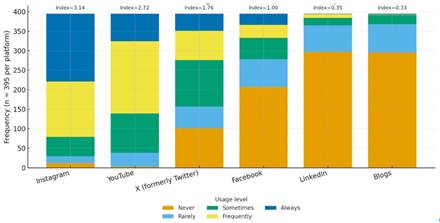
In the sample, social media use concentrates on visual-video platforms: Instagram and YouTube lead with “frequently/always” totals of 80.0% and 64.8%, respectively; for X (formerly Twitter), the distribution is polarized (“sometimes” 30.1%; “never” 25.6%). Facebook (52.4%), LinkedIn (75.2%), and blogs (74.7%) show high “never” usage shares, indicating a clear shift away from low-interaction networks. The weighted usage index (0 = never, 4 = always) is: Instagram = 3.14; YouTube = 2.72; X (formerly Twitter) = 1.76; Facebook = 1.00; LinkedIn = 0.35; Blogs = 0.33. Daily use is moderate, with 54.9% spending 1-3 hours/day and 29.4% spending 3-5 hours. Heavy users (≥5 hours) account for 8.9%, and light users (<1 hour) for 6.8%. Using midpoint coding, the mean is approximately 2.9 hours/day. “First association with social media” clusters around entertainment (38.5%) and sharing (31.6%), with instant access (15.2%) and communication (14.7%) as secondary themes (see Figure 1). This pattern suggests that SMM strategies should prioritize highly interactive, visually rich platforms such as Instagram and YouTube. In contrast, for X (formerly Twitter), more selective positioning by content type is advisable.
Validity and Reliability Analysis
An EFA was conducted to examine the underlying factor structure. The Kaiser-Meyer-Olkin (KMO) measure of sampling adequacy was 0.899, and Bartlett’s Test of Sphericity was significant (p < .001), confirming the data’s high suitability for factor analysis and instilling confidence in the research process. The final factor solution yielded 13 constructs, collectively explaining 88.65% of the total variance. The overall Cronbach’s Alpha (CA) was .940, suggesting high internal consistency. Reliability indicators, including CA, AVE, and CR for each construct, are reported in Table 2. Overall, the findings provide strong evidence of the measurement model’s validity and reliability.
Table 2 Validity and Reliability Analysis
| Factor | Item | Loading | CA | AVE | CR |
|---|---|---|---|---|---|
| INT | INT1 | 0.881 | 0.930 | 0.742 | 0.896 |
| INT2 | 0.864 | ||||
| INT3 | 0.839 | ||||
| INF | INF1 | 0.804 | 0.942 | 0.612 | 0.825 |
| INF2 | 0.751 | ||||
| INF3 | 0.793 | ||||
| PER | PER1 | 0.757 | 0.904 | 0.553 | 0.787 |
| PER2 | 0.749 | ||||
| PER3 | 0.725 | ||||
| TRE | TRE1 | 0.837 | 0.935 | 0.712 | 0.881 |
| TRE2 | 0.824 | ||||
| TRE3 | 0.871 | ||||
| WOM | WOM1 | 0.860 | 0.914 | 0.718 | 0.884 |
| WOM2 | 0.856 | ||||
| WOM3 | 0.826 | ||||
| QC | QC1 | 0.866 | 0.802 | 0.714 | 0.833 |
| QC2 | 0.824 | ||||
| BC | BC1 | 0.902 | 0.915 | 0.798 | 0.922 |
| BC2 | 0.877 | ||||
| BC3 | 0.903 | ||||
| FNC | FNC1 | 0.873 | 0.935 | 0.752 | 0.858 |
| FNC2 | 0.862 | ||||
| PC | PC1 | 0.965 | 0.956 | 0.909 | 0.968 |
| PC2 | 0.940 | ||||
| PC3 | 0.957 | ||||
| PPS | PPS1 | 0.922 | 0.856 | 0.840 | 0.913 |
| PPS2 | 0.912 | ||||
| WCC | WCC1 | 0.833 | 0.968 | 0.750 | 0.947 |
| WCC2 | 0.882 | ||||
| WCC3 | 0.893 | ||||
| WCC4 | 0.899 | ||||
| WCC5 | 0.901 | ||||
| WCC6 | 0.784 | ||||
| WIC | WIC1 | 0.916 | 0.877 | 0.833 | 0.909 |
| WIC2 | 0.910 | ||||
| PI | PI1 | 0.780 | 0.969 | 0.585 | 0.876 |
| PI2 | 0.764 | ||||
| PI3 | 0.779 | ||||
| PI4 | 0.723 | ||||
| PI5 | 0.779 |
Source: Own elaboration.
Confirmatory Factor Analysis
The Confirmatory Factor Analysis (CFA) was performed to validate the measurement model. The SMM activities scale demonstrated an excellent fit, with model fit indices within acceptable ranges: χ²/df = 2.065, CFI = 0.984, NFI = 0.970, TLI = 0.979, GFI = 0.968, and RMSEA = 0.052. Similarly, the decision-making styles scale showed a satisfactory model fit: χ²/df = 2.777, CFI = 0.965, NFI = 0.946, TLI = 0.950, GFI = 0.947, and RMSEA = 0.067. The findings provide strong evidence of the validity and reliability of the measurement model, further confirming that the constructs are not only statistically robust but also theoretically sound, making them suitable for advancing to the SEM stage to test the hypothesized relationships.
Structural Equation Modeling
The SEM was constructed to test the research hypotheses. The model fit indices are presented in Table 3. All indices fell within the acceptable or good fit thresholds, indicating a model structure.
Table 3 Model Fit Indices
| Fit Index | Observed Value | Interpretation | Threshold (Good Fit) | Threshold (Acceptable Fit) |
|---|---|---|---|---|
| CMIN/DF | 2.204 | Good fit | ≤ 3 | ≤ 5 |
| CFI | 0.952 | Good fit | ≥ 0.95 | ≥ 0.90 |
| NFI | 0.916 | Acceptable fit | ≥ 0.95 | ≥ 0.90 |
| TLI | 0.941 | Acceptable fit | ≥ 0.95 | ≥ 0.90 |
| GFI | 0.935 | Acceptable fit | ≥ 0.95 | ≥ 0.90 |
| RMSEA | 0.057 | Good fit | ≤ 0.06 | ≤ 0.08 |
Source: Own elaboration
Note: Hu and Bentler (1999) suggest CFI/TLI ≥ .95 and RMSEA ≤ .06 for good fit; Kline (2016) and Hair et al. (2019) accept ≥ .90 as adequate for CFI/TLI/NFI/GFI and RMSEA ≤ .08 as acceptable.
Hypothesis Testing
The comprehensive SEM path analysis results, detailed in Table 4, provide a thorough understanding of the relationship between SMM activities and purchase intention. All dimensions of SMM activities (INT, INF, PER, TRE, and WOM) significantly and positively affected PI. There were also significant impacts on consumer decision-making styles (BC, FNC, WCC). However, QC, PC, PPS, and WIC were not significant predictors, reinforcing the study's comprehensive approach.
Table 4 SEM Path Analysis Results
| Hypothesis | Path | Standardized Coefficient | p-value | Result |
|---|---|---|---|---|
| H1a | INT → PI | 0.246 | .001 | Accepted |
| H1b | INF → PI | 0.215 | .001 | Accepted |
| H1c | PER → PI | 0.127 | .022 | Accepted |
| H1d | TRE → PI | 0.134 | .002 | Accepted |
| H1e | WOM → PI | 0.189 | .001 | Accepted |
| H2a | QC → PI | 0.06 | .260 | Rejected |
| H2b | BC → PI | 0.108 | .002 | Accepted |
| H2c | FNC → PI | 0.175 | .001 | Accepted |
| H2d | PC → PI | 0.016 | .465 | Rejected |
| H2e | PPS → PI | 0.02 | .594 | Rejected |
| H2f | WCC → PI | 0.417 | .001 | Accepted |
| H2g | WIC → PI | 0.007 | .841 | Rejected |
Source: Own elaboration.
These results underscore the direct role of digital interaction and user-centric content in shaping purchase intentions on social platforms. They also indicate that not all consumer styles equally influence purchase behavior in online contexts.
Differences by Demographic Variables
Significant variations in key variables were observed based on demographic characteristics: Gender Differences: Independent-samples t tests show higher scores for women than men on INT, INF, PER, QC, WCC, and PI. INT: t(306.39)=2.42, p=.01; INF: t(393)=2.18, p=.03; PER: t(393)=2.32, p=.02; QC: t(287.81)=2.05, p=.04; WCC: t(393)=2.00, p=.04; PI: t(393)=2.10, p=.03 (female means > male means in all cases). Effects are small (Cohen’s d≈0.20-0.26). No gender differences are observed for TRE, WOM, BC, FNC, PC, PPS, or WIC (p≥.05). Notably, female participants outperformed males in interaction, informativeness, and personalization; this pattern underscores the value of tailoring social media strategies to women’s preferences, who appear more receptive to relational and content-centric marketing elements (Table 5)
Table 5 T-Test Results for Gender
| Variable | Female n | Mean | SD | Male n | Mean | SD | t(df) | p |
|---|---|---|---|---|---|---|---|---|
| INT | 239 | 3.93 | 0.89 | 156 | 3.69 | 0.99 | t(306) = 2.42 | .01 |
| INF | 239 | 3.85 | 0.98 | 156 | 3.62 | 1.03 | t(393) = 2.18 | .03 |
| PER | 239 | 3.85 | 0.96 | 156 | 3.61 | 1.04 | t(393) = 2.32 | .02 |
| TRE | 239 | 3.95 | 0.87 | 156 | 3.84 | 0.95 | t(393) = 1.17 | .24 |
| WOM | 239 | 3.53 | 1.07 | 156 | 3.44 | 1.10 | t(393) = 0.81 | .41 |
| QC | 239 | 4.1 | 0.89 | 156 | 3.89 | 1.07 | t(287) = 2.05 | .04 |
| BC | 239 | 3.43 | 1.17 | 156 | 3.51 | 1.07 | t(393) = −0.76 | .44 |
| FNC | 239 | 3.7 | 1.24 | 156 | 3.58 | 1.21 | t(393) = 1.02 | .30 |
| PC | 239 | 3.7 | 1.38 | 156 | 3.82 | 1.29 | t(393) = −0.92 | .36 |
| PPS | 239 | 3.81 | 0.97 | 156 | 3.81 | 1.08 | t(393) = 0.07 | .94 |
| WCC | 239 | 4.29 | 0.99 | 156 | 4.07 | 1.13 | t(393) = 2.00 | .04 |
| WIC | 239 | 4.13 | 1.05 | 156 | 4.04 | 1.19 | t(393) = 0.75 | .45 |
| PI | 239 | 4.13 | 0.97 | 156 | 3.92 | 1.08 | t(393) = 2.10 | .03 |
Source: Own elaboration.
Marital Status: Independent-samples t-tests show that marital status differentiates among several SMM stimuli and content sensitivities. Single participants reported significantly higher means than married participants on INT, INF, PER, TRE, and WCC (t = 2.25-3.26, p ≤ .03). At the same time, no differences emerged for WOM, QC, BC, FNC, PC, PPS, WIC, or PI (p ≥ .07). Notably, single consumers scored higher on interaction, informativeness, and personalization, indicating greater receptivity to relational and content-based features of brand communications on social media (Table 6).
Table 6 T-Test Results for Marital Status
| Variable | Marital status | N | Mean | SD | t(df) | p |
|---|---|---|---|---|---|---|
| INT | Single | 263 | 3.92 | 0.86 | t(219) = 2.35 | .02 |
| Married | 132 | 3.67 | 1.06 | |||
| INF | Single | 263 | 3.89 | 0.90 | t(213) = 3.26 | .01 |
| Married | 132 | 3.52 | 1.15 | |||
| PER | Single | 263 | 3.86 | 0.92 | t(223) = 2.79 | .01 |
| Married | 132 | 3.55 | 1.11 | |||
| TRE | Single | 263 | 3.98 | 0.80 | t(207) = 2.25 | .03 |
| Married | 132 | 3.75 | 1.07 | |||
| WOM | Single | 263 | 3.56 | 1.05 | t(393) = 1.79 | .07 |
| Married | 132 | 3.36 | 1.13 | |||
| QC | Single | 263 | 4.07 | 0.91 | t(393) = 1.61 | .10 |
| Married | 132 | 3.91 | 1.06 | |||
| FNC | Single | 263 | 3.72 | 1.21 | t(393) = 1.47 | .14 |
| Married | 132 | 3.53 | 1.26 | |||
| PC | Single | 263 | 3.77 | 1.34 | t(393) = 0.48 | .63 |
| Married | 132 | 3.70 | 1.36 | |||
| PPS | Single | 263 | 3.83 | 1.01 | t(393) = 0.38 | .70 |
| Married | 132 | 3.79 | 1.03 | |||
| WCC | Single | 263 | 4.32 | 0.93 | t(393) = 2.93 | .01 |
| Married | 132 | 3.99 | 1.23 | |||
| WIC | Single | 263 | 4.10 | 1.09 | t(393) = 0.12 | .90 |
| Married | 132 | 4.09 | 1.15 | |||
| PI | Single | 263 | 4.12 | 0.92 | t(213) = 1.76 | .08 |
| Married | 132 | 3.92 | 1.18 |
Source: Own elaboration.
Age: Participants aged 25-31 scored significantly higher than those 18-24 on INT, INF, TRE, FNC, PPS, WCC, and PI, WOM was also higher for 25-31 than 43+ (all p ≤ .03). This pattern indicates that the 25-31 cohort is more responsive to digital marketing stimuli and more actively engages in online consumer behaviors (Table 7).
Table 7 ANOVA Results for Age, Education, Occupation and Income
| Demographic factor | Variable | F | p | Group difference |
|---|---|---|---|---|
| Age | INT | 4.52 | .01 | 1 → 2 |
| INF | 4.82 | .01 | 1 → 2 | |
| TRE | 4.56 | .01 | 1 → 2 | |
| WOM | 3.06 | .01 | 2 → 4 | |
| FNC | 3.66 | .01 | 1 → 2 | |
| PPS | 4.40 | .01 | 1 → 2 | |
| WCC | 3.84 | .01 | 1 → 2 | |
| PI | 3.97 | .01 | 1 → 2 | |
| Education | WOM | 3.09 | .02 | 1 → 4 |
| WIC | 2.83 | .03 | 1 → 4 | |
| Occupation | INT | 3.30 | .02 | 1 → 3 |
| INF | 3.88 | .01 | 1 → 3 | |
| PER | 4.36 | .01 | 1 → 3 | |
| TRE | 3.12 | .03 | 1 → 3 | |
| WOM | 3.24 | .02 | 2 → 3 | |
| BC | 3.23 | .02 | 3 → 4 | |
| PPS | 4.12 | .01 | 1 → 4 | |
| Income | INT | 2.16 | .05 | 1 → 4 |
| INF | 3.02 | .01 | 1 → 4 | |
| WOM | 5.90 | .01 | 1 → 4 | |
| PER | 2.62 | .05 | 1 → 4 |
Source: Own elaboration.
Education level: Only two constructs varied by education: postgraduates outperformed the high-school-or-below group on WOM and WIC (p = .02-.03). This suggests that highly educated consumers apply more critical evaluations to communicative cues and interface quality (Table 7).
Occupation: Compared with students, private-sector employees reported higher means on INT, INF, PER (personalization), and TRE; WOM was higher for private sector than public sector, BC (brand consciousness) was higher for private sector than retired/unemployed, and PPS was higher for retired/unemployed than students (all p ≤ .03), underscoring systematic role-based differences in digital engagement (Table 7). Income level: Respondents earning $ 2001-$2550 exceeded the ≤ $500 group on INT, INF, and WOM (p ≤ .01), with a marginal difference on PER (≈ .05), indicating a mid-income segment that is primarily engaged with digital marketing content (Table 7)
Women scored higher than men on INT, INF, PER, QC, WCC, and PI (minor effects), whereas singles exceeded married respondents on INT, INF, PER, TRE, and WCC. ANOVAs showed that the 25-31 cohort outperformed the 18-24 cohort on INT, INF, TRE, FNC, PPS, WCC, and PI, and surpassed the 43+ cohort on WOM. Postgraduates scored higher than the high school or below group on WOM and WIC. Private-sector employees reported higher means than INT, INF, PER, and TRE students. WOM was higher among private-sector employees than among public-sector employees. At the same time, BC was higher among private-sector employees than among retired/unemployed individuals, and PPS was higher among retired/unemployed individuals than among students. Finally, the $2001- $2550 income group exceeded the ≤ $500 income group on INT, INF, WOM, and PER.
These patterns reveal a systematic demographic variation in responsiveness to SMM stimuli and decision-style sensitivities, supporting the H3 suite and underscoring the value of demographic tailoring in digital campaigns (See Table 8). In summary, these findings underscore the importance of tailoring SMM strategies to the demographic characteristics of target audiences. This approach is crucial to maximizing the effectiveness of marketing efforts and ensuring more informed consumer engagement. It is not just a strategy but a necessity in the digital age.
Table 8 Results on Demographic Differences in SMM and PI
| Hypothesis | Factor | Test | Significant constructs | p (range) | Key pairwise difference(s) | Result |
|---|---|---|---|---|---|---|
| H3a | Gender | T-test | INT, INF, PER, QC, WCC, PI | .01-.04 | Female > Male (all six) | Accepted |
| H3b | Marital status | T-test | INT, INF, PER, TRE, WCC | .01-.03 | Single > Married (all five) | Accepted |
| H3c | Age | ANOVA | INT, INF, TRE, WOM, FNC, PPS, WCC, PI | .01-.03 | 25-31 > 18-24 for INT, INF, TRE, FNC, PPS, WCC, PI; 25-31 > 43+ for WOM | Accepted |
| H3d | Education level | ANOVA | WOM, WIC | .02-.03 | Postgraduate > High school-or-below | Accepted |
| H3e | Occupation | ANOVA | INT, INF, PER, TRE, WOM, BC, PPS | .01-.03 | Private sector > Students for INT, INF, PER, TRE; Private sector > Public sector for WOM; Private sector > Retired/Unemployed for BC; Retired/Unemployed > Students for PPS | Accepted |
| H3f | Income | ANOVA | INT, INF, WOM, PER | .01-.05 | 2001-2550 $ > ≤500$ (all four) | Accepted |
Source: Own elaboration.
DISCUSSION
The SORCIS model refines the S-O-R framework by conceptualizing consumer decision- making styles as an internal part of the organism rather than as external moderators. This respecification produces three key insights. First, enduring CSI styles add explanatory value to purchase intention beyond social media stimuli. Second, the same SMM cues interaction, informativeness, personalization, trendiness, and eWOM produce different intention levels depending on whether consumers are brand, fashion/novelty, or content-conscious. Third, digital environments characterized by standardized interfaces shift the locus of influence toward content transparency, credibility, and privacy, all of which are filtered through CSI.
These findings align with existing work showing that interaction and informativeness reduce decision costs and enhance trust (Li et al., 2023; Ngo et al., 2024), personalization strengthens evaluative outcomes (Dai & Liu, 2024), and content quality and credibility drive engagement (Chen et al., 2024; Keng & Ting, 2009; Zhang & Hu, 2024). Under UI parity, competitive advantage shifts toward credible, transparent, and privacy-oriented content. Non-significant effects suggest that platform standards dampen quality variance, discounting weakens price, and interface standardization limits the explanatory power of usability, directing resources toward scalable content, review loops, and community interaction.
Globally, the SORCIS framework builds on a universal trust spine grounded in transparent, informative content (Lăzăroiu et al., 2020), complemented by accelerators' interaction, eWOM, personalization, and trend speed tailored to local style mixes (Semwal et al., 2024). Market-specific dynamics from Latin America’s mobile-first communities to Southeast Asia’s live-commerce ecosystems, MENA’s identity-based trust cues, Sub-Saharan Africa’s lightweight content paths, and Europe’s regulatory-driven content leadership illustrate the model’s adaptability and help determine which levers dominate in each context (Mendoza et al., 2025; Paguay et al., 2025; Eze et al., 2024; Srivastava et al., 2024; Florea et al., 2025).
The evidence shows that SORCIS mechanisms are not Türkiye-specific but characterize mobile-first, platform-based settings across emerging markets (Souza et al., 2023; Zeqiri et al., 2025). Demographic and value risk structures shift the strength but not the direction of these relationships, confirming their context sensitivity (Ghosh, 2024; Srivastava et al., 2023). Latin American markets, with their social-discovery culture and dependence on eWOM, align closely with the trust-spine logic, though privacy expectations limit personalization (Chaparro et al., 2025; Medina & Lodeiros, 2025; Mendoza et al., 2025; Souza et al., 2023). Future multi-group SEM can further validate cross-market performance and identify boundary conditions.
Theoretical Contributions
This study offers four main theoretical contributions. First, it advances the S-O-R tradition by embedding decision-making styles directly into the organism, demonstrating that stable cognitive orientations meaningfully shape how stimuli translate into intention. Second, the odel provides a style-sensitive explanation of heterogeneity, showing that SMM cues vary in effectiveness across brand-, fashion/novelty-, and content-conscious consumers. Third, SORCIS clarifies boundary conditions in digital contexts characterized by interface convergence, where content credibility, transparency, and privacy become the primary interpretive filters. Fourth, it articulates a portable decision logic for emerging and global markets by linking trust-spine mechanisms with context-specific accelerators, offering a unifying explanation for variability across regions.
Practical Contributions
Managerially, the results indicate three actionable implications. First, firms should prioritize content quality and credibility by investing in transparent, diagnostic information, clear policies, and curated UGC to strengthen trust and engagement. Second, engineering interaction and personalization remain essential. Tools such as live Q&A, community features, and responsible recommendation systems are especially effective for brand- and fashion-conscious segments. Personalization should follow a “usefulness over intrusiveness” rule with user-controlled settings. Third, demographic segmentation enhances competitiveness: women and younger adults respond strongly to interaction and informativeness, while postgraduate groups value evaluative depth. For internationalization, firms should standardize the trust spine across markets while localizing accelerators to regional CSI profiles. In Latin America’s mobile-social environments, rapid trust-building content, eWOM scaling, and community mechanisms precede trend-based tactics, supporting market share and competitive differentiation.
CONCLUSIONS
This study aimed to fill a significant gap in the literature by introducing the novel SORCIS model, which integrates consumer decision-making styles into the S-O-R framework. Drawing on survey data from 395 online consumers in Türkiye, the findings reveal that the five dimensions of SMM interaction, informativeness, personalization, trendiness, and WOM exert significant and positive effects on purchase intention. In addition, consumer decisionmaking styles such as brand, fashion/novelty, and website content consciousness emerge as important predictors. In contrast, quality consciousness, price sensitivity, product portability sensitivity, and website interface sensitivity are not significant. These results provide novel insights into how enduring consumer orientations interact with marketing stimuli in digital environments.
Theoretically, this study advances the S-O-R model by positioning consumer decisionmaking styles as enduring organismic constructs, rather than peripheral control variables, and by showing that these styles explain systematic variation in purchase intention that cannot be accounted for by social media stimuli alone. In practice, it provides clear guidance for firms to design social media strategies that emphasize personalization, content quality, and interaction, particularly when targeting consumer groups such as fashion- or noveltyconscious individuals and brand-oriented individuals. The study equips marketers with actionable insights to maximize engagement and conversion in increasingly competitive online marketplaces by identifying which decision-making styles are most responsive to specific digital stimuli.
This research underscores the importance of adopting an integrated perspective when examining consumer responses in digital marketing contexts. Testing the SORCIS model not only contributes to academic theory but also delivers relevant implications for businesses operating in dynamic social media ecosystems. This integrated perspective provides a comprehensive understanding of consumer behavior in digital environments, enlightening academics and practitioners in the field.
Limitations and Future Research
Despite its contributions, this study has several limitations that should be acknowledged. First, the data were collected via convenience sampling from consumers in Türkiye, limiting the generalizability of the findings to other cultural or regional contexts. The voluntary, online nature of the sampling approach may also introduce self-selection bias, as individuals with higher digital engagement are more likely to participate. Replicating the study across different countries and product categories could validate and extend the robustness of the SORCIS framework. Second, the cross-sectional design captures consumer perceptions at a single point in time; longitudinal or experimental studies would provide deeper insights into the dynamic nature of consumer decision-making in digital environments. Third, reliance on self-reported measures may introduce common-method bias, suggesting that future studies could incorporate behavioral or observational data to triangulate results. In addition, platform-specific usage patterns and socioeconomic differences may influence how SMM stimuli and decision styles interact, indicating that contextual biases should also be considered when interpreting the findings.
To strengthen portability, we recommend multi-country, multi-group SEM that compares regions with different regulatory stringency, platform maturity, interface convergence, privacy salience, and style compositions. Such comparative designs would directly address the cultural sensitivity of decision-style distributions and clarify which contextual factors shift the strength of SORCIS pathways across markets. Modeling country-level style distributions alongside interface and privacy indicators can disentangle when content leadership versus interaction/eWOM and trend accelerators dominate intention formation, and how the usefulness threshold for personalization shifts across privacy regimes.
Future research could also explore additional psychological or contextual variables that moderate the SORCIS relationships, such as digital literacy, privacy concerns, or platformspecific affordances. Moreover, integrating advanced analytical techniques, such as multigroup SEM or machine learning, may yield greater precision in identifying heterogeneous consumer responses. Cross-market SEM comparing Türkiye and key Latin American economies represents an auspicious direction, offering a systematic test of generalisability while addressing the editorial suggestion for a broader international research agenda. By addressing these directions, future studies can refine and extend the applicability of the SORCIS framework, enhancing both theoretical understanding and managerial relevance in digital marketing research.

