




 nova página do texto(beta)
 Inglês (pdf)
 Artigo em XML
 Referências do artigo

 Tradução automática
 Enviar este artigo por email
 Citado por SciELO
 Similares em
SciELO

 Permalink

Introduction
The complexity of protein prescription in subjects with specific conditions relies on evidence that there are no identical proteins in foods and, consequently, the amino acids (AA) intake pattern shows high interindividual variability that may preclude receiving an intake according to the requirements. On the other hand, it is known that there is no extra storage location for AA in the body, as is observed for carbohydrates and lipids, which can be stored in the liver or the adipocytes. AA must always be involved in metabolic function. Therefore, if an AA is not used or incorporated into body proteins, it is discarded through the formation of ammonia and urea.
Depending on the way of administration, an organism absorbs the same AA or peptide differently; even in parenteral nutrition (PN), where the administration is in its most elemental form as a mixture of single AA, the utilization and degradation of AA may vary according to the pathology or condition that is present, modifying the protein requirement of the host. There is evidence that in PN, the utilization of AA is greater than that in enteral nutrition, given that AA is infused directly through the vein, skipping the absorption step of enteral nutrition1. A list of articles was compiled by searching electronic databases from the National Library of Medicine (PubMed) for English reviews, original research articles in humans, and full-text articles. The initial search strategy used a combination of the key terms, “Proteins”, “metabolism”, “Nutritional Requirements”, and “PN” to identify potential articles. Articles were included if they were primary sources, published in English from 2000 onward.
Protein metabolism and turnover
Peptides and proteins are formed by peptide bonds where the amine group of one AA and the carboxyl group of another AA bonds. Of the 20 AA that is involved in this process, the body cannot synthesize nine and, therefore, are considered indispensable (essential); these are histidine, isoleucine, leucine, lysine, methionine, phenylalanine, threonine, tryptophan, and valine2.
The pancreatic proteases, used in the upper part of the gastrointestinal tract, digest almost all proteins when these are provided in an enteral way; however, the few remaining undigested peptides can be utilized by the gut microbiota. Once protein breakdown occurs in the gastrointestinal tract, only free AA and some dipeptides are transported into the enterocyte. The portal vein transports the absorbed free AA into the liver, where AA is partially utilized by the liver, which changes the AA composition distributed through the general circulation to the rest of the body. During this process, AA partially oxidizes, releasing urea and CO2/HCO3 and increasing oxygen consumption. Oxidation depends on the body’s balance of the different AAs needed to achieve nutritional needs3.
The body cell mass (BCM), mainly formed by organs such as the liver, intestine, kidney, and muscles, is responsible for the flux and regulation of AA metabolism. BCM represents approximately 50% of the total body weight (BW), and it has been divided into the peripheral protein compartment (skeletal muscle) and the central protein compartment (blood cells, immunocytes, plasma proteins, and fat-free cells). Since protein is not used mainly as a fuel, protein consumption is necessary to maintain or increase BCM under different conditions. Besides, the individual AAs play distinct and important roles during metabolism since they are pre-cursors for the synthesis of different compounds, including dispensable AA, heme groups, carnitine, neurotransmitters, purine, and pyrimidines4.
The complexity of AA metabolism is partly due to protein turnover, which refers to the capacity of body proteins to be synthesized and degraded depending on metabolic needs. Therefore, the catabolism of AA coming from the diet or protein turnover cannot be wholly prevented; therefore, it is necessary to have at least a minimum dietary protein consumption to avoid a negative nitrogen balance5. The lower the AA catabolism, the lower the required protein intake; nonetheless, there is an obligatory nitrogen loss and a minimum protein requirement to maintain homeostasis. The equation to estimate nitrogen loss is 1 g of nitrogen in urea/0.85 + 2 g4.
Two models have been developed to estimate the AA requirements: the direct AA oxidation model involves a graded increase in the diet of the AA, whose requirement is assessed until the AA consumption increases its oxidation rate, indicative of the AA requirement6. The second method, named the indicator AA model, uses an AA different from the AA assessed and indirectly determines the AA requirement1,4. This determination aims to calculate the labeled AA’s appearance and disappearance rate (Fig. 1).
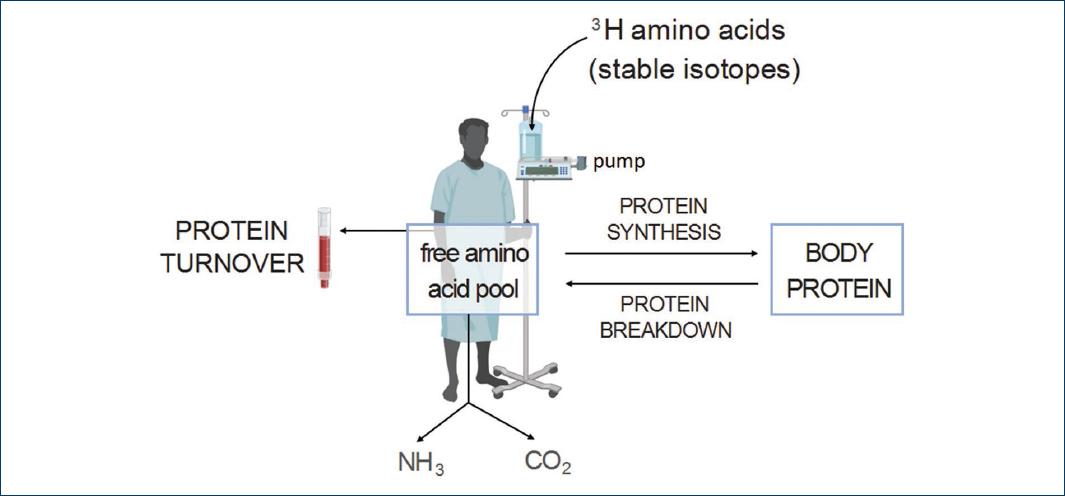
Figure 1 Method of the labeled isotope of specific amino acid. To estimate the requirement of each amino acid, a continuous administration of a tracer labeled amino acid is performed until an isotopic equilibrium is reached, (ratio of tracer infusion equals the ratio of disappearance from the sampling compartment). Labeled isotopes have different masses but the same chemical properties than those found in nature. Thus, the rate of tracee appearance depends on the endogenous protein breakdown, the rate of tracer administration, the protein synthesis, the catabolism, and excretion. Mass spectrometry is commonly used to analyze the amount of labeled isotope excreted through the body.
AA interorgan exchange is a pathway through which AA passes through the body to enable protein synthesis and plasma AA homeostasis and develop different metabolic functions. The flux of AA throughout the body depends directly on whether a feeding or starvation process occurs. In the first condition, the AA is mobilized from the intestine to the rest of the tissues. In the second condition, almost all AA are transported mainly from the skeletal muscle to the liver and kidney.
During starvation or critical illness, carbon skeletons from the degradation of gluconeogenic AA (alanine, glycine cysteine, serine, threonine, asparagine, arginine, aspartic acid, histidine, glutamic acid, glutamine, isoleucine, methionine, proline, valine, and phenylalanine) can be utilized for hepatic glucose synthesis. Leucine is the only one from the rest of the branched-chain AAs (BCAAs) that undergoes complete oxidation to provide energy in the muscle and spare pyruvate oxidation in the Krebs cycle through the formation of acetyl coenzyme-A. During fast, leucine levels rise in the bloodstream and muscle7 (Fig. 2).
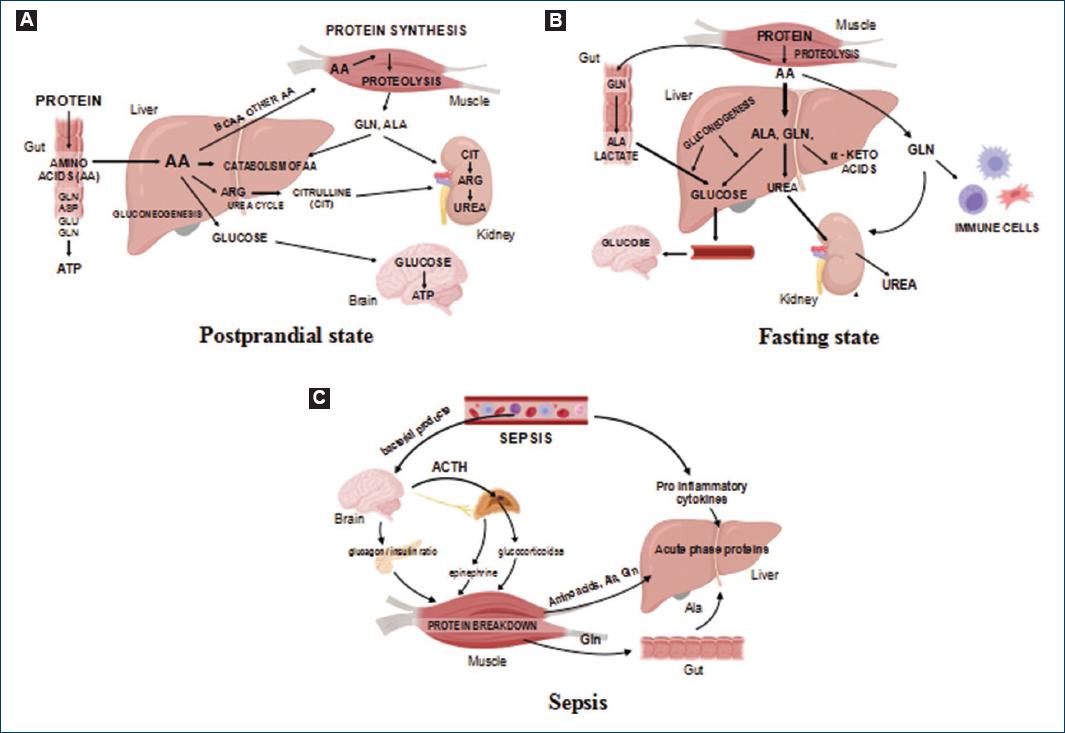
Figure 2 Amino acid (AA) interorgan exchange in the post-prandial, fasting and sepsis states. A: during the post-prandial state, ingested AA is mobilized from the intestine to the liver, where they are used for protein synthesis and synthesis of nitrogen compounds. AA released from the liver is taken up by skeletal muscle, kidney, and brain; the excess is oxidized and further excreted mainly by the urine but also by the feces. B: during the fasting state, skeletal muscle proteolysis releases mainly Alanine (Ala) and Glutamine (Gln) to circulation to obtain energy and stimulate hepatic gluconeogenesis. The skeletal muscle-derived Ala is a rate controlling for the hepatic mitochondrial oxidation that translates into glucose production during fasting. C: during sepsis, the bacterial products induce a pro-inflammatory response leading to skeletal muscle proteolysis, to release mainly Ala or Gln and increases hepatic gluconeogenesis simulating a fasting state, furthermore the proteolysis during sepsis is greater than in a fasting state, so a greater requirement of protein through nutritional support is needed. Asp: aspartic acid; Glu: glutamate; Cit: citrulline; BCAA: branched-chain amino acid; ATP: adenosine triphosphate; ACTH: adrenocorticotrophic hormone.
Protein requirements in different conditions
It is difficult to identify if an improvement that occurs in an intervention is exclusively from the protein or energy administration because proteins are ultimately part of the energy administered in any nutritional intervention (each g of protein provides 4 kcal). Nonetheless, if the energy supplied is not adequate or the energy requirements increase, the dietary protein will serve as an energy provider rather than a keeper of the nitrogen balance8.
The concept of non-protein calories (NPC) has been widely used in nutritional support. The NPC-to-nitrogen (N) ratio has the aim to balance the energy provided by dextrose and lipids so that AA can be used to form protein and lean body mass (LBM) and assist in wound healing. However, this ratio does not provide information about the distribution of lipids and dextrose8. The range of NPC 125:1g N-225:1 is adequate for non-stressed patients9, and in critically ill patients, an adequate NCP: N ratio is between 70:1 and 100:110.
Although a lot of research has been done on this topic, there is no recent or complete concordance in the prescription of protein particularly in those with special conditions. Table 1 summarizes the most recent prescriptions suggested by experts according to different conditions, but further, a better explanation is presented.
Table 1 Protein requirement according to the clinical situation
| Patient type | Protein requirement |
|---|---|
| Well-nourished, healthy adult | 0.8-1 g/kg |
| Well-nourished, healthy older adult | 1.0-1.2 g/kg |
| Critically ill adult, normal weight | 1.2-2.0 g/kg 0.2-0.4 g/kg in acute phase |
| Critically ill adult, obese | BMI 30-40 kg/m2: 2.0 g/kg of IBW BMI > 40 kg/m2: 2.5 g/kg of IBW |
| Critically ill elderly adult | 1.2-1.5 g/kg, if greater losses up to 2.0 g/kg |
| Kidney disease | 0.6-0.8 g/kg CKD non-critically ill > 1.2 g/kg on intermittent RRT non-critically ill 0.8-1.0 g/kg AKI non-critically ill 1.5-1.7 g/kg AKI or CKD with prolonged or continuous RRT. |
| Hepatic disease | 1.5 g/kg, considering dry weight ascites, circulating volume depletion, and hypoalbuminemia |
| Cancer | Up to 1.5 g/kg |
IBW: ideal body weight; BMI: body mass index; CKD: chronic kidney disease; RRT: renal replacement; AKI: acute kidney injury.
Healthy individuals
A key factor in the success of an intervention is the patient nutritional status. However, even in well-nourished, protein/energy malnourishment can occur in approximately 10-15 days if there is inadequate feeding, and this can be reflected in the amount of LBM loss and clinical outcomes related to feeding11-14.
The reference dietary intake has been estimated at 0.65 g/kg BW/day. Still, given the large inter-individual variation in measurement, a standard deviation from this value was added to ensure a high-quality intake, resulting in a final estimate of 0.8 g/kg BW/day8.
The World Health Organization and the Food and Agriculture Organization state that protein requirements are not affected by ethnicity or environmental factors unless an outstanding situation deviates from the norm15. Therefore, it has been recommended in Mexico to follow international protein requirements unless an individual case requires something different16,17.
Critically ill adult patients
The high protein turnover that occurs during a critical state of a patient is due to the body’s different needs, including gluconeogenesis, the synthesis of proteins necessary for immune system function, and wound repair. This can lead to muscle wasting of approximately 15-25%; the larger the decrease in LBM, the worse the outcome. It has been seen that multiorgan failure is related to increased muscle wasting, patients with organic failure of more than two systems had a muscle loss after a week of 15.7% compared with single organ failure14,18.
Organ failure diseases cause problems with nitrogen balance, protein turnover, and homeostasis. In addition, conditions that bring stress such as trauma and sepsis, activate neuroendocrine, inflammatory and gastrointestinal pathways, enhancing catabolism, energy expenditure, and proteolysis. In these cases, muscle proteolysis shifts AA into the liver, where they are used for immunoglobulins, glycogenesis, and acute-phase proteins19. It is important to recognize the presence of inflammatory response as well as its severity on intermediary metabolism because it can be associated as a diagnostic and therapeutic target, and its presence limits the effectiveness of nutritional interventions compared with other clinical situations without or less intense inflammation20,21.
Different studies have demonstrated that adequate protein administration is preferred to energy22 and the effects of prescribed hypocaloric nutrition support on clinical outcomes23. The main problems in protein metabolism are muscle wasting, glutamine depletion, hyperglycemia, and hypoalbuminemia. This promotes the loss of LBM and represents a short-and long-term burden for functional recovery; the amount of protein required can be calculated as 1.5 g/kg of ideal BW (IBW)24.
The most recent European Society for Clinical Nutrition and Metabolism (ESPEN) guidelines suggested that 1.3 g/kg could be an optimal dose if it is administrated progressively and does not fall into overfeeding25. On the other side, ASPEN guidelines suggested that 1.2-2.0 g/kg of actual BW is recommended10,26.
A consensus by experts concluded that 1.2-2.0 g/kg/day is adequate for these patients, although higher doses can be safely used for specific subpopulations as in burn and trauma patients27. In the NUTRIREA-3 showed that in the acute phase in critically ill patients who received lower protein and calories (energy 6 kcal/kg and protein 0.2-0.4 g/kg of BW) had fewer complications and a faster recovery than those who were provided since the beginning high doses of protein28. Furthermore, the EFFORT Protein study reveals that there is no benefit of using high protein doses in the intensive care unit (ICU) (over 2.2 g/kg of BW) in the time of discharge and on the contrary might worsen the outcomes, especially in those with kidney injury or organ failure compared with those with lower doses of protein (1.2 g/kg of BW)29.
Glutamine is an important AA that is involved in many metabolic processes and is related to a reduction in mortality and infectious complications, among others. Currently, it is recommended to supplement glutamine in PN as L-glutamine (0.2-0.4 g/kg of BW) or as alanyl-glutamine dipeptide (0.3-0.6 g/kg of BW) for critically ill patients but with caution in multiorgan failure patients30. Animal studies have shown that the supplementation with L-glutamine improves ischemic brain injury as it improves oxidative stress damage31. Moreover, Cotoia et al., found that in polytrauma patients intravenous supplementation of glutamine (50 mg/kg IBW) improves patient immunity32.
Critically ill obese patients
Hypocaloric high-protein diets refer to those that provide low energy according to the requirements but a concentration of protein high enough to achieve equilibrium or even positive nitrogen balance. This concept is necessary to achieve lean mass’s protein requirements and gain. ESPEN guidelines recommend the use of urinary nitrogen losses or LBM determination (preferably using computed tomography) to determine protein intake; if these are not available, 1.3 g/kg adjusted BW can be used25.
On the other hand, ASPEN guidelines recommend that the protein goal for a patient with a body mass index (BMI) < 27 kg/m2 should be 1.5 g protein/kg of BW. When BMI is from 27 to 30 kg/m2, weight can be corrected to that for a BMI of 27 kg/m2 to make the calculation. In the case of obese patients when BMI > 30 kg/m2, IBW should be used and the protein administration is set to 2.0 g/kg of IBW, but when BMI is > 40 kg/m2, a 2.5 g protein/kg of IBW goal can be set10,31.
In a regression analysis between nitrogen balance and protein intake, it appears that to maintain the nitrogen equilibrium, critically ill patients with class I and class II obesity must consume approximately 1.9-2.0 g protein/kg of IBW per day, while for patients with class III obesity, the protein intake recommendation increases to 2.5 g/kg of IBW unless a severe renal or hepatic dysfunction is present33. Strong enough evidence is still lacking that 2-2.5 g/kg is worth administering, given that there is not always an increase in protein synthesis once this goal is achieved34.
Critically ill elderly adults
Older adults are considered those3 65 years of age, in this population group, it is highly important to maintain muscle mass. When a patient enters the ICU, the greater challenge is to achieve the protein and energy goals to avoid frailty. Muscle mass losses and sarcopenia are conditions of greater importance to consider given that they function as predictors of extended length of hospital stay and mortality in the ICU35.
Patients require more protein, especially leucine, to stimulate protein synthesis; the addition of 2.5-2.8 g of leucine per meal is enough to achieve the anabolic threshold and optimize muscle protein synthesis according to PROT-AGE recommendations. The major contributors to muscle protein breakdown are inflammation, the insulin resistance of proteolysis and muscle disuse, ESPEN guidelines recommend that when acute or chronic illness is present, 1.2-1.5 g protein/kg of BW is recommended, and in cases of severe illness, injury or malnourishment, up to 2 g protein/kg of BW can be administered36.
Kidney and liver diseases
Acute kidney injury is usually secondary to a disease process such as sepsis, hypovolemia, and drug-mediated kidney injury that leads to a homeostatic malfunction. It is known that renal replacement therapy (RRT) increases protein losses (0.2 g AA is lost per liter of filtrate, amounting to a total daily loss of 10-15 g), therefore, protein restriction is not needed37. Latest ESPEN guidelines suggested more accurate protein prescriptions according to the state of the pathology, if the patient is hospitalized and if there is or not RRT. The less requirements are for those without critical illness and RRT with a prescription of 0.6-0.8 g/kg of BW up to 1.5-1.7 g/kg of BW to those hospitalized critically ill with RRT37.
This is not the case with hepatic diseases, in which, according to the pathology, the protein requirement can change and there is still no strong evidence that high protein intake is harmless. For instance, acute liver failure is potentially reversible, and during the disease, glycogen stores and insulin metabolism are reduced and gluconeogenesis and ammonia clearance are impaired, which can lead to multiorgan failure. All this promotes an increase in energy and protein requirements. Unfortunately, decompensated liver cirrhosis is an irreversible late-stage disease; the most common complications are portal hypertension, hepatic encephalopathy, ascites, hepatorenal syndrome, and pre-existing protein-energy malnutrition.
Contrary to the previous recommendation and thoughts, there is no protein restriction with liver diseases, primarily because of the catabolic state that persists during the disease19. The general recommendation to avoid sarcopenia in these patients (if they are not overweighted) is to provide from 1.2-1.5 g/kg/BW38,39, but it will be necessary to take into consideration the calculations of dry weight given the conditions of ascites, circulating volume depletion and hypoalbuminemia.
It has been reported that an infusion of BCAAs brings some benefits as improvement in glucose metabolism by the synthesis of glutamine and leucine; leucine induces the stimulation of hepatic growth factor, the prevention of tissue triglyceride accumulation, and an improvement in neutrophil phagocytic function. However, there are no sufficient data to demonstrate the improvement in this type of patient, and only the ESPEN recommends its use19.
Cancer
One of the major problems in patients with cancer is nutritional deficiency, with primary weight and LBM loss, which increases the length of stay in the hospital, infections, and mortality. This can be due not only to the disease itself, as it is characterized by a catabolic state, but also to the site of the tumor and the cancer therapies that have several side effects. The protein recommendations for these patients should be > 1.0 g/kg up to 1.5 g/kg of BW; however, they can reach up to 2 g/kg if the catabolic state is greater40.
Arginine, glutamine, BCAAs, and hydroxyl-methyl-butyrate leucine derivate (HMB) have been used to avoid catabolic state, but still with inconclusive results about their use40. In a systematic review Prado et al., found that the HMB has been used usually in a dosage of 3.0 g/day to improve muscle mass and function however they suggested that better well-designed trials are needed41.
PN and its protein administration
PN is indicated when there is an intestinal failure or there is no other way to fully nourish a patient by oral or enteral access42-44. Depending on the patient’s needs, PN includes macronutrients (AAs, carbohydrates, and fat), micronutrients (electrolytes, vitamins, trace elements, minerals), and water42,44.
When AAs are administered in PN, they provide less energy than protein because once they are metabolized in the organism, the bonding of peptides releases water. Therefore, 100 g of AAs provides 340 kcal and 83 g of protein substrate; roughly, if the protein requirement for an individual is 0.8 g/kg, the infusion of AAs would be approximately 1 g/kg of weight45. In the case of PN, AA solutions are formed by different amounts of AAs; however, none of them has cysteine because of its instability in the solution (but it can be added as N-acetylcysteine instead) and tyrosine is limited given that it is not quite soluble in water (but N-acetylated tyrosine can be added instead)4,45. Moreover, these solutions usually lack glutamine but have sufficient glycine and other non-essential AAs45.
All standard AA mixtures for PN contain high amounts of essential AAs as well as arginine and amine N from some of the non-essential AAs (for their synthesis) to ensure the fulfillment of daily needs. Specialized mixtures can be found for specific requirements, for example, increased BCAAs and reduced methionine, phenylalanine, and tryptophan (usually for hepatic disease) or solutions exclusively of essential AAs (usually for renal insufficiency) or increased BCAAs (for protein-catabolic critical illness). Additional glutamine can be added to PN solutions, such as alanyl-glutamine (20 g/100 mL)45.
It is important to remember that PN administration varies according to the needs and availability, from single-bottle systems where each nutrient is parallel administrated from separated bottles into a common IV catheter, to the all-in-one system that combines all components of PN in a single infusion line. In this last one, there are individually or ready-to-use admixtures. Special attention has to be taken with the ready-to-use admixtures if the protein requirements want to be met because it can result in calorie overfeeding, usually these types of admixtures have an NCP: N ratio from 160:1 to 90:145.
Finally, even rare AAs can cause an admixture instability showing a dark color, especially when the cysteine and tryptophan are degraded. Therefore, it is important to avoid high temperatures and avoid residual oxygen in the containers for storage or administration46.
Conclusion
The present review remarks on the importance of protein metabolism and the physiological changes that are frequently observed in patients. The scientific evidence and the technological advances available allow us to provide the amount of protein required for the support and treatment of patients to prevent or reduce the negative effects of protein depletion on nutritional status, and to reduce adverse clinical outcomes associated with this condition. This is one of the few works that not only englobes the basics of the function of protein metabolism but also the recommendations for prescriptions in different conditions, such as age, clinical condition, and body composition, and the ways of infuse through PN, facilitating to the healthcare provider all the information necessary for the decision-making regarding protein prescription, especially in those with PN.

