




 nueva página del texto (beta)
 Inglés (pdf)
 Artículo en XML
 Referencias del artículo

 Traducción automática
 Enviar artículo por email
 Citado por SciELO
 Similares en
SciELO

 Permalink

I. Introduction
Organic amendments are crucial for improving the physical and chemical properties of soil, thereby addressing nutrient efficiency and crop productivity challenges. Among them, vermicompost stands out as a unique organic amendment. It is produced through the non-thermophilic biodegradation of organic matter in the presence of earthworms, which results in the fragmentation of organic matter into fine particles. This process, unique to vermicompost, promotes the mineralization of organic matter and the availability of nitrogen and carbon, which in turn stimulate plant growth. These effects, akin to hormone activity, make vermicompost a valuable organic product with added commercial value in the agricultural field (Celikcan et al., 2021). Some studies have applied composted organic amendments based on sewage sludge and animal manure to the soil, with promising results in increased productivity due to the organic matter and total nitrogen, considered ecological indicators for soil health and fertility (Nweke, 2018). In vermicompost, earthworms are probably responsible for a more significant part of the respiratory activity, CO2 evolution, and the amount of mineralized carbon, which increases the total nitrogen and reduces organic carbon, affecting the C/N ratio (Das et al., 2015). The stability of vermicompost includes physicochemical, biochemical, and biological parameters such as temperature, odor, color, and carbon/nitrogen ratio (Morales et al., 2016). This list also includes respiratory activity, basal respiration rate, enzymatic activities, indicators of microbial metabolism, nutrient cycling, and environmental stress (Xin et al., 2020).
In this way, the effect of applied vermicompost has been investigated on different types of crops, such as basil (Ocimum basilicum L.), a native plant from India and other regions of Asia, and recognized as a vegetable food seasoning, having an intense scent in its leaves with a pleasant aroma. In addition, essential oils with pharmaceutical applications can be obtained from this plant (Kholiya et al., 2022). It has been reported that basil grown in agroecological conditions may contain a more significant amount of biologically active compounds with potential health applications, suggesting that these conditions are favorable for the production of this plant. However, occasionally excessive addition of organic matter can result in a lower yields, which is why different rates combined with inorganic fertilizers are still being sought so that optimal performance can be reached (Raj et al., 2022). Kosem et al. (2022), investigated the effects of liquid vermicompost applications (25, 50, 75, and 100%) on the agronomic attributes of basil plants, revealing that the 100% concentration led to significant differences in root length and fresh root weight.
On the other hand, it has been observed that using 10 t ha-1 of organic poultry manure in basil produces fresh weight yields of up to 32.52 t ha-1 per year. However, combinations with conventional fertilizers to maximize performance were not carried out (Yaldız et al., 2019). This suggested that organic fertilizers for basil growth remain to be explored. Understanding the optimal rates for the growth and performance of basil plants using organic fertilizers is a crucial step towards advancing sustainable agricultural practices. Therefore, this study aimed to investigate specific vermicompost rates based on sewage sludge and bovine manure, using comprehensive assessments of soil chemical and biochemical parameters in basil crops. The findings will provide valuable insights into determining the most appropriate vermicompost dosage for improving basil plant growth and yield, allowing further research and developing effective and environmentally friendly agricultural practices with the potential to significantly impact the field of sustainable agriculture.
II. Material and methods
Experimental Site Location
The study was conducted under greenhouse conditions at the Faculty of Agronomy, and the biochemical analysis was performed at the laboratory of the Faculty if Science. Both faculties are affiliated to the Autonomous University of the Sate of Mexico (UAEMex). The site is located at Campus "El Cerrillo" at 19° 24' 32" N latitude and 99° 41' 20" W longitude, at 2,620 meters above sea level.
The Earthworm
The reproduction of earthworms Eisenia fetida began with a breeding a stock of 20 reproductive-age organisms (presence of clitellum).
Selection of Vermicompost
The vermicompost was prepared using bovine manure, agricultural soil, Eisenia fetida, and municipal sewage sludge, with components sourced locally: soil from the university campus, bovine manure from the Faculty of Veterinary Medicine, and sewage sludge from the "Planta Norte" wastewater treatment plant in Toluca. The chemical properties of the materials used are detailed in Table 1.
Table 1 Chemical properties of the used soil, sewage sludge, and bovine manure.
| Parameter | Soil | Sewage sludge | Bovine manure |
|---|---|---|---|
| pH | 6.51 ± 0.20 | 6.87 ± 0.10 | 9.61 ± 0.10 |
| EC (dS m-1) | 0.03 ± 0.10 | 3.03 ± 0.10 | 2.00 ± 0.10 |
| OC (%) | 1.45 ± 0.10 | 25.54 ± 0.20 | 20.18 ± 0.30 |
| TN (%) | 0.11 ± 0.10 | 1.66 ± 0.20 | 0.99 ± 0.10 |
| C/N | 13.18 | 15.38 | 20.38 |
| Phosphorus (mg kg-1) | 12.90 ± 0.10 | 21.70 ± 3.60 | 59.5 ± 0.60 |
| Potassium (g kg-1) | 0.21 ± 0.10 | 0.49 ± 0.10 | 3.81 ± 0.10 |
| C.E.C (cmol kg-1) | 34.00 ± 0.60 | 37.17 ± 1.70 | 41.20 ± 2.00 |
| Zinc (mg kg-1) | 28.80 ± 11.70 | 245.60 ±141.50 | 202.10 ± 29.30 |
| Copper (mg kg-1) | 5.69 ± 0.10 | 142.40 ± 98.40 | 44.90 ± 22.60 |
| Cadmium (mg kg-1) | N.D | 1.74 ± 0.42 | 2.50 ± 1.90 |
| Lead (mg kg-1) | 8.09 ± 1.50 | 59.90 ± 33.00 | 8.30 ± 1.90 |
| Nickel (mg kg-1) | 12.70 ± 1.60 | 34.83 ± 5.60 | 8.20 ± 1.40 |
Mean ± standard deviation. EC: electrical conductivity (deciSiemens/m), OC: organic carbon, TN: total nitrogen, C/N: carbon/nitrogen, C.E.C: cation-exchange-capacity (centimole/kilogram), N.D: Not detectable ***
The selection of the vermicompost was carried out according to the Mexican standard (DOF, 2007). Three proportions of bovine manure (50, 70, and 100%) were tested, keeping sewage sludge (40 Mg/ha) and soil (500 g) constant. The 50% bovine manure proportion met the standard, with a pH of 8.5 (permissible range: 5.5-8.5), 22.06% organic matter (range: 20-50 % dry weight), and a carbon/nitrogen ratio of 14 (below the required 20).
The vermicompost was prepared using bovine manure, soil, E. fetida, and municipal sewage sludge. The agricultural soil was collected from the university campus, the bovine manure from the Faculty of Veterinary and Medicine, and the sewage sludge was supplied by the "Planta Norte" wastewater treatment plant in Toluca (Operadora de Ecosistemas S.A. de C.V.). The chemical properties of each component used in the vermicompost preparation are detailed in Table 1.
The selection of the appropriate vermicompost for the study was carried out in accordance with the Mexican standard (DOF, 2007). Three dosages were evaluated, keeping the sewage sludge (40 Mg/ha) and soil (500 g) constant in the treatments, while varying the proportions of bovine manure at 50, 70, and 100%. The 50% bovine manure dose was the one that complied with the regulations compared to the other proportions, presenting a pH of 8.5, within the permissible range of 5.5 to 8.5. The organic matter content was 22.06%, in line with the established range of 20 to 50% (dry basis), and the C/N ratio was 14, meeting the standard requirement of being below 20.
Greenhouse Experiment Setup
In this experiment, five treatments were applied randomly distributed by placing each plastic pot inside each block. The variable of interest was the dose of the mixture of vermicompost and chemical fertilizer, using basil as the crop. The block formation was done to eliminate the effect of light entering the greenhouse based on the location of each pot to ensure uniform conditions for all treatments.
The statistical model was a randomized complete block design, which uses a blocking technique to control variability. It is represented as follows:
Where:
Yij is the response variable (the dose of the mixture of vermicompost and fertilizer).
μ is the overall meaning.
τi is the effect of treatment i (different doses of the mixture).
βj is the effect of block j (controlling for the effect of light).
ϵij is the experimental error associated with observation ij.
This model assumes that treatments are applied randomly within each block and that the block effects (in this case, to control for light) remain constant within each block (Montgomery, 2007).
In this experiment, five treatments were applied with six repetitions, randomly distributed by placing each plastic pot (diameter = 30 cm and height = 15 cm). One kilogram of volcanic substrate (tezontle) and five kilograms of soil were used. Three rates of vermicompost and three rates of NPK fertilizer, nitrogen, phosphorus, and potassium were added to each pot, following the recommendations of Kashem et al. (2015) with some modifications, such as the exclusion of both a low dose of 5 tons/ha of vermicompost and the use of tomato cultivation.
Treatments were set as follows:
Basil Plant Cultivation
Basil seeds (O. basilicum) of the delicate green variety were supplied by “Rancho Los Molinos” (90 and 99% germination and purity, respectively). They were germinated in agrolite and peat moss substrate (2:1) inside Petri dishes, and the transplanting was performed 40 days later. The manual planting in the pots was conducted during the month of October, transplanting five seedlings in each pot per treatment at an average greenhouse temperature of 23 ± 2°C. Cultural practices were carried out according to Barroso and Jerez (2002). Water was supplied daily (approximately 200 mL) during the morning using a watering can throughout the crop cycle (90 days). The same rates of vermicompost and inorganic fertilizer were added for the first harvest (45 days) and second harvest (90 days), according to Briseño-Ruiz et al., (2013).
Chemical parameters
A chemical evaluation of the vermicompost and the substrates used in the experiment was conducted, and the following parameters were determined: pH, electrical conductivity (dS/m) using the electrode method, organic carbon, total nitrogen, and C/N ratio, following the guideline provided by Official Journal of the Federation (DOF, 2007).
Biochemical variables
Basal respiration through CO2 emission was determined by the method of Alef & Nannipieri (1995): the samples were incubated in airtight jars and titrated with HCl. Catalase activity was determined using the method proposed by Johnson & Temple (1964): H2O2 was added to the sample and incubated at 20 °C. Then, H2O2 was enzymatically broken into H2O and O2. Urease activity was determined according to Tabatabai & Bremner (1972), based on the determination of ammonia released from soil samples incubated with urea solution for 2 hours at 37 °C (optimal conditions for enzyme activity). Three replicates were performed for each treatment, and respiratory activity was monitored every three days over 22 days, during which microbial respiration stabilized.
Evaluation of plant development through fresh weight
Total fresh weight was measured at 60 (1st harvest) and 90 (2nd harvest) days, using a precision1 electronic balance (RS 232, GLP/ISO, Kern & Sohn, Germany).
Treatments and Experimental Design
The experiment was CRBD, and it is shown in Figure 1.
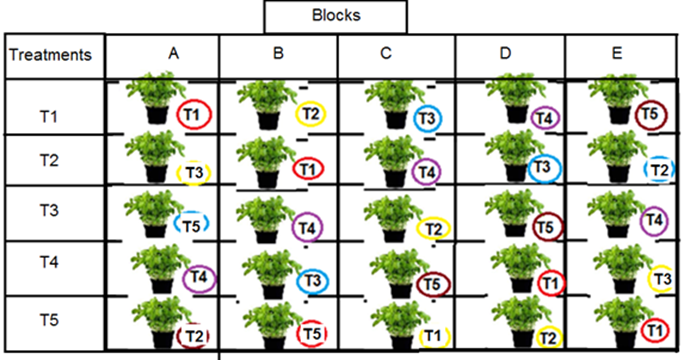
Figure 1 CRBD of five treatments with six replicates. NPK: nitrogen, phosphorus, and potassium, T1: soil only, T2: 100 kg ha-1 of N, 50 kg ha-1 of P and 50 kg ha-1 of K, T3: 50 kg ha-1 of N, 25 kg ha-1 of P and 25 kg ha-1 of K + 10 Mg ha-1 vermicompost, T4: 25 kg ha-1 of N, 10 kg ha-1 of P and10 kg ha-1 of K + 20 Mg ha-1 vermicompost, T5: 40 Mg ha-1 vermicompost only.
Statistical Analysis
The physicochemical and biochemical variables of each were analyzed using ANOVA and Tukey´s tests to determine the differences between treatments. The T-Student test was used to test for differences in the total fresh weight of the plant between the first and second cuts. All statistical tests were analyzed at a confidence level of 95% using the Statgraphics Centurion Statistical Package.
III. Results and discussion
Chemical evaluations
The addition of different rates of vermicompost to the soil during greenhouse cultivation of basil (Table 2) did not induce changes in the soil pH (average of 6.2 ± 0.08). It behaved slightly acidic in accordance with the Mexican standard (SEMARNAT, 2000). However, differences were observed in electrical conductivity (p < 0.05) among treatments, and T5 (122.8 ± 33.08 dS/m) exhibited the highest value. Similarly, higher doses of vermicompost resulted in higher electrical conductivity and organic carbon among groups. In this way, a tendency to increase electrical conductivity with higher concentrations of vermicompost was observed. On the other hand, a higher concentration of organic carbon was observed in T5, and lower concentrations of the same in treatments with a lower amount of vermicompost. It is important to note that all treatments maintain an organic carbon content within a medium range. Likewise, differences in total nitrogen were observed among the groups. On the other hand, it is important to mention that four treatments showed medium nitrogen content. In contrast, only the T5 treatment showed a high content, all in compliance with the referenced standard. Likewise, differences in total nitrogen were also observed among groups. However, T5 (0.2 ± 0.05%) had the highest total nitrogen content. The C/N ratio did not follow the patterns of electrical conductivity, organic carbon, and total nitrogen based on vermicompost content in the treatments. Its behavior was not uniform and showed values of 7.1, 7.6, 8.09, 8.1, and 10.3 for T5, T2, T1, T3, and T4, respectively (Table 2). However, it is also worth mentioning that the T2 treatment exhibits the best chemical stability regarding the C/N ratio, making it a suitable and appropriate option for agricultural practices. These results underscore the importance of our study in improving waste management strategies and enhancing soil quality.
Table 2 Chemical parameters of different rates of vermicompost in soil with inorganic fertilizer (NPK).
| Parameter | T1 | T2 | T3 | T4 | T5 |
|---|---|---|---|---|---|
| pH | 6.10 ± 0.05a | 6.30 ± 0.04 a | 6.30 ± 0.20a | 6.20 ± 0.20a | 6.20 ± 0.40a |
| EC (dS m-1) | 28.02 ± 4.50c | 42.78 ± 5.90bc | 49.61 ± 3.60bc | 67.94 ±11.20b | 122.8 ± 33.08a |
| OC (%) | 1.10 ± 0.07cd | 0.90 ± 0.09d | 1.40 ± 0.08bc | 1.60 ± 0.03ab | 1.90 ± 0.10a |
| TN (%) | 0.10 ± 0.03bc | 0.10 ± 0.01c | 0.10 ± 0.02b | 0.10 ± 0.02bc | 0.20 ± 0.05a |
| C/N | 8.42 ± 1.86ab | 7.70 ± 0.91ab | 8.18 ± 0.65ab | 10.57 ± 2.40a | 7.44 ± 2.16b |
EC: electrical conductivity, OC: organic carbon, TN: total nitrogen, C/N: carbon/ nitrogen, dS: deciSiemens/m. T1: soil only, T2: 100 kg ha-1 of N, 50 kg ha-1 of P and 50 kg ha-1 of K, T3: 50 kg ha-1 of N, 25 kg ha-1 of P and 25 kg ha-1 of K + 10 Mg ha-1 vermicompost, T4: 25 kg ha-1 of N, 10 kg ha-1 of P and10 kg ha-1 of K + 20 M g ha-1 vermicompost, T5: 40 Mg ha-1 vermicompost only. Different superscripts per row mean differences among treatments. Tukey's test at p < 0.05.
In another way, high carbon content is beneficial in carbon sequestration, which keeps it in use as a reserve in the soil. Adding vermicompost increased the organic carbon, revealing differences among T5, T2, and the control.
C/N increased due to the decomposition of organic matter, the mineralization process into nitrogen-rich products, and the generation of metabolites from the earthworm (E. fetida) via excreta, urine, and mucoproteins (Bhat et al., 2016). T5 had more nitrogen content from vermicompost than the rest of the treatments, including T2, which had only inorganic fertilizer. Regarding the chemical parameters of organic carbon and total nitrogen, the C/N ratio was below 20, which meant an advanced degree of stabilization and acceptable maturity (Hait & Tare, 2011). Authors such as Katakula et al. (2021) and Aycan dümenci̇ et al. (2021) mentioned that a C/N ratio lower than 20 indicates good quality in vermicompost, as the soluble organic matter is biodegradable and contains stable high-molecular-weight compounds. However, if the C/N ratio is high, nitrogen is insufficient to produce bacterial proteins, which reduces the growth of organisms that decompose organic matter. Additionally, Das et al. (2021) and Gebrehana et al. (2023) reported that the nutrient quality and the species of earthworm present in the waste influence the C/N ratio, making it an essential factor in promoting the growth rate of earthworms.
Biochemical properties
Figure 2 illustrates the results of this study on the respiratory activity in soils with inorganic fertilizer and vermicompost in the five treatments. T4 had the highest respiration rate, followed by T5, T3, T1, and T2, after 21 days of incubation. This was observed when vermicompost’s respiratory activity was halted. According to Atiyeh et al. (2000), the rapid stabilization of manure with earthworms is reflected in decreased respiration rate (CO2 production). During the first six weeks of processing, the earthworms and associated microbial activity quickly degraded most easily biodegradable substances, as evidenced by the accelerated reduction in CO2 emissions. Notably, the treatments with higher respiration rates were those with a higher vermicompost dosage, indicating a significant role of vermicompost dosage in the respiration rate. In agreement with Suthar (2009), this increase in respiration rate can be attributed to a consortium of microorganisms derived from the waste residues and the vermicomposting process, which is consistent with this study.
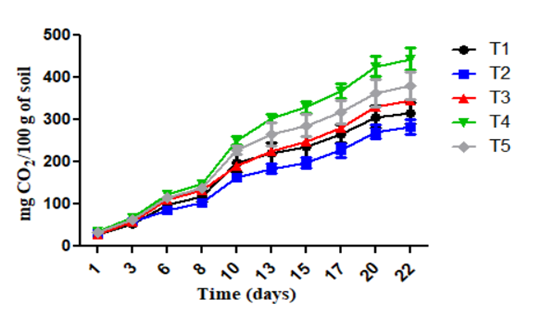
Figure 2 The behavior of the soil’s cumulative respiratory activity in the treatments during the cultivation of the basil plant. T1: soil only, T2: 100 kg ha-1 of N, 50 kg ha-1 of P and 50 kg ha-1 of K, T3: 50 kg ha-1 of N, 25 kg ha-1 of P and 25 kg ha-1 of K + 10 Mg ha-1 vermicompost, T4: 25 kg ha-1 of N, 10 kg ha-1 of P and10 kg ha-1 of K + 20 Mg ha-1 vermicompost, T5: 40 Mg ha-1 vermicompost only.
Studies by Del Aguila-Juárez et al. (2024) observed that stability is reached at the end of the process when respiratory activity is reduced by 22% and remains at that level, as the degradable material begins to be exhausted, decreasing degradation activity and the release of carbon dioxide. Previous studies have reported that the biological activity of soil fertilized with vermicompost is higher than soil amended with regular mineral fertilizers (Das et al., 2021). Respiratory activity and the role played by microorganisms when organic amendments are applied favor plant growth. Also, it has been reported that microorganism-worm-soil-plant associations improve environmental quality and soil fertility (Ahmed & Al-Mutairi, 2022).
In Figure 3, graph A, it was observed that catalase showed its highest activity in T5 (0.286 mol H2O2 /g/h) and the lowest in T2 (0.083 mol H2O2/g/h), which had only inorganic fertilizer. Graph B revealed that urease activity tended to behave like catalase, with its highest value in T5 (1.2 µg of NH4/g/12h), which had more vermicompost dosage.
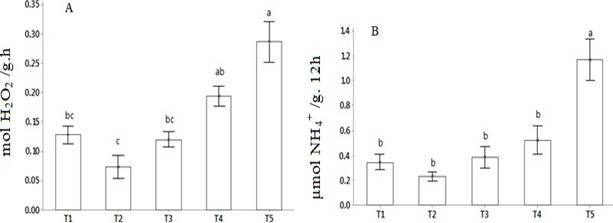
Figure 3 The behavior of the enzymatic activity of the catalase graph A and the activity of the urease graph B of five treatments in the cultivation of the basil plant. T1: soil only, T2: 100 kg ha-1 of N, 50 kg ha-1 of P and 50 kg ha-1 of K, T3: 50 kg ha-1 of N, 25 kg ha-1 of P and 25 kg ha-1 of K + 10 Mg ha-1 vermicompost, T4: 25 kg ha-1 of N, 10 kg ha-1 of P and10 kg ha-1 of K + 20 Mg ha-1 vermicompost, T5: 40 Mg ha-1 vermicompost only. Different letters mean differences among treatments. Tukey's test at p<0.05.
Catalase activity is a key factor in mitigating soil contamination by inorganic and organic compounds (Tang et al., 2019), playing a vital role in protecting cells from oxidative stress caused by reactive oxygen species. In T5, the highest observed catalase activity may be linked to the organic carbon produced by microbial activity in vermicompost (Das et al., 2022).
Some studies, such as those by Feng et al. (2019), Wang et al. (2021), and Pan et al. (2023), highlight the impact of composting and amendments on increasing catalase activity. These studies found that the presence of microorganisms like Bacillus, combined with the addition of materials such as seashell powder and residual sludge, promotes the growth of catalase-producing microorganisms, thereby enhancing the composting process. Specifically, Tuo et al. (2023) reported that adding deer manure and Bacillus during composting boosts catalase activity by stimulating microorganisms that secrete this enzyme, facilitating the conversion of hydrogen peroxide into an essential substrate for catalase activity.
In contrast, using inorganic fertilizers (NPK) in T2 inhibited catalase activity due to biochemical changes in soil microbial metabolism and reduced enzymatic activity (Abdelgalil & Gad, 2023). This trend aligns with the findings of Hosseinzadeh et al. (2018), who observed that catalase activity significantly decreased as vermicompost proportions increased, showing no significant differences compared to the control consisting solely of soil.
On the other hand, the urease activity increased in the vermicompost treatments, showing a behavior similar to catalase and reaching its highest activity in T5. These results align with previous studies that reported a significant increase in urease activity after the addition of compost to agricultural soils (Antonious et al., 2020; Wang et al., 2021). In this study, urease plays a crucial role in composting, as it hydrolyzes urea into ammonia and CO₂, reflecting the mineralization of organic nitrogen. While it facilitates ammonia volatilization, this enzyme can paradoxically inhibit it; generally, a lower urease activity is preferred.
In the early stages of composting, high levels of urease activity were observed, which decreased over time due to the production of inhibitory substances by microorganisms or reduced microbial activity, leading to a decrease in enzyme production, as reported by Xu et al. (2024). In T5, a positive association between organic matter and urease activity was also observed, suggesting a favorable impact on the biological quality of the soil, reflected in increased microbial growth. This effect contributes to improving soil fertility and health, due to the stimulation of microbial growth generated by the interaction between organic matter and urease activity.
In addition, urease is an integral part of the nitrogen cycle, synthesizing nitrogen-rich compounds that are highly available to plants. This process provides key information on the rate of organic matter decomposition and the stability of the resulting product (Antonious et al., 2020; Howe et al., 2024).
Total fresh weight
In Table 3, differences (p < 0.05) were observed when comparing the two moments of basil plant cutting, showing a significant weight increase in the second cut. The treatments with significant changes in fresh weight, in increasing order, were T4 (4.9%), T2 (37.5%), and T5 (51.1%). T4, which combines vermicompost and chemical fertilizer, showed the highest weight increase. Therefore, T4 can be recommended as a cost-effective option for the environment and the producer.
Table 3 Fresh weight of the basil plant between treatments and two different cuts.
| Treatment | Fresh weight (g/plant) | |
|---|---|---|
| First cut | Second cut | |
| T1 | 11.25 ± 6.31 aA | 15.68 ± 3.72 aA |
| T2 | 7.93 ± 5.22 aA | 21.13 ± 4.92 aB |
| T3 | 13.36 ± 11.17 aA | 15.20 ± 3.75 aA |
| T4 | 11.45 ± 6.83 aA | 23.01 ± 6.32 aB |
| T5 | 9.05 ± 6.60 aA | 17.70 ± 9.25 aB |
Mean ± SD weights of basil plants, T1: soil only, T2: 100 kg ha-1 of N, 50 kg ha-1 of P and 50 kg ha-1 of K, T3: 50 kg ha-1 of N, 25 kg ha-1 of P and 25 kg ha-1 of K + 10 Mg ha-1 vermicompost, T4: 25 kg ha-1 of N, 10 kg ha-1 of P and10 kg ha-1 of K + 20 Mg ha-1 vermicompost, T5: 40 Mg ha-1 vermicompost only. Different lowercase letters indicate differences between the mean weight of the treatments of the same harvest (one-way ANOVA), and different capital letters indicate differences in the mean weight between harvests 1 and 2 (T-Student test).
Similar studies by Moncayo-Luján et al. (2015), using commercial chemical fertilizers along with compost and vermicompost in basil cultivation, obtained satisfactory and similar results in plant development, influencing parameters such as plant height, leaf area and total phenolic compounds. Cabanillas et al. (2013) examined the productive and economic benefits of waste reduction and reuse, highlighting that vermicompost from rabbit manure and bovine ruminal contents derived from rural and agro-industrial waste is a viable and environmentally friendly alternative to urea in basil production.
Similarly, the application of organic and inorganic fertilizers to the soil with basil in this study significantly impacted the plants' fresh weight, indicating a transition towards organic agriculture and a gradual shift away from the exclusive use of inorganic fertilizers. This reduces environmental pollution and improves soil structure, water retention, nutrient availability, and crop yield. These findings are supported by the studies by Torres Lozada et al. (2021) and Tang et al. (2022).
On the other hand, research by Mondal et al. (2017) and Acharya et al. (2024) suggested that the combination of vermicompost and chemical fertilizers has positive effects on organic agriculture and natural resources, improving agronomic performance, soil fertility, nutrient use efficiency, and reducing nitrogen losses to the environment. Optimizing nitrogen fertilizers through sound management practices is essential for improving soil health and mitigating global warming by reducing nitrogen leaching and greenhouse gas emissions such as ammonia, nitric, and nitrous oxide.
Finally, this study has significantly advanced our understanding of the benefits of combining chemical fertilizers and vermicompost in basil cultivation, highlighting the crucial role that organic amendments play in improving soil fertility, nutrient availability, and crop productivity. With the support of municipal sewage sludge and bovine manure, vermicompost emerges as a promising strategy for sustainable agriculture, effectively addressing environmental concerns and promoting more efficient and eco-friendly farming practices.
IV. Conclusions
The application of compost in basil cultivation provides a strong foundation for future exploration and innovation in this field. The selected dose, consisting of 50% manure and 720 g (40 Mg ha-¹) of residual sludge, was used in five treatments with varying proportions of compost and chemical fertilizer, modifying the physicochemical and biochemical properties of the substrate in compliance with Mexican regulations. These changes contributed to an increase in the fresh weight of basil. The highest plant productivity, observed during the initial cutting period, was notable in T4 (25:10:10 NPK with 20 Mg ha-¹ of compost), where the C/N ratio of 10.3 highlighted the stability of the applied vermicompost dose, which combined vermicompost and chemical fertilizer.
This study has provided crucial insights into the optimal conditions for vermicompost in basil cultivation and opened a world of possibilities. The technique suits other crops due to its randomized experimental design and growth monitoring during its two key cutting phases. The careful handling of plants and measuring yield through drying and weighing biomass allow for comparable data, making this methodology easily adaptable for assessing productivity in various crop species. The potential applications of vermicompost in different crop systems are vast, and this study provides the knowledge for future exploration and innovation in this field.

