




Services on Demand
Journal
Article
 text in
 English (pdf)
 Article in xml format
 Article references

 Automatic translation
 Send this article by e-mail
Indicators
-
 Cited by SciELO
-
 Access statistics
Related links
-
 Similars in
SciELO
Share

 Permalink

Revista mexicana de ciencias forestales
Print version ISSN 2007-1132
Rev. mex. de cienc. forestales vol.17 n.95 México May./Jun. 2026 Epub Aug 13, 2026
https://doi.org/10.29298/rmcf.v17i95.1618
Research notes
Relationship between the size of pruning wounds and the location of the cut in urban tres
1
 http://orcid.org/0000-0001-6294-4275
2
http://orcid.org/0000-0003-3464-363X
3
http://orcid.org/0000-0001-5818-1391
3
http://orcid.org/0000-0002-2541-4176
1Facultad de Ciencias Forestales, Universidad Autónoma de Nuevo León. México.
2Campo Experimental Altos de Jalisco, Instituto Nacional de Investigaciones Forestales Agrícolas y Pecuarias. México.
3Universidad Autónoma de Chihuahua, Facultad de Ciencias Agrícolas y Forestales. México.
4División de Estudios de Posgrado, Instituto de Estudios Ambientales, Universidad de la Sierra Juárez. México.
Pruning urban trees is a key practice for maintaining their structural stability, functionality and longevity; however, improper cut location can generate extensive wounds that compromise the tree's structural integrity and increase its vulnerability to pathogenic fungi and other microorganisms. The Hamburg method stipulates that cuts should be made after the branch collar and the bark wrinkle, preserving the tissues responsible for compartmentalization, a physiological mechanism that limits the spread of internal decay. However, in the management of urban trees in various cities, cutting trees flush with the steem is still a common practice. This study evaluated the effect of pruning cut location (correct and flush pruning) on wound size in ten tree species used in Northeastern Mexico. To this end, two diameters per wound were measured to calculate its area, and statistical tests were applied to determine differences between species and cut type. Results indicated that flush pruning produces significantly larger wounds, with an average increase of 73 % compared to pruning done after the branch collar and bark wrinkling, with values ranging from 54 to 99 % depending on the species. These differences confirm that the location of the pruning cut directly influences the size of the wound and the tree's ability to compartmentalize.
Keywords Urban trees; urban forest; compartmentalization; pruning wounds; Hamburg method; urban pruning
La poda de árboles urbanos es una práctica clave para mantener su estabilidad estructural, funcionalidad y longevidad; sin embargo, la localización inadecuada del corte puede generar heridas extensas que afectan la integridad estructural del árbol y favorece su vulnerabilidad a la entrada de hongos patógenos y otros microorganismos. El método Hamburgo establece que los cortes deben realizarse después del collar de la rama y la arruga de la corteza, para preservar los tejidos responsables de la compartimentación, mecanismo fisiológico que limita la propagación del deterioro interno. No obstante, en el manejo del arbolado urbano de diversas ciudades aún son frecuentes los cortes al ras del fuste. En este estudio se evaluó el efecto de la localización del corte de poda (poda correcta y al ras) en la magnitud de la herida en 10 especies arbóreas utilizadas en el noreste de México. Para ello, se midieron dos diámetros por herida para calcular su área y se aplicaron pruebas estadísticas para determinar diferencias entre especies y tipo de corte. Los resultados indicaron que las podas al ras producen heridas significativamente mayores, con un incremento promedio de 73 %, respecto a las podas realizadas después del collar de la rama y arruga de la corteza, con valores que oscilaron entre 54 y 99 % según la especie. Estas diferencias confirman que la localización del corte de poda influye directamente en la magnitud de la herida y en la capacidad de compartimentación de los árboles.
Palabras clave Arbolado urbano; bosque urbano; compartimentación; heridas de poda; método Hamburgo; poda urbana
Subject development
Location of pruning cuts in urban trees
The branches of urban trees are pruned for various reasons: cultural, historical, aesthetic, functional, and technical (Drénou, 2000). These prunings create wounds that cause discoloration and, if poorly executed, decay of the exposed wood, as well as loss of structural integrity (Purcell, 2015). When the wounds are large or located in structurally vulnerable areas, they facilitate the entry of wood-decaying fungi and other pathogens, accelerating tissue degradation and the overall deterioration of the tree (Morris et al., 2020). These processes are closely linked to the tree's ability to compartmentalize the damage caused by pruning (Shigo & Marx, 1977; Shigo, 1984).
Wound healing among species can vary depending on their ability to compartmentalize damage: a mechanism that isolates affected tissues and limits the spread of pathogens within the woody tissue (Purcell, 2015; Morris et al., 2020).
In this context, it is necessary to strengthen our understanding of the effects of pruning practices on trees in urban areas of Mexico; this information is fundamental for inferring and promoting best practices in tree management. Understanding the differences between correct and incorrect pruning is essential for developing technical protocols that guarantee the health, longevity, and structural stability of urban trees.
The publication of research on pruning in urban trees began in the late 1970’s and 1980’s (Shigo et al., 1979; Neely, 1988). Although the importance of avoiding flush cuts to the stem had been scientifically documented since the late 20th century (Shigo, 1984), this practice persisted in urban arboriculture and in various technical manuals for years afterward (Dujesiefken & Stobbe, 2002; Van der Zanden et al., 2008). While the compartmentalization of damage and rot processes had already been described by Shigo (1984), the study by Dujesiefken and Stobbe (2002) in Hamburg provided empirical evidence that allowed for the formalization and dissemination of pruning recommendations based on respecting the branch collar. This method, known as the Hamburg method, became an international standard and has been adopted in modern arboriculture manuals in Europe and North America (Dujesiefken & Stobbe, 2002).
Flush cuts to the trunk have two disadvantages: they leave a larger wound and eliminate the tissues responsible for compartmentalization and natural chemical protection (Shigo, 1984; Dujesiefken & Stobbe, 2002). In contrast, pruning after the branch collar and bark wrinkle leaves a smaller wound, preserves the tissues responsible for compartmentalization and natural chemical protection, and protects the wound against fungi and other pathogens (Shigo, 1984; Dujesiefken & Stobbe, 2002; Van der Zanden et al., 2008; Morris et al., 2020).
Although the Hamburg method was published more than two decades ago, incorrect pruning practices continue in numerous cities. This occurs even in contexts where technical standards regulate urban tree pruning, suggesting that the problem lies less in the absence of guidelines and more in their application, supervision and the training of operational personnel.
The objective of this research was to quantify the magnitude of the pruning wound based on the location of the cut in branches of ten tree species used in urban environments in Northeastern Mexico. The research question is posed in quantitative terms: What is the magnitude of the increase in wound area associated with the location of the pruning cut (beyond the branch collar vs. flush with the stem) and how does it vary among urban tree species?
Answering this question allows us to support technical recommendations for urban tree management with quantitative evidence, going beyond visual or descriptive observations.
Field information
In the winter of 2024, 10 tree species were selected: three introduced and seven native to Northeastern Mexico, located in the green areas of the Graduate School of Forest Sciences at the Universidad Autónoma de Nuevo León (Autonomous University of Nuevo León) (Table 1). The tree species were selected because they are abundant in urban areas of the region (Alanís et al., 2014; Leal-Elizondo et al., 2018; Canizales-Velázquez et al., 2020).
Table 1 Species used in the research.
| Scientific name | Common name | Origen |
|---|---|---|
| Caesalpinia mexicana A. Gray (Synonym of Erythrostemon mexicanus (Rose) Gagnon & G. P. Lewis) | Árbol del potro | Native |
| Diospyros texana Scheele | Chapote manzano | Native |
| Ebenopsis ebano (Berland.) Barneby & J. W. Grimes | Ébano | Native |
| Fraxinus americana L. | Fresno | Exotic |
| Havardia pallens (Benth.) Britton & Rose | Tenaza | Native |
| Helietta parvifolia Benth. | Barreta | Native |
| Ligustrum japonicum Thunb. | Trueno | Exotic |
| Neltuma laevigata (Humb. & Bonpl. ex Willd.) Britton & Rose | Mezquite | Native |
| Quercus rubra L. | Encino rojo | Exotic |
| Quercus virginiana Mill. | Encino siempre verde | Native |
Twenty branches of each species were measured, with diameters ranging from 3 to 10 cm at the crown, using a model 283D Forestry Suppliers® diameter tape measure. The selected branches corresponded to functional, well-developed crowns without visible damage, representative of formative and maintenance pruning in urban trees. On each branch, two sections were chosen for pruning: one correct according to the Hamburg method (Figure 1B), and one incorrect, flush with the main trunk (Figure 1C). Using a model K519 Koiss® digital flexometer, two diameters were measured for each pruning section (Figure 1A and 1B): the longest diameter of the wound (d major ) and the diameter perpendicular to the longest diameter, which is usually the smallest diameter (d minor ).
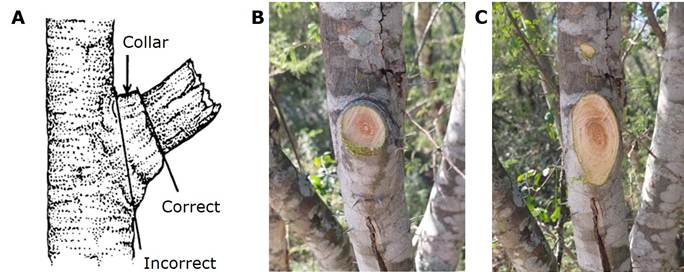
A = Diagram showing the branch collar and the pattern of a correct pruning using the Hamburg method, as well as an incorrect pruning flush with the main stem (Image taken from Van der Zanden et al. [2008] ). B = Photograph of the wound resulting from pruning performed using the Hamburg method. C = Photograph of the wound caused by pruning flush with the main trunk.
Figure 1 Wounds caused by different pruning methods in urban trees
Data analysis
To estimate the correct pruning diameter, the average diameter of the two measurements was calculated using the following formula (Branthomme, 2004):
Where:
The wound area was calculated by the following formula (Alanís-Rodríguez et al., 2020):
Where:
A = Area of the wound
d = Average diameter of the wound
Since the incorrect wound at the base of the main stem is elliptical in shape, the following formula was used (Branthomme, 2004):
Where:
A = Area of the wound
a = Minor radius
b = Major radius
To compare the magnitude of the cut wound, parametric statistical tests were performed. First, to test the hypothesis of equal means, the average cut area for each species was compared using Student's t-test with Welch's adaptation for unequal variances (Welch, 1947). Subsequently, an analysis of variance (ANOVA) was performed to compare the size of the exposed area, but only for the flush pruning treatment. The assumption of normality was verified, and an asymmetric distribution of the data was observed. Since the wound area is a continuous and positive variable, a natural logarithmic transformation was applied to approximate normality and stabilize variances, allowing for an ANOVA and multiple comparisons using Tukey's post-hoc test. Statistical analyses were performed using the free license software R (R Core Team, 2021) in its version 4.1 with support from the ggplot2 library (Wickham, 2010) to create the graphs.
The results confirm the hypothesis that pruning flush with the main trunk produces larger cuts than correct pruning. On average, based on the 10 species, the increase in the exposed cut area was 73±15 %. At the species level, Diospyros texana Scheele showed the highest increase (99 %), while Quercus virginiana Mill. showed the lowest (54 %). This variation is mainly associated with the angle of branch insertion relative to the trunk; however, crown architecture is also influenced by environmental, management, and tree location factors.
Stepping to the stem creates ellipsoidal cuts that expose a larger surface area of vascular tissue, while pruning past the crown collar produces smaller, more circular wounds that facilitate the formation of protective barriers and compartmentalization. Differences between species were statistically significant (p<0.001) according to Tukey's HSD test following ANOVA in all cases (Table 2), which validated the consistent effect of cut type on wound size.
Table 2 Comparison of average wound area by species and pruning type.
| Scientific name | Exposed area (SD) | Difference (%) |
DF | t-value | p-Value | |
|---|---|---|---|---|---|---|
| FC | CP | |||||
|
Caesalpinia mexicana A. Gray (Synonym of Erythrostemon mexicanus (Rose) Gagnon & G. P. Lewis) |
18.10 (4.68) |
9.82 (3.23) |
84 | 33.73 | 6.50 | <0.001 |
| Diospyros texana Scheele | 32.41 (15.81) |
16.25 (9.18) |
99 | 30.50 | 3.95 | <0.001 |
|
Ebenopsis ebano (Berland.) Barneby & J. W. Grimes |
14.86 (4.42) |
8.69 (1.75) |
71 | 24.84 | 5.81 | <0.001 |
| Fraxinus americana L. | 14.66 (4.69) |
9.09 (2.24) |
61 | 27.25 | 4.80 | <0.001 |
|
Havardia pallens (Benth.) Britton &
Rose |
16.14 (3.75) |
10.18 (2.43) |
59 | 32.59 | 5.97 | <0.001 |
| Helietta parvifolia Benth. | 17.25 (2.83) |
10.53 (2.81) |
64 | 38.00 | 7.52 | <0.001 |
| Ligustrum japonicum Thunb. | 25.32 (8.08) |
13.25 (5.20) |
91 | 32.42 | 5.62 | <0.001 |
|
Neltuma laevigata (Humb. & Bonpl. ex Willd.) Britton & Rose |
21.77 (7.60) |
12.60 (5.45) |
73 | 34.44 | 4.38 | <0.001 |
| Quercus rubra L. | 16.48 (4.60) |
9.34 (1.99) |
76 | 25.89 | 6.38 | <0.001 |
| Quercus virginiana Mill. | 30.39 ( 10.41) |
19.76 (8.00) |
54 | 39.39 | 3.80 | <0.001 |
SD = Standard deviation; FC = Flush cuts; CP = Correct pruning; DF = Degrees of freedom.
The results confirm the fundamentals of the Hamburg method, demonstrating that the location of the pruning cut directly influences the size of the wound and, therefore, the tree's ability to compartmentalize and close the exposed tissue. In all the species analyzed, pruning flush with the main trunk generated significantly larger wounds than those made after the branch collar and the bark wrinkle, consistent with the findings of Dujesiefken and Stobbe (2002), Van der Zanden et al. (2008) and Martínez-Trinidad and Islas-Rodríguez (2010).
The average 73 % increase in exposed area observed in this study has significant physiological implications, as larger wounds prolong tissue closure time and increase the tree's vulnerability to wood-decay pathogens and internal rot processes (Martínez-Trinidad & Islas-Rodríguez, 2010; Smiley et al., 2017; Morris et al., 2020). These results highlight the importance of respecting the branch collar and bark wrinkle to promote natural tissue compartmentalization, mechanisms that reduce internal deterioration and facilitate wound closure (Martínez-Trinidad & Islas-Rodríguez, 2010; Purcell, 2015; Pietzarka, 2016).
The study confirms that the location of the pruning cut significantly influences wound size, validating the effectiveness of the Hamburg method of making cuts beyond the branch collar and bark wrinkle to minimize structural damage. In this regard, it is recommended to strengthen the application and updating of municipal urban tree management manuals, many of which already incorporate guidelines based on internationally recognized arboricultural standards, such as those promoted by arborists certified by the International Society of Arboriculture (ISA). Likewise, it is essential to strengthen ongoing training programs for technicians and operational staff to ensure the correct implementation of these standards and reduce the structural and health deterioration of urban trees resulting from inadequate pruning practices, both in Northeastern Mexico and in regions with similar conditions.
Acknowledgments
To the technical staff for their support in the field activities.
REFERENCES
Alanís, E., Jiménez, J., Mora-Olivo, A., Canizales, P., & Rocha, L. (2014). Estructura y composición del arbolado urbano de un campus universitario del noreste de México. Revista Iberoamericana de Ciencias, 1(7), 93-101. https://www.researchgate.net/publication/271271778_Estructura_y_composicion_del_arbolado_urbano_de_un_campus_universitario_del_noreste_de_Mexico [ Links ]
Alanís-Rodríguez, E., Mora-Olivo, A., & Marroquín-de la Fuente, J. S. (2020). Muestreo ecológico de la vegetación. Universidad Autónoma de Nuevo León. https://libros.uat.edu.mx/index.php/librosuat/catalog/view/221/182/537 [ Links ]
Branthomme, A. (Comp.). (2004). National forest inventory. Field manual template (Working Paper 94/E). Food and Agriculture Organization. https://openknowledge.fao.org/server/api/core/bitstreams/614a9eed-25cf-4c10-a6b7-7f85611565ef/content [ Links ]
Canizales-Velázquez, P. A., Alanís-Rodríguez, E., Holguín-Estrada, V. A., García-García, S., & Collantes-Chávez-Costa, A. (2020). Caracterización del arbolado urbano de la ciudad de Montemorelos, Nuevo León. Revista Mexicana de Ciencias Forestales, 11(62), 111-135. https://doi.org/10.29298/rmcf.v11i62.768 [ Links ]
Drénou, C. (2000). La poda de los árboles ornamentales: del por qué al cómo. Mundi-Prensa Libros. https://dialnet.unirioja.es/servlet/libro?codigo=143550 [ Links ]
Dujesiefken, D., & Stobbe, H. (2002). The Hamburg tree pruning system-a framework for pruning of individual trees. Urban Forestry & Urban Greening, 1, 75-82. https://trees.umn.edu/sites/trees.umn.edu/files/files/media/hamburg_tree_pruning_system.pdf [ Links ]
Leal-Elizondo, C. E, Leal-Elizondo, N., Alanís-Rodríguez, E., Pequeño-Ledesma, M. Á., Mora-Olivo, A., & Buendía-Rodríguez, E. (2018). Estructura, composición y diversidad del arbolado urbano de Linares, Nuevo León. Revista Mexicana de Ciencias Forestales, 9(48), 252-270. https://doi.org/10.29298/rmcf.v8i48.129 [ Links ]
Martínez-Trinidad, T., & Islas-Rodríguez, L. (2010). Biología y compartimentación del árbol. ArbolAMA, (3), 21-29. https://www.researchgate.net/publication/344156016_BIOLOGIA_Y_COMPARTIMENTACION_DEL_ARBOL [ Links ]
Morris, H., Hietala, A. M., Jansen, S., Ribera, J., Rosner, S., Salmeia, K. A., & Schwarze, F. W. M. R. (2020). Using the CODIT model to explain secondary metabolites of xylem in defence systems of temperate trees against decay fungi. Annals of Botany, 125(5), 701-720. https://doi.org/10.1093/aob/mcz138 [ Links ]
Neely, D. (1988). Closure of branch pruning wounds with conventional and “Shigo” cuts. Journal of Arboriculture, 14(11), 261-264. https://doi.org/10.48044/jauf.1988.062 [ Links ]
Pietzarka, U. (2016). Tree pruning: methods and parameters. In A. Roloff (Edit.), Urban Tree Management for the sustainable development of green cities (pp. 154-168). John Wiley & Sons, Ltd. https://content.e-bookshelf.de/media/reading/L-4159854-2e383bc4f1.pdf [ Links ]
Purcell, L. (2015). Lo esencial para la poda de árboles. Forestry and Natural Resources, 506, 1-18. https://www.extension.purdue.edu/extmedia/FNR/FNR-506-S-W.pdf [ Links ]
R Core Team. (2021). R: A Language and Environment for Statistical Computing (Version 4.1) [Software]. R Foundation for Statistical Computing. https://www.r-project.org/ [ Links ]
Shigo, A. L. (1984). Compartmentalization: a conceptual framework for understanding how trees grow and defend themselves. Annual Review of Phytopathology, 22, 189-214. https://doi.org/10.1146/annurev.py.22.090184.001201 [ Links ]
Shigo, A. L., & Marx, H. G. (1977). Compartmentalization of decay in trees (Agriculture Information Bulletin No. 405). United States Department of Agriculture. https://research.fs.usda.gov/download/treesearch/5292.pdf [ Links ]
Shigo, A. L., McGinnes Jr., E. A., Funk, D. T., & Rogers, N. (1979). Internal defects associated with pruned and nonpruned branch stubs in Black Walnut (Forest Service Research Paper NE-440). United States Department of Agriculture. https://research.fs.usda.gov/treesearch/14974 [ Links ]
Smiley, E. T., Matheny, N., & Lilly, S. (2017). Best management practices: Tree risk assessment (2nd ed.). International Society of Arboriculture. https://www.cabidigitallibrary.org/doi/full/10.5555/20183082467 [ Links ]
Van der Zanden, A. M., Cogger, C., Sullivan, D. M., Kropf, J. A., Bobbitt, V., Fox, R., Kennell, H., Moulton, H., Pinyuh, G., Robson, M., Patterson, P., Maleike, R., Olsen, J., Azarenko, A., Strik, B., Antonelli, A. L., Stanke, G., Adams, E. B., Collman, S. J., … Wingate, M. (2008). Sustainable Gardening: The Oregon-Washington Master Gardener Handbook. Oregon State University. https://extension.oregonstate.edu/catalog/pub/em-8742-sustainable-gardening-oregon-washington-master-gardener-handbook [ Links ]
Welch, B. L. (1947). The generalization of Student’s problem when several different population variances are involved. Biometrika, 34(1-2), 28-35. https://doi.org/10.1093/biomet/34.1-2.28 [ Links ]
Wickham, H. (2010). A layered grammar of graphics. Journal of Computational and Graphical Statistics, 19(1), 3-28. https://doi.org/10.1198/jcgs.2009.07098 [ Links ]
Received: November 19, 2025; Accepted: April 27, 2026
 Este es un artículo publicado en acceso abierto bajo una licencia Creative Commons
