




 nova página do texto(beta)
 Inglês (pdf)
 Artigo em XML
 Referências do artigo

 Tradução automática
 Enviar este artigo por email
 Citado por SciELO
 Similares em
SciELO

 Permalink


Introduction
The most common cancer in women to be diagnosed is breast cancer (BC), which also happens to be the second largest cause of cancer-related mortality in this population. BC can now be identified and diagnosed with much greater accuracy. There is a correlation between a high-fat diet, excessive alcohol consumption, and inactivity in relation to BC [1]. Reducing morbidity and mortality could be aided by the removal of these variables. Early tumour diagnosis may be aided by breast self-examination, mammography, ultrasound, and magnetic resonance imaging [2]. Lung cancer has been overtaken by BC (11.7 %) as the most common cancer diagnosed in women. Lung cancer (11.4 %), colorectal (10.0 %), prostate (7.3 %), and stomach (5.6 %) follow. About 2.1 million women are impacted by BC annually, and it is the primary cause of cancer-related deaths in women. BC accounted for about 15 % of all female cancer deaths in 2020, affecting 2.3 million women worldwide and resulting in 685,000 fatalities [1].
Human epidermal growth factor receptor 2 (HER2) is a member of the epidermal growth factor family (ErbB family) that consists of four transmembrane tyrosine kinase receptors: ErbB1 (EGFR/HER1), ErbB2 (HER2), ErbB3 (HER3), and ErbB4 (HER4) [3]. Overexpression of HER2 has been associated with adenocarcinomas, including those of the breast, ovaries, endometrium, cervix, and lung. HER2 is therefore an important target for a number of cancer therapeutic modalities [1]. Fifteen to twenty percent of BC cases had overexpression of the HER2 gene, which is typically associated with a high degree of biological and clinical disease aggression [4]. Many malignancies' biology is significantly influenced by HER2 [5]. In addition, novel HER2-targeted medications have been thoroughly investigated recently and have demonstrated improved results [1]. The development of active dimers is stabilised by ligand binding to the extracellular domain of ErbB receptors, which are ordinarily inactive monomers (Fig. 1). Dimerization causes kinase domain activation, which in turn causes transphosphorylation of tyrosine residues within the domains. It can happen between two distinct ErbB receptors or between two domains of the same receptor.
Tyrosine residue phosphorylation generates binding sites for effector or adaptor proteins with phosphotyrosine-binding domains and Src-homology (SH2) [6]. Two significant signalling pathways that are triggered by ErbB receptors are phosphatidylinositol-3-kinase (PI3K) and mitogen-activated protein kinase (MAPK) (Fig. 1). These pathways cause gene transcription, which produces proteins involved in cell division, migration, proliferation, and death [3].
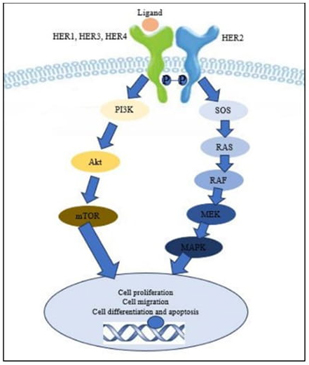
Fig. 1 The Human epidermal growth factor receptor 2 (HER2) pathway. The generation of active HER2 heterodimers is stabilised by ligand binding to the extracellular domain of HER1/3/4.
The finest sources of therapeutic compounds are natural items. Because medicinal plants feature intriguing secondary metabolites that may have undiscovered anticancer properties, there has been a surge in scientific interest in these plants within the last several decades [7]. One of these is lichen, which is a symbiotic relationship between fungus and algae. There are around 20,000 types of lichen on the globe. A vast variety of primary (intracellular) and secondary (extracellular) chemicals are produced by their chemistry. Amino acids, polyols, carotenoids, polysaccharides, and vitamins are examples of primary metabolites. Lichen acids, or secondary metabolites generated by the lichen's fungal partner, comprise most of the organic chemicals present in lichens. More than 850 secondary metabolites have been found in lichens thus far, and research has demonstrated that these chemicals are produced by lichens under duress and are crucial for the self-defence of slow-growing lichens [8].
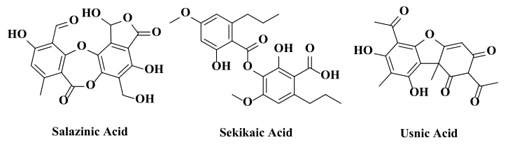
A wide range of secondary metabolites, including those with antibacterial, antiviral, antitumor, antioxidant, antihervivor, insecticidal, allelochemical, and allergenic properties, are produced by lichen [9]. The fresh thallus of the natural lichens Ramalina celastri, Ramalina nervulosa, and Ramalina pacifica produce usnic acid, salazinic acid, and sekikaic acid, respectively [10]. Based on the evidence by Morris Kupchan and Kopperman (1975), we postulated that the secondary metabolites (salazinic acid, sekikaic acid, and usnic acid; Fig. 2) may interact with BC's HER2 receptor in light of lichens' anti-cancer properties [11]. Therefore, the primary emphasis of this work was on computer-aided drug design processes such as molecular docking, PASS prediction methods, and e-pharmacophore to find a potential natural antagonist against the HER2 protein in order to cure BC.
Methodology
Molecular docking
The compounds were docked with the receptor separately using the CB-Dock (cavity-detection-guided blind docking) protein-ligand docking technique [12]. The ChemSketch tool was used to create compound structures, which were then saved in the .mol format. The RCSB Protein Data Bank provided the target protein for docking, which had a resolution of less than 2.25 Å, a R value of less than 0.260, and a PDB ID (PDB ID: 3PP0) [13]. According to Liu et al., the CB-Dock method accurately locates the binding zone, ascertains the size and location of the centre, modifies the size of the docking region in response to the molecule input, and then uses AutoDock Vina version 1.1.2 to dock [14]. A PBD file for the receptor and a .mol file for the ligands were entered prior to docking. Each of the several top cavities that were automatically selected throughout this process and used for additional research (cavity sorting) underwent molecular docking.
Prediction of anticancer activity
Using a web server called the PASS-Way2Drug server, the in-silico prediction of usnic acid's anticancer characteristics was investigated further. P values for the similarity measures are provided by the PASS (Prediction of Activity Spectra for Substances), which is based on the likelihood of anticancer activity being highly or less likely [15]. At a false-positive rate of 0.05, it may get 65% positive findings. We sourced the necessary entries from the PubChem service as it necessitates the canonical Simplified Molecular Input Line Entry String (SMILES) of substances to be examined [16].
E-pharmacophore analysis
The energetic (e)-pharmacophore technique now incorporates both structure- and ligand-based approaches. The pharmacophore sites of UA, such as hydrogen bond acceptor (A), hydrogen bond donor (D), hydrophobic group (H), positively ionizable (P), negatively ionizable (N), and aromatic ring (R), were identified using the phase v 3.4 module in Schrödinger [17].
Results
Molecular docking
Table 1 Molecular docking analysis of lichen derived salazinic acid, sekikaic acid, usnic acid and reference compound (co-crystal ligand) with the HER2 receptor of breast cancer (PDB ID: 3PP0).
| Compound Name | Cavity Size | Vina Score | Bound Amino Acids |
|---|---|---|---|
| Co-crystal (Control) | 4513 | -9.7 | Met774, Arg784, Thr862, Thr798, Gln799, Asn850, Arg849, Ser728, Cys805 (H-B), Ala771, Glu770, Met774, Leu769, Leu785, Phe864, Thr798, Ala751, Lys753, Leu852, Val734, Leu726 (C-H) |
| Salazinic Acid | 4513 | -7.7 | Leu726, Cys805, Arg849, Gly804, Thr862 (H-B), Leu726, Met801, Ala751, Leu852, Val734 (C-H), Lys753 (ionic) |
| Sekikaic Acid | 4513 | -8.1 | Thr862, Ala730, Asp863, Arg849, Cys805, Ser728, Asp808 (H-B), Ala751, Leu800, Leu726, Val734, Leu852 (C-H), Lys753 (ionic) |
| Usnic Acid | 4513 | -8.9 | Thr862, Cys805, Asp808, Thr798 (H-B), Val734, Thr862, Leu852, Met801, Leu726 (C-H), Lys753 (ionic) |
The current work attempted to generate lead targeting HER2 by comparing docking scores and subsequently the interactions with the co-crystal ligand from lichen-derived salazinic acid, sekikaic acid, and usnic acid to inhibit BC. Table 1 lists the docking scores of the chosen lichen and the reference ligand (co-crystal). The reference chemical showed a -9.7 kcal/mol docking score. It is well understood that a higher affinity for the target receptor is indicated by a lower docking score. Docking scores of -7.7, -8.1, and -8.9 kcal/mol were observed for the salazinic acid, usnic acid, and sedikaic acid that were extracted from lichens, respectively. Docking studies indicate that usnic acid may function as an HER2 receptor inhibitor.
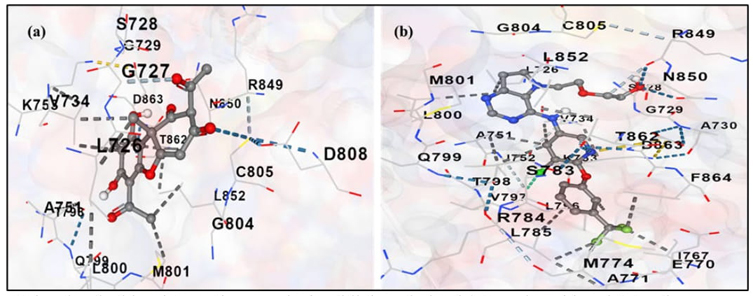
Fig. 3 Molecular docking interactions analysis of lichen derived (a) usnic acid and (b) reference compound (co-crystal ligand) with the HER2 receptor of breast cancer (PDB ID: 3PP0).
Fig. 3(b) shows that the reference compound showed nine hydrogen bonds (H-B) with residues of Met774, Arg784, Thr862, Thr798, Gln799, Asn850, Arg849, Ser728, and Cys805, whereas the usnic acid showed four H-B with residues of Thr862, Cys805, Asp808, and Thr798 (Fig. 3(a)). The possible anticancer effects of usnic acid have been thoroughly investigated, especially in relation to breast cancer [18-20]. It has been shown that usnic acid causes apoptosis via a ROS-dependent mitochondrial route, therefore inhibiting the survival of human breast cancer MCF-7 cells in a concentration- and time-dependent manner [21]. To increase usnic acid's anticancer efficacy and selectivity, compounds such as isoxazole and pyrazole derivatives have been created. It has been demonstrated that these compounds cause breast cancer cells to undergo cell cycle arrest, apoptosis, and paraptosis-like cell death [22]. Furthermore, the docking score of usnic acid in the BCL2, PI3KCA, and PI3KCG proteins was -36.51, -44.59, and -41.93 kcal/mol, respectively [23]. Human BC MCF-7 cell viability was reduced by usnic acid in a concentration- and time-dependent way [24]. Moreover, usnic acid suppresses VEGFR2-mediated AKT and ERK1/2 signalling pathways, which in turn decreases BC angiogenesis and growth [25]. These academic works further supported our conclusions.
Prediction of anticancer activity
Using the PASS Online programme (http://www.way2drug.com/passonline), the possible BC inhibitor, usnic acid, was subjected to biological activity analysis after docking [26]. We only forecasted the anticancer activity in which the antineoplastic property-the primary parameter-was taken into account using PASS Online. The PASS Online server forecasts the biological activities of various substances and displays the outcomes as indicators of biological activity or inactivity. The likelihood of either biological activity (Pa) or biological inactivity (Pi) is present [16]. Table 2 lists the UA's expected antineoplastic characteristics. Pa values of usnic acid were greater than Pi for antineoplastic characteristics, indicating a higher likelihood of biological activity as opposed to inactivity. It is noteworthy that the Pa value of usnic acid was significantly higher than the Pi value. This indicates that there is a higher chance that usnic acid will block BC.
E-Pharmacophore Analysis
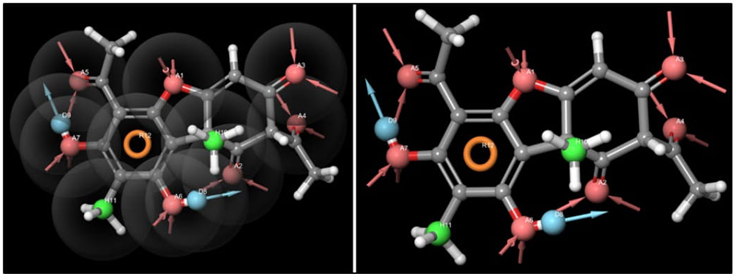
By preserving the activity criterion in the range of 6.5 to 7.9, the data set was split into regions that were actively, moderately, and inactively occupied. Due to the usnic acid binding domain's strong survival value, the generic pharmacophore hypotheses were added among its four properties, as illustrated in Fig. 4. The e-pharmacophore also reveals that usnic acid is composed of seven acquired acceptors (A1 to A7), two obtained donors (D8 and D9), two obtained hydrophobics (H10 and H11), and one obtained aromatic ring (R12).
Discussion
One of the most prevalent malignant illnesses in the world is cancer, with BC ranking as the second most common cause of death for women. According to the World Health Organisation (WHO), were an estimated 2.3 million women diagnosed with breast cancer and 670 000 deaths globally in 2022 [27]. Age, a personal or family history of BC, radiation, inborn errors, and obesity are among the most significant risk factors for BC. According to a case study conducted in Mexico City, women who are obese, overweight, or nursing have an increased chance of developing BC [28]. In the ongoing search for more secure and potent medication choices, innovative chemopreventive and anticancer therapy strategies are frequently highlighted. Various types of natural and synthetic chemicals have already been used to investigate a large number of molecular targets of distinct cellular processes during tumour formation. On the other hand, because cancer cells are immortal, many scientists are interested in finding new techniques to cause cancer cells to undergo apoptosis in order to create anticancer medications. Many new substances and anticancer medications can dramatically and occasionally precisely cause apoptosis in a range of cancer cells [29]. Currently, one of the most actively researched areas in BC research is tailored therapies, which can target certain targets. Following the oestrogen receptor-α, the human epidermal growth factor receptor 2 (HER2) is a tyrosine kinase protein that is frequently targeted in BC. HER2-positive tumours make up around 18-20 % of all other BC and are often more aggressive than HER2-negative tumours [30]. Thus, it is essential to treat BC and stop the spread of malignant cells by suppressing HER2 expression and activity [31].
The most popular methods of treating BC have been linked to several drawbacks. According to Muhammad et al., they primarily include stem cell and dendritic cell-based immunotherapy, radiation, chemotherapy, and surgery [32]. Therefore, the development of novel drugs to treat BC is crucial. Massive global research is being conducted by scientists to both prevent and treat BC. The invention of synthetic medications started as a result of the rapid breakthroughs in technology, and the long-term use of medicinal plants was forgotten. But over the past several decades, the promise of phytomedicine has drawn more attention due to the serious side effects that such synthetic medications induce [33]. Natural goods are a reliable source of pharmaceuticals. Among them, lichen demonstrated a wide range of biological properties, including the ability to fight cancer [34, 35]. Given that lichens have anti-cancer properties, we speculate that salazinic acid, sekikaic acid, and usnic acid-all derived from lichens-would be effective BC agents.
Theoretical and computational techniques employed in in silico drug creation can be utilised to find new hits or leads against certain biologically active macromolecules. In order to find, create, and evaluate medications and related physiologically active compounds, computer-aided drug design (CADD) techniques, including virtual screening, molecular docking, and dynamic simulation methods, are now being utilised. A compound's biological activity may be assessed anytime it attaches to a target macromolecule and sets off a particular reaction. In traditional drug development, determining a compound's binding capability required extensive in vitro and in vivo testing, which was time-consuming and expensive. However, using a molecular docking technique simplifies this process quickly [36]. Additionally, pharmacology is using the e-pharmacophore modelling approach to quickly create new medications [37]. The terms Pa (probability for active molecules) and Pi (probability for inactive molecules) define the measurement data that PASS provides. In order for a molecule to be classified as potential, its Pa and Pi values need to be between 0.00 and 1.00, with Pa + Pi ≠ 1. In this case, the chosen pharmacological molecule's biological activities are considered likely if Pa > Pi [26]. Thus, the primary emphasis of this work was on computer-aided drug design processes such as e-pharmacophore methods, pass prediction, and molecular docking to find a potential natural antagonist against the HER2 protein in order to cure BC.
Salazinic acid, sekikaic acid, and usnic acid produced from lichens have docking scores of -7.7, -8.1, and -8.9 kcal/mol, respectively. Usnic acid was regarded as the lead chemical based on the highest docking score. Four hydrogen connections were observed between usnic acid and the residues of Thr862, Cys805, Asp808, and Thr798. In addition, this molecule exhibited ionic connections with the Lys753 residue, which enhances the inhibitory effect, and hydrophobic contacts with Val734, Thr862, Leu852, Met801, and Leu726. The PASS prediction was evaluated using the Pass online biological activity prediction tool based on the structure of usnic acid. Table 2 indicates that usnic acid has potential pharmacological effects (Pa > Pi), which may include BC prevention. A lead molecule's activity is considered experimental if Pa > Pi. Pa values of 0.5 to 0.6 demonstrate considerable pharmacological potential, whereas Pa > 0.6 suggests a significant possibility of pharmacological potential [38]. It was predicted that usnic acid will function as an anti-cancer agent against BC with a Pa of >0.7 and a Pi of <0.005. The generic pharmacophore hypotheses were added to the usnic acid binding domain's four features due to its significant survival value, as shown in Fig. 4. Usnic acid is likewise made up of seven acquired acceptors (A1 to A7), two obtained donors (D8 and D9), two obtained hydrophobics (H10 and H11), and one acquired aromatic ring (R12), according to the e-pharmacophore.
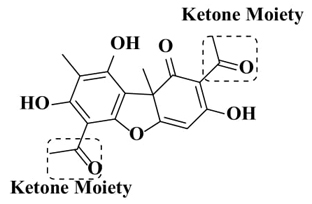
Usnic acid is a secondary metabolite of biologically active lichens that is well known as an antibiotic but also endowed with several other interesting properties [39]. In addition, usnic acid is structurally unique and has two ketone moieties, which could undergo further modification. For instance, the ketone moiety (Fig. 5) is potentially to be used in structural modifications such as the formation of new C-C and C-N bonds through the Claisen-Schmidt condensation reaction and the Michael addition reaction, respectively. Furthermore, α,β-unsaturated compounds like chalcone could be synthesised from the reaction of the usnic acid ketone moiety and benzaldehyde. In this study, usnic acid showed anti-BC activity against the HER2 receptor. Based on the results and discussion, we hypothesised that usnic acid derivatives could be good inhibitors of BC.
Conclusions
In silico research can save a great deal of time and money by avoiding the need for experiments before they begin. In addition to computational tests, in silico methods can aid in the prediction of the likely active medication. The best compound (usnic acid) was predicted using docking and Pass prediction algorithms in the current study, which may open the door to the creation of novel, safer drugs for BC. We were able to identify usnic acid as a BC inhibitor against the HER2 receptor with the use of the in silico platform. To further assess usnic acid as a BC inhibitor, more wet-lab research is needed.

