




 nova página do texto(beta)
 Inglês (pdf)
 Artigo em XML
 Referências do artigo

 Tradução automática
 Enviar este artigo por email
 Citado por SciELO
 Similares em
SciELO

 Permalink

Introduction
The exponential population growth has detonated a similar behavior in energy consumption since energy has been identified as a prerequisite for everything from the most basic human needs such as cooking, food or medicine refrigeration, lighting, and heating to the more recent needs of modern societies such as industry requirements, urban developments, communication, and contemporary vehicle innovations (Martínez & Ebenhack, 2008). Then, a large body of academic research has focused on the relationship between energy use and economic growth (Destek & Aslan, 2017; Kahia, Aïssa, & Lanouar, 2017; Salahuddin & Gow, 2019; Osman, Gachino & Hoque, 2016; Mbarek, Saidi & Rahman, 2017).
However, several sectors of the population around the world are still precluded from the benefits of accessing energy services. For example, the International Energy Agency [IEA] (2017) estimated that approximately one billion people in the world remained without access to electricity, mostly in developing economies, distributed largely in rural areas and urban slums. This particular problem has been identified and defined in the literature as “energy poverty” and can be described as “the lack of sufficient options to provide adequate, accessible, reliable, high-quality, healthy, and environmentally sustainable energy services to support economic and human growth,” according to Reddy (2000). According to the A.T. Kearney Energy Transition Institute (2018), the IEA defined energy poverty as “a lack of access to modern energy,” and for the United Nations [UN], energy poverty is perceived as “a lack of energy access,” referring to developing economies.
Then, understanding the link between energy use and economic development is not sufficient when still a significant number of individuals are without access to “reliable, affordable, sustainable, sufficient, and modern energy sources and services” just as is established in the 7-development goal from the UN. Nevertheless, despite the relevance of energy poverty for national and international goals for human, sustainable, and economic development, there is a lack of research focused on understanding the relationship between energy poverty and economic growth, regardless of the scarce previous literature in the matter that suggests a possible significant relationship between both variables.
For example, Morris & Kirubi (2009) identified that financial initiatives to support poor sectors' purchases of modern energy systems have important effects on poverty reduction, job creation, and improvements in health and rural development, and according to the results found by Giannini Pereira, Vasconcelos Freitas & da Silva (2010a), throughout the last two decades, several plans to reform the power sector have been implemented by emerging countries. Such adjustments, however, merely overlap with the modest progress made in providing adequate access to electricity. Finally, the same authors evaluated the impact of rural electrification on the reduction of energy poverty in Brazil through the analysis of 23,000 rural households and found that such an initiative had a significant positive impact. The authors agreed that their findings clearly showed that access to electricity is a key component in reducing the number of people struggling with poverty (Giannini Pereira, Vasconcelos Freitas & da Silva, 2010b).
In that matter, Latin America represents a relevant region of study since, according to the Inter-American Development Bank [IDB], in 2015, Latin America and the Caribbean reported that 21.8 million people were without electricity access and more than 80 million people still relied on firewood for cooking (Barnes, Samad & Rivas, 2018). As a result, the region's income level, lack of access to financing options, and uneven distribution of resources drive the region's vulnerable sectors, such as rural communities, into a state of poverty, where people struggle to pay their electric bills or invest in appliances to adopt cleaner, quality, or modern energy alternatives.
Then, the present article studies the relationship between energy poverty and economic growth for nine selected Latin American countries for the period 1990-2018 using data from the World Bank Development Indicators with the main objective of identifying short-run and long-run linkages between both variables; in order to do so, the article is structured as follows. Section 2 presents an overview of the relevance of energy poverty for Latin America and addresses the link between energy poverty and economic development in the literature. Section 3 centers on the literature review addressing this issue, whereas Section 4 describes the baseline model, the methodology adopted, and the data used for the empirical study. Section 5 presents and discusses the empirical results, while Section 6 concludes.
Energy poverty relevance
Energy poverty in Latin America
According to the Economic Commission for Latin America and the Caribbean [ECLACL] (Calvo et al., 2021), in Latin America and the Caribbean, around 18 million people are still not capable of accessing electricity, and another 54 million still report not having access to clean fuels and technologies for cooking; however, this situation has particularly relevant implications for urban slums and rural areas where vulnerable sectors are distributed. Such groups deal with not only the lack of access to energy, but even those sectors with access to electricity reported power outages that could last several hours or even days.
For example, Figure 1 shows the percentage of people living without access to electric services per country in the Latin American region. In that sense, according to data from the World Development Indicators (World Bank), on average, the countries in the region are over or close to 90% in terms of their level of access to electricity services. However, certain countries represent a major concern for the region since they show high levels of lack of access to energy; Haiti, Nicaragua, Honduras, and Guatemala report high levels of lack of access to electricity that are close to 10%. Bolivia, Belize, Peru, Jamaica, Panama, and El Salvador showed levels oscillating around 5%. However, most important is not the percentage of the population that has access to electricity, but quality, reliability, and new technology in energy services.
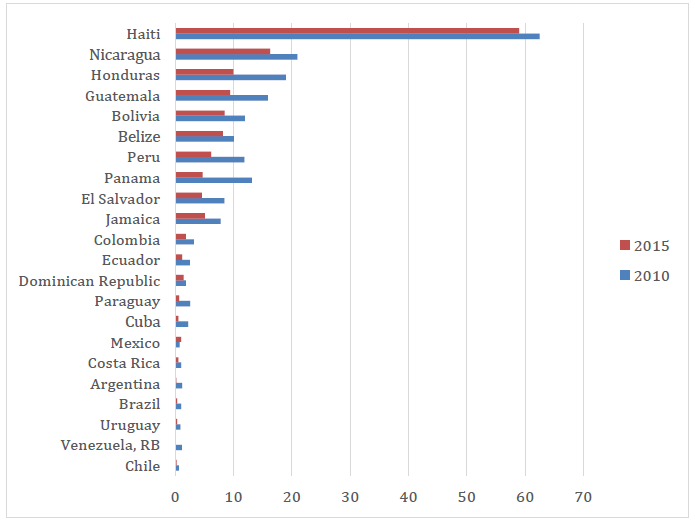
Source: World Development Indicators, 2021
Figure 1 Lack of access to electricity as a percentage of the population
Moreover, from Figure 2, the levels are worrisome, showing relevant increases in the percentage of people living with a lack of access to electricity when the measure is focused on rural areas, denoting important barriers that are limiting equitable access to energy services.
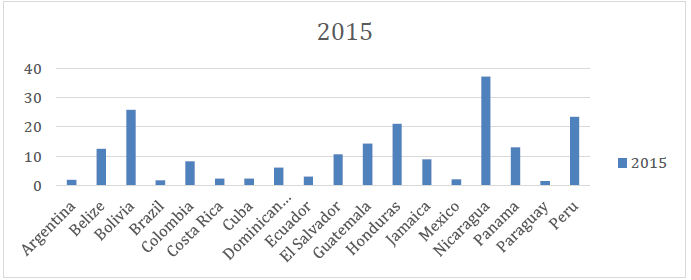
Source: World Development Indicators, 2021
Figure 2 Lack of access to electricity in rural areas, as a percentage of population
For example, in Haiti, 97% of the people living without access to electricity reside in rural areas, while Honduras and Nicaragua reported 20.9% and 37.12% of people in rural areas being excluded from energy services, respectively; however, both countries concentrate around 40% of their national population living in rural areas (Calvo et al., 2021). Also, in countries reporting lower levels of energy poverty, like Mexico, the situation is still concerning; according to data from the Energy Department, or Secretaria de Energia [SENER], and the national utility Federal Electricity Commission [CFE] in 2018, around 2 million people did not have access to energy services, caused by living in remote rural areas without access to an energy network or in marginalized urban sectors where households are unable to cover electricity bills (Jaime et al., 2022; Programa Sectorial de Energía [PROSENER], 2020). Also, Argentina and Belize reported that suffer from around 14.4 and 14.2 respectively, supply interruptions of energy services per year (Calvo et al., 2021).
This particular gap is a key source of concern for the region, as vulnerable settlements lack essential utilities like lighting at night, food refrigeration, and winter heating, resulting in a dangerous poverty cycle and unequal human and economic growth. Then, the mentioned adverse circumstances raise the need to understand the role that energy poverty plays in economic development.
Several studies have focused on linking energy consumption with economic growth (Destek et al., 2017; Kahia et al., 2017; Salahuddin et al., 2019; Osman et al., 2016; Mbarek et al., 2017), and despite the fact that a significant relationship between such variables has been reported in the mentioned articles, but the lack of access to energy services is still understudied regardless of being a prerequisite for energy use. Energy consumption does not consider the context of inequality that developing economies such as those in Latin America face, inequality that is perpetuated by poverty and scarcity.
For example, according to Urquiza & Billi (2020), the proportion of expenditures destined for energy services is significantly related to levels of income. For example, those quantiles with high levels of income are quite able to cover their energy demands, while quantiles with low levels of income remain with limited energy access due to not being able to pay for it or opting for unhealthy and unsustainable alternatives. In that matter, the proportion of the income destined to pay for energy services is over 10% in countries like Barbados, Brazil, Chile, Guyana, and Uruguay (Chile and Uruguay being the countries with the highest prices of energy services from Latin America), and other countries such as Colombia, Ecuador, Panama, and the Dominican Republic report levels below 10% but not so far (Calvo et al., 2021).
Then, from Latin America specific characteristics, the level of income from vulnerable groups that prevents them from sufficient and reliable energy services and energy modern equipment, combined with the inefficient extension of energy networks in developing economies cause that energy use, only represents some sectors of society. However, a truly understatement of the relationship between energy and economic development cannot be made without considering all sectors affecting economic growth: energy consumption from sectors with access to energy services and energy poverty to visualize those individuals without the most basic energy services.
Energy poverty and economic development
The role of energy access for economic development has been broadly identified and recognized, for example, in the new Sustainable Goals adopted by 193 countries in 2015. For the first time, it contained, according to the IEA (2020), the aim of ensuring “accessible, secure, sustainable, and modern energy for all,” reflecting a new degree of political consensus on the value of accessing modern energy services overall. However, the relevance of this statement should be better approached since any other development goal cannot be achieved without understanding the relevance that energy access plays for all human modern and basic activities.
As was mentioned before, the link between energy consumption and economic development has been widely studied, but the literature has reached different conclusions about the nature of the relationship between both variables. As Tuna & Tuna (2019) identified, this relationship has been approached from four main hypotheses: i) the acceleration in economic growth is aided by a rise in energy consumption; ii) when income level rises, so does energy use; iii) there could exist a bidirectional causality relationship; and iv) alternatively, there is no relation between the variables; being the first three hypotheses more relevant for empirical studies. However, despite the attention of the literature on the matter and policy suggestions, according to Sovacool (2016), a relevant amount of the world´s population remains without access to electricity and relies on biomass for cooking without considering the dependence on fuel energy that causes several environmental and health damages.
Then, developing economies are experiencing significant challenges in achieving equitable satisfaction of the most basic requirements, implying that these challenges could have significant implications for developing economies and regions' long-term growth. For example, Kemmler et al. (2007) demonstrated that a measure of energy access is significantly related to poverty measures, and Goozee (2017) and Jaime et al. (2022) posited that energy access is a prerequisite to ensuring the satisfaction of the most basic human needs that are considered human rights.
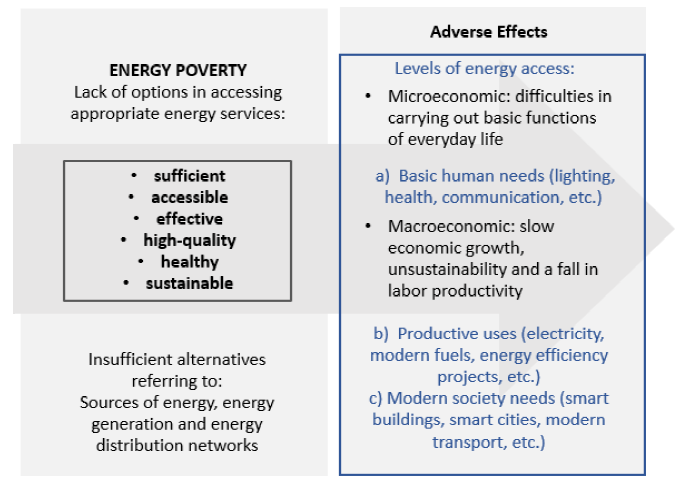
For example, from Figure 3, energy poverty adverse effects are classified from basic human needs, productive uses to modern society needs also if such effects are attributable to micro or macro-economic repercussions. This classification, according to Qurat-ul-Ann & Mirza (2020) denotes that the micro-economic effects refer to the difficulties in carrying out basic functions, whereas the macro-economic effects are those that cause slow economic growth related to a fall in labor productivity.
In that sense, Reddy (2000) concluded that energy access plays a critical role for development inputs such as employment, education, and health care. Singh & Inglesi-Lotz (2021) recognized that providing access to energy through extending electrification networks stimulates employment and income-generating activities; for example, small entrepreneurs reported an income surplus as a benefit from electrification improvements in Africa (Cook, 2013). Also, Barnes, Samad & Banerjee (2014) described that being connected to the grid causes users to adopt different appliances like lamps, radios, televisions, computers, cooking devices, machinery, cooling or warming space devices, etc., “leading to productive outcomes as increases in education, health, employment, and general quality of life by extending the amount of time destinated to study, business operation, information exposure, and participation in public and private initiatives.”
In addition, relevant studies linking energy poverty with economic development have identified significant negative effects of energy poverty on economic growth (Acharya, 2018; Groh, 2014), and when the analyses are focused on rural areas, this relationship is also proved by recognizing the relevance of promoting energy access initiatives for remote and vulnerable groups (Kanagawa & Nakata, 2008; Giannini Pereira et al., 2010a; Kaygusuz, 2011). Finally, recent studies in different regions analyzed energy access effects as a proxy for energy poverty, and they found important evidence that supports the relationship between energy access and economic development (Singh et al., 2021; Amin et al., 2020).
Then, the effects of energy poverty on economic development represent a relevant intersection that needs to be further analyzed, with particular emphasis on developing economies. The present study has the objective of filling this gap in order to mobilize public and private institutions into a joint effort to overcome energy poverty by promoting equal access to reliable, sustainable, accessible, healthy, and sufficient energy.
Literature review on the interlinkages issue
Using diverse theoretical and methodological approaches, research into the nature and direction of causality between energy consumption and economic growth in the literature to date has produced a variety of results but often with contradictory conclusions (Tsani ,2010). Then, the present section briefly describes literature in the matter that presented relevant results from the analyzed region.
One important point to stress, is that only a few studies analyzing energy consumption and economic growth have focused on Latin America. However, several studies including a large number of countries have considered countries from Latin America reporting mixed results and as was mentioned before. For example, Cheng (1997); Francis, Moseley & Iyare (2007); Apergis & Payne (2009); Apergis & Danuletiu (2014); Solarin & Ozturk (2015) and Pablo-Romero & De Jesús (2016) carried out analyses focusing on Latin America or specific regions of the area, such as the Caribbean region or Central and South America. The results obtained are varied. Nevertheless, they could be split into one of two conclusions: a bidirectional causal relationship between energy consumption and economic growth or a causality that runs from energy use to economic development. Only Cheng (1997) reported no causal linkages between energy consumption and economic growth for both Mexico and Venezuela.
Other authors focused their studies on specific countries that are part of Latin America. For example, Joo, Kim & Yoo (2014) reported conclusions that suggest a causality relationship running from energy consumption to economic growth for Chile, while Mavikela & Khobai (2018) ran an ARDL and a Vector Error Correction Model (VECM), obtaining results supporting bidirectional causality from Argentinian data. Finally, several studies have focused on Brazil, with different outcomes, but bidirectional causality between both variables is the predominant conclusion, according to Al-Mulali, Solarin, & Ozturk (2016); Pao & Fu (2013); Mele (2019); Santos & Zhaohua (2019); Magazzino, Mele, & Morelli (2021).
Other countries were included in studies that analyzed large numbers of countries around the world and grouped them by the level of income. For example, countries such as Bolivia, El Salvador, Guatemala, Honduras, Nicaragua, and Paraguay are considered lower-middle-income countries, while Argentina, Brazil, Chile, Colombia, Costa Rica, the Dominican Republic, Ecuador, Jamaica, Mexico, Panama, Peru, Uruguay, and Venezuela were included as part of the upper-middle-income group. The results were mixed as well. However, all suggested the existence of a relationship between energy consumption and economic growth, with bidirectional or unidirectional causality, such as in Huang, Hwang, & Yang (2008); Ozturk, Aslan & Kalyoncu (2010); Adhikari & Chen (2013); Bayar & Özel (2014); Narayan (2016) and Apergis & Payne (2010).
However, after considering all the empirical research connecting energy use and economic development, the empirical studies focusing on connections between energy poverty and economic growth are still insufficient. A few relevant articles found in previous literature are described as follows.
Acharya (2018) carried out a panel data analysis of the relation between energy poverty and economic development using Indian household data, showing a negative relationship between economic development and energy poverty, adding the fact that the strength of the relationship has increased over time. Groh (2014) also linked the role of energy poverty in development using a case analysis from Peru. The results show that there are negative effects caused by energy poverty on development opportunities, which are most prevalent in the lowest income segments. The author even suggests, as a subject for further research, the possibility of causality between energy service quality and economic growth in low-income segments.
Kanagawa et al. (2008); Giannini Pereira et al. (2010a) and Kaygusuz (2011) approached the relevance of energy poverty, but, for rural development, both articles concluded that energy access initiatives can have dramatic benefits for rural communities. However, the rural sector is not the only one negatively affected by energy poverty. For example, Ogwumike & Ozughalu (2015) studied data from Nigeria and found implications of energy poverty for sustainable development in the country. In that sense, Amin et al. (2020) demonstrated the existence of a long-term negative relationship between energy poverty (using electricity access as a proxy) and economic development for different Asian countries, and Lacroix & Chaton (2015) identified significant evidence of a negative impact of fuel poverty on self-reported health in French households.
Finally, a recent study from Sub-Saharan African countries analyzed energy access effects as a proxy for energy poverty and found important evidence that supports the relationship between energy access and economic development (Singh et al., 2021). However, other authors couldn’t find sufficient evidence to sustain a significant relationship between economic development and energy poverty (Doğanalp, Ozsolak & Aslan, 2021). Then, the main objective of the present study is to contribute to the literature by linking energy poverty with economic development in Latin America since not only the relationship between the variables is understudied but the region is misrepresented in the existing empirical evidence.
Methodology and data
A panel data from nine selected Latin American countries from 1990 to 2018 was analyzed in order to study the link between energy poverty and economic development. Countries analyzed include Argentina, Belize, Bolivia, Chile, Colombia, Ecuador, El Salvador, Guatemala, and Panama. The countries were mainly constrained by data availability and to meet the requirement of not being over 95% of energy access and not being over 6,500 of GDP per capita by the first date available. The data for this study are measured annually and were obtained from the World Bank Development Indicators. Relevant summary descriptions of the variables selected are detailed in Table 1 and Table 2.
Table 1 Summary statistics
| Variable | Mean | Median | Std. Dev. | Min | Max | N.
Observations |
Jarque-Bera |
| Y (GDP) | 5350.35 | 4340.747 | 3218.311 | 1356.54 | 15111.7 | 261 | (53.521)*** |
| LAB | 63.591 | 62.41 | 4.071 | 54.46 | 73.02 | 261 | (6.358)** |
| EDUC | 1987493 | 1514761 | 1652165 | 35754 | 5299258 | 245 | (33.371)*** |
| POPG | 1.641 | 1.673 | 0.613 | 0.421 | 3.8355 | 261 | (12.763)*** |
| EPOV | 88.642 | 91.857 | 10.137 | 59.846 | 100 | 236 | (31.599)*** |
***, **, * denote significance at the 1, 5, and 10% levels, respectively
Source: own creation using E-Views 12 software package
Table 2 Correlation analysis
| Y (GDP) | LAB | EDUC | POPG | EPOV | |
| Y (GDP) | 1 | ||||
| LAB | -0.3436 | 1 | |||
| EDUC | 0.2569 | 0.1938 | 1 | ||
| POPG | -0.3114 | 0.1901 | -0.3265 | 1 | |
| EPOV | 0.6238 | -0.1153 | 0.4133 | -0.4983 | 1 |
Source: own creation using E-Views 12 software package
The baseline model used in the current paper is:
where LAB is a measure of labor, EDUC represents education, POPG is population growth, and EPOV represents a proxy for energy poverty, with Y being economic development.
By taking logs, the linearized production function from equation (2) can be given as follows:
In the above equations, i= 1…, n represents the country sign, t= 1…, T is time, and ε is an error term. Y represents GDP per capita as a proxy for economic development, LAB is the labor variable measured by the labor force participation rate, EDUC represents education using the number of total enrolments in primary education. POPG is the annual population growth, and EPOV represents the percentage of people with access to electricity as a proxy for energy poverty (as in Singh et al., 2021; Amin et al., 2020).
Then, a positive sign is expected from labor, education, population growth, and energy access (reduced energy poverty) in terms of their effect on economic growth.
The hypothesis to be tested and according with to the existing literature analyzed is that energy poverty (measured as access to energy) has a positive and significant relationship with economic development. To do so initially, it is critical to define the order of integration of each variable in order to avoid making erroneous estimates. The panel data unit root test is examined as a first step in order to do this, taking into account the use of time series, as testing panel unit roots is said to produce more trustworthy results by Shao et al. (2019).
The second step is to select the appropriate methodology for the variables analyzed, and since all the tests of unit roots resulted in the series being I (0) and I (1), according to Shrestha & Bhatta (2018), the proper method with mixed variables is carrying out an ARDL model in order to explore long-run and short-run relationships between the variables. “ARDL modeling is an appropriate technique as it provides consistent estimations by including lag lengths in both endogenous and exogenous variables”, eliminating then, the endogeneity inconvenient (Attiaoui & Boufateh, 2019).
Then, an ARDL Mean Group (MG) and an ARDL Pooled Mean Group (PMG) were estimated since these techniques provide better estimations by taking into account the particularities of the different regions using the maximum likelihood method (Attiaoui et al., 2019). In that sense, a Hausman standard test was applied, and the result suggests that PMG estimates are more efficient, given the null hypothesis that the long-run parameters are homogeneous (Chu & Sek, 2014).
Results and discussion
Unit root tests
Because correlations between non-stationary variables might be biased, time series econometrics has difficulty assessing the relationships between those variables that have a time trend. Unless the variables are cointegrated, this problem might lead to erroneous correlations. Then, the first step in proving cointegration is to execute unit root tests to determine whether or not the series are stationary.
However, according to Ciarreta & Zarraga (2010), tests to confirm unit roots for individual time series tend to have lower power than panel tests, and Shao et al. (2019) suggest that testing panel unit roots leads to more reliable results. Therefore, a panel unit root was tested using the most common methods: Levin, Lin and Chu with a null hypothesis of a common unit root process, while Im, Pesaran and Shin, ADF and PP sustain a null hypothesis of an individual unit root process. The results at the variable level with a constant, constant and trend and applying the first difference are presented in Table 3.
Table 3 Results of panel unit root tests
| Test | ln Y (GDP) | ln LAB | ln EDUC | ln POPG | ln EPOV | |
| Level, intercept | (-0.1553) | (-1.0157) | (-2.2989)** | (-4.9193)*** | (-1.7257)** | |
| Levin, Lin and Chu | Level, intercept and trend | (-1.3529)* | (-0.8842) | (-0.5012) | (-6.4504)*** | (1.1708) |
| First difference | (-6.5607)*** | NA | NA | NA | (-9.2040)*** | |
| Level, intercept | (2.5208) | (-1.6981)** | (-1.0566) | (-3.9674)*** | (1.5005) | |
| Im, Pesaran and Shin Wstat | Level, intercept and trend | (-1.0068) | (-1.6754)** | (2.6412) | (-8.6514)*** | (-1.2071) |
| First difference | (-6.0074)*** | NA | NA | NA | (-12.2992)*** | |
| Level, intercept | (10.1337) | (29.6228)** | (27.6946)** | (66.6281)*** | (7.5177) | |
| ADF F | Level, intercept and trend | (25.1811) | (29.1495)** | (14.2405) | (104.947)*** | (23.7502) |
| First difference | (70.5053)*** | NA | NA | NA | (153.744)*** | |
| Level, intercept | (17.9824) | (44.4763)*** | (34.4357)** | (13.5398) | (27.0320)* | |
| PP F | Level, intercept and trend | (8.9561) | (66.3386)*** | (9.7016) | (13.1878) | (86.3009)*** |
| First difference | (80.2930)*** | NA | NA | NA | (258.296)*** | |
| Integration order | I(1) | I(0) | I(0) | I(0) | I(1) |
***, **, * denote significance at the 1, 5, and 10% levels, respectively
Source: own creation using E-Views 12 software package
In terms of integration, a time series is said to have a root of order I (d) when the time series is transformed into a stationary behavior by being differentiated d times. From Table 3, all the tests of unit roots resulted in the series being I (0) and I (1), and according to Shrestha et al. (2018), the proper method with mixed variables is to carry out an ARDL model to explore long-run and short-run relationships between the variables. This requisite is important since ARDL models cannot be applied to variables of a higher order of integration than 1.
Panel co-integration
The next stage is to see if the variables are cointegrated; if this is the case, a long-run equilibrium relationship between the variables is proven. To do so, Pedroni’s and Johansen’s panel cointegration tests were carried out, and the results are reported in Table 4 and Table 5.
Table 4 Results of Pedroni’s Cointegration Test
| Pedroni Cointegration Test | ||
| Common AR coefs. (within-dimension) | Statistic | Weighted Statistic |
| Panel v-Statistic | (0.2334) | (-0.0671) |
| Panel rho-Statistic | (0.0931) | (0.2126) |
| Panel PP-Statistic | (-1.9019)** | (-1.8647)** |
| Panel ADF-Statistic | (-2.3754)*** | (-2.7765)*** |
| Individual AR coefs. (between-dimension) | ||
| Group rho-Statistic | (1.4985) | |
| Group PP-Statistic | (-1.2656) | |
| Group ADF-Statistic | (-2.6998)*** | |
***, **, * denote significance at the 1, 5, and 10% levels, respectively
Source: own creation using E-Views 12 software package
Table 5 Results of Johansen’s Cointegration Test
| Johansen Cointegration Test | ||
| Unrestricted Cointegration Rank Test | ||
| Hypothesized No. Of CE(s) | Fisher Stat. (from trace test) | Fisher Stat. (from max-eigen test) |
| None | (298)*** | (204)*** |
| At most 1 | (168)*** | (117)*** |
| At most 2 | (72.74)*** | (54.54)*** |
| At most 3 | (37.20)*** | (34.13)** |
| At most 4 | (24.03) | (24.03) |
***, **, * denote significance at the 1, 5, and 10% levels, respectively
Source: own creation using E-Views 12 software package
According to the panel analysis results, it could be interpreted as a rejection of the null hypothesis of no cointegration at the 5% and 1% significance levels, meaning that there is a significant long-term relationship between a country's economic behavior and the level of energy access, considering education, labor, and population growth rate as control variables.
ARDL estimations
The estimation of the long-run and short-run relationship using the PMG method and the MG method are presented in the following Table 6. However, as was previously explained, the results are more efficient for the PMG method, and such a conclusion is confirmed by the Hausman test included in Table 7.
Table 6 Results of the ARDL model (1, 1, 1, 1, 1)
| ARDL MG model | ADRL PMG model | |||||
| Variables | Coefficient | SE | t-Stat | Coefficient | SE | t-Stat |
| Long-run estimations | ||||||
| LAB | -21.6337 | 21.4417 | (-1.01) | -1.6421 | 0.5188 | (-3.16)*** |
| EDUC | 8.9528 | 8.9829 | (1) | -1.0656 | 0.4503 | (-2.37)** |
| POPG | 3.1695 | 3.6166 | (0.88) | -0.7689 | 0.1961 | (-3.92)*** |
| EPOV | 6.6551 | 2.7620 | (2.41**) | 6.1949 | 0.9147 | (6.77)*** |
| Short-run estimations | ||||||
| ECT | -0.3180 | 0.0790 | (-4.02)*** | -0.1262 | 0.0711 | (-1.77)* |
| D (LAB) | -0.0371 | 0.2678 | (-0.14) | -0.2348 | 0.4551 | (-0.52) |
| D (EDUC) | 0.4408 | 0.2330 | (1.89)* | 0.0653 | 0.09671 | (0.68) |
| D (POPG) | 0.2632 | 0.9703 | (0.27) | -0.1113 | 0.1350 | (-0.82) |
| D (EPOV) | -0.1815 | 0.7322 | (-0.25) | -0.3704 | 0.7802 | (-0.47) |
| _cons | -12.8572 | 13.7559 | (-0.93) | 0.4806 | 0.2676 | (1.80)* |
***, **, * denote significance at the 1, 5, and 10% levels, respectively
Source: own creation using Stata 14 software package
Table 7 Hausman test results
| Hausman Test | 2.86 (0.5819) |
***, **, * denote significance at the 1, 5, and 10% levels, respectively
Source: own creation using Stata 14 software package
Moreover, unlike the MG method, which assumes heterogeneity for both short- and long-run coefficients, PMG results only maintain heterogeneity for short-run coefficients while assuming homogeneity for long-run coefficients (Pesaran, Shin & Smith, 1999). Then, the long-run homogeneity among countries could imply that, in the long term, political measures about overcoming energy poverty should be adopted and coordinated in a homogeneous manner throughout the Latin American region analyzed to reach significant impacts on economic development, while in the short-run, particular policies by country are needed to increase levels of energy access.
From Table 6 and according to PMG estimations, a significant long-run relationship is identified between energy poverty and economic growth and between the control variables (education, labor, and population growth) and economic growth. Then, an increase of 1% in energy access could lead to an increase of 6.19 percent in economic development in the long run (measured in GDP per capita) for the selected countries (see Table 6, ARDL PMG model results).These results are consistent with the conclusions of Singh et al. (2021) and Amin et al. (2020), who identified a significant positive relationship between energy access and economic development or a negative effect when energy poverty (1- the percentage of energy access) is analyzed. However, other authors couldn’t find sufficient evidence to sustain a significant relationship between economic development and energy poverty (Doğanalp et al., 2021).
In terms of the control variables, the resulting sign is significant and negative, different from the expected outcomes. For example, an increase of 1% in education or population growth would cause a decrease of 1.065% and 0.7689% in economic growth, measured in GDP per capita, in the long run for the studied countries, respectively (see Table 6, ARDL PMG model results). But, despite the fact that these results are contradictory to the expected positive outcomes, they are consistent with the results from previous studies. Amin et al. (2020) also reported a negative long-run impact from education to economic development in the short run, while Singh et al. (2021) identified negative effects of population growth on GDP, and negative effects from labor to economic growth were reported by Inglesi-Lotz (2016) from a study focused on the impact of renewable energy consumption.
On the other hand, energy poverty and control variables resulted in not being significant for economic development in the short run, and only education reported an outcome with the expected positive sign. However, these results could be linked with the conclusions of Barnes et al. (2014), who described that being connected to the grid causes users to opt for different appliances in the short term, but the significant effect on economic development could be appreciated in the long term when such appliances lead to productive outputs.
Conclusions
The body of knowledge on energy consumption and GDP growth is vast, and there is no general agreement on which variable influences the other. Energy consumption, on the other hand, is necessary but not sufficient for growth because economic inequalities and their repercussions must be evaluated, particularly in terms of energy poverty, which is defined as a lack of access to energy. Then, this article studies the relationship between energy poverty and economic growth for nine Latin American countries for the period 1990-2018 using data from World Bank Development Indicators with the main objective of identifying short-run and long-run linkages between both variables and assessing energy poverty effects on developing economies.
The empirical evidence obtained after cointegration tests proved the existence of a long-run equilibrium relationship between energy poverty and economic development. However, the evidence does not support a relationship between energy poverty and GDP in the short run for selected Latin American countries. Finally, long-run homogeneity among countries could imply that, in the long term, political measures about overcoming energy poverty should be adopted and coordinated homogeneously throughout the Latin American region, while in the short run, particular policies by country are needed to increase levels of energy access.
In that sense, the results suggested that just one policy is unlikely to work in all countries in Latin America in the short term and that efforts should be made to accommodate the varied needs of the specific countries. However, the relevance of taking action as a region to overcome energy poverty in the long term could lead to higher positive effects on economic development, suggesting the relevance of creating particular policy measures that combined individual initiatives by country with collective efforts in the region to achieve relevant energy poverty improvements.
The importance of reducing energy scarcity and its impact on economic development in Latin America, as well as in other developing nations, cannot be overstated. In this regard, the current study found that energy access is an important precondition for addressing poverty, stimulating economic growth, expanding work opportunities, improving the delivery of social and health services, facilitating a sustainable future, enhancing human development, and ensuring fundamental human rights. As a result, as this study suggests, actions must be taken to offset the impact of energy poverty on economic development.
Finally, the findings of this study should motivate authorities and the private sector to help people gain access to modern energy services since all individuals require safe, clean, sufficient, high-quality, and affordable energy resources in order to live a dignified life.
For further research, energy poverty and the economic growth link should be studied considering other variables, such as renewable energy usage, energy efficiency expansion, financial support for energy services, infrastructure of power stations, deployment of current energy networks, energy policies and support of energy market development, in order to take into account, the role that different factors could play for energy poverty eradication. It's also worthy to note that electricity access alone might not be enough to capture the multifaceted nature of energy scarcity, so a broader set of indicators could help us better understand the nature of energy poverty's impact on economic development, taking into account factors like the ability to pay for energy services, the opportunity cost of obtaining access to energy services, the availability of energy alternatives, and the quality of existing energy supplies.

