




Servicios Personalizados
Revista
Articulo
 texto en
 Inglés (pdf)
 Artículo en XML
 Referencias del artículo

 Traducción automática
 Enviar artículo por email
Indicadores
-
 Citado por SciELO
-
 Accesos
Links relacionados
-
 Similares en
SciELO
Compartir

 Permalink

Revista mexicana de fitopatología
versión On-line ISSN 2007-8080versión impresa ISSN 0185-3309
Rev. mex. fitopatol vol.44 no.1 Texcoco ene. 2026 Epub 23-Jun-2026
https://doi.org/10.18781/r.mex.fit.2509-3
Phytopathological notes
Comparative in vitro and in vivo study of anthracnose in papaya (Carica papaya) caused by Colletotrichum gloeosporioides and Colletotrichum truncatum
1Maestría en Ciencias en Productividad en Agroecosistemas. Instituto Tecnológico del Valle de Oaxaca. Tecnológico Nacional de México. México.
2Tecnológico Nacional de México. Instituto Tecnológico del Valle de Oaxaca. Ex- Hacienda de Nazareno, Santa Cruz Xoxocotlán, Oaxaca, México, C.P. 71223.
3Instituto Politécnico Nacional-CIIDIR-Unidad Oaxaca. Hornos 1003, Col. Nochebuena, Santa Cruz Xoxocotlán Oaxaca, México. C.P. 71230.
Background/Objetive.
Globally, Mexico is the leading exporter of fresh papaya, with Oaxaca being the largest national producer. However, anthracnose, a disease caused by species of the Colletotrichum spp. complex, can affect up to 40% of production. The objective of the research was to identify the causal agent of anthracnose in producing localities of Oaxaca and to evaluate the effectiveness of different products (chemical and biological) in reducing the severity of this disease under in vitro and in vivo conditions.
Experimental Development.
A sampling of fruits with anthracnose lesions was carried out at 12 sites in the municipalities of Villa de Tututepec de Melchor Ocampo and Santa María Huazolotitlán, Costa de Oaxaca. The isolates were identified by morphological analysis and microcultures. Three chemical fungicides (prochloraz, benomyl and azoxystrobin) and three biological fungicides (Bacillus subtilis, Trichoderma sp. and Bacillus cereus) were evaluated in vitro and in vivo, with a completely randomized design, with Duncan's mean comparison (p ≤ 0.005).
Results.
Colletotrichum gloeosporioides and C. truncatum were identified as being associated with anthracnose. In in vitro tests, prochloraz was the most effective treatment, with inhibition values of 86.42% against C. truncatum and 48.66% against C. gloeosporioides, achieving an overall effectiveness of 75%. Likewise, B. subtilis and Trichoderma sp. showed high in vitro efficacy (≥ 70%), demonstrating a potential for biological control under laboratory conditions.
Conclusions.
Colletotrichum gloeosporioides (in 66.7% of the sampled sites) and C. truncatum (in 33.3% of the sampled sites) were confirmed as the cause of anthracnose in papaya in the Costa region of Oaxaca. In in vivo tests, prochloraz was the most effective treatment with 75% effectiveness against C. truncatum and 50% against C. gloeosporioides. Benomyl showed intermediate effectiveness, with 65% against C. truncatum and 45% against C. gloeosporioides, with severities of 60-73%. Biological treatments showed low effectiveness: Trichoderma sp. (35 and 15%) and B. subtilis (25 and 30%) for C. gloeosporioides and C. truncatum, respectively, with high severities between 73 and 93%. B. cereus and azoxystrobin showed intermediate behavior, with 30- 40% effectiveness and severities of 75-86%. Overall, the results indicate that systemic fungicides outperformed biological agents by more than 30-40% in effectiveness, while biological agents showed less than 35% control and greater than 80% severity, confirming their limited performance in post-harvest.
Keywords: Biocontrol; Carica papaya; Colletotrichum spp.; Synthetic pesticide
Antecedentes/Objetivo.
Mundialmente, México es el principal exportador de papaya fresca, donde Oaxaca es el mayor productor nacional. Sin embargo, la antracnosis, enfermedad causada por especies del complejo Colletotrichum spp., puede llegar a afectar hasta el 40 % de la producción. El objetivo de la investigación fue identificar al agente causal de la antracnosis en localidades productoras de Oaxaca y evaluar la eficacia de diferentes productos (químicos y biológicos) en la reducción de la severidad de esta enfermedad bajo condiciones in vitro e in vivo.
Desarrollo experimental.
Se realizó un muestreo de frutos con lesiones de antracnosis en 12 sitios de los municipios de Villa de Tututepec de Melchor Ocampo y Santa María Huazolotitlán, costa de Oaxaca. Los aislamientos se identificaron mediante análisis morfológicos y microcultivos. Tres fungicidas químicos (procloraz, benomilo y azoxystrobin) y tres biológicos (Bacillus subtilis, Trichoderma sp. y Bacillus cereus) fueron evaluados in vitro e in vivo, con un diseño completamente al azar, con comparación de medias Duncan (p ≤ 0.005).
Resultados.
Se identificaron Colletotrichum gloeosporioides y C. truncatum asociados a la antracnosis. En las pruebas in vitro, procloraz fue el tratamiento más eficaz, con valores de inhibición de 86.42 % frente a C. truncatum y 48.66 % frente a C. gloeosporioides, alcanzando una efectividad general del 75 %. Asimismo, B. subtilis y Trichoderma sp. mostraron una alta eficacia in vitro (≥ 70 %), evidenciando un potencial de control biológico en condiciones de laboratorio.
Conclusiones.
Se confirmaron a C. gloeosporioides (en el 66.7 % de los sitios muestreados) y a C. truncatum (en el 33.3 % de los sitios muestreadas) como causantes de la antracnosis en papaya en la región Costa de Oaxaca. En las pruebas in vivo, procloraz fue el tratamiento más efectivo con 75 % de efectividad contra C. truncatum y 50 % contra C. gloeosporioides, Benomilo mostró una efectividad intermedia, con 65 % en C. truncatum y 45 % en C. gloeosporioides, con severidades de 60-73 %. Los tratamientos biológicos mostraron baja efectividad: Trichoderma sp. (35 % y 15 %) y B. subtilis (25 % y 30 %) para C. gloeosporioides y C. truncatum, respectivamente, con severidades elevadas entre 73 y 93 %. B. cereus y azoxystrobin presentaron un comportamiento intermedio, con 30-40 % de efectividad y severidades de 75-86 %. En conjunto, los resultados indican que los fungicidas sistémicos superaron en más del 30-40 % de efectividad a los agentes biológicos, los cuales mostraron controles inferiores al 35 % y severidades mayores al 80 %, confirmando su limitado desempeño en poscosecha.
Palabras clave: Biocontrol; Carica papaya; Colletotrichum spp.; Plaguicida sintético
Introduction
Mexico is the leading exporter of fresh papaya to the United States and Canada (OEC, 2022). The state of Oaxaca ranks first in national production, with an average yield of 100 t ha⁻¹. Within the state, the Costa region stands out for its significant contribution, accounting for about 80% of total production. The main producing municipalities-Villa de Tututepec, Santa María Huazolotitlán, Santiago Pinotepa Nacional, and Santiago Jamiltepec-together comprise a harvested area of 2 787 ha (SIAP, 2024). Papaya cultivation in this region represents an important source of economic activity, largely due to its high demand for labor. Each hectare is estimated to require around 500 workdays per production cycle, underscoring its regional economic impact (Alarcón-Pulido et al., 2022). Papaya production faces major phytosanitary challenges, particularly anthracnose, caused by Colletotrichum species. This disease is characterized by dark lesions on fruits accompanied by acervuli arranged in concentric rings (Tapia-Tussell et al., 2008). It can affect up to 40% of total yield (Maharaj and Rampersad, 2012), leading to the intensive use of highly toxic fungicides, mainly to control C. gloeosporioides (Landero-Valenzuela et al., 2016). However, recent evidence suggests that the disease may involve a complex of Colletotrichum species, highlighting the need for further research to confirm this (Zakaria,
2021).
Anthracnose management in tropical crops such as papaya, mango (Mangifera indica), avocado (Persea americana), and banana (Musa × paradisiaca) has relied primarily on synthetic fungicides. This dependence raises concerns about toxic residues in fruits and underscores the lack of comprehensive management strategies. Although biocontrol agents offer a more sustainable alternative, they still face challenges related to consistency and effectiveness (Crouch et al., 2014). In this context, the present study aimed to identify the causal agent of anthracnose in papaya and assess the efficacy of biological and chemical products in reducing disease severity.
Experimental Development
Collection of infected fruits. Fruits of papaya showing typical anthracnose symptoms were collected from 12 sites located in the municipalities of Villa de Tututepec de Melchor Ocampo and Santa María Huazolotitlán, in the Costa region of Oaxaca.
Fungal isolates. Fruits showing visible symptoms were washed several times with sterile distilled water and liquid soap to remove dust and impurities, then disinfected with 96% ethyl alcohol for three minutes. Brown to black lesions with orange-black acervuli were selected. From each lesion, a 1-mm fragment of symptomatic tissue was excised and placed on Petri dishes containing Potato Dextrose Agar (PDA, BIDICO®) medium. The plates were labeled and incubated for seven days to promote fungal growth. All plates were incubated at 25 °C in complete darkness. After four days of growth, actively growing hyphal tips from disinfected tissues were subcultured onto fresh PDA plates to obtain axenic cultures.
Taxonomic identification. Identification of the isolates was carried out at the Soil Laboratory of CIIDIR-IPN, Oaxaca. For cultural and morphological characterization, the microculture technique described by Aquiahuatl-Ramos et al. (2012) was used. This method involves culturing small portions of mycelium on PDA agar blocks placed on microscope slides inside a humid chamber, allowing microscopic observation of hyphae, conidiophores, and reproductive structures with minimal disturbance and under conditions resembling natural growth. Taxonomic identification was performed using the keys of Ainsworth et al. (1973), Sutton (1992), and Barnett and Hunter (1998).
In vitro sensitivity and effectiveness analysis. To evaluate in vitro sensitivity, the agar disk diffusion method was used following the procedure described by Davis and Stout (1971), as adapted by Adaskaveg and Hartin (1997). Three commonly used field fungicides and three biological control agents were tested, each applied at three concentrations (high, medium, and low). The specific doses for each treatment are detailed in Table 1.
Table 1 Evaluated concentrations of chemical fungicides and biological agents used against Colletotrichum gloeosporioides and C. truncatum in papaya fruits.
| Product / Microorganism | High concentration | Medium concentration | Low concentration |
|---|---|---|---|
| g L-1 | L-1 | g L-1 | |
| Prochloraz | 3 | 2 | 1 |
| Benomyl | 0.6 | 0.4 | 0.3 |
| Azoxystrobin | 0.3 | 0.2 | 0.1 |
| Trichoderma sp. | 1.5 | 1.2 | 1 |
| 9.0 × 10⁶ conidia mL-1 | 7.2 × 10⁶ conidia mL-1 | 6.0 × 10⁶ conidia mL-1 | |
| Bacillus subtilis | 4.0 × 10⁹ UFC mL-1 | 3.0 × 10⁹ UFC mL-1 | 2.0 × 10⁹ UFC mL-1 |
| Bacillus cereus | 1.5 × 10⁸ UFC | 1.2 × 10⁸ UFC | 1.0 × 10⁸ UFC |
Two previously identified fungal strains (C. gloeosporioides and C. truncatum) were used. PDA plates were inoculated with 200 µL of a spore suspension adjusted to 1 × 10⁶ spores mL⁻¹, prepared by counting in a Neubauer chamber and adjusted to the required concentration using the dilution equation:
Where C₁ is the initial concentration, V₁ the initial volume, C₂ the desired final concentration, and V₂ the required final volume.
On each plate, four filter paper disks (6 mm) were placed and impregnated with 10 µL of each treatment, leaving one disk with distilled water as a control. The plates were incubated at 25 ± 1 °C for seven days, after which the inhibition halos were measured. Effectiveness (%) was calculated using Abbott’s formula (1925), comparing the growth of each treatment with that of the control.
Where X c = value observed in the control treatment, and X t = value observed in the tested treatment.
In vivo assays in papaya for the control of Colletotrichum spp. under laboratory conditions. Five fruits per treatment were selected at ripeness stage 5 according to Salazar (2002). After washing and disinfection, the fruits were allowed to dry for 10 minutes, and the treatments described in Table 1 were applied by spraying; the control consisted of fruits treated only with sterile distilled water. The fruits were incubated for 10 days at 25 ± 1 °C and 75% relative humidity. The experimental design was factorial, considering six antifungal treatments and four evaluation times. Product effectiveness was determined after 10 days based on the number of positive infections per fruit, using Abbott’s formula (1925). Disease severity was assessed by measuring the diameter of lesions caused by C. gloeosporioides and C. truncatum and classifying them according to the five-grade scale of Castellanos et al. (2014), based on the affected area (mm²) (Table 2).
Table 2 Visual and quantitative scale for classifying anthracnose damage in papaya fruits according to lesion area.
| Grade | Injury area (mm) | Damage description |
|---|---|---|
| 1 | 0 | No visible damage |
| 2 | 1 – 15 | Very small injuries |
| 3 | 16 – 30 | Moderate injuries |
| 4 | 31 – 45 | Extensive injuriess |
| 5 | > 45 | Very severe injuries |
Treatment effectiveness was evaluated 10 days after inoculation using Abbott’s formula (1925). Disease severity was quantified by measuring lesion diameter and classifying fruits according to the five-grade scale of Castellanos et al. (2014). In addition, the severity index was calculated using the formula of Anculle and Álvarez (1999), considering both the frequency and degree of damage in the evaluated fruits:
Where IS = severity index; Nf = number of fruits in each grade; G = damage grade; N = total number of fruits evaluated; and Gₘₐₓ = highest grade on the scale.
Data analysis. Data on in vitro and fruit inhibition were transformed (√(x+1) and cosine, respectively) and analyzed under a completely randomized design. For the fruit assay, a factorial arrangement (6 × 4) was applied, followed by ANOVA and mean comparison (Tukey or Duncan, p ≤ 0.05) using SAS® 9.4. The severity index was used solely as a descriptive indicator.
Identification of isolates. C. gloeosporioides was identified in 66.7% of the sites and C. truncatum in the remaining 33.3%, based on morphological characteristics, as associated with anthracnose in papaya fruits. Colletotrichum gloeosporioides produced cylindrical- fusiform conidia (14.5-17.02 µm) and white-to-black colonies (29.55-56.38 mm after seven days). In contrast, C. truncatum exhibited curved, hyaline conidia (22.8-23.8 µm) and white-to-black colonies with radial growth (22.3-41.1 mm after seven days) (Figure 1). Molecular identification of the isolates is necessary for confirmation.
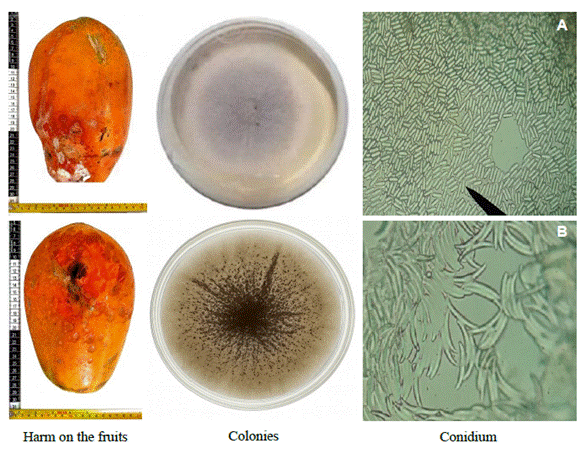
Figure 1 Morphological characteristics of Colletotrichum gloeosporioides (1A) and C. truncatum (1B) isolated from papaya fruits.
In vitro sensitivity and effectiveness of fungicides and biological agents. Table 3 shows the results of the in vitro assays, which revealed clear differences in the sensitivity of C. gloeosporioides and C. truncatum to the evaluated treatments. Prochloraz was the most effective, producing inhibition halos of 14 mm (48.66%) in C. gloeosporioides and 25-27 mm (86.42%) in C. truncatum.
Table 3 Analysis of variance of the effect of different products on lesions in Carica papaya var. Maradol fruits caused by C. truncatum 10 days after inoculation.
| Source of variation | DF | Day | |||||||
|---|---|---|---|---|---|---|---|---|---|
| 3 | 4 | 5 | 6 | 7 | 8 | 9 | 10 | ||
| Product | 5 | 1.141** | 3.225** | 4.588** | 7.880** | 9.209** | 13.157** | 17.345** | 17.985** |
| Injury | 3 | 1.393** | 5.048** | 8.410** | 9.234** | 8.945** | 13.873** | 17.345** | 24.967** |
| Product* | |||||||||
| Injury | 15 | 0.318ns | 0.321ns | 0.365ns | 0.720ns | 0.703ns | 1.229ns | 17.345ns | 1.773ns |
| Mistake | 96 | 0.306 | 0.43 | 0.991 | 1.204 | 1.504 | 1.716 | 17.345 | 2.213 |
| Total | 119 | ||||||||
| CV (%) | 46.723 | 47.071 | 55.33 | 58.024 | 59.319 | 57.459 | 50.705 | 48.269 | |
Where: (P < 0.05) according to Tukey’s multiple range test; * = significant at 0.05, ** = highly significant at 0.001, ns = not significant.
In the experiment with C. gloeosporioides, high-dose azoxystrobin produced similar inhibition halos (14 mm; 29.81%), while B. subtilis and B. cereus achieved 11-13 mm (73.47% and 50.87%, respectively). Trichoderma sp. showed intermediate inhibition against C. gloeosporioides (9-11 mm; 27.65%), whereas benomyl and low-dose azoxystrobin were the least effective (<7 mm; <20%). For C. truncatum, B. subtilis (25-27 mm; 28.97%) and Trichoderma sp. (20-23 mm; 71.34%) were the most notable, with prochloraz being the most effective treatment against both species. Overall, B. subtilis and Trichoderma sp. exhibited greater control potential for C. truncatum (Figure 2A and B).
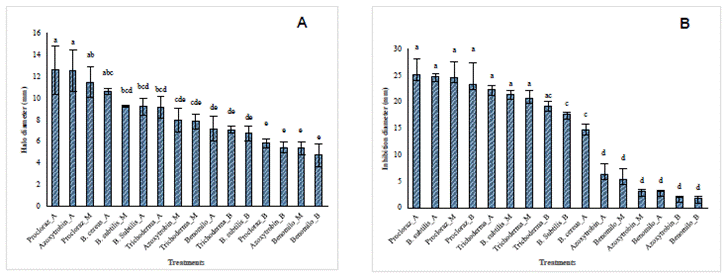
Figure 2 Inhibition diameter after seven days of growth for C. gloeosporioides (A) and C. truncatum (B) with three doses and six fungicides using the disk diffusion technique. Evaluated doses: prochloraz, H = high 3 g L⁻¹; M = medium 2 g L⁻¹; L = low 1 g L⁻¹; benomyl, H = high 0.6 g L⁻¹; M = medium 0.4 g L⁻¹; L = low 0.3 g L⁻¹; azoxystrobin, H = high 0.3 g L⁻¹; M = medium 0.2 g L⁻¹; L = low 0.1 g L⁻¹; B. subtilis, H = high 4 g L⁻¹; M = medium 3 g L⁻¹; L = low 2 g L⁻¹; Trichoderma spp., H = high 1.5 g L⁻¹; M = medium 1.2 g L⁻¹; L = low 1 g L⁻¹; B. cereus 1.5 × 10⁸ CFU mL⁻¹. Means followed by the same letter within each species are not significantly different (Duncan, 0.05).
Effectiveness and severity of fungicides in Carica papaya var. Maradol fruits. Analysis of variance revealed highly significant differences (P < 0.001) among treatments throughout the evaluation period (3-10 days after inoculation), indicating a marked effect on the inhibition and progression of lesions caused by C. truncatum. Disease severity also showed a continuous and significant increase (Table 3).
For C. gloeosporioides, analysis of variance showed significant differences among treatments from day 5 post-inoculation (P < 0.05; P < 0.001), indicating their effect on lesion progression. The lesion factor was highly significant, with no treatment × lesion interaction (P > 0.05), reflecting uniform behavior across sites. The coefficients of variation (44.9-54.3%) correspond to the natural variability of fresh tissue (Table 4).
Table 4 Analysis of variance of the effect of different chemical and biological products on lesions in Carica papaya var. Maradol fruits caused by C. gloeosporioides, 10 days after inoculation.
| Source of variation | DF | Day | |||||||
|---|---|---|---|---|---|---|---|---|---|
| 3 | 4 | 5 | 6 | 7 | 8 | 9 | 10 | ||
| Product | 5 | 0.563ns | 1.505* | 3.969** | 4.229* | 7.361** | 6.744* | 5.882* | 8.296* |
| Injury | 3 | 3.378** | 8.904** | 17.604** | 22.457** | 30.895** | 32.674** | 40.082** | 43.353** |
| Product*Injury | 15 | 0.206ns | 0.4655ns | 0.420ns | 0.880ns | 0.990ns | 1.206ns | 1.555ns | 1.170ns |
| Mistake | 96 | 0.442 | 0.669 | 0.958 | 1.351 | 1.705 | 2.207 | 2.153 | 2.606 |
| Total | 119 | ||||||||
| CV (%) | 49.726 | 52.811 | 52.284 | 54.337 | 54.134 | 53.807 | 46.713 | 44.897 | |
Where: (P < 0.05) according to Tukey’s multiple range test; * = significant at 0.05, ** = highly significant at 0.001, ns = not significant.
In fruits inoculated with C. truncatum, significant differences were observed among treatments. B. cereus showed the largest lesions (2.74-20.02 mm), whereas prochloraz exhibited the least progression (<1.0 mm initially; 1.54-5.58 mm on day 10), followed by benomyl. Trichoderma sp. and B. subtilis presented intermediate values, with site 1 being the most affected (17.73 mm) compared to site 4 (6.28 mm) (Table 5).
Table 5 Effect of different chemical and biological products on lesions in Carica papaya var. Maradol fruits caused by C. truncatum, 10 days after inoculation.
| Product | Day | ||||
|---|---|---|---|---|---|
| 3 | 4 | 5 | 6 | ||
| B. cereus | 2.739±1.096a | 5.006±1.263a | 7.441±1.475a | 9.26±1.885a | |
| B. subtilis | 0.920±0.646ab | 0.702±0.533b | 3.329±1.256ab | 4.414±1.530ab | |
| Benomyl | 0.686±0.523ab | 1.0775±0.614b | 1.795±0.735b | 1.548±0.854b | |
| Azoxytrobin | 0.284±0.284b | 1.3975±0.652b | 4.241±1.205ab | 5.301±1.497ab | |
| Trichoderma | 0±0b | 0.979±0.56b | 3.07±0.985b | 4.094±1.172ab | |
| Prochloraz | 0±0b | 0.341±0.341b | 0.977±0.551b | 0.521±0.52b | |
| Injury: | |||||
| 1 | 1.9243±0.633ab | 3.987±0.962a | 6.464±0.881a | 7.844±1.141a | |
| 2 | 0.842±0.639ab | 1.724±0.565b | 3.69±0.932ab | 3.392±0.877b | |
| 3 | 0.842±0.319ab | 0.329±0.2349b | 2.073±0.915b | 3.264±1.377b | |
| 4 | 0±0b | 0.2943±0.294b | 1.674±0.825b | 2.257±1.0359b | |
| Product | Day | ||||
| 7 | 8 | 9 | 10 | ||
| B. cereus | 10.488±1.831a | 13.469±2.395a | 17.736±2.355a | 20.024±2.826a | |
| B. subtilis | 6.812±1.897ab | 7.145±2.103a | 11.137±2.342ab | 13.954±2.477ab | |
| Benomyl | 1.724±0.986b | 2.123±1.161ab | 4.043±1.501bc | 5.579±1.921b | |
| Azoxytrobin | 5.62±1.532ab | 6.793±1.783b | 8.102±1.948bc | 11.048±2.398ab | |
| Trichoderma | 4.851±1.440ab | 8.346±1.761ab | 8.892±2.267bc | 15.273±2.444a | |
| Prochloraz | 1.541±1.064b | 1.844±1.271b | 3.014±1.773c | 5.311±2.286b | |
| Injury: | |||||
| 1 | 8.105±1.397a | 10.564±1.486a | 14.717±1.897a | 17.726±1.743a | |
| 2 | 6.386±1.23ab | 7.878±1.466ab | 10.922±1.920a | 14.584±2.091ab | |
| 3 | 3.506±1.237b | 4.605±1.543b | 5.167±1.439b | 8.868±2.065bc | |
| 4 | 2.694±1.235b | 3.433±1.675b | 4.475±1.442b | 6.281±2.124c | |
Means within columns followed by the same letter are not significantly different (P < 0.05) according to Tukey’s multiple ange test. where: * = significant at 0.05; ** = highly significant at 0.001; ns = not significant.
In fruits inoculated with C. gloeosporioides, significant differences were observed among treatments (Table 6). Prochloraz produced the largest lesion diameters throughout the evaluation period (2.38-24.58 mm), whereas benomyl and Trichoderma sp. recorded the smallest values (1.10-8.23 mm). Site 1 exhibited the highest severity (23.99 mm) and site 4 the lowest (6.36 mm). In terms of effectiveness, prochloraz was the most efficient (50-75%), followed by benomyl (45-65%), while Bacillus spp. and azoxystrobin showed limited control (<40%) and higher severity (>70%).
Table 6 Effect of different products on lesions in Carica papaya var. Maradol fruits caused by C. gloeosporioides, 10 days after inoculation.
| Product | Day | |||
|---|---|---|---|---|
| 3 | 4 | 5 | 6 | |
| Prochloraz | 2.38±0.69a | 4.19±1.04a | 7.61±1.19a | 9.07±1.76a |
| B. subtilis | 1.06±0.50a | 2.89±0.95a | 3.37±1.27ab | 5.82±1.73ab |
| B. cereus | 0.94±0.55a | 2.26±0.94a | 4.25±1.46ab | 6.77±1.67ab |
| Trichoderma | 1.57±0.84a | 1.72±0.95a | 2.70±1.35 | 2.63±1.51b |
| Azoxytrobin | 0.61±0.42a | 1.36±0.74a | 3.63±1.21ab | 5.26±1.58ab |
| Benomyl | 1.1±0.61a | 1.25±0.69a | 2.04±0.82b | 3.47±1.00b |
| Injury: | ||||
| 1 | 3.10±0.654a | 5.42±0.90a | 8.50±1.22a | 10.87±1.40a |
| 2 | 1.12±0.497b | 2.51±0.72b | 5.07±0.96b | 7.09±1.27ab |
| 3 | 0.55±0.388b | 0.82±0.47b | 1.62±0.71c | 3.10±1.07bc |
| 4 | 0.34±0.241b | 0.36±0.36b | 0.54±0.40c | 0.95±0.56c |
| Product | Day | |||
| 7 | 8 | 9 | 10 | |
| Prochloraz | 13.22±2.24a | 15.56±2.56a | 18.72±2.80a | 24.58±3.90a |
| B. subtilis | 6.550±1.95ab | 9.55±2.32ab | 12.96±2.48ab | 16.88±2.85ab |
| B. cereus | 8.07±1.99ab | 6.97±2.26b | 11.93±2.53ab | 15.71±2.77ab |
| Trichoderma | 4.63±2.01b | 6.61±2.45b | 9.05±2.63b | 13.67±2.78b |
| Azoxytrobin | 8.54±2.16ab | 10.46±2.49ab | 11.61±2.52ab | 14.47±2.58bc |
| Benomyl | 3.34±1.06b | 5.66±1.26b | 7.93±1.61b | 8.23±1.78b |
| Injury: | ||||
| 1 | 13.6±1.62a | 15.59±1.76a | 19.66±1.51a | 23.99±1.53a |
| 2 | 9.85±1.58a | 12.13±2.06ab | 15.33±2.16a | 19.07±2.50ab |
| 3 | 4.52±1.45b | 6.65±1.72bc | 8.73±1.88b | 12.94±2.46bc |
| 4 | 1.56±1.02b | 2.17±1.05c | 4.40±1.49b | 6.36±1.95c |
Means within columns followed by the same letter are not significantly different (P < 0.05) according to Tukey’s multiple range test. where: * = significant at 0.05; ** = highly significant at 0.001; ns = not significant.
The results demonstrated variability in the efficacy of the evaluated treatments for managing C. gloeosporioides and C. truncatum in papaya fruits. Overall, chemical fungicides showed better performance than biological agents. Prochloraz stood out as the most effective treatment, achieving 75% effectiveness against C. truncatum and 50% against C. gloeosporioides, with relatively low severity levels (60-75%), confirming its ability to reduce disease progression and limit visible fruit damage. Benomyl showed intermediate performance, with 65% effectiveness against C. truncatum and 45% against
C. gloeosporioides, while also maintaining low severity values (60-73%), suggesting that it remains a viable alternative under postharvest conditions, although less effective than prochloraz.
In contrast, the biological treatments showed limited effectiveness. Trichoderma sp. and Bacillus spp. exhibited control percentages below 35% for both pathogens, reflecting a reduced ability to halt infection progression at this phenological stage of the fruit. Moreover, the associated severity values were high, particularly for B. subtilis and Trichoderma sp., which reached 93 and 73% in C. gloeosporioides, and 86 and 93% in C. truncatum, respectively. These results indicate that, under postharvest evaluation conditions, their efficacy was insufficient to contain lesion development-possibly due to the rapid colonization of fruit tissue by Colletotrichum spp., whose aggressiveness poses a challenge for biological agents when applied in a curative manner.
The values recorded for azoxystrobin and B. cereus place these treatments at an intermediate response level, with 30-40% effectiveness and severity ranging from 75- 86%, indicating some suppressive activity, although insufficient for effective postharvest control (Table 7).
Table 7 Effectiveness and severity in Carica papaya var. Maradol fruits of six fungicides seven days after inoculation with C. truncatum and C. gloeosporioides species.
| Treatments | Effectiveness in fruit (%) | Severity (%) | ||
|---|---|---|---|---|
| C. gloeosporioides | C. truncatum | C. gloeosporioides | C. truncatum | |
| Benomyl | 45 | 65 | 73 | 60 |
| Trichoderma sp. | 35 | 15 | 73 | 93 |
| Procloraz | 50 | 75 | 75 | 60 |
| Azoxytrobin | 30 | 40 | 86 | 80 |
| B. cereus | 30 | 10 | 86 | 75 |
| B. subtilis | 25 | 30 | 93 | 86 |
Overall, the results suggest that the preventive application of chemical fungicides such as prochloraz and benomyl remains the most effective strategy for managing anthracnose in papaya, while biocontrol agents could serve as complementary tools within an integrated management program, particularly at preharvest stages or under repeated application schemes to enhance their establishment and antagonistic activity.
Anthracnose severity in papaya fruits was significantly influenced by treatment and time after inoculation (P < 0.001), with progressive lesion development observed up to day 10. Prochloraz was the most effective treatment, achieving 75% control against C. truncatum and 50% against C. gloeosporioides, followed by benomyl with intermediate efficacy. In contrast, azoxystrobin and the biological agents (Bacillus spp. and Trichoderma sp.) exhibited effectiveness below 50% and severity above 70%, indicating limited postharvest control. These results confirm that systemic fungicides remain the most effective strategy for curative postharvest management, whereas biocontrol agents may be better suited for preventive applications within integrated disease management programs.
Conclusions
Anthracnose in papaya fruits from the coastal region of Oaxaca was caused by C. gloeosporioides in 66.7% of the sampled sites and by C. truncatum in 33.3% of the sites, with both species differing in their response to fungicides and biological antagonists. In the in vitro assays, prochloraz was the most effective treatment, showing 14 mm inhibition in
C. gloeosporioides (48.66%) and 25-27 mm in C. truncatum (86.42%). High-dose azoxystrobin produced 14 mm inhibition in C. gloeosporioides (29.81%). The biological agents exhibited intermediate to low control: in C. gloeosporioides, B. subtilis (11-13 mm; 73.47%) and B. cereus (11-13 mm; 50.87%), while Trichoderma sp. reached 9-11 mm (27.65%). In C. truncatum, Trichoderma sp. performed best with 20-23 mm inhibition (71.34%), surpassing B. subtilis (25-27 mm; 28.97%).
In fruit assays, prochloraz was the most effective treatment, achieving 75% control against C. truncatum and 50% against C. gloeosporioides, followed by benomyl, which showed moderate control. The biological agents exhibited low postharvest effectiveness (<35%) and high disease severity (>70%), particularly B. subtilis and B. cereus. Overall, the results confirm that prochloraz is the most reliable alternative for curative postharvest management, whereas biocontrol agents require preventive applications within an integrated management program to improve their effectiveness.
Limitations
The in vivo assays were conducted under controlled conditions and therefore do not fully represent the environmental variability and dynamics present in the field. Moreover, the persistence of the treatments and their long-term effects were not evaluated, highlighting the need for additional studies under real cultivation conditions with extended monitoring.
Conflict of Interest
The authors declare no conflict of interest in the conduct and publication of this study.
Acknowledgements
To the Secretaría de Ciencia, Humanidades, Tecnología e Innovación (SECIHTI), formerly CONAHCYT, for awarding scholarship No. 1006887; and to the Tecnológico Nacional de México (TecNM) for funding key research project: 10559.21-P.
REFERENCES
Abbott WS. 1925. A method of computing the effectiveness of an insecticide. Journal of Economic Entomology 18: 265-267. https://doi.org/10.1093/jee/18.2.265a [ Links ]
Adaskaveg JE and Hartin RJ. 1997. Characterization of Colletotrichum acutatum isolates causing anthracnose of almond and peach in California. Phytopathology 87: 979-987. https://doi.org/10.1094/PHYTO.1997.87.9.979 [ Links ]
Ainsworth GC, Sparrow FK and Sussman AS. 1973. The fungi. An advanced treatise. The Yale Journal of Biology and Medicine 38: 485-486. https://www.scirp.org/reference/referencespapers?referenceid=1281204 [ Links ]
Alarcón-Pulido SA, Hernández-Sánchez ML, González-Cárdenas JC, Enríquez-García F y Velázquez-García EP. 2022. Producción y manejo del cultivo de papaya (Carica papaya L.). Revista Biológico Agropecuaria Tuxpan 10 : 164-169. https://doi.org/10.47808/revistabioagro.v10i1.414 [ Links ]
Anculle A y Álvarez R. 1999. Evaluación de enfermedades de plantas. Estudio Arequipa, Perú. https://es.scribd.com/document/151857253/Evaluacion-de-Enfermedades-de-Las-Plantas [ Links ]
Aquiahuatl-Ramos MA, Volke-Sepúlveda T, Prado-Barragán LA, Shirai-Matsumoto K, Ramírez-Vives F, et al. 2012. Manual de prácticas de laboratorio. Microbiología General. 46 p. [ Links ]
Barnett HL and Hunte BB. 1998. Illustrated genera of imperfect fungi. 4th edition, APS Press, st. Paul, 218 p. https://www.scirp.org/reference/referencespapers?referenceid=1727814 [ Links ]
Castellanos G, Núñez K, Ramírez R y Sindoni M. 2014. Evaluación de Colletotrichum gloeosporioides en frutos de lechosa (Carica papaya L.) variedad Maradol en poscosecha y su efecto sobre algunas características de calidad. Observador del Conocimiento 2 : 173-180. [ Links ]
Davis WW and Stout TR. 1971. Disc plate method of microbiological antibiotic assay. American Society for Microbiology 22 : 659-665. https://doi.org/10.1128/am.22.4.659-665.1971 [ Links ]
Landero-Valenzuela N, Lara-Viveros FM, Andrade-Hoyos P, Aguilar-Pérez LA y Aguado-Rodríguez GJ. 2016. Alternativas para el control de Colletotrichum spp.. Revista Mexicana de Ciencias Agrícolas 7 : 1189-1198. https://doi.org/10.29312/remexca.v7i5.245 [ Links ]
Maharaj A and Rampersad SN. 2012. Genetic differentiation of Colletotrichum gloeosporioides and C. truncatum associated with anthracnose disease of papaya (Carica papaya L.) and bell pepper (Capsicum annuum L.) based on ITS PCR-RFLP fingerprinting. Molecular Biotechnology 50 : 237-249. https://doi.org/10.1007/s12033-011-9434-2 [ Links ]
Servicio de Información Agroalimentaria y Pesquera (SIAP). 2024. Avance de siembra y cosecha. https://nube.siap.gob.mx/avance_agricola/. (Consulta: octubre 2024). [ Links ]
Sutton BC. 1992. The genus Glomerella and its anamorph Colletotrichum. In: Bailey JA and Jeger MJ, Eds., Colletotrichum: Biology, Pathology and Control, CAB International, Wallingford, UK, 1-26. https://www.scirp.org/reference/referencespapers?referenceid=2694947 [ Links ]
Tapia-Tussell R, Quijano-Ramayo A, Cortez-Velásquez PL, Larqué-Saavedra A and Pérez-Brito M. 2008. PCR-based detection and characterization of Colletotrichum gloeosporioides and C. capsici causing anthracnose in papaya (Carica papaya L.) in the Yucatán Peninsula. Molecular Biotechnology 40: 293-298. https://doi.org/10.1007/S12033-008-9093-0 [ Links ]
Zakaria L. 2021. Diversity of Colletotrichum species associated with anthracnose disease in tropical fruit crops-a review. Agriculture 11 , 297. https://doi.org/10.3390/agriculture11040297 [ Links ]
Received: September 23, 2025; Accepted: December 09, 2025
 Este es un artículo publicado en acceso abierto bajo una licencia Creative Commons
