




Serviços Personalizados
Journal
Artigo
 texto em
 Inglês (pdf)
 Artigo em XML
 Referências do artigo

 Tradução automática
 Enviar este artigo por email
Indicadores
-
 Citado por SciELO
-
 Acessos
Links relacionados
-
 Similares em
SciELO
Compartilhar

 Permalink

Revista mexicana de fitopatología
versão On-line ISSN 2007-8080versão impressa ISSN 0185-3309
Rev. mex. fitopatol vol.42 no.3 Texcoco Set. 2024 Epub 27-Maio-2025
https://doi.org/10.18781/r.mex.fit.2404-6
Review Articles
Sclerotinia sclerotiorum on bean and potato in Sinaloa: Etiology, epidemiology and alternatives for management
11 Universidad Autónoma de Occidente, Unidad Regional Los Mochis, Departamento de Ciencias Naturales y Exactas, Bulevard Macario Gaxiola y Carretera Internacional s/n, CP 81223. Los Mochis, Sinaloa, México;
2 Junta Local de Sanidad Vegetal del Valle del Fuerte. Lázaro Cárdenas, PTE. 315, Colonia Centro, Los Mochis Sinaloa, CP. 81200, México;
3 Departamento de Producción Agrícola y Animal, Universidad Autónoma Metropolitana, Unidad Xochimilco, Xochimilco, CDMX, México C.P. 04960;
4 Instituto Nacional de Investigaciones Forestales, Agrícolas y Pecuarias, Campo Experimental Valle del Fuerte. Carretera Internacional México-Nogales Km. 1609. Juan José Ríos, Guasave, Sinaloa. C.P. 81110, México.
White mold (Sclerotinia sclerotiorum) is the main disease of bean and potato in Sinaloa. In the present review, the symptoms and signs of the disease as well as cultural and morphological characteristics of the teleomorph of the pathogen, its ecology and the epidemiology of the disease are addressed. The implementation of a prediction system which includes the carpogenic germination of the sclerotia and the phenology of both bean and potato for the management of the disease is described. This system considers soil temperature ranging from 13 to 19 °C a at depth of 2.5 cm in the soil and the flowering stage in both bean and potato to do the first spray application of synthetic fungicide to prevent the disease. In vitro studies indicated that Trichoderma harzianum, T. viride and T. atroviride reduced mycelial growth rate of S. sclerotiorum. The same antagonistic species exerted control of white mold under field conditions, where an increment of 40% of yield was observed in the treated plots, with respect to those treated with fungicide fluazinam. Future lines of research focusing on the ecology of the pathogen and management of the disease including the antagonistic fungi in the prediction system are suggested.
Key words: Phaselus vulgaris; Solanum tuberosum; apothecia; Trichoderma.
El moho blanco (Sclerotinia sclerotiorum) es la principal enfermedad del frijol y de la papa en Sinaloa. Se describen los síntomas y signos de la enfermedad, las características culturales y morfológicas del teleomorfo del patógeno, su ecología y la epidemiología de la enfermedad. Se aborda la implementación de un sistema de predicción que contempla la germinación carpogénica de los esclerocios y la fenología del frijol y de la papa para el manejo de la enfermedad. Dicho sistema incluye la temperatura del suelo a 2.5 cm de profundidad y la floración en dichos cultivos. Una vez que en el suelo ocurren temperaturas de 13 a 19 °C e inicia la floración en los cultivos, se realiza la primera aplicación preventiva de fungicida sintético contra la enfermedad. Estudios de laboratorio indicaron que Trichoderma harzianum, T. viride y T. atroviride ejercen inhibición in vitro contra S. sclerotiorum y controlaron el moho blanco en campo, pues hubo un incremento en el rendimiento de 40 %, con respecto a las parcelas que se aplicaron con el fungicida fluazinam. Se proponen nuevas líneas de investigación enfocadas a la ecología del patógeno y al manejo de la enfermedad donde se incluyan estos hongos benéficos en el sistema de predicción.
Palabras clave: Phaselus vulgaris; Solanum tuberosum; Epidemiología; Trichoderma
Introduction
In Mexico, bean (Phaseolus vulgaris) and potato (Solanum tuberosum) crops covered an area of 1,472,462 and 60,102 ha in 2022, respectively. Bean production reached 965,371 t with a value of 16,984 million pesos, while potato production yielded 1,878,976 t valued at 16,173 million pesos (SIAP, 2022). In Sinaloa, during the same year, 58,925 ha of beans were planted, yielding 165,475 t with a production value of 3,271 million pesos. For potatoes, 11,975 ha were planted, producing 403,923 t valued at 3,363 million pesos. Fungal diseases stand out as a limiting factor for both crops in Sinaloa. For instance, beans are affected by root rots (Fusarium spp., Rhizoctonia solani, Pythium spp., Macrophomina phaseolina, and Sclerotium rolfsii), white mold (Sclerotinia sclerotiorum), rust (Uromyces appendiculatus var. appendiculatus) (Rodríguez-Cota et al., 2022), and powdery mildew (Erysiphe diffusa) (Félix-Gastélum et al., 2011). Regarding bacterial diseases, common blight (Xanthomonas axonopodis pv. phaseoli) (RodríguezCota et al., 2022) and halo blight (Pseudomonas syringae pv. phaseolicola) (FélixGastélum et al., 2016) are prominent.
Sclerotinia sclerotiorum is a phytopathogen that affects 408 species belonging to 278 genera and 75 families. Most susceptible species are in the subclass Dicotyledonae of angiosperms, although it can also attack several members of the subclass Monocotyledonae (Boland and Hall, 1994; Islam et al., 2021; Jahan et al., 2022). It can also occur as an endophyte in cereals such as rice (Oryza sativa), wheat (Triticum aestivum), maize (Zea mays), barley (Hordeum vulgare), and oat (Avena sativa) (Tian et al., 2020). Annual losses due to white mold in the United States exceed $200 million (Bolton et al., 2006). In Sinaloa, the disease has been reported in eggplant (Cebreros-Sánchez and Sánchez-Castro, 1998) and beans (Rodríguez-Cota et al., 2022), with losses of 50%, while in potatoes they can reach 30%. Despite this, no applied research has been conducted on disease management. This review describes white mold symptoms in beans and potatoes in northern Sinaloa, the morphological characteristics of S. sclerotiorum teleomorph, its ecology, and disease epidemiology, as well as management strategies used in other parts of the world. It also outlines the current situation of disease management in Sinaloa and future research directions needed for efficient control of white mold in beans and potatoes in this region.
Symptoms and signs of the disease
Bean and potato plants infected by S. sclerotiorum display typical white, cottonlike mycelium on the infected tissue surface. The mycelium produces cellulases and pectinases, which are involved in the infection process and cause plant tissue rot (Fernando et al., 2004; Bolton et al., 2006). It also produces oxalic acid, which has toxic effects on host tissue (Hegedus and Rimmer, 2005). In the field, wilted plants show watery lesions on stems, leaves, and pods. Infected tissue is covered with whitish mycelium. In advanced stages, mycelial aggregations occur, which mature and transform into black sclerotia of various shapes, ranging from 0.5 to 1.7 cm. These are found mainly on the whitish tissue surface, although they can also be found inside stems (Hooker, 1981).
Morphological characteristics of the causal agent (S. sclerotiorum) of white mold in Sinaloa
White mold on beans and potatoes occurs year after year in Sinaloa. Colonies of S. sclerotiorum isolated on potato dextrose agar (PDA) are white, cotton-like, regular, with slightly elevated growth. Sclerotia form a double ring in the Petri dish, both in the center and at the edge near the dish wall (Figure 1A). Although fungal colonies from potatoes were similar to those from beans, sclerotia were produced sporadically on PDA (Figure 1C). Several species of Sclerotinia have been reported as phytopathogens, but in this region, only S. sclerotiorum has been identified as the causal agent (Mora-Romero et al., 2016). The fungus survives the summer through sclerotia, which measure 0.5 to 1.7 cm in length when produced on beans (Figure 1B) and 0.3 to 1.0 cm when produced on potatoes (Figure 1D), and produce one to several light brown apothecia 0.5 to 0.8 cm in diameter (Figure 3D). Apothecia are more common in potato fields, likely due to high humidity levels generated by sprinkler irrigation systems. The hymenium of the apothecia has asci measuring 85.0 to 160.0 µm by 3.0 to 5.5 µm (Figure 3B) and hyaline paraphyses; the ascospores are also hyaline, unicellular, ovoid to elliptical, and measure 5 to 7.0 µm (Figure 3C).
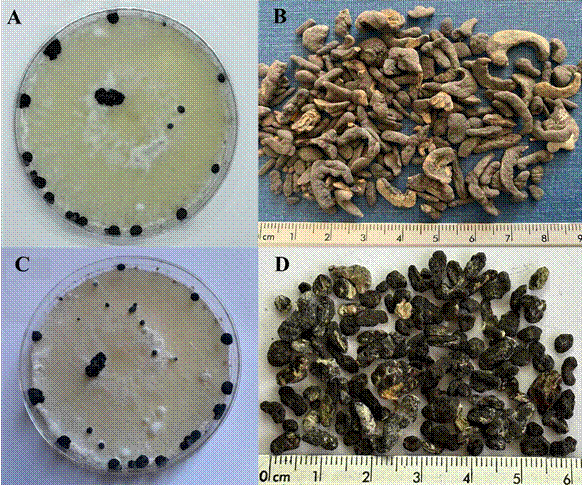
Figure 1 Mycelial growth and sclerotia of Sclerotinia sclerotiorum. A) Fungal growth obtained from bean with sclerotia forming a double circle on PDA in a Petri dish; B) Light brown sclerotia produced on bean plants in the field; C) Fungal growth obtained from potato plant with scattered sclerotia on PDA in a Petri dish; D) Black sclerotia produced on potato plants in the field.
Field observations in Sinaloa indicate that in beans, the disease frequently initiates at the base of plant stems (Figure 2A), suggesting that the initial infection likely occurs through direct germination of sclerotia (myceliogenic). From there, the symptom progresses to stems, leaflets, and pods (Figure 2B and 2C) where cottony, whitish mycelium forms, causing soft rot and initiating sclerotia formation (Figure 2D). This observation agrees with previous studies where sclerotia germinate to produce mycelium that infects plants (Abawi and Grogan, 1979; Lane et al., 2019). In potatoes, sclerotia have been observed inside stems (Figure 3A), as well as fungal apothecia on the soil surface (Figure 3D) with asci (Figure 3B) containing eight ascospores (Figure 3C). Infected inflorescences falling onto leaves have also been observed, from which initial disease symptoms originate (Figure 3E) and progress to invade the rest of the plant parts (Figure 3F). Stems on the ground showing disease symptoms and signs have also been observed (Figure 3G), where
infection may originate from direct germination of sclerotia.
Ecology of S. sclerotiorum
S. sclerotiorum is a soil-dwelling fungus that survives through sclerotia (SousaMelo et al., 2019). The outer layer of sclerotia consists of melanin-containing cells (Butler et al. 2009), protecting the fungus from ultraviolet light, toxic metals, lytic enzymes, and antagonistic microorganisms (Butler and Day, 1998; Thomma, 2003). In some bean-cultivated soils, averages of 0.6 to 6.2 sclerotia per kg of soil have been found (Schwartz and Steadman, 1977). Soil temperature, pH, and moisture seem to have a limited effect on sclerotia survival, but the biological component has a greater impact on their survival in soil (Adams and Ayers, 1979). Sclerotia quantity in soil can increase in two ways: a) secondary sclerotia production and b) production on the host (Adams and Ayers, 1979).
The fungus’s wide host range (Toby et al., 2023) and susceptible monocultures lead to increased sclerotia populations in soil. Sclerotia survival varies with depth; studies showed that sclerotia placed deeper than 10 to 30 cm remained viable longer than those at 5 cm (Cosic et al., 2012). It was also reported that S. sclerotiorum sclerotia viability at 0, 5, and 10 cm decreased with depth (Duncan et al. 2006). Other studies indicated that S. sclerotiorum sclerotia remain viable in soil for eight to 10 years (Coley-Simth and Cooke, 1971). It was demonstrated that 3.2 sclerotia per m² can cause 95% incidence in kidney beans under field conditions (Suzui and Kobayashi, 1972). However, 0.2 sclerotia per kg of soil could cause moderately severe white mold levels in beans (Schwartz and Steadman, 1977). Ascospores constitute the primary inoculum source, germinating and colonizing senescent tissue, from which the fungus invades different plant parts (Hossain et al., 2023).
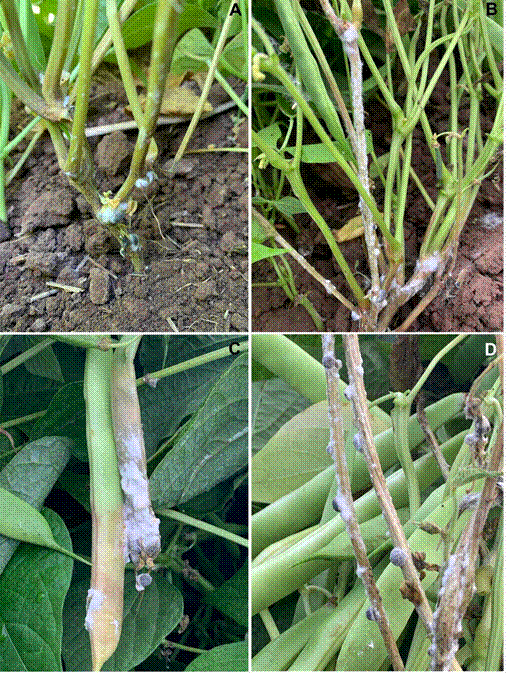
Figure 2 Symptoms and signs of white mold in beans. A). Disease symptoms initiating at the base of the plant stem; B). Progression of symptoms and signs on stems; C). Symptoms and signs on pods; D). Whitish stems invaded by S. sclerotiorum with mycelial aggregation and abundant sclerotia.
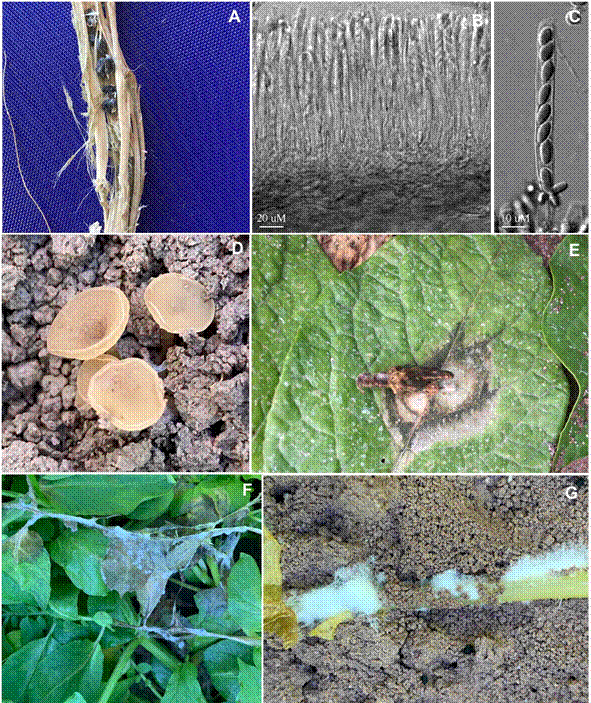
Figure 3 Teleomorph structures of S. sclerotiorum, symptoms and signs of white mold. A). Potato stem with sclerotia inside; B). Fragment of apothecial hymenium with asci, ascospores, and paraphyses; C). Ascus containing eight ascospores; D). Apothecia produced by sclerotia on soil surface; E). Initial symptom of white mold on potato leaf originating from an infected inflorescence; F). Soft rot of leaves and presence of mycelium on infected tissue; G). Stem on soil colonized by the fungus with abundant whitish mycelium.
S. sclerotiorum spreads from one field to another or between regions in several ways: a) as mycelium attached to seed surfaces, b) farming equipment (ZubietaCoronado, 2021), animals, or humans (Starr et al., 1953). About 2% of sclerotia ingested by sheep remain viable after passing through their digestive system, suggesting that this type of livestock and other animals can spread sclerotia to pathogen-free areas (Brown, 1937). Irrigation water is another means of sclerotia dissemination, where they remain viable for 10 to 21 days (Steadman et al., 1975). However, long-distance spread occurs through mycelium-infected seeds in sunflower (Helianthus annuus) (Young and Morris, 1927), cabbage (Brassica oleracea var. capitata), cauliflower (Brassica oleracea var. botrytis), kale (Brassica oleracea var. sabellica) (Neergaard, 1958), clover (Trifolium sp.) (Dillon-Weston et al., 1946), beans (Starr et al., 1953), and peanuts (Arachis hypogaea) (Porter and Beute, 1974). Air as an element for ascospore dissemination has also been considered in recent years (Leyronas, 2019; Reich et al., 2024).
Epidemiology of white mold in beans and potatoes
White mold epidemics in beans and potatoes initiate from ascospores produced in apothecia originating from sclerotia (Abawi and Grogan, 1979; Cook et al., 1975; Schwartz and Steadman, 1978; Clarkson, et al., 2003). In Sinaloa, damage has been observed on potato stems at the furrow bottom; bean plants also show damage at the stem base, occurring through direct sclerotia germination. Thus, apothecia production by sclerotia in beans is essential for epidemic development (Abawi and Grogan, 1979). In contrast, in some Canadian regions, sclerotia can produce mycelium directly to cause infection below soil level in sunflowers, although infection can also occur through ascospores from apothecia (Hung and Hoes, 1980). Only apothecia on the soil surface at 2.0-3.0 cm depth release ascospores, as apothecial stipes do not exceed 3.0 cm in length, and those at greater depths do not emerge above the soil surface and do not release ascospores into the air, as light intensity is insufficient for their formation (Sun and Yang, 2000). An epidemic’s onset does not necessarily occur from ascospores produced in a particular field but can come from neighboring fields, including some weeds like dandelion (Taraxacum officinale) and clover (Trifolium spp.) (Cooke et al., 1975). The first apothecia appear when the crop covers 100% of the soil surface and evaporation decreases (Abawi and Grogan, 1979).
Exposure of sclerotia to extreme drought and high temperatures has been observed to have a detrimental effect on apothecia production by sclerotia; however, they remain viable for three years at a depth of 20 to 25 cm in the soil (Peltier et al., 2012). Hao et al. (2007) demonstrated that carpogenic germination of sclerotia occurred between 15 and 20°C, when soil water matric potential was -0.03 to 0.07 MPa; but no apothecia were produced at temperatures above 26°C (Clarkson et al., 2003). Apothecia produce ascospores whose dispersal from the point of origin can vary from 25 cm (Suzui and Kobayashi, 1972) to several km (Leyronas et al., 2019), and the optimal temperature for their germination on bean flowers with free moisture is 21°C (Shahovesi and del Río-Mendoza, 2020). It has also been established that ascospores are released at 15°C in continuous light and darkness and relative humidity regimes of 90 to 95% and 65 to 75% with the release of 7.6 x 10⁵ ascospores per apothecium in 20 days. The release of S. sclerotiorum ascospores in the field has been observed at midday (Harthill, 1976; Raynal, 1990), which could be related more to temperature than to daylight (Clarkson et al., 2003).
Management of white mold
White mold management has involved solarization (Ferraz, 2003; Supriya et al., 2017; Juliatti et al., 2019), crop rotation, and chemical control (Kurozawa and Pavan, 1997). Due to low levels of host resistance to the pathogen, a wide range of fungicides has been used to control the disease. For example, in the United States, Canada, Australia, China, and Europe, boscalid, fluazinam, fluxapyroxad, pyraclostrobin, penthiopyrad, picoxystrobin, prothioconazole, trifloxystrobin, tetraconazole, and thiophanate-methyl are used (Matheron and Porchas, 2004; Bradley et al., 2006; Wang et al., 2015). The biological effectiveness of procymidone and fluazinam was demonstrated in controlling white mold in soybeans when applied at the beginning of flowering and 15 days after flowering began (Hideki-Sumida et al., 2015). In Sinaloa, carbendazim, benomyl, methyl thiophanate, and fluazinam are used to control the disease in beans and potatoes (Rodríguez-Cota et al., 2022; Personal communication, Ing. Joel González; Pasa, SA de CV, Los Mochis, Sinaloa), achieving 85-90% control efficacy in both crops when applied preventively. Fungicides boscalid+pyraclostrobin, carbendazim, fluazinam, fludioxonil+cyprodinil, and prochloraz showed in vitro effectiveness in inhibiting mycelial growth of S. sclerotiorum, as did biorational products: salicylic acid, hydrogen peroxide, and grapefruit seed extract (Ayala-Armenta et al., 2015). There is no field evidence on the biological effectiveness of these substances except for carbendazim and fluazinam (Rodríguez-Cota et al., 2022).
Regarding biological control, the activity of antagonistic agents is affected by abiotic and biotic factors such as temperature, soil type and moisture, pH, pesticides, organic matter, soil microorganisms, plant species, among others, leading to these agents being less effective than synthetic chemical fungicides (Smolińska and Kowalska, 2018).
Several fungal species have shown biological control with mycoparasitic activity against S. sclerotiorum, with Coniothyrium minitans standing out (Huang and Hoes, 1976; McQuilken et al., 1995; Zeng et al., 2012b; Patel et al., 2020). Spraying fungal conidia during flowering reduced white mold incidence in beans by 56% (Huang et al., 2000). Additionally, incorporating the mycoparasite on the soil surface before soybean planting reduced disease severity by 68% and the number of sclerotia by up to 95.3% (Zeng et al., 2012a). The optimal temperature for mycoparasite growth was 15 to 20°C and a pH of 4.5 to 5.0 (Zeng et al., 2012b).
Preliminary studies on biological control of the causal agent of bean white mold in Sinaloa demonstrated the in vitro inhibitory effect of endemic Trichoderma harzianum, T. viride, and T. atroviride from northern Sinaloa against S. sclerotiorum obtained from beans (Félix-López, 2016). Additionally, in a semi-commercial field experiment, Trichoderma strains were applied to bean seeds at planting; a second application was made in the furrow irrigation system. A reduction in white mold incidence and severity was observed, along with a 40% yield increase compared to the regional control, where two applications of the fungicide fluazinam were made (Personal communication Ing. Fernando Urías; Asociación de Agricultores del Río Sinaloa Poniente, Guasave Sinaloa).
Studies on the efficacy of Trichoderma in controlling S. sclerotiorum in the field are limited (Knudsen et al., 1991; Zeng et al., 2012a); however, in beans, Trichoderma asperellum at a dose of 2x10¹² conidia per mL reduced the number of apothecia and white mold severity (Geraldine et al., 2013). T. hamatum reduced disease incidence by 31 to 57%, resulting from sclerotia colonization and reduced apothecia production by the pathogen in cabbage (Brassica oleracea var. capitata) (Jones et al., 2015). In cucumber (Cucumis sativus), T. harzianum T39 reduced stem and fruit rot in greenhouses (Elad, 2000); while the T22 strain of the same antagonist decreased the disease severity index by 38.5% (Zeng et al., 2012a).
Regarding antagonistic bacteria, Bacillus cereus and B. subtilis affected S. sclerotiorum mycelial growth and reduced white mold incidence in sunflower (Zazzerini, 1987). B. subtilis BY-2 controlled the same disease in rapeseed (Brassica napus) when applied to seeds and during flowering; incidence in bacteria-treated plots ranged from 8.9 to 11.8%, while in untreated plots, it ranged from 18.1-22.9% (Hu et al., 2014). Two weekly applications of B. cereus SC reduced canola stem rot by S. sclerotiorum by 6.5 to 9.3%, while control plots had 20.0 to 29.8% incidence (Kamal et al. 2015). The efficacy of bean seed treatment with Bacillus sp. B19, Bacillus sp. P12, and B. amyloliquefaciens B14 in controlling white mold was also demonstrated (Sabaté et al., 2018).
Survival of S. sclerotiorum and disease incidence
Sclerotia constitute the pathogen’s survival structure during summer in Sinaloa, as both beans and potatoes develop during autumn-winter, contrary to other agricultural areas where they survive the winter and crops develop during springsummer.Previous studies indicated that carpogenic germination of apothecia can occur between 5 and 25°C, when soil water matric potential is -0.03 to 0.07 MPa (Hao, et al., 2007). Field observations in northern Sinaloa indicate that these temperatures at 2.5 cm soil depth occur from the first week of December (Figure 4). These conditions coincide with the flowering stage of both beans and potatoes; additionally, 100% of the soil surface is covered by plant foliage, reducing evaporation, mainly in potatoes whose varieties grow exuberantly and are irrigated
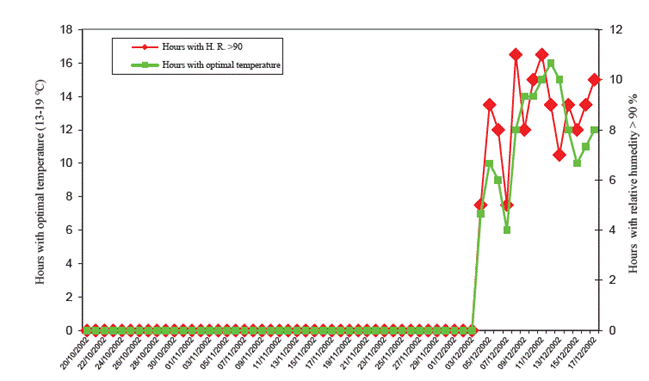
Figure 4 Daily periods with optimal soil temperature (2.5 cm depth) for germination of S. sclerotiorum sclerotia and periods with relative humidity > 90% in northern Sinaloa from October 20 to December 03, 2002.
by sprinklers, resulting in leaf wetness periods up to 17 hours daily in the lower part of the canopy of the plants and permanent moisture on the soil surface near saturation. These climatic variables and crop phenology favor apothecia formation and subsequent ascospore release, which penetrate and infect senescent flowers that detach and fall onto plant leaves and stems where initial disease symptoms are observed. Symptoms and signs of the disease are also frequently observed at the stem base in bean plants or on potato stems on the soil at the furrow bottom; in these cases, primary infection could occur from direct sclerotia germination (Hossain et al., 2023).
Although it has been reported that exposure of sclerotia to drought and temperatures of 30°C does not favor apothecia production by sclerotia, they remain viable and germinate through mycelium formation (Abawi and Grogan; 1979). These climatic conditions occur in potato fields that are not planted in the springsummer cycle in Sinaloa and are subjected to tillage for planting in the autumnwinter agricultural cycle. In this case, sclerotia at 5 cm soil depth are exposed to 40°C and low moisture levels (15 bars) (Sifuentes-Ibarra et al., 2021) in fallow fields during summer; although 50% of the fields are planted with sorghum, where the temperature could be lower than 40°C.
Management of white mold in beans and potatoes in Sinaloa
In Sinaloa, a system was recently implemented where the first preventive application of synthetic fungicides in bean and potato fields is recommended when soil temperature at 2.5 cm depth varies from 13 to 19°C. These conditions occur during the first week of December in Ahome municipality, coinciding with increased periods of relative humidity ≥ 90% (Figure 4). For beans, these conditions occur when the first supplementary irrigation has been applied, the crop covers 100% of the soil surface, and flowering has begun with the accumulation of 630 heat units in the Noroeste variety. The first fungicide application should be made seven days after temperatures of 13 to 19°C are recorded, which favors apothecia formation and ascospore release.
These criteria also apply to white mold management in potatoes, where moisture conditions in both foliage and soil are favorable for apothecia formation, ascospore release, and disease progression due to sprinkler irrigation systems. As in beans, preventive fungicide applications in potatoes begin seven days after soil temperature at 2.5 cm depth varies from 13 to 19°C and the crop presents the first inflorescences; at this stage, the soil is completely covered by foliage, reducing evaporation of moisture supplied by irrigation systems. Fungicides carbendazim, benomyl, methyl thiophanate, and fluazinam are used for disease control under these conditions (Rodríguez-Cota et al., 2022). Based on this disease management system, two applications are recommended for beans during the crop cycle, and up to three applications at seven-day intervals are recommended for potatoes, mainly in varieties with prolonged flowering periods. Infected senescent flowers infected by ascospores frequently fall onto plants where initial disease symptoms appear. Due to soil moisture levels, damage also occurs on stems and senescent leaves with subsequent production of sclerotia that survive up to five years (Ben-Yephet et al., 1993). In Sinaloa, soils used for potato monocultures show increased populations of sclerotia, which produce primary inoculum consisting of ascospores cycle after cycle.
Future lines of research
Although S. sclerotiorum attacks economically important crops in Sinaloa, studies on its ecology have not been developed there. Research on this topic has been conducted mainly in the United States, where beans and potatoes are cultivated during spring and summer, contrasting with Sinaloa where these crops are grown during the autumn-winter cycle. This indicates potential research areas related to planting cycles and regions where temperature and different moisture regimes affect sclerotia at various depths, as well as the activity of antagonistic microorganisms under these conditions.
Regarding white mold control, fungicides have traditionally been used. However, these molecules induce resistance in the causal agent and contaminate the environment. In the search for environmentally friendly strategies to control the disease, the biological effectiveness of native Trichoderma species should be determined. This approach is crucial for identifying fungal species in the region, determining their in vitro effectiveness, and understanding the antagonist’s modes of action against the pathogen under these conditions, such as mycoparasitism, antibiosis, resistance-inducing genes, and pathogen enzyme deactivation. The greater the number of modes of action of Trichoderma species, the more efficient and long-lasting the control over the pathogen will be, aspects that synthetic chemical fungicides do not possess (Infante et al., 2000).
Another point to address is investigating the biological effectiveness of Trichoderma species in planta under greenhouse and field conditions, including induced resistance (Bisen et al., 2016). In the field, the effect of applications to seed tubers at planting time and subsequent applications through the sprinkler irrigation system during each irrigation throughout crop growth should be determined.
The reduction in sclerotia viability of Sclerotinia species is likely due to the action of beneficial microorganisms (Williams and Western, 1965). Hence the importance of testing the efficacy of Trichoderma species applied at harvest time for both beans and potatoes. Thus, when fields are tilled, the sclerotia inoculated with antagonistic species to the white mold fungus would by incorporated to the soil. It would also be necessary to determine sclerotia viability at different soil depths, as well as the effect of soil temperature and moisture throughout the year; simultaneously determining Trichoderma incidence levels on the sclerotia and their capacity to germinate directly and through apothecial production. The extensive study of biological control agents is evident, with research limited to in vitro and greenhouse conditions, but little has been directed towards field conditios (Córdova-Albores et al., 2021), and even less regarding this fungus and crops in northwestern Mexico.
The effectiveness of the fungus Coniothyrium minitans against white mold has been demonstrated elsewhere (Huang and Hoes, 1980; McQuilk et al., 1995; Zeng et al., 2012b); the efficacy of preventive applications against S. sclerotiorum ascospore germination on bean and potato inflorescences should be determined in Sinaloa, as this phenological stage in both crops occurs during winter, when temperatures range from 5 to 25°C, favoring ascospore release by the pathogen and potential colonization of this structures by the antagonistic fungus (Clarkson et al., 2003). However, C. minitans application on crop residues with the antagonistic on sclerotia may not be effective in reducing their viability since summer temperatures in Sinaloa reach up to 40°C at the soil surface, contrasting with other producing areas where the mycoparasite is applied to crop residues in early autumn with temperatures around 20 °C (Zeng et al., 2012b).
Regarding antagonistic bacteria, Bacillus cereus and B. subtilis were found to control sunflower stem rot caused by S. sclerotiorum (Zazzerinim, 1987). A similar effect was observed when B. subtilis BY-2 was applied as seed treatment or sprayed during flowering against the same disease in canola (Hu et al., 2014). These findings lead to the search for such bacteria in Sinaloa and the determination of their efficacy in controlling white mold in beans and potatoes.
To complement the white mold management scheme, studies on phenology of bean and potato varieties should be conducted to determine the heat unit accumulation necessary for flowering initiation, as when this phenological stage coincides with favorable environmental conditions for ascospore, release and infection of senescent flowers, which detach and fall onto plants, initiating the first disease symptoms. Additionally, the flowering period varies in both beans and potatoes, undoubtedly influencing the presence of substrate for ascospore infection in disease development. Compiling information on this topic will contribute to greater efficacy of fungicides and biocontrol agents in disease management.
Conclusions
White mold of beans and potatoes is one of the most important diseases affecting these crops in Sinaloa. Although studies on the ecology of the causal agent and disease epidemiology have been conducted elsewhere, research on these topics in this region is incipient. In this regard, implementing a management system that integrates soil temperature and crop phenology has allowed efficient use of fungicides for disease control; however, new research avenues are opening up concerning bean and potato variety phenology, determining heat units required for the onset of flowering in commercial varieties, which is important for white mold epidemic progression. Additionally, the control scheme should investigate the biological effectiveness of endemic Trichoderma species in disease management from in vitro to semi-commercial plots experimentation and subsequent transfer to commercial fields.
Literatura Citada
Abawi, GS, Grogan, RG (1979). Epidemiology of diseases caused by Sclerotinia species. Phytopathology, 69, 889-904. 10.1094/Phyto-69-899. [ Links ]
Adams, PB, Ayers, NA (1979). Ecology of Sclerotinia species. Phytopathology, 69, 896-899. 10.1094/Phyto-69-896. [ Links ]
Ayala-Armenta, QA, Cortez-Mondaca, E, Apodaca-Sánchez, MA, Leal León, VM, Valenzuela-Escoboza, FA, Palacios-Mondaca, CA (2015). Bio-rational and conventional fungicides effectiveness on in vitro Sclerotinia sclerotiorum. Revista Mexicana de Ciencias Agrícolas, 11, 2149-2156. 10.29312/remexca.v0i11.784. [ Links ]
Ben-Yephet, Y, Genizi, A, Siti, E (1993). Sclerotial survival and apotecial production by Sclerotinia sclerotiorum following outbreaks of lettuce drop. Phytopathology, 83, 509-513. 10.1094/Phyto-83-509. [ Links ]
Bisen, K, Keswani, C, Patel, JS, Sarma, BK, Singh, HB (2016). Trichoderma spp.: efficient inducers of systemic resistance in plants. In: Microbial-mediated induced systemic resistance in plants. Choudhary, DK, Varma, A. Springer, Singapore. 185-195. 10.1007/978-981-10-0388-2_12. [ Links ]
Boland, GJ, Hall, R (1994). Index of plant hosts of Sclerotinia sclerotiorum. Canadian Journal of Plant Pathology, 16, 93-108. 10.1080/07060669409500766. [ Links ]
Bolton, MD, Thomma, BPHJ, Nelson, BD (2006). Sclerotinia sclerotiorum (Lib.) de Bary: biology and molecular traits of a cosmopolitan pathogen. Molecular Plant Pathology, 7, 1-16. 10.1111/j.1364-3703.2005.00316.x. [ Links ]
Bradley, CA, Lamey, HA, Endres, GJ, Henson, RA, Hanson, BK, McKay, KR, Halvorson, M, LeGare, DG, Porter, PM (2006). Efficacy of fungicides for control of Sclerotinia stem rot of canola. Plant Disease, 90, 1129-1134. 10.1094/PD-90-1129. [ Links ]
Brown, JG (1937). Relation of livestock to the control sclerotiniosis of lettuce. Phytopathology, 27, 1045-1050. https://eurekamag.com/research/013/480/013480651.php. [ Links ]
Butler, MJ, Day, AW (1998). Fungal melanins: a review. Canadian Journal of Microbiology, 44, 1115-1136. 10.1139/W98-119. [ Links ]
Butler, MJ, Gardiner, RB, Day, A (2009). Melanin synthesis by Sclerotinia sclerotiorum. Mycologia, 101, 296-301. 10.3852/08-120. [ Links ]
Cebreros-Sánchez, F, Sánchez-Castro, MA (1998). Enfermedades de la berenjena. En: Enfermedades de las Hortalizas. Ortega, JC, García-Estrada, R, Carrillo-Facio, A. Universidad Autónoma de Sinaloa. 161-175. [ Links ]
Clarkson, JP, Staveley, J, Phelps, K, Young, CS, Whipps, JM (2003). Ascospore release and survival in Sclerotinia sclerotiorum. Mycological Research, 107, 213-222. 10.1017/s0953756203007159. [ Links ]
Coley-Smith, JR, Cooke, RC (1971). Survival and germination of fungal sclerotia. Annual Review of Phytopathology, 9, 65-92. 10.1146/annurev.py.09.090171.000433. [ Links ]
Cook, GE, Steadman, JR, Boosalis, MG (1975). Survival of Whetzelinia sclerotiorum and initial infection of dry edible beans in Western Nebraska. Phytopathology, 65, 250-255. 10.1094/Phyto-65-250. [ Links ]
Córdova-Albores, LC, Zelaya-Molina, LX, Ávila-Alistac, N, Valenzuela-Ruíz, V, Cortés-Martínez, NE, Parra-Cota, FI, Burgos-Canul, YY, Chávez-Díaz, IF, Fajardo-Franco, ML, de los Santos-Villalobos, S (2021). Omics sciences potential on bioprospecting of biological control microbial agents: the case of the Mexican agro-biotechnology. Mexican Journal of Phytopathology, 39, 1, 147-184. 10.18781/R.MEX.FIT.2009-3. [ Links ]
Cosic, J, Jurkowic, D, Vrandecic, K, Kaucic, D (2012). Survival of buried Sclerotinia sclerotiorum sclerotia in undisturbed soil. Helia, 35, 73-78. 10.2298/HEL1256073C. [ Links ]
Dillon-Weston, WAR, Loveless, RA, Taylor, ER (1946). Clover rot. The Journal of Agricultural Science, 36, 18-28. 10.1017/S0021859600010856. [ Links ]
Duncan, RW, Dilantha-Fernando, WG, Rashid, KY (2006). Time and burial depth influencing the viability and bacterial colonization of sclerotia of Sclerotinia sclerotiorum. Soil Biology and Biochemistry, 38, 275-284. 10.1016/j.soilbio.2005.05.003. [ Links ]
Elad, Y (2000). Biological control of foliar pathogens by means of Trichoderma harzianum and potential modes of action. Crop Protection, 19, 709-714. [ Links ]
Félix-Gastélum, R, Maldonado-Mendoza, IE, Herrera-Rodríguez, G, Martínez-Valenzuela, C, Espinosa-Matías, S, Cordero-Ramírez, JD, Martínez-Álvarez, JC (2011). Powdery mildew on common bean (Phaseolus vulgaris L.) in Northern Sinaloa, Mexico. Sydowia, 63, 2, 169-182. https://ipn.elsevierpure.com/es/publications/powdery-mildew-on-common-bean-phaseolus-vulgaris-l-in-northern-si. [ Links ]
Félix-Gastélum, R, Maldonado-Mendoza, IE, Navarrete-Maya, R, Olivas-Peraza, NG, Brito-Vega, H, Acosta-Gallegos, JA (2016). Identification of Pseudomonas syringae pv. phaseolicola as the causal agent of halo blight in yellow beans in northern Sinaloa, México. Phytoparasitica, 44, 369-378. 10.1007/s12600-016-0530-5. [ Links ]
Felix-Lopez, JE (2016). Antagonismo in vitro de cepas Nativas de Trichoderma spp. y sensibilidad de Sclerotinia sclerotiorum. Tesis de Licenciatura. Universidad Autónoma de Occidente, Los Mochis, Sinaloa, México, 44. [ Links ]
Fernando, WGD, Nakkeeran, S, Zhang, Y (2004). Ecofriendly methods in combating Sclerotinia sclerotiorum (Lib.) de Bary. In: Recent Research Developments in Environmental Biology, Pandalai, SG, Research Signpost. India, 329-347. https://www.researchgate.net/publication/238111476. [ Links ]
Ferraz, LCL, Bergamin-Filho, A, Amorim, L, Nasser, LCB (2003). Viabilidade de Sclerotinia sclerotiorum após a solarização do solo na presença de cobertura morta. Fitopatologia Brasileira, 28, 017-026. 10.1590/S0100-41582003000100003. [ Links ]
Geraldine, AM, Lopes, FAC, Carvalho, DDC, Barbosa, ET, Rodrigues, AF, Brandao, RS, Ulhoa, CJ, Junior, ML (2013). Cell wall-degrading enzymes and parasitism of sclerotia are key factors on field biocontrol of white mold by Trichoderma spp.. Biological Control, 67, 308-316. 10.1016/j.biocontrol.2013.09.013. [ Links ]
Hao, JJ, Subbarao, KV, Duniway, JM (2007). Germination of Sclerotinia minor and Sclerotinia sclerotiorum sclerotia under various soil moisture and temperature combinations. Phytopathology, 93, 443-450. [ Links ]
Harthill, WFT, Underhill, AP (1976). Puffing in Sclerotinia sclerotiorum and S. minor. New Zealand Journal of Botany, 14, 355-358. 10.1080/0028825X.1976.10428909. [ Links ]
Hegedus, DD, Rimmer, SR (2005). Sclerotinia sclerotiorum: When “to be or not to be” a pathogen. FEMS Microbiology Letters, 251, 177-184. 10.1016/j.femsle.2005.07.040. [ Links ]
Hideki-Sumida, IC, Giovanetti-Canteri, M, Casaroto-Peitl, D, Tibolla-Idenize, F, Pedrina-Orsini, F, André-Araújo, D, Fonseca-Chagas, D, Sanches-Calvos, N (2015). Chemical and biological control of Sclerotinia stem rot in the soybean crop. Ciência Rural, 45, 760-766. 10.1590/0103-8478cr20140198. [ Links ]
Hossain, MM, Sultana, F, Li, W, Tran, LSP, Mostofa, MG (2023). Sclerotinia sclerotiorum (Lib.) de Bary: insights into the patho-genomic features of a global pathogen. Cells, 12, 1063. 10.3390/cells12071063. [ Links ]
Hu, X, Roberts, DP, Xie, L, Maul, JE, Yu, C, Li, Y, Jiang, M, Liao, X, Che, Z, Liao, X (2014). Formulation of Bacillus subtilis BY-2 suppresses Sclerotinia sclerotiorum on oil seed rape in the field. Biological Control, 70, 54-64. 10.1016/j.biocontrol.2013.12.005. [ Links ]
Huang, HC, Hoes, JA (1976). Penetration and infection of Sclerotinia sclerotiorum by Coniothyrium minitans. Canadian Journal of Botany, 54, 406-410. 10.1139/b76-039. [ Links ]
Huang, HC, Bremer, E, Hynes, RK, Ericson, RS (2000). Foliar application of fungal biocontrol agents for the control of white mold of dry bean caused by Sclerotinia sclerotiorum. Biological Control, 18, 270-276. 10.1006/bcon.2000.0829. [ Links ]
Huang, HC, Hoes, JA (1980). Importance of host spacing and sclerotial position to development of Sclerotinia wilt of sunflower. Plant Disease, 64, 81-84. 10.1094/PD-64-81. [ Links ]
Infante, D, Martínez, B, Noyma-González, N, Reyes, Y (2000). Mecanismos de acción de Trichoderma frente a hongos fitopatógenos. Revista Protección Vegetal, 24, 14-21. http://scielo.sld.cu/pdf/rpv/v24n1/rpv02109.pdf. [ Links ]
Islam, MR, Akanda, AM, Hossain, MM, Hossain, MM (2021). First characterization of a newly emerging phytopathogen, Sclerotinia sclerotiorum causing white mold in pea. Journal of Basic Microbiology, 61, 923-939. 10.1002/jobm.202100223. [ Links ]
Jahan, R, Siddique, SS, Jannat, R, Hossain, MM (2022). Cosmos white rot: First characterization, physiology, host range, disease resistance, and chemical control. Journal of Basic Microbiology, 62, 911-929. [ Links ]
Jones, EE, Rabeendran, N, Stewart, A (2015). Biocontrol of Sclerotinia sclerotiorum infection of cabbage by Coniothyrium minitans and Trichoderma spp.. Biocontrol Science Technology, 24, 1363-1382. [ Links ]
Juliatti, FC, Rezende, AA, Juliatti, BCM, Morais, TP (2019). Trichodermas a Biocontrol Agent against Sclerotinia Stem rot or white mold on soybeans in Brazil. In Mohammad MS, Umar S, Tijjani RB (eds.). Usage and Technology. 116. 10.5772/intechopen.84544. [ Links ]
Kamal, MM, Lindbeck, KD, Savocchia, S, Ash, GJ (2015). Biological control of Sclerotinia stem rot of canola using antagonistic bacteria. Plant Pathology, 64, 1375-1384. [ Links ]
Kimati, H, Amorim, L, Bergamin Filho, A, Camargo, LEA, Rezende, JAM (1997). Doencas do tomateiro. Manual de fitopatologia: doencas das plantas cultivadas, Sao Paulo: Agronómica Ceres. 690-719. https://vdocuments.mx/h-kimati-l-amorim-a-bergamin-filho-lea-camargo-jam-bacterias.html?page=1#google_vignette. [ Links ]
Lane, D, Denton-Giles, M, Derbyshire, MC (2019). Abiotic conditions governing the myceliogenic germination of Sclerotinia sclerotiorum allowing the basal infection of Brassica napus. Australasian Plant Pathology, 48, 85-91. 10.1007/s13313-019-0613-0. [ Links ]
Leyronas, C, Benigni, M, Leignez, S, Duffaud, M, Villeneuve, F (2019). Characterization of Sclerotinia sclerotiorum airborne inoculum, the widespread agent of white mould disease. Aerobiologia, 35, 243-252. 10.1007/s10453-018-09555-x. [ Links ]
Matheron, ME, Porchas, M (2004). Activity of boscalid fenhexamid, fluazinam fludioxonil, and vinclozolin on growth of Sclerotinia sclerotiorum. Plant Disease, 88, 1107-1111. [ Links ]
Supriya, G, Singh, RP, Rautela, P (2017). Effect of soil solarisation on survival of sclerotia and viability of antagonists under protected and natural cultivation. Journal of Pharmacognosy and Phytochemistry, 6, 387-390. [ Links ]
Suzui, T, Kobayashi, T (1972). Dispersal of ascospores of Sclerotinia sclerotiorum (Lib.) de Bary on kidney bean plants. Part 1. Dispersal of ascospores from a point source of apothecia. Hokkado Nat. Agric. Exp. Bull, 101, 137-151. [ Links ]
Taylor, A, Coventry, E, Handy, C, West, JS, Young, CS, Clarkson, JP (2018). Inoculum potential of Sclerotinia sclerotiorum sclerotia depends on isolate and host plant. Plant Pathology, 67, 6, 1286-1295. 10.1111/ppa.12843. [ Links ]
Thomma, BPHJ (2003). Alternaria spp. from general saprophyte to specific parasite. Molecular Plant Pathology, 4, 225-236. 10.1046/j.1364-3703.2003.00173.x. [ Links ]
Tian, B, Xie, J, Fu, Y, Cheng, J, Li, BO, Chen, T, Zhao, Y, Gao, Z, Yang, P, Barbetti, MJ (2020). A cosmopolitan fungal pathogen of dicots adopts an endophytic lifestyle on cereal crops and protects them from major fungal diseases. ISME Journal, 14, 3120-3135. [ Links ]
Toby, E, Newman, TE, Kim, H, Khentry, Y, Sohn, KH, Derbyshire, MC, Kamphuis, LG (2023). The broad host range pathogen Sclerotinia sclerotiorum produces multiple effector proteins that induce host cell death intracellularly. Molecular Plant Pathology, 24, 866-881. 10.1111/mpp.13333. [ Links ]
Wang, Y, Duan, YB, Zhou, MG (2015). Molecular and biochemical characterization of boscalid resistance in laboratory mutants of Sclerotinia sclerotiorum. Plant Pathology, 64, 101-108. 10.1111/ppa.12246. [ Links ]
Williams, GH, Western, JH (1965). The biology of Sclerotinia trifoliorum Erikss and other species of Sclerotium-forming fungi. Annals of Applied Biology, 56, 261-268. 10.1111/j.1744-7348.1965.tb01234.x. [ Links ]
Wu, BM, Subbarao, KV (2008). Effects of soil temperature, moisture, and burial depths on carpogenic germination of Sclerotinia sclerotiorum and S. minor. Phytopathology, 98, 1144-1152. [ Links ]
Young, PA, Morris, HE (1927). Sclerotinia wilt of sunflower. Montana Agric. Exp. Stn. Bull, 208. https://www.scirp.org/reference/referencespapers?referenceid=3193855. [ Links ]
Zeng, W, Kirk, W, Hao, J (2012a). Field management of Sclerotinia stem rot of soybean using biological control agents. Biological Control, 60, 141-147. 10.1016/j.biocontrol.2011.09.012. [ Links ]
Zeng, W, Wang, D, Kirk, W, Hao, J (2012b). Use of Coniothyrium minitans and other microorganisms for reducing Sclerotinia sclerotiorum. Biological Control, 60, 225-232. 10.1016/j.biocontrol.2011.10.009. [ Links ]
Zubieta-Coronado, DA, Echeverry-Prieto, LC, Zafra-Mejía, CA (2021). Antagonismo in vitro por consorcios de Trichoderma sp. y Aspergillus sp. contra el fitopatógeno Sclerotinia sp. Biotecnología en el Sector Agropecuario y Agroindustrial, 19, 16-31. [ Links ]
Zazzerini, A (1987). Antagonistic effect of Bacillus spp. on Sclerotinia sclerotiorum sclerotia. Phytopathologia Mediterranea, 26, 185-187. [ Links ]
Received: April 22, 2024; Accepted: June 11, 2024
 Este es un artículo publicado en acceso abierto bajo una licencia Creative Commons
