




Services on Demand
Journal
Article
 text in
 English (pdf)
 Article in xml format
 Article references

 Automatic translation
 Send this article by e-mail
Indicators
-
 Cited by SciELO
-
 Access statistics
Related links
-
 Similars in
SciELO
Share

 Permalink

Revista mexicana de fitopatología
On-line version ISSN 2007-8080Print version ISSN 0185-3309
Rev. mex. fitopatol vol.42 n.1 Texcoco Jan. 2024 Epub Jan 27, 2025
https://doi.org/10.18781/r.mex.fit.2307-2
Phytopathological Notes
Cellulase and chitinase production by Fusarium oxysporum f.sp. cubense race 1 in submerged culture
1 Colegio de Postgraduados, Posgrado de Edafología, Microbiología de Suelos, Km 36.5 Carretera México-Texcoco, Montecillo 56264, Texcoco, Estado México. México;
2 Centro Nacional de Referencia Fitosanitaria. Dirección General de Sanidad Vegetal, Servicio Nacional de Sanidad, Inocuidad y Calidad Agroalimentaria (SENASICA), Unidad Integral de Servicios, Diagnóstico y Constatación, Carretera Federal México-Pachuca Km 37.5. Tecámac 55740, Estado de México. México;
Background/Objective.
Fusarium has the capability to produce hydrolytic enzymes that can be used in the food and alcohol industries to break down natural organic compounds. This work studied the ability of Fusarium oxysporum f. sp. cubense race 1 (FocR1) to produce cellulases and chitinases enzymes in submerged culture using different carbon sources.
Materials and methods.
Five strains of FocR1 (CNRF-MIC17188, CNRF- MIC17189, CNRF-MIC17190, CNRF-MIC17191, and CNRF-MIC17192) were used in submerged culture for the degradation of three substrates [filter paper, newspaper, and chitin (Sigma®)], from where the radial growth rate (RGr) and the quantitative analysis of enzyme activities (FPase, CMCase and chitinase) were evaluated.
Results.
The RGr of the five FocR1 strains oscillated in a range of 0.043 to 0.051 cm h-1. At 7 and 14 days, the five FocR1 strains produced cellulases and chitinases using the three substrates. Based on the statistical analysis, the strains CNRF- MIC17191 and CNRF-MIC17192 showed best results about enzymatic activities.
Conclusion.
The five strains of FocR1 can be exploited as a commercial source of cellulases and chitinases, as well as potential candidates for bioconverting complex C-sources for further utilization in industrial processes.
Keywords: Fungi; enzymatic activity; submerged fermentation; newspaper; filter paper; chitin
Antecedentes/Objetivo.
Fusarium tiene la capacidad de producir enzimas hidrolíticas de interés en la industria de los alimentos o alcohólica para descomponer compuestos orgánicos naturales. Este trabajo estudió la capacidad de Fusarium oxysporum f.sp. cubense raza 1 (FocR1) para producir enzimas celulasas y quitinasas en cultivo sumergido utilizando diferentes fuentes de carbono.
Materiales y métodos.
Cinco cepas de FocR1 (CNRF-MIC17188, CNRFMIC17189, CNRF-MIC17190, CNRF-MIC17191, y CNRF-MIC17192) se utilizaron en cultivo sumergido para la degradación de tres sustratos [papel filtro, papel periódico, y quitina (Sigma®)], evaluando la velocidad de crecimiento radial (VCr) y la actividad enzimática cuantitativa (FPase, CMCase y quitinasa).
Resultados.
La VCr en las cinco cepas de FocR1 osciló en un rango de 0.043 a 0.051 cm h-1. A los días 7 y 14, las cinco cepas de FocR1 produjeron celulasas y quitinasas al utilizar los tres sustratos. De acuerdo con el análisis estadístico, las cepas CNRF-MIC17191 y CNRF-MIC17192 presentaron los mejores resultados de actividades enzimáticas.
Conclusiones.
Las cinco cepas de FocR1 pueden utilizarse como una fuente comercial de celulasas y quitinasas, así como ser candidatas potenciales para bioconvertir complejas fuentes de carbono para su futuro aprovechamiento en procesos industriales.
Palabras clave: Hongo; actividad enzimática; fermentación sumergida; papel periódico; papel filtro; quitina
Introduction
Fusarium oxysporum is a soil-borne fungus whose species include a wide diversity of strains responsible for wilts or rots on many plant species such as banana and cotton (Khan et al., 2021; Mon et al., 2021). In contrast, several Fusarium species participate in the biocontrol of other fungal phytopathogens like Botrytis cinerea (ascomycete) and the oomycete Phytophthora capsici (Veloso and Díaz, 2012). Fungal endophytes confer a direct biocontrol either by interacting with pathogens via mycoparasitism and antibiosis or by competing for nutrients or root niches. Mycoparasitism is considered a major contributor to fungus-fungus antagonism; moreover, the antagonistic activity of necrotrophic mycoparasites is attributed to the production of antibiotics, toxins, and hydrolytic enzymes such as glucanase, cellulase and chitinase (De Silva et al., 2019). These hydrolytic enzymes produced by F. oxysporum (mainly pectinase and cellulase) can be used in food and alcohol industries to break down natural organic compounds, and for biodegrading different organic substrates such as sugarcane bagasse (de Almeida et al., 2019), rice straw (Indira et al., 2016), moringa straw (Vázquez-Montoya et al., 2020), under submerged and solid state fermentations (Hemansi et al., 2019). Some Fusarium strains participate in beneficial ways for the environment not only as an antagonist to phytopathogens but also as a producer of enzymes of industrial interest to favor the biodegradation of complex substrates (Xiros et al., 2009). Given the ability of certain species of Fusarium to secrete extracellular enzymes of industrial importance, it is necessary to study the ability of Fusarium species to biodegrade complex substrates which are utilized as carbon sources, with the purpose of reducing the production costs of these enzymes. Thus, this study evaluated the potential enzyme production (cellulase and chitinase) by five strains of Fusarium oxysporum f. sp. cubense race 1 (FocR1) grown under submerged cultures with different carbon sources.
Five strains of FocR1 were utilized. These banana associated fungi (Florencio-Anastasio et al., 2022) were obtained from the fungal collection of Laboratorio de Micologia of the Centro Nacional de Referencia Fitosanitaria (CNRF) belonged to the Servicio Nacional de Sanidad, Inocuidad y Calidad Agroalimentaria (SENASICA, Mexico). These fungal strains are coded as CNRF-MIC17188, CNRF-MIC17189, CNRF-MIC17190, CNRF-MIC17191, and CNRF-MIC17192. The radial growth rate (RGr) of the five FocR1 strains was estimated according to García-Espejo et al. (2016). The degradation kinetics of three complex substrates [filter paper, newspaper, and colloidal chitin (Sigma®)] were determined by growing the fungal strains in submerged cultures for 14 days at 25 ± 2 °C, and 200 rpm. Each assay was carried out by triplicate with the corresponding substrate and with the fungal strain under study. Briefly, 50 mL-Falcon tubes were utilized; each tube contained 35 mL of basal minimum medium (BMM) [Na2HPO4 6 g L-1, KH2PO4 3 g L-1, (NH4)2SO4 2.64 g L-1, MgSO4•7H2O 0.5 g L-1, CaCl2 0.015 g L-1, MnSO4 3 g L-1, ZnSO4 3 g L-1], with a pH of 4.8 adjusted with a 0.05 M citrate buffer (García-Espejo et al., 2016). Afterwards, the respective substrate to be degraded was added: a) 1% w/v of chitin, b) one strip (1x11cm) of filter paper, and c) one strip (1x11cm) of newspaper. Each tube was inoculated with a spore suspension concentration (1x10⁶ spores mL-1) of the corresponding fungal strain. After 7 and 14 days, 1.5 mL aliquots were taken for determining the corresponding enzyme activity. The total cellulase activity was evaluated from the bioassay with filter paper (FPase), and with the endoglucanase activity (CMCase) performed by the DNS technique (Miller, 1959; Ghose, 1987), and by using D-Glucose as blank. The chitinase activity was performed by means of the method described by Vargas-Hoyos and Gilchrist- Ramelli (2015). The production of sugars was determined with the method of Miller (1959) using N-acetyl-D-glucosamine (GlcNAc) as blank. The procedure to carry out the enzymatic activities was described by Hernández-Melchor et al. (2022), the measurement was performed at 540 nm with a microplate reader (Synergy 2, Biotek®). Each unit of enzyme activity was defined as the amount of the enzyme required to release 1 μmol min-1 of the reducing sugar and expressed as equivalents of glucose under our experimental conditions. The activities were expressed as international units per liter (IU L-1).
Experiment consisted in a completely randomized design with four treatments with three replicates for each Fusarium strain. Normality of data was checked out by using the test Shapiro-Wilks (P≤0.05). Then, both analysis of variance (ANOVA) and mean comparison test (Tukey, P≤0.05) were performed with the statistical SAS program (Windows version 6.2.9200), to assess significant differences among parameters (RGr and the capability of each FocR1 strains for degrading three complex substrates), and expressed as means ± standard error.
The RGr estimated for the five strains of FocR1 are presented in Figure 1. The strain CNRF-MIC17190 showed significant differences (Tukey, α=0.05) for the RGr (0.051 cm h-1) when compared to the remaining FocR1 strains. The RGr of CNRF-MIC17190 was 1.2 times higher than that reported by Pal et al. (2019) for F. oxysporum f. sp. lini (0.0399 cm h-1) growing at 25±2 °C, and 21 to 23 times higher than that reported by Scott et al. (2010) for F. oxysporum f.sp lactucae (0.0022-0.0024 cm h-1) growing at temperatures ranging from 10 to 25 °C. The RGr of filamentous fungi helps knowing their growth over time under certain cultural conditions such as temperature, substrate, pH, among others; in addition, this parameter allow the establishment of the time for operating specific submerged batch bioreactors based on the utilization of microorganisms (Moore et al., 2020; Valle et al., 2022).
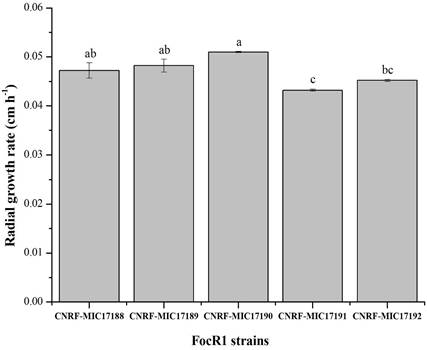
Figure 1 Radial growth rate (RGr) of Fusarium oxysporum f.sp. cubense Race 1 (FocR1) strains in PDA medium, at 192 h. Different letters on bars are significantly different (Tukey; p≤0.05). Means ± standard error, n=3.
Figures 2 to 4 show the quantified enzymatic activities achieved by the five FocR1 strains, at days 7 and 14, by using newspaper, filter paper, and colloidal chitin as carbon sources. By using newspaper, the enzyme production resulted in significant differences (Tukey, α=0.05) among FocR1 strains; the highest cellulase activities (FPase and CMCase) were recorded for strains CNRF-MIC17191 and CNRF- MIC17192 at days 7 and 14 (Figure 2A and B), and the highest chitinase activity was obtained for CNRF-MIC17188 and CNRF-MIC17189, at day 7 (Figure 2C). However, by using filter paper as a carbon source, the strains CNRF- MIC17191, CNRF-MIC17192 and CNRF-MIC17190 at days 7 and 14 respectively, had significant differences (Tukey, α=0.05) on cellulase activities when compared to the rest of FocR1 strains (Figure 3A and B). At day 14, the strains CNRF- MIC17189 and CNRF-MIC17192 showed the highest chitinase activity (Figure 3C). Finally, when chitin was applied as a carbon source, the fungal strains showed significant differences (Tukey, α=0.05) on the enzymatic activity. Strains CNRF- MIC17188 and CNRF-MIC17190, at day 7, and strains CNRF -MIC17188 and CNRF-MIC17189 at day 14, had high FPase, respectively (Figure 4A). In the case of CMCase, the strain CNRF-MIC17192 showed the highest enzyme activity
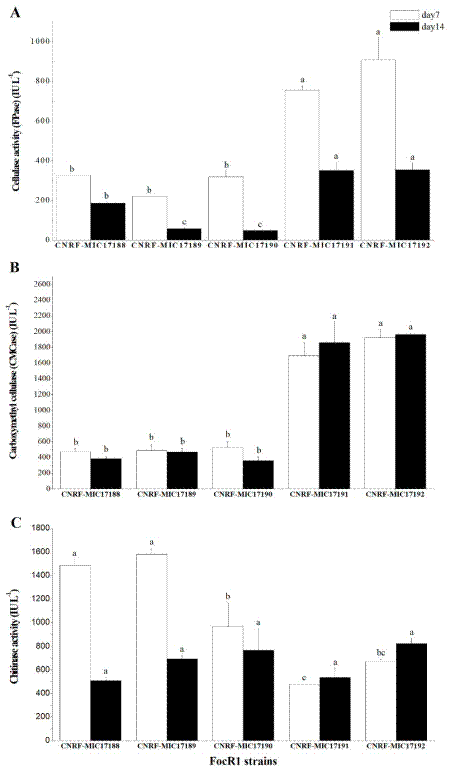
Figure 2 Quantitative enzymatic activity of five strains of Fusarium oxysporum f.sp. cubense Race 1 (FocR1) using newspaper as substrate, at 7 and 14 days. A) Cellulase activity (FPase). B) Carboxymethyl cellulase (CMCase). C) Chitinase activity. Different letters over the bars in the three graphs are significantly different (Tukey; p≤0.05). Means ± standard error, n=3.
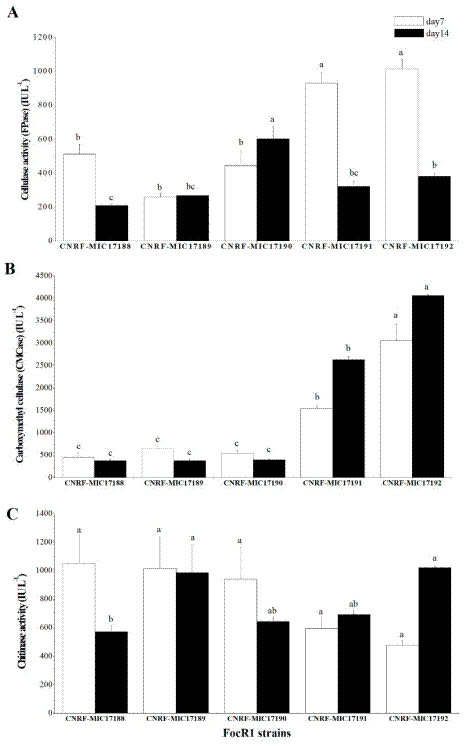
Figure 3 Quantitative enzymatic activity of five strains of Fusarium oxysporum f.sp. cubense Race 1 (FocR1) using filter paper as substrate, at 7 and 14 days. A) Cellulase activity (FPase). B) Carboxymethyl cellulase (CMCase). C) Chitinase activity. Different letters over the bars in the three graphs are significantly different (Tukey; p≤0.05). Means ± standard error, n=3.
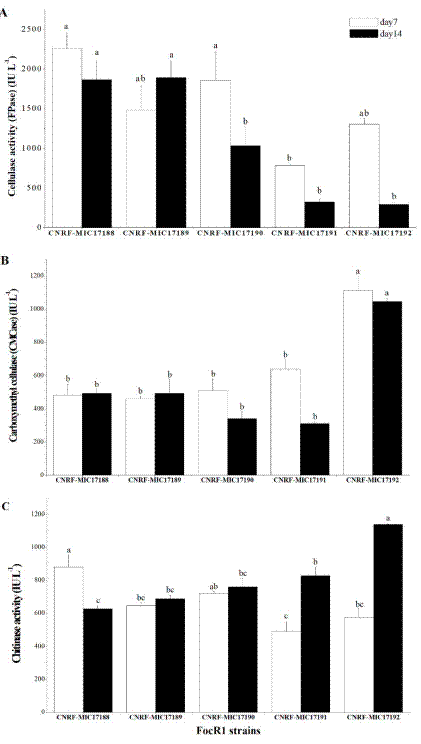
Figure 4 Quantitative enzymatic activity of five strains of Fusarium oxysporum f.sp. cubense Race 1 (FocR1) using chitin as substrate, at 7 and 14 days. A) Cellulase activity (FPase). B) Carboxymethyl cellulase (CMCase). C) Chitinase activity. Different letters over the bars in the three graphs are significantly different (Tukey; p≤0.05). Means ± standard error, n=3.
at both 7 and 14 days (Figure 4B). In addition, strains CNRF-MIC17188 and CNRF-MIC17192, at 7 and 14 days, respectively, showed high chitinase activity (Figure 4C). Overall, results on enzyme activity varied depending on the carbon source and on the fungal strain. Martinez-Pacheco et al. (2020) mentioned that the nutritional requirements of each Fusarium species are specific for producing different enzymatic activities, this is due to the abundance or limitation of macro- or micronutrients throughout the fermentation process that alters fungal physiology; in addition, the nature of organic residues may influence the expression of enzyme mechanisms that intervene in their depolymerization over time.
The highest CMCase activities recorded for strains CNRF-MIC17191 and CNRF-MIC17192 were achieved at 14 days, by using either newspaper (1859 IU L-1) or chitin (1045 IU L-1) as carbon source, respectively. Those values are comparable to those reported by Yuan et al. (2012) who evaluated the cellulase activity from one strain of F. oxysporum by using carboxymethylcellulose as a carbon source in submerged culture (1430 IU L-1). Conversely, the CMCase values mentioned by Yuan et al. (2012) were 2.8 times lower than those recorded in the present study by the strain CNRF-MIC17192 (4063 IU L-1) when filter paper was applied as a carbon source. On the other hand, the best results of FPase activity were obtained for strains CNRF-MIC17191 and CNRF-MIC17192 at day 7, when using newspaper (754 IU L-1 and 906 IU L-1, respectively) and filter paper (930 IU L-1 and 1011 IU L-1, respectively) as carbon source; for strains CNRF-MIC17188 and CNRF-MIC17190 the highest FPase activity was detected at day 7, by using chitin as carbon source (2259 IU L-1 and 1859 IU L-1). These results are comparable to those reported by Ramanathan et al. (2010) who studied the enzymatic capacity of F. oxysporum using 1% carboxymethylcellulose as carbon source at 50 °C and pH 6 for 12 d. Also, Xiros et al. (2009) obtained similar values of FPase activity from F. oxysporum isolated from cumin which achieved maximum values of 850 IU L-1, after 70 h in culture based on corn cobs and brewer spent grains as carbon sources. Likewise, results of FPase by using chitin as a substrate are similar to those reported by da Rosa-Garzon et al. (2019) who carried out a submerged culture with F. oxysporum in which the FPase (~ 2000 IU L-1) was produced at similar levels in casein and feather-meal cultures. Regarding chitinase activity, the most significant results were achieved for strains CNRF-MIC17188 and CNRF-MIC17189 by using newspaper, for strains CNRF-MIC17189 and CNRF-MIC17192 with filter paper, and for strains CNRF-MIC17188 and CNRF-MIC17192 by using chitin as carbon source. There are few scientific reports about the capability of Fusarium species to produce chitinases under submerged cultures (Mathivanan et al., 1998), but some species may release chitinases that are involved for the biocontrol of fungal phytopathogens like Puccinia arachidis (Patil et al., 2000). In this regard, various authors demonstrated the ability of several species of Fusarium to use complex substrates as a carbon source to produce multienzyme complexes under controlled fermentation process in a bioreactor. For instance, F. verticillioides may produce cellulose enzymes by using carboxymethylcellulose or residues of Gamba grass (Andropogon gayanus) as carbon sources in submerged cultures (de Almeida et al., 2019; Vázquez-Montoya et al., 2020). Indira et al. (2016) studied the ability of F. subglutinans to produce cellulases by using pretreated rice straw in Mandel’s media and prepared with fresh water or seawater (277.5 U mL-1 and 126.72 U mL-1, respectively). Martínez-Pacheco et al. (2020) optimized the ability of F. solani to produce extracellular xylanases by using the Box-Wilson design. These enzymes are relevant for biotechnological processes (food, paper and cellulose pulp, textile and chemical industries). Although many fungal enzymes have been selected on their efficiency for biodegrading complex substrates, their large-scale production is influenced by several factors like pH variations, temperature, and enzyme-substrate concentration (Hemansi et al., 2019), which must be studied and standardized to carry out effective scaling-up of such bioprocess. The latter highlights the importance of our research, so that even though some strains of Fusarium are well- known to be as phytopathogens, these fungi may also produce multi-enzymatic extracellular complexes (cellulase and chitinase enzymes, for instance) which can be characterized and purified, and they possess unique characteristics when compared to enzymes produced by other fungal genera. In addition, some saprophytic species of Fusarium have the capability to degrade different substrates (agro-industrial wastes) under controlled submerged cultures in bioreactors, thus these fungal species may reduce the costs of enzyme production, and allow the separation of the fungal biomass from the supernatant that contains the target product throughout a safe bioprocess at different production scales. Nevertheless, the further utilization of Fusarium species or strains may be carefully valorized in order to avoid negative implications when using pathogenic agents, and to concur with certain safety and ecological risk assessments.
In conclusion, this paper showed that carbon sources like newspaper, filter paper and chitin can be efficient inductors for cellulase and chitinase production by Fusarium oxysporum f.sp. cubense race 1 (FocR1) in submerged cultures. These FocR1 strains are promising fungal species for further biotechnological application since these fungi grow fast under controlled submerged conditions with the addition of low-cost substrates thus, secreting and producing important extracellular enzymes.
Acknowledgments
This work was financially supported by the Grant 292399 “Fondo Institucional de Fomento Regional para el Desarrollo Científico, Tecnológico y de Innovación-Consejo Nacional de Ciencia y Tecnología” (FORDECyT-CONACyT).
REFERENCES
da Rosa-Garzon, NG, Laure, HJ, Rosa, JC y Cabral, H (2019). Fusarium oxysporum cultured with complex nitrogen sources can degrade agricultural residues: Evidence from analysis of secreted enzymes and intracellular proteome. Renewable Energy, 133: 941-950. https://doi.org/10.1016/j.renene.2018.10.100 [ Links ]
de Almeida, MN, Falkoski, DL, Guimarães, VM y de Rezende, ST (2019). Study of gamba grass as carbon source for cellulase production by Fusarium verticillioides and its application on sugarcane bagasse saccharification. Industrial Crops and Products, 133: 33-43. https://doi.org/10.1016/j.indcrop.2019.03.008 [ Links ]
De Silva, NI, Brooks, S, Lumyong, S y Hyde, KD (2019). Use of endophytes as biocontrol agents. Fungal Biology Reviews, 33(2): 133-148. https://doi.org/10.1016/j.fbr.2018.10.001 [ Links ]
Florencio-Anastasio, JG, García-Ávila, CJ, Alarcón, A, Ferrera-Cerrato, R, Quezada-Salinas, A, Almaraz-Suárez, JJ, Moreno-Velázquez, M y Hernández-Ramos, L (2022). Effectiveness of antagonistic bacteria, commercial fungicides, and fourth generation quaternary ammonium salts, against Fusarium oxysporum f. sp. cubense race "1 or 2". European Journal of Plant Pathology, 163: 719-731. https://doi.org/10.1007/s10658-022-02510-0 [ Links ]
García-Espejo, CN, Mamani-Mamani, MM, Chávez-Lizárraga, GA y Álvarez-Aliaga, MT (2016). Evaluación de la actividad enzimática del Trichoderma inhamatum (BOL-12 QD) como posible biocontrolador. Journal of the Selva Andina Research Society, 7(1): 20-32. http://www.scielo.org.bo/scielo.php?script=sci_arttext&pid=S2072-92942016000100004 [ Links ]
Ghose, TK (1987). Measurement of cellulase activities. Pure and Applied Chemistry, 59(2): 257-268. https://doi.org/10.1351/pac198759020257 [ Links ]
Hemansi, , Chakraborty, S, Yadav, G, Saini, JK y Kuhad, RC (2019). Comparative study of cellulase production using submerged and solid-state fermentation. En: Srivastava, N, Srivastava, M, Mishra, PK, Ramteke, PW y Singh, RL (eds.). New and Future Developments in Microbial Biotechnology and Bioengineering. Elsevier, 99-113. https://doi.org/10.1016/B978-0-444-64223-3.00007-2 [ Links ]
Hernández-Melchor, DJ, Ferrera-Cerrato, R, López-Pérez, PA, Ferrera-Rodríguez, MR, de Jesús García-Ávila, C y Alarcón, A (2022). Qualitative and quantitative enzymatic profile of native Trichoderma strains and biocontrol potential against Fusarium oxysporum f. sp. cubense Race 1. Journal of Microbiology, Biotechnology and Food Sciences, 11(4): e3264-e3264. https://doi.org/10.55251/jmbfs.3264 [ Links ]
Indira, D, Sharmila, D, Balasubramanian, P, Thirugnanam, A y Jayabalan, R (2016). Utilization of sea water based media for the production and characterization of cellulase by Fusarium subglutinans MTCC 11891. Biocatalysis and Agricultural Biotechnology, 7: 187-192. https://doi.org/10.1016/j.bcab.2016.06.006 [ Links ]
Khan, MA, Khan, SA, Waheed, U, Raheel, M, Khan, Z, Alrefaei, AF y Alkhamis, HH (2021). Morphological and genetic characterization of Fusarium oxysporum and its management using weed extracts in cotton. Journal of King Saud University-Science, 33(2): 101299. https://doi.org/10.1016/j.jksus.2020.101299 [ Links ]
Martínez-Pacheco, MM, Flores-García, A, Zamudio-Jaramillo, MA, Chávez-Parga, MC y Alvarez-Navarrete, M (2020). Optimization of production of xylanases with low cellulases in Fusarium solani by means of a solid state fermentation using statistical experimental design. Revista Argentina de Microbiología, 52(4): 328-338. https://doi.org/10.1016/j.ram.2019.12.003 [ Links ]
Mathivanan, N, Kabilan, V y Murugesan, K (1998). Purification, characterization, and antifungal activity of chitinase from Fusarium chlamydosporum, a mycoparasiteto groundnut rust, Puccinia arachidis. Canadian Journal of Microbiology, 44(7): 646-651. https://doi.org/10.1139/w98-043 [ Links ]
Miller, GL (1959). Use of dinitrosalysilic acid reagent for determination of reducing sugar. Analytical Chemistry, 31: 426-428. https://doi.org/10.1021/ac60147a030 [ Links ]
Mon, YY, Bidabadi, SS, Oo, KS y Zheng, SJ (2021). The antagonistic mechanism of rhizosphere microbes and endophytes on the interaction between banana and Fusarium oxysporum f.sp. cubense. Physiological and Molecular Plant Pathology, 116: 101733. https://doi.org/10.1016/j.pmpp.2021.101733 [ Links ]
Moore, D, Robson, GD y Trinci, AP (2020). 21st century guidebook to fungi. Cambridge University Press. [ Links ]
Pal, N, Kumar, A y Malannavar, AB (2019). Effect of temperature and pH levels on the growth and sporulation of Fusarium oxysporum f. sp. lini causing linseed wilt. International Journal of Chemical Studies, 7(3): 4494-4497. https://www.chemijournal.com/archives/2019/vol7issue3/PartBV/7-3-393-120.pdf [ Links ]
Patil, RS, Ghormade, V y Deshpande, MV (2000). Chitinolytic enzymes: an exploration. Enzyme and Microbial Technology, 26(7): 473-483. https://doi.org/10.1016/S0141-0229(00)00134-4 [ Links ]
Ramanathan, G, Banupriya, S y Abirami, D (2010). Production and optimization of cellulase from Fusarium oxysporum by submerged fermentation. Journal of Scientific & Industrial Research, 69: 454-459. https://nopr.niscpr.res.in/bitstream/123456789/9685/1/JSIR%2069(6)%20454-459.pdf [ Links ]
Scott, JC, Gordon, TR, Shaw, DV y Koike, ST (2010). Effect of temperature on severity of Fusarium wilt of lettuce caused by Fusarium oxysporum f. sp. lactucae. Plant Disease, 94(1): 13-17. https://doi.org/10.1094/PDIS-94-1-0013 [ Links ]
Valle, M, Van Long, NN, Jany, JL, Bregier, T, Pawtowski, A, Barbier, G y Coroller, L (2022). Impact of water activity on the radial growth of fungi in a dairy environment. Food Research International, 157: 111247. [ Links ]
Vargas-Hoyos, HA y Gilchrist-Ramelli, E (2015). Producción de enzimas hidrolíticas y actividad antagónica de Trichoderma asperellum sobre dos cepas de Fusarium aisladas de cultivos de tomate (Solanum lycopersicum). Revista Mexicana de Micología, 42: 9-16. https://www.scielo.org.mx/scielo.php?script=sci_arttext&pid=S0187-31802015000200003 [ Links ]
Vázquez-Montoya, EL, Castro-Ochoa, LD, Maldonado-Mendoza, IE, Luna-Suárez, S y Castro-Martínez, C (2020). Moringa straw as cellulase production inducer and cellulolytic fungi source. Revista Argentina de Microbiología, 52(1): 4-12. https://doi.org/10.1016/j.ram.2019.02.005 [ Links ]
Veloso, J y Díaz, J (2012). Fusarium oxysporum Fo47 confers protection to pepper plants against Verticillium dahliae and Phytophthora capsici, and induces the expression of defence genes. Plant Pathology, 61: 281-288. https://doi.org/10.1111/j.1365-3059.2011.02516.x [ Links ]
Xiros, C, Katapodis, P y Christakopoulos, P (2009). Evaluation of Fusarium oxysporum cellulolytic system for an efficient hydrolysis of hydrothermally treated wheat straw. Bioresource Technology, 100(21): 5362-5365. https://doi.org/10.1016/j.biortech.2009.05.065 [ Links ]
Yuan, L, Wang, W, Pei, Y y Lu, F (2012). Screening and identification of cellulase-producing strain of Fusarium oxysporum. Procedia Environmental Sciences, 12: 1213-1219. https://doi.org/10.1016/j.proenv.2012.01.410 [ Links ]
Received: July 09, 2023; Accepted: December 21, 2023
 Este es un artículo publicado en acceso abierto bajo una licencia
Creative Commons
