




 nueva página del texto (beta)
 Inglés (pdf)
 Artículo en XML
 Referencias del artículo
 Traducción automática
 Enviar artículo por email
 Citado por SciELO
  Similares en
SciELO
Similares en
SciELO 
 Permalink
Dear Editor,
Research is an essential tool for social development. Its outcome must be communicated to the scientific community to acquire applicability. Nowadays, health professionals are encouraged to participate in scientific publications and cultural heterogeneity is a fundamental aspect of the diffusion of different perspectives and realities in their work.1 In this context, bibliometric analysis of neurology articles is very useful for assessing the quantity and quality of research carried out in low- and middle-income countries, such as Latin American countries, in which there is a particular interest in improving scientific production.2,3
In the subject area and category of neurology (clinical), a bibliometric analysis was carried out based on the information available in five leading neurology journals, according to the Scimago Journal & Country Rank (SJR). The aim was to assess the participation of Latin American authors during 2021 in neurology journals with the highest impact factor (according to 2020 metrics). The selected journals were: The Lancet Neurology (SJR: 12,776), JAMA Neurology (SJR: 5,298), Brain (SJR: 5,142), Annals of Neurology (SJR: 4,754), and Neurology (SJR: 2,910). The typology of publications was organized as follows: original articles, reviews (narrative, systematic, and meta-analysis), and other types (any other type of manuscript, e.g. letters to the editor). Collaborative groups were not considered. Metrics and data on the number of published articles, total number of authors, Latin American authors, and publications according to typology were analyzed.
A total of 2463 articles were considered. 38.4% were original articles (n=946), 3.9% were reviews (n=95) and 57.7% were articles included in the category of “other types” (n=1422) (Figure 1). A total of 19,703 authors participated in the aforementioned publications, 1.3% were Latin American authors (n=265) and only 15.5% of them were main authors (n=41/265). Regarding typology, Latin American authors participated more frequently with articles included in the “other types” category (n=182; 12.8%) and seldom with reviews (n=3; 3.2%). In relation to the total number of publications, Latin American authors represented only 10.8%. Annals of Neurology was the journal with the highest participation of Latin American authors, considering the total number of articles published (27.08%) and the total number of authors (2.66%), followed by Neurology in both categories (9.97% and 1.42%, respectively). Neurology included the highest number of articles with Latinos as main authors (n=21/128; 16.4%); although the journal with the highest proportion of Latinos as main authors in relation to the total number of articles with Latino participation was The Lancet Neurology (n=7/10; 70%).
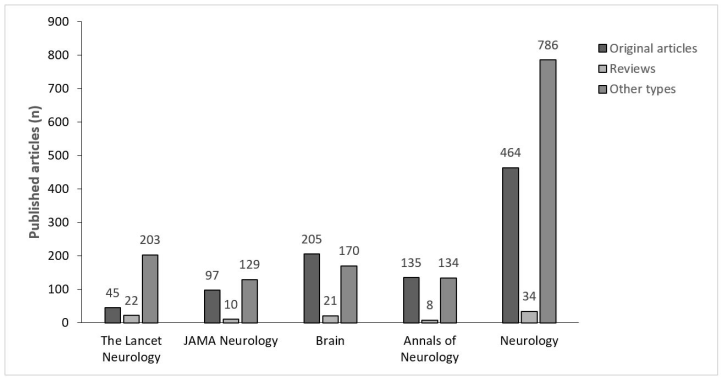
Figure 1 Number of articles published in top neurology journals during 2021, according to text types.
According to the types of articles, Annals of Neurology showed the highest Latino participation over the total of original articles (37.04%), JAMA Neurology in reviews (10%), and Brain in other types (22.94%). During the analyzed period, out of the total articles published, Annals of Neurology was the journal that published the highest proportion of original articles (48.7%), and The Lancet Neurology had the highest proportion of reviews (8.1%) and other types (75.2 %).
The results of this bibliometric analysis offer an overview of the high-quality scientific production of Latin America, insofar as top neurology journals − with a significant global impact − published those studies. According to our findings, Annals of Neurology is the top journal most attractive and with the greatest coverage for Latin American authors, especially with texts other than originals or reviews. Despite this, Latino authors had a low publication rate in 2021 (10.8%). Only 1 out of 10 articles published in top neurology journals included a Latin American author. This represented 1% of the total number of authors.
This information should be considered as a wake-up call to address the long road ahead in promoting scientific development in low- and middle-income countries. Achieving optimal research -- adequate and applicable to its context --, focused on global challenges in the field of neurology, is essential for such purpose. The gap with high-income countries, evident when analyzing high-quality scientific production, often published in top neurology journals, is still very wide. Therefore, it is necessary to radically modify the way neurology research is conducted in Latin America.
Author contributions
Ariel Camilo Marrugo-Ortiz: Conception and design of the study; analysis and interpretation of the data; drafting of the manuscript; critical revision; approval of the final version. Cristina Isabela Ealo-Cardona: Analysis and interpretation of the data; drafting of the manuscript; critical revision; approval of the final version.
Jhony Alejandro Díaz-Vallejo: Analysis and interpretation of the data; drafting of the manuscript; critical revision; approval of the final version.
Wendy Dayanna Cuji-Galarza: Analysis and interpretation of the data; drafting of the manuscript; critical revision; approval of the final version.
Ivan David Lozada-Martínez: Analysis and interpretation of the data; drafting of the manuscript; critical revision; approval of the final version.
Conflict of Interest
The authors declare that they have no conflicts of interest to declare relevant to the research, authorship and/or publication of this article.
Funding
The author(s) received no financial support for the research, authorship and/ or publication of this article.

