




 nueva página del texto (beta)
 Inglés (pdf)
 Artículo en XML
 Referencias del artículo
 Traducción automática
 Enviar artículo por email
 Citado por SciELO
  Similares en
SciELO
Similares en
SciELO 
 Permalink

Introduction
The global prevalence of depression and anxiety is estimated to be 4.4% and 3.6%, respectively, with higher rates among women. In the Americas region, the rates are concentrated at 15% and 21%.1 The COVID-19 pandemic, caused by the SARSCoV-2 virus, has become a trigger for stressful experiences in the general population, leading to the onset or worsening of mental illnesses. Reports have shown an increase in cases of depression, anxiety, psychological distress, and suicidal behavior.2 Following the start of the pandemic in China, there was a rapid increase in negative emotions such as anxiety and depression in the week,3 resulting in a prevalence of 23.8% and 28.8% for depression and anxiety, respectively.4
Over the past few decades, the prevalence of mental disorders in Mexico has been on the rise. According to data from the National Health Survey 2019, 17.9% of adults exhibited depressive symptoms indicative of moderate or severe depression.5 Similarly, there has been an increase in alcohol and illicit substance use before the pandemic.6 The increasing prevalence of mental disorders has had an impact on the demand and supply of mental health services, which is particularly challenging in countries like Mexico where access to these services is limited.7 It is worth noting that the treatment gap for these disorders in Latin American countries can be as high as 80%.8 This study aims to compare the demand for mental health care between June and December in 2019 and 2021 at a public psychiatric hospital in Mexico City.
The Fray Bernardino Álvarez Psychiatric Hospital (HPFBA, for its acronym in Spanish) was the sole medical-psychiatric facility in Mexico City that remained operational throughout the COVID-19 pandemic caused by the SARS-CoV-2 virus.
Method
This study is an observational, descriptive, retrospective comparative study. A non-probabilistic sample was used, consisting of all patient records who sought medical-psychiatric care during the periods of June to December in 2019 and 2021. All patients included in the study were over 18 years of age.
Data Sources
The psychiatric morbidity report from the Biostatistics Service of the HPFBA for the period of June to December 2019 was consulted. This report contains the following data: sex, number of appointments by sex, and diagnostic categories according to the International Classification of Mental and Behavioral Disorders (ICD-10). The diagnostic categories included in the report are: 1) organic mental disorders, 2) mental and behavioral disorders due to psychoactive substance use, 3) schizophrenia, schizotypal, and delusional disorders, 4) bipolar affective disorders, 5) depressive disorders, 6) neurotic, stress-related, and somatoform disorders, 7) personality disorders and behavior disorders in adults, 8) intellectual disability, 9) hyperkinetic disorders, 10) epilepsy.
The database of medical-psychiatric care records from the triage service of the HPFBA for the period of June to December 2021 was consulted. This database contains sociodemographic characteristics (age, sex, place of residence), psychiatric diagnosis according to the ICD-10, and the presence of COVID-19-compatible symptoms. It is important to note that this service started functioning in May 2020 due to the COVID-19 pandemic, but the information was systematized into a database in June 2021. Since the biostatistics service prepares the morbidity report based on the diagnostic categories mentioned above, the diagnoses from the June to December 2021 period were also grouped to compare the variations in demand.
Weekly information on the number of COVID-19 cases in Mexico City during the second half of 2021 was obtained from the daily report by the Federal Government.9
Data analysis
Descriptive statistics, including means, standard deviations, frequencies, and percentages, were employed to summarize the data for each variable. To compare the demand for care between the June-December periods of 2019 and 2021, the psychiatric triage data were categorized based on the diagnostic categories of the ICD-10, and the mean differences were calculated. A significance level of p=<0.05 was considered as the threshold for statistical significance. All statistical analyses were performed using SPSS version 26.
Ethical considerations were duly addressed in this study. The Research Committee of the Fray Bernardino Álvarez Psychiatric Hospital approved the research with registration number CI924-2021. Authorization was obtained from the institution to access, handle, and create the necessary database for the research while ensuring the confidentiality and anonymity of the participants. Informed consent was not required due to the nature of the study.
Results
During the June-December period of 2019, there were a total of 14,602 appointments, with 6,369 requested by males and 8,233 by females. The main reason for consultation was categorized as schizophrenia, schizotypal, and delusional disorders (42.09%), followed by personality disorders (19.5%) and depressive disorders (10.87%) (Table 1).
Table 1 Variations in demand for mental health care between 2019 and 2021
| Demand 2019 | Demand 2021 | Demand 2019 | Demand 2021 | ||||
|---|---|---|---|---|---|---|---|
| Men (n=6369) | Women (n=8233) | Total (n=14602) | Men (n=2614)+ | Women (n=3093)+ | Total (n= 5707) | Variation | |
| n (%) | n (%) | % | n (%) | n (%) | % | % | |
| Diagnosis | |||||||
| Depressive disorders | 392 (6.15) | 1196 (14.53) | 10.87 | 556 (9.74) | 1113 (19.50) | 29.94 | 275.4 |
| Schizophrenia, schizotypal disorders, and delusional disorders | 3749 (58.86) | 2398 (29.13) | 42.09 | 770 (13.49) | 592 (10.37) | 23.87 | 56.7 |
| Neurotic disorders, stress-related disorders, and somatoform disorders | 164 (2.57) | 305 (3.70) | 3.21 | 366 (6.41) | 524 (9.18) | 15.59 | 485.7 |
| Mental and behavioral disorders due to multiple drug use and other psychoactive substance use | 460 (7.21) | 220 (2.67) | 4.65 | 442 (7.74) | 110 (1.93) | 9.67 | 208.0 |
| Personality disorders and adult behavior disorders | 461 (7.23) | 2387 (28.99) | 19.5 | 162 (2.84) | 351 (6.15) | 8.99 | 46.1 |
| Organic mental disorders | 379 (5.95) | 293 (3.56) | 4.6 | 95 (1.66) | 131 (2.30) | 3.96 | 86.1 |
| Bipolar affective disorder | 308 (4.84) | 667 (8.10) | 6.67 | 57 (1.0) | 140 (2.45) | 3.45 | 51.7 |
| Intellectual disability | 84 (1.47) | 76 (1.33) | 2.8 | ||||
| Hyperkinetic disorders | 38 (0.67) | 8 (0.14) | 0.81 | ||||
| Epilepsy | 12 (0.21) | 26 (0.46) | 0.67 | ||||
| Other disorders ** | 121 (1.90) | 341 (4.14) | 3.16 | 32 (0.65) | 22 (0.39) | 0.95 | 30.1 |
| Residence | Accumulated | ||||||
| Mexico City | sd | sd | 1632 (28.60) | 2095 (36.71) | 65.31 | ||
| State of Mexico | sd | sd | 824 (14.44) | 839 (14.70) | 94.45 | ||
| Morelos | sd | sd | 49 (0.89) | 54 (0.95) | 96.25 | ||
| Guerrero | sd | sd | 37 (0.65) | 27 (0.47) | 97.37 | ||
| Hidalgo | sd | sd | 16 (0.28) | 22 (0.39) | 98.04 | ||
| Puebla | sd | sd | 18 (0.32) | 14 (0.25) | 98.60 | ||
| Veracruz | sd | sd | 3 (0.05) | 10 (0.18) | 98.83 | ||
| Querétaro | sd | sd | 4 (0.07) | 8 (0.14) | 99.04 | ||
| Michoacán | sd | sd | 5 (0.09) | 5 (0.09) | 99.21 | ||
| Oaxaca | sd | sd | 9 (0.16) | 0 (-) | 99.37 | ||
| Other states** | sd | sd | 17 (0.30) | 19 (0.33) | 100.00 |
*Includes: psychological developmental disorders; behavioral syndromes associated with physiological disturbances and physical factors; unspecified organic or symptomatic mental disorders; problems related to management; onset and maintenance of sleep disorders; intentional self-harm; problems related to primary support group difficulties; problems related to other psychosocial circumstances.
**Includes population from Oaxaca, Guanajuato, Tlaxcala, Chiapas, Sinaloa, Jalisco, Baja California, Tabasco, Nayarit, Tamaulipas, and Zacatecas; as well as from foreign countries (Chile, El Salvador).
+t = -0.337, p = 0.714 (95% CI -314.0 - 226.9), nd = no data
In the June-December period of 2021, there were a total of 5,707 cases, with a distribution of 2,614 males (45.8%) and 3,093 females (54.2%). The mean age was 37.6 years (SD=15.0; min-max: 18-92) (Table 1). The main reason for consultation during this period was depressive disorders, followed by psychotic disorders, as well as neurotic and stressrelated disorders; another frequent reason was substance use disorders. There were no statistically significant differences between males and females in relation to diagnoses; however, affective disorders (depression and bipolar) and neurotic, stress-related, and somatoform disorders were more common in females. On the other hand, psychotic disorders (schizophrenia, schizotypal disorders, delusional disorders) and substance use disorders were more common in males.
Table 1 shows that there was a significant increase in demand for substance use disorders (208%), depressive disorders (275%), and neurotic disorders (mainly anxiety, 485%) when comparing the two periods. In contrast, there was a decrease of 56.7% in demand for care for patients with schizophrenia and 51.7% for bipolar disorders.
The population seeking care predominantly resided in Mexico City, the State of Mexico, and Morelos, which together accounted for 96.25% of the total. A very low percentage of patients (0.9%) reported symptoms compatible with COVID-19 (Table 1).
When comparing the total demand, it was observed that in 2021, it decreased by more than 50% compared to the same period in 2019 (Table 2); the months of June, September, and November had the most drastic reductions. The differential demand for care was -5,830 appointments, with statistically significant differences (p=<0.05).
Table 2 Comparison of demand for mental health care between 2019 and 2021
| Care demand 2019 | Care demand 2021 | Differential | Daily COVID-19 Cases | |
| Mean (SD) | Mean (SD) | t(CI 95%) | ||
| Total | 11570 (1652.8 +/-188) | 5740 (676.7+/-) | 3.137 (254.3-1411-4)* | |
| June | 1395 | 164 | -1231 | 564 |
| July | 1749 | 2004 | 255 | 1607 |
| August | 1858 | 1284 | -574 | 3158 |
| September | 1707 | 333 | -1374 | 1460 |
| October | 1837 | 1145 | -692 | 398 |
| November | 1609 | 323 | -1286 | 176 |
| December | 1415 | 487 | -926 | 607 |
| *p=0.009 | ||||
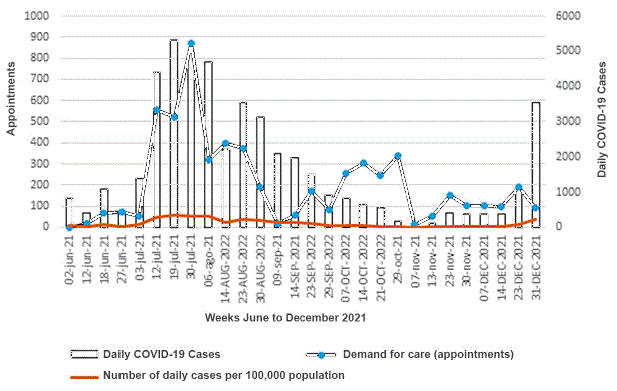
When comparing the daily number of COVID-19 cases in Mexico City between June and December 2021 with the demand for care, a notable pattern emerged. It was observed that the demand for care tended to increase during weeks with a higher number of infections. This trend persisted until September and then showed some fluctuations, with irregular increases observed throughout October (see Figure 1).
Discussion
The June-December period of 2021 witnessed a notable 50% reduction in the total demand for mental health care compared to the same period in 2019. This decline aligns with the 100% reduction in new and subsequent consultations reported by the General Directorate of Health Information in 2020,10 confirming the persistence of this trend throughout 2021.
This decrease in demand can be attributed to mobility restrictions and reduced staff in mental health centers and psychiatric hospitals, which limited access to health services. Similar trends of decreased demand were observed in psychiatric hospitals in Spain, where demand decreased by 58% compared to 2019.11
Despite the overall decrease in demand, certain mental disorders exhibited increasing trends. Depression and anxiety showed a significant increase in demand, with the latter quadrupling. Substance-related disorders also displayed a rising trend. While some studies reported an increase in the prevalence of anxiety disorders during the pandemic, others indicated no significant changes in alcohol consumption.12,13 Furthermore, there was a confirmed increase in the number of mental disorder cases proportionate to the reported rise in COVID-19 infections, consistent with findings from other studies.14
One dire consequence of the lack of mental health care is suicide. Mexico was already experiencing a steady increase in suicide deaths, which was exacerbated by the reduction in mental health services during the pandemic. The demand for care related to depression and anxiety quadrupled, while the demand for psychotic disorders decreased. This likely contributed to the highest number of suicide cases reported since 1994, with 7,896 cases in 2020.15
Another crucial aspect to consider is the accessibility of mental health services. Our results showed that only 65% of individuals seeking care at the hospital were residents of Mexico City, indicating that 35% were unable to receive care in their local areas. This issue should be addressed through policies that aim to enhance actions and improve access to mental health services at the primary care level.16
Conclusions
Based on these findings, it is evident that there has been a reduction in the demand for mental health care and an increase in the demand for depressive and neurotic disorders. Mental health services face significant challenges in addressing this demand and developing strategies to meet the accumulated needs. The findings of this study provide insight into the situation in the country, considering the role of the Fray Bernardino Álvarez Psychiatric Hospital, which attends to approximately 15% of outpatient consultations nationwide7 and remained operational throughout the pandemic. However, further research is necessary to estimate the impact of mobility restrictions and the shortage of mental health professionals (such as doctors, nurses, psychologists, and social workers) in the context of the pandemic. Acknowledgments
The authors would like to thank the authorities of the Fray Bernardino Álvarez Psychiatric Hospital.

