




 nueva página del texto (beta)
 Inglés (pdf)
 Artículo en XML
 Referencias del artículo
 Traducción automática
 Enviar artículo por email
 Citado por SciELO
  Similares en
SciELO
Similares en
SciELO 
 Permalink

INTRODUCTION
The diagnostic performance of artificial intelligence (AI) assessing mammographic breast density (MBD) is comparable to that of radiologists, and synergies may exist between the two1-3. The Food and Drug Admini stration (FDA) approved AI Quantra v.2.2.2 for MBD assessment. It quantifies the densest area based on the Breast Imaging Reporting and Data System (BI-RADS) 5th Edition4. AI software for MBD assessment has potential benefits and risks, as radiologists may be distracted, leading to more errors in image diagnosis5-7. Therefore, an automated AI method such as Quantra software could have greater reproducibility and accuracy in classifying MBD. However, Quantra AI was not developed for MBD assessment of women with breast implants8.
Intra- and interobserver agreement between radio logists and Quantra AI has been reported in women without implants3,5, and when women with and without implants are compared9. In a previous report, we compared the diagnostic performance of AI Quantra and an experienced radiologist in MBD assessment without differentiating women with and without implants5.
Previous studies have shown better diagnostic per formance of Quantra AI in two categories (non-dense and dense)10,11. Mammographic sensitivity decreases in women with dense breasts and implants12,13. The dense (c+d) category has a higher risk of cancer, and additional examinations must be performed. This study compared the diagnostic performance of Quantra AI software with that of an experienced radiologist as the gold standard in MBD assessment of dense categories (c+d) in women with and without breast implants.
MATERIAL AND METHODS
This prospective cohort study was conducted from May 2 to June 30, 2022, in the Breast Imaging Department of the Centro de Diagnóstico Especializado por Imagen in Zapopan, Jalisco, Mexico. An experienced radiologist with training in breast imaging and current certification by the Mexican Council of Radiology and Imaging participated in the study. Consent was obtained from the radiologist who participated in the study.
Study development and variables
Screening or diagnostic mammograms of women aged 35 years and older with and without breast implants were analyzed from a previously published study9 corres ponding to phase 1. The dense MBD category (c+d) was based on the American College of Radiology BI-RADS 5th Edition4. Sex and years of experience as a radiologist performing breast imaging examinations were recorded.
Digital mammography and digital breast tomosynthesis
Images were acquired using Selenia Dimensions equipment (Hologic, Bedford, MA, USA) with automatic acquisition parameters. Images were stored and reviewed in PACS (SecureView, Diagnostic Workstation, Bedford, MA, USA). Conventional projections, two craniocaudal (CC) and two mediolateral oblique (MLO) images of both breasts, were obtained. Images with implant displacements were evaluated in women with breast implants. MBD was classified according to the 5th Edition of BI-RADS based on the densest area of fibroglandular tissue in the dense breast (c+d), category c, heterogeneously dense, and category d, extremely dense.
Quantra AI software
The mammography images were analyzed with Quantra AI version 2.2.2 (Hologic Inc., Bedford, MA, USA). AI Quantra analyzes MBD in images with implant displacements. The assessment is based on the distribution and texture of the fibroglandular tissue pattern, with an estimate of breast composition by selecting the densest category according to BI-RADS 5th Edition.
Statistical analysis
Sensitivity, specificity, positive predictive values, negative predictive values, and accuracy were calculated to evaluate the diagnostic performance of Quantra AI compared to an experienced radiologist as the gold standard. The statistical analysis was performed with SPSS v.25 (IBM Corp., Armonk, NY, USA).
RESULTS
The radiologist with 32 years of experience reads approximately 90 mammograms per week and spends 50 hours performing various breast examinations and procedures (including mammography, ultrasound, MRI, biopsies, and breast marking). A total of 678 mammograms were analyzed, 130 mammograms with breast implants and 548 mammograms without breast implants.
Table 1 shows the diagnostic performance of AI Quantra compared to an experienced radiologist in assessing MBD in women with dense breasts (c+d) and breast implants. The sensitivity of AI Quantra in assessing dense categories (c+d) in women with breast implants (n = 130) was low (30.6%, 95% CI 18.2-45.4). Specificity was high (98.8%, 95% CI, 93.3-99.9) while accuracy was 73.1% (95% CI, 64.6-80.5).
Table 1 Diagnostic performance of AI Quantra compared to an experienced radiologist as the gold standard in MBD assessment of dense categoriesa in women with breast implants
| Parameter | % | 95% CI |
|---|---|---|
| Sensitivity | 30.6 | 18.2-45.4 |
| Specificity | 98.8 | 93.3-99.9 |
| Positive predictive value | 93.7 | 67.1-99.1 |
| Negative predictive value | 70.2 | 66.1-73.9 |
| Accuracy | 73.1 | 64.6-80.5 |
ac+d categories; AI: artificial intelligence; BI-RADS: Breast Imaging Reporting and Data System; MBD: mammographic breast density; CI: confidence interval.
Figure 1 shows a mammogram with concordance between Quantra AI and the radiologist in classifying dense (c+d) MBD categories in a woman with breast implants. In contrast, Figure 2 shows that Quantra AI underestimates or overestimates dense MBD categories compared to the radiologist in a patient with breast implants.
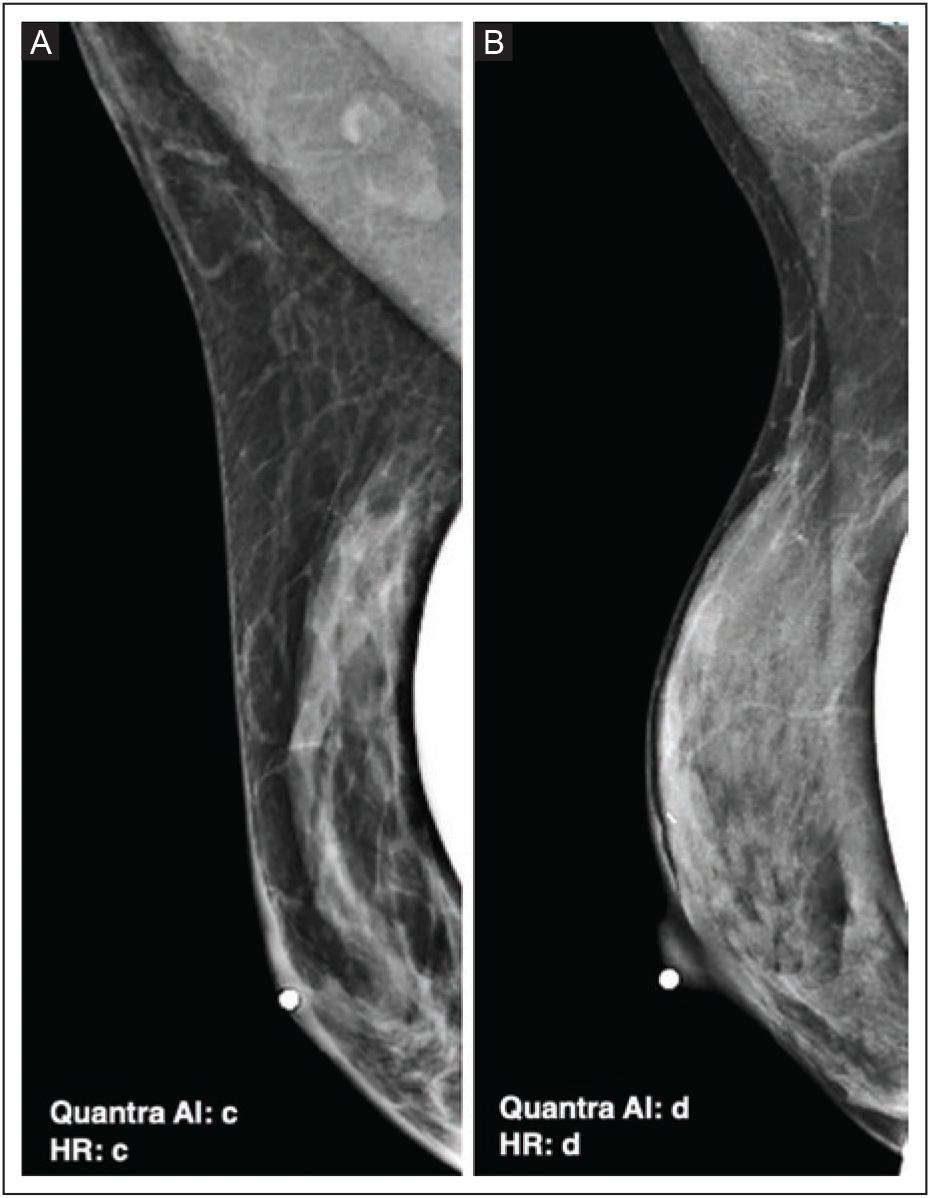
AI: artificial intelligence; BI-RADS: Breast Imaging Reporting and Data System; MBD: mammography breast density; HR: human reader; MLOID: mediolateral oblique implant displacement.
Figure 1 Mammogram of a woman with breast implants. A and B: the MLOID views of the right breast show concordance between Quantra AI and an experienced radiologist (HR) in the classification of dense (c+d) MBD categories using BI-RADS 5th Edition: category c, heterogeneously dense; and category d, extremely dense.
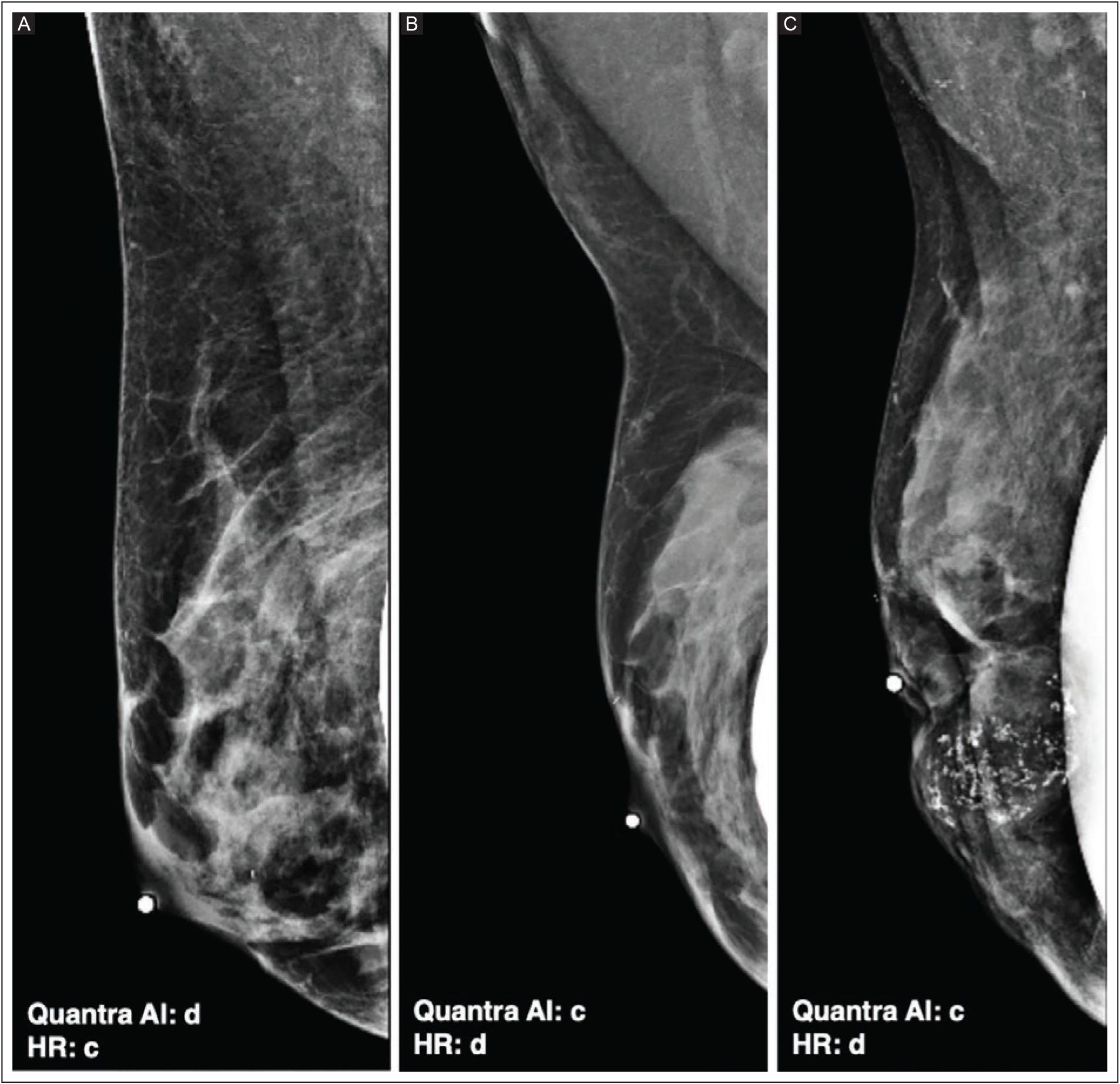
AI: artificial intelligence; BI-RADS: Breast Imaging Reporting and Data System; HR: human reader; MBD: mammography breast density; MLOID: mediolateral oblique implant displacement.
Figure 2 Mammogram of a woman with breast implants. A, B, and C: the MLOID views of the right breast show no concordance between Quantra AI and an experienced radiologist (HR) in the classification of dense (c+d) MBD categories using BI-RADS 5th Edition: category c, heterogeneously dense; and category d, extremely dense.
Table 2 shows the diagnostic performance of Quantra AI compared to an experienced radiologist as the gold standard in MBD assessment of dense categories (c+d) in women with dense breasts without breast implants. Sensitivity was high (95.2%, 95% CI 92.1-97.3), while specificity was low (62.6%, 95% CI 56.1-68.8). Accuracy was 81.0% (95% CI, 77.5-84.2).
Table 2 Diagnostic performance of AI Quantra compared to an experienced radiologist as the gold standard in MBD assessment of dense categoriesa in women without breast implants
| Parameter | % | 95% CI |
|---|---|---|
| Sensitivity | 95.2 | 92.1-97.3 |
| Specificity | 62.6 | 56.1-68.8 |
| Positive predictive value | 76.8 | 73.7-79.6 |
| Negative predictive value | 90.8 | 85.7-94.3 |
| Accuracy | 81.0 | 77.5-84.2 |
ac+d categories; AI: artificial intelligence; BI-RADS: Breast Imaging Reporting and Data System; MBD: mammographic breast density; CI: confidence interval.
Figure 3 shows the mammogram of a woman without breast implants, with concordance between Quantra AI and the radiologist in classifying the dense (c+d) MBD categories. In contrast, Figure 4 shows that the Quantra AI underestimates or overestimates the dense MBD categories compared to the radiologist in a patient without breast implants.
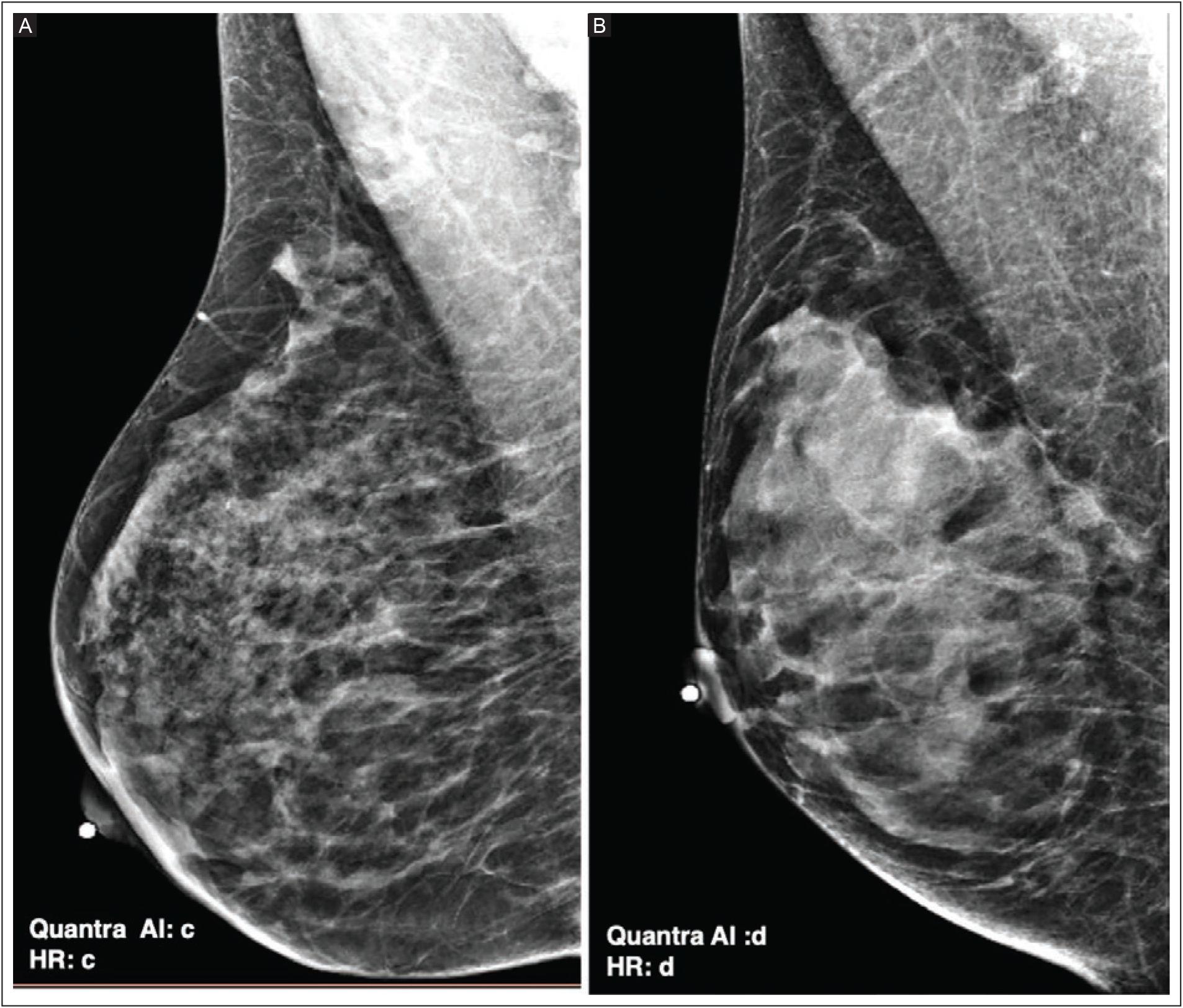
AI: artificial intelligence; BI-RADS: Breast Imaging Reporting and Data System; MBD: mammography breast density; HR: human reader; MLO: mediolateral oblique.
Figure 3 Mammogram of a woman without breast implants. A and B: the MLO views of the right breast show concordance between Quantra AI and an experienced radiologist (HR) in the classification of dense (c+d) MBD categories using BI-RADS 5th Edition: category c, heterogeneously dense; and category d, extremely dense.
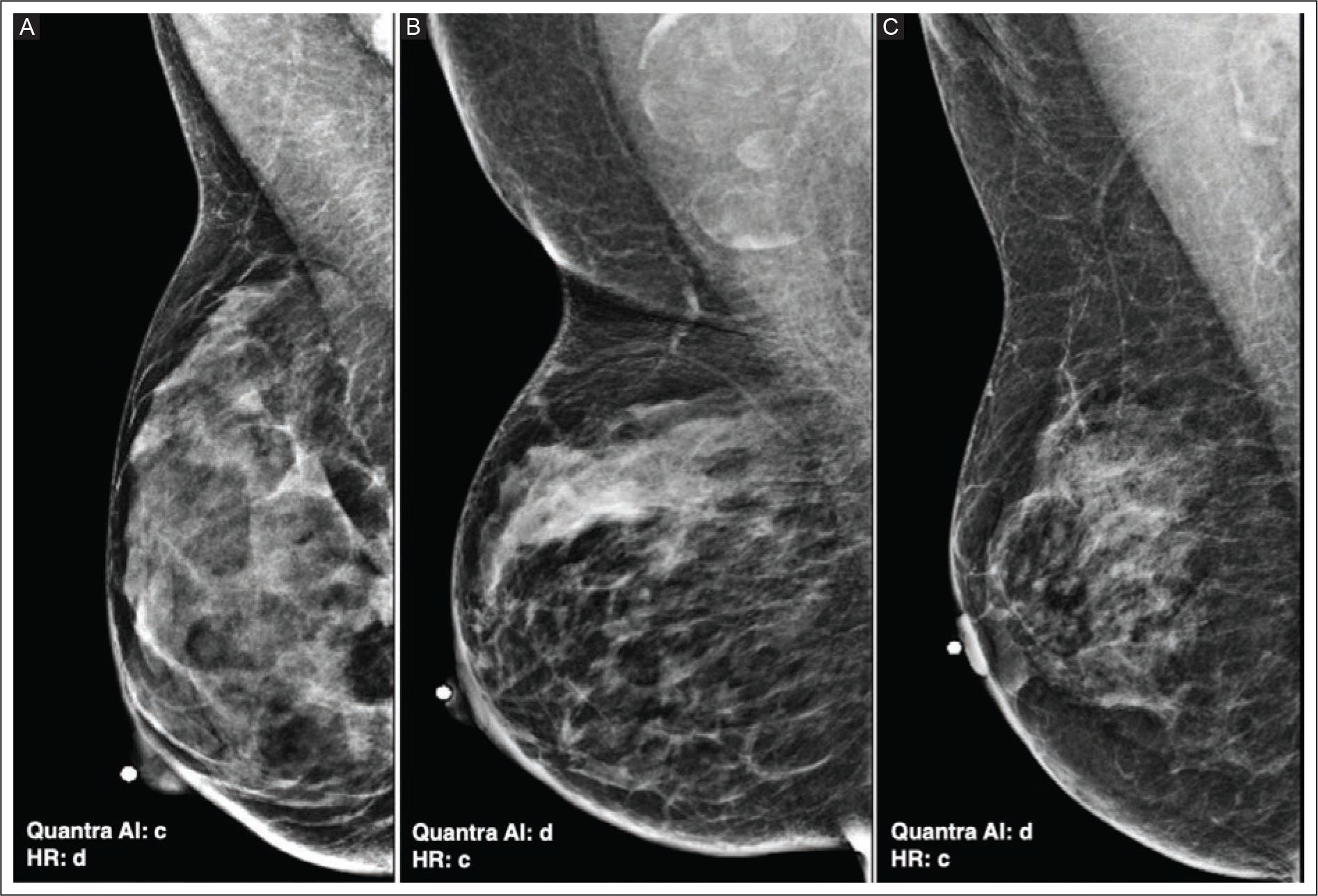
AI: artificial intelligence; BI-RADS: Breast Imaging Reporting and Data System; HR: human reader; MBD: mammography breast density; MLO: mediolateral oblique.
Figure 4 Mammogram of a woman without breast implants. A, B, and C: the MLO views of the right breast show no concordance between Quantra AI and an experienced radiologist (HR) in the classification of dense (c+d) MBD categories using BI-RADS 5th Edition: category c, heterogeneously dense; and category d, extremely dense.
DISCUSSION
Our study showed unacceptably low sensitivity in the diagnostic performance of the current version of Quantra AI in MBD assessment in dense categories (c+d) in women with breast implants. In contrast, its sensitivity in assessing dense MBD categories (c+d) in women without breast implants was high. This report is the first comparing Quantra AI and an experienced radiologist in MBD assessment of women with dense breasts with and without breast implants.
Quantra AI has not been sufficiently tested for the evaluation of MBD in women with implants, and there are no reports evaluating its diagnostic performance. In our previously published study9, we examined 678 women, 130 with breast implants and 548 without breast implants. Quantra AI classified dense categories in 114 (87.7%) of 130 women with breast implants and four radiologists in 81 (62.3%), whereas in women without breast implants, Quantra AI classified dense categories in 384 (70.1%) of 548 and radiologists in 310 (56.6%) of 548 mammograms; the concordance between Quantra AI and four radiologists was better in women without breast implants. On the other hand, the interobserver agreement between four radiologists and Quantra AI in dense categories was slight to fair in women with breast implants. In contrast, it was moderate in women without breast implants. These results suggest that the interobserver agreement between the radiologists and Quantra AI was unacceptable in dense MBD categories in women with breast implants. This study showed comparable results in the diagnostic performance of Quantra AI with that of an experienced radiologist as the gold standard in MBD assessment of dense categories (c+d) in women with breast implants. The sensitivity of Quantra AI was unacceptably low (30.6%). This result means that Quantra AI does not detect dense breasts in 7 out of 10 women with breast implants. We therefore confirmed the manufacturer's recommendation that Quantra AI can process images with breast implants, although it was not designed for this purpose and may inaccurately report MBD in women with breast implants.
There are few reports on the diagnostic performance of AI Quantra in MBD assessment1,10,11. Epko et al.11 compared the previous version of AI Quantra (v2.0) with a majority radiologist-generated report as the gold standard for MBD assessment. Sensitivity was 91.3% and specificity was 83.6% for the two MBD categories (a+b vs. c+d). Although the authors did not specify whether the women had implants or not, the diagnostic performance of AI Quantra was high, especially in the two MBD categories. They concluded that the diagnostic performance of AI Quantra reproduced the BI-RADS classification for two MBD categories very well. In our study, using the current AI Quantra version (v2.2.2) as a comparison to an experienced radiologist, we found high sensitivity (95.2%) for dense breasts in women without breast implants, with a specificity of 62.6%. As Quantra AI version was a different version, it showed a higher sensitivity with the new version of the software. There is no doubt about the added value that AI can bring to diagnostic imaging, especially in the assessment of MBD.
The strengths of this study are its prospective design and sample size. However, the limitations of the study were that it was a single-center study, only one experienced radiologist participated, and a single mammography unit recorded all mammograms. On the other hand, Quantra AI was the only software evaluated at our center.
CONCLUSION
The diagnostic performance of the current version of Quantra AI in MBD assessment in dense categories (c+d) had unacceptably low sensitivity in our study of women with breast implants. In contrast, the sensitivity of Quantra AI in assessing dense MBD categories (c+d) in women without breast implants was high. Therefore, it is important to have an AI tool with better diagnostic performance in women with breast implants. We hope a new version of Quantra AI software will be available for use in women with implants, as the number of women with implants is increasing.

