




 texto en
  Inglés (pdf)
 Artículo en XML
 Referencias del artículo
 Traducción automática
 Enviar artículo por email
 Citado por SciELO
  Similares en
SciELO
Similares en
SciELO 
 Permalink

1. Introduction
The Internet and mobile technologies have greatly changed how people communicate, especially through social media, which allows interactive conversations and direct, ongoing contact between senders and receivers (Cardoso & Schweidler, 2014; Li et al., 2019). In journalism, a key issue has been the growth of unmediated information sources on social media, where message verification is often missing, making these sources the primary ones (Coleman et al., 2012; Alonso-González, 2019). Additionally, the rise of new digital channels has led to the creation of new formats and stories, with audiences becoming more segmented and choosing platforms that match their preferences. Mainstream media often respond to these changes by exploring new platforms and formats. However, these efforts are often limited by factors like funding, willingness to innovate, human resources, and audience trends and habits (Sidorenko-Bautista et al., 2020). Usually, large segments of audiences are categorized by age groups called “generations,” which are defined by cultural trends and events that create a global divide between social groups (Parry & Urwin, 2011).
Lu (2021) notes that COVID-19 reinforced the digital culture of certain generations, solidifying their content consumption habits and shaping the development of formats. For digital audiences like Millennials and Generation Z, the smartphone’s dominance as the main tool for communication, information, and entertainment drives the “verticality” of their preferred digital formats (Fundación Telefónica, 2020; IAB, 2025; Ma et al., 2019). Snapchat transformed digital communication in 2011 by recognizing smartphones as the primary interaction device, leading to the creation of “express communication” or “ephemeral communication” with short posts (10 seconds) and a maximum lifespan of 24 hours. This concept evolved into the “stories” feature popular on platforms like Instagram, which provides full-screen content that blocks other device stimuli (Blasco-Doñamayor, 2021). This format requires high visual stimulation from broadcasters due to the quick pace of messages and constant exposure to posts (Bayer et al., 2016; Yang et al., 2019).
Digital communication has advanced, requiring media and journalists to adapt in order to preserve and grow their influence across various audiences. This change often involves modifications in work routines, communication channels, message styles, and the roles of those involved (Deggen et al., 2024; Herranz-de-la-Casa et al., 2019).
1.1. TikTok and the new paradigm of ephemeral communication
In 2020, TikTok became a major global digital trend (Sidorenko-Bautista et al., 2020), primarily driven by COVID-19 lockdowns, which led people to seek new tools for information, communication, and entertainment. Originating in China in 2016 from Music.ly, with influences from Dubsmash, Snapchat, and Vine, TikTok provides a dynamic, visually engaging platform centered on creativity and quick content creation and consumption (Li et al., 2019; Yang et al., 2019). It now has over 800 million users worldwide and was the most downloaded mobile app in early 2020, a trend that continued into early 2021 (Ditrendia, 2020; Chan, 2021). Available in 154 countries and more than 75 languages (Villena-Alarcón et al., 2020; Xiang, 2018), its user base mainly consists of ‘Generation Z’ (IAB, 2024; Li et al., 2019; Yang et al., 2019), but there was a notable increase in Millennial and ‘Generation X’ users during the pandemic (Sidorenko-Bautista et al., 2021). TikTok’s significance is demonstrated by its inclusion in the Brand Z ranking of the top 100 companies worldwide (Kantar, 2020), its position as the sixth most popular social app globally (Sehl, 2020), and its rank as the sixth most used social network in Spain up to early 2021 (IAB, 2024).
And while it is true that these posts mainly focus on playbacks, funny stories, and “mind-soothing” content (Feng et al., 2019), there is evidence of a significant rise in new content such as recipes, ‘micro-tutorials,’ ‘micro-documentaries,’ and reports.
Unlike other social networks, TikTok’s concept of ephemeral communication involves content that lasts up to 15, 60, or 180 seconds by default, with a minimum of 3 seconds, and features an exclusively vertical format.
The algorithm that manages TikTok’s content recommendation and visibility is an AI system that evaluates each post individually. As a result, TikTok favors ‘micro-influencers’ over traditional influencers on other platforms, depending on the success of specific content-a trend that grew during the COVID-19 lockdowns (Abidin, 2020). TikTok’s algorithm does not prioritize profiles with large followings over those with fewer followers. It boosts a post’s expo-sure on the “For You” feed through consistent engagement, but stops promoting it organically once engagement decreases.
Several factors influence content visibility on TikTok: user viewing time, comments, ‘likes’, shares across digital channels, background audio use and type, and hashtags. Audios, although designed to accompany videos, now also promote emerging and established artists, helping them spread virally faster compared to traditional radio or the initial use of music-on-demand platforms.
1.2. Digital and community journalism
Digital resources have significantly impacted journalism in both work practices and content creation (Canavilhas, 2007). Audience expectations now focus on visually compelling content and audiovisual options on social media (Westley & Rulyova, 2017). Consequently, media outlets and journalists increasingly customize their work to align with each digital platform’s narrative style, resulting in “interrelated mutations” among organization, audience, and technology (Boczkowski, 2011, p. 11). The audience actively interacts with and reproduces messages. The challenge is that the success and visibility of social media posts, including journalistic ones, depend on user engagement, promoting a ‘likes’ culture. Media no longer hold a monopoly on information and are evolving through mutual adaptation with users (Gómez, 2019; Manfredi-Sánchez et al., 2019), who are less loyal and more sporadic in their news consumption (Casero-Ripollés, 2020, p. 10). Today, users face information overload, shifting from actively seeking news to feeling overwhelmed by it (Salaverría, 2018). Audiences influence which content becomes prominent, a process embedded in social media recommendation algorithms (Sidorenko-Bautista & Garrido-Pintado, 2021). Information consumption has become multiscreen, encouraging the adoption of transmedia models (Castellet et al., 2013).
The long-standing crisis in journalism has driven the need for rapid innovation, pushing the industry to embrace higher levels of creativity (Anguí et al., 2019; Nee, 2013; Serrano, 2017). This innovation relies on technological progress, especially those that enable mobility and ‘neo-nomadism’ among individuals (Giddens, 2003; Hill & Bradshaw, 2019; Hjelm, 2000; Sidorenko-Bautista & Garrido-Pintado, 2021; Urry, 2000). Internet journalism now involves creating new digital-specific formats and narratives, expanding the diversity of digital storytelling and journalistic techniques (Manfredi-Sánchez & Artero, 2014; Alonso et al., 2021).
The journalism crisis varies by scope-whether international, national, regional, local, or hyperlocal. From the regional level downward, additional challenges include lack of internet access and aging populations disconnected from digital resources, which hinder digital strategies aimed at reaching new audiences (Jerónimo, 2015; Ramos & Grupillo, 2020). Despite these issues, community journalism must work to adapt to new digital formats and connect with these emerging audiences (Camponez, 2017).
Ultimately, the media and journalists also become influencers of the culture and quirks of the environment they cover. TikTok has become a lively and influential platform for showcasing the cultural heritage of places, especially targeting broader audiences (Chalipah et al., 2025; Haitao et al., 2024), which can influence other trends such as increased tourism and the development of the place’s brand (Huttayavilaiphan, 2024).
2. Methods
With TikTok’s global growth and the inclusion of new user groups beyond ‘Generation Z,’ various actors have adopted the platform’s narrative style to create niches. Since 2020, journalists have increasingly started using TikTok, although this trend remains in its early stages. Their content often features short videos with visual elements like stickers and emojis, frequently presented as infotainment (Sidorenko-Bautista & Herranz-de-la-Casa, 2020; Vásquez-Herrero et al., 2020).
The main goal of this research is to analyze the presence, activity, and narrative strategies of the Spanish local and hyperlocal press on TikTok during 2021 and its development through December 2024. As secondary objectives, the following are proposed:
SO1. Quantify how many Spanish local and hyperlocal media have active profiles on TikTok, and describe their level of activity (total posts, frequency, followers, likes).
SO2. Identify and classify content types (journalistic vs. non-journalistic) and the main themes (social, events, sports, economy, culture, etc.).
SO3. Assess how well the format fits TikTok, considering whether it is native or reused, horizontal or static, and examine narrative features like effects, transitions, interactions, and use of sound.
SO4. Compare the activity trends between August 2021 and December 23, 2024, at both the aggregate level and by medium.
SO5. Examine the connection between posting frequency and engagement metrics (followers, likes), as well as the link between content type and engagement.
Based on this, the research questions are:
RQ1. What is the extent of implementation and level of activity of the Spanish local and hyperlocal press on TikTok, and how has it evolved from 2021 to 2024?
RQ2. What types of content, themes, and narrative elements are most common in the posts, and how well are they adapted to TikTok’s native format?
RQ3. How does the frequency and type of publication relate to the engagement metrics (followers, likes) of local media on TikTok?
Using the “prensaescrita.com” list of print media by the Autonomous Region in Spain, we checked which local Spanish newspapers are on TikTok. We reviewed 705 newspapers across 18 major regions: Andalusia, Aragon, Asturias, Balearic Islands, Cantabria, Castilla y León, Castilla-La Mancha, Canary Islands, Catalonia, Ceuta and Melilla, the Madrid region, the Valencia region, Extremadura, Galicia, La Rioja, Murcia, Navarre, and the Basque Country, excluding regional publications.
The activities of these profiles were coded to identify content strategies, topics, and narrative elements.
Strategy or purpose of content
Non-journalism (NJ): advertising the medium itself or products and services (AD), humor and satire (HS), behind the scenes (BS), Journalism (J),
other (O).
Subjects used
Sports news (SN)
Economic news (EN)
Political news (PN)
Social news (SocN)
Cultural events & Science (CES)
Natural phenomena (NP)
Traditional festivities (TF)
Other non-journalistic (ONJ)
Promotion of the medium (PM)
Medium work routines (WR)
Events (E)
Narrative aspects
Content that does not adapt to the interface of the social network because it has been exported with other dimensions from an app or editing program (COD).
Content from other social media (COSM)
Effects and transitions (ET)
Interactions such as polls, duets, tags, answers, and pasted video (INT)
Full-screen vertical image (VI)
Sounds and/or music (SM)
To ensure objectivity and consistency in applying the analysis categories, an intercoder reliability test was performed based on the content theme variables, which were later displayed in Figure 1. Two researchers independently coded a random 10% subsample of the total collected publications (N=41).
Next, the results were calculated using Cohen’s Kappa statistical method (Cohen, 1960) (see Annex 1) to assess the agreement between the two evaluators on nominal scales. To facilitate calculations and obtain results, the online tool GraphPad (graphpad.com), specialized in Kappa quantification, was used.
The initial coefficient was K = 0.20, indicating a slight initial agreement (Landis & Koch, 1977). Although this coefficient is low, it should be interpreted considering the small test subsample and the uneven distribution of cases across multiple categories, which is known to lower Kappa values even when the percentage of agreement is moderate. The simple measure obtained was Po = 0.336.
Following this result, calibration sessions were held to review category definitions and standardize coding criteria. Full recoding of the dataset was not practical; therefore, in cases of uncertainty, coders used consensus coding to ensure consistency in the final dataset. This approach is considered acceptable in exploratory and early-stage research (Wongpakaran et al., 2013), as it balances methodological rigor with practical constraints.
To improve robustness in future research, it is advised to supplement Cohen’s Kappa with other agreement metrics that are less affected by prevalence and marginal distribution effects, such as Gwet’s AC1 (Wongpakaran et al., 2013) or Krippendorff’s α (Krippendorff, 2011). The current results should be seen as preliminary and indicative, serving as a basis for refining the coding scheme in later stages of research.
Although the low initial reliability might impact the robustness of the results, mitigation strategies like calibration and consensus were used, since this is an exploratory and early-stage study. Its findings should be seen as preliminary and referential, with some differences possibly stemming from variations in how the categories are interpreted, despite the observations and discussions carried out by the researchers.
The sample was observed and analyzed in 2021 as part of another research project, within the context of establishing the platform as a new digital channel with global reach, following the scenario set by COVID-19 in 2020. These data have been compared up to December 23, 2024, to determine whether there has been a continuation, evolution, or mere suspension of the journalistic work of these media through this channel. This date marks the conclusion of the research update for publication purposes.
3. Results
We identified 20 local newspapers with active profiles and content on TikTok up to August 31, 2021 (see Table 1). Notably, ABC Sevilla, Levante-EMV, Valencia Plaza, Viladecans News, Gavà Info, Mijas Comunicación, La Nueva España, Noticias de Arnedo, Diario de Ibiza and Pamplona Actual had active profiles but no posted content by the review date. In summary, only 2.83% of the Spanish news outlets analyzed were active on TikTok.
Table 1 Spanish local press on TikTok up to 31 August 2021
| No. | Medium | Town | First-last content | Total content | Total f-ers | Total “Likes” |
|---|---|---|---|---|---|---|
| 1 | Alcalá Hoy | Alcalá de Henares | 04/08/21 | 15 | 89 | 228 |
| @alcalahoy | 27/08/21 | |||||
| 2 | Algeciras al minuto | Algeciras | 10/04/20 | 1 | 11 | 2 |
| @algeciraslaminuto | 10/04/20 | |||||
| 3 | Vilapress | Baix Llobregat, Hospitalet | 22/03/21 | 26 | 10 | 76 |
| @vilapress | 03/05/21 | |||||
| 4 | Diari de Barcelona | Barcelona | 03/08/20 | 22 | 80 | 608 |
| @diaridebarcelona | 30/06/21 | |||||
| 5 | Cinca Medio Noticias | Binaced | 02/01/21 | 2 | 5 | 6 |
| @cincamedionoticias | 07/01/21 | |||||
| 6 | Noticias Castelldefels | Castelldefels | 01/02/21 | 8 | 40 | 282 |
| @noticiascastelldefels | 29/05/21 | |||||
| 7 | Periódico Mediterráneo | Castellón | 03/02/21 | 33 | 676 | 4,859 |
| @periodicomediterraneo | 22/08/21 | |||||
| 8 | Horajaen.com | Jaén | 14/02/21 | 9 | 2 | 17 |
| @horajaen.com | 06/03/21 | |||||
| 9 | La Provincia | Las Palmas | 11/01/21 | 10 | 1,414 | 15.500 |
| @laprovincia.es | 02/07/21 | |||||
| 10 | Diario Sur | Málaga | 17/05/21 | 117 | 15,100 | 167,700 |
| @diariosur | 30/08/21 | |||||
| 11 | Diario de Mallorca | Majorca | 28/01/21 | 19 | 2,321 | 42,000 |
| @diariodemallorca | 25/08/21 | |||||
| 12 | Villactualidad | Oeste de Madrid | 23/08/21 | 5 | 1 | 3 |
| @villactualidad | 25/08/21 | |||||
| 13 | Ponferrada Hoy | Ponferrada | 20/04/20 | 46 | 180 | 1.190 |
| @ponferradahoy | 19/08/21 | |||||
| 14 | Diario de Sevilla | Seville | 21/10/20 | 16 | 14 | 213 |
| @grupojoly | 26/11/20 | |||||
| 15 | Atlántico Hoy | Tenerife | 04/07/20 | 53 | 14 | 130 |
| @atlanticohoy_com | 09/07/21 | |||||
| 16 | Diario de Avisos | Tenerife | 17/08/21 | 1 | 12 | 17 |
| @diariodeavisos | 17/08/21 | |||||
| 17 | La Tribuna de Toledo | Toledo | 04/10/20 | 18 | 402 | 23,600 |
| @latribunadetoledo | 17/08/21 | |||||
| 18 | Diario El Hierro | Valverde (Canaries) | 17/08/20 | 3 | 12 | 20 |
| @diarioelhierro | 29/01/21 | |||||
| 19 | Diario do Tamega | Verín | 26/06/21 | 8 | 167 | 799 |
| @diariodotamega | 24(08/21 | |||||
| 20 | El 3 de Vuit | Vilafranca del Penedés | 10/06/20 | 1 | 1 | 4 |
| @el3devuit | 10/06/20 |
Source: Authors.
Some profiles listed in Table 1 have not posted for months or nearly a year, indicating a lack of human resources to consistently and creatively produce desired content. Local journalism faces significant cuts in editorial staff and financial constraints. Content production by local and hyperlocal media outlets on TikTok is generally low, but output levels vary among different outlets. Higher engagement and follower counts are linked to more frequent posts, showing that increased exposure improves audience reach and loyalty. While horizontal audiovisual content can be adapted for TikTok, native vertical content created within the app is preferred, requiring dedicated effort that many local or hyperlocal outlets cannot afford. Media struggle to engage audiences and often give up if short-term engagement metrics (likes, comments, shares) are not met, a trend also seen in the commercial sector (Sidorenko et al., 2021). Algeciras al Minuto, Diario de Avisos and El 3 de Vuit posted only one piece of content in 2020.
Table 2 Type of Spanish local press activity on TikTok up to 31 August 2021
| No. | Medium | Town | Strategy of purpose of content | Most common topics | Narrative |
|---|---|---|---|---|---|
| 1 | Alcalá Hoy | Alcalá de Henares | NJ/J | SocN / CES / TF/WR | ET / INT/ VI / SM |
| @alcalahoy | |||||
| 2 | Algeciras al minuto | Algeciras | AD | PM | COSM |
| @algeciraslaminuto | |||||
| 3 | Vilapress | Baix Llobregat, Hospitalet | J | SocN / EN / SN/S | COD / INT / VI/SM |
| @vilapress | |||||
| 4 | Diari de Barcelona | Barcelona | HS / NJ/ BS | PM/ONJ/ | ET/INT/VI |
| @diaridebarcelona | WR | / SM | |||
| 5 | Cinca Medio Noticias | Binaced | NJ | ONJ | COSM / VI |
| @cincamedionoticias | |||||
| 6 | Noticias Castelldefels | Castelldefels | NJ | ONJ/S | COSM / VI |
| @noticiascastelldefels | |||||
| 7 | Periódico Mediterráneo | Castellón | NJ/ J | SocN / SN / EN/CES/ ONJ/ E | VI / COSM / SM / |
| @periodicomediterraneo | |||||
| 8 | Horajaen.com | Jaén | NJ/AD | SocN / E | COSM / VI |
| @horajaen.com | |||||
| 9 | La Provincia | Las Palmas | NJ/J | SocN / NP / E | COSM / VI |
| @laprovincia.es | |||||
| 10 | Diario Sur | Málaga | J | EN / SocN / CE/NP/E | ET / INT/ VI / SM / |
| @diariosur | |||||
| 11 | Diario de Mallorca | Majorca | J | SocN / SN / | COSM / ET / |
| @diariodemallorca | CE/NP/E | INT VI / SM | |||
| 12 | Villactualidad | Oeste de Madrid | NJ | CES / PM | VI/SM |
| @villactualidad | |||||
| 13 | Ponferrada Hoy | Ponferrada | NJ/J | SocN / SN / CES/NP/E | COSM / ET / VI/SM/ |
| @ponferradahoy | |||||
| 14 | Diario de Sevilla | Seville | J | SocN / NP / ONJ/ E | COSM / ET / INT /VI / SM |
| @grupojoly | |||||
| 15 | Atlántico Hoy | Tenerife | J | EN /SocN / CES | COD |
| @atlanticohoy_com | |||||
| 16 | Diario de Avisos | Tenerife | J | TF | ET/INT/VI/SM/ |
| @diariodeavisos | |||||
| 17 | La Tribuna de Toledo | Toledo | J | SocN / CES / E | COSM / VI |
| @latribunadetoledo | |||||
| 18 | Diario El Hierro | Valverde (Canaries) | NJ | ONJ | COSM |
| @diarioelhierro | |||||
| 19 | Diario do Tamega | Verín | J | EN / SocN / TF / | COSM / ET / INT/VI/SM |
| @diariodotamega | |||||
| 20 | El 3 de Vuit | Vilafranca del Penedés | NJ | E | VI |
| @el3devuit |
Source: Authors.
Media outlets like Noticias Castelldefels, La Hora Jaén and El 3 de Vuit recorded events but lacked enough context for the image sequences. Titles and hashtags were often unclear, causing users to speculate and draw their own conclusions, which made it hard to classify their work as journalistic.
Periódico Mediterráneo, a local newspaper in Castellón (Valencian region), focused on video content with minimal context, providing only brief descriptions at the bottom. Occasionally, short texts identified the sequences, but viewers were often directed to the website for more information. Ponferrada Hoy exhibited poor quality in image and content editing, featuring low-resolution videos, inconsistent photo sizes, and recordings of website content.
Many TikTok posts directed users to external websites, distracting them from engaging with TikTok content itself. Some posts were non-journalistic, such as jokes or memes from various platforms. For example, Atlántico used YouTube as a landing page to showcase both national and international content on TikTok, but this did not generate much engagement or organic visibility (many videos lacked comments and likes). Profiles often mixed journalistic and non-journalistic posts, with the latter mainly promoting tourism. In Diario El Hierro, for instance, two out of three posts were promotional. This strategy was a simple way to share content by posting videos that highlighted a city or town’s attractions.
Although its content strategies differ from those of The Washington Post, Diario Sur creatively uses satire and humor to share news on TikTok. Although based in Málaga and primarily covering local news, it also provides national and regional content.
El Diario de Sevilla frequently uses TikTok’s editing and animation tools, but its visual posts are mainly static images or sequences of these, filling the entire screen vertically without using video, which is TikTok’s primary feature. El Diario do Tamega, from Verín (Province of Ourense, Galicia), is notable because it features limited audiovisual content in its feed (only eight videos since June 2021), yet its engagement surpasses its follower count. From the beginning, it has followed the platform’s narrative style and shows potential for significant coverage.
Figure 1 shows that Spanish local media mainly covered social news and events, rather than traditional festivals, cultural events, and sports, which is surprising given Spain’s rich artistic and sporting history. In summary, this figure indicates that out of the sample studied, 12 media outlets (the majority) explicitly focused on local social news. Tables 3 and 4 highlight an uneven situation in 2024; not all the analyzed media continued, while some increased their presence on the platform. Table 3 includes comments on data updates.
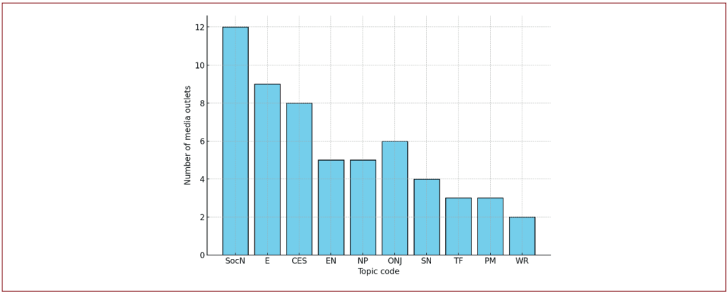
Table 3 Spanish local press on TikTok revised up to 23 December 2024
| No. | Medium | Town | First - last content | Total content | Total f-ers | Total ‘Likes’ | Comments |
|---|---|---|---|---|---|---|---|
| 1 | Alcalá Hoy | Alcalá de Henares | 04/08/21 | 21 | 180 | 402 | Not published since 2021 |
| @alcalahoy | 16/09/21 | ||||||
| 2 | Algeciras al minuto | Algeciras | 10/04/20 | 396 | 1,266 | 4,786 | Increase of followers and likes. Keep posting regularly |
| @algeciraslaminuto | 22/12/24 | ||||||
| 3 | Vilapress | Baix Llobregat, Hospitalet | 22/03/21 | 51 | 48 | 239 | They have not been published since March. |
| They have been maintained but with little periodicity of publication. | |||||||
| @vilapress | 04/03/24 | ||||||
| 4 | Diari de Barcelona | Barcelona | 03/08/20 22/12/24 | 231 | 1,893 | 101,000 | It maintains and increases the number of followers and likes. Frequency of publications. |
| @diaridebarcelona | |||||||
| 5 | Cinca Medio Noticias | Binaced | 02/01/21 | 2 | 4 | 8 | They remain the same as in 2021. They have not continued, only the same two publications. |
| @cincamedionoticias | 07/01/21 | ||||||
| 6 | Noticias Castelldefels | Castelldefels | 01/02/21 | 232 | 3,029 | 36,100 | Increase of followers and likes. Keep posting regularly |
| @noticiascastelldefels | 23/12/24 | ||||||
| 7 | Periódico Mediterráneo | Castellón | 03/02/21 | 177 | 14,400 | 206,100 | Increased number of followers and likes. Continues to publish periodically, although less than other media. |
| @periodicomediterraneo | 18/12/24 | ||||||
| 8 | Horajaen.com | Jaén | 14/10/21 | 1.206 | 14,200 | 193,200 | Errata in the date of the first publication in the other table. Increase of followers and Likes. Continue to publish with a high-frequency |
| @horajaen.com | |||||||
| 9 | La Provincia | Las Palmas | 11/01/21 | 332 | 13,800 | 430,400 | Increase of followers and likes. Keep posting regularly |
| @laprovincia.es | 23/12/24 | ||||||
| 10 | Diario Sur | Málaga | 17/05/21 | 2.831 | 120,700 | 3,4 mills | Increase of followers and likes. Keep posting regularly |
| @diariosur | 23/12/24 | ||||||
| 11 | Diario de Mallorca | Majorca | 28/01/21 | 215 | 9,901 | 210,000 | Increase followers and likes. Publish regularly. |
| @diariodemallorca | 23/12/24 | ||||||
| 12 | Villactualidad | Oeste de Madrid | 23/08/21 | 15 | 2 | 10 | They ceased publication in September 2021. |
| @villactualidad | 03/09/21 | ||||||
| 13 | Ponferrada Hoy | Ponferrada | 20/04/20 | 159 | 1,592 | 12,900 | They continue to publish, but with little frequency. Increasing number of followers and likes. |
| @ponferradahoy | 23/12/24 | ||||||
| 14 | Diario de Sevilla | Seville | 21/10/20 | 234 | 14,900 | 296,800 | Change the username. It is @diariodesevilla and not @grupojoly. They continue to publish regularly and the number of followers is increasing. |
| @grupojoly | 23/12/24 | ||||||
| 15 | Atlántico Hoy | Tenerife | 04/07/20 | 53 | 100 | 135 | They have not published more, but they have increased the number of followers. |
| @atlanticohoy_com | 09/07/21 | ||||||
| 16 | Diario de Avisos | Tenerife | 17/08/21 | 1 | 1,039 | 17 | There are no videos. The video that was there is gone. However, they have more followers than in 2021. |
| @diariodeavisos | 17/08/21 | ||||||
| 17 | La Tribuna de Toledo | Toledo | 04/10/20 | 165 | 417 | 26,000 | They continue to publish, but with little regularity. They do not increase the number of followers excessively. |
| @latribunadetoledo | 02/12/24 | ||||||
| 18 | Diario El Hierro | Valverde (Canaries) | 17/08/20 | 3 | 719 | 27 | It continues with the same publications as in 2021, but significantly increased the number of followers. |
| @diarioelhierro | 29/01/21 | ||||||
| 19 | Diario do Tamega | Verín | 26/06/21 | 30 | 327 | 2.301 | It has not been published since March 2023. |
| @diariodotamega | 03/03/23 | ||||||
| 20 | El 3 de Vuit | Vilafranca del Penedés | 10/06/20 | 1 | 10 | 4 | Same as in 2020. The number of followers has practically not increased and the number of Likes remains the same. |
| @el3devuit | 10/06/20 |
Source: Authors.
Table 4 Type of Spanish local press activity on TikTok revised up to 23 December 2024
| No. | Medium | Town | Strategy of purpose of content | Most Common topics | Narrativa | Comments |
|---|---|---|---|---|---|---|
| 1 | Alcalá Hoy | Alcalá de Henares | NJ/J | SN/CE/ TF/WR | ET / INT/ VI / SM | Same as 2021 |
| @alcalahoy | ||||||
| 2 | Algeciras al minuto | Algeciras | AD/J | SN/ | COSM/ COD/ SM | It continues to carry advertisements, but also sports news. We found several static images |
| @algeciraslaminuto | ||||||
| 3 | Vilapress | Baix Llobregat, Hospitalet | J | SN/EN /SN/PN / CE | COD / INT / VI / SM | General information. CupCut text screens are used in many publications. |
| @vilapress | ||||||
| 4 | Diari de Barcelona | Barcelona | J | SN/EN/ PN/SN/ CE/TF/ ONJ | ET / INT /VI/SM | Profile very adapted to TikTok’s narrative. General information. |
| @diaridebarcelona | ||||||
| 5 | Cinca Medio Noticias | Binaced | NJ | CJ | COSM / VI | Same as 2021 |
| @cincamedionoticias | ||||||
| 6 | Noticias Castelldefels | Castelldefels | J/AD | SN/SN/ CE/TF | COSM / VI/ SM | Lots of information about events and warnings. Static images. |
| @noticiascastelldefels | ||||||
| 7 | Periódico Mediterráneo | Castellón | J/NJ | SN/SN/ EN/CE/ ONJ/ PN/ ONJ | VI / COSM / SM / | It has evolved into journalistic content with general information and content created for the platform itself in most cases. |
| @periodicomediterraneo | ||||||
| 8 | Horajaen.com | Jaén | NJ/AD | SN / PN// CN/ CE | COSM / VI/SM | A lot of news in horizontal video. |
| @horajaen.com | ||||||
| 9 | La Provincia | Las Palmas | NJ/J | SN/NP/ EN/ PN/ CE | COSM / VI /ET/ SM | General information. A lot of vertical video. Content created for the platform. |
| @laprovincia.es | ||||||
| 10 | Diario Sur | Málaga | J | EN/SN/ CE/NP/ PN/E | ET / INT/ VI / SM / | General information. Content created for the platform |
| @diariosur | ||||||
| 11 | Diario de Mallorca | Majorca | J | SN/SN/ CE/NP / E | COSM /ET/ INT/ VI / SM | General information. Content created for the platform |
| @diariodemallorca | ||||||
| 12 | Villactualidad | Oeste de Madrid | NJ | CE/JM | VI/SM | Same as 2021 |
| @villactualidad | ||||||
| 13 | Ponferrada Hoy | Ponferrada | NJ / J /AD/ HS | EN/SN/ CE/NP/ E/TF | COSM / ET/VI/ SM / | Predominance of vertical video. Very local news and promotion of the town and the area, sometimes with some humorous videos. |
| @ponferradahoy | ||||||
| 14 | Diario de Sevilla | Seville | J | SN/NP / EN/ TF/ CE | COSM / ET / INT /VI / SM | General information. Predominance of vertical video. |
| @grupojoly | ||||||
| 15 | Atlántico Hoy | Tenerife | J | EN/AJ/SN/SC | COD | Same as 2021 |
| @atlanticohoy_com | ||||||
| 16 | Diario de Avisos | Tenerife | J | TF | ET / INT /VI/SM | Same as 2021 |
| @diariodeavisos | ||||||
| 17 | La Tribuna de Toledo | Toledo | J | SN/CE / E | COSM / VI | La mayoría son vídeo vertical, noticias locutadas. |
| @latribunadetoledo | ||||||
| 18 | Diario El Hierro | Valverde (Canaries) | NJ | ONJ | COSM | Same as 2021 |
| @diarioelhierro | ||||||
| 19 | Diario do Tamega | Verín | J | CE/SN/TF / | COSM / ET / INT /VI/SM | News of typical cultural events in the area |
| @diariodotamega | ||||||
| 20 | El 3 de Vuit | Vilafranca del Penedés | NJ | E | VI | Same as 2021 |
| @el3devuit |
Source: Authors.
Several media outlets, including Alcalá Hoy, Cinca Medio Noticias, Villactualidad, Atlántico Hoy, Diario de Aviso, Diario de El Hierro, and El 3 de Vuit, have maintained their profiles since 2021, with minimal updates. Others, such as Vilapress, Ponferrada Hoy, and Tribuna de Toledo, have infrequent publication schedules.
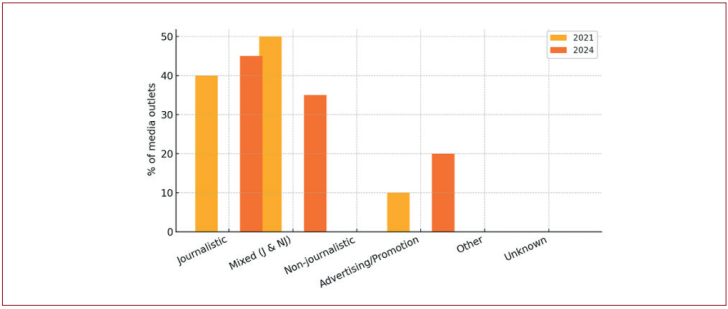
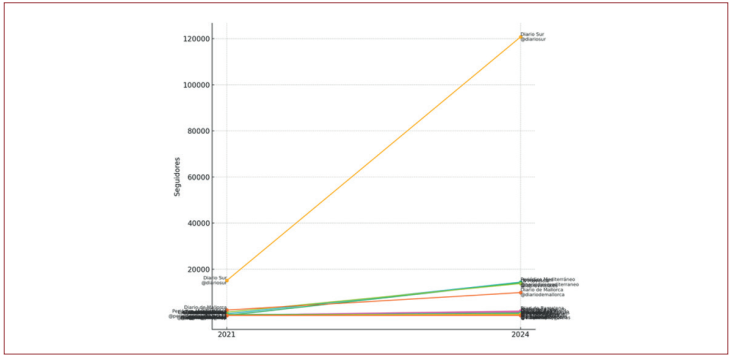
The number of local media with TikTok profiles in Spain has increased, especially in Anda-lucía and Comunitat Valenciana, where several outlets actively post content tailored to the platform’s style. Many focus on general information using vertical videos and native content, gradually shifting toward proprietary content for TikTok. However, it is important to note that media and journalists lack awareness of other content creation methods, in a platform where challenges, trends, and the mainstream drive success (see Figure 2). Perhaps these data are associated with the growth reported by some media in the period studied, with Diario Sur being the most notable and allowing us to infer that the more interesting the content is, the greater the involvement of users
Source: Authors.
Figure 2 Distribution of strategies (Journalistic/Non-Journalistic) by year 2021 vs. 2024
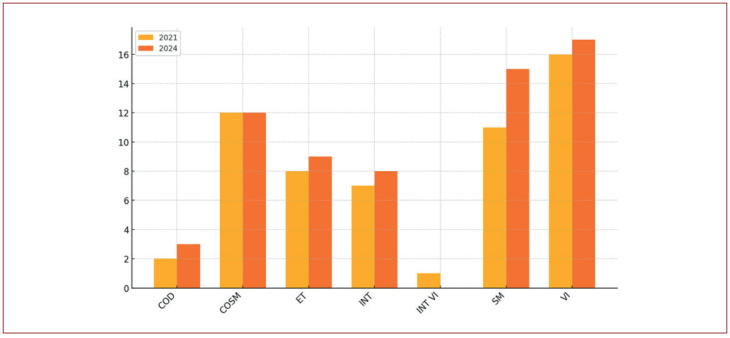
Some content, as shown in Tables 2 and 4 and Figure 4, is mainly tailored to the platform’s narrative, especially regarding the video’s vertical format and the use of music to stand out among the many posts in an endless feed, even when they reuse content published on their profiles across other digital channels. Specifically, of the sample analyzed, more than 16 media outlets already reported using native vertical video, and over 14 reported using music (a factor considered for boosting organic reach by the Platform’s algorithm) in their TikTok posts by the end of 2024.
Source: Authors.
Figure 4 Comparison of narrative elements in TikTok videos of Spanish local media between 2021 and 2024
This exponential growth, which will be discussed in the next section, seems to be linked to a native content strategy and tone adapted to the platform.
4. Discussion and conclusions
The case of Diario Sur (Malaga) shows that successful local journalism on TikTok depends on a dedicated newsroom member to engage the community, requiring creativity and effort to develop and sustain it. Similarly, Diario do Tamega illustrates that understanding the platform’s storytelling features and providing engaging stories can expand hyperlocal coverage to larger audiences, thereby boosting overall reach. Overall, the Spanish local press exhibits experimentation and hesitation to innovate on TikTok, a platform with an algorithm that treats content individually, which can result in higher engagement and coverage compared to Instagram or Facebook.
In contrast, the infrequent publication and the dominance of static content, as seen in cases like El Diario de Sevilla, directly reflect the resource and staffing limitations faced by these newsrooms.
This reluctance likely stems from uncertainty and the new storytelling challenges the platform introduces, as it targets emerging digital audience segments and is linked to a fear of failure. Most reviewed cases demonstrate “headline journalism,” often limited to content descriptions or extra text over images, with key information not conveyed through audiovisual content alone.
Media outlets like Diario Sur, Periódico Mediterráneo, Diario do Tamega, and Vilapress show evolving stories that are more often crafted for social media platforms’ timing and editing features. They also aim for innovation by summarizing current events or working with other content creators.
As Sidorenko-Bautista and Herranz-de-la-Casa (2020) highlight, media outlets and journalists should not confuse user-driven content trends with a justification for sensationalism. Journalism on TikTok must uphold its seriousness; only high-quality, creative content will effectively engage viewers. The platform should serve as a new, immediate window into current events, rather than trying to become an influencer.
Since 2021, TikTok has emerged as a prominent platform for sharing news. The Reuters Institute for the Study of Journalism at Oxford University, in their Digital News Report 2023 , highlights TikTok’s rapid growth, with 44% of 18-24-year-olds using it and 20% specifically for news. This aligns with the 2025 predictions and trends report, identifying it as a key trend for media strategies (Newman & Cherubini, 2025). The platform’s short-form video format appeals to younger audiences’ preference for engaging, easily digestible content. As a result, news organizations are increasingly adopting TikTok, tailoring their storytelling to match the platform’s style and connect with a demographic less engaged with traditional media.
TikTok’s current importance as a news source lies in its ability to democratize information and expand media voices. The platform allows established news outlets, independent journalists, and everyday users to report events, share perspectives, and engage in public discussion. As a cultural hub, TikTok is essential for journalists and news organizations to understand current issues. Its algorithmic curation, though debated, exposes users to a wide range of topics and viewpoints, potentially enhancing their understanding of complex issues. TikTok’s ability for real-time reporting and eyewitness accounts during major events offers an immediacy that exceeds traditional news outlets, as shown during significant global incidents when it provided firsthand on-the-ground perspectives and raw, unfiltered news.
TikTok is essential for reaching digital and emerging audiences, requiring media outlets and journalists to adapt quickly to shifts in narrative and style. Major media organizations, like The Washington Post, can manage this challenge. However, local media, including those in Spain, often lack the necessary resources and staff for effective social listening and platform monitoring. This gap impacts their ability to handle TikTok’s fast-changing and fleeting content efficiently.
The findings of this study emphasize the need to improve and expand journalistic work through this channel, which I have already noted is the main source of information for emerging and younger audiences. The data indicate the urgency, in broad terms, to go beyond experimentation and to establish these narratives and digital practices as standard elements of each media outlet’s routine. However, this also underscores the fragility of the local press, especially in Spain, and the limitations of its newsrooms in economic and logistical aspects (Palacio, 2020).
Faced with this type of platform and the growth of global audiences, local media struggle to maintain viewer interest, as they may not be their usual target audience. However, the di-lemma remains of covering local news with global appeal to boost user engagement through views and interaction, which in turn enables algorithms to reward that content’s visibility. This also has financial consequences if the growth is substantial. In the attention economy, greater exposure creates new monetization opportunities, but for this to happen, ‘glocity’ must be enhanced (López, 2021).
That said, there is evidence of an opportunity for local media and journalists on “more disruptive” platforms such as TikTok. This does not require large investments of money and resources but instead involves understanding how to communicate messages differently, considering what is done through other digital channels. In countries like Spain, where the economy heavily depends on tourism and related activities, local journalism is especially crucial as a source of information for travelers making decisions and learning about the current situation where they will be spending a season among the locals. Ultimately, coverage of a major forest fire or an increase in crime in specific areas can influence foreigners’ travel plans, so the media must communicate effectively to both locals and visitors.

