




 texto en
  Inglés (pdf)
 Artículo en XML
 Referencias del artículo
 Traducción automática
 Enviar artículo por email
 Citado por SciELO
  Similares en
SciELO
Similares en
SciELO 
 Permalink

1. Introduction
In September 2024, the football player Vinícius Jr. stated during an interview on CNN that Spain should not host the 2030 World Cup because of racist attacks on the pitches (CNN, 2024). This prompted an immediate institutional response, in a debate that became a low intensity lawfare. In 2023, Vinícius Jr. had been victim of racism in Spain during a match against opposing team Valencia. In addition to the racism itself, the dramatization of the case in the press and on social media was accentuated by the player’s statements about the collusion of the Spanish football league (La Liga), including statements on social media calling for the outlawing of racist language. Instead, fans have referred to the player as ‘Whinycius’ or ‘Victimicius’ (Youtube, 2024), and he is often accused of provocative behaviour.
Non-white football players have suffered abuse in football for decades (Kassimeris et al., 2022), but some cases opened a social debate (Cable et al., 2022). The Vinícius case went viral on social media and in the Brazilian press. In Spain, racist attacks in football are now being called Vinícius cases. Moreover, legal initiatives were approved in 2023, on instruction from the Secretary of State for Security which reinforces the Security Forces for the prevention of and response to racist and xenophobic behaviour and attitudes or any expression of discrimination or intolerance in sporting events.
The complex nature of analysing the repercussions of a case of racism, especially on social media, must be considered. In this sense, this study agrees with the most recent report published by the Observatory of Racism on the Internet (Santos et al., 2023) that racism is a multifaceted phenomenon that aims to attack and discredit the lives of black people in their entirety. This demonstrates the need to try to make an empirical analysis of cases of racism on the internet, facing the methodological difficulties that such research imposes. As Solomos stated, it is necessary to develop “a detailed and contextualized understanding of how race and difference are experienced and lived in popular cultural arenas, such as football” (2023, p.16).
This research employs an essayistic approach anchored in cultural and discursive studies. This entails an exploration of the linguistic material of the public debates on racism against Vinícius Júnior, which may be conceived as an expedition, a sort of counter storytelling (Meghji, 2023 in Bashi, 2024). This research observes what is said in the media, what circulates in social networks, blogs, forums, tweets, etc., and what is heard in conversations, to take note of what we call ordinary discourse.
“Studies on verbal violence, considering communication situations, the identity of the actors and the cultural context, should make it possible to avoid globalising the phenomenon, lumping together employment situations and making generalised judgements based on specific cases.”1 (Charaudeau, 2019, p. 471).
Considering that racism is a type of verbal violence or hate speech, discourse analysis plays an important role in studying the actors of the language scene, the social relationships they establish and the identities they want to affirm or destroy. It is in this sense, that discourse analysis can contribute to research about verbal violence, by moving away from the generalisation of particular cases because it analyses them in the communication situation. To examine the aspects of racism depicted in the cases of Vinícius Jr, this study will explore the three dimensions of public speech circulation -social agenda, media agenda, and political agenda- through a semiolinguistic approach (Charaudeau, 2019; Henni-Moulaï, 2018) in a framework of coloniality of power.
The adoption of a decolonial approach in analysing the instance of racism in football involving the player Vinícius Jr. signifies an endeavour to articulate the reality that, in recent decades, this sport has evolved into a spectacle that has garnered increased visibility and engagement with social media, fuelled by racist hate speech. The articulation that is intended to be demonstrated here is that the racial issue is still present in the historical structure of coloniality, performed by a cunning capitalism that has turned sports spectators not only into consumers of league products, but also of a market of hatred that feeds back into the production of this type of discourse.
2. Racism on the pitch, a hatred market of coloniality
Analysing racism requires an interdisciplinary approach. Although this research takes a discursive perspective, it considers the political and economic aspects of the sporting event where the racism incident occurred. Ginesta (2021) argues for the need to contextualise the relationship between capitalism promoted, among others, by the current president of La Liga (Spanish Football National League), Javier Tebas. The researcher argues that today’s football industry is a continuation of the spectacularisation (Ferré-Pavia, 2013) built by the Disney culture, which can be defined along five axes: 1) the process of Americanising sports organisations and the format of competitions, 2) the culture of the spectacle of sporting events, 3) the fertile ground for football franchising, 4) the transformation of clubs into media companies, and 5) the conversion of fans into consumers and producers of digital content (prosumers) about sport.
The advent of the prosumer is of great significance in this study, as it demonstrates how the football pitch transforms into a spectacularised arena with extensive coverage through fans’ involvement on social media. This expansion of football matches before and after their conclusion extends the reach of the event. The result is increased profits for club managers through monetisation and franchising of this type of entertainment. If it is accurate to state that Vinícius Júnior’s case aids our comprehension of racism in its geopolitical context, this idea can extend to football. Chadwik’s (2022) in Viñas-Gracia & Ginesta-Portet, 2022) definition of the economic geopolitics of sport, which involves nations and other entities exercising power to secure strategic advantages in networks where sport plays a vital role, supports this notion.
The racism aimed at Vinícius Jr. could be viewed as a beneficial tactic in both the sport and hate economies (Cameron, 2009). Moreover, it can serve as a tool for comprehending the interplay between nations, their policies, cultures, identities, and power dynamics among individuals, considering that one of the hallmarks of power is the incapacity to set boundaries on the authority of institutions (Meira, 2021).
The combination of Vinícius Jr.’s status as a Brazilian international football star and his public stance on social issues on social media has placed him in seventh place in the ranking of the 200 biggest content creators in Brazil in 2025 (Favikon, 2025). Brazil is considered one of the most dynamic markets in the world, with 67.8% of the population using social media. It has been posited that Vinícius Jr. serves as a paradigm of an individual who has the capacity to amalgamate personal narratives with his most outstanding moments on the field into digital narratives. This development resulted in a 0.63% increase in followers and elevated levels of community engagement on TikTok and Instagram. Further research could be conducted into the nature of engagement involving a public figure such as Vinícius Jr. in his country, and the origin of hate speech directed towards him. This would facilitate a more profound comprehension of the economics of football and the hate market, as Cameron (2009) previously proposed.
Hate speech is a form of communication that aims to dehumanise, demonise, or incite violence against a particular group (Meneguelli & Ferré-Pavia, 2024). It is not only what is said, but also how it is said. As Bahador explains, “dehumanisation is a tactic that portrays groups as less than human, often by associating them with sub-human creatures like rats and cockroaches, or non-human forms like garbage or dirt” (2023, p. 294). In football, racism often manifests itself through the dehumanisation of black players, who are compared to monkeys and treated as if they were circus animals put on display for public entertainment.
Almeida (2019) previously cautioned about football’s creation of a space he referred to as the “free market of hatred”, where racial offence becomes a part of the spectacle’s culture as a subjective expression by the passionate fans, who, having bought a ticket to watch the match, feel entitled to vent their emotions, regardless of their vulgarity. It would be incumbent upon the black player to remain silent or endure the insults from fans since he is being handsomely compensated to participate in the sport. This scenario exemplifies the subjective conditions created by capitalism, whereby individuals are subjectively constituted to replicate social relations in their concrete attitudes (Balibar & Wallerstein, 2021; Almeida, 2019).
In the specific case of Brazil, it is necessary to recover the historical component of football as a sport, which would entail a comprehensive re-examination of the sport’s historical development and the ways in which it has been represented and consumed in the country. Pereira’s study (2023) reveals that Black players were integrated into teams only in 1900, a full 12 years after the abolition of slavery in Brazil. In 1907, the Metropolitan Football League in Rio de Janeiro enacted a ban on the participation of black players in the Carioca Championship.
In 1912, the Campos team was established by black individuals who subsequently became champions of the Carioca Championship in 1918. Additionally, in 1914, the Brazilian Football Confederation (CBF) was established. However, it was not until 2021 that the CBF advanced its anti-discrimination discourse and practice by becoming the first confederation to implement a regulation that prescribes a sporting penalty for instances of racism in football.
Despite the existence of an institutionalized practice of combating racism in Brazil, the legacy of historical racial discrimination, both on and off the pitch, is evident in the low representation of black individuals in leadership roles within Brazilian football, including managerial and coaching positions. In the context of the football market, the value placed on the skills of black people is contingent on their physical abilities, rather than on their mental and strategic capabilities, which are linked to structural racism (Almeida, 2019).
In this regard, Nobis & Lazaridou (2023) posit the existence of the phenomenon of ‘racist stacking’ in their analysis of football in Germany. This is defined as the institutionalisation of the under-representation of blacks in football in tactical and leadership positions that have become part of the sport’s routine. The theoretical underpinning of racist stacking posits that roles which demand leadership, responsibility, organisational skills, intelligence, and keen vision are not occupied by African descendants. Football players are frequently associated with stereotypical images such as aggressiveness, speed, and instinct. Aggressiveness, for example, is a characteristic attributed to Vinícius Jr.
In recent decades, anti-racist movements in Brazil have succeeded in placing the issue of racism within Brazilian society at the forefront of the public discourse. This has resulted in the establishment of a public agenda to combat racism and other discriminatory practices through the lens of intersectionality. Some research assessed that Brazil was not yet an achieved racial democracy but an aspirational one, with some oppressive perspectives (Joseph, 2013). Regarding football, several countries have adopted anti-racist attitudes on the field of play. One example is the No Room for Racism campaign in the English league, which commenced in 2019. Nevertheless, in his study on racism and xenophobia in Spanish football, Llopis-Goig (2009) highlights the fact that these types of hate speech have been more prevalent in Spain and Belgium in recent years, in comparison to other European countries such as the United Kingdom, the Netherlands and France, where they originated between the 1970s and 1990s. The author investigated the frequency of racist insults during the 2004/5 and 2005/6 seasons of the two highest divisions of the Spanish football league. The data indicated a notable in-crease between the two seasons.
Given that this is a study published in 2009, whose conclusion is that racism in Spanish football is anchored in the last two categories and that there is a need for more research into institutional racism, the public debate provoked by the case involving Real Madrid player Vinícius Jr. sheds light precisely on the institutionalised aspect of racism in LaLiga and triggers a public sub-debate in Brazil: structural racism in Spain. In this regard, Vinícius Jr. has accorded particular emphasis to this matter and even initiated a controversy in an interview with CNN on 27 August 2024:
“Until 2030, we have a lot of room for evolution, so I hope Spain can understand how serious it is to insult someone because of the colour of their skin. If things don’t evolve by then, I think [the World Cup] will have to move, because the players don’t feel comfortable playing in a country where they can suffer racism, it’s a bit complicated.”
Another study that sought to ascertain the frequency of racist incidents in Spanish football is that of Villar-Cirujano et al. (2024). This study identifies episodes on the subject in specialised digital journalism. The study revealed that, prior to the incidents involving Vinícius Jr., the issue of racism in football was not a prominent topic in the Spanish sports press, despite the prevalence of discriminatory attitudes within the sport. In particular, the insults directed at the player in the match with Valencia attracted significant media attention, which had not been directed towards other players in similar situations. The investigation establishes the criteria by which the incident was deemed to be of sufficient interest to warrant such extensive coverage in the media. One such factor is the unexpected nature of the outcome on the pitch caused by Vinícius Júnior’s reaction after the racist attack, which imbued the case with a certain degree of controversy.
At the same time that racism is exposed in labour hierarchies, the concentration of capital in the hands of European teams determines these positions of power. Inequality in the division of labour also occurs in international football. As Rozo (2024) notes, this benefits European leagues, which reproduce coloniality in relations with players originating from Latin America and Africa.
To fully comprehend this phenomenon, it is essential to revisit Quijano’s (2014a) concept of the coloniality of power, which still proliferates, seen, for instance, in the hateful discourse of the international far-right. Quijano posits race as the principal classifier of humankind, arising from the process of ‘reorigination’ of the globe engendered by America’s conquest and colonisation. Thus, a new system, known as the ‘coloniality of power’, was established, introducing the concept of race to categorize the defeated by their innate characteristics, essentially reducing them to biology.
The processes of colonization gave rise to a new category, the idea of race, which initiated a significant historical and philosophical debate about the nature of humanity. The category of race and the concept of racism refer to the biological differences that establish levels of inequality in human development (Quijano, 2014a).
The identity categories of classification serve to differentiate between developed and undermined humans, thereby justifying the domination of the former over the latter. In other words, it was necessary to invent new historical identities to confront ethnicities. This ingrained sense, which is still present today, is a central feature of social power that imposes a hegemonic category on which a new rationality is forged and through it the foundation of modernity. This phenomenon, which Quijano calls coloniality, is a key aspect of the construction of modernity.
In her analysis of Quijano’s work, Segato (2023) argues that racism cannot be reduced to mere xenophobic or cultural prejudices but rather is historically situated. This is because race is a concept that emerged from the aftermath of war victories. As such, the expansion of colonialism can be seen as an ongoing process since race, alongside gender, is a fundamental component of the production of inequality and difference.
If race is considered a biological marker of inequality, it implies that it is an inherent characteristic of the racialized individual, an aspect of their very nature. Consequently, this inequality is unchangeable because it is embedded in their physical makeup. From the Eurocentric perspective, the world is divided into entities that generate and enhance value through their knowledge, or, as Segato (2018) states, entities possessing racial capital, and those without value due to their knowledge lacking legitimacy.
The instances of racism directed towards Vinícius Jr. coincide with the intersection of two factors: his body’s production of knowledge and value, and the need to undermine his knowledge by using race as an unacknowledged tool, which is impossible to conceal due to his status as a football star. The accusations of racism bring attention to two things: the attempt to silence black individuals and the recognition of the symbolic significance that Vinícius Jr. has gained in the fight against racism.
3. Racism in football from a discursive perspective
Every language situation begins with someone’s right to speak. This right, which guarantees the actant in a communication situation the right to take the floor and express something, establishes the socio-linguistic state of verbal exchanges. In this case, Vinícius Jr. (a Brazilian footballer, immigrant, black and one of the most respected athletes in his sport, although controversial in some matches) accused the entire Spanish football scene of being a racist stage after a match in which he was the victim of racism. The attacks came both off the pitch (from a community represented by football fans) and on the pitch (from social actors involved in the match within the four rows from which he was sent off). Through his social networks and media interviews, he spoke out against a larger structure that legitimises racism in Spain.
His speech is therefore a denunciation of a type of hate speech that is a criminal offence in that country and in so many others in the West. This accusation is justified because the Real Madrid striker has been the target of ten previous racist attacks, all of which have been dismissed or are pending in the Spanish courts. In his indictment, he demands that the perpetrators be punished. Two days after the polemic attack, on 21 May 2023, the police arrested seven people suspected of hate crimes against the player.
According to Article 510 of the Spanish Penal Code (1995), hostility, discrimination or violence against a group, a part of it or against a specific person is punishable, on the grounds of their belonging to it, for racist, antisemitic, anti-gypsy or other reasons relating to ideology, religion or beliefs, family situation, the belonging of its members to an ethnic group, race or nation, their national origin, their sex, sexual orientation or identity, for reasons of gender, among others.
Vinícius Jr. is asserting his rights as a citizen and athlete by addressing the lack of action against racism in Spanish football stadiums, to maintain his professional credibility and personal integrity. However, the public discourse of the athlete is not limited solely to his professional and civic sphere. His social media presence reaches a vast audience in Spain and across the globe, using his platform to highlight an unacceptable crime that is still being tolerated in the 21st century.
The case of racism directed at Vinícius Jr. illustrates how this type of offence is not only updated in language but also in the way it is expressed through hate speech. As Charaudeau explains that, “language enables individuals living in society to acquire value systems that will give reasons for their actions, justify human behaviour and a certain hierarchical vision of life in society” (2017, p. 15).
Therefore, it is essential to analyse the content of such discourses and their circulation to conceptualise violence against socially underprivileged groups based on identity factors, such as race/ethnicity. According to Sponholz (2023), “hate speech has its roots in ideologies of inequality, such as racism, sexism, homophobia, and Islamophobia, rather than emotional reactions.” (p. 151)
The issue of racism, brought to the forefront by a high-profile victim in the football world, highlights a socially acceptable behaviour. Consequently, perpetrators need to be held accountable, and this initiates a dialogue between two conflicting value systems: those which sanction racism and those which actively reject it. Thus, the issue is defined by the polarisation of two opposing outlooks.
The recurrence and scope of the racist offences that targeted Vinícius Jr. place them in a communicational problematic of the public sphere with a transnational bias. According to Chaudhry and Gruzd (2019), from a media perspective, hate speech serves as a catalyst for interactions among social network users. Consequently, the concept of transnationalism has been a central focus in research on the far-right, aiming to comprehend the shared ideologies, connections, and actors involved in the transnational dissemination of hate speech (Magalhães & Caldeira-Neto, 2024; Ferreira, 2023; Alcalde, 2020).
The transnationalism of hate speech gained this status by circulating in the mouths of politicians, party leaders and candidates for a role in institutional politics, until it became naturalised in everyone’s speech.
Sponholz (2021) proposes that hate speech can be defined by three characteristics: Firstly, the reference to the target group, as the victim, even if individual, carries collective traits. Secondly, the offence itself. Thirdly, the public sphere. This essay proposes to focus the issue on a discursive problem with the attempt to organise the debate that raised the cases of racism directed at the Real Madrid player. This will be done by looking at three axes: the social agenda, the media agenda and the political agenda, in interaction with the conceptual schemas of racism as a product of coloniality. The perspective adopted takes Charaudeau’s (2017) consideration of public debate as the sphere where there are crossings of diverse voices, in a demonstration of sources of language changes, which can be rich insofar as they are associated with the practice of democracy and its condition of ‘contestability’.
Social networks are virtual spaces that enable millions of people to share their opinions on any subject (Henni-Moulaï, 2018). Our era is characterized by the emergence of debates, and as a result, exchanges on social networks can be easily overlooked. Therefore, it is important to give them a tone of engagement. There is no doubt that racism is a serious issue, and unfortunately, it is not an isolated incident, particularly in European football leagues (Farias et al., 2020). Vinícius Jr. has taken a controversial approach by linking the hate speech he has experienced to a systemic problem in Spain: racism. In a statement on his social media accounts, the player said:
“It wasn’t the first time, nor the second, nor the third. Racism is normal in La Liga. The competition thinks it’s normal, the Federation does too, and opponents encourage it. I’m very sorry. The league that once belonged to Ronaldinho, Ronaldo, Cristiano and Messi now belongs to racists. A beautiful nation, which welcomed me and which I love, but which has agreed to export the image of a racist country to the world. I’m sorry for the Spaniards who don’t agree, but today, in Brazil, Spain is known as a country of racists. And unfortunately, because of everything that happens every week, I can’t defend it. I agree. But I’m strong and I’ll go all the way against the racists. Even if it’s far from here.”
After the aforementioned match, a video circulated on social media showing Real Madrid coach Carlo Ancelotti refusing to discuss the game and stating that he would only give an interview to discuss what happened to Vinícius. Ancelotti’s stance on the matter has been widely reported in the Spanish media, as he has prohibited any sporting discourse that is not connected to social events.
“I don’t want to talk about football. I want to talk about what happened here. I think it’s more important than a defeat. What happened today doesn’t have to happen. It’s obvious. When a stadium shouts “monkey” at a player and a coach thinks about taking the player off for it, it’s a sign that there’s something bad going on in this league. He didn’t want to carry on, and I said, “I don’t think it’s fair that you don’t, because it’s not your fault. You’re the victim”. He carried on playing and after that they gave him a pointless red card, because it wasn’t aggression. That said, we have a problem. For me, Vinícius is the most important player in the world, the strongest in the world. The league has a problem.”
The Spanish bank Santander’s name appeared on Twitter’s trending topics the day after the event. Internet users demanded that the financial institution, one of La Liga’s main sponsors, take action against racism. The Brazilian trade union movement also criticised the bank for its “omission”. A social media campaign has been launched to boycott brands that sponsor Spanish football. The brands targeted include Santander, Microsoft, Puma, EA Sports, Panini, and Allianz. The campaign is associated with the hashtags ‘La Liga racist’, ‘respect Vini Jr’, and ‘sponsoring racism’. One of the groups leading the initiative is Sleeping Giants Brazil, which is known for taking down company adverts on websites that spread fake news or unverified information (Toledo & Brambila, 2023).
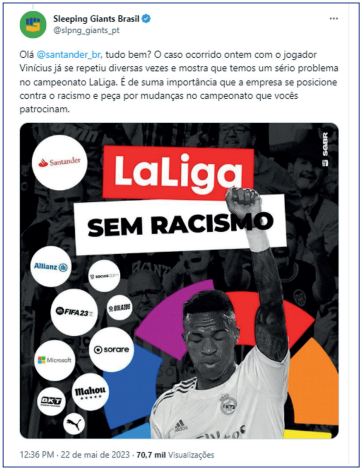
The iconography of the tweet will be analysed using the concept of enunciative heterogeneity proposed by Authier-Revuz (1982). This discourse presents the subject as creating an alterity that leads to the presence of the Other. The subject produces recognisable forms of this other in a specific communication situation, and we can identify these marked forms of discursive heterogeneity. These forms introduce the other into the discourse, revealing shared meanings in the produced utterance. In the background, a crowd is hurling insults and making obscene gestures at Vinícius Jr. He is in the foreground, his back turned, and his eyes closed, seemingly above and oblivious to the hate speech. His left arm is raised in a clear reference to the Black Panther movement’s gesture against racial discrimination, endorsing his display of virtue and strength. This gesture is symbolic in the world of sport. It involves lowering the head, raising the arm, and covering the closed hand with a black glove. During the 1968 Olympic Games in Mexico, two US athletes who had won the gold and bronze medals in the 200-metre race protested on the podium. The incident occurred during the peak of the civil rights movement in the United States. As a result, the International Olympic Committee barred them from the Games, and the US media criticised the athletes.
Javier Tebas, the president of Spanish football league La Liga, used his Twitter profile to criticise the Brazilian player: ‘Before criticising and insulting La Liga, you need to inform yourself properly, Vini Jr. Don’t let yourself be manipulated and make sure you understand each other’s competences and the work we’re doing together’. Shortly afterwards, Vinícius Jr. hit back at Tebas:
“Once again, instead of criticising racists, the president of La Liga has taken to social media to attack me. No matter how much you talk and pretend not to read, the image of your league has been damaged. Omit-ting yourself only makes you equal to racists. I’m not your friend to talk to about racism. I want action and punishment. Hashtags don’t move me.”
This debate between the League president and one of his players, within the context of the football industry, underscores the argument made by Marxist theorists analysing the issue of race: the struggle against racism must occur not only in the social sphere, but also -and most importantly -in the economic sphere. Oliveira affirms: “Racism must be confronted not only in the behavioural and relational dimension, but fundamentally as a structuring mechanism of the social authoritarianism that sustains the various logics of capital” (2021, p.32).
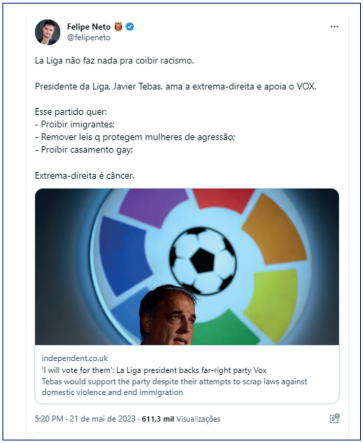
During the aforementioned discussion, Brazilian influencer Felipe Neto contributed to the controversy by making a polemic statement against Javier Tebas, in which he referred to the far-right as cancer. This statement may explain Tebas’ criticism of Vini Jr.
Verifying the source provided by Felipe Neto, on January 17, 2019, the British newspaper The Independent published a report on statements made by Tebas in which he expressed his electoral support for the Spanish far-right party Vox. In 2016, according to the newspaper, he declared: “If far-right means defending the unity of Spain, life and the Catholic way of life, I am in that group and I still think the same as when I was in Fuerza Nueva”, referring to the Spanish fascist party he was a member of in the 1980s.
Tebas’ offensive against Vinícius Jr. goes beyond the issue of race, because the far-right’s agenda is much broader. The La Liga president’s tweet must also be understood in the context of this agenda, which is currently being financed by globalised capital (Chadwick et al., 2024).
The media regulate the public sphere (Häussler, 2018). They are the mediators of the political reality constructed along with the public consciousness. Because of their responsibility to inform the public, the media use discursive techniques to induce belief, thereby placing the public in a position of obligation to believe. According to Charaudeau (2012), to attract the public, the media use specific criteria that aim to be both credible and engaging. These criteria include celebrity, where certain individuals in the public sphere are highlighted; representativeness, where political and civic democracy dominates the public space and actors and groups representing power and counter-power are limited in their presence; expression, where simple and accessible language is preferred; and controversy, where opposing viewpoints are brought into conflict in order to generate lively debate.
This is how polemical statements are born. These can be bombshells in the public and private lives of certain actors. In this sense, the headline in the magazine Piauí (2023) “‘Somos Todos Vinícius Júnior’: as histórias cotidianas de racismo na Espanha” [“‘We Are All Vinícius Jr.’: everyday stories of racism in Spain”] has a double effect: That of giving credibility to the racism suffered by the player, by rebutting a relativising discourse, and that of being pathemic (Puig, 2008), by arousing a certain type of complicit emotion in solidarity with the player’s pain, given that, for discourse analysis, “emotions are of an intentional order, are linked to knowledges of belief and are inscribed in a problematic of psychosocial representation” (Charaudeau, 2007a).
The Piauí report includes accounts from black Brazilians residing in various Spanish cities, detailing their encounters with racism and xenophobia in the country. The report aims to reinforce Vinícius Jr.’s thesis that Spain displays racist tendencies. To support this claim, the article presents a set of data.
“The latest report by the Spanish organisation SOS Racismo points out that in 2021, Spain reached the peak of racist cases since it began recording them in 2013. In the last four years, attacks have risen by 50 per cent -from 347 cases in 2017 to 523 attacks in 2021. One in every six victims has experienced physical aggression, not accounting for the 89% of incidents that go unreported. Fear and a lack of faith in the justice system are among the primary reasons for this silence. “It’s the result of the ideological environment that has fuelled Spain’s extreme right in recent years, which shows intolerable hatred towards foreigners, immigrants or people of a different colour”, says sports sociologist David Moscoso, a professor at the University of Córdoba.” (Piauí, 2023)
Still arguing to prove the thesis raised by the player, Piauí: 1) recaps the controversy on social media involving Tebas’ relationship with the Spanish far-right party Vox and his past association with Francoism; 2) presents Moscoso’s analysis that racism against Vinícius is a reflection of the behaviour and values of Spanish society; 3) disapproves of the Spanish media outlets that claimed the Brazilian player is a provocateur. Some Spanish journalists no longer support this view, with La Liga itself announcing measures against racism in football.
In the Brazilian press, there was almost a consensus that the Spanish media had watered down the racism suffered by the player and even blamed the victim for the aggression he suffered. One of the main Brazilian news sites, UOL, published an opinion piece by Alves (2023) entitled “Part of the Spanish press is complicit in racism against Vini Jr”. The article gives special prominence to the behaviour of the Spanish media after the match on 21 May, which preferred to focus on the player’s expulsion and the argument he had with the fans rather than the case of racism. The Spanish press, in the other hand, expresses that everybody supports the player against the racism (Marca, 2023).
Charaudeau (2018) argues that public debate is the first place for democracy. From this point of view, the debate on racism that inspired the Brazilian and Spanish media would be a guarantee of democracy. This is one of the points addressed by Villar-Cirujano et al. (2024) in their analysis of media coverage in sports journalism in the cities of Madrid and Barcelona. The authors posit that the dissemination of information pertaining to racism in football serves to enhance societal awareness and facilitate the implementation of anti-racist public policies.
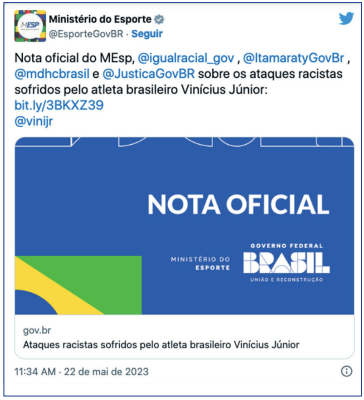
Following the public backlash on social media and in the Brazilian and international press, the Brazilian government has issued an official statement condemning the racist attacks against Vinícius Jr. The statement, jointly issued by the Ministries of Foreign Affairs, Racial Equality, Sports and Human Rights and Citizenship, strongly condemns the acts and calls on FIFA and La Liga to take action. The note also mentions the Spanish government’s commitment to promoting policies of racial equality and intolerance of discriminatory practices through cooperation with Brazil. The Brazilian government’s involvement with Spain follows bilateral agreements signed during the Brazilian diplomatic visit to the country a few weeks before the player’s incident.
One of the agreements signed on 9 May concerns the fight against xenophobia and racism, with a particular focus on cases of racism in sport. As stated by the Federal Secretariat for Social Communication, “the signatory countries must also promote studies, research and statistics that assess the impact of structural racism on their societies and recognise the consequences of discrimination on their socio-cultural formations” (Ministerio da Igualdade Racial, 2023).
The release of the note had repercussions not only in the Brazilian press, but also through the social networks of the government bodies marked in the publication below, in order to give visibility to the Brazilian government’s commitment to tackling racism:
The Lula administration’s Minister of Justice and Public Security, Flávio Dino, also defended the Brazilian player and former that La Liga’s sponsors take a stand: “I hope these companies do something serious and effective about the unacceptable and repeated racism against Vinícius Jr. in Spain.”
The President of the Federal Senate, Rodrigo Pacheco, rejected racism against the Brazilian player and took the opportunity to congratulate “the Spanish authorities who, according to what I have read in the press, are already taking action”. During the debate on 23 May, many senators took to the podium to echo Pacheco’s gesture, with the exception of Senator Magno Malta, an ally of former President Jair Bolsonaro, who said:
“The saddest thing is that the broadcasters have been harping on the subject since yesterday, because it’s popular. It’s shameless. It’s a subject I can’t even talk about in public. So, where are the animal rights activists who aren’t defending the monkey? The monkey is helpless (...) Look at all the hypocrisy. The monkey is intelligent, he’s very close to man, the only difference is his tail. It’s agile, brave, cheerful, it has everything you can imagine” (Poder360, 2023).
The senator’s statement, which went against Brazilian public opinion, led to him being reported to the Senate Ethics Council and the Supreme Court due to its racist and speciesist nature. President Luís Inácio Lula da Silva also commented on the matter during a diplomatic visit to Japan. He began a press conference by testifying: “We must prevent fascism and racism from dominating football stadiums.” Real Madrid issued a public statement:
“Real Madrid C. F. expresses its strongest condemnation of the events that took place yesterday against our player Vinícius Jr. Such events constitute a direct attack on the model of coexistence of our social and democratic state of law. Real Madrid considers that these acts also constitute a hate crime.”
In its declaration, the club signalled what Spanish jurisprudence provides for, as well as the attitude expected under the bilateral agreement signed by Brazil and Spain.
4. Dismantling the coloniality of power
This political attitude of converging agendas has become a commitment of President Lula’s third term in office, and he has appointed black ministers in his government to demonstrate this. One of them, Silvio Almeida, was at the head of the Ministry of Human Rights, which in 2023 launched the Report of Recommendations for Confronting Hate Speech and Extremism in Brazil, a collective document drawn up by a working group of experts and members of civil society.
It has been observed that the Brazilian social and media agendas have accused Spain of being a racist nation, using heated language to capture attention. However, within the political agenda, political actors are conscious of the fact that racism and hate speech are not exclusive to any particular country. So much so that the United Nations (UN) has expressed its concern regarding the rise in hate speech worldwide. In 2019, the UN published the Strategy and Action Plan on Hate Speech and established the International Day to Combat Hate Speech in 2021 through Resolution A/RES/75/309/11.
Brazil has made significant progress in addressing the current challenge of combating hate speech, which has permeated the words of public figures in civil society and, more disturbingly, within government. It is imperative, as suggested by Balibar and Wallerstein (2021), to examine the uniqueness of historical circumstances by considering the particularity of their contradictions and the limitations imposed by the global frameworks in which they exist. There has been an effort in the country to identify vulnerable groups and institutions in order to advise on public policies for them. Vulnerable groups and institutions have been mapped to advise on appropriate public policies. However, this can only be achieved by acknowledging and understanding its own racism. This approach aligns with Segato’s (2012) proposition to dismantle the coloniality of power. While originally concerning gender and colonialism, it can be examined in the context of race and coloniality.
The analysis of this article indicates that in modern Brazil, the legacy of colonialism has exposed fractures in different sectors. The objective is to discredit the colonial-national racial identity that persists in various spheres such as football, which serves as both a hub for sociodiscursive imaginaries and a profitable industry (Charaudeau, 2007b). According to Badia’s research on European football (2013), the economic dependence of European clubs on the global football market and their susceptibility to influence from mainstream media has significantly increased.
Investigating the association between the far right’s political and economic power with football would be valuable, as Soto Pineda’s study has highlighted: “European football is recognised within the European Community as a major focus of state aid, due to its social, territorial and political significance” (2017, p.116). Returning to the issue raised within the discourse analysis framework regarding the legitimacy of speakers and the positions they hold through language, this study aligns with Segato’s argument that “race is a sign” (2007, p.142). This signifies that there exists a central entity on the global stage that decides which interlocutors are authorised for representation in the multicultural arena, whilst denying access to others. The discourse prevalent in social, media, and political agendas appears to arise from the existing cracks in Brazilian social and symbolic structures. This creates an apparent force that aims to cause a seismic shift in these structures, as Segato writes, to “agitate the signs” and disrupt the slow historical reproduction of the structures (2007, p.144).
Some instances of acting through fractures have occurred in Brazil. In relation to football, the Brazilian Football Confederation (CBF) introduced regulatory sanctions in 2023 to address instances of racism in local competitions, including the deduction of points from teams, with the aim of educating everyone involved in the sport, including supporters. Furthermore, the nation’s Brazilian Sports Justice Code establishes penalties for fans who engage in racist activities on the pitch. The government has launched a programme aimed at combating racism in sport, incorporating 19 actions that include the implementation of affirmative policies on and off the pitch (Awan & Zempi, 2023).
In addition to government initiatives, the appointment of Ednaldo Rodrigues as the first black president of the CBF has prompted the organisation to establish partnerships, campaigns, and plans in response to the growing prevalence of racism in domestic and international competitions. One action taken following the attacks on Vinícius Jr. was the CBF’s educational campaign, There’s no game with racism, which FIFA later joined. This campaign seeks to raise awareness among fans about the need for social change, as FIFA believes dialogue is the primary way to tackle racism in football.
Vinícius Jr. serves as a prime example of counter-pedagogy of cruelty, utilising his speech and body as instruments to dismantle racism in football and Brazilian society. Another strategy employed by the player is the establishment of an institute named after him. The Vinícius Jr. Institute is focused on supporting students in vulnerable situations in Brazil through three core pillars: education as a foundation, technology as a tool, and football as a medium of communication. The institute’s commitment to anti-racist education for teachers and children is evident through the Anti-Racist Education Offices. The institute has also produced and disseminated an Anti-Racist Education Manual (2023), which brings together theory and practice to assist teachers in their classrooms. The initiative has attracted major Brazilian companies as sponsors and has received support from the government of the province of Rio de Janeiro and the Brazilian government, through the Ministries of Culture and Sport.
Those cases suggest examining the actions implemented in Brazil through Segato’s (2018) idea of counter-pedagogies of cruelty. While the concept is primarily associated with challenging patriarchal power structures to prevent gender-based violence, it can also be utilised to tackle racial hate speech and racism within the sports domain. The initiatives implemented in Brazil serve as a model for novel approaches to restoring sensitivity and relationships, as advocated by the Argentinian anthropologist Rita Segato. Cruelty is a pattern that exceeds the thematic and permeates classism as mistreatment based on gender, race or income. Cruelty that becomes a habit promotes individual separation and narcissistic-consumerist enjoyment, which digital media and social networks are so fond of, through the desensitisation of the suffering of others, which can only be contained through a directed historical project.
It is therefore necessary to try to understand the statement made by Vini Jr. that ‘Spain is a racist country’ in a decolonial key, in order to go beyond its polemical tone. As proposed by Quijano (2014b), the concept of race was invented by the colonisers. If Brazil is still considered a racist country, this is due to a historical, economic, and social fact that is currently being addressed through judicial and educational initiatives. This is the perspective adopted by the Real Madrid player when he points to the racism he has suffered not only as an isolated case, but as a condition that was invented by colonialism and that extends over the long period of coloniality.
The incident of racism experienced by the Brazilian football player Vinícius Jr. during a Real Madrid vs Valencia match, in October 2023, highlights the detrimental impact of recurring violence in creating a culture of cruelty (Segato, 2018). While racism remains prevalent on a daily basis in Brazil, it is undoubtedly acknowledged as a social issue. Once it was deemed a problem, it became part of the discourse, leading to a myriad of perspectives and subjects being brought to the table, expanding its scope. Is especially significant exposing those who still advocate for a so-called racial democracy in Brazil (Cortés-Martínez et al. 2023).
5. Discussion
As a limitation of the study, a semiotic and linguistic study on racism as a form of hate speech disseminated on social networks, we have to bear in mind the opacity of language in the context of social networks, always related to immediate contexts and with a limited length. However, this study can contribute to the analysis of how hate speech operates discursively, as proposed by the Dangerous Speech Project (DSP), founded in the United States in 2010. It can also be useful in designing interventions to diminish the dangerousness of such speech (Benesch et al., 2021), not only in sports frameworks.
Research into racism, hate speech, and social media needs to consider theoretical and ethical dimensions (Pineda Machuca, 2020). The researchers caution that research must consider the commonplace nature of racism on social media, incorporate visual communication elements in addition to verbal text, and highlight that software and platforms technological architecture embodies structural racism. Finally, the authors critique the importance of academic research advancing in its commitment to “critical race perspectives to interrogate the inner workings of social media platforms” to understand the structural participation of whiteness in racist systems, following Daniels (2013, p. 216).
The Vinícius case has both positive and negative aspects, but when considered as a case involving racist language, it shows that the intersection of sport, social media, and racism is deeply ingrained in social and colonial behaviour, with no solutions in sight in most countries. In an era of social progress, but also of revisionism by some new populist politicians, combating hate speech against minority groups based on race, gender or social class (Vilar-Lluch, 2023) is a civic duty that remains mostly unfulfilled.
This essay was prompted by the paucity of research on coloniality in football as a system for the actualisation of exploitative relations. While there are numerous studies on racism in football and its media coverage in Spain, the number is significantly lower than in Brazil, despite the latter’s extensive commentary on the subject in the written and televised press. The central contribution of this essay is to raise the decolonial perspective in cases of racism in sport from a culturalist perspective. It is hoped that this interpretation will gain ground in academic circles in First World countries.
Therefore, articulating the decolonial perspectives of the Global South and Global North on racism in football seems a way of uniting strategies for overcoming hate speech through difference. If these perspectives, such as the coloniality of power, have a transnational dimension, then insurgent counter-narratives -understood here through the concept of counter-pedagogies of cruelty- must transcend circumscribed spaces to connect experiences and change relationships of violence of all kinds.
5. Conclusions
Undoubtedly, the case of racism experienced by Vinícius Jr. has been involved in micro and macro politics. In Brazil, the political agenda included statements from political representatives, trade unions, associations, and black movements, among others. This is due to a convergence between the social, media, and political agendas in the fight against racism in the country. The first way to combat it is to identify and name it and then analyse it with a view to openly exposing this historical wound.
In the international context, Vinícius Jr.’s anti-racist stance may appear unconventional or exaggerated, but in Brazilian society, it is both predictable and supported. The issue of racism and strategies for combating it, including through legal channels, is already a significant part of the public debate, both on social media and in political discourse. The Brazilian press has not only given ample visibility to the racial offences suffered by the player but also endorsed the seriousness of the hate speech directed at him. In a society with a historical legacy of racism, it is unacceptable to label individuals as racists and question their victim status. When an individual of prominence is targeted, it serves as a valuable educational opportunity. It underscores the gravity of racism as a criminal act and highlights the historical underpinnings of racial prejudice, encouraging societal awareness and collective action to address and overcome these issues. Discursive practices must be employed pedagogically, challenging pre-established and therefore natural discourses. This is also about actively dismantling the structures of coloniality, which are deeply entrenched, even in the most popular sport in the world.
The concept of coloniality is central to the notion of race, which serves to perpetuate the idea that certain human beings do not deserve equal rights. Proof of this is that some individuals engage in reprehensible displays of animosity towards black players on football pitches. Coloniality is an ideological matrix of inequalities that is expressed in the geopolitical economy, as well as in other domains, including football.
This research suggests examining the actions implemented in Brazil through the idea of counter-pedagogies of cruelty. While the concept is primarily associated with challenging patriarchal power structures to prevent gender-based violence, it can also be utilised to tackle racial hate speech and racism within the sports domain. The initiatives implemented in Brazil serve as a model for novel approaches to restoring sensitivity and relationships. Cruelty is a pattern that exceeds the thematic and permeates classism as mistreatment based on gender, race or income. Cruelty that becomes a habit promotes individual separation and narcissistic-consumerist enjoyment, which digital media and social networks are so fond of, through the desensitisation of the suffering of others, which can only be contained through a directed historical project.

