




Servicios Personalizados
Revista
Articulo
 texto en
  Inglés (pdf)
 Artículo en XML
 Referencias del artículo
 Traducción automática
 Enviar artículo por email
Indicadores
-
 Citado por SciELO
 -
 Accesos
Links relacionados
-
 Similares en
SciELO
Similares en
SciELO
Compartir

 Permalink
Medicina y ética
versión On-line ISSN 2594-2166versión impresa ISSN 0188-5022
Med. ética vol.36 no.3 Ciudad de México jul./sep. 2025 Epub 09-Sep-2025
https://doi.org/10.36105/mye.2025v36n3.01
Articles
Modafinil, pharmacologization, technoscience and the tension of values

* Professor-Researcher, Faculty of Health Sciences, Corporación Universitaria Remington. Family and Community Health Research Group. Medellín, Colombia. Professor-Researcher, Faculty of Nursing, Universidad CES. Nursing Care Research Group, Medellin, Colombia.
** Medical Doctor, Psychiatry Resident. Faculty of Health Sciences, Corporación Universitaria Remington. Family and Community Health Research Group, Medellín, Colombia.
*** Medical Doctor, Psychiatry Resident. Faculty of Health Sciences, Corporación Universitaria Remington. Family and Community Health Research Group, Medellín, Colombia.
Modafinil is a non-amphetamine central nervous system (CNS) stimulant drug, with properties that increase wakefulness. It is also prescribed for attention deficit disorder and bipolar affective disorder. One of the most problematic uses is cognitive enhancement. This essay proposes an analysis of technoscience and ethical values in tension through a critical literature review of the drug modafinil. While the therapeutic possibilities of the drug need to be recognized, the values in tension cannot be ignored, including that the drug per se represents values oriented towards efficacy and effectiveness, decreasing time lost to sleep, increasing productivity and consumption time.
Keywords: medicalization; patents; technoscience; biopolitics
El modafinilo es un medicamento estimulante del sistema nervioso central (SNC) no anfetamínico, con propiedades que aumentan la vigilia. También se receta para el trastorno por déficit de atención y el trastorno afectivo bipolar. Uno de los usos más problemáticos es la mejora cognitiva. Este ensayo propone un análisis de la tecnociencia y los valores éticos en tensión a través de una revisión crítica de literatura sobre el fármaco modafinilo. Si bien es preciso reconocer las posibilidades terapéuticas del fármaco, no se puede desconocer los valores en tensión, incluso que el fármaco per se representa unos valores orientados a la eficacia y la efectividad, disminuyendo el tiempo que se pierde al dormir, para aumentar el tiempo de productividad y consumo.
Palabras clave: medicalización; patentes; tecnociencia; biopolítica
1. Introduction
Technoscience emerged specifically in the 1980s in the United States, although it could be said that it is the offspring of the big science of the post-war period of the 1950s. It was at the beginning of the 1980s that marked economic and political changes occurred that permeated, made possible, and even validated, in an epistemic sense, scientific activity. According to Echeverria (1):
With the advent of technoscience the most characteristic values of capitalism entered the very core of scientific-technological activity. Rapid enrichment, for example, which had traditionally been alien to scientific communities, became part of the objectives of technoscientific companies. Stock market capitalization and investor confidence became dominant values for many technoscience companies.
Some characteristics of technoscience are determined by a marked increase in private funding of science and knowledge management by industries with an instrumental approach, in which a variety of actors are involved: political, economic, industrial, scientific, military, technical and many others, so that administrative relations and lobbies are an essential component for the development of technoscientific projects This technoscience is at the service of politics, economic and military development, and can be a form of power, domination and wealth of states and companies (1).
A precursor of modafinil, Adrafinil, was identified in 1974 by Gombert and Assous, who observed that its use generated an increase in motor activity without observing peripheral sympathomimetic effects. In 1976, the active metabolite of this drug was identified, what is now known as modafinil, or as 2-diphenylmethylsulfinyl acetamide. In 1983, it was first prescribed to patients with narcolepsy in a hospital in France. The first double-blind, multicenter clinical trial in healthy patients on the effects of modafinil was published in 1994 in the journal Sleep,1 in 1992 it was approved in France as a treatment for narcolepsy and in 1994 it began to be marketed. Additional studies randomized controlled clinical trials were conducted by the American company Cephalon,2 which in 2001 bought the French company that developed the drug (2).
Modafinil is a central nervous system (CNS) stimulant not derived from amphetamines but possesses properties that increase wakefulness. In the United States, modafinil is approved by the FDA (Food and Drugs administration) for the treatment of narcolepsy, a sleep disorder related to shift work, and as an adjunctive therapy for obstructive sleep apnea (2). In addition, it is also being prescribed for attention deficit disorder and bipolar affective disorder. One of the most problematic uses is for cognitive enhancement. This refers to interventions by which healthy individuals attempt to improve their cognitive functions, e.g., attention, cognitive control or memory (3).
Although the efficacy of the drug has been described in some studies (4), the mechanism of action underlying the drug’s effects is still uncertain, but it was already used in humans. Recent studies (5) suggest that this drug also elevates extracellular levels of catecholamines by inhibiting dopamine and noradrenaline transporters. However, Modafinil is also believed to affect other neurotransmitter systems, such as promoting glutamate, serotonin and histamine pathways. Recent clinical trials (6) describe that this drug significantly improves premature ejaculation in patients with stable marital relationships. However, questions remain about the use of the drug especially to improve cognitive abilities and wakefulness in today’s production and consumption-oriented world. Although some authors (7) propose that technoscience and the drug itself are neutral and that it is the use of the drug that should be regulated, it is worth asking how the production system itself induces the consumption of nootropics and sleep modifiers to make people docile, productive, active consumers and obedient to the system. While sleep, rest, leisure, non-productivity and low efficiency may be considered pathological.
2. Methodology
This article proposes an analysis of values and technoscience through a critical review of the literature on the drug modafinil by reviewing various sources of information, databases, patent records and official portals for the registration of drugs and medicines such as the Superintendence of Industry and Commerce (SyC). In the first place, it is described how the drug has become a pillar for the treatment of narcolepsy and at the same time for the medicalization of life. In a second instance, the question of values in the case of analysis is problematized; finally, the results are discussed taking Javier Echeverría, Franco Berardi and Diego Gracia as conceptual referents, in order to make a common and articulated approach from technoscience, trying to elucidate the values in tension in the new forms of work, the global movement and an ontology of technology.
3. Development
3.1. Technoscience and modafinil
3.1.1. The military use of modafinil
During a press conference at a NATO international defense meeting in France in March 1987, one of the scientists-researchers on this drug stated that modafinil had a potential military application, as it has many characteristics that would make it preferable to amphetamines3 as a stimulant drug in war crises. In such a way, it could increase troop capacity and performance, because it could keep an army up and fighting for three days and three nights without significant side effects (10).
The use of modafinil by French troops has been referred to as the French gulf syndrome (10). At that time the drug had not been approved for use in the French country, and only a year later it would be approved. Before the troops were sent to the gulf war, eight normal military subjects were subjected to sleep deprivation for 60 hours and modafinil was administered every 8 hours for 3 days. Cognitive test results were positive, and no consistent adverse effects were observed (2). Following this precedent, the Air Force and Army of the United States, Canada, India and Singapore have begun to use it in their troops (11). According to Cadwell (12), 200 mg of modafinil every 4 h maintained pilots’ simulator flight performance at near resting levels, despite 40 h of continuous wakefulness; without the treatment performance was reduced by 82%. The UK Ministry of Defense has been buying modafinil since 1998 to maintain the UK’s military capability. In the same vein, something paradoxical described by The Guardian newspaper is that:
The prices at which the defense ministry has purchased the drug have been 10% lower than those charged to the National Health Service (NHS), the peak purchase being during the 2001 period when allied forces raided Afghanistan. The next largest order, for more than 4,000 pills, was delivered in 2002, the year before troops entered Iraq. In total, the ministry has spent more than £43,000 on the drugs (13).
Modafinil was initially produced by Lafon Laboratories in France, the rights to produce the drug were acquired by Cephalon in 1993, and this company acquired Lafon Laboratories in 2001. The pharmaceutical company producing the drug, Cephalon, generated 988 million dollars in sales in 2008, constituting 46% of the company’s sales for the same year (14). Sales of the drug Provigil (trade name of modafinil) have grown substantially over time. In 1999, in the United States alone, sales of the drug earned 25 million dollars, in 2005 475 million dollars and in 2008 more than 800 million dollars. In the period 1999-2005, Cephalon earned more than 1.65 billion dollars from modafinil sales, which substantially exceeds the expenditure on the production of the drug.
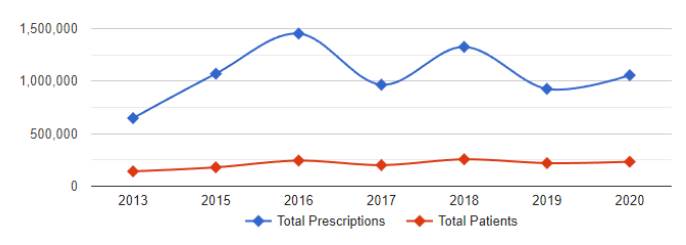
During 2020, 1056221 patients were prescribed modafinil in the United States. Among the most widely used drugs (Top Drug Rank) it ranked 302nd in that same year and had a 34 position rise over the previous year, the cost per prescription is approximately $69 and per day of therapy $3.38. The number of prescriptions, although fluctuating, tends to increase in the North American country (15), as can be seen in Figure 1.
Source: Clinical Calculators. Modafinil [Internet]. Drug usage statistics, United States, 2023. Available at: https://clincalc.com/DrugStats/Drugs/Modafinil
Figure 1 Number of prescriptions and patients per year with modafinil in the period 2013-2020.
The cost of modafinil has fallen in recent years in part because of patent releases and probably because of numerous lawsuits involving the Cephalon company. Teva was to pay $512 million to settle a claim that it received payments in various guises from the pharmaceutical company Cephalon in exchange for not producing a cheap generic version of modafinil (16). Teva was one of four generic drug manufacturers named in antitrust law. A lawsuit was filed by a large group of U.S. bulk drug purchasers, pharmacies, and health insurance plans over an alleged scheme to avoid generic competition for the sleep disorder drug modafinil (marketed in the United States as Provigil). The main patent for Provigil expired in 2003, but the drug’s manufacturer, Cephalon, still held minor patents related to the particle size of the active ingredient. Faced with a possible patent expiration, Cephalon paid pharmaceutical companies not to produce a generic drug with the modafinil active ingredient, at least not until the successor molecule, armodafinil or Nuvigil, was released. In the face of this, critics, including the U.S. government, have argued that this is monopolistic behavior that harms the consumer by keeping prices artificially high beyond the expiration of the patent. According to generic manufacturers Cephalon delayed the entry of its cheaper drugs by six years, until 2012. During that time, Provigil sales grew to more than $1 billion a year. Cephalon allegedly transferred about $200 million in various forms to generic manufacturers, a fraction of Provigil’s one-year sales profits. Drugmaker Teva was potentially exposed on two fronts in the case, first as a company that Cephalon paid, and subsequently with the acquisition of Cephalon in 2011.
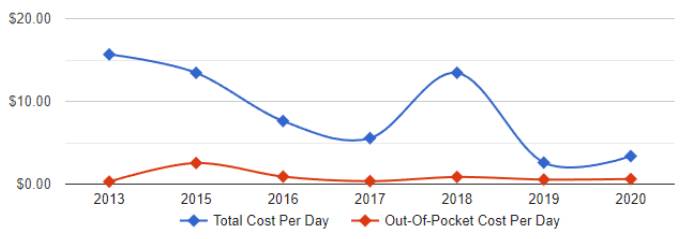
Subsequent to the purchase of Cephalon by Teva and the release of the patent, costs decreased, but usage has continued to progressively increase, the cost of the drug per day and the out-of-pocket cost per day can be seen depicted in Figure 2.
Source: Clinical Calculators. Modafinil [Internet]. Drug usage statistics, United States, 2023. Available at: https://clincalc.com/DrugStats/Drugs/Modafinil.
Figure 2 Cost of Provigil during the period 2013-2020
3.1.2. Patents on modafinil
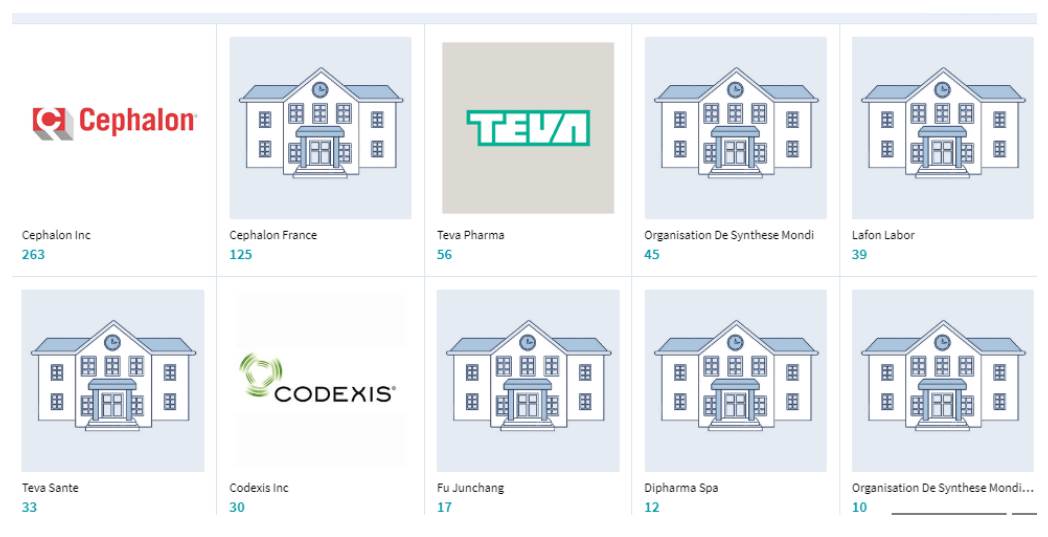
A search was carried out in the Lens database, finding 57 patent registrations, of which 56 are between inactive and expired, only one is active and it is on the biocatalysis and synthesis of armodafinil, the ownership of the latter is in the hands of Codexis INC, the rest of the patents belonged to Laboratories Lafon, Cephalon and Teva. In the case of this study, it is of interest that a molecule on which there is a patent favored that pharmaceutical laboratories were sucking each other, Cephalon buys Lafon and just when the agreement with the payments for the non-production of the molecule was going to end, Teva buys Cephalon. Figure 3 shows the distribution by patent applicants of modafinil, in which Cephalon and Teva, of course, head the list.
Source: Lens.org [Internet]. 2024. Available at: www.lens.org
Figure 3 Main pharmaceutical companies applying for patents for the modafinil principle
The synthesis of patents around modafinil can be seen in Table 1.
Table 1 Patent history on the compound modafinil
| Date of application | Title | Applicants | Citations per patent | Legal Status |
|---|---|---|---|---|
| 18/10/1993 | Use of modafinil for urinary incontinence | LAFON LABOR | 68 | Expired |
| 30/04/1996 | Modafinil for the treatment of sleep apnea and ventilatory disorders of central origin | LAFON LABOR | 77 | Expired |
| 10/10/2001 | Pharmaceutical solutions containing modafinil compounds | CEPHALON INC | 36 | Expired |
| 20/12/2001 | Modafinil compositions for the treatment of attention deficit hyperactivity disorder as well as multiple sclerosis fatigue | CEPHALON INC | 45 | Expired |
| 19/02/2002 | Use of modafinil and its D and L enantiomers | FU JUNCHANG | 10 | Expired |
| 17/08/2000 | Modafinil-containing compositions for treating eating disorders and appetite stimulation | CEPHALON INC | 52 | Expired |
| 27/07/2001 | Oxidation method for the preparation of highly pure modafinil and crystalline forms | TEVA PHARMA | 24 | Expired |
| 18/12/2001 | Mixture of modafinil and cyclodextrin | CEPHALON INC | 7 | Expired |
| 18/12/2003 | Method to produce crystalline modafinil and forms of optical enantiomers of modafinil | CEPHALON FRANCE | 37 | Inactive |
| 9/11/2004 | Process for the preparation of modafinil | DIPHARMA SPA | 7 | Inactive |
| 7/08/2003 | Polymorphic forms of modafinil | ORGANISATION DE SYNTHESE MONDI | 27 | Inactive |
| 27/10/2005 | Method for preparing methyl 2-diphenylmethylsulfinylacetate | CEPHALON FRANCE | 5 | Inactive |
| 30/10/2007 | Process for the enantioselective synthesis of single enantiomers of modafinil by asymmetric oxidation | CEPHALON FRANCE | 0 | Inactive |
| 16/12/2019 | Biocatalysts and methods for the synthesis of armodaphanil | CODEXIS INC | 1 | Active |
Source: prepared by the authors based on records in Lens.com.
According to the Federal District Court for the District of Columbia (17), the patent for the use of modafinil expired in 2001. However, in 1994 Cephalon applied for a second patent related to the drug, not for the entire modafinil compound, but covering a formulation of modafinil consisting of a specific distribution of small particles. This patent was first issued in 1997 and was reused in 2002 with the code RE37, 516. This patent expired in October 2014. However, the company received an extension of exclusivity for an additional 6 months from the FDA, until April 2015. On December 24, 2002, 4 companies approached the FDA to file a generic drug application for modafinil: Teva, Ranbaxy, Mylan and Barr Laboratories. Cephalon realizes that generic drug entry would be priced at 75% to 90% less, which would mean a revenue cut of $400 million per year and about 75% of Provigil’s cost of sales. To avoid this devastating effect Cephalon is introducing Nuvigil to the market as a successor to modafinil, hoping to escalate a portion of modafinil patients to armodafinil. The FDA does not approve the new drug as quickly as expected, which leads Cephalon to seek economic agreements for the acquisition of generic drugs produced by generic companies (17).
The above shows how around the research and technological production for the development of the molecule a series of mechanisms or devices are generated to obtain as much profit as possible, establishing monopolies that affect prices, generating unfair competition, and even penetrating the war market, for which the drug was not approved in its initial version. Today the drug is sold over the counter in Colombia and other Latin American countries, while in Spain (18) it is widely used by university students and businessmen. It is a paradigmatic case of technoscience in which different actors (pharmaceutical companies, State, intellectual property, armed forces, among others) are articulated around science and technology.
3.1.3. Ontology and axiology of technology
Two fundamental determining factors seem to underline the ontogeny of the genus homo: the development of a specialized physio-anatomy (bipedal posture, pincer grasp, with the subsequent functional and anatomical development of the frontal lobe), with the adoption of technical selection as a mechanism for the acquisition of complexity; and the other aspect is the formation of social bonds and relational skills such as compassion (19). Thus, hominization favors humanization as a social, cultural and technical process. That is to say, the human arose when a group of primates began to use their limbs to make tools, to such an extent that artificiality became natural, making the creation of objects outside the body, as well as the habit of using them in practice, a daily occurrence (20).
In this way, two arguments about the human seem to oppose each other, one that gives priority to the role of technical and instrumental skills and the other in favor of social and relational skills. Faced with the opposition of the opposites, a third argument may arise, that the process of the human constitution has been open for millions of years, i.e., we are under construction who are being shaped by relationships and technology. Today by technology itself and by drugs such as modafinil.
For this reason, one of the key questions is whether we are only subject to evolution in Darwinian terms or are we de-Darwinianized? If we are only under the Darwinian paradigm, are we beings subject to the rules of evolution and bound by them (21), is the consumption of drugs to be more efficient, to stay awake longer, to produce more and to consume more, to have better soldiers and pilots, is this really a matter of adaptation or does it exceed it? If technique and technology have been part of the process of humanization and hominization, of a certain way of coming into existence, of this taking charge of circumstance, why do we look at it with so much disdain? How does the way we look at technology and the human configure our relationship with it?
3.1.4. How neutral can a nootropic drug be?
The axiological neutrality of the drug in question can be discussed from the philosophy of technology: what vision of technology do we have? What vision do the different actors have within the framework of cognitive capitalism?
In the instrumental view of technology, three basic postulates are held:
Technology is neutral in its moral and political dimension since the means are independent of the ends sought.
That the technical artifact is essentially heteronomous, since its functioning and results are subject to the will of the user.
That from a genetic point of view, technology is understood on the basis of the problem/solution scheme, prioritizing the image of the instrument (22).
Based on this view it is possible to affirm that it is the use of technology that has important bioethical implications and that technology itself is neutral, does not represent intrinsic values and therefore we can be in favor of it. However, there are excellent counterexamples, ranging from the extermination ovens and gas chambers during the Holocaust, the design of bridges intentionally created to make it difficult to access certain parts of cities by public transport, the new devices for bio-surveillance and control of health services (23), to the case of interest, the design of drugs to improve cognitive performance in the world of immaterial work.
From other perspectives on technoscience it is possible to argue that technology is immersed in economic and political macro-processes, and currently, in a bio-technoscientific model that leads to a particular rationality of the time, thus representing interests and values, even generating the subordination of some values and knowledge over others (24). Therefore, it is not neutral (25), and in the particular case of modafinil it implies a series of interests that seem to intertwine and that exceed the treatment of narcolepsy; since it exceeds the biological need of adaptation to empower human beings for war, to improve cognitive capacities, to increase the time of wakefulness, and with it, of production and consumption, favoring the economic growth of pharmaceutical companies.
Along the same lines, according to Stengers (26), there would never have been experimental science if laboratory researchers had not been passionately interested in the difference between what “works”, what creates a relevant relationship, what produces knowledge that matters, that can be of interest, and an observation that is methodologically impeccable but incapable of creating any difference or consequence.
This medicine, which implies a decrease in sleep time, seeks a decrease in the so-called dead or unproductive time. Similar phenomena have already been elucidated around the massive consumption of energizers and at the same time of sleeping pills, which constitutes a mercantile colonialization of the space of sleep on the part of biocapitalism (27). In this sense, an analysis of the contrast between useful time and useless leisure time takes on a superlative value because he who sleeps more, loses time and money. Therefore, the imperative is to consume and be consumed in order to sleep, and if at the end of the day we cannot sleep, we must consume more drugs in order to sleep. Thus, configuring a vicious circle around the logic of the production and consumption system that demands obedience. It is a paradox, one must remain awake not necessarily to be more agents, but on the contrary by being active one will be more alienated and subdued.
4. Discussion
According to Preciado (28), the biochemical (pharmaceutical), electronic, computer or communication industries are the new industrial supports of capitalism. Today we are witnessing a production model, one in which technoscience is at the service of economic growth, a techno-capitalism in which the pharmacologization of life reigns. “At the beginning of the new millennium, four million children are treated with Ritalin for hyperactivity and for the so-called Attention Deficit Syndrome, and more than two million consume psychotropic drugs to control childhood depression” (28), while the aim is to control the hyperactivity of children, on the other hand, the aim is to control the sleep-wake cycle of adults.
Today we are witnessing a society product and producer of Prozac subjects, vigil subjects and subjects subjected to any molecule that can be developed, it is a dialectic relationship, society needs these subjects and vice versa, a co-dependence of subject and society. The body of the 21st century is a techno-vital platform, the result of an irreversible implosion of subject and object, of the natural and the artificial. The boundaries between the natural and the artificial are increasingly blurred, dynamic and arbitrary. It might be thought that it makes no sense to establish demarcation criteria between natural and artificial, however, at least from an ethical stance it is necessary to consider the implications of artifacts and in general of human transformations and creations, the interests, values, benefits, applications and risks that come into play within the framework of a technical culture and system. In this same line, the widespread use of modafinil can be interpreted as a form of normalization and social control where individuals are expected to maximize their productivity and efficiency, adapting to the demands of a super competitive society that questions the limits of the body and mind, every time it reinforces a logic in which performance and constant improvement become almost mandatory, affecting individual freedom and promoting a culture where rest and human limitations are seen as obstacles to overcome.
At times, it would seem that for a society of tiredness (29) not to tire, or rather, for it, despite tiredness to produce economic growth in a hyperconnected and catatonic world, requires the production of tons of drugs, millions of pornographic images (28), millions of new tweets, reels, tik toks, and the generation of medicalized biotechnological subjects devoid of moral agency. The interest of biocapitalism (30) is not to produce things, but mobile ideas, living organs, symbols, desires, chemical reactions and states of the soul. And in this conception, disease enters the domain of reality as a consequence of a medical and pharmaceutical model, able to explain. Staying awake and improving intellectual performance acquires a superlative value in the era of immaterial work.
According to Berardi (31), it is possible to speak of an economy of attention insofar as this cognitive faculty becomes part of the economic discourse, which means that it has become a scarce resource. This lack of attention is explained by the scarce time needed to pay attention to the large flows of information to which we are exposed and which we must constantly evaluate in order to be able to make decisions. Today there is no time for leisure, everything becomes neg-leisure (negation of leisure), we no longer have time for love, tenderness, nature, pleasure and compassion (31), thus, according to this same author, a pathogenic gap opens up and mental illnesses spread. As pathologies spread, so do drugs. Everything seems finely articulated in a vicious circle, hyper-consumption, hyper-connection, hyper-production, hyper-tiredness, drugs, screens and back to the loop (32).
One of the characteristics of contemporary society is its obsession with happiness, everywhere there appear, a series of supposed shortcuts to reach it easily and quickly. According to Rojas Estapé (2023) happiness is not in these easy shortcuts, but in the meaning that each one gives to life; or in the Aristotelian sense in a virtuous life; but in a society that has lost meaning, that does not transcend from work to action in Arendt’s sense, it has opted for sensory stimuli, ranging from social networks to drugs. Despite these pleasurable stimuli, happiness does not seem to be the common denominator of contemporaneity. Today we live in a world of hypercortisolemia, allostatic load (34), inadequate emotional management and high suicide rates. (35). The state of sustained stress and cortisol intoxication alters the immune system from an anti-inflammatory to a chronic inflammatory state. One of the target organs involved in the stress storm is the digestive system (36), and it is not surprising that today there is a marked exacerbation of digestive disorders, gastritis, irritable bowel, among others.
Drug research and design has a social value and cannot be subordinated to economic ends, much less when it is done with participants, since this would translate into exploitation and its use as a means and not as an end. Therefore, it is mandatory that pharmacological research should change, return to the humanistic and social path and move away from the economic stimuli supported by pernicious and mercantilist patent systems, since, to the extent that they take control of the great discoveries in health, power and access are taken away from the patients who need it. It should be remembered that intellectual property coerces access to what is appropriate, including access to what is one’s own (37).
From an axiological point of view, “everything is the object of esteem or appreciation. The smallest thing, a grain of sand, is the object of esteem or contempt, and therefore has at least an economic value, i.e., a price” (38). Values are emotional and not rational, or in Gracia’s words, the world is governed by values, not ideas. The superlative value of producing, thinking more and better, consuming, being awake, seems to represent on the one hand effectiveness, utility and efficiency as opposed to values such as caring for others (39), self-care and leisure. The drug, the development of the drug, the production and its consumption are in the framework of the facts, therefore, they represent instrumental material values. However, behind these facts there are other non-instrumental valuations (40): a valuation of the living beings who consume the drug, of those who need, buy and consume the drug, and of those who are considered to need the drug but do not consume it for whatever cause or reason. Other valuations could be underlying, such as the aesthetic value of perfection and rationality at its best.
Today, one of the characteristics of educational systems is to train for competition and success, therefore, the values that are being put at the top are social and economic power, competitiveness, success against others, generating in passing a group of failures (41), marginalized and defeated who may find in substance abuse a way to get out of the way. The consumption of drugs and psychoactive substances is not merely a biological fact, it is a social and moral fact, because it has to do with the value system that each person takes as his own, with what he believes he can and should do, or what he somehow considers good for himself (41).
According to Diego Gracia (38), economic, food and social progress is responsible for the growth of the famous six main causes of death in developed countries, techno-scientific developments and advances in medicine not only cure diseases, but can also produce them, the widely used placebo effect should be superimposed on the “Nocebo” effect, every drug is toxic, and the indiscriminate consumption of drugs can lead to a greater burden of disease. Similar cases have been evidenced with the opioid cases in the United States in which over-prescription and financial interests generated a social crisis (42).
To what extent are the subjects who consume modafinil truly autonomous to produce and consume more? Probably, it is the social and economic conditions that conditions the consumption of this drug in the absence of narcolepsy. However, it is worth noting that there are still no long-term studies on the effects of the drug on sleep architecture and, in general, on the well-being of patients who take it. At this point there seem to be tensions between the value of health and life and the value of money, as has been described in other areas such as those related to intellectual property (33), and in general the products of technoscience (43).
According to Gracia (35), it is possible for values, whether of the same or different nature, to conflict with each other, which leads to the presence of conflicts being considered a fundamental characteristic in the bioethical field. “The solution to value conflicts must be sought in the deliberation of values and their characteristics but taking into account the circumstances of each case and the foreseeable consequences” (35). And in such complex situations it is evident that it is necessary to train human beings more and better in the dimensions of value and duty, people who are critical of their environment and aware of their responsibilities (41). The point is that these problematic assessments and the conflicts of values surrounding the medicalization of daily life and the subsequent pharmacologization have been little problematized and elucidated, either because of their emergent character or because of the lack of interest of various actors (State, academia, pharmaceutical companies, and the community in general). Therefore, there has been little deliberation on the subject.
5. Conclusions
A bioethical analysis of the use of modafinil, especially from a biopolitical perspective, reveals important issues related to autonomy, power over life and the body, the technification and medicalization of life, the risks associated with consumption, and intellectual property policies. Although this drug may offer cognitive and performance enhancements in demanding contexts, its use outside of medical indications raises serious concerns. In times of medicalization and pathologization of life, new drugs emerge as the solution to all problems and especially to emerging pathologies. In this case, diseases are associated with lack of production, lack of concentration and fatigue. A critical look at the medicalization of everyday life is more than necessary, especially when drugs such as modafinil are configured as techno-scientific tools that, although they can solve health problems, also generate a certain form of government of the subjects, that is, an intentional driving, in which others are governed behind the scenes to make the subjects productive bodies at the service of the performance society.
In the face of emerging drugs, it is worthwhile to make a genealogy of the origins and interests involved; political and social interests account for the values in tension. The issue of patents in the production of drugs remains a complex issue in which utility and equity seem to be set against each other. However, industry is not the only actor; academia and the political sector also play key roles within the bioscience system, influencing the direction of research, regulation and distribution. In this context, it is essential to analyze how these power dynamics are configured, as they determine both access to medicines and the orientation of scientific advances towards public health priorities or economic interests.
REFERENCES
1. Echeverría J. La revolución tecnocientífica. Madrid: Fondo de Cultura Económica de España; 2003. [ Links ]
2. Billiard M, Broughton R. Modafinil: its discovery, the early European and North American experience in the treatment of narcolepsy and idiopathic hypersomnia, and its subsequent use in other medical conditions. Sleep Medicine [Internet]. 2018 [citado 20 de mayo de 2023]; 49:69-72. Disponible en: https://linkinghub. elsevier.com/retrieve/pii/S1389945718302211 [ Links ]
3. Repantis D, Schlattmann P, Laisney O, Heuser I. Modafinil and methylphenidate for neuroenhancement in healthy individuals: A systematic review. Pharmacological Research [Internet]. 2010 [citado 20 de mayo de 2023]; 62(3):187-206. Disponible en: https://linkinghub.elsevier.com/retrieve/pii/S1043661810000927 [ Links ]
4. Keating GM, Raffin MJ. Modafinil: A Review of its Use in Excessive Sleepiness Associated With Obstructive Sleep Apnoea/Hypopnoea Syndrome and Shift Work Sleep Disorder. CNS Drugs [Internet]. 2005 [citado 20 de mayo de 2023]; 19(9):785-803. Disponible en: http://link.springer.com/10.2165/00023210200519090-00005 [ Links ]
5. Franke AG, Gränsmark P, Agricola A, Schühle K, Rommel T, Sebastian A, et al. Methylphenidate, modafinil, and caffeine for cognitive enhancement in chess: A double-blind, randomised controlled trial. European Neuropsychopharmacology. 2017 Mar; 27(3):248-60. https://doi.org/10.1016/j.euroneuro.2017.01.006 [ Links ]
6. Haghighi M, Jahangard L, Meybodi AM, Shayganfard M, Ahmadpanah M, Faryadres M, et al. Influence of modafinil on early ejaculation. Results from a double-blind randomized clinical trial. Journal of Psychiatric Research [Internet]. 2022 [citado 20 de mayo de 2023]; 146:264-71. Disponible en: https://linkinghub.elsevier.com/retrieve/pii/S0022395621006646 [ Links ]
7. Rios MD. Technological Neutrality and Conceptual Singularity. SSRN Journal [Internet]. 2013 [citado 18 de noviembre de 2024]; Disponible en: http://www.ssrn.om/abstract=2198887 [ Links ]
8. Bourke J. Enjoying the high life-drugs in history and culture. The Lancet [Internet]. 2010 Nov [citado 20 de mayo de 2023]; 376(9755):1817. Disponible en: https://linkinghub.elsevier.com/retrieve/pii/S0140673610621538 [ Links ]
9. Kamieński Ł. Shooting up: a short history of drugs and war. New York, NY: Oxford University Press; 2016. [ Links ]
10. Martí-Font J. El “síndrome del Golfo” francés. El país; 2005. [ Links ]
11. Ooi T, Wong SH, See B. Modafinil as a Stimulant for Military Aviators. Aerospace Medicine and Human Performance [Internet]. 2019 [citado 20 de mayo de 2023]; 90(5):480-3. Disponible en: https://www.ingentaconnect.com/content/10.3357/AMHP.5298.2019 [ Links ]
12. Caldwell JA, Mallis MM, Caldwell JL, Paul MA, Miller JC, Neri DF. Fatigue Countermeasures in Aviation. aviat space environ med [Internet]. 2009 [citado 20 de mayo de 2023]; 80(1):29-59. Disponible en: https://asma.kglmeridian.com/view/journals/asem/80/1/article-p29.xml [ Links ]
13. Sample I, Evan R. MoD bought thousands of stay awake pills in advance of war in Iraq. The Guardian; 2004. [ Links ]
14. Reuters Staff. Cephalon dice fármaco Nuvigil ayuda a tratar el “jet lag.” Reuters; 2009. [ Links ]
15. Clinicalc.com. Modafinil Drug Usage Statistics, United States, 2013 - 2020. Disponible en: https://clincalc.com/DrugStats/Drugs/Modafinil [ Links ]
16. Corte del circuito de Richmond. La Commonwealth de Virginia demanda camapaña de veinte años viola la Ley de Protección del Consumidor de Virginia, Va. Code §§ 59.1-196 a 59.1-207. [Internet]. 2019. Disponible en: https://www.oag.state.va.us/consumer-protection/files/Lawsuits/Teva-Pharmaceuticals-and-cephalon-Complaint.pdf [ Links ]
17. Corte del distrito de Columbia. Complaint for injuctive relief. 2008. [ Links ]
18. Bermejo D. Modafinilo, así es la droga inteligente que triunfa entre los estudiantes. El Mundo; 2017. [ Links ]
19. Sáez R. Evolución humana: Prehistoria y origen de la compasión. Córdoba: Almuzara; 2019. [ Links ]
20. Carbonell E, Sala R. Planeta humano. Barcelona: Ediciones Península; 2000. [ Links ]
21. Rodríguez González M. Filosofía de la mente. Primera edición. Madrid: Ediciones Complutense; 2021. [ Links ]
22. Mattarollo L. ¿Es la tecnología valorativamente neutral? Interpretaciones y respuestas desde el pragmatismo de John Dewey. RV. 2022; (30):189-219. https://doi.org/10.15174/rv.v15i30.587 [ Links ]
23. Uribe JCG, Ovalle JLV, Cruz VAV. Care Units or Intensive Care Units? Cultura de los Cuidados. 2024; 3(69):67-79. https://doi.org/10.14198/cuid.26486 [ Links ]
24. Echeverría J. Innovation and values: a European perspective. First [edition]. Reno, Nevada: Center for Basque Studies; 2014. [ Links ]
25. García Uribe JC, Augusto Bedoya O, Arteaga A. La técnica y la tecnología no son culpables de la deshumanización del cuidado de enfermería. Index Enferm. 2024; 10:e14789. [ Links ]
26. Stengers I. La propuesta cosmopolítica. Pléyade. 2014; (14):17-41. Disponible en: https://www.revistapleyade.cl/index.php/OJS/article/view/159 [ Links ]
27. Botero Bernal A. El capitalismo y el sueño. revfil [Internet]. 2020 [citado 13 de mayo de 2024]; 20(1). Disponible en: https://revistas.uis.edu.co/index.php/revistafilosofiauis/article/view/11640 [ Links ]
28. Preciado PB. Testo yonqui: sexo, drogas y biopolítica. Barcelona: Editorial Anagrama; 2020. [ Links ]
29. Han BC. La sociedad del cansancio. Segunda edición ampliada. Barcelona: Herder; 2020. [ Links ]
30. Sunder Rajan K. Biocapital: The Constitution of Postgenomic Life [Internet]. Duke University Press; 2006 [citado 16 de enero de 2025]. Disponible en: http://read.dukeupress.edu/books/book/1061/BiocapitalThe-Constitution-of-Postgenomic-Life [ Links ]
31. Berardi F. La fábrica de la infelicidad: nuevas formas de trabajo y movimiento global. Madrid: Traficantes de sueños; 2003. [ Links ]
32. García Uribe, John. Hermenéutica del burnout. Revista Colombiana de Bioética. 2023; 18(1):1-16. https://doi.org/10.18270/rcb.v18i1.4335 [ Links ]
33. Rojas Estapé M. Cómo hacer que te pasen cosas buenas: entiende tu cerebro, gestiona tus emociones, mejora tu vida. Barcelona: Espasa; 2023. [ Links ]
34. Garcia JC, Arteaga A. Allostatic load and physiological responses to work stress: an integrative review. Rev Bras Med Trab. 2023; 21(04):01-9. https://doi.org/10.47626/1679-4435-2023-945 [ Links ]
35. Soria V, Uribe J, Salvat-Pujol N, Palao D, Menchón JM, Labad J. Psiconeuroinmunología de los trastornos mentales. Revista de Psiquiatría y Salud Mental [Internet]. 2018 [citado 28 de septiembre de 2023]; 11(2):115-24. Disponible en: https://linkinghub.elsevier.com/retrieve/pii/S1888989117301003 [ Links ]
36. Kemp W, Bashir A, Dababneh H, Cohen-Gadol A. Cushing’s ulcer: Further reflections. Asian J Neurosurg [Internet]. 2015 [citado 28 de septiembre de 2023]; 10(02):87-94. Disponible en: http://www.thieme-connect.de/DOI/DOI?10.4103/1793-5482.154976 [ Links ]
37. García Uribe JC. Propiedad intelectual, patentes y salud: una mirada desde la Bioética. Rev latinoam bioet. 2021; 21(2):25-40. https://doi.org/10.18359/rlbi.5076 [ Links ]
38. Gracia Guillén D, Cortina Orts A. La cuestión del valor. Madrid: Real Academia de Ciencias Morales y Políticas; 2011. [ Links ]
39. García Uribe JC, Lopera Jaramillo DM. Valor para cuidar y cuidado como valor. CES Enf. 2024; 5(1):49-55. https://doi.org/10.21615/cesenferm.7522 [ Links ]
40. Gracia D. Valor y precio. Madrid: Triacastela; 2013. [ Links ]
41. Gracia Guillén D. Como arqueros al blanco: estudios de bioética. España: Triacastela; 2004. [ Links ]
42. Maumus M. Bioethics in Practice - The Ethics of Opiate Use and Misuse from a Hospitalist’s Perspective. Ochsner J. 2015; 15(2):124-6. [ Links ]
43. García Uribe JC, Rico Areiza LF. La automatización laboral: una perspectiva fenomenológica e histórica. Jangwa Pana. 2022; 21(3):182-91. https://doi.org/10.21676/16574923.4730 [ Links ]
1International peer-reviewed journal on sleep and circadian rhythm, is the official journal of the Sleep Research Society, ranking Q1, with about 5000 citations during 2020.
2An American pharmaceutical company, today it is part of the Teva group of industries, the largest pharmaceutical company producing generic drugs and one of the most important worldwide.
3British soldiers in World War I ingested convenient pills containing a potent mixture of cocaine and caffeine that promised to substantially increase stamina and reduce appetite, which may have helped them endure the rigors of trench warfare (8,9). In the case of Nazi Germany, amphetamines and alkaloids were also used to improve the performance of the troops, and preliminary experiments were conducted with concentration camp prisoners. Prisoners at Sachsenhausen who were administering the drug, codenamed D-IX, were forced to march in circles carrying 20 kg packets. They could go 55 miles without resting. According to The Guardian magazine, “The aim was to use D-IX to redefine the limits of human endurance.”
CÓMO CITAR: García Uribe, J. C., Almeida, A., Carrero, T. Y. (2025). Modafinil, pharmacologization, technoscience and the tension of values. Medicina y ética, vol. 36, núm. 3. DOI: https://doi.org/10.36105/mye.2025v36n3.01
Received: November 26, 2024; Accepted: January 16, 2025
 Este es un artículo publicado en acceso abierto bajo una licencia Creative Commons
