




 nueva página del texto (beta)
 Inglés (pdf)
 Artículo en XML
 Referencias del artículo
 Traducción automática
 Enviar artículo por email
 Citado por SciELO
  Similares en
SciELO
Similares en
SciELO 
 Permalink
Introduction
According to the World Health Organization, breast cancer has the highest incidence among women worldwide1-3. As a result, awareness campaigns are frequently conducted to promote prevention. Treatment for breast cancer often involves a combination of chemotherapy, radiotherapy, hormonal therapy, and/or mastectomy. Mastectomy is a surgical procedure that removes the affected breast tissue, altering the breast's appearance and, consequently, impacting a woman's self-image. This can lead to feelings of anxiety and/or depression, as the breast is often seen as a symbol of femininity and motherhood4,5.
It is well known that only a small number of women afford breast reconstruction surgery, primarily due to high cost of the procedure. Many cannot afford it unless they receive government assistance or benefit from other forms of financial support6,7. As a result, following the emotional and physical challenges of a mastectomy, many women turn their attention to the use of an external breast prosthesis8 and its requirements.
Initially, the first prostheses used after mastectomy surgery are made from lightweight materials, such as foam or yarn filling. Once the surgical wound has healed, typically after 6 or 8 weeks, a silicone or handmade prosthesis with the appropriate weight is introduced9. These prostheses serve as artificial breast, replacing the patient's natural breast to help them adjust to their new body image. This, in turn, aids improving their self-image, as well as their psychological and physical well-being.
Studies have shown that the long-term use of standardized external breast prostheses (SEBP) provides significant emotional satisfaction for breast cancer survivors, enhancing their quality of life and reducing the stress associated with mastectomy10,11.
After undergoing mastectomy surgery, patients often do not immediately focus on external breast prostheses due to emotional and physical stress of cancer treatment, as well as the challenges of coping with the loss of a breast. Studies show that, during the recovery period, patients initially express little concern about the specific characteristics of the prosthesis. They are simply grateful to have one. However, as time passes by, the use of a prosthesis significantly contributes to their self-acceptance, with many reporting high levels of satisfaction, which greatly aids in their emotional recovery after mastectomy12.
The advancements in external breast prostheses design over time have been remarkable. Today, a wide range of options is available to meet individual preferences and needs, including variations in size, shape, weight, color, material, and texture. Women can choose prostheses with or without nipples, with or without areolas, or self-adhesive models designed for specific activities like sports. This variety allows more women to find a prosthesis that best suits their unique requirements13,14. However, despite these innovations, the high costs of an appropriate prosthesis remain prohibitive for some women15,16. In addition, the lifespan of the external silicone prostheses is typically around 2 years, assuming no damage occurs within that time frame, which leads to a recurring expense. Moreover, wearing these prostheses requires a specialized bra, which, due to its specific design, adds to the financial burden17,18.
In the state of Zacatecas, Mexico many women acquire SEBP through institutional support. These institutions distribute prostheses through donation campaigns. But to reduce costs, standardized shapes and weights are often provided. While this approach is beneficial in terms of accessibility, it can negatively impact mobility, comfort, and the natural appearance of the prosthesis.
To evaluate the satisfaction and comfort of breast cancer survivors in Zacatecas using SEBP exclusively for women with unilateral radical mastectomy, an anonymous survey was administered to women who had undergone different medical treatments for breast cancer. A total of 16 women in 2024 and 28 women in 2025 participated, providing valuable data for analysis. Similar studies conducted by cancer research institutions in different countries have demonstrated that the primary aim is to evaluate the satisfaction with the use of SEBP, even with small sample sizes4,19.
In this work, the results indicated that, although the majority of participants reported general satisfaction with their prostheses, a deeper analysis revealed the need for custom-design prostheses tailored to each individuals unique physical and emotional needs, but also contributes to solve musculoskeletal problems after mastectomy20.
This article is structured as follows: first, an introduction to the subject; next, the methodology used in the qualitative study; followed by the results obtained; and finally, the conclusions drawn from the research.
Methods
Cross-sectional observational studies conducted in March 2024 and February 2025, of members of two emotional support groups for breast cancer patients in Zacatecas, Mexico, were invited to anonymous participation. These support groups consist of women who have either completed or are currently undergoing treatment for breast cancer. As the women have different medical treatment, for this work were considered women which had undergone unilateral radical mastectomy only. Hence, with this characteristics, 16 and 28 women agreed to participate, responding either through internet, through electronic means, or by telephone.
In this study, it was not considered to compare the results with a test group of mastectomized women without using SEBP, because it does not exist in the support groups.
The survey consisted of 52 questions, focusing on the emotional aspects of using an external breast prosthesis, with confidentiality and anonymous assured. The questions used in this study were based from the Questionnaire10, validated by the Institutional Review Board of Emory University. The results obtained were analyzed using Excel tables and with the χ2 test with a significance level of α = 0.05 to evaluate the independence of the variables.
The questions were organized as follows: the first section gathered demographic information about the participants. The second section focused on the evaluation of the breast prosthesis in terms of comfort and emotional response to its use, including factors such as type, material, frequency, duration of use, and form. Furthermore, participants were asked about their emotional response to using an external prosthesis following a radical mastectomy, using a five-point Likert scale, ranging from "very dissatisfied" to "very satisfied" (Table 1).
Table 1 Five-point Likert
| Likert-scale | ||||
|---|---|---|---|---|
| Strongly disagree | Disagree | Neutral/uncertain | Agree | Strongly agree |
| 1 | 2 | 3 | 4 | 5 |
Satisfaction was assessed using a five-point Likert scale too. This evaluation considered aspects such as size, fit, comfort, appearance while wearing, weight, the natural feel of the prosthesis, how well it moves with the body, its durability, compatibility with different types of clothing, and overall satisfaction for each participant.
Finally, the third section of the survey evaluated the characteristics of specialized bras, including cost, difficulties in acquisition, and adaptability to the size of the prosthesis. It also explored whether modifications to regular bras were necessary for wearing an external prosthesis and the implications of such adjustments.
Results
The findings in 2024 and in 2025 from the two groups of 16 and 28 female breast cancer survivors who only underwent unilateral radical mastectomy are presented below.
General information
Table 2 presents the demographic characteristics of the participants, where m representing the survey responses from 2024 and n representing those from 2025. As shown, all women are from Zacatecas and have children. The age range of the participants is between 41 and 70 years old, with educational levels ranging from basic to higher education. The majority of participants underwent mastectomy between 1 and 5 years ago, accounting for 69% in 2024 and 61% in 2025. Mastectomies reported by these women are left breast, right breast or both. The medical treatment varied for each participant, including hormonal therapy, chemotherapy, surgery, and radiotherapy. Depending on each patient's healthcare system, these procedures were performed in Zacatecas or in different parts of the country. In addition, 10% of the women in 2024 and 53% in 2025 reported working at home. Finally, 31% of participants in 2024 and 17% in 2025 have an income of < $10,000 MXN.
Table 2 Demographic characteristics, m2024 = 16, n2025 = 28
| Residence Zacatecas state | Age | Studies | Monthly income (pesos MXN) | Mastectomy | Time post mastectomy (years) | ||||||||||||
|---|---|---|---|---|---|---|---|---|---|---|---|---|---|---|---|---|---|
| City | m | n | Years | m | n | Educational level | m | n | Income | m | n | Breast side | m | n | Time | m | n |
| Guadalupe | 8 | 12 | 41-50 | 9 | 7 | Basic school | 2 | 4 | Work at home | 6 | 15 | Left | 8 | 15 | < 1 year | 4 | 7 |
| Monte Escobedo | 1 | 1 | 51-60 | 6 | 15 | High school | 2 | 2 | ≤ $10000 | 5 | 5 | Right | 7 | 12 | 1-5 years | 11 | 16 |
| Río Grande | 1 | 61-70 | 1 | 6 | Technical career | 1 | 5 | More than $10000 | 5 | 8 | Both | 1 | More than 5 years | 1 | 5 | ||
| Villanueva | 1 | 1 | University | 6 | 9 | ||||||||||||
| Zacatecas | 6 | 13 | Higher education | 5 | 8 | ||||||||||||
Pre-surgery information on prosthesis use
When patients are informed that a mastectomy is necessary as part of their treatment, it is uncommon for them to receive information about the characteristics of external prostheses that may be used post-surgery. Of the participants, 93.75% in 2024 and 85.71% in 2025 received information about external prostheses after their surgery, reflecting the significant implications that this type of surgery has for the patients.
For the participants, 46.6 and 60.7% received information from the support group, 26.6 and 14.28% from their treating physician, 13.3 and 0% were not informed by anyone, and the remaining were informed by co-workers or friends, this information was provided by the responses in 2024 and in 2025, respectively.
Prosthesis use
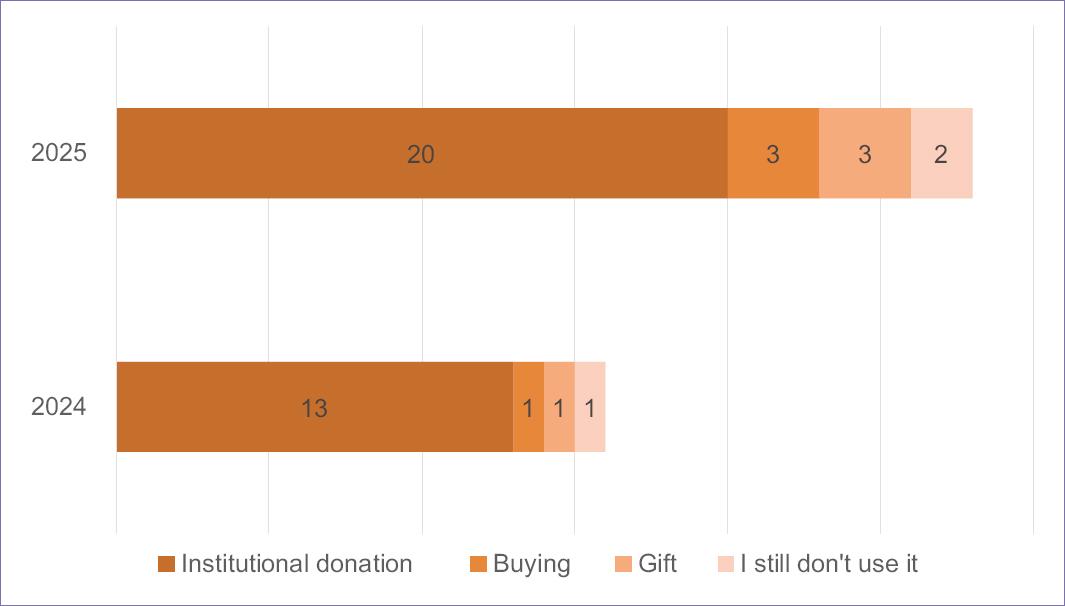
After mastectomy, the responses of women surveyed in 2024 and 2025 about getting their SEBP were 13 and 20 women obtained their prosthesis through institutional donations, 1 and 3 women purchased it and also received it as a gift; meanwhile, 1 and 2 women do not use it (Fig. 1).
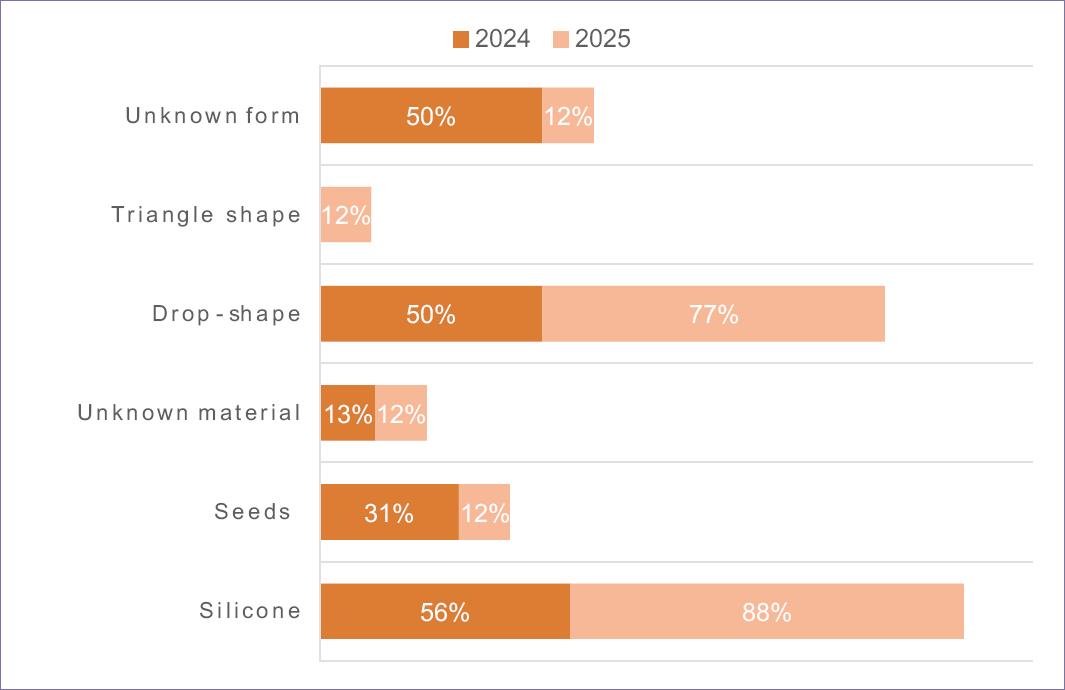
Regarding the shape of the SEBP, in 2024, a total of 62.5% of the participants were unaware of the specific shape of their prosthesis. However, in 2025, 76.82% of the participants were able to identify the drop shape of their prosthesis. For the material, 56.25 and 88.46% of the women reported that their prosthesis was made of silicone, 31.25 and 11.53% used prosthesis filled with seeds, and 12.5 and 0% did not know the material of their prosthesis (Fig. 2).
The participants, 56.25% in 2024 and 84.61% in 2025, owned one prosthesis. Even the rest of the women had more than one SEBP, most reported that only one prosthesis either fit properly or was undamaged.
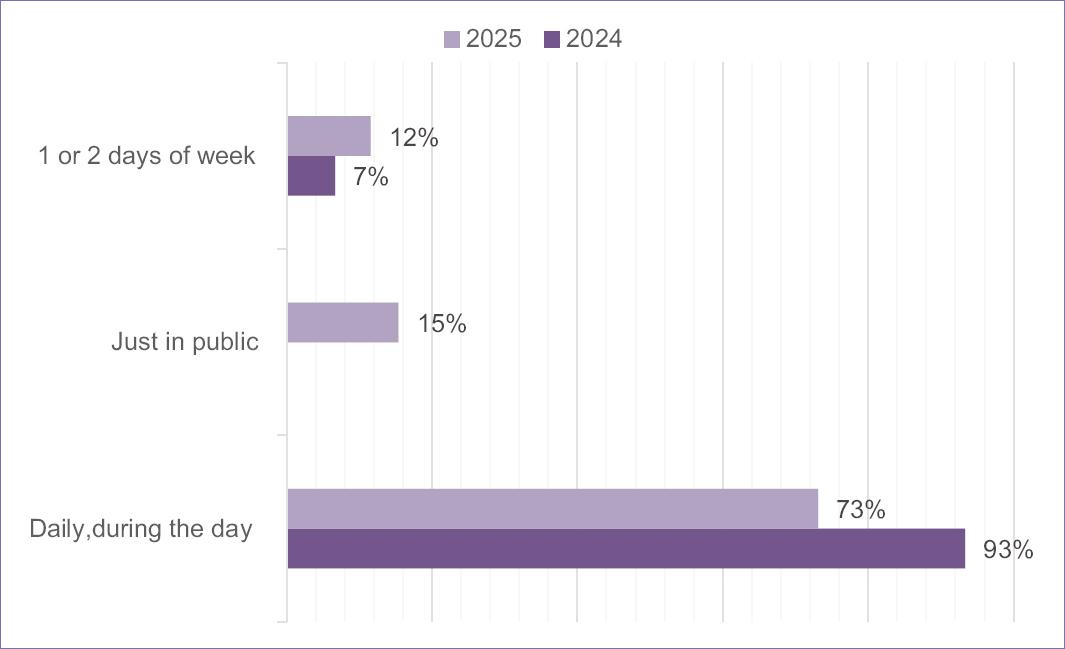
In terms of daily usage (Fig. 3), 93.33 and 73.08% of the women wore their prosthesis daily during the day. However, 6.67 and 11.54% wore 1 or 2 day of the week. One and two participants had not yet started using a prosthesis due to the recent timing of her surgery. Meanwhile, in the participants of 2025, 15.38% wore it only on public. It is important to mention that this study also indicates that 43.75% of women in 2024 and 34.61% of women in 2025 have been using their prosthesis for more than 2 years.
As an additional note, a government's breast reconstruction campaigns, only one woman of the group applied. Therefore, analyzing the successful use of SEBP is important for improving the lives of these women.
Prosthesis and mastectomy
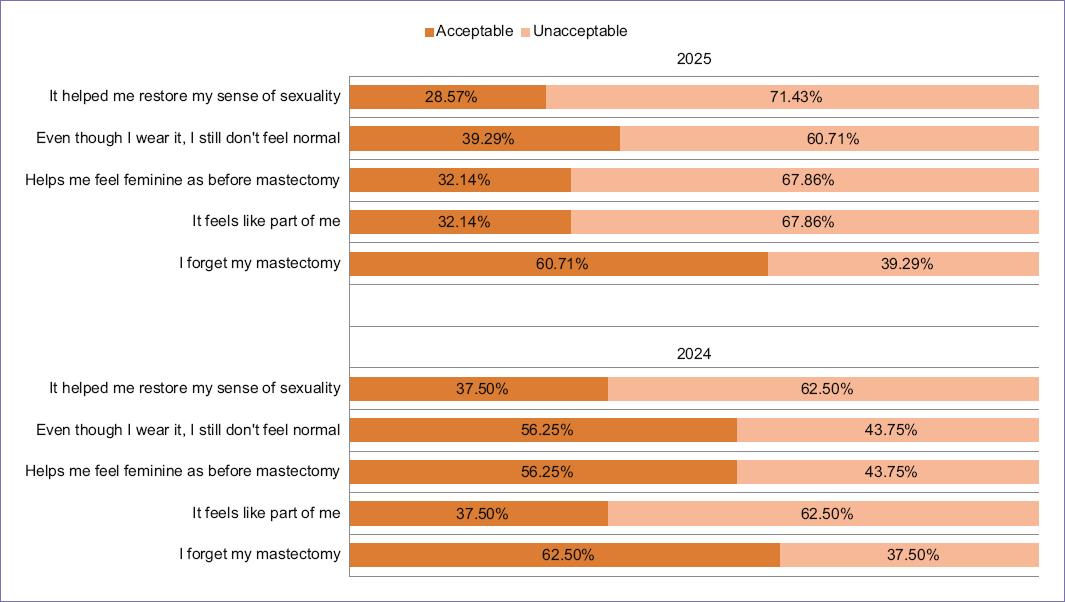
As shown in figure 4 (in year 2024 and in 2025), 62.5 and 60.71% of the women reported that using a prosthesis helps them forget about their mastectomy. However, 62.5 and 67.86% do not feel that the prosthesis is part of their body. In 2024, 56.25% feel more feminine when wearing it against 60.71% in 2025 that do not fell but 67.86% answered in 2025 that do not feel feminine. In addition, 62.5 and 71.43% believe that the prosthesis has not adequately restored their sense of sexuality. These responses were consolidated (grouping "very acceptable" and "acceptable" as acceptable, and "indifferent", "unacceptable" and "very unacceptable" as unacceptable) for analysis.
Satisfaction with prosthesis use
Satisfaction with the use of SEBP is shown in figure 5. The ability to wear different types of clothing was cited as an advantage by 56.25 and 76.92% of the participants in 2024 and 2025, respectively. The participants consider 43.75 and 53.85% suitable weight; 87.5 and 50% considered it of inappropriate form. In addition, 68.75 and 61.54 found the overall comfort of their prosthesis unacceptable.
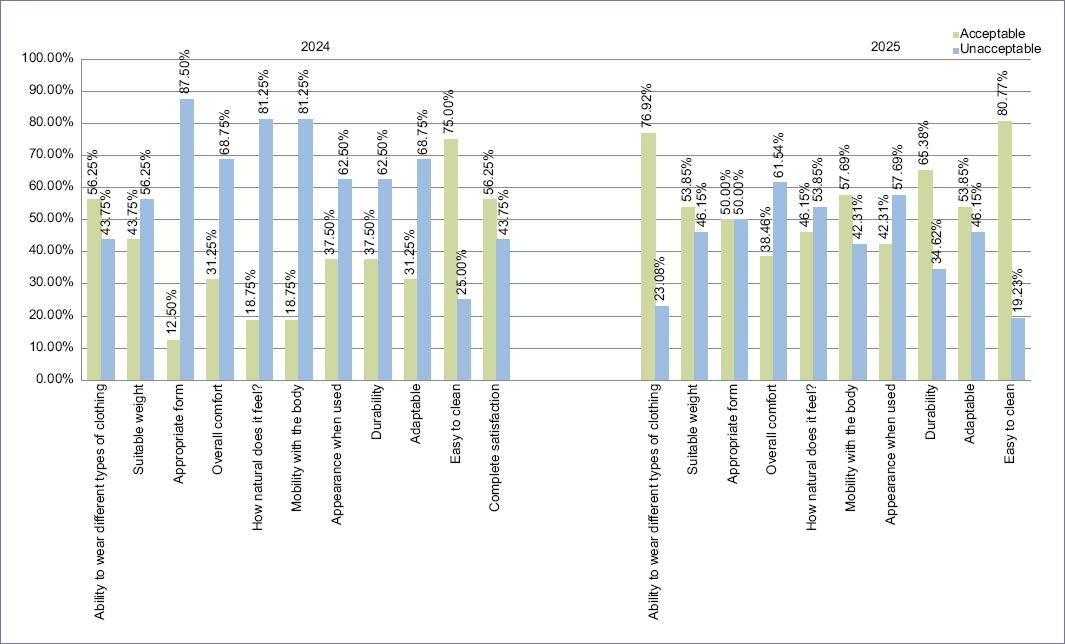
In terms of natural feel, 81.2 and 53.85% reported that their prosthesis did not meet acceptable standards, and 81.25 and 42.31% stated that the prosthesis did not move naturally with their body. Furthermore, 62.5% and 57.69% were dissatisfied with its appearance when worn, 62.5 and 34.62% rated its durability as unacceptable, and 68.75 and 46.15% considered it unadaptable.
However, in 2024, 56.25% of the participants, and in 2025, 69.23%, reported overall satisfaction with their SEBP. Nevertheless, when comparing satisfaction across specific parameters using the Chi-square test (χ², α = 0.05), it becomes evident that users are not entirely comfortable with their donated prosthesis, as shown in table 3.
Table 3 Comparison satisfaction with specific parameters using Chi-square, χ2 with α = 0.05
| Characteristic | 2024 | 2025 |
|---|---|---|
| Shape | 5.95 | 2.81 |
| Weight | 5.82 | 2.00 |
| Naturalness | 5.61 | 7.09 |
| Mobility | 4.17 | 2.74 |
Regarding the type of bra worn with SEBP, results from both years show that 87.5% of participants used a special bra, which they considered more expensive than a regular one. Moreover, 75% of the participants who wore the special bra reported difficulty obtaining them, so 50% adapted regular bras for use with SEBP.
As shown in figure 6, for special bra users 46.67 and 53.85% did not find them comfortable when worn with their SEBP, 66.67 and 50% felt that the size was inadequate. Among those who used regular bras, 86.67 and 65.38% found them uncomfortable and 86.67 and 76.92% reported that they did not fit the shape of the prosthesis.
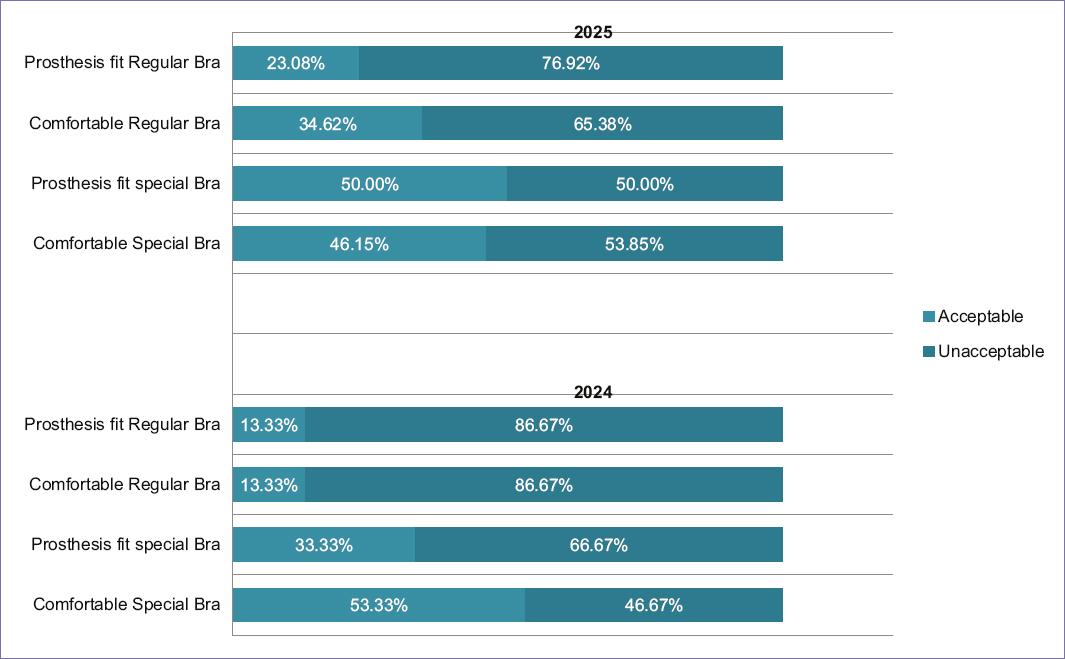
As previous section, the responses were consolidated for analysis, and the order of the answers is first from the year 2024 and then from the year 2025.
Discussion
This study focused on women who underwent radical mastectomy as part of their breast cancer treatment and responded to surveys conducted in 2024 and 2025. The results show that all participants were mothers over the age of 40, with educational backgrounds ranging from basic to higher education. These women were from various regions of the state of Zacatecas, and over 65% reported an income of < $10,000 MXN. More than 60% of them had undergone a radical mastectomy more than a year prior and had been using external prostheses since then. The study reveals that most participants received information about external prostheses post-surgery from emotional support groups, underscoring the critical role these groups play.
Most of the participants obtained their prostheses through institutional donations, where the type of the prothesis depended largely on what the donating institution offered. Many women expressed dissatisfaction with the shape of their SEBP, as most had received teardrop-shaped prostheses that differed significantly from the shape of their natural breasts. Regarding the weight of prostheses, participants reported that the SEBP was often inappropriate, potentially leading to future physical issues. In addition, they noted that SEBP did not fit properly in their bras, even when using specialized bras, resulting in an asymmetrical appearance.
The fact that most of the participants wore their SEBP for more than 6 h a day highlights the importance of self-image and physical care.
In terms of prosthesis material, while most participants used silicone protheses, some were using seed-filled protheses. Remarkably, those using seed prostheses had done so for over a year due to limited availability of SEBP from donation campaigns, which occur annually and have long waiting lists. On the other hand, some women had been using silicon SEBP for over 2 years, exceeding the recommended lifespan of these devices. The standardized nature of the prostheses resulted in discomfort, restricted mobility, and a lack of natural appearance, as indicated by the Chi-square test results.
Furthermore, some participants owned more than one prosthesis, but only one was in good condition. Many donated prostheses had been damaged in accidents, forcing women to wait for the next donation campaign to receive a replacement.
An additional challenge for participants was the need to purchase appropriate bras for their SEBP. Most women purchased specialized bras, despite their higher cost, and reported difficulty in finding them in local stores. Even with a specialized bra, participants did not feel comfortable due to the standardized size of the SEBP. Conversely, those who adapted regular bra found them uncomfortable, as they did not fit the shape of the prosthesis, leading to an uneven appearance in both cases.
In terms of the emotional impact of SEBP and its relationship to mastectomy, the survey revealed that while many participants stated that the prosthesis helped them forget about their surgery, a considerable number still did not feel entirely normal, as they had not fully regained their sense of sexuality. A smaller portion of participants, however, reported that the prothesis helped them feel feminine.
Given that an external breast prosthesis symbolizes femininity and affects both the physical and mental health of mastectomy survivors, wearing a well-fitting prosthesis is crucial. Incomplete satisfaction with the prosthesis can negatively impact daily life, especially since many women wear it every day, sometimes even while sleeping. However, the high cost of customized prostheses often prevents them from obtaining one that meets their needs. Additionally, the need to purchase appropriate bras and the limited lifespan of prostheses—typically around two years—make the overall cost prohibitive for some.
These results indicate that, despite general satisfaction, the shape and weight of the prostheses, as well as the comfort of the bras (whether specialized or adapted) are not optimal for most users.
Conclusion
Over the course of 2 years, surveys were conducted to obtain the results of this study, which highlights several critical challenges faced by breast cancer survivors in Zacatecas who use SEBP following radical mastectomy. Despite most participants reporting that the prosthesis helped them in some aspects of self-image and emotional recovery, significant issues remain regarding to fit, comfort, and functionality of these devices. The mismatch between the shape and weight of the SEBP and the women's natural bodies, compounded by limited availability and prolonged use of outdated devices, underscores the need for more personalized prosthetic solutions. Furthermore, the financial burden of acquiring specialized bras and the scarcity of suitable prostheses through donation programs add to the physical, emotional, and monetary difficulties experienced by these women in Zacatecas.
To improve the quality of life for breast cancer survivors, it is essential to prioritize the development and availability of custom-designed prostheses that cater to individual needs. In addition, more frequent donation campaigns and enhanced access to appropriate undergarments are necessary to ensure that survivors receive proper support. The identification and understanding of the needs of this vulnerable group of women in Zacatecas is just as important as the outcomes of this work.
Emotional support groups also play a vital role, not only in disseminating information about protheses but also in addressing the psychological and social impacts of breast cancer surgery. Future research should focus on explore innovative solutions to provide survivors with prostheses that better meet their physical and emotional requirements.

