




 nueva página del texto (beta)
 Inglés (pdf)
 Artículo en XML
 Referencias del artículo
 Traducción automática
 Enviar artículo por email
 Citado por SciELO
  Similares en
SciELO
Similares en
SciELO 
 Permalink
Introduction
Pain is described as an unpleasant sensation in the organism1. Neuropathic pain can be expressed as a stimulation of the algogenic receptors caused by a lesion to the peripheric or central nervous system2,3. There has been an increment in invertebrate and small mammal (i.e., mice, rats, bunnies) models aiming to understand molecular mechanisms of action, as neurons and fibers are involved in transmitting pain4,5. Furthermore, different therapeutic possibilities have been researched, including medications, biological substances, and other neuromodulators that might shift treatment options6.
The constriction of the sciatic nerve is one of the most popular models used to understand neuropathic pain. This article will exhaustively describe the existing tests and experiments in the scientific literature. The objective of this review is to display the different forms of measuring pain and the specific techniques that are used in sciatic nerve constriction in rat models4.
Materials and methods
This review used the National Library of Medicine standard research protocol to obtain its bibliography. We used public and free meta-search engines such as PubMed, Scopus, and Google Scholar. To identify the articles measuring neuropathic pain with sciatic nerve constriction technique in rats (Bennett technique), we selected a time lapse between 1988 and 2024. To correctly filter the scientific literature, Boolean Operators were used with the upcoming Medical Subject Headings (MeSH): neuropathic pain, sciatic constriction, rats, measurement, and evaluation.
The inclusion criteria were: (1) studies in rats; (2) use of sciatic nerve constriction technique (Bennett technique) to produce neuropathic pain; and (3) measurement of neuropathic pain in rats. The exclusion criteria were: (1) review articles, (2) articles that were not written in English, French, or Spanish; and (3) incomplete or non-specific measurement articles. A total of 132 articles were selected (Fig. 1).
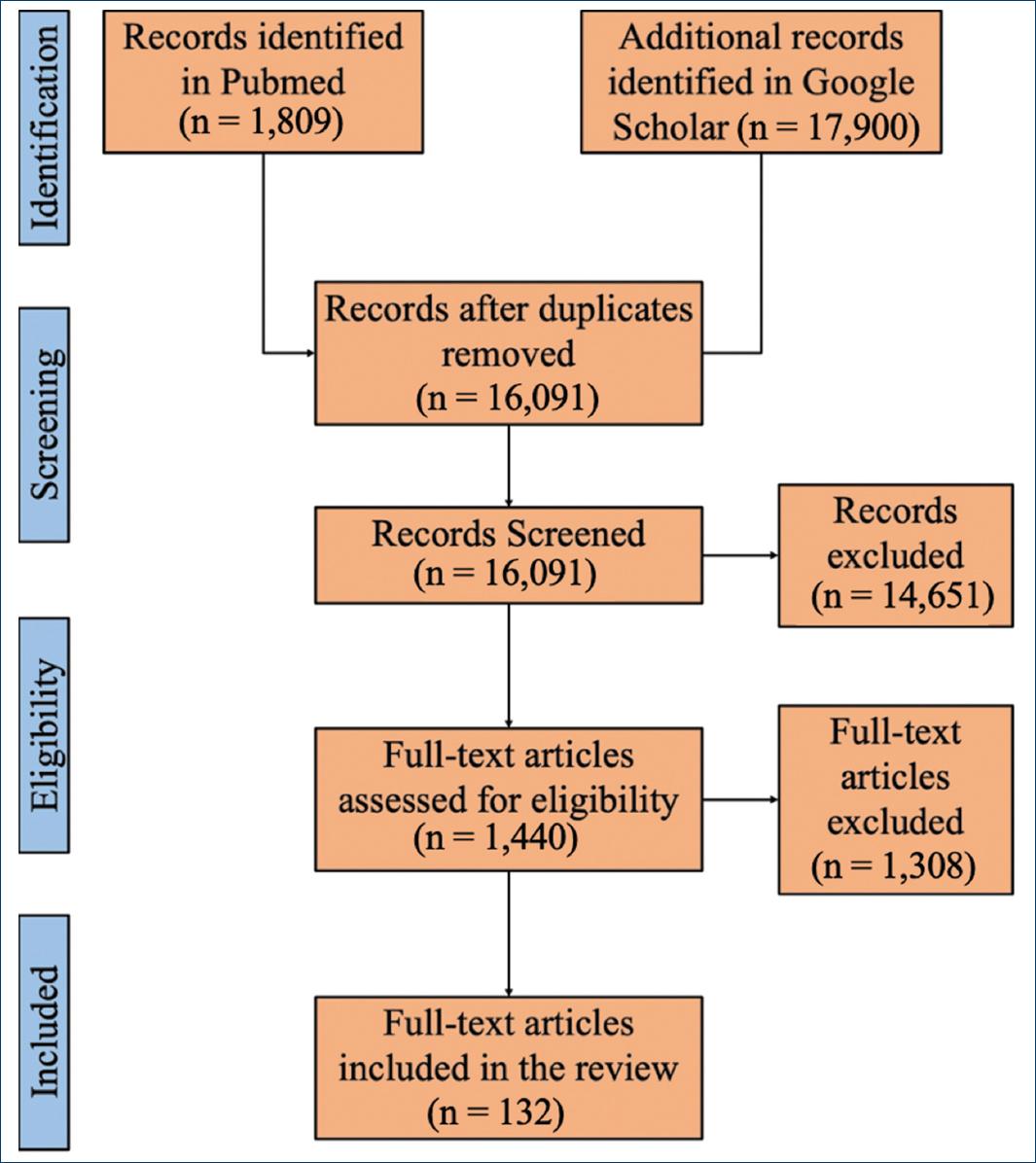
Figure 1 PRISMA flow diagram for paper selection. In this figure, the criteria used for selecting the scientific papers used in this review can be seen. It is important to state that the search started using the operators "(neuropathic pain) AND (sciatic constriction)" and after different exclusions the final search with Boolean operators was "(neuropathic pain) AND (sciatic constriction) AND (rats) AND (measurement) AND (evaluation)". This prompt reduced the number of articles from 17,900 to 132 eligible for making the review.
Bennett technique or sciatic nerve constriction model
The Bennett technique was proposed in 1988 as the first rat model that recreated mononeuropathy in rats7. The steps to make this procedure are the following. First, the researcher must apply intraperitoneal anesthesia to the rat trying to induce sleep and nullify pain in the upcoming surgery, insulin needles are recommended for applying chloral hydrate or propofol. After the animal is set asleep, the lower right extremity that will be operated must be shaved with a hair clipper, and antisepsis should be done using chlorhexidine or povidone-iodine in the gluteal region and the leg of the rat. It is important to mention that the surgeon should use the proper equipment (i.e., surgical gown, adequate surgical gloves, facemask, and aseptic surgical equipment) and antiseptic technique to reduce the probability of post-surgical infections, as shown in figure. 2.
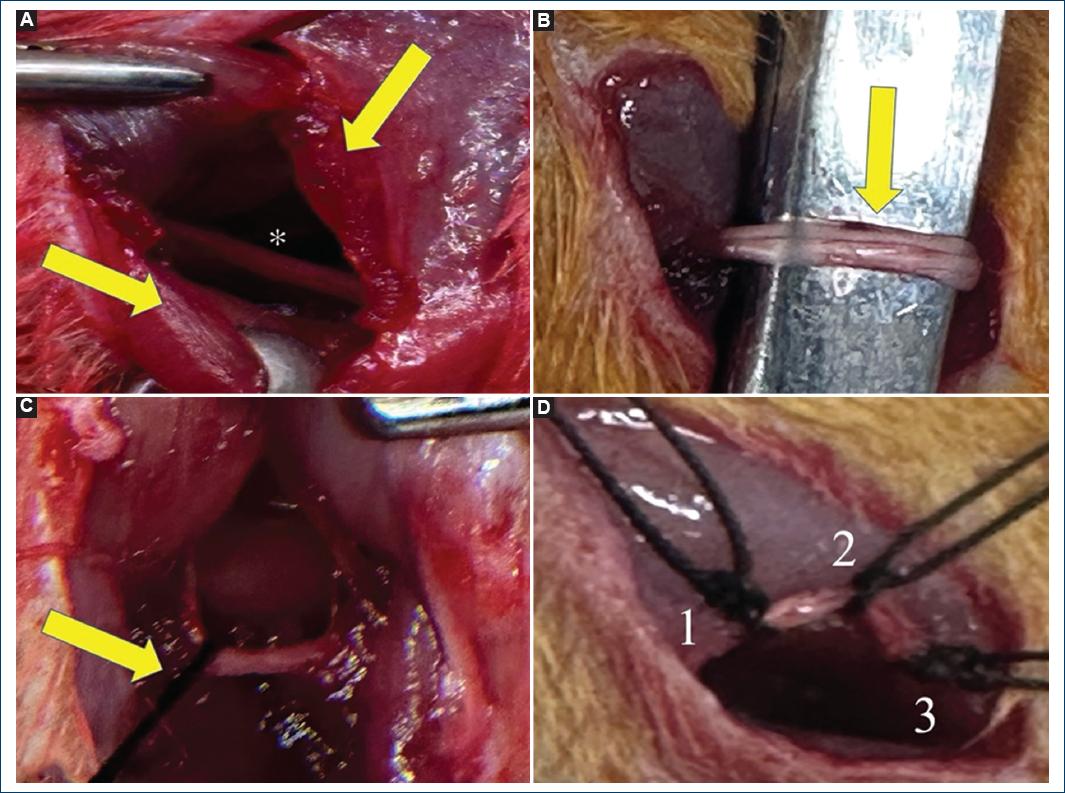
Figure 2 Bennett technique steps. In the upper images are shown the series of steps that are required for the Bennett technique for compressing the sciatic nerve. After previously completing the first steps mentioned before. A: shows the separation of the gluteus maximus and biceps femoris muscles; *: sciatic nerve. B: the sciatic nerve is located and exposed to realize the dissection. C: 4-0 silk thread that will be used for three knots. D: the image describes how the three knots should look like, and the correct spacing between them.
Subsequently, the skin should be cut with a #15 scalpel, and dissection should be done with Mayo or Iris scissors, it may also be done with curved Kelly forceps. When the sciatic nerve has been located, a gentle dissection must be done with the curved Kelly forceps to preserve the nerve. This white structure must be exposed to pass under three 4-0 silk threads. These strings will be used to tie the nerve firmly 3 times. After that, the surgeon must do a layered closure using a 4-0 silk suture, starting with the muscle, and finishing with the skin. The recommended technique is the use of a simple interrupted suture. Finally, a single dose of prophylactic broad-spectrum antibiotic is used to lower the risk of future infections and complications8.
Results
Different methods to measure pain
After inspecting the scientific literature, we found 132 articles that measure neuropathic pain in rats using sciatic nerve constriction. These articles can be divided into the following categories by using the methods in which the authors measured pain: (1) Von Frey test, (2) pin pricking test (3) cold score, (4) hot-plate test, and (5) miscellaneous. In the following paragraphs, the article will describe each method as well as the specifications of each measurement. We will display a figure to clarify how the tests are done.
It should be highlighted that out of all the papers that were selected (n = 132), the Von Frey filament test was used in 99 (75%) of the articles, Hot stimuli in 80 (60.60%) of the items, cold score in 40 (30.30%) of the articles, pin pricking in 5 (3.78%) of the items and Other forms of measurement in 41 (31.06%). In the following subdivisions, each technique will be described in this section.
VON FREY TEST
It can be said that the Von Frey filament test is the gold standard for measuring pain that produces allodynia from mechanical stimuli in rats. This measuring method can be applied either manually with different hair thicknesses, or with an electronic filament that applies increasing force until the extremity is withdrawn9. The manual filaments are a standardized set of 20 units that vary in the force applied to the rat extremity. The range of hairs goes from 0.008 to 300 g of force applied to its tip, which has a corresponding thickness between 1.65 and 6.65 mm as shown in table 1.
Table 1 Von Frey filaments equivalences. Equivalence between filament label and force in grams applied
| Filament label | Force (g) |
|---|---|
| 1.65 | 0.008 |
| 2.36 | 0.02 |
| 2.44 | 0.04 |
| 2.83 | 0.07 |
| 3.22 | 0.16 |
| 3.61 | 0.4 |
| 3.84 | 0.6 |
| 4.08 | 1.0 |
| 4.17 | 1.4 |
| 4.31 | 2.0 |
| 4.56 | 4.0 |
| 4.74 | 6.0 |
| 4.93 | 8.0 |
| 5.07 | 10.0 |
| 5.18 | 15.0 |
| 5.46 | 26.0 |
| 5.88 | 60.0 |
| 6.10 | 100 |
| 6.45 | 180 |
| 6.65 | 300 |
Although the electronic Von Frey test can be used, not every laboratory has this equipment for measuring pain. Moreover, pain can still be quantified accurately manually as well as electronically. The latter has a clear advantage, it reduces measurement times because the force is applied by the device and no instrument change is required. The hardware and software used for measuring neuropathic pain are Dynamic Plantar Esthesiometer and Mouse Met/Rat Met10.
For using Von Frey hairs, it is essential to lay the animal under a meshed surface and use a transparent cage to determine the response to stimuli, as shown in figure. 3. A positive response is a clear withdrawal of the extremity or continuous repeated small movements because sometimes the extremities might have paresis. The most used methods for measuring pain are: "percentage response frequency," "ascending test" and "up-down method." The "percentage response frequency" is the easiest way of measuring neuropathic pain because the hairs are used in ascending order, the same number of times proposed by the researchers (e.g., 3 times, 6 times, 10 times) until the paw withdrawal is frankly positive, as Kim and Chung described11. A variation of the last method is the "ascending test" which consists of using hairs from thinnest to thickest until a positive response is seen 2 times in ten applications as Scholz et al. first proposed12.
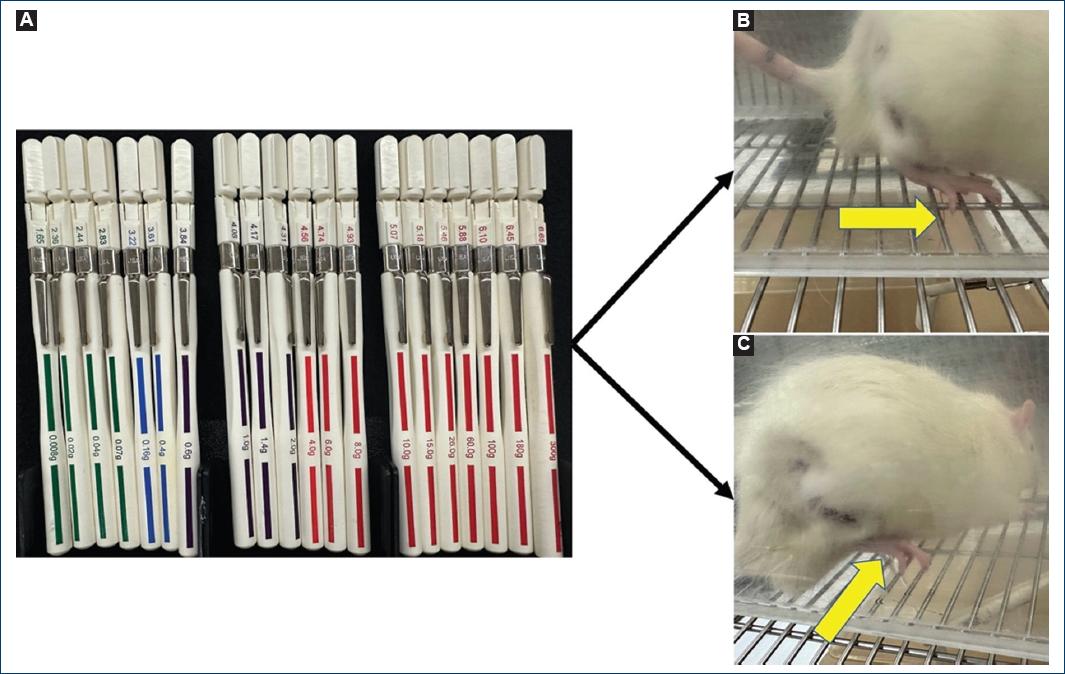
Figure 3 Von Frey test being held on a rat. In the upper image, it can be seen how a Von Frey test should be applied. A: shows the 20 tools for measuring the Von Frey test, which vary from 0.008 to 300 g. B: indicates no withdrawal of the extremity, thus it is a negative response. C: it is seen as a withdrawal of the rats extremity, which indicates there is a positive response to the Von Fray test.
Finally, the "up-down method" was introduced in rats in 1944 by Chaplan SR, for measuring neuropathic pain in the lower extremities in rats. This method proposes using a 50% withdrawal threshold calculated by positive or negative responses. The test starts after selecting a filament if there is a positive response the immediate lower hair should be used, and if there is a negative one the upper filament should be used. A minimum of four tests should be done after the change of direction13. The Up-Down Reader software can help researchers obtain the correct filament size more efficiently and create more accurate statistics with this method14.
Pin pricking test
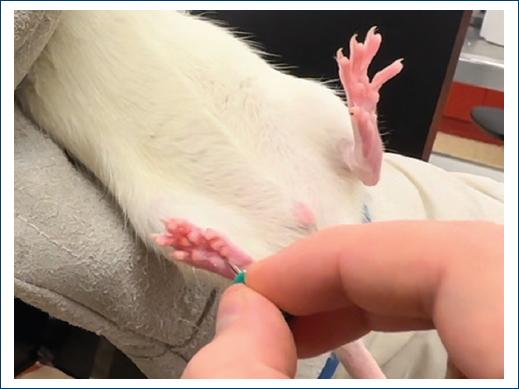
This technique was initially described by Kingery and Vallin in 1989 for sciatic nerve section in a hyperalgesia model in rats. The pin pricking test is one of the simplest ways of measuring pain, and it consists of applying pressure to the paw of the rat in the plantar zone with a pin to determine if the animal moves upward the limb15. It should be pointed out that the person in charge of holding the animal must use bait gloves to reduce injuries while realizing this technique because rats tend to react aggressively. The examiner should apply a moderate amount of pressure to lower the chances of penetrating the paw, and it should be said that the principal complication of this test is harming the animal16, as shown in figure 4.
Cold score
The cold score test was stated by Hao et al. in 1999 as a method to quantify neuropathic pain in rats in a sciatic nerve constriction model. The tests consist of applying a cold spray directly to the affected limb as shown in figure 5. The response to this test is measured in a scale created by the author that helps to understand allodynia induced by a cold stimulus as shown in table 217,18.
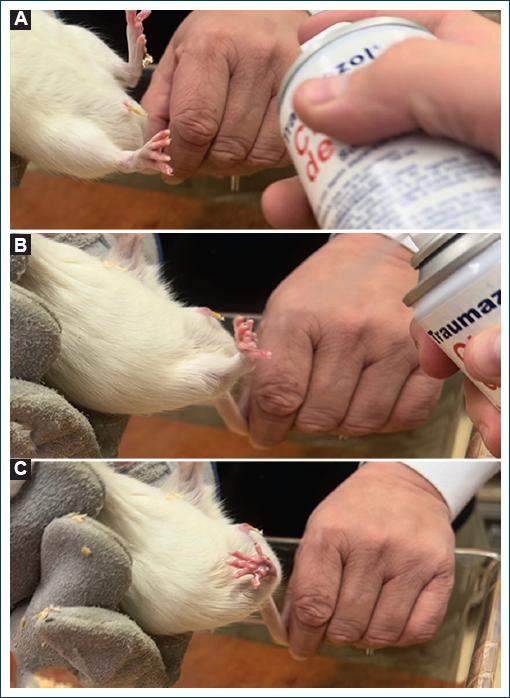
Figure 5 Methodology of cold score. The image shows the three steps to be followed when realizing the cold score methodology. A: prepare the rat for the test, placing the bottle spray in front of the rat's affected paw. B: spray is applied to the rat's feet. C: the leg is moved in an upward direction, confirming a positive test.
Table 2 Cold score chart. Items establish the classification of each level of response to a cold stimulus
| Cold score (Hao et al., 1999)18 | |
|---|---|
| 0 | No response |
| 1 | Startle response without paw withdrawal |
| 2 | Brief withdrawal of the paw |
| 3 | Prolonged withdrawal of the paw |
| 4 | Repeated prolonged withdrawal and other reactions |
Hot-plate test
In 1944, Woolfe and MacDonald used for the 1st time the hot-plate test in mice for measuring discomfort during exposure to a metal surface. Although the methodology of this article was first used for pharmacological efficiency, nowadays the implementation of this technique has been replicated in various models for measuring pain as shown in table 3. This test is made by laying the paw of the animal on a surface with a temperature of 55°C, equivalent to 131°F, for an approximate time of half a minute, unless the animal starts to feel intense pain. The major complication of this technique is burning the rat's extremity19.
Table 3 Techniques found in the scientific literature for assessing allodynia and hyperalgesia from 1988 to 2024
| No. | Technique | No. articles | Percentage |
|---|---|---|---|
| 1 | Von Frey | 99 | 75 |
| 2 | Hot stimuli | 80 | 60.60 |
| 3 | Others* | 41 | 31.06 |
| 4 | Cold score | 40 | 30.30 |
| 5 | Pin pricking | 5 | 3.78 |
| Total | 132 | 100 | |
This table represents the frequency of each diagnostic method for measuring pain from the 132 articles selected from the literature that realized the Bennett technique.
*In this section of the table the following methods are included: Dynamic weight bearing test (n = 1), duration of licking after injecting formalin (n = 8), open field test (n = 1), Randall-Selitto paw pressure test (n = 18), rotarod test (n = 7), spontaneous pain specific method (n = 3), cold plate test (n = 1), spontaneous pain (n = 2), weight-Erbearing test (n = 1), cotton bud test (n = 1), resting paw posture (n = 2), acetic acid (n = 1), tail-flick test (n = 1), vocalization threshold (n = 1), conditioned place preference (n = 1), free walking pattern (n = 1), neutral plate test (n = 1), sciatic function index (n = 1), Choi test (n = 1).
Some of the latest articles published in 2021, also use a variation of the hot plate with focused infrared radiation to the paw20,21, adapting the tail-flick test proposed in 1941 by DAmour and Smith to the affected limb22. This variation of the hot plate is made with converging radiant heat. The paw thermal withdrawal time was first proposed by Hargreaves et al. back in 198823. The hot-plate test is the gold standard to measure hyperalgesia with warm stimuli, as shown in figure. 6.
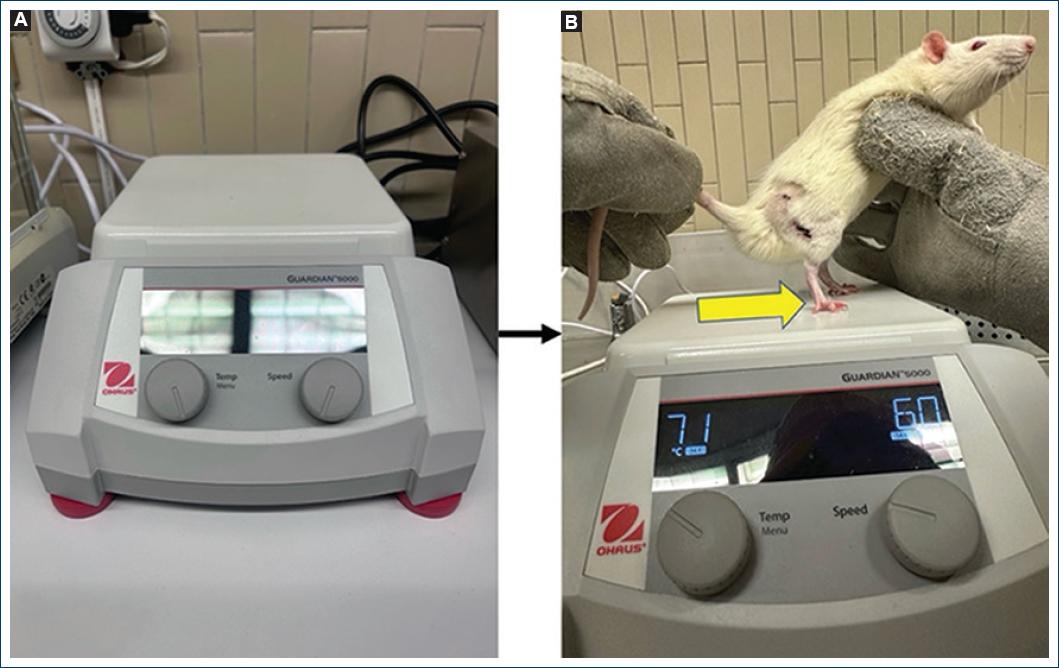
Figure 6 Hot-plate test image. As demonstrated in the image above, this test requires a machine that conducts heat into the plate. A: a hot plate device is shown without any form of heat being passed to the surface. B: an active device is being used to assess a pain test in the lower extremities of the rat.
Miscellaneous
Some of the other methods found in the scientific literature can be seen in table 3. It is important to mention that these tests have been used to study neuropathic pain as alternative proposals or newly found methods. Other 19 different methods have been used, according to the search. It is vital to emphasize that every research group tries to measure pain with the material available in the laboratory. Furthermore, some of these scales might evaluate more efficiently their specific models, as shown in table 3.
Discussion
Bennet´s model is a successful and consistent one to produce, undoubtedly, neuropathic pain in rodents. This solid article was cited more than 7,000 times in the scientific literature and demonstrates the consolidation of this technique to produce pain with its diverse modalities including the responses to mechanical and thermic stimuli7,8. In our article, we well illustrated how the technique was performed and demonstrated the different measurements with several figures that help to exemplify how each test should be done with the rats.
Moreover, the systematic review showed that the most frequent evaluation was the use of the Von Frey filaments with 75% of the articles using them, then the hot plate in almost 61%, the cold test in 30%, and coming at last, the use of pin pricking maneuver in 4% of the papers (23-153). As a resume, the most common variable measured was the mechanical stimuli; after that, the thermic response and finally, the mechanical function. Our investigation found many other techniques to evaluate pain. We have described them in this article as a miscellaneous group. To acknowledge all the different methodologies, we included them in table 3.
This shift of paradigms allows us to identify which are the main tests used in the selected articles. Therefore, this must help to standardize the pain measures in the next scientific productions regarding this field.
Conclusion
Neuropathic pain can be produced with a constriction model of the sciatic nerve, known as the Bennett technique. For successfully recreating this procedure, the correct equipment and set of steps described should be followed. The Von Frey filament test is one of the most effective ways of measuring painful stimuli in rat extremities. The pin pricking test, cold score, and hot-plate test are complementary methods that might help to understand more specifically how rats react to algogenic stimuli. Furthermore, some other experiments use different methods to measure neuropathic pain after sciatic nerve compression in rats.

