




 nueva página del texto (beta)
 Inglés (pdf)
 Artículo en XML
 Referencias del artículo
 Traducción automática
 Enviar artículo por email
 Citado por SciELO
  Similares en
SciELO
Similares en
SciELO 
 Permalink
Introduction
The 16th Century was the scene of some of the most remarkable advances in the history of anatomical science, such as those made in Spain by Andreas Vesalius, Juan Valverde, Pedro Ximeno, Andrés Laguna, Luis Lobera, and Luis Collado. Less well-known among these anatomists is Bernardino Montaña de Monserrate (1480-1558), professor of anatomy at the University of Valladolid and physician to the court of King Charles I of Spain. Although it is often attributed to the book "History of the Composition of the Human Body", written by Juan Valverde de Amusco and published in Rome in 15561,2, the merit of presenting for the first time in Spanish the anatomical knowledge actually corresponds to the "Book of the Anathomy of Man" by Bernardino Montaña de Monserrate, who wrote the first book of human anatomy in Spanish and printed it in Valladolid, Spain, in 15513-5. The purpose of this work is to make a very brief biographical synthesis about the little-known anatomist Bernardino Montaña de Monserrate and to inquire about his "Book of the Anathomy of Man".
Bernardino Montaña de Monserrate (1480-1558)
The scant information about Bernardino Montaña comes from a few scattered references about him; the only thing that is known for sure is that he was born around 1480 in a small town in Catalonia, near Barcelona, Spain6. It is not known with certainty where Bernardino Montaña de Monserrate studied medicine, apart from his own testimony that he studied medicine outside Spain7, most likely in Montpellier and/or Bologna. Bernardino Montaña de Monserrate's entire career as a physician took place under the reign of Emperor Charles I (1500-1558). After studying medicine, Montaña de Monserrate returned to Spain in 1513 and became a professor of anatomy at the University of Valladolid, where he held the chair of anatomy at that university from 1537 to 1550. Bernardino Montaña de Monserrate wrote his "Book of the Anathomy of Man" when he was 70 years old. His book did not sell particularly well due to financial problems regarding copyright and also because his work received little attention and was largely forgotten by both Spanish anatomists and other physicians7,8. Toward the end of his life, Bernardino Montaña suffered from gout and osteoarthritis and died in 1558 in Valladolid, Spain. He was succeeded in the chair of anatomy at the University of Valladolid by Alfonso Rodríguez de Guevara, who made the first dissections in Spain along the lines of Andreas Vesalius4.
Libro de la anathomía del hombre
Montaña's book was one of the first works on anatomy written not in Latin but in local languages, which made them suitable for the training of surgeons and physicians. Montaña's book conforms to the style of major European anatomy treatises of the mid-sixteenth century, such as Thomas Vicary's Treatise of Anatomie on Man Body in England and Henry Mondeville's Surgery in France3,6.
The "Libro de la anatomía del hombre" (Fig. 1) consists of two different works, although both encompass the same content. The first is a regular presentation of the study of the human body. The second is a narrative in which anatomical, physiological, and philosophical problems are discussed based on the interpretation of an allegorical dream. The first part of Montaña's book consists of an exhaustive and detailed anatomical description of 58 pages and is divided into 12 chapters. The Libro de la anatomía del hombre is close to Galen's vision but brings two novelties: first, it breaks with the scholastic method (by channeling a rudimentary system of clinical observation and anatomical dissection), and second, and more importantly, it is written in Spanish, which forced Montaña to invent medical terms in general and anatomical terms in particular. A process that gave the anatomical structure names that was sometimes exact and sometimes univocal. In his book, Bernardino Montaña de Monserrate does not mention Andreas Vesalius or any other contemporary author. In fact, among the few authors cited in Montaña's work are Aristotle and Galen4,7.
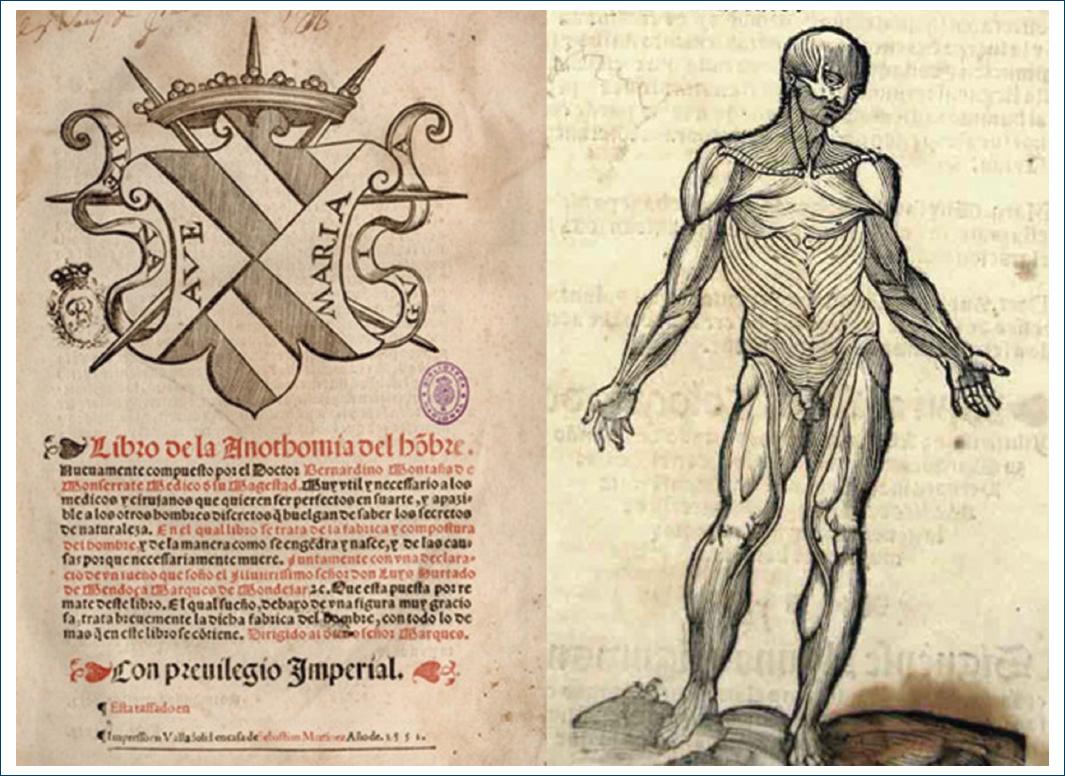
Although it is not, strictly speaking, an original treatise on human anatomy, epistemologically it represents a turning point between the Galenist and mechanistic conceptions of the human body. Montaña's book is a clear example of the plurality of scientific currents of the Renaissance and the process of crisis and collapse of Galenic medicine7,8. It is also noteworthy that Montaña's scientific approach reflected a robustness of real experience felt as a valid source of scientific knowledge. This was explained not only by clinical observation but also by the practice of dissections of human cadavers to expand knowledge of human anatomy and by the practice of vivisection experiments with animals to study physiology. Montaña de Monserrate believed in his own distillation experiences, which allowed him to contribute alchemical conceptions about gastric digestion, the analysis of different parts of the composition of blood, urine, and other organic fluids5,7,8. The "Libro de la anatomía del hombre" was the first work that made the anatomical figures of Vesalius' book known to Spanish anatomists, surgeons, and physicians. However, the images reproduced in Montaña de Monserrate are very small, as well as somewhat crudely reproduced from the work of Vesalius, and moreover, they bear no special relation to the text1,7.
Montaña's book consists of an essential anatomical exposition through which he intends that surgeons devoid of Latin and medical terminology but who know where the organs, muscles, veins, and arteries are, thanks to their basic daily medical practice, can form an idea of the parts and organs, how many there are, what their complexion is, and what they are for, fundamentally referring to them in the ordinary language of the common people, for example, calling the vertebrae "spondyls" and the ribs "calves", the muscles "black pudding", the womb "the mother"9. The exhibition follows the traditional medical school procedure, from cephalic to caudal (head to toe). Its originality lies in the surgical marginal notes addressed mainly to surgeons. As for the diseases linked to each part or organ, this book mentions them, but very briefly.
It is hoped that this research will contribute to the understanding of the first contributions in the Spanish language on human anatomy. The Libro de la anatomía del hombre by Bernardino Montaña de Monserrate initiated the type of illustrated manual publication in Spain, presenting images, albeit crudely reproduced, that became, in conjunction with a basic anatomical exposition, part of the anatomical learning process.

