




 nueva página del texto (beta)
 Inglés (pdf)
 Artículo en XML
 Referencias del artículo
 Traducción automática
 Enviar artículo por email
 Citado por SciELO
  Similares en
SciELO
Similares en
SciELO 
 Permalink

Study contribution
Given the threat of global warming to egg production and the carbon footprint associated with the replacement of single-cycle laying hens by flocks, a calcium carbonate-phytoelements pharmaceutical design was studied. Its supplementation could preserve egg production in second and third-cycle egg-producing backyard hens under moderated heat stress.
Introduction
Eggs are of paramount importance for human nutrition. Approximately 80 million tons of chicken eggs are produced worldwide, and growth in this industry is expected to exceed 25 % by 2030.1-3 Hence, it is necessary to improve egg production, and such a challenge should not entail using antibacterial production promoters and must not compromise the health of the laying hens. Even small family farms are emerging to meet this egg demand.4 The obvious approach should be to bring producing hens to an optimum state of health without affecting their welfare and in an antibacterial-free manner. This situation has called on researchers to seek alternatives to optimize egg production, i.e., herbal constituents, as few and inconsequential side-effects have been reported with this approach.5,6 Herbal extracts have been shown to be innocuous and contribute to maintaining or improving hen intestinal health while allowing an increase in production without significant environmental impact.7,8
More than 80 % of the egg-producing farms in Mexico are regarded as intensive producers, which entails one single egg-production cycle. Then, the hens are culled. This decision is primarily based on the fact that egg posture in the second and third cycles markedly decreases, i.e., 40 % or more. It has been pointed out that deterioration in eggshell quality as the flock ages is a sizable physiological puzzle to investigate in laying hens, particularly in second and third-cycle hens. Egg quality also decreases with age, although egg weight increases, a trait that may be of little use as eggshell quality, particularly shell thickness and breaking strength, decreases, rendering many eggs useless.9 Consequently replacing such hens is considered more viable than dealing with reduced egg production.10 In contrast, to non-technified and backyard farms, second and even third laying cycles are a common practice despite the detriment in egg production and quality. The main surrogate parameter for evaluating egg quality is a firm and full-thickness eggshell, resistant to cracking and capable of sustaining its typical shape. A significant inverse relationship between shell thickness and the percentage of cracked eggs has been identified.11 Low-quality eggshells in the second laying cycle have been linked to body changes such as poor intestinal absorption of nutrients, particularly calcium. We have reported that a modified release preparation of various pharmaceuticals and nutraceuticals can be designed to improve the absorption capabilities of the gastrointestinal tract (GIT) of hens and poultry,12-14 and that the inclusion of capsaicin and calcium in the FOLA pellets improves the bioavailability of calcium in second cycle hens. A patent has been granted for the pelleted pharmaceutical form (MX/a/2012/013222) under the name of FOLA (F = bioavailability; O = optimal; LA = Long action) as it can improve the bioavailability of calcium from calcium carbonate, one of the most inexpensive sources of this element.12-14
An additional problem to consider is global climate warming. Laying hens are among the most sensitive species to heat stress due to their deficient ability to dissipate body heat.15,16 Egg production and health rapidly deteriorate under heat stress.17-19 The optimum environmental temperature for laying hens has been set at approximately 20 °C to 25 °C, with minor variations due to hen-line.16,17 If the environmental temperature approaches or exceeds 30 °C, various signs of heat stress appear, such as a decreased feed intake, lower egg weight, and a distinctive drop in egg production observed together with increases in flock mortality.16-19) Apart from the obvious recommended housing improvement and hen husbandry, a wide variety of studies have shown that the administration of essential oils and plant extracts limits the detrimental effects of heat stress in these birds, mainly when heat stress is not extreme.20,21
In this study, two FOLA-type pellets have been manufactured in an attempt to sustain both eggshell thickness and egg production in second and even third-cycle hens and also in laying hens exposed to temperatures above their comfort zone (≥ 30 °C) in the central part of Mexico during summer. The FOLA-type pellets contain a gastro-retentive vehicle and capsicum or these constituents, plus cinnamon and turmeric powder. The FDA has already approved cinnamon as phytoadditive.22 It has potent anti-inflammatory, antimicrobial, and antioxidant properties with free radical scavenging actions and strong inhibitory effects on nitric oxide (NO) production by inhibiting NFϏβ activity.7 In addition, it has been shown to reduce the effects of heat stress in poultry,22 reducing oxidative activities in poultry when supplemented in their diets.23,24 Also, antiviral, antibacterial, and antifungal activities7,25 have been demonstrated in broiler chickens.26,27 Capsicum oleoresin improves immunity and overall gastrointestinal health, enhancing growth and meat quality even in broiler chickens under heat stress.7,28-31 Turmeric (Curcuma spp.) powder and its main active principle, curcumin (hydrophobic polyphenolic phytocompound), possess several therapeutic benefits as feed-additive in poultry, including disease-resistance featured. Apart from other potentially active principles, turmeric powder contains curcumin, demethoxycurcumin, and bisdemethoxycurcumin.32 These substances act as antioxidant and anti-inflammatory agents33-35 and have been chosen as an alternative to antibiotics in animal feed to improve production.36,37
The FOLA formulation manages to maintain the nutrients in the GIT of the birds for a longer time. Hence, as modified-release pharmaceutical system for antibiotics12,38 it was thought possible that it could improve the bioavailability of nutrients and active principles in poultry. Therefore, the working hypothesis for this trial is that egg production and shell quality in second and third-cycle backyard hens subjected to moderated heat-stress, will be better sustained with phytocompounds and calcium carbonate manufactured as for the FOLA design, as compared to unsupplemented hens.
Material and methods
Ethical statement
This study was conducted on a family farm in Texcoco, State Mexico. The Subcommittee Institutional for the Care and Use of Experimental Animals of the Faculty of Veterinary Medicine and Zootechnics at the National Autonomous University of Mexico (CUEA-FVMZ/NAUM) study number: SICUAE-DC2018/2-1.
Development of the preparations
FOLA-pellets were manufactured as described in Patent MX/a/2012/013222. Briefly, FOLA-pellets are obtained by extruding corn and wheat flour (1:1) containing modified release vehicles (mentioned in the referred patent), plus 4.1 % calcium-carbonate.12,14
Animals
A total of 180 Bovans-White weighing 1 570 ± 20 g, laying hens in a second cycle (> 180 weeks old) and 180 Bovans-White hens in the third cycle (> 270 weeks of age), were included in this trial carried out from August to Mid December 2022. To test FOLA pellet subjected to environmental heat stress, further 90-second and third-cycle Bovans-White hens were studied for egg production and eggshell thickness during May 2023, the hottest period of the year in the central part of Mexico, reaching temperatures at or above 30 °C.20,21 Hens were allocated in groups of three per California-type cage, 40 cm wide, 45 cm deep, and 45 cm high (600 cm3/hen). Water was provided ad libitum through cup drinkers (one per cage), and a 16 light/8 dark h lighting program was established.
Groups
For the posture cycle test, hens were divided into six groups of 30 hens each with the following designation: GCC2 = control group of the second cycle; GFcC2 = FOLA group + 2 ppm oleoresin of 500 000 Scoville Heat Units (SHU) (VEPINSA SA de CV, Sinaloa, Mexico); GfexC2 = FOLA group + 2 ppm oleoresin of 500 000 Scoville Heat Units + 1 % cinnamon powder (McCormic® food grade) and 1 % turmeric powder (McCormick® food grade) were added; GCC3 = control group of the third cycle; GFcC3 = FOLA group + capsicum oleoresin 2 ppm; GFexC3 = FOLA group + capsicum oleoresin 2 ppm + turmeric powder 1 % + 1 % cinnamon powder.
The control groups (GCC2 and GCC3) were fed a balanced diet according to the utilized lineage guidelines in this trial (Table 1). The experimental groups (GFcC2, GfexC2, GFcC3, GFexC3) were deprived of all the fine and coarse calcium carbonate generally added to the chicken diets, and only the calcium contained as orthophosphate, already present in their feed, was maintained. Calcium requirements for the experimental hens were met with calcium carbonate FOLA pellets. The rest of the feed constituents remained the same. Their feed was supplied in a trough feeder (13.3 cm/hen), and the experimental groups received a dose of 8 g of FOLA pellets/hen containing 4.1 % calcium carbonate.
Table 1 Calculated nutrient of the diet in the untreated control groups
| Ingredients (kg) | |
|---|---|
| Corn | 595 |
| Soybean meal 48 (%) | 267 |
| Soy oil | 13.00 |
| Salt | 4.00 |
| Calcium carbonate | 101.00 |
| Ortophosphate 1 820 | 11.00 |
| Vitamine1 and mineral2 premix | 3.00 |
| DL-methionine 99 | 1.98 |
| L-lysine 2.75 | 2.75 |
| Vitamin B2 | 0.200 |
| Vitamin B12 | 0.200 |
| Ronozyme Phytase (GT) | 0.100 |
| Total | 1 000 |
| Calculated analysis (g/kg) | |
| Meatbolizable energy (kcal/kg) | 2859 |
| Crude protein (%) | 18.792 |
| Total calcium | 4.100 |
| Phosphorus (disp)3.80 | 0.450 |
| Methionine + Cysteine 4.50 | 0.800 |
| Lysine (%) | 0.980 |
| Triptophan (%) | 0.220 |
| Sodium (%) | 0.180 |
| Choline (mg/kg) | 1 022.63 |
| Chlorine (%) | 0.275 |
| Linoleic acid (%) | 1.867 |
1 Quantity/kg: Retinol 0.9 g, cholecalciferol 0.019 g, d-alpha tocopherol 10.004 g, phylloquinone 1 g, riboflavin 4 g, cyanocobalamin 0.06 g, pyridoxine 3 g, calcium pantothenate 13 g, niacin 25 g, biotin 0.063 g, choline chloride 250 g.
2 Quantity/kg: 0.2 g selenium, 0.1 g cobalt, 0.3 g iodine, 10 g copper, 50 g zinc, 100 g iron, 100 g manganese.
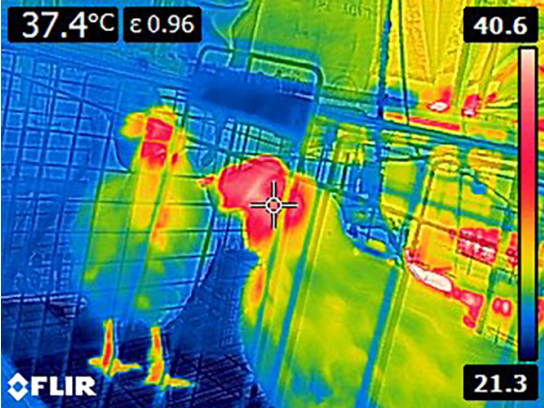
In Table 1, the untreated control groups were of second-cycle (GCC2), and third cycle GCC3 laying hens. Calcium for the experimental hens (GFcC2; GFex2; GFcC3; GFex3) was incorporated into the FOLA pellets, also as calcium carbonate. The rest of the feed constituents remained unaltered. To evaluate the possible effect of calcium primed FOLA-pellets on laying hens under moderate heat-stress, the body temperature of the hens was individually taken using a thermographic camera (FLIR®, Figure 1) aiming the eye. Chicken house environmental temperatures were measured at 13:00, 14:00, and 15:00 h which are considered the hottest months in the area, with May being the hottest month.39,40
Statistical evaluation
The thickness of the eggshell was evaluated daily, in the middle zone (between the poles) with a precision digital Vernier that admits an error of 0.01 mm. These data were statistically compared using Student’s t-tests and no parametric tests (F-test to compare variances). A statistically significant value was considered when P ≤ 0.05. All statistical analyses were performed with Prism (GraphPad Software, for macOS, LLC).
Results
Figure 2 shows the mean ± 1 SD of the eggshell thickness of the FOLA-treated and control groups one week before treatment and three weeks after. Considering the values from the fourth day of FOLA administration in the experimental groups, the improvements in thickness were 128 % for GFcC2 and 135 % for GfexC2 as compared to GCC2, and an improvement of 168 % for GFcC3 and 173 % for GFexC3 as compared to the control group (GCC3). However, groups in which no statistical significance was found were GfexC2 vs GFexC3 and GFcC2 vs GFexC3 using ANOVA and Bonferroni t-tests (P < 0.0500).
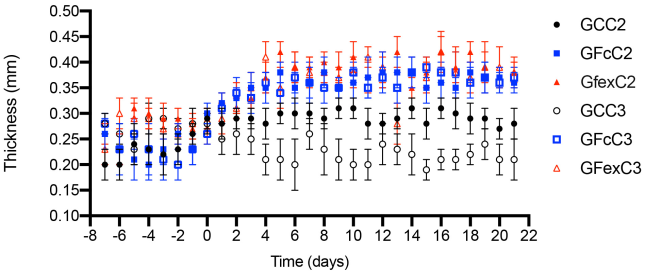
Figure 2 Mean ± 1 SD of eggshell thickness in control groups, and pellet-FOLA calcium-supplemented groups. Basal data (-1 week) and after treatment (weeks 1-3). GCC2 and GCC3 = control groups for second and third laying cycles; GFcC2 = FOLA group + capsicum oleoresin two ppm; GfexC2 = FOLA group + capsicum oleoresin + turmeric powder + cinnamon powder; GCC3 = control group of cycle 3; GFcC3 = FOLA group + capsicum oleoresin two ppm; GFexC3 = FOLA group + capsaicin + turmeric powder + cinnamon powder.
Global laying percentages for all groups are depicted in Figure 3, which shows the daily global mean values ± 1 SD obtained. Also, using ANOVA and Bonferroni t-tests, results reveal higher values of 185 % superior for GFcC2 and 189 % for GfexC2, compared to GCC2. Hens from GFcC3 had 193 % higher laying, and GFexC3 197 %, compared to GCC3. Other comparisons of global laying percentages showed no statistical differences, i.e., GFcC2 vs. GfexC2 and GFcC2 vs. GFcC3 (P < 0.0500).
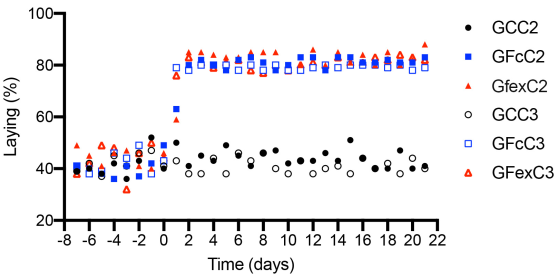
Figure 3 Mean ± 1 SD of laid eggs in control groups, and in pellet-FOLA calcium-supplemented groups. Basal data (-1 week) and after treatment (weeks 1−3). GCC2 and GCC3 = control groups for second and third laying cycles; GFcC2 = FOLA group + capsicum oleoresin two ppm; GfexC2 = FOLA group + capsicum oleoresin + turmeric powder + cinnamon powder; GCC3 = control group of cycle 3; GFcC3 = FOLA group + capsicum oleoresin two ppm; GFexC3 = FOLA group + capsaicin + turmeric powder + cinnamon powder.
Figure 4 shows the body temperatures ± 1 SD of the untreated control hens and those of the second and third-cycle hens treated with FOLA. Using ANOVA and Bonferroni and t-tests, It becomes apparent that from day 4 of treatment onwards, mean temperatures become statistically distinguishable from untreated control groups (P < 0.05 in all cases). The GfexC2 group had the lowest mean body temperature (37.8 ± 0.2 °C), statistically significant as compared to the GCC3 group, which had the highest mean body temperature of 39.1 ± 0.5 °C. The groups in which no statistical differences were found in body temperatures were GCC2 vs GCC3; GFcC2 vs. GFcC3; GFcC3 vs GFexC3 and GfexC2 vs GFexC3.
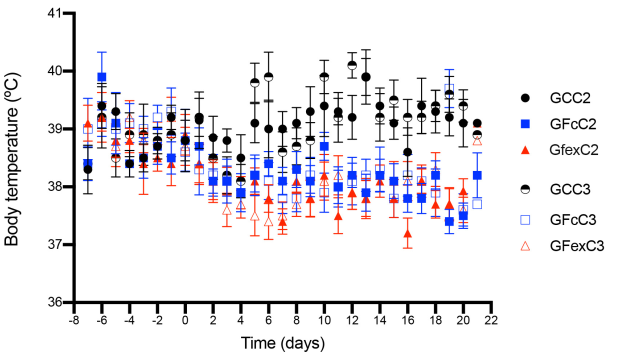
Figure 4 Mean ± 1 SD of body temperatures measured by FLIR thermographic camera in the eye of egg-producing hens subjected to moderate heat stress (approximately 30 °C) with the following groups: untreated second and third cycle hens (GCC2 and GCC3) and in pellet-FOLA calcium-supplemented groups: GFcC2 = FOLA group + capsicum oleoresin two ppm; GfexC2 = FOLA group + capsicum oleoresin + turmeric powder + cinnamon powder; GFcC3 = FOLA group + capsicum oleoresin two ppm; GFexC3 = FOLA group + capsaicin + turmeric powder + cinnamon powder.
Only on some days were the parameters of laying percentage and eggshell thickness achieved in the GfexC2 groups statistically different from other FOLA-supplemented groups. As already demonstrated in the literature, egg weight increases in second and third-cycle laying hens 10,11. Hence, measuring this parameter was omitted in this study. The mean highest in-chicken house temperature during May 2023 was 31 ± 2 °C.
Discussion
The commercially viable lifespan of laying hens in intensive farming enterprises is generally limited to a single cycle of approximately one year41 This is due to both commercial commitments with hatcheries for replacements and the sharp drop in egg production in hens during the second and third cycles, having drops of approximately 30 %.41,42 In a previous study, it was shown that adding calcium carbonate, as in FOLA pellets, improved egg quality in second-cycle laying hens as for the parameters measured in this trial. Hence, production was maintained as efficiently as that observed in first cycle hens.12,14 Nevertheless, it may be possible that the supplementation with turmeric powder and cinnamon powder could have assisted the formulation of FOLA-pellets described here, as it has been shown that these phytoelements improve various performance parameters in poultry.43,44 To ponder these results, and despite the benefits outlined, it will be of particular interest to carry out economic studies in hens that produce eggs for human consumption, as well as in hens producing fertile eggs for broiler production. In contrast, in the backyard or small-production egg-producing units, layer hens can be benefited and have their productive lives extended. Particularly when their replacement is not possible or unprofitable. Hence, this study can have immediate benefit to this important sector of the egg-industry. It is essential to add that the production cost of FOLA pellets is not burdensome, and it is easily offset by the production obtained from commercially viable eggs.
The production of quality layer eggs depends on many factors, including environmental stress such as noise, diet adequacy, and whether or not there is heat stress.11,19 However, the key features that stand out for their successful marketing and handling are their integrity and eggshell thickness. To optimize the former features, it is critical to enhance blood calcium bioavailability.12,14,15 In this context, it is noteworthy that one of the primary sources of calcium in the hens’ diet is calcium carbonate, as it is the most economical source of calcium. Additionally, the added phytoelements, turmeric and cinnamon powder, are inexpensive enough to be included in the FOLA treatments without affecting the cost-benefit ratio of the cycle.
Calcium carbonate is the most used ingredient of diets in poultry production. However, it is the least water-soluble source of calcium, and therefore, absorption of calcium can be low and unpredictable, particularly in second and third-cycle laying hens.12,14 Additionally, it is recognized that not only calcium is deficiently absorbed, but other nutrients also seem to be affected during the second and third production cycles, generating a deficient egg-lying performance, as has been shown in previous works.10,14,45 In this study, it became clear that medication of second and third-cycle hens with calcium carbonate incorporated in FOLA pellets and fortified with turmeric and cinnamon powder, achieves a remarkable recovery of egg production under moderate heat stress conditions. Phytogenic additives have been proven in multiple trials to be of great importance in improving or contributing to the health of the gastrointestinal tract of poultry and, through this effect, can significantly improve both their production and welfare.7,46 Furthermore, it has been shown that essential oils and extracts can mitigate the environmental impact of egg production by optimizing the relationship between egg production and a hen’s food intake.47,48 Thus, the pellet / FOLA design of calcium carbonate with added phytochemicals meets the demand to design the referred calcium source that remains available in the gastrointestinal tract of egg-producing hens when it is required, e.g., during the shell formation process at night. This is, in turn, achieved by the programmed release of calcium carbonate facilitated by vehicles that also enhance bioavailability.12 It is also possible to postulate that including phytoadditives in the FOLA pellets contributes to maintaining better intestinal health, enabling the modern genetic line of hens to meet their production nutritional requirements. The theoretical bases of the FOLAs described here have already been published in part.12 Nevertheless, assuming that the ideal formula or formulas still require additional research is feasible. Also, it would be important to carry out studies on an industrial scale to confirm or discard these results.
Enabling economically viable second and third cycle laying hens with the FOLA-calcium and phytoelements pellets complies well with breeding companies that are seeking the development of “long life” laying hens, whose goal is ending up with laying hens producing 500 eggs in a single continuous cycle of 100 weeks.41 This goal has been conceived using selection programs based on phenotype, cross breed progeny testing, and genotype information derived from DNA markers associated with phenotypic traits.49 Nevertheless, proper nutrient supplementation must be anticipated to meet new physiologial demands, and the formulation of FOLA-calcium and phytoelements here studied may result adequate.41

