




 nueva página del texto (beta)
 Inglés (pdf)
 Artículo en XML
 Referencias del artículo
 Traducción automática
 Enviar artículo por email
 Citado por SciELO
  Similares en
SciELO
Similares en
SciELO 
 Permalink
Walking, singing, and following the devotion
This title paraphrases Geraldo Vandré's song, To not say I did not speak of the flowers (Para não dizer que não falei das flores), winner at the 1968 Music Festival, and later an anthem against the civil-military dictatorship in Brazil. Currently we are living a democratic period, but we remain hostages to the effects of social inequalities produced by the neoliberalism (Bauman 1999) which isolate the concentrations of misery and conflicts provided by the "necropolitics" of State on the peripheries of large cities (Mbembe 2016). Amid the conflict zones of the city of Rio de Janeiro, between December and January, groups of devotees move to carry out their ritual practices, by walking, singing, and bringing the good news of the birth of Jesus to their faithful hosts, this is the Folia de Reis.
This paper aims to problematize the devotional practices of the Folias de Reis as a political action; therefore I argue that it is in the walk throughout the city (Certeau 2011) that the Three Kings chants give a new meaning to the sacred as a space of resistance. Walking and singing in the midst of the "margins of the State" (Das and Poole 2008) insert the devotees into a complex game that endangers their moral and physical integrity.
I understand devotion for its strong political character and resistance, for arising through the agency of the sub-alternized through the forms and uses of cities (Ceretau 2011). There is no state social assistance that safeguards the movement of devotees through the peripheries of big cities, much less a guarantee from the coercive power of drug trafficking. On the contrary, the singing of the foliões reconfigures the streets of the slums through their ritual pilgrimage.1.
This paper is the unfolding of one of the topics addressed in my doctoral thesis (Souza 2020a), in which I presented my fieldwork alongside Antônio José da Silva and his Folia de Reis, Bandeira Nova Flor do Oriente (East New Flower Flag). I followed the master and his devotees through the years 2010-2017, my research method was participant observation, helping the foliões in their trips around the city.
The Folias de Reis
The Folias de Reis are groups of promise keepers devotees of the Magi, formed by singers and musicians, who carry out the sacred mission of announcing the birth of Christ to their hosts. The revelers are formed by people of both sexes and of all ages, organized hierarchically by the master and the foreman of the revelry. They are the holders of the foundation, the theoretical framework based on the mythical narrative about the life of the Three Kings and the Holy Family. As in the "traditions of knowledge" of Barth (2000), the foundation is permeated by the three characteristics: the "substantive corpus", which would be the content itself; "communicative means", that are linked to the transmission form, insofar as in the revelry the orality is predominant; and the "social organization", which are the social relations in which this knowledge is inserted, how it will be forwarded and who will be the future master.2
Basically, the foundation is the hagiography,3 a source of inspiration for the construction of sung verses, the prophecies. The song is about the hagiography of the Magi and is divided in three moments: 1) the announcing of the birth of Jesus to Joseph, Mary, and the Three Magi by the angel Gabriel; 2) the journey of the three saints guided by the star that led them to Jesus and to the meeting with King Herod; 3) the visitation, greeting, and adoration of the Baby God, ending with the return of the three saints to their lands. This story can be found in the Bible in the Gospel of St. Matthew, chapter 2, verses 1 to 12.
Both the master and the foreman conduct the singing of the devotees, which are usually groups of revelers formed by twelve members in two lines, each one with their percussion instrument, following the organization of the instruments: the first one is the accordionist and the viola, then the snare drum players, war snare and cymbals, the latter being responsible for the bass drums marking the rhythm. The revelers follow the orders of the master who is next to the bandeireira ("flag bearer"), the one responsible for carrying the greatest symbol of the revelry, the saints themselves (Bitter 2010).
Beyond the singing revelers, in the state of Rio de Janeiro there is the palhaço de reis ("clown of kings"). He is a different figure from the musical procession: while the revelers follow a hierarchical organization, the clown walks around the ranks of instrumentalists, screaming and teasing passersby who stop to watch the Folia de Reis. Within the cosmology of the Reisado, the clown is the representation of Herod's soldiers sent to kill Jesus who got lost and regretted and are currently at the side of the devotees, protecting the saints and the sacred mission (Souza 2020). They need to go through a very complex ritual process to wear the clothes that bears the mark of the persecutors of Christ (Bitter 2010), besides operating with knowledge and prohibitions that protect them from real and spiritual risk (Chaves 2003).
Religious pilgrimages occur in the period known as epiphany of the Three Kings, which extends from midnight on December 24 to January 6, the day of the patron saints revelry. This interval is called "Giros'" ("tours" or "journeys") and represents the 12-day journey of the Saints to find the child Jesus. During this period, the revelers move from house to house, carrying their singing, prayers, instruments and the flag of Kings.
These displacements vary according to the reality of the municipalities of the devotees. In rural areas researched by Luzimar Pereira (2009), Wagner Chaves (2003) and Carlos Rodrigues Brandão (1977, 1981) the "tours" are carried out in 12 days of displacement of the revelers, having the departure and the return at the house of the emperor (the main host of the revelry) and the landing nights at the house of the devout hosts along the route of the "tours". In urban centers of the state of Rio de Janeiro researched by Daniel Bitter (2010), Renato Mendonça Barreto da Silva (2011) and Souza (2020a), the Folias de Reis complete their ritual circuits on weekends and holidays, extending the days to January 20, Saint Sebastian's Day, patron saint of the city of Rio de Janeiro and the main saint of devotion of most revelers. In the urban "tours" (Souza 2020a) the revelries circulate from midnight on Saturday, visiting most of the nearby houses, and returning on Sunday afternoon to the head office, where the flag altar is set and where the clothes and instruments are being kept. Usually, it is the house of the master.
The Folias de Reis and the uses of the Catholic calendar by the devotees are close to other ritual practices that occur in Latin America, such as those of the indigenous people of Durango and Nayarit, in Mexico:
Se trata de las Pachitas (carnaval) y de la Semana Santa. Cada uno de ellos constituye un episodio de la narración anual de las hazañas de Cristo sobre la tierra, pues cabe mencionar que el sub-ciclo católico puede ser pensado como una narración de la vida del Nazareno así como la conciben los coras. Tanto en los mitos como en los rituales, esta deidad es asimilada al sol, quien nace, crece, alcanza su apogeo y luego desaparece para dar paso a la oscuridad. Todos los rituales tienen su importancia y están integrados en un sistema, por lo tanto, los que preceden en términos calendáricos contienen las premisas de los hechos que se desarrollarán en los que siguen. Aunque todos los rituales tengan su importancia, las Pachitas y la Semana Santa son los que congregan a un mayor número de personas, ya que llega gente desde los ranchos y hasta de Estados Unidos (la mayoría de los coras emigran a la ciudad de Montrose, Colorado). Las Pachitas y Semana Santa son ocasiones importantes para que las familias lejanas se reúnan, y para que los jóvenes puedan convivir entre ellos y con las personas mayores, y así acercarse al llamado "costumbre" y a las reglas que rigen la sociedad (Benciolini 2014).
The Folia de Reis was presented to me by Mr. Antônio José da Silva, the Master Fumaça (Mestre Fumaça). I have been following his devotion since 2010, it was with the master and his family that I met the universe of the Reisado through the Folia de Reis Bandeira Nova Flor do Oriente.
The Metropolitan Region of the State of Rio de Janeiro
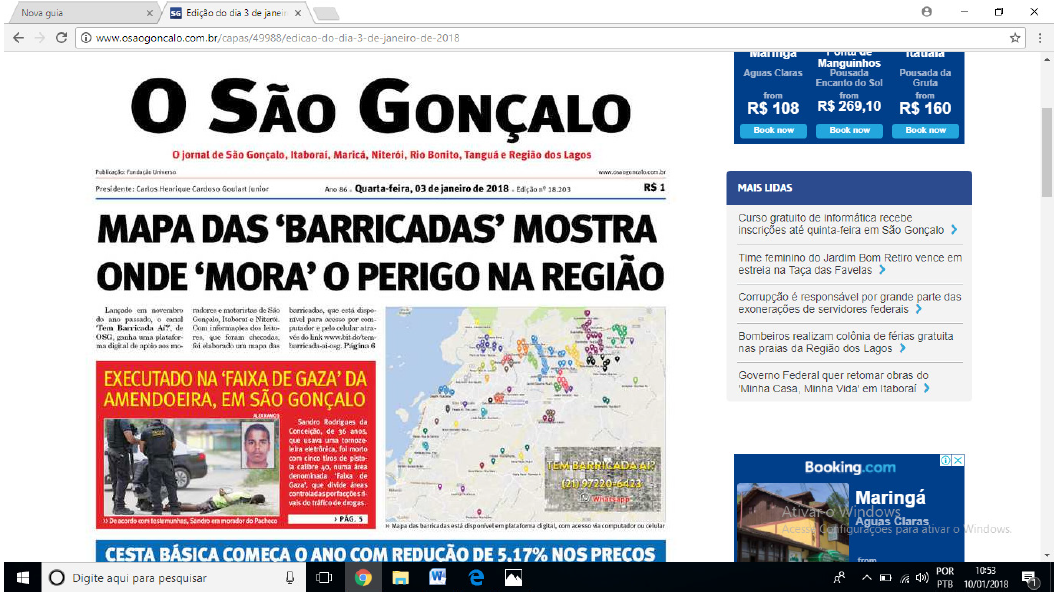
In the first week of 2018, the "Map of the barricades" of the municipality was published on the first page of the newspaper O São Gonçalo. According to its website, in less than a day the digital resource had already been accesseed by thousands of people. This is due to the fact that the city of São Gonçalo is part of the Metropolitan Region of the State of Rio de Janeiro and the second most populated municipality, with 1 044 058 inhabitants.4 This is the configuration of a city with residents who reached the poverty rate of 39.86 % of the population, according to the 2003 Census indices provided by the Brazilian Institute of Geography and Statistics (IBGE). It is in this social framework that the components of the Folia de Reis Bandeira Nova Flor do Oriente are inserted.
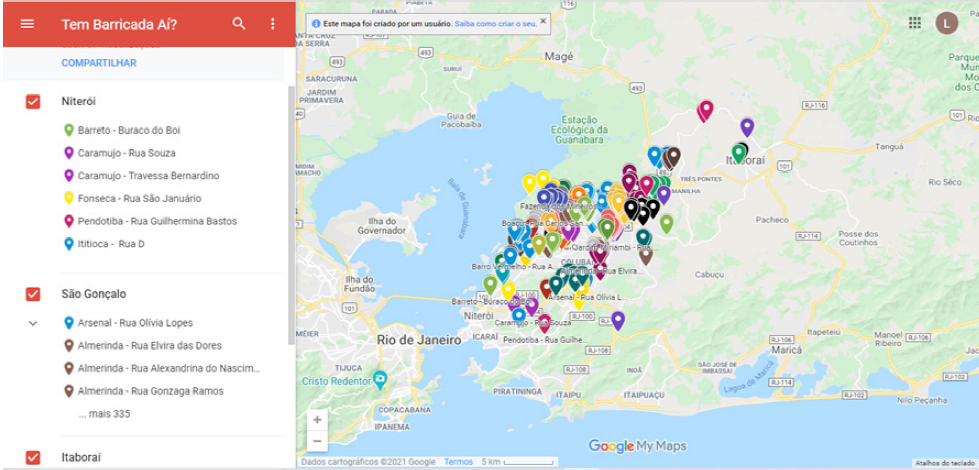
My interest in this newspaper resides in pointing out the difficulties that residents have to transit through the conflict zones, for these are regions of dispute that put in relation criminal factions, militias, "van mafias"5 and the military and civil police. These places suffer from shootings, street and commerce closures. In addition to these, the difficulty of offering quality public transport adds to the residents' complaints. Besides not attending the demands, some lines close at night.
Figure 2 is a recent screenshot of the website that demonstrates the tensions of the displacements of revelers in the Metropolitan Region.
It is precisely through these places that the Folia de Reis transits, taking its indiscriminate devotion to the house of its faithful hosts (Souza 2020b), and facing each and every sorcery that the dawn can offer to the promise keepers (Souza 2019). In this regard, the Folia de Reis reaches places where the state does not allow itself to reach. The anthropologist Michel Agier (2010a) understands these precarious spaces of the city as banlieu, the "place of confinement of the banished, whose political and territorial remoteness allows all the dominations and exclusions, whether economic, cultural or 'racial'" (Agier 2010a: 41). Places like these suffer from the absence of public policies of the state, not because of the lack of action of the State, but because the reports of police confrontations are very present in the daily lives of the residents of these territories. Understanding these conflict zones as "state margins" (Das and Poole 2008) can be explained in three ways:
that the margins of the state can be imagined: first, as the peripheries or territories into which the state must still penetrate; secondly, as "those spaces, forms and practices through which the state is continually both experienced and undone in the illegibility of its own practices, documents, and words"; and, finally, as "the space between bodies, law and discipline" (Asad 2008: 53).6
Such peripheral regions reveal themselves as border zones on the "margins of the State" (Das and Poole 2008). According to Veena Das and Deborah Poole:
Paradoxically, it is in these exceptional spaces where the creativity of the margins are visible; it is here that alternative forms of economic and political action are instituted. To suggest that margins are spaces of creativity is not to say that the forms that politics and economics acquire in these, which are usually formed by the need to survive, are not fraught with terrible dangers (Das and Poole 2008: 34).7
Regardless of investing in public policies of the State, there is the possibility of cultural flow in "its margins". They are creatively fulfilled, and the Folia de Reis fits into these categories. In another work (Souza 2020a) I adressed the difficulties and complexities faced by the revelers of the Bandeira Nova Flor do Oriente to carry out their urban "tours". In order to achieve this, plans are elaborated by the master and his devout hosts, which I sought to understand with the analytical key of the "tactics" of Michel de Certeau (2011). The "tactics", as an art of the weak (2011: 95), in sum, the agency power of those inserted in a sphere of surveillance and control, but also who use the most varied means of action to be able to carry out their daily practices. The "tactics" are made by both the master of the revelry who conducts a circuit of previous visits to the places where the "tours" will be held (2019), and by the devout hosts who establish a network of sociability and solidarity among the residents to ensure the movement of pilgrims and the saint through their neighborhood (Souza 2020b).
Among the "tactics" of the hosts, the one that stands out the most is the resident notifying the movement staff. Master Fumaça once told me about the importance of the resident informing "the people of the movement about my revelers". The pessoal do movimento ("movement staff") is a native category used by residents of São Gonçalo and some other cities in the Metropolitan Region of the State of Rio de Janeiro that refers to the members of drug trafficking. They establish a control relation with neighborhoods through the drug sales point, the bocas de fumo ("mouths of smoke"), which is a "drug den". The peripheries -the so-called favelas (slums)- live a complex relationship between residents and the people of the movement.8
The idea that, in these peripheral regions, drug trafficking is carried out in exchange for the offer of "security" to their residents, persists in common sense. This is one of the "myths" fought by Luiz Antônio Machado da Silva and Márcia Pereira Leite (2007), alerting the risk of simplification of the social relations in these contexts. The authors make a methodological effort to separate the views of favela and violence pointing to the reports of residents on topics of police and criminal violence, "which, in fact, constitutes clear evidence of the misunderstanding of identifying the recurrence of violent behaviors in the slums with the trivialization of these practices by residents" (Silva and Leite 2007: 555). Silva and Leite point out that the emphasis on the speech that equates favelas and violence, based on the parallel power notion, "is unaware of the numerous evidences of the presence of State Apparatus (both the Executive and the Legislative) and its agents in the slums" (2007: 551).
The movement is established in the peripheral regions through coercion, they can invade the residents' homes to hide from the police or to store weapons and drugs in times of conflict. Since there is no effective presence of the State, the residents eventually give in to the pressures of the movement, which carries to the silencing of this issue (Pollack 1989).
The cosmological danger
Master Fumaça's Folia de Reis is composed by devotees of the Three Kings, but, mainly, they are residents of the Metropolitan Region of the State of Rio de Janeiro. They are the individuals who operate with the daily "tactics" to move through the territories of the city, from the margins to the city center. The flag of Reis (Kings) makes this journey too, for the saints are taken by their faithful pilgrims to the houses of their devout hosts. The experiences of living in a violent environment are present in the speeches and conversations of the revelers as they get ready for the "tour", they are understood as the onus of the unbridled growth of cities. The disputes between the factions over the administration of narcotics sales point, the conflicts narrated by the television news shows between the Military Police and the factions in the peripheries, the numbers of dead killed by these confrontations, are within the bodies of the revelers and their families. The actions and postures of the State assume a strong character of "making die" interpreted by the "necropolitics" of Mbembe (2016). The Cameroonian philosopher understands "necropower" as a policy of mass confinement and extermination. If the policy is based on the management and recognition of people, the dehumanized population becomes the target of each and every death policy.
The dimension of this daily danger takes a cosmological proportion in the speech of Master Fumaça. And on one of our outings, I questioned him if he did not notice an armed boy who had passed along us. The master replied:
If I worried about that, I would not put my revelry on the street! Furthermore, what we do is a sacred mission and we have the guardianship of the Three Holy Kings, who have never let us down! I have always been around the city "tours" and never had any problems! We have been approached by these kids (people of the movement), but when they see what we do, they do not imply or anything! "You want to see something", before we leave the house, we light a candle for our guardian angel to protect us! Besides the angel, we ask Our Lady, Saint Sebastian, the Three Holy Kings and the Holy Family so that nothing [bad] happens to us!
In addition to the strategies used with the residents, the master appropriates a set of ritual practices that aim to relieve the tensions and conflicts of the street. Before departure to the street with the revelry, even before the removal of the flag from the altar, the master lights a candle and places it in front of the revelry maximum symbol to ask the Guardian Angel and the other saints for protection. A glass of water is placed beside the candle, which, according to the master:
Well, the candle symbolizes the light of the holy angels who guard us and guide us through our journey. When people light a candle, they are offering it to the Guardian Angel, asking for lighting and protection to guide us on our paths in our lives. It also means the star who guided the Three Holy Kings so they could worship the baby Jesus.
The glass of water is a lot, okay? It is so we never starve or get thirsty. The water is for the Three Holy Kings, who have managed to fulfill the sacred mission without going hungry or thirsty. And for the Holy Family, who managed to escape from the soldiers of the King Herod. Without being in the need, they were there in the stable, but they had the food and drink, as well as the Child Jesus! When someone puts a glass of water in front of the Nativity scene, we thank God because until that year God has been helping in that person's house with food, without lack of anything to drink or to eat!
The street is the place of risk, danger, traffic betwee: ritual situations, according to Van Gennep: "whoeve passes from one to another [territory] finds himself phy sically and magic-religiously in a special situation for certain amount of time: he wavers between two worlds (Gennep 1997: 36). Because "you never know wha you can find out there", as one of the revelers said th first time that the clown absented from the mission wi thout giving any reason in the middle of one of the 201 "tours". The outskirts is the place of the uncertain, th unpredictable, which means that the prayers made by th master to remove the flag from the altar are meant to th protective saints, as well as those who have designate the mission of these devotees. The ritual is performer with extreme care and only begins with the presenc of all revelers already in uniform, equipped with thei instruments. The master stands in front of the altar ac companied by the foreman and the flag bearer; silentb Fumaça lights a candle placed beside the glass of wate below the flag. Such as the symbols for Turner (2005) the candle and the glass of water acquire various mea nings: according to the master, the "water is so that i never lacks neither what to eat nor what to drink, bot for my revelers and for my devotees". The lit candle sym bolizes "the light that illuminates and guides the reveler in the midst of their sacred mission, as well as the sta that guided the Three Holy Kings". In addition to th star, this same flame is dedicated "to the holy angels wh protect the revelers and the flag in the midst of the joui ney". The water and fire on the altar represent the agenc of the saints ensuring food and protection to revelers an devotees in the midst of carrying out the sacred missior both ritual elements being placed for the removal of th flag and collected only after the return of the saints.
Victor Turner argues that:
the crucial properties of a ritual symbol involve these dynamic unfoldings. Symbols instigate social action. In a field context, we could even describe them as "forces", as they constitute determinable influences that incline people or groups to action. Furthermore, it is in a field context that the properties described by us, that is, polarization of meanings, transfer of affective quality, discrepancy between meanings and condensation of meanings manifest themselves more eloquently. (Turner 2005: 68).9
The verses sung by the master and by the revelers always begin with: "Save my God and Our Lady / I will begin my singing [prophecy]". All the revelers begin their singing by praying ("salve") for the appeal of God and Our Lady to begin the rite of removal of the flag from the altar and the head office. The other verses sung by the master focus on carrying out the mission left by the Three Kings and helping them to complete their devotion.
But it is in the last verses that the master evokes the entities responsible for the protection of the revelers and the flag:
May our Guardian Angel / Protect our guardian / May the Guardian Angel / Protect our paths / Protect my revelers / At this blessed hour / I will stop [silence] my instruments.
The set of deities agglutinated by the purpose of protecting the revelers approaches to the analytical category of Renata Menezes (2004), the "combination of devotions". Menezes observes that:
the combination of devotions can not only "add" to the strength of the saints, but also "unite" their specific fields of intervention. Being devout of several saints of different specialties -whether these be the protection of certain professions, the cure of specific diseases, the defense of body parts- can make the person sheltered in various areas in which their holy protectors act (Menezes 2004: 202).10
Within the head office of the revelry the candle and the glass of water acquire numerous roles and represent the most diverse functions in the cosmology of the devotees. Thus we can reach an important property of several ritual symbols: their polysemy and their multivocality. This means that a symbol can represent multiple things (Turner 2005: 85). In the streets, it is the flag that embodies the variations of meaning of the ritual symbol, it is the materialization of the patron saints going ahead of the group, it becomes the sacred star that directs and guides the revelers to the houses of the devout hosts. The saint needs protection and this mission is embodied by the guardian of the revelry, the clown.
Likewise the other ritual symbols, the clown also adopts a polysemic role within the Folia de Reis: sometimes he is the representation of the persecutors of Christ, sometimes he is the representation of evil, the devil, "of Judas who repented and today protects the flag".11 He can also be associated with Herod's soldiers, who, in the narratives of revelers, would have persecuted the child Jesus:
The main element that defines these characters, however, is not the uniform or staff, but the mask. A clown without a mask is not doing the imitation of the soldiers of Herod, and can, for example, enter in a house or walk safely down the street. With the mask on their faces, things change and it is recommended that they never leave the flag when the Foli" walks down the street. Cases of clowns that when they flouted this rule were beaten without knowing who they were or even missing at crossroads are abundant (Chaves 2003: 58).12
Don Handelman draws attention to the complexity of constructing an analytical category that accounts for the understanding of the "clown type". Starting this search for the meaning of the word "clown", there is a definition of this character as the clot (clod, clot or lump) (Handelman 1998). Handelman points out that such a difficulty is closely related to his function, the "clown type" arises amid the transformation process (in-process): "Like events of modeling and transformation, that necessarily are in-process from outset to end, I would summate the internal organization of the clown type as that of 'in-process': in motion, but unfinished and incomplete" (Handelman 1998: 243). And it is precisely because it is a persona that arises in the course of the transformation process, in the liminal period, that there is a whole ritual rigidity for the departures of clowns. Similarly, there is also a script of ritualistic practices for the removal of the mask. But there is still a freedom that others revelers do not enjoy. It is this ambivalence (Bakthin 2010) that defines the character.
The revelry clowns end up becoming the potential target of real and spiritual dangers, so devotees who wear this uniform need to dominate a "corpus of knowledge" (Barth 2000) to "know the secrets" (Chaves 2003). Assuming the role of clown in the ritual induces to be always alert and aware of a set of important rules to preserve their moral and physical integrity and even their life.
An ethnographic example of the clown in a situation of ritual vulnerability in the urban peripheries is offered by Daniel Bitter in a field report in which the guardian of the revelry becomes the target of jokes by armed traflickers, or of witchcraft (Bitter 2010: 182). As I have already witnessed, clowns attract the attention of children and drunks who approach them instead of the revelers or the flag. Within the interpretation of some of the devotees: "this happens for us to complete our mission without being hindered by them".
Final considerations
The real dangers that ravage revelers in the midst of their displacements through the peripheries of the Metropolitan Region of the State of Rio de Janeiro are intimately related to the cosmological dangers that affected the Three Kings. The foundation brings the hagiographic report of how the three wise men carried out their sacred journey under the watchful eye of their pursuers, materialized by the clowns. Just as the revelers of the Bandeira Nova Flor do Oriente are protected by the saints and the Guardian Angel, the Three Kings were also protected by the divine power that guided them and deceived their enemies, the guiding star.
The Folia de Reis brings with it the materialization of a sung pilgrimage that can suffer from the real and cosmological dangers at any time. The devotion to the Three Kings is not merely a religious act, it acquires a strong political content within the "tours" of the revelry as they go through the city announcing the birth of the son of God along the "margins of the State". In the words of Renata Menezes: "For over than two thousand years the baby Jesus is born on December 25 and the 'Folia de Reis' operates in an intense dialogue between the physical and the metaphysical to fulfill his mission of worship and announce the birth of the child Jesus".13
The practices of the "tours" in the city streets are eventually associated with the notion of Folia de Reis and danger, not limited to a cosmological risk, but, above all, to a physical risk. The sacred mission notion allows us to think of myth in practice, that is, revelry is the annunciation of the good news, it is the mission of announcing that Jesus was born. Not only announce, but to revere the child who will save us. We cannot forget that the child Jesus was born inside a stable, next to the animals, and the Holy Family suffered from the persecution of Herod's soldiers. All the saints involved in the foundation were at risk, as well as the revelers. Thereby, the devout reveler has a very important obligation, a sacred mission, which puts him at permanent risk, because it is a biblical risk, that is, they had to escape the persecution of Herod's soldiers and protect the Messiah.
This matter of danger can be compared to a game that has not been won: the game has been played for over 2 000 years. Every year, with every "tour" of the revelry, the devotees reveal to us through their rites that the child Jesus is being born and is at risk.
Both in the hagiography of the Three Kings and in the departure ritual of the devotees the figure of Herod is present, whether as the Roman Empire, the ostentatious presence of the military police, the soldiers of the drug traffickers, the "van mafias" or other agents that symbolize the real danger. The analogy of the game can be very fruitful in the case of the Folias de Reis, because in this game the revelers run the constant risk that it may go wrong and they would not perform their "tour". The revelry game has never been won, whether with the Three Kings at the time of the birth of Christ, or in 2021 with the risk of violence from the "margins of the State" or the pandemic danger. It is played every year, because every year it is at risk of going wrong, and that is also what the clown is. He represents the evil lurking. The reveler is the sung prophet, he is the prophet poet who is going to announce the good news, he is one of the Three Wise Men.
To explain the emergence of the sacred mission the master also relates it to its social context, the mythical narrative is not only an explanation of the life of the saints, but an intersection between the cosmological and the practices of the revelers. The "tours" are performed every year in risky city zones, a danger not limited to the physical plane, but also cosmological, symbolized by the persecution of the Roman Empire.

