Praxis
Nursing process care for elderly drug user
Processo de enfermagem no cuidado ao idoso usuário de drogas
Guerrero-Carrasco, Yessenia Guadalupe1
 http://orcid.org/0009-0005-0562-0094
Miranda-Félix, Patricia Enedina2*
http://orcid.org/0000-0002-7076-0991
Reyes-Pérez, Narce Dalia3
http://orcid.org/0000-0001-9735-1402
Ortiz-Félix, Rosario Edith2
http://orcid.org/0000-0002-5827-3218
Moreno-Félix, Ana Lilia4
http://orcid.org/0000-0001-9992-0189
http://orcid.org/0009-0005-0562-0094Miranda-Félix, Patricia Enedina2*
http://orcid.org/0000-0002-7076-0991Reyes-Pérez, Narce Dalia3
http://orcid.org/0000-0001-9735-1402Ortiz-Félix, Rosario Edith2
http://orcid.org/0000-0002-5827-3218Moreno-Félix, Ana Lilia4
http://orcid.org/0000-0001-9992-0189
-
Publication dates-
May 23, 2025
Jan-Dec , 2025
- Article in PDF
- Article in XML
- Automatic translation
- Send this article by e-mail
- Share this article +
Abstract
Introduction:
Worldwide, 296 million people use some type of drug, which translates into 5.8 % of the world's population between 15 and 64 years of age.
Objective:
Develop a nursing care process in a person who is a major drug user by employing the general theory of the Self-Care Deficit by Dorothea Orem.
Methodology:
Clinical case, using Dorothea Orem's assessment guide, completing the stages of the nursing care process (assessment, diagnosis, planning, execution and evaluation), applying Pesut's clinical reasoning model that allows making way to the plan care, where the study followed ethical guidelines while respecting the rights of the participant.
Results:
Person over 60 years of age, male, unemployed, collects cans on the street, lives by himself, does not undergo medical checks, understands his poor health status, uses legal drugs and is a former user of illicit drugs. Fourteen diagnosis labels emerged from the risk conditioning factors, of which 11 were according to reality and 3 were risky. According to the biopsychosocial status of the older person, the priority diagnoses of generalized deterioration of the older adult were planned, that is, generalized deterioration of the elderly, anxiety and suicide risk that allowed the development of PLACES establishing counseling, prevention and support interventions such as substance abuse prevention, sleep improvement and emotional support.
Conclusion:
The case study demonstrates that Orem's general theory of self-care deficit provides a fundamental basis for the nursing care process (PAE by its acronym in Spanish), allowing us to offer more individualized and structured care to the elderly.
Key words::
Elderly person, Harmful substances, Patient Care Planning. (DeCS)
Introduction
Older people aged 60 years and older may be more likely to experience mood changes, lung or heart disease, and memory problems 1. Drugs can worsen disorders and exacerbate negative health consequences 2. Worldwide 296 million people consume some type of drug, which in relative terms translates into 5.8 % of the world’s population between 15 and 64 years of age 3. In Mexico, in the population aged 35 to 65 years, licit drug use increased from 6.4% to 7.5 % and illicit drug use increased from 5.7 % to 7 % from 2011 to 2016. The state of Sinaloa, Mexico, has an incidence of drug use of 16.6 % in men and 2.3 % in women according to the National Scale of Drug, Alcohol and Tobacco Use (ENCODAT by its acronym in Spanish) 4.
-
1El envejecimiento del adulto mayor y sus principales característicasRecimundo, 2019
-
2El consumo de drogas en el adulto mayor, 2020
-
3Informe mundial sobre las drogas 2023, 2023
-
4Consumo de drogas: prevalencias, tendencias y variaciones estatales: 2016, 2016
Socially, the elderly are considered a vulnerable group, exposed to discrimination, violence, stigmatization, abandonment, and situations that affect their state of mind, impacting their health and quality of life 5. Additionally, this situation leads them to make unfavorable decisions that increase the deterioration of their aging process, which becomes an aggravating factor for the consumption of licit and illicit substances, the most consumed being tobacco and alcohol because of its easy access and cost, others resort to illicit substances such as marijuana, cocaine, inhalants and heroin, drugs that could be used during their lifetime 6. These results in a series of biological, psychological, social and well-being complications that increase the risk of mental and physical health problems such as depression, anxiety, memory loss, cognitive impairment, chronic pain, reduced mobility, frailty, falls or other health problems that cause consequences that impact their quality of life 7.
-
5La indigencia de adultos mayores como consecuencia del abandono en el Estado de MéxicoPap. poblac, 2016
-
6El adulto mayor frente a las adicciones, un problema de salud públicaRev Edu fis, 2018
-
7Salud mental en los adultos mayores: 2023OMS, 2023
Professional nursing education is directly related to caring for the life and health of individuals, following a care registry to promote a healthy lifestyle 8. Nursing has been characterized as a service profession whose essence is the respect for life and the care of the human being. Therefore, it is responsible for the diagnosis and treatment of human responses to present or potential health problems 9. Therefore, the approach to the elderly from the healthy aging approach as proposed by the World Health Organization (WHO) is essential for the well-being of their health. This approach promotes comprehensive care in old age, allowing the nursing professional to help the older person to maintain independence, improve quality of life, prevent disease, encourage healthy habits, promote socialization and emotional care that contribute to the improvement of public health in general 10.
-
8El cuidado de enfermería y la ética derivados del avance tecnológico en saludActa bioeth, 2018
-
9Rol de los profesionales de enfermería en el sistema de salud colombianoUniv. Salud, 2018
-
10Década del envejecimiento saludable 2020-2030OMS, 2019
This leads to the implementation of the Nursing Care Process (PAE by its acronym in Spanish) using Dorothea Orem's general theory of self-care deficit and the Taxonomies: North American Nursing Diagnosis Association (NANDA) which allows the definition of nursing diagnoses 11, Nursing Outcomes Classification (NOC) which refers to the classification of nursing outcomes 12 and Nursing Interventions Classification (NIC) 13. In addition, Pesut's logical reasoning network 14 is implemented in order to prioritize diagnoses. The purpose of this work was to develop an PAE for an elderly drug user using Dorothea Orem's general theory of self-care deficit and the NANDA, NOC and NIC taxonomies.
-
11Diagnósticos enfermeros, definiciones y clasificación, 2021
-
12Clasificación de resultados de enfermería (NOC), 2019
-
13Clasificación de intervenciones de enfermería (NIC), 2019
-
14Planes de cuidados enfermeros de estudiantes de pregrado: comparación de dos modelosSalud UIS, 2020
Methodology
This study refers to a case study of an elderly male drug user living in the urban area of Los Mochis, Sinaloa, Mexico, conducted in August 2023. During the development of the stages suggested by the PAE, which correspond to assessment, diagnosis, planning, execution and evaluation 15, they were processed as follows: The assessment was performed by observing the environment where the person lived and the physical examination, which allowed obtaining subjective and objective data. The recording of the information was organized in a guide based on the General Theory of Self-Care Deficit based on Dorothea Orem's theory, which was designed and validated by López and Moreno in 2010.
-
15Proceso de atención de enfermería como instrumento del cuidado, significado para estudiantes de último cursoEnferm. univ, 2019
The instrument was divided into two sections, in the first one there are 22 questions, based on the Basic Conditioning Factors (BCF), which refer to individual characteristics, showing which areas are affected in the person according to personal, family and environmental aspects. As for the second section, it contains 165 questions distributed in three phases recognized as Universal Self-Care Requirements (USR) with 117 items, Developmental Self-Care Requirements (DSR) with 29 items and Health Deviation Self-Care Requirements (HSR) with 19 items, which comprise a key guideline for nursing intervention. The response options are open-ended, multiple and dichotomous 16.
-
16Construcción de instrumentos para realizar el proceso de enfermería basado en la teoría general de OremDesarrollo Cientif Enferm, 2010
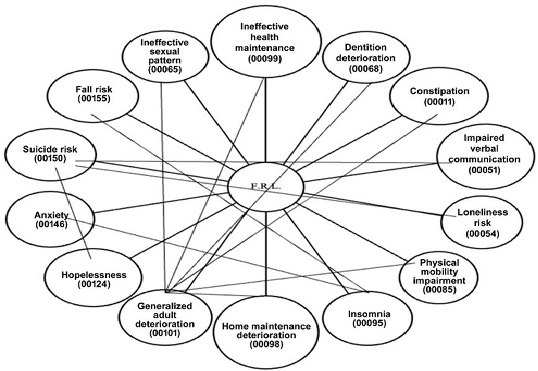
From the data obtained, clinical judgment was used to move on to the diagnosis stage; in this case, it was necessary to use the NANDA taxonomy that allowed the nursing diagnoses to be established 14, which had to be submitted to Pesut's clinical reasoning model, where the logical reasoning network is based on the graphic presentation of the relationships that exist between the nursing diagnoses and the central element 17 with the objective of prioritizing the concept of care. Many nursing diagnoses tend to relate to each other, i.e. there are relationships between them, it could even be inferred that some of them interrelate with each other, so that the creation of a clinical reasoning network tries to link, unite, connect, and create links between the central question (element that is at the center of the network) and the rest of the elements, in this case the nursing diagnoses 18.
-
14Planes de cuidados enfermeros de estudiantes de pregrado: comparación de dos modelosSalud UIS, 2020
-
17Sobre el modelo AREA y el proceso enfermeroInquietudes, 2006
-
18Proceso enfermero de tercera generaciónEnferm Universitaria, 2016
In the next stage, which corresponds to planning, the NOC taxonomy was used to establish the results; moreover, the execution stage was approached from the NIC taxonomy where independent interventions were established, the four stages comprise the conformation of the nursing care plans (PLACE by its acronym in Spanish), which were personalized. The fifth stage was the evaluation, which shows the results according to each stage with emphasis on the implementation of the interventions.
The study complied with the provisions of the General Health Regulations on Health Research; the Ethics and Research Committee of the School of Medicine approved the study with file number CEI-077; the privacy of the participant was protected during data collection; the assessment was carried out in a place where only the main researcher and the participant were present; the study was risk-free and the informed consent form was signed in accordance with Articles 16, 20 and 21 19.
-
19Reglamento de la Ley General de salud en materia de investigaciones para la saludDiario oficial de la Federación, 2014
Case Presentation
In basic conditioning factors, this is elderly whose name is F.R.L., who lived in the urban area of Los Mochis. He was 68 years old, male, 155 centimeters tall, weighed 55 kilograms, with a body mass index of 22.9 kg/m2. Additionally, he was single, Catholic, unemployed, sold metal cans collected by him in the streets, having achieved elementary school study level, lived alone, did not know if he suffered from any chronic or acute illness because he did not go to any medical institution for check-ups, and since he came from a broken family, family communication was distant. Moreover, he covered his needs, he had basic services in his home, and in relation to his health he did not expect anything since he perceived his state of health as deficient. Assessment in relation to self-care requirements: Universal, F.R.L. had a respiratory rate of 24 per minute, saturation of 96%, capillary refill of 2 seconds, dry skin, body temperature of 36° C, low turgor, blood pressure of 115/50 mm/Hg, heart rate of 77 per minute, plus hot burps when eating, and incomplete denture. He ingested 500 to 1000 milliliters of water per day, 500 milliliters of soft drinks and 500 milliliters of coffee per day, showed dehydrated oral mucosa, dry skin, dry eyes without tears, had a normal oral diet, drank milk and milk derivatives, eggs, pasta, flour and vegetables, and lost more than 10 kilograms.
In relation to bowel movements, he reported constipation, decreased peristalsis, brown and hard stools, he could last up to 10 days without bowel movements, he did not exercise because he had pain and limitations in her joints; in addition, the person mentioned sleeping 6 to 8 hours a day, experienced changes in the sleep pattern, had difficulty falling asleep, worrying about pending issues were factors that interrupted his rest, thus, when he woke up he felt tired, took naps, insomnia was present, he was sad and depressed, and according to his words he felt hopeless and anxious. Regarding the psychosocial state, he stated that he did not like relationships, he did not consider himself a social person, his communication with other people was distant, emotionally speaking he felt empty and had no will to live, in relation to the interaction with other people based on the basic senses he only had visual difficulty, he currently smoke more than 10 cigarettes a day, his consumption began at 17 years of age, he drank alcoholic beverages every weekend since he was 12 years old, he expressed that his life changed since his family abandoned him which led him to feel lonely.
Regarding family history, he reported having a history of diabetes mellitus and arterial hypertension in both parents. In the development requirement, the person expressed that during adulthood he was a consumer of illicit drugs (marijuana and cocaine), stated that he did not receive sex education, did not have children, did not use family planning methods, did not attend prostate or testicular exams, and had erection and premature ejaculation problems. Additionally, in the health deviation requirement, the person, F.R.L., did not attend health campaigns aimed at detecting diseases, had not been hospitalized, showed continuous emotional changes and regarding the labor environment he has been unemployed.
It was noted that the elderly, F.R.L., lived in a quite deteriorated house. It was found that the conditions of the environment where he lived was not adequate for a comprehensive care and also the skills were scarce for self-care since he lacked mobility, and knowledge was deficient regarding the necessary aspects to have good health.
Results
Regarding the assessment of the elderly person, F.L.R., according to the significant data found and the clinical reasoning, 14 diagnosis labels were identified, of which 11 were true and 3 were risky, (Figure 1).
Thumbnail
 Source: Own development.
Figure 1
Clinical reasoning network, 2024
Clinical reasoning network, 2024
In accordance with the planning stage, in the first instance, the priority diagnosis was retrieved from the clinical reasoning network, which indicated generalized deterioration of the person (00101). It was considered necessary to incorporate two additional diagnoses that allowed for the biopsychosocial state to be assessed, which was reflected in the labels that were also developed as Anxiety (00146) identified in the assessment of the psychosocial state and Suicide risk (00150), which arose from the relationship between substance abuse, living by himself and social isolation. These diagnoses were considered as part of the individualized PLACES using the NOC taxonomy. In addition, it was essential for the implementation stage to consult the NIC taxonomy in order to identify the most efficient interventions required by the elderly.
The PLACE of generalized deterioration of the elderly (00101) allowed for nursing interventions that would contribute to the reduction of the associated signs and symptoms, based on the implementation of counseling and prevention of substance use activities, the target score was increased, reaching a measurement scale of 4 (Table 1).
Table 1
Individualized care plan for elderly drug user, 2023
Individualized care plan for elderly drug user, 2023
| Domain: 09 Stress Coping / Tolerance Class 02: Coping responses | ||
| Nursing Diagnosis (NANDA) | Measurement scale | Intervention (NIC) |
| Label: Generalized deterioration of the elderly | Indicator 1 and 2 | Prevention of the |
| (00101) | Keep: 1 | consumption of harmful |
| Related factors: | Increase: 4 | substances. (4500) |
| Depression. | Activities: | |
| Defining Characteristics (Signs and | Intervention (NIC): | - Reduce social isolation. |
| Symptoms): | Counseling (5240) | - Encourage one's own |
| Neglect of the economic sphere, omission of | Activities: | decision making for |
| household cleaning activities, physical wear | - Create a therapeutic environment | appropriate lifestyle |
| and tear, self-care deficits, unintentional | of security and esteem. | choices. |
| weight loss, social withdrawal | - Encourage the expression of the | - Provide support in |
| person's feelings. | identifying strategies to | |
| Result (NOC) | - Practices that allow reflection and | help improve relaxation. |
| Label: Development: Elderly. (0121) | clarification, with the objective of | |
| Domain 01: Functional health. | allowing the manifestation of | |
| Class B: Growth and development. | problems. | |
| - Support the person in identifying | ||
| Indicator: | his skills and abilities in order to | |
| Maintains interest in life. | strengthen them. | |
| Avoid substance abuse. | - Assist in the growth of new self- | |
| care capabilities. | ||
| Target score: | - Encourage the use of desirable | |
| 1. Never demonstrated | habits. | |
| 2. Rarely demonstrated | ||
| 3. Sometimes demonstrated | ||
| 4. Partially demonstrated | ||
| 5. Always demonstrated | ||
| Assessment | ||
| The implementation of the interventions made it possible to understand the person's current situation, thus identifying all those aspects that needed to be addressed, and to help prevent physical, mental and social deterioration from continuing to advance, with the establishment of strategies to help the person achieve an optimal state of health. | ||
In the anxiety PLACE (00146), the activities were carried out in a didactic way to facilitate the identification of the mood of the elderly, for this purpose, a set of questions related to the psychological aspects that influenced his life was used, which favored the expression of negative emotions. In addition, relaxation techniques aimed at reducing anxiety were taught and guidance was provided on the positive impact of sleeping well in stressful situations. As a result of these interventions, a target score of 4 was achieved, (Table 2).
Table 2
Individualized care plan for elderly drug user, 2023
Individualized care plan for elderly drug user, 2023
| Domain 09: Stress Coping / Tolerance Class 02: Coping responses | ||
| Nursing diagnoses (NANDA) | Measurement scale | Intervention (NIC) |
| Label: Anxiety (00146) | Improve sleep (1850) | |
| Related factor: | Indicator 1 and 2: | Activities: |
| Substance abuse | Keep: 2 | - Guidance on why it is |
| Defining Characteristics (Signs and | Increase: 4 | important to get a good night's |
| Symptoms) | sleep when there is too much | |
| Decreased productivity, insomnia, sleep | Interventions (NIC) | stress. |
| disturbances and dry mouth | Reduced anxiety (5820) | - To teach the guidelines for |
| Activities. | proper sleep. | |
| Results (NOC) | - Understanding the circumstances | - Teaching the patient to control |
| Label: Anxiety label (1211). | that lead to stress in the person. | sleep patterns. |
| Domain 03: Psychosocial health | - Encourage the expression of | - Encourage the patient to forget |
| Class M: Psychosocial wellbeing | emotions, fears and concerns. | the situations that worry him |
| Encourage the expression of | before going to sleep. | |
| Indicator | feelings, perceptions and fears. | - Instructing with the person on |
| Productivity reduction. | - Implement activities that help to | techniques that promote sleep. |
| Sleep pattern disorders | release worries. | - Discuss sleep promoting |
| - Contribute to the identification of | techniques with the patient. | |
| Target score | situations that originate anxiety. | |
| 1. Severe | - Teach the patient techniques that | |
| 2. Substantial | help him to relax. | |
| 3. Moderate | ||
| 4. Slight | ||
| 5. None | ||
| Assessment | ||
| The patient showed all the availability for the development of strategies related to the resolution of the problem in a constructive manner. It is worth mentioning that the elderly participated in didactic activities developed by the nursing professional, in which relaxation and sleep promotion techniques were established for the overall wellbeing of the person. | ||
In the PLACE suicide risk assessment (00150), the degree of risk was initially identified by analyzing emotional disturbances and the impact of substance use. Upon detecting a high risk of suicidal thoughts, a session was conducted to address the recognition of negative feelings, teaching strategies to cope with daily challenges. In addition, free counseling was provided by centers that promote psychosocial wellbeing, focusing on the integration of people in social isolation. This process involved the participation of nursing professionals in collaboration with other health experts. As a result, the target score increased to 4. It is important to mention that the person, with the help of counseling, was able to attend a social integration center for the elderly, (Table 3).
Table 3.
Individualizedcare plan for elderly drug user, 2023
Individualizedcare plan for elderly drug user, 2023
| Domain 11: Security / Protection Class 03: Violence | ||
| Nursing diagnoses (NANDA) | Measurement scale | Interventions (NIC) |
| Label: Suicide risk (00150) | Keep: 2 | Emotional support (5270) |
| Related factors: | Increase: 4 | Activities: |
| Substance abuse. | - Help the patient recognize | |
| Living alone. | Interventions (NIC) | feelings of anxiety and |
| Social isolation. | Suicide prevention (6340) | sadness. |
| Activities: | - Listening to expressions of | |
| Results (NOC) | - Determine the existence, degree | feeling. |
| Label: Self-control of suicidal impulse. | and risk of suicide. | - Discuss the consequences of |
| Domain 03: Psychosocial Health | - Examine for symptoms that | deepening guilt feelings. |
| Class O: Self-control | indicate suicide risk such as | - Provide decision making |
| emotional disturbances or | assistance. | |
| Indicator | substance use. | - Referral to counseling |
| Does not attempt suicide | - Teaching the patient coping | services. |
| strategies to deal with problems. | ||
| Target score | - Providing advice on locating | |
| 1. Never demonstrated. | available support groups. | |
| 2. Rarely demonstrated | - Consider strategies to eliminate | |
| 3. Sometimes demonstrated | social isolation. | |
| 4. Frequently demonstrated. | ||
| 5. Always demonstrated. | ||
| Assessment | ||
| The patient showed a great change in his ideals regarding life, based on the emotional support provided, it was possible to see a greater tranquility in the person, which allowed him to set goals to improve his quality of life and thus clarify his concerns that he has long brought from the past. | ||
Discussion
Based on the objective of developing an PAE for an elderly drug user using Orem's general theory of self-care deficits and the NANDA, NOC and NIC taxonomies. It began with the application of Dorothea Orem's assessment 21 in a community context, where interventions for prevention, education and counseling that could favor the integral development of the biological, psychological and social aspects of the elderly person were identified. The general theory of self-care deficit has been used by various researchers in different case studies that have considered the elderly as a subject of study. However, it has not been assessed from a perspective that conditions them as consumers of licit substances and that in turn relates them to the consumption of illicit substances in their past stages, because, when referring to this age group, it is thought that they are a susceptible group and that they are not capable of carrying out these activities that put their health at risk, and most studies are directed to adolescents and young adults 22,23.
-
21Nursing: Concepts of practice, 2001
-
22Conceptos y prácticas de autocuidado en adolescentes: registros cualitativos en diarios personalesEnfermería global, 2023
-
23Intervención de enfermería en pacientes adictos al consumo de marihuana con estado depresivoRev Arb Interdiscip Cienc Salud, 2022
From all the above, it is clear that it is important to assess the elderly from a universal perspective that takes into account all the factors that condition their well-being. In this PAE, three nursing care plans arising from the grouping carried out with Pesut's clinical reasoning model were identified: Generalized deterioration of the elderly, anxiety and suicide risk. It is essential for the nursing professional to be involved in the aging process, which will allow him/her to identify defining characteristics of generalized deterioration in the elderly.
To that extent, scientific evidence infers that aging is a process of changes that occur as a consequence of diseases or bad habits 1,6. In this regard, the older person in the present study reported the use of alcohol, tobacco, marijuana and cocaine during the course of his life. It has been shown that the excessive consumption of these substances poses a significant risk or harm to the individual, resulting in the development of dependence causing physical and mental harm in the older adult population 24.
-
1El envejecimiento del adulto mayor y sus principales característicasRecimundo, 2019
-
6El adulto mayor frente a las adicciones, un problema de salud públicaRev Edu fis, 2018
-
24Prevalencia de consumo alcohol y tabaco en adultos mayores de un centro gerontológico de AguascalientesRev Lux Médica, 2023
Regarding anxiety and suicide risk, several scientific investigations consider that substance use may increase the probability of developing or aggravating mental health disorders such as depression, anxiety, post-traumatic stress disorder, bipolar disorder and psychosis, which considerably increases the risk of suicide. In addition, habitual substance use is linked to problems such as economic hardship, unemployment, homelessness, social isolation and lack of family support. These problems generate higher levels of stress, which, in turn, may increase the risk of suicide 25-27.
-
25Prevalencia, variables sociodemográficas, estado de salud mental y tipo de consumo de drogas asociado con conductas suicidas entre personas con trastornos por consumo de sustancias: una revisión sistemática y metanálisisJ Addict Dis, 2021
-
27Factors associated with suicide in people who use drugs: a scoping reviewBMC psychiatry, 2023
Therefore, it is important to include nursing programs that include didactic and psychosocial strategies to strengthen the coping with risk situations faced by the elderly in daily life.
It is important to highlight the limitations of the PAE due to the community context in which it was developed, which reduced the number of meetings with the participant to only 4 days a week and for a period of three hours. Another limitation was that the elderly did not go to a health institution for medical monitoring, a situation that made it impossible to obtain laboratory studies that could provide relevant information on their state of health.
Conclusions
The case study demonstrates that Orem's general theory of self-care deficit provides a fundamental basis for PAE, enabling more individualized and structured care to be provided to the older person. The follow-up of the significant data obtained in the assessment stage allowed the application of the Pesut clinical reasoning network, which facilitated the identification of key nursing diagnoses such as generalized adult deterioration (00101), anxiety (00146) and suicide risk (00150). In addition, the integration of the NANDA, NOC and NIC taxonomies may serve as a guideline for this care towards the human responses of the elderly drug user. This approach contributed to an integral and adequate model, through the planning, execution and evaluation of nursing interventions, and an increase in the target score of each PLACE was achieved, which had a positive impact on the reduction of complications and risks that limited the physical, mental and social integrity of the elderly person. In the nursing field, the implementation of the EAP promotes a standardized language among professionals, which contributes to providing specific care supported by scientific evidence. This approach contributes to the advancement of knowledge patterns and the improvement of practices in the development of the profession.
It is recommended to continue the application of the PAE in community contexts, seeking to establish programs with longer periods of time that allow for a complete health evaluation. Also, do not just focus on what the person reports, but include laboratory data, laboratory studies or medical reports on their conditions. In addition, it is important to inform that those people who do not have medical service due to lack of economic resources can go to the IMSS-BIENESTAR health system since all Mexicans have the right to receive free medical attention, including educational, preventive, orientation and hospital services.
Conflicts of Interest
The authors stated that there was no conflict of interest.
Financing
The authors stated that there was no funding of any kind.
Artificial Intelligence
The authors stated that they have not used any type of artificial intelligence resource in any of the sections of this manuscript (in the elaboration, design, writing, structuring and proposals of figures, tables or graphs).
Referencias bibliográficas
-
1Vélez E, Falcones M, Vásquez M, Solórzano A. El envejecimiento del adulto mayor y sus principales características. Recimundo. [Internet]. 2019 [citado 12 dic 2024]:3(1):58-74. Disponible en: Disponible en: http://www.recimundo.com/index.php/es/article/view/357 Links
-
2National Institute on Drug Abuse. El consumo de drogas en el adulto mayor [Internet]. Estados Unidos: NIH; 2020 [citado 11 feb 2024]. Disponible en: Disponible en: https://nida.nih.gov/sites/default/files/df-subabuse-older-adults-sp.pdf Links
-
3Organización Mundial de la Salud (OMS). Informe mundial sobre las drogas 2023. [Internet]. OMS; 2023 [citado 11 feb 2024]. Disponible en: Disponible en: https://www.unodc.org/lpomex/es/noticias/junio-2023/el-informe-mundial-sobre-las-drogas 2023 . Links
-
4Escala Nacional de Consumo de Drogas, Alcohol y Tabaco (ENCODAT). Consumo de drogas: prevalencias, tendencias y variaciones estatales: 2016. [Internet]. México; 2016 [citado 12 feb 2024]. Disponible en: Disponible en: https://www.gob.mx/cms/uploads/attachment/file/234856/CONSUMO_DE_DROGAS.pdf Links
-
5Fuentes G, Flores F. La indigencia de adultos mayores como consecuencia del abandono en el Estado de México. Pap. poblac [Internet]. 2016 [citado 13 feb 2024];22(87):161-181. Disponible en: Disponible en: https://www.scielo.org.mx/scielo.php?script=sci_arttext&pid=S1405-74252016000100161 Links
-
6Quimbayo J. El adulto mayor frente a las adicciones, un problema de salud pública. Rev Edu fis [Internet]. 2018 [citado 14 feb 2024];10(22):109-118. Disponible en: Disponible en: https://revistas.ut.edu.co/index.php/edufisica/article/view/1286/1004 Links
-
7Organización Mundial de la Salud (OMS). Salud mental en los adultos mayores: 2023 [Internet]. OMS; 2023 [citado 17 feb 2024]. Disponible en: Disponible en: https://www.who.int/es/newsroom/factsheets/detail/mental-health-of-older-adults Links
-
8Escobar-Castellanos B, Cid-Henríquez P. El cuidado de enfermería y la ética derivados del avance tecnológico en salud. Acta bioeth. [Internet]. 2018 [citado 18 feb 2024]; 24(1):39-46. Disponible en: Disponible en: http://www.scielo.cl/scielo.php?script=sci_arttext&pid=S1726569X2018000100039&lng=es Links
-
9De Arco-Canoles O, Suarez-Calle Z. Rol de los profesionales de enfermería en el sistema de salud colombiano. Univ. Salud [Internet]. 2018 [citado 18 feb 24]; 20(2):171-182. Disponible en: Disponible en: http://www.scielo.org.co/pdf/reus/v20n2/0124-7107-reus-20-02-0017110 . Links
-
10Organización Mundial de la Salud (OMS). Década del envejecimiento saludable 2020-2030. [Internet]. OMS; 2019 [citado 11 feb 2024]. Disponible en: Disponible en: https://www.who.int/es/initiatives/decade-of-healthy-ageing Links
-
11Herdman TH, Kamitsuru S, Takao-Lopes C. Diagnósticos enfermeros, definiciones y clasificación. 12a ed. España: Elsevier; 2021. Links
-
12Moorhead S, Swanson E, Johnson M, Maas ML. Clasificación de resultados de enfermería (NOC). 6ª ed. Italia: Elsevier; 2019. Links
-
13Butcher HK, Bulechek GM, Dochterman JM, Wagner CM. Clasificación de intervenciones de enfermería (NIC). 7a ed. Italia: Elsevier; 2019. Links
-
14Ibáñez LE, Fajardo MT, Cardozo CE, Roa ZM. Planes de cuidados enfermeros de estudiantes de pregrado: comparación de dos modelos. Salud UIS [Internet]. 2020 [citado 22 feb 2024]:52(1):33-40. Disponible en: Disponible en: http://www.scielo.org.co/pdf/suis/v52n1/2145-8464-suis-52-01-33.pdf Links
-
15Miranda K, Rodríguez Y, Cajachagua M. Proceso de atención de enfermería como instrumento del cuidado, significado para estudiantes de último curso. Enferm. univ [Internet]. 2019 [citado 23 feb 2024]:16(4):374-389. Disponible en: Disponible en: https://www.scielo.org.mx/scielo.php?script=sci_arttext&pid=S1665-70632019000400374 Links
-
16López MC, Moreno NE. Construcción de instrumentos para realizar el proceso de enfermería basado en la teoría general de Orem. Desarrollo Cientif Enferm [Internet]. 2010 [citado 24 feb 2024]:18(3):135-140. Disponible en: Disponible en: https://www.index-f.com/dce/18pdf/18-135.pdf Links
-
17Bellido JC. Sobre el modelo AREA y el proceso enfermero. Inquietudes [Internet]. 2006 [citado 24 feb 2024]:12(35):21-29. Disponible en: Disponible en: https://www.index-f.com/inquietudes/35pdf/35_articulo_21_29-0707.pdf Links
-
18González MG, Monroy A. Proceso enfermero de tercera generación. Enferm Universitaria [Internet]. 2016 [citado 27 feb 2024]:13(2):124-129. Disponible en: Disponible en: https://www.scielo.org.mx/pdf/eu/v13n2/1665-7063-eu-13-02-00124.pdf Links
-
19Cámara de Diputados del H. Congreso de la Unión. Reglamento de la Ley General de salud en materia de investigaciones para la salud. Diario oficial de la Federación. [Internet]. México; 2014 [citado 27 feb 2024]. Disponible en: Disponible en: https://www.imss.gob.mx/sites/all/statics/pdf/reglamentos/4447_RLGSMIS.pdf Links
-
20Pacheco A, Telles C, Dezordi MA, Dias E. Uso y abuso de substancias en adultos mayores atendidos en servicios de salud mental. Mem. Inst. Investig. Cienc. Salud [Internet]. 2022 [citado 28 feb 2024]:20(1):73-84. Disponible en: Disponible en: http://scielo.iics.una.py/pdf/iics/v20n1/1812-9528-iics-20-01-73.pdf Links
-
21Orem DE. Nursing: Concepts of practice. 6th ed. St. Louis, MO: Mosby; 2001. Links
-
22Cabrera A, Lossi M, Dos Santos M, Neves L, Monique D, Abadio W. Conceptos y prácticas de autocuidado en adolescentes: registros cualitativos en diarios personales. Enfermería global [Internet]. 2023 [citado 12 dic 2024]:22(72):104-146. Disponible en: https://doi.org/10.6018/eglobal.551381 Links
-
23Marcalla P, Gómez M, Sánchez B. Intervención de enfermería en pacientes adictos al consumo de marihuana con estado depresivo. Rev Arb Interdiscip Cienc Salud [Internet]. 2022 [citado 12 dic 2024]:6(2):301-309. Disponible en: http://dx.doi.org/10.35381/s.v.v6i2.2105 Links
-
24González C, Rodríguez M, Romo K, Saucedo J, Villalobos F, Ortega M. Prevalencia de consumo alcohol y tabaco en adultos mayores de un centro gerontológico de Aguascalientes. Rev Lux Médica [Internet]. 2023 [citado 12 dic 2024]:18(52):1-9. Disponible en: Disponible en: https://revistas.uaa.mx/index.php/luxmedica/article/view/4202 Links
-
25Armoon B, SoleimanvandiAzar N, Fleury M, Noroozi A, Hossein A, Mohammadi R. Prevalencia, variables sociodemográficas, estado de salud mental y tipo de consumo de drogas asociado con conductas suicidas entre personas con trastornos por consumo de sustancias: una revisión sistemática y metanálisis. J Addict Dis [Internet]. 2021 [citado 12 dic 2024];39:550-569. Disponible en: https://doi.org/10.1080/10550887.2021.1912572 Links
-
26Soboka M, Stewart S, Tibbo P, Wang J. Substance use and risk of suicide among adults who sought mental health and addiction specialty services through a centralized intake process in Nova Scotia: a cross-sectional study. BMJ open [Internet]. 2024 [citado 12 dic 2024]:14(10):1-11. Disponible en: https://doi.org/10.1136/bmjopen-2024-086487 Links
-
27Devin J, Lyons S, Murphy L, O'Sullivan M, Lynn E. Factors associated with suicide in people who use drugs: a scoping review. BMC psychiatry [Internet]. 2023 [citado 12 dic 2024]:23(1):655. Disponible en: https://doi.org/10.1186/s12888-023-05131-x Links