




Servicios Personalizados
Revista
Articulo
 texto en
  Inglés (pdf)
 Artículo en XML
 Referencias del artículo
 Traducción automática
 Enviar artículo por email
Indicadores
-
 Citado por SciELO
 -
 Accesos
Links relacionados
-
 Similares en
SciELO
Similares en
SciELO
Compartir

 Permalink
Sanus
versión On-line ISSN 2448-6094
Sanus vol.9 Sonora ene./dic. 2024 Epub 04-Abr-2025
https://doi.org/10.36789/sanusrevenf..vi20.479
Review
Delayed Growth in children: concept analysis through an integrative review
1
*
 http://orcid.org/0000-0002-3344-8413
2
http://orcid.org/0000-0001-8728-2570
3
http://orcid.org/0000-0002-6262-4578
1Maestro en Ciencias de Enfermería, Facultad de Enfermería de Tampico, Universidad Autónoma de Tamaulipas. Tampico, Tamaulipas, México.
2Doctora en Ciencias. Facultad de Enfermería de Tampico, Universidad Autónoma de Tamaulipas. Tampico, Tamaulipas, México.
3Doctora en Ciencias de la Salud. Facultad de Enfermería de Tampico, Universidad Autónoma de Tamaulipas. Tampico, Tamaulipas, México.
4Maestro en Ciencias de Enfermería. Facultad de Enfermería de Tampico, Universidad Autónoma de Tamaulipas. Tampico, Tamaulipas, México.
Introduction:
Delayed growth in children is studied globally by nursing professionals independently at all levels of care, however, there is no standardized language to describe it from the discipline.
Objective:
Analyze the concept of delayed growth in children and identify etiological factors, ways to quantify it, differentiate it and recognize it from the nursing discipline.
Methodology:
Integrative review of the literature to carry out a concept analysis through the Walker and Avant methodology. 46 articles published in LILACS, CUIDEN, Wiley Online Library, Science Direct, EBSCO, Scielo, PudMed in English, Spanish, Portuguese and French between January and April 2022 were analyzed. The descriptors were: Delayed growth, child, risk factors and nursing, exploring concepts, attributes, background, consequences and empirical references. Critical reading files and methodological quality evaluation were used using the STROBE initiative criteria. Quantitative data were analyzed descriptively.
Results:
Background information such as inadequate feeding pattern, poor household hygiene, ineffective breastfeeding, ineffective parental care and its consequences were the decrease or pause in the child's growth, proposing the concept: Condition in which the weight, length, height, height velocity cm/year, body mass index and head circumference of the child are lower for sex, age, in relation to the population average.
Conclusions:
The evidence describes the multifactorial complexity of the phenomenon and highlights the peculiarities of the delay and pause in the growth rate.
Key words: Growth; Failure to thrive; Child health; Nursing; Nursing care (DeCS)
Introducción:
El retraso del crecimiento en niños es estudiando globalmente por profesionales de enfermería de manera independiente en todos los niveles de atención, sin embargo, no existe dentro del lenguaje estandarizado una etiqueta para describirlo desde la disciplina.
Objetivo:
Analizar el concepto de retraso del crecimiento en niños e identificar factores etiológicos, formas de cuantificarlo, diferenciarlo y reconocerlo desde la disciplina de enfermería.
Metodología:
Revisión integrativa de la literatura a fin de realizar un análisis de concepto a través de la metodología de Walker y Avant. Se analizaron 46 artículos publicados en LILACS, CUIDEN, Wiley Online Library, Science Direct, EBSCO, Scielo, PudMed en inglés, español, portugués y francés entre enero a abril del 2022. Los descriptores fueron: retardo del crecimiento, niño, factores de riesgo y enfermería, explorando conceptos, atributos, antecedentes, consecuencias y referentes empíricos. Se hizo uso de ficheros de lectura crítica y evaluación de calidad metodológica mediante los criterios de la iniciativa STROBE. Los datos cuantitativos se analizaron en forma descriptiva.
Resultados:
Se identificaron antecedentes como patrón de alimentación inadecuado, higiene deficiente del hogar, lactancia materna inefectiva, Cuidado ineficaz parental y sus consecuentes fueron la disminución o pausa del crecimiento del niño, proponiendo el concepto: condición en la que el peso, longitud, talla, velocidad de talla cm/año, índice de masa corporal y perímetro cefálico del niño son inferiores para sexo, edad, en relación con la media poblacional.
Conclusiones:
La evidencia describe la complejidad multifactorial del concepto y resalta las peculiaridades del retraso y pausa de la tasa de crecimiento.
Palabras clave: Crecimiento; Retardo del crecimiento; Salud del niño; Enfermería; Atención de enfermería (DeCS)
Introdução:
O retardo de crescimento em crianças é estudado globalmente por profissionais de enfermagem de forma independente em todos os níveis de atenção, porém, não existe um rótulo de linguagem padronizado para descrevê-lo na disciplina;
Objetivo:
Analisar o conceito de retardo de crescimento em crianças e identificar fatores etiológicos, formas de quantificá-lo, diferenciá-lo e reconhecê-lo da disciplina de enfermagem.
Metodologia:
Revisão integrativa da literatura com o objetivo de realizar uma análise de conceito através da metodologia Walker e Avant. Foram analisados 46 artigos publicados nas bases LILACS, CUIDEN, Wiley Online Library, Science Direct, EBSCO, Scielo, PudMed nos idiomas inglês, espanhol, português e francês entre janeiro e abril de 2022. Os descritores foram: Crescimento retardado, criança, fatores de risco e enfermagem, explorando conceitos, atributos, antecedentes, consequências e referências empíricas. Foram utilizadas fichas de leitura crítica e avaliação da qualidade metodológica utilizando os critérios da iniciativa STROBE. Os dados quantitativos foram analisados descritivamente.
Resultados:
Foram identificados antecedentes como padrão alimentar inadequado, má higiene domiciliar, amamentação ineficaz, cuidado parental ineficaz e suas consequências foram a diminuição ou pausa no crescimento da criança, propondo o conceito: condição em que o peso, comprimento, altura, velocidade de crescimento cm/ano, o índice de massa corporal e o perímetro cefálico da criança são menores para sexo, idade, em relação à média populacional.
Conclusões:
As evidências descrevem a complexidade multifatorial do fenômeno e destacam as peculiaridades do atraso e da pausa na taxa de crescimento.
Palavras-chave: Crescimento; Insuficiência de Crescimento; Saúde da criança; Enfermagem; Cuidados de enfermagem (DeCS)
Introduction
The World Health Organization (WHO) in the year 2021 declared that delayed growth in children is one of the most important difficulties for the development of human beings and it affects 155 million infants under 5 years of age in the world and if the current trend continues, in 2025 there will be 127 million children under 5 years of age with delayed growth (1. This problem is largely irreversible and has a series of long-term effects for the human being such as decreased physical, cognitive, and psychosocial development, decreased productive capacity, deterioration of health status, risk of developing non-communicable diseases and disabilities, as well as a considerable risk of mortality, which brings with it high public health costs, high costs for public health, in the implementation of public policies, social programs, and as an intergenerational consequence it affects social welfare. Therefore, early identification of this situation is essential to reduce the risk of long-term complications and ensure that the child has the best possible opportunities for a healthy and productive life 1.
The issue of delayed growth in children is approached from different disciplines including medicine, nutrition and psychology; it is currently known that this concept is conditioned by genetic, nutritional and endocrine factors, general health status, as well as the psychosocial environment and affectivity (2,3. At the international level, growth retardation has been studied from the theoretical perspective of the nursing discipline since 1978 by Kathryn E. Barnard; similarly, in Latin America and Mexico the current evidence describes the use of the concept by nursing professionals in primary health care, specifically in the areas of comprehensive child care and schooling in connection with the concept of development as well as their independent and important participation in the evaluation, analysis, determination of individual variations and foreseeable characteristics with the objective of providing a parental intervention to generate anticipated care for delayed growth and stimulate healthy growth 4-6.
Although the work of the nursing professional in relation to childhood delayed growth is evidenced in publications of the discipline and in the standardized languages themselves, the Nursing Outcomes Classification (NOC) (7 describes the expected results of the nursing intervention: Growth (0110). In the same direction, the Nursing Interventions Classification (NIC) (8 contains the interventions: Nutritional Monitoring (11160), Nutrition Management (1100), and Weight Management (1260) that describe activities to alleviate the analyzed concept (5-8. However, there is currently no diagnosis label within the standardized language of the discipline to describe the human response of downward trend or slow growth, but there are publications that analyze the concept of stunting, conceptualizing it as follows: Anthropometric measurements below -2 standard deviations (SD) or below the 3rd percentile or due to a decrease in growth velocity 3,9,10.
For nursing professionals it is essential to be able to label, order and clearly define a human response that, in the nurse's opinion, requires independent and transdisciplinary intervention, in order to name the activity of the professional who applies care, within a universal and standardized language as is the case with the current NANDA-I taxonomy; therefore, it is relevant to analyze the background of slow growth in children where the nursing professional acts independently and in line with the regulatory framework that rules the profession in each country, to generate a concept and theoretical support according to the hierarchical levels of evidence of the NANDA-I classification where the conceptual analysis gives a level 2 theoretical support, to then have a framework of analysis and generate in subsequent studies a clinical support of the human response under study and thus increase the level of evidence of nursing diagnoses 9,11,12.
To this end, the following question is asked: What are the attributes, empirical references, background and consequences of delayed growth in children? For the above reasons, the purpose of this study was to analyze the concept of delay pondero-statural growth in children and to identify etiological factors, ways to quantify, differentiate and recognize it from the nursing discipline.
Methodology
This is an integrative review of the literature with the purpose of undertaking a concept analysis according to the model proposed by Walker and Avant, which approaches recent or little explored concepts in the literature through 8 rigorous and systematic steps: (a) concept selection, (b) determination of analysis objectives, (c) identification of concept usage in the literature, (d) determination of defining attributes, (e) identification of a model case, (f) identification of additional cases, borderline cases, opposite case, related case, invented case and illegitimate case, (g) identification of background and consequences, and (h) definition of empirical references 13-15.
For data collection, the following different strategies were used in the documentary retrieval, that is: First, the free language descriptors were used such as delay, growth, child, causes, risk factors and nursing in Spanish, English, Portuguese and French. Based on these descriptors, a review was conducted in web search engines such as Google and Safari, which led to web addresses of international organizations such as WHO, United Nations Children's Fund (UNICEF), About Kids Health and the American Academy of Pediatrics (AAP). Subsequently, a more exhaustive search was conducted in databases such as: LILACS, CUIDEN, Wiley Online Library, Science Direct, EBSCO, Scielo, PudMed, through the Medical Subject Headings (MeSH) thesauri and the Health Sciences Descriptors (DeCS), and their synonyms already in the 4 languages interconnected by the Boolean operators AND and OR: Delayed Growth, Child AND Nursing, in the period from January to April 2022.
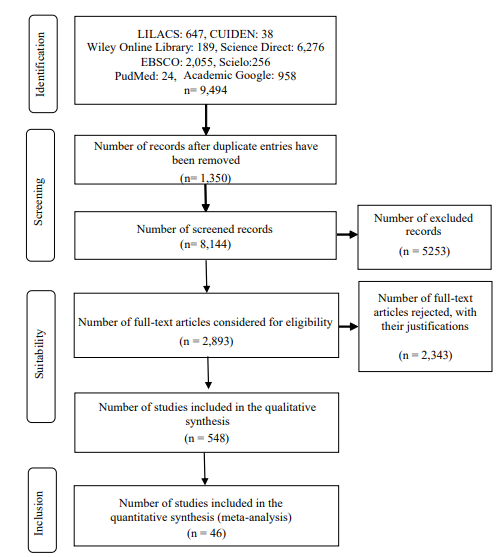
Original articles dealing with the subject with a time frame of 15 years were included; editorials, opinion articles, duplicate articles and those with a publication date older than 15 years were excluded. A total of 9,494 studies were identified and after the analysis of titles and abstracts, the complete and rigorous exploration of the inclusion and exclusion criteria, a final sample of 46 articles were selected.
The articles selected were evaluated in terms of their response to the research question and, to order the information, critical reading files (CLF) were used to extract data that allowed the characteristics of the studies to be identified with greater precision. As for the included studies, they were analyzed through the methodological quality assessment criteria of the Strengthening the Reporting of Observational studies in Epidemiology (STROBE) Initiative statement (16, in which none were discarded, (Figure 1).
Results
The selection of the concept reflected the researchers' interest in defining the deficit of cellular, tissue and body mass, as well as the increase in bone size represented by the increase in human body height during childhood, in order to recognize the effects on the child's health and the factors that have influenced the presentation of this situation 26,29,30,49,71.
When identifying the use of the concept in the literature, it was found that 95.6 % of the studies were developed in the disciplinary area of medicine 25-30,32-40,42-46, followed by multidisciplinary studies with 4. 3 % in which the disciplines involved were nutrition and psychology 31,41, in the review it was found that the term was defined in an apparent way by the WHO 1 and other authors 18,25,49,41 as a child who presents an insufficient height and weight for age over a determined period of time. Other recent conceptualizations 19,20 defined delayed growth in children as a specific subset of malnourishment characterized by insufficient height and weight compared with age-specific growth reference standards.
It was also identified that several authors 25,38,40,48 described the phenomenon under study as a situation in which a child has a sustained weight or height in a linear fashion below the third to fifth percentile for age and sex, a stepwise decrease in weight below the third to fifth percentile, or a percentile decrease of 2 important growth parameters in a short period, while in one study reference was made to growth standards and defined it as a measurement below -2 standard deviations (SD) or the 3rd percentile and a decrease in growth velocity per year 21.
Within the nursing discipline, no conceptualization of delayed growth in children was found, however, the use of the concept was evidenced from theory and research 4,6. Additionally, the concept of delayed growth has different alternative terms or synonyms in the Spanish language such as: insuficiencia ponderal, retardo físico, retardo del crecimiento, retraso estaturo-ponderal, retraso ponderal, in English failure trive, in Portuguese: insuficiência de crescimento and in French: Retard de croissance staturo-pondérale (22-25.
In relation to similar concepts that could cause confusion with their use, there is “Child development”, a term used in child and adolescent health to describe the continuous and dynamic process in the acquisition of motor, cognitive, psychosocial and language skills and its etiologies for developmental delay (23. Another related concept is delayed puberty and, although there is no international consensus, it has been defined as the non-onset of pubertal development at an age 2 to 2.5 SD above the mean age of onset in the reference population and the absence of telarche in girls at age 13 and the absence of testicular enlargement in boys (≥ 4 ml) at 14 24.
In relation to the determination of the defining attributes to identify delayed growth, most of the studies demonstrated that height and length-for-age and their genetic relationship below -2 SD or the 30th percentile is one of the most important guiding attributes to characterize the human response under study 100% (25-71). On the other hand, the attribute weight below -2 SD or the 30th percentile was the second most important attribute for defining the concept of delayed growth, as evidenced in 23.9% of studies (31,38,40-56,58,61,62,64,65,70,71), another of the attributes that has been identified in children specifically older than 5 years to explain delayed growth is the Body Mass Index (BMI) lower than -2 SD or lower than the 30th percentile, reported in 15.2 % of the studies (38,42-44,58,61,65). In the same way, head circumference less than -2 SD or less than the 30th percentile was found in 10.8% of the studies, an attribute of special importance in children under 5 years of age (31,35-37,41). Similarly, the attribute decreased growth (cm/year) was identified in a smaller proportion with 6.5 % (Table 1).
Table 1 Attributes of the delayed growth concept, 2022 (n=46)
| Atributo | n | % |
| Child's height or length less than -2 standard deviations (SD) or less than the 30th percentile compared to the reference indicators of the population of origin and age (25-71). | 46 | 100 |
| Weight of the child below -2 standard deviations (SD) or below 30th percentile compared to the reference indicators of the population from which the child comes and age (31,38,40-56,58,61,62,64,65,70,71). | 11 | 23.9 |
| Head circumference less than -2 standard deviations (SD) or less than the 30th percentile compared to the reference indicators of the population of origin and age (31,35-37,41). | 5 | 10.8 |
| BMI at -2 standard deviations (SD) or below the 30th percentile compared to the reference indicators of the population of origin and age (38,42-44,58,61,65). | 7 | 15.2 |
| Growth decrease (cm/year) to -2 standard deviations (SD) or less than the 30th percentile compared to the reference indicators of the population of origin and age (46,52,65). | 3 | 6.5 |
Source: Own development
In order to identify a model case to exemplify delayed growth in children, a published case report was selected. It is about a three years and nine months girl, product of a first gestation, at term, daughter of a young couple, not consanguineous; the mother was a 22 years old housewife, the father was 28 years old laborer, without licit and illicit drug addictions; a younger sister of two years old, all of them apparently healthy. Term gestation, cesarean section was performed due to the diagnosis of fetal distress related to short umbilical cord around the baby's neck. At birth she weighed 2.900 g, with presence of cleft palate and congenital heart disease. The palate defect was surgically treated with palatal plasty at one year of age. She had frequent respiratory tract infections. In the last hospitalization she was studied in the dysmorphological aspect. The somatometry corresponded to a two-year-old girl, with a height of 89 cm; weight, 12 kg; head circumference of 48 cm; all these measurements were below the 3 percentile 72.
In relation to the identification of an additional case, which represents the concept analyzed, we present the case of a 12-year-old male patient, white, living in an urban area, the only product of vaginal delivery at 36 weeks of gestation, due to a history of placenta previa; he was referred to the pediatric endocrinology office for delayed growth. Physical examination indicated harmonic dental development according to his age, average intellectual level, high-pitched voice, thyroid grade 0, negative Chevostek sign, presence of fat accumulation in the trunk, limited development of muscle mass, absence of pubic hair, external genitalia of male appearance, descended testicles of 2 ml volume, normal penis, Tanner stage 1 and the following is shown below in relation to auxological measures. Weight: 41 kg; height: 139.5 cm; upper segment: 65.5 cm; lower segment: 74 cm; stroke: 129 cm, height for age below the third percentile. Paternal height: 173 cm, maternal height: 167.5 cm, bone age was agreed by radiography of the left carpus corresponding to a 9 year old child, in relation to the magnetic resonance imaging, the pituitary gland was of normal size and homogeneous 73.
The exemplification of a contrary case acknowledges that it is not a good example of the concept described: 13-year-old boy admitted to the hospital for emetic cough and fever of 3 months of evolution. Body weight was 63.200 kg, height 174 cm, detailed x-ray examination revealed that the mass involved the apical segment of the right lower lobe, two months later right lower lobectomy was performed. At that time the body height was 177.7 cm, relevant to the 100th percentile, that is SD=+3.32 of the 50th percentile which corresponded to a chronological age of 13.5 years. The father's height was 169.8 and the mother's height was 154.5 74.
In the identification of background and consequences, it was possible to recognize that low birth weight 32,35,39,42,45,47,63 was one of the most important antecedents that as a consequence predisposes the child to have a height and/or length less than expected 25-71, in addition to a decreased cephalic perimeter 35. In addition, poverty 25,29,30,45,47,59 was identified as a representative background of the concept, resulting in a reduced height and length for age 25-71, as well as having been born premature 34,35,39,45,51 resulting in a low height and/or length 25-71. A decrease in head circumference was also found 35. In addition, partial breastfeeding 48,50,50,53,62,68 was one of the most representative backgrounds of the analysis, leading to consequences such as low height and length 25-71 and low weight for age 62, (Table 2).
Table 2 Identification of background and consequences that that give rise to the development of the concept, 2022
| Background information | n | % |
| Partial breastfeeding (48,50,53,62,68) | 5 | 10.8 |
| Inappropriate child feeding behavior (26,51) | 2 | 4.3 |
| Inappropriate diet for age (26,51) | 2 | 4.3 |
| Food uncertainty (59,66) | 2 | 4.3 |
| Intolerance to any of the milk components (36) | 1 | 2.1 |
| Preterm birth (34,35,39,45,51). | 5 | 10.8 |
| Birth underweight (32,35,38,42,45,47,63) | 7 | 15.2 |
| Undersized height at birth (63) | 1 | 2.1 |
| Prepubertal children with autism spectrum disorder (56) | 1 | 2.1 |
| Second-hand smoker (49) | 1 | 2.1 |
| Non-sanitary house (37,49,53,57) | 4 | 8.6 |
| Drinking water is difficult to access (25,36,49) | 3 | 6.5 |
| Environmental pollution (50,55) | 2 | 4.3 |
| Affective deprivation (31,41) | 2 | 4.3 |
| Insufficient nutritional knowledge of the mother (51,57,68) | 3 | 6.5 |
| Poverty (25,29,30,45,47,59) | 6 | 13.0 |
| Overcrowded living (31,36,49,54,59) | 5 | 10.8 |
| Effects | ||
| Under Size/Length (25-71) | 46 | 100 |
| Underweight (31,38,40-56,58,61,62,64,65,70,71) | 11 | 23.9 |
| Reduced head circumference (31,35,36,37,41) | 5 | 10.8 |
| Under BMI for age (38,42-44,58,61,65) | 7 | 15.2 |
| Delayed growth rate (46,52,65) | 3 | 6.5 |
Source: Own development
In relation to the empirical references of the concept under study, this should be quantified through anthropometry (length, height, weight, head circumference). These measurements with precise and calibrated instruments are of total utility to evaluate size, proportions, composition and speed with which the human being has a stature-ponderal gain, besides this referent is easy to apply, has a low operation cost and being a non-invasive procedure is the method of choice and the most used in the world 20. The three most commonly used anthropometric indices for the infant age group are: weight for age, height for age and weight for height, in addition to growth velocity (cm/year).
To continue with the way to measure the concept, the use of reference standards has been described; once the child’s data are obtained, they should be compared with some previous standard to evaluate the growth process in which the child is currently in. Presently, there are several institutions in the world that describe these standards for various stages of life (WHO, Center for Disease Control and Prevention, National Center for Health Statistics, among others) 3,75-78.
Discussion
It was seen that for the time being the concept of delayed growth in children is only defined and studied by other biomedical disciplines 25-71 and in relation to the nursing discipline no conceptualizations were found; however, the use of the concept was described by Barnard since 1987, quoted by Alligood, in his theory of child health assessment and according to his statements he describes that the assessment of the child aims to identify problems before they arise. This theory determines the health, growth and development focused on family interaction and the environment 4. Researchers referred that in the nursing care process (NCP) it is convenient to analyze growth, individual variations, and its predictability characteristics; these data will guide the nursing professional to provide anticipated activities to parents, without this knowledge it is not possible to present the appropriate care for the age, 6 and for this reason it is important to generate analysis of the concept of this subject from the nursing discipline to standardize its use.
In relation to some conceptualizations, it was possible to analyze that the definitions only have basic elements that do not adequately lead to a recognition of delayed growth in children because they lack attributes, as is the case of the definitions of the WHO and the Local Burden of Disease Child Growth Failure Collaborators 18,20. Moreover, the most current conceptualizations already describe points of reference and comparison to describe the concept as is the case of some authors 19,20 where they mentioned the z-scores in the reference tables for growth as in the totality of the articles reviewed 25-71.
Based on the attributes, most of the analyzed researches took as an essential attribute the height or length less than expected to describe the concept under study, in addition, a very limited amount of studies selected the decrease in growth (cm/year) as an essential referent to describe the concept, being this an important referent as described in some studies by different authors 46,52,65. In the same sense, the studies described that in order to conceptualize delayed growth in children it is essential to have an attribute in this order of importance: Height or length for age, weight for age and BMI for age decreased below -2 SD or below the 30th percentile for age in populations older than 5 years 21-71 and in populations younger than 5 years the head circumference should be considered 31,35-37,41. The attribute cm/year reduction was found in a minority of studies, so it is important to continue studying this attribute to validate it as an essential element in the description of the phenomenon 46,52,65.
In reference to the causes that generate as a consequence a pause or delay of growth where the nursing professional would have an independent action, we found partial breastfeeding 48,50,53,62,68, inadequate feeding behavior 26,51, inadequate diet for the age 26,51, food insecurity 59,66, secondhand smoking 49, unhealthy housing 37,49,53,57, difficult access to drinking water 25,36,49 and inadequate nutritional knowledge of the mother 51,57,68, elements that could be translated into the standardized language of NANDA-I 9.
In addition, in a study 23 of concept analysis on child development, the authors determined that both NANDA-I and the International Classification for Nursing Practice (ICNP) have forged a limitation because they have generated a study framework with the combination of delayed development and growth as the same phenomenon, making it necessary to analyze growth retardation as the sole focus. Brazilian researchers focused on a specific group of adolescents identified similarities with the present study by analyzing and studying growth and development separately, although they were closely related. It was striking that only 2 factors were found to be connected, and according to the current structure of the NANDA-I nursing diagnoses, the nursing professional's actions are limited to intervention, since nurses cannot participate in the face of associated conditions and at-risk population 9,80. Therefore, the following diagnosis label and its definition is proposed as Delayed Growth in Children: Condition in which the weight, length, height, height velocity cm/year, BMI and cephalic perimeter of the child are lower for sex, age, in relation to the population average 25-71. This is a diagnostic proposal that should be exhaustively investigated for a precise identification in clinical practice. This analysis demonstrated the complexity of the factors that can predispose to delayed growth, similar to the data expressed by researchers when performing a clinical validation of a diagnosis proposal labeled as delayed growth in adolescents 80. Therefore, it is important to study the concept of delayed growth in children in isolation because it is an important core of the analysis, currently it is described in other standardized languages and in the CIPE 79; however, a clear definition is not described, nor etiological factors to raise diagnosis accuracy, besides these elements for teaching the methodology of care are essential to reach a better understanding of the analyzed phenomenon.
The construction of diagnosis labels for the stages of child development are tools that will contribute significantly to the comprehensive health care of infants at different levels of care, in addition to being great indicators to measure the quality of life of children and in this same direction the creation of new labels addresses care needs, clarifying the nursing professional and disciplinary work and, thus, standardize a universal language, facilitating communication between health professionals and documentation of care around phenomena treated by nursing, generating greater visibility of the work of the profession 79.
Conclusions
Delayed growth in children is a universal phenomenon inherent to living or health conditions that is characterized by a decrease in height, weight, head circumference, growth velocity and/or BMI in comparison with age, genetic characteristics inherited by the parents or the ethnicity to which the child belongs, This term has been described as a public health problem that affects a large proportion of the world's child population and represents a challenge for nursing professionals who play their role in the health care of the child population and an important part of nursing care in childhood is to ensure that their growth is optimal, for this reason it is necessary to ensure timely diagnosis of delayed growth pondero-statural and timely care through the methodological tool of the NCP.
The study of delayed growth in children becomes a challenge for the nursing discipline due to the limitation in this study as it was the scarce evidence found, generated by nursing professionals from the approach of human response as a consequence of health or life conditions. The knowledge of the concept will allow to generate research with a nursing care approach and increase the level of evidence of the related standardized languages, improve intervention strategies and produce a better nursing practice, it is worth mentioning that the present analysis demonstrates only the core of the growth concept (anthropometry) without involving other concepts related to development and maturation, Since in the clinic only the concept is presented without other added data, it is suggested that this type of studies be continuously replicated to increase the framework of analysis of growth retardation in children and to perform subsequent content and clinical validations as suggested by NANDA-I to increase the level of evidence in this case of the NANDA-I diagnosis label that focuses on diagnosing the human response to the slowing or delay of the physiological process of having a pondero-statural growth during childhood.
Referencias bibliográficas
1. Pinos-Calle M, Mesa-Cano I, Ramírez-Coronel A, Aguirre-Quezada M. Estado nutricional en niños menores de 5 años: revisión sistemática. prosciences [Internet]. 2021 [citado 22 may 2024];5(40):411-425. Disponible en: Disponible en: https://journalprosciences.com/index.php/ps/article/view/509 [ Links ]
2. Pons-Álvarez O, Juárez-Muñoz I, Lopez GG. Trastornos del desarrollo y crecimiento. En: Santacruz J, Mazón JJ, Editores. Terapéutica en medicina familiar. [Internet]. Texcoco, México: Nieto Editores; 2022 [citado 25 ene 2023];91-118. Disponible en: Disponible en: https://medfam.fmposgrado.unam.mx/wp-content/uploads/2022/09/Libro-Terapeutica-en-Medicina-Familiar.pdf#page=105 [ Links ]
3. Moyano-Brito E, Villavicencio-Caparo E, Cuenca-León K. Patrones de crecimiento y estado nutricional en escolares. Facsalud [Internet]. 2023 [citado 22 may 2024];7(13):36-46. Disponible en: Disponible en: https://ojs.unemi.edu.ec/index.php/facsalud-unemi/article/view/1882 [ Links ]
4. Pokorny M. Teóricas de la enfermería de importancia histórica. En: Alligood-Raile M. Modelos y teorías en enfermería. 9na ed. Barcelona: Elsevier; 2018. p. 2-9. [ Links ]
5. Lucas-Choéz M, Sabando-Farías J, Quiroz-figuroa M, Santana-Holguín J. Intervenciones de los profesionales de enfermería de atención primaria de salud en el control de crecimiento y desarrollo en lactantes. Pol Con [Internet]. 2021 [citado 25 ene 2023];6(3):3-14. Disponible en: Disponible en: https://dialnet.unirioja.es/servlet/articulo?codigo=7926850 [ Links ]
6. Souza LS, Jacob LM, Lucena EE, Costa RR. Experiências brasileiras no acompanhamento de crescimento e desenvolvimento infantil no contexto da atenção básica. Enferm Foco [Internet]. 2021 [citado 25 ene 2023];12(2):407-413. Disponible en: Disponible en: http://revista.cofen.gov.br/index.php/enfermagem/article/view/3722/1150 [ Links ]
7. Moorhead S, Swanson E, Johnson M, Maas M. Clasificación de resultados de enfermería (NOC). 6a ed. España: Elsevier; 2019. p. 668. [ Links ]
8. Howard B, Bulechek G, Dochterman J, Wagner Ch. Clasificación de intervenciones de enfermería (NIC). 7ma ed. España: Elsevier; 2019. p. 506. [ Links ]
9. Herdman TH, Takào C, Kamitsuru S, Editores. NANDA Internacional diagnósticos enfermeros definiciones y clasificación 2021-2023. España: Elsevier; 2021. [ Links ]
10. Monteiro FP, De Araujo T, Cavalcante T, Leandro T, Sampaio FS. Child growth: Concept analysis. Texto contexto-enferm [Internet]. 2016 [citado 25 ene 2023];25(2):1-9. Disponible en: https://doi.org/10.1590/0104-07072016003300014 [ Links ]
11. Moniez S, Pienkowski C, Cartault A. Pubertad normal y patológica. EMC-Pediatr [Internet]. 2022 [citado 25 ene 2023];57(1):1-10. Disponible en: http://dx.doi.org/10.1016/s1245-1789(22)46106-3 [ Links ]
12. Taboada EM, Iglesias PM, López S, Rivas RM. Neurodevelopmental difficulties as a comprehensive construct of learning disabilities in children with developmental delay: A systematic review. Anal. Psicol [Internet]. 2020 [citado 28 abr 2023];36(2):271-282. Disponible en: Disponible en: http://scielo.isciii.es/scielo.php?script=sci_arttext&pid=S0212-97282020000200010&lng=es . [ Links ]
13. Silva NL, Lopes RO, Bitencourt GR, Bossato HR, Brandão MA, Ferreira MA. Social identity of transgender persons: Concept analysis and proposition of nursing diagnoses. Rev Bras Enferm [Internet]. 2020 [citado 28 abr 2023];73(Suppl 5):1-8. Disponible en: https://doi.org/10.1590/0034-7167-2020-0070 [ Links ]
14. Bezerril MS, Moreno IM, Ayllón FS, Lira AL, Cogo AL, Santos VE. Analysis of the expert patient concept according to walker and avant's model. Texto contexto-enferm [Internet]. 2022 [citado 28 abr 2023];31:1-8. Disponible en: https://doi.org/10.1590/1980-265X-TCE-2021-0167 [ Links ]
15. Araújo DA, Araújo JN, Da Silva AB, Lopes JV, Dantas AC, Martins QC. Alteration of skin condition in newborns admitted to neonatal intensive care: a concept analysis. Rev Bras Enferm [Internet]. 2022 [citado 28 abr 2023];75(4):1-9. Disponible en: Disponible en: https://www.scielo.br/j/reben/a/h7M9BJtGVRjCTmgd89YQKfS/?format=pdf&lang=pt [ Links ]
16. Cuschieri S. The STROBE guidelines. Saudi J Anaesth [Internet]. 2019 [citado 24 jul 2024];13(5):31. Disponible en: http://dx.doi.org/10.4103/sja.sja_543_18 [ Links ]
17. Costa A, Capelo T, Almeida PH, Ferraz P, Benini W. Crescimento pôndero-estatural de crianças e adolescentes submetidos à adenoamigdalectomia. Sci Med (Porto Alegre) [Internet]. 2021 [citado 30 ago 2024];31(1):e39746. Disponible en: Disponible en: https://revistaseletronicas.pucrs.br/index.php/scientiamedica/article/view/39746 [ Links ]
18. Santos G, Talessa L, Camapum E. A importância da assistência do enfermeiro no crescimento e desenvolvimento infantil na atenção primária. Revista ft [Internet]. 2023 [citado 29 abr2024];26(127):1-4. Disponible en: Disponible en: https://revistaft.com.br/a-importancia-da-assistencia-do-enfermeiro-no-crescimento-e-desenvolvimento-infantil-na-atencao-primaria/ [ Links ]
19. Raab CP. Manual Merk [Internet]. 2023. [citado 29 abr 2023]. Disponible en: Disponible en: https://acortar.link/6U60bY [ Links ]
20. Local Burden of Disease Child Growth Failure Collaborators. Mapping child growth failure across low- and middle-income countries. Nature [Internet]. 2020 [citado 23 may 2023];577(7789):231-234. Disponible en: http://dx.doi.org/10.1038/s41586-019-1878-8 [ Links ]
21. Khalil H, Husain SM, Alkhateeb M, Alezzi J. Failure to thrive in children under two years of age and associated factors, A hospital- based study. Diyala J Med [Internet]. 2019 [citado 28 abr 2023];17(2):127-135. Disponible en: Disponible en: https://www.iasj.net/iasj/download/3058c5e97d3f9bfa [ Links ]
22. Gomez RY, Taboada GM, Acevedo RI, Gordillo JD, Vélez EE, Ochoa MY, et al. Estado nutricional materno, lactancia materna y desnutrición crónica en niños peruanos menores de 5 años. Nutr Clín Diet Hosp [Internet]. 2024 [citado 23 sep 2024];44(3):332-338. Disponible en: Disponible en: https://revista.nutricion.org/index.php/ncdh/article/view/665 [ Links ]
23. De Souza JM, Veríssimo M de Lór. Child development: analysis of a new concept. Rev Latino-Am Enfermagem [Internet]. 2015 [citado 29 abr 2023];23(6):1097-1104. Disponible en: https://doi.org/10.1590/0104-1169.0462.2654 [ Links ]
24. Moniez S, Pienkowski C, Cartault A. Pubertad normal y patológica. EMC-Pediatr [Internet]. 2022 [citado 28 abr 2024];57(1):1-10. Disponible en: http://dx.doi.org/10.1016/s1245-1789(22)46106-3 [ Links ]
25. Mazze N, Cory E, Gardner J, Alexanian-Farr M, Mutch C, Marcus S, et al. Biopsychosocial factors in children referred with failure to thrive: Modern characterization for multidisciplinary care. Glob Pediatr Health [Internet]. 2019 [citado 28 abr 2024];6:1-7. Disponible en: http://dx.doi.org/10.1177/2333794x19858526 [ Links ]
26. Zenagui S, Louh H, Asli H, Bendeddouche S. Etude descriptive de la croissance staturo-pondérale des adolescents garçon en milieu scolaire dans la willaya de Tlemcen (Algérie). Antropo [Internet]. 2020 [citado 28 abr 2024];43:17-26. Disponible en: Disponible en: http://www.didac.ehu.es/antropo/43/43-03/Zenagui.pdf [ Links ]
27. Centro para el Control y la Prevención de Enfermedades. Indicadores del desarollo [Internet]. USA; 2023 [citado 28 abr 2024]. Disponible en: Disponible en: https://www.cdc.gov/ncbddd/spanish/actearly/milestones/index.html#print [ Links ]
28. Tarqui-Mamani C, Alvarez-Dongo D, Espinoza-Oriundo P. Análisis de la tendencia de la talla en niños y adolescentes peruanos; 2007 - 2013. Rev Esp Nutr Hum Diet [Internet]. 2018 [citado 28 abr 2022];22(1):64-71. Disponible en: Disponible en: http://scielo.isciii.es/scielo.php?script=sci_arttext&pid=S2174-51452018000100064&lng=es . [ Links ]
29. Fernández-Fernández M, Piña-Borrego C, Piña-Rodríguez L. Algunos factores familiares asociados a fallo de medro en lactantes. Rev Cubana Med Gen Integr [Internet]. 2015 [citado 24 may 2023];31(3):333-335. Disponible en: Disponible en: http://scielo.sld.cu/scielo.php?script=sci_arttext&pid=S0864-21252015000300008&lng=es . [ Links ]
30. Maidana RE, Bianciotti MA, Del Valle MG, Sabattini GN, Ojeda NA, Vera RD, et al. Valoración del estado nutricional antes y después del tratamiento de quimioterapia en fase de inducción en niños y adolescentes con leucemia. Rev salud pública [Internet]. 2023 [citado 24 may 2024];29(1):2-9. Disponible en: Disponible en: https://revistas.unc.edu.ar/index.php/RSD/article/view/40611 [ Links ]
31. Chimborazo-Bermeo M, Aguaiza-Pichazaca E. Factores asociados a la desnutrición crónica infantil en menores de 5 años en el Ecuador: Una revisión sistemática. LATAM [Internet]. 2023 [citado 24 may 2023];4(1):269-288. Disponible en: Disponible en: https://latam.redilat.org/index.php/lt/article/view/244 [ Links ]
32. Ruiz-Brunner M, Cieri M, Rodriguez-Marco M, Schroeder AS, Cuestas E. Estado nutricional de niños y niñas con parálisis cerebral que asisten a centros de rehabilitación. Dev Med Child Neurol [Internet]. 2020 [citado 24 may 2023];62(12):9-13. Disponible en: http://dx.doi.org/10.1111/dmcn.14680 [ Links ]
33. Fabiano A, Tavares A, Gibson G, Maeda NK, Barrios S. Impacto de doenças crônicas degenerativas no crescimento pondero-estatural de crianças e adolescentes: uma revisão bibliográfica. Ciências da Saúde [Internet]. 2021 [citado 24 may 2023];38(21):266-286. https://downloads.editoracientifica.com.br/articles/211006408.pdf [ Links ]
34. Durá-Travé T, San Martín-García I, Gallinas-Victoriano F, Chueca-Guindulain M, Berrade-Zubiri S. Crecimiento recuperador y factores asociados en niños de muy bajo peso al nacer. An Pediatr (Barc) [Internet]. 2020 [citado 28 abr 2023];93(5):282-288. Disponible en: Disponible en: https://pubmed.ncbi.nlm.nih.gov/31983650/ [ Links ]
35. Darias-Kochetkova A, Pérez-Martínez Y, León-Cuevas C, Molina-Hernández O, Gómez-Fernández M, Cairo-Morales E. Factores predictores del fallo de medro en lactantes egresados de la sala de piel a piel. Acta Médica del Centro [Internet]. 2018 [citado 28 abr 2023];12(4):406-421. Disponible en: Disponible en: https://revactamedicacentro.sld.cu/index.php/amc/article/view/992 [ Links ]
36. Khalil H, Husain SM, Alkhateeb M, Alezzi J. Failure to thrive in children under two years of age and associated factors, a hospital-based study. Diyala J Med [Internet]. 2019 [citado 28 abr 2023];17(2):127-135. Disponible en: Disponible en: https://www.iasj.net/iasj/download/3058c5e97d3f9bfa [ Links ]
37. Deleón A, Ramos S, Cañete F, Ortiz I. Social determinants of health and nutritional status of children under five years of Fernando de la Mora, Paraguay. An Univ Nac Asuncion [Internet]. 2021 [citado 23 abr 2023];54(3):41-50. Disponible en: Disponible en: http://scielo.iics.una.py/scielo.php?script=sci_arttext&pid=S1816-89492021000300041&lng=en [ Links ]
38. Alarcón R, Loor C, Mera G. Caracterización del estado nutricional de niños y adolescentes de zonas urbano-marginales de la ciudad de Guayaquil-Ecuador. Rev Esp Nutr comunitaria [Internet]. 2020 [citado 23 abr 2023];26(4):1-4. Disponible en: Disponible en: https://www.renc.es/imagenes/auxiliar/files/RENC_2020_4_04._-RENC_D-19-0039.pdf [ Links ]
39. Lim J, Yoon SJ, Shin JE, Han JH, Lee SM, Eun HS, et al. Growth failure of very low birth weight infants during the first 3 years: A Korean neonatal network. PLoS One [Internet]. 2021 [citado 23 abr 2023];16(10):1-12. Disponible en: http://dx.doi.org/10.1371/journal.pone.0259080 [ Links ]
40. Lozada-Tequeanes A, García-Guerra A, Mejía-Rodríguez F, Bonvecchio-Arenas A. Talla baja y sobrepeso en menores de 5 años que habitan la sierra tarahumara, México. Arch Latinoam Nutr [Internet]. 2022 [citado 23 abr 2023];71(4):252-260. Disponible en: http://dx.doi.org/10.37527/2021.71.4.002 [ Links ]
41. Álvarez-Córdova L, Rojas-Criollo M, Escobar-Valdivieso G, Sierra-Nieto V, Espinoza-Caicedo J, Fonseca-Pérez D. Estado nutricional de los escolares atendidos en un hogar ecuatoriano para huérfanos. Rev Cubana Aliment Nutr [Internet]. 2017 [citado 24 may 2024];27(1):1-13. Disponible en: Disponible en: https://revalnutricion.sld.cu/index.php/rcan/article/view/352 [ Links ]
42. Braga E, Rodrigues C, Lucas L, Muniz A, De Souza P, De Andrade A, et al. The relationship of birthweight with anthropometric indicators in preschool children. Mundo Saude [Internet]. 2019 [citado 29 abr 2023];43(03):701-712. Disponible en: Disponible en: https://revistamundodasaude.emnuvens.com.br/mundodasaude/article/view/50 [ Links ]
43. Disalvo L, Varea A, Matamoros N, Malpeli A, Fasano, MV, González, HF. Deficiencia de vitamina A y factores asociados en niños preescolares de la periferia de la ciudad de La Plata, Buenos Aires. Arch Argent Pediatr [Internet]. 2019 [citado 29 abr 2023];117(1):19-25. Disponible en: Disponible en: https://www.sap.org.ar/docs/publicaciones/archivosarg/2019/v117n1a05.pdf [ Links ]
44. Ramos-Padilla P, Villanueva-Espinoza M, Vílchez-Perales C, Cárdenas-Quintana H. Nutrición clínica y dietética hospitalaria. Nutr clín diet hosp [Internet]. 2020 [citado 29 abr 2024];40(3);132-138. Disponible en: Disponible en: https://revista.nutricion.org/index.php/ncdh/article/view/70 [ Links ]
45. Miranda-Cota G, Ortiz-Félix R, Miranda-Félix P, Ramírez-Jaime L, Heredia-Morales M, Buichia-Sombra F. Estado nutricional de población infantil de comunidades indígenas de México: Revisión Sistemática. Mujer Andina [Internet]. 2022 [citado 26 may 2024];1(1):65-67. Disponible en: Disponible en: https://revistas.uandina.edu.pe:443/index.php/mujer-andina/article/view/639 [ Links ]
46. Rabosto-Moleón M, Martínez-Cáceres M, Del Pino M, Bauer G, Fano V. Estatura final de una poblacion de prematuros con muy bajo peso al nacer. Med Inf [Internet]. 2014 [citado 29 abr 2023];21(3):227-230. Disponible en: Disponible en: https://www.medicinainfantil.org.ar/images/stories/volumen/2014/xxi_3_227.pdf [ Links ]
47. Azpurua L, Mujica JR. Prevalencia de talla baja en niños y adolescentes de nueve entidades federales de Venezuela. Rev Digit Postgrado [Internet]. 2020 [citado 31 ago 2024];9(3):e230. Disponible en: Disponible en: http://saber.ucv.ve/ojs/index.php/rev_dp/article/view/19865 [ Links ]
48. González MA, Pino JL. Estudio comparativo de las curvas de crecimiento nchs/oms: evaluación del estado nutricional e implicancias en un centro de salud familiar. Rev. chil. nutr [Internet]. 2010 [citado 29 abr 2023];37(2):169-177. Disponible en: http://dx.doi.org/10.4067/S0717-75182010000200005. [ Links ]
49. Piña B, Fernández F, Uranga PR. Comportamiento de algunos factores de riesgo ambientales del pobre crecimiento físico en lactantes. Cuba y Salud [Internet]. 2013 [citado 29 abr 2023];8(2):3-9. Disponible en: Disponible en: https://www.medigraphic.com/cgi-bin/new/resumen.cgi?IDARTICULO=50971 [ Links ]
50. Rahmanian V, Sarikhani Y, Rahmanian K, Mansoorian E, Zare M. Factors associated with failure to thrive among children aged 3 to 72 months in Jahrom, southern Iran. Shiraz E Med J [Internet]. 2018 [citado 29 abr 2023];19(4):1-5. Disponible en: http://dx.doi.org/10.5812/semj.60404 [ Links ]
51. Mazze N, Cory E, Gardner J, Alexanian-Farr M, Mutch C, Marcus S, et al. Food for thought: Biopsychosocial factors and feeding behaviors in failure to thrive. Paediatr Child Health [Internet]. 2018 [citado 29 abr 2024];23(1):41-42. Disponible en: Disponible en: https://academic.oup.com/pch/article/23/suppl_1/e41/4999561 [ Links ]
52. Soliz D. Determinación de talla y peso en escolares del área urbana y periurbana. Bio Scientia [Internet]. 2020 [citado 29 abr 2024];3(5):37-48. Disponible en: Disponible en: https://revistas.usfx.bo/index.php/bs/article/view/273 [ Links ]
53. George CM, Burrowes V, Perin J, Oldja L, Biswas S, Sack D, et al. Enteric infections in young children are associated with environmental enteropathy and impaired growth. Trop Med Int Health [Internet]. 2018 [citado 29 abr 2024];23(1):26-33. Disponible en: Disponible en: https://pubmed.ncbi.nlm.nih.gov/29121442/ [ Links ]
54. Gotthelf SJ, Tempesti CP. Baja talla y vulnerabilidad social en la población de la ciudad de Salta. Actual nutr [Internet]. 2018 [citado 29 abr 2024];71-80. Disponible en: Disponible en: https://pesquisa.bvsalud.org/portal/resource/pt/biblio-970125 [ Links ]
55. Ocampo CE, Pradilla A, Méndez F. Impacto de un depósito de residuos sólidos en el crecimiento físico infantil. Colomb. Med [Internet]. 2008 [citado 23 abr 2022];39(3):253-259. Disponible: Disponible: http://www.scielo.org.co/scielo.php?script=sci_arttext&pid=S1657-95342008000300007&lng=en . [ Links ]
56. Toscano CV, Ferreira JP, Gaspar JM, Carvalho HM. Growth and weight status of brazilian children with autism spectrum disorders: A mixed longitudinal study. J Pediatr (Rio J) [Internet]. 2019 [citado 29 abr 2022];95(6):705-712. Disponible en: Disponible en: https://www.scielo.br/j/jped/a/V8N4xypTRgSKMhJvXMwtqQL/?lang=en [ Links ]
57. Haq U, Mehmood Z, Afzal T, Khan N, Ahmed, B, Nawsherwan A, et al., Prevalence and determinants of stunting among preschool and school-going children in the flood-affected areas of Pakistan. Braz J Biol [Internet]. 2022 [citado 29 abr 2022];1-9. Disponible en: https://doi.org/10.1590/1519-6984.249971 [ Links ]
58. Sgambat K, Cheng YI, Charnaya O, Moudgil A. The prevalence and outcome of children with failure to thrive after pediatric kidney transplantation. Ped Transplantation [Internet]. 2019 [citado 23 may 2023];23(1):e13321. Disponible en: https://doi.org/10.1111/petr.13321 [ Links ]
59. Adhikari RP, Shrestha ML, Acharya A, Upadhaya N. Determinants of stunting among children aged 0-59 months in Nepal: findings from Nepal demographic and health survey, 2006, 2011, and 2016. BMC Nutr [Internet]. 2019 [citado 23 may 2023];5(1):1-10. Disponible en: http://dx.doi.org/10.1186/s40795-019-0300-0 [ Links ]
60. Torrejón C, Galaz MI, Vizueta E, Álvarez AM, Wu E, Chávez A, et al. Evaluación de la densidad mineral ósea en niños con infección vertical por VIH. Rev Chi Infectol [Internet]. 2018 [citado 23 may 2023];35(6):634-641. Disponible en: http://dx.doi.org/10.4067/s071610182018000600634 [ Links ]
61. Nguefack S, Tchiffo AN, Chelo D, Chiabi A, Mah E, Dongmo F, et al. Croissance staturo-pondérale des enfants souffrant d’infirmité motrice cérébrale à Yaoundé, Cameroun. Pan Afr Med Journal [Internet]. 2015 [citado 23 may 2023];22(1):2-7 Disponible en: Disponible en: https://www.ajol.info/index.php/pamj/article/view/133234 [ Links ]
62. Uwiringiyimana V, Ocké MC, Amer S, Veldkamp A. Data on child complementary feeding practices, nutrient intake and stunting in Musanze District, Rwanda. Data Brief [Internet]. 2018 [citado 23 may 2023];21:334-342. Disponible en: Disponible en: https://pubmed.ncbi.nlm.nih.gov/30364727/ [ Links ]
63. Manggala AK, Kenwa KW, Kenwa MM, Sakti AA, Sawitri AA. Risk factors of stunting in children aged 24-59 months. Paediatr Indones [Internet]. 2018 [citado 23 may 2023];58(5):205-212. Disponible en: Disponible en: https://paediatricaindonesiana.org/index.php/paediatrica-indonesiana/article/view/1850 [ Links ]
64. Rodríguez-Sáenz AY. Factores de riesgo del parasitismo intestinal en niños escolarizados de una institución educativa del municipio de Soracá-Boyacá, Colombia. Univ Salud [Internet]. 2015 [citado 23 may 2023];17(1):112-120. Disponible en: Disponible en: https://revistas.udenar.edu.co/index.php/usalud/article/view/2401 [ Links ]
65. Zurita JN, Dosta GE, Villasís MA, Rivera A, Garrido E, Nishimura E. Pacientes pediátricos con diabetes tipo 1: Crecimiento y factores asociados con su alteración. Bol Med Hosp Infant Mex [Internet]. 2016 [citado 23 may 2023];73(3):174-180. Disponible en: Disponible en: https://pubmed.ncbi.nlm.nih.gov/29421204/ [ Links ]
66. Chen C, Mitchell NJ, Gratz J, Houpt ER, Gong Y, Egner PA, et al. Exposure to aflatoxin and fumonisin in children at risk for growth impairment in rural Tanzania. Environ Int [Internet]. 2018 [citado 23 may 2023];115:29-37. Disponible en: http://dx.doi.org/10.1016/j.envint.2018.03.001 [ Links ]
67. Hak SF, Arets HG, Van der Ent CK, Van der Kamp HJ. Rapid early increase in BMI is associated with impaired longitudinal growth in children with cystic fibrosis. Ped Pulmonol [Internet]. 2019 [citado 29 abr 2024];54(8):1209-1215. Disponible en: Disponible en: https://pubmed.ncbi.nlm.nih.gov/31012271/ [ Links ]
68. Maguire DJ, Visovsky CF, Hernández I, Palacios L, Huerta A, López CH. Prácticas al momento de la ablactación en Chitré, Herrera. Ped Panama [Internet]. 2020 [citado 29 abr 2024];5-11. Disponible en: Disponible en: https://www.pediatricadepanama.org/index.php/rspp/article/view/1589 [ Links ]
69. Aghdasi Z, Tehrani H, Esmaiely H, Ghavami M, Vahedian-Shahroodi M. Application of social cognitive theory on maternal nutritional behavior for weight of children 6 to 12 months with Failure to thrive (FTT). Iran J Health Educ Health Promot [Internet]. 2021 [citado 29 abr 2022];9(2):145-158. Disponible en: Disponible en: http://journal.ihepsa.ir/article-1-1563-en.html [ Links ]
70. Lebela ED, Chiabi A, Kobela M, Tetanye E. P177 - Croissance staturo-pondérale des enfants infectés par le VIH à Yaoundé. Arch Pediatr [Internet]. 2010 [citado 29 abr2024];17(6):94. Disponible en: Disponible en: https://www.sciencedirect.com/science/article/abs/pii/S0929693X10705777?via%3Dihub [ Links ]
71. Karim MR, Al Mamun AS, Rana MM, Mahumud RA, Shoma NN, Dutt D, et al. Acute malnutrition and its determinants of preschool children in Bangladesh: gender differentiation. BMC Pediatr [Internet]. 2021 [citado 23 may 2023];21(1):1-10. Disponible en: http://dx.doi.org/10.1186/s12887-021-03033-z [ Links ]
72. Aviña-Fierro J, Pérez-Ornelas N. Síndrome de Kabuki. Informe de un caso. Acta Pediatr Mex [Internet]. 2006 [citado 23 may 2023];27(6):349-351. Disponible en: Disponible en: https://www.medigraphic.com/cgi-bin/new/resumen.cgi?IDARTICULO=13806 [ Links ]
73. Coll-Bujardón D, Cabrera-Figueredo I, Sellén-Sanchén E, Rodríguez-Rosa Y. Déficit de hormona del crecimiento como causa de baja talla. AMC [Internet]. 2021 [citado 29 jul 2024];25(4):629-634. Disponible en: Disponible en: http://scielo.sld.cu/scielo.php?script=sci_arttext&pid=S1025-02552021000400013&lng=es . Epub 01-Ago-2021. [ Links ]
74. De Castro M, Soler AM, Arjona J. Tumor carcinoide bronquial en pediatría: reporte de caso. Univ Médica [Internet]. 2017 [citado 29 jul 2024];58(1):3-5. Disponible en: http://dx.doi.org/10.11144/javeriana.umed58-1.tcbp [ Links ]
75. Torres SA. Crecimiento y desarrollo. Rev Mex Med Fis Rehab [Internet]. 2002 [citado 23 may 2023];14(2-4):54-57. Disponible en: Disponible en: https://www.medigraphic.com/cgi-bin/new/resumen.cgi?IDARTICULO=2875 [ Links ]
76. Santos G, Talessa L, Camapum E. A importância da assistência do enfermeiro no crescimento e desenvolvimento infantil na atenção primária. Revista ft [Internet]. 2023 [citado 29 abr2024];26(127):1-4. Disponible en: Disponible en: https://revistaft.com.br/a-importancia-da-assistencia-do-enfermeiro-no-crescimento-e-desenvolvimento-infantil-na-atencao-primaria/ [ Links ]
77. Hockenberry M, Wilson D, Rodgers. Enfermería pediátrica. 10ma ed. España: Elsevier, 2020. p. 459. [ Links ]
78. Organización Mundial de la Salud (OMS.) Patrones de crecimiento infantil de la OMS. Métodos y desarrollo. Tópicos de salud [Internet]. 2008 [citado 23 may 2023]. Disponible en: Disponible en: https://www.who.int/es/health-topics/child-growth#tab=tab_1 [ Links ]
79. Dantas AM, Gomes GL, Silva KD, Nóbrega MM. Diagnósticos de enfermagem para as etapas do crescimento e desenvolvimento de crianças utilizando a CIPE. Rev Eletrônica Enferm [Internet]. 2016 [citado 23 may 2023];18:2-18. Disponible en: http://dx.doi.org/10.5216/ree.v18.35524 [ Links ]
80. Lucio KD, Andriola IC, Tinôco JD, Fernandes MI, Macedo BM, Cossi MS, et al. Delay in growth in adolescents: Clinical validation of a proposed nursing diagnosis. J Pediatr Nurs [Internet]. 2019 [citado 23 may 2023];46:e72-76. Disponible en: http://dx.doi.org/10.1016/j.pedn.2019.03.009 [ Links ]
81. Andriola IC, Delgado MF, Fernandes MI, Fernandes RM, Matias KC, Lira AL, et al. Análise do conceito no crescimento em adolescentes. Artmed Panamericana [Internet]. 2022 [citado 23 may 2023];10(4):11-46. Disponible en: Disponible en: https://acortar.link/nNceU9 [ Links ]
Received: October 16, 2023; Accepted: July 12, 2024
 Este es un artículo publicado en acceso abierto bajo una licencia Creative Commons
