




 nueva página del texto (beta)
 Inglés (pdf)
 Artículo en XML
 Referencias del artículo
 Traducción automática
 Enviar artículo por email
 Citado por SciELO
  Similares en
SciELO
Similares en
SciELO 
 Permalink
Introduction
The performance of gender-affirming procedures has become increasingly common, reflecting a changing social and political climate of equality for gender identity. Although many transgender patients do not choose to undergo the surgical transition process, gender-affirming procedures remain an option for those who wish to further align physical appearances with their identified gender. Vaginoplasty with foreskin inversion is commonly performed for female transgender patients in which the foreskin and scrotum are used to create a natural-appearing vulva and vaginal canal.
Despite these positive results, penile inversion for vaginoplasty is associated with a high rate of functional and cosmetic complications, most of which are self-limited or treated on an outpatient basis without the need for surgical procedures. Large series report that 70% of patients experience some type of postoperative complications such as altered skin tissue flap integration (26%) and less commonly but more consistently neo vaginal stenosis (4%) and rectovaginal fistula (2%). In addition, up to 33.7% of patients undergo procedures for secondary correction of esthetic conditions and function1-3.
In this article, we present our experience and management of patients with post-surgical complications in patients undergoing vaginoplasty procedure.
Method
A descriptive and observational study was performed, of patients attended and post-operated of vaginoplasty in the period from 2019 to 2022, patients with complete surgical protocol and previous assessments by endocrinology and psychiatry, of clínica Condesa, in addition to hormonal interruption 2 months before surgical procedure, all patients with strict compliance with the criteria of World Professional Association for Transgender Health, such as: majority of age, hormonal treatment for at least 2 years, assessment by 2 mental health professionals (psychiatry), 24/7 life experience with chosen sex.
The technique performed was the penis-scrotal inversion technique, which consists of a series of procedures such as: penectomy, orchiectomy, clitoroplasty, and vaginoplasty. The creation of vaginoplasty involves inversion of the penile skin and is perhaps the most studied and used today. For most surgeons, it is the technique of choice. It uses the inverted penile skin that functions as a tube that becomes the neovagina. It has been described that the average vaginal depth ranges from 10 to 13.5 cm; the average width of the neovagina is 3 to 4 cm.
An evaluation of the complications in the patients operated in the period from 2019 to 2022, with vaginoplasty technique with inversion of the foreskin was carried out, three groups were divided: intraoperative, immediate, and late. The immediate complications were: rectal perforation, bleeding with necessity, and transfusion. As for immediate complications: wound dehiscence, hematoma, vaginal segment necrosis, vaginal edema, abscess, urethral necrosis, clitoral necrosis, and urinary tract infection. Late complications were taken as: urethrovaginal fistula, rectovaginal fistula, vaginal introitus stenosis, vaginal prolapse, urethral meatus stenosis, and urethral prolapse.
Results
The total number of patients studied were 22 postoperative patients of vaginoplasty procedure with foreskin inversion, performed by a single surgeon in our institution, the mean age was 36 years, 2 patients with a history of previous orchiectomy, mean body mass index 28.0 kg/m² (range, 20.2-39.4 kg/m²), mean use of hormonal treatment of 6 years, with follow-up during each month for 6 months (Tables 1 and 2).
Table 1 Characteristics of the patients who underwent vaginoplasty
| Variable | p |
|---|---|
| Total patients (n) | 22 |
| Age (years) | 36.2 (19-55) |
| Diabetes Mellitus | 2 |
| Arterial hypertension | 1 |
| Years of hormonal treatment | 7 (2-18) |
| Previous orchiectomy | 2 |
| Body mass index | 28.0 kg/m² |
| History of circumcision. | 2 |
| Smoking | 3 |
Table 2 Complications percentage intraoperative
| Time complication | % |
|---|---|
| Intraoperative | |
| Rectal perforation. | - |
| Bleeding | 1 (4.5) |
| Immediate | |
| Wound dehiscence | 2 (9.0) |
| Hematoma | 2 (9.0) |
| Vaginal segment necrosis | 4 (18) |
| Abscess | 1 (4.5) |
| Urethral necrosis | - |
| Wound infection | 1 (4.5) |
| Edema. | 2 (9.0) |
| Necrosis of the clitoris | - |
| Late | |
| Urethrovaginal fistula | - |
| Rectovaginal fistula. | - |
| Introitovaginal stenosis | - |
| Vaginal prolapse | 1 (0.45) |
| Meatourethral stenosis | 1 (0.45) |
| Urethral prolapse | - |
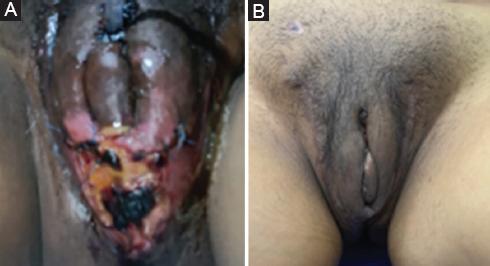
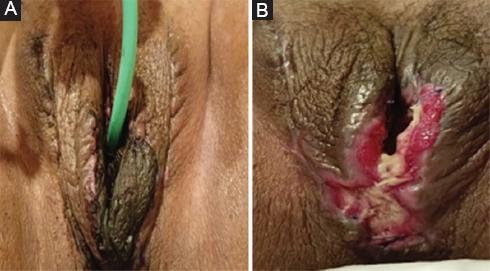
Of the 22 patients operated on, intra-operative complications were found as intraoperative bleeding in only one patient, secondary to a sacral bleeding >500cc, indication for transfusion by the anesthesiology service. As for immediate complications, the most common was alterations in healing and tissue integration, being necrosis of the vaginal segment, the others were: hematoma, wound dehiscence, abscess, wound infection, and edema (Figs. 1 and 2). Finally, the late complications presented were: vaginal prolapse secondary to severe edema and partial stenosis of meatal urethral stenosis.
Discussion
Minor wound healing problems are commonly reported after vaginoplasty (range 3.3%-33%), and many resolve without surgical intervention. Wound dehiscence, especially in areas of increased tissue tension (i.e., introitus and labia majora), most commonly occurs within the 1st month after surgery4,5. In the observed results, most of the complications observed were of the immediate type the most common, with impaired healing as well as the presence of partial necrosis of vaginal tissue, Ferrando reported that of the 17% of her patients (n = 76 patients) who experienced complications, more than 50% of these complications involved wound dehiscence or wound separation. Most studies consistently report that post-operative wound dehiscence is treated with local wound care and does not require surgical intervention6,7.
Tissue loss may be associated with wound dehiscence and occurs most frequently at points of maximal tissue tension, such as the vaginal introitus. Minor tissue necrosis (i.e., resolved without reoperation under general anesthesia) representing the highest incidence reported in some studies8,9. Minor cases of tissue necrosis can often be treated with local wound care, whereas more significant tissue loss may require surgical debridement. The most common major complication (17%) was tissue necrosis along the lower edge of the wound. García MM et al. reported that of the patients requiring reoperation, 25% were related to tissue necrosis10,11.
Pre-operative patient optimization (smoking cessation, control of diabetes, and cardiopulmonary status) is important, as these concomitant conditions may be independent predictors of post-operative tissue necrosis.
Conclusion
Complications arising from surgery are defined as an unexpected or undesired outcome of surgical treatment that causes, in addition to a difficult situation for the surgeon, a lengthening of the hospital stay, vary in severity and some can be easily treated with conservative management strategies and/or small revision surgeries, whereas other events are considered true complications and require and/or surgery to treat the problem.
Foreskin inversion vaginoplasty is the most widely used and safest technique worldwide, above colovaginoplasty and peritoneal vaginoplasty techniques, and fortunately serious complications are rare. In our report, tissue alterations were the common ones and that is secondary alteration of vascular integration and devascularization factors during the dissection.

