




 nueva página del texto (beta)
 Inglés (pdf)
 Artículo en XML
 Referencias del artículo
 Traducción automática
 Enviar artículo por email
 Citado por SciELO
  Similares en
SciELO
Similares en
SciELO 
 Permalink

Introduction
In Mexico, 120 128 t days-1 of municipal solid waste (MSW) were generated in 2020. The state of Veracruz generated 6.5% of this waste, ranking fourth nationwide (SEMARNAT 2020). Xalapa is the second municipality of the state with the highest generation of MSW, which is approximately 440 t days-1 (INEGI 2021). According to Mexico’s Secretariat of Environment and Natural Resources (SEMARNAT), organic solid waste (OSW) makes up approximately 46.4% of this waste, indicating significant potential for its separation and management (SEMARNAT 2020). However, approximately 90% of the MSW generated in Xalapa is deposited in the El Tronconal sanitary landfill, while only 10%, which is basically organic waste, is sent to a composting plant (H. Ayuntamiento de Xalapa 2020).
Organic waste represents a highly biodegradable fraction that, when inadequately managed, can cause severe environmental and sanitary problems (Kaza et al. 2018). Composting is a widely recommended technology for OSW stabilization due to its relatively low cost and capacity to reduce waste volume by 33 to 50% (Roy et al. 2018, INEGI 2021, Esteban and Quesada 2022). However, composting centers face sanitary challenges such as soil and water contamination caused by leachate generation, the presence of vectors, emission of gases such as methane, sulfuric acid, or ammonia, and worker exposure to pathogenic microorganisms, among others (Oviedo-Ocaña et al. 2023, González et al. 2024, Obiols 2004). The proper disposal of OSW poses a difficult challenge, and thus data collection efforts in this sector may contribute to the improvement of management and treatment strategies in order to reduce the negative impact on the environment and human health. Information provided by the INEGI indicates that only three municipalities of Veracruz, namely Coatzacoalcos in 2012, Coyutla in 2021, and Xalapa in 2019, have carried out studies to analyze the composition of their MSW (INEGI 2021). This reveals a lack of knowledge about the composition of MSW in the entire state of Veracruz, which hinders the design of specific management strategies and limits policy development for integrated waste management at the state level.
In this sense, the state of Veracruz, with its 212 municipalities, faces the challenge of approaching waste management in an integrated manner, and the lack of information on the composition of MSW represents a significant limitation in this process. Considering the above, the objective of the present study was to determine the amount, volumetric weight, and composition of the OSW received by the CC of Xalapa, as well as to measure some physicochemical parameters of the leachates generated during the composting process.
Materials and methods
Location of the study area
The Composting Center of the city of Xalapa, Veracruz is located next to the city’s wholesale market (19°31’1’’N, 96°51’16’’W), at an altitude of 1 140 masl, and occupies a surface area of approximately 3 000 m2 (Figure 1).
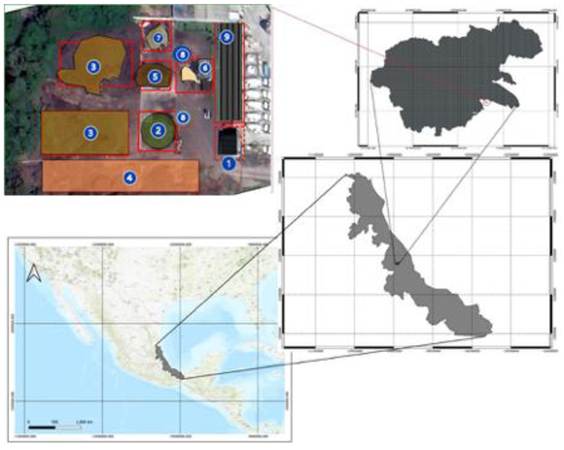
Figure 1 Geographic location and spatial distribution of the functional areas within the municipal composting center of the city of Xalapa, Veracruz. The top-left panel shows a satellite image of the facility, with numbered blue circles (1-9) indicating key operational zones: 1. Security booth and stockroom; 2. OSW arrival area; 3. Composting piles in the initial phase; 4. Storage area of organic waste from parks and gardens; 5. Composting pile in the final phase; 6. Sieving area; 7. Storage of sieved compost; 8. Leachate storage tank; and 9. Vermicomposting beds.
Sampling
Sampling was conducted during the spring-summer period of 2023 and consisted of 21 periodic visits to the CC, the first of which were exploratory, while the remaining 10 involved the collection of OSW samples. During this period, the number and type of waste collection vehicles entering the CC were recorded. The make and model of each vehicle type were documented to estimate their cargo capacity and volume. Random sampling was conducted five days a week, from Monday to Friday. Saturday and Sunday were not included in the sampling due to the low level of activity at the CC. All samples were obtained immediately after the collection trucks were unloaded at the reception area. Samples were obtained from three equidistant points (top, middle, and bottom) within the pile or mound of unloaded waste until reaching approximately 100 kg per day. The waste was analyzed daily to prevent its degradation and avoid disturbances in the classification of its components. Leachate samples were also collected periodically to determine, at least in triplicate, the following parameters in the laboratory using standardized methods: pH, COD, total solids (TS), volatile suspended solids (VSS), nitrite (NO2 -), nitrate (NO3 -), and ammonium (NH4 +).
Determination of volumetric weight
To determine the volumetric weight and composition of the OSW, a collection vehicle was selected randomly and, after it was unloaded, an analysis was performed following the method established in the Standard NMX-AA-015-1985 (SECOFI 1985a). Subsequently, volumetric weight was determined according to the Mexican Standard NMX-AA-019-1985 (SECOFI 1985b) volumetric weight “in situ”. The empty container was weighed and then filled with thoroughly homogenized OSW and shaken repeatedly in order to fill all the empty spaces inside. Volumetric weight was calculated with the following equation:
Organic solid waste composition
The composition of the OSW was determined according to the standards NMX-AA-015-1985 (SECOFI 1985a), which refers to the quartering method, and NMX-AA-022-1985 (SECOFI 1985c) for the selection and quantification of components applicable to municipal solid waste. The sample analyzed was taken from the sample of approximately 100 kg obtained from the piles unloaded from the collection vehicles. The sample was placed on a concrete slab, mixed thoroughly with a shovel, and subsequently analyzed. The fraction and percentage by weight of the components were calculated with the following equation:
Analytical methods
Leachates were analyzed to evaluate their potential environmental impact based on key physicochemical indicators [pH, chemical oxygen demand (COD), ammonium (NH4 +), nitrate (NO3 -), and volatile suspended solids (VSS)]. The pH influences solubility, microbial activity, and contaminant mobility. Chemical oxygen demand provides a comprehensive measure of the organic load, including both biodegradable and recalcitrant fractions, and is essential for estimating oxygen demand in receiving bodies. Ammonium and nitrate are highly soluble nitrogen species that contribute to eutrophication and are environmentally regulated due to their toxicity at elevated concentrations. Volatile suspended solids serve as an indicator of particulate organic matter and microbial biomass. Together, these parameters offer a reliable profile of the pollution potential of leachates and aid in the design of appropriate treatment strategies (Renou et al. 2008, Saghi et al. 2024).
Chemical oxygen demand was determined by digestion and subsequent spectrophotometric measurement at 620 nm (NMX-AA-030-SCFI-2001). Ammonium was measured using an ion-selective electrode (Cole-Parmer model K-27503 CA USA). Nitrate was measured by the salicylic acid method (Robarge et al. 1983) using spectrophotometry at 410 nm (Shimadzu model UV-1280, Japan). Multi-range calibration curves, with a minimum correlation coefficient of 0.99, were constructed for all analytes measured by spectrophotometry or electrode. Detection and quantification limits were taken from the method documentation or manufacturer specifications. Blanks, duplicates, and periodic verifications were included as part of analytical quality control, using certified reference materials. The pH was measured using a potentiometer (Thermo Scientific Orion VSTAR90, Connecticut, USA). Total solids (TS), fixed suspended solids (FSS), and volatile suspended solids (VSS) were determined according to the Mexican Standard NMX-AA-034-SCFI-2015 (SCFI 2016).
Results
The CC has an access control system for logging vehicle entries (Figure 1, number 1), which includes a security booth, restrooms, and a stockroom that stores work equipment (wheelbarrows, rakes, brooms, shovels, pitchforks, buckets, and other tools). The CC receives waste from markets, parks, and gardens six days a week (Monday to Saturday). Even though the official operating hours are from 8:00 to 16:00, vehicles were regularly permitted entry beyond these hours.
Market waste is unloaded on a receiving plate called “Area 2”, while waste from parks and gardens is transported separately and unloaded onto the ground in area “Area 4” (Figure 1). A backhoe is used to mix the waste from Area 2 with that from Area 4 to create an initial composting pile, which is kept in Area 2. After 30 days, the composting pile is transferred to Area 3, where it remains for approximately 60 days, during which it is mixed biweekly to provide aeration. The composted material is then moved to Area 5, where CC personnel manually remove non-compostable items such as plastics, threads, bags, and bottles, among others. The obtained product is transferred to Area 6, where it is sieved, and finally transferred to the storage area (Area 7). The final product, or compost, is delivered to the local forest nursery or donated to local farmers who sell their products at the wholesale market and use the compost as organic fertilizer for their crops.
The mean number of vehicles that entered the CC during the evaluation period was 6 ± 2 units per day. Figure 2 shows the type or model of the collection vehicles that entered the CC, where 29.9% corresponded to 3.5 t trucks, which had the highest frequency, followed by compactor trucks (28.2%). Based on the technical information of the cargo capacity of the vehicles, 65.4% of the residues was estimated to be collected by compactor trucks, followed by dump trucks (17.3%) (Figure 2).
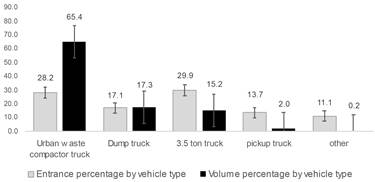
Figure 2 Percentage of vehicle entries and corresponding waste volume contribution by vehicle type at the municipal composting center. *Other includes boxes, drums, small containers
The volumetric weight of the OSW per sampling day is shown in Table 1, where the mean value was 676.8 ± 62.2 kg m-3. Considering these values and the cargo capacity of the vehicles, the estimated mean quantity of waste entering the CC was 26.4 ± 8.6 t days-1. Considering this amount and based on standard NMX-AA-180-SCFI-2018 (SCFI 2018), which establishes categories for composting centers based on their organic waste reception capacity, it was found that the CC in the city of Xalapa belongs to category B (Table 2).
Table 1 Volumetric weight of the organic waste received at the composting center of the city of Xalapa, Veracruz per weekday (Monday to Friday).
| Days | Mean | |||||
|---|---|---|---|---|---|---|
| 1 | 2 | 3 | 4 | 5 | ||
| Volumetric weight (kg m-3) | 761.5 ( 24.6 | 678.0 ( 1.9 | 595.4 ( 24.6 | 645.5 ( 67.6 | 703.6 ( 20.3 | 676.8 ( 62.2 |
| Quantity received (t day-1) | 34.8 ( 2.5 | 19.9 ( 1 | 24.1 ( 0.3 | 17.0 ( 0.7 | 35.9 ( 2.5 | 26.4 ( 8.6 |
Table 2 Categories of composting centers according to their waste reception capacity.
| Category | Reception of waste from the OFMSW (t d-1) |
|---|---|
| A | Over 100 |
| B | Over 10 and up to 100 |
| C | Over 1 and up to 10 |
| D | Less than or equal to 1 |
OFMSW: Organic fraction of municipal solid waste. Source: NMX-AA-180-SCFI-2018
Table 3 shows the classification and percentage of OSW received at the CC, where 95% corresponded to food waste, 1.9% to plant fiber, and the remaining 3% was classified as cardboard, plastic, construction, and metal waste. The predominance of readily biodegradable organic waste suggests high composting potential but also indicates the need for stricter controls to prevent odor generation and proper leachate management.
Table 3 Percentages, based on weight, of the components of the organic waste received at the composting center of the city of Xalapa, Veracruz.
| 1 | 2 | 3 | 4 | 5 | Mean | |||
|---|---|---|---|---|---|---|---|---|
| Type of waste [%] | Organic | Food | 90.4 ( 1.6 | 96.7 ( 1.6 | 94.4 ( 0.6 | 97.7 ( 0.7 | 96.3 ( 1.1 | 95.1 ( 2.9 |
| Hard plant fiber | 6.8 ( 1.7 | 0.9 ( 1.7 | 0 ( 0 | 0.3 ( 0.4 | 1.6 ( 0.1 | 1.9 ( 2.8 | ||
| Gardening | 0.3 ( 0.1 | 0 ( 0 | 1.2 ( 0.7 | 0 ( 0 | 0 ( 0 | 0.3 ( 0.1 | ||
| Inorganic | Cardboard | 1.2 ( 0.7 | 0.1 ( 0.6 | 3.4 ( 1.3 | 1.2 ( 0.7 | 0.2 ( 0.1 | 1.2 ( 1.3 | |
| Metal | 0.01 ( 0 | 0 ( 0 | 0 ( 0 | 0.4 ( 0.3 | 0 ( 0 | 0.1 ( 0.2 | ||
| Construction | 0.4 ( 0.1 | 0 ( 0 | 0.5 ( 0.1 | 0 ( 0 | 0 ( 0 | 0.1 ( 0.2 | ||
| Plastic | 0.7 ( 0.8 | 2.1 ( 0.7 | 0.3 ( | 0.1 ( 1.3 | 1.8 ( 0.4 | 1.0 ( 0.8 | ||
Table 4 shows the results of the physicochemical characterization of the leachates. The concentration of COD varied between 61 825 and 75 081 mg L-1, which represents a high load of organic matter. The pH showed acidic values of approximately 4.2. Ammonium showed values in the range of 495 to 1 620 mg L-1, while nitrite and nitrate were not detected with the methods used. Overall, these results highlight the need to improve aspects related to the operation of the system in order to reduce environmental risk and comply with current regulations.
Table 4 Physicochemical properties of leachates derived from organic solid waste processed at the municipal composting center of Xalapa, Veracruz.
| M1 | M2 | M3 | |
|---|---|---|---|
| COD | 61825.05 ± 485 | 70567.8 ± 201 | 75081.75 ± 325 |
| pH | 4.25 ± 0.2 | 4.2 ± 0.4 | 4.15 ± 0.2 |
| NH4 + | 495.05 ± 22 | 506.3 ± 64 | 1620 ± 183 |
| NO3 - | ND | ND | ND |
| VSS | 49174 ± 1125 | 49766 ± 939 | 36640 ± 1909 |
M1, M2, M3 are samples from different days. All values are in mg L-1 except for the pH. ND = not detectable
Discussion
The results of the amount of organic waste that entered the CC of Xalapa showed variations between days of the week (Table 1). Monday and Friday were the days with the highest amount of collected waste, 34.8 and 35.9 t, respectively. The amount recorded on Mondays may be due to the accumulation of waste during the weekend, while the amount on Fridays may be related to the accumulation of waste during the week and people preparing for different leisure activities for the weekend. These values are in agreement with Raya-Cruz et al. (2022), who studied waste generation at a market in Mexico City and also found that Monday and Friday were the days with the highest waste production. Recognizing these patterns is essential for optimizing collection logistics, avoiding operational overload, and aligning labor and equipment schedules with peak delivery days.
The estimated amount of OSW received per year at the CC was 9 668.1 t (26.4 t days-1). Thus, the CC is officially classified as a type “B” facility based on the NMX-AA-180-SCFI-2018 standard. However, verbal statements by municipal authorities indicate that between 20 and 50 tons are received daily, suggesting a wide variability in operation. This discrepancy highlights the need to improve the CC´s record-keeping systems through systematic monitoring of the origin, cargo capacity, volume, and entry and exit times of all vehicles. A more robust control would help optimize operations.
At present, few composting and organic solid waste treatment plants exist in Mexico, or at least there is limited information about them. Their processing capacity ranges from small plants, of 0.5 t, to the largest in the country, of 1 300 t days1, which is the Bordo Poniente Plant in Mexico City (SEMARNAT 2020). Sánchez-Velasco et al. (2016) reported records of seven composting plants in Mexico City: Bordo Poniente, San Juan de Aragón, Álvaro Obregón, Cuajimalpa, Iztapalapa, Milpa Alta, and Xochimilco. The latter six have a combined collection capacity (9 140 t year) similar to that of the plant of Xalapa, and they surpass it during peak seasons. According to the records of the Basic Diagnosis for Integrated Waste Management (DBGIR) (SEMARNAT 2020), the plant of Xalapa would rank as the seventh largest in Mexico, and thus an adequate management of its operations is fundamental.
The city of Xalapa generates 160 600 t of MSW per year (INEGI 2021), with approximately 74 550 t (46.42%) estimated to be organic waste (SEMARNAT 2020). Based on this amount, it would be possible to determine the number of collection vehicles necessary to collect 100% of this organic waste. According to the DBGIR, the state of Veracruz reported 457 collection vehicles in 2020, 71% of which corresponded to compactor trucks, 25% to open-top vehicles, and 4% to other vehicles. Based on this information, it can be estimated, for example, that collecting the amount of organic waste generated in Xalapa would require approximately 16 runs per day with 16 m3 compactor trucks, 6 runs with 7 m3 open-top vehicles, and 1 run with 3.5 t vehicles. On the other hand, if we consider keeping the same proportion of vehicles that currently enter the CC (Figure 2), 14 runs per day would be required with 3.5 t trucks, 13 with compactor trucks, and 7 with open-top vehicles. Both examples would satisfy the current demand. However, the use of higher-capacity vehicles is justified by their operational efficiency, as they reduce the number of daily runs, personnel requirements, and resource consumption. The results therefore favor optimizing logistics by prioritizing these types of vehicles, which also contributes to lowering operational costs and emissions. This approach appears more optimal and provides valuable input for planning future investments in municipal waste collection fleets.
The CC currently occupies an area of 3 000 m2, which includes compost storage piles, leachate collection pits, offices, and vermicomposting bins, among other areas. The OSW piles in the CC are approximately 10 m long, 8 m wide, and 3 m high. Considering the volumetric weight value determined in the present study and that the city of Xalapa produces 74 550 t of organic waste per year (SEMARNAT 2020), it is possible to calculate an approximate volume of 300.5 m3 day-1 of organic waste generated in the entire city. Thus, in order to treat these volumes, it is necessary to increase the area of the CC to 6 000 m2 to increase the number of storage piles.
The quantification of the OSW components indicated a high percentage of organic matter, which is higher than that reported in other studies (Aguilar et al. 2010, Saldaña-Duran et al. 2013, Araiza-Aguilar et al. 2017, Bernal 2017). However, it is important to emphasize that those studies considered total MSW without prior separation, whereas the present study focused exclusively on source-separated organic waste. This key methodological distinction likely accounts for the observed differences in composition, particularly in the organic fraction. By analyzing only the organic waste stream, this study provides a more accurate profile of the materials received at the composting facility, highlighting the potential for targeted treatment and improved compost quality. A more similar study was conducted by Buenrostro et al. (1999), who reported 80% of organic waste coming from municipal markets in the city of Morelia, Mexico, although the study did not include a formal process of separation and collection of organic waste. Raya-Cruz et al. (2022) analyzed the composition of waste from a market in the north of the state of Veracruz and also obtained values of approximately 80% OSW.
Quantifying the components of organic waste provides information about the composition of the materials used to make compost. In the present study, 3% of the waste corresponded to plastic materials. It is important to note that large and medium plastic fragments are removed at the beginning of the process; however, smaller fragments remain in the system. The use of compost from this source in agricultural production processes may contribute to the accumulation of microplastics in the soil (Kumar 2020). Therefore, one of the recommended improvement strategies is to increase the separation effort in order to reduce the presence of inorganic materials, such as plastic, in the waste that enters the composting plant. In Mexico, the standard NMX-AA-180-SCFI-2018 establishes maximum allowable values of plastic impurities in the final product of the composting process that range between completely absent to a maximum of 1% plastic.
With respect to the physicochemical characteristics of composting leachates, different parameters used have shown high concentrations of nitrogen, organic matter, electric conductivity, and COD concentrations of up to 116 000 mg L-1 (Roy et al. 2018, Sall et al. 2019). In the present study, the leachates generated showed COD concentrations between 61 825 and 75 081 mg L-1. There are currently no regulations or allowable limits for the discharge of leachates from MSW. NOM-001-SEMARNAT-2021 is a related official standard on wastewater that, for example, specifies that the maximum allowable value of COD discharge in any reception site (including bodies of water and soil) is 210 mg L-1. The values observed in this study far exceed what is established in this standard. Ammonium concentration showed values of up to 495 mg L-1, which are very similar to those reported by Sall et al. (2019) of 491 ± 137 mg L-1 , and also exceed the maximum allowable limit of 35 mg L-1 of total nitrogen (the sum of the concentrations of ammoniacal and organic nitrogen, nitrites, and nitrates) in any reception site, also established by the NOM-001. The pH was approximately 4, which is also outside the values allowed by the standard NOM-001 (of 6-9). The elevated concentrations of chemical oxygen demand and ammonium found in the leachates reflect high organic and nitrogen loads, which may pose environmental risks if these effluents reach surface water bodies or infiltrate into the subsurface without prior treatment. Such loads can result in eutrophication, excessive depletion of dissolved oxygen, and toxicity to aquatic organisms (Kjeldsen et al. 2002). Leachates with high COD and ammonium concentrations, in addition to alkalinity, make direct biological treatment difficult. Therefore, systems coupled with physicochemical processes have been proposed, including the use of constructed wetlands, zeolites, and biochar (Luo et al. 2020). Another strategy has been the biological treatment (nitrification-denitrification) of dilute leachates, where the initial concentrations of ammonium and COD are reduced to values around 90 mgN/L and 5 500 mg/L, respectively, achieving removal efficiencies of up to 90% (Martínez-Jardines et al. 2024).
Beyond operational considerations, composting represents a strategic opportunity to reduce landfill pressure, mitigate greenhouse gas emissions, and recover organic matter. According to the IPCC (2022), these benefits make composting an environmentally favorable alternative. However, to realize its full potential, robust data on waste flows, material composition, and process conditions are required.
Gathering data on the generation and composition of solid waste is fundamental for optimizing the resources, space, or equipment necessary for its treatment and management. The efficient operation of a composting center requires a clear understanding of the nature of the materials involved, the quantities entering the system, and the key physical parameters of the process. The use of a high proportion of low-capacity vehicles (e.g., 3.5 t trucks) further results in more frequent trips and higher resource consumption compared to logistics optimized with compactors or larger trucks. These issues suggest a reactive operational model and underscore the need to implement performance indicators, such as compost yield per ton of input, space utilization efficiency, and average processing time per batch, as tools for guiding improvements in overall system efficiency. To the best of our knowledge, based on the existing literature, the present study provides a preliminary assessment of the quantities and types of materials that enter the composting center of the city of Xalapa, Veracruz.
Conclusions
This exploratory study characterized the operational dynamics, waste composition, and leachate quality at the CC of Xalapa, which manages a mean quantity of 26.4 t of organic waste, with the entrance of 6 collection vehicles per day. Based on this volume of waste, the CC is classified as type B and is one of the largest recorded in Mexico, with a similar capacity to that of other centers established in large cities such as Mexico City, and plays a crucial role in reducing the amount of waste sent to the sanitary landfill. The waste that entered the CC consisted of 97% organic waste, and the rest corresponded to inorganic waste. This finding highlights the need to improve separation efforts to prevent the presence of inorganic material. The leachates generated showed COD concentrations higher than 61 825 mg L-1 and ammonium concentrations higher than 495 mg L-1, which indicates the need for a preliminary treatment prior to disposal in order to comply with Mexican and international standards. The results obtained on the characterization of the OSW and leachates from the CC will contribute to more efficient composting processes, a reduced environmental impact, and an improved management of the MSW of Xalapa. This study provides evidence-based insights that may support the development of local public policies focused on improving composting infrastructure and monitoring systems. Implementing standardized tracking of vehicle entries, periodic leachate quality assessments, and stronger source separation protocols are measures that could enhance operational efficiency and environmental compliance. These findings may also serve as a reference for designing municipal composting strategies in other medium-sized cities, promoting the replication of successful practices and addressing gaps in the regulatory framework for organic waste management in Mexico.

