




 nueva página del texto (beta)
 Inglés (pdf)
 Artículo en XML
 Referencias del artículo
 Traducción automática
 Enviar artículo por email
 Citado por SciELO
  Similares en
SciELO
Similares en
SciELO 
 Permalink

As currently delimited, the genus Prosthechea Knowles & Westc. encompasses approximately 120 species distributed from Mexico and the southeastern United States (Florida) through Central America and the Antilles south to Bolivia and Brazil (Higgins 2005, POWO 2024). Prosthechea belongs to the Neotropical subtribe Laeliinae, and historically most of its species have been considered as members of the genera Epidendrum L., Encyclia Hook., or various segregates including Hormidium Lindl. ex Heynh. (Brieger 1977), Anacheilium Rchb. ex Hoffmanns. (Pabst et al. 1981), Euchile (Dressler & G.E.Pollard) Withner (Withner 1998), Pseudencyclia Chiron & V.P.Castro (Chiron & Castro Neto 2003), Panarica Withner & P.A.Harding, and Pollardia Withner & P.A.Harding (Withner & Harding 2004). Higgins (1998) resurrected and re-delimited Prosthechea based on a phylogenetic analysis of morphological characters, and his subsequent analysis of combined nuclear (nrITS) and plastid (trnL-F and matK) DNA sequences further supported his approach (Higgins 2000). A recent phylogenetic analysis of one nuclear (nrITS) and three plastid markers (rpl32-trnL, trnD-trnT, ycf1) that included about two-thirds (80) of the known species of the genus confirmed the monophyly of Prosthechea sensu Higgins (1998), revealed the non-monophyly of Anacheilium, Pollardia, and Pseudencyclia, and uncovered recurrent homoplasy in various morphological characters used previously to delimit genera, on which basis its authors made a case for recognizing only one genus (i.e., Prosthechea; Vieira et al. 2024; see also Pupulin 2004).
Together, Mexico and Central America represent one of the three main centers of diversity for Prosthechea, the other two being the tropical Andes and the Atlantic Rainforest region of Brazil (Vieira et al. 2024). Forty-seven species have been recorded in Mexico (Solano et al. 2019) and, overall, the Mexican species have been well-known since Dressler & Pollard (1976) revised them (as members of Encyclia subgenus Osmophytum [Lindl.] Dressler & G.E.Pollard), with a few subsequent taxonomic clarifications and transfers (e.g., Hágsater 1982, Higgins 2004, Soto 2008, Karremans 2009).
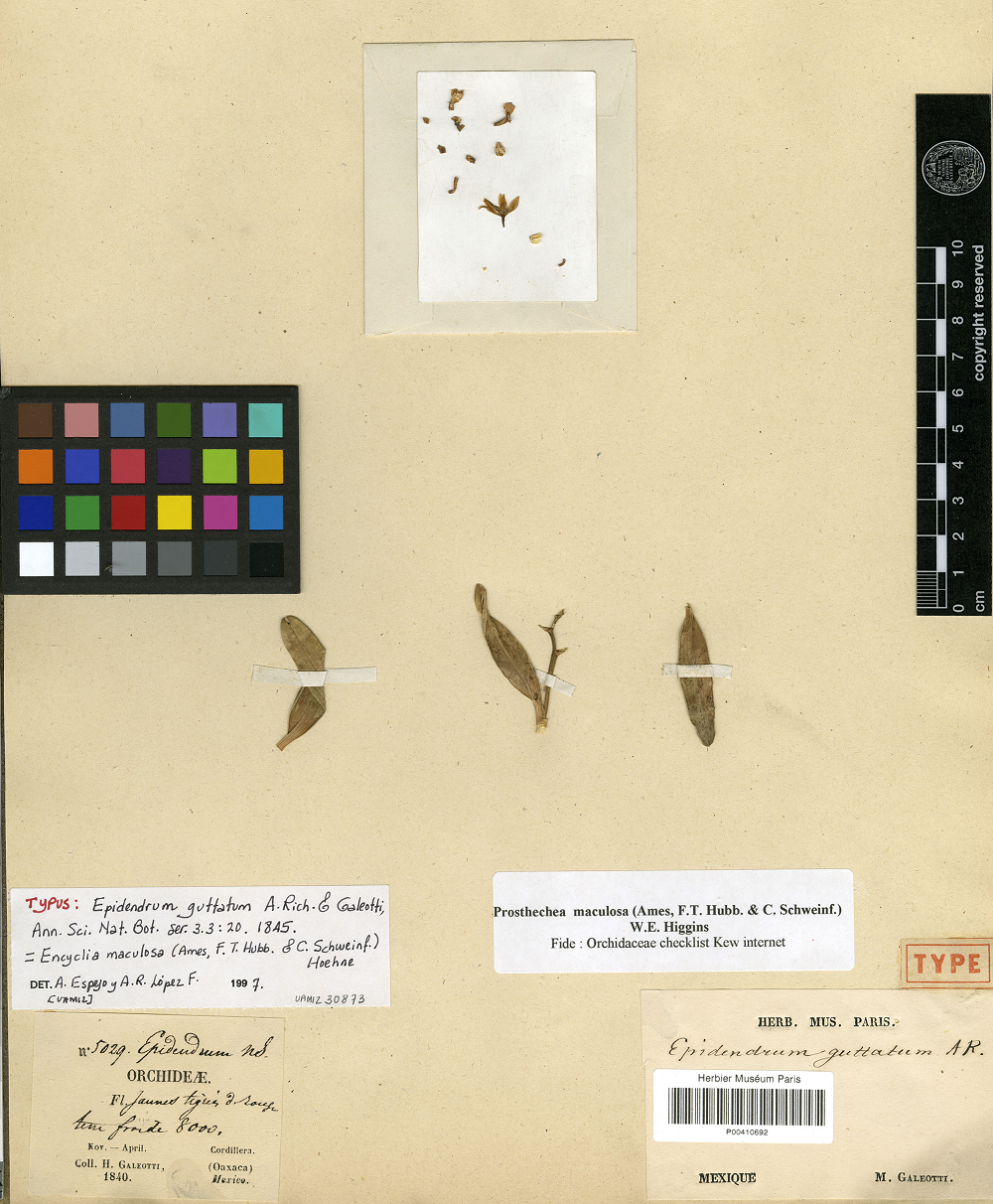
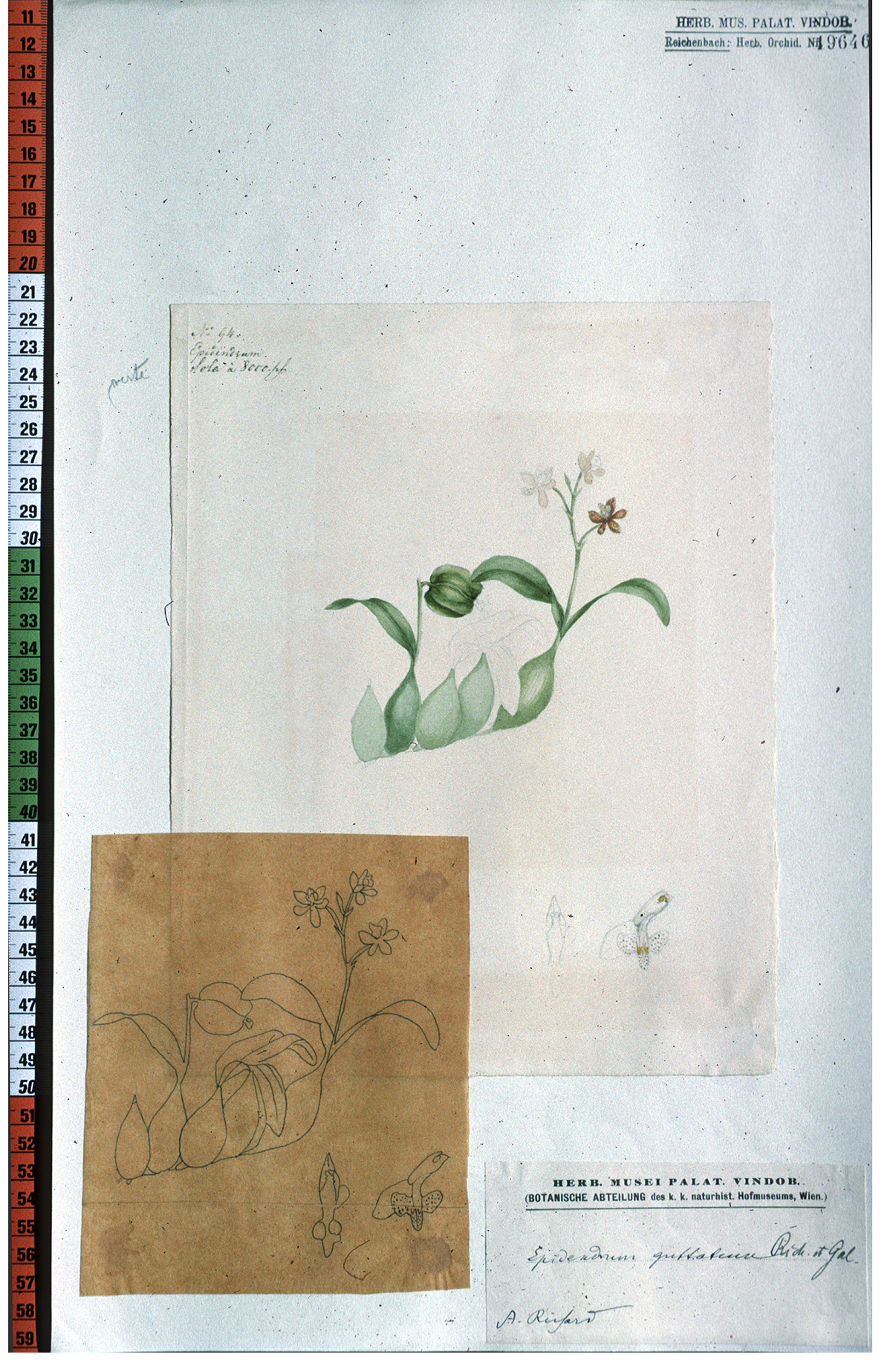
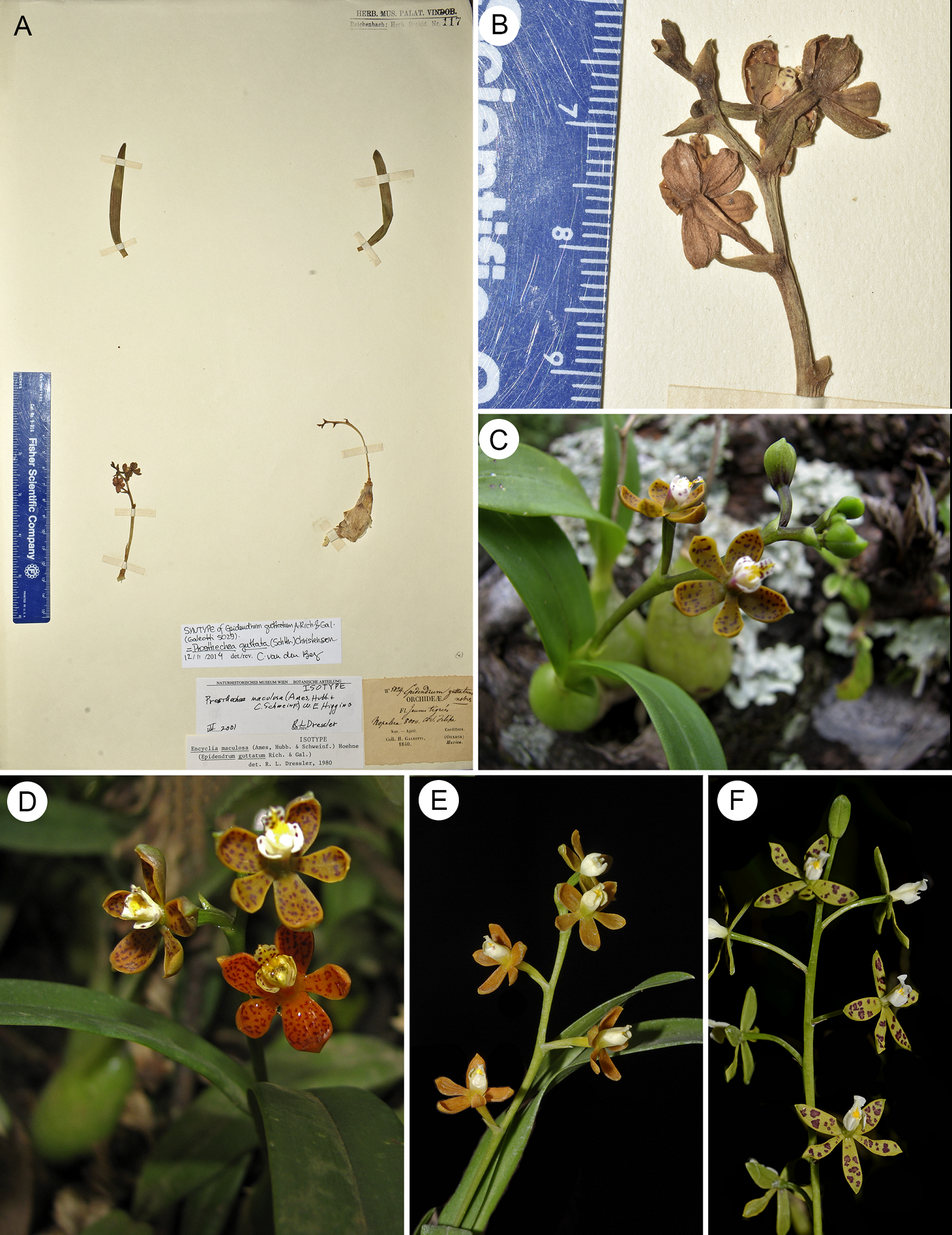
During routine determination of specimens of Orchidaceae received at Mexico’s National Herbarium (MEXU), one of the authors (GAS) noted several recent collections from the Sierra Madre del Sur in the state of Oaxaca, Mexico, which, although obviously belonging to Prosthechea, did not match any of the species recorded for this country in recent literature. Such plants were similar in overall floral morphology to P. ochracea (Lindl.) W.E.Higgins, but otherwise they were distinctive in the short stature of the plants (up to 12 cm tall), pseudobulbs sometimes densely clustered but in other cases spaced apart along a rhizome, proportionately short leaves, shortly pedunculate, few-[3-10]flowered inflorescence, and orange sepals and petals spotted with wine-red. These features agreed with a collection made by Henri Guillaume Galeotti in Oaxaca, Mexico in 1840 (Galeotti 5029, P!; Figure 1), which was designated as the lectotype of Epidendrum guttatum A.Rich. & Galeotti by Christenson (2003) since it appears to have been the basis for the description of that species by Richard & Galeotti (1845). Our material also matches the isolectotypes in W, one of which consists of a color drawing by Galeotti (Figure 2, 4A-B). Moreover, Galeotti’s material, and the modern collections from Oaxaca mentioned earlier, are amply different from the species that has been called Prosthechea guttata (Schltr.) Christenson, or its synonym P. maculosa (Ames, F.T.Hubb. & C.Schweinf.) W.E.Higgins in recent literature (Dressler & Pollard 1976: 65-67, Withner & Harding 2004: 267-269, Beutelspacher & Moreno 2018: 178). We contend that the last entity represents an undescribed species, and, in the following, we provide descriptions, illustrations, and information on the distribution, habitat, and distinguishing features of both genuine P. guttata and the new species. Their differences from each other and from similar, closely related species are contrasted in a key.
Photograph by Eric Hágsater.
Figure 1 Lectotype of Epidendrum guttatum A.Rich. & Galeotti (P, barcode P00410692, reproduced by courtesy of the Herbarium of the Muséum National d'Histoire Naturelle, Paris, France).
Photograph by Eric Hágsater.
Figure 2 Color drawing by Galeotti of Epidendrum guttatum A.Rich. & Galeotti (W-R catalogue No. 19646, reproduced by courtesy of the Herbarium of the Naturhistorisches Museum Wien, Vienna, Austria).
Materials and methods
We examined and photographed the type specimens of Epidendrum guttatum A.Rich. & Galeotti housed at P and W, and revised the scarce literature relevant to that species, including its protologue (Richard & Galeotti 1845) and an earlier publication by its authors in which E. guttatum was mentioned but not formally described (Richard & Galeotti 1844). Additionally, we studied live flowering plants of the new species in the field in the Mexican states of Oaxaca and Chiapas, and examined dried specimens, flowers preserved in alcohol, illustrations, and photographic records from Mexican and Guatemalan plants. The herbaria consulted where we found material and/or digital images relevant to the species dealt with here were AMES, AMO, CAS, CHIP, MEXU, MO, NY, P, SEL, SERO, UC, UVAL, and W (acronyms according to Thiers continuously updated). Flowers from herbarium specimens were softened in hot water prior to examination and measurement. For descriptive terminology we followed Dressler & Pollard (1976). All the material studied is available in public repositories and herbaria, and no additional collecting requiring permits was conducted.
The conservation status of the two species dealt with here was assessed using the IUCN Red List Categories and Criteria version 3.1 (IUCN 2012; IUCN Standards and Petitions Committee 2024). The estimation of the extent of occurrence and the area of occupancy was carried out with GeoCAT (available at geocat.iucnredlist.org; Bachman et al. 2011), with a cell width of 2 km. The distribution map was generated with ArcGIS Desktop 10.8.1 (ESRI 2020). Image processing was done with Adobe Photoshop 25.12.0. (Adobe 2024).
Prosthechea guttata (Schltr.) Christenson, Richardiana 3(3): 116. 2003. (Fig. 1-3, 4A-D). Encyclia guttata Schltr., Beih. Bot. Centralbl. 36(2): 472. 1918, nom. nov. for Epidendrum guttatum A. Rich. & Galeotti, non L. 1753. Epidendrum guttatum A.Rich. & Galeotti, Comptes Rend. Acad. Sci. Par. 18: 509, 510, 512. 1844, nom. nud. Epidendrum guttatum A.Rich. & Galeotti, Ann. Sci. Nat., Bot., sér. 3, 3: 20.1845, nom. illeg., non L. 1753. Hormidium guttatum (A.Rich. & Galeotti) Brieger, Orchideen 9(33-36): 573. 1977. Epidendrum maculosumAmes, F.T.Hubb. & C.Schweinf., Bot. Mus. Leafl., Harvard Univ. 3: 72. 1935; intended as a nom. nov. for Epidendrum guttatum A.Rich. & Galeotti. Encyclia maculosa (Ames, F.T.Hubb. & C.Schweinf.) Hoehne, Arq. Bot. Estado São Paulo, n.s., f.m., 2: 152. 1952. Prosthechea maculosa (Ames, F.T.Hubb. & C.Schweinf.) W.E.Higgins, Phytologia 82(5): 379. 1997 [published 1998].
Type. No specimen was indicated in the protologue. Lectotype (designated by Christenson 2003). Mexico, “Cordillera (Oaxaca), chénes de terre froide, 8000 [pieds], Fl.[eurs] jaunes tigrées d´rouge, Nov.-April 1840,” H.G. Galeotti 5029 (P 00410692]; Isolectotypes: G 00168623 [digital image], W-R 117, 17035, 19659).
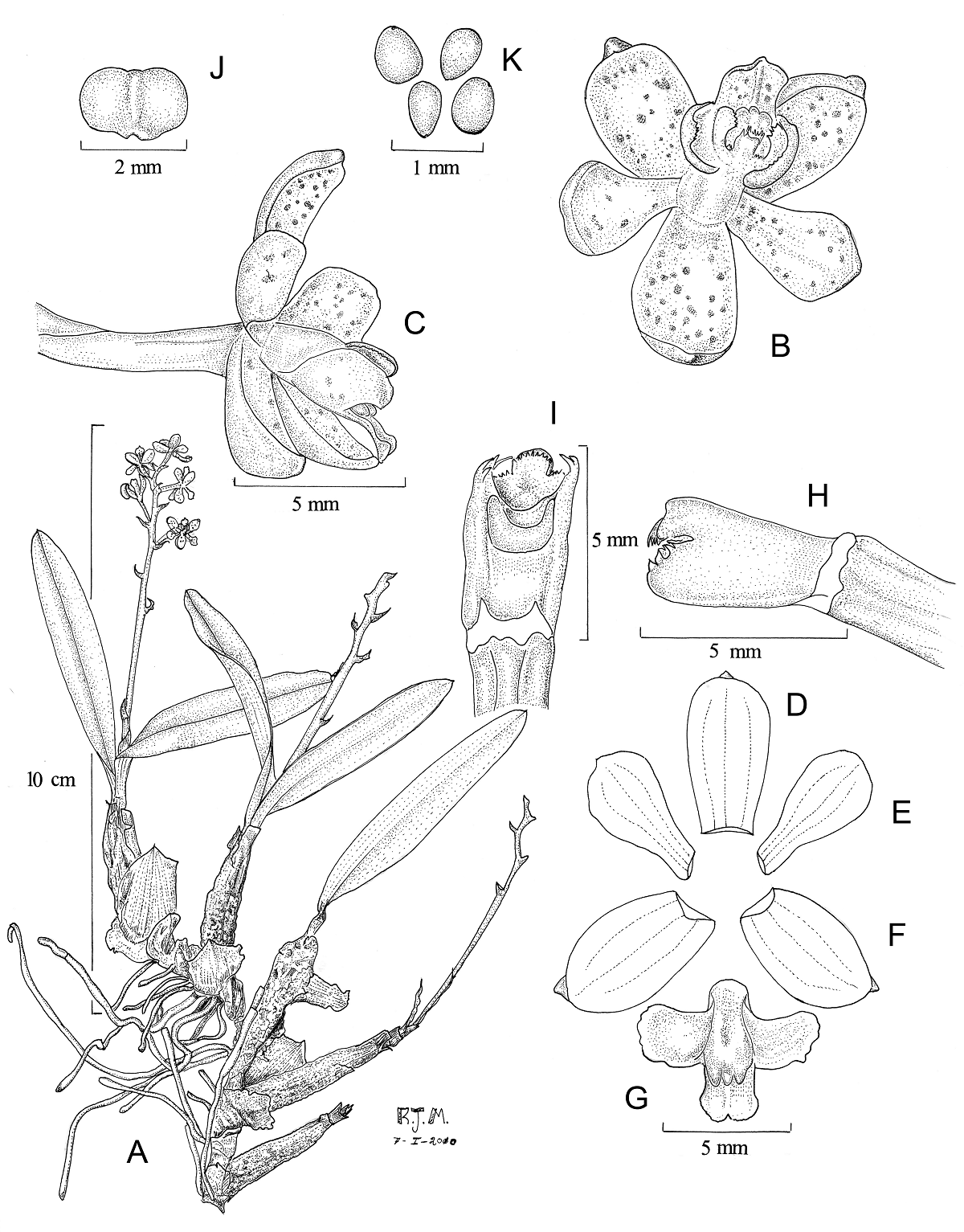
Description. Caespitose to creeping, epiphytic herb 8-12 cm tall including the inflorescence, when creeping forming strings of shoots up to about 40 cm long. Roots produced along the rhizome, white, simple or scarcely branching, terete, 0.8-1.8 mm in diameter. Rhizome covered by grayish to yellow-brown cataphylls, 10-25 mm long between pseudobulbs, 3-4.5 mm in diameter. Pseudobulbs formed by a single main internode, ovoid, pale green, rugose, bifoliate at apex, 17-45 × 7-10 mm (in dried condition), when young nearly completely covered by two yellowish, papery, somewhat translucent, rapidly evanescent sheaths. Leaves narrowly oblong-elliptic, base conduplicate, apex asymmetrically obtuse-rounded to acute, sometimes with a translucent apicule, 45-85 × 7-14 mm. Inflorescence a terminal raceme 50-85 mm long, often barely exceeding the leaves, producing 3-10 flowers that open in succession, up to three open at a time; peduncle laterally compressed, 25-45 × 1.3-1.4 mm, covered at the base by a yellow or yellow-brown, triangular, acute bract 7-10 mm long; rachis loosely zigzag, more notoriously so towards the apex, with the floral bracts spaced 2-8 mm apart. Floral bracts triangular, conduplicate, acute, scarious, thin, 3-6 mm long. Flowers small for the genus (7-9 mm maximum spread), fleshy, non-resupinate, fragrance not noted by collectors; sepals and petals orangish ochre to greenish-orange upon opening, turning deep orange as the flower ages, all with sparse, irregular wine-red spots on their inner surface, labellum white with sparse wine-red spots and, bright yellow callus, and a yellow band extending from the callus to the apex, column greenish suffused with wine-red below the middle, white apically, anther yellow. Sepals spreading, incurved, concave, with a thickened dorsal keel towards the apex, outer surface smooth, 5.3-5.7 × 3.2 mm; dorsal sepal obovate, rounded, lateral sepals elliptic-obovate, abruptly sub-apiculate. Petals spreading, incurved, concave, obovate-spatulate, broadly obtuse to rounded, 5.4-5.8 × 2.8-3.2 mm. Labellum basally adnate to the ventral surface of the column for ca. 1 mm; free portion sessile, deeply three-lobed, when spread out ca. 4.5 mm total length, ca.7 mm width between the apices of the lateral lobes; lateral lobes embracing the column in natural position, when spread out divaricate, oblong-falcate, their proximal margin (toward the labellum base) entire, their distal margin (toward the midlobe) irregularly crenate, sometimes with a definite triangular tooth near the middle, apex broadly rounded to subtruncate, 2.8-3.0 × 1.4-2.4 mm; midlobe shortly oblong or ovoid, with a longitudinal, warty keel that ends before the apex, the later apiculate, slightly conduplicate, margins undulate, irregularly crenate; callus fleshy and prominent, occupying about – of the total labellum length, shallowly channeled under the column, ending in three distinct teeth, the middle one rounded, the lateral ones uncinate, curving inwards. Column ca. 4 × 2.5 mm, subclavate, subtrigonous, with a dorsal keel, ventrally concave; clinandrium 3-toothed, all teeth lacerate to laciniate, the lateral teeth subquadrate and somewhat concave, the midtooth swollen, obtriangular, trigonous, subtruncate, bearing a ligula resting over the anther, which is less markedly lacerate to laciniate than the lateral teeth. Anther oblate, broadly bidentate at apex, frontally flattened, 4-locular, ca. 1.4 × 2 mm, yellow. Pollinia 4, ovoid, laterally compressed, yellow, with oblong granular caudicles. Rostellum laminar, semicircular with a transversally elliptic viscarium. Stigma broadly U-shaped, concave, ca. 1.4 ×1.7 mm. Ovary subcylindrical, pedicellate, gently tapering toward the base, with three narrow ribs alternating with three low angles, 6-6.5 mm long including the pedicel, ca. 1.3 mm in diameter. Capsule ellipsoid, 3-winged, ca. 15 × 15 mm, with terete pedicel ca. 3 × 1 mm.
Distribution and ecology. Prosthechea guttata is endemic to the Sierra Madre del Sur in the state of Oaxaca, Mexico (Figure 5). Epiphyte on Quercus or litophyte, in Quercus- and Pinus-Quercus forest at 2,100-2,600 m asl.
Conservation status. Least concern (LC). The extent of occurrence and the area of occupancy estimated by GeoCAT are 1,690.4 km2 and 32 km2, respectively, and the species is known to exist in less than 10 locations (eight). However, there is no evidence of severe fragmentation, decline, or fluctuation of its extent of occurrence, area of occupancy, extent or quality of the habitat, number of subpopulations, or number of mature individuals. Hence, based on the available information, the species does not qualify for any IUCN (2012) category of threat (see also IUCN Standards and Petitions Committee 2024: 72).
Phenology. Flowering from July to November. The only capsule recorded so far was portrayed in Galeotti’s color drawing (Figure 2); the date of collection of the original material was indicated as November to April.
Discussion. We agree with Christenson (2003) that the transfer of Epidendrum guttatum A.Rich. & Galeotti to Encyclia by Schlechter should be considered as a new name, not merely as a transfer, in agreement with the Berlin Code, which was in effect at that time (Greuter et al. 1988). Subsequently to Schlechter (1918), Ames et al. (1935) proposed another new name, Epidendrum maculosum Ames, F.T.Hubb. & C.Schweinf., to replace illegitimate E. guttatum A.Rich. & Galeotti (predated by E. guttatum L., now Tolumnia guttata [L.] Nir), but Schlechter’s name has priority.
Nomenclatural matters aside, our study of the original material of E. guttatum A.Rich. & Galeotti and its comparison with modern specimens from the same region of Mexico where it came from (southern Oaxaca) demonstrates that it represents a different species from what recent authors have called Prosthechea guttata (or P. maculosa), which is an undescribed species requiring formal naming (see below). Genuine P. guttata can be distinguished from all other Prosthechea species by the following combination of characters: Short plants (8-12 cm tall); ovoid, attenuate pseudobulbs either closely clustered or spaced apart up to about 2.5 cm along a creeping rhizome; proportionately short, oblong-elliptic leaves; shortly pedunculate inflorescence with laterally compressed peduncle and 3-10-flowered raceme with a loosely zigzag rachis; flowers with sepals and petals orangish ochre upon opening but turning deep orange with age, all with sparse, irregular wine-red dots; and white labellum with prominent deep yellow, three-toothed callus occupying about – of its length, and oblong-falcate lateral lobes embracing the column in natural position but divaricate when spread out (Figure 3, 4B-D).
Photographs by Tiago L. Vieira (A-B), Kenia Velasco (C-D), and Gerardo A. Salazar (E-F).
Figure 3 A. Isolectotype of Epidendrum guttatum A.Rich. & Galeotti (W-R catalogue No. 117, reproduced by courtesy of the Herbarium of the Naturhistorisches Museum Wien, Vienna, Austria). B. Close-up of the inflorescence of the specimen in A. C. Prosthechea guttata in situ on a lichen-covered rock (from Velasco et al. 3038). D. Inflorescence of another plant of P. guttata (from Velasco et al. 2355). E. Inflorescence of Prosthechea ochracea (from Pérez García s.n.). F. Inflorescence of Prosthechea panthera (from Hágsater 12607).
Drawn from Velasco et al. 2379 by R Jiménez-Machorro.
Figure 4 Prosthechea guttata. A. Flowering plant. B. Flower, oblique view from front. C. Flower, side view. D. Dorsal sepal. E. Petals. F. Lateral sepals. G. Labellum. H. Column, side view. I. Column, ventral view after removal of anther and pollinarium. J. Anther. K. Pollinia.
Regarding the geographic origin of Galeotti’s collection of E. guttatum, although the label on the lectotype and isolectotypes does not indicate a specific place but only “Cordillera (Oaxaca)” and “terre froide 8,000 [ft]” (Figure 1, 4A), the color drawing by Galeotti mounted on the herbarium sheet W-R No. 19646 (Figure 2) bears a handwritten annotation on the upper left-hand corner reading “No. 94 Epidendrum Sola à 8,000 pd”, which no doubt refers to Sola de Vega, in the Sierra Madre del Sur in southern Oaxaca (coordinates: 16.514805° N, 96.978239° W). That place was referred to, as “les environs de Sola,” in Richard and Galeotti’s account of the vegetation of “the lower cold subregion” of Mexico (“Sous-région froide inférieure”; Richard & Galeotti 1844: 508). Sola de Vega is on a valley at 1,400 m asl, but Galeotti explored the higher surroundings. In fact, E. guttatum was listed by Richard & Galeotti (1844: 510) among the species that live in “le branche occidentale de la cordiliére de Oaxaca,” which, taking as a reference the dry central valleys of that state, coincides with the portion of the Sierra Madre del Sur where modern records of Prosthechea guttata were collected (Figure 5).
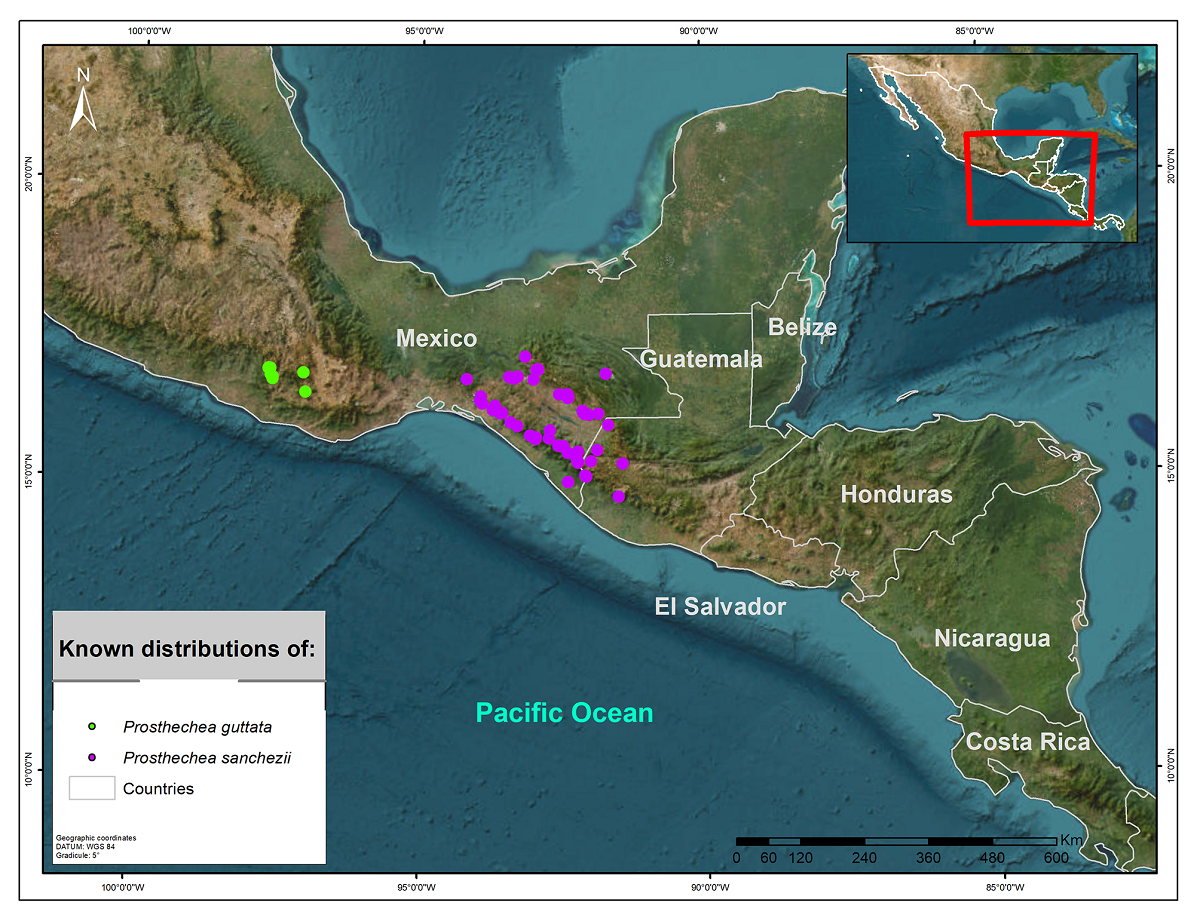
Figure 5 A. Known distributions of Prosthechea guttata (green dots) and P. sanchezii (magenta dots).
Additional Specimens Examined. Mexico, Oaxaca, distrito Putla, municipio [Santa Cruz] Itundujia, Cerro de la Troja, 2,593 m, 28 August 2004, García et al. 127 (MEXU); distrito Putla, municipio Santa Cruz Itundujia, sobre carretera a 1 km en L[ínea]R[ecta] N de Santa Cruz Itundujia, bosque de pino-encino, con Quercus, Pinus oaxacana, 2,366 m, epífita de 15 cm, fl[or]. anaranjada con puntos negros y verde-café, 9 August 2007, Velasco et al. 2355 (MEXU); distrito Putla, municipio Santa Cruz Itundujia, comunidad Buena Vista, paraje Loma de Trigo, 2,437 m, bosque de pino-encino, epífita de 15 cm, flor verde con puntos guindas, labelo blanco con puntos guindas, 5 October 2007, Nava & Garcia 2443 (MEXU); distrito Putla, municipio Santa Cruz Itundujia, La Era, a 2.54 km en L[línea]R[recta] N de Santa Cruz Itundujia, 2,219 m, bosque de pino encino con Pinus oaxacana, P. leiophylla, Rhus, Oreopanax, leguminosas, epífita herbácea de 15 cm, fl[or]. anaranjada-verdosa con puntos negros, 10 October 2007, Velasco et al. 2379 (MEXU); distrito Putla, municipio Santa Cruz Itundujia, camino a Iturbide por El Carrizal, a 2.26 km en L[ínea]R[ecta] (SE) de la agencia de Buena Vista, bosque de encino con asteráceas, leguminosas, Viburnum, 2,381 m, 31 July 2008, Velasco et al. 3038 (MEXU); distrito Putla, municipio Santa Cruz Itundujia, mojonera de ayuntamientos unidos (entre San Andrés Cabecera Nueva y Santa Cruz Itundujia, San Andrés Cabecera Nueva, 2365 m, 16 November 2013, Carrada et al. 211 (MEXU).
Other Records. Mexico, Oaxaca, municipio Zimatlán de Álvarez, San Pedro el Alto, 24 April 2017, observation in iNaturalist by K. Gómez-Salazar (https://www.naturalista.mx/observations/6000420, https://www.naturalista.mx/observations/6000419; accessed 15 August2024).
Prosthechea sanchezii Salazar, R.Jiménez & T.L.Vieira, sp. nov. (Figure 6, 7).
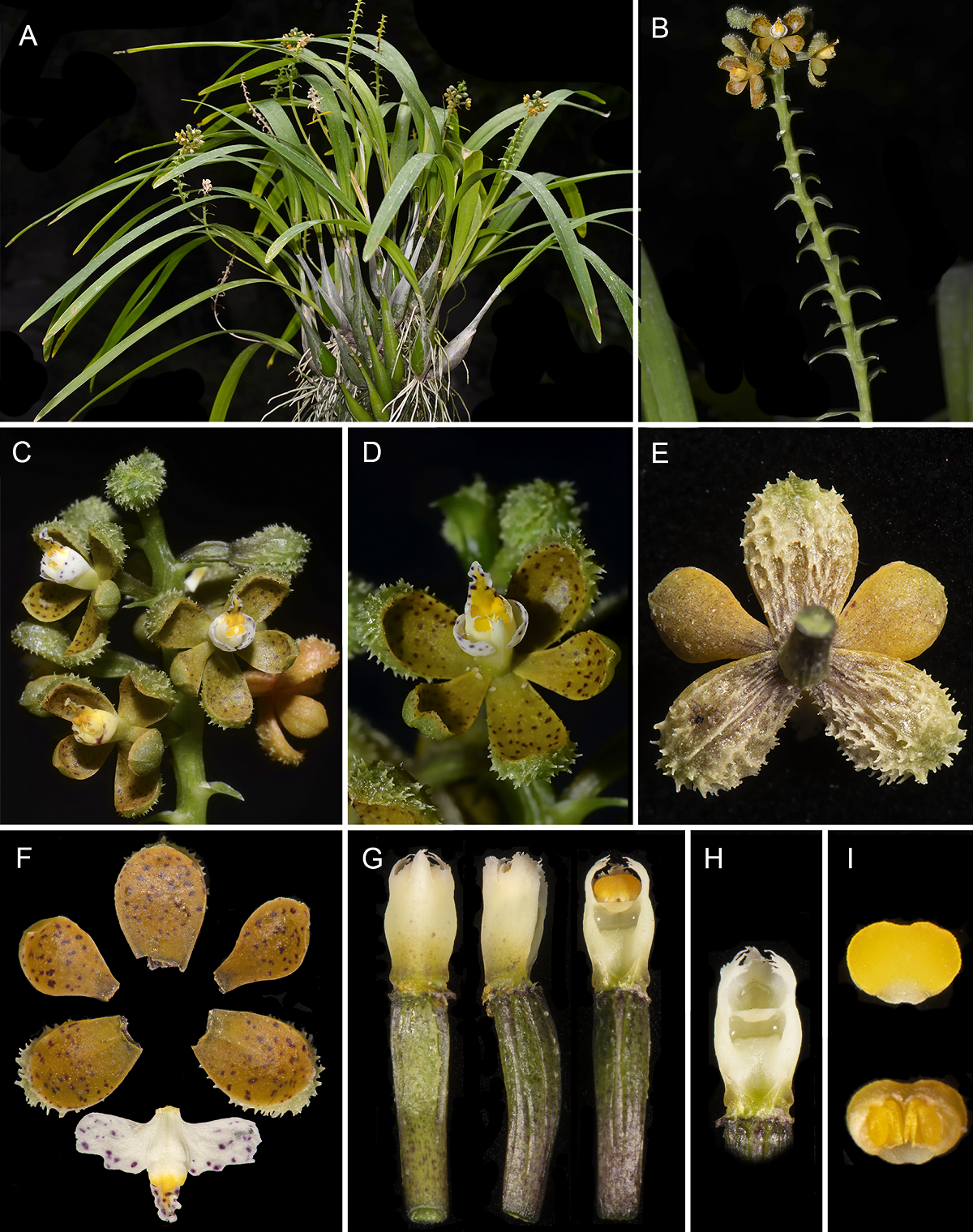
Photographs by Gerardo A. Salazar (A-D, from Salazar et al. 5761) and Rolando Jiménez-Machorro (E-I, from Leleu sub Jiménez 860).
Figure 6 Prosthechea sanchezii. A. Flowering plant. B. Inflorescence. C. Close-up of flowers at the apex of the inflorescence. D. Flower, front view. E. Flower, back view. F. Floral dissection. G. Column, dorsal, side, and ventral views (left to right). H. Column, ventral view, after removal of anther and pollinarium. I. Anther, top and bottom views, the latter showing the four pollinia and caudicles.
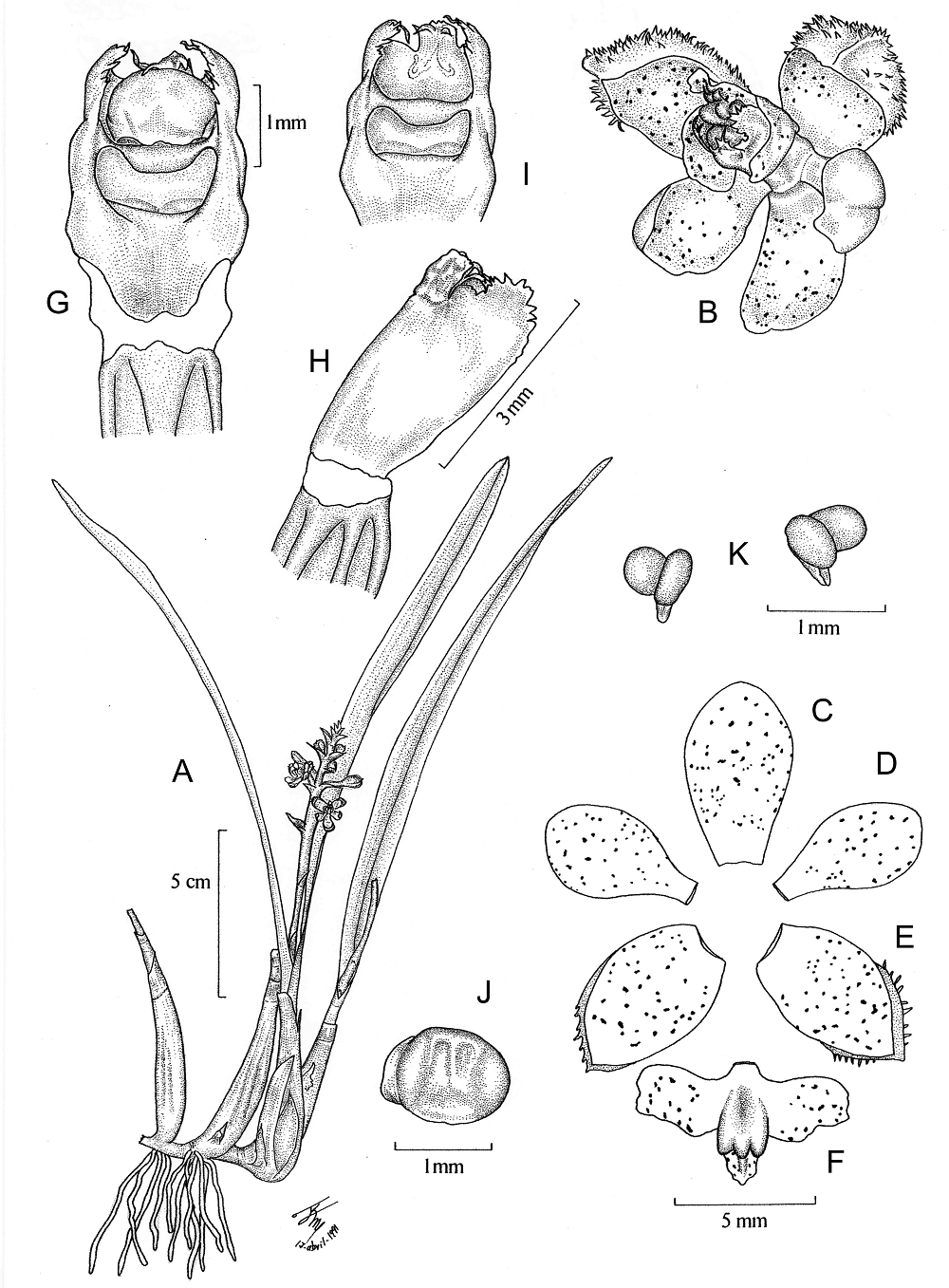
Drawn from Leleu sub Jiménez 860 by R. Jiménez-Machorro.
Figure 7 Prosthechea sanchezii. A. Flowering plant. B. Flower, oblique front view. C. Dorsal sepal. D. Petal. E. Lateral sepal. F. Labellum. G. Column, ventral view. H. Column, side view. I. Ventral view of column apex after removal of anther and pollinarium. J. Anther. K. Pollinia.
Type. Mexico, Chiapas, SW of Comitán, 1,600 m, in dry oak forest on trees, in large colonies, S[epals], P[etals] zinc orange, L[abellum] sea foam yellow w[ith] brown dots, fl[ower]s full of warty protuberances, 6 April 1936, O. Nagel [sub E. Östlund] 5693 (Holotype: AMO 13268, isotypes AMES [barcodes 02124024, 02124025, and 02124047], MEXU 9196).
Diagnosis. Similar to Prosthechea ochracea (Lindl.) W.E.Higgins, differing in the sepals with echinate-warty crests on the outer surface, the warts irregularly conical to uncinate, and the orangish ochre to greenish-orange flowers turning deep orange as the flower ages, the sepals and petals with sparse, irregular wine-red spots on their inner surface.
Description. Epiphytic, caespitose to creeping herb 14-55 cm tall including the inflorescence. Roots 0.9-2.5 mm in diameter, terete, white. Rhizome 10-35 × 4-6 mm, terete, with 4-5 nodes between pseudobulbs, covered by scarious, fibrous, dull white to dull brown, evanescent cataphylls. Pseudobulbs 3.6-13 × 0.7-2.7 cm, narrowly ovoid to ovoid-fusiform, 2-leaved at the apex, when young covered by 1-2 silvery white, evanescent sheaths, green. Leaves 13-36 × (0.8-) 1.2-2.5 cm, flexible, linear-elliptic, acute to obtuse, conduplicate at base, dorsally keeled, arcuate, pale green. Inflorescence 6-25 cm long, racemose, erect, with 8-35 successive flowers, 3-6 open at a time; peduncle (3.5-)5.0-11.5 cm long, subtended at base by a scarious, spathe-like bract (1.0-)2.0-5.0 cm long at base and with 1-2 triangular, amplexicaul, acute bracts 4-9 mm long above; rachis 2.0-11.5 cm long. Floral bracts 5-12 mm long, triangular-lanceolate, conduplicate, deep green, fleshy. Flowers relatively showy, fleshy, 10-13 mm in maximum span, non-resupinate, fragrant during the daylight hours; sepals and petals brownish green, greenish-orange or orange, with irregular wine-red dots on their inner surface, these less dense toward the base, labellum with wine-red dots and the callus apex deep yellow. Sepals incurved, concave, obovate to oblanceolate, externally crested and echinate-verrucose; dorsal sepal obtuse to rounded, 5.5-7.0 × 2.0-3.9 mm; lateral sepals slightly oblique, acute to obtuse, 4.8-6.1 × 3-4 mm. Petals incurved, obovate to oblanceolate, abruptly contracted toward the base, concave, obtuse to rounded, all its surfaces smooth, 3.9-6.5 × 2-3.3 mm. Labellum 4.3-5.0 × 6.5-8.0 mm, adnate to the column ca. 1 mm, free portion sessile, deeply three-lobed; lateral lobes 2.0-3.5 × 1.3-2.5 mm, embracing the column, oblong, obliquely oblong or rhombic-oblong, apex truncate; midlobe 2.0-3.2 × 1.0-1.4 mm, triangular-oblong to narrowly triangular-ovate, bilobulate, shortly apiculate, bearing a longitudinal greenish-yellow keel throughout the central portion from the callus towards the apex; callus obovate, sulcate, mostly white with apex yellow, the apical portion 3-toothed. Column 3.5-5.0 × 2.5 mm, oblong, subtrigonous, deeply sulcate on the ventral surface, white becoming greenish towards the base; clinandrium 3-toothed, all teeth lacerate to laciniate, the lateral ones somewhat petaloid and concave, the midtooth swollen, somewhat trigonous, truncate, and bearing an also lacerate to laciniate ligule resting over the anther. Anther oblate, smooth, 4-locular, ca. 1 × 1.3 mm, yellow. Pollinia 4, obovoid and laterally compressed, ca. 0.8 × 0.5 mm, smooth, yellow, the caudicles linear, granular, ca. 0.8 mm long, attaching together the two pairs of pollinia. Rostellum laminar, semicircular with a transversally elliptic viscarium. Stigma transversally oblong, concave, shiny, ca. 1 × 2 mm. Ovary subclavate, pedicellate, triquetrous, furrowed and slightly dilated toward the apex, green, sometimes with wine-red stripes or dots, scarcely verrucose along the furrows, 4.0-7.0 × 1.5-2.0 mm. Capsule ellipsoid, 3-winged, 11-16(-20) × 9-10(-15) mm, with terete pedicel 1.5-2.0 × ca. 1.0 mm.
Distribution and ecology. Known only from the Sierra Madre de Chiapas in Mexico (Chiapas and Oaxaca) and from Guatemala (Huehuetenango and Quetzaltenango; Figure 5). Epiphytic or rarely lithophytic, in Quercus- and Pinus-Quercus forest, tropical deciduous forest, semi-evergreen tropical forest, and montane rain forest at 450-1,850 m asl.
Conservation status. Least concern (LC). This is a relatively common, widespread species found in a variety of habitats. The extent of occurrence and the area of occupancy estimated by GeoCAT are 45,121.8 km2 and 212 km2, respectively, and the species does not qualify under the IUCN (2012) criteria for any category of threat (see also IUCN Standards and Petitions Committee 2024).
Phenology. Flowering and fructification throughout the year by virtue of the successive opening of flowers along the inflorescence.
Etymology. The specific epithet honors our late friend and colleague Luis Martín Sánchez Saldaña (1966-2017), who for over 20 years was curator and researcher of Herbarium AMO, Mexico City, with a special interest in the systematics of the Epidendrum difforme Jacq. group.
Additional Specimens Examined. Guatemala, Huehuetenango: La Libertad, road to La Libertad-Naranjo, 1 km N of Naranjo, near experimental station, 1,575-1,640 m, epiphyte, 4 September 1976, Boeke 135 (SEL, digital image); Quetzaltenango: Zunil, 21 March 2000, del Pinal sub Dix and Dix 9459 (UVAL, spirit [digital photographs]). Mexico, Chiapas, Aguacatenango, epiphytic on oak, collected by R. Alava, pressed April 1964, University of California Botanical Garden (Berkeley) accession 57.649 (UC, digital image); same data, pressed 16 March 1968 (UC, digital image); Aguacatenango a 15 km Teopisca, 1,780 m, 4 Nov. 1965, Sousa 2710 (MEXU); along highway 195 between Tuxtla Gutiérrez and Villahermosa, 5.6 km by rd. N of Soyaló on S to SW facing slope, 1,600 m, 24 July 1976, Breckon & Breckon 2225 (MEXU); same data, pressed in cultivation 28 July 1981, Breckon & Breckon 2225 (MEXU); same data, pressed in cultivation in 30 August 1982, Breckon & Breckon 2225 (MO); Col[onia]. Mispia, 1,000 m, 4 August 1995, [cultivated at] Jardín Orquídeas Moxviquil, Dietz 8667 (AMO); m[oun]t[ain]s around Hacienda Santa María de los Arcos, east of Comitán, lake system of Tziscao, on oaks, 1,500-1,600 m, [collected] February 1935, flowered in the garden 23 April 1935, Nagel sub Östlund 4547 (AMES, SEL); Honduras, Siltepec, 1,500 m, 9 July 1941, Matuda 4406 (MEXU); La Grandeza, 2,016 m, 19 May 1945, Matuda 5609 (AMES, MEXU, UC [digital image]); Cascada, Siltepec, 1,600 m, 2 June 1949, Matuda 18796 (MEXU); cerca de Comitán, collected 16 April 1990, pressed in cultivation 22 June 1991, Leleu sub Jiménez 860 (AMO); same data, pressed in cultivation 16 October 1991, Leleu sub Jiménez 861 (AMO); Panamerican highway east of Comitán, 12 April 1949, Carlson 1975 (SEL); growing in oak trees in Teopixco [Teopisca], ca. 6,800 ft, 22 August 1953, Johnson 353-63 (SEL); on the southeast side of Volcán Tacaná above Talquian, 2,200 m, 16 January 1973, Breedlove & Smith 31668 (CAS, MEXU, MO, NY); Tenam Puente, 1,700 m, 2 June 2006, [cultivated at] Jardín Orquídeas Moxviquil, Dietz 10208 (AMO); without locality, pressed in cultivation 5 March 1984, Hartmann s.n. (AMO); municipio Arriaga, Ejido López Mateos, cerro El Carrizalillo, 1,130 m, 17 Jan. 2004, Alvarado et al. 948 (MEXU, MO); municipio Arriaga, cerca del Rancho Monte Bonito, sobre la carr[etera]. México 190, 450 m, 23 April 2002, Reyes et al. 4505 (MEXU); municipio Jiquipilas, a 7.83 Km al NW de Tiltepec, 1,025 m, 25 April 2002, Calónico et al. 22983 (MEXU, MO); municipio Jiquipilas, Cerro La Palmita, 1,390 m, 7 November 1994, Castillo 408 (AMO, CHIP); municipio La Concordia, a 3 km de la Finca Cuxtepec, 1,100 m, selva lluviosa de montaña, 11 May 1988, Cabrera Cachón 0073 (AMO, CHIP, MEXU); municipio La Concordia, finca Custepec, trail NW from finca, 1-3 km along trail, ca. 1,180 m, 12 July 1990, Hampshire & Reyes 1215 (MEXU); municipio La Trinitaria, 4 km E of La Trinitaria along Mex 190, 1,480 m, 8 July 1990, Hampshire et al. 1156 (MEXU, MO); municipio Las Rosas, 3 km al E del Puerto, 1,575 m, bosque caducifolio alterado, epífita en Ficus, sépalos y pétalos café verdoso, labelo blanco cremoso, columna verde, 9 August1998, Martínez et al. 31188 (MEXU); municipio Motozintla de Mendoza, 4 km above Tolimán on road to Motozintla, 1,380 m, 22 November 1980, Breedlove 47657 (AMES); municipio Motozintla de Mendoza, 8 km above Motozintla along road to Niquivil, 1,850 m, 10 June 1988, Breedlove 69136 (CAS, MEXU, MO); municipio Ocozocuautla, km 25 carretera nueva Tuxtla-Aeropuerto, selva mediana subcaducifolia, 21 August1986, Cabrera Cachón 0026 (AMO, CHIP); municipio Ocozocoautla, a 21 km al W de Tuxtla Gutiérrez, camino a Ocozocuautla, 1,030 m, 31 May 1987, Martínez 21467 (MEXU); same data, Martínez et al. 21481 (MEXU); municipio Ocozocuautla, 1 km al NW del entronque Aeropuerto-Ocozocuautla-México, sobre la carretera 190, 1,000 m, 11 November 1988, Reyes & Urquijo 1238 (MEXU, MO); municipio Ocozocoautla, km 9 del libramiento de Ocozocuautla, 800 m, 31 July 1991, Cabrera Cachón 164 (MEXU); municipio Siltepec, Concepción Pinada, Torre 259 C.F.E., 1,168 m, 21 August 1998, Pérez et al. 12 (MO); municipio Villacorzo, Cerro La Peña, al W del ejido Sierra Morena, 1,450 m, 19 Oct. 2002, Alvarado & Reyes 579 (MEXU); municipio Villacorzo, ejido Sierra Morena, 1,150 m, 31 May 2002, Reyes et al. 4870 (MEXU, MO); municipio Villaflores, poblado El Triunfo, 1,080 m, 20 February 2002, Reyes & Velásquez 4082 (MEXU); municipio Villaflores, ejido Tierra y Libertad, 1,400 m, 24 March 2004, Reyes et al. 6621 (MEXU). Oaxaca: Municipio San Miguel Chimalapa, filo del cerro Guayabitos en los alrededores de Benito Juárez, 1,750 m, collected 24 October 1996, pressed in cultivation 8 May 2010, Salazar et al. 5761 (MEXU).
Other records. Mexico, Chiapas, Acacoyagua, 7 November 2014, observation by N. Ramírez-Marcial (https://www.naturalista.mx/observations/21376688; accessed 15 August 2024); Cañón del Sumidero, 23 February 2019, observation by N. Ramírez-Marcial (https://www.naturalista.mx/observations/21296398; accessed 15 August 2024); Motozintla, 27 March 2017, observation by J. Gutierres [sic] (https://www.naturalista.mx/observations/5478856; accessed 15 August 2024); San Cristobal de Las Casas, ojo de agua, 21 April 2020, observation by D. Manzano-Méndez (https://www.naturalista.mx/observations/42900351; accessed 15 August2024); Tuxtla Gutierrez, 15 April 2019, observation by N. Ramírez-Marcial (https://www.naturalista.mx/observations/27183822; accessed 15 August 2024); Villa de Corzo, 26 August 2017, observation by D. Manzano-Méndez (https://www.naturalista.mx/observations/9946550; accessed 15 August 2024).
Discussion. Prosthechea sanchezii is similar to P. guttata (Figure 1-3, 4A-D), P. ochracea (Figure 4E), and P. panthera (Rchb.f.) W.E.Higgins (Figure 4F), all having slender, ovoid pseudobulbs bearing two linear to narrowly elliptic leaves, non-resupinate, comparatively small (for the genus) flowers reaching at most about 1 cm in span, and deeply 3-lobed labellum with the lateral lobes embracing the column (see Dressler & Pollard 1976). However, P. sanchezii can be separated from the last three species at a glance, even in herbarium specimens, by its crested, echinate-warty outer surface of the sepals (Figure 6C-E, 7E). This and other features permitting the distinction of all four species are presented in the form of a dichotomous key below. It is worthy of mention that P. panthera, P. ochracea, and P. sanchezii were recovered forming a well-supported clade in the molecular phylogenetic analysis of Vieira et al. (2024), where P. ochracea and P. sanchezii are sisters to each other (the latter was incorrectly identified there as P. guttata). No material of genuine P. guttata suitable for DNA analysis has been available, but its noticeable morphological similarity suggests that it is closely related to those three species.
The only Oaxacan record of P. sanchezii known to us came from the Sierra Atravesada or Sierra de Niltepec, in the Chimalapa region, which is the westernmost extension of the Sierra Madre de Chiapas (see Wendt 1997). Hence, all the known records of this species occur east of the Isthmus of Tehuantepec, whereas P. guttata occurs only west of the Isthmus of Tehuantepec and thus their geographical distributions do not overlap (Figure 5). The distinguishing features of P. guttata, P. ochracea, P. panthera, and P. sanchezii are contrasted in the following key.
1. Floral bracts green, fleshy; outer surface of the sepals with echinate-warty crests ......................P. sanchezii
1. Floral bracts scarious, thin; outer surface of the sepals smooth ................................................................2
2. Sepals and petals olive green to dull yellow with large chocolate-red blotches; midlobe of labellum obtrapezoid, conspicuously broader at the apex than at the base; pedicellate ovary subfiliform, 9-16 mm long; capsule fusiform-obovoid, wingless .......................................................................................................P. panthera
2. Sepals and petals ochre, greenish brown, brownish-orange, or deep orange, spotless or with wine red dots; midlobe of labellum oblong-ovate, broader at the base than at the apex; pedicellate ovary subclavate, triquetrous, ≤ 7 mm long; capsule ellipsoid, 3-winged ..............................................................................3
3. Peduncle of inflorescence terete; rachis of raceme straight; sepals and petals ochre, greenish brown, or brownish-orange, spotless (in populations from the Sierra Norte de Puebla sometimes with faint, irregular wine-red spots); petals oblanceolate-spathulate; lateral lobes of the labellum as wide as long or wider ............................................................................................................................................P. ochracea
3. Peduncle of inflorescence laterally compressed; rachis of raceme loosely zigzag; sepals and petals orangish ochre to greenish orange upon opening, turning deep orange as the flower ages, all with sparse, irregular wine-red spots on inner surface; petals obovate; lateral lobes of the labellum distinctly longer than wide ...............................................................................................................................................P. guttata

