Physiology
Effect of temperature and drought stress on germination of Magnolia pugana, an endangered species from western Mexico
Efecto de la temperatura y el estrés por sequía en la germinación de Magnolia pugana, una especie amenazada del occidente de México
Jacobo-Pereira, César1
 http://orcid.org/0000-0003-1454-575X
Muñiz-Castro, Miguel Ángel2*
http://orcid.org/0000-0002-9127-057X
Muñoz-Urias, Alejandro3
http://orcid.org/0000-0003-0828-9729
Huerta-Martínez, Francisco Martín3
http://orcid.org/0000-0001-6923-3425
Vázquez-García, J. Antonio2
http://orcid.org/0000-0002-8393-5906
Flores, Joel4
http://orcid.org/0000-0001-8856-6022
http://orcid.org/0000-0003-1454-575XMuñiz-Castro, Miguel Ángel2*
http://orcid.org/0000-0002-9127-057XMuñoz-Urias, Alejandro3
http://orcid.org/0000-0003-0828-9729Huerta-Martínez, Francisco Martín3
http://orcid.org/0000-0001-6923-3425Vázquez-García, J. Antonio2
http://orcid.org/0000-0002-8393-5906Flores, Joel4
http://orcid.org/0000-0001-8856-6022
-
Publication dates-
October 30, 2023
Oct-Dec , 2023
- Article in PDF
- Article in XML
- Automatic translation
- Send this article by e-mail
- Share this article +
Abstract
Background:
Magnolia pugana populations are declining, in addition, it is estimated that precipitation will decrease by up to 10 % and temperatures will increase (2-4 °C) under the most severe climate change scenario, which may affect germination.
Hypotheses:
The interaction of increased temperature and decreased water potential reduces and delays the germination of Magnolia pugana seeds.
Studied species:
Magnolia pugana, an endangered species endemic to western Mexico.
Study site and dates:
Southern Zacatecas and central Jalisco, Mexico. April 2019.
Materials and methods:
Seed viability was evaluated with tetrazolium test. In addition, the effects of temperature (24, 28, and 37 °C), water potential with PEG 8000 (0, -0.3, -0.6, -0.9, -1.2 MPa) and its interaction on the percentage and mean germination time were analyzed with factorial ANOVA tests.
Results:
Viability was 80 %. The interactions between temperature and water potential on germination percentage and mean germination time were significant. There was no germination at 37 °C. The highest germination (78 %) was at 24 °C and -0.3 MPa, while the lowest (3 %) was at 28 °C and -0.6 MPa. The control treatment (24 °C and 0 MPa) facilitated germination in a shorter time (23.9 ± 1.5 days). At 28 °C and -0.9 MPa, the mean germination time was slowed by 1.5 times.
Conclusions:
Magnolia pugana germinability was reduced by the interaction between low water potentials and increased temperature, conditions predicted by future climate change scenarios, therefore its vulnerability to extinction could increase.
Keywords::
Climate change, mean germination time, riparian tree species, seed ecophysiology, water potential
There are nearly 300 to 350 species of Magnolia L. (Magnoliaceae Juss.) occurring worldwide, in tropical, subtropical, and warm temperate climates (Rivers et al. 2016, Vázquez-García et al. 2016). The genus is distributed across Southeast and East Asia, Eastern Canada, the United States of America, Mexico, the Caribbean, and Central and South America. Unfortunately, half of its species (48 %) are at risk of extinction (Rivers et al. 2016). Mexico is one of the two major centers of diversity for this genus in the Neotropics with 38 species (Sánchez-González et al. 2021, Vázquez-García et al. 2021a, b). About 80 % of these species are under threat or endangered, and the conservation status for the remaining 20 % is not determined due to a lack of enough information (Rivers et al. 2016).
-
Rivers et al. 2016The red list of Magnoliaceae-revised and extended, 2016
-
Vázquez-García et al. 2016Magnolias de Ecuador: en riesgo de extinción. Ecuador, Puyo, 2016
-
Rivers et al. 2016The red list of Magnoliaceae-revised and extended, 2016
-
Sánchez-González et al. 2021Magnolia zotictla (Magnolia sect. Macrophylla, Magnoliaceae): a new species from the southern Sierra Madre Oriental, MéxicoPhytotaxa, 2021
-
Vázquez-García et al. 2021aCorncob flower, Magnolia mixteca (M. sect. Macrophylla, Magnoliaceae) a new species endemic to the Alto Balsas Basin (Baja Mixteca), in the Pacific slopes of Oaxaca, MexicoPhytotaxa, 2021
-
bHow to save endangered magnolias? From population biology to conservation action: the case of allopatric radiation in Western MexicoEndangered Plants, 2021
-
Rivers et al. 2016The red list of Magnoliaceae-revised and extended, 2016
Magnolia pugana (Iltis & A.Vázquez) A.Vázquez & Carvajal is an endangered species endemic to western Mexico. It has been categorized as Endangered in the IUCN Red List of Threatened Species since 2014 (Gibbs & Khela 2014, IUCN 2022). It thrives in riparian forests with intermittent streams and ravines of southern Zacatecas and central Jalisco (Vázquez-García et al. 2002). Despite the high fruit and seed production of Magnolia pugana in wild populations, germination without scarification is low (Jacobo-Pereira et al. 2016), and predation by rodents is high (Vázquez-García 1994). Thus, populations of this species consist of isolated individuals or small groups in tributary creeks within riparian forests, where natural recruitment is limited (Rivers et al. 2016). Multiple anthropic disturbance factors affect Magnolia populations, including livestock, habitat fragmentation, and illegal wood extraction (He et al. 2009, Kundu 2009, Vásquez-Morales et al. 2017, Serna-González et al. 2019). High fragmentation and isolation of populations and habitats, high deforestation rate, low regeneration, forest conversion to pasture lands and agriculture, forest fires, and expansion of urban and rural human settlements are the major threats to M. pugana populations (Linsky & Muñiz-Castro 2022). Furthermore, it is estimated that precipitations will decrease (up to 10 %) and temperatures will increase (2 to 4 °C) in western Mexico, under the most severe climate change scenario (Durán 2010, Ibarra-Montoya et al. 2011, IPCC 2014, Ruiz-Corral et al. 2016), which may affect, to a great extent, seed germination and survival of seedlings occurring in natural populations, thus, increasing their vulnerability to extinction (Donohue et al. 2010, Vásquez-Morales et al. 2014).
-
Gibbs & Khela 2014Magnolia puganaThe IUCN Red List of Threatened Species 2014, 2014
-
IUCN 2022The IUCN Red List of Threatened Species, 2022
-
Vázquez-García et al. 2002Magnolia pugana (Magnoliaceae): una nueva combinación en el complejo M. pacificaNovon, 2002
-
Jacobo-Pereira et al. 2016Germinación de semillas de Magnolia pugana (Magnoliaceae), especie endémica y en peligro de extinción del occidente de MéxicoBotanical Sciences, 2016
-
Vázquez-García 1994Magnolia (Magnoliaceae) in Mexico and Central America: a synopsisBrittonia, 1994
-
Rivers et al. 2016The red list of Magnoliaceae-revised and extended, 2016
-
He et al. 2009Population structure and genetic diversity distribution in wild and cultivated populations of the traditional Chinese medicinal plant Magnolia officinalis subsp. biloba (Magnoliaceae)Genetica, 2009
-
Kundu 2009A synopsis on distribution and endemism of Magnoliaceae s.l. in Indian SubcontinentThaiszia Journal of Botany, 2009
-
Vásquez-Morales et al. 2017Moderate anthropogenic disturbance does not affect the demography of Magnolia schiedeana, an endangered species from MexicoFlora, 2017
-
Serna-González et al. 2019Mycorrhizae: a key interaction for conservation of two endangered Magnolias from Andean forestsPlant Ecology and Evolution, 2019
-
Linsky & Muñiz-Castro 2022Magnolia pugana (Iltis & A.Vázquez) A.Vázquez & CarvajalGlobal Conservation Gap Analysis of Magnolia, 2022
-
Durán 2010Modelo de distribución de los pastizales en zonas áridas de México, ante los efectos del cambio climático, 2010
-
Ibarra-Montoya et al. 2011Cambio en la cobertura y uso de suelo en el norte de Jalisco, México: Un análisis del futuro, en un contexto de cambio climáticoRevista Ambiente & Agua, 2011
-
IPCC 2014Climate Change 2014: Impacts, Adaptation, and Vulnerability. Part A: Global and Sectoral Aspects. Contribution of Working Group II to the Fifth Assessment Report of the Intergovernmental Panel on Climate Change, 2014
-
Ruiz-Corral et al. 2016Regionalización del cambio climático en MéxicoRevista Mexicana de Ciencias Agrícolas, 2016
-
Donohue et al. 2010Germination, postgermination adaptation, and species ecological rangesAnnual Review of Ecology and Systematics, 2010
-
Vásquez-Morales et al. 2014Effect of climate change on the distribution of Magnolia schiedeana: a threatened speciesBotanical Sciences, 2014
Germination is a critical stage in the plant life cycle that modulates population and community dynamics as it depends on numerous potentially adverse biotic and abiotic conditions such as increased temperature and low water availability (Harper 1977, Dürr et al. 2015). Germination of Magnolia seeds has been studied in Mexico, particularly M. pugana (Jacobo-Pereira et al. 2016) and other species of the genus (Vovides & Iglesias 1996, Saldaña-Acosta et al. 2001, Corral-Aguirre & Sánchez-Velásquez 2006, Vásquez-Morales & Sánchez-Velásquez 2011, Toledo-Aceves 2017, Vásquez-Morales & Ramírez-Marcial 2019, Gallardo-Yobal et al. 2022). However, the combined effect of temperature and water potential was not evaluated. Reductions in percentage and delayed germination under stress provoked by alterations caused by global warming (higher temperatures and decreased humidity) have already been documented for various ecosystems. Daws et al. (2008) found that 14 pioneer species of the Neotropical semideciduous forest in Panamá, exhibited reductions and delays in germination at water potentials ≤ -1 MPa. On the other hand, Flores & Briones (2001) and Flores et al. (2017) reported, in arid and semiarid environments, a probable increase in temperature > 4 °C and decrease in humidity, which would inhibit seed germination of some species, however, if the tolerance threshold of soil water potential above -0.4 MPa and high temperature is not exceeded, germinability could be increased and made faster. Furthermore, in Atlantic rainforests, Braz et al. (2014) reported that germination of Arecaceae species is reduced and mean germination time is prolonged at water potentials ≤ -0.4 MPa, however, they were able to observe a low germinability at -0.8 MPa. In contrast, Ooi et al. (2009) reported that germination percentage was not affected by the increase in temperatures from 60/20 to 70/25 °C (soil diurnal temperature range), in most ephemeral species in the arid region of the western interior of Australia, due to a possible adaptation in their germination ecology to a greater temperature range that facilitated the breaking of physical seed dormancy. Therefore, it is evident that temperature and humidity fluctuation due to global warming can approach or exceed tolerance thresholds and lead to seed death and thereby influence species distributions (Donohue et al. 2010, Dürr et al. 2015).
-
Harper 1977Population Biology of Plants, 1977
-
Dürr et al. 2015Ranges of critical temperature and water potential values for the germination of species worldwide: contribution to a seed trait databaseAgricultural and Forest Meteorology, 2015
-
Jacobo-Pereira et al. 2016Germinación de semillas de Magnolia pugana (Magnoliaceae), especie endémica y en peligro de extinción del occidente de MéxicoBotanical Sciences, 2016
-
Vovides & Iglesias 1996Seed germination of Magnolia dealbata Zucc. (Magnoliaceae), an endangered species from MexicoHortScience, 1996
-
Saldaña-Acosta et al. 2001Germinación de Acer skutchii Rehder y Magnolia iltisiana Vázquez en la Reserva de la Biosfera Sierra de Manantlán, Jalisco, MéxicoForesta Veracruzana, 2001
-
Corral-Aguirre & Sánchez-Velásquez 2006Seed ecology and germination treatments in Magnolia dealbata: an endangered speciesFlora: Morphology, Distribution, Functional Ecology of Plants, 2006
-
Vásquez-Morales & Sánchez-Velásquez 2011Seed ecology and pre-germinative treatments in Magnolia schiedeana Schlecht, an endangered species from MexicoJournal of Food, Agriculture and Environment, 2011
-
Toledo-Aceves 2017Germination rate of endangered cloud forest trees in Mexico: Potential for ex situ propagationJournal of Forest Research, 2017
-
Vásquez-Morales & Ramírez-Marcial 2019Seed germination and population structure of two endangered tree species: Magnolia perezfarrerae and Magnolia sharpiiBotanical Sciences, 2019
-
Gallardo-Yobal et al. 2022Light quality and temperature fluctuation promote the germination of Magnolia alejandrae (Magnoliaceae, sect. Macrophylla), a critically endangered species endemic to northeast MexicoBotanical Sciences, 2022
-
Daws et al. (2008)Germination responses to water potential in neotropical pioneers suggest large-seeded species take more risksAnnals of Botany, 2008
-
Flores & Briones (2001)Plant life-form and germination in a Mexican inter-tropical desert: effects of soil water potential and temperatureJournal of Arid Environments, 2001
-
Flores et al. (2017)The combined effect of water stress and temperature on seed germination of Chihuahuan Desert speciesJournal of Arid Environments, 2017
-
Braz et al. (2014)Germination niche breadth differs in two co-occurring palms of the Atlantic RainforestNatureza & Conservação, 2014
-
Ooi et al. (2009)Climate change and bet‐ hedging: interactions between increased soil temperatures and seed bank persistenceGlobal Change Biology, 2009
-
Donohue et al. 2010Germination, postgermination adaptation, and species ecological rangesAnnual Review of Ecology and Systematics, 2010
-
Dürr et al. 2015Ranges of critical temperature and water potential values for the germination of species worldwide: contribution to a seed trait databaseAgricultural and Forest Meteorology, 2015
However, these phenomena have been understudied in species thriving in warm temperate mesic forests (Siegel & Brock 1990, Falleri et al. 2004). On the surface soil of such environments, low water potentials (drought stress) are rarely present, but if they decrease, seed germination of some species, such as Magnolia pugana, may be affected (Evans & Etherington 1990, Daws et al. 2008, Walck et al. 2011). Studies conducted on different species of this genus warn us about sensitivity and vulnerability to drought during the stages comprising their growth and development (Nash & Graves 1993, Sjöman et al. 2018). Thus, the present study aims to evaluate the combined effects of higher temperatures and water stress on the germination of M. pugana seeds. We test the hypothesis that the interaction of increased temperature and decreased water potentials harms seed germination of M. pugana by reducing its germination rate and germination percentage.
-
Siegel & Brock 1990Germination requirements of key southwestern woody riparian speciesDesert Plants, 1990
-
Falleri et al. 2004Effect of water stress on germination of beechnuts treated before and after storageCanadian Journal of Forest Research, 2004
-
Evans & Etherington 1990The effect of soil water potential on seed germination of some British plantsNew Phytologist, 1990
-
Daws et al. 2008Germination responses to water potential in neotropical pioneers suggest large-seeded species take more risksAnnals of Botany, 2008
-
Walck et al. 2011Climate change and plant regeneration from seedGlobal Change Biology, 2011
-
Nash & Graves 1993Drought and flood stress effects on plant development and leaf water relations of five taxa of trees native to bottomland habitatsJournal of the American Society for Horticultural Science, 1993
-
Sjöman et al. 2018Magnolias as urban trees a preliminary evaluation of drought tolerance in seven Magnolia speciesArboricultural Journal, 2018
Materials and methods
Study species. Magnolia pugana is an evergreen tree species of high longevity that grows up to 25 m tall and could reach over 1.5 m in dbh (Vázquez-García et al. 2021b). It occurs naturally in western Mexico between 1,100 to 1,569 m asl., with mean annual temperatures from 20 to 26 °C, and annual precipitation from 900 to 1,000 mm (Jacobo-Pereira et al. 2016). The reproductive age of the species has not been reported; however, based on cultivated plants, it starts at seven years of age. This species exhibits a flowering period between March and June, with the possibility of observing flowers throughout the year (Dahua-Machoa 2018). Additionally, it produces white fragrant flowers and has narrow oblong or elliptic coriaceous leaves (Figure 1A). Their fruits are dehiscent oblongoid polyfollicles that usually stay joined together, with dehiscence occurring in April or May of the following year (Figure 1B). The polyfollicles contain 21 to 47 seeds with a size of approx. 3-7 mm covered with a scarlet aril (Figure 1C). The species is used for medicinal purposes, where its petals, prepared as tea, are thought to have properties beneficial for the treatment of the heart (Osorio-Muñoz 2020).
-
Vázquez-García et al. 2021bHow to save endangered magnolias? From population biology to conservation action: the case of allopatric radiation in Western MexicoEndangered Plants, 2021
-
Jacobo-Pereira et al. 2016Germinación de semillas de Magnolia pugana (Magnoliaceae), especie endémica y en peligro de extinción del occidente de MéxicoBotanical Sciences, 2016
-
Dahua-Machoa 2018Temporalidad de fenofases y micropropagación in vitro de tres especies relictuales de Magnolia del Occidente de México: implicaciones para su conservación in situ y ex situ, 2018
-
Osorio-Muñoz 2020Identificación química y perspectiva medicinal de los aceites esenciales de hojas, semillas y flores de Magnolia pugana, 2020
Thumbnail
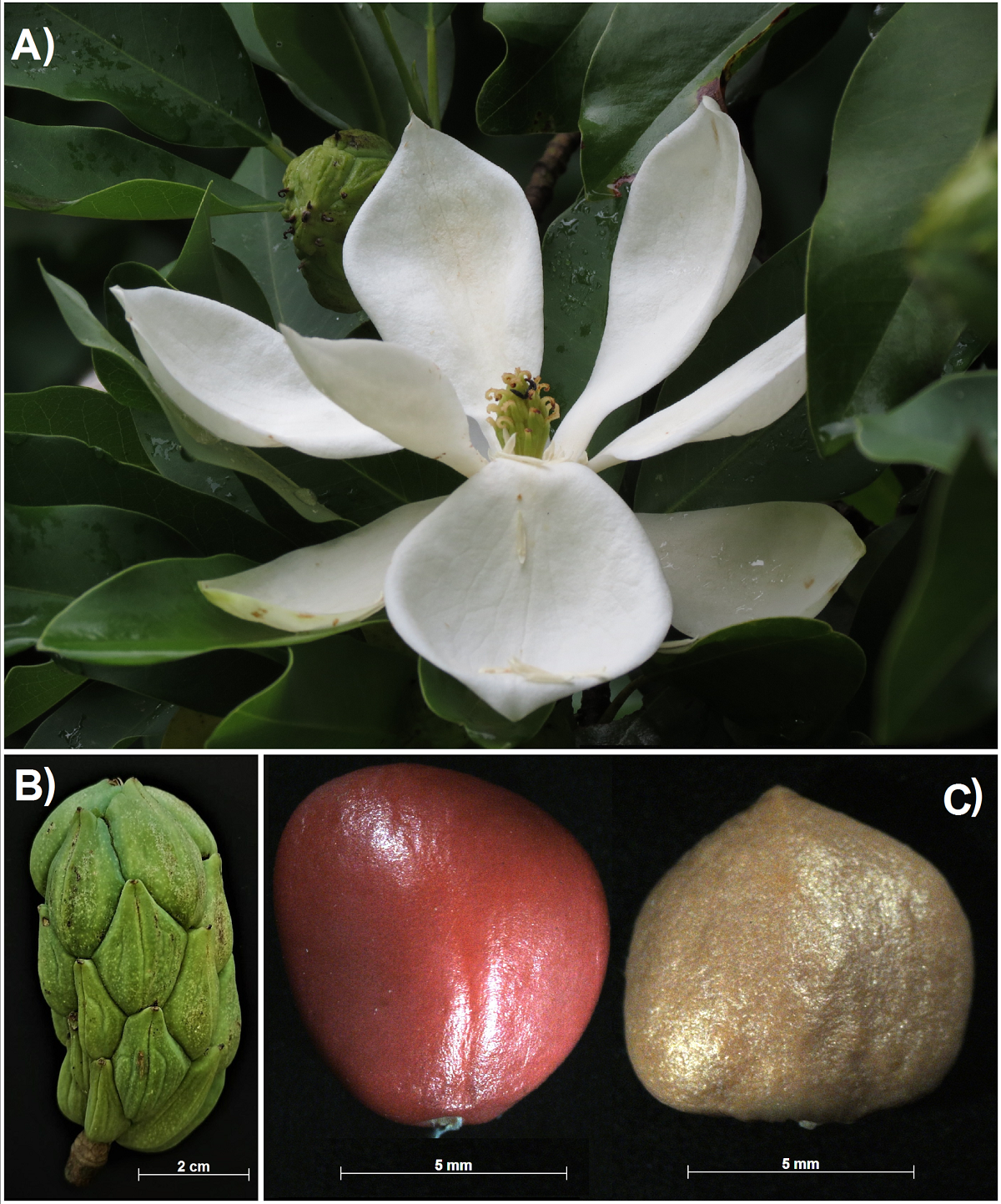
Figure 1
Magnolia pugana: A) Flower, B) fruit (oblongoid polyfollicles), and C) seeds (with or without aril).
Magnolia pugana: A) Flower, B) fruit (oblongoid polyfollicles), and C) seeds (with or without aril).
Sampling sites. To obtain current environmental conditions and sampling heterogeneity, two populations of M. pugana located in tributary creeks that drastically reduce their flow in dry seasons were selected, one from Palo Verde, in the municipality of Mezquital del Oro, southern Zacatecas, Mexico (21° 15´ 38. 4” N, 103° 18´ 22.3” W; 1,530 m asl), and the other near San Nicolás, in the municipality of Zapopan, central Jalisco, Mexico (20° 48´ 53.4” N, 103° 34´ 49.8” W; 1,445 m asl). Its mean annual temperatures are 22.1 and 20.6 °C, while annual precipitation is 803.5 and 1,007.1 mm, respectively (CONAGUA 2019).
-
CONAGUA 2019Condiciones climáticas normales por temporada para los estados de Jalisco y Zacatecas, México, 2019
Seed collection. Mature polyfollicles of the two populations were collected in April 2019, from at least 10 M. pugana parental trees which were separated by distances of 10-100 m from each other. Approximately 2,100 seeds were sorted and then treated with a 3 % sodium hypochlorite solution for 30 min to remove fungal contamination and later dried with absorbent paper (Saldaña-Acosta et al. 2001). Seeds were stored in a plastic container in a conventional refrigerator at 4 °C to avoid dehydration (Jacobo-Pereira et al. 2016).
-
Saldaña-Acosta et al. 2001Germinación de Acer skutchii Rehder y Magnolia iltisiana Vázquez en la Reserva de la Biosfera Sierra de Manantlán, Jalisco, MéxicoForesta Veracruzana, 2001
-
Jacobo-Pereira et al. 2016Germinación de semillas de Magnolia pugana (Magnoliaceae), especie endémica y en peligro de extinción del occidente de MéxicoBotanical Sciences, 2016
Viability test. A sample of thirty seeds was randomly selected from a mixture from the two locations. Aril was removed via manual scarification and then seeds were placed in sterile plastic Petri dishes (90 × 15 mm). The seeds were washed in running water, dissected transversely with a scalpel, submerged in a 1 % tetrazolium solution, and then placed in a drying oven (JISICO Co., Ltd. J-DECO) at a temperature of 30 ºC for 24 hours in complete darkness (Yaklich & Kulick 1979, Jacobo-Pereira et al. 2016). Finally, the seeds were examined under a stereoscope and classified according to the coloration of the embryo. Embryos dyed red were considered viable and those presenting no coloration were considered non-viable (Baskin & Baskin 2014).
-
Yaklich & Kulick 1979Evaluation of vigor tests in soybean seeds: relationship of the standard germination test, seedling vigor classification, seedling length, and tetrazolium staining to field performanceCrop Science, 1979
-
Jacobo-Pereira et al. 2016Germinación de semillas de Magnolia pugana (Magnoliaceae), especie endémica y en peligro de extinción del occidente de MéxicoBotanical Sciences, 2016
-
Baskin & Baskin 2014Seeds: Ecology, biogeography, and evolution of dormancy and germination, 2014
Germination tests. The experimental design was a 3 × 5 factorial arrangement, comprising three constant temperatures (24, 28, 37 °C) and five water potentials (Ψw of 0, -0.3, -0.6, -0.9, -1.2 MPa). The temperature of 24 °C was selected because it is the optimum temperature for the germination of this species (Bonner & Karrfalt 2008) and represents the average of the month when seeds are dispersed for germination, whereas 28 °C is the maximum temperature in the warmest month in the habitat. We consider that 37 °C could represent the maximum extreme temperature to which M. pugana seeds could be exposed in western Mexico under the climate change scenario RCP 4.5 projected for future years (2050-2100) in groups G3 and G5, which includes levels of severe warming (2 to 3 °C) and severe drying (-50 to -10 mm of seasonal precipitation), and levels of moderate continentalization (0-1.5 °C) (Ibarra-Montoya et al. 2011, IPCC 2014, Ruiz-Corral et al. 2016, CONAGUA 2019).
-
Bonner & Karrfalt 2008The woody plant seed manual agriculture, 2008
-
Ibarra-Montoya et al. 2011Cambio en la cobertura y uso de suelo en el norte de Jalisco, México: Un análisis del futuro, en un contexto de cambio climáticoRevista Ambiente & Agua, 2011
-
IPCC 2014Climate Change 2014: Impacts, Adaptation, and Vulnerability. Part A: Global and Sectoral Aspects. Contribution of Working Group II to the Fifth Assessment Report of the Intergovernmental Panel on Climate Change, 2014
-
Ruiz-Corral et al. 2016Regionalización del cambio climático en MéxicoRevista Mexicana de Ciencias Agrícolas, 2016
-
CONAGUA 2019Condiciones climáticas normales por temporada para los estados de Jalisco y Zacatecas, México, 2019
The five different water potentials (Ψw of 0, -0.3, -0.6, -0.9, -1.2 MPa) were chosen to simulate the diverse levels of water stress that seeds would experience under global climate change scenarios, and are within the range of values described for different soil types worldwide (Dürr et al. 2015). The different water potentials were calculated and prepared with polyethylene glycol (PEG 8000) following Michel (1983). PEG 8000 was dissolved in distilled water and placed in a magnetic stirrer for 16 hours at 20 °C. Each treatment combination for five water potentials and the three temperatures comprised five repetitions of 20 randomly selected seeds. Seeds were placed separately in sterile plastic Petri dishes (90 × 15 mm) containing 20 ml of the respective PEG 8000 solution and sealed with plastic wrap to prevent evaporation, while 20 ml of distilled water (Ψw = 0 MPa) in a temperature of 24 °C was used as control. The experiment used a 12 hours’ photoperiod in a germination chamber (Lumistell ICP-19 d-c/iv), Treatments at different temperatures and water potentials were evaluated over 45 days the time suggested by Barbour (2008) necessary for Magnolia seeds to germinate. Seeds showing an emerged radicle were considered germinated (Baskin & Baskin 2014). The number of germinated seeds was counted, and the germination percentage (GRP) and mean germination time (MGT) were calculated. The MGT of germinated seeds per experimental unit was calculated using the following formula according to Ranal et al. (2009):
-
Dürr et al. 2015Ranges of critical temperature and water potential values for the germination of species worldwide: contribution to a seed trait databaseAgricultural and Forest Meteorology, 2015
-
Michel (1983)Evaluation of the water potentials of solutions of polyethylene glycol 8000 both in the absence and presence of other solutesPlant Physiology, 1983
-
Barbour (2008)Magnolia L.The Woody Plant Seed Manual, 2008
-
Baskin & Baskin 2014Seeds: Ecology, biogeography, and evolution of dormancy and germination, 2014
-
Ranal et al. (2009)Calculating germination measurements and organizing spreadsheetsBrazilian Journal of Botany, 2009
e1
MGT =
∑
i
=1
k
n
i
t
i
∑
i
=1
k
n
i
Where n i is the number of seeds germinated in the i th time; k is the last day of germination evaluation; t i is the time from the beginning of the experiment to the i th observation, given in the corresponding experimental unit expressed in the number of days.
The GRP was transformed with Arcsine square root, to ensure homogeneity of variances (Ranal & Santana 2006). Shapiro-Wilk test was used to test for normality and a Bartlett test was used to test for equal variances (Crawley 2012). A two-way analysis of variance (ANOVA) was performed to study the effects of the factors: temperature, water potential, and its interaction on GRP and MGT. Environmental chambers were nested to the temperature factor. All statistical analyses were performed with the GerminaR package (Lozano‐Isla et al. 2019) in R. When statistical differences were observed, means were compared using multiple comparisons Student-Newman-Keuls (SNK) (α = 0.05). All statistical analyses were carried out in the R software v. 3.5.2 (R Core Team 2018).
-
Ranal & Santana 2006How and why to measure the germination process?Brazilian Journal of Botany, 2006
-
Crawley 2012The R Book, 2012
-
Lozano‐Isla et al. 2019GerminaR: An R package for germination analysis with the interactive web application “GerminaQuant for R”Ecological Research, 2019
-
R Core Team 2018R: A language and environment for statistical computing, 2018
Results
The viability test showed positive results for 24 viable seeds out of 30 (80 %). As no germination was observed in the seeds placed at 37 °C, this temperature was excluded from the analysis. The ANOVA test for GRP revealed significant effects of both factors, temperature (F = 24.49, P < 0.001) and water potential (F = 68.75, P < 0.001), and of its interaction (F = 13.32, P < 0.001) (Figure 2). The GRP decreased significantly as the temperature increased and water potential decreased. On the other hand, the effect of the interaction between temperature and water potential on MGT was significant (F = 3.86, P < 0.001). The MGT was delayed due to the effect of decreasing water potentials (F = 24.00, P < 0.001) and increasing temperature (F = 20.01, P < 0.001) (Figure 3). The highest GRP was 78 % at 24 °C and water potential Ψw = -0.3 MPa, while the lowest was 5 % at 24 °C and water potential Ψw = -0.9 MPa (Table 1).
Table 1
Effects of temperature and water potential (Ψw) on germination percentage (GRP) and mean germination time (MGT) of Magnolia pugana.
Effects of temperature and water potential (Ψw) on germination percentage (GRP) and mean germination time (MGT) of Magnolia pugana.
| Temperature (°C) / |
GRP (%) | MGT (days) |
|---|---|---|
| 24/0 | 64 ± 12.6 a | 23.9 ± 1.5 d |
| 24/-0.3 | 78 ± 4.0 a | 26.4 ± 0.4 cd |
| 24/-0.6 | 44 ± 9.4 b | 30.16 ± 1.2 bc |
| 24/-0.9 | 5 ± 1.6 c | 36.62 ± 1.8 a |
| 24/-1.2 | 0 ± 0 c | 0 ± 0 a |
| 28/0 | 77 ± 13 a | 24.79 ± 0.9 d |
| 28/-0.3 | 28 ± 4.6 b | 33.08 ± 1.2 ab |
| 28/-0.6 | 3 ± 1.22 c | 37.6 ± 1.8 a |
| 28/-0.9 | 0 ± 0 c | 0 ± 0 a |
| 28/-1.2 | 0 ± 0 c | 0 ± 0 a |
Thumbnail
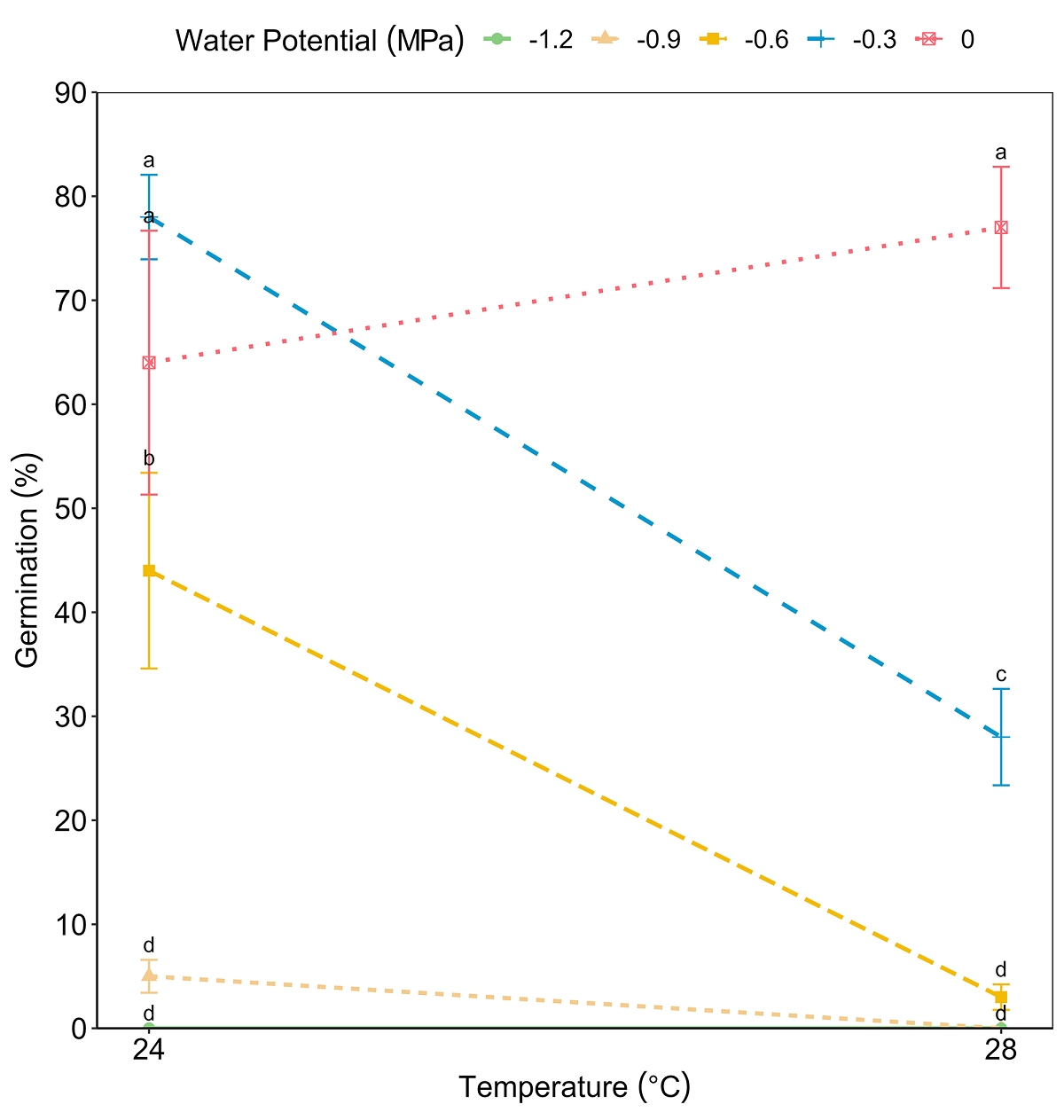
Figure 2
Interaction of factors temperature and water potential on the germination percentages of Magnolia pugana seeds, different letters mean statistical differences between averages by multiple comparisons (Student-Newman-Keuls) (α = 0.05).
Interaction of factors temperature and water potential on the germination percentages of Magnolia pugana seeds, different letters mean statistical differences between averages by multiple comparisons (Student-Newman-Keuls) (α = 0.05).
Thumbnail
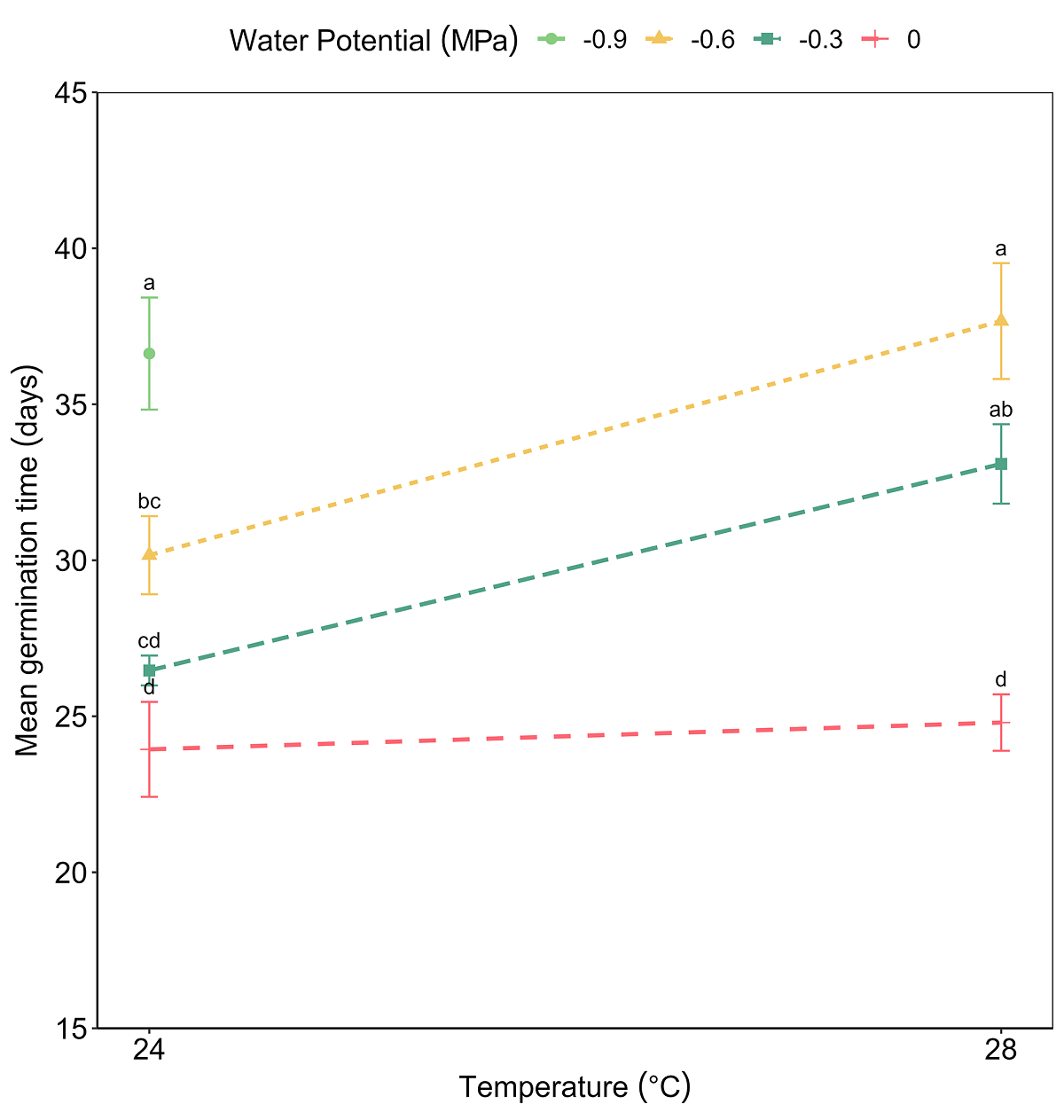
Figure 3
Effects temperature, water potential, and interaction between factors, on the mean germination time of Magnolia pugana seeds, different letters mean statistical differences by multiple comparisons (Student-Newman-Keuls) (α = 0.05).
Effects temperature, water potential, and interaction between factors, on the mean germination time of Magnolia pugana seeds, different letters mean statistical differences by multiple comparisons (Student-Newman-Keuls) (α = 0.05).
Additionally, when water potential Ψw = 0 MPa was applied at 28 °C resulted in 77 % of germination, but with the same temperature and Ψw = -0.6 and -0.9 MPa, resulted in a significant decrease in the number of germinated seeds (3 and 0 %, respectively). Finally, a water potential Ψw = -1.2 MPa resulted in no germination at both temperatures.
The water potential Ψw = 0 MPa facilitated germination in a shorter time at temperatures of 24 °C (MGT = 23.93 ± 1.52 days), and at 28 °C (MGT = 24.79 ± 0.90 days), while the Ψw = -0.9 MPa treatment registered a delay for MGT at 24 °C (36.62 ± 1.79 days) and it produced any germination at 28 °C. In the combination of 24 °C and water potential Ψw = 0 MPa (control), seeds began to germinate on day 16, on the other hand, with 28 °C and Ψw = 0 MPa germination initiated the day 17th. At 24 °C and Ψw = -0.3 MPa germination began on day 17, but at 28 °C and -0.3 MPa, the beginning of germination was delayed until day 20 (Figure 4). At the other lower water potential treatments and the higher temperature combinations, germination was delayed even more or was zero. MGT increased due to the effect of decreased water potential and high temperature.
Thumbnail
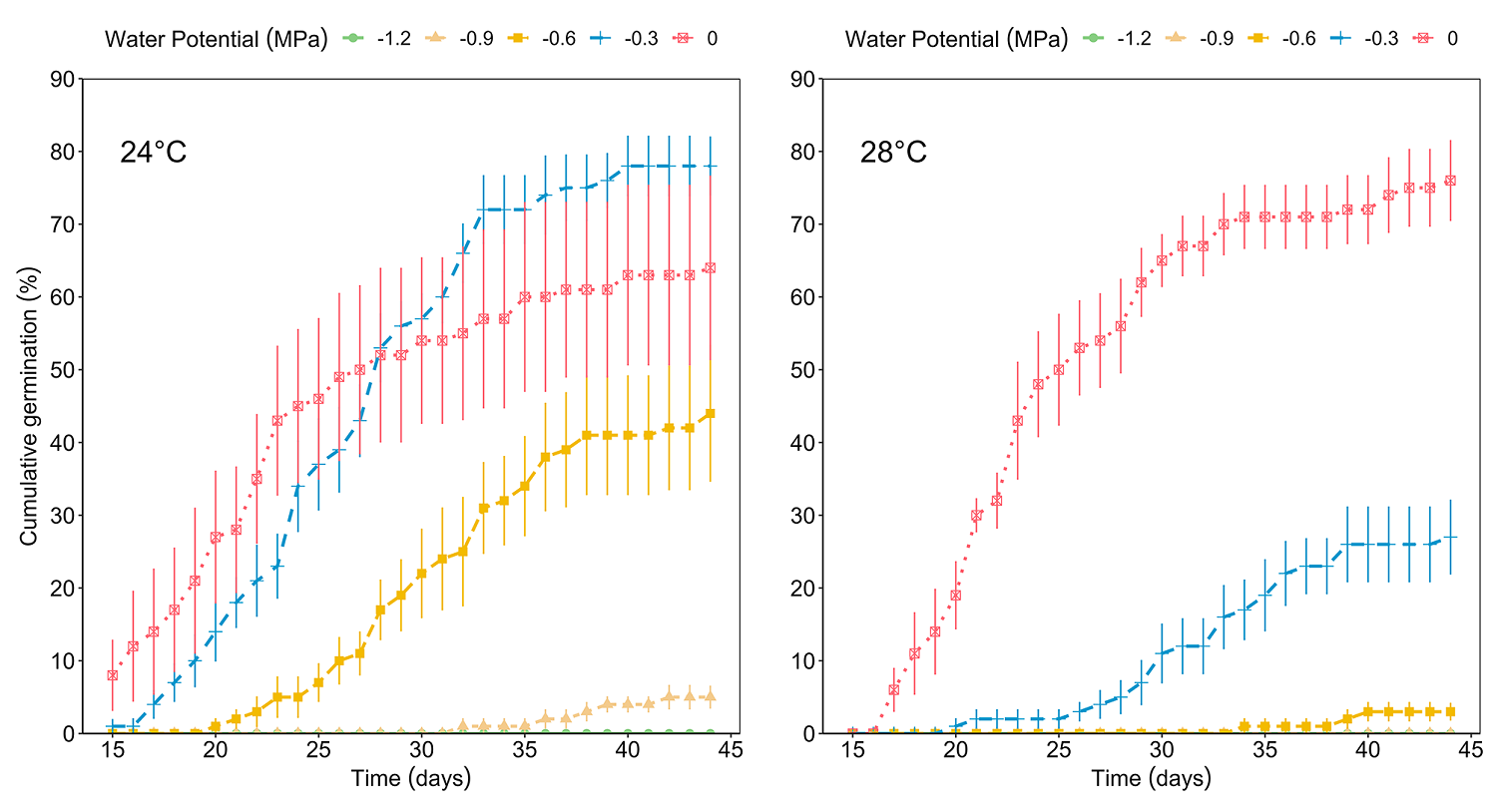
Figure 4
Cumulative germination of Magnolia pugana at different water potentials (Ψw of 0, -0.3, -0.6, -0.9, and -1.2 MPa), and two temperatures (24 and 28 °C), during the 45 days of the test.
Cumulative germination of Magnolia pugana at different water potentials (Ψw of 0, -0.3, -0.6, -0.9, and -1.2 MPa), and two temperatures (24 and 28 °C), during the 45 days of the test.
Discussion
This study represents the first report about the effects of temperature and water potential as combined factors on the germination of Magnolia seeds. Our results support our hypothesis that germination of Magnolia pugana is negatively affected by the combined effect of increasing temperature and water stress, thus confirming that germination in this species would be adversely affected under the predicted conditions of global warming. Interactions between low water potential due to decreases in precipitation (up to 10 %), and temperature increases (between 2 and 4 °C), are conditions that may be present in habitats within the natural distribution of M. pugana under climate change scenarios (Durán 2010, Ibarra-Montoya et al. 2011, IPCC 2014, Ruiz-Corral et al. 2016). We infer that a temperature increment of 4 °C (up to 28 °C) only affects germination if there is water stress, but temperatures higher than 28 °C inhibit germination in drier conditions.
-
Durán 2010Modelo de distribución de los pastizales en zonas áridas de México, ante los efectos del cambio climático, 2010
-
Ibarra-Montoya et al. 2011Cambio en la cobertura y uso de suelo en el norte de Jalisco, México: Un análisis del futuro, en un contexto de cambio climáticoRevista Ambiente & Agua, 2011
-
IPCC 2014Climate Change 2014: Impacts, Adaptation, and Vulnerability. Part A: Global and Sectoral Aspects. Contribution of Working Group II to the Fifth Assessment Report of the Intergovernmental Panel on Climate Change, 2014
-
Ruiz-Corral et al. 2016Regionalización del cambio climático en MéxicoRevista Mexicana de Ciencias Agrícolas, 2016
Our results showed that GRP decreased and MGT increased at the highest temperature (28 °C) in combination with lower water potentials (Ψw of -0.3, -0.6, -0.9, and -1.2 MPa). At water potential Ψw = 0 MPa GRP was not different between 24 and 28 °C treatments but decreased to 0 % at the highest temperature (37 °C). Temperatures higher than 30 °C have been reported to decrease the germinability of Magnolia wilsonii, M. sinica, and other tropical woody species (Han & Long 2010a, Buttler et al. 2014, Lin et al. 2022). This could be explained by the fact that increasing temperatures and desiccation unbalance endogenous abscisic acid concentrations by decreasing auxins, gibberellins, and cytokinins to inhibit germination (Baskin & Baskin 2014, Liu et al. 2019). Similar results have been observed for some species in other temperate and humid environments: the effect of temperature (5 to 25 °C) and water potentials (Ψw = -0.10 to -0.30 MPa) on germinability for riparian species (Salix alba, S. triandra, S. viminalis, and Populus nigra) resulted in 80 to 100 % germination at all temperatures for all species (Van Splunder et al. 1995), at this temperature range, thermal variation was not a restrictive factor for the cited species as it was not for M. pugana; however, germination percentages for all these species were from approximately 100 % at Ψw = -0.10 MPa and decreased to 0 % at Ψw = -0.26 MPa.
-
Han & Long 2010aSeed dormancy, germination, and storage behavior of Magnolia wilsonii (Magnoliaceae), an endangered plant in ChinaPlant Diversity, 2010
-
Buttler et al. 2014Temperature affects the germination of forage legume seedsCrop Science, 2014
-
Lin et al. 2022Seed dormancy, germination, and storage behavior of Magnolia sinica, a plant species with extremely small populations of MagnoliaceaePlant Diversity, 2022
-
Baskin & Baskin 2014Seeds: Ecology, biogeography, and evolution of dormancy and germination, 2014
-
Liu et al. 2019High temperature and drought stress cause abscisic acid and reactive oxygen species accumulation and suppress seed germination growth in riceProtoplasma, 2019
-
Van Splunder et al. 1995Establishment of alluvial forest species in floodplains: the role of dispersal timing, germination characteristics, and water level fluctuationsActa Botanica Neerlandica, 1995
The later results agree with those reported for two riparian species, Populus euphratica, and P. pruinosa, which showed considerably lower germination percentages with decreasing water potentials, to almost 0 % at Ψw = -0.6 MPa (P. pruinosa), and up to 5 % at Ψw = -0.9 MPa (P. euphratica) (Li et al. 2006), whereas both species had 100 % germination at Ψw = 0 MPa. Although Li et al. (2006) took into account the factors included in the present study, they did not evaluate their interactions.
-
Li et al. 2006Responses of germination and radicle growth of two Populus species to water potential and salinityForestry Studies in China, 2006
-
Li et al. (2006)Responses of germination and radicle growth of two Populus species to water potential and salinityForestry Studies in China, 2006
The reduction in germinability with increasing temperatures has been observed for other temperate mesic tree species such as Magnolia officinalis (Zhou et al. 2012), M. sinica (Lin et al. 2022), and Acer saccharum (Solarik et al. 2016). M. officinalis experienced the highest germination percentage between 15 and 25 °C, which coincides with the results in the present study, as well as the finding that temperatures higher than 30 °C also considerably decreased germination percentage (Zhou et al. 2012). Similarly, Lin et al. (2022) reported a M. sinica germinability ca. 87 % at 25/15 °C but poorly at 30 °C. A possible explanation for these responses could be related to the environmental conditions of their habitats (Han & Long 2010a, b, Fernando et al. 2013, Iralu & Upadhaya 2016, Aragón-Gastélum et al. 2018). Germinability and germination speed represented by MGT may be affected by seed quality (e.g., seed size, mass, and nutrients), which are strongly related to environmental factors such as temperature, light, and precipitation of the seed provenances (De Frenne et al. 2011, Chamorro et al. 2013, Carón et al. 2014). Thus, the sensitivity of germination to climatic variability could be a function of the phenotypic plasticity of the species, its local adaptation, and its geographic distribution (Nicotra et al. 2010, Cochrane et al. 2015).
-
Zhou et al. 2012Effects of temperature, light, nutrients, and smoke-water on seed germination and seedling growth of Astragalus membranaceus, Panax notoginseng and Magnolia officinalis highly traded Chinese medicinal plantsSouth African Journal of Botany, 2012
-
Lin et al. 2022Seed dormancy, germination, and storage behavior of Magnolia sinica, a plant species with extremely small populations of MagnoliaceaePlant Diversity, 2022
-
Solarik et al. 2016Assessing tree germination resilience to global warming: a manipulative experiment using sugar maple (Acer saccharum)Seed Science Research, 2016
-
Zhou et al. 2012Effects of temperature, light, nutrients, and smoke-water on seed germination and seedling growth of Astragalus membranaceus, Panax notoginseng and Magnolia officinalis highly traded Chinese medicinal plantsSouth African Journal of Botany, 2012
-
Lin et al. (2022)Seed dormancy, germination, and storage behavior of Magnolia sinica, a plant species with extremely small populations of MagnoliaceaePlant Diversity, 2022
-
Han & Long 2010aSeed dormancy, germination, and storage behavior of Magnolia wilsonii (Magnoliaceae), an endangered plant in ChinaPlant Diversity, 2010
-
bDormancy, germination, and storage of Magnolia ingrata seedsSeed Science and Technology, 2010
-
Fernando et al. 2013Identifying dormancy class and storage behavior of champak (Magnolia champaca) seeds, an important tropical timber treeJournal of the National Science Foundation of Sri Lanka, 2013
-
Iralu & Upadhaya 2016Dormancy, storability, and germination of seeds of Magnolia punduana (Magnoliaceae)Botany, 2016
-
Aragón-Gastélum et al. 2018Potential impact of global warming on seed bank, dormancy and germination of three succulent species from the Chihuahuan DesertSeed Science Research, 2018
-
De Frenne et al. 2011A latitudinal gradient in seed nutrients of the forest herb Anemone nemorosaPlant Biology, 2011
-
Chamorro et al. 2013Germination response to various temperature regimes of four Mediterranean seeder shrubs across a range of altitudesPlant Ecology, 2013
-
Carón et al. 2014Latitudinal variation in seeds characteristics of Acer platanoides and A. pseudoplatanusPlant Ecology, 2014
-
Nicotra et al. 2010Plant phenotypic plasticity in a changing climateTrends in Plant Science, 2010
-
Cochrane et al. 2015Will among-population variation in seed traits improve the chance of species persistence under climate change?Global Ecology and Biogeography, 2015
Therefore, we infer that germination of Magnolia pugana seeds is likely to be manifested by decreasing germination percentages and delayed mean times, due to the future warmer climate and lower precipitation predicted for the geographical distribution area of this species (IPCC 2014, Ruiz-Corral et al. 2016). A similar effect was found with temperature increase for M. sinica and M. wilsonii, for which climate warming could hurt their germinability (Han & Long 2010a, Lin et al. 2022). In addition, Vázquez-García et al. (2021b) predicted a loss of 66 % of the suitable environmental area of M. pugana by the end of the present century under a scenario of high emissions of greenhouse gases (SSP3-7.0), which may increase its vulnerability to extinction, since not only its germination could be affected, but also the survivorship of seedlings, saplings, and adult trees.
-
IPCC 2014Climate Change 2014: Impacts, Adaptation, and Vulnerability. Part A: Global and Sectoral Aspects. Contribution of Working Group II to the Fifth Assessment Report of the Intergovernmental Panel on Climate Change, 2014
-
Ruiz-Corral et al. 2016Regionalización del cambio climático en MéxicoRevista Mexicana de Ciencias Agrícolas, 2016
-
Han & Long 2010aSeed dormancy, germination, and storage behavior of Magnolia wilsonii (Magnoliaceae), an endangered plant in ChinaPlant Diversity, 2010
-
Lin et al. 2022Seed dormancy, germination, and storage behavior of Magnolia sinica, a plant species with extremely small populations of MagnoliaceaePlant Diversity, 2022
-
Vázquez-García et al. (2021b)How to save endangered magnolias? From population biology to conservation action: the case of allopatric radiation in Western MexicoEndangered Plants, 2021
Germination percentages in Magnolia pugana decreased and MGT increased with reducing water potential, as reported in other tropical woody plant species showing faster germination time and the highest percentage at a water potential of Ψw = 0 MPa and the lowest at Ψw = -1.0 MPa (Daws et al. 2008). However, these authors did not evaluate the interaction with temperature, since they focused on ten species at a single temperature (26 °C). Generally, in subtropical species, such as eucalypts, germination does not occur in water potentials of less than Ψw = -0.25 MPa, with greater germination typically occurring at Ψw = 0 MPa (López et al. 2000). In contrast, it has been reported that in Cercidium praecox and Prosopis laevigata, from semi-arid environments, a 0 MPa treatment resulted in the lowest germination 77 and 64 % respectively, while a Ψw = -0.41 MPa resulted in 100 % for both species (Flores & Briones 2001). In general, for these xerophilous species, the germination percentage increased with increasing temperature, in combination with low water potentials, while the MGT was shorter, as reported for seeds associated with drier habitats which present higher germination percentages in a reduced time (Evans & Etherington 1990).
-
Daws et al. 2008Germination responses to water potential in neotropical pioneers suggest large-seeded species take more risksAnnals of Botany, 2008
-
López et al. 2000The effect of temperature and water stress on laboratory germination of Eucalyptus globulus Labill. seeds of different sizesAnnals of Forest Science, 2000
-
Flores & Briones 2001Plant life-form and germination in a Mexican inter-tropical desert: effects of soil water potential and temperatureJournal of Arid Environments, 2001
-
Evans & Etherington 1990The effect of soil water potential on seed germination of some British plantsNew Phytologist, 1990
The viability of seeds obtained in the present study was 80 %, higher than that previously reported for the same species (Jacobo-Pereira et al. 2016). Various authors have reported different viability percentages in Magnolia species: 78 % for M. iltisiana (Saldaña-Acosta et al. 2001), 100 % for M. dealbata (Corral-Aguirre & Sánchez-Velásquez 2006), 80 % for M. schiedeana (Vásquez-Morales & Sánchez-Velásquez 2011), 92 and 87.5 % for M. perezfarrerae and M. sharpii, respectively (Vásquez-Morales & Ramírez-Marcial 2019). Habitat characteristics, longevity during storage, seed moisture content, and the morpho-anatomical features of recalcitrant seeds explain this variability (Ibrahim & Roberts 1983, Vaz et al. 2018). Our main conclusion in this experimental study on the effect of increased temperature and drought stress on the germination of Magnolia pugana seeds is that the interaction of simulated drought and temperature increases affected decreasing germination percentages and delaying the mean germination time. Such conditions are expected under climate change scenarios where severe warming (> 3 °C) and levels of severe drying -300 to -150 mm (< 10 % of seasonal precipitation) in the species distribution zones, which will, in turn, determine the dynamics of natural populations, increasing their medium to long-term vulnerability. A temperature increment of 4 °C (at a germination temperature of 28 °C) only affects germination if there is drought stress. At drier conditions, temperatures higher than 28 °C inhibit germination. The observed effects of temperature increase and water potential reduction to the germination of M. pugana seeds will help predict the fate of this critically endangered endemic species under future climate change.
-
Jacobo-Pereira et al. 2016Germinación de semillas de Magnolia pugana (Magnoliaceae), especie endémica y en peligro de extinción del occidente de MéxicoBotanical Sciences, 2016
-
Saldaña-Acosta et al. 2001Germinación de Acer skutchii Rehder y Magnolia iltisiana Vázquez en la Reserva de la Biosfera Sierra de Manantlán, Jalisco, MéxicoForesta Veracruzana, 2001
-
Corral-Aguirre & Sánchez-Velásquez 2006Seed ecology and germination treatments in Magnolia dealbata: an endangered speciesFlora: Morphology, Distribution, Functional Ecology of Plants, 2006
-
Vásquez-Morales & Sánchez-Velásquez 2011Seed ecology and pre-germinative treatments in Magnolia schiedeana Schlecht, an endangered species from MexicoJournal of Food, Agriculture and Environment, 2011
-
Vásquez-Morales & Ramírez-Marcial 2019Seed germination and population structure of two endangered tree species: Magnolia perezfarrerae and Magnolia sharpiiBotanical Sciences, 2019
-
Ibrahim & Roberts 1983Viability of Lettuce Seeds: I. Survival in Hermetic StorageJournal of Experimental Botany, 1983
-
Vaz et al. 2018A role for fruit structure in seed survival and germination of Swartzia langsdorffii Raddi beyond dispersalPlant Biology, 2018
Acknowledgments
We thank Dr. Adriana Natividad Avendaño López and Dr. Rosa de Lourdes Romo-Campos for providing the material and laboratory for this research. Funding: This work was supported by Consejo Nacional de Humanidades, Ciencias y Tecnología (CONAHCYT, grant to the first author 2018-000068-02NACF-00624), and by the postgraduate program Doctorado en Ciencias en Biosistemática, Ecología y Manejo de Recursos Naturales y Agrícolas (BEMARENA), and Centro Universitario de Ciencias Biológicas y Agropecuarias of the Universidad de Guadalajara, through PROINPEP program. We thank two anonymous reviewers and the associate editor, Dr. Enrique Jurado, for their valuable suggestions.
Literature cited
- Aragón-Gastélum JL, Flores J, Jurado E, Ramírez-Tobías HM, Robles-Díaz E, Rodas-Ortiz JP, Yáñez-Espinosa L. 2018. Potential impact of global warming on seed bank, dormancy and germination of three succulent species from the Chihuahuan Desert. Seed Science Research 28: 312-318. DOI: https://doi.org/10.1017/S0960258518000302 Links
- Barbour JR. 2008. Magnolia L., In: Bonner FT, Karrfalt RP. eds, The Woody Plant Seed Manual, Agriculture Handbook 727. Washington DC: US. Department of Agriculture Forest Service, pp. 700-705. https://www.fs.usda.gov/treesearch/pubs/32626 (accessed October 20, 2019) Links
- Baskin CC, Baskin JM. 2014. Seeds: Ecology, biogeography, and evolution of dormancy and germination San Diego: Elsevier Sciences. ISBN 13: 978-0-12-416677-6 Links
- Bonner FT, Karrfalt RP. 2008. The woody plant seed manual agriculture Handbook 727, Washington DC. U.S. Department of Agriculture Forest Service https://www.fs.usda.gov/treesearch/pubs/32626 (accessed May 15, 2019) Links
- Braz MIG, Portela RDCQ, Cosme LHM, Marques VGC. De Mattos EA. 2014. Germination niche breadth differs in two co-occurring palms of the Atlantic Rainforest. Natureza & Conservação 12: 124-128. DOI: https://doi.org/10.1016/j.ncon.2014.09.003 Links
- Buttler TJ, Celen AE, Webb SL, Krstic D, Interrante SM. 2014. Temperature affects the germination of forage legume seeds. Crop Science 54: 2846-2853. DOI: https://doi.org/10.2135/cropsci2014.01.0063 Links
- Carón MM, De Frenne P, Brunet J, Chabrerie O, Cousins SA, De Backer L, Diekmann M, Graae BJ, Heinken T, Kolb A, Naaf T, Plue J, Selvi F, Strimbeck GR, Wulf M, Verheyen K. 2014. Latitudinal variation in seeds characteristics of Acer platanoides and A. pseudoplatanus. Plant Ecology 215: 911- 925. DOI: https://doi.org/10.1007/s11258-014-0343-x Links
- Chamorro D, Luna B, Moreno JM. 2013. Germination response to various temperature regimes of four Mediterranean seeder shrubs across a range of altitudes. Plant Ecology 214: 1431-1441.DOI: https://doi.org/10.1007/s11258-013-0264-0 Links
- Cochrane A, Yates CJ, Hoyle GL, Nicotra AB. 2015. Will among-population variation in seed traits improve the chance of species persistence under climate change? Global Ecology and Biogeography 24: 12-24. DOI: https://doi.org/10.1111/geb.12234 Links
- CONAGUA [Comisión Nacional del Agua]. 2019. Condiciones climáticas normales por temporada para los estados de Jalisco y Zacatecas, México. https://smn.conagua.gob.mx/es/climatologia/informacion-climatologica/normales-climatologicas-por-estado (accessed May 17, 2019). Links
- Corral-Aguirre J, Sánchez-Velásquez LR. 2006. Seed ecology and germination treatments in Magnolia dealbata: an endangered species. Flora: Morphology, Distribution, Functional Ecology of Plants 201: 227-232. DOI: https://doi.org/10.1016/j.flora.2005.07.004 Links
- Crawley MJ. 2012. The R Book. UK: John Wiley & Sons. ISBN 978-0-470-97392-9 Links
- Dahua-Machoa NA. 2018. Temporalidad de fenofases y micropropagación in vitro de tres especies relictuales de Magnolia del Occidente de México: implicaciones para su conservación in situ y ex situ. MSc Thesis, Universidad de Guadalajara. Links
- Daws MI, Crabtree LM, Dalling JW, Mullins CE, Burslem DF. 2008. Germination responses to water potential in neotropical pioneers suggest large-seeded species take more risks. Annals of Botany 102: 945-951. DOI: https://doi.org/10.1093/aob/mcn186 Links
- De Frenne P, Kolb A, Graae BJ, Decocq G, Baltora S, De Schrijver A, Brunet J, Chabrerie O, Cousins SAO, Dhond R, Diekmann M, Gruwez R, Heinken T, Hermy M, Liira J, Saguez R, Shevtsova A, Baskin CC, Verheyen K. 2011. A latitudinal gradient in seed nutrients of the forest herb Anemone nemorosa. Plant Biology 13: 493-501. DOI: https://doi.org/10.1111/j.1438-8677.2010.00404.x Links
- Donohue K, Rubio de Casas R, Burghardt L, Kovach K, Willis CG. 2010. Germination, postgermination adaptation, and species ecological ranges. Annual Review of Ecology and Systematics 41: 293-319. DOI: https://doi.org/10.1146/annurev-ecolsys-102209-144715 Links
- Durán P. 2010. Modelo de distribución de los pastizales en zonas áridas de México, ante los efectos del cambio climático. PhD Thesis. Universidad Nacional Autónoma de México. Links
- Dürr C, Dickie JB, Yang XY, Pritchard HW. 2015. Ranges of critical temperature and water potential values for the germination of species worldwide: contribution to a seed trait database. Agricultural and Forest Meteorology 200: 222-232. DOI: https://doi.org/10.1016/j.agrformet.2014.09.024 Links
- Evans CE, Etherington JR. 1990. The effect of soil water potential on seed germination of some British plants. New Phytologist 115: 539-548. DOI: https://doi.org/10.1111/j.1469-8137.1990.tb00482.x Links
- Falleri E, Muller C, Laroppe E. 2004. Effect of water stress on germination of beechnuts treated before and after storage. Canadian Journal of Forest Research 34: 1204-1209. DOI: https://doi.org/10.1139/x04-003 Links
- Fernando MTR, Jayasuriya KG, Walck JL, Wijetunga A. 2013. Identifying dormancy class and storage behavior of champak (Magnolia champaca) seeds, an important tropical timber tree. Journal of the National Science Foundation of Sri Lanka 41: 141-146. DOI: http://doi.org/10.4038/jnsfsr.v41i2.5708 Links
- Flores J, Briones O. 2001. Plant life-form and germination in a Mexican inter-tropical desert: effects of soil water potential and temperature. Journal of Arid Environments 47: 485-497. DOI: https://doi.org/10.1006/jare.2000.0728 Links
- Flores J, Pérez-Sánchez RM, Jurado E. 2017. The combined effect of water stress and temperature on seed germination of Chihuahuan Desert species. Journal of Arid Environments 146: 95-98. DOI: https://doi.org/10.1016/j.jaridenv.2017.07.009 Links
- Gallardo-Yobal SI, Rosa-Manzano EDL, Castro-Nava S, Reyes-Zepeda F, Mora-Olivo A, Vázquez-García JA. 2022. Light quality and temperature fluctuation promote the germination of Magnolia alejandrae (Magnoliaceae, sect. Macrophylla), a critically endangered species endemic to northeast Mexico. Botanical Sciences 100: 631-644. DOI: https://doi.org/10.17129/botsci.2908 Links
- Gibbs D, Khela S. 2014. Magnolia pugana. The IUCN Red List of Threatened Species 2014: e.T194806A2363344. Available at: DOI https://doi.org/10.2305/IUCN.UK.2014-1.RLTS.T194806A2363344.en Links
- Han CY, Long CL. 2010a. Seed dormancy, germination, and storage behavior of Magnolia wilsonii (Magnoliaceae), an endangered plant in China. Plant Diversity 32: 47-52. DOI: https://doi.org/10.1016/j.pld.2021.06.009 Links
- Han CY, Long CL. 2010b. Dormancy, germination, and storage of Magnolia ingrata seeds. Seed Science and Technology 38: 252-256. DOI: https://doi.org/10.15258/sst.2010.38.1.28 Links
- Harper JL. 1977. Population Biology of Plants. London: Academic Press, ISBN: 9780123258502 Links
- He J, Chen L, Si Y, Huang B, Ban X, Wang Y. 2009. Population structure and genetic diversity distribution in wild and cultivated populations of the traditional Chinese medicinal plant Magnolia officinalis subsp. biloba (Magnoliaceae). Genetica 135: 233-243. DOI: https://doi.org/10.1007/s10709-008-9272-8 Links
- Ibarra-Montoya JL, Román R, Gutiérrez K, Gaxiola J, Arias V, Bautista M. 2011. Cambio en la cobertura y uso de suelo en el norte de Jalisco, México: Un análisis del futuro, en un contexto de cambio climático. Revista Ambiente & Agua 62: 111-128. DOI: https://doi.org/10.4136/ambi-agua.189 Links
- Ibrahim AE, Roberts EH. 1983. Viability of Lettuce Seeds: I. Survival in Hermetic Storage. Journal of Experimental Botany 34: 620-630. Links
- IPCC [Intergovernmental Panel on Climate Change]. Field CB, Barros VR Dokken DJ, Mach KJ, Mastrandrea MD, Bilir TE, Chatterjee M, Ebi KL, Estrada YO, Genova RC, Girma B, Kissel ES, Levy AN, MacCracken S, Mastrandrea PR, White LL. eds. 2014. Climate Change 2014: Impacts, Adaptation, and Vulnerability. Part A: Global and Sectoral Aspects. Contribution of Working Group II to the Fifth Assessment Report of the Intergovernmental Panel on Climate Change. New York: Cambridge University Press. ISBN 978-1-107-05807-1 Links
- Iralu V, Upadhaya K. 2016. Dormancy, storability, and germination of seeds of Magnolia punduana (Magnoliaceae). Botany 94: 967-973. DOI: https://doi.org/10.1139/cjb-2016-0056 Links
- IUCN. 2022. The IUCN Red List of Threatened Species. Version 2022-2. https://www.iucnredlist.org/species/194806/2363344 (accessed May 22, 2023). Links
- Jacobo-Pereira C, Romo-Campos R, Flores J. 2016. Germinación de semillas de Magnolia pugana (Magnoliaceae), especie endémica y en peligro de extinción del occidente de México. Botanical Sciences 94: 575-584. DOI: https://doi.org/10.17129/botsci.512 Links
- Kundu SR. 2009. A synopsis on distribution and endemism of Magnoliaceae s.l. in Indian Subcontinent. Thaiszia Journal of Botany 19: 47-60. https://www.upjs.sk/public/media/4479/047-060-kundu-upr.pdf (accessed January 10, 2020). Links
- Li L, Xi-ming Z, Runge M, Xiao-ming L, Xing-yuan H. 2006. Responses of germination and radicle growth of two Populus species to water potential and salinity. Forestry Studies in China 8: 10-15. DOI: https://doi.org/10.1007/s11632-006-0002-y Links
- Lin L, Cai L, Fan L, Ma JC, Yang XY, Hu XJ. 2022. Seed dormancy, germination, and storage behavior of Magnolia sinica, a plant species with extremely small populations of Magnoliaceae. Plant Diversity 44: 94-100. DOI: https://doi.org/10.1016/j.pld.2021.06.009 Links
- Linsky J, Muñiz-Castro MÁ. 2022. Magnolia pugana (Iltis & A.Vázquez) A.Vázquez & Carvajal. In: Linsky J, Crowley D, Beckman Bruns E, Coffey EED, eds. Global Conservation Gap Analysis of Magnolia. Atlanta, GA: Atlanta Botanical Garden, pp. 171-176. Links
- Liu J, Hasanuzzaman M, Wen H, Zhang J, Peng T, Sun H, Zhao Q. 2019. High temperature and drought stress cause abscisic acid and reactive oxygen species accumulation and suppress seed germination growth in rice. Protoplasma 256: 1217-1227. DOI: https://doi.org/10.1007/s00709-019-01354-6 Links
- López M, Humara M, Casares A, Majada J. 2000. The effect of temperature and water stress on laboratory germination of Eucalyptus globulus Labill. seeds of different sizes. Annals of Forest Science 57: 245-250. DOI: https://doi.org/10.1051/forest:2000115 Links
- Lozano‐Isla F, Benites-Alfaro OE, Pompelli MF. 2019. GerminaR: An R package for germination analysis with the interactive web application “GerminaQuant for R”. Ecological Research 34: 339-346. DOI: https://doi.org/10.1111/1440-1703.1275 Links
- Michel B. 1983. Evaluation of the water potentials of solutions of polyethylene glycol 8000 both in the absence and presence of other solutes. Plant Physiology 72: 66-70. DOI: https://doi.org/10.1104/pp.72.1.66 Links
- Nash LJ, Graves WR. 1993. Drought and flood stress effects on plant development and leaf water relations of five taxa of trees native to bottomland habitats. Journal of the American Society for Horticultural Science 118: 845-850. DOI: https://doi.org/10.21273/JASHS.118.6.845 Links
- Nicotra AB, Atkin OK, Bonser SP, Davidson AM, Finnegan EJ, Mathesius U, Poot P, Purugganan MD, Richards CL, Valladares F, van Kleunen M. 2010. Plant phenotypic plasticity in a changing climate. Trends in Plant Science 15: 684-692. DOI: https://doi.org/10.1016/j.tplants.2010.09.008 Links
- Ooi MK, Auld TD, Denham AJ. 2009. Climate change and bet‐ hedging: interactions between increased soil temperatures and seed bank persistence. Global Change Biology 15: 2375-2386. DOI: https://doi.org/10.1111/j.1365-2486.2009.01887.x Links
- Osorio-Muñoz EA. 2020. Identificación química y perspectiva medicinal de los aceites esenciales de hojas, semillas y flores de Magnolia pugana. MSc Thesis. Universidad de Guadalajara. Links
- R Core Team. 2018. R: A language and environment for statistical computing. R Foundation for Statistical Computing, Vienna, Austria. https://www.R-project.org/ Links
- Ranal MA, Santana DG. 2006. How and why to measure the germination process? Brazilian Journal of Botany 29: 1-11. DOI: https://doi.org/10.1590/S0100-84042006000100002 Links
- Ranal MA, Santana DGD, Ferreira WR, Mendes-Rodrigues C. 2009. Calculating germination measurements and organizing spreadsheets. Brazilian Journal of Botany 32: 849-855. DOI: https://doi.org/10.1590/S0100-84042009000400022 Links
- Rivers M, Beech E, Murphy L, Oldfield S. 2016. The red list of Magnoliaceae-revised and extended. Fauna and Flora International. Cambridge U.K. https://www.bgci.org/?s=%22The+red+list+of+Magnoliaceae-revised+and+extended%22 (accessed May 15, 2019) Links
- Ruiz-Corral JA, Medina-García G, Rodríguez-Moreno VM, Sánchez-González DJ, Villavicencio R, Durán N, Grageda J, García GE. 2016. Regionalización del cambio climático en México. Revista Mexicana de Ciencias Agrícolas 7: 2451-2464. DOI: https://doi.org/10.29312/remexca.v0i13.460 Links
- Saldaña-Acosta A, Zuluaga S, Jardel E. 2001. Germinación de Acer skutchii Rehder y Magnolia iltisiana Vázquez en la Reserva de la Biosfera Sierra de Manantlán, Jalisco, México. Foresta Veracruzana 3: 1-8. https://www.redalyc.org/articulo.oa?id=49703201 (accessed February 10, 2019) Links
- Sánchez-González A, Gutiérrez-Lozano M, Domínguez-Yescas R, Hernández-Álvarez AG, Ortega-Peña AS. Vázquez-García JA. 2021. Magnolia zotictla (Magnolia sect. Macrophylla, Magnoliaceae): a new species from the southern Sierra Madre Oriental, México. Phytotaxa 513: 271-281. DOI: https://doi.org/10.11646/phytotaxa.513.4.1 Links
- Serna-González M, Urrego-Giraldo LE, Walter-Osorio N, Valencia D. 2019. Mycorrhizae: a key interaction for conservation of two endangered Magnolias from Andean forests. Plant Ecology and Evolution 152: 30-40. DOI: https://doi.org/10.5091/plecevo.2019.1398 Links
- Siegel RS, Brock JH. 1990. Germination requirements of key southwestern woody riparian species. Desert Plants 10: 3-8. http://hdl.handle.net/10150/609112 (accessed May 15, 2019) Links
- Sjöman H, Hironsd A, Bassuk N. 2018. Magnolias as urban trees a preliminary evaluation of drought tolerance in seven Magnolia species. Arboricultural Journal 40: 47-56. DOI: https://doi.org/10.1080/03071375.2017.1415554 Links
- Solarik KA, Gravel D, Ameztegui A, Bergeron Y, Messier C. 2016. Assessing tree germination resilience to global warming: a manipulative experiment using sugar maple (Acer saccharum). Seed Science Research 26: 153-164. DOI: https://doi.org/10.1017/S0960258516000040 Links
- Toledo-Aceves T. 2017. Germination rate of endangered cloud forest trees in Mexico: Potential for ex situ propagation. Journal of Forest Research 22: 61-64. DOI: https://doi.org/10.1080/13416979.2016.1273083 Links
- Van Splunder I, Coops H, Voesenek LACJ, Blom CWPM. 1995. Establishment of alluvial forest species in floodplains: the role of dispersal timing, germination characteristics, and water level fluctuations. Acta Botanica Neerlandica 44: 269-278. DOI: https://doi.org/10.1111/j.1438-8677.1995.tb00785.x Links
- Vaz TAA, Rodrigues‐Junior AG, Davide AC, Nakamura AT, Toorop PE. 2018. A role for fruit structure in seed survival and germination of Swartzia langsdorffii Raddi beyond dispersal. Plant Biology 20: 263-270. DOI: https://doi.org/10.1111/plb.12671 Links
- Vázquez-García JA. 1994. Magnolia (Magnoliaceae) in Mexico and Central America: a synopsis. Brittonia 46: 1-23. DOI: https://doi.org/10.2307/2807454 Links
- Vázquez-García JA, Carbajal S, Hernández LL. 2002. Magnolia pugana (Magnoliaceae): una nueva combinación en el complejo M. pacifica. Novon 12: 137-141. DOI: https://doi.org/10.2307/3393253 Links
- Vázquez-García JA, Domínguez-Yescas R, Luna-Vega I, Rodríguez-Ramírez EC, Rodríguez-Pérez C. 2021a. Corncob flower, Magnolia mixteca (M. sect. Macrophylla, Magnoliaceae) a new species endemic to the Alto Balsas Basin (Baja Mixteca), in the Pacific slopes of Oaxaca, Mexico. Phytotaxa 522: 200-210. DOI: https://doi.org/10.11646/phytotaxa.522.3.3 Links
- Vázquez-García JA, Muñiz-Castro MA, Dahua-Machoa A, Osorio-Muñoz EA, Hernández-Vera G, Ortega-Peña AS , Romo-Campos R, Jacobo-Pereira C, Álvarez de Román N, Shalisko V. 2021b. How to save endangered magnolias? From population biology to conservation action: the case of allopatric radiation in Western Mexico. In: Endangered Plants, ed. Sanjeet Kumar. London, United Kingdom, IntechOpen, pp 44: DOI: https://doi.org/10.5772/intechopen.94346 Links
- Vázquez-García JA , Neill DA, Asanza M, Pérez AJ, Arroyo F, Dahua-Machoa A, Merino-Santi RE. 2016. Magnolias de Ecuador: en riesgo de extinción. Ecuador, Puyo: Universidad Estatal Amazónica, Universidad de Guadalajara-CUCBA, Pontificia Universidad Católica de Ecuador, Universidad Nacional Agraria La Molina. ISBN:978-9942-932-18-1 Links
- Vásquez-Morales SG, Ramírez-Marcial N. 2019. Seed germination and population structure of two endangered tree species: Magnolia perezfarrerae and Magnolia sharpii. Botanical Sciences 97: 2-12. DOI: https://doi.org/10.17129/botsci.1977 Links
- Vásquez-Morales SG, Sánchez-Velásquez LR. 2011. Seed ecology and pre-germinative treatments in Magnolia schiedeana Schlecht, an endangered species from Mexico. Journal of Food, Agriculture and Environment 9: 604-608. Links
- Vásquez-Morales SG, Sánchez-Velásquez LR, Pineda-López MDR, Díaz-Fleischer F, Flores-Estévez N, Viveros-Viveros H. 2017. Moderate anthropogenic disturbance does not affect the demography of Magnolia schiedeana, an endangered species from Mexico. Flora 234: 77-83. https://doi.org/10.1016/j.flora.2017.07.005 Links
- Vásquez-Morales SG, Téllez-Valdés O, Pineda-López MDR, Sánchez-Velásquez LR, Flores-Estévez N, Viveros-Viveros H. 2014. Effect of climate change on the distribution of Magnolia schiedeana: a threatened species. Botanical Sciences 92: 575-585. https://doi.org/10.17129/botsci.116 Links
- Vovides AP, Iglesias CG. 1996. Seed germination of Magnolia dealbata Zucc. (Magnoliaceae), an endangered species from Mexico. HortScience 31: 877-877. Links
- Walck JL, Hidayati SN, Dixon KW, Thompson KEN, Poschlod P. 2011. Climate change and plant regeneration from seed. Global Change Biology 17: 21452161. DOI: https://doi.org/10.1111/j.1365-2486.2010.02368.x Links
- Yaklich RW, Kulik MM. 1979. Evaluation of vigor tests in soybean seeds: relationship of the standard germination test, seedling vigor classification, seedling length, and tetrazolium staining to field performance. Crop Science 19: 247-252. DOI: https://doi.org/10.2135/cropsci1979.0011183X001900020019x Links
- Zhou J, Kulkarni MG, Huang LQ, Guo LP, Van Staden J. 2012. Effects of temperature, light, nutrients, and smoke-water on seed germination and seedling growth of Astragalus membranaceus, Panax notoginseng and Magnolia officinalis highly traded Chinese medicinal plants. South African Journal of Botany 79: 62-70. DOI: https://doi.org/10.1016/j.sajb.2011.11.004 Links