Physiology
Light quality and temperature fluctuation promote the germination of Magnolia alejandrae (Magnoliaceae, sect. Macrophylla), a critically endangered species endemic to northeast Mexico
La calidad de la luz y la fluctuación de temperaturas promueven la germinación de Magnolia alejandrae (Magnoliaceae, sección Macrophylla), una especie en peligro crítico, endémica del noreste de México
Gallardo-Yobal, Sergio Ignacio14
 http://orcid.org/0000-0001-6118-7065
Rosa-Manzano, Edilia de la1*
http://orcid.org/0000-0001-5985-6266
Castro-Nava, Sergio2
http://orcid.org/0000-0002-8759-001X
Reyes-Zepeda, Francisco1
http://orcid.org/0000-0002-5107-0426
Mora-Olivo, Arturo1
http://orcid.org/0000-0002-9654-0305
Vázquez-García, José Antonio3
http://orcid.org/0000-0002-8393-5906
http://orcid.org/0000-0001-6118-7065Rosa-Manzano, Edilia de la1*
http://orcid.org/0000-0001-5985-6266Castro-Nava, Sergio2
http://orcid.org/0000-0002-8759-001XReyes-Zepeda, Francisco1
http://orcid.org/0000-0002-5107-0426Mora-Olivo, Arturo1
http://orcid.org/0000-0002-9654-0305Vázquez-García, José Antonio3
http://orcid.org/0000-0002-8393-5906
-
Publication dates-
May 16, 2022
Jul-Sep , 2022
- Article in PDF
- Article in XML
- Automatic translation
- Send this article by e-mail
- Share this article +
Abstract
Background:
Magnolia alejandrae is a critically endangered species and endemic to the Sierra Madre Oriental in northeastern Mexico. The abiotic requirements for its germination, such as light and temperature, are unknown.
Hypotheses:
White light and temperature fluctuations will promote the germination of M. alejandrae and seeds from site with higher humidity will have increased germination percentage.
Study species:
Magnolia alejandrae.
Study sites and dates:
El Farallón in the Jaumave municipality and Los San Pedros in the Güémez municipality, Tamaulipas, Mexico. May-June 2019.
Methods:
Four light-quality treatments (white, red, far-red and darkness) were evaluated, along with two temperature treatments: constant (18/18 ºC) and fluctuating temperatures (8/18 ºC) and two populations (El Farallón and Los San Pedros) on the germination of M. alejandrae. We used twenty seeds of the study species per experimental unit with five repetitions for each treatment.
Results:
Light quality influenced the germination of M. alejandrae seeds, having the highest germination (76 %) under white light, followed by 45 % under red light, 9 % under far-red and 5 % in darkness, demonstrating that the seeds of this species are neutral photoblastic. Temperature fluctuation (8/18 °C) enhanced germination of M. alejandrae more than constant temperature (18/18 °C).
Conclusions:
M. alejandrae seeds respond differentially to light quality and temperature, which has important implications in the reforestation and conservation of the species.
Keywords::
Dormancy, low temperatures, photoblastics, Tamaulipas, temperate forest
Germination occurs when seeds encounter suitable environmental conditions of temperature, humidity and light for their development; however, the nature of the seed itself and internal dormancy can inhibit germination, even in favorable environmental conditions (Finch-Savage & Leubner-Metzger 2006, Holdsworth et al. 2008). Besides the obstacles for germination, the species may face difficulties for establishment, such as Magnolia vovidesii A. Vázquez, Domínguez-Yescas & L. Carvajal belonging to Magnolia L. sect. Macrophylla Figlar & Noot., having high seed mortality (99.7 %) and 96.7 % mortality in the transition from seedlings to juveniles, resulting in low regeneration potential (Galván-Hernández et al. 2020).
-
Finch-Savage & Leubner-Metzger 2006Seed dormancy and the control of germination: Tansley reviewNew Phytologist, 2006
-
Holdsworth et al. 2008Molecular networks regulating Arabidopsis seed maturation, after‐ripening, dormancy and germinationNew Phytologist, 2008
-
Galván-Hernández et al. 2020Current Status of Magnolia vovidesii (Magnoliaceae, Magnoniales): New data on population trends, spatial structure, and disturbance threatsTropical Conservation Science, 2020
Seeds have developed different strategies that enable them to survive adverse environmental conditions. For example, some seeds conserve energy to maintain the integrity of their genetic information and prolong their viability for several days, months, or even years (Corral-Aguirre & Sánchez-Velázquez 2006, Kisanuki et al. 2008), establishing a demographic balance in the population (Simpson et al. 1989); meanwhile, others germinate immediately when environmental conditions are right (Long et al. 2015). These strategies, whether alone or in combination, are called seed dormancy and are directly related and antagonistic to the plant life cycle (Black et al. 2006, Finch-Savage & Leubner-Metzger 2006, Bewley et al. 2013).
-
Corral-Aguirre & Sánchez-Velázquez 2006Seed ecology and germination treatments in Magnolia dealbata: an endangered speciesFlora-Morphology, Distribution, Functional. Ecology of Plants, 2006
-
Kisanuki et al. 2008The soil seed bank of the threatened plant Magnolia stellata is subordinate to the emergence of current-year seedlingsJournal of Forest Research, 2008
-
Simpson et al. 1989Seed banks: General concepts and methodological issuesEcology of soil seed banks, 1989
-
Long et al. 2015The ecophysiology of seed persistence: a mechanistic view of the journey to germination or demiseBiological Reviews, 2015
-
Black et al. 2006Learning how to learn and assessment for learning: A theoretical inquiryResearch Papers in Education, 2006
-
Finch-Savage & Leubner-Metzger 2006Seed dormancy and the control of germination: Tansley reviewNew Phytologist, 2006
-
Bewley et al. 2013GerminationSeeds. Physiology of development, Germination and Dormancy, 2013
Sexual reproduction could result in a bottleneck when the seeds are unviable or dormant (Venable & Brown 1988). Some species of the genus Magnolia exhibit morphological or physiological dormancy, or a combination of both (Baskin & Baskin 2014). For example, some species present embryos that are not fully developed at the time of fruit dehiscence, suggesting physiological, chemical, mechanical, or morphological dormancy (Evans 1933, Baskin & Baskin 2004, 2008, Jacobo-Pereira et al. 2016, Gallegos-Mendoza et al. 2019). Seed dormancy occurs in temperate and tropical species of Magnolia (Baskin & Baskin 2014, Fernando et al. 2013) despite that the most tropical species are recalcitrant seeds with relatively short life span (Subbiah et al. 2019). In general, seeds of the genus Magnolia present low percentage of germination due to dormancy and various techniques have been used to break dormancy and increase germination (Vásquez-Morales & Sánchez-Velásquez 2011, Iralu & Upadhaya 2016, Vásquez-Morales & Ramírez-Marcial 2019).
-
Venable & Brown 1988The selective interactions of dispersal, dormancy, and seed size as adaptations for reducing risk in variable environmentsThe American Naturalist, 1988
-
Baskin & Baskin 2014Seeds: ecology, biogeography, and evolution of dormancy and germination, 2014
-
Evans 1933Germination behavior of Magnolia grandifloraBotanical Gazette, 1933
-
Baskin & Baskin 2004A classification system for seed dormancySeed Science Research, 2004
-
2008Some considerations for adoption of Nikolaeva’s formula system into seed dormancy classificationSeed Science Research, 2008
-
Jacobo-Pereira et al. 2016Germinación de semillas de Magnolia pugana (Magnoliaceae), especie endémica y en peligro de extinción del occidente de MéxicoBotanical Sciences, 2016
-
Gallegos-Mendoza et al. 2019Pruebas de germinación en semillas de Magnolia pacifica y M. vallartensis, 2019
-
Baskin & Baskin 2014Seeds: ecology, biogeography, and evolution of dormancy and germination, 2014
-
Fernando et al. 2013Identifying dormancy class and storage behaviour of champak (Magnolia champaca) seeds, an important tropical timber treeJournal of the National Science Foundation of Sri Lanka, 2013
-
Subbiah et al. 2019Towards understanding the incidence and evolutionary history of seed recalcitrance: An analytical reviewPerspectives in Plant Ecology, Evolution and Systematics, 2019
-
Vásquez-Morales & Sánchez-Velásquez 2011Seed ecology and pre-germinative treatments in Magnolia schiedeana Schlecht, an endangered species from MexicoJournal of Food, Ecology and Agriculture, 2011
-
Iralu & Upadhaya 2016Dormancy, storability, and germination of seeds in Magnolia punduana (Magnoliaceae)Botany, 2016
-
Vásquez-Morales & Ramírez-Marcial 2019Seed germination and population structure of two endangered tree species: Magnolia perezfarrerae and Magnolia sharpiiBotanical Sciences, 2019
Temperature fluctuation, including low temperature, is a requirement to activate the metabolic processes of germination and break seed dormancy in Magnolia seeds (Bewley & Black 1994, Baskin & Baskin 2004), since the slow release of food reserves from the endosperm to the embryo is probably in response to the natural temperature fluctuations that seeds experience in nature (Probert 2000, Baskin & Baskin 2014). The use of temperatures (4 to10 ºC) to break dormancy and subsequent germinative treatments increase the percent germination in Magnolia vovidesii, treated by Vovides & Iglesias 1996, and Corral-Aguirre & Sánchez-Velázquez (2006) as M. dealbata Zucc. (Vázquez-García et al. 2015, 2016a) and Magnolia schiedeana Schltdl. (Vásquez-Morales & Sánchez-Velásquez 2011).
-
Bewley & Black 1994Seeds: Physiology of development and germination, 1994
-
Baskin & Baskin 2004A classification system for seed dormancySeed Science Research, 2004
-
Probert 2000The role of temperature in the regulation of seed dormancy and germinationSeeds: The ecology of regeneration in plant communities, 2000
-
Baskin & Baskin 2014Seeds: ecology, biogeography, and evolution of dormancy and germination, 2014
-
Vovides & Iglesias 1996Seed Germination of Magnolia dealbata Zucc. (Magnoliaceae), An endangered species from MexicoHortScience, 1996
-
Corral-Aguirre & Sánchez-Velázquez (2006)Seed ecology and germination treatments in Magnolia dealbata: an endangered speciesFlora-Morphology, Distribution, Functional. Ecology of Plants, 2006
-
Vázquez-García et al. 2015Magnolia rzedowskiana (Magnoliaceae), a new species of section Macrophylla from the central Sierra Madre Oriental, MexicoActa botánica mexicana, 2015
-
2016aMagnolia nuevoleonensis sp. nov. (Magnoliaceae) from northeastern Mexico and a key to species of section MacrophyllaNordic Journal of Botany, 2016
-
Vásquez-Morales & Sánchez-Velásquez 2011Seed ecology and pre-germinative treatments in Magnolia schiedeana Schlecht, an endangered species from MexicoJournal of Food, Ecology and Agriculture, 2011
A combination of environmental factors determines the timing of seed germination for some species. Light may regulate seed germination and early establishment of seedlings because phytochrome-mediated responses play a critical role in determining the time of germination (Baskin & Baskin 2014). Fluctuating temperatures can substitute light requirements for the germination of some positive photoblastic species (Pons 2000). Photoblastism is the seed’s response to different light conditions; 1) some seeds require light to germinate (positive photoblastism); 2) others require darkness to germinate (negative photoblastism); 3) others have a higher percentage of germination in light than in darkness; 4) others have a higher percentage in darkness than in light; and 5) some seeds germinate equally well in light and darkness (Baskin & Baskin 2014). Other authors have classified the types of photoblastism into three categories, where positive photoblastism is equivalent to category 1; negative photoblastism is equivalent to category 2; and the other three categories could be classified as neutral photoblastism or non-photoblstic (Fenner & Thompson 2005, Flores et al. 2016). It has been found that the percentage of germination of Magnolia kobus DC. and M. obovata Thunb. does not differ among red:far-red ratio under both constant and fluctuating temperatures, being an adaptive germination strategy to ensure seed germination in gaps, even for buried seeds in soil or litter (Xia et al. 2016). Seed conditions such as light exposure and soil depth, among others, can change the dynamic of a population (Bond et al. 1999).
-
Baskin & Baskin 2014Seeds: ecology, biogeography, and evolution of dormancy and germination, 2014
-
Pons 2000Seed responses to lightSeeds: The Ecology of Regeneration in Plant Communities, 2000
-
Baskin & Baskin 2014Seeds: ecology, biogeography, and evolution of dormancy and germination, 2014
-
Fenner & Thompson 2005The Ecology of Seeds, 2005
-
Flores et al. 2016Effect of light on seed germination and seedling shape of succulent species from MexicoJournal of Plant Ecology, 2016
-
Xia et al. 2016Interaction of seed size with light quality and temperature regimes as germination cues in 10 temperate pioneer tree speciesFunctional Ecology, 2016
-
Bond et al. 1999Seed size and seedling emergence: an allometric relationship and some ecological implicationsOecologia, 1999
The genus Magnolia comprises 36 species in Mexico, almost 10% of the known species of this genus worldwide (350 spp.) (Vázquez-García et al. 2016b). Despite the high species richness and endemism of this group in Mexico, little is known about its light quality requirements or the effect of temperature on the development of Magnolia embryos, which are overriding factors in the early establishment of tree seedlings in tropical humid forests (Whitmore 1996). Low temperatures treatment are often used to break seed dormancy, for instance in the deciduous Magnolia sect. Macrophylla: M. vovidesii (Corral-Aguirre & Sánchez-Velásquez 2006); several species of the evergreen sect. Magnolia: Magnolia iltisiana A.Vázquez (Saldaña-Acosta et al. 2001); M. schiedeana (Vásquez-Morales & Sánchez-Velásquez 2011), and Magnolia pugana (Iltis & A. Vázquez) A. Vázquez & Carvajal (Jacobo-Pereira et al. 2016); and two species of the evergreen sect. Michelia: Magnolia punduana Hook. f. & Thomson and M. champaca (L.) Baill. ex Pierre (Silvertown 1999, Fernando et al. 2013, Iralu & Upadhaya 2016).
-
Vázquez-García et al. 2016bMagnolias de Ecuador: En Riesgo de Extinción, 2016
-
Whitmore 1996A review of some aspects of tropical rain forest seedling ecology with suggestions for further enquiryMan and the Biosphere Series, 1996
-
Corral-Aguirre & Sánchez-Velásquez 2006Seed ecology and germination treatments in Magnolia dealbata: an endangered speciesFlora-Morphology, Distribution, Functional. Ecology of Plants, 2006
-
Saldaña-Acosta et al. 2001Germinación de Acer skutchii Rehder y Magnolia iltisiana Vázquez en la Reserva de la Biosfera Sierra de Manantlán, Jalisco, MéxicoForesta Veracruzana, 2001
-
Vásquez-Morales & Sánchez-Velásquez 2011Seed ecology and pre-germinative treatments in Magnolia schiedeana Schlecht, an endangered species from MexicoJournal of Food, Ecology and Agriculture, 2011
-
Jacobo-Pereira et al. 2016Germinación de semillas de Magnolia pugana (Magnoliaceae), especie endémica y en peligro de extinción del occidente de MéxicoBotanical Sciences, 2016
-
Silvertown 1999Seed ecology, dormancy, and germination: A modern synthesis from Baskin and BaskinAmerican Journal of Botany, 1999
-
Fernando et al. 2013Identifying dormancy class and storage behaviour of champak (Magnolia champaca) seeds, an important tropical timber treeJournal of the National Science Foundation of Sri Lanka, 2013
-
Iralu & Upadhaya 2016Dormancy, storability, and germination of seeds in Magnolia punduana (Magnoliaceae)Botany, 2016
Magnolia alejandrae García-Morales & Iamonico is a recently described and critically endangered species endemic to the northeast of Mexico, known only from its taxonomic description (García-Morales et al. 2017) and its interaction with the insect, Leptoglossus dilaticollis Guérin-Méneville (Gallardo-Yobal et al. 2020). The species has a narrow distribution in the Sierra Madre Oriental province (western center of the state of Tamaulipas), include five populations (www.naturalista.mx) in the tropical mountain cloud forest and the pine-oak forest between 1,500 and 1,600 m asl. At these sites, the mean annual temperature varies from 17 ºC during the day to 8 ºC at night (Fick & Hijmans 2017).
-
García-Morales et al. 2017Nomenclatural remarks on Magnolia sect. Macrophylla (Magnoliaceae), with description of a new species from North America (Tamaulipas, Mexico)Phytotaxa, 2017
-
Gallardo-Yobal et al. 2020Leptoglossus dilaticollis Guérin-Méneville (Hemiptera: Coreidae) occurrence on Magnolia alejandrae García-Mor. & Iamonico (Magnoliaceae) in Northeast MexicoProceedings of the Entomological Society of Washington, 2020
-
Fick & Hijmans 2017WorldClim 2: New 1‐km spatial resolution climate surfaces for global land areasInternational Journal of Climatology, 2017
This work presents the photoblastic response of M. alejandrae seeds and the influence of temperatures on germination. The aim was to determine what effect light quality, temperature fluctuation and population provenance have on the germination of M. alejandrae. The hypothesis is that white light and fluctuating temperatures promote the germination of M. alejandrae, while M. alejandrae seeds from Los San Pedros will have a higher germination percentage than those from El Farallón, due to the first site being more humid than the second.
Materials and methods
Study species. Magnolia alejandrae is a deciduous tree, up to 16 m tall with grayish-brown bark and greenish patches (Figure 1A); obovate leaves with a silky texture, cordate leaf bases, acute to attenuate at the apex; open flowers 30-34 cm in diameter, petals oblong with attenuate base, creamy white, glabrous, with 5 or 7 well-marked stripes, with a purple spot close to their truncated bases, glutinous around the blotch (Figure 1B). Flowering occurs between April and May. Fruiting occurs from August to September.
Thumbnail
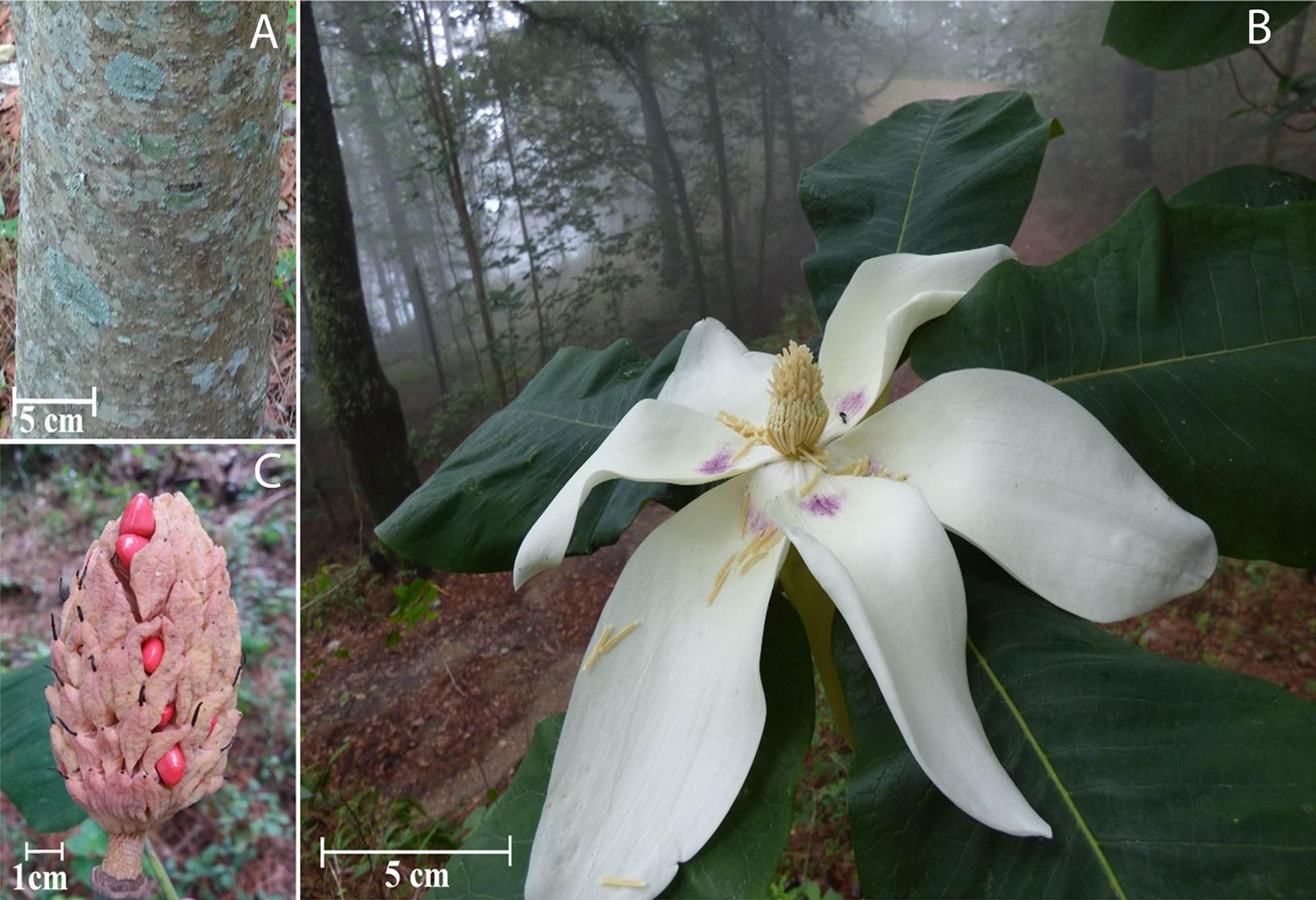
Figure 1
Morphological characteristics of Magnolia alejandrae: bark (A), flower (B) and fruit (C). Photo credit: SIGY.
Morphological characteristics of Magnolia alejandrae: bark (A), flower (B) and fruit (C). Photo credit: SIGY.
The seeds have a three-layer coat, the outer one is bright reddish and rugose-striate and is called sarcotesta (presumably a bird dispersal syndrome), fleshy and with persistent oily scents that make it impermeable to water and gas exchange, protective from some diseases and predators and containing germination inhibitors; the middle hardcover, called sclerotesta, is bony blackish and provides mechanical protection; the inner coat, a thin membrane, surrounds the endosperm, including a rudimentary embryo (Callaway 1994, Vásquez-Morales et al. 2010, Vázquez-García et al. 2021a) (Figure 1C).
-
Callaway 1994The world of magnolias, 1994
-
Vásquez-Morales et al. 2010Las semillas de la magnoliaLa Ciencia y el Hombre, 2010
-
Vázquez-García et al. 2021aHow to save endangered magnolias? From population biology to conservation action: The case of allopatric radiation in western MexicoEndangered Plants, 2021
Magnolia alejandrae is similar to all other eight members of section Macrophylla including the newly described M. mixteca A. Vázquez & Domínguez-Yescas and M. zotictla A. Sánch.-Gonz., Gut.-Lozano & A. Vázquez (Sánchez-González et al. 2021, Vázquez-García et al. 2021b) in having a deciduous habit, short longevity (ca. 75 years), giant flowers and large (abaxially glaucous leaves). Its morphologically closest species is M. nuevoleonensis A. Vázquez & Domínguez-Yescas (García-Morales et al. 2017) and recent molecular evidence from a multi-gen approach (Ibarra-Martínez 2020) and microsatellites (Chávez-Cortázar et al. 2021) support a close relationship between these two taxa, despite their results including a clear geographic structure, high genetic differentiation and fine-scale genetic structure supporting allopatric speciation for these species, the latter authors suggest that all five Mexican members of Magnolia sect. Macrophylla are conspecific. Here, we adopt the species concept used by de Queiroz (1998, 2007), also in agreement with García-Morales et al. (2017) in that Magnolia alejandrae differs morphologically from M. nuevoleonensis in having larger flowers, a brighter and much wider purple petal spot, and narrower fruits.
-
Sánchez-González et al. 2021Magnolia zotictla (Magnolia sect. Macrophylla, Magnoliaceae): a new species from the southern Sierra Madre Oriental, MéxicoPhytotaxa, 2021
-
Vázquez-García et al. 2021bCorncob flower, Magnolia mixteca (M. sect. Macrophylla, Magnoliaceae): a new species endemic to the Alto Balsas Basin (Baja Mixteca), in the Pacific slopes of Oaxaca, MexicoPhytotaxa, 2021
-
García-Morales et al. 2017Nomenclatural remarks on Magnolia sect. Macrophylla (Magnoliaceae), with description of a new species from North America (Tamaulipas, Mexico)Phytotaxa, 2017
-
Ibarra-Martínez 2020Relaciones filogenéticas y filogeografía de Magnolia sect. Macrophylla en México, 2020
-
Chávez-Cortázar et al. 2021Conservation genetics of relict tropical species of Magnolia (section Macrophylla)Conservation Genetics, 2021
-
de Queiroz (1998The general lineage concept of species, species criteria, and the process of speciation: A conceptual unification and terminological recommendationsEndless forms: Species and speciation, 1998
-
2007)Species concepts and species delimitationSystematic Biology, 2007
-
García-Morales et al. (2017)Nomenclatural remarks on Magnolia sect. Macrophylla (Magnoliaceae), with description of a new species from North America (Tamaulipas, Mexico)Phytotaxa, 2017
Seed collection sites. We collected seeds of M. alejandrae from two population provenances in the Sierra Madre Oriental in Tamaulipas. The first population site was El Farallón (23° 52' 03.90" N; 99° 23' 21.31" W) at 1,655 m asl, in the Altas Cumbres Natural Protected Area of the Jaumave municipality; the second is at Los San Pedros (23° 57' 26.63" N; 99° 28' 41.21" W) at 2,050 m asl, in the Güémez municipality. The climate at both sites is sub-humid temperate, with an average annual temperature of 17.4 °C and annual rainfall of 800-1,200 mm, in pine and oak forest (Fick & Hijmans 2017).
-
Fick & Hijmans 2017WorldClim 2: New 1‐km spatial resolution climate surfaces for global land areasInternational Journal of Climatology, 2017
We collected seeds in May and June, 2019, when the fruits were ripe but before dehiscence to avoid losing the seeds. We collected three fruits, pest and disease-free, from each of 30 randomly distributed M. alejandrae trees in each one of the two sites, specially avoiding those frequently damaged by the leaf-footed bug, L. dilaticollis (Gallardo-Yobal et al. 2020). Distance between M. alejandrae trees was a minimum of 50 m and a maximum of 100 m in the two study sites. The fruits were placed in paper bags, labeled and transported to the laboratory for drying. They were placed on an aluminum table at room temperature to allow the follicles containing the seed to open, preventing them from being rendered unviable from excess heat, since Magnolia seeds are recalcitrant (Del Tredici 1981). Follicles dehisced within three days. Subsequently, the seeds were immersed in water for 24 hr to facilitate removal of the sarcotesta by wrapping with a plastic mesh until the sclerotesta was exposed.
-
Gallardo-Yobal et al. 2020Leptoglossus dilaticollis Guérin-Méneville (Hemiptera: Coreidae) occurrence on Magnolia alejandrae García-Mor. & Iamonico (Magnoliaceae) in Northeast MexicoProceedings of the Entomological Society of Washington, 2020
-
Del Tredici 1981Magnolia virginiana in MassachusettsArnoldia, 1981
Experiment design. We obtained a work sample from the batch of seeds from each study site using International Seed Testing Association (ISTA 2017) methodology. Twenty seeds were placed in each 9 cm Petri dish, with five repetitions for each light treatment (100 seeds × treatment), for two temperature treatments and two study sites, having a total of 1,600 seeds. All seeds were disinfected with 5 % bleach for 15 min and then washed and immersed in running water for 24 hr, before being removed and placed on layers of cotton moistened with distilled water under cold stratification (5 ºC) for seven days.
-
ISTA 2017ISTA, 2017
We performed a cold stratification as recommended by Evans et al. (1933) to break seed dormancy, and the temperature used in the stratification of M. alejandrae matched that of in situ provenance. Once we completed this process, we exposed the seeds from each population site to four light quality treatments: red, far-red, white and dark. For the red-light simulation, we covered the Petri dishes with red (Lee, number 071) filters; and for the far-red with overlapping red and blue (Lee, number 182) filters. We used the definition by Tsuboi et al. (2012) and González de León et al. (2021) to delimit the red light (650-670 nm) and far-red (730-750 nm), whose ratios were 7.22 and 0.12, respectively. We determined the light quality by spectroradiometer LI-180 (Lincoln, LI-COR, EUA). The seed dishes being subjected to darkness were covered with aluminum to prevent light from entering. Finally, for the white light treatment, we exposed the dishes to unfiltered direct light. We used water agar (Meyer©) at 5 % as substrate and sealed the Petri dishes with parafilm. We exposed the seeds of each population and each light treatment to two temperature levels: in chamber I (Luministell©, model IES-OS, México), the temperature was constant at 18 °C with a 12-hr photoperiod, while the temperature in chamber II (Luministell©, model ICP-O9, México) fluctuated between 8 ºC and 18 ºC with a 12-hr photoperiod. This temperature range represents the variations that occurs in the study sites (Fick & Hijmans 2017). Each chamber was equipped with white and cold light lamps of 32 W (Phillips©). Daily recorded germinated seeds under white light except those under red, far-red and darkness treatments, recorded towards the end of the experiment (44 days after seeding). A seed was considered to have germinated when the radicle was visible (Finch-Savage & Leubner-Metzger 2006).
-
Evans et al. (1933)Germination behavior of Magnolia grandifloraBotanical Gazette, 1933
-
Tsuboi et al. (2012)Red light-induced phytochrome relocation into the nucleus in adiantum capillus-venerisMolecular Plant, 2012
-
González de León et al. (2021)Germination of an invasive fern responds better than native ferns to water and light stress in a Mexican cloud forestBiological Invasions, 2021
-
Fick & Hijmans 2017WorldClim 2: New 1‐km spatial resolution climate surfaces for global land areasInternational Journal of Climatology, 2017
-
Finch-Savage & Leubner-Metzger 2006Seed dormancy and the control of germination: Tansley reviewNew Phytologist, 2006
We calculated final germination percentage as:
e1
n
N
×
100
(1)
where n is the number of germinated seeds and N is the total number of seeds. We calculated the speed of seed germination under white light based on Kotowski’s coefficient of velocity:
e2
K
C
V
=
Σ
n
i
t
i
×
100
(2)
where ni is the number of germinated seeds in the day i, and ti is the number of days after seeding. KCV takes values from 0 to 100; high values represent a high germination velocity (González-Zertuche & Orozco-Segovia 1996). We calculated the time to reach 50 % germination (t50) according to Grime et al. (1981).
-
González-Zertuche & Orozco-Segovia 1996Métodos de análisis de datos en la germinación de semillas, un ejemplo: Manfreda brachystachyaBoletin de la Sociedad Botánica de Mexico, 1996
-
Grime et al. (1981)A comparative study of germination characteristics in a local floraThe Journal of Ecology, 1981
Statistical analyses. We analyzed the data in R version 4.0.4 (R Core Team 2021). Effects of light quality (white, red, far-red, and dark), site (El Farallón and Los San Pedros) and temperature (18/18 °C and 8/18 °C) on germination probability were analyzed using generalized linear models (GLM) with a quasibinomial distribution to correct overdispersion and a logit link function (Crawley 2007) using “lme4” package (Bates et al. 2015). We corroborated the absence of multicollinearity between variables by the variance inflation factor (VIF) function of the “car” package (Fox & Weisberg 2019). We applied the analysis of variance (ANOVA) by Wald test to determine the significance of each factor (light quality, site and temperature) and their interaction on the germination (Dunn & Smyth 2018), and subsequently multiple means comparisons (Holm, P ˂ 0.05) to evaluate possible differences between pair light quality treatments. Holm's method is an adjustment to the p-value used in multiple hypothesis tests to prevent false statistical inferences (Holm 1979).
-
R Core Team 2021R: A language and environment for statistical computing, 2021
-
Crawley 2007The R BookStatistical Papers, 2007
-
Bates et al. 2015Fitting linear mixed-effects models using lme4Journal of Statistical Software, 2015
-
Fox & Weisberg 2019An R Companion to Applied Regression, 2019
-
Dunn & Smyth 2018Generalized Linear Models: InferenceGeneralized Linear Models with examples in R, 2018
-
Holm 1979A simple sequentially rejective multiple test procedureScandinavian Journal of Statistics, 1979
We applied a two-way analysis of variance (ANOVA) to test the effect of temperature (two levels) and population provenance (two levels) on germination velocity and germination at t50 of M. alejandrae seeds under the white light treatment. We checked normality using the Shapiro-Wilk test.
Results
The three-way ANOVA indicated that the percentage of germination did not differ significantly among temperature, light quality, and population site combinations (P > 0.05; Table 1). However, the light quality and temperature factors had a significant effect on the germination of M. alejandrae (P < 0.05; Table 1), where dark and far-red treatments showed a negative impact on germination, and the temperature of 8/18 °C had the highest positive effect (Table 2). The population provenances and the interaction of factors studied had no significant outcome on the germination of M. alejandrae (P > 0.05; Table 1 and 2). The light quality explained more variance (70.6 %) on seed germination, than temperature (1.7 %) (Table 3). M. alejandrae seeds from each population presented a similar germination pattern under different light quality (Figure 2), the highest germination occurring under white light (~70 %), followed by red light (45 %), far-red (9 %) and darkness (~5 %). Multi-comparison tests showed significant differences among all pairs of light quality treatments (P < 0.001, Table 4).
Table 1
Three-way analysis of variance to estimate the effect of temperature, light quality, population site and their interaction on percentage of germination of Magnolia alejandrae. The significance P value of the Wald test was < 0.05.
Three-way analysis of variance to estimate the effect of temperature, light quality, population site and their interaction on percentage of germination of Magnolia alejandrae. The significance P value of the Wald test was < 0.05.
| Df | Chisq | Pr(> Chisq) | |
|---|---|---|---|
| (Intercept) | 1 | 0.070 | 0.790 |
| Light quality (Lq) | 3 | 139.042 | ˂ 0.001 |
| Population site (Ps) | 1 | 0.080 | 0.777 |
| Temperature (T) | 1 | 4.116 | 0.042 |
| Lq × Ps | 3 | 0.298 | 0.960 |
| Lq × T | 3 | 0.963 | 0.810 |
| Ps × T | 1 | 0.001 | 0.970 |
| Lq × Ps × T | 3 | 2.612 | 0.455 |
Table 2
GLM model with quasibinomial distribution on germination of Magnolia alejandrae under different light quality, population site, and temperature regimes. The white light, El Farallón and 18/18 °C are not listed as coefficients because they were used as reference points for the model. The significance P value was < 0.05.
GLM model with quasibinomial distribution on germination of Magnolia alejandrae under different light quality, population site, and temperature regimes. The white light, El Farallón and 18/18 °C are not listed as coefficients because they were used as reference points for the model. The significance P value was < 0.05.
| Estimate | t value | Pr(> |t|) | |
|---|---|---|---|
| Intercept | 0.031 | 0.265 | 0.791 |
| Dark | -2.508 | -9.825 | ˂ 0.001 |
| Red light | -0.523 | -3.01 | ˂ 0.001 |
| Far-red light | -1.756 | -8.498 | ˂ 0.001 |
| Los San Pedros | 0.048 | 0.283 | 0.778 |
| 8/18 ºC | 0.348 | 2.029 | 0.046 |
| Dark × Los San Pedros | 0.096 | 0.274 | 0.784 |
| Red light × Los San Pedros | -0.022 | -0.093 | 0.925 |
| Far-red light × Los San Pedros | 0.114 | 0.398 | 0.692 |
| Dark × 8/18 ºC | -0.348 | -0.964 | 0.338 |
| Red light × 8/18 ºC | -0.107 | -0.44 | 0.661 |
| Far-red light × 8/18 ºC | -0.126 | -0.442 | 0.659 |
| Los San Pedros × 8/18 ºC | 0.009 | 0.037 | 0.97 |
| Dark × Los San Pedros × 8/18 ºC | 0.597 | 1.236 | 0.22 |
| Red light × Los San Pedros × 8/18 ºC | 0.127 | 0.37 | 0.712 |
| Far-red light × Los San Pedros × 8/18 ºC | -0.231 | -0.573 | 0.568 |
Table 3
Percentage of contribution of each variable on the germination of Magnolia alejandrae.
Percentage of contribution of each variable on the germination of Magnolia alejandrae.
| DF | Sum Sq | Percentage of contribution | F values | Pr(> F) | |
|---|---|---|---|---|---|
| Light quality (Lq) | 3 | 62.845 | 70.63 | 57.793 | ˂0.001 |
| Population site (Ps) | 1 | 0.029 | 0.03 | 0.080 | 0.778 |
| Temperature (T) | 1 | 1.498 | 1.68 | 4.132 | 0.046 |
| Lq × Ps | 3 | 0.108 | 0.12 | 0.099 | 0.959 |
| Lq × T | 3 | 0.349 | 0.39 | 0.321 | 0.810 |
| Ps × T | 1 | 0.001 | 0 | 0.001 | 0.970 |
| L × Ps × T | 3 | 0.95 | 1.07 | 0.873 | 0.459 |
| Residuals | 64 | 23.198 | 26.07 |
Thumbnail
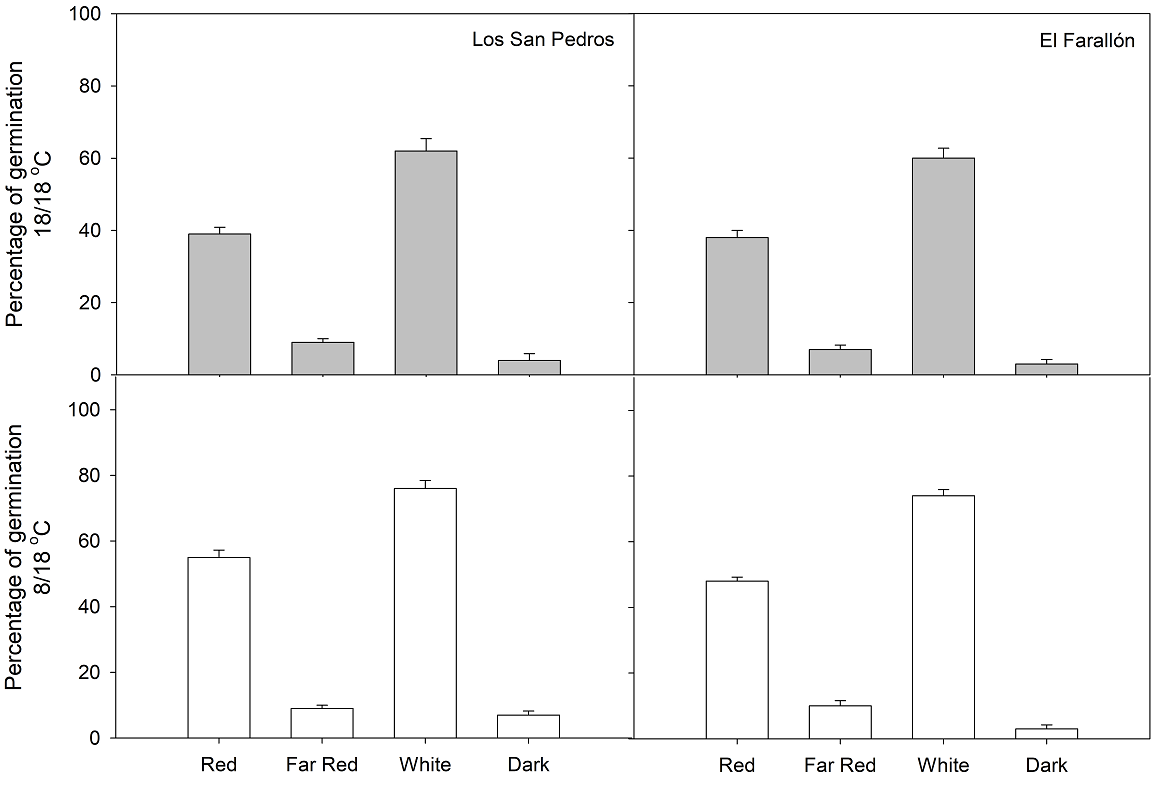
Figure 2
Germination percentage of Magnolia alejandrae under red, far-red, white and dark light. The seeds come from two populations: El Farallón and Los San Pedros, Tamaulipas.
Germination percentage of Magnolia alejandrae under red, far-red, white and dark light. The seeds come from two populations: El Farallón and Los San Pedros, Tamaulipas.
Table 4
Paired comparisons of light quality on germination of Magnolia alejandrae. The significance P value was < 0.001.
Paired comparisons of light quality on germination of Magnolia alejandrae. The significance P value was < 0.001.
| Contrast | Estimate | z value | Pr(> |z|) | ||
|---|---|---|---|---|---|
| White | - | Dark | 2.4849 | 20.558 | ˂ 0.001 |
| White | - | Red | 0.5535 | 6.413 | ˂ 0.001 |
| White | - | Far red | 1.8207 | 18.07 | ˂ 0.001 |
| Dark | - | Red | -1.9314 | -15.956 | ˂ 0.001 |
| Dark | - | Far red | -0.6643 | -5.042 | ˂ 0.001 |
| Red | - | Far red | 1.2671 | 12.551 | ˂ 0.001 |
The germination velocity of the seeds of M. alejandrae and the number of days to 50 % of germination (t50) were influenced by the interaction of the site and temperature (F (1, 16) = 22.7, P < 0.05; F (1, 16) = 19.6, P < 0.05, respectively; Table 5).
Table 5
Germination velocity and germination at t50 of Magnolia alejandrae under white light and constant temperature (18/18 ºC) and fluctuating temperature (8/18 ºC). Different letters mean significant differences between temperature treatments and population sites for each variable analyzed, P < 0.05.
Germination velocity and germination at t50 of Magnolia alejandrae under white light and constant temperature (18/18 ºC) and fluctuating temperature (8/18 ºC). Different letters mean significant differences between temperature treatments and population sites for each variable analyzed, P < 0.05.
| 18/18 ºC | 8/18 ºC | |
|---|---|---|
| Germination speed (%) | ||
| El Farallón | 2.39 ± 0.01 b | 2.40 ± 0.01 b |
| Los San Pedros | 2.36 ± 0.01 c | 2.42 ± 0.01 a |
| t50 (days) | ||
| El Farallón | 37.67 ± 0.15 b | 37.60 ± 0.23 b |
| Los San Pedros | 39.26 ± 0.46 a | 36.72 ± 0.13 b |
Germination was epigeal, and sclerotesta rupture occurred on day 31st; the seedlings remained alive for 44 days after seeding and presented high mortality at 50 days. A lapse of 10 days occurred between the emergence of the first radicles to the formation of the seedling, during which the first leaves, anchor roots and secondary roots appeared, as well as the presence of photosynthetic tissue (Figure 3).
Thumbnail
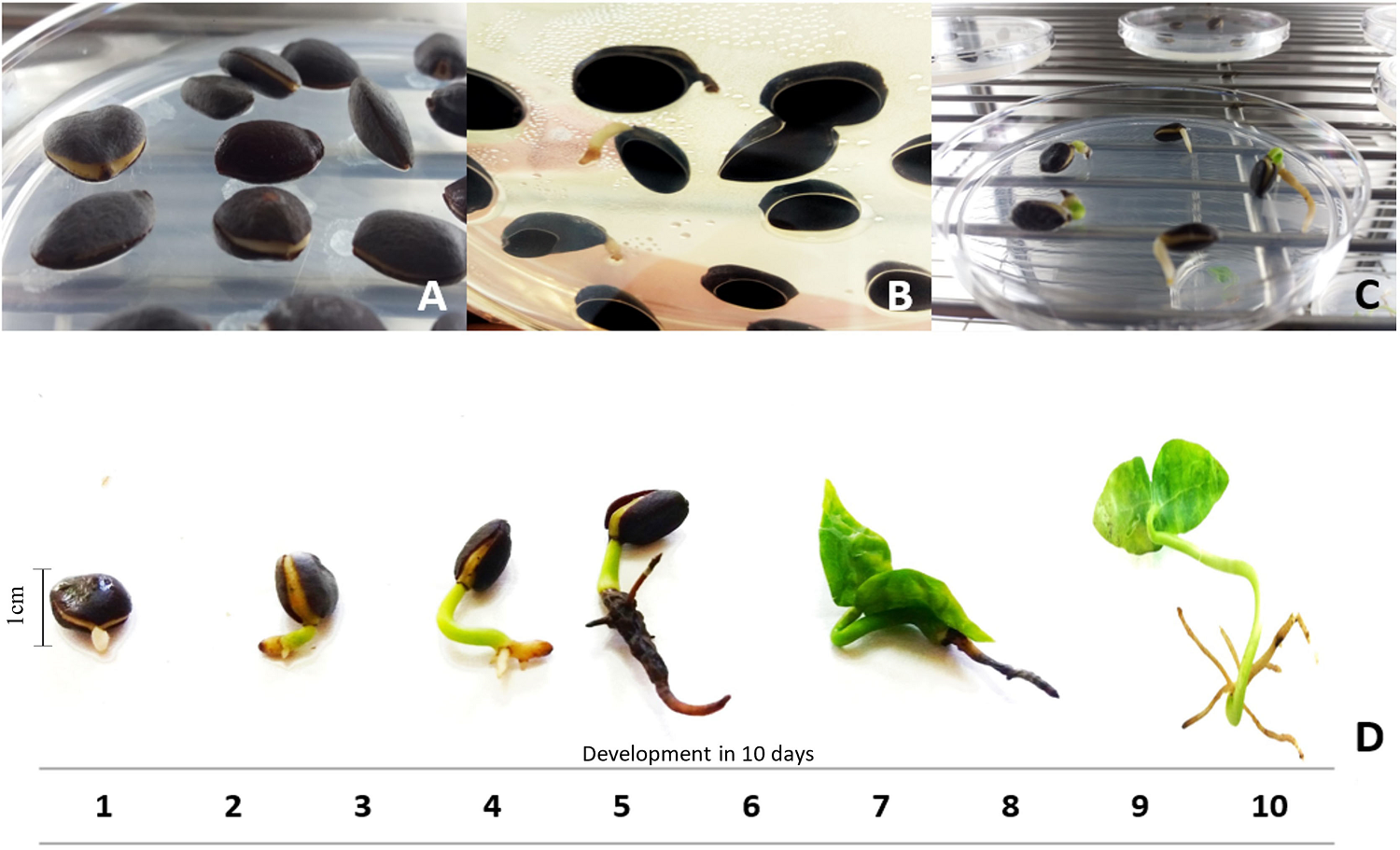
Figure 3
Development of Magnolia alejandrae seedlings in a period of 10 days under white light: A) Rupture of the sclerotesta (31 days after sowing), B) Emergence of the first radicles (epigeal germination), C) Growth of radicle and formation of the first secondary roots (shows photosynthetic tissue), and D) Seedling 10 days old, from germination (44 days).
Development of Magnolia alejandrae seedlings in a period of 10 days under white light: A) Rupture of the sclerotesta (31 days after sowing), B) Emergence of the first radicles (epigeal germination), C) Growth of radicle and formation of the first secondary roots (shows photosynthetic tissue), and D) Seedling 10 days old, from germination (44 days).
Discussion
Light quality and temperature had a significant effect on the germination of M. alejandrae in agreement with our hypothesis. Seeds germinated more under white light (76 %) than in darkness (˂ 5 %), hence this species can be classified in category 3 (seeds that have higher percentage of germination in light than in darkness) according to Baskin & Baskin (2014). Moreover, M. alejandrae seeds can be considered neutral photoblastic or non-photoblastic, in which seed germinate both in the dark and under white light (Fenner & Thompson 2005, Flores et al. 2016). The neutral photoblastism of M. alejandrae coincides with Magnolia officinalis Rehder & E.H.Wilson (Zhou et al. 2012), and the species M. kobus and M. obovate, which are indifferent to light quality (Xia et al. 2016).
-
Baskin & Baskin (2014)Seeds: ecology, biogeography, and evolution of dormancy and germination, 2014
-
Fenner & Thompson 2005The Ecology of Seeds, 2005
-
Flores et al. 2016Effect of light on seed germination and seedling shape of succulent species from MexicoJournal of Plant Ecology, 2016
-
Zhou et al. 2012Effects of temperature, light, nutrients and smoke-water on seed germination and seedling growth of Astragalus membranaceus, Panax notoginseng and Magnolia officinalis - highly traded Chinese medicinal plantsSouth African Journal of Botany, 2012
-
Xia et al. 2016Interaction of seed size with light quality and temperature regimes as germination cues in 10 temperate pioneer tree speciesFunctional Ecology, 2016
The high percentage of germination of M. alejandrae seeds under white light suggests that this species could take advantage of the forest gaps to germinate, indicating that this species responds as a pioneer species (Fenner & Thompson 2005). Moreover, pioneer seed species are stimulated by an increased range of temperature fluctuation that occurs in large canopy gaps (Pearson et al. 2002). In contrast, the low germination in the darkness of M. alejandrae seeds is probably a reflection of its adaptive capacity to ensure seed germination under forest litter, where other tree species such as Liquidambar styraciflua L. and Pinus sp. protect the Magnolia spp. seedlings from exposure to direct sunlight, avoiding desiccation (Ramírez-Bamonde et al. 2005, Arrieta & Suárez 2006).
-
Fenner & Thompson 2005The Ecology of Seeds, 2005
-
Pearson et al. 2002Germination ecology of neotropical pioneers: Interacting effects of environmental conditions and seed sizeEcology, 2002
-
Ramírez-Bamonde et al. 2005Seedling survival and growth of three species of mountain cloud forest in Mexico, under different canopy treatmentsNew Forests, 2005
-
Arrieta & Suárez 2006Scots pine (Pinus sylvestris L.) plantations contribute to the regeneration of holly (Ilex aquifolium L.) in mediterranean central SpainEuropean Journal of Forest Research, 2006
In the field, light received by seeds has a direct effect on temperature and water availability that affect germination. Fluctuation temperature (8/18 ºC) enhanced germination of M. alejandrae seeds from the two studied populations (Table 2) and increase percent germination in tropical species (Pearson et al. 2002), including Magnolia species (Xia et al. 2016); this suggests that fluctuating temperatures can stimulate germination of tropical pioneer species in large-canopy gaps, even when seeds buried beneath the soil litter (Pearson et al. 2002).
-
Pearson et al. 2002Germination ecology of neotropical pioneers: Interacting effects of environmental conditions and seed sizeEcology, 2002
-
Xia et al. 2016Interaction of seed size with light quality and temperature regimes as germination cues in 10 temperate pioneer tree speciesFunctional Ecology, 2016
-
Pearson et al. 2002Germination ecology of neotropical pioneers: Interacting effects of environmental conditions and seed sizeEcology, 2002
The use of low temperatures (4 to -1 ºC) during seed stratification and subsequent exposure to constant temperatures from 20 to 28 ºC promotes germination in some species, such as Magnolia punduana and M. champaca belonging to the Magnolia sect. Michelia, a group consisting of species confined to tropical Asia (Silvertown 1999, Fernando et al. 2013, Iralu & Upadhaya 2016). Nevertheless, in our study, the prior stratification and the subsequent exposure of the seeds to temperature fluctuation increased the percent germination of M. alejandrae. Exposure to cold and warm periods is a process that occurs naturally in forest species. Species such as the Fabaceae, inhabiting pine and oak forests, are found in environments susceptible to frost and generally present physiological dormancy (Jurado & Flores 2005). Temperature is a primary factor to stimulate germination and regulate changes in the state of dormancy (Vleeshouwerset al. 1995,Benech-Arnoldet al. 2000). The low temperatures in the high mountains of the Sierra Madre Oriental could facilitate the germination of M. alejandrae seeds during fall, but field experiments are needed to prove this hypothesis. This low temperature could also facilitate assisted migration to immediately higher elevations as shown in Magnolia vovidesii (also a member of sect. Macrophylla), having an increase in relative growth rates and survival for saplings, and could become a promising conservation strategy for cloud forest trees to mitigate the impacts of climate change (García-Hernández & Toledo-Aceves 2020).
-
Silvertown 1999Seed ecology, dormancy, and germination: A modern synthesis from Baskin and BaskinAmerican Journal of Botany, 1999
-
Fernando et al. 2013Identifying dormancy class and storage behaviour of champak (Magnolia champaca) seeds, an important tropical timber treeJournal of the National Science Foundation of Sri Lanka, 2013
-
Iralu & Upadhaya 2016Dormancy, storability, and germination of seeds in Magnolia punduana (Magnoliaceae)Botany, 2016
-
Jurado & Flores 2005Is seed dormancy under environmental control or bound to plant traits?Journal of Vegetation Science, 2005
-
Vleeshouwerset al. 1995Redefining seed dormancy: An attempt to integrate physiology and ecologyThe Journal of Ecology, 1995
-
Benech-Arnoldet al. 2000Environmental control of dormancy in weed seed banks in soilField Crops Research, 2000
-
García-Hernández & Toledo-Aceves 2020Is there potential in elevational assisted migration for the endangered Magnolia vovidesii?Journal for Nature Conservation, 2020
Several works on Magnolia germination have used treatments to break dormancy, including imbibition, cold moist stratification, acid (chemical) and mechanical scarification, the use of hydrogen peroxide and even hormones such as gibberellic acid (GA3) (Saldaña-Acosta et al. 2001, Corral-Aguirre & Sánchez-Velásquez 2006, Vásquez-Morales & Sánchez-Velásquez 2011, Iralu & Upadhaya 2016, Jacobo-Pereira et al. 2016, Vásquez-Morales & Ramírez-Marcial 2019). However, this study shows that M. alejandrae seeds exposed to fluctuating temperatures (8/18 ºC) enhanced the percentage of germination in comparison to 18/18 ºC.
-
Saldaña-Acosta et al. 2001Germinación de Acer skutchii Rehder y Magnolia iltisiana Vázquez en la Reserva de la Biosfera Sierra de Manantlán, Jalisco, MéxicoForesta Veracruzana, 2001
-
Corral-Aguirre & Sánchez-Velásquez 2006Seed ecology and germination treatments in Magnolia dealbata: an endangered speciesFlora-Morphology, Distribution, Functional. Ecology of Plants, 2006
-
Vásquez-Morales & Sánchez-Velásquez 2011Seed ecology and pre-germinative treatments in Magnolia schiedeana Schlecht, an endangered species from MexicoJournal of Food, Ecology and Agriculture, 2011
-
Iralu & Upadhaya 2016Dormancy, storability, and germination of seeds in Magnolia punduana (Magnoliaceae)Botany, 2016
-
Jacobo-Pereira et al. 2016Germinación de semillas de Magnolia pugana (Magnoliaceae), especie endémica y en peligro de extinción del occidente de MéxicoBotanical Sciences, 2016
-
Vásquez-Morales & Ramírez-Marcial 2019Seed germination and population structure of two endangered tree species: Magnolia perezfarrerae and Magnolia sharpiiBotanical Sciences, 2019
Evans (1933) used fluctuating temperatures to germinate Magnolia grandiflora L., obtaining 10 % of seeds germination below 29 °C, while 40 % germination under alternating temperatures of 10/23 ºC. The international rules for seed testing (AOSA 2017), recommend 45 days of pre-chilling followed by alternating temperatures of 20/30 °C for M. grandiflora. For other species, such as M. officinalis, with alternated temperatures of 25/30 ºC, achieve 59 % germination, while temperatures of 20/30 ºC achieved 65 % germination (Xiao 2010). These results are similar to those reported for M. alejandrae under constant temperature (18/18 °C) that reached 62 % germination.
-
Evans (1933)Germination behavior of Magnolia grandifloraBotanical Gazette, 1933
-
AOSA 2017Rules for testing seeds, 2017
-
Xiao 2010Seed germinating characteristics of endangered plant Magnolia officinalisChina Journal of Chinese Matera Medica, 2010
The germination of M. alejandrae seeds began at 31 days after seeding, reaching the seedling stage at 44 days (Figure 3). In other species of the genus Magnolia, variations have been found in the number of days to onset germination. For example, the seeds of M. grandiflora germinate after 60 days of storage in vermiculite (Hanchey & Kimbrough 1954); Magnolia perezfarrerae A. Vázquez & Gómez-Domínguez in 75 days; Magnolia sharpii Miranda in 45 days (Vásquez-Morales & Ramírez-Marcial 2019) and M. punduana in 212 days (Iralu & Upadhaya 2016). Magnolia alejandrae germinates in fewer days than the previously mentioned Magnolia species, may be as a mechanism to reduce desiccation mortality (Yirdaw & Leinonen 2002).
-
Hanchey & Kimbrough 1954Magnolia grandiflora seed germination testsProceedings, 1954
-
Vásquez-Morales & Ramírez-Marcial 2019Seed germination and population structure of two endangered tree species: Magnolia perezfarrerae and Magnolia sharpiiBotanical Sciences, 2019
-
Iralu & Upadhaya 2016Dormancy, storability, and germination of seeds in Magnolia punduana (Magnoliaceae)Botany, 2016
-
Yirdaw & Leinonen 2002Seed germination responses of four afromontane tree species to red/far-red ratio and temperatureForest Ecology and Management, 2002
Rapid germination is a good indicator to assess the speed of occupation of a species in a given environment (Ferreira et al. 2001). In this respect, the germination at t50 of M. alejandrae was influenced by temperature and site interaction, having significant differences between population provenance under constant temperature treatment, with an average of 38.4 days. In the case of M. vovidesii, it takes 39.4 days to germinate 50 % of the seeds (Toledo-Aceves 2017), matching that of M. alejandrae in the Los San Pedros population under constant temperature but is higher than the seeds from El Farallón in the two temperature treatments (Table 5). Similarly, species from the tropical montane cloud forest, such as Carpinus caroliniana Walt., require 36.5 days to germinate 50 % of the seeds after being stored for two months, matching the results for M. alejandrae under fluctuating temperatures. Other species, like L. styraciflua, require only 5.5 days to germinate 50 % of the seeds (Linera & Pérez 2005), reflecting the capacity of the species from the tropical montane cloud forest to use environmental resources differentially.
-
Ferreira et al. 2001Germinação de sementes de Asteraceae nativas no Rio Grande do Sul, BrasilActa Botanica Brasilica, 2001
-
Toledo-Aceves 2017Germination rate of endangered cloud forest trees in Mexico: Potential for ex situ propagationJournal of Forest Research, 2017
-
Linera & Pérez 2005Microhabitat conditions for germination and establishment of two tree species in the mexican montane cloud forestAgrociencia, 2005
In summary, we demonstrate that 1) Magnolia alejandrae seeds are neutral photoblastic and 2) light quality and fluctuating temperatures have a direct effect on germination; this is relevant in understanding how environmental factors, such as temperature and light, influence the initial stage of seed development. The environmental factors required for germination vary from one species to another, hence, being relevant to recognize the abiotic and biotic factors necessary for seed germination to determine the type of dormancy a species presents; likewise, microclimatic requirements are fundamental for the seeds to become established since these directly influence the obtaining of seedlings for population recovery. However, further ecophysiological studies of Magnolia alejandrae seeds are needed, such as the embryo/endosperm relationship, rupture of the sclerotesta, successful in situ germination, establishment, and survival.
Acknowledgments
The authors are thankful to the Autonomous University of Tamaulipas for financing of the project (PFI2015-03) granted to FRZ and PFI2016-EB-41 to ERM. SIGY was recipient of a Ph.D. fellowship by National Council for Science and Technology, Mexico (449249).
Literature cited
- AOSA [Association of Official Seed Analysts]. 2017. Rules for testing seeds. 270 pp. https://analyzeseeds.com/wp-content/uploads/2018/03/2017-AOSA-Rules-Volume-3.pdf (accessed March 14, 2021). Links
- Arrieta S, Suárez F. 2006. Scots pine (Pinus sylvestris L.) plantations contribute to the regeneration of holly (Ilex aquifolium L.) in mediterranean central Spain.European Journal of Forest Research 125: 271-279. DOI: https://doi.org/10.1007/s10342-006-0121-y Links
- Baskin CC, Baskin JM. 1988. Germination ecophysiology of herbaceous plant species in a temperate region.American Journal of Botany75: 286-305. DOI: https://doi.org/10.2307/2443896 Links
- Baskin JM, Baskin CC. 2004. A classification system for seed dormancy.Seed Science Research14: 1-16. DOI: https://doi.org/10.1079/SSR2003150 Links
- Baskin JM, Baskin CC. 2008. Some considerations for adoption of Nikolaeva’s formula system into seed dormancy classification.Seed Science Research18: 131-137. DOI: https://doi.org/10.1017/S096025850803674X Links
- Baskin CC, Baskin JM. 2014. Seeds: ecology, biogeography, and evolution of dormancy and germination, San Diego: Elsevier Academic Press. pp. 459-557. ISBN 978-012-4166-83-7 Links
- Bates D, Mächler M, Bolker B, Walker S. 2015. Fitting linear mixed-effects models using lme4.Journal of Statistical Software 67: 1-48. DOI: https://doi.org/10.18637/jss.v067.i01 Links
- Benech-Arnold RL, Sánchez RA, Forcella F, Kruk BC, Ghersa CM. 2000. Environmental control of dormancy in weed seed banks in soil.Field Crops Research 67: 105-122. DOI: https://doi.org/10.1016/S0378-4290(00)00087-3 Links
- Bewley JD, Black M. 1994.Seeds: Physiology of development and germination. New York: Plenum Press. DOI: https://doi.org/10.1007/978-1-4899-1002-8 Links
- Bewley JD, Bradford KJ, Hilhorst HWM, Nonogaki H. 2013. Germination. In: Bewley JD, Bradford KJ, Hilhorst HWM, Nonogaki H, eds. Seeds. Physiology of development, Germination and Dormancy. New York: Springer, pp. 133-182. DOI: https://doi.org/10.1007/978-1-4614-4693-4 Links
- Black P, McCormick R, Jame M, Pedder D. 2006. Learning how to learn and assessment for learning: A theoretical inquiry.Research Papers in Education 21: 119-132. DOI: https://doi.org/10.1080/02671520600615612 Links
- Bond WJ, Honig M, Maze KE. 1999. Seed size and seedling emergence: an allometric relationship and some ecological implications. Oecologia 120:120-132. DOI: https://doi.org/10.1007/s004420050841 Links
- Callaway DJ. 1994. The world of magnolias. Portland, USA: Timber Press. ISBN 978-088-1922-36-3 Links
- Chávez-Cortázar A, Oyama K, Ochoa-Zavala M, Mata-Rosas M, Veltjen E, Samain MS, Quesada M. 2021. Conservation genetics of relict tropical species of Magnolia (section Macrophylla). Conservation Genetics 22: 259-273. DOI: https://doi.org/10.1007/s10592-021-01334-5 Links
- Corral-Aguirre J, Sánchez-Velásquez LR. 2006. Seed ecology and germination treatments in Magnolia dealbata: an endangered species.Flora-Morphology, Distribution, Functional. Ecology of Plants201: 227-232. DOI: https://doi.org/10.1016/j.flora.2005.07.004 Links
- Crawley MJ. 2007. The R Book.Statistical Papers50: 445-446. DOI: https://doi.org/10.1007/s00362-008-0118-3 Links
- de Queiroz K. 1998. The general lineage concept of species, species criteria, and the process of speciation: A conceptual unification and terminological recommendations. In: De Queiroz K, Berlocher SH, eds. Endless forms: Species and speciation. New York: Oxford University Press, pp. 57-75. Links
- de Queiroz K. 2007. Species concepts and species delimitation. Systematic Biology 56: 879-886. https://doi.org/10.1080/10635150701701083 Links
- Del Tredici P. 1981. Magnolia virginiana in Massachusetts. Arnoldia 41: 36-49. Links
- Dunn PK, Smyth GK. 2018. Generalized Linear Models: Inference. In: Generalized Linear Models with examples in R. New York: Springer , pp. 265-296. DOI: https://doi.org/10.1007/978-1-4419-0118-7_7 Links
- Evans CR. 1933. Germination behavior of Magnolia grandiflora.Botanical Gazette 94: 729-754. DOI: https://doi.org/10.1086/334344 Links
- Fernando MTR, Jayasuriya KG, Walck JL, Wijetunga A. 2013. Identifying dormancy class and storage behaviour of champak (Magnolia champaca) seeds, an important tropical timber tree.Journal of the National Science Foundation of Sri Lanka41: 141-146. DOI: https://doi.org/10.4038/jnsfsr.v41i2.5708 Links
- Fenner M, Thompson K. 2005. The Ecology of Seeds. Cambridge: Cambridge University Press, DOI: https://doi.org/10.1017/CBO9780511614101 Links
- Ferreira AG, Cassol B, Rosa SGT, Silveira TS, Stival AL, Silva AA. 2001. Germinação de sementes de Asteraceae nativas no Rio Grande do Sul, Brasil. Acta Botanica Brasilica 15: 231-242. DOI: https://doi.org/10.1590/S0102-33062001000200009 Links
- Fick SE, Hijmans RJ. 2017. WorldClim 2: New 1‐km spatial resolution climate surfaces for global land areas.International Journal of Climatology 37: 4302-4315. DOI: https://doi.org/10.1002/joc.5086 Links
- Finch-Savage WE, Leubner-Metzger G. 2006. Seed dormancy and the control of germination: Tansley review.New Phytologist171: 501-523. DOI: https://doi.org/10.1111/j.1469-8137.2006.01787.x Links
- Flores J, González-Salvatierra C, Jurado E. 2016. Effect of light on seed germination and seedling shape of succulent species from Mexico.Journal of Plant Ecology. 9: 174-179. DOI: https://doi.org/10.1093/jpe/rtv046 Links
- Fox J, Weisberg S. 2019. An R Companion to Applied Regression. Thousand Oaks CA: SAGE Publications. ISBN: 978-154-4336-47-3 Links
- Galván-Hernández DM, Octavio-Aguilar P, Bartolo-Hernández C de J, García-Montes MA, Sánchez-González A, Ramírez-Bautista A, Vovides A. 2020. Current Status of Magnolia vovidesii (Magnoliaceae, Magnoniales): New data on population trends, spatial structure, and disturbance threats.Tropical Conservation Science 13: 1-12 DOI: https://doi.org/10.1177/1940082920923894 Links
- Gallegos-Mendoza SM, Ortega-Peña AS, Jacobo-Pereira C, Vázquez-García JA. 2019. Pruebas de germinación en semillas de Magnolia pacifica y M. vallartensis. Consortium for Conservation of Neotropical Magnolias. https://www.magnoliamexico2019.org/ (accessed October 16, 2021). Links
- Gallardo-Yobal SI, Chacón-Hernández JC, Reyes-Zepeda F, Vázquez-García JA, Monjarás-Barrera JI, Ordaz-Silva S, López-Sánchez IV. 2020. Leptoglossus dilaticollis Guérin-Méneville (Hemiptera: Coreidae) occurrence on Magnolia alejandrae García-Mor. & Iamonico (Magnoliaceae) in Northeast Mexico. Proceedings of the Entomological Society of Washington 122: 1011-1014. DOI: https://doi.org/10.4289/0013-8797.122.4.1011 Links
- García-Hernández MA, Toledo-Aceves T. 2020. Is there potential in elevational assisted migration for the endangered Magnolia vovidesii?Journal for Nature Conservation53: 125782. https://doi.org/10.1016/j.jnc.2019.125782 Links
- García-Morales LJ, Iamonico D, Jiménez JG. 2017. Nomenclatural remarks on Magnolia sect. Macrophylla (Magnoliaceae), with description of a new species from North America (Tamaulipas, Mexico).Phytotaxa309: 238-244. DOI: https://doi.org/10.11646/phytotaxa.309.3.4 Links
- González de León S, Briones O, Aguirre A, Mehltreter K, Pérez-García B. 2021. Germination of an invasive fern responds better than native ferns to water and light stress in a Mexican cloud forest. Biological Invasions 23: 3187-3199. DOI: https://doi.org/10.1007/s10530-021-02570-z Links
- González-Zertuche L, Orozco-Segovia A. 1996. Métodos de análisis de datos en la germinación de semillas, un ejemplo: Manfreda brachystachya. Boletin de la Sociedad Botánica de Mexico 58: 15-30. https://doi.org/10.17129/botsci.1484 Links
- Grime JP, Mason G, Curtis AV, Rodman J, Band SR. 1981. A comparative study of germination characteristics in a local flora.The Journal of Ecology69: 1017-1059. DOI: https://doi.org/10.2307/2259651 Links
- Hanchey RH, Kimbrough WD. 1954. Magnolia grandiflora seed germination tests. In: Proceedings, Association of Southern Agricultural Workers; 1954. Dallas, TX. https://www.fs.usda.gov/nsl/Wpsm%202008/M&N%20genera.pdf (accessed March 14, 2021). Links
- Holdsworth MJ, Bentsink L, Soppe WJ. 2008. Molecular networks regulating Arabidopsis seed maturation, after‐ripening, dormancy and germination.New Phytologist 179: 33-54. DOI: https://doi.org/10.1111/j.1469-8137.2008.02437.x Links
- Holm S. 1979. A simple sequentially rejective multiple test procedure. Scandinavian Journal of Statistics 6: 65-70. Links
- Ibarra-Martínez MV. 2020. Relaciones filogenéticas y filogeografía de Magnolia sect. Macrophylla en México. MSc. Thesis Universidad de Guadalajara. Links
- Iralu V, Upadhaya K. 2016. Dormancy, storability, and germination of seeds inMagnolia punduana(Magnoliaceae).Botany 94: 967-973. DOI: https://doi.org/10.1139/cjb-2016-0056 Links
- ISTA [International Rules for Seed Testing, International Seed Testing Association]. 2017. Bassersdorf, Switzerland. https://www.seedtest.org/en/home.html (accessed March 14, 2021). Links
- Jacobo-Pereira C, Romo-Campos R, Flores J. 2016. Germinación de semillas de Magnolia pugana (Magnoliaceae), especie endémica y en peligro de extinción del occidente de México.Botanical Sciences 94: 575-584. DOI: https://doi.org/10.17129/botsci.512 Links
- Jurado E, Flores J. 2005. Is seed dormancy under environmental control or bound to plant traits?Journal of Vegetation Science 16: 559-564. DOI: https://doi.org/10.1111/j.1654-1103.2005.tb02396.x Links
- Kisanuki H, Oguro H, Nakai A, Setsuko S, Nishimura N, Tomaru N. 2008. The soil seed bank of the threatened plantMagnolia stellatais subordinate to the emergence of current-year seedlings.Journal of Forest Research 13: 143-146. DOI: https://doi.org/10.1007/s10310-008-0066-8 Links
- Linera GW, Pérez RAP. 2005. Microhabitat conditions for germination and establishment of two tree species in the mexican montane cloud forest.Agrociencia 39: 457-464. Links
- Long RL, Gorecki MJ, Renton M, Scott JK, Colville L, Goggin DE, Commander LE, Westcott DA, Cherry H, Finch‐Savage WE. 2015. The ecophysiology of seed persistence: a mechanistic view of the journey to germination or demise. Biological Reviews 90: 31-59. DOI: https://doi.org/10.1111/brv.12095 Links
- Pearson TRH, Burslem DFRP, Mullins CE, Dalling JW. 2002. Germination ecology of neotropical pioneers: Interacting effects of environmental conditions and seed size.Ecology83: 2798-2807. DOI: https://doi.org/10.1890/0012-9658(2002)083[2798:GEONPI]2.0.CO;2 Links
- Pons TL. 2000. Seed responses to light. In: Fenner M. eds. Seeds: The Ecology of Regeneration in Plant Communities. Wallingford UK: CABI. pp. 237-260. DOI: https://doi.org/10.1079/9780851994321.0000 Links
- Probert RJ. 2000. The role of temperature in the regulation of seed dormancy and germination. In M Fenner, eds. Seeds: The ecology of regeneration in plant communities. Wallingford: CABI Press, pp. 261-292. DOI: https://doi.org/10.1079/9780851994321.0261 Links
- R Core Team. 2021. R: A language and environment for statistical computing. R Foundation for Statistical Computing, Vienna, Austria. URL: https://www.R-project.org Links
- Ramírez-Bamonde ES, Sánchez-Velásquez LR, Andrade-Torres A. 2005. Seedling survival and growth of three species of mountain cloud forest in Mexico, under different canopy treatments.New Forests 30: 95-101. DOI: https://doi.org/10.1007/s11056-004-5397-5 Links
- Saldaña-Acosta A, Zuloaga-Aguilar MS, Jardel E. 2001. Germinación de Acer skutchii Rehder y Magnolia iltisiana Vázquez en la Reserva de la Biosfera Sierra de Manantlán, Jalisco, México. Foresta Veracruzana 3: 1-8. Links
- Sánchez-González A, Gutiérrez-Lozano M, Domínguez-Yescas R, Hernández-Álvarez AG, Ortega-Peña AS, & Vázquez-García JA. 2021. Magnolia zotictla (Magnolia sect. Macrophylla, Magnoliaceae): a new species from the southern Sierra Madre Oriental, México.Phytotaxa513: 271-281. DOI: https://doi.org/10.11646/phytotaxa.513.4.1 Links
- Silvertown J. 1999. Seed ecology, dormancy, and germination: A modern synthesis from Baskin and Baskin.American Journal of Botany 86: 903-905. DOI: https://doi.org/10.2307/2656711 Links
- Simpson RL, Leck MA, Parker VT. 1989. Seed banks: General concepts and methodological issues. In: Leck MA, Parker VT, Simpson RL, eds. Ecology of soil seed banks. London: Academic Press, pp. 3-8. ISBN: 978-032-3148-65-8 Links
- Subbiah A, Ramdhani S, Pammenter NW, Macdonald AHH, Sershen S. 2019. Towards understanding the incidence and evolutionary history of seed recalcitrance: An analytical review.Perspectives in Plant Ecology, Evolution and Systematics 37:11-19. DOI: https://doi.org/10.1016/j.ppees.2019.01.001 Links
- Toledo-Aceves T. 2017. Germination rate of endangered cloud forest trees in Mexico: Potential forex situpropagation.Journal of Forest Research 22: 61-64. DOI: https://doi.org/10.1080/13416979.2016.1273083 Links
- Tsuboi H, Nakamura S, Schäfer E, Wada M. 2012. Red light-induced phytochrome relocation into the nucleus in adiantum capillus-veneris.Molecular Plant5: 611-618. DOI: https://doi.org/10.1093/mp/ssr119 Links
- Vásquez-Morales SG, Sánchez-Velázquez LR, Pineda-López R. 2010. Las semillas de la magnolia. La Ciencia y el Hombre 23: 37-40. Links
- Vásquez-Morales SG, Ramírez-Marcial N. 2019. Seed germination and population structure of two endangered tree species: Magnolia perezfarrerae and Magnolia sharpii.Botanical Sciences 97: 2-12. DOI: https://doi.org/10.17129/botsci.1977 Links
- Vásquez-Morales SG, Sánchez-Velásquez LR. 2011. Seed ecology and pre-germinative treatments in Magnolia schiedeana Schlecht, an endangered species from Mexico. Journal of Food, Ecology and Agriculture 99: 604-608. Links
- Vázquez-García JA, Domínguez-Yescas R, Pedraza-Ruiz R, Sánchez-González A, Muñiz-Castro MA. 2015. Magnolia rzedowskiana (Magnoliaceae), a new species of section Macrophylla from the central Sierra Madre Oriental, Mexico.Acta botánica mexicana 112: 19-36. DOI: https://doi.org/10.21829/abm112.2015.1086 Links
- Vázquez-García JA, Domínguez-Yescas R, Velazco-Macías C, Shalisko V, Merino-Santi RE. 2016a.Magnolia nuevoleonensissp. nov. (Magnoliaceae) from northeastern Mexico and a key to species of sectionMacrophylla. Nordic Journal of Botany 34: 48-53. DOI: https://doi.org/10.1111/njb.00800 Links
- Vázquez-García JA, Muñiz-Castro MÁ, Dahua-Machoa A, Osorio-Muñoz EA, Hernández-Vera G, Ortega-Peña AS, Romo-Campos RL, Jacobo-Pereira C, Álvarez de R N, Shalisko V. 2021a. How to save endangered magnolias? From population biology to conservation action: The case of allopatric radiation in western Mexico.In:Kumar, S. (Ed.),Endangered Plants .London, UK, IntechOpen. DOI: https://doi.org/10.5772/intechopen.94346 Links
- Vázquez-García JA, Neill D, Asanza M, Pérez ÁJ, Arroyo F, Dahua A, et al. 2016b. Magnolias de Ecuador: En Riesgo de Extinción. Ecuador: Universidad Estatal Amazónica. ISBN: 978-607-8328-02-4. Links
- Vázquez-García JA, Yescas RD, Luna-Vega I, Rodríguez-Ramírez EC, & Rodríguez-Pérez C. 2021b. Corncob flower, Magnolia mixteca (M. sect. Macrophylla, Magnoliaceae): a new species endemic to the Alto Balsas Basin (Baja Mixteca), in the Pacific slopes of Oaxaca, Mexico. Phytotaxa 522: 200-210. DOI: https://doi.org/10.11646/phytotaxa.522.3.3 Links
- Venable DL, Brown JS. 1988. The selective interactions of dispersal, dormancy, and seed size as adaptations for reducing risk in variable environments.The American Naturalist131: 360-384. DOI: https://doi.org/10.1086/284795 Links
- Vleeshouwers LM, Bouwmeester HJ, Karssen CM. 1995. Redefining seed dormancy: An attempt to integrate physiology and ecology.The Journal of Ecology 83: 1031-1037. DOI: https://doi.org/10.2307/2261184 Links
- Vovides AP, Iglesias CG. 1996. Seed Germination of Magnolia dealbata Zucc. (Magnoliaceae), An endangered species from Mexico,HortScience 31: 877-877. https://doi.org/10.21273/HORTSCI.31.5.877 Links
- Whitmore TC. 1996. A review of some aspects of tropical rain forest seedling ecology with suggestions for further enquiry.Man and the Biosphere Series17: 3-40. Links
- Xia Q, Ando M, Seiwa K. 2016. Interaction of seed size with light quality and temperature regimes as germination cues in 10 temperate pioneer tree species.Functional Ecology 30: 866-874. DOI: https://doi.org/10.1111/1365-2435.12584 Links
- Xiao S. 2010. Seed germinating characteristics of endangered plant Magnolia officinalis.China Journal of Chinese Matera Medica 35: 419-422. Links
- Yirdaw E, Leinonen K. 2002. Seed germination responses of four afromontane tree species to red/far-red ratio and temperature.Forest Ecology and Management168: 53-61. DOI: https://doi.org/10.1016/S0378-1127(01)00719-8 Links
- Zhou J, Kulkarni MG, Huang LQ, Guo LP, Van Staden J. 2012. Effects of temperature, light, nutrients and smoke-water on seed germination and seedling growth ofAstragalus membranaceus, Panax notoginsengandMagnolia officinalis- highly traded Chinese medicinal plants. South African Journal of Botany79: 62-70. DOI: https://doi.org/10.1016/j.sajb.2011.11.004 Links