




 texto en
  Inglés (pdf)
 Artículo en XML
 Referencias del artículo
 Traducción automática
 Enviar artículo por email
 Citado por SciELO
  Similares en
SciELO
Similares en
SciELO 
 Permalink

Introduction
The Quercus genus is highly significant because of its great diversity as well as its ecological and economic importance (Rodríguez-Trejo & García-Pascual, 2021). Mexico is home to about 170 species of Quercus (De Jesús Albino et al., 2021), with 109 of them being endemic (Ramírez-Roacho et al., 2021). These species inhabit the country's temperate and semi-humid ecosystems, as well as some tropical and subtropical regions (Rodríguez-Trejo & García-Pascual, 2021). Unfortunately, abundance and distribution of oak populations have declined due to land use changes, expansion of agriculture, livestock farming, and urbanization (Rodríguez-Acosta & Coombes, 2020), coupled with the effects of climate change such as temperature increase and precipitation reduction.
In some cases, the natural regeneration rate of oaks is low due to various factors. On one hand, the seeds are recalcitrant, sensitive to dehydration and causing them to lose viability quickly after dispersal. To maintain viability, the seeds must germinate under conditions with moisture levels above 30 %; however, this condition usually is not consistent with seed dispersal events, leading to dehydration and eventual loss of viability in less than three months (González-Salvatierra et al., 2013). Furthermore, dehydration is accelerated when acorns fall onto bare soil without leaf litter, exposing them to adverse environmental conditions such as direct sunlight and wind, which rapidly reduces their viability (Zavala-Chávez, 2004). Moreover, acorns are subject to predation, as they are an important food source for wildlife during the fall and winter (Aguilar-Peralta et al., 2016); they are also damaged in the pre-dispersal stage by pests such as weevils, moths, and borers (Díaz-Guzmán & Bonfil, 2020), which affect their germination capacity (Clark-Tapia et al., 2018). As a result of these adverse factors, percentage of acorns available and viable for regeneration is low, sometimes as little as 1 % (Barragán-Zúñiga et al., 2020).
Extending the viability of acorns represents a significant challenge in the management of oak germplasm for reproduction in nurseries. In Mexico, studies on acorn storage are limited; some of these include those conducted by Zavala-Chávez (2008) on Quercus rugosa Née and Quercus glabrescens Benth., Díaz-Pontones and Reyes-Jaramillo (2009) on Quercus hintonii Warburg, and González-Salvatierra et al. (2013) on Quercus polymorpha (Schltdl. & Cham.).
In Mexico, reforestation programs that use oaks rely on plants produced in nurseries from acorns collected in the field, ensuring their reproduction (González-Salvatierra et al., 2013). However, the conservation of acorns with viability for more than three months requires moisture levels of 30 to 50 % of the seed's fresh weight and the control of essential factors such as relative humidity, temperature, and aeration (Rodríguez-Trejo & García-Pascual, 2021). Low temperatures (1 to 7 °C) and control of gas exchange promote viability (Bonner, 2003); however, when temperatures are too low or the absence of gas exchange is total, it can lead to embryo death (Rodríguez-Trejo & García-Pascual, 2021). To promote aeration, the use of open containers or those with openings that allow air circulation is recommended (Aguilera-Rodríguez et al., 2023). Based on this, the medium in which acorns are stored is crucial, because it fulfills two functions: 1) maintaining a constant high moisture content in the seed, and 2) allowing enough oxygen diffusion to the moist seeds (Hong & Ellis, 2010).
Quercus durifolia Seemen is important in the pine-oak forests of the Sierra Madre Occidental, as the species is found in areas that are part of the transition between grasslands and pine-oak forests (González-Elizondo et al., 2012). Moreover, the wood is highly recommended for the manufacture of furniture and visible parts (moldings) of high-quality upholstered furniture, as well as to produce charcoal (García Molina, 2008). Oaks have been widely studied in relation to their ecology, conservation, and use, but little is known about acorn storage, reproduction, and reforestation aspects (Rosaliano-Evaristo et al., 2024).
In this context, information on the conservation of oak acorns remains limited; therefore, it is necessary to understand the optimal environmental conditions for storage to maintain viable seeds and produce vigorous plants with good morphological quality, in accordance with nursery quality indicators and establishment in the field for reforestation and restoration purposes. Thus, the aim of this study was to evaluate the effect of storage media, including fresh pine sawdust, perlite, peat moss, and vermiculite, on the germination capacity of Q. durifolia acorns.
Materials and Methods
Seed collection
Seeds were collected from a natural stand with predominant pine-oak vegetation, located in the ejidos of Estación Otinapa and San Carlos, Durango municipality, Durango, Mexico, at coordinates 24° 03’ 27” N and 105° 00’ 54” W, at an altitude of 2 397 m. The collection took place between October 25 and 30, 2022, from three mature trees with an average height of 12 to 15 m, spaced 150 m apart. This distance was maintained because species of the Quercus genus are prone to hybridization due to their high genetic diversity, allowing them to cross with nearby species with similar genetic traits (González-Rodríguez et al., 2004).
Collected acorns (sample of 40 acorns) had an average polar and equatorial diameter of 1.26 ± 0.2 cm and 0.81 ± 0.1 cm, respectively, measured with a Truper® digital caliper. A total of 1 492 acorns∙kg-1 were obtained, corresponding to 0.670 kg per 1 000 seeds. Moisture content (MC) on a dry weight basis was 31.2 %, calculated using the equation proposed by Liegel and Venator (1987): MC % = [(FSW - DM)/FSW] * 100; where, FSW and DM are the fresh weight and dry weight (g) of the sample, respectively. The acorns were dried in four 10 g seed samples in an oven (Ecoshel® model 9024A) at 103 °C for 17 hours; averages were estimated using the obtained values.
Treatments evaluated and storage process
This study was carried out in the multipurpose laboratory of the Faculty of Forest and Environmental Sciences at the Universidad Juárez del Estado de Durango (24° 00’ 47” N, 104° 40’ 57” W, at an altitude of 1809 m). The following storage media for acorns were evaluated: 1) fresh pine sawdust, 2) expanded perlite (Multiperl®, Grupo Perlita, Mexico), 3) peat moss (Premier®, Premier Horticulture Inc., Canada), 4) vermiculite (Hydro Environment®, Mexico), and 5) control (no substrate). The seeds collected were subjected to a flotation test in water, with those that floated being discarded (Bonner, 2003), and it was visually confirmed that they were healthy, without insect damage (such as small perforations in the pericarp).
Before storage, the seed coats and plastic containers (250 mL) were disinfected with a 10 % commercial sodium hypochlorite solution and purified water to prevent fungal damage. The seeds were immersed in the solution for 10 minutes, then rinsed with drinking water to remove any chlorine residue. Fresh pine sawdust was disinfected using the same solution, then placed in a drying oven (Ecoshel® model 9024A) at 60 °C for 24 hours. Prior to placing the seeds in the storage media, the materials were humidified with purified water, to which 1 g∙L-1 of the fungicide Thiabendazole (Tecto 60®, Syngenta, Mexico) was added to prevent fungal damage. The water was applied using a 1 L sprayer. Additionally, the amount of water retained in each substrate was measured (sawdust: 65.0 mL, perlite: 101.2 mL, peat moss: 114.4 mL, and vermiculite: 68.0 mL). Moisture was considered adequate when the particles of each material were moist but not compacted
The storage media were placed in plastic containers; a layer of substrate was first added, followed by a layer of seeds, and so on (Figure 1). In each treatment, 600 seeds were placed, distributed in four containers (replicates) with 150 seeds each. Subsequently, following the methodology proposed by Díaz-Pontones and Reyes-Jaramillo (2009), the sealed containers were stored at 5 °C.
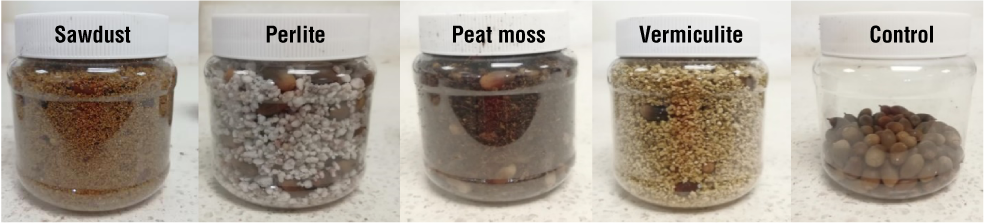
Germination test
To assess the effectiveness of the treatments, germination tests were conducted monthly over six months. In each test, 25 seeds were randomly selected from each replicate of the treatments (100 seeds per treatment). These seeds were placed on a sheet of absorbent paper and then placed in plastic bags inside a controlled environment chamber (ECOSHEL® cultivation oven, Model 9052) at 28 °C (Figure 2), following the International Rules for Seed Testing (International Seed Testing Association [ISTA], 2016). To prevent fungal attack, a fungicide solution composed of N-tricloromethylthio-4-cyclohexene-1,2-dicarboximide (Captan 50®, ADAMA, Israel) at a rate of g∙L-1 of water was applied using a 1 L sprayer. During the test, humidity was kept constant by spraying this solution.
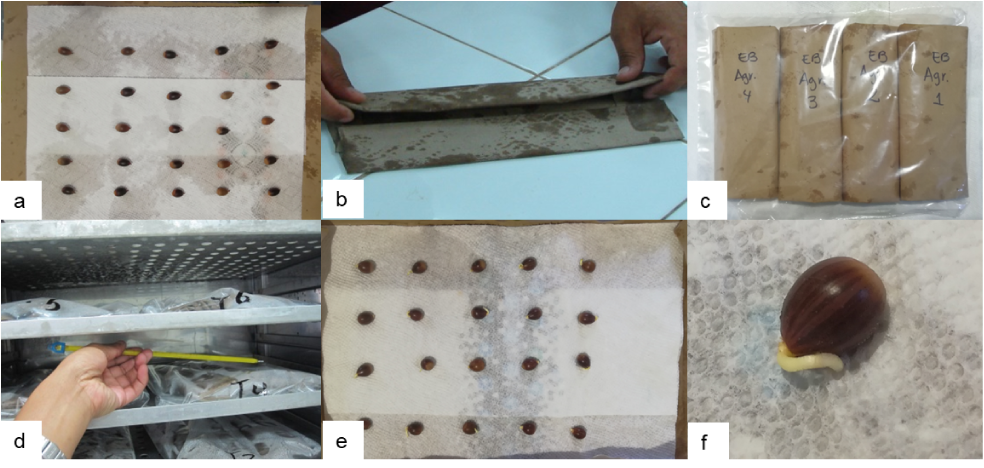
Figure 2 Germination process of Quercus durifolia acorns. a) Placing seeds on absorbent paper, b) preparing paper wrappings with moistened seeds, c) arranging wrapped seeds in plastic bags to retain moisture, d) positioning a thermometer to monitor the temperature in the germination chamber, e) counting germinated seeds, f) germinated acorn.
From the start, germination was recorded every two days for a period of 14 days, subsequently, there was no more seedling emergence. A seed was considered germinated when the radicle reached a length of at least 1 cm (ISTA, 2016), and an acorn was considered rotten when the pericarp turned black and, when split in half, the cotyledons also showed a dark brown to black color.
Response variables
The cumulative germination percentage (CGP), average of the six evaluations, was calculated using the following equation: CGP = (Number of germinated seeds /Total number of seeds) * 100. Germination speed index (GSI) was determined using the following equation: GSI = ∑(ni/ti); where, ni is the number of seeds that germinated from the first to the last day, and ti is the time in days (from the day the seeds were placed to germinate until the last evaluation day) (Maguire, 1962). Moreover, the cumulative percentage of rotten seeds was recorded over the six-month evaluation period.
Experimental design and statistical analysis
The experimental design was completely randomized with four replications (150 seeds) per treatment (600 seeds in total). Results were subjected to a non-parametric analysis of variance (Kruskal-Wallis test) due to the violation of normality and homogeneity of variance assumptions (p ≤ 0.05) assessed using the Shapiro-Wilk and Levene tests, respectively. For variables showing statistical differences, Dunn's median comparison test was performed, which follows a chi-square (X2) distribution. The analyses were conducted using the InfoStat software (InfoStat, 2020).
Results and Discussion
Temporal variation in germination
Germination of Q. durifolia acorns was statistically different (p ≤ 0.05; gl = 4; X2 = 10.3) among treatments during the monthly evaluations (Table 1). From the first month, the treatment with fresh sawdust had the highest germination rate (69 %), which decreased by only 10 % after six months of storage. In contrast, acorns stored in perlite, vermiculite, and without a substrate showed no signs of seedling emergence after sixth months. For the peat treatment, germination values ranged from 31 to 20.3 % at the end of the evaluation period.
Table 1 Germination of Quercus durifolia acorns (%) in five storage media evaluated during six months.
| Treatment | Months of storage | |||||
|---|---|---|---|---|---|---|
| 1 | 2 | 3 | 4 | 5 | 6 | |
| Control | 32.0 ± 12.5 ab | 26.0 ± 15.1 b | 25.0 ± 13.7 b | 20.0 ± 11.2 c | 4.0 ± 2.3 b | 0.0 ± 0.0 c |
| Sawdust | 69.0 ± 2.5 a | 76.0 ± 4.3 a | 69.0 ± 4.4 a | 72.0 ± 7.7 a | 72.0 ± 6.5 a | 58.0 ± 3.5 a |
| Perlite | 37.0 ± 8.1 ab | 42.0 ± 6.2 ab | 48.0 ± 14.0 ab | 55.0 ± 11.4 abc | 43.0 ± 16.0 ab | 0.0 ± 0.0 c |
| Peat moss | 27.0 ± 5.0 b | 31.0 ± 9.7 ab | 25.0 ± 1.0 b | 29.0 ± 3.4 bc | 26.0 ± 7.4 ab | 20.3 ± 7.0 b |
| Vermiculite | 55.0 ± 10.5 ab | 36.0 ± 15.6 ab | 45.0 ± 10.0 ab | 63.0 ± 11.7 ab | 38.3 ± 18.2 ab | align="center">0.0 ± 0.0 c |
| P value | 0.0175 | 0.0456 | 0.0375 | 0.0067 | 0.0140 | 0.0001 |
Means (± standard error) with different letters indicate statistically significant differences among treatments according to Dunn's median test (p ≤ 0.05).
Reduction in acorn germination capacity can be attributed to their recalcitrant nature, which, during storage, leads to a depletion of reserve tissues to the point where essential processes for germination decrease or cease (Jaganathan et al., 2024). For this reason, achieving high germination rates beyond one year of storage is challenging. Zavala-Chávez (2004) reported that Q. rugosa acorns maintained over 80 % viability for up to four months when stored at 5 to 7 °C in sealed plastic bags, but this rate dropped to around 30 % after just under one year of storage. Similarly, Pasquini et al. (2011) stored Quercus ilex L. acorns in peat moss for one year and observed low vigor and germination rates, as well as high electrolyte leakage and moisture content. These results are consistent with those of the present study, likely because peat moss retains high moisture content (Landis et al., 2022), which caused the acorns to deteriorate due to oxidative damage during their metabolism.
In this regard, a key aspect to consider when storing acorns is moisture control, which is influenced by the type of material used. In the case of peat moss, a higher amount of water was added (114.4 mL), and since particles are very fine, they adhered to the acorns, potentially causing oxidation and resulting in low seedling emergence after sixth months. Conversely, 101.2 mL of water was added to the perlite, but germination was null by the end of the evaluation, possibly because water tends to adhere to the surface of the particles, absorbing little moisture (Landis et al., 2022). This suggests that acorns likely lost their physiological germination capacity due to water loss and embryo dehydration (Kang et al., 2023). On the other hand, although vermiculite retains large amounts of water (Monsalve Camacho et al., 2021), a smaller amount was added (68 mL), which resulted in a significant decrease in germination percentage between the fifth and the sixth month. In contrast, fresh sawdust maintained acorn viability above 50 % for at least six months, despite receiving the lowest amount of water (65.0 mL).
Cumulative germination
Cumulative germination of Quercus durifolia acorns after six months of storage showed statistically significant differences among treatments (p ≤ 0.05; gl = 4; X2 = 17.0) in all six evaluations (Figure 3). Germination began after two days, except for the control, which started after four days, and the maximum cumulative emergence occurred after 14 days. In seeds stored in vermiculite and perlite, cumulative germination was similar between them from the beginning of the test until day 14. Seeds stored in fresh sawdust showed over 50 % germination after six days and reached the highest cumulative percentage at 72.5 %, while this value was 29 % in both the control and peat moss treatments.
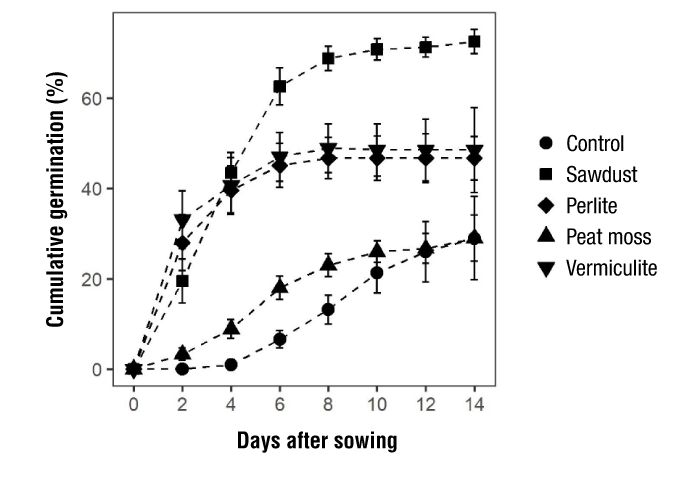
Figure 3 Cumulative germination of Quercus durifolia acorns after six months of storage using four different substrates. The points represent mean values ± standard error from monthly evaluations.
Few studies have examined seed storage in substrates. One of these studies is that of Pasquini et al. (2012), who stored Q. ilex acorns in containers mixed with peat moss and in polyethylene bags without substrate. Storing the seeds in polyethylene bags preserved optimal quality by limiting gas exchange and maintaining low metabolic activity in acorns. In contrast, acorns stored in peat moss showed lower germination rates and higher proportion of damaged seeds. Pasquini et al. (2012) concluded that excessive moisture likely had a negative impact on seed viability. Similarly, Berjak and Pammenter (2010) highlight that one of the main factors contributing to the loss of viability in recalcitrant seeds is an imbalance in metabolism, which occurs both during dehydration and when seeds are stored under hydrated conditions. Doria (2010) further indicates that seeds stored with excessive moisture are susceptible to fungal attacks and reduced oxygen availability for the embryo.
This study also recorded acorn rot with the different substrates (p = 0.0004; gl = 4; X2 = 20.6) and consistent with the germination levels, seeds stored in fresh sawdust had the lowest percentage of rotten seeds (30 %). In contrast, 50 % of the seeds stored in vermiculite and perlite were rotten, while the highest percentages were recorded in the control and peat moss treatments (81.5 and 73 %, respectively). In most substrates, acorn rot was caused by fungal activity (Figure 4a). González-Salvatierra et al. (2013) found that after storing Q. polymorpha seeds for one year, 70 % of the acorns were damaged by parasitic insects, 20 % were affected by fungal damage and physiological loss of viability, and only 10 % remained viable. In the present study, larvae were observed in some seeds during germination, although the percentage was minimal in each treatment (0.5 %) (Figure 4b). It is important to note that no signs of infestation were detected before acorn storage. According to González-Salvatierra et al. (2013), acorns may be infested by parasitic insect larvae at the time of collection without visible signs of damage, as the damage caused by the infestation is not visually apparent.
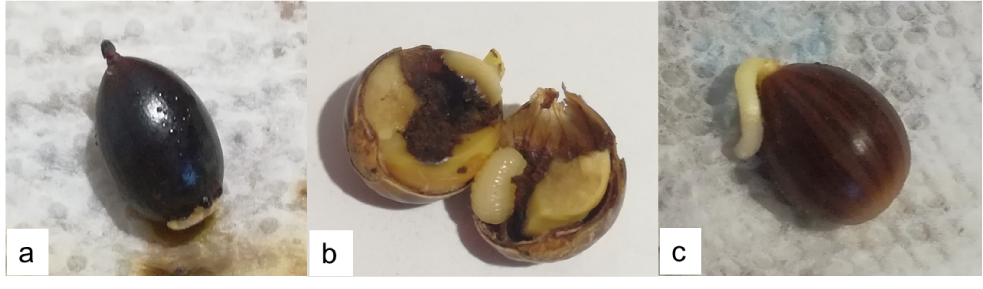
Conditions observed in Quercus durifolia acorns during storage: a) rotten seed, b) seed with larvae, and c) germinated seed.
Figure 4
In this study, seed germination occurred within the containers in the storage media with perlite (2 %) and vermiculite (7 %) (Figure 4c). This is consistent with the findings of Pasquini et al. (2012), who reported that Q. ilex acorns stored in peat moss began germinating inside the container and experienced faster deterioration due to seed rot. Germination occurs under these conditions due to a combination of factors such as moisture, temperature, and oxygen availability in the storage medium (Adetunji et al., 2021).
Another important factor affecting seed viability during storage is temperature, which should be kept low to moderate (1 to 7 °C) (Rodríguez-Trejo & García-Pascual, 2021). In this regard, Szuba et al. (2022) evaluated two temperatures for Quercus robur L. acorns (-3 °C and -7 °C) and demonstrated that those stored at -7 °C for six months showed deterioration and 80 % reduction in germination capacity. Similarly, Zavala Chávez (2008) stored Q. glabrescens and Q. rugosa acorns in plastic bags at temperatures between 5 and 7 °C for 15 months and achieved germination rates of 69 and 54 %, respectively. In the present study, seeds stored in plastic containers with fresh sawdust at 5 °C showed higher germination rates, but only for six months, while seed rot was similar to that observed in the aforementioned study (30 %). The advantage of using low temperatures for acorn storage is the reduction of metabolic activity and respiration rates, making the seeds less susceptible to deterioration (Magnitskiy & Plaza, 2007).
Germination speed
According to Figure 5, the germination speed index varied significantly (p ≤ 0.05; df = 4; X2 = 75.7) between the control and the evaluated substrates. Seeds from the control and those stored in peat moss showed a drastic reduction in germination speed (8.6 and 13.0, respectively), while those stored in fresh sawdust, perlite, and vermiculite were statistically similar (p > 0.05). When no storage medium was used, the germination speed index of the seeds decreased by more than 50 %, as acorns had lost more moisture in a shorter period, thereby reducing their viability.
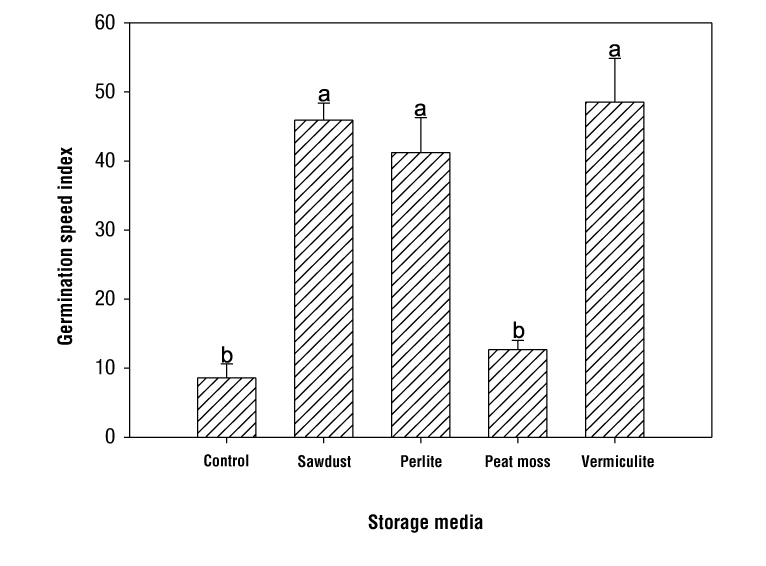
Figure 5 Germination speed index of Quercus durifolia acorns according to the type of substrate used for storage. Bars represent means ± standard error; different letters indicate statistically significant differences among treatments according to Dunn’s median test (p ≤ 0.05).
The germination value indicates the seed's vigor during the initial days of germination. In this case, seeds stored in fresh sawdust showed an increased germination speed during the first days, contributing to the overall germination percentage. Díaz-Pontones and Reyes-Jaramillo (2009) reported that maintaining acorns of Q. hintonii at 7 °C is essential for preserving a high germination rate (94 %) for over 48 days in a chamber with 33 % relative humidity. In the present study, acorns were stored at 5 °C, and the highest germination capacity was achieved with fresh sawdust after two months (76 %).
The storage conditions of the containers, as described in the methods, may have affected the viability of acorns. Since recalcitrant seeds require constant gas exchange, they are usually placed in unsealed containers to avoid oxygen deprivation and carbon dioxide accumulation (Luna & Wilkinson, 2014). Therefore, it is recommended that the containers be left open or have openings that promote aeration. Humidity present in the containers was another factor that could have influenced the results, as moisture was only added at the start of the storage process. Each substrate retained different amounts of water due to the inherent characteristics of the particles and their size. For example, sawdust is a lightweight material with fine particles and has a low to medium water retention capacity, but its aeration capacity is adequate (Pineda-Pineda et al., 2012). In contrast, peat moss contains very fine particles that adhere to the seeds, which may have caused a higher percentage of rotten seeds at the end of the test due to constant moisture on the seed coating. Perlite and vermiculite, on the other hand, have a high moisture retention capacity due to the size of their particles (1-3.5 mm and 0.6-4.7 mm, respectively). These characteristics may have influenced the results of this study, which confirm that the storage medium is critical for maintaining the viability of acorns, including temperature, moisture, and ventilation, to prevent damage from excess moisture and microorganisms (Díaz-Pontones & Reyes-Jaramillo, 2009). Based on the above, it is recommended to continue evaluating acorn storage in fresh sawdust for longer periods and under different moisture and temperature conditions.
Conclusions
Quercus durifolia acorns stored in fresh sawdust at 5 °C had the highest germination rate and the least reduction in viability after six months of storage. They also had the lowest proportion of rotten seeds. Acorns stored in peat moss and those without a substrate showed greater reduction in germination capacity and higher percentage of rotten seeds. This study provides an economic alternative for prolonging the viability of acorns for nursery plant production, reforestation, and restoration efforts with the species. However, further long-term studies are needed to evaluate the effects of storage in relation to temperature levels and humidity levels of storage media in acorns from Mexican oaks.

