




 nueva página del texto (beta)
 Inglés (pdf)
 Artículo en XML
 Referencias del artículo
 Traducción automática
 Enviar artículo por email
 Citado por SciELO
  Similares en
SciELO
Similares en
SciELO 
 Permalink

Introduction
Municipal solid waste (MSW) is the waste produced in homes, offices, businesses (Toro et al., 2016), or in any other activity carried out on public roads with household characteristics generated from human populations based on the Mexican Official Standard NOM-161-SEMARNAT-2011 (Official Gazette of the Federation [DOF], 2013). In Mexico, MSW generation reached 44.6 million tons, representing an average of 0.980 kg per inhabitant per day (INECC, 2022). Of this waste, approximately half is food waste known as solid food waste (SFW), which has become a serious health problem, generating harmful fauna that could become a public health problem according to the legal framework of the standard (Taboada-González et al., 2011; Ramírez et al., 2017; Duo et al., 2018; INECC, 2022). Due to its high availability and diversity, SFW had an important and varied potential use (Grande et al., 2009; Uçkun et al., 2014), for example, serving as a great source of energy, proteins, and vitamins, that can be easily used if they are processed properly to avoid decomposition or contamination (Granja et al., 2005). SFW are made up of a wide variety of “foods” that can provide a nutrient to a greater or lesser extent. Among the main sources of protein that are wasted are: fish, shrimp, pork, chicken, and beef; and among the sources of carbohydrates are: potato, prickly pear, cucumber, apple, chili pepper, and avocado (Granja et al., 2005).
The use of SFW is not new, in the 90's it was summarized in two main ideas; 1) as a food source for animals, which reduces food competition with humans, and 2) to reduce potential contaminants to the environment by transforming these into foods of high biological value (Salazar & Cuarón, 1997). However, for SFW to be used in animal feed, these must undergo a method that guarantees the elimination of pathogenic microorganisms to humans (Duo et al., 2018; Jinno et al., 2018), such as Salmonella typhi, Salmonella paratyphi A, Salmonella paratyphi B, Salmonella paratyphi C, Staphylococcus aureus, Staphylococcus epidermidis, Micrococcus, Listeria monocytogenes, Enterococci, fecal coliforms and Escherichia coli. After which, animals fed with these SFW may be considered safe food, based on the Mexican Official Standard NOM-210-SSA1-2014 (DOF, 2015g).
Chihuahua contributes 13.70 % of the total SFW generated on the northern border of Mexico (INECC, 2022), and its main generator is the manufacturing industry that produces 9,600 tons of SFW annually, as waste from its dining rooms (Keith, 2001; Rodríguez et al., 2010). However, there is little information on its use as an input in animal feed and it is not known whether there is adequate management during transport, handling, and storage, which guarantees the absence of microorganisms that could cause diseases in the animals that are going to consume it (animal production) and these, in turn, to the human being (Martínez-Castañeda & Perea-Peña, 2012; Ramírez et al., 2017). Therefore, the objective of the study was to use the SFW generated in the maquiladora industry as raw material for the production of flour for pig feeding purposes and to determine the bacterial load before and after its transformation as a food input for animals.
Material and Methods
Sampling and transport of samples
The solid food waste containers were sampled by the Food Waste Collection and Processing Center (CAPRA), a company responsible for collecting waste from dining rooms of the manufacturing industry in the Heroic Ciudad Juárez (Latitude 31°44′42″ North and Longitude 106°29'06″ West), municipality of Juárez, in the state of Chihuahua, Mexico, at an altitude of 1140 meters above sea level, with an arid temperate and cold climate, average annual temperature and precipitation of 20 °C and 220 mm, respectively (INEGI, 2023).
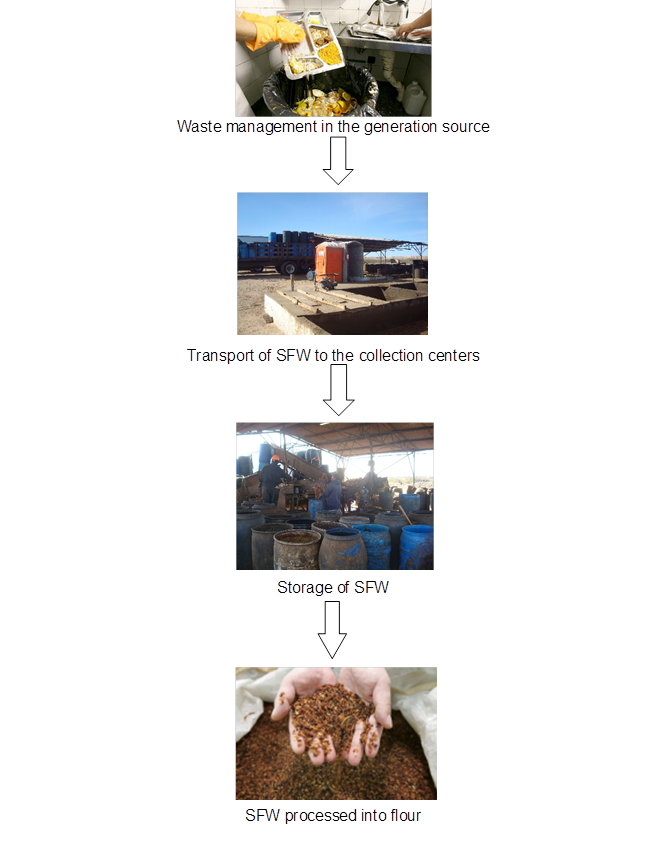
21 samples were taken at random from the SFW containers collected on the day that will be named “fresh”, 21 samples after the dehydration process that will be named “flour” and 21 samples from the formulated food that will be called “pelletized” (Figure 1), which were placed in sterile laboratory glasses (SYM laboratories®, Mexico) of 100 mL duly identified according to the requirements of the Mexican Official Standard NOM-109-SSA1-1994 (DOF, 1995a). The glasses were opened when the sample was introduced and were immediately closed, taking care not to contaminate the lid. The following data were recorded: date, place, sampling time, and batch number for conservation and transportation. Subsequently, the samples were transported in portable car coolers with refrigerants to the Microbiology Laboratory at the Institute of Biomedical Sciences, of the Autonomous University of Ciudad Juárez, where they were placed in sterile laboratory flasks and stored in a refrigerator (Samsung®, Mexico) at 3 °C, for subsequent microbiological triplicate analysis.
Sample preparation
A 1.0 N sodium hydroxide solution was prepared by weighing 4.0 g of sodium hydroxide and added to 100 mL of distilled water. A buffered peptone water solution was prepared with 1.0 g of peptone plus 8.5 g of sodium chloride dissolved in 1 L of distilled water, the pH was adjusted to 7 ± 0.1 with 1.0 N sodium hydroxide. The solutions were distributed in proportions of 90 and 9 mL, respectively, and subsequently sterilized at 121 ± 1.0 °C for 15 minutes. pH and volumes of the final solution were confirmed again according to NOM-110-SSA1-1994 (DOF, 1995e).
Each sample was ground using a blender (Oster®, Mexico) because the samples were semisolid. Primary dilutions (1:10) were prepared with 10 mL of the sample and added to 90 mL of sterile dilution medium (buffered peptone water) and homogenized. Subsequently, additional decimal dilutions were made, for which 1 mL of the primary dilution (1:10) was transferred into a sterile tube (Fisher Scientific®, U.S.A) with 9 mL of buffered peptone water (1:100); and so on until a dilution of 1:1,000,000. These dilutions were made for each of the samples according to NOM-110-SSA1-1994 (DOF, 1995e).
Microbiological analysis
Isolation of total coliforms on plate
1 mL of each of the previously diluted liquid samples (decimal dilutions 1:10,000, 1:100,000, and 1:1,000,000) was placed in individual sterile Petri dishes (Corning®, USA). 20 mL of melted red violet bile agar (RVBA) medium (Neogen®, USA) was poured. Afterwards, the inoculum was carefully mixed with the medium, making six movements from right to left, six in a clockwise direction, another six in a counterclockwise direction and six from front to back, on a smooth and level surface. The Petri dishes were incubated using an incubator (Fisher Scientific®, USA) at 35 °C for 24 hours. At the end of this time, colonies were counted and Petri dishes containing 15 to 150 typical dark red colonies were selected. The total coliform count was carried out based on NOM-092-SSA1-1994 (DOF, 1995d) and NOM-113-SSA1-1994 (DOF, 1995b).
Isolation of Staphylococcus aureus
0.1 mL of each of the previously diluted liquid samples (decimal dilutions 1:10,000, 1:100,000 and 1:1,000,000) was placed in individual sterile Petri dishes (Corning®, USA) with Baird-Parker agar (International Chemical Industries Ltd., UK), distributing the inoculum on the surface of the agar with the help of sterile glass rods at right angles. Once the inoculum was absorbed by the agar, the dishes were incubated at 35 ºC for 48 hours. The Petri dishes that presented between 15 and 150 typical colonies of Staphylococcus aureus were selected. The determination of colony forming units (CFU) was carried out based on NOM-092-SSA1-1994 (DOF, 1995d) and NOM-115-SSA1-1994 (DOF, 1995c).
Isolation of Salmonella spp.
25 mL of each of the samples were taken and poured into a solution previously enriched with 225 mL of buffered peptone water. These were dissolved correctly and incubated at 35 °C for 24 hours. At the end of this time, the enrichment step was continued, where 1.0 mL of the pre-enriched medium was taken and poured into tubes containing 10 mL of Vassiliadis-Rappapor Broth medium (Cat No. 257257, D-69126 Heidelberg, Germany), it was subsequently incubated at 35 °C for 24 hours. Products enriched on Salmonella shigella agar (BIO-RAD®, USA) were examined and incubated at 35°C for 24 hours.
For the biochemical identification of Gram-negative Enterobacteriaceae, an API 20E kit (bioMérieux® S.A. Spain) was used. The inoculum was prepared using “early cultures” (18 to 24 hours) and 5.0 mL of a 0.85 % saline solution, which was homogenized to obtain a bacterial suspension and then the 20 biochemical microtubes (Fisherbran®, USA) were placed containing the strips: immediately inoculated, filled with citrate tests (CIT), Voges Proskauer (VP) and gelatin liquefaction (GEL) to the domed lid; in the rest of the tests such as: hydrolysis of ortonitrophenyl-galactopyranoside (ONPG), tryptophan deaminase (TDA), indole production (IND), glucose fermentation (GLU), mannitol (MAN), inositol (INO), sorbitol (SOR) , rhamnose (RHA), sucrose (SUC), melibiose (MEL), amygdalin (AMY), arabinose (ARA), oxidase (OX), arginine hydrolase (ADH), lysine decarboxylase (LDC), ornithine decarboxylase (ODC), production of sulfuric acid (H2S) and urease (URE), the tubes were not filled to the domed cap. In the ADH, LDC, ODC, H2S and URE tests, mineral oil was injected after inoculum to create anaerobiosis. The strips were placed in an incubation box, where 5.0 mL of distilled water was added to the wells of the tray to create a humidified atmosphere. The box was closed and incubated at 36 ± 2 °C for 24 hours. Finally, after that time, the results obtained were interpreted.
Isolation of Listeria monocytogenes
25 mL of each samples were taken and poured into a solution pre-enriched with 225 mL of buffered peptone water and incubated at 30 °C for 48 hours. The media were streaked in excess in lithium chloride phenylethanol-moxolactam (LMP) (Neogen Corporation®, USA) and Oxford medium (OXA) (Neogen Corporation®, USA), and incubated at 30 and 35 °C for 48 hours. respectively. Subsequently, five typical colonies were selected from the OXA and LMP medium and transferred to Petri dishes with trypticase soy agar with yeast extract (ASTEL) and allowed to incubate at 35 °C for 24 hours according to the Mexican Official Standard NOM- 143-SSA1-1995 (DOF, 1997). Cultures in ASTEL medium were maintained at 48 °C and were used for inoculation and identification tests.
The fresh mobility test was performed by inoculating a small drop of 0.85 % saline solution placed on a slide and observed under a microscope with an immersion objective (100x). The catalase test was also performed by inoculating a drop of 3 % peroxide solution and observed under a microscope with an immersion objective (100x). A Gram stain was then developed from a 24 h culture.
Separately, the hemolysis test was performed in which a grid of 25 spaces was drawn at the bottom of the Petri dish (Corning®, USA) with 5 % sheep blood agar. One frame per sting was inoculated for each culture and incubated at 35 °C for 48 hours. Finally, the hemolytic reaction obtained was observed.
Preparation of SFW flour
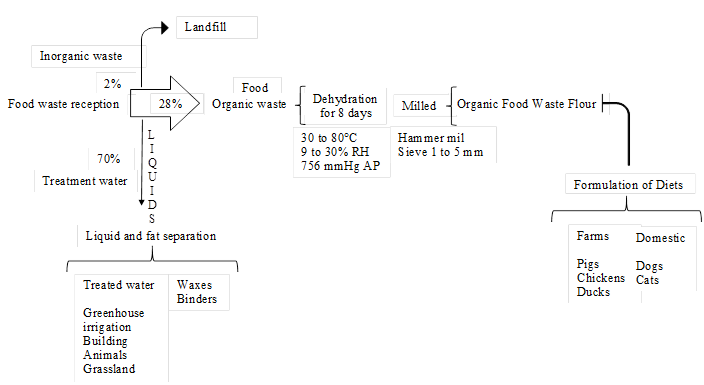
The fresh SFW raw material was obtained from the mix of the 21 containers randomly sampled from the same company that collected the wet SFW and dehydrated it to obtain SFW in flour presentation, using the following procedure and conditions: a temperature of 30 to 45°C, humidity from 9 to 30%, atmospheric pressure of 756 mmHg, which allows up to 8 tons to be dehydrated in 4 days under outdoor conditions (Figure 2).
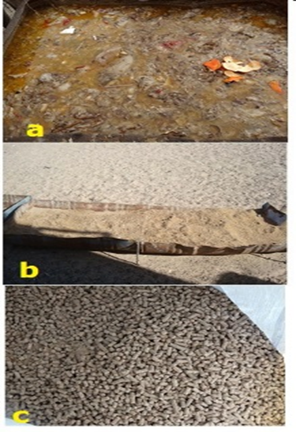
The dehydrated SFW was ground using a MKHM420A hammer mill (MEELKO, Florida, USA), using a sieve between 1 and 5 mm. Figure 3 shows the wet SFW, raw material obtained from SFW (dehydrated), and the balanced diet in pellet presentation.
Proximate analysis and preparation of the experimental diet
The SFW flour was analyzed for pathogenic microorganisms according to the methodology described above, Mexican Official Standards, to subsequently be stored in airtight plastic containers until processed into a balanced diet. The nutritional value of the raw material was obtained through a proximate analysis (AOAC, 1997) (Table 1).
Table 1 Proximate analysis of SFW flour.
| Nutrient | Proximal analysis1 |
|---|---|
| Dry matter (%) | 75.65 |
| Organic matter (%) | 87.92 |
| Brute protein (%) | 16.02 |
| Gross energy kcal/kg | 4 500 |
| Ash (%) | 7.28 |
| Etheric extract (%) | 13.8 |
| Brute fiber (%) | 3.03 |
| Neutral detergent fiber (%) | 17.91 |
| Acid detergent fiber (%) | 10.15 |
1AOAC, 1997; Source: Own elaboration.
Four diets based on sorghum, yellow corn, and soybean meal were balanced with the inclusion of the raw material SFW flour in 15, 30, and 45% and a negative control (0 %), using the Zmix® V.3.1 program (Zootech, 2022), (Table 2). The diets were isoprotein and isoenergetic, following the nutritional requirements of pigs in the growth stage (NRC, 2012). The flour feed was pelletized at a temperature of 80 to 85 °C, a steam pressure of 552 Kpa (80 psi), with a conditioning time between 30 to 60 seconds using a 120 mm 45-60 kg/h electric pellet machine MKFD120B (MEELKO, Florida, USA) with a power of 4 kw (three-phase). The pellets were manufactured through a 6 mm mesh. The granulated feed (pellet) was also microbiologically analyzed in triplicate according to the methodology described above.
Table 2 Ingredients and calculated analysis of a diet for pigs from 15 to 50 kg.
| Ingredients | Inclusion % | |||
|---|---|---|---|---|
| Yellow corn | 33.86 | 30.12 | - | - |
| Soybean paste | 25.57 | 27.15 | 24.61 | 24.01 |
| Flour of SFW1 | - | 15.00 | 30.00 | 45.00 |
| Whey of milk | 6.90 | 7.02 | 7.31 | 7.09 |
| Beef tallow | 6.03 | 4.50 | - | - |
| Molasses | 6.00 | 6.00 | 6.00 | 6.00 |
| Sorghum | 13.93 | 5.00 | 26.17 | 13.11 |
| Vegetable oil | 3.05 | 0.55 | 1.24 | - |
| Premix pigs2 | 3.00 | 3.00 | 3.00 | 3.00 |
| Calcium carbonate | 1.66 | 1.66 | 1.67 | 1.79 |
| 100.00 | 100.00 | 100.00 | 100.00 | |
| Price kg/USD | $ 0.46 | $ 0.38 | $ 0.31 | $ 0.24 |
| Nutrient | Calculated analysis | |||
| Dry matter (%) | 71.10 | |||
| Protein (%) | 18.00 | |||
| Energy Mcal/kg | 3.30 | |||
| Calcium (%) | 0.85 | |||
| Fiber (%) | 2.68 | |||
| E.E. (%) | 2.08 | |||
1Solid Food Waste (SFW). 2Vitamin A 10,000,000 IU, Vitamin D 31,500,000 IU, Vitamin E 60,000 IU, Vitamin K3 2,000 mg, Vitamin B1 2,000 mg, Vitamin B2 4,000 mg, Vitamin B3 20,000 mg, Vitamin B6 3,000 mg, Vitamin B12 20 mg, Acid Pantothenic 10,000 mg, Biotin 100 mg, Folic acid 1,000 mg, antioxidant 25,000 mg, copper 10,000 mg, cobalt 150 mg, Iron 70,000 mg, Manganese 62,000 mg, Iodine 210 mg, Zinc 100,000 mg, Selenium 200 mg, Special vehicle l C.S.P 1,000 g. Source: Own elaboration.
Results and discussion
SFW is the result of the collection of food waste not consumed by humans. The Mexican Official Standard NOM-061-ZOO-1999 (DOF, 2000) considers that the contamination of SFW is caused by chemical, microbiological or biological factors and may represent a health or zoosanitary risk, if these are destined for animal feed without adequate processing. Among the main pathogenic bacteria found in foods are Escherichia coli, Staphylococcus aureus, Listeria monocytogenes, Salmonella, and others such as Streptococcus spp., Micrococcus spp. and Mycoplasma hyogenatalium (Félix-Fuentes et al., 2005; Flórez et al., 2008; Valdiviezo et al., 2006).
In this work, the maximum permissible limits for cooked foods were taken into account, dictated in Appendix B of NOM-093-SSA1-1994 (DOF, 1995h), goods and services, hygiene and health practices in food preparation, that are offered in commercial establishments, which include the dining rooms of the maquiladora industries, detailing the management and route that organic food waste must follow, as well as the maximum permissible microbiological limits (Table 3). However, at the time of collection, all food waste ends up in a container accompanied by liquids that are the result of unconsumed juices or drinks, leaving a semi-solid consistency in the storage container for approximately 200 liters, from which 80 % are liquid, 18 % solid (food waste) and 2% garbage (disposable cups, plates, spoons or forks). Coliforms are a group of bacteria that ferment lactose, generate gas, and are thermolabile; they can also develop in media with bile salts (Fernández & Barrera, 2013). Therefore, coliforms are considered indicator microorganisms, some of which may have a non-fecal origin (Yousef & Carlstrom, 2006).
Table 3 Permissible limits of microorganisms in cooking foods according to NOM-093-SSA1-1994 (DOF, 1995h).
| Food | Total coliforms (permissible limit) |
|---|---|
| Sauces and purees | 50 CFU/g or mL |
| Salads, milk, or fruit waters | < 100 CFU/g or mL |
| Meats, poultry, fish, crustaceans, and mollusks | < 10 CFU/g or mL |
Source: Own elaboration.
In the present study, there was growth of coliform colonies in samples 2 (59,000,000 CFU/mL), 4 (600,000 CFU/mL) and 16 (100,000 CFU/mL), which represented a presence of 14.28 % of coliforms in fresh SFW (Figure 4). The quantification of total coliforms of the positive samples (2, 4 and 16) greatly exceeds the limit indicated by NOM-093-SSA1-1994 (DOF, 1995h), due to the poor disposition of the containers or the waiting time for sample collection, even compared to the limits dictated for samples such as cooked sauces and purees, salads, dairy and non-dairy desserts, ice creams and yogurts, in which the highest limit for the aforementioned foods is 100 CFU/g or mL. The microbiological results after the process to obtain the flour (dehydrated) and balanced feed (pellet) were negative.
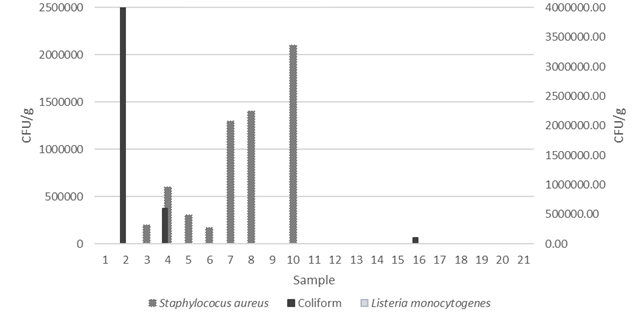
The permissible limits in milk for Staphylococcus aureus are < 100 CFU/g or mL (NOM-093-SSA1-1994). The growth of Staphylococcus aureus was observed in samples 3 (200,000 CFU/mL), 4 (600,000 CFU/mL), 5 (300,000 CFU/mL), 6 (170,000 CFU/mL), 7 (1,300,000 CFU/mL), 8 (1,400,000 CFU/mL) and 10 (2,100,000 CFU/mL) which represented 33.30% in the wet SFW. The presence of this bacteria in foods such as dairy-derived desserts, for example, cream cake, dulce de leche, milk gelatin, and flan, which allows the presence of Staphylococcus aureus with a maximum permissible limit of < 100 CFU/g or mL; positive samples for these microorganisms far exceed the limit allowed by NOM-093-SSA1-1994 (DOF, 1995h). On the other hand, the microbiological results found after the process of obtaining the SFW flour and pellet were negative mainly because the bacteria found are thermolabile and the dehydration and pelleting process exceeds 37 °C (Yousef & Carlstrom, 2006).
Staphylococcus spp. can be coagulase-positive, form large creamy colonies, and be beta-hemolytic. It is highly tolerant to large concentrations of salts, surviving in preserves (Fernández & Barrera, 2013). Anderson et al. (2000), mentioned that the presence of a high number of this microorganism represents poor hygiene in food, although it may be the case that it is not detected and even that the number detected is insignificant and there is a high amount of staphylococcal enterotoxins, which may be because the bacteria may have disappeared while the toxin prevails due to its resistance capacity. The presence of more than 105 CFU/g or mL translates as a risk to the consumer's health (Anderson et al., 2000). S. aureus can be present in the throat and nose of people who prepared the food and who did not have good food handling practices that guarantee its safety (Yousef & Carlstrom, 2006). It is important to mention that the antagonistic capacity of the microbial flora can be an obstacle to the development of pathogens such as S. aureus (Anderson et al., 2000).
Salmonella is a bacterium that is present in the intestines of birds, reptiles, and mammals and is usually found in meat, milk, unpasteurized cheeses, and raw eggs; infecting humans when consumed (Moreno & Alarcón, 2010). Of the 21 samples analyzed for Salmonella spp., only sample 18 (prevalence of 4.76 %) presented typical characteristics such as translucent colonies that were eventually opaque, and some of them with a black center (NOM-114-SSA1-1994 (DOF, 1995f); Winn et al., 2008). The microbiological results after the process of obtaining flour and balanced feed (pellet) were negative for Salmonella spp.
The prevalence of Listeria monocytogenes was 0 %. This microorganism can survive in unfavorable conditions and its prevalence is frequent and affects everything from the raw material to the obtaining of the final product (Barbuti & Parolari, 2002). However, when there is a good process during the preparation and conservation of food, the probability of acquiring listeriosis due to food waste is practically zero (Moreno & Alarcón, 2010).
It is important to emphasize that the collection of food waste that was food intended for human consumption can be free of pathogens during its preparation. However, these can become contaminated during the storage or transportation process and cause the proliferation of bacteria (Yousef & Carlstrom, 2006).
Barbuti & Parolari (2002) and Anderson et al. (2000), agree that there are factors that favor the development of microorganisms, that can be controlled, guaranteeing food safety, such as the reduction of water activity, pH, temperature, and the decrease in competitive flora which facilitates the growth of pathogens. All of the above generates an interaction with different molecules and ions contained in the food, obtaining chemical reactions (Bonilla & Díaz, 2003), which favor the preservation of food (Rodríguez & Simón, 2008).
The SFW collected in the dining rooms of the maquiladora industry contains a large amount of liquid, approximately 80 % water. However, the total amount of water contained in the foods analyzed in this study cannot be taken into account because the water may be interacting with some elements present in it, such as carbohydrates, proteins, and lipids (Boatella et al., 2004). In this sense, Rodríguez & Simón (2008) mention that the availability of water and not so much the total water content will determine the shelf life of a food, in fact, water can bind to various ions and molecules present in food.
The demand and high values of protein and energy concentrates used in the feeding of animals for slaughter, such as pigs, have made their production more expensive due mainly to the feed that represents up to 70 % of the fixed costs of production; the integration of a raw material made from SFW makes the diet more profitable since it reduces the cost per kilogram (Rivera et al., 2007; Montero-López et al., 2015). However, a drawback could be the variable amount of ingredients that make up the raw material of SFW, which can vary depending on the time of year, since foods with a greater or lesser amount of energy, protein or fiber are not selected in the diet, but everything collected is processed to dehydrate it; this could be solved by carrying out a proximate analysis of the raw material obtained to formulate the diet according to its real nutritional values. The nutritional values of the raw material in the present study are similar to those reported by Domínguez (1991), who mentions that the estimated nutritional content ranges between 15 and 18% of dry matter, protein between 14 and 16 %, and ashes about 10 %. It is important to mention that only obtaining SFW raw material free of pathogenic microorganisms can be considered an adequate input in the preparation of diets for different productive or companion animal species. Therefore, it should be mentioned that, under the conditions of handling freshly collected SFW, it is not advisable to use these for the preparation of animal diets, especially if these are intended for human consumption.
Grande et al. (2009), recommend the inclusion of up to 50 % of SFW in the diet of pigs. In the present study, a diet was formulated for pigs (Table 4) in the initial stage according to their nutritional requirements (NRC, 2012), with up to 45 % inclusion of dehydrated SFW, partially replacing the protein source that is provided by an input such as soybean paste. This is important because the highest production costs in the diet are due to protein inputs, and it should be considered that there is no evidence of detrimental factors in dehydrated SFW and there are no reports that they have any anti-nutritional factor that restricts their inclusion in the diet. Furthermore, because it is a cooked food, it is considered predigested and, therefore, very digestible (Rodríguez & Simón, 2008; Dou et al., 2018).
Table 4 Calculated and proximal analysis of the diet for pigs from 15 to 50 kg with an inclusion of 45% of SFW meal.
| Nutrient | Calculated analysis | Proximal analysis1 |
|---|---|---|
| Dry matter (%) | 71.10 | 70.71 |
| Protein (%) | 18.00 | 17.98 |
| Energy Mcal/kg | 3.30 | 3.28 |
| Calcium (%) | 0.85 | - |
| Fiber (%) | 2.68 | 2.71 |
| E.E. (%) | 2.08 | 1.98 |
1AOAC, 1997; Source: Own elaboration.
The pelleting process involves several stages, 1) hydrothermal conditioning, 2) compression-extrusion, and 3) drying-cooling (Keith, 2001), which have a positive effect on the yield and/or productive performance of the animals, increasing the feed conversion (highly digestible feed), eliminating pathogens (particularly Salmonella and coliforms), improving feed acceptance, eliminating anti-nutritional substances and increasing the transit rate of material through the digestive system; as well as the decrease in food waste (Keith, 2001; Vukmirovića et al., 2017).
The microbiological tests results on dehydrated SFW (flour) and the feed formulated with the inclusion of dehydrated SFW (pelletized) were negative; the first (flour) was due to the dehydration process, and the second (pellet), due to the pelleting process per se, which involves temperature (80 to 85 °C) and steam pressure (552 Kpa) favoring the elimination of the microbial load (mainly phototropic bacteria, lactic acid, and yeasts), which can be harmful to the animal that consumes it (García et al., 2018).
The use of processed SFW in animal feed is an activity that is still undervalued and studied in Mexico, although it represents an important alternative to support the production of animal-origin foods, as has been demonstrated in countries such as Japan, Germany, and the United States of America, by obtaining good quality proteins for incorporation into the population's diet (Maeda, 2008; ReFED, 2016; Zu-Ermgassen et al., 2016). However, the waste products that cause SFW can be vehicles for various types of microbiological contaminants, which are the most abundant and varied. The necessary sanitary measures must be taken to guarantee their health and safety in all phases of the process from preparation, packaging, storage, transportation, distribution, handling, and sale (Figueroa, 1989; Dou et al., 2018).
Conclusions
It was possible to prepare flour as an input, originating from fresh solid food waste that can be used to formulate rations for pigs with up to 45 % inclusion. However, it must be kept in mind that the nutritional quality of this input may vary, depending on the quality of the raw material (SFW) at the time of collection. The microbiological analysis of the fresh SFW indicated a percentage of pathogenic microorganisms (Staphylococcus aureus and Salmonella spp) much higher than those established by the Mexican Official Standard NOM-093-SSA1-1994. However, the dehydration process is sufficient to eliminate them and if it is additionally pelletized, the presence of microorganisms is not observed.

