




 nueva página del texto (beta)
 Inglés (pdf)
 Artículo en XML
 Referencias del artículo
 Traducción automática
 Enviar artículo por email
 Citado por SciELO
  Similares en
SciELO
Similares en
SciELO 
 Permalink

Introduction
SARS-CoV-2, the etiological agent of COVID-19, was declared a pandemic event in march 2020 (WHO, 2020a) due to its burden on human health worldwide, reaching more than 114 countries (WHO, 2023). By February 2023, this disease had caused around 757,264,511 confirmed cases and more than 6,850,594 deaths. Despite the origin of COVID-19 was in China, specifically in Wuhan, Hubei, Europe, and America were the most affected regions (WHO, 2023). The burden of this virus may be attributed to the high transmissibility, using several vias such as personal contact, droplet, airborne, fomite, fecal-oral, bloodborne, mother-to-child, and animal-to-human transmission (WHO, 2020b).
The COVID-19 symptoms include fever or chills, cough, fatigue, sore throat, congestion or runny nose, loss of taste or smell, pneumonia, and diarrhea. Viruses are shed by saliva droplets and/or stools. Thus, wastewater is ideal for tracking the virus or its genetic material at the community level (Ghimire et al., 2021; Megyeri et al. 2021; Poeta et al., 2022). In this regard, wastewater surveillance can be applied as a proper mitigation measure and thus, there is no excuse for any outbreak becoming more than an outbreak. For example, Wastewater-Based Epidemiology (WBE) is an especially useful tool for early warning of COVID-19 outbreaks in large communities as previously demonstrated by Basavaraju et al. (2021). But also, people traveling in aircraft and cruise ships can be discretely and indirectly monitored during the journey. Ahmed et al. (2020) and Ahmed et al. (2022) have tested the presence of the virus on international flights and/or cruise ships holding wastewater tanks. Thus, in any transportation means, the WBE tools can be applied (Ahmed et al., 2020; Ahmed et al., 2022). Buses, for example, are one of the key modes of transport in almost the entire world. In many countries, many people use buses to move from one city to another almost every day.
According to the different opinions and perceptions about the safety or the risk of transmission of SARS-CoV-2 in closed spaces such as public transport, several studies have been performed focusing on the detection of viral RNA in diverse environmental matrices such as aerosols, air filtering systems, surfaces as handrails, buttons and handles next to seats in buses, trains and bus stations, detecting the presence of the virus in all the above-mentioned samples (Caggiano et al., 2021; Singh et al., 2021; Hoffman et al., 2022; Gomes da Silva 2022). The development of this kind of studies contributes to understanding and estimating the potential risk of the presence of passengers aware or unaware of being positive for COVID-19, a factor for the SARS-CoV-2 transmission in public transport; Hence, the purpose of this study was to detect the SARS-CoV-2 RNA presence in wastewater holding tanks from domestic and international buses.
Materials and Methods
Sample collection
This study was performed from February 04th to April 22nd 2022 in Culiacan, Sinaloa, Mexico, at the international bus station, which receives buses and passengers from almost all the 32 states of México, including some international destinations from The United States of America, such as Arizona, California, and Nevada. During the study, which included the fourth COVID-19 wave in Mexico, the bus station showed monthly occupancy of 193,718 persons in February, 229,900 in march, and 246,969 in April; with a maximum daily occupancy of 13,401 persons, respectively. Sample collection began on February 4th, and continued weekly until the 22nd of the same month.
A total of 45-one liter samples were analyzed in this study, which were strategically collected from the main WC drainage system of the bus station and the stool holding tank from domestic and international buses; the selection of buses for sample was performed as follows: an innitial sample collection to observe of the contents of the holding tanks from prefferably long-trip and non scale buses, to ensure that holding tanks were not previously washed or emptied during the journey, in order to collect samples with abundance of fecal matter and discarding all samples with only urine. Another criteria was the notorious absence of inactivators compounds, such presence is evident by color and aroma in the wastewater, these criteria for sample collection was established to increase the probabilities to detect SARS-CoV-2 in the samples. Samples were transported under refrigeration conditions to the laboratory for their processing.
Sample concentration
Sample concentration was performed by precipitation using Poly Ethylen Glycol (PEG 6000) 20%/2.5M NaCl (Sapula et al., 2021). Briefly, samples were initially purified by centrifugation at 10,000 g for 10 min at 4 ºC, using 250 mL sterile polypropylene bottles. After centrifugation, samples were processed by sequential membrane filtration using 0.65, 0.45, and 0.22 mm pore diameter nitrocellulose membranes (Millipore, USA) coupled to a vacuum system (Millipore, USA). From the filtered sample, a volume of 200 mL was mixed with 50 mL of PEG 6000/2.5 M NaCl solution and centrifugation steps for a final resuspension with 2 mL of PBS and final centrifugation at 14,000 g for 10 min at 4ºC to recover the supernatant (Lu et al., 2020; Sapula et al., 2021).
RNA extraction and identification by Real-Time PCR
From the concentrated samples, RNA extraction was performed using the column-based protocol QIAamp Viral RNA Mini Kit (Qiagen, Germany) according to manufacturer instructions. Retro-transcription of viral RNA and PCR was performed by GoTaq® 1-Step RT-qPCR using the detection 2019-nCov CDC detection Kit, according to manufacturer´s instructions using the N1 as a marker for SARS-CoV-2 and the RP marker as control of a correct reverse transcription and amplification process in each sample (Integrated DNA Technologies IDT, USA) RT-PCR in real time was performed in a CFX 96 instrument (Biorad). Positive samples were processed for further sequencing at CIAD Mazatlan station, using Nextera XT DNA Library Preparation Kit (Illumina, San Diego, CA, USA) according to the manufacturer’s instructions, and sequenced by Illumina Miniseq platform (Illumina, San Diego, CA, USA).
Phylogenetic analyses
From SARS-CoV-2 positive sequenced samples, phylogenetic analysis was performed to compare the similarity with other sequences distributed in Mexico and Sinaloa state. Multiple alignments (Default parameters) and phylogenetic tree (neighbor-joining with a bootstrap value of 1000) were performed with MAFFT 7. The phylogenetic tree was edited with iTOL v6 (Interactive Tree of Life). Results from the phylogenetic analysis are based on metadata associated with 71 sequences available from February 1st to 28th, 2022, and accessible at 10.55876/gis8.230131pv (Supplementary Table 1).
Results and Discussion
SARS-CoV-2 detection in holding tanks
Results for SARS-CoV-2 RNA in holding tanks, showed its detection in two buses from national origin and one international origin bus (Figure 1). We consider that results are very interesting because, to our knowledge, this study may represents the first research focused on determining the presence of SARS-CoV-2 RNA in wastewater from touristic buses. Previous studies have detected the presence of SARS-CoV-2 RNA in wastewater from airplanes and cruise ships, suggesting that surveillance based on wastewater is a useful tool for the detection of positive passengers (Ahmed et al., 2020; Ahmed et al., 2022). However, it is important to establish as limitation in this study that detection of viral RNA not necessarily guarantees the presence of infective viral particles in the holding tanks.
The SARS-CoV-2 RNA presence in holding tanks is evidence of at least one passenger infected with the virus, a potential risk for the health of the rest of the passengers, given the SARS-CoV-2 transmissibility, the absence of HEPA-based air filtering systems and the long-term people accumulation in a closed space such a bus. In this regard, some studies have focused risk assessment for SARS-CoV-2 transmissibility, indicating that breathing and speaking by an infected person in public buses scenarios may represent a potential risk for transmission among people (Bertone et al. 2022). As we know, one person starts a whole outbreak that can lead to sparking pandemic-type behavior if a new variant is present. And then, one week to incapacitate a city; a month the entire country, and two months the entire world again (Musa et al., 2020; Arantes et al., 2023; Eales et al., 2023).
SARS-CoV-2 detection in drainage system
Results from the drainage system showed the presence of SARS-CoV-2 RNA in only one sample (1 of 12) (Figure 1). The SARS-CoV-2 RNA detection in the drainage system allows us to suggest that at least one infected person was in contact with the users and employees at the bus station, representing a potential risk for the health of people given the high transmissibility of SARS-CoV-2, the absence of air-filtering systems and the continuous contact among people in a bus station or within a bus (Bertone et al., 2022; Denpetkul et al., 2022). Park and Kim (2021) assessed the risk of transmission of SARS-CoV-2 in public buses, estimating around 0.609 to 0.909% risk of new infections, which increase according to the occupancy and spaces apart in the bus.
The results of this study allow us to suggest that PEG-concentration/filtration method is a useful tool for the SARS-CoV-2 identification in wastewater samples (Lu et al., 2020; Sapula et al., 2021). Thongpradit et al. (2022) suggest that the filtration method is sensitive for the SARS-CoV-2 detection in wastewater. The presence of this virus in this matrix may be influenced or affected by the environmental temperature, regardless of the ability to sediment by Brownian movement, which deals with a low prevalence of COVID-19, being useful for wastewater monitoring to prevent the viral spread in a community (Bivins et al., 2020; Haramoto et al., 2020; D´Aoust et al., 2021; Mitic et al., 2021).
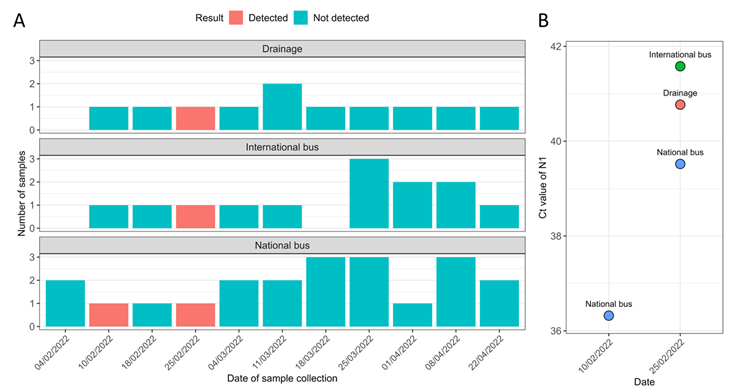
Figure 1 Results for detection of SARS-CoV-2 RNA in wastewater on each date of sample collection. A: type of sample (international bus, national bus holding tanks, and bus station drainage system), B: Ct value for N1 gene in positive samples, maximum Ct 42 to consider as positive.
The SARS-CoV-2 presence in public transport has been widely studied worldwide, focused on the detection of different kinds of matrices. Hoffman et al. (2022) detected 5/37 positive samples of air filters in public buses in Seattle, Washington, USA; their results suggest that identification of SARS-CoV-2 RNA in air filtering systems from public transport may serve as an indicator for the detection of viral presence, to better understand the transmission of viral particles in public transport.
In Italy, Caggiano et al. (2021) studied the presence of SARS-CoV-2 on handrails, stop buttons, and handles next to seats from bus and train surfaces, detecting a higher percentage of positive samples in buses (19.3%) compared to trains (2%), being the handles near to seats and buttons the most contaminated surfaces, which indicate the necessity to improve sanitation procedures in the public transport. Gomes da Silva et al. (2022) detected the SARS-CoV-2 presence in surfaces and air samples from the public transport system in Portugal, detecting the SARS-CoV-2 presence in 2 air samples, and contrarily, it was not possible to detect positive surface samples, suggesting that the adequate use of facemasks is effective to prevent the transmission of SARS-CoV-2 among people in the public transport system. The percentage of positive samples in our study was around 9% of the total samples, which concurs with previous studies ranging from 2 to 19% of positive samples, which may deal with a potential risk for passengers in the presence of at least one infected person during the fourth COVID-19 wave. An important data for this kind of study is the viability for the detection of SARS-CoV-2 RNA in wastewater, which is possible to be detected during 62 days wastewater, suggesting the stability of viral RNA for future studies (Lira-Morales et al., 2023a)
Tsuchihashi et al. (2021) detected the SARS-CoV-2 transmission among people during a bus tour in Japan, which may occur as a product of direct or indirect contact. It was possible to detect infected people at different seat positions on the buses. However, the transmissibility of viral particles by bioaerosols, such as droplets, may contribute to the infection of passengers, regardless of their ubication in the bus. For that reason, bus companies should emphasize efforts to improve hygiene and sanitation, as well as ventilation in the buses.
Studies support the idea of the utility of the detection of viral RNA of SARS-CoV-2 in wastewater to perform epidemiological studies, naming this research line wastewater-based epidemiology. Singh et al. (2021) suggest the importance of the SARS-CoV-2 detection in wastewater to accelerate the massive diagnosis of COVID-19 and the development of control measurements such as disinfection in wastewater treatment plants during viral pandemics. Basavaraju et al. (2021) have suggested a double purpose for the study of coronavirus in wastewater, including the early detection of outbreaks and the estimation of infected people, to mitigate the impact of this disease in a community.
Coronado et al. (2021) detected the presence of SARS-CoV-2 in wastewater from Mexico City, showing the presence in 6 samples from the river and five irrigation water samples, relating the highest viral concentration in samples to the proximity to Mexico City. González-Reyes et al. (2021) suggest the use of wastewater-based epidemiology in combination with mathematical analysis for the study of SARS-CoV-2 in Mexico City to determine with more accuracy the range of positivity for COVID-19 among people. Their results suggest the study of wastewater coupled with statistical analysis such as the Monte Carlo model to evaluate the prevalence of infected people in a temporal space scenario as a “pandemic monitoring method”.
Cerrada-Romero et al. (2022) detected SARS-CoV-2 RNA in stool samples in 27 of 62 COVID-19 patients, which showed positivity until 3-4 weeks after the apparition of symptoms, interestingly, detecting lower ct values for nasopharyngeal samples compared to feces. However, the detection of genetic material does not mean the presence of viable infectious virions but also can be a useful tool to detect the spread of infected people, which means a potential health risk for virus transmission as the product of close contact among people.
Cartenì et al. (2021) studied the relationship between public transport and the occurrence of COVID-19 cases in Italy, detecting a high correlation of 0.87 between COVID-19 contagions and the use of public transport, suggesting the necessity of quarantine for at least two weeks for infected people to diminish the increase of cases.
The most interesting data of this study is that, based on results, there is a strong relationship between the increase of new cases in 22 days as the product of the usage of public transport or that data related to public transport and the occurrence of new cases of COVID-19 will be reflected after 22 days (Cartenì et al., 2021). Nonetheless, there is an important issue to consider in wastewater-based epidemiology, such as the final disposition of the wastewater from bus holding tanks, which, at least in our study area, is directly released in the public drainage system without a previous inactivation treatment. This process may be observed in two ways, the first one is the releasing of untreated wastewater contaminated with SARS-CoV-2 in the municipal drainage network, which may represent a potential risk to the health of people in contact with this water, and the second one is the alteration of the values of SARS-CoV-2 RNA in municipal wastewater, which may lead to non-accurate estimation results for the SARS-CoV-2 presence with the purpose of wastewater-based epidemiology.
Interestingly, all positive samples in this study were detected only on February 10th and 25th, which was a critical month given the increase of cases in Mexico. For the week of February 14th showed 5,658,047 confirmed cases, while for the week of February reported 5,715,880 confirmed cases, Omicron the predominant variant. In this regard, from the four positive samples, one sample was sequenced, submitted to the GISAID database (Elbe et al., 2017; Khare et al., 2021; Shu et al., 2017), and reported as VOC Omicron (Variant Of Concern), B.1.1.529+BA (Accession ID EPI_ISL_10953115, type betacoronavirus, clade GRA, Pango lineage: BA.1.1), which based on the database this viral variant was first detected in Botswana/Hong Kong/ South Africa. Based on data reported by GISAID (2022), during October 2022, there is a register of VOC Omicron in Mexico, registering a total of 32,149 genomes/strains circulating, while for the period of study, data from Omicron strain in Mexico ranged from 98.5% on February 5th to 100% on April 27th, 2022. In this regard, the sequence reported in this study concurs with the tendency and the abundance of the Omicron variant worldwide, which was not the exception for Mexico and Sinaloa state; the behavior of sequences for this variant was very interesting during the period of this study, Lira-Morales et al, (2023b) reported that Omicron variant in Mexico was predominant since the final of December 2021 to November 2022, with the highest peak in January, February, June, July and August, which included the period of our study.
Phylogenetic analysis of SARS-CoV-2 RNA in wastewater
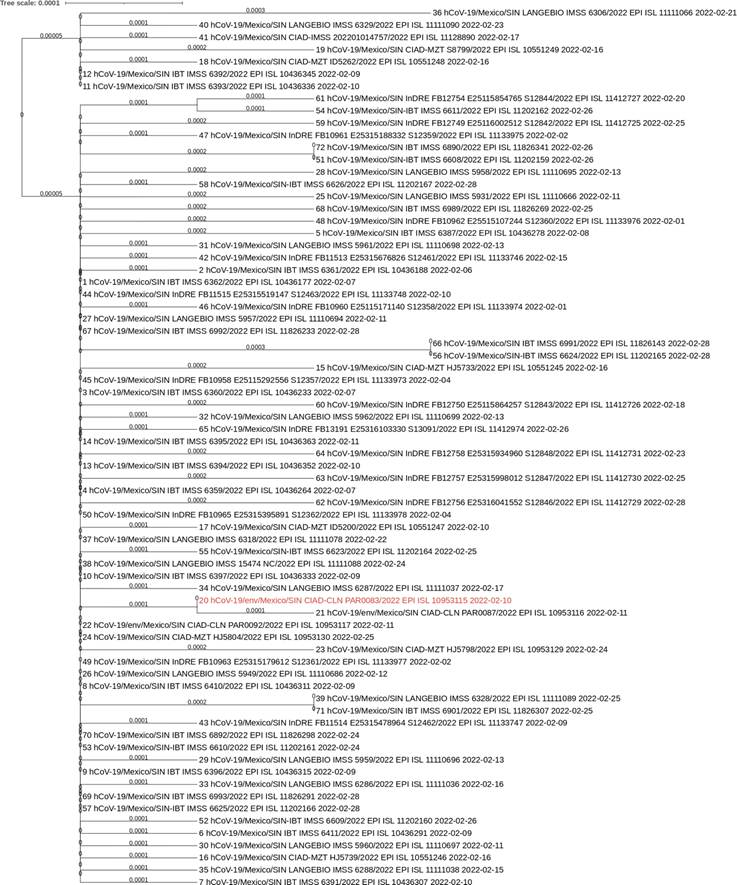
Phylogenetic analysis reveals the similarity of the sequence retrieved from bus water in this study with those previously reported in Mexico. This sequence was submitted to GISAID (Global initiative on sharing all influenza data) with an accession number EPI_ISL_10953115 and characterized as the Omicron variant, which was compared with 71 sequences, which were retrieved from Sinaloa, Mexico from February 1 to February 28 (Figure 2). Interestingly, all 72 sequences were identified as the Omicron variant, with two main clades observed in the phylogenetic tree: one belonging to the Pango lineage BA.1.15 and the other to various Pango lineages. The closest relative of the sequence reported in this study was found in a hospital bed swab, also from Culiacan, highlighting the prevalence of similar sequences despite differences in isolation sources within this city. The sequences were distributed throughout the tree regardless of location and reporting institution, suggesting a homogeneous distribution of Omicron strains among individuals in this state. Public transportation may have served as a potential source of viral particle transmission among both domestic and foreign populations traveling within Sinaloa state.
Previous studies have been performed to detect variants of concern in municipal wastewater (Nemudryi et al., 2020). Swift et al. (2021) detected the presence of variants such as Iota, Delta, and Gamma in wastewater in South Carolina, USA, indicating that WBE for SARS-CoV-2 may provide preliminary early warning signals about the presence of variants of concern in a community; interestingly it is noticeable the viable detection of SARS-CoV-2 RNA in wastewater, which despite of limitations it is possible to obtain RNA enough quality for sequencing and detection of mutations to identify variants of concern. Further studies have consolidated the importance of wastewater-based epidemiology for the SARS-CoV-2 detection, suggesting that it is possible to detect the SARS-CoV-2 in reduced spaces such as a dormitory, including symptomatic and asymptomatic, being possible the detection of variants, such as B.1.5 sublineage, previously detected in Europe. Results in this study allow us to remark on the need for monitoring using wastewater-based epidemiology to evaluate the incidence of pathogens prior to the report of cases in a community, which may serve as a tool for better strategies for preventive or corrective actions, suggesting the possibility to couple WBE with whole-genome sequencing (WGS) to trace not only COVID-19 positive individuals but also VOC.
Conclusions
The present study reveals the presence of SARS-CoV-2 in domestic and international buses and a bus station, which highlights the importance of the study of wastewater to infer the presence and distribution of viruses and the introduction of new variants among people to establish the traceability of pathogens for future scenarios. Additionally, it is necessary to emphasize the importance of personal hygiene measures such as hand washing, disinfectant gel, and facemasks, given the probability of interacting with passengers positive for SARS-CoV-2 during their tour, which is a high risk for human health given its transmissibility and the dispersion of pathogens among people. The present study suggests that tracing the virus on wastewater is a reliable and sensitive tool that can be of use as an early warning system for community outbreaks and the introduction of new variants

