Original articles
Northern records of Mazama temama and Leopardus wiedii in northeastern, Mexico
Registros norteños de Mazama temama y de Leopardus wiedii en el noreste de México
Hernández-Jasso, R.E.1*
 http://orcid.org/0000-0002-5875-1769
Manuel De la Rosa, Z.A.23
http://orcid.org/0000-0002-8098-2993
Mendoza Gutiérrez, G.R.23
http://orcid.org/0000-0003-1873-5219
Soria-Díaz, L.24
http://orcid.org/0000-0002-2412-3211
http://orcid.org/0000-0002-5875-1769Manuel De la Rosa, Z.A.23
http://orcid.org/0000-0002-8098-2993Mendoza Gutiérrez, G.R.23
http://orcid.org/0000-0003-1873-5219Soria-Díaz, L.24
http://orcid.org/0000-0002-2412-3211
-
Publication dates-
January 20, 2025
Jan-Dec , 2024
- Article in PDF
- Article in XML
- Automatic translation
- Send this article by e-mail
- Share this article +
ABSTRACT
Historical records of the red brocket deer (Mazama temama) and the margay (Leopardus wiedii) in northeastern Mexico, particularly were limited to the southern of Tamaulipas. However, between September 2020 and November 2021, a mammal monitoring project was carried out using camera traps in the southern portion of Altas Cumbres, Victoria, Tamaulipas. Five camera traps georeferenced were installed and established near wildlife crossing sites. Among the documented mammals, the presence of M. temama and L. wiedii stands out, both recorded for the first time in the area. The presence of a pair of red brocket deer increases the northern range of the species to about 61.69 km. While, for margay, the northern record is expanded to 61.80 km, and the most northwestern population located in Nuevo Leon to 47.09 km, being a key link between these populations.
KEYWORDS::
Camera traps, distribution, mammals, first records, Tamaulipas
Introduction
The Altas Cumbres Natural Protected Area (NPA) is located in the central-western of the state of Tamaulipas, covering the municipalities of Victoria and Jaumave, practically bordering the state capital (POE, 2014). The natural area boasts a diverse topography, ranging from 450 to 2,100 meters above sea level (masl), covering an expanse of 303.2785 km2. It constitutes a significative segment of the Gran Sierra Plegada subprovince within the Sierra Madre Oriental, encompassing notable features such as the Cuenca Alta del Rio San Marcos, Arroyo de San Felipe, Sierra del Filo, and La Melera. This extensive region extends over the municipalities of Victoria and Jaumave, Tamaulipas (Almaguer-Sierra, 2005).
-
POE,
2014Programa de Manejo de la Zona Especial Sujeta a Conservación Ecológica “Área Natural Protegida Altas Cumbres”., 2014
-
Almaguer-Sierra, 2005Fisiografía del estado de Tamaulipas, 2005
Between September 2020 and November 2021, a monitoring mammal project was carried out in the Altas Cumbres NPA, using camera trap techniques. Implementing these techniques was of great help in documenting several endangered species, among which two species that had not yet been registered in this Natural Protected Area, the margay (L. wiedii) and the red brocket deer (M. temama).
The M. temama is the smallest species of the five cervids that live in Mexico (Pérez-Solano et al., 2012). It is distributed from Mexico, through Costa Rica, and Panama to the north of South America (north of Colombia, and Venezuela); preferably in high evergreen and medium subevergreen forests, cloud forests, and even temperate pine-oak forests (Bello-Gutiérrez et al., 2010; Pérez-Solano et al., 2012). Although this deer is a species that prefers preserved forests (Branan & Marchinton, 1985), it can also be found in, transformed sites such as small clearings in the forest (Bello et al., 2004), fallows and crops (Bodmer, 1989), as long as the forest does not is totally destroyed (Álvarez del Toro, 1991).
-
Pérez-Solano et al.,
2012Primeros registros del temazate rojo Mazama temama en áreas aledañas a la Reserva de la Biosfera de Tehuacán-Cuicatlán, México.Revista Mexicana de Biodiversidad, 2012
-
Bello-Gutiérrez et
al., 2010Central American red brocket deer Mazama temama (Kerr 1992).Neotropical cervidology, Biology and medicine of Latin American deer, 2010
-
Branan & Marchinton, 1985Biology of the Red Brocket Deer in Suriname with emphasis on Management Potential.Biology of deer production, 1985
-
Bello et al., 2004Caracterización del hábitat de tres especies de artiodáctilos en un área fragmentada de Tabasco, México., 2004
-
Bodmer, 1989Ungulates biomass in relation to feeding strategy within Amazonian forest.Oecologia, 1989
-
Álvarez del
Toro, 1991Los mamíferos de Chiapas., 1991
In Mexico, M. temama is not included in any risk category by current environmental regulations NOM- 059-SEMARNAT-2010 (SEMARNAT, 2010). However, just a decade ago it was considered a great hunting trophy by the Safari Club International (SCI), entering the trophy catalog in the "Grand Slam of the deer" (Villarreal et al., 2008). In addition to this, the Secretariat of the Environment and Natural Resources (SEMARNAT) published in 2014 the list of priority species for conservation in Mexico, including the M. temama due to its potential as a game species (Briceño-Méndez & Contreras-Moreno, 2020). The wide distribution in the country, covers from the south of Tamaulipas to the Yucatan peninsula, through the slope of the Gulf of Mexico (San Luis Potosi, Queretaro, and Puebla, to the states of Veracruz, Tabasco, Oaxaca, Chiapas, Campeche, Quintana Roo and Yucatan) (Gallina, 2005). However, currently the distribution is restricted to a limited area in the Gulf of Mexico due to the advance of the agricultural frontier (Villarreal et al., 2008). The northern range boundary of species was restricted to the south of Tamaulipas, with its main sightings in the municipalities of Tula, Ocampo and Gómez Farías, the latter two in the El Cielo Biosphere Reserve (Carrera-Treviño et al., 2018 ).
-
SEMARNAT, 2010NOM-059-SEMARNAT-2010. Lista de especies en riesgo de la Norma Oficial Mexicana NOM-059-SEMARNAT-2010, Protección ambiental-Especies nativas de México de flora y fauna silvestres-Categorías de riesgo y especificaciones para su inclusión, exclusión o cambio- Lista de especies en riesgo. Diario Oficial de La Federación., 2010
-
Villarreal et al., 2008Premio Thummler: El Súper Slam de los Venados de México.Conservación y manejo de fauna cinegética de México, 2008
-
Briceño-Méndez & Contreras-Moreno, 2020Los Temazates de Calakmul: Venados poco conocidos.El Herbario CICY, 2020
-
Gallina, 2005Temazate (Mazama americana)Los mamíferos silvestres de México., 2005
-
Carrera-Treviño et al., 2018Temporal and spatial interactions of sympatric mesocarnivores at a Biosphere Reserve: coexistence or competition?Revista de Biología Tropical, 2018
On the other hand, the L. wiedii is a small felid with solitary hunting habits that captures its prey both on the ground and in the trees thanks to its ability to travel through the canopy (Morales-Delgado et al., 2021). Among the prey recorded throughout its distribution, include amphibians, lizards, rodents, squirrels, and small primates (de Oliveira-Calleia et al., 2009). It is commonly associated with conserved tropical and subtropical evergreen and deciduous forests, ranging from sea level to 1,000 masl, with few records above 2,000 masl; although there is increasing evidence that it can persist in disturbed sites, with unchanged forest fragments, mixed with degraded forests and secondary vegetation (Aranda & Valenzuela-Galván, 2015; Valenzuela-Galván et al., 2013).
-
Morales-Delgado et al., 2021Distribución potencial de Leopardus wiedii en las áreas naturales protegidas de México.Revista Mexicana de Biodiversidad, 2021
-
de Oliveira-Calleia et
al., 2009Hunting strategy of the margay (Leopardus wiedii) to attract the wild pied tamarin (Saguinus bicolor).Neotropical Primates, 2009
-
Aranda
& Valenzuela-Galván, 2015Registro notable de margay (Leopardus wiedii) en el bosque mesófilo de montaña de Morelos, México.Revista Mexicana de Biodiversidad, 2015
-
Valenzuela-Galván et al., 2013The margay Leopardus wiedii and bobcat Lynx rufus from the dry forests of Southern Morelos, MexicoThe southwestern naturalist, 2013
In Mexico, the density of the L. wiedii population is unknown, and it may be continually declining (Morales-Delgado et al., 2021), which is why it has been included in the Official Mexican Standard NOM-059-SEMARNAT-2010 in the category of endangered species (SEMARNAT, 2010). This cat is mainly associated with tropical evergreen forests, semi-deciduous forests, mangroves, and cloud forests of the Pacific from Sonora to Chiapas and the entire slope of the Gulf of Mexico (Aranda, 2005; Botello et al., 2006).
-
Morales-Delgado
et al., 2021Distribución potencial de Leopardus wiedii en las áreas naturales protegidas de México.Revista Mexicana de Biodiversidad, 2021
-
SEMARNAT, 2010NOM-059-SEMARNAT-2010. Lista de especies en riesgo de la Norma Oficial Mexicana NOM-059-SEMARNAT-2010, Protección ambiental-Especies nativas de México de flora y fauna silvestres-Categorías de riesgo y especificaciones para su inclusión, exclusión o cambio- Lista de especies en riesgo. Diario Oficial de La Federación., 2010
-
Aranda, 2005Leopardus wiedii (Schinz, 1821).Los mamíferos silvestres de México., 2005
-
Botello et al., 2006Primer registro del tigrillo (Leopardus wiedii, Schinz 1821) y del gato montés (Lynx rufus, Kerr 1792) en la Reserva de la Biosfera de Tehuacán-Cuicatlán, Oaxaca, México.Acta zoológica mexicana, 2006
This work aimed to report the northernmost extent of the distribution of the red brocket deer and the margay in Tamaulipas.
Material and Methods
The study was conducted in the state of Tamaulipas, within the Gran Sierra Plegada subprovince of the Sierra Madre Oriental (Almaguer-Sierra, 2005). This area comprises an ecological association of low deciduous forest formed by Celtis iguanaea, Sabal mexicana, Sapindus sp., Commelina sp., Centrosema sp., and Pteris vittata. The study area comprises the south of the Natural Protected Area Altas Cumbres, just 3.5 km north of the Altas Cumbres community (close to the state highway 126 Ciudad Victoria - Tula, beginning on one side of the point known as the 'Cerro Agujerado' tunnel.
-
Almaguer-Sierra, 2005Fisiografía del estado de Tamaulipas, 2005
Despite protection and conservation efforts, there has been an increase in anthropic activities in the area, mainly mining extraction and new human settlements. It was unknown if these activities were affecting the fauna, so from September 2, 2020, to November 30, 2021 (1820 trap-nights), we started a project to monitor medium and large mammals in the south of the Altas Cumbres NPA.
Four simple georeferenced sampling stations were established, each equipped with one camera, except for the first station which utilized two devices. The first station (CTN1MAM) was established in an artificial watering hole for wildlife that is in the NPA at 992 masl at a point with coordinates 23°37.917' N, 99°11.657' W, just 300 m east of the area known as the 'Cerro Agujerado' tunnel. From that point the following stations were established (CTN2MAM at 971 masl at 23°38.002' N, 99°11.574' W; CTN3MAM at 977 masl at 23°38.072' N, 99°11.480' W; and CTN4MAM at 991 masl at 23°38.157' N, 99°11.366' W) on a linear transect of 1.2 km, each station separated by 300 m distance from each other. The selection of the transect was made by looking for corridors and trails that evidenced the passage of fauna based on the criteria established by Aranda-Sánchez (2012). Camera traps from the MixMart® and HCO Scoutguard® models were used; these were placed on tree trunks, at a height between 43 and 48 cm above the ground. The cameras operated continuously, during the entire sampling period and were checked every three months. They were configured to record 10-second videos and take a photograph when triggered by an animal, with a target range of 1.5 to 3.3 m. Cameras were set to medium sensitivity levels, and the interval between photos was programmed at 5 s; no baits were used during the sampling.
-
Aranda-Sánchez (2012Manual para el rastreo de mamíferos silvestres de México., 2012
Results and Discussion
Between the sampling months, the camera traps recorded the presence of several medium-sized mammals that are common in Altas Cumbres such as Urocyon cinereoargenteus, Odocoileus virginianus, and Nasua narica, among others. However, the taxa that drew the most attention for having their first record in the region were M. temama and L. wiedii, these were species-level identifications made using specialized literature (Aranda-Sánchez, 2012; Ceballos, 2014). For M. temama, its reddish-brown hue, slender body, large ears, and the male's antlers were taken into consideration. Conversely, for margay, its medium-sized, coloration, neck spots, and proportionally longer tail were considered.
-
Aranda-Sánchez, 2012Manual para el rastreo de mamíferos silvestres de México., 2012
-
Ceballos,
2014Mammals of Mexico, 2014
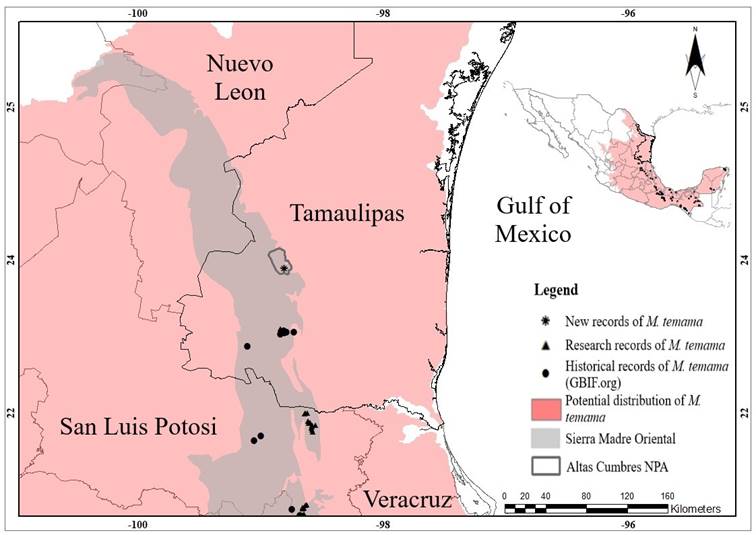
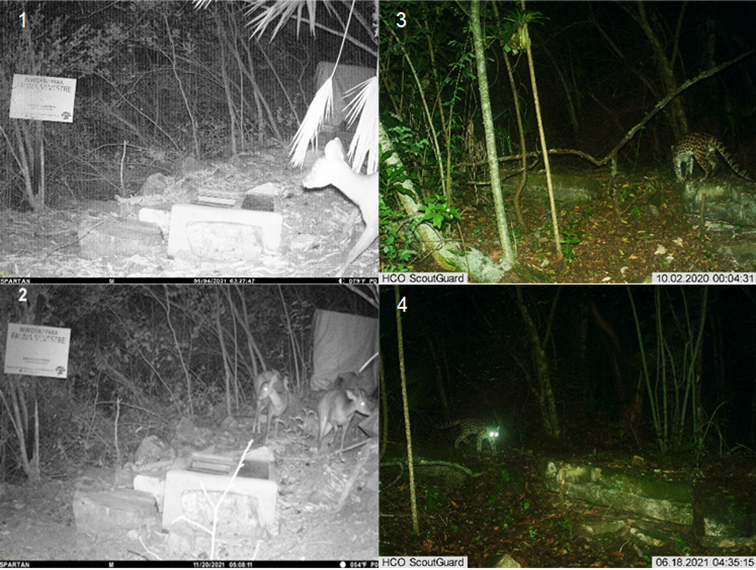
On May 3, 2021, M. temama was first documented in the Altas Cumbres NPA, extending the known northern range (Figure 1). The CTN1MAM camera station captured the presence of an adult female M. temama on three occasions that day. The first record was at 00:18 h, followed by a second image at 00:22 h, and a third at 00:28 h. The following day (May 4), this station recorded the presence of an adult female of M. temama, considering that these are consecutive photographs separated by over 24 hours, they can be identified as independent events, leading to the conclusion that they represent the same individual (O'Brien et al., 2003). The first record on this day occurred at 03:27 h, followed by a second at 03:28 h. A particularly noteworthy observation, from a biological perspective, took place on October 30, 2020. The CTN1MAM station recorded two adult specimens at 05:08 h, with one displaying antlers, indicative of sexual dimorphism and suggesting a reproductive pair (Aranda, 2000).
-
O'Brien et al., 2003Crouching tigers, hidden prey: Sumatran tiger and prey populations in a tropical forest landscapeAnimal Conservation Forum, 2003
-
Aranda, 2000Huellas y otros rastros de los mamíferos grandes y medianos de México., 2000
Thumbnail
 Source: Del Río-García et
al., 2020; GBIF,
2023a; Ochoa-Espinoza et al., 2023; Sánchez-Cordero et al.,
2020
Source: Del Río-García et
al., 2020; GBIF,
2023a; Ochoa-Espinoza et al., 2023; Sánchez-Cordero et al.,
2020
Figure 1
Map of new records, research records, historical records, and potential distribution of Mazama temama in the Altas Cumbres Natural Protected Area, Victoria, Tamaulipas.
Map of new records, research records, historical records, and potential distribution of Mazama temama in the Altas Cumbres Natural Protected Area, Victoria, Tamaulipas.
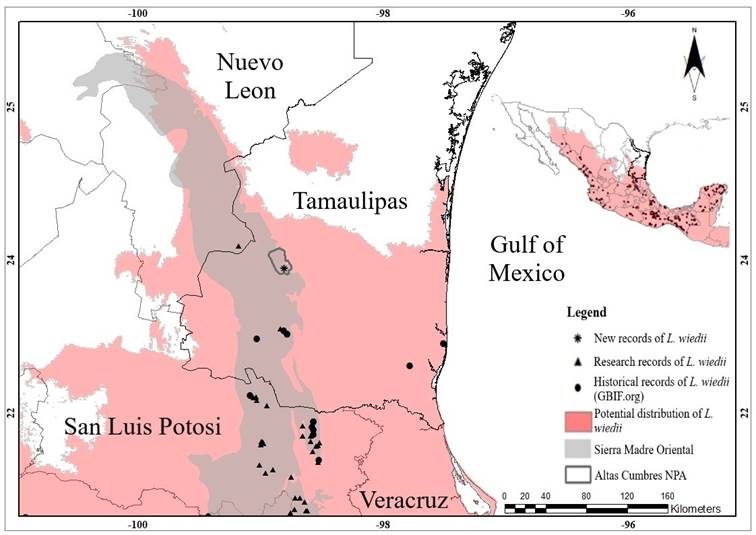
On the night of October 2, 2020, at 00:04 h, the CTN2MAM station made the first photographic record of this little cat in the Altas Cumbres NPA, expanding its distribution in Tamaulipas (Figure 2). The image shows a specimen in posterior view that, judging by its size and presence of testicles is a male adult, margay could be readily differentiated from other felines, such as ocelot, due to its proportionately long tail (Eisenberg, 1989). A second sighting took place a month later on November 6, 2020, at 22:21 h, when the CTN3MAM station recorded an adult margay, although it was moving in the opposite direction. The third sighting occurred at the same location, on June 18, 2021, when the camera recorded the presence of an adult margay at 04:35 h (Figure 3). It was not possible to confirm whether it is the same individual based on its spot pattern because the shots capture the animal at angles that do not allow for unequivocal comparisons (Di Bitetti et al., 2006).
-
Eisenberg, 1989Mammals of the Neotropics, 1989
-
Di Bitetti et al.,
2006Density, habitat use and activity patterns of ocelots (Leopardus pardalis) in the Atlantic Forest of Misiones, ArgentinaJournal of Zoology, 2006
Thumbnail
 Source: GBIF, 2023b; Lavariega & Briones-Salas, 2019;
Martínez-Calderas et al., 2012;
Ochoa-Espinoza et al., 2023;
Peña-Mondragón & De La Peña-Cuéllar,
2017
Source: GBIF, 2023b; Lavariega & Briones-Salas, 2019;
Martínez-Calderas et al., 2012;
Ochoa-Espinoza et al., 2023;
Peña-Mondragón & De La Peña-Cuéllar,
2017
Figure 2
Map of new records, research records, historical records and potential distribution of Leopardus wiedii in the Altas Cumbres Natural Protected Area, Victoria, Tamaulipas.
Map of new records, research records, historical records and potential distribution of Leopardus wiedii in the Altas Cumbres Natural Protected Area, Victoria, Tamaulipas.
Thumbnail
 Source: own.
Figure 3
First photographic records of Leopardus wiedii and Mazama temama in the Altas Cumbres NPA: 1) Image of a red brocket deer recorded on May 4 by the CTN1MAM station; 2) Photographic of two red brocket deer in Altas Cumbres NPA; 3) Photographic of male margay on October 2 by the CTN2MAM; 4) Image of margay recorded on June 18 by the CTN3MAM.
First photographic records of Leopardus wiedii and Mazama temama in the Altas Cumbres NPA: 1) Image of a red brocket deer recorded on May 4 by the CTN1MAM station; 2) Photographic of two red brocket deer in Altas Cumbres NPA; 3) Photographic of male margay on October 2 by the CTN2MAM; 4) Image of margay recorded on June 18 by the CTN3MAM.
Previously, the distribution was restricted to a limited area in the Gulf of Mexico due to the advance of the agricultural frontier (Villarreal et al., 2008). Notably, the Altas Cumbres NPA lacks any documented records of these species within the taxonomic inventory of the NPA's management program (GET-IEA-UAT, 2014). The northernmost range boundary of the species was formerly confined to the southern region of Tamaulipas, with records reported within the El Cielo Biosphere Reserve (Carrera-Treviño et al., 2018; Carvajal et al., 2012; Ochoa-Espinoza et al., 2023) extending the known range by over 61 km approximately from the prior records.
-
Villarreal et al., 2008Premio Thummler: El Súper Slam de los Venados de México.Conservación y manejo de fauna cinegética de México, 2008
-
GET-IEA-UAT,
2014Programa de Manejo de la Zona Especial Sujeta a Conservación Ecológica 'Área Natural Protegida Altas Cumbres'., 2014
-
Carrera-Treviño et
al., 2018Temporal and spatial interactions of sympatric mesocarnivores at a Biosphere Reserve: coexistence or competition?Revista de Biología Tropical, 2018
-
Carvajal
et al., 2012Spatial patterns of the margay (Leopardus wiedii; Felidae, Carnivora) at “El Cielo” biosphere reserve, Tamaulipas, Mexico.Mammalia, 2012
-
Ochoa-Espinoza et al., 2023Diversidad y abundancia de mamíferos del bosque mesófilo de montaña del noreste de México.Acta Zoológica Mexicana (nueva serie), 2023
The northern distribution limit of M. temama it was known to occur south of Tamaulipas, with its primary sightings in the El Cielo Biosphere Reserve (Carrera-Treviño et al., 2018; Ochoa-Espinoza et al., 2023; Vargas-Contreras & Hernández-Huerta, 2001) adjacent to records in San Luis Potosi (Del Río-García et al., 2020; Rivera-Corona & Sobal-Méndez, 2007), and Veracruz (Salazar-Ortiz et al., 2022). The records of M. temama contribute to expanding knowledge of the biology of the species since a pair (female and a male) was documented in November of 2021, coinciding right at the second peak and the most pronounced of the rainy season in the region. While the other records were of solitary specimens in the dry season (Ochoa-Espinoza et al., 2023).
-
Carrera-Treviño et al.,
2018Temporal and spatial interactions of sympatric mesocarnivores at a Biosphere Reserve: coexistence or competition?Revista de Biología Tropical, 2018
-
Ochoa-Espinoza et
al., 2023Diversidad y abundancia de mamíferos del bosque mesófilo de montaña del noreste de México.Acta Zoológica Mexicana (nueva serie), 2023
-
Vargas-Contreras
& Hernández-Huerta, 2001Distribución altitudinal de la mastofauna en la reserva de la Biosfera El Cielo, Tamaulipas, México.Acta Zoológica Mexicana (nueva serie), 2001
-
Del Río-García et al.,
2020Importancia de las áreas naturales protegidas para la conservación de mamíferos terrestres en el sur de la sierra Madre oriental, San Luis Potosí, México.Agro Productividad, 2020
-
Rivera-Corona & Sobal-Méndez,
2007Diagnóstico de los mamíferos mayores y medianos en el Área Natural Protegida Sierra de Otontepec, Veracruz, México, 2007
-
Salazar-Ortiz
et al., 2022Populational attributes of the central american red brocket deer (Mazama temama) in the Sierra de Zongolica, Veracruz, Mexico.Agrociencia, 2022
Similar to the presence of M. temama, the presence of L. wiedii has been documented in the El Cielo Biosphere Reserve, considering this locality as the northern limit of distribution of the state, the registered studies have been documented in preserved vegetation types (Carrera-Treviño et al., 2018; González-Yáñez, 2022; Martínez-González, 2023; Mendoza-Gutiérrez, 2023; Vargas-Contreras & Hernández-Huerta, 2001). However, the new record extends the northern distribution of L. wiedii in the state by approximately 62 km from the previous record (Carvajal et al., 2012) and about 47 km from the northeasternmost record in Aramberri, Nuevo Leon (Peña-Mondragón & De la Peña-Cuéllar, 2017).
-
Carrera-Treviño et al., 2018Temporal and spatial interactions of sympatric mesocarnivores at a Biosphere Reserve: coexistence or competition?Revista de Biología Tropical, 2018
-
González-Yáñez, 2022Estimación de la abundancia y densidad poblacional de Leopardus wiedii (Schinz, 1821) a través de registros de trampas-cámara, en la Reserva de la Biosfera “El Cielo”, Gómez Farias Tamaulipas, México, 2022
-
Martínez-González, 2023Patrón de actividad de mamíferos medianos y grandes del bosque mesófilo de montaña de la reserva de la biosfera El Cielo, Tamaulipas, 2023
-
Mendoza-Gutiérrez, 2023Abundancia y densidad de dos meso-depredadores felinos asociados al bosque mesófilo de montaña de la reserva de la biosfera El Cielo, Gómez Farías, Tamaulipas, México, 2023
-
Vargas-Contreras & Hernández-Huerta, 2001Distribución altitudinal de la mastofauna en la reserva de la Biosfera El Cielo, Tamaulipas, México.Acta Zoológica Mexicana (nueva serie), 2001
-
Carvajal et al., 2012Spatial patterns of the margay (Leopardus wiedii; Felidae, Carnivora) at “El Cielo” biosphere reserve, Tamaulipas, Mexico.Mammalia, 2012
-
Peña-Mondragón & De la Peña-Cuéllar, 2017First confirmed record of margay in Nuevo León, north-east Mexico.CATnews, 2017
Despite the presence of domestic taxa (cows, horses, pigs, dogs, and cats) that have a direct impact within the PNA, the presence of M. temama and L. wiedii was documented, which may be due to the plasticity of the species to adapt to sites with secondary vegetation and crops located near the better-preserved vegetation fragments (Bello-Gutiérrez et al., 2010; Vera-García et al., 2023).
-
Bello-Gutiérrez et al., 2010Central American red brocket deer Mazama temama (Kerr 1992).Neotropical cervidology, Biology and medicine of Latin American deer, 2010
-
Vera-García et al., 2023First record of margay (Leopardus wiedii) in the Sierra Monte Negro State Reserve; Morelos, México: the importance of low deciduous forest relicts for conserving the species.Therya notes, 2023
Conclusions
These first records of M. temama and L. wiedii in the Altas Cumbres NPA expand their known distribution further north by at least 61.69 km and 61.80 km, respectively to the previous record in the El Cielo Biosphere Reserve; and among the most northeastern population located in Aramberri with 47.09 km for L. wiedii. This area is crucial for these species’ conservation in the Sierra Madre Oriental, serving as a connection between populations in southern Tamaulipas and Nuevo Leon.
Acknowledgments
We thank the Instituto Tecnológico Nacional de México Campus Victoria. The authors are especially grateful to Benigno Gómez, Alfonso Terán, and José Mendoza for their contributions to logistics and team support. We also thank the reviewers for their time and dedication to this manuscript.
References
- Almaguer-Sierra, P. (2005). Fisiografía del estado de Tamaulipas. In Barrientos, L., Correa, A., Horta, V., & García, J. Biodiversidad Tamaulipeca Vol. 1. (pp. 2-20). Ed. Dirección General de Educación Superior Tecnológica, Instituto Tecnológico de Ciudad Victoria. https://biblioteca.ecosur.mx/cgi-bin/koha/opac-detail.pl?biblionumber=000042379 Links
- Álvarez del Toro, M. (1991). Los mamíferos de Chiapas. Casa del Libro Press on Demand. https://books.google.com.mx/books/about/Los_mam%C3%ADferos_de_Chiapas.html?id=hj8gAQAAIAAJ&redir_esc=y Links
- Aranda, J. M. (2000). Huellas y otros rastros de los mamíferos grandes y medianos de México. Ed. CONABIO e Instituto de Ecología A. C. Links
- Aranda, J. M. (2005). Leopardus wiedii (Schinz, 1821). In Ceballos, G., & Oliva, G. Los mamíferos silvestres de México. (pp. 361-362). Ed. Fondo de Cultura Económica de España. https://www.researchgate.net/publication/286334774_Los_mamiferos_silvestres_de_Mexico Links
- Aranda, M., & D. Valenzuela-Galván, D. (2015). Registro notable de margay (Leopardus wiedii) en el bosque mesófilo de montaña de Morelos, México. Revista Mexicana de Biodiversidad, 86(4), 1110-1112. https://doi.org/10.1016/j.rmb.2015.09.015 Links
- Aranda-Sánchez, J. M. (2012). Manual para el rastreo de mamíferos silvestres de México. Ed. CONABIO. Links
- Bello-Gutiérrez, J., Guzmán-Aguirre, C., & Chablé-Montero, C. (2004). Caracterización del hábitat de tres especies de artiodáctilos en un área fragmentada de Tabasco, México. (ponencia oral). Memorias de Congreso. VI Congreso Internacional sobre el Manejo de Fauna Silvestre en la Amazonía y Latinoamérica. http://www.bio-nica.info/biblioteca/Unap2004ResumenesVICongresoFauna.pdf Links
- Bello-Gutiérrez, J., Reyna-Hurtado, R., & Wilham, J. (2010). Central American red brocket deer Mazama temama (Kerr 1992). In Duarte, J. M. B., & González, S. Neotropical cervidology, Biology and medicine of Latin American deer (pp. 166-171). Ed. FUNEP/IUCN. https://www.researchgate.net/publication/270050767_Neotropical_Cervidology_Biology_and_Medicine_of_Latin_American_Deer Links
- Bodmer, R. E. (1989). Ungulates biomass in relation to feeding strategy within Amazonian forest. Oecologia, 81, 447-550. https://doi.org/10.1007/BF00378967 Links
- Botello, F., Illoldi-Rangel, P., Linaje, M., & Sánchez-Cordero, V. (2006). Primer registro del tigrillo (Leopardus wiedii, Schinz 1821) y del gato montés (Lynx rufus, Kerr 1792) en la Reserva de la Biosfera de Tehuacán-Cuicatlán, Oaxaca, México.Acta zoológica mexicana,22(1), 135-139. https://doi.org/10.21829/azm.2006.2211969 Links
- Branan, W. V., & Marchinton, R. L. (1985). Biology of the Red Brocket Deer in Suriname with emphasis on Management Potential. In Fennessy, P. F., & Drew, K. R. Biology of deer production (pp. 41-44). Ed. Royal Society New Zealand Bulletin. Links
- Briceño-Méndez, M. A., & Contreras-Moreno, F. M. (2020). Los Temazates de Calakmul: Venados poco conocidos. Desde El Herbario CICY, 12, 205-211. https://www.cicy.mx/sitios/desde_herbario/2020 Links
- Carrera-Treviño, R., Astudillo-Sánchez, C. C., Garza-Torres, H. A., Martínez-García, L., & Soria-Díaz, L. (2018). Temporal and spatial interactions of sympatric mesocarnivores at a Biosphere Reserve: coexistence or competition?.Revista de Biología Tropical,66(3), 996-1008. https://doi.org/10.15517/rbt.v66i3.30418 Links
- Carvajal-Villarreal, S., Caso, A., Downey, P., Moreno, A., Tewes, M. E., & Grassman Jr, L. I. (2012). Spatial patterns of the margay (Leopardus wiedii; Felidae, Carnivora) at “El Cielo” biosphere reserve, Tamaulipas, Mexico.Mammalia,76(3), 237-244. https://doi.org/10.1515/mammalia-2011-0100 Links
- Ceballos, G. (2014). Mammals of Mexico. Ed. JHU Press. Links
- de Oliveira Calleia, F., Rohe, F., & Gordo, M. (2009). Hunting strategy of the margay (Leopardus wiedii) to attract the wild pied tamarin (Saguinus bicolor).Neotropical Primates,16(1), 32-34. https://doi.org/10.1896/044.016.0107 Links
- Del Río-García, I. N., Tarango-Arámbula, L. A., Hernández-SaintMartin, A. D., Rosas-Rosas, O. C., Martínez-Montoya, J. F., & Guerrero-Rodríguez, J. (2020). Importancia de las áreas naturales protegidas para la conservación de mamíferos terrestres en el sur de la sierra Madre oriental, San Luis Potosí, México.Agro Productividad,13(6), 65-69. https://doi.org/10.32854/agrop.vi.1735 Links
- Di Bitetti, M. S., Paviolo, A., & De Angelo, C. (2006). Density, habitat use and activity patterns of ocelots (Leopardus pardalis) in the Atlantic Forest of Misiones, Argentina. Journal of Zoology, 270(1), 153-163. https://doi.org/10.1111/j.1469-7998.2006.00102.x Links
- Eisenberg, J. F. (1989). Mammals of the Neotropics, Volume 1: The Northern Neotropics. University of Chicago Press. https://books.google.com.mx/books/about/Mammals_of_the_Neotropics.html?id=Dmj_HILpXXcC&redir_esc=y Links
- Gallina, S. (2005). Temazate (Mazama americana). In Ceballos, G., & Oliva, G. Los mamíferos silvestres de México. (pp. 512-513). Ed. CONABIO/Fondo de Cultura Económica. Links
- Global Biodiversity Information Facility [GBIF]. (2023a). Mazama temama (Kerr, 1792) in GBIF Secretariat. https://www.gbif.org/species/7261373 Links
- Global Biodiversity Information Facility [GBIF]. (2023b). Leopardus wiedii (Schinz, 1821) in GBIF Secretariat. https://www.gbif.org/species/24349509 Links
- Gobierno del Estado de Tamaulipas-Instituto de Ecología Aplicada-Universidad Autónoma de Tamaulipas (GET-IEA-UAT) (2014). Programa de Manejo de la Zona Especial Sujeta a Conservación Ecológica 'Área Natural Protegida Altas Cumbres'. Ed. Gobierno del Estado de Tamaulipas-Instituto de Ecología Aplicada-UAT. Links
- González-Yáñez, I. C. (2022). Estimación de la abundancia y densidad poblacional de Leopardus wiedii (Schinz, 1821) a través de registros de trampas-cámara, en la Reserva de la Biosfera “El Cielo”, Gómez Farias Tamaulipas, México [Tesis de Licenciatura, Tecnológico Nacional de México Campus Victoria , Departamento de Ingeniería Química y Bioquímica]. Links
- Lavariega, M. C., & Briones-Salas, M. (2019). Leopardus wiedii (tigrillo) Distribución potencial. http://www.conabio.gob.mx/informacion/gis/?vns=gis_root/biodiv/distpot/dpmamif/dpmcarni/lwi011dpgw Links
- Martínez-Calderas, J. M., Rosas-Rosas, O. C., Palacio-Núñez, J., Martínez-Montoya, J. F., & Villordo-Galván, J. A. (2012). Nuevos registros de tigrillo (Leopardus wiedii) en San Luis Potosí, México.Acta zoológica mexicana ,28(2), 482-486. https://doi.org/10.21829/azm.2012.282851 Links
- Martínez-González, N. (2023). Patrón de actividad de mamíferos medianos y grandes del bosque mesófilo de montaña de la reserva de la biosfera El Cielo, Tamaulipas [Tesis de Licenciatura, Benemérita Universidad Autónoma de Puebla, Facultad de Ciencias Biológicas]. Links
- Mendoza-Gutiérrez, G. R. (2023). Abundancia y densidad de dos meso-depredadores felinos asociados al bosque mesófilo de montaña de la reserva de la biosfera El Cielo, Gómez Farías, Tamaulipas, México [Tesis de Licenciatura, Tecnológico Nacional de México Campus Victoria, Departamento de Ingeniería Química y Bioquímica]. Links
- Morales-Delgado, L. M., Farías-González, V., & Téllez-Valdés, O. (2021). Distribución potencial de Leopardus wiedii en las áreas naturales protegidas de México. Revista Mexicana de Biodiversidad , 92, 923322. https://doi.org/10.22201/ib.20078706e.2021.92.3322 Links
- O'Brien, T., Kinnaird, M., & Wibisono, H. (2003). Crouching tigers, hidden prey: Sumatran tiger and prey populations in a tropical forest landscape.Animal Conservation Forum, 6(2), 131-139. https://doi.org/10.1017/S1367943003003172 Links
- Ochoa-Espinoza, J. M., Soria-Díaz, L., Astudillo-Sánchez, C. C., Treviño-Carreón, J., Barriga-Vallejo, C., & Maldonado-Camacho, E. (2023). Diversidad y abundancia de mamíferos del bosque mesófilo de montaña del noreste de México.Acta Zoológica Mexicana (nueva serie),39(1), 1-18. https://doi.org/10.21829/azm.2023.3912591 Links
- Peña-Mondragón, J. L., & De La Peña-Cuéllar, E. (2017). First confirmed record of margay in Nuevo León, north-east Mexico. CATnews, 65, 18-19. http://www.catsg.org/catsglib/recordetail.php?recordid=11559 Links
- Pérez-Solano, L. A., Mandujano, S., Contreras-Moreno, F., & Salazar, J. M. (2012). Primeros registros del temazate rojo Mazama temama en áreas aledañas a la Reserva de la Biosfera de Tehuacán-Cuicatlán, México.Revista Mexicana de Biodiversidad ,83(3), 875-878. https://doi.org/10.7550/rmb.27007 Links
- Periódico Oficial del Estado de Tamaulipas (POE). (2014). Programa de Manejo de la Zona Especial Sujeta a Conservación Ecológica “Área Natural Protegida Altas Cumbres”. Congreso del Estado de Tamaulipas. http://po.tamaulipas.gob.mx/wp-content/uploads/2015/05/cxl-52-300415F-ANEXO-2.pdf Links
- Rivera-Corona, A. S., & Sobal-Méndez, A. C. (2007). Diagnóstico de los mamíferos mayores y medianos en el Área Natural Protegida Sierra de Otontepec, Veracruz, México [Tesis de Especialidad, Universidad Veracruzana, Facultad de Ingeniería Química]. Links
- Salazar-Ortiz, J., Barrera-Perales, M., Bravo-Vinaja, M. G., Serna-Lagunes, R., Ocaña-Parada, C. J., & Gastelum-Mendoza, F. I. (2022). Populational attributes of the central american red brocket deer (Mazama temama) in the Sierra de Zongolica, Veracruz, Mexico. Agrociencia, 56(3), 1-13. https://doi.org/10.47163/agrociencia.v56i3.2805 Links
- Sánchez-Cordero, V., Rodríguez, P., Moreno-Almeraya, N., Jiménez-Cruz, M. (2020). Mazama temama (temazate rojo) Distribución Potencial en México. http://www.conabio.gob.mx/informacion/gis/?vns=gis_root/biodiv/bdotras/mte040dpgw Links
- Secretaría de Medio Ambiente y Recursos Naturales [SEMARNAT]. (2010). NOM-059-SEMARNAT-2010. Lista de especies en riesgo de la Norma Oficial Mexicana NOM-059-SEMARNAT-2010, Protección ambiental-Especies nativas de México de flora y fauna silvestres-Categorías de riesgo y especificaciones para su inclusión, exclusión o cambio- Lista de especies en riesgo. Diario Oficial de La Federación. https://www.dof.gob.mx/nota_detalle.php?codigo=5578808&fecha=14/11/2019 Links
- Valenzuela-Galván, D., De Leon-Ibarra, A., Lavalle-Sánchez, A., Orozco-Lugo, L., & Chávez, C. (2013). The margay Leopardus wiedii and bobcat Lynx rufus from the dry forests of Southern Morelos, Mexico.The southwestern naturalist,58(1), 118-120. https://doi.org/10.1894/0038-4909-58.1.118 Links
- Vargas-Contreras, J. A., & Hernández-Huerta, A. (2001). Distribución altitudinal de la mastofauna en la reserva de la Biosfera El Cielo, Tamaulipas, México. Acta Zoológica Mexicana (nueva serie) , (82), 83-109. https://doi.org/10.21829/azm.2001.82821866 Links
- Vera-García, Z. S., Fuentes-Vargas, L., Weston-Flores, M., & Uriostegui-Velarde, J. M. (2023). First record of margay (Leopardus wiedii) in the Sierra Monte Negro State Reserve; Morelos, México: the importance of low deciduous forest relicts for conserving the species. Therya notes, 4(2), 114-119. https://doi.org/10.12933/therya_notes-23-116 Links
- Villarreal, O., Thummler, H., Hernández, J., Franco, F. J., Campos, L. R., & Reséndiz, R. (2008). Premio Thummler: El Súper Slam de los Venados de México. In Villarreal, O., Franco, F. J., Hernández, J., & Romero, S. Conservación y manejo de fauna cinegética de México. (pp. 31-48). Ed. Benemérita Universidad Autónoma de Puebla. https://books.google.com.mx/books/about/Conservaci%C3%B3n_y_manejo_de_fauna_cineg%C3%A9t.html?id=HxwgAQAAIAAJ&redir_esc=y Links