




 nueva página del texto (beta)
 Inglés (pdf)
 Artículo en XML
 Referencias del artículo
 Traducción automática
 Enviar artículo por email
 Citado por SciELO
  Similares en
SciELO
Similares en
SciELO 
 Permalink

Introduction
The Altas Cumbres Natural Protected Area (NPA) is located in the central-western of the state of Tamaulipas, covering the municipalities of Victoria and Jaumave, practically bordering the state capital (POE, 2014). The natural area boasts a diverse topography, ranging from 450 to 2,100 meters above sea level (masl), covering an expanse of 303.2785 km2. It constitutes a significative segment of the Gran Sierra Plegada subprovince within the Sierra Madre Oriental, encompassing notable features such as the Cuenca Alta del Rio San Marcos, Arroyo de San Felipe, Sierra del Filo, and La Melera. This extensive region extends over the municipalities of Victoria and Jaumave, Tamaulipas (Almaguer-Sierra, 2005).
Between September 2020 and November 2021, a monitoring mammal project was carried out in the Altas Cumbres NPA, using camera trap techniques. Implementing these techniques was of great help in documenting several endangered species, among which two species that had not yet been registered in this Natural Protected Area, the margay (L. wiedii) and the red brocket deer (M. temama).
The M. temama is the smallest species of the five cervids that live in Mexico (Pérez-Solano et al., 2012). It is distributed from Mexico, through Costa Rica, and Panama to the north of South America (north of Colombia, and Venezuela); preferably in high evergreen and medium subevergreen forests, cloud forests, and even temperate pine-oak forests (Bello-Gutiérrez et al., 2010; Pérez-Solano et al., 2012). Although this deer is a species that prefers preserved forests (Branan & Marchinton, 1985), it can also be found in, transformed sites such as small clearings in the forest (Bello et al., 2004), fallows and crops (Bodmer, 1989), as long as the forest does not is totally destroyed (Álvarez del Toro, 1991).
In Mexico, M. temama is not included in any risk category by current environmental regulations NOM- 059-SEMARNAT-2010 (SEMARNAT, 2010). However, just a decade ago it was considered a great hunting trophy by the Safari Club International (SCI), entering the trophy catalog in the "Grand Slam of the deer" (Villarreal et al., 2008). In addition to this, the Secretariat of the Environment and Natural Resources (SEMARNAT) published in 2014 the list of priority species for conservation in Mexico, including the M. temama due to its potential as a game species (Briceño-Méndez & Contreras-Moreno, 2020). The wide distribution in the country, covers from the south of Tamaulipas to the Yucatan peninsula, through the slope of the Gulf of Mexico (San Luis Potosi, Queretaro, and Puebla, to the states of Veracruz, Tabasco, Oaxaca, Chiapas, Campeche, Quintana Roo and Yucatan) (Gallina, 2005). However, currently the distribution is restricted to a limited area in the Gulf of Mexico due to the advance of the agricultural frontier (Villarreal et al., 2008). The northern range boundary of species was restricted to the south of Tamaulipas, with its main sightings in the municipalities of Tula, Ocampo and Gómez Farías, the latter two in the El Cielo Biosphere Reserve (Carrera-Treviño et al., 2018 ).
On the other hand, the L. wiedii is a small felid with solitary hunting habits that captures its prey both on the ground and in the trees thanks to its ability to travel through the canopy (Morales-Delgado et al., 2021). Among the prey recorded throughout its distribution, include amphibians, lizards, rodents, squirrels, and small primates (de Oliveira-Calleia et al., 2009). It is commonly associated with conserved tropical and subtropical evergreen and deciduous forests, ranging from sea level to 1,000 masl, with few records above 2,000 masl; although there is increasing evidence that it can persist in disturbed sites, with unchanged forest fragments, mixed with degraded forests and secondary vegetation (Aranda & Valenzuela-Galván, 2015; Valenzuela-Galván et al., 2013).
In Mexico, the density of the L. wiedii population is unknown, and it may be continually declining (Morales-Delgado et al., 2021), which is why it has been included in the Official Mexican Standard NOM-059-SEMARNAT-2010 in the category of endangered species (SEMARNAT, 2010). This cat is mainly associated with tropical evergreen forests, semi-deciduous forests, mangroves, and cloud forests of the Pacific from Sonora to Chiapas and the entire slope of the Gulf of Mexico (Aranda, 2005; Botello et al., 2006).
This work aimed to report the northernmost extent of the distribution of the red brocket deer and the margay in Tamaulipas.
Material and Methods
The study was conducted in the state of Tamaulipas, within the Gran Sierra Plegada subprovince of the Sierra Madre Oriental (Almaguer-Sierra, 2005). This area comprises an ecological association of low deciduous forest formed by Celtis iguanaea, Sabal mexicana, Sapindus sp., Commelina sp., Centrosema sp., and Pteris vittata. The study area comprises the south of the Natural Protected Area Altas Cumbres, just 3.5 km north of the Altas Cumbres community (close to the state highway 126 Ciudad Victoria - Tula, beginning on one side of the point known as the 'Cerro Agujerado' tunnel.
Despite protection and conservation efforts, there has been an increase in anthropic activities in the area, mainly mining extraction and new human settlements. It was unknown if these activities were affecting the fauna, so from September 2, 2020, to November 30, 2021 (1820 trap-nights), we started a project to monitor medium and large mammals in the south of the Altas Cumbres NPA.
Four simple georeferenced sampling stations were established, each equipped with one camera, except for the first station which utilized two devices. The first station (CTN1MAM) was established in an artificial watering hole for wildlife that is in the NPA at 992 masl at a point with coordinates 23°37.917' N, 99°11.657' W, just 300 m east of the area known as the 'Cerro Agujerado' tunnel. From that point the following stations were established (CTN2MAM at 971 masl at 23°38.002' N, 99°11.574' W; CTN3MAM at 977 masl at 23°38.072' N, 99°11.480' W; and CTN4MAM at 991 masl at 23°38.157' N, 99°11.366' W) on a linear transect of 1.2 km, each station separated by 300 m distance from each other. The selection of the transect was made by looking for corridors and trails that evidenced the passage of fauna based on the criteria established by Aranda-Sánchez (2012). Camera traps from the MixMart® and HCO Scoutguard® models were used; these were placed on tree trunks, at a height between 43 and 48 cm above the ground. The cameras operated continuously, during the entire sampling period and were checked every three months. They were configured to record 10-second videos and take a photograph when triggered by an animal, with a target range of 1.5 to 3.3 m. Cameras were set to medium sensitivity levels, and the interval between photos was programmed at 5 s; no baits were used during the sampling.
Results and Discussion
Between the sampling months, the camera traps recorded the presence of several medium-sized mammals that are common in Altas Cumbres such as Urocyon cinereoargenteus, Odocoileus virginianus, and Nasua narica, among others. However, the taxa that drew the most attention for having their first record in the region were M. temama and L. wiedii, these were species-level identifications made using specialized literature (Aranda-Sánchez, 2012; Ceballos, 2014). For M. temama, its reddish-brown hue, slender body, large ears, and the male's antlers were taken into consideration. Conversely, for margay, its medium-sized, coloration, neck spots, and proportionally longer tail were considered.
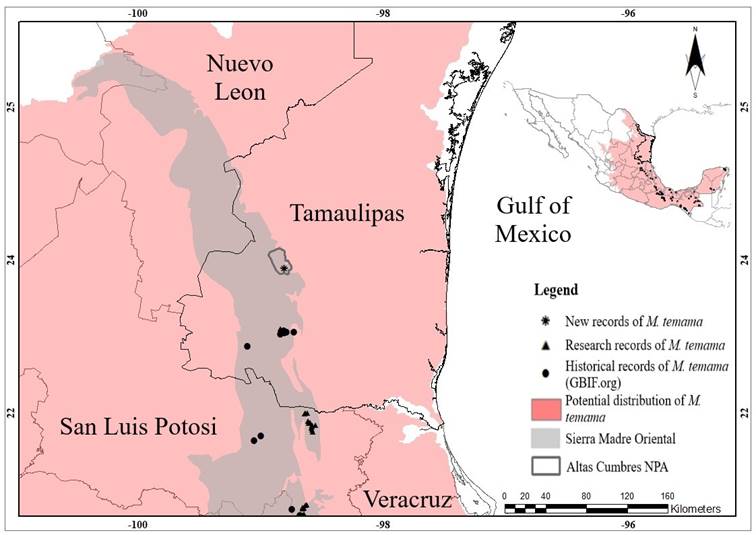
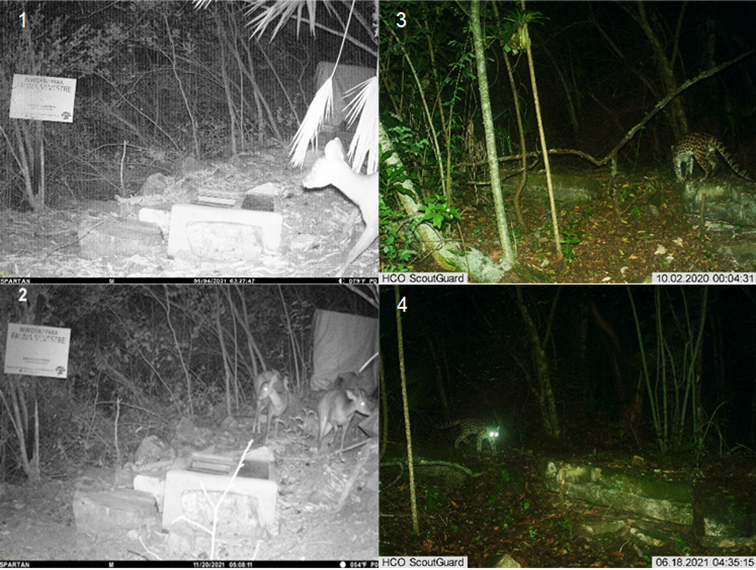
On May 3, 2021, M. temama was first documented in the Altas Cumbres NPA, extending the known northern range (Figure 1). The CTN1MAM camera station captured the presence of an adult female M. temama on three occasions that day. The first record was at 00:18 h, followed by a second image at 00:22 h, and a third at 00:28 h. The following day (May 4), this station recorded the presence of an adult female of M. temama, considering that these are consecutive photographs separated by over 24 hours, they can be identified as independent events, leading to the conclusion that they represent the same individual (O'Brien et al., 2003). The first record on this day occurred at 03:27 h, followed by a second at 03:28 h. A particularly noteworthy observation, from a biological perspective, took place on October 30, 2020. The CTN1MAM station recorded two adult specimens at 05:08 h, with one displaying antlers, indicative of sexual dimorphism and suggesting a reproductive pair (Aranda, 2000).
Source: Del Río-García et al., 2020; GBIF, 2023a; Ochoa-Espinoza et al., 2023; Sánchez-Cordero et al., 2020
Figure 1 Map of new records, research records, historical records, and potential distribution of Mazama temama in the Altas Cumbres Natural Protected Area, Victoria, Tamaulipas.
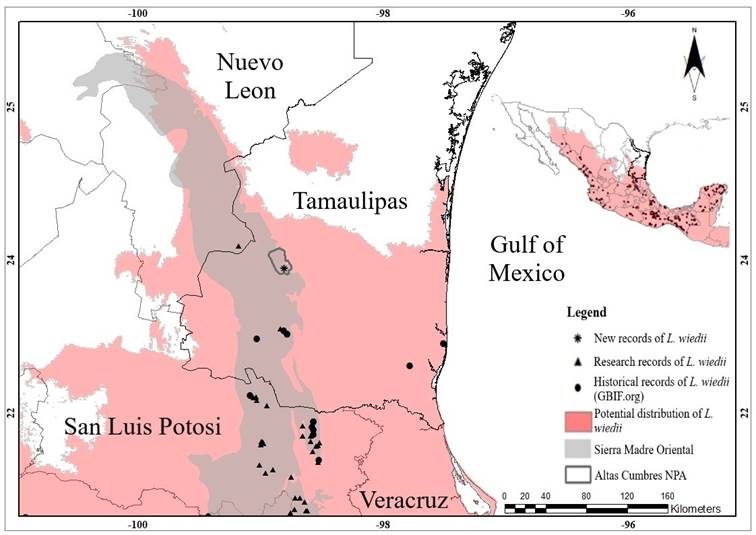
On the night of October 2, 2020, at 00:04 h, the CTN2MAM station made the first photographic record of this little cat in the Altas Cumbres NPA, expanding its distribution in Tamaulipas (Figure 2). The image shows a specimen in posterior view that, judging by its size and presence of testicles is a male adult, margay could be readily differentiated from other felines, such as ocelot, due to its proportionately long tail (Eisenberg, 1989). A second sighting took place a month later on November 6, 2020, at 22:21 h, when the CTN3MAM station recorded an adult margay, although it was moving in the opposite direction. The third sighting occurred at the same location, on June 18, 2021, when the camera recorded the presence of an adult margay at 04:35 h (Figure 3). It was not possible to confirm whether it is the same individual based on its spot pattern because the shots capture the animal at angles that do not allow for unequivocal comparisons (Di Bitetti et al., 2006).
Source: GBIF, 2023b; Lavariega & Briones-Salas, 2019; Martínez-Calderas et al., 2012; Ochoa-Espinoza et al., 2023; Peña-Mondragón & De La Peña-Cuéllar, 2017
Figure 2 Map of new records, research records, historical records and potential distribution of Leopardus wiedii in the Altas Cumbres Natural Protected Area, Victoria, Tamaulipas.
Source: own.
Figure 3 First photographic records of Leopardus wiedii and Mazama temama in the Altas Cumbres NPA: 1) Image of a red brocket deer recorded on May 4 by the CTN1MAM station; 2) Photographic of two red brocket deer in Altas Cumbres NPA; 3) Photographic of male margay on October 2 by the CTN2MAM; 4) Image of margay recorded on June 18 by the CTN3MAM.
Previously, the distribution was restricted to a limited area in the Gulf of Mexico due to the advance of the agricultural frontier (Villarreal et al., 2008). Notably, the Altas Cumbres NPA lacks any documented records of these species within the taxonomic inventory of the NPA's management program (GET-IEA-UAT, 2014). The northernmost range boundary of the species was formerly confined to the southern region of Tamaulipas, with records reported within the El Cielo Biosphere Reserve (Carrera-Treviño et al., 2018; Carvajal et al., 2012; Ochoa-Espinoza et al., 2023) extending the known range by over 61 km approximately from the prior records.
The northern distribution limit of M. temama it was known to occur south of Tamaulipas, with its primary sightings in the El Cielo Biosphere Reserve (Carrera-Treviño et al., 2018; Ochoa-Espinoza et al., 2023; Vargas-Contreras & Hernández-Huerta, 2001) adjacent to records in San Luis Potosi (Del Río-García et al., 2020; Rivera-Corona & Sobal-Méndez, 2007), and Veracruz (Salazar-Ortiz et al., 2022). The records of M. temama contribute to expanding knowledge of the biology of the species since a pair (female and a male) was documented in November of 2021, coinciding right at the second peak and the most pronounced of the rainy season in the region. While the other records were of solitary specimens in the dry season (Ochoa-Espinoza et al., 2023).
Similar to the presence of M. temama, the presence of L. wiedii has been documented in the El Cielo Biosphere Reserve, considering this locality as the northern limit of distribution of the state, the registered studies have been documented in preserved vegetation types (Carrera-Treviño et al., 2018; González-Yáñez, 2022; Martínez-González, 2023; Mendoza-Gutiérrez, 2023; Vargas-Contreras & Hernández-Huerta, 2001). However, the new record extends the northern distribution of L. wiedii in the state by approximately 62 km from the previous record (Carvajal et al., 2012) and about 47 km from the northeasternmost record in Aramberri, Nuevo Leon (Peña-Mondragón & De la Peña-Cuéllar, 2017).
Despite the presence of domestic taxa (cows, horses, pigs, dogs, and cats) that have a direct impact within the PNA, the presence of M. temama and L. wiedii was documented, which may be due to the plasticity of the species to adapt to sites with secondary vegetation and crops located near the better-preserved vegetation fragments (Bello-Gutiérrez et al., 2010; Vera-García et al., 2023).
Conclusions
These first records of M. temama and L. wiedii in the Altas Cumbres NPA expand their known distribution further north by at least 61.69 km and 61.80 km, respectively to the previous record in the El Cielo Biosphere Reserve; and among the most northeastern population located in Aramberri with 47.09 km for L. wiedii. This area is crucial for these species’ conservation in the Sierra Madre Oriental, serving as a connection between populations in southern Tamaulipas and Nuevo Leon.

