Articles
Availability of two species of fruits and their influence on the social structure of Tayassu pecari and Dicotyles tajacu

-
Publication dates-
Sep-Dec , 2017
Electronic publication (usually web, but also includes CD-ROM or other electronic only distribution) - Article in PDF
- Article in XML
- Automatic translation
- Send this article by e-mail
- Share this article +
Abstract
The white-lipped peccary (Tayassupeccari) and the collared peccary (Dicotyles tajacu) are social ungulates that contribute to tropical forest maintenance, molding the composition of tree species through herbivory and seed dispersal and predation. The fruits of zapote (Manilkara zapota) and ramon (Brosimum alicastrum) trees are important items in the diet of both peccary species. The objective of this study was to assess the relationship between the abundance of fruits of Manilkara zapota and Brosimum alicastrum and its relationship with the number of newborns in groups of both peccary species during the rainy and dry season in a tropical forest in the Yucatan Peninsula, Mexico. Peccary groups were monitored with ten camera trap stations and through direct observations during the dry season of 2014 (February-May) and the rainy season of 2015 (June - September). To estimate fruit availability, five transects (2 km long) were set at random in forested areas. Several 2-m2 tree plots were established in each transect to obtain a fruit abundance index. Peccary group size and number of newborns in each season were correlated with fruit abundance. In both species, group size was significantly larger in the dry vs. rainy season (P < 0.001). Offspring were proportionally more abundant during the dry season (P < 0.001). Fruits of M. zapota were more abundant in the dry season and reached the peak availability in May (P < 0.001). Fruits of B. alicastrum were more abundant in the rainy season, reaching the peak availability in September (P < 0.001). For both peccary species, the highest numbers of newborns in individual groups may be attributable, although not specifically, to the abundance of M. zapota fruits during the dry season. In this sense, the groups of both peccary species may depend on the seasonal availability of food of key species, such as the fruits of M. zapota during the dry season. Based on these results, preserving areas in good conservation status is deemed important, as well as reducing tree clearing of species such as zapote and ramon at the study site.
Key words::
Brosimum alicastrum, Calakmul, fruit index availability, Manilkara zapota, ramon, newborns, peccary, zapote
Introduction
Frugivorous or omnivorous mammals are a key component in tropical forest ecosystems, since they serve as seed dispersers or predators (O'Farrill et al. 2006, 2011; Peres et al. 2016). This contributes to the regeneration of forests, by structuring their composition (Peres et al. 2016). However, the reduction of tropical forests through changes in land use affects the diversity and availability of fruits and prolongs the natural periods of scarcity (Tabarelli et ai. 2004; Keuroghlian and Eaton 2008). As a result, some mammal species migrate to other areas in search of fruits, while others are able to make adjustments to their diets (Altricher et al. 2001; Keuroghlian 2003; Keuroghlian and Eaton 2008). In peccary species (Tayassu pecari and Dicotyles tajacu), it has been pointed out that the breeding, gestation and birth periods are related to the nutritional quality of food resources and the primary productivity of key fruit species available in the environment (Altricher et al. 2001; Keuroghlian et al. 2004; López et al. 2006).
-
O'Farrill et al. 2006Manilkara zapota: A new record of a species dispersed by tapirsTapir Conservation, 2006
-
2011Origin and deposition sites influence seed germination and seedling survival of Manilkara zapota: implications for long-distance, animal-mediated seed dispersalSeed Science Research, 2011
-
Peres et al.
2016Dispersal limitation induces long-term biomass collapse in overhunted Amazonian forestsProceedings of the National Academy of Sciences of the United States of America, 2016
-
Peres et al.
2016Dispersal limitation induces long-term biomass collapse in overhunted Amazonian forestsProceedings of the National Academy of Sciences of the United States of America, 2016
-
Tabarelli et
ai. 2004Forest fragmentation, synergisms and the impoverishment of Neotropical forestsBiodiversity and Conservation, 2004
-
Keuroghlian and
Eaton 2008Fruit availability and peccary frugivory in an isolated Atlantic forest fragment: effects on peccary ranging behavior and habitat useBiotropica, 2008
-
Altricher et al. 2001White-lipped peccary (Tayassu pecari, Artiodactyla: Tayassuidae) diet and fruit availability in a Costa Rican rain forestRevista de Biología Tropical, 2001
-
Keuroghlian 2003The response of peccaries to seasonal fluctuations in an isolated patch of tropical forest, 2003
-
Keuroghlian and Eaton 2008Area use by white lipped and collared peccaries (Tayassu pecari and Tayassu tajacu) in a tropical forest fragmentBiological Conservation, 2004
-
Altricher et al. 2001White-lipped peccary (Tayassu pecari, Artiodactyla: Tayassuidae) diet and fruit availability in a Costa Rican rain forestRevista de Biología Tropical, 2001
-
Keuroghlian et al. 2004Area use by white lipped and collared peccaries (Tayassu pecari and Tayassu tajacu) in a tropical forest fragmentBiological Conservation, 2004
-
López et al.
2006Valor Nutricional de los Alimentos de Tayassu pecari (Atiodactyla: Tayassuidae) en el Parque Nacional Corcovado, Costa RicaRevista de Biología Tropical, 2006
The white-lipped peccary (T. pecari) and the collared peccary (D. tajacu), belonging to the Family Tayassuidae, are important social ungulate species in tropical ecosystems. Both species contribute to the maintenance and composition of trees in forests through herbivory and seed dispersal and predation (Bodmer 1991; March 1993; Beck 2005,2006; Keuroghlian and Eaton 2009; Beck et al. 2010). Peccaries are an essential food resource for the inhabitants of rural and indigenous communities throughout their distribution range (Weber 2000; Altrichter and Boaglio 2004; Desbiez et al. 2009; Reyna-Hurtado et al. 2010; Briceño-Méndez et al. 2011; Keuroghlian et al. 2013; Naranjo et al. 2015). Wild populations of both species are currently under an intense pressure by hunting and loss of habitat (Reyna-Hurtado 2009; Góngora et al. 2011; Altrichter et al. 2012; Keuroghlian et al. 2013; Naranjo et al. 2015; Briceño-Méndez etal. 2016).
-
Bodmer 1991Strategies of seed dispersal and seed predation in Amazonian ungulatesBiotropica, 1991
-
March 1993The white-lipped peccary (Tayassu pecari)Pigs, Peccaries and Hippos, 1993
-
Beck
2005Seed predation and dispersal by pecaries thoughout the Neotropics and its consequence: a review and synthesisSeed fate: predation, dispersal and seedling establishment, 2005
-
2006A review of peccary-palm interactions and their ecological ramifications across the NeotropicsJournal of Mammalogy, 2006
-
Keuroghlian and Eaton 2009Removal of palm fruits and ecosystem engineering in palm stands by white-lipped peccaries (Tayassu pecari) and other frugivores in an isolated Atlantic Forest fragmentBiodiversity and Conservation, 2009
-
Beck et al.
2010Do Neotropical peccary species (Tayassuidae) function as ecosystem engineers for anurans?Journal Tropical Ecology, 2010
-
Weber 2000Effects of hunting on tropical deer populations in southeastern México, 2000
-
Altrichter and Boaglio 2004Distribution and relative abundance of peccaries in the Argentine Chaco: associations with human factorsBiological Conservation, 2004
-
Desbiez et al. 2009Niche partitioning among white-lipped peccaries (Tayassu pecari), collared peccaries (Pecari tajacu), and feral pigs (Susscrofa)Journal of Mammalogy, 2009
-
Reyna-Hurtado et al. 2010Hunting patterns, population density, group size, and conservation of the white-lipped peccary (Tayassu pecari) in the Calakmul Region of MexicoOryx, 2010
-
Briceño-Méndez et al. 2011Cacería del pecarí de collar (Pecari tajacu) (Artiodactyla: Tayassuidae) en Tzucacab, Yucatán, MéxicoRevista Mexicana de Mastozoología, 2011
-
Keuroghlian et al. 2013Tayassu pecari en IUCN 2013IUCN Red List of Threatened Species, 2013
-
Naranjo et al.
2015Distribución , abundancia y amenazas a las poblaciones de tapir centroamericano (Tapirus bairdii) y pecarí de labios blancos (Tayassupecari) en MéxicoTherya, 2015
-
Reyna-Hurtado 2009Conservation status of the white-lipped peccary (Tayassu pecari) outside the Calakmul Biosphere Reserve in Campeche, Mexico: a synthesisTropical Conservation Science, 2009
-
Góngora
et al. 2011Pecari tajacuLa lista Roja de la UICN de especies amenazadas, 2011
-
Altrichter et al. 2012Range-wide declines of a key Neotropical ecosystem architect, the Near Threatened white-lipped peccary Tayassu pecariOryx, 2012
-
Keuroghlian et al. 2013Tayassu pecari en IUCN 2013IUCN Red List of Threatened Species, 2013
-
Naranjo et al. 2015Distribución , abundancia y amenazas a las poblaciones de tapir centroamericano (Tapirus bairdii) y pecarí de labios blancos (Tayassupecari) en MéxicoTherya, 2015
-
Briceño-Méndez etal. 2016Responses of two sympatric species of peccaries (Tayassu pecari and Pecari tajacu) to hunting in Calakmul, MexicoTropical Conservation Science, 2016
The Calakmul region, in the state of Campeche, is one of the main remnants of tropical forest in Mexico and includes the Calakmul Biosphere Reserve (RBC; 7,231 km2). Various activities such as the production of charcoal and the use of natural resources have led the accelerated deforestation and fragmentation of the primary vegetation, in addition to poaching of wild species. A site adjacent to this reserve is the ejido Nuevo Becal, stretching across 520 km2, where the loss of habitat and poaching of wild species prevail (Briceño-Méndez et al. 2016). The forests of the Calakmul region include two tree species that are key in the diet of peccaries (Reyna-Hurtado 2007; Perez-Cortez and Reyna-Hurtado 2008): the ramon, Brosimum alicastrum, and the zapote, Manilkara zapota. These species account for 57.10 % of the total species producing fruits consumed by peccaries on the ground (Briceño-Méndez et al. 2014). Given the importance of their fruits as a source of food, these species have also been described as part of the diet of primates such as the spider monkey, Ateles geoffroyi, and the howler monkey, Alouatta pigra (Hernández-Sarabia 2013), as well as of other ungulates such as the tapir, Tapirus bairdii (O'Farrill et al. 2006, 2011) and the temazates deer, Mazama temama and M. pandora (Weber 2008; González-Zamora et al. 2009).
-
Briceño-Méndez et al. 2016Responses of two sympatric species of peccaries (Tayassu pecari and Pecari tajacu) to hunting in Calakmul, MexicoTropical Conservation Science, 2016
-
Reyna-Hurtado 2007Social ecology of the white-lipped peccary (Tayassu pecari) in Calakmul forest, Campeche, Mexico, 2007
-
Perez-Cortez and Reyna-Hurtado 2008La dieta de los pecaríes (Pecari tajacu y Tayassu pecari) en la región de Calakmul, Campeche, MéxicoRevista Mexicana de Mastozoología, 2008
-
Briceño-Méndez et al. 2014Preferencias de hábitat y abundancia relativa de Tayassu pecari en un área con cacería en la región de Calakmul, Campeche, MéxicoRevista Mexicana de Biodiversidad, 2014
-
Hernández-Sarabia 2013Estrategias de desplazamiento de Ateles geoffroyiyucatanensis y Alouattapigra en la búsqueda de recursos tróficos durante la temporada seca y húmeda en la Reserva de la Biosfera, Calakmul, Campeche, México, 2013
-
O'Farrill et al. 2006Manilkara zapota: A new record of a species dispersed by tapirsTapir Conservation, 2006
-
2011Origin and deposition sites influence seed germination and seedling survival of Manilkara zapota: implications for long-distance, animal-mediated seed dispersalSeed Science Research, 2011
-
Weber 2008Un especialista, un generalista y un oportunista: uso de tipos de vegetación por tres especies de venados en Calakmul, CampecheAvances en el Estudio de los Mamíferos de México. Publicaciones Especiales, Vol. II, 20082008
-
González-Zamora et al. 2009Diet of spider monkeys (Ateles geoffroyi) in Mesoamerica: current knowledge and future directionsAmerican Journal of Primatology, 2009
An investigation conducted in RBC has revealed that the availability of ramon is related to the surface area used by T. pecari (Reyna-Hurtado 2007). However, it is unknown whether the proportion of newborns in groups of peccaries varies according to the season. This could be related to the availability of M. zapota and B. alicastrum fruits, documented as essential seasonal food items in the peccary diet (Reyna-Hurtado 2007, Perez-Cortez and Reyna-Hurtado 2008). Unveiling the relationship between the availability of key fruit species such as ramón and zapote and the composition in the social structure of peccaries is essential for management and conservation plans. The objectives of this study were two. Quantify the seasonal availability and variations of M. zapota and B. alicastrum fruits in ejido Nuevo Becal. Evaluate the social structure of T. pecari and D. tajacu. Specifically, it was assessed whether there are fluctuations in the number of newborns of the two peccary species according to the rainy and dry seasons matching the availability of M. zapota and B. alicastrum fruits.
-
Reyna-Hurtado 2007Social ecology of the white-lipped peccary (Tayassu pecari) in Calakmul forest, Campeche, Mexico, 2007
-
Reyna-Hurtado 2007Social ecology of the white-lipped peccary (Tayassu pecari) in Calakmul forest, Campeche, Mexico, 2007
-
Perez-Cortez and Reyna-Hurtado 2008La dieta de los pecaríes (Pecari tajacu y Tayassu pecari) en la región de Calakmul, Campeche, MéxicoRevista Mexicana de Mastozoología, 2008
Materials and Methods
Area of study. The site is located in the southeastern portion of the Calakmul region, at ejido Nuevo Becal (18.6920° N, -89.2511° W; 20.9450° N, -89.6433° N; 21.2811° N, -89.6650° W; 21.0161° N, -89.8772° W), in the municipality of Calakmul, Campeche, Mexico. This area is adjacent to RBC, a protected area of tropical forest in Mexico with an extension of 7,231 km2 (Figure 1).
Thumbnail
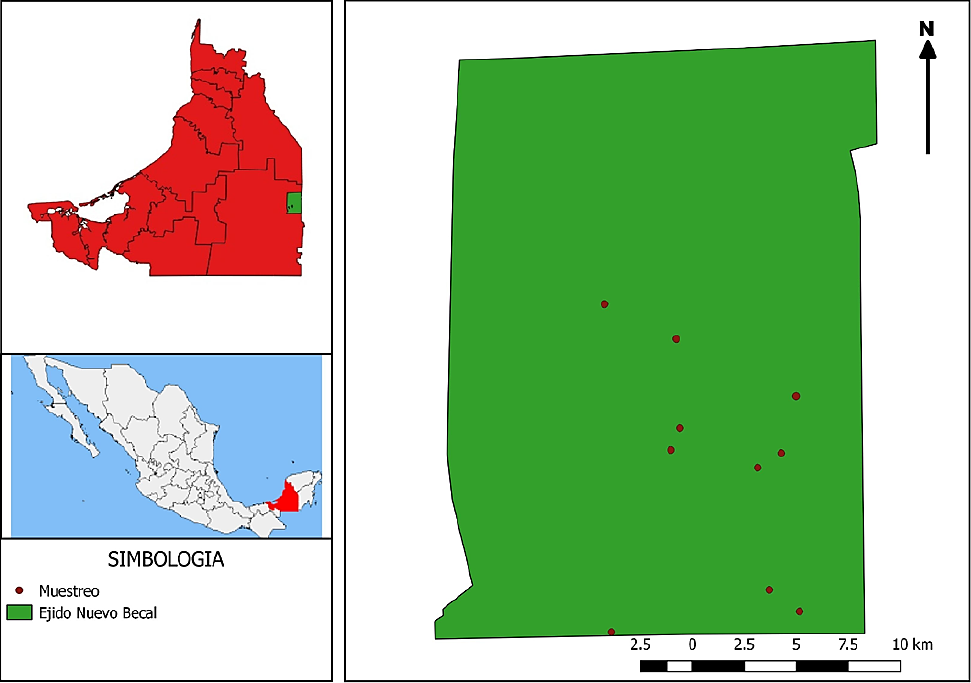
Figure 1
Location of the study area and sampling points at ejido Nuevo Becal, Calakmul, Campeche Mexico.
Location of the study area and sampling points at ejido Nuevo Becal, Calakmul, Campeche Mexico.
The ejido comprises an area of 520 km2. The types of vegetation include subdeciduous forest, floodplain forests, dry forests, and secondary vegetation (Pennington and Sarukhan 1998). Elevation ranges between 100 to 380 masl. The predominant climate is warm sub-humid with summer rainfall and with less than 60 mm of precipitation in the driest month; the mean annual temperature is 25 °C (García-Gil 2003).
-
Pennington and Sarukhan 1998Árboles Tropicales de México, 1998
-
García-Gil 2003Colonización humana reciente y formación del paisaje agrario en la Reserva de la Biosfera de Calakmul, Campeche, México, 2003
Social structure. During the 2014 dry season (February-May) and the 2015 rainy season (June-September) peccary groups were monitored in 10 camera-trap stations (Reconyx PC800 Hyperfire Professional IRTM y PC600 Hyperfire Pro White FlashTM; Reconyx, Inc., Holmen, Wisconsin, USA) on a permanent basis in sites near water bodies, roads and trails selected at random in the ejido section covered by natural vegetation. Camera traps were placed at a height not exceeding 50 cm from ground level and with a separation of 1.5 km, covering an area of approximately 112 km2 delimited by the external location of traps (Figure 1). The period of photographic records was set to operate 24 hours with trigger intervals of one second. This interval allows counting all individuals passing in a line or grouped (Maffei et al. 2002; Figure 2). Records were considered independent after 24 hours between one record and another, or when more than one individual appeared in the photograph. The position of each station was georeferenced with a Garmin 62s® GPS. For each picture obtained, the time and date was recorded (Lira Torres et al. 2014). The age structure of each group was examined and evaluated by obtaining the individuals into three categories, adults, juveniles, and young, according to size and pelage coloration; then, the percentage of each category was calculated (Reyna-Hurtado et al. 2010). The average number of hatchlings was estimated and counted during the month of birth, either in the February-May dry season or in the June-September rainy season (Figure 2).
-
Maffei et al. 2002Uso de trampas cámara para la evaluación de mamíferos en el Ecotono Chaco-ChiquitaníaRevisa de Biología Tropical, 2002
-
Lira Torres et al. 2014Abundancia relativa, estructura poblacional, preferencia de hábitat y patrones de actividad del tapir centroamericano Tapirus bairdii (Perissodactyla: Tapiridae), en la Selva de Los Chimalapas, Oaxaca, MéxicoRevista de Biología Tropical, 2014
-
Reyna-Hurtado et al. 2010Hunting patterns, population density, group size, and conservation of the white-lipped peccary (Tayassu pecari) in the Calakmul Region of MexicoOryx, 2010
Thumbnail
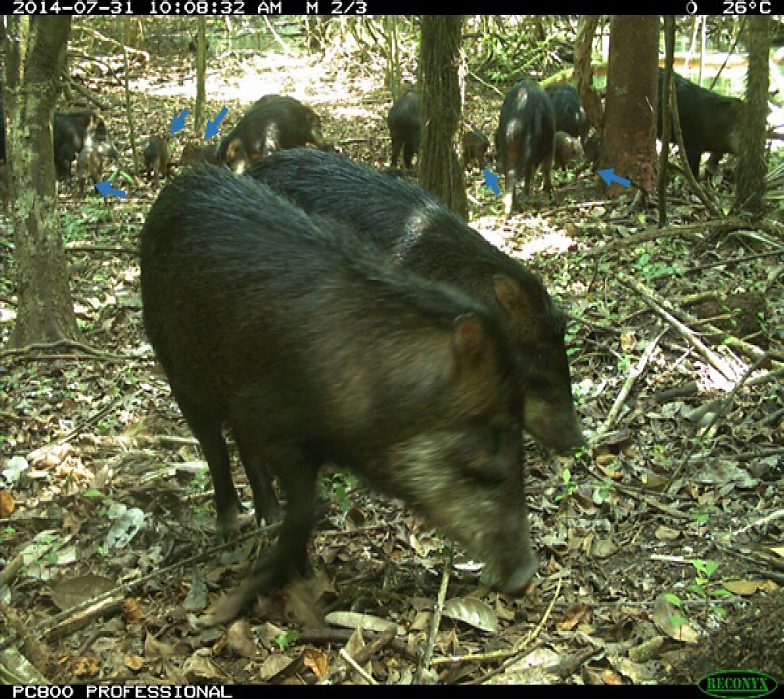
Figure 2
Group of white-lipped peccaries (Tayassu pecari) photographed with camera traps. Blue arrows indicate five newborns of white-lipped peccaries in ejido Nuevo Becal, Calakmul, Campeche, Mexico.
Group of white-lipped peccaries (Tayassu pecari) photographed with camera traps. Blue arrows indicate five newborns of white-lipped peccaries in ejido Nuevo Becal, Calakmul, Campeche, Mexico.
Fruit Availability. To estimate fruit abundance, five 2 km-long transects were established, which were determined randomly in forested areas, avoiding a radius of at least 7 km from the village. Transects were visited once a month in order to derive a fruit abundance index (Altrichter et al. 2001). The method consists in finding a fruit on the ground, then locating the source tree where the fruit came from, provided it is located at a perpendicular distance not exceeding 5 m from the center line of the transect. Once the source tree was located, all the fruits found within a quadrat of 2 m2 under the canopy were recorded.
-
Altrichter et al. 2001White-lipped peccary (Tayassu pecari, Artiodactyla: Tayassuidae) diet and fruit availability in a Costa Rican rain forestRevista de Biología Tropical, 2001
Data Analysis. To evaluate the differences in the size of the groups of both species between the dry and rainy seasons, and the proportion newborns, Mann-Whitney tests were conducted. We used the availability index of each fruit species and the monthly variation was evaluated using a Pearson's Chi2 non-parametric test. In all cases, statistical tests considered a significance level of P < 0.05. The variables analyzed were the proportion of newborns per group, species, fruit availability index, dry season and rainy season. A simple correlation analysis was conducted between fruit availability index values and number of newborns. The statistical analyzes were performed in SPSS v. 17.0.
Results
The sampling effort was 2,420 trap-nights (302.5 trap-nights per month) and a total of 86 records of Tayassu pecari were obtained, resulting in a total of 1,026 individuals counted. For Dicotyles tajacu, 76 records were obtained, leading to a total of 33 individuals counted.
A higher number of groups and individuals of both species were observed in the dry season (T. pecari 53.8; D. tajacu 46.2) versus the rainy season (T. Pecari 33.1; D. tajacu 30.1). Similarly, the average size (mean ± SD) of groups for both species was significantly higher in the dry season (T. pecari 23 ± 5.3, n = 53; D. tajacu 4.9 ± 2.6, n = 46; U = 0.01).
Social structure. The age structure of T. pecari in the dry season was determined based on 886 individuals, with the following proportions: adults, 76.3 %; sub-adults, 9.4 %; and newborns 14.3 %. In the rainy season, the age structure on the basis of 140 adult individuals was 66.6 %, sub-adults 26.2 % and 7.2 % newborns. The age structure of D. tajacu in the dry season (n = 46) was: adults, 76.0 %; sub-adults, 7.7 %; and newborns, 16.3 %; the percentages of these age classes for the rainy season (n = 17) are 93.0 %, 6.0 % and 1.0 %, respectively. In both species, the proportion of offspring was significantly higher during the months of the dry season T. pecari (X2 = 27.14, d. f. = 7, P < 0.001) and D. tajacu (X2 = 34.0, d. f. = 5, P < 0.001, Figure 3, 4).
Thumbnail
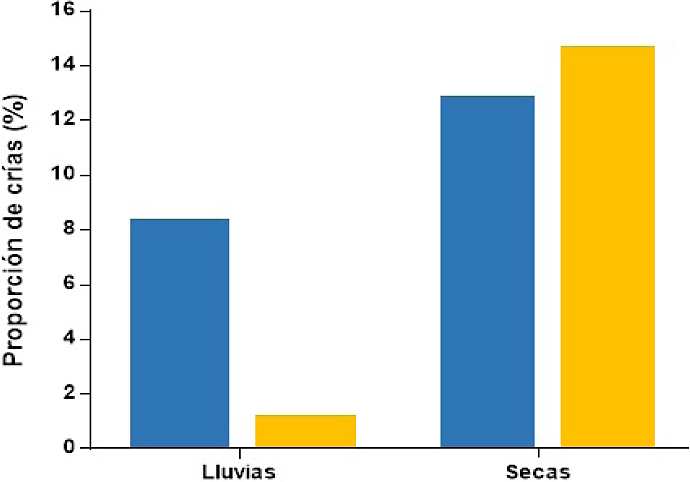
Figure 3
Proportion of the number of newborns in groups of white-lipped peccary (Tayassu pecari) (blue bars), and collared peccary (Dicotyles tajacu) ( yellow bars) recorded during the 2014 dry season and 2015 rainy season in ejido Nuevo Becal, Calakmul, Campeche, Mexico.
Proportion of the number of newborns in groups of white-lipped peccary (Tayassu pecari) (blue bars), and collared peccary (Dicotyles tajacu) ( yellow bars) recorded during the 2014 dry season and 2015 rainy season in ejido Nuevo Becal, Calakmul, Campeche, Mexico.
Thumbnail
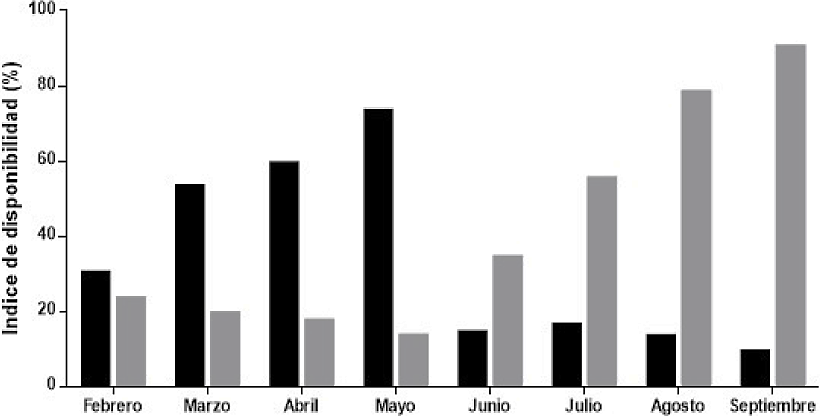
Figure 4
Availability of fruits of zapote Manilkara zapota (black bars) and ramon Brosimun alicastrum (gray bars) during the dry season (Feb-May 2014) and rainy season (June-Sept 2015) in ejido Nuevo Becal, Calakmul, Campeche, Mexico.
Availability of fruits of zapote Manilkara zapota (black bars) and ramon Brosimun alicastrum (gray bars) during the dry season (Feb-May 2014) and rainy season (June-Sept 2015) in ejido Nuevo Becal, Calakmul, Campeche, Mexico.
Fruit Availability. The walkthrough of 80 km of transects (n = 5) in 15 plots per season (dry and rainy seasons) yielded a total of 329 fruits of B. alicastrum and 267 of M. zapota. The fruit availability index for ramon was variable, peaking in September (X2 = 39.00, d. f. = 3, P < 0.001, Figure 4). The availability of M. zapota fruits was significantly higher in the dry season and varied throughout this season, reaching its peak availability in May (X2 = 33.14, d. f. = 7, P < 0.001, Figure 4). The proportion of offspring in both peccary species was significantly correlated with the availability of M. zapota fruits during the dry season (T. pecari, r2 = 0.43; D. tajacu, r2 = 0.46).
Discussion and Conclusions
Social Structure and Fruit Availability. In both species, the social structure within groups showed a higher proportion of adults. This is consistent with the findings reported in the Calakmul Biosphere Reserve (Reyna-Hurtado et al. 2010), in areas subjected to hunting pressure in ejido Nuevo Becal for the white-lipped peccary (Briceño-Méndez et al. 2016), and for the collared peccary in the Chimalapas, Oaxaca (Pérez Irineo and Santos Moreno 2016).
-
Reyna-Hurtado et al. 2010Hunting patterns, population density, group size, and conservation of the white-lipped peccary (Tayassu pecari) in the Calakmul Region of MexicoOryx, 2010
-
Briceño-Méndez et al. 2016Responses of two sympatric species of peccaries (Tayassu pecari and Pecari tajacu) to hunting in Calakmul, MexicoTropical Conservation Science, 2016
-
Pérez Irineo and Santos Moreno 2016Abundance, herd size, activity pattern and occupancy of ungulates in Southeastern MexicoAnimal Biology, 2016
The proportion of offspring was higher in the dry season than in the rainy season for both species; this is consistent with the findings reported for white-lipped peccaries in the Calakmul Biosphere Reserve (Reyna-Hurtado et al. 2010). However, for the collared peccary these findings are contrary to those reported in French Guiana, where the proportion of offspring is higher in the rainy season (Henry 1994).
-
Reyna-Hurtado et al. 2010Hunting patterns, population density, group size, and conservation of the white-lipped peccary (Tayassu pecari) in the Calakmul Region of MexicoOryx, 2010
-
Henry 1994Saisons de reproduction chez tres Rongeurs et un Ariodactyle en Guyane FrancËaise, en fonction des facteurs du milieu et de l'alimentationMammalia, 1994
Although there are no data on the nutritional value of the fruit species for peccaries, it has been reported that both ramon and zapote play a key role in the seasonal diet of both species (Perez-Cortez and Reyna-Hurtado 2008). This fact may explain the relationship between the presence of a higher number of offspring of both species during the dry season and the fruit abundance index for zapote fruits. Two plant species (Ficus spp. and Licania operculipetata) have been mentoned as fructifying during periods of shortage of other food items, and are related to the breeding season and number of offspring, which affects the size and composition of groups in both peccary species, although not necessarily being the factor that could be driving the increase in group size in both species (Altricher et al. 2001; Keuroghlian 2004). Another possible explanation in relation to the number of offspring during the greater availability of fruits, is that these may be providing postpartum mothers nutrient needs for young infants (Lopez et al. 2006).
-
Perez-Cortez and Reyna-Hurtado 2008La dieta de los pecaríes (Pecari tajacu y Tayassu pecari) en la región de Calakmul, Campeche, MéxicoRevista Mexicana de Mastozoología, 2008
-
Altricher et al. 2001White-lipped peccary (Tayassu pecari, Artiodactyla: Tayassuidae) diet and fruit availability in a Costa Rican rain forestRevista de Biología Tropical, 2001
-
Keuroghlian 2004Area use by white lipped and collared peccaries (Tayassu pecari and Tayassu tajacu) in a tropical forest fragmentBiological Conservation, 2004
-
Lopez et al. 2006Valor Nutricional de los Alimentos de Tayassu pecari (Atiodactyla: Tayassuidae) en el Parque Nacional Corcovado, Costa RicaRevista de Biología Tropical, 2006
The fruits of Pouteria campechiana, Ampelocera hottlei, Cratavea tapia, Byrsonima crassifolia, Citrullus vulgaris, Talisia olivaeformis and Metopium brownei are identified as potential food items for peccaries in the region, being a supplement to their diet (Perez-Cortez and Reyna-Hurtado 2008). The production of these fruits is variable; they are usually available for very short periods of time (Reyna-Hurtado 2007; Briceño-Méndez et al. 2014), contrary to the zapote and ramon fruits, which are available throught a season. For example, zapote can reach peak fruit availability in the dry season during May, while ramon reaches its highest fruit abundance index values in the rainy season (Reyna-Hurtado 2007; Briceño-Méndez et al. 2014).
-
Perez-Cortez and Reyna-Hurtado 2008La dieta de los pecaríes (Pecari tajacu y Tayassu pecari) en la región de Calakmul, Campeche, MéxicoRevista Mexicana de Mastozoología, 2008
-
Reyna-Hurtado 2007Social ecology of the white-lipped peccary (Tayassu pecari) in Calakmul forest, Campeche, Mexico, 2007
-
Briceño-Méndez et al. 2014Preferencias de hábitat y abundancia relativa de Tayassu pecari en un área con cacería en la región de Calakmul, Campeche, MéxicoRevista Mexicana de Biodiversidad, 2014
-
Reyna-Hurtado 2007Social ecology of the white-lipped peccary (Tayassu pecari) in Calakmul forest, Campeche, Mexico, 2007
-
Briceño-Méndez et al. 2014Preferencias de hábitat y abundancia relativa de Tayassu pecari en un área con cacería en la región de Calakmul, Campeche, MéxicoRevista Mexicana de Biodiversidad, 2014
Both peccary species are benefited by the availability and search for these important dietary resources in heterogeneous environments during well-marked seasons of the year in the study site. In addition, peccaries can consume a wide variety of food types available in the landscape, and even modify their diet (Keuroghlian 2004; Beck 2005; Keuroghlian and Eaton 2008; Fernandes et al. 2013).
-
Keuroghlian 2004Area use by white lipped and collared peccaries (Tayassu pecari and Tayassu tajacu) in a tropical forest fragmentBiological Conservation, 2004
-
Beck 2005Seed predation and dispersal by pecaries thoughout the Neotropics and its consequence: a review and synthesisSeed fate: predation, dispersal and seedling establishment, 2005
-
Keuroghlian and Eaton 2008Fruit availability and peccary frugivory in an isolated Atlantic forest fragment: effects on peccary ranging behavior and habitat useBiotropica, 2008
-
Fernandes et al. 2013When there are no fruits for white-lipped peccaries, how about Sushi?Suiform Soundings, 2013
Our results reveal the relationship between the primary productivity of fruit species and the size and social composition in groups of both peccary species in the tropics (Altrichter et al. 2001). There are other factors related to group composition and size; for example, it has been documented that in the rainy season white-lipped peccaries consume small amounts of animal food items, including invertebrates and some fish species (Fernandes et al. 2013; Reyna-Hurtado 2007). Water availability, the state of conservation of the habitat and the hunting pressure have been considered as factors that strongly influence group size in peccaries inhabiting the Calakmul region (Reyna-Hurtado et al. 2015).
-
Altrichter et al. 2001White-lipped peccary (Tayassu pecari, Artiodactyla: Tayassuidae) diet and fruit availability in a Costa Rican rain forestRevista de Biología Tropical, 2001
-
Fernandes et al. 2013When there are no fruits for white-lipped peccaries, how about Sushi?Suiform Soundings, 2013
-
Reyna-Hurtado 2007Social ecology of the white-lipped peccary (Tayassu pecari) in Calakmul forest, Campeche, Mexico, 2007
-
Reyna-Hurtado et al. 2015What ecological and anthropogenic factors affect group size in white-lipped peccaries (Tayassu pecari)?Biotropica, 2015
Conservation Perspectives. An important factor for the conservation of peccaries is the reduction and/or control of zapote tree logging, which is an important resource in the study site. The plant species consumed by peccaries are also relevant for other endangered species such as the spider monkey (Ateles geoffroyi), howler monkey (Alouatta pigra), tapir (Tapirus bairdii), temazate deer (Mazama temama and Mazama pandora), all of which depend to a large extent on these fruit species to supplement their diet (O'Farrill et al. 2006, 2011; Weber 2008; González-Zamora et al. 2009).
-
O'Farrill et al. 2006Manilkara zapota: A new record of a species dispersed by tapirsTapir Conservation, 2006
-
2011Origin and deposition sites influence seed germination and seedling survival of Manilkara zapota: implications for long-distance, animal-mediated seed dispersalSeed Science Research, 2011
-
Weber 2008Un especialista, un generalista y un oportunista: uso de tipos de vegetación por tres especies de venados en Calakmul, CampecheAvances en el Estudio de los Mamíferos de México. Publicaciones Especiales, Vol. II, 20082008
-
González-Zamora et al.
2009Diet of spider monkeys (Ateles geoffroyi) in Mesoamerica: current knowledge and future directionsAmerican Journal of Primatology, 2009
The ejido Nuevo Becal is home to endangered species and includes habitats in good state of conservation (Briceño Méndez et al. 2017). However, human activities such as hunting and loss of habitat still prevail (Escamilla et al. 2000; Santos Fita et al. 2012; Briceño-Méndez et al. 2014). Therefore, it is imperative to introduce feasible subsistence strategies to the local community (Montiel et al. 1999), particularly for being a rural community that is connected to the Calakmul Biosphere Reserve.
-
Briceño Méndez et al. 2017Richness and trophic guilds of carnivorous mammals in ejido Nuevo Becal, Calakmul, Campeche, MexicoTherya, 2017
-
Escamilla et al. 2000Habitat mosaic, wildlife availability, and hunting in the tropical forest of Calakmul, MéxicoConservation Biology, 2000
-
Santos Fita et al. 2012Wildlife uses and hunting patterns in rural communities of the Yucatan Peninsula, MexicoJournal of Ethnobiology and Ethnomedicine, 2012
-
Briceño-Méndez et al. 2014Preferencias de hábitat y abundancia relativa de Tayassu pecari en un área con cacería en la región de Calakmul, Campeche, MéxicoRevista Mexicana de Biodiversidad, 2014
-
Montiel et al. 1999La cacería tradicional en el norte de Yucatán: Una práctica comunitariaRevista de Geografía Agrícola, 1999
Acknowledgments
This study was carried out thanks to the support of the authorities of the Calakmul Biosphere Reserve, the staff of the Comisión Nacional de Áreas Nacionales Protegidas (National Commission of Protected Natural Areas, CONANP), who collaborated in various logistical support tasks. The grant # 248308 was granted to the first author by the Consejo Nacional de Ciencia y Tecnología. To R. Reyna Hurtado for the financial support granted through the Basic Science Project # 182386 (CONACyT). To C. Chapman for his support with camera traps through the McGill University. To Colegio de la Frontera Sur, Campeche. Thanks also to the inhabitants of Nuevo Becal, Campeche, in particular, to N. Arias Domínguez and H. Arias Dominguez. To E. Sandoval, R. de la Cerda, M. Sanvicente, G. Castillo, I. Chi, L. Ramirez, K. Sanchez , A. Matos and R. Heredia for their assistance in data collection. Two anonymous reviewers provided valuable comments on a previous version of this manuscript. María Elena Sánchez-Salazar translated the manuscript into English.
Literatura citada
- Altrichter, M., E. Carrillo, J. Saenz, and K. Fuller. 2001. White-lipped peccary (Tayassu pecari, Artiodactyla: Tayassuidae) diet and fruit availability in a Costa Rican rain forest. Revista de Biología Tropical 49:1183-1192. Links
- Altrichter, M. , and G. L. Boaglio. 2004. Distribution and relative abundance of peccaries in the Argentine Chaco: associations with human factors. Biological Conservation 116:217-225. Links
- Altrichter, M. , A. Taber, H. Beck, R. Reyna-Hurtado, L. Lizarraga, A. Keuroghlian, and E. W. Sanderson. 2012. Range-wide declines of a key Neotropical ecosystem architect, the Near Threatened white-lipped peccary Tayassu pecari. Oryx 46:87-98. Links
- Beck, H. P. 2005. Seed predation and dispersal by pecaries thoughout the Neotropics and its consequence: a review and synthesis. Pp.77-115, in Seed fate: predation, dispersal and seedling establishment (Forget, P. M., P. E. Hulme, and S. B. Vander Wall, eds.). CABI Publishing. Wallingford, United Kingdom. Links
- Beck, H. P. 2006. A review of peccary-palm interactions and their ecological ramifications across the Neotropics. Journal of Mammalogy 87:519-530. Links
- Beck, H., P. Thebpanya, and M. Filiaggi. 2010. Do Neotropical peccary species (Tayassuidae) function as ecosystem engineers for anurans? Journal Tropical Ecology 26: 407-414. Links
- Briceño-Méndez, M. A., R. Montes, W. Aguilar, and A. Pool. 2011. Cacería del pecarí de collar (Pecari tajacu) (Artiodactyla: Tayassuidae) en Tzucacab, Yucatán, México. Revista Mexicana de Mastozoología 15:8-18. Links
- Briceño- Méndez, M. A., R. Reyna-Hurtado, S. Calme, and G. García-Gil. 2014. Preferencias de hábitat y abundancia relativa de Tayassu pecari en un área con cacería en la región de Calakmul, Campeche, México. Revista Mexicana de Biodiversidad 85:242-250. Links
- Briceño-Méndez, E. J. Naranjo, S. Mandujano, M. Altrichter, and R. Reyna-Hurtado . 2016. Responses of two sympatric species of peccaries (Tayassu pecari and Pecari tajacu) to hunting in Calakmul, Mexico. Tropical Conservation Science 9:1-11. Links
- Briceño-Méndez, M., E. J. Naranjo , G. Pérez-Irineo, Y. Contreras-Perera, E. Sandoval-Serés, and M. G. Hidalgo Mihart. 2017. Richness and trophic guilds of carnivorous mammals in ejido Nuevo Becal, Calakmul, Campeche, Mexico. Therya 8:145-150 Links
- Bodmer, R. E. 1991. Strategies of seed dispersal and seed predation in Amazonian ungulates. Biotropica 23:255-261. Links
- Desbiez, A. L. J., Santos, S. A., A. Keuroghlian, and R. E. Bodmer. 2009. Niche partitioning among white-lipped peccaries (Tayassu pecari), collared peccaries (Pecari tajacu), and feral pigs (Susscrofa). Journal of Mammalogy 90:119-128. Links
- Escamilla, A., M. Sanvicente, M. Sosa, and C. Galindo. 2000. Habitat mosaic, wildlife availability, and hunting in the tropical forest of Calakmul, México. Conservation Biology 14:1592-1601. Links
- Fernandes, D. A., Keuroghlian, D. P., Eaton, And A. Desbiez. 2013. When there are no fruits for white-lipped peccaries, how about Sushi? Suiform Soundings 12:51-54 Links
- García-Gil, G. 2003. Colonización humana reciente y formación del paisaje agrario en la Reserva de la Biosfera de Calakmul, Campeche, México. Tesis de doctorado. Facultad de filosofía y letras. Universidad Nacional Autónoma de México. Ciudad de México, México. Links
- Golden, C. D., M. Bonds, J. S. Brashares, B. J. Rasolofoniaina, and C. Kremen. 2014. Economic valuation of subsistence harvest of wildlife in Madagascar. Conservation Biology 28: 234-243. Links
- Góngora, J., R. Reyna-Hurtado , H. Beck , A. Taber , M. Altrichter , and A. Keuroghlian . 2011. Pecari tajacu. La lista Roja de la UICN de especies amenazadas. Versión 2014.3< www.iucnredlist.org >. Consultado el 29 de diciembre de 2014. Links
- González-Zamora A., V. Arroyo-Rodríguez, and O. M. Chaves. 2009. Diet of spider monkeys (Ateles geoffroyi) in Mesoamerica: current knowledge and future directions. American Journal of Primatology 71:8-20. Links
- Henry, O. 1994. Saisons de reproduction chez tres Rongeurs et un Ariodactyle en Guyane FrancËaise, en fonction des facteurs du milieu et de l'alimentation. Mammalia 58:183-200. Links
- Hernández Sarabia, R. U. 2013. Estrategias de desplazamiento de Ateles geoffroyiyucatanensis y Alouattapigra en la búsqueda de recursos tróficos durante la temporada seca y húmeda en la Reserva de la Biosfera, Calakmul, Campeche, México. Tesis de maestría. Universidad Veracruzana. Jalapa, México. Links
- Keuroghlian, A. 2003. The response of peccaries to seasonal fluctuations in an isolated patch of tropical forest. Ph.D. Dissertation. University of Nevada, Reno, Nevada. Links
- Keuroghlian, A., D. P. Eaton, and W. S. Longland. 2004. Area use by white lipped and collared peccaries (Tayassu pecari and Tayassu tajacu) in a tropical forest fragment. Biological Conservation 120:411-425. Links
- Keuroghlian, A. , and D. P. Eaton . 2008. Fruit availability and peccary frugivory in an isolated Atlantic forest fragment: effects on peccary ranging behavior and habitat use. Biotropica 40:62-70. Links
- Keuroghlian, A., and D. P. Eaton . 2009. Removal of palm fruits and ecosystem engineering in palm stands by white-lipped peccaries (Tayassu pecari) and other frugivores in an isolated Atlantic Forest fragment. Biodiversity and Conservation 18:17-33. Links
- Keuroghlian A., A. Desbiez , R. Reyna-Hurtado , M. Altrichter , B. Beck, A. Taber , and J. M. V. Fragoso. 2013. Tayassu pecari en IUCN 2013. IUCN Red List of Threatened Species. Version 2013.2. < www.iucnredlist.org >. Downloaded on 18 Noviembre 2015. Links
- Lira-Torres, I., M. Briones-Salas, and G. Sanchez-Rojas. 2014. Abundancia relativa, estructura poblacional, preferencia de hábitat y patrones de actividad del tapir centroamericano Tapirus bairdii (Perissodactyla: Tapiridae), en la Selva de Los Chimalapas, Oaxaca, México. Revista de Biología Tropical 62:1407-1419. Links
- López, M., M. Altrichter, J. Saenz, and E. Eduarte. 2006. Valor Nutricional de los Alimentos de Tayassu pecari (Atiodactyla: Tayassuidae) en el Parque Nacional Corcovado, Costa Rica. Revista de Biología Tropical 54:687-700. Links
- Maffei, I., E. Cuellar, and J. Noss. 2002. Uso de trampas cámara para la evaluación de mamíferos en el Ecotono Chaco-Chiquitanía. Revisa de Biología Tropical 11:55-65. Links
- Montiel S, L., Arias, and F. Dickinson. 1999. La cacería tradicional en el norte de Yucatán: Una práctica comunitaria. Revista de Geografía Agrícola 29:43-52. Links
- March, I. J. 1993. The white-lipped peccary (Tayassu pecari). Pp. 13-22 in Pigs, Peccaries and Hippos (Oliver, W. L. R., ed.). IUCN. Gland, Suiza. Links
- Naranjo, E. J., S. A. Amador-Alcalá, F. A. Falconi-Briones, and R. Reyna-Hurtado . 2015. Distribución , abundancia y amenazas a las poblaciones de tapir centroamericano (Tapirus bairdii) y pecarí de labios blancos (Tayassupecari) en México. Therya 6:227-249. Links
- O'Farrill, G., S. Calme , and A. González. 2006. Manilkara zapota: A new record of a species dispersed by tapirs. Tapir Conservation 15:32-35. Links
- O'Farrill, G. , A. C. Chapman, and A. González. 2011. Origin and deposition sites influence seed germination and seedling survival of Manilkara zapota: implications for long-distance, animal-mediated seed dispersal. Seed Science Research 21 :305-313. Links
- Peres, C. A., T. Emilio, J. Schietti, S. J. M. Desmouliere, and T. Levi. 2016. Dispersal limitation induces long-term biomass collapse in overhunted Amazonian forests. Proceedings of the National Academy of Sciences of the United States of America 113:892-897. Links
- Pérez-Cortez, S., and R. Reyna-Hurtado. 2008. La dieta de los pecaríes (Pecari tajacu y Tayassu pecari) en la región de Calakmul, Campeche, México. Revista Mexicana de Mastozoología 12:17-42. Links
- Pennington, T. and J. Sarukhán. 1998. Árboles Tropicales de México. UNAM-Fondo de Cultura Económica. Ciudad de México, México. Links
- Pérez-Irineo, G., and A. Santos-Moreno. 2016. Abundance, herd size, activity pattern and occupancy of ungulates in Southeastern Mexico. Animal Biology 66:97-109. Links
- Reyna-Hurtado, R. 2007. Social ecology of the white-lipped peccary (Tayassu pecari) in Calakmul forest, Campeche, Mexico. (Tesis de doctorado). University of Florida. Gainesville, U. S. A. Links
- Reyna-Hurtado, R. 2009. Conservation status of the white-lipped peccary (Tayassu pecari) outside the Calakmul Biosphere Reserve in Campeche, Mexico: a synthesis. Tropical Conservation Science 2:159-172. Links
- Reyna-Hurtado, R., E. Naranjo, C. Chapman, and G. Tanner. 2010. Hunting patterns, population density, group size, and conservation of the white-lipped peccary (Tayassu pecari) in the Calakmul Region of Mexico. Oryx . 44:88-96. Links
- Reyna-Hurtado, R. , H. Beck , M. Altrichter , C. Chapman , R. B. Tyler, A. Keuroghlian , L., Arnaud Desbiez, J. F. Moreira-Ramirez, G. O'farrill, J. M. Fragoso, and E. J. Naranjo . 2015. What ecological and anthropogenic factors affect group size in white-lipped peccaries (Tayassu pecari)? Biotropica 48:246-254. Links
- Santos-Fita. D., E. J. Naranjo, and R. Salazar. 2012. Wildlife uses and hunting patterns in rural communities of the Yucatan Peninsula, Mexico. Journal of Ethnobiology and Ethnomedicine 8:38. Links
- Tabarelli, M., M. J. C. Silva, and C. Gascon. 2004. Forest fragmentation, synergisms and the impoverishment of Neotropical forests. Biodiversity and Conservation 13:14191-425. Links
- Weber, M. 2000. Effects of hunting on tropical deer populations in southeastern México. Tesis de maestría. Royal Veterinary College. University of London. Londres, Reino Unido. Links
- Weber. M. 2008. Un especialista, un generalista y un oportunista: uso de tipos de vegetación por tres especies de venados en Calakmul, Campeche. En Lorenzo, C., E. Espinoza y J. Ortega (eds.). 2008. Avances en el Estudio de los Mamíferos de México. Publicaciones Especiales, Vol. II, Asociación Mexicana de Mastozoología, A. C. Ciudad de México, México. Links