Artículos
Water quality for agriculture use in Jequetepeque middle river basin, Peru
Guerrero-Padilla, Ana M.1
 http://orcid.org/0000-0003-0008-3785
Cabrera-Carranza, Carlos F.2
http://orcid.org/0000-0002-5821-5886
http://orcid.org/0000-0003-0008-3785Cabrera-Carranza, Carlos F.2
http://orcid.org/0000-0002-5821-5886
-
Publication dates-
June 26, 2025
Sep-Oct , 2021
- Article in PDF
- Article in XML
- Automatic translation
- Send this article by e-mail
- Share this article +
Abstract
This research had the main objective to determine water quality for agriculture use in Jequetepeque middle basin river, Peru. Six sampling stations were located (Puente Kuntur Wasi bridge, La Monica sector, La Capilla sector, Yatahual village, El Pongo village, and Yonan bridge). The physical-chemical, bacteriological parameters and SAR index were determined. The water quality in the study area was found within the Water Quality Standards by Supreme Decree N°004-2017-MINAM, according to Category 3: vegetable irrigation and animal drink, and D1: vegetable irrigation, it used without restrictions for different crops. It is important for bacteriological assessment, the average values of thermotolerant coliforms exceeded water quality (1 000 NMP/100 ml) and indicating low organic pollution as a consequence of the contributions or discharges of domestic origin. The SAR index was found values lower than 3, therefore it is not limiting for agricultural activity. It is of great importance to carry out water quality studies of all the river basins in the country, especially the determination of the quality of water for irrigation due to the potential effect on human health and ecosystems.
Keywords::
Water quality, Jequetepeque River, SAR index
Introduction
Water resources play a vital role in economic, agriculture, industry activity, and finally sustainable development. The availability and quality of water, surface or underground, has deteriorated due to the increase in the population, urbanization, and industrialization (Tyagi, Sharma, Singh, & Dobhal, 2013), in this sense the availability and quality of water are indicators used to calculate the environmental sustainability index that considers the ability countries to protect the environment in the coming decades (Balmaseda & García, 2013). The water resource is subject to the pressure of an increasingly hydric demand in quantity and quality water-related to social, political, and environmental aspects (Roldan, Díaz, Pérez, & Moreno, 2010), it is necessary to have timely sources information regarding water quality to achieve the integrated management water resource (Bermejillo et al., 2012).
-
Tyagi, Sharma, Singh, & Dobhal, 2013Water quality assessment in terms of water quality indexAmerican Journal of Water Resources, 2013
-
Balmaseda & García, 2013Calidad de las aguas de la Cuenca del río Naranjo, Municipio Majibacoa, provincial Las Tunas para el riegoCultivos Tropicales, 2013
-
Roldan, Díaz, Pérez, & Moreno, 2010Mejora de la gestión del agua de riego mediante el uso de indicadores de riegoRevista de la Facultad de Ciencias Agrarias, Universidad Nacional de Cuyo. Mendoza, Argentina, 2010
-
Bermejillo et al., 2012Aptitud para riego del agua subterránea basada en la salinidad y sodicidad en las perforaciones realizadas entre 2004 y 2014 en los Oasis Norte y Centro de MendozaRevista de la Facultad de Ciencias Agrarias UNCuyo, 2012
The physicochemical and biological water characteristics vary due to anthropogenic pollution, coupled with natural and artificial processes; make its physicochemical and biological properties vary widely from section to section throughout the basin river (Sutadian, Muttil, Yilmaz, & Perera, 2016). Due to high water demand, it is relevant to determine its quality water for human consumption, agricultural, industrial use, aquaculture, and biodiversity conservation, as well as its use for recreation and aesthetics (Rivera, Encina, Palma, & Mejias, 2009).
-
Sutadian, Muttil, Yilmaz, & Perera, 2016Development of river water quality indices-a reviewEnvironmental Monitoring and Assessment, 2016
-
Rivera, Encina, Palma, & Mejias, 2009La calidad de las aguas en el curso superior y medio del río Traiguén, IX Región-ChileInformación Tecnológica, 2009
Consequently, it is important to keep in mind the resources; water quality has closely related to social well-being and economic population development, which well-being depends on it the current and future generations (Ocampo-Duque, Osorio, Piamba, Schuhmacker, & Domingo, 2013). Ecosystems balance of various water sources belong environmental services. They will allow the integrated water resources management; which includes control and water management, and its uses in agricultural, forestry, livestock, and industrial activities for the control and minimization of pollution effluents water quality is closely related to social well-being and economic population development, which well-being depends on it the current and future generations (Pawar, 2013; Gyawali, Techato, Yuangyai, & Musikavong, 2013).
-
Ocampo-Duque, Osorio, Piamba, Schuhmacker, & Domingo, 2013Water quality analysis in rivers with non-parametric probability distributions and fuzzy inference systems: application to the Cauca River, ColombiaEnvironment International, 2013
-
Pawar, 2013Monitoring of impact of anthropogenic inputs on water quality of mangrove ecosystem of Uran, Navi Mumbai, west coast of IndiaMarine Pollution Bulletin, 2013
-
Gyawali, Techato, Yuangyai, & Musikavong, 2013Assessment of relationship between land uses of riparian zone and water quality of river for sustainable development of river basin, a case study of U-Tapao River Basin, ThailandProcedia Environmental Sciences, 2013
Sutadian et al. (2016) and Medeiros et al. (2017) (cited in Pérez, Nardini, & Galindo, 2018), affirmed quality water is one of the most important issues in water management resources and its classification is based on the purity degree and pollution. It could be the assessment from the physicochemical and biological characteristics Rangeti, DzwairoBarratt, & Otieno, 2015, cited in Pérez et al., 2018). Due to the various factors and parameters that affect water quality, the final evaluation makes it complex. In this sense, it was necessary to use water quality indicators, which are a very useful tool for monitoring, control, and water resources management. Different countries use quality indices, which vary widely according to current regulations or provisions that have to do with government policies.
-
Sutadian et al. (2016Development of river water quality indices-a reviewEnvironmental Monitoring and Assessment, 2016
-
Medeiros et al. (2017Quality index of the surface water of Amazonian rivers in industrial areas in Pará, BrazilMarine Pollution Bulletin, 2017
-
Pérez, Nardini, & Galindo, 2018Análisis comparativo de índices de calidad del agua aplicados al río Ranchería, La Guajira-ColombiaInformación Tecnológica, 2018
-
Rangeti, DzwairoBarratt, & Otieno, 2015Ecosystem-specific water quality indicesAfrican Journal of Aquatic Science, 2015
-
Pérez et al., 2018Análisis comparativo de índices de calidad del agua aplicados al río Ranchería, La Guajira-ColombiaInformación Tecnológica, 2018
Studies carried out in Mexico at Amajac River presented values higher than the Mexican standard, of the water quality index (I.C.A.), as well the results found by Álvarez, Panta, Ayala, and Acosta (2008), for values of soluble solids, total solids and dissolved oxygen, and total and fecal coliforms most likely number. Likewise, studies carried out in the Santa Cruz River (RSC), Sonora-Mexico, in the dry season, the parameters assessing reported with very high concentrations, except pH (referred to the Mexican standard). Unlike the above, the concentrations found for nitrites, and sediment presence considered between into standard values, of good water quality in the Santa Cruz River, Sonora (Posada, Roldán, & Ramírez, 2000). Sarabia-Meléndez, Cisneros-Almazán, Aceves-De-Alba, Durán-García, and Castro-Larragoitia (2011) found that there are two most important parameters in the water quality determining for agricultural use; the electrical conductivity (EC) and Sodium Adsorption Ratio Index (SAR), it is possible to establish a classification of water for agricultural use, according to Salinity Laboratory standards of United States.
-
Álvarez, Panta, Ayala, and Acosta (2008)Calidad integral del agua superficial en la cuenca del río Amajac, Hidalgo, MéxicoInformación Tecnológica, 2008
-
Posada, Roldán, & Ramírez, 2000Caracterización fisicoquímica y biológica de la calidad de aguas de la cuenca de la quebrada Piedra Blancas, Antioquia. ColombiaRevista Bioltrop V, 2000
-
Sarabia-Meléndez, Cisneros-Almazán, Aceves-De-Alba, Durán-García, and Castro-Larragoitia (2011)Calidad de agua de riego en suelos agrícolas y cultivos del valle de San Luis Potosí, MéxicoRevista Internacional de Contaminación Ambiental, 2011
Studies carried out in Colombia in 2000, it was determined the physicochemical and biological parameters evaluated in the Piedras Blancas-Antioquia basin presented low fluctuations throughout the basin under study, with exception of electrical conductivity parameter and total solids, whose variations were related to the evaluation period, due to high rainfall during the study execution period (Solís, Israel, Nubes, Castillo, & Meraz, 2011).
-
Solís, Israel, Nubes, Castillo, & Meraz, 2011Fisicoquímica del agua superficial y sedimento en el río Santa Cruz, Sonora. MéxicoRevista Biotecnia, 2011
In Chile, Peña (1993) stated water quality for agricultural use has been restricted due to the amount of boron, presented especially in the Altiplanic region (“Norte Grande”), where water frequently exceeds high boron levels as 5.0 mg/l, mainly affecting crops sensitive like citrus plants, which are affected by 0.3 mg/l concentrations. Likewise, in the “Norte Chico” area, it is affected by boron content in water with values close to 1.5 mg/l, which to because high limitations the resource use.
-
Peña (1993)Caracterización de la calidad de las aguas naturales y contaminación agrícola en ChilePrevención de la contaminación del agua por la agricultura y actividades afines. Anales de la Consulta de Expertos Organizada por la FAO, 1993
Reinaudi, Grégoire, Rosiére, Nadal and Viñuela (1998) carried out of water quality study for irrigation in Central Region hothouses of La Pampa-Argentina found total arsenic concentration was higher than allowed by World Health Organization (WHO). Likewise, Báez (1999), in Buenos Aires, indicated the more important problems associated with irrigation quality water are soil salinization and sodification because it causes a deterioration of properties soil, although some crops such as Triticum aestivum “wheat" produced acceptable yields even with relatively high salinity levels.
-
Reinaudi, Grégoire, Rosiére, Nadal and Viñuela (1998)Calidad del agua para riego en invernáculos de la Región Central de la Pampa, 1998
-
Báez (1999)Efecto de la calidad del agua de riego sobre las propiedades del suelo, 1999
In Peru, the National Strategy for Management Water Resources establishes protection water quality of resources, necessary implementation mechanisms for hydrographic protection basins and aquifers is relevant. It has been determined that water quality is mainly affected by mining tailings effluents discharge, containing heavy metals, which are evacuated directly without any treatment into hydrographic basins, some of them being basins with great problems. Due to reversing the difficulty of effect and negative impact on water bodies, these are Mantaro, Rímac, Santa, and Ilo river basins, among others, which present great chemical pollution cause loss biodiversity and ecosystems deterioration (INRENA, 2003). In La Libertad Region, the basins with the greatest deterioration or pollution are the Moche and Jequetepeque rivers, presenting bioaccumulation of mining-metallurgical pollutants and sediments. The indiscriminate agrochemicals use causes loss of trophic chains, biodiversity and decrease the productive capacity of agricultural soils of Moche and Jequetepeque valleys (Juarez, 2006).
-
INRENA, 2003Evaluación y ordenamiento de los recursos hídricos en la cuenca del río Chicama. Hidrología. Estudio Hidrológico, 2003
-
Juarez, 2006Contaminación del río Rímac por metales pesados y efecto en la agricultura en el cono este de Lima metropolitana, 2006
There are large-scale agricultural projects for developing countries, but unfortunately, they lack adequate management of irrigation projects, bringing negative consequences on communities, whose primary objective was to achieve sustainable development from an economic, social, and environmental perspective. The complex environmental interactions processes and development of irrigation and drainage systems, present high difficulty in predicting types of impact and/or changes in nature. However, currently, with strategic, economic, and environmental detailed studies, it could be handled and controlled different interactions of human activities, agricultural areas, and water resources used in different activities, avoiding possible negative impacts produced in the development zone.
It is necessary to know the situational status of the Jequetepeque river basin, with emphasis on the middle part, evaluating supply and water demand, the water quality of hydrological events, which results will allow have basic information in making decisions about authorities at different levels and propose integrated management of Jequetepeque river basin. Likewise, determine impacts generated by activities carried out that affect water quality for agricultural use, with a long-term approach, which guarantees a complete and holistic vision of meaning agricultural activities associated with water quality to contribute to integrated water quality management for agricultural use in middle Jequetepeque river basin, Peru.
Materials and methods
Study area
Jequetepeque river borns in a small lagoon located at “Cerro Agopití” foot, Cajamarca province, at 07° 20' S.L. and 78° 21' W.L., 4 000 meters above sea level; basin river runs about 150 km from east to west. About 4 000 meters above sea level, collects on its way drainage more than 30 secondary rivers, streams, and minor streams and it is stored in the “Gallito Ciego” dam. The main tributaries of the Jequetepeque river extend between 600 and 2500 meters above sea level.
Jequetepeque River is the result of Puclush and Magdalena confluence rivers, the same ones that join at height of Llallan town, at an approximate of 710 elevation meters downstream; receives contributions from Pallac river on the right bank and Chausis stream on the left bank. The hydrographic system of the Puclush sub-basin contributes the greatest amount of water to the Jequetepeque river due to rainfall in the upper part and the presence of lagoons, shrubby tree vegetation, and pastures. Magdalena River borns at Huacrarucro heights, initially it receives contributions from Choten and Naranjo rivers on the right bank and the Asunción River on the left bank. It takes the name Magdalena River at Choropampa height with an approximate elevation of 1600 meters above sea level; its main tributaries on the right bank are La Viña, Chetillano, and Llaminchan, and San Pablo rivers; on the left bank it has following Chonta, Huertas and Contumaza tributaries rivers.
Sampling
Sampling corresponded in seasonal periods changes, flood and low water, whose sampling frequency was twice a month in each sampling station, according to established in Resolution N°010-2016-National Water Authority: National Protocol quality monitoring of Surface Water Resources (ANA, 2016). The study comprised a sampling period (December 2018 to May 2019), following international standards (GEMS, 1987). Six sampling stations were selected (Table 1 and Figure 1), per standards established by Global Environmental Monitoring System (GEMS, 1987). Portable equipment used in the present investigation were HI 991300 multiparameter equipment (HANNA brand), pH meter, electrical conductivity (EC), total dissolved solids (TDS) and temperature; HI 9829 multiparameter equipment (HANNA brand), pH, mV, ORP, DO, EC, TDS, resistivity, salinity, temperature, atmospheric pressure, and turbidity meter.
-
ANA, 2016Protocolo Nacional para el Monitoreo de la Calidad de los Recursos Hídricos. Resolución Jefatural N°010-2016 ANAEl Peruano, 2016
-
GEMS, 1987GEMS/Water Operational Guide, 1987
Table 1
Georeferencing and altitude of sampling stations located in middle Jequetepeque river basin, Peru.
Georeferencing and altitude of sampling stations located in middle Jequetepeque river basin, Peru.
| Sampling stations | Coordinates UTM | Altitude (m.a.s.l.) | |
|---|---|---|---|
| East | North | ||
| E-1 (Kurtur Wasi bridge) | 7°13’ 23’’ S | 78° 50’ 51’’ W | 837 |
| E-2 (La Mónica sector) | 7°13’ 39’’ S | 78° 54’ 04’’ W | 759 |
| E-3 (La Capilla sector) | 7°12’ 16’’ S | 78° 56’ 21’’ W | 689 |
| E-4 (Yatahual village) | 7°10’ 03’’ S | 79° 01’ 17’’ W | 596 |
| E-5 (El Pongo village) | 7°12’ 22’’ S | 79° 02’ 52’’ W | 552 |
| E-6 (Yonan bridge) | 7°15’ 17’’ S | 79° 06’ 03’’ W | 448 |
Thumbnail
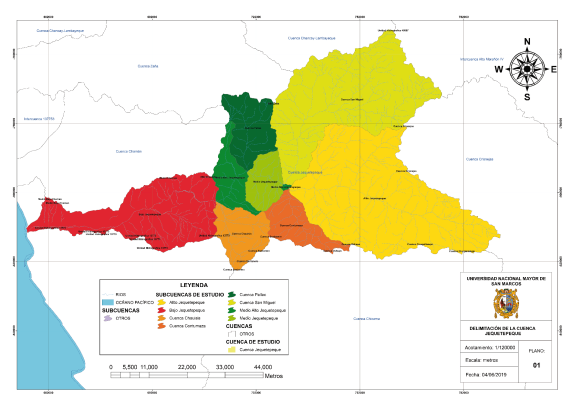
Figure 1
Delimitation of middle Jequetepeque river basin, Peru.
Delimitation of middle Jequetepeque river basin, Peru.
From a statistical point of view, this investigation has a longitudinal type with a trend design (Hernández, Fernández, & Baptista, 2010). The information corresponding to water availability (supply and demand) of the Jequetepeque river basin is registered in the database by application test for multivariate normality and bivalent normal distribution. This investigation was necessary to use a coefficient nonparametric correlation like Spearman's and Wilcoxon's bivalent distribution test (Hines & Montgomery, 1996). This is due to the fact there is a relationship between water volumes through which it flows in hydrological basins and water quality, so much that in flood times, higher concentrations of total dissolved solids could be found and also a greater possibility of dilution or contaminants concentration such as heavy metals.
-
Hernández, Fernández, & Baptista, 2010Metodología de la investigación, 2010
-
Hines & Montgomery, 1996Probabilidad y estadística para ingeniería y administración, 1996
Wilcoxon statistical analysis is a non-parametric test used when comparing the mean range of two related samples and determining if there are differences between them. It uses as an alternative to the Student's t-test when the normality of these samples cannot be assumed. It is a nonparametric comparison test of two related samples and therefore does not need a specific distribution. In the case of basin volumes, as the Jequetepeque basin. It is very irregular for this reason of the dependent variable is used rather. It is used to compare two related measurements and determine if the difference between them is due to chance or not (in the latter case, the difference is statistically significant).
Spearman's coefficient correlation (rho) use to evaluate the association between two variables that have ordinal categories. The coefficient can vary from -1 to +1. Spearman's rho interpretation agrees on values close to 1; indicate a strong and positive correlation. Values close to -1 indicate a strong and negative correlation. Values close to zero indicate there is no linear correlation. There may be another type of correlation, but not linear.
Physical-chemical parameters evaluated according to APHA-AWWA-WEF (2012) and bacteriological (NMP/100 ml) standards, whose methods for each parameter evaluated detailed in Table 2, for agricultural use, Category 3: Vegetable irrigation and animal drink, and D1: Vegetable irrigation according to D.S. N°004-2017-MINAM; SAR index was also determined (Ayers & Westcot, 1987; Rashidi & Seilsepour, 2011).
-
APHA-AWWA-WEF (2012)Standard methods for examination of water and wastewater, 2012
-
Ayers & Westcot, 1987La calidad del agua y su uso en la agriculturaRiego y Drenaje, Food and Agriculture Organization of the United Nations, 1987
-
Rashidi & Seilsepour, 2011Prediction of soil sodium adsorption ratio base on soil electrical conductivityMiddle-East Journal of Scientific Research, 2011
Table 2
Physical-chemical and bacteriological parameters to assessing water quality
Physical-chemical and bacteriological parameters to assessing water quality
| Physical-chemical and bacteriological parameters | Methods | Year |
|---|---|---|
| Temperature | Standard Methods for the analysis of water and wastewater, 22 ND edition. SM 2550 B | 2012 |
| Hydrogen potential (pH) | Standard Methods for the analysis of water and wastewater, 22 ND edition. SM 4500-H+ -B | 2012 |
| Conductivity (CE) | Standard Methods for the analysis of water and wastewater, 22 ND edition. SM 2510 B | 2012 |
| Total dissolved solids (TDS) | Standard Methods for the analysis of water and wastewater, 22 ND edition. SM 2540 C | 2012 |
| Carbonate (CO3) | Standard Methods for the analysis of water and wastewater, 22 ND edition. SM 2320 B | 2012 |
| Bicarbonate (HCO3) | Standard Methods for the analysis of water and wastewater, 22 ND edition. SM 2320 B | 2012 |
| Chlorides (Cl-1) | Standard Methods for the analysis of water and wastewater, 22 ND edition. SM 4500-Cl- -B | 2012 |
| Dissolved oxygen (O2) | Standard Methods for the analysis of water and wastewater, 22 ND edition. SM 5210 B | 2012 |
| Biochemical oxygen demand (BOD5) | Standard Methods for the analysis of water and wastewater, 22 ND edition. SM 5210 B | 2012 |
| Total coliforms (NMP/100 ml) | Standard Methods for the examination of water and wastewater APHA, AWWA, WEF | 2012 |
| Thermotolerant coliforms (NMP/100 ml) | Standard Methods for the examination of water and wastewater APHA, AWWA, WEF | 2012 |
| Calcium (Ca+2) | Calcium. EDTA Titrimetric Method. 3500-Ca B. APHA-AWWA-WEF. 23rd Edition. | 2017 |
| Magnesium (Mg+2) | Magnesium. Calculation Method. 3500-Mg B. APHA-AWWA-WEF. 23rd Edition. | 2017 |
| Sodium (Na+1) | Metals by Flame Atomic Absorption Spectrometry. Direct Air-Acetylene Flame Method. 3111 B. APHA-AWWA-WEF. 23rd Edition. | 2017 |
| Lead (Pb) | SMEWW-APHA-AWWA-WEF Part 3111 B, 23rd Ed. 2017 Metals by Flame Atomic Absorption Spectrometry. Direct Air-Acetylene Flame Method | 2017 |
| Cadmium (Cd) | SMEWW-APHA-AWWA-WEF Part 3111 B, 23rd Ed. 2017 Metals by Flame Atomic Absorption Spectrometry. Direct Nitrous Oxide-Acetylene Flame Method | 2017 |
Water the agricultural used is evaluated for potential risk, because can be considered potentially dangerous, if they present high salt concentrations, which is harmful and it is evident when waters irrigate agricultural soils, making soils become saline and consequently lose their productivity (FAO, 2002). When evaporation occurs, the percentage of water retention in soil decreases, and consequently soil humidity is lower, salt elimination does not take place, then the soil becomes saline and there is loss of water. If water irrigation has salt concentration (initial) and this is within permissible limits being able to reach higher soil salinity due to water evaporation. On the other hand, salt concentration can reach a limited value of solubility, and consequently salts precipitate. This is determined by the presence of calcium and magnesium cations, sodium anion (chlorides), which are not in equilibrium and have a direct relationship with the pH, altering the initial concentrations. That is when calcium salts have low solubility and what happens is sodium concentrations increase in soil water, as well as percentage exchangeable sodium anion (Romero, 2013).
-
FAO, 2002Agricultural drainage water management in arid and semiarid areas, 2002
-
Romero, 2013Calidad del agua, 2019
Sodium Adsorption Ratio Index (SAR) assess is to adjusted Sodium Absorption Ratio Index (Adjusted SAR), Residual Sodium Carbonate, Water Hardness, calcium (Ca + 2), and magnesium (Mg + 2) cations evaluated concerning water quality for agricultural use (Ayers & Westcot, 1987; Rashidi & Seilsepour, 2011). Parameters to be evaluated Environmental Quality Standards for water category III-Vegetables irrigation and animal drink described in Supreme Decree N° 004-2017-MINAM be taken into account (MINAM, 2017).
-
Ayers & Westcot, 1987La calidad del agua y su uso en la agriculturaRiego y Drenaje, Food and Agriculture Organization of the United Nations, 1987
-
Rashidi & Seilsepour, 2011Prediction of soil sodium adsorption ratio base on soil electrical conductivityMiddle-East Journal of Scientific Research, 2011
-
MINAM, 2017Aprueban Estándares de Calidad Ambiental (ECA) para Agua y establecen Disposiciones Complementarias. Decreto Supremo N°004-2017-MINAMDiario “El Peruano”, 2017
Results and discussion
Water balance of Jequetepeque basin was carried out with data from the 2017-2018 year, it was carried out because ENSO (El Niño Southern Oscillation) occurred in the area study under the main demand is for agricultural use, the contribution of seasonal rains is used and it is complemented with irrigation in the dry season as can be seen. There was greater supply and demand water during February, March, and April months (Figure 2), which has been decreasing since from May to July months. Having a greater supply at 75 % persistence with 749.96 hm3 and a real supply of 142.35 hm3 during March 2018. Likewise, in Figure 3, it can be seen that it was presented that executed offer 749.96 hm3 exceeded the scheduled offer of 142.35 hm3, making a differential 607.61 hm3 (Figure 3) for the 2017-2018 water year. About highest programmed gross demand was 129.8029319 hm3 and executed 111.1599072 hm3 (Figure 4) for all uses occurred on February month while highest differential occurred on December month (32.66550747 hm3) and on March (34.49521828 hm3), respectively (Figure 5).
Thumbnail
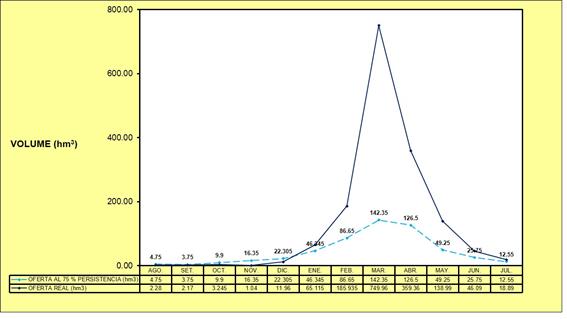
Figure 2
Real water supply at 75 % persistence in Jequetepeque river basin, Peru (August 2017-July 2018).
Real water supply at 75 % persistence in Jequetepeque river basin, Peru (August 2017-July 2018).
Thumbnail
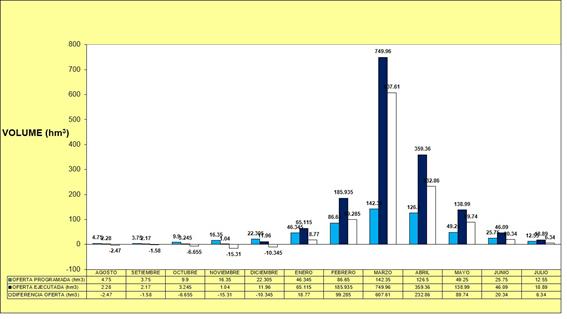
Figure 3
Water supply programmed and executed and it's differential in Jequetepeque river basin, Peru (August 2017-July 2018).
Water supply programmed and executed and it's differential in Jequetepeque river basin, Peru (August 2017-July 2018).
Thumbnail
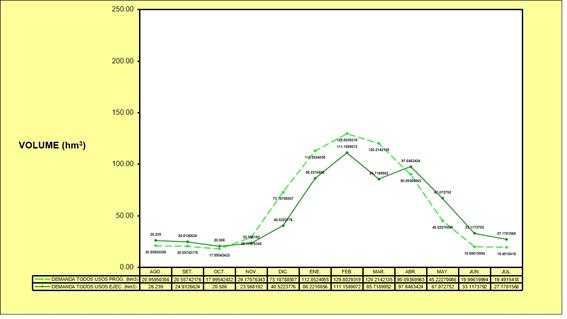
Figure 4
Gross demand programmed and executed in Jequetepeque river basin, Peru (August 2017-July 2018).
Gross demand programmed and executed in Jequetepeque river basin, Peru (August 2017-July 2018).
Thumbnail
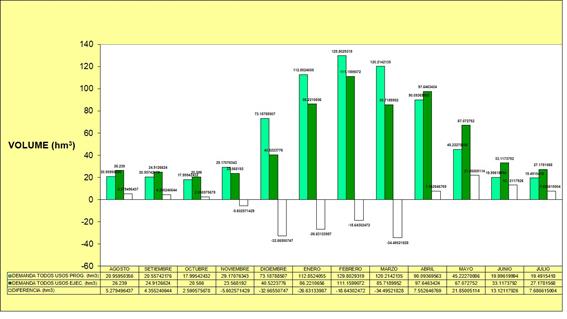
Figure 5
Scheduled and executed gross demand and its differential in Jequetepeque river basin, Peru (August 2017-July 2018)
Scheduled and executed gross demand and its differential in Jequetepeque river basin, Peru (August 2017-July 2018)
Thumbnail
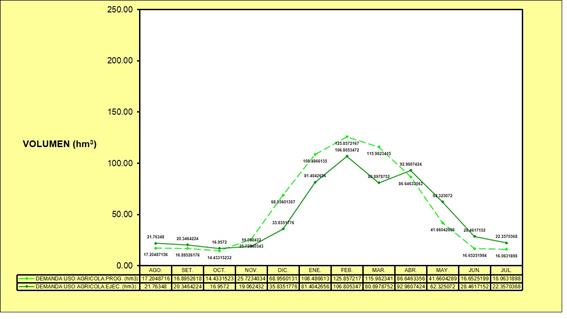
Figure 6
Agricultural demand programmed and executed in Jequetepeque river basin, Peru (August 2017-July 2018).
Agricultural demand programmed and executed in Jequetepeque river basin, Peru (August 2017-July 2018).
Thumbnail
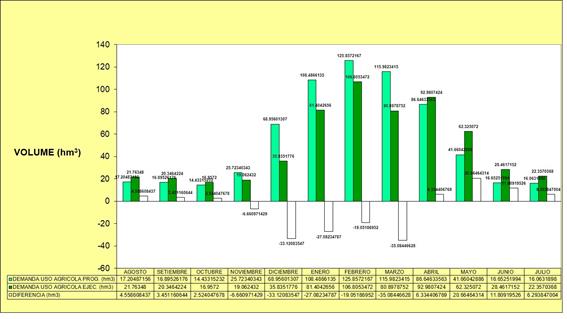
Figure 7
Programmed and executed agricultural demand and its differential in Jequetepeque river basin, Peru (August 2017-July 2018).
Programmed and executed agricultural demand and its differential in Jequetepeque river basin, Peru (August 2017-July 2018).
The hypergeometric approximation distribution is presented as the Poisson approximation to the binomial distribution. In this section, we will consider the normal approximation to the binomial distribution. Since the binomial is a discrete probability distribution, this may seem counterintuitive; however, it is involved in a limit process, keeping the p of the binomial fixed and leaving n ∞. It is known as the DeMoivre-Laplace approximation.
To determine bivalent normality, it is necessary to evaluate the relationship between water supply and demand, if both variables followed a normal distribution. If they were bivalent normal distribution (Table 3, Table 6, Table 9), it was necessary to use Pearson's correlation which indicated that there was no bivalent normal distribution and in this case, it was necessary to use a non-parametric correlation coefficient like Spearman's. When it was evaluated using Spearman correlation (Table 4, Table 7, Table 10), two variables were found that are very strongly related because their value was P < 0.05. Likewise, Wilcoxon bivalent distribution test (Table 5, Table 8, Table 11), the asymptotic significance of 0.638 and 0.53 was found for supply and demand hydric respectively (Table 6 and Table 7) in Jequetepeque river basin 2017-2018 year.
Table 3
Multivariate normality test relation to water supply in Jequetepeque river basin during the 2017-2018 year.
Multivariate normality test relation to water supply in Jequetepeque river basin during the 2017-2018 year.
| Bivalent normal distribution | ||
|---|---|---|
| Henze-Zirkler = 1.520446 | Chi2(1) = 13.256 | Prob > chi2 = 0.0003 |
| Doornik-Hansen | Chi2(4) = 37.525 | Prob > chi2 = 0.0000 |
Table 4
Spearman's rank correlation, stats (rho p) pw to water supply in Jequetepeque river basin during the 2017-2018 year.
Spearman's rank correlation, stats (rho p) pw to water supply in Jequetepeque river basin during the 2017-2018 year.
| Spearman's rank correlation, stats (rho p) pw | |
|---|---|
| Object numbers | 12 |
| Spearman's rho | 0.9161 |
| Ho test: Program to run if they are independent variables | |
| Prob > |t| | 0.0000 |
Table 5
Range test with Wilcoxon signs for related samples according to water supply in Jequetepeque river basin during the 2017-2018 year.
Range test with Wilcoxon signs for related samples according to water supply in Jequetepeque river basin during the 2017-2018 year.
| Data | Results |
|---|---|
| Total number | 12 |
| Contrast statistic | 60.000 |
| Standard error | 12.748 |
| Standardized contrast statistic | 1.647 |
| Asymptotic significance (bilateral test) | 0.099 |
Table 6
Multivariate normality test with gross demand in Jequetepeque river basin during the 2017-2018 year.
Multivariate normality test with gross demand in Jequetepeque river basin during the 2017-2018 year.
| Bivalent normal distribution | ||
|---|---|---|
| Henze-Zirkler = 0.8018365 | Chi2(1)= 4.479 | Prob>chi2 = 0.0343 |
| Doornik-Hansen | Chi2(4)= 8.533 | Prob>chi2 = 0.0739 |
Table 7
Spearman's rank correlation, stats (rho p) pw about gross demand in Jequetepeque river basin during the 2017-2018 year.
Spearman's rank correlation, stats (rho p) pw about gross demand in Jequetepeque river basin during the 2017-2018 year.
| Spearman's rank correlation, stats (rho p) pw | |
|---|---|
| Object numbers | 12 |
| Spearman's rho | 0.8392 |
| Ho test: Program to run if they are independent variables | |
| Prob > |t| | 0.0006 |
Table 8
Range test with Wilcoxon sign for related samples according to gross demand in Jequetepeque river basin during the 2017-2018 year.
Range test with Wilcoxon sign for related samples according to gross demand in Jequetepeque river basin during the 2017-2018 year.
| Data | Results |
|---|---|
| Total number | 12 |
| Contrast statistic | 33.000 |
| Standard error | 12.748 |
| Standardized contrast statistic | -0.471 |
| Asymptotic significance (bilateral test) | 0.638 |
Table 9
Multivariate normality test about agricultural demand in Jequetepeque river basin during the 2017-2018 year.
Multivariate normality test about agricultural demand in Jequetepeque river basin during the 2017-2018 year.
| Bivalent normal distribution | ||
|---|---|---|
| Henze-Zirkler = 0.8085096 | Chi2(1) = 4.563 | Prob > chi2 = 0.0327 |
| Doornik-Hansen | Chi2(4) = 8.554 | Prob > chi2 = 0.0733 |
Table 10
Spearman's rank correlation, stats (rho p) pw about agricultural demand in Jequetepeque river basin during the 2017-2018 year.
Spearman's rank correlation, stats (rho p) pw about agricultural demand in Jequetepeque river basin during the 2017-2018 year.
| Spearman's rank correlation, stats (rho p) pw | |
|---|---|
| Object numbers | 12 |
| Spearman's rho | 0.8392 |
| Ho test: Program to run if they are independent variables | |
| Prob > |t| | 0.0006 |
Table 11
Range test with Wilcoxon sign for related samples according to agricultural demand in Jequetepeque river basin during the 2017-2018 year.
Range test with Wilcoxon sign for related samples according to agricultural demand in Jequetepeque river basin during the 2017-2018 year.
| Data | Results |
|---|---|
| Total number | 12 |
| Contrast statistic | 31.000 |
| Standard error | 12.748 |
| Standardized contrast statistic | -0.628 |
| Asymptotic significance (bilateral test) | 0.530 |
Water quality is affected by diverse factors like land use, industrial and agricultural production. Do not adequate treatment give before discharged back into water bodies and amount water in rivers and lakes since its purification capacity depends on it. Water quality is a widely used term, however, scientific evaluation is quite important and this solution is a basic strategy in development foundations for resources water management (Parparov, Hambrigh, Hakanson, & Ostapenia, 2006). There are many physical-chemical and microbiological factors that allow us to know whether certain water bodies are contaminated or not. This means that if there is an alteration in established parameters, pollution occurs, although the foreign substance present in water does not imply be contaminated, unless there is an impact on a living being or material (Bonet & Ricardo, 2011; Guerrero, 2014).
-
Parparov, Hambrigh, Hakanson, & Ostapenia, 2006Development of a system of water quality as a tool for management. Final report to INTAS, 2000
-
Bonet & Ricardo, 2011Calidad de riego y su posible efecto en los rendimientos agrícolas en la empresa de cultivos varios sierra de CubitasRevista Ciencias Técnicas Agropecuarias, 2011
-
Guerrero, 2014Gestión integrada de recursos hídricos de la cuenca del río Jequetepeque, PerúSciendo, 2014
The irrigation quality water is very important to reduce the problem of the total concentration of soluble salts present in water, meanwhile higher quantity salts are present lower in water quality (Guerrero, 2016). Factors that influence water quality are pH, presence [calcium (Ca+2) and magnesium (Mg+2)] and electrical conductivity (Palancar, 2006; Cortés-Jiménez, Troyo-Diéguez, & Murillo-Amador, 2009; Lingaswamy & Saxena, 2015).
-
Guerrero, 2016Análisis de calidad de agua de la cuenca hidrográfica Chicama, PerúGestión Ambiental, 2016
-
Palancar, 2006Compresibilidad y resistencia al corte de suelos salinizados y sodificados por irrigación, 2006
-
Cortés-Jiménez, Troyo-Diéguez, & Murillo-Amador, 2009Índices de calidad del agua del acuífero del valle del Yaqui SonoraTerra Latinoamericana, 2009
-
Lingaswamy & Saxena, 2015Water quality of Fox Sagar Lake, Hyderabad, Telangana State, India, its suitability for irrigation purposeInternational Journal of Advanced Research in Science, Engineering and Technology, 2015
Physico-chemical and bacteriological parameters were evaluated in six sampling stations in the Jequetepeque river. These parameters were temperature (t), hydrogen potential (pH), electrical conductivity (EC), total dissolved solids (TDS), dissolved oxygen (DO), biochemical oxygen demand (BOD5), calcium (Ca+2), magnesium (Mg+2), sodium (Na+1), carbonates (CO3-2), bicarbonates (HCO3-1), chlorides (Cl-1) and including lead (Pb) and cadmium (Cd), total and thermotolerant coliforms (NMP/100 ml) (Figure 8, Figure 9, Figure 10). These results compared with water quality standards, according to ECA D.S. N° 004-2017-MINAM and European Union's Environmental Quality Standards (EQS) (UE, 2013).
-
UE, 2013Normas de calidad ambiental aplicables a las aguas superficiales (UE). Directiva 2013/39/UE del Parlamento Europeo y del Consejo de 12 de agosto de 2013, 2013
Thumbnail
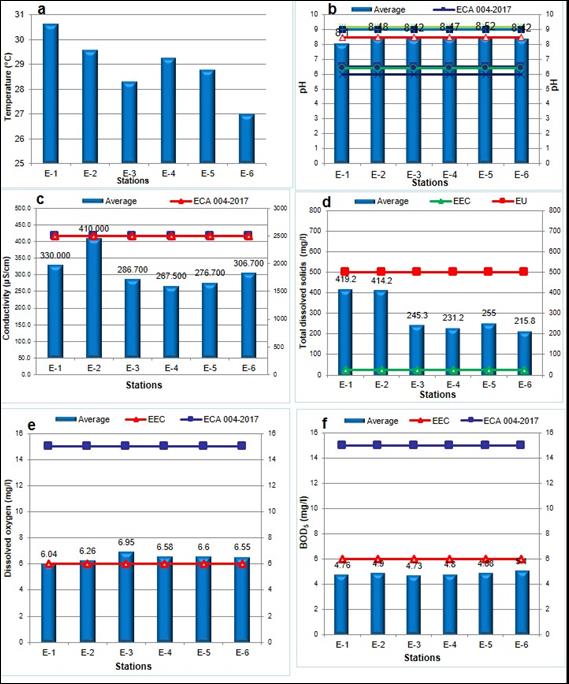
Figure 8
Physical-chemical parameters assessing: temperature (a), pH (b), conductivity (c), total dissolved solids (d), dissolved oxygen (e), biochemical oxygen demand (f) in middle Jequetepeque river basin, Peru.ECA= Environmental Water Quality Standards-Peru (D.S. N°004-2017-MINAM).EEC= European Economic Community (Directive 2008/105/CE of European Parliament and Council on December 16, 2008).EU= European Union-2013 (Directive 2013/39/UE of European Parliament and Council on August 12, 2013).
Physical-chemical parameters assessing: temperature (a), pH (b), conductivity (c), total dissolved solids (d), dissolved oxygen (e), biochemical oxygen demand (f) in middle Jequetepeque river basin, Peru.ECA= Environmental Water Quality Standards-Peru (D.S. N°004-2017-MINAM).EEC= European Economic Community (Directive 2008/105/CE of European Parliament and Council on December 16, 2008).EU= European Union-2013 (Directive 2013/39/UE of European Parliament and Council on August 12, 2013).
Thumbnail
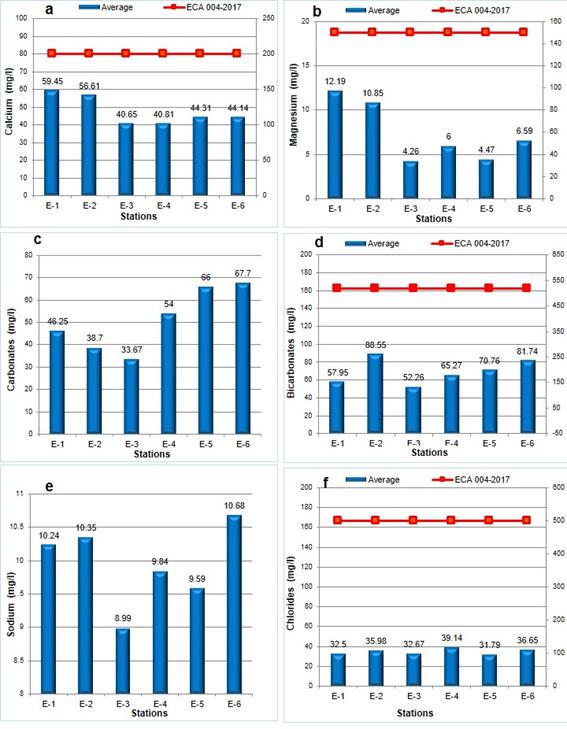
Figure 9
Chemical parameters assessing: calcium (a), magnesium (b), carbonates (c), bicarbonates (d), sodium (e), and chlorides (f) in Jequetepeque river middle basin, Peru. ECA = Environmental Water Quality Standards-Peru (D.S. N°004-2017-MINAM).
Chemical parameters assessing: calcium (a), magnesium (b), carbonates (c), bicarbonates (d), sodium (e), and chlorides (f) in Jequetepeque river middle basin, Peru. ECA = Environmental Water Quality Standards-Peru (D.S. N°004-2017-MINAM).
Thumbnail

Figure 10
Chemical and bacteriological parameters assessing: lead (a), cadmium (b), total coliforms (c), thermotolerant coliforms (d), and determination of SAR index and its diagram (e, f) in middle Jequetepeque river basin, Peru.ECA= Environmental Water Quality Standards-Peru (D.S. N°002-2008-MINAM).ECA= Environmental Water Quality Standards-Peru (D.S. N°004-2017-MINAM).FAO= Food and Agriculture Organization of the United Nations (FAO). Soil erosion (FAO, 2019).
Chemical and bacteriological parameters assessing: lead (a), cadmium (b), total coliforms (c), thermotolerant coliforms (d), and determination of SAR index and its diagram (e, f) in middle Jequetepeque river basin, Peru.ECA= Environmental Water Quality Standards-Peru (D.S. N°002-2008-MINAM).ECA= Environmental Water Quality Standards-Peru (D.S. N°004-2017-MINAM).FAO= Food and Agriculture Organization of the United Nations (FAO). Soil erosion (FAO, 2019).
All evaluated parameters were within Water Quality Standard values, except bacteriological parameters (total and thermotolerant coliforms), which exceeded ECA D.S. N°004-2017-MINAM. Which is not equivalent to European Union standards (UE, 2013). There is no equivalence in any case.
-
UE, 2013Normas de calidad ambiental aplicables a las aguas superficiales (UE). Directiva 2013/39/UE del Parlamento Europeo y del Consejo de 12 de agosto de 2013, 2013
Castañé, Topolián, Cordero and Salibián (2003), cited by Salas (2014), classify Hg, As, Cr, Pb, Ni and Zn as metals with greatest toxicological and ecotoxicological effect in aquatic environments, while Prieto, González, Román y Prieto (2009) consider Hg, Cd, As, Cr, Tl and Pb, toxic as well. It is pertinent to mention that copper (Cu1,2) is an essential element, required by plants and animals, however, copper in high concentrations has cytotoxic effects (Gaete, Aránguiz, Cienfuegos, & Tejos, 2007). While other metals mentioned above do not have metabolic functions like copper so they are not biodegraded and bioaccumulate in tissues and could affect the central nervous system and/or become carcinogenic. The average lead value (Pb) found in all monitoring stations in the middle Jequetepeque river basin was 0.005 mg/l (Figure 10a). Lead does not found in bodies of water naturally, it comes from pollution by lead arsenate and other salts, especially from mining effluents. Lead bioaccumulates in bones, could cause damage to the central nervous system. Long-term consumption of lead-contaminated water has lethal effects.
-
Castañé, Topolián, Cordero and Salibián (2003)Influencia de la especiación de los metales pesados en el medio acuático como determinante de su toxicidadRevista de Toxicología, 2003
-
Salas (2014)Determinación de metales pesados en las aguas del río Ananea debido a la actividad minera aurífera, Puno-PerúRevista de Investigaciones, 2014
-
Prieto, González, Román y Prieto (2009)Contaminación y fitotoxicidad en plantas por metales pesados provenientes de suelos y aguaTropical and Subtropical Agroecosystems, 2009
-
Gaete, Aránguiz, Cienfuegos, & Tejos, 2007Metales pesados y toxicidad de aguas del río Aconcagua en ChileQuímica Nova, 2007
Cadmium average value found at all monitoring stations in the middle Jequetepeque river basin was 0.001 mg/L (Figure 10b). Cadmium is a metallic element soluble in water like chlorides, nitrates, and sulfates, uncommon in natural waters. In addition to causing nausea and vomiting, it bioaccumulates in the liver, pancreas, thyroid, and kidneys, is considered a carcinogenic element. Its presence in water usually comes from pollution with residues of the electroplating industry. Buenfil-Rojas and Flores-Cuevas (2007) affirms pollution of Hondo River by heavy metals (As, Cd, Pb, and Hg) comes from sugar mills, such as pesticides use and fertilizers, as well as direct sewage discharges at different points of riverbank and small industry waste.
-
Buenfil-Rojas and Flores-Cuevas (2007)Determinación de metales pesados (As, Cd, Hg y Pb) presentes en el río Hondo, Quintana Roo, 2007
Determination of total coliforms (Figure 10c) has do not been considered in the Peruvian regulations, Category 3: Irrigation of vegetables and animal drink. D1: Irrigation of Vegetables (D.S. N° 004-2017-MINAM) (MINAM, 2017), whose parameter was considered in D.S. N° 002-2008-MINAM (MINAM, 2008); however currently aforementioned supreme decree has been repealed. However, thermotolerant coliforms (Figure 10d) in six monitoring stations exceeded the standard value (1000 CFU/100 ml), according to Category 3: Irrigation of vegetables and animal drink. D1: Irrigation of Vegetables (D.S. N° 004-2017-MINAM).
-
MINAM, 2017Aprueban Estándares de Calidad Ambiental (ECA) para Agua y establecen Disposiciones Complementarias. Decreto Supremo N°004-2017-MINAMDiario “El Peruano”, 2017
-
MINAM, 2008Aprueban los Estándares Nacionales de Calidad Ambiental (ECA) para el Agua y Disposiciones Complementarias Transitorias. Decreto Supremo N°002-2008-MINAMDiario “El Peruano”, 2008
Temperature, total dissolved solids, as well as organic matter, directly related to survival and proliferation rates of microorganisms, including total and fecal coliforms, latter associated with pathogenic bacteria. It is pertinent to mention in the study area there are small populated centers, whose domestic effluents discharge directly into the Jequetepeque river basin, as a consequence, it was found thermotolerant coliforms (Figure 10d), exceeded quality standards (ECA ) for agricultural use (D.S. N°004-2017-MINAM). However, studies carried out by Lessard and Sieburth (1983), Rozen and Belkin (2001), and Cabral (2010) affirmed temperature is not related to survival and proliferation of microorganisms as demonstrated by Davies and Evison (1991), at not find significant differences in the survival rate of Salmonella montevideo subjected to 5, 15 and 25°C temperatures.
-
Lessard and Sieburth (1983)Survival of natural sewage populations of enteric bacteria in diffusion and batch chambers in the marine environmentApplied and Environmental Microbiology, 1983
-
Rozen and Belkin (2001)Survival of enteric bacteria in seawaterFEMS Microbiology Reviews, 2001
-
Cabral (2010)Water microbiology. Bacterial pathogens and waterInternational Journal of Environmental Research and Public Health, 2010
-
Davies and Evison (1991)Sunlight and the survival of enteric bacteria in natural watersJournal of Applied Microbiology, 1991
SAR index is used in sodium absorption relationship (Can-Chulim, Ramírez-Ayala, Ortega-Escobar, Trejo-López, & Cruz-Díaz, 2008), which expresses the relationship between sodium ions to calcium and magnesium cations. Figure 10e observed the lowest value (1.744) found in Kuntur Wasi bridge station (E-1), while the highest average value (2.121) was found in Yonan bridge station (E-6). Values found in all stations were less than 3, according to FAO normative (Ayers & Westcot, 1987), there is no restriction for agricultural water use (Figure 10f). Likewise, studies carried out on water quality irrigation in "Sierra Norte" Puebla (Mexico), found average values of 1.0 for sodium absorption ratio in the relation between sodium ions to calcium and magnesium cations (SAR), concluding it is optimal for agricultural use (Can-Chulim, Ortega-Escobar, Sánchez-Bernal, & Cruz-Crespo, 2014).
-
Can-Chulim, Ramírez-Ayala, Ortega-Escobar, Trejo-López, & Cruz-Díaz, 2008Evaluación de la relación de adsorción de sodio en las aguas del río Tulancingo, estado de Hidalgo, MéxicoTerra Latinoamericana, 2008
-
Ayers & Westcot, 1987La calidad del agua y su uso en la agriculturaRiego y Drenaje, Food and Agriculture Organization of the United Nations, 1987
-
Can-Chulim, Ortega-Escobar, Sánchez-Bernal, & Cruz-Crespo, 2014Calidad del agua para riego en la Sierra Norte de Puebla, MéxicoTecnología y ciencias del agua, 2014
However, it is relevant to mention agricultural constantly contributes different types of pollutants (salts, pesticides, and fertilizers from irrigation, among others), so this sector requires to assessment water use considering other aspects, in addition, specific quantitative analyses (Söderbaum & Tortajada, 2011). Return waters (runoff and percolation waters) due to their high salinity and nutrient content can produce a negative environmental impact on the water bodies (surface or underground) that receive them, conditioning water quality rivers and aquifers both for irrigation and other uses (Thayalakumaran, Bethune, & Mcmahon, 2007).
-
Söderbaum & Tortajada, 2011Perspectives for water management within the context of sustainable developmentWater International, 2011
-
Thayalakumaran, Bethune, & Mcmahon, 2007Achieving a salt balance- Should it be a management objective?Agricultural Water Management, 2007
Conclusions
Water quality of middle Jequetepeque River basin found within Category 3: Irrigation of vegetables and animal drink. D1: Irrigation of Vegetables, according to quality standards ECA D.S. N°004-2017-MINAM can use without restrictions for different crops in the study area. Using Spearman's nonparametric correlation coefficient P<0.05 was found. Likewise, with Wilcoxon bivalent distribution test, the asymptotic significance of 0.638 and 0.53 was found.
The sodium absorption index (SAR) was found to be less than 3, which indicates that it is not limiting for agricultural activity, it can be used without restrictions for the different crops in the study area.
Quality water in the middle Jequetepeque river basin has moderately altered by contributions or discharges of domestic effluents throughout the basin. However, it is important to indicate average values of thermotolerant coliforms exceeded the Environmental Quality Standards (D.S. N° 004-2017-MINAM) (MINAM, 2017).
-
MINAM, 2017Aprueban Estándares de Calidad Ambiental (ECA) para Agua y establecen Disposiciones Complementarias. Decreto Supremo N°004-2017-MINAMDiario “El Peruano”, 2017
Acknowledgments
Special thanks for the support provided for the development of this research, collaborative work by two important universities of Peru, the National University of Trujillo and the National University of San Marcos.
Referencias
- Álvarez, J., Panta, J., Ayala, C., & Acosta, E. (2008). Calidad integral del agua superficial en la cuenca del río Amajac, Hidalgo, México. Información Tecnológica, 19(6), 21-32. Links
- APHA-AWWA-WEF, American Public Health Association-American Water Works Association-World Economic Forum. (2012). Standard methods for examination of water and wastewater. (22nd ed.). Washington, DC, USA: American Public Health Association. Links
- ANA, Autoridad Nacional del Agua. (11 de enero, 2016). Protocolo Nacional para el Monitoreo de la Calidad de los Recursos Hídricos. Resolución Jefatural N°010-2016 ANA. El Peruano. Normas Legales, 575300-575301. Links
- Ayers, R. S., & Westcot, D. W. (1987). La calidad del agua y su uso en la agricultura. Riego y Drenaje, Food and Agriculture Organization of the United Nations, 29(1), 81. Links
- Báez, A. (1999). Efecto de la calidad del agua de riego sobre las propiedades del suelo (monografía para optar el grado académico de especialista en Producción Vegetal). Universidad Nacional de Mar del Plata. Buenos Aires, Argentina. Recuperado de http://www.inta.gov.ar/barrow/info/documentos/agricultura/pdf/ TesisBaez.pdf Links
- Balmaseda, C., & García, Y. (2013). Calidad de las aguas de la Cuenca del río Naranjo, Municipio Majibacoa, provincial Las Tunas para el riego. Cultivos Tropicales, 34(4), 68-73. Links
- Bermejillo, A., Martí, L., Cónsoli, D., Salcedo, C., Llera, J., Valdés, A., Vernier, M., & Troilo, S. (2012). Aptitud para riego del agua subterránea basada en la salinidad y sodicidad en las perforaciones realizadas entre 2004 y 2014 en los Oasis Norte y Centro de Mendoza. Revista de la Facultad de Ciencias Agrarias UNCuyo, 44(2), 221-240. Links
- Bonet, C., & Ricardo, M. (2011). Calidad de riego y su posible efecto en los rendimientos agrícolas en la empresa de cultivos varios sierra de Cubitas. Revista Ciencias Técnicas Agropecuarias, 20(3), 19-23. Links
- Buenfil-Rojas, M., & Flores-Cuevas, N. (2007). Determinación de metales pesados (As, Cd, Hg y Pb) presentes en el río Hondo, Quintana Roo. Memorias en extenso (pp. 435-439). VI Congreso Internacional y XII Nacional de Ciencias Ambientales, Chihuahua, México. Links
- Cabral, J. (2010). Water microbiology. Bacterial pathogens and water. International Journal of Environmental Research and Public Health, 7(10), 3657-3703. Links
- Can-Chulim, A., Ortega-Escobar, H. M., Sánchez-Bernal, E. I., & Cruz-Crespo, E. (2014). Calidad del agua para riego en la Sierra Norte de Puebla, México. Tecnología y ciencias del agua, 5(5), 77-96. Links
- Can-Chulim, Á., Ramírez-Ayala, C., Ortega-Escobar, M., Trejo-López, C., & Cruz-Díaz, J. (2008). Evaluación de la relación de adsorción de sodio en las aguas del río Tulancingo, estado de Hidalgo, México. Terra Latinoamericana, 26(3), 243-252. Links
- Castañé, M., Topolián, L., Cordero, R., & Salibián, A. (2003). Influencia de la especiación de los metales pesados en el medio acuático como determinante de su toxicidad. Revista de Toxicología, 20, 13-18. Links
- Cortés-Jiménez, J. M., Troyo-Diéguez, E., & Murillo-Amador, E. (2009). Índices de calidad del agua del acuífero del valle del Yaqui Sonora. Terra Latinoamericana, 27(2), 133-141. Links
- Davies, C., & Evison, L. (1991). Sunlight and the survival of enteric bacteria in natural waters. Journal of Applied Microbiology, 3(70), 265-274. Links
- FAO, Food and Agriculture Organization of the United Nations. (2019). Soil erosion: The greatest challenge to sustainable soil management. Rome, Italy: Food and Agriculture Organization of the United Nations. Links
- FAO, Food and Agriculture Organization of the United Nations. (2002). Agricultural drainage water management in arid and semiarid areas (Paper Nº 61). Rome, Italy: FAO Irrigation and Drainage. Links
- Gaete, H., Aránguiz, F., Cienfuegos, G., & Tejos, M. (2007). Metales pesados y toxicidad de aguas del río Aconcagua en Chile. Química Nova, 30(4), 885-891. Links
- GEMS, Global Environmental Monitoring System. (1987). GEMS/Water Operational Guide. Geneva, Italy: Prepared under the joint sponsorship of the United Nations Environmental Programme. World Health Organization, United Nations Educational, Scientific and Cultural Organization, World Meteorological Organization, World Health Organization. Links
- Guerrero, A. M. (2016). Análisis de calidad de agua de la cuenca hidrográfica Chicama, Perú. Gestión Ambiental, 31, 51-62. Links
- Guerrero, A. M. (2014). Gestión integrada de recursos hídricos de la cuenca del río Jequetepeque, Perú. Sciendo, 17(2), 92-116. Links
- Gyawali, S., Techato, K., Yuangyai, C., & Musikavong, C. (2013). Assessment of relationship between land uses of riparian zone and water quality of river for sustainable development of river basin, a case study of U-Tapao River Basin, Thailand. Procedia Environmental Sciences, 17, 291-297. Links
- Hakanson, L., Parparov, A., Ostapenia, A., Boulion, V., & Hambrig, K. D. (2000). Development of a system of water quality as a tool for management. Final report to INTAS. Upsala, Sweden: Uppsala University, Department of Earth Science. Links
- Hernández, R., Fernández, C., & Baptista, M. (2010). Metodología de la investigación (5ª ed.). México, DF, México: McGraw-Hill/Interamericana Editores, S.A. de C.V. Links
- Hines, W., & Montgomery, D. (1996). Probabilidad y estadística para ingeniería y administración (3ª ed.). México, DF, México: Compañía Editorial Continental, S.A. de C.V. Links
- INRENA, Instituto Nacional de Evaluación de Recursos Naturales. (2003). Evaluación y ordenamiento de los recursos hídricos en la cuenca del río Chicama. Hidrología. Estudio Hidrológico. Lima, Perú: Ministerio de Agricultura, Instituto Nacional de Evaluación de Recursos Naturales. Links
- Juarez, H. (2006). Contaminación del río Rímac por metales pesados y efecto en la agricultura en el cono este de Lima metropolitana. Lima, Perú: Universidad Agraria La Molina. Links
- Lessard, E. J., & Sieburth, J. (1983). Survival of natural sewage populations of enteric bacteria in diffusion and batch chambers in the marine environment. Applied and Environmental Microbiology, 45(3), 950-959. Links
- Lingaswamy, M., & Saxena, P. R. (2015). Water quality of Fox Sagar Lake, Hyderabad, Telangana State, India, its suitability for irrigation purpose. International Journal of Advanced Research in Science, Engineering and Technology, 4(8), 490-494. Links
- Medeiros, A., Freitas, K. R., Freitas, K., Do, C., Da-Silva, I., De-Oliveira, M., Guimarãesb, R., & Mendonçac, N. (2017). Quality index of the surface water of Amazonian rivers in industrial areas in Pará, Brazil. Marine Pollution Bulletin, 123(1-2), 156-164. Links
- MINAM, Ministerio del Ambiente. (7 de junio, 2017). Aprueban Estándares de Calidad Ambiental (ECA) para Agua y establecen Disposiciones Complementarias. Decreto Supremo N°004-2017-MINAM. Diario “El Peruano”, 10-19. Links
- MINAM, Ministerio del Ambiente. (30 de julio, 2008). Aprueban los Estándares Nacionales de Calidad Ambiental (ECA) para el Agua y Disposiciones Complementarias Transitorias. Decreto Supremo N°002-2008-MINAM. Diario “El Peruano”, Perú, 12 pp. Links
- Ocampo-Duque, W., Osorio, C., Piamba, C., Schuhmacker, M., & Domingo, J. (2013). Water quality analysis in rivers with non-parametric probability distributions and fuzzy inference systems: application to the Cauca River, Colombia. Environment International, 52, 17-28. Links
- Pawar, P. R. (2013). Monitoring of impact of anthropogenic inputs on water quality of mangrove ecosystem of Uran, Navi Mumbai, west coast of India. Marine Pollution Bulletin, 75(1-2), 291-300. Links
- Palancar, T. (2006). Compresibilidad y resistencia al corte de suelos salinizados y sodificados por irrigación (tesis doctoral). Universidad Nacional de la Plata, La Plata-Argentina. Recuperado de https://doi.org/10.4995/Thesis/10251/1939 Links
- Peña, H. (1993). Caracterización de la calidad de las aguas naturales y contaminación agrícola en Chile. En: Prevención de la contaminación del agua por la agricultura y actividades afines. Anales de la Consulta de Expertos Organizada por la FAO. Santiago, Chile: Editorial de la Organización de las Naciones Unidas para la Alimentación y la Agricultura. Links
- Pérez, J., Nardini, A., & Galindo, A. (2018). Análisis comparativo de índices de calidad del agua aplicados al río Ranchería, La Guajira-Colombia. Información Tecnológica, 29(3), 47-58. Links
- Posada, J., Roldán, G., & Ramírez, J. (2000). Caracterización fisicoquímica y biológica de la calidad de aguas de la cuenca de la quebrada Piedra Blancas, Antioquia. Colombia. Revista Bioltrop V, 48(1), 0034-7744. Links
- Prieto, J., González, C., Román, A., & Prieto, F. (2009). Contaminación y fitotoxicidad en plantas por metales pesados provenientes de suelos y agua. Tropical and Subtropical Agroecosystems, 10, 29-44. Links
- Rangeti, I., Dzwairo, B., Barratt, G., & Otieno, F. (2015). Ecosystem-specific water quality indices. African Journal of Aquatic Science, 40(3), 227-234. Links
- Rashidi, M., & Seilsepour, M. (2011). Prediction of soil sodium adsorption ratio base on soil electrical conductivity. Middle-East Journal of Scientific Research, 8(2), 379-383. Links
- Reinaudi, N., Grégoire, H., Rosiére, J., Nadal, D., & Viñuela, R. (1998). Calidad del agua para riego en invernáculos de la Región Central de la Pampa. Santa Rosa La Pampa, Argentina: Facultad de Agronomía. Recuperado de http://libnet.unse.edu.ar/5Con/Rhid/T/03021.PDF Links
- Rivera, N., Encina, F., Palma, R., & Mejias, P. (2009). La calidad de las aguas en el curso superior y medio del río Traiguén, IX Región-Chile. Información Tecnológica, 20(4), 75-84. Links
- Roldan, J., Díaz, M., Pérez, R., & Moreno, M. (2010). Mejora de la gestión del agua de riego mediante el uso de indicadores de riego. Revista de la Facultad de Ciencias Agrarias, Universidad Nacional de Cuyo. Mendoza, Argentina, 42(1), 104-124. Links
- Romero, J. (2019). Calidad del agua. Edición 3R/2019. Bogotá, Colombia: Escuela Colombiana de Ingeniería. Links
- Rozen, Y., & Belkin, S. (2001). Survival of enteric bacteria in seawater. FEMS Microbiology Reviews, 25(1), 513-529. Links
- Salas, F. (2014). Determinación de metales pesados en las aguas del río Ananea debido a la actividad minera aurífera, Puno-Perú. Revista de Investigaciones, 5(4), 47-53. Links
- Sarabia-Meléndez, I. F., Cisneros-Almazán, R., Aceves-De-Alba, J., Durán-García, H. M., & Castro-Larragoitia, J. (2011). Calidad de agua de riego en suelos agrícolas y cultivos del valle de San Luis Potosí, México. Revista Internacional de Contaminación Ambiental, 27(2), 103-113. Links
- Söderbaum, P., & Tortajada, C. (2011). Perspectives for water management within the context of sustainable development. Water International, 36(7), 812-827. Links
- Solís, G., Israel, A., Nubes, G., Castillo, J., & Meraz, F. (2011). Fisicoquímica del agua superficial y sedimento en el río Santa Cruz, Sonora. México. Revista Biotecnia, 13(1), 3-9. Links
- Sutadian, A. D., Muttil, N., Yilmaz, A. G., & Perera, B. J. C. (2016). Development of river water quality indices-a review. Environmental Monitoring and Assessment, 188, 58. Links
- Thayalakumaran, T., Bethune, M. G., & Mcmahon, T. A. (2007). Achieving a salt balance- Should it be a management objective? Agricultural Water Management, 92, 1-12. Links
- Tyagi, S., Sharma, P., Singh, P., & Dobhal, R. (2013). Water quality assessment in terms of water quality index. American Journal of Water Resources, 1(3), 34-38. Links
- UE, Unión Europea. (2013). Normas de calidad ambiental aplicables a las aguas superficiales (UE). Directiva 2013/39/UE del Parlamento Europeo y del Consejo de 12 de agosto de 2013. Recuperado de http://eur-lex.europa.eu/LexUriServ/LexUriServ.do?uri=OJ:l:2013:226:0001:001 Links