




Servicios Personalizados
Revista
Articulo
 texto en
  Inglés (pdf)
 Artículo en XML
 Referencias del artículo
 Traducción automática
 Enviar artículo por email
Indicadores
-
 Citado por SciELO
 -
 Accesos
Links relacionados
-
 Similares en
SciELO
Similares en
SciELO
Compartir

 Permalink
Diálogos sobre educación. Temas actuales en investigación educativa
versión On-line ISSN 2007-2171
Diálogos sobre educ. Temas actuales en investig. educ. vol.15 no.29 Zapopan mar. 2024 Epub 17-Nov-2025
https://doi.org/10.32870/dse.v0i29.1439
Thematic axis
Sexual crimes in Spain: analysis of prison programs and socio-educational intervention
*
 http://orcid.org/0009-0003-4598-295X
**
http://orcid.org/0000-0003-1156-6483
* Doctoranda en Ciencias de la educación. Universidad de Granada. España. Correo electróico: alinadcorp@gmail.com.
** Doctor en Ciencias de la Educación. Docente e investigador, Universidad de Granada. España. Correo electróico: rubenbj@ugr.es.
*** Doctora en Ciencias de la Educación. Docente e investigadora. Universidad de Granada. España. Correo electróico: elisabethmoles@ugr.es.
**** Doctora en Pedagogía. Docente e investigadora. Universidad de Granada. España. Correo electróico: fanntab@ugr.es.
This article aims to analyze the programs and socio-educational intervention for the reintegration of those convicted of sexual crimes in Spain. Methodologically, we carried out a systematic bibliographic review of scientific bases, documents and relevant scientific institutions. The main results show an increase in sexual assaults in 2021 and greater visibility of such crimes after the modification of Organic Law 10/2022 of September 6 on crimes against sexual freedom, which redefines sexual assaults. Thus, Penitentiary Institutions have implemented a number of treatment programs based on cognitive-behavioral strategies for awareness and self-control. The effectiveness of the Sexual Assault Control Program stands out, with a 14.1% reduction in recidivism and valued positively by 90% of its participants. However, these programs focus on measuring the prevention of recidivism in sexual crimes, making it necessary to assess the processes of personal development. A lack of participation is observed in the last stages of the inmates’ sentences, while the participants demand more content in these interventions. However, it is necessary to train professionals to apply socio-educational evaluation methods and facilitate treatment continuity and social reinsertion.
Keywords: Prison; sexual crimes; sexual offenders; socio-educational intervention; reintegration
El presente artículo tiene por objeto analizar la realidad e intervención para la reinserción de penados por delitos sexuales en España. Metodológicamente, se realiza una revisión bibliográfica sistemática con bases científicas, documentos e instituciones científicas de relevancia. Los resultados muestran un aumento de las agresiones sexuales en los últimos años y una mayor visibilización a partir de la modificación de la Ley Orgánica 10/2022 de los delitos contra la libertad sexual, que redefinen las tipologías de agresiones sexuales. Ante ello, la institución penitenciaria implementa diversos programas de tratamiento basados en estrategias cognitivo-conductuales para la toma de conciencia y autocontrol. Se destaca el Programa de Control de la Agresión Sexual, con una reducción de la reincidencia de 14.1% y valorado positivamente por 90% de sus participantes. Sin embargo, estos programas se centran en medir la prevención de la reincidencia en delitos sexuales, lo que hace necesario valorar los procesos de desarrollo personal y social. Se observa una falta de participación en las últimas etapas de la condena, mientras que los participantes demandan más contenidos en estas intervenciones. Con todo, resulta necesaria la formación de profesionales para actuar desde enfoques y métodos socioeducativos y de género que faciliten la continuidad tratamental y la reinserción social.
Palabras clave: Prisión; delitos sexuales; agresores sexuales; intervención socioeducativa; reinserción
Introduction
Sexual aggression crimes are considered, according to new articles 178 to 180 of the Penal Code (a modification of the Organic Law 10/2022 of September 6 2022 on crimes against sexual freedom specified in Title VII, Book II of the Penal Code), as any acts or behaviors against the sexual freedom of a person without the person’s consent, involving actions of violence, abuse of power, intimidation or vulnerability against the victims. They also include any consensual aggression in a situation of loss of the senses, abuse due to mental disorder, or loss of willpower due to the consumption of drugs (Fazel, 2002; Martínez-Catena, Redondo, 2017).
These behaviors represent a complex reality in the world’s socio-educational and legal panorama today, since they are regarded as sexual behavior disorders associated to different psychological, biological, environmental and educational factors (Clegg et al., 2011), which cause in their victims all kinds of physical, psychological, behavioral and emotional consequences and traumas (Arcila et al., 2013; Martín, Vozmediano, 2014). Likewise, these crimes are related to the abuse and submission in the gender relations exerted over women, and generate in them stigmatization, rejection, and social isolation (López, 2016).
In Spain, according to the National Institute of Statistics (INE, 2022) and the report on crimes against sexual freedom and indemnity (Ministry of the Interior, 2021a), during 2021 sexual crimes increased by 34.6% compared to the previous year, with a total of 3,196 sentences and 97.9% of the aggressor being males. The total number of women is 118, while that of men is 3,842, which shows the differences as to gender. Specifically, it was observed that 1,556 of these sexual crimes (39.3%) were considered sexual abuse, followed by 738 cases (18.63%) considered abuse and sexual aggression to minors (16 and younger). There were also 491 cases of sexual aggressions (12.4%), 450 cases of prostitution and corruption of minors (11.36%), and 445 cases of rape (11.23%). The average age of aggressors was 37.7 years old (INE, 2022).
On the other hand, the General Secretariat of Penitentiary Institutions (Secretaría General de Instituciones Penitenciarias, henceforth SGIP) (2022), reported a total of 3,746 persons convicted of sexual crimes in December 2021, which constitutes 8.3% of the total of the imprisoned population. It also highlighted that 98.5% of these crimes were committed by men, while the number of women was almost no-existent.
In this sense, the punishments established in Spain’s Penal Code for these violations are different and depend on the nature of the action. If sexual freedom was violated without consent (Art. 178.1 CP), a penalty of 1 to 4 years in prison will be applied. If the crime included an aggravating circumstance under Article 1801.1 of the PC, a punishment of 2 to 8 years in prison will be applied, and if it includes more it can go from 5 to 8 years.
A rape is defined as access to the victim’s body vaginally, anally or orally, both by the insertion of body parts or objects - the latter not including oral insertion. The punishment for this crime is 4 to 12 years in prison, and in case it included an aggravating circumstance (Art. 180.1 of the PC), it would be 7 to 15 years. For more than one aggravating circumstance, the punishment goes from 11 years and one day to 15 years. Therefore, in the definition of these crimes the absence of the victim’s consent is fundamental, whether expressed verbally or through non-verbal expressions (López, 2016). These specifications show the importance of developing educational, social, and affective-sexual competencies and pro-positive attitudes toward sexuality (Ministerio del Interior, 2006).
Faced with this situation, and beyond their functions of conviction and enforcement of punishment, prisons represent a socio-educational field of action (Burgos-Jiménez et al., 2023; Domínguez et al., 2022; Manchado, 2012) that facilitates the processes of reinsertion and re-education of convicted people, according to Article 25.2 of the Spanish Constitution (1978) and a number of international norms (United Nations Organization [UN], 2004; United Nations Office against Drugs and Crime [UNODC], 2019). In this respect, Martín-Solbes et al. (2021) underscore the fundamental action of professionals working in the area of socio-educational intervention in prisons, where through a multidimensional network of collaboration (educators, social workers, teachers, psychologists, pedagogues, and sociologists) they design different strategies of support, accompaniment, and action to develop skills, attitudes, and educational competencies that foster a better adaptation to life in freedom, which is of great importance for people convicted of this kind of crimes, especially through a comprehensive sexual-affective education that foments attitudes of respect, tolerance, equality, as well as healthy values and proper sexual behaviors (Ministerio del Interior, 2006).
These treatments are coordinated by the Penitentiary Administration through an individual diagnostic that identifies the inmates’ personality, inadequacies, and criminological factors (Pérez, 2019; Sordi, 2016), that has developed the Individualized Treatment Program” (PIT, Programa Individualizado de Tratamiento), that according to Art. 62 of the LOGP will have its own individualized principles of action (Pérez, 2019).
According to the needs and characteristics of the people convicted of sexual crimes in their processes of social reinsertion and adaptation to life in freedom, the Spanish prison system designs different programs and actions for their treatment, among them the Program of Control of Sexual Aggression (PCAS), conducted by the Group of Work on Treatment Programs for the Control of Sexual Aggression (Ministerio del Interior, 2006). This program aims to prevent the recidivism of sexual crimes, help the analysis and recognition of criminal activities, and improve socio-personal capacities and competencies to achieve a normalized life (Carcedo et al., 2008; SGIP, 2005).
On the other hand, there is a Program about Gender Violence for Aggressors (Programa de Violencia de Género para Agresores, or PRIA) for the prevention of recidivism in people convicted of gender violence. Its interventions are focused on the modification of sexist behaviors and on developing respect and gender equality through reeducation and psychotherapy. Its contents address sexual education issues, as well as the identification and sensitization towards sexual aggressions and violence (Ministerio del Interior, 2010).
Likewise, there is a Program for Control of Violent Behavior (Programa para el control de la conducta violenta, PICOVI), whose aim is to develop cognitive, behavioral and re-educational skills for group cohesion and affective communication, foment emotional self-regulation, and promote coexistence values and behaviors. Especially interesting is the intervention on convicted inmates who have shown violent behaviors during their stay in prison or who are convicted of family violence crimes, crimes committed in rural areas, crimes related to violence (murders, homicides, injuries…). Gender violence and community violence crimes are excluded because they are given priority for specialized treatments (Ministerio del Interior, 2017; Montero, 2019).
Worth mentioning too is the Program of Actions for the Equality Between Men and Women in Prisons, in which 122 positive actions are implemented with the aim of promoting a gender perspective and reduce the vulnerability of female inmates. Among its different items are contents for the awareness and sensitization towards sexual harassment and the victims of sexual aggression to foster inclusion and participation in treatment and intervention programs (Ministerio del Interior, 2009). For the prevention and attention to women convicted victims of gender violence or situations of dependency there is the program “Ser Mujer.es”, which addresses in its interventions sexuality and situations of sexual violence (Burgos-Jiménez et al., 2020; Ministerio del Interior, 2011).
Despite all these initiatives, however, the social reinsertion of people convicted of this kind of crimes turns out to be a very complex process that requires strategies for reeducation, treatment and professional socio-educational accompaniment (Burgos-Jiménez et al., 2023). Recidivism, the failure to adapt to society and the risk of committing these crimes after serving their sentence is a current institutional concern (Nguyen et al., 2014) that has reached, according to Herrero (2013), a recidivism rate of 15 to 20% and is more frequent in aggressors of victims who are minors, which shows the need to set in place treatments and interventions adequate to their characteristics and individual needs that facilitate their continuity and post-prison accompaniment and develop socio-educational and psychological competencies in the processes of social reinsertion and prevention of the recidivism of sexual crimes.
Therefore, the aim of this research is to analyze and describe the program of sexual aggressors and the socio-educational intervention aimed at men convicted of this type of crimes in the Spanish prison system, to improve its processes of social reinsertion and reeducation in order to conduct possible proposals of improvement in socio-educational penitentiary actions.
Methods
Methodological Design
This research work is based on a descriptive and interpretive methodological design that, according to Pereira (2011), allows us to identify, describe, and understand the constructions and relationships that constitute a reality or phenomenon under study. In this sense, we conducted an analytic and qualitative systematic bibliographical review (Daset, Cracco, 2013) in the different data bases, using key descriptors related to the research objective and search criteria that help us better approach and address this issue. This review was also supported by institutional resources and bibliographical publications of great scientific relevance on this issue, namely the national and international norms as well as resources from the SGIP and Spain’s Ministry of the Interior.
Procedures
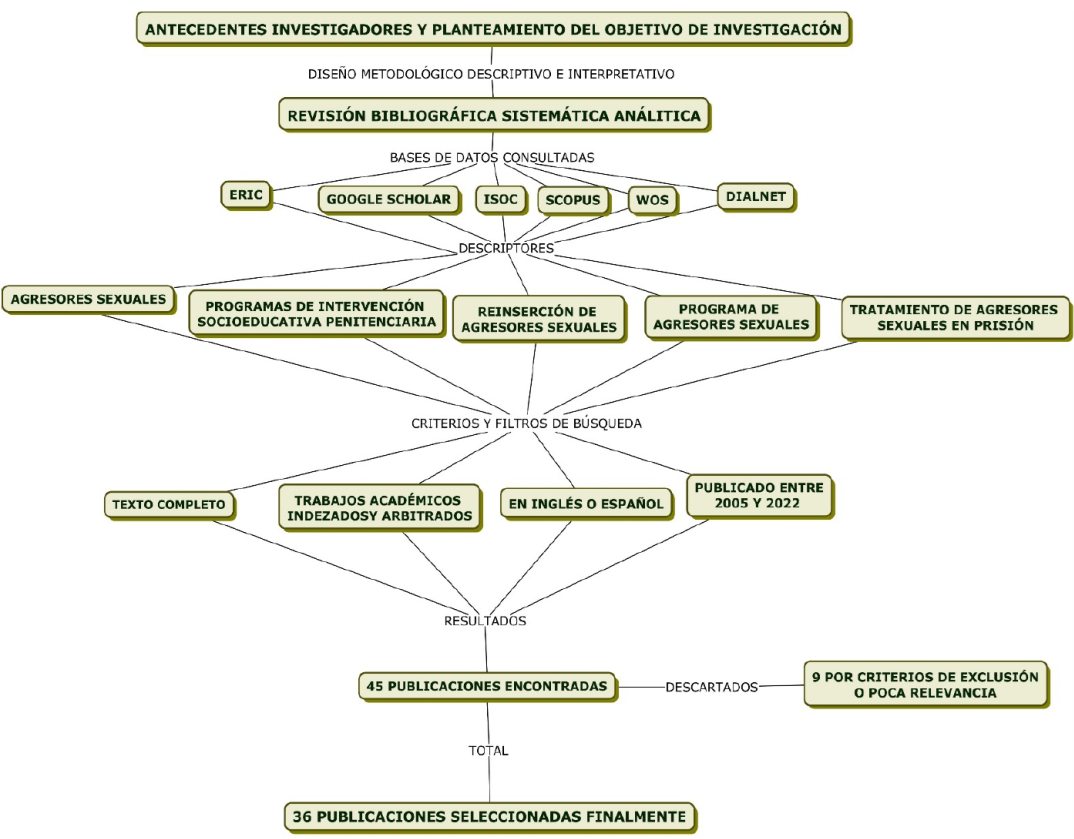
According to the methodological design chosen, we have reviewed the scientific data bases ERIC, Google Scholar, ISOC, SCOPUS, Web Of Sciences, and Dialnet.
To gather information, in our search we used the descriptors: a) sexual aggressors, b) programs of socio-educational intervention in prison, c) programs of sexual aggressors, d) treatments for sexual aggressors in prison, and e) social reinsertion of sexual aggressors.
Finally, for a more comprehensive information search we used the following search criteria and filters: 1) period of publication from January 2005 to December 2022, 2) publications in Spanish or English, 3) indexed, peer reviewed academic publications, and 4) with a full text availability.
Based on the above, we found 45 bibliographic references that met such consultation criteria, although after reviewing their abstracts we discarded 9 papers with little relevance. Thus, we finally selected 36 scientific articles for the analysis of the information. To illustrate this methodological process better, we present the following visual chart that summarizes the selection criteria and the consultation procedure in the bibliographical review we conducted (Figure 1).
Results
Prevalence of sexual crimes
In the Spanish context, the total number of people convicted of sexual crimes in 2017 was 2,816 (Table 1), with 137 cases less than in 2018, that showed a total of 2,953 people convicted of sexual crimes. These numbers increased even more in 2019, with 3,401 convictions, followed by 2,922 in 2020 and a great increase of up to 3,960 cases in 2021 (INE, 2022).
Table 1 Convictions for sexual crimes in Spain desde 2017 hasta 2021
| 2017 | 2018 | 2019 | 2020 | 2021 | |
|---|---|---|---|---|---|
| Sexual crimes | 2,816 | 2,953 | 3,401 | 2,922 | 3,960 |
| 1. Human trafficking | 52 | 36 | 105 | 37 | 79 |
| % of human trafficking | 1.85 | 1.22 | 3.09 | 1.27 | 1.99 |
| 2. Against sexual freedom and indemnity | 2,764 | 2,917 | 3,296 | 2,885 | 3,881 |
| % against sexual freedom and indemnity | 98.15 | 98.78 | 96.91 | 98.73 | 98.01 |
| 2.1. Sexual aggression | 360 | 354 | 392 | 390 | 445 |
| % of sexual aggression | 12.78 | 11.99 | 11.53 | 13.35 | 11.24 |
| 2.2. Rape | 27 | 32 | 36 | 38 | 46 |
| % of rape | 0.96 | 1.08 | 1.06 | 1.30 | 1.16 |
| 2.3. Sexual abuse | 956 | 1,011 | 1,218 | 1,070 | 1,556 |
| % of sexual abuse | 33.95 | 34.24 | 35.81 | 36.62 | 39.29 |
| 2.4. Sexual abuse and aggressions to minors | 320 | 453 | 529 | 560 | 738 |
| % of sexual abuse and aggressions to minors | 11.36 | 15.34 | 15.55 | 19.16 | 18.64 |
| 2.5. Sexual harassment | 45 | 59 | 69 | 58 | 74 |
| % of sexual harassment | 1.60 | 2.00 | 2.03 | 1.98 | 1.87 |
| 2.6. Exhibitionism and sexual provocation | 414 | 394 | 432 | 340 | 430 |
| % of exhibitionism and sexual provocation | 14.70 | 13.34 | 12.70 | 11.64 | 10.86 |
| 2.7. Prostitution and corruption of minors | 642 | 614 | 620 | 429 | 592 |
| % of prostitution and corruption of minors | 22.80 | 20.79 | 18.23 | 14.68 | 14.95 |
Source: own, after data from INE (2021).
Regarding human trafficking, there were 52 cases in 2017; that is, 1.85%, while in 2021 there were 79 cases, reaching almost 2%. As for the crimes against sexual freedom and indemnity, these were the larger part both in 2017, with 98.15% of the cases, and in 2021, with 98%. Among the latter crimes we find sexual aggressions, which accounted for 12.7% of the total convictions in 2017, against 11.2% in 2021, while the ratio of rapes remained stable with 27 convictions for rape in 2017, constituting 0.96% of the cases against the 46 rapes of 2021, equivalent to 1.16%. Likewise, sexual abuses in 2017 represented 33.95% of the convictions for sexual violence, contrasting with 2021, when they increased to 39.2%. Besides, 11.36% of the cases in 2017 were abuse and aggressions to minors (under 16 years old), while in 2021 the percentage increased again to 18.64%. Sexual harassment, in turn, had 45 cases, 1.6% in 2017 and 74 cases, 1.87% in 2021, as well as 10.86% of cases of exhibitionism and sexual provocation in 2017 and 14.7% in 2021. Finally, the cases of crimes for prostitution and corruption of minors in 2017 constituted a total of 22.8%, unlike in 2021, when there was a significant reduction to 15% (INE, 2022).
According to the Balance of Criminality (Ministry of the Interior, 2021a), one of the possible causes of the increase of these variables might be the restrictions and social consequences of the lockdown during the health crisis of Covid-19 in 2020, but the increase in sexual crimes recorded might also be linked to better awareness to denounce these crimes, as well as the designation of sexual abuse as sexual aggression in Organic Law 10/2022 of September 6, as a comprehensive guarantee of sexual freedom.
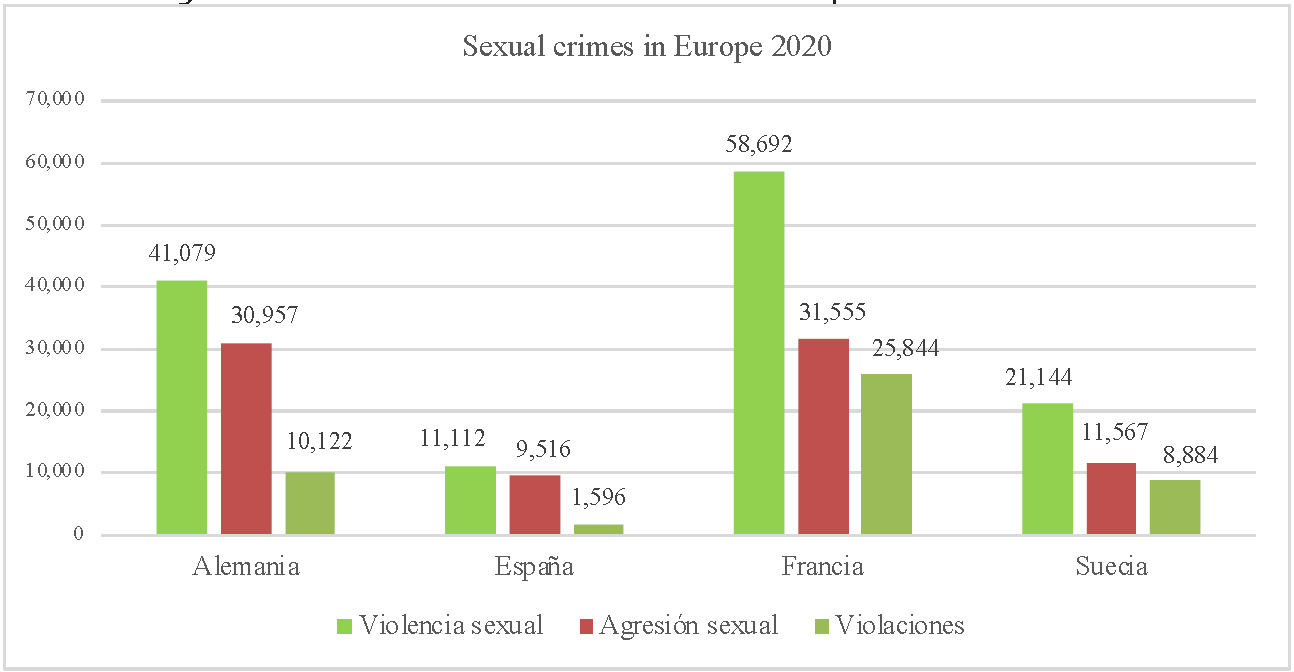
Nevertheless, in the whole of Europe the number of cases recorded by the police is considerably higher than that of those who are ever convicted. In 2020 in Spain 9,516 cases of sexual aggression were recognized, which places the country in the fourth place after Sweden with 11,567 cases, followed by Germany with 30,957, and France is at the top of the list with 31,555. Regarding sexual violence sexual, cases follow the same order: Spain is in the fourth place with 11,112 cases, Sweden in the third with 21,144, Germany in the second with 41,079, and France in the first with 58,692. The last statistic, rapes recorded, puts Spain in the ninth place with 1,596, and France once again in first with 25,844 cases (Figure 2).
Source: own, after data from Eurostat (2022).
Figure 2: Prevalence of sexual crimes in four European countries in 2020
We must take into account the fact that the numbers for each country differ according to the laws, the jurisdiction and the enforcement, so the data do not show the same values and the comparison between different countries does not provide real results. Thus, we know that in Sweden each rape against the same victim is recorded as a single case, and that accounts for such a high number of cases (Eurostat, 2022).
Profiles of sexual aggressors
The typology of sexual aggressors and aggressions in a couple is often heterogeneous, and its description depends on the authors who deal with it and the variables they take into account, which may be the level de aggressiveness, the gravity of the crime, the rage, the attachment or the psychopathologies of the aggressor (Loinaz et al., 2009; Loinaz et al., 2010). According to Cohen et al. (Fernández, Sanz, 2016) there are four types of rapists. The first is the displaced aggression rapist, who uses humiliation to look down on the victim sadistically, and the woman who suffers the aggression often has a passive role, added to the absence of triggering factors of the rape. The second is the compensatory rapist, characterized by being an introvert who uses sex to compensate a lack of social life and a low self-esteem (Loinaz et al., 2009; Loinaz et al., 2010). The third, the sexually aggressive rapist, uses physical violence because it arouses him and is characterized by being antisocial, distorting reality, and having short-lived relationships. Finally, the impulsive rapist has a criminal history and rapist while conducting other crimes to assault his victims.
There are also a number of factors that converge in a person who has perpetrated sexual violence, such as socio-economic level, family environment, individual psychological factors, the family model (Herrera et al, 2020) and development during adolescence (Arcila et al., 2013). Echeburúa and Esbec (2014) suggest a division into primary and secondary aggressors. The former are pedophiles, for whom conventional sexual relations with adults are of little interest. They have an appearance of good and seductive people, capable of attracting their victim easily. The latter, have proper sexual behaviors and commit sexual crimes when they are under high levels of stress, feeling guilty, unlike primary aggressors.
The abuse of alcohol and illegal substances is a significant factor in this kind of criminals, added to the antisocial disorder of the personality and schizoid features or those typical of the obsessive-compulsive disorder, which trigger a violent sexual reaction (Echeburúa, Esbec, 2014; Burgos-Jiménez et al., 2020).
Programs of socio-educational intervention in sexual crimes
Program for Control of Sexual Aggression
One of the main programs of reeducation and socio-educational intervention in Spain is the Program for Control of Sexual Aggression (PCAS), a fundamental initiative for the treatment of those convicted of sexual crimes (Martínez-Catena, Redondo, 2016). It was implemented in 1999, but it became relevant nationwide after 2005 (Ministerio del Interior, 2021). Access to this program is voluntary, although it is regarded as a priority in the PIT and in the valuation of the processes of reinsertion and in cases of imminent freedom (Sordi, 2016). It has been adapted and designed according to the needs, characteristics and possible external variables of sexual aggressors, in order to prevent recidivism, fostering healthy sexual behavior based on respect and free of violence, and favoring self-criticism and realistic analysis of this kind of activities (Ministerio del Interior, 2006).
For that purpose, this program does an initial diagnostic evaluation of the sexual behaviors, social functioning, and cognitive distortions of the inmate, creating a personalized intervention model for a better reeducation and adaptation to an adequate life in freedom. After that there is a phase of treatment and intervention with a recommended duration of four weekly sessions for 9 to 11 months which can be extended up to two years. These professional actions are organized in two stages (Ministerio del Interior, 2006): 1) the treatment to create awareness, through acceptation and commitment therapy (ACT) and cognitive-behavioral interventions that seek to attain the inmate’s own acceptation of his violent activities and criminal behaviors, with the aim of achieving a personal evolution, developing his self-esteem, values, and resilience (García, 2019; Martínez-Catena, Redondo, 2016), and 2) the treatment to take control, which aims to develop cognitive-emotional processes, training in relaxation, emotional awareness, empathy with the victim, modification of the sexual impulse and analysis of his own behavior and personal history in order to prevent the risk of recidivism (Martínez-Catena, Redondo, 2016; Ministerio de Interior, 2006).
According to the General Report of the Ministry of the Interior (Ministerio del Interior, 2021b) this program was implemented in 2021 in 40 penitentiary establishments, with the participation of 457 inmates. Redondo and Mangot (2017) point out that the program has succeeded in reducing recidivism between 9 and 11%, against 17% of those who did not attend that program. In turn, Redondo (2006a) reports a decrease in recidivism from 4.5 to 13 percent.
Concretely, the risk of sexual violence is measured by psycho-social tools and instruments such as the Sexual Violence Risk Scale (SVR-20) developed by Boer, Hart, Kroppy and Webster in 1997, or the Risk of Sexual Violence Protocol (RSVP) designed by Hart, Kroppy and Laws in 2003 (García, 2019; Redondo, 2006a). However, Martínez-Catena and Redondo (2016) mention the need of including the assessment of socio-educational factors that determine the processes of personal development and change, and highlight the efficacy of these treatments in aspects such as assertiveness, empathy, aggressiveness, anxiety before normalized sexual situations, loneliness and isolation, which are key to social reinsertion.
Likewise, in spite of its great effectiveness in preventing recidivism, the program shows some limitations in its implementation, such as the fact that it has not succeeded in motivating the inmates to participate, which leads to absenteeism in the sessions or makes it difficult to carry them out, as well as the lack of adaptation and personalization of the sessions according to the person’s criminological profile and needs de la persona (Redondo, 2006b). On the other hand, Martínez-Catena and Redondo (2016) mention the need to intervene also in the socio-personal contexts of the inmates to achieve a comprehensive treatment and reinsertion process (Clegg et al., 2011). Another limitation, pointed out by Pérez (2019), is the lack of collaboration of multidimensional professional teams of different specializations that enrich the interventions and activities in this program, as well as professional follow-up and accompaniment strategies.
It must be pointed out that, despite its effectiveness to prevent relapses of sexual aggressions, García (2019) underscores a notable tendency to recidivism in crimes against property. Therefore, it is important to provide support and socio-educational accompaniment throughout the journey to freedom of this population taking into account their return to their social spaces, resuming their relationships, searching for jobs, etc. (Burgos-Jiménez et al., 2023), as the main measure to prevent criminal recidivism.
Program about Gender Violence for aggressors (PRIA)
Secondly, the penitentiary institution has the Program about Gender for Agressors (PRIA), applied as a pilot experience in 2001 and 2002, then revised and updated in 2004, to create a program for the prevention of aggression in the household, although it was not until 2010 that this specific strategy was implemented for gender violence in Spanish prisons (Ministerio del Interior, 2010; Sordi, 2015). Through cognitive-behavioral therapy, this program seeks to eradicate attitudes of violence towards the aggressors’ couples and sexist beliefs in which sexual aggressions and sexual education are classified as key units in its contents.
The program consists of four phases. The first one is a diagnostic evaluation of the profile, needs and characteristics of the inmate through psychosocial interviews. The second phase includes the therapeutic interventions, organized in 11 thematic units covered in weekly group sessions of two and a half hours for six months, although these can also be individual in case reinforcement is needed (Ministerio del Interior, 2010). These interviews are based on ecological cognitive-behavioral models with a gender perspective and self-reflection activities to foster empathy in the aggressors towards their victims, identify and express emotions, accept their own responsibilities, and generate a process of motivation to change (Sordi, 2015). Salient features are the reformulation of the inmate’s sexual attitudes, and interventions for the management of jealousy, enjoyment of sexuality, promotion of values of respect towards the LGTBIQ+ community, and awareness of healthy habits in sexual behavior (sexually transmitted diseases, unwanted pregnancies …) (Ministerio del Interior, 2010).
The third stage is the post-treatment evaluation, using the same instrument as the diagnostic evaluation, and a final follow-up phase, to verify the inmate’s process of change and evolution (Ministerio del Interior, 2010). The latter phase includes strategies of support, reeducation and accompaniment to facilitate an adequate life in freedom (Burgos-Jiménez et al., 2023).
The evaluation of the efficacy of these actions is based on the prevention of recidivism. In this sense, Arrigoni et al. (2013) value as the main results in this type of interventions a better management of conflict, attitudes of tolerance and sexual respect, and a decrease in sexist behaviors towards women, with 65% of cognitive reductions. Likewise, Sordi (2015) observed better results in its implementation in an open regime with only 4.6% of crime recidivism.
Regarding the limitations of this program, the inmates’ motivation to participate is a key aspect, since a lack of interest was observed that limited its efficacy and development due to a perception of its compulsoriness since it was a specific priority treatment program of the PIT to assess their evolution in the reinsertion processes (Sordi, 2015). Thus, it is necessary to implement motivational dynamics and strategies that foment participation. In that sense, Lila et al. (2012, 2013) underscore the use of the motivational interview and relationships of support, closeness and professional therapeutic accompaniment as psychosocial and re-educational models that are fundamental for the development of identification and awareness of sexual aggressions.
We must also mention that Sordi (2015) identifies a number of risk situations among the participants in the program, such as unemployment (37%), drug addiction (24%) and having experienced family violence episodes during childhood (15.4%).
Program for the Control of Violent Behavior (PICOVI)
This program is designed for those convicted of aggressive and violent behaviors, both at a personal level outside prison and in the coexistence within prison, and who do not have specific programs of treatment for this issue, such as the PRIA or the PCAS (Ministerio del Interior, 2017; Montero, 2019). Concretely, its aim is to train the inmates in self-regulation and emotional management, create an environment of comfort and coexistence within prison and foment competencies of communication, empathy, assertiveness, and respect (Ministerio del Interior, 2017).
Through cognitive-behavioral and psychosocial therapies, the program aims to foster in the inmate an adequate management of aggressiveness and create a social relationships network (Ministerio del Interior, 2021b; Núñez, 2022). The program is structured in three parts. The first is an introductory phase in which an initial evaluation is conducted and an explanation is given of what the program consists of and what its objectives are. The second phase is the intervention itself, and in the third there is a final evaluation. The evaluations are conducted using a number of different questionnaires and scales of values (Ministerio del Interior, 2017).
The program’s contents address the identification of and reflection on sexual violence behaviors, sexual harassment at work, sexual aggressions to minors, and the physical and cognitive consequences of these behaviors for the victim and the aggressor (Ministerio del Interior, 2017; García, 2019).
The program was applied in 2021 to groups in 14 penitentiary centers in Spain, with the participation of 123 men and 7 women (Ministerio del Interior, 2021b), besides individual interventions in cases where it was needed, through motivational interviews (Ministerio del Interior, 2017). Likewise, the central axis of the efficacy of these programs is the prevention of recidivism. Echeburúa and Fernández-Montalvo (2008) report a reduction of 14.1 points in the rate of recidivism in the inmates who participate in this type of actions (18.2% for the inmates who did not participate and 4.1% for those who did).
Regarding the limitations of its implementation, García (2019) reflects on the usefulness of methods that propitiate the participation and motivation for the inmates’ process of change, which might be limited by the questionnaires and scales of values offered by the program (Ministerio del Interior, 2017). The author also mentions the need to intervene and follow up on the socio-family context and the return of the inmate, a fundamental element that conditions his return to life in freedom and committing the crime, whose professional task must be to offer comprehensive attention in the social reinsertion processes (Burgos-Jiménez et al., 2023; García, 2019).
Program of Actions for the Equality between Men and Women in Prisons
The Program of actions for the Equality between Men and Women in Prison has been applied since 2009 with the aim of fomenting equality of opportunities, reducing the situations of discrimination against women convicted and fomenting a gender perspective at an institutional level, due to the scarce presence of women in this institution (Burgos-Jiménez et al., 2020; Ministerio del Interior, 2009; Montero, 2019).
To that end, in collaboration with the Ministry of Equality and through the Institute for Women, a diagnosis was conducted to identify differences in treatment, opportunities, and actions among the women in Spanish prisons, which showed that women experience a stay of deprivation of freedom different from that of men and with fewer opportunities, especially in the final stage of sentence in the open regime and in facing their following life in freedom (Añaños et al., 2013; Burgos-Jiménez et al., 2020; Martínez, Cantero, 2020; Ministerio del Interior, 2009).
This program proposes 122 specific and transversal positive actions in gender in prison, taking into account the frequency of the episodes of violence, harassment and sexual aggressions in this population, as well as their possible sequels (Burgos-Jiménez et al., 2023). For this reason, socio-educational interventions and re-educational strategies that sensitize inmates about sexual aggressions and harassment, gender rights and identities, and that offers support measures for women and present behavioral models for inmates to foment social skills that promote personal and sexual-affective autonomy, diversity, reduce factors of social exclusion and facilitate the prevention of sexual violence are established as a priority (Del Pozo, Añaños, 2013; Ministerio del Interior, 2009; Wangen et al., 2020). In this sense, actions related to the identification of situations of violence and sexual aggression, analysis of social myths and beliefs on these issues, and reproduction of healthy and affective habits for equality and sexual respect are designed (Ministerio del Interior, 2009).
As for the participation in this program, the Ministry of the Interior (2021b) reports a maximum of 10,908 professionals, convicted women and men, although Burgos-Jiménez et al. (2020) highlight a greater involvement of the female population, especially in the ordinary regime, with 48.7%, which is rated as positive by 85.1% of the female participants. The convicted women refer to the efficacy of the interventions for the development of social and communicative skills, as well as strategies to prepare them for their life in freedom. Likewise, it has been noted that this program features a follow-up and evaluation plan of these actions for their improvement, adjustment and greater involvement of social and communitarian bodies and entities and functional structures (Ministerio del Interior, 2009, 2021b).
However, in spite of its actions in issues of equality, Martínez and Cantero (2020) observe a lower offer of sociocultural activities, of treatment and of paid employment for women in prisons, since these are institutions designed mainly for a male population. Also, the main limitation of this initiative is its lack of continuity in the open regime and in the last stages of the sentence, since Burgos-Jiménez et al. (2020) show a decrease of participation to 5.9% in the women surveyed for their study.
Program SerMujer.es
Finally, we must mention the relevance of the Program SerMujer.es (Ministerio del Interior, 2011) for the prevention, treatment and attention to convicted women who are victims of gender violence. These interventions are aimed at decreasing the vulnerabilities and dependency generated by gender aggressions and violence in the female population convicted, fostering their self-esteem, promoting healthy attitudes of care and sexuality, as well as offering socio-communitarian resources of protection, help, and support (Montero, 2019).
The program has been implemented nationwide and is made up of a professional team of multidimensional socio-educational intervention (Martín-Solbes et al., 2021), in collaboration with the Institute for Women and Equality of opportunities of the Ministry of Equality since 2011. It is carried out through group interventions complemented with individual sessions, according to the needs of the participants (Burgos-Jiménez et al., 2020; Ministerio del Interior, 2021b). Its duration is variable, although the group phase comprises around 48 weekly sessions and the individual phase is flexible, based on the characteristics of the women who need it (Ministerio del Interior 2021b).
The program has a psycho-social and socio-educational character, and is organized by an intervention team that begins by selecting participants through diagnostic interviews (Burgos-Jiménez et al.,2020; Ministerio del Interior, 2011). The initial phase of the intervention process aims to build cohesion and links within the group. Then, there is a phase of development to foment skills and attitudes, as well as provide tools and resources that will reduce their vulnerability, followed by a final phase of evaluation of goals and competencies achieved, and possible psychological support and future follow-up. These actions are supported by techniques of communication, individual psychological intervention, identification of violent or unequal situations, specific formation, and expression of their own emotions (Ministerio del Interior, 2011).
In regard to sexual violence, this program has among its contents a conceptual unit that addresses the formation, reeducation and sensitization of women for a correct development of their sexuality and demystification, as well as the identification of sexual aggressions. Namely, it addresses issues of sexuality, masculine and feminine autonomy, birth control methods, sexually transmitted diseases, and inmates are motivated to have a healthy enjoyment of sex away from situations of submission to men (Ministerio del Interior, 2011).
In 2021 there was a participation of 190 inmates in 18 penitentiary centers in Spain (Ministerio del Interior, 2021b). Burgos-Jiménez et al. (2020) report a high participation of women convicted in the ordinary regime: 52.6%. These authors underscore the fact that this program is the best evaluated by female inmates, with 87.5% of positive evaluations among its participants, since it is a space that recognizes their needs, personal improvement and empowering to cope with the vulnerabilities generated by male sexual aggressions and violence.
However, among its limitations we can observe a reduction of its participation to 3.9% in the open regime, so the women express concerns about their social reinsertion and adaptation to life in freedom. Likewise, 25% of its participants point out the need of enhancing its contents and activities, since routines and lack of occupation in these punitive environments have negative repercussions in their mental health and emotional well-being (Burgos-Jiménez et al., 2020; Martínez, Cantero, 2020).
As a summary, Table 2 shows the main characteristics of the intervention programs about sexual crimes in Spanish prisons.
Table 2: Programs of Socio-Educational Intervention in Sexual Crimes
| PROGRAMS OF SOCIOEDUCATIONAL INTERVENTION IN SEXUAL CRIMES | OBJECTIVES |
|---|---|
| Program for Control of Sexual Aggression (PCAS) | Cognitive-behavioral and psychosocial treatment for people convicted of sexual crimes to create awareness, self-control and prevent recidivism. |
| Program about Gender Violence for Aggressors (PRIA) | Psychosocial intervention psychosocial and cognitive-behavioral treatment for people convicted of crimes of gender violence, violent attitudes towards women or sexist beliefs, for their better adaptation to life in freedom. |
| Program for the Control of Violent Behavior (PICOVI) | Therapeutic and re-educational actions to improve attitudes of communication and coexistence for inmates with crimes or violent behaviors who are not participating in PCAS or PRIA. |
| Program of Actions for the Equality between Men and Women in Prisons | Set of 122 positive and re-educational actions to foment gender equality in prisons, sensitize and raise awareness about the vulnerability of women and reduce differences in their treatment and attention. |
| Program SerMujer.es | Socio-educational treatment and attention to reduce the vulnerability of women who are victims of gender violence, providing coping skills, empowering, and prevention of aggressions. |
Source: own, after Ministerio del Interior (2006, 2009, 2010, 2011, 2017).
Conclusions
Sexual crimes represent a current problem as well as a latent issue in socio-educational action and penitentiary treatment. The increase in sexual crimes and aggressions in Spain, reported by institutions such as SGIP (2022), Eurostat (2022) and the INE (2021), generate a social and institutional alarm that has led to the prioritization of conducting re-educational interventions and penitentiary treatments aimed at reducing the risk of criminal recidivism and offering different cognitive-behavioral models for their social reinsertion (Añaños et al., 2021; Herrero, 2013).
Hence the importance of socio-educational action and professional accompaniment in punitive and imprisonment contexts (Burgos-Jiménez et al., 2023; Makwana, Elizabeth, 2022; Manchado, 2012), which are fundamental strategies for reincorporation and adaptation to life in freedom according to the objectives of social reinsertion and reeducation in prison regulated nationwide by the Spanish Constitution (1978) and internationally by the UN (2004) and the UNODC (2019). Thus, the prison system offers a number of programs and actions in regard to sexual crimes, which both for Martínez and Redondo (2016) and for Echeberúa and Fernández-Montalvo (2009) must be rehabilitating actions that promote values and attitudes of respect and sexual freedom and develop self-control and identification of situations of violence, according to the criminological profile of the individual.
In this sense, the Program for Control of Sexual Aggression (PCAS) and the Program about gender violence for aggressors (PRIA) stand out as the main measures to prevent these crimes through cognitive-behavioral therapies designed and adapted to this population (Sordi, 2016). On the other hand, the Program for the control of violent behavior (PICOVI) has been implemented in order to improve their strategies of communication, relationship and coexistence (Ministerio del Interior, 2017; Montero, 2019).
Fundamentally, these initiatives are based on cognitive-behavioral models adapted to the profiles and needs of their participants through an initial and individual diagnostic. For Sordi (2016) it is essential to use motivational interviews that foster the therapeutic alliance and relationship and helps participation and continuity of the treatment. As for the treatments and interventions conducted, Martínez-Catena and Redondo (2016), along with García (2019), underscore the use of psycho-social therapies to create awareness of their episodes of violent behaviors (Nguyen et al., 2014), as well as the related emotions and behaviors, so that they can face up to their own criminal activity and, in second place, participate in activities of training for the self-control of sexual violence and impulses. Also, during these actions, Sordi (2016) explains that the aim is to modify sexist beliefs, reduce jealousy, and foment their affective responsibility through re-educational strategies to establish adequate couple relationships.
However, due to the need of re-education that shows the high tendency of these convicts to reoffend in other types of crimes, it has been observed that the evaluations of these programs are limited to measure recidivism in sexual crimes, so socio-educational contents and methods of address and evaluation are needed to assess the development of competencies, skills, and attitudes to adapt to life in freedom (Moles-López et al., 2023; Moles-López, Añaños, 2021).
In this respect, according to Loinaz et al. (2010) and Arcila et al. (2013), sexual aggressors display heterogeneous profiles associated to different pathologies, psychological factors, socio-educational shortcomings and needs that lead to different types antisocial and criminal behaviors, determining the severity of their crimes, psychopathological or personality alterations and educational shortcomings (Clegg et al., 2011; Lila, Herrero, 2012; Loinaz et al., 2009). In short, there are personal characteristics that also determine their processes of social reinsertion and require professional socio-educational support, such as drug abuse by the convict himself and in his family context, histories of abuse during childhood, poor educational levels or situations of unemployment (Arcila et al., 2013; Martínez-Catena, Redondo, 2016), which may limit their social reinsertion (Añaños, 2022). Therefore, their stay in deprivation of freedom must offer a comprehensive professional attention that fosters not only therapeutic actions of psychological treatment, but also socio-educational support and reeducation interventions to facilitate their processes of social adaptation and reinsertion (Añanos et al., 2013; Martín-Solbes et al., 2021).
On the other hand, the socio-educational aims of the initiatives proposed by the uestas in el Program of actions for the Equality between Men and Women in Prisons (Ministerio del Interior, 2009) stand out. These actions foment a gender perspective in the penitentiary environment, both in the inmates and the professionals themselves (Montero, 2019), facilitates socialization and foments affective-sexual education in the processes of social reinsertion (Burgos-Jiménez et al., 2020). For the prevention and attention to women victims of gender violence and sexual aggressions, there is the Program SerMujer.es (Ministerio del Interior, 2011), which offers support and socio-educational actions to help alleviate the psycho-social consequences generated by gender violence (Arcila et al., 2013; Martín, Vozmediano, 2014). This initiative is the best rated by convicted women, according to Burgos-Jiménez et al. (2020), underscoring the individuality and the acknowledgement of their needs and characteristics in the interventions. All of this facilitates the preparation for life in freedom and helps decrease the vulnerability of this population.
However, Burgos et al. (2020) perceive that the female participants in both initiatives demand a greater development of contents that recognize and attend to their needs in a more comprehensive way. Also, Martín-Solbes et al. (2021) show a discontinuity of these actions when they go into the open regime, which may hinder their social la adaptation in the semi-freedom stage and increases the risk of criminal activities, especially in sexual aggressors, due to the difficulties involved in returning to the social and family context (Burgos et al., 2023).
Therefore, it is necessary to have re-educational, supportive, and ongoing professional follow-up strategies that foster, among other things, personal, social, cognitive, and behavioral change, as well as the comprehensive reincorporation of people convicted, in this case, of sexual crimes (Añaños et al., 2021; Añaños, 2022; Martín-Solbes et al., 2021). It is essential to have an impact on the different risk factors and foster the factors of protection that prepare and strengthen people to manage their life in freedom (Huaiquián-Billeke et al., 2021).
Consequently, we propose the training of professionals that enables them to apply socio-educational strategies and methods of evaluation with a gender approach that value personal attitudes and values in regard to their social reinsertion and adaptation to life in freedom, such as empathy, aggressiveness, communicative skills, competencies for work… Professional actions must not be centered in the prevention of recidivism in sexual crimes, but offer a process of reeducation and comprehensive social reinsertion. In this respect, educational interventions for gender equality become very useful for this population, although they must include specialized professionals who can innovate and broaden their contents and foster the inmates’ interest. Likewise, we emphasize the need of applying motivation strategies that facilitate the participation in and continuity of these programs in the modality of open regime and the post-prison stage, offering a more effective therapeutic and accompaniment process for the risks entailed by the inmates’ return to their social and family context.
Referencias
Añaños, F. (2022). Hacia modelos socioeducativos y de desarrollo humano. Claves para la inserción-re/inserción social penitenciaria. En Añaños, F.; M. García-Vita; A. Amaro (coords.), Justicia social género e intervención socioeducativa. Medio penitenciario y contextos delictivos, I. España: Ediciones Pirámide, 77-92. [ Links ]
Añaños, F.; J. Nistal; E. Moles-López (2021). La reincidencia penitenciaria en España: género, factores asociados y prevención. Psychology, Society & Education, 13(2), 1-10. https://doi.org/10.25115/psye.v13i2.3489 [ Links ]
Añaños, F.; P. Fernández-Sánchez; J. Llopis (2013). Aproximación a los contextos en prisión. Una perspectiva socioeducativa. Pedagogía Social. Revista interuniversitaria, (22), 13-28. https://doi.org/10.7179/PSRI_2013.22.02 [ Links ]
Arcila, A.; M. Castaño; D. Osorio; G. Quiroz (2013). Caracterización sociodemográfica del desarrollo psicosexual y del delito en hombres condenados por delitos sexuales recluidos en el centro penitenciario de Manizales. Revista Colombiana de Psiquiatría, 42(1), 51-62. https://www.redalyc.org/pdf/806/80626357008.pdf [ Links ]
Arrigoni, F.; J. Jiménez; J. Navarro; P. Mendoza (2013). Aplicación de un programa terapéutico en hombres violentos contra la pareja. Anuario de Psicología Jurídica, 23(1), 3-9. https://doi.org/10.5093/aj2013a2 [ Links ]
Burgos-Jiménez, R.; A. Amaro; F. Añaños (2023). Procesos de acompañamiento socioeducativo y adaptación a la vida en libertad en mujeres penadas. Pedagogía Social. Revista interuniversitaria, 42, 197-214. https://doi.org/10.7179/PSRI_2023.42.13 [ Links ]
Burgos-Jiménez, R.; B. Tardón; V. Martín-Solbes; F. Pozuelo (2021). El enfoque de género en la intervención socioeducativa con mujeres: un estudio en el medio penitenciario español. Psychology, Society & Education, 13(1), 73-83. http://dx.doi.org/10.25115/psye.v1i1.3474 [ Links ]
Carcedo, R.; F. López; B. Orgaz; K. Toth; N. Fernández-Rouco (2008). Menand Women in the Same Prison: Interpersonal Needs and Psychological Health of Prison Inmates. International Journal of Offender Therapy and Comparative Criminology, 52(6), 641-657. https://doi.org/10.1177/0306624X07311596 [ Links ]
Clegg, C.; W. Fremouw; T. Horacek; A. Cole; R. Schwartz (2011). Factors Associated with Treatment Acceptance and Compliance among Incarcerated Male Sex Offenders. International Journal of Offender Therapy and Comparative Criminology, 55(6), 880-897. https://doi.org/10.1177/0306624X10376160 [ Links ]
Constitución Española (1978). Publicada en BOE de 29 de diciembre de 1978. [ Links ]
Daset, L.; C. Cracco (2013). Psicología basada en la evidencia: algunas cuestiones básicas y una aproximación a través de una revisión bibliográfica sistemática. Ciencias Psicológicas, 7(2), 209-220. https://doi.org/10.22235/cp.v7i1.53 [ Links ]
Del Pozo, F.; F. Añaños (2013). La educación social penitenciaria: ¿De dónde venimos y hacia dónde vamos? Revista Complutense de Educación, 24(1), 47-68. http://dx.doi.org/10.5209/rev_RCED.2013.v24.n1.41191 [ Links ]
Domínguez, Q.; E. Sánchez; M. Ojeda (2022). “Miradas otras”: promoviendo prácticas de lectura y escritura desde una cárcel mexicana. Sinéctica, Revista Electrónica de Educación, (58), e1357. https://doi.org/10.31391/S2007-7033(2022)0058-005 [ Links ]
Esbec, E.; E. Echeburúa (2014). La evaluación de los trastornos de la personalidad según el DSM-5: Recursos y limitaciones. Terapia Psicológica, 32(3). http://dx.doi.org/10.4067/S0718-48082014000300008 [ Links ]
Echeburúa, E.; J. Fernández-Montalvo (2009). Evaluación de un programa de tratamiento en prisión de hombres condenados por violencia grave contra la pareja. International Journal of Clinical and Health Psychology, 9(1), 5-20. https://www.aepc.es/ijchp/articulos_pdf/ijchp-306.pdf [ Links ]
Eurostat (22 de octubre de 2022). Recorded Offences by Offence Category - Police Data. https://ec.europa.eu/eurostat/databrowser/view/crim_off_cat/default/bar?lang=en [ Links ]
Fazel, S.; T. Hope; I. Donell; R. Jacoby (2002). Psychiatric, Demographic and Personality Characteristics of Elderly Sex Offenders. Psychological Medicine, 32(2), 219-226. [ Links ]
Fernández, N.; L. Sanz (2014). Conducta de agresión sexual: Revisión de la literatura y propuesta de análisis mediante el modelo de triple riesgo delictivo. International e-journal of Criminal Sciences, (8), 3-32. https://ojs.ehu.eus/index.php/inecs/article/view/13230 [ Links ]
García, V. (2019). Programas específicos de tratamiento en las prisiones españolas: control de la agresión sexual, atención integral a enfermos mentales y unidades terapéuticas y educativas. Revista de Estudios Socioeducativos. ReSed, (7), 184-200. http://dx.doi.org/10.25267/Rev_estud_socioeducativos.2019.i7.13 [ Links ]
Huaiquián-Billeke, C.; V. Sánchez-Toledo; R. Quilodrán-Contreras; J. Vera-Urra (2021). Education in Confinement: The Reintegration of Young People in Prison in La Araucanía, Chile. Social Inclusion, 9(4), 60-68. https://doi.org/10.17645/si.v9i4.4605 [ Links ]
Herrera J.; J. Arellano; C. Mendivil (2020). Evaluación penitenciaria forense de agresores sexuales. Aproximación, revisión y notas críticas de la práctica de profesionales penitenciarios mexicanos. Revista de Investigación Académica Sin Frontera: División de Ciencias Económicas y Sociales, (32), 28. https://doi.org/10.46589/rdiasf.vi32.309 [ Links ]
Herrero, O. (2013). ¿Por qué no reincide la mayoría de los agresores sexuales? Anuario de Psicología Jurídica, 23(1), 71-77. https://doi.org/10.5093/aj2013a11 [ Links ]
Instituto Nacional de Estadística (15 de septiembre de 2022). Estadística de condenados: Adultos. Condenados por delitos sexuales. https://www.ine.es/dynt3/inebase/index.htm?padre=4021&capsel=4746 [ Links ]
Ley Orgánica 10/2022, de 6 de septiembre, de garantía integral de la libertad sexual. Boletín Oficial del Estado, 215, de 7 de septiembre de 2022. https://www.boe.es/eli/es/lo/2022/09/06/10 [ Links ]
Lila, M.; E. Gracia; J. Herrero (2012). Asunción de responsabilidad en hombres maltratadores: influencia de la autoestima, la personalidad narcisista y la personalidad antisocial. Revista Latinoamericana de Psicología, 44(2), 99-108. https://core.ac.uk/download/pdf/229321709.pdf [ Links ]
Lila, M.; E. Gracia; S. Murgui (2013). Psychological Adjustment and Victim-Blaming among Intimate Partner Violence Offenders: The Role of Social Support and Stressful Life Events. The European Journal of Psychology Applied to Legal Context, 5(2), 147-153. http://dx.doi.org/10.5093/ejpalc2013a4 [ Links ]
Loinaz, I.; R. Torrubia; E. Echeburúa; J. Navarro; L. Fernández (2009). Implicaciones de las tipologías de agresores de pareja para el tratamiento en prisión. Cuadernos de Medicina Psicosomática y Psiquiatría de Enlace, 91, 19-25. https://derechopenitenciario.com/wp-content/uploads/2018/10/2061.pdf [ Links ]
Loinaz, I.; E. Echeburúa; R. Torrubia (2010). Tipología de agresores contra la pareja en prisión. Psicothema, 22(1), 106-111. https://www.redalyc.org/pdf/727/72712699017.pdf [ Links ]
López, A. (2015). La denuncia de delitos sexuales. Camino doblemente victimizante: una mirada desde las víctimas de violencia sexual. Trabajo Social UNAM, (7), 71-93. https://www.revistas.unam.mx/index.php/ents/article/view/56283/50044 [ Links ]
Makwana, G.; H. Elizabeth (2022). The Concept of Socio-Educational Intervention in Social Pedagogy, Community Development, and Services. AMCA Journal of Community Development, 2(2), 75-79. https://doi.org/10.51773/ajcd.v2i2.298 [ Links ]
Manchado, M. (2012). Educación en contextos de encierro: Problemáticas, miradas e interrogantes en torno al sujeto del aprendizaje y el proceso educativo en las prisiones santafesinas. Revista Latinoamericana de Educación Inclusiva, 6(1), 125-142. https://www.rinace.net/rlei/numeros/vol6-num1/art7.pdf [ Links ]
Martín, N.; L. Vozmediano (2014). Conducta de agresión sexual: Revisión de la literatura y propuesta de análisis mediante el modelo de triple riesgo delictivo. International e-journal of Criminal Sciences, (8), 3-32. https://ojs.ehu.eus/index.php/inecs/article/view/13230 [ Links ]
Martín-Solbes, V.; F. Añaños; E. Molina-Fernández; R. Burgos-Jiménez (2021). The Professional Dimension in Spanish Prison Socio-Educational Action. Education Sciences, 11(10), 585. https://doi.org/10.3390/educsci11100585 [ Links ]
Martínez, O.; P. Cantero (2020). Ser mujer en prisión: Privación ocupacional en la vida diaria de mujeres internas en un centro penitenciario en España. Revista Chilena de Terapia Ocupacional, 20(2), 269-277. https://doi.org/10.5354/0719-5346.2020.54757 [ Links ]
Martínez-Catena, A.; S. Redondo (2016). Etiología, prevención y tratamiento de la delincuencia sexual. Anuario de Psicología Jurídica, 26(1), 19-29. https://doi.org/10.1016/j.apj.2016.04.003 [ Links ]
Martínez-Catena, A.; S. Redondo (2017). Psychological Treatment and Terapeutic Change in Incarcerated Rapists. The European Journal of Psychology Applied to Legal Context, 9(1), 41-49. https://doi.org/10.1016/j.ejpal.2016.11.001 [ Links ]
Ministerio del Interior (2006). El control de la agresión sexual: Programa de intervención en el medio penitenciario. Ministerio del Interior. Secretaría General Técnica. [ Links ]
Ministerio del Interior (2009). Programa de acciones para la igualdad entre hombres y mujeres en el medio penitenciario. Ministerio del Interior. Secretaría General Técnica. [ Links ]
Ministerio del Interior (2010). Programa de violencia de género para agresores (PRIA). Ministerio del Interior. Secretaría General Técnica. [ Links ]
Ministerio del Interior (2011). Ser mujer.es: Programa de Intervención con mujeres privadas de libertad. Ministerio del Interior. Secretaría General Técnica. [ Links ]
Ministerio del Interior (2017). PICOVI: Programa de intervención en conductas violentas. Ministerio del Interior. Secretaría General Técnica. [ Links ]
Ministerio del Interior (2021a). Informe sobre delitos contra la libertad e indemnidad sexual 2021. Ministerio del Interior. Secretaría General Técnica. [ Links ]
Ministerio del Interior (2021b). Informe general 2021. Ministerio del Interior. Secretaría General Técnica. [ Links ]
Moles-López, E.; F. Añaños (2021). Factors of Prison Recidivism in Women: A Socioeducational and Sustainable Development Analysis. Sustainability, 13(11), 5822. https://doi.org/10.3390/su13115822 [ Links ]
Moles-López, E.; R. Burgos-Jiménez; F. Añaños (2023). La prisión y su acción re-insertiva. Estudio socioeducativo y de género en España. Convergencia Revista de Ciencias Sociales, 30(1), 1-31. https://doi.org/10.29101/crcs.v30i0.21347 [ Links ]
Montero, E. (2019). La reeducación y la re/inserción social en prisión: El tratamiento en el medio penitenciario español. Revista de Estudios Socioeducativos. ReSed, (7), 227-249. http://dx.doi.org/10.25267/Rev_estud_socioeducativos.2019.i7.16 [ Links ]
Nguyen, T.; N. Frerich; C. García; C. Soler; S. Redonde-Illescas; A. Andrés-Pueyo (2014). Re/inserción y gestión del riesgo de reincidencia en agresores sexuales excarcelados: el proyecto “Círculos de Apoyo y Responsabilidad” en Cataluña. Boletín Criminológico, (151), 1-4. https://doi.org/10.24310/Boletin-criminologico.2014.v20i0.7965 [ Links ]
Núñez, J. (2022). ¿Prosperaría una demanda contra España ante el TEDH por parte del primer condenado a prisión permanente? Revista General de Derecho Penal, 37, 19. [ Links ]
Oficina de las Naciones Unidas contra la Droga y el Delito (2019). Manual introductorio sobre prevención de la reincidencia y reintegración social de los delincuentes. https://www.unodc.org/documents/dohadeclaration/Prisons/HandbookPreventionRecidivism/18-02306_S_ebook.pdf [ Links ]
Organización de Naciones Unidas (2004). Los derechos humanos y las prisiones. Nueva York y Ginebra: Oficina del Alto Comisionado de las Naciones Unidas para los Derechos Humanos. [ Links ]
Pereira, Z. (2011). Los diseños de método mixto en la investigación en educación: Una experiencia concreta. Revista Electrónica Educare, 15(1), 15-29. https://www.redalyc.org/pdf/1941/194118804003.pdf [ Links ]
Pérez, E. (2019). La reeducación y la re/inserción social en prisión: El tratamiento en el medio penitenciario español. Revista de Estudios Socioeducativos. ReSed, (7), 227-249. http://dx.doi.org/10.25267/Rev_estud_socioeducativos.2019.i7.16 [ Links ]
Redondo, S. (2006a). Intervención intensiva con internos autores de delitos violentos y contra la libertad sexual. La Ley Penal: Revista de Derecho Penal, Procesal y Penitenciario, (30), 15-31. [ Links ]
Redondo, S. (2006b). ¿Sirve el tratamiento para rehabilitar a los delincuentes sexuales? Revista Española de Investigación Criminológica, 4, 1-22. https://doi.org/10.46381/reic.v4i0.26 [ Links ]
Redondo, S.; A. Mangot (2017). Génesis delictiva y tratamiento de los agresores sexuales: una revisión científica. e-Eguzkilore, (2). https://ojs.ehu.eus/index.php/eguzkilore/article/view/18132/0 [ Links ]
Secretaría General de Instituciones Penitenciarias (2022). Estadística Penitenciaria. https://www.iipp.es/es/web/home/fondo-documental/estadistica-penitenciaria [ Links ]
Sordi, B. (2015). Programas de rehabilitación para agresores en España: un elemento indispensable de las políticas de combate a la violencia de género. Política Criminal, 10(19), 297-317. http://dx.doi.org/10.4067/S0718-33992015000100010 [ Links ]
Sordi, B. (2016). Programas para agresores de violencia de género en prisión: ¿Avanzamos o caminamos en círculos? Estudios Penales y Criminológicos, 36, 79-129. https://doi.org/10.46381/reic.v13i0.91 [ Links ]
Wangen, N.; De Arruda; J. Carneiro (2020). Conjugal Visits in the Context of Incarceration of Women and Girls in the State of Bahia, Brazil: Permissions, prohibitions and (in)visibilities. Oñati Socio-Legal Series, 10(2), 415-441. https://doi.org/10.35295/osls.iisl/0000-0000-0000-1052 [ Links ]
Received: October 03, 2023; Accepted: January 04, 2024
 Este es un artículo publicado en acceso abierto bajo una licencia
Creative Commons
Este es un artículo publicado en acceso abierto bajo una licencia
Creative Commons
