




 nueva página del texto (beta)
 Inglés (pdf)
 Artículo en XML
 Referencias del artículo
 Traducción automática
 Enviar artículo por email
 Citado por SciELO
  Similares en
SciELO
Similares en
SciELO 
 Permalink
Introduction
Body Image is defined as the perceptions, thoughts, and feelings that a person has about his o her body (Grogan 2016). Moreover, body image is a complex construct that affects the cognitive attitudes and evaluations we make of ourselves; it determines how we perceive our ‘look’ and how we relate to other people through how we experience their ‘looks’. Since 2015, some researchers had concluded that body image, as a construct, may not reflect the physical characteristics of the body but rather can be built on a systematic bias in the perception of anthropometric body dimensions (Linkenauger, Kirby, McCulloch, & Longo, 2017; Sadibolova, Ferre, Linkenauger, & Longo, 2019) that engages cognitive-affective and social perception processes (Linkenauger et al., 2017). The body image changes and adapts as the body changes (e.g., during adolescence or with large weight fluctuations) and it is open to external social influences that range from friends and family to cultural forces such as the body ideal promoted by the media. These influences affect self-perception (i.e., the evaluative judgments people make about their body image concerning the social environment they inhabit). When the discrepancy between evaluative judgments about the body and its physical characteristics is too great, it results in a dysfunctional body image or body image disorder (Pitron, Alsmith, & de Vignemont, 2018). The ability to detect the degree of perceived body image distortion early in risk populations is critical and maybe a successful way of reducing the incidence of body image disorders in the general population.
In the last two decades, changes in the forms of social interaction afforded by digital tools have introduced a new medium through which the social environment influences body image formation and the emergence of related disorders. Social media is a group of internet-based applications that allow the creation and exchange of user-generated content (Kaplan & Haenlein, 2010). Social networks are an immensely popular phenomenon among Internet users in Argentina, where more than 90% participate in one or more of these (Carrier, 2021; Ravalli & Paoloni, 2016). Communication and the use of social networks are associated with body image problems, disordered eating behaviors, and changes in the body (such as dietary restriction and muscle development) in younger generations (Marques, Paxton, McLean, Jarman, & Sibley, 2022; Rodgers et al., 2020). A relatively recent Pew Research study (Taylor y Keeter, 2010) defined five generations: the silent generation (those born between 1922 and 1945), the baby boomers (born from 1946 to 1964); Generation X (born from 1965 to 1977), millennials (born from about 1977 to 1993) and Generation Z, youth born in the mid-1990s through the late 2010s. Younger generations that are constantly exposed to computers and other technologies are considered ‘‘digital natives’’ (Bennett, 2012), while older generations are considered ‘‘digital immigrants’’ that learned to use these new tools in adulthood (Prensky, n.d.). Generation Z individuals are considered true digital natives because they never experienced life before the Internet. Consequently, they have become accustomed to interacting and communicating in a world that is connected at all times (Turner, 2015).
For the most part, studies have looked at social media as a new force that has a singular influence but have not directly compared the pressure it exerts on body image for both genders across generations against other sources of external pressure (e.g., family, peers, traditional media) (Fardouly & Vartanian, 2016). A recent study found that younger adults use Facebook more frequently and are significantly more emotionally impacted by the site than older adults (Hayes, van Stolk-Cooke, & Muench, 2015). However, a cross-sectional study found that having and using a Facebook profile is associated with comparatively poor body satisfaction for both men and women across all ages (Stronge et al., 2015). Recently, the worldwide pandemic forced us to quarantine in isolation or with cohabitants, which has resulted in negative psychological effects for a large proportion of the population (Brooks et al., 2020; López Steinmetz et al., 2022). Some of these effects are related to the constant exposure to social media; for instance, social media-related content has conveyed strong fears of gaining weight or becoming “fat” (Pearl, 2020). A Spanish study concluded that the lockdown has had an impact on social media use and the link to increased drive for thinness and eating disorders risk among women between 14 to 35 years old (Vall-Roqué, Andrés, & Saldaña, 2021). Moreover, social distancing has changed how we relate to our bodies in fundamental ways, by isolating individuals from social pressures and constraining their social interactions to virtual means instead of face-to-face full-body exchanges. This new reality brought up by social isolation provides a unique opportunity for comprehensive studies of how social media--amplified by the pervasive use of virtual interaction tools--impacts body satisfaction both for men and women of different generations.
The current study examined whether social media pressure has a distinct effect compared to other kinds of external pressures on an individual’s body image depending on their generation and gender. To assess this issue, we administered a modified version of the Sociocultural Attitudes Towards Appearance Questionnaire SATAQ-4R (it included questions about social media use) to a large sample of individuals (18 to 55 years of age) of both genders. The main hypothesis guiding this project was that social media pressures on body appearance perception-not included in the SATAQ-4R-could have a distinct influence compared to other kinds of pressure and in particular traditional media pressure. We expected that social media would affect people differently depending on their age (i.e., the generation they belonged to) and that, in line with previous work, external pressures would have a more pronounced effect on women compared to men.
Method
Participants
957 subjects (528 females, 419 males, 11 other genders; M = 30.42 years old, SD = 11.20 years) answered an online survey that included an initial set of demographic and social media use questions and the modified version of the SATAQ-4. The inclusion criteria included: adults over 18 years old residing in the province of Buenos Aires, that matched their gender and sex and weren’t diagnosed with any chronic disease and/or eating disorders. Participation was free and voluntary.
Participants were recruited through online ads and posts on Facebook and Instagram, and WhatsApp groups of college students. Before the beginning of the survey participants gave their informed consent to participate in the study. Informed consents followed the norms of the Declaration of Helsinki. Protocol and consent forms were adapted to be administrated online. These modifications were approved by the ethics review board of the Argentinean Society for Clinical Analyses (SAIC).
Several respondents were excluded from the final sample if they failed to answer all required questions and did not meet the inclusion criteria previously mentioned. The final sample submitted for analyses included 827 respondents grouped according to their age into three generations: Generation X (40-55-yrsold); Generation Y (26-39-yrs.-old), and Generation Z (18-25-yrs.-old) (see Table 1). Respondents’ educational level was high school education or higher.
Table 1 Age and body mass index (BMI) mean (M) and standard deviation (SD), age range, and gender for the 3 generations.
| Generation | Gender | Age | BMI | SNS daily usage | ||
| Z (18-25 yrs old) | 189 | 177 | 21,67 (1.98) | 26,64 (12.93) | 4,08 (0.84) | |
| Y (26-39 yrs old) | 213 | 138 | 31,45 (3.83) | 24,45 (4.37) | 3,40 (0.94) | |
| X (40-55 yrs old) | 65 | 51 | 45,64 (4.53) | 25,88 (4.72) | 3,39 (0.96) | |
Instruments
Sociodemographic information was obtained from a sociodemographic survey that enquired about the respondent’s age, sex, gender, weight, and height (used to calculate participants’ BMI), residence, and the presence of chronic disease and eating disorders. Social media use information was obtained from a survey that asked which Social Networking Sites (SNS) they used, how often, what type of content they uploaded, whether they looked at their profile, if their personal information was accurate in the cites (i.e., not edited or modified), how many online friends they knew outside of social media, and what were their main purposes for using it. Questions were sourced from a combination of well-known demographic and social media questionnaires (Andreassen, Torsheim, Brunborg, & Pallesen, 2012; Jenkins-Guarnieri, Wright, & Johnson, 2013) and updated to include the most current social media platforms (see Appendix-A).
The Sociocultural Attitudes Towards Appearance Questionnaire-4-Revised (SATAQ-4R) (Schaefer, 2017) was translated to Spanish (Schaefer, 2017), based on the Argentinian validation of SATAQ-3 (Murawski, Elizathe, Custodio, & Rutsztein, 2015) and the Spanish validation (Llorente, Gleaves, Warren, Pérez-de-Eulate, & Rakhkovskaya, 2015). The SATAQ-4R-Female is a 31-item scale encompassing seven factors: (1) Internalization- Thin/Low Body Fat, (2) Internalization-Muscular, (3)
Internalization-General Attractiveness, (4) Pressures- Family, (5) Pressures-Peers, (6) Pressures-Media, and (7) Pressures-Significant Others. The SATAQ-4R-Male is a 28-item scale that encompasses the same seven factors but contains eight additional items. Since the inclusion of muscularity pressure items within the SATAQ-4R-Male allows for an assessment of perceived sociocultural appearance-related pressures most relevant to men, that increases the utility of the scale for male respondents.
In both gender versions, each item is rated on a fivepoint Likert scale ranging from 1 (“definitely disagree”) to 5 (“definitely agree”) and is averaged to obtain an overall score of each factor. Higher scores reflect greater perceived internalization and social pressure.
Per the main goal of this study, we added an eighth factor to the previous ones: (8) Pressures-Social Media. The items added were based on the items from the Pressures-Media factor; questions were identical for both factors but replacing the wording ‘media’ for ‘social media’ (Appendix-B). These items were added at the end of the female and male scale so as not to bias the expected responses to the SATAQ-4R. Rodgers et al., 2020 modified similarly to ours, but in their case, they added a fourth internalization factor: (4) Social Media Ideal Internalization.
Procedure
Participants were recruited using a convenience and snowball non-probability sampling technique. The study was conducted online 3 months into a strict quarantine that prevented face-to-face social interaction during late May and early June 2020.
Data analysis
In order to evaluate the relationship between type of social pressure (family, peer, significant other, media, and social media) or type of body-ideal (General Attractiveness, Muscularity, Low body Fat), generation (X, Y, and Z), and gender (male and female), we performed a three-way Repeated Measures ANOVA and follow up factorial ANOVAs for each type of pressure and each type of body-ideal were performed with gender and generation as factors. The data was analyzed with SPSS 26.0 package.
Results
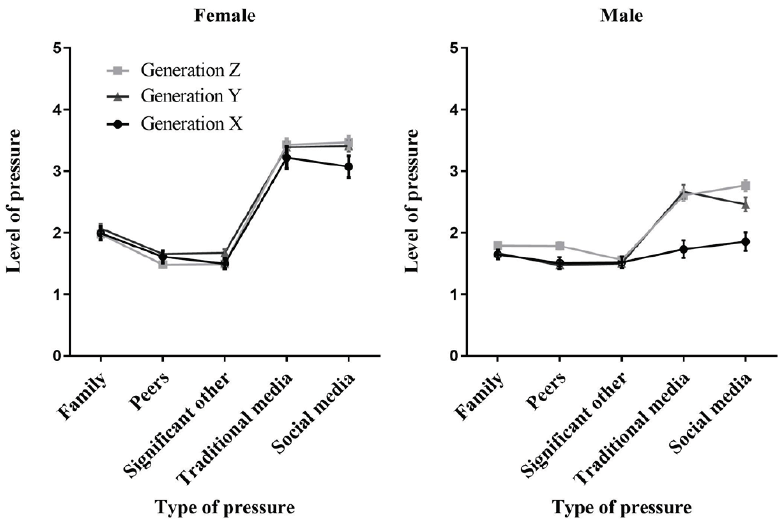
A significant three-way interaction effect was found between gender, generation, and type of social pressure (see Figure A.1). ANOVA was performed on each type of pressure with generation and gender as factors showed: a distinct effect of family pressure for each gender (F(1, 827) = 22.77, p = 0.00, ŋp2= .003) with females experiencing more pressure than males regardless of their age (p = 0.00). No significant effects were found for significant other pressure (F(2, 827) = 2.30, p = 0.10, ŋp2 = .005). An effect of peer pressure depending on generation and gender (F(2, 827) = 11.51, p = 0.00, ŋp2 = .027), tukey post-hoc analyses showed that generation Z males experience more pressure than females and that generation Z respondents experience more pressure than older generation Y respondents (p < 0.001). Analyses of traditional media showed a significant interaction between gender and generation (F(2, 827) = 3.73, p = 0.02, ŋp2 = .008). As for gender regarding traditional media, Tukey’s post-hoc analysis showed that females experience more pressure than males (F(1, 827) = 91.96, p = 0.00, ŋp2 = .010) and that there is no difference in how women of different generations experience traditional media pressure. However, generational differences were present in males, with Z males experiencing more pressure than X males (p < 0.0001). Finally, analyses of social media showed that females experience more pressure from social media than men (F(1, 827) = 82.85, p = 0.00, ŋp2 = .009) and that the impact of social media pressure decreases significantly with age (F(2, 827) = 10.88, p = 0.00, ŋp2 = .002).
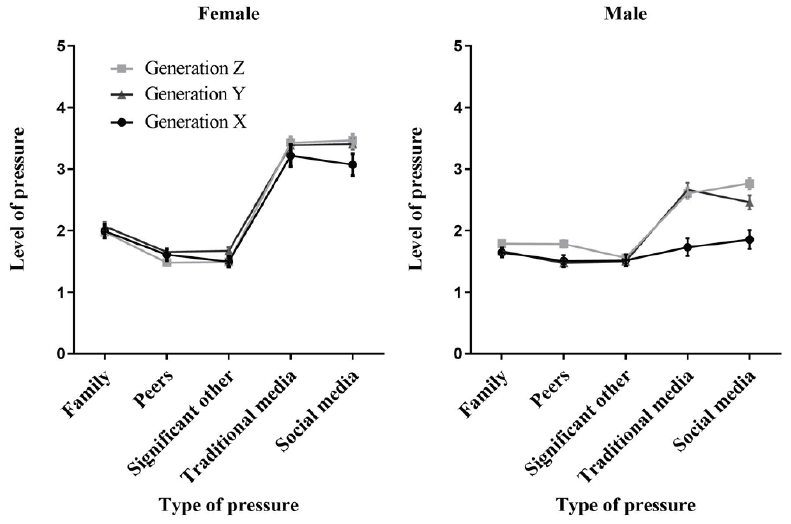
Fig. A.1 Three-way repeated measures analysis of variance with effect sizes and powers, comparing type of pressure, gender, and generation.
For the items that evaluated the relationship to a body-ideal, a significant three-way interaction effect was found for gender, generation, and pressure (see Figure B.1). ANOVA was performed on each type of body-ideal with generation and gender as factors. Results showed no effects for generation X. For generation Y, analysis found significant effects of gender (F(1, 698) = 36.61, p = 0.00), type of body-ideal (F(2, 698) = 19.93, p = 0.00) and the interaction between them (F(2, 698) = 26.23, p = 0.00). Tukey post-hoc analysis showed that while Y males had no differences between type of body-ideal, Y females experimented more pressure on the general attractiveness of their body-ideal. Lastly, for generation Z there was a significant main effect for gender (F(1, 728) = 35.25, p = 0.00), and the interaction between gender and type of body-ideal was also significant (F(2, 728) = 95.75, p = 0.00). Tukey post-hoc analysis showed that Z males experienced more pressure to have a muscular body and Z females experienced pressure to have a generally attractive body compared to a thin or a muscular body.
Discussion
The aim of this project was to assess how, during a pandemic that forces individuals to abstain from face-to-face interactions and engage in social interactions virtually, different social pressures and specifically social media influence body image. The study is the first to evaluate different sources of social influence that include social media on both genders and across age groups. A modified version of the SATAQ-4 (Schaefer, 2017) was used to evaluate social pressures and their relationship to different types of body ideals.
Overall, social and traditional media showed distinct impacts on body image for each gender and age group. Both types of media pressure exerted a similarly high degree of perceived social pressure on appearance, higher than any other type of pressure (family, peers, and significant others). Results showed that social media had a different effect on males depending on their age and affected women of all ages in a similar fashion. Other types of external pressures that influence body image were family pressure-which was higher for females but showed no differences within generations-and peer pressure-which had a higher impact on younger generations of both genders.
In addition, males and females of different generations were shown to have different predominant body ideals. Younger Z males experienced more pressure to have a muscular body, while Z females experienced more pressure to have a generally attractive body. In line with previous studies (Grogan, 2016; Thompson y Stise, 2021), men tend to aspire to a muscular body (capable of becoming muscular dysmorphia disorder) and women aspire to have an attractive body, which is not specifically muscular or thin.
The central aim of this study was to determine whether a new type of social pressure on body image (i.e., social media) should be measured independently of other known types of external pressure. Results of the comparison between social and traditional media showed that they affect distinctly men and women of different generations. While males were expected to be less affected by social media than women and this effect decreased with age, women continued to be affected by social media in a similar fashion as they age. However, when pooled together with other kinds of external pressure the differences between social and traditional media disappear. This could be because they are overall similar to each other and harder to distinguish than other types of pressures. Traditional media has an online presence within social media channels and the questionnaire does not specify their differences. This should be considered in developing follow-up studies.
Peers did not have a distinct effect on either gender or generation, even though a significant portion of the content people are exposed to on social media is about their peers and friends. Hence, this result was unexpected, particularly so for younger generations, for which social media had a higher influence than other types of pressure. Because only adults in the Z generation were included (older than 18), perhaps the effect of peer pressure in teenage years was diluted (Chua & Chang, 2016; Kenny, Sullivan, Callaghan, Molcho, & Kelly, 2018; Rodgers & Rousseau, 2022; de Vries, Peter, de Graaf, & Nikken, 2016). Regardless, the finding that media but not peers influence body image is important as it might indicate that media (both traditional and social) exerts influence on younger generations through social comparison with non-peers, such as celebrities (Brown & Tiggemann, 2016; Ho, Lee, & Liao, 2016; Pedalino, F. & Camerini, A.L., 2022).
A gender effect was found in family-perceived pressure on body appearance, with females experiencing more pressure than males regardless of their age. Previous studies found that various aspects of family behavior related to food and weight (e.g., expressed attitudes towards appearance, comments about body size) are associated with increased rates of problematic eating (Golan & Crow, 2004). A general tendency for a family to focus on appearance and attractiveness is related to greater difficulties with disordered eating and weight concerns among daughters (Davis, Shuster, Blackmore, & Fox, 2004). These results were found in younger women, but not in adult ones, whereas our results found no distinctive interaction between gender and generation, or generation effect overall.
As for body ideals, Z males experienced more pressure to have a muscular body, while Z females experience more pressure to have a generally attractive body. This later result could reflect the pressure on general appearance on women exerted by the other’s gaze, regardless of a specific type of body-ideal, as overall for all generations the level of perceived pressure was higher for women. For both genders, the older the generation the higher pressure was perceived in general attractiveness in comparison with muscular or low body fat body types. This could relate to a developmental effect where the older we get, we are prone to have a higher percentage of fat and a lower percentage of muscle. These findings are in line with the literature in the field (Carrard, Rothen, & Rodgers, 2021; Tiggemann, 2004).
It is important to consider that this study was conducted during a pandemic, a time when the use of social media, in general, increased (Cellini, Canale, Mioni, & Costa, 2020; Wong, Ho, Olusanya, Antonini, & Lyness, 2021). Follow-up post-pandemic studies should be conducted to explore if the pressure exerted by social media decreases with more face-to-face social interactions or when physical activity returns to normal (i.e., exercising). Taking into account that muscular body-type is the body-ideal most with the most perceived pressure in younger males, we consider future research should evaluate physical activity impact on the perceived level of pressure on having a muscular body. Future research should include other variables as well (regarding living social conditions, such as whom they live with, whether they currently have a partner, etc.) in order to do a factor analysis and elucidate further our findings.
Future research should also focus on obtaining a psychometric validation of the test-including the items regarding social media-on a larger sample that includes adolescents. It would be important to investigate whether these effects are found in other cultures given the documented differences in body ideal internalization (Lee, Lee, Choi, Kim, & Han, 2014; Ricciardelli, McCabe, Williams, & Thompson, 2007) and the differences on how governments and institutions limited social interactions during the pandemic. Finally, because social media use has been associated with mental health issues (Barry, Sidoti, Briggs, Reiter, & Lindsey, 2017; O’Reilly et al., 2018; Rodgers et al., 2020), eating (Mabe, Forney, & Keel, 2014) and body image disorders (Perloff, 2014; Rodgers & Melioli, 2016), a targeted study of clinical populations would help elucidate further how social media influences our lives.
In conclusion, over the past two decades, virtual interactions have become a significant means of socialization. Never has this been more evident than during the current covid-19 pandemic. In this study, we find that interacting with a virtual self-body has profound effects on how people of different genders and generations perceive their body image. These effects are more pronounced for younger generations and specifically younger males. This finding highlights the role of social media in our daily lives and how our cognitive system adapts to it. Recent changes in social policy reflect how societies have started to adjust to it; for instance, some countries are starting to ban filtered images promoting beauty products, as the impact of SNS on body image is recognized, in spite of editing disclaimer use (Hallet, E., 2021). In the future, it would be important to take into consideration how social media tools might affect individuals distinctly based on their gender and age and whether they can be used to promote realistic body images, encourage healthier behaviors, and help ameliorate their negative effects on how we construe our body image.

