Artículo científico
Micropropagation of Agave angustifolia Haw., for use and conservation purposes

-
Publication dates-
May 16, 2025
Mar-Apr , 2025
- Article in PDF
- Article in XML
- Automatic translation
- Send this article by e-mail
- Share this article +
Abstract
Agave angustifolia is a species utilized as raw material for mescal production in the South of the Estado de México, which is why the demand for the establishment of plantations of this succulent has increased. Plant tissue culture offers an alternative for mass plant propagation; thus, the objective of the present research was to develop a protocol for the in vitro propagation of the species. Germination, shoot multiplication and elongation, and root formation took place under in vitro conditions, and the plants were acclimatized in the nursery. The germination percentage was higher than 80 %, and there were differences between disinfection treatments and culture media. The use of 100 % MS medium+0.003 mg L-1 of BAP+0.002 mg L-1 of IBA+0.1 mg L-1 of calcium pantethonate produced a higher number of shoots per plant at 90 and 120 days. With 75 % MS culture medium, 100 % rooting was obtained, with an average of 6.5 roots per plant and 45 mm root length. In the nursery acclimatization stage, there was 100 % survival in the three substrates evaluated and differences were observed in height, diameter and dry matter. In conclusion, a complete protocol was generated for the micropropagation of Agave angustifolia, from in vitro germination to acclimatization in nursery.
Keywords:
Forest biotechnology, tissue culture, xerophytic scrubland, mescal production, agave propagation, in vitro propagation
Introduction
Agaves are endemic to the Americas and have their center of origin in Mexico (Mandujano et al., 2018), where they are mainly found in arid and semi-arid areas (Pérez et al., 2012). The richness of endemic species of the Agave L. genus in Mexico is mainly due to the country's heterogeneous habitats, which differ in climate, geology, soils, topography, and altitude, among other environmental factors (León et al., 2013). Some of the taxa are used as raw material for the production of alcoholic beverages and natural fibers, which causes the decline of the natural populations of several taxa (NOM-059-SEMARNAT-2010, 2010). The list of priority species for conservation includes six species of agaves, among them is Agave angustifolia Haw. (Secretaría de Medio Ambiente y Recursos Naturales [Semarnat], 2014).
-
Mandujano et al., 2018Diversidad genética de maguey (Agave spp.) en las sierras y llanuras del norte de GuanajuatoRevista Mexicana de Ciencias Agrícolas, 2018
-
Pérez et al., 2012Conservación in vitro de germoplasma de Agave spp. bajo condiciones de crecimiento retardadoRevista Fitotecnia Mexicana, 2012
-
León et al., 2013Diversidad de especies de agave en San Miguel Tilquiapam, Ocotlán, OaxacaRevista Mexicana de Ciencias Agrícolas, 2013
-
NOM-059-SEMARNAT-2010, 2010). NORMA Oficial Mexicana NOM-059-SEMARNAT-2010, Protección ambiental-Especies nativas de México de flora y fauna silvestres-Categorías de riesgo y especificaciones para su inclusión, exclusión o cambio-Lista de especies en riesgoDiario Oficial de la Federación, 2010
-
Secretaría de Medio Ambiente y Recursos Naturales [Semarnat], 2014Especies de flora prioritarias para la conservaciónCompendio de estadísticas ambientales 2018, 2014
Agave angustifolia (maguey delgado, maguey de monte or espadín) grows wild and extensively in the Western Sierra Madre, in the states of Aguascalientes, Chihuahua, Durango, Jalisco, Nayarit, Sinaloa, Sonora and Zacatecas (Fragoso-Gadea et al., 2021). Aguamiel (maguey juice) is produced from the sap concentrated in its apical meristematic zones and is utilized to make pulque. Its leaves are utilized to cook lamb meat in barbecue, and the flowers are employed in various dishes (Ávila-Lara et al., 2021). It is also used as a remedy for sprains or broken bones in people or animals (Barrientos et al., 2019).
-
Fragoso-Gadea et al., 2021Poblaciones silvestres de Agave angustifolia (Asparagaceae) de Sonora, México: variación morfológica y contenido de azúcaresActa Botánica Mexicana, 2021
-
Ávila-Lara et al., 2021Rentabilidad de la producción de aguamiel en el sureste del estado de Coahuila, México: Un estudio de casoInvestigación y Ciencia, 2021
-
Barrientos et al., 2019Caracterización morfológica de Agave angustifolia y su conservación en Guerrero, MéxicoRevista Mexicana de Ciencias Agrícolas, 2019
Today, one of the strategies with the greatest potential for recovering, multiplying and preserving plant species is in vitro culture (Suárez, 2020). For example, in the study by Domínguez et al. (2008) with Agave cupreata Trel. & A. Berger, A. difformis A. Berger, A. karwinskii Zucc., A. obscura Schiede and A. potatorum Zucc., meristematic tissues extracted from in vitro germinated seedlings were used. Multiple shoots were obtained from basal explants in Murashige and Skoog (1962), added with 30 g L-1 sucrose, 8 g L-1 agar and various cytokinin treatments [6-benzylaminopurine (BA), 6-γ,γ-dimethylallylaminopurine (2iP), cinetin (Cin), thidiazuron (TDZ) and meta-topoline or N6-(metahydroxybenzyl) adenine (MT)].
-
Suárez, 2020Cultivo de tejidos vegetales, 2020
-
Domínguez et al. (2008)Efecto de citocininas en la propagación in vitro de agaves mexicanosRevista Fitotecnia Mexicana, 2008
-
Murashige and Skoog (1962)A revised medium for rapid growth and bio assays with tobacco tissue culturesPhysiologia Plantarum, 1962
Literature includes records on the successful use of this technique for the propagation of such agaves as Agave tequilana F. A. C. Weber (Ángeles-Espino et al., 2012; Portillo et al., 2007; Ramírez-Malagón et al., 2008), A. inaequidens K. Koch (Aureoles-Rodríguez et al., 2008), A. salmiana Otto ex Salm-Dyck (Ramírez-Malagón et al., 2008), A. fourcroydes Lem. (Garriga et al., 2010), A. grijalvensis B. Ullrich (Santíz et al., 2012), A. americana L. var. oaxacensis Gentry (Cruz et al., 2017; Miguel et al., 2013), A. angustifolia (Monja-Mio et al., 2015; Ríos-Ramírez et al., 2017) and A. potatorum (Luna-Luna et al., 2017).
-
Ángeles-Espino et al., 2012Micropropagación de agave (Agave tequilana Weber. var. Azul) a través de yemas axilaresTropical and Subtropical Agroecosystems, 2012
-
Portillo et al., 2007Somatic embryogenesis in Agave tequilana Weber cultivar AzulIn vitro Cellular & Developmental Biology-Plant, 2007
-
Ramírez-Malagón et al., 2008In vitro propagation of three Agave species used for liquor distillation and three for landscapePlant Cell, Tissue and Organ Culture, 2008
-
Aureoles-Rodríguez et al., 2008Propagación in vitro del ‘Maguey bruto’ (Agave inaequidens koch), una especie amenazada de interés económicoRevista Chapingo Serie Horticultura, 2008
-
Ramírez-Malagón et al., 2008In vitro propagation of three Agave species used for liquor distillation and three for landscapePlant Cell, Tissue and Organ Culture, 2008
-
Garriga et al., 2010Management of auxin-cytokinin interactions to improve micropropagation protocol of henequen (Agave fourcroydes Lem.)Chilean Journal of Agricultural Research, 2010
-
Santíz et al., 2012Propagación in vitro de Agave grijalvensis B. Ullrich, una especie endémica de Chiapas bajo protección especialGayana Botánica, 2012
-
Cruz et al., 2017Senescencia foliar en plantas micropropagadas de Agave americana durante su aclimataciónRevista Mexicana de Ciencias Agrícolas, 2017
-
Miguel et al., 2013Composición del medio de cultivo y la incubación para enraizar brotes de AgaveRevista Mexicana de Ciencias Agrícolas, 2013
-
Monja-Mio et al., 2015Development of the stomatal complex and leaf surface of Agave angustifolia Haw. ‘Bacanora’ plantlets during the in vitro to ex vitro transition processScientia Horticulturae, 2015
-
Ríos-Ramírez et al., 2017Benzylaminopurine and indol-3-acetic acid concentrations in in vitro proliferation of Agave angustifolia adventitious shootsCiencia e Investigación Agraria, 2017
-
Luna-Luna et al., 2017Anatomía y morfología de plantas micropropagadas-aclimatadas de Agave potatorum Zucc. fertirrigadas en viveroRevista Fitotecnia Mexicana, 2017
In the Southern region of the Estado de México, mescal production is a deep-rooted tradition in many communities and an important source of income for many families. The use and demand for A. angustifolia in this region is generating an increase in the demand for plants to establish commercial plantations. To address this situation, the Protectora de Bosques del Estado de México, Probosque (Agency for the Protection of Forests of Estado de México) is developing biotechnological techniques such as in vitro plant tissue culture in order to obtain plants with quality characteristics for establishment in the field. Therefore, the objective of this study was to evaluate the effectiveness of in vitro propagation to produce A. angustifolia plants from seeds and their subsequent acclimatization in nursery.
Materials and Methods
Plant material
The project was carried out from June 2021 to December 2023 at Probosque's Forest Biotechnology Laboratory, located in Metepec, Estado de México. In March 2021, A. angustifolia seeds were collected at La Joya del Campo, Lagunita locality, Ocuilán municipality (395569 E, 2130744 N, UTM zone 14 s). Vegetation is xerophilous scrubland; 21.2 °C average annual temperature and 1 085.2 mm average annual rainfall (Instituto Nacional de Estadística y Geografía [Inegi], 2019). In the milling process, seeds were manually extracted and cleaned to eliminate impurities. A representative sample of the lot was considered for quality analysis according to International Seed Testing Association (ISTA, 2025) procedures. Seeds showed 46 % viability, 40.25 % germination, 9.36 % moisture, 98.50 % purity, with 92 299 seeds per kilogram, 0.0069 g per seed, and a length of 0.8 to 0.9 mm. The germplasm was placed in high-density polyethylene bags, Captan (Captán 50 WP®, Israel) and Thiabendazole (Tecto® 60, Mexico) were added in a 1:1 ratio, enough to impregnate the seeds; the bags were subsequently sealed, placed in hermetically sealed plastic containers and stored in a cold room at 3-5 °C with 90 % relative humidity.
-
Instituto Nacional de Estadística y Geografía [Inegi], 2019Conjunto de datos vectoriales de información topográfica E14A58 (Tenancingo) escala 1:50 000 serie III. Mex. Mapas Topográficos. Escala 1:50 000, 2019
-
ISTA, 2025Chapter 2: SamplingInternational Rules for Seed Testing, 2025
Germination
The laboratory experiment was started in June 2021. 720 seeds were used for in vitro germination. They were washed by manual shaking using a glass rod in a solution with Roma® detergent (1 g L-1) for three minutes and rinsed with running water. Then, the seeds were disinfected with a solution of [aluminum tris-(O-ethyl phosphonate)] Jabali® (Mexico) fungicide (2 g L-1), using a model SP88857100 Thermo Scientific ® magnetic stirrer, shaken at 250 rpm for 2 hours. For the germination process, a completely randomized factorial experiment was set up. Factor A was the three-level disinfection process: (D1) 3 % H2O2 for 160 min+Roma ® detergent (1 g L-1) for 3 min+3 % H2O2 for 10 min+70 % ethanol for 0.5 min+Chloralex ® (0.6 % NaClO) for 10 min; (D2) 3 % H2O2 for 480 min+Roma ® detergent (1 g L-1) for 3 min+3 % H2O2 for 10 min+70 % ethanol for 0.5 min+Chloralex ® (0.6 % NaClO) for 15 min; and (D3) 3 % H2O2 for 960 min+Roma® detergent (1 g L-1) for 3 min+3 % H2O2 for 10 min+Chloralex® (0.6 % NaClO) for 10 min.
Factor B was MS (Murashige & Skoog, 1962) and SH (Schenk & Hildebrandt, 1972) at five levels: (T1) 100 % MS, (T2) 100 % SH, (T3) 50 % MS+0.2 g L-1 glutamine, (T4) 50 % SH, and (T5) 50 % MS. 30 g L-1 of sucrose and 7 g L-1 of bacteriological agar as gelling agent were added to the culture media, and the mixture was adjusted to a pH of 5.7 and then placed (20 mL) in glass vials, which were autoclaved (model Fe-399 Felisa ®) at 121 °C for 15 minutes.
-
Murashige & Skoog, 1962A revised medium for rapid growth and bio assays with tobacco tissue culturesPhysiologia Plantarum, 1962
-
Schenk & Hildebrandt, 1972Medium and techniques for induction and growth of monocotyledonous and dicotyledonous plant cell culturesCanadian Journal of Botany, 1972
The 720 seeds were used to set up 15 treatments that resulted from combining the three levels of Factor A (disinfection process) with the five levels of Factor B (culture media); the experimental unit was a flask with 6 seeds, and 8 replicates were used per treatment, for a total of 120 flasks.
Germination took place in an incubation room at 22 °C, with a relative humidity of 23 %, and a photoperiod of 16 hours of light and 8 hours of darkness. The percentage of germinated seeds per flask was evaluated as a response variable. Data were subjected to a normality test, homogeneous variances, analysis of variance, and Tukey's mean comparison test; a level of p<0.05 was considered as a reference (Quinn & Keough, 2002). The analyses were performed using the SAS® 9.4 statistical package (Statistical Analysis System Institute [SAS Institute], 2013).
-
Quinn & Keough, 2002Experimental design and data analysis for biologists, 2002
-
Statistical Analysis System Institute [SAS Institute], 2013Procedures Guide: Statistical Procedures, 2013
Multiplication of shoots
Seedlings obtained at the germination stage were used for the multiplication of axillary shoots. For this purpose, individuals with similar characteristics (90 days after germination and with an average height of 5 cm) were chosen, and a cut was made at the root collar to induce the formation of shoots. Five treatments were installed: (T1) 100 % MS; (T2) 100 % MS+0.3 mg L-1 of BAP+0.2 mg L-1 of IBA; (T3) 100 % MS+0.3 mg L-1 of BAP+0.2 mg L-1 of IBA+0.1 mg L-1 of calcium pantethonate (Andrade et al., 2013); (T4) 100 % MS+0.8 mg L-1 of BAP+0.2 mg L-1 of IBA, and (T5) 100 % MS+0.8 mg L-1 of BAP+0.2 mg L-1 of IBA+0.1 mg L-1 of calcium pantethonate. The base medium utilized was the MS formulation (Murashige & Skoog, 1962), added with 1 mg L-1 of thiamine, 100 mg L-1 of Myo-inositol, and 30 g L-1 of sucrose. The growth regulators used were: N6-Benzylaminopurine (BAP), indole butyric acid (IBA), and calcium pantethonate. The latter compound has been successfully used in the micropropagation of other plants like Solanum L. (Andrade et al., 2013). The pH of the mixture was adjusted to 5.7, and 7 g L-1 of bacteriological agar were added (Enríquez et al., 2005); 30 mL were placed in glass vials and autoclaved (model Fe-399 Felisa ®) at 121 °C for 15 minutes.
-
Andrade et al., 2013Evaluación de medios de cultivo para propagación in vitro de semillas y explantes de especies silvestres de SolanumActa Agronómica, 2013
-
Murashige & Skoog, 1962A revised medium for rapid growth and bio assays with tobacco tissue culturesPhysiologia Plantarum, 1962
-
Andrade et al., 2013Evaluación de medios de cultivo para propagación in vitro de semillas y explantes de especies silvestres de SolanumActa Agronómica, 2013
-
Enríquez et al., 2005Sales inorgánicas y ácido indolbutírico en el enraizado in vitro de brotes de Agave angustifoliaRevista Fitotecnia Mexicana, 2005
At this stage, a completely randomized experimental design was used, with 10 replications per treatment, and the experimental unit was a jar with three seedlings. The response variables were the number and size of the shoot (mm), measured with a 12 cm vernier caliper (model 5” Anelsam®). The data were subjected to a statistical analysis applying normality test and homogeneous variances tests, an analysis of variance, and a mean comparison test using Tukey's method with a p-value<0.05 (Quinn & Keough, 2002). The analyses were performed with the SAS® 9.4 statistical package (SAS Institute, 2013).
-
Quinn & Keough, 2002Experimental design and data analysis for biologists, 2002
Shoot elongation
A. angustifolia shoots obtained at the multiplication stage after 180 days were selected. Healthy 3 cm long shoots were placed in the culture media corresponding to each treatment: (T1) 75 % MS; (T2) 75 % MS+3 mg L-1 of kinetin+3 mg L-1 of BAP; (T3) 75 % MS+3 mg L-1 of kinetin+10 mg L-1 of BAP; (T4) 75 % MS+3 mg L-1 of BAP+0.3 mg L-1 of NAA; (T5) 100 % MS; (T6) 100 % MS+3 mg L-1 kinetin+3 mg L-1 BAP; (T7) 100 % MS+3 mg L-1 kinetin+10 mg L-1 BAP; (T8) 100 % MS+3 mg L-1 BAP+0.3 mg L-1 NAA. The decision was made to test the combination of cytokinins and auxins, given that the effect of these plant hormones on the elongation of A. angustifolia shoots is not clear in the literature.
The experimental design was completely randomized, with ten replications per treatment, and the experimental unit was a jar with three seedlings. The response variable was shoot height (mm), measured with a 12 cm vernier caliper (model 5” Anelsam®). The data were subjected to a statistical analysis, applying normality and homogeneous variances tests, an analysis of variance, and a mean comparison test using Tukey's method with a p-value<0.05 (Quinn & Keough, 2002). The SAS® 9.4 statistical package was used (SAS Institute, 2013).
-
Quinn & Keough, 2002Experimental design and data analysis for biologists, 2002
Root formation
The plants obtained at the elongation stage were subjected to rooting. For this purpose, a MS culture medium was utilized at 75 % concentration without growth regulators. The process of root formation occurred within a period of 8 to 12 weeks in an incubation room, under the same laboratory conditions described above. The length (cm) and root collar diameter (mm) were measured with a 12 cm vernier caliper (model 5” Anelsam®), and the number of roots was counted. The average for 300 plants was estimated.
Acclimatization
The 300 rooted plants were used at the acclimatization stage. The average characteristics of the individuals were: five leaves, 7.8±0.8 cm in height, 1±0.1 cm root collar diameter and 6±0.2 cm root length. Plants were placed in three volume mixtures of four different substrates (soil, pumice, Multiperl® agrolite, and Berger® peat moss): (T1) Soil (40 %)-pumice (30 %)-peat moss (30 %), (T2) Soil (50 %)-pumice (50 %), and (T3) Soil (40 %)-pumice (30 %)-agrolite (30 %). The soil properties used were as follows: pH (5.6), EC (0.04 dS m-1), OM (7.8 %), N (0.25 %), P (5.2 mg kg-1), K (0.1 cmol+ kg-1), Ca (7.7 cmol+ kg-1), Mg (2.1 cmol+ kg-1), Na (0.1 cmol+ kg-1), Fe (90 mg∙kg-1), Cu (1 mg∙kg-1), Zn (2 mg∙kg-1) and Mn (4 mg∙kg-1).
32×32 cm plastic trays were used, with 25 cavities for 16.5 cm long tubes, a 6 cm upper diameter, a 4.5 cm lower base, and a volume of 285 cm3 were utilized for planting. After transplanting, each tube was covered with a polypropylene bag to maintain the moisture. The trays were placed in a pre-acclimatization room at a temperature of 24 °C, with a 41 % relative humidity and lighting with LED lamps (16 hours of light and 8 hours of darkness). After eight days, the polypropylene bag was removed to verify the leaf turgor and plant survival; the plants were transferred to 25 cm long nursery bags with a 12.5 cm diameter and established under greenhouse conditions at an average temperature of 20.5 °C and with 52 % relative humidity.
After six months, height (cm), root collar diameter (cm), and root length (cm) were measured with a 12 cm vernier caliper (model 5” Anelsam®). The number of roots and the dry matter content of the plant were also quantified. During this period, the plants were watered every other day, and no fertilizer was applied.
The data were subjected to statistical analysis by means of an analysis of variance and a comparison of means test using Tukey's method with a p-value<0.05 (Quinn & Keough, 2002); for this purpose, the SAS® 9.4 statistical package (SAS Institute, 2013) was utilized.
-
Quinn & Keough, 2002Experimental design and data analysis for biologists, 2002
Results and Discussion
Disinfection treatments
Differences were obtained between disinfection treatments (p<0.05), culture media (p<0.05), and interaction of disinfection treatments and culture media (p<0.05) on germination. In this sense, disinfection treatment D3 registered the highest germination percentage (Figure 1), and the lowest percentage corresponded to treatments D1 and D2; thus, not all disinfection methods proved equally effective in reducing contamination. Method D3 had the longest immersion time in H2O2, which explains its effectiveness. In the study by Aguilar-Rito et al. (2024), the highest levels of contamination were observed with the Ca(ClO2) and NaClO treatments, while the lowest percentage of seed contamination occurred with the treatments with H2O2.
-
Aguilar-Rito et al. (2024)Establecimiento de un protocolo eficiente de desinfección in vitro en semillas de siete especies de Agave sppMexican Journal of Phytopathology, 2024
Thumbnail
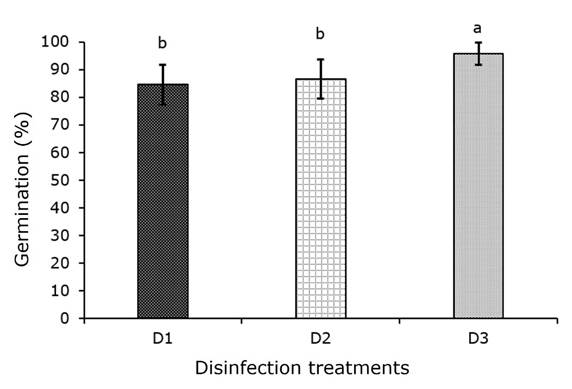 Equal letters indicate that there is no significant difference (p<0.05). D = Disinfection.
Figure 1
Percentage of germination by disinfection treatment.
Percentage of germination by disinfection treatment.
Treatments D1 and D2 included the use of ethanol. However, this compound and other small alcohols, being natural surfactants of aqueous/organic interfaces, act on the cell membrane by mechanically stressing it and inhibiting the natural adsorption of terminal groups at these interfaces (Rivera & Lima, 2013), and thereby damage plant tissues.
-
Rivera & Lima, 2013Efecto desorbedor del metanol en la membrana celularTIP Revista Especializada en Ciencias Químico-Biológicas, 2013
The D3 method was developed in the Forest Biotechnology Laboratory at Probosque, where it is routinely utilized for seed disinfection; its application resulted in a higher germination percentage compared to treatments D1 and D2 (Figure 1). This procedure contrasts with the technique employed by Aguilar-Rito et al. (2024), who used 3 % H2O2 for 24 h+30 % copper sulfate for 10 min+0.1 % HgCl2 for 10 min and obtained 100 % disinfection, although with variable germination rates. Other disinfection techniques involve the use of 96 % ethanol for 1 min+3 % NaClO for 10 min (Santacruz-Ruvalcaba et al., 2022) or 70 % ethanol for 3 min+0.6 % NaClO for 15 min (Correa-Hernández et al., 2022). Finally, plants from seeds show genetic variability compared to those obtained from Mother plants, which remain genetically uniform (Arzate-Fernández et al., 2016). For conservation purposes, micropropagation from seeds is recommended because it maintains the genetic diversity.
-
Aguilar-Rito et al. (2024)Establecimiento de un protocolo eficiente de desinfección in vitro en semillas de siete especies de Agave sppMexican Journal of Phytopathology, 2024
-
Santacruz-Ruvalcaba et al., 2022Micropropagación de Agave maximiliana Baker por proliferación de yemas axilaresPolibotánica, 2022
-
Correa-Hernández et al., 2022In vitro multiplication of agave tobala (Agave potatorum Zucc.) using Ebb-and-Flow biorreactorSouth African Journal of Botany, 2022
-
Arzate-Fernández et al., 2016Regeneración de agave mezcalero (Agave angustifolia Haw.) a partir de embriones somáticos encapsuladosRevista Fitotecnia Mexicana, 2016
Culture media for germination
The highest germination percentage was achieved with T1, T3, and T5 culture media (Figure 2). Conversely, the lowest amount of germinated seeds was recorded with T4; although T2 followed a similar trend. This behavior suggests that the MS medium provides a higher germination rate. The results of the present investigation are superior to those documented by Téllez et al. (2023), who used a MS medium with 50 % concentration of its inorganic components, supplemented with sucrose 30 g L-1 and bacto-agar 8.5 g L-1, pH 5.7 and obtained 56 % germination in A. potatorum seeds stored for six months at 5 °C. The same authors indicate a germination rate of 31.8 % in seeds germinated in substrate under greenhouse conditions. Aguilar-Rito et al. (2024) used a MS medium supplemented with 30 g L-1 sucrose and 0.5 g L-1 activated carbon, without plant growth regulators and gelled with 8 g L-1 agar, and obtained a germination percentage of 85 % for A. angustifolia seeds analyzed in the same harvest year. Therefore, the generated protocol increased the germination percentage in agave seeds compared to conventional germination methods, i. e., 46 % in substrate germination and 89 % on average under in vitro conditions.
-
Téllez et al. (2023)Cultivo in vitro de Agave potatorum, especie amenazada endémica de MéxicoBotanical Sciences, 2023
-
Aguilar-Rito et al. (2024)Establecimiento de un protocolo eficiente de desinfección in vitro en semillas de siete especies de Agave sppMexican Journal of Phytopathology, 2024
Thumbnail
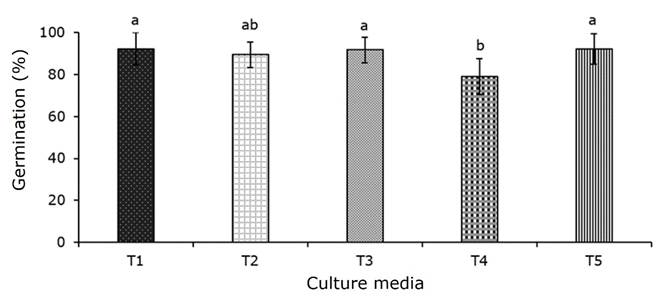 Equal letters indicate that there is no significant difference (p<0.05). T = Treatment.
Figure 2
Percentage of germination by culture medium.
Percentage of germination by culture medium.
Multiplication of shoots
After establishment in the culture medium, there were differences between treatments in the average number of shoots obtained per explant (p<0.05). At 90 days, T3 had the highest number of shoots and, with the exception of T1, the rest of the treatments showed an increase in the number of shoots at 120 days; T3 and T4 were superior. Treatment T1 did not develop shoots because it contained neither cytokinins nor auxins (Table 1). Faisal et al. (2018) report that shoot apices of Ruta graveolens L. show no morphogenic response in a MS medium without a growth regulator. Auxins are unique hormones that can be subjected to polar transport, create gradients, and regulate cell differentiation; therefore, they are responsible for shoot morphogenesis (Pasternak & Steinmacher, 2024). High levels of cytokinins together with low auxin concentration synergistically affect cell division and in vitro plant regeneration (Fatima et al., 2011).
-
Faisal et al. (2018)Auxin-cytokinin synergism in vitro for producing genetically stable plants of Ruta graveolens using shoot tip meristemsSaudi Journal of Biological Sciences, 2018
-
Pasternak & Steinmacher, 2024Plant growth regulation in cell and tissue culture in vitroPlants, 2024
-
Fatima et al., 2011Enhanced in vitro regeneration and change in photosynthetic pigments, biomass and proline content in Withania somnifera L. (Dunal) induced by copper and zinc ionsPlant Physiology and Biochemistry, 2011
Table 1
Shoot development in Agave angustifolia Haw., 90 and 120 days after establishment in different culture media.
Shoot development in Agave angustifolia Haw., 90 and 120 days after establishment in different culture media.
| Treatment | Number of shoots per |
Number of shoots per |
|---|---|---|
| T1 | 0±0c | 0±0c |
| T2 | 1.9±0.9bc | 4.7±1.2ab |
| T3 | 4.9±1.1a | 6.0±1.3a |
| T4 | 3.6±0.6ab | 5.5±1.1a |
| T5 | 1.2±0.6bc | 2.9±1.0b |
At 90 days, T3 generated the highest number of shoots per plant, and at 120 days the best treatments were T3 and T4. In the present study, due to the unavailability of TDZ, calcium pantethonate was used; this compound has been used in the micropropagation of Solanum mammosum L. and Solanum hirtum Vahl generating the highest number of leaves and plant length (Andrade et al., 2013). Cytokinins and auxins are commonly used in shoot multiplication. According to Domínguez et al. (2008), the highest shoot production in Agave cupreata and A. karwinskii is obtained with 1 and 1.5 mg L-1 of BAP, while in A. difformis and A. obscura, it is achieved with 0.2 mg L-1 TDZ.
-
Andrade et al., 2013Evaluación de medios de cultivo para propagación in vitro de semillas y explantes de especies silvestres de SolanumActa Agronómica, 2013
-
Domínguez et al. (2008)Efecto de citocininas en la propagación in vitro de agaves mexicanosRevista Fitotecnia Mexicana, 2008
In Agave nussaviorum García-Mend., Miguel-Luna et al. (2023) observed that, at 80 days, 6.2 shoots were formed in the culture medium with 1 mg L-1 of BAP and 75 % in MS, 2.0 shoots with 0.5 mg L-1 of BAP and 50 % MS, and 4.3 shoots with 0.5 mg L-1 of BAP and 75 % MS. Finally, the combination of growth regulators with low doses of auxin (between 0.025 and 0.5 mg L-1) and high doses of cytokinin (between 3 and 10 mg L-1) stimulates the production of shoots from axillary buds in A. angustifolia (Ríos-Ramírez et al., 2017), A. guiengola Gentry (Chávez-Ortiz et al., 2021), and A. fourcroydes (Zhang et al., 2013).
-
Miguel-Luna et al. (2023)Bencilaminopurina y sales minerales para la propagación in vitro de brotes de Agave nussaviorumRevista Mexicana de Agroecosistemas, 2023
-
Ríos-Ramírez et al., 2017Benzylaminopurine and indol-3-acetic acid concentrations in in vitro proliferation of Agave angustifolia adventitious shootsCiencia e Investigación Agraria, 2017
-
Chávez-Ortiz et al., 2021In vitro propagation of Agave guiengola Gentry using semisolid medium and temporary immersion bioreactorsPhyton-International Journal of Experimental Botany, 2021
-
Zhang et al., 2013Shoot organogenesis and plant regeneration in Agave hybridScientia Horticulturae, 2013
Shoot elongation
The 75 % MS medium without growth regulators (T1) was the most effective for shoot elongation (Table 2). The evidence indicates that only T2 produced the lowest shoot growth.
Table 2
Shoot elongation of Agave angustifolia Haw., 60 days after establishment in a culture medium.
Shoot elongation of Agave angustifolia Haw., 60 days after establishment in a culture medium.
| Treatment | Shoot length (mm) |
|---|---|
| T1 | 15.4±3.3a |
| T2 | 5.9±1.5b |
| T3 | 12.4±3.2ab |
| T4 | 12.9±1.3ab |
| T5 | 10.5±2.5ab |
| T6 | 9.9±1.5ab |
| T7 | 9.0±2.3ab |
| T8 | 9.7±1.7ab |
The study conducted by Santacruz-Ruvalcaba et al. (2022) on in vitro propagation with A. maximiliana Baker indicates that the use of a MS medium with 5 mg L-1 indole-3-butyric acid results in longer shoot length. On the other hand, Faisal et al. (2018) observe that, in the case of Ruta graveolens, a MS medium enriched with 10 µM benzyladenine generates the shoots with the greatest length. However, further studies are needed to elucidate the effect of the combination of auxins and cytokinins on the growth of A. angustifolia shoots, as published research does not evaluate this stage separately.
-
Santacruz-Ruvalcaba et al. (2022)Micropropagación de Agave maximiliana Baker por proliferación de yemas axilaresPolibotánica, 2022
-
Faisal et al. (2018)Auxin-cytokinin synergism in vitro for producing genetically stable plants of Ruta graveolens using shoot tip meristemsSaudi Journal of Biological Sciences, 2018
Root formation
The use of a 75 % MS culture medium prompted 100 % rooting, with an average of 6.5 roots per plant and 45 mm root length (Figure 3). These results coincide with those of Bautista-Castellanos et al. (2020) in A. potatorum, a species that is difficult to root, when they used a MS medium at 75 and 100 % concentration of salts without auxins; the authors point out that 73 % of the shoots form adventitious roots.
-
Bautista-Castellanos et al. (2020)Enraizado de brotes in vitro y aclimatación de plantas de Agave potatorum ZuccEcosistemas y Recursos Agropecuarios, 2020
Thumbnail
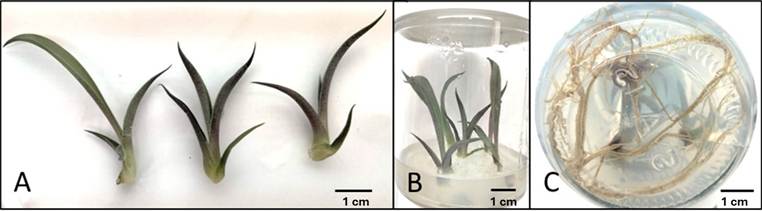 A = Explants for root induction; B = Explants established in MS medium; C = Root formation.
Figure 3
Root formation stage in Agave angustifolia Haw.
Root formation stage in Agave angustifolia Haw.
Aclimatization
At the nursery acclimatization stage, there was 100 % survival in the three treatments (Table 3, Figure 4). These results agree with those of Aguilar and Rodríguez (2018), who in A. marmorata Roezl at the acclimatization stage observed a 100 % survival in a mixture of peat moss with agrolite and peat moss with river sand. Other studies with Mexican agaves (A. cupreata, A. difformis, A. karwinskii, A. obscura and A. potatorum) have estimated survival rates of 53, 73, 60, 100 and 73 %, respectively, in commercial potting soil and sand (1:1) (Domínguez et al., 2008).
-
Aguilar and Rodríguez (2018)Micropropagación y aclimatación de Maguey Pitzometl (Agave marmorata Roezl) en la Mixteca PoblanaRevista Colombiana de Biotecnología, 2018
-
Domínguez et al., 2008Efecto de citocininas en la propagación in vitro de agaves mexicanosRevista Fitotecnia Mexicana, 2008
Table 3
Characteristics evaluated in Agave angustifolia Haw. plants after six months of acclimatization in nursery.
Characteristics evaluated in Agave angustifolia Haw. plants after six months of acclimatization in nursery.
| Substrate | Height |
Root collar |
Root |
No. of |
Dry |
|---|---|---|---|---|---|
| T1 | 13±0.1ab | 1.6±0.1a | 17.5±0.6a | 11±1a | 15.0±1.4ab |
| T2 | 13.6±0.5a | 1.6±0.2a | 17.5±0.5a | 11±2a | 17.0±0.7a |
| T3 | 12.3±0.5b | 1.3±0.1b | 18.0±0.1a | 11±1a | 12.1±1.4b |
Thumbnail
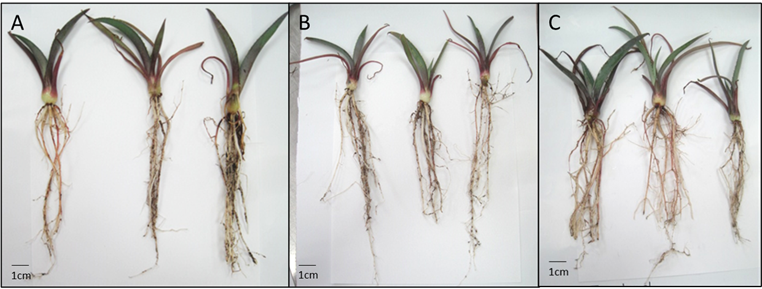 A = Soil (40 %)-pumice (30 %)-agrolite (30 %); B = Soil (40 %)-pumice (30 %)-peat moss (30 %); C = Soil (50 %)-pumice (50 %).
Figure 4
Development of Agave angustifolia Haw. on different substrates.
Development of Agave angustifolia Haw. on different substrates.
In the present study, differences in height, diameter and dry matter content between treatments were detected. The use of a higher percentage of soil in T2 favored a greater growth in height and biomass content, which is explained by a higher concentration of nutrients and moisture retention. In addition to providing nutrients, organic matter increases soil porosity, moisture holding capacity, and aeration (Osman, 2013). The T3 substrate exhibited the lowest growth in height, root collar diameter, and dry matter content. Stone materials (agrolite and pumice) do not provide nutrients and retain less moisture than peat moss, which explains the lower plant development. For this reason, inorganic materials (pumice, tezontle -a reddish, porous volcanic rock-, and agrolite) are more widely used, individually, in hydroponic cultivation (Gayosso-Rodríguez et al., 2016), where the supply of water and nutrients to the plants is precisely controlled. In this experiment, no nutrients were applied to the substrate, which resulted in no differences in root length and number of roots. Particularly, phosphorus supply is related to root growth (Havlin et al., 2016).
-
Osman, 2013Soils. Principles, properties and management, 2013
-
Gayosso-Rodríguez et al., 2016Sustratos para producción de floresAgrociencia, 2016
-
Havlin et al., 2016Soil fertility and fertilizers. An introduction to nutrient management, 2016
Conclusions
A complete protocol was generated for the micropropagation of Agave angustifolia, from in vitro germination to acclimatization in nursery. The survival rate at the acclimatization stage was 100 %, i. e., the 300 plants obtained at the rooting phase were established in the nursery. The specimens were obtained from seed germination, which gives them greater genetic variability, a key aspect in the conservation of this forest resource. Therefore, in vitro production of A. angustifolia is a feasible alternative for plant propagation in greater quantities and quality for the establishment of commercial mescal agave plantations in the Estado de México. This will help to reduce the pressure that exists due to the overexploitation of the species in its natural habitat.
Acknowledgments
The authors are grateful to Probosque for providing the facilities for the execution of the project. To the Forestry Engineering Division of the Higher Technological Institute of Higher Studies of Valle de Bravo (TESVB, for its acronym in Spanish) for their support in the data analysis of the project. To Dr. Alejandro Santiago Sánchez Vélez, General Director of Probosque. To Eng. Sergio Cuevas Solórzano, head of the department of commercial plantation support. To the Forest Biotechnology Laboratory technicians. To Dr. María Ascensión Aguilar Morales for her support in the development of the project. To Food Chemistry Intern Adriana Tinajero Martínez for her support in the preparation of graphs and literature review. And, finally, to C. Simona Jiménez Salazar for her support in the care of the plant in the greenhouse and to the technical staff of the Germplasm Bank of Probosque for the donation of the seeds.
Referencias
- Aguilar J., D., y Rodríguez de la O, J. L. (2018). Micropropagación y aclimatación de Maguey Pitzometl (Agave marmorata Roezl) en la Mixteca Poblana. Revista Colombiana de Biotecnología, 20(2), 124-131. https://doi.org/10.15446/rev.colomb.biote.v20n2.77084 Links
- Aguilar-Rito, M. G., Arzate-Fernández, A. M., García-Núñez, H. G., y Norman-Mondragón, T. H. (2024). Establecimiento de un protocolo eficiente de desinfección in vitro en semillas de siete especies de Agave spp. Mexican Journal of Phytopathology, 42(1), 5. https://www.rmfito.smf.org.mx/volumenes/4212024/articulos/5.%20RMF2310-1.%20Espa%C3%B1ol.pdf Links
- Andrade D., D., Córdoba F., M. E., Criollo E., H., y Lagos B., T. C. (2013). Evaluación de medios de cultivo para propagación in vitro de semillas y explantes de especies silvestres de Solanum. Acta Agronómica, 62(1), 27-36. https://repositorio.unal.edu.co/bitstream/handle/unal/37275/25153-187505-2-PB.pdf?sequence=1&isAllowed=y Links
- Ángeles-Espino, A., Valencia-Botín, A. J., Virgen-Calleros, G., Ramírez-Serrano, C., Paredes-Gutiérrez, L., y Hurtado-de la Peña, S. (2012). Micropropagación de agave (Agave tequilana Weber. var. Azul) a través de yemas axilares. Tropical and Subtropical Agroecosystems, 15(3), 693-698. https://www.researchgate.net/publication/287187919_Micropropagation_of_agave_Agave_tequilana_Weber_var_Azul_through_axillary_buds Links
- Arzate-Fernández, A. M., Piña-Escutia, J. L., Norman-Mondragón, T. H., Reyes-Díaz, J. I., Guevara-Suárez, K. L., y Vázquez-García, L. M. (2016). Regeneración de agave mezcalero (Agave angustifolia Haw.) a partir de embriones somáticos encapsulados. Revista Fitotecnia Mexicana, 39(4), 359-366. https://www.redalyc.org/journal/610/61049142004/html/ Links
- Aureoles-Rodríguez, F., Rodríguez-de la O., J. L., Legaria-Solano, J. P., Sahagún-Castellanos, J., y Peña O., M. G. (2008). Propagación in vitro del ‘Maguey bruto’ (Agave inaequidens koch), una especie amenazada de interés económico. Revista Chapingo Serie Horticultura, 14(3), 263-269. https://www.scielo.org.mx/scielo.php?script=sci_arttext&pid=S1027-152X2008000300006 Links
- Ávila-Lara, D. D., González-Montemayor, Á. M., Espinoza-Arellano, J. de J., Flores-Gallegos, A. C., y Rodríguez-Herrera, R. (2021). Rentabilidad de la producción de aguamiel en el sureste del estado de Coahuila, México: Un estudio de caso. Investigación y Ciencia de la Universidad Autónoma de Aguascalientes, 29(82), 61-71. https://www.redalyc.org/journal/674/67470553007/67470553007.pdf Links
- Barrientos R., G., Esparza I., E. L., Segura P., H. R., Talavera M., Ó., Sampedro R., M. L., y Hernández C., E. (2019). Caracterización morfológica de Agave angustifolia y su conservación en Guerrero, México. Revista Mexicana de Ciencias Agrícolas, 10(3), 655-668. https://doi.org/10.29312/remexca.v10i3.1554 Links
- Bautista-Castellanos, A. I., Enríquez-del Valle, J. R., Velasco-Velasco, V. A., y Rodríguez-Ortiz, G. (2020). Enraizado de brotes in vitro y aclimatación de plantas de Agave potatorum Zucc. Ecosistemas y Recursos Agropecuarios, 7(3), Artículo e2618. https://doi.org/10.19136/era.a7n3.2618 Links
- Chávez-Ortiz, L. I., Morales-Domínguez, J. F., Rodríguez-Sahagún, A., & Pérez-Molphe-Balch, E. (2021). In vitro propagation of Agave guiengola Gentry using semisolid medium and temporary immersion bioreactors. Phyton-International Journal of Experimental Botany, 90(3), 1003-1013. https://doi.org/10.32604/phyton.2021.012862 Links
- Correa-Hernández, L., Baltazar-Bernal, O., Sánchez-Páez, R., y Bello-Bello, J. J. (2022). In vitro multiplication of agave tobala (Agave potatorum Zucc.) using Ebb-and-Flow biorreactor. South African Journal of Botany, 147, 670-677. https://doi.org/10.1016/j.sajb.2022.03.009 Links
- Cruz G., H., Campos Á., G. V., Enríquez del V., J. R., Velasco V., V. A., y Rodríguez O., G. (2017). Senescencia foliar en plantas micropropagadas de Agave americana durante su aclimatación. Revista Mexicana de Ciencias Agrícolas, 8(2), 381-391. https://doi.org/10.29312/remexca.v8i2.58 Links
- Domínguez R., M. S., Alpuche S., A. G., Vasco M., N. L., y Pérez M. B., E. (2008). Efecto de citocininas en la propagación in vitro de agaves mexicanos. Revista Fitotecnia Mexicana, 31(4), 317-322. https://revistafitotecniamexicana.org/documentos/31-4/3a.pdf Links
- Enríquez del V., J. R., Carrillo C., G., y Rodríguez de la O, J. L. (2005). Sales inorgánicas y ácido indolbutírico en el enraizado in vitro de brotes de Agave angustifolia. Revista Fitotecnia Mexicana, 28(2), 175-178. https://www.redalyc.org/pdf/610/61028212.pdf Links
- Faisal, M., Ahmad, N., Anis, M., Alatar, A. A., & Qahtan, A. A. (2018). Auxin-cytokinin synergism in vitro for producing genetically stable plants of Ruta graveolens using shoot tip meristems. Saudi Journal of Biological Sciences, 25(2), 273-277. https://doi.org/10.1016/j.sjbs.2017.09.009 Links
- Fatima, N., Ahmad, N., & Anis, M. (2011). Enhanced in vitro regeneration and change in photosynthetic pigments, biomass and proline content in Withania somnifera L. (Dunal) induced by copper and zinc ions. Plant Physiology and Biochemistry, 49(12), 1465-1471. https://doi.org/10.1016/j.plaphy.2011.08.011 Links
- Fragoso-Gadea, T., Gutiérrez, A., Coronado, M. L., Terrazas, T., Ramos-Clamont, G., Vázquez-Moreno, L., Álvarez-Bajo, O., y Esqueda, M. (2021). Poblaciones silvestres de Agave angustifolia (Asparagaceae) de Sonora, México: variación morfológica y contenido de azúcares. Acta Botánica Mexicana, (128), Artículo e1889. https://doi.org/10.21829/abm128.2021.1889 Links
- Garriga C., M., González O., G., Alemán G., S., Abreu C., E., Quiroz B., K., Caligari, P. D. S., & García-González, R. (2010). Management of auxin-cytokinin interactions to improve micropropagation protocol of henequen (Agave fourcroydes Lem.). Chilean Journal of Agricultural Research, 70(4), 545-551. http://dx.doi.org/10.4067/S0718-58392010000400003 Links
- Gayosso-Rodríguez, S., Borges-Gómez, L., Villanueva-Couoh, E., Estrada-Botello, M. A., y Garruña-Hernández, R. (2016). Sustratos para producción de flores. Agrociencia, 50(5), 617-631. https://www.agrociencia-colpos.org/index.php/agrociencia/article/view/1237/1237 Links
- Havlin, J. L., Tisdale, S. L., Nelson, W. L., & Beaton, J. D. (2016). Soil fertility and fertilizers. An introduction to nutrient management. Pearson India. https://www.researchgate.net/publication/366175716_Soil_Fertility_and_Fertilizers_by_John_L_Havlin_z-liborg Links
- Instituto Nacional de Estadística y Geografía. (2019). Conjunto de datos vectoriales de información topográfica E14A58 (Tenancingo) escala 1:50 000 serie III. Mex. Mapas Topográficos. Escala 1:50 000. Serie III. México. https://datos.gob.mx/busca/dataset/mapas-topograficos-escala-1-50-000-serie-iii-mexico/resource/dcfed692-f291-4db3-9c9c-e5d6175b9476?inner_span=True Links
- International Seed Testing Association. (2025). Chapter 2: Sampling. In ISTA (Edit.). International Rules for Seed Testing (Vol. 2025, pp. 1-48). ISTA. https://www.seedtest.org/api/rm/97C62HX4T55R346/ista-rules-2025-02-sampling-web.pdf Links
- León V., N. I., Campos Á., G. V., Enríquez-del Valle, J. R., Velasco V., V. A., Marini Z., F., y Rodríguez O., G. (2013). Diversidad de especies de agave en San Miguel Tilquiapam, Ocotlán, Oaxaca. Revista Mexicana de Ciencias Agrícolas, (6), 1185-1195. https://doi.org/10.29312/remexca.v0i6.1282 Links
- Luna-Luna, S., Enríquez-del Valle, J. R., Rodríguez-Ortiz, G., Carrillo-Rodríguez, J. C., y Velasco-Velasco, V. A. (2017). Anatomía y morfología de plantas micropropagadas-aclimatadas de Agave potatorum Zucc. fertirrigadas en vivero. Revista Fitotecnia Mexicana, 40(4), 491-494. https://doi.org/10.35196/rfm.2017.4.491-494 Links
- Mandujano B., A., Pons H., J. L., Paredes M., R., y García M., P. (2018). Diversidad genética de maguey (Agave spp.) en las sierras y llanuras del norte de Guanajuato. Revista Mexicana de Ciencias Agrícolas, 9(3), 511-523. https://doi.org/10.29312/remexca.v9i3.1212 Links
- Miguel L., M. E., Enríquez-del Valle, J. R., Velasco V., V. A., Villegas A., Y., Carrillo R., J. C., y Rodríguez O., G. (2013). Composición del medio de cultivo y la incubación para enraizar brotes de Agave. Revista Mexicana de Ciencias Agrícolas, (6), 1151-1159. https://doi.org/10.29312/remexca.v0i6.1279 Links
- Miguel-Luna, M. E., González-Zafra, E. E., Enríquez-del Valle, J. R., Rodríguez-Ortiz, G., y de los Santos-Romero, R. B. (2023). Bencilaminopurina y sales minerales para la propagación in vitro de brotes de Agave nussaviorum. Revista Mexicana de Agroecosistemas, 10(S1), 3. https://revistaremaeitvo.mx/index.php/remae/article/view/53/45 Links
- Monja-Mio, K. M., Barredo-Pool, F., Herrera H., G., Esqueda V., M., & Robert, M. L. (2015). Development of the stomatal complex and leaf surface of Agave angustifolia Haw. ‘Bacanora’ plantlets during the in vitro to ex vitro transition process. Scientia Horticulturae, 189, 32-40. https://doi.org/10.1016/j.scienta.2015.03.032 Links
- Murashige, T., & Skoog, F. (1962). A revised medium for rapid growth and bio assays with tobacco tissue cultures. Physiologia Plantarum, 15(3), 473-497. https://doi.org/10.1111/j.1399-3054.1962.tb08052.x Links
- NOM-059-SEMARNAT-2010. (2010, 26 de noviembre). NORMA Oficial Mexicana NOM-059-SEMARNAT-2010, Protección ambiental-Especies nativas de México de flora y fauna silvestres-Categorías de riesgo y especificaciones para su inclusión, exclusión o cambio-Lista de especies en riesgo. Diario Oficial de la Federación, Segunda Sección, de 30 de diciembre de 2010. http://biblioteca.semarnat.gob.mx/janium/Documentos/Ciga/agenda/DOFsr/DO2454.pdf Links
- Osman, K. T. (2013). Soils. Principles, properties and management. Springer. https://books.google.com.mx/books?id=pZ0rVya6CW4C&printsec=frontcover&hl=es&source=gbs_ge_summary_r&cad=0#v=onepage&q&f=false Links
- Pasternak, T. P., & Steinmacher, D. (2024). Plant growth regulation in cell and tissue culture in vitro. Plants, 13(2), 327. https://doi.org/10.3390/plants13020327 Links
- Pérez M. B., E., Esparza A., M. J., y Pérez R., M. E. (2012). Conservación in vitro de germoplasma de Agave spp. bajo condiciones de crecimiento retardado. Revista Fitotecnia Mexicana, 35(4), 279-287. https://www.scielo.org.mx/pdf/rfm/v35n4/v35n4a4.pdf Links
- Portillo, L., Santacruz-Ruvalcaba, F., Gutiérrez-Mora, A., & Rodríguez-Garay, B. (2007). Somatic embryogenesis in Agave tequilana Weber cultivar Azul. In vitro Cellular & Developmental Biology-Plant, 43(6), 569-575. https://doi.org/10.1007/s11627-007-9046-5 Links
- Quinn, G. P., & Keough, M. J. (2002). Experimental design and data analysis for biologists. Cambridge University Press. https://www2.ib.unicamp.br/profs/fsantos/apostilas/Quinn%20&%20Keough.pdf Links
- Ramírez-Malagón, R., Borodanenko, A., Pérez-Moreno, L., Salas-Araiza, M. D., Nuñez-Palenius, H. G., & Ochoa-Alejo, N. (2008). In vitro propagation of three Agave species used for liquor distillation and three for landscape. Plant Cell, Tissue and Organ Culture, 94, 201-207. https://doi.org/10.1007/s11240-008-9405-x Links
- Ríos-Ramírez, S. C., Enríquez-del Valle, J. R., Rodríguez-Ortiz, G., & Ruíz-Luna, J. (2017). Benzylaminopurine and indol-3-acetic acid concentrations in in vitro proliferation of Agave angustifolia adventitious shoots. Ciencia e Investigación Agraria, 44(3), 285-294. http://dx.doi.org/10.7764/rcia.v44i3.1810 Links
- Rivera, J. L. y Lima, E. (2013). Efecto desorbedor del metanol en la membrana celular. TIP Revista Especializada en Ciencias Químico-Biológicas, 16(2), 93-97. https://www.scielo.org.mx/pdf/tip/v16n2/v16n2a2.pdf Links
- Santacruz-Ruvalcaba, F., Castañeda-Nava, J. J., Villanueva-González, J. P., García-Sahagún, M. L., Portillo, L., y Contreras-Pacheco, M. L. (2022). Micropropagación de Agave maximiliana Baker por proliferación de yemas axilares. Polibotánica, (54), 139-151. https://doi.org/10.18387/polibotanica.54.9 Links
- Santíz, J. A., Rincón-Rosales, R., y Gutiérrez-Miceli, F. A. (2012). Propagación in vitro de Agave grijalvensis B. Ullrich, una especie endémica de Chiapas bajo protección especial. Gayana Botánica, 69, 23-30. http://www2.udec.cl/~gvalencia/pdf/GB2012_69_ne_Santiz_etal.pdf Links
- Schenk, R. U., & Hildebrandt, A. C. (1972). Medium and techniques for induction and growth of monocotyledonous and dicotyledonous plant cell cultures. Canadian Journal of Botany, 50(1), 199-204. https://doi.org/10.1139/b72-026 Links
- Secretaría de Medio Ambiente y Recursos Naturales. (2014). Especies de flora prioritarias para la conservación, 2014 (Número). Compendio de estadísticas ambientales 2018. https://apps1.semarnat.gob.mx:8443/dgeia/compendio_2018/dgeiawf.semarnat.gob.mx_8080/ibi_apps/WFServlet9529.html Links
- Statistical Analysis System Institute. (2013). Base SAS ® 9.4 Procedures Guide: Statistical Procedures. SAS Institute Inc. https://books.google.com.pa/books?id=M0TawAEACAAJ&hl=es&source=gbs_book_other_versions Links
- Suárez P., I. E. (2020). Cultivo de tejidos vegetales. Fondo Editorial Universidad de Córdoba. https://repositorio.unicordoba.edu.co/entities/publication/800256e3-9997-4159-aae4-a0a2c5522852 Links
- Téllez T., A. G., Jiménez R., J. Á., González C., O., Juárez P., W. R., Martínez M., S., y Chávez Á., V. M. (2023). Cultivo in vitro de Agave potatorum, especie amenazada endémica de México. Botanical Sciences, 101(3), 883-894. https://doi.org/10.17129/botsci.3279 Links
- Zhang, Y. M., Li, X., Chen, Z., Li, J. F., Lu, J. Y., & Zhou, W. Z. (2013). Shoot organogenesis and plant regeneration in Agave hybrid, No. 11648. Scientia Horticulturae, 161, 30-34. https://doi.org/10.1016/j.scienta.2013.06.047 Links