Artículo científico
Disturbance influence on morphological attributes and population structure of Dalbergia palo-escrito Rzed. & Guridi-Gómez
Rubio Tobón, Cuauhtémoc Alain1
 http://orcid.org/0000-0003-2209-8339
Rodríguez Laguna, Rodrigo1*
http://orcid.org/0000-0002-1014-8784
Suárez Islas, Alfonso1
http://orcid.org/0000-0002-3315-321X
Octavio Aguilar, Pablo2
http://orcid.org/0000-0002-4636-9773
Capulin Grande, Juan1
http://orcid.org/0000-0002-4161-2105
http://orcid.org/0000-0003-2209-8339Rodríguez Laguna, Rodrigo1*
http://orcid.org/0000-0002-1014-8784Suárez Islas, Alfonso1
http://orcid.org/0000-0002-3315-321XOctavio Aguilar, Pablo2
http://orcid.org/0000-0002-4636-9773Capulin Grande, Juan1
http://orcid.org/0000-0002-4161-2105
-
Publication dates-
May 26, 2025
Jan-Feb , 2025
- Article in PDF
- Article in XML
- Automatic translation
- Send this article by e-mail
- Share this article +
Abstract
Palo escrito is considered a precious wood and is used in luthier woodworking; its uncontrolled harvesting puts its natural populations at risk. Fortunately, its adaptability to disturbed areas and secondary vegetation suggest that it is susceptible to management. Mensuration attributes were analyzed of this species in relation to the disturbance index (human activity, livestock and habitat deterioration) in four natural populations. The populations were morphologically described by organizing individuals by Euclidean distances. The population density and aggregation pattern were established using the Coefficient of variation in the distance between individuals. Results showed from which four morphological groups, Group 3 was formed with individuals with straight, non-bifurcated stems and complete dominance in the initial axis for timber production. All populations differed significantly (p≤0.01) in composition in all disturbance comparisons (Chi 2 >19.3). The greatest disturbance was due to human activity, followed by livestock activity and finally habitat deterioration. Populations with an intermediate level of disturbance have the highest number of individuals best suited for timber production; however, extremes in the level of disturbance compromise recruitment and the homogeneity of desirable morphological attributes. Also, spatial distribution analysis showed that the species forms clusters of individuals in all populations. It is concluded that disturbance modifies the density and morphological conformation of individuals, but only to a point, which makes this species susceptible to agrosilvopastoral and conservation management.
Key words:
Habitat deterioration, agrosilvopastoral management, Palo escrito, natural population, restoration, secondary vegetation
Introduction
Several factors, both biotic and abiotic have an effect on vegetable populations, that influence and determine their regeneration processes (Funk et al., 2017). When a population undergoes some important change in its size, composition and disposition of resources, it results in specific alteration in its structure and dynamics that occurs in specific time and space. Scientific information shows the relationship between habitat loss, the drastic decrease in populations and the fragmentation of the vegetation that come from these specific changes in time and space (Rivera-Fernández et al., 2012). Disturbance alters the structure of ecosystems, changing the disposition of resources and the physical environment (De la Cruz-Cabrera & Contreras, 2019).
-
Funk et al., 2017Revisiting the Holy Grail: using plant functional traits to understand ecological processesBiological Reviews, 2017
-
Rivera-Fernández et al., 2012Population structure and spatial distribution of Ceratozamia mexicana Brongn. (Zamiaceae) in preserved and disturbed environmentsTropical and Subtropical Agroecosystems, 2012
-
De la Cruz-Cabrera
& Contreras, 2019Alteraciones ambientales por perturbaciones antropogénicas en dos fragmentos de bosques: un sistema de agroforestería y un bosque natural secundario en regeneraciónRevista Científica Orbis Cógnita, 2019
Fragmentation decreases size and connectivity between populations, promotes general deterioration (Silvério et al., 2019), and generates particular selection pressures on the least adapted categories. This induces demographic changes that increase the risk of extinction of local populations (Alfaro et al., 2014), which has been associated with the decrease in population size (Cohen et al., 2016), reduction in fertility (Zheng et al., 2017), alterations in the structure and demographic composition (McDowell et al., 2020), low density and loss of evolutionary potential (Budde et al., 2016).
-
Silvério et al.,
2019Fire, fragmentation, and windstorms: A recipe for tropical forest degradationJournal of Ecology, 2019
-
Alfaro et al.,
2014The role of forest genetic resources in responding to biotic and abiotic factors in the context of anthropogenic climate changeForest Ecology and Management, 2014
-
Cohen et al., 2016Forest disturbance across the conterminous United States from 1985-2012: The emerging dominance of forest declineForest Ecology and Management, 2016
-
Zheng et al., 2017The distribution, diversity, and conservation status of Cycas in ChinaEcology and Evolution, 2017
-
McDowell et al., 2020Pervasive shifts in forest dynamics in a changing worldScience, 2020
-
Budde et al.,
2016The natural evolutionary potential of tree populations to cope with newly introduced pests and pathogens-lessons learned from forest health catastrophes in recent decadesCurrent Forestry Reports, 2016
On the other hand, disturbance directly impacts the diversity of communities and persistence of populations, including their demographic and genetic aspects. This is interesting to explain local adaptations to degraded habitats, modifications in their genetic diversity and short and medium term variation in the demographic structure (Octavio-Aguilar et al., 2017).
-
Octavio-Aguilar et
al., 2017Fine-scale genetic structure of Zamia furfuracea: variation with life-cycle stagesInternational Journal of Plant Sciences, 2017
Dalbergia palo-escrito Rzed. & Guridi-Gómez, known as “Written stick”, is a tree species up to 35 m high, with stems up to 80 cm in normal diameter, whose wood is considered fine and has been used in agroforestry management as shadow canopy for Coffea arabica L., and in Musa spp. plantations.
It grows with other tree species such as Juglans pyriformis Liebm., Trema micranthum (L.) Blume., Bursera simaruba (L.) Sarg., Platanus mexicana Moric. and Cedrela odorata L.; where it has been observed that the agroforestry association benefits the performance of morphological attributes for timber production in this species (Suárez-Islas et al., 2020).
-
Suárez-Islas et al., 2020Performance of Dalbergia palo-escrito Rzed. & Guridi-Gómez, a valuable timber tree, in a coffee plantation in Hidalgo, MexicoBois et Forêts des Tropiques, 2020
On the other hand, Rzedowski and Guridi-Gómez (1988) said that D. palo-escrito is favored by certain types of disturbance and is presented with greater abundance in secondary forest, although it is unknown if the disturbance changes some morphological attribute of the tree of interest. Such information is necessary for decision -making and technical criteria for forest and agroforestry management for conservation and restoration. Therefore, this work aimed to determine the influence of the disturbance on the variation of morphological attributes and the population structure of D. palo-escrito in four locations in Tlahuiltepa, Hidalgo state, Mexico.
-
Rzedowski and Guridi-Gómez
(1988)El palo escrito, árbol de madera preciosa-una nueva especie mexicana de Dalbergia (Leguminosae, Papilionoideae)Acta Botánica Mexicana, 1988
Materials and Methods
Study area
Tlahuiltepa municipality, state of Hidalgo, Mexico (Figure 1), it is located between 21°02' and 20°38' North, and 98°51 'and 99°07' West. Physiographically it is within the Sierra Madre Oriental in particular in the Sierra Alta Hidalguense. It has an irregular topography with cliffs ranging from 20 to 80 % slope in 90 % of the territory. The annual average temperature is 17 °C and the annual precipitation, 900 mm. The predominant climates in these sites are tempered (C) and subhumid temperate (CW) (Instituto Nacional de Estadística y Geografía [INEGI], 2003). The predominant tree species are Cupressus lusitanica Mill., Platanus mexicana, Myroxylon balsamum (L.) Harms, Dalbergia palo-escrito, Quercus spp., Pinus spp., Junglas spp., among others (Sistema Integral de Información del Estado de Hidalgo [SIIEH], 2011).
-
Instituto Nacional de Estadística y Geografía [INEGI], 2003Tlahuiltepa, Estado de Hidalgo. Cuaderno estadístico municipal, 2003
-
Sistema Integral de Información del
Estado de Hidalgo [SIIEH], 2011Enciclopedia de los municipios de Hidalgo. Tlahuiltepa, 2011
Thumbnail
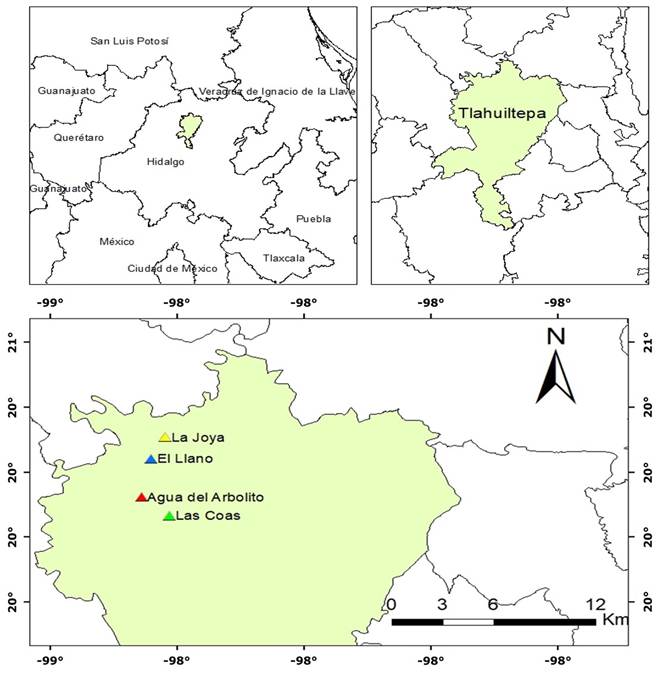 San Luis Potosí = State of San Luis
Potosí; Veracruz de Ignacio de la
Llave = State of Veracruz de Ignacio de la
Llave; Guanajuato = State of
Guanajuato; Querétaro = State
of Querétaro; Hidalgo = State of
Hidalgo; Puebla = State of
Puebla; México = State of
Mexico; Tlaxcala = State of
Tlaxcala; Ciudad de México =
Mexico City; Tlahuiltepa =
Tlahuiltepa municipality. La
Joya = La Joya population; El
Llano = El Llano population;
Agua del Arbolito = Agua del
Arbolito population; Las Coas =
Las Coas population.
San Luis Potosí = State of San Luis
Potosí; Veracruz de Ignacio de la
Llave = State of Veracruz de Ignacio de la
Llave; Guanajuato = State of
Guanajuato; Querétaro = State
of Querétaro; Hidalgo = State of
Hidalgo; Puebla = State of
Puebla; México = State of
Mexico; Tlaxcala = State of
Tlaxcala; Ciudad de México =
Mexico City; Tlahuiltepa =
Tlahuiltepa municipality. La
Joya = La Joya population; El
Llano = El Llano population;
Agua del Arbolito = Agua del
Arbolito population; Las Coas =
Las Coas population.
Figure 1
Geographic location of Dalbergia palo-escrito Rzed. & Guridi-Gómez natural populations in Tlahuiltepa, Hidalgo state, Mexico.
Geographic location of Dalbergia palo-escrito Rzed. & Guridi-Gómez natural populations in Tlahuiltepa, Hidalgo state, Mexico.
Sampling
Through field tours, four populations of D. palo-escrito in Tlahuiltepa municipality, Hidalgo state (Table 1) were identified. The study sites were selected based on the presence of human activity, grazing and disturbance by different agents; they were georeferenced with a model Montana 680 Garmin® GPS. In each one, a 50×50 m quadrant was established, with the representative characteristics of the trees (Galván-Hernández et al., 2020).
-
Galván-Hernández et al., 2020Current status of Magnolia vovidesii (Magnoliaceae, Magnoniales): New data on population trends, spatial structure, and disturbance threatsTropical Conservation Science, 2020
Table 1
Assessed Dalbergia palo-escrito Rzed. & Guridi-Gómez natural populations in Tlahuiltepa municipality, Hidalgo state, Mexico.
Assessed Dalbergia palo-escrito Rzed. & Guridi-Gómez natural populations in Tlahuiltepa municipality, Hidalgo state, Mexico.
| Population | Locality | Latitude | Longitude | Altitude (masl) | Slope (%) |
|---|---|---|---|---|---|
| Las Coas | Demañi | 20°55’35.8” | 98°59’51.4” | 1 635 | 33 |
| Agua del Arbolito | El Duraznito | 20°56’19.8” | 99°00’44.4” | 1 443 | 65 |
| El Llano | El Llano | 20°57’49.8” | 99°00’25.4” | 1 611 | 48 |
| La Joya | Agua Tapada | 20°58’39.8” | 98°59’59.4” | 1 309 | 42 |
The trees were mapped in a Cartesian plane to locate them and then evaluate the spatial density of individuals (Aguirre-Salado et al., 2015). Each one was measured the total height, the bifurcation height (distance to the point where the main axis loses dominance and develops in two or more axes) and clean shaft (m) with a Vertex III Haglöf® hipsometer and its auxiliary transmitter (transponder). For the normal diameter (cm) a model 5M Forestry Suppliers Inc.® with mm precision diamethric tape was used. The shaft shape, the main axis dominance, the insertion angle of the first branch and the crown shape were evaluated according to the numerical scale developed by Acosta-Hernández et al. (2011) and da Cunha et al. (2013) (Table 2). In the quadrants, three transects of 50×1 m were drawn, where 14 disturbance indicators were assessed (Martorell & Peters, 2005).
-
Aguirre-Salado et al., 2015Modeling site selection for tree plantation establishment under different decision scenariosJournal of Tropical Forest Science, 2015
-
Acosta-Hernández et al. (2011)Caracterización morfológica y dasométrica de la especie amenazada Juglans pyriformis LiebmRevista Chapingo Serie Ciencias Forestales y del Ambiente, 2011
-
da Cunha et al. (2013)Linear mixed model to describe the basal area increment for individual cedro (Cedrela odorata L.) trees in Occidental Amazon, BrazilCiência Florestal, 2013
-
Martorell & Peters,
2005The measurement of chronic disturbance and its effects on the threatened cactus Mammillaria pectiniferaBiological Conservation, 2005
Table 2
Classification of variables and descriptors for the morphological characterization of Dalbergia palo-escrito Rzed. & Guridi-Gómez.
Classification of variables and descriptors for the morphological characterization of Dalbergia palo-escrito Rzed. & Guridi-Gómez.
| Stem shape (SS) | Straight |
6 |
| Bifurcation height (BH) | Not bifurcated |
6 |
|
Main axis dominance |
Complete dominance in the initial axis
|
2 |
|
Branch
insertion |
From 0° to 30° |
1 |
| Crown shape (CS) | Circular |
6
|
-
Acosta-Hernández et al. (2011)Caracterización morfológica y dasométrica de la especie amenazada Juglans pyriformis LiebmRevista Chapingo Serie Ciencias Forestales y del Ambiente, 2011
Morphological analysis
Populations were morphologically described by grouping individuals with a cluster analysis using Ward's method based on Euclidean distances (Hidalgo, 2003). Groups were defined by a 1 000-step bootstrap, which consists of a resampling simulation method (Alonso et al., 2002). Group composition was contrasted between populations using the X 2 test (Castañeda-Garzón et al., 2021). For the analysis of diameter structure, histograms of normal diameter classes were created with 5 cm intervals. Statistical analyses were performed with the Statistica program 10.0 version (StatSoft, 2011).
-
Hidalgo, 2003Variabilidad genética y caracterización de especies vegetalesAnálisis estadístico de datos de caracterización morfológica de recursos fitogenéticos, 2003
-
Alonso et al., 2002Una revisión de los métodos de remuestreo en series temporalesEstadística Española, 2002
-
Castañeda-Garzón et al.,
2021Caracterización morfológica y dasométrica de Mimosa trianae y Cassia moschata de la colección de AGROSAVIATemas Agrarios, 2021
-
StatSoft, 2011STATISTICA (data analysis software system), 2011
Disturbance analysis
The methodology of Martorell and Peters (2005) was used to determine the disturbance of the populations. The data were analyzed using principal coordinates with Gower distances (Galindo-García et al., 2019; Gower, 2005) to establish the indicators with the greatest weight in the divergence of the populations. This distance measure allows the integration of continuous and discrete variables. The method measures 14 disturbance indicators that are added together to form the disturbance index, which results from the sum of the total proportion of affectation by each disturbance indicator in the transects.
-
Martorell and Peters
(2005)The measurement of chronic disturbance and its effects on the threatened cactus Mammillaria pectiniferaBiological Conservation, 2005
-
Galindo-García et al., 2019Genetic diversity of sun poinsettia (Euphorbia spp.) in Morelos, Mexico, with RAPD molecular markersRevista Chapingo Serie Horticultura, 2019
-
Gower, 2005Principal coordinates analysisEncyclopedia of biostatistics, 2005
In each population, a 50×50 m plot (2 500 m2) was established and the disturbance indicators were measured along three 50×1 m transects and 20 points in each plot. Both the transect and the points were placed randomly in each plot. Each of the 14 disturbance indicators was measured three times per transect.
Spatial structure analysis
The population density and spatial aggregation pattern of individuals were established using the Coefficient of variation (CV) in the distance between individuals. When the CV is equal to 1, the populations are randomly distributed; when the CV is significantly greater than 1, the populations are spatially ordered, and when the CV is significantly less than one, then the populations are distributed in an aggregated manner (Dale & Fortin, 2014; Octavio-Aguilar et al., 2017; Rivera-Fernández et al., 2012). To corroborate the relationship between the CV and the unit, t tests were used.
-
Dale & Fortin, 2014Spatial analysis: A guide for ecologists, 2014
-
Octavio-Aguilar et al., 2017Fine-scale genetic structure of Zamia furfuracea: variation with life-cycle stagesInternational Journal of Plant Sciences, 2017
-
Rivera-Fernández et al., 2012Population structure and spatial distribution of Ceratozamia mexicana Brongn. (Zamiaceae) in preserved and disturbed environmentsTropical and Subtropical Agroecosystems, 2012
Basal area analysis and Shannon Index
To determine the dominance of D. palo-escrito over other species through density, the basal area per individual (g) was calculated with the formula:
e3
g
=
π
4
×
d
2
(1)
Where:
g = Basal area per individual
d 2 = Density of individuals per square meter in each population, obtained from the sum of all individuals at the sampling site
The basal area per hectare (G) was obtained by extrapolation (Shannon & Weaver, 1949). The Shannon Index was also established to determine species diversity and relative abundance of individuals per population, assuming that these two factors influence community heterogeneity (Pla, 2006; Shannon & Weaver, 1949). The following formula was used:
-
Shannon & Weaver, 1949The mathematical theory of communication, 1949
-
Pla, 2006Biodiversidad: inferencia basada en el índice de Shannon y la riquezaInterciencia, 2006
-
Shannon & Weaver,
1949The mathematical theory of communication, 1949
e4
H
´
=
-
Σ
p
i
log
p
i
(2)
Where:
pi = Relative abundance of i species:
ni = Number of individuals of i species
N = Total number of species
Results and Discussion
Morphological structure
Four morphological groups were detected by cluster analysis, the main variation of which is due to mensuration characteristics (Table 3). The four populations differ significantly in terms of their composition of morphological groups (Xi 2>19.3 in all comparisons, p≤0.01). Individuals from Group 3 (Agua del Arbolito) presented better attributes (straight, non-bifurcated trunk and complete dominance in the initial axis) for wood production, followed by Group 4 (El Llano). The population of La Joya (Group 1) had the highest proportion of young individuals, while the population with the highest dominance of intermediate trees corresponds to Las Coas (Group 2). The differences in the morphological structure of the populations analyzed are shown by means of the normal diameter (Figure 2).
Table 3
Cluster analysis for morphological descriptors that indicate characteristics for timber activity.
Cluster analysis for morphological descriptors that indicate characteristics for timber activity.
| ND | TH | CS | SS | BH | MAD | BIA | CS | N | |
|---|---|---|---|---|---|---|---|---|---|
| Group 1 | 3.6±2.1 | 3.5±2.0 | 2.5±1.7 | 4.0±1.9 | 5.0±1.7 | 0.7±0.8 | 2.0±0.5 | 1.6±0.9 | 48 |
| Group 2 | 12.6±3.9 | 10.7±2.6 | 5.9±2.6 | 2.3±1.0 | 3.6±1.5 | 1.6±0.5 | 2.1±0.5 | 3.3±1.3 | 115 |
| Group 3 | 15.9±3.7 | 20.4±2.7 | 9.9±4.9 | 2.8±1.1 | 3.5±1.2 | 1.8±0.4 | 2.0±0.5 | 3.6±1.2 | 75 |
| Group 4 | 32.2±6.7 | 18.6±5.2 | 4.7±2.1 | 2.3±1.0 | 2.1±1.1 | 1.5±0.6 | 2.5±0.5 | 3.9±1.3 | 30 |
-
Acosta-Hernández et al.
(2011)Caracterización morfológica y dasométrica de la especie amenazada Juglans pyriformis LiebmRevista Chapingo Serie Ciencias Forestales y del Ambiente, 2011
Thumbnail
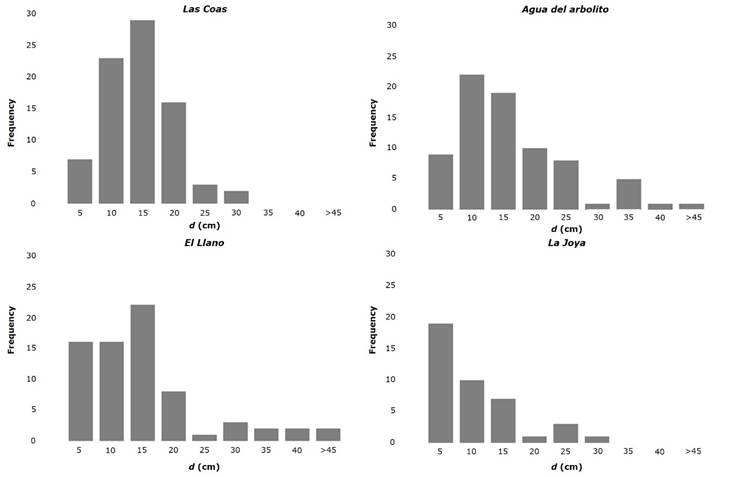
Figure 2
Diameter distribution in four Dalbergia palo-escrito Rzed. & Guridi-Gómez natural populations in Tlahuiltepa municipality, Hidalgo state, Mexico.
Diameter distribution in four Dalbergia palo-escrito Rzed. & Guridi-Gómez natural populations in Tlahuiltepa municipality, Hidalgo state, Mexico.
Disturbance analysis
The natural population of trees with the highest disturbance index was La Joya (7.6), while the group of trees under conservation conditions is located in the Las Coas population (4.1). Likewise, the latter is considered a secondary forest due to natural regeneration of around 20 years, the last five as a private reserve; this has limited the entry of cattle, loggers and hunters (Table 4). The Agua del Arbolito population received silvopastoral management by leaving D. palo-escrito as a shade species for the growth of forage. The trees in the group are around 18 years old, and are associated with livestock and wood extraction; the largest individuals in height and diameter of the evaluated populations were found there.
Table 4
Disturbance of Dalbergia palo-escrito Rzed. & Guridi-Gómez natural populations in Tlahuiltepa municipality, Hidalgo state, Mexico.
Disturbance of Dalbergia palo-escrito Rzed. & Guridi-Gómez natural populations in Tlahuiltepa municipality, Hidalgo state, Mexico.
| Agent | Indicator | La Joya* | Agua delArbolito* | El Llano* | Las Coas* |
|---|---|---|---|---|---|
| Human activities | w | 0.55 | 0.65 | 0.30 | 0.26 |
| a | 1.00 | 1.00 | 1.00 | 1.00 | |
| tb | 0.61 | 0.34 | 0.36 | 0.61 | |
| f | 0.67 | 0.33 | 0.33 | 0.33 | |
| p | 1.00 | 1.00 | 1.00 | 0.00 | |
| u | 1.00 | 1.00 | 1.00 | 1.00 | |
| Livestock activity | b | 0.61 | 0.47 | 0.06 | 0.07 |
| tt | 0.34 | 0.12 | 0.06 | 0.02 | |
| dc | 0.60 | 0.40 | 0.30 | 0.20 | |
| dg | 0.00 | 0.00 | 0.00 | 0.00 | |
| c | 0.78 | 0.72 | 0.63 | 0.65 | |
| Habitat deterioration | e | 0.25 | 0.15 | 0.10 | 0.05 |
| i | 0.00 | 0.00 | 0.00 | 0.00 | |
| m | 0.00 | 0.00 | 0.00 | 0.00 | |
| Disturbance index | 7.60 | 6.29 | 5.14 | 4.19 | |
-
Martorell & Peters,
2005The measurement of chronic disturbance and its effects on the threatened cactus Mammillaria pectiniferaBiological Conservation, 2005
The trees of El Llano are under agroforestry management for agricultural activities (production of corn, beans, squash, striped chili, among other crops) and silvopastoral for cutting grass as fodder for cattle and sheep. The trees were remnants of selective cutting and are approximately 25 years old, which favors the development of crops and pastures. Finally, the trees of the La Joya population have been disturbed by slash-and-burn activities in order to form pastures, where the D. palo-escrito species protects the cattle with shade. The trees have about 10 years of natural regeneration, and it is confirmed that the species is heliophilous since vigorous juvenile individuals were found in open sites with full sun exposure. The highest disturbance index was determined at this site.
The results of the present study are similar to those reported by Cervantes (2016) and Gálvez (2009) because they show the same risk of disturbance of natural populations from the extraction of wood by rural communities for local use, coupled with the intrinsic threats to its biology such as its natural scarcity and slow growth, which have seriously impacted natural populations (Cervantes et al., 2019). This situation has led to all native Mexican timber species of Dalbergia L. f. being classified under some risk category, which are listed under protection by CITES and competent Mexican authorities (NOM-059-SEMARNAT-2010) (Cervantes et al., 2019).
-
Cervantes (2016)La conservación del Granadillo en México: una carrera contra el tiempoBiodiversitas, 2016
-
Gálvez (2009)Perfil Ambiental de Guatemala 2008-2009: Las señales ambientales críticas y su relación con el desarrollo, 2009
-
Cervantes et al., 2019An updated checklist of the Mexican species of Dalbergia (Leguminosae) to aid in its conservation effortsRevista Mexicana de Biodiversidad, 2019
-
Cervantes et al., 2019An updated checklist of the Mexican species of Dalbergia (Leguminosae) to aid in its conservation effortsRevista Mexicana de Biodiversidad, 2019
Spatial structure analysis
Trees in the Agua del Arbolito natural population are on average 24.1±12.4 m apart from each other, with a Coefficient of variation significantly lower than one (CV=0.52, p≤0.01), indicating a spatial aggregation pattern (patched); the population density was 300 individuals ha-1. In the El Llano population, the average distance between individuals was 18.0±10.7 meters, with a Coefficient of Variation less than one (CV=0.59, p≤0.001), also corresponding to an aggregated pattern; the population density was 280 individuals ha-1. The natural population La Joya had the lowest tree density with 160 ind ha-1, with a distance between individuals of 27.4±15.1 m and a Coefficient of Variation less than one (CV=0.55, p≤0.01). Finally, the Las Coas tree population had an aggregated pattern (CV=0.61, p≤0.01) and distances between individuals of 22.8±13.8 m, with a density of 320 ind ha-1. The species in natural environments had a clumped pattern (Figure 3), regardless of disturbance or light availability, which has been linked to deficiency in seed dispersal and habitat loss due to fragmentation (Arasa-Gisbert et al., 2021) or for conservation purposes (Fahrig et al., 2019).
-
Arasa-Gisbert et al., 2021El debate sobre los efectos de la fragmentación del hábitat: causas y consecuenciasEcosistemas, 2021
-
Fahrig et al., 2019Is habitat fragmentation bad for biodiversity?Biological Conservation, 2019
Thumbnail
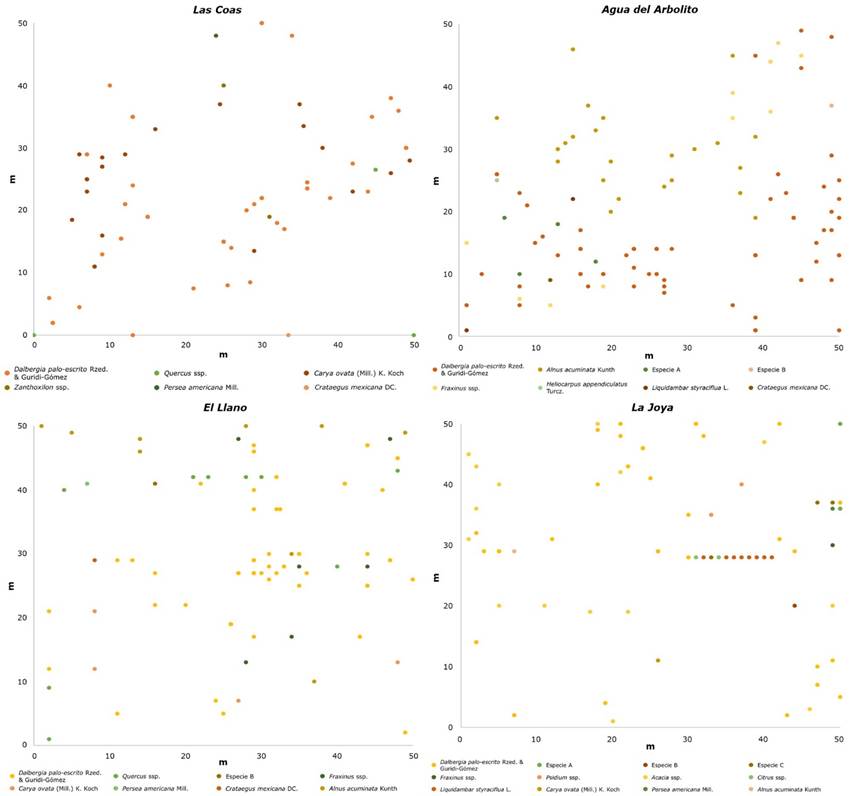
Figure 3
Spatial distribution of trees Dalbergia palo-escrito Rzed. & Guridi-Gómez in natural populations in Tlahuiltepa municipality, Hidalgo state, Mexico.
Spatial distribution of trees Dalbergia palo-escrito Rzed. & Guridi-Gómez in natural populations in Tlahuiltepa municipality, Hidalgo state, Mexico.
Basal area analysis and Shannon index
The natural population Las Coas presented less species diversity, and was also the least disturbed. In contrast, the La Joya population had the highest species diversity, low density, and highest disturbance. This suggests that species diversity in populations may be related to the intensity of disturbance. According to the Shannon index (H’: <2 low diversity and >3 high diversity), the natural populations of D. palo-escrito in Tlahuiltepa municipality, Hidalgo state, had lower values than two in the referred index (Las Coas 1.3, Agua del Arbolito 1.5, El Llano 1.6, and La Joya 1.8). This means low species diversity due to the current land use for agroforestry and silvopasture.
However, D. palo-escrito remains the predominant species in the region (Figure 4). The results of the present research are similar in the morphological traits to those that Onaindia et al. (2013) described for Quercus robur L. and Pinus radiata D. Don. in older tree populations. In the basal area variable for Pinus spp., gains were obtained in basimetric composition (Hernández-Salas et al., 2013) and modifying tree density promoted a greater abundance of individuals (Barefoot et al., 2019). In Pinus hartwegii Lindl. forests, morphological gains were recorded in height and normal diameter (Rojas-García et al., 2022).
-
Onaindia et al. (2013)Can understorey native woodland plant species regenerate under exotic pine plantations using natural succession?Forest Ecology and Management, 2013
-
Hernández-Salas et al.,
2013Efecto del manejo forestal en la diversidad y composición arbórea de un bosque templado del noroeste de MéxicoRevista Chapingo Serie Ciencias Forestales y del Ambiente, 2013
-
Barefoot et al., 2019Effects of thinning and prescribed fire frequency on ground flora in mixed Pinus-hardwood standsForest Ecology and Management, 2019
-
Rojas-García et al., 2022Efecto de corta de saneamiento sobre el crecimiento radial del bosque de Pinus hartwegiiMadera y Bosques, 2022
Thumbnail
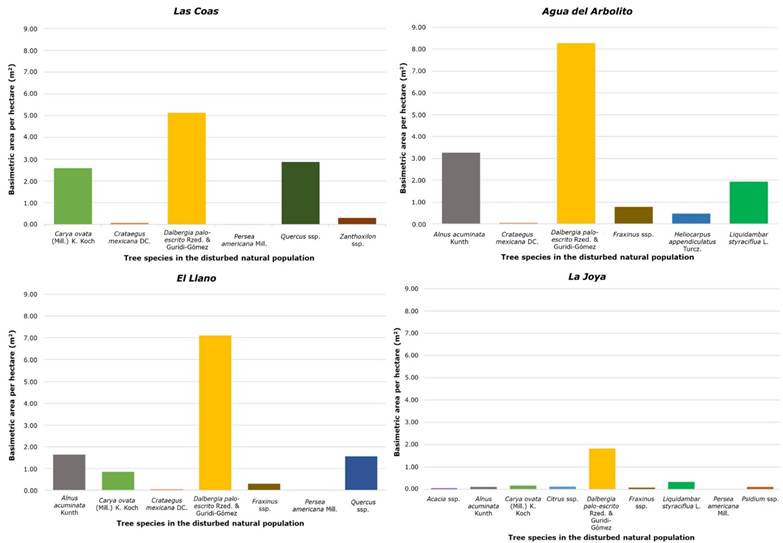
Figure 4
Basal area distribution of tree species in four Dalbergia palo-escrito Rzed. & Guridi-Gómez natural populations in Tlahuiltepa municipality, Hidalgo state, Mexico.
Basal area distribution of tree species in four Dalbergia palo-escrito Rzed. & Guridi-Gómez natural populations in Tlahuiltepa municipality, Hidalgo state, Mexico.
In another study, Douglas fir forests (Pseudotsuga menziesii (Mirb.) Franco) have been used as a model to evaluate the gain and loss of morphological traits under different levels of disturbance (Linares & Samain, 2019).
-
Linares & Samain, 2019Dalbergia glomerata. The IUCN Red List of Threatened Species, 2019
Conclusions
Moderate disturbance by cattle and loggers in natural populations of Dalbergia palo-escrito favors population density and morphological conformation of trees for sawmilling purposes. Its spatial distribution is aggregated and generates suitable conditions for the use of the species in agrosilvopastoral systems in the region. However, high levels of disturbance compromise the conservation of natural populations of D. palo-escrito in Tlahuiltepa municipality, Hidalgo state, Mexico.
Acknowledgements
The authors wish to express their gratitude to the National Council of Humanities, Science and Technology (Conahcyt). To Dr. Raúl Ortiz Pulido in the “Las Coas Private Reserve”; to Mr. Antonio Rivera Ramírez in “El Llano”; Mr. Salomón Rubio Muñoz at “La Joya” and Mrs. Sidronia Trejo Chávez at “Agua del Arbolito” for allowing this work to be carried out on their properties. And to the contributors to this article for their cooperation.
Referencias
- Acosta-Hernández, C. C., Luna-Rodríguez, M., Noa-Carrazana, J. C., Galindo-González, J., Vázquez-Torres, S. M., Morales-Romero, Z. e Iglesias-Andreu, L. G. (2011). Caracterización morfológica y dasométrica de la especie amenazada Juglans pyriformis Liebm. Revista Chapingo Serie Ciencias Forestales y del Ambiente, 17(1), 59-67. https://doi.org/10.5154/r.rchscfa.2010.03.015 Links
- Aguirre-Salado, C. A., Valdéz-Lazalde, J. R., Sánchez-Díaz, G., Miranda-Aragón, L. & Aguirre-Salado, A. I. (2015). Modeling site selection for tree plantation establishment under different decision scenarios. Journal of Tropical Forest Science, 27(3), 298-313. https://www.jstor.org/stable/43490288 Links
- Alfaro, R. I., Fady, B., Vendramin, G. G., Dawson, I. K., Fleming, R. A., Sáenz-Romero, C., Lindig-Cisneros, R. A, Murdock, T., Vinceti, B., Navarro, C. M., Skroppa, T., Baldinelli, G., El-Kassaby, Y. A. & Loo, J. (2014). The role of forest genetic resources in responding to biotic and abiotic factors in the context of anthropogenic climate change. Forest Ecology and Management, 333, 76-87. https://doi.org/10.1016/j.foreco.2014.04.006 Links
- Alonso, A. M., Peña, D. y Romo, J. 2002. Una revisión de los métodos de remuestreo en series temporales. Estadística Española, 44(150), 133-159. https://halweb.uc3m.es/esp/Personal/personas/dpena/publications/castellano/2002EE_alonso_romo.pdf Links
- Arasa-Gisbert, R., Arroyo-Rodríguez, V. y Andresen, E. (2021). El debate sobre los efectos de la fragmentación del hábitat: causas y consecuencias. Ecosistemas, 30(3), 2156. https://doi.org/10.7818/ECOS.2156 Links
- Barefoot, C. R., Willson, K. G., Hart, J. L., Schweitzer, C. J. & Dey, D. C. (2019). Effects of thinning and prescribed fire frequency on ground flora in mixed Pinus-hardwood stands. Forest Ecology and Management, 432, 729-740. https://doi.org/10.1016/j.foreco.2018.09.055 Links
- Budde, K. B., Nielsen, L. R., Ravn, H. P. & Kjær, E. D. (2016). The natural evolutionary potential of tree populations to cope with newly introduced pests and pathogens-lessons learned from forest health catastrophes in recent decades. Current Forestry Reports, 2, 18-29. https://link.springer.com/article/10.1007/s40725-016-0029-9 Links
- Castañeda-Garzón, S. L., Moreno-Barragán, J., Argüelles-Cárdenas, J. H., Camargo-Tamayo, H. y Zuluaga-Peláez, J. J. 2021. Caracterización morfológica y dasométrica de Mimosa trianae y Cassia moschata de la colección de AGROSAVIA. Temas Agrarios, 26(1), 46-57. https://www.researchgate.net/publication/357280425_Morphological_and_dasometric_characterization_of_Mimosa_trianae_and_Cassia_moschata_from_AGROSAVIA_collection Links
- Cervantes M., A. (2016). La conservación del Granadillo en México: una carrera contra el tiempo. Biodiversitas, 128, 6-11. https://bioteca.biodiversidad.gob.mx/janium/Documentos/12765.pdf Links
- Cervantes, A., Linares, J. & Quintero, E. (2019). An updated checklist of the Mexican species of Dalbergia (Leguminosae) to aid in its conservation efforts. Revista Mexicana de Biodiversidad, 90(2019), Article e902528. https://doi.org/10.22201/ib.20078706e.2019.90.2528 Links
- Cohen, W. B., Yang, Z., Stehman, S. V., Schroeder, T. A., Bell, D. M., Masek, J. G., Huang, C. & Meigs, G. W. (2016). Forest disturbance across the conterminous United States from 1985-2012: The emerging dominance of forest decline. Forest Ecology and Management, 360, 242-252. https://doi.org/10.1016/j.foreco.2015.10.042 Links
- da Cunha, T. A., Guimarães F., C. A. & Schneider, P. R. 2013. Linear mixed model to describe the basal area increment for individual cedro (Cedrela odorata L.) trees in Occidental Amazon, Brazil. Ciência Florestal, 23(3), 461-470. https://doi.org/10.5902/1980509810557 Links
- Dale, M. R. T. & Fortín, M. J. (2014). Spatial analysis: A guide for ecologists. Cambridge University Press. Links
- De La Cruz-Cabrera, V. y Contreras, M. (2019). Alteraciones ambientales por perturbaciones antropogénicas en dos fragmentos de bosques: un sistema de agroforestería y un bosque natural secundario en regeneración. Revista Científica Orbis Cógnita, 3(2), 57-72. https://revistas.up.ac.pa/index.php/orbis_cognita/article/view/755 Links
- Fahrig, L., Arroyo-Rodríguez, V., Bennett, J. R., Boucher-Lalonde, V., Cazetta, E., Currie, D. J., Eigenbrod, F., Ford, A. T., Harrison, S. P., Jaeger, J. A. G., Koper, N., Martin, A. E., Martin, J. L., Metzger, J. P., Morrison, P., Rhodes, J. R., Saunders, D. A., Simberloff, D., Smith, A. C., … Watling, J. I. (2019). Is habitat fragmentation bad for biodiversity? Biological Conservation, 230, 179-186. https://doi.org/10.1016/j.biocon.2018.12.026 Links
- Funk, J. L., Larson, J. E., Ames, G. M., Butterfield, B. J., Cavender-Bares, J., Firn, J., Laughlin, D. C., Sutton-Grier, A. E., Williams, L. & Wright, J. (2017). Revisiting the Holy Grail: using plant functional traits to understand ecological processes. Biological Reviews, 92(2), 1156-1173. https://doi.org/10.1111/brv.12275 Links
- Galindo-García, D. V., Alia-Tejacal, I., Núñez-Colin, C. A., Andrade-Rodríguez, M., Canul-Ku, J., Colinas-León, M. T. & Sainz-Aispuro, M. de J. (2019). Genetic diversity of sun poinsettia (Euphorbia spp.) in Morelos, Mexico, with RAPD molecular markers. Revista Chapingo Serie Horticultura, 25(2), 113-127. https://doi.org/10.5154/r.rchsh.2018.06.012 Links
- Galván-Hernández, D. M., Octavio-Aguilar, P., Bartolo-Hernández, C. de J., García-Montes, M. A., Sánchez-González, A., Ramírez-Bautista, A. & Vovides, A. (2020). Current status of Magnolia vovidesii (Magnoliaceae, Magnoniales): New data on population trends, spatial structure, and disturbance threats. Tropical Conservation Science, 13(1), 1-12. https://doi.org/10.1177/1940082920923894 Links
- Gálvez, J. (Coord.). (2009). Perfil Ambiental de Guatemala 2008-2009: Las señales ambientales críticas y su relación con el desarrollo. Universidad Rafael Landívar e Instituto de Agricultura, Recursos Naturales y Ambiente de la Universidad Rafael Landívar. https://www.url.edu.gt/publicacionesurl/FileCS.ashx?Id=41026 Links
- Gower, J. C. (2005). Principal coordinates analysis. In P. Armitage & T. Colton (Eds.). Encyclopedia of biostatistics. (pp. 3514-3518). John Wiley & Sons. https://doi.org/10.1002/0470011815.b2a13070 Links
- Hernández-Salas, J., Aguirre-Calderón, Ó. A., Alanís-Rodríguez, E., Jiménez-Pérez, J., Treviño-Garza, E. J., González-Tagle, M. A., Luján-Álvarez, C., Olivas-García, J. M. y Domínguez-Pereda, L. A. (2013). Efecto del manejo forestal en la diversidad y composición arbórea de un bosque templado del noroeste de México. Revista Chapingo Serie Ciencias Forestales y del Ambiente, 19(2), 189-199. https://doi.org/10.5154/r.rchscfa.2012.08.052 Links
- Hidalgo, R. (2003). Variabilidad genética y caracterización de especies vegetales. En T. L. Franco y R. Hidalgo (Eds.). Análisis estadístico de datos de caracterización morfológica de recursos fitogenéticos (pp. 2-26). Instituto Internacional de Recursos Fitogenéticos (Ipgri). https://cgspace.cgiar.org/server/api/core/bitstreams/40ad97cf-daba-48d0-a80f-2b1d9803c738/content Links
- Instituto Nacional de Estadística y Geografía. (2003). Tlahuiltepa, Estado de Hidalgo. Cuaderno estadístico municipal . Edición 2003. Instituto Nacional de Estadística y Geografía. https://www.inegi.org.mx/app/biblioteca/ficha.html?upc=702825935771 Links
- Linares, J. & Samain, M. S. (2019, March 26). Dalbergia glomerata. The IUCN Red List of Threatened Species 2019: e.T36144A148392849. Red List. https://www.iucnredlist.org/species/36144/148392849 Links
- Martorell, C. & Peters, E. M. (2005). The measurement of chronic disturbance and its effects on the threatened cactus Mammillaria pectinifera. Biological Conservation, 124(2), 199-207. https://doi.org/10.1016/j.biocon.2005.01.025 Links
- McDowell, N. G., Allen, C. D., Anderson-Teixeira, K., Aukema, B. H., Bond-Lamberty, B., Chini, L., Clark, J. S., Dietze, M., Grossiord, C., Hanbury-Brown, A., Hurtt, G. C., Jackson, R. B., Johnson, D. J., Kueppers, L., Lichstein, J. W., Ogle, K., Poulter, B., Pugh, T. A. M., Seidl, R., … Xu, C. (2020). Pervasive shifts in forest dynamics in a changing world. Science, 368(6494), Article eaaz9463. https://doi.org/10.1126/science.aaz9463 Links
- Octavio-Aguilar, P., Iglesias-Andreu, L. G., Núñez de Cáceres-González, F. F. & Galván-Hernández, D. M. (2017). Fine-scale genetic structure of Zamia furfuracea: variation with life-cycle stages. International Journal of Plant Sciences, 178(1), 57-66. https://doi.org/10.1086/689200 Links
- Onaindia, M., Ametzaga-Arregi, I., San Sebastián, M., Mitxelena, A., Rodríguez-Loinaz, G., Peña, L. & Alday, J. G. (2013). Can understorey native woodland plant species regenerate under exotic pine plantations using natural succession? Forest Ecology and Management, 308, 136-144. https://doi.org/10.1016/j.foreco.2013.07.046 Links
- Pla, L. (2006). Biodiversidad: inferencia basada en el índice de Shannon y la riqueza. Interciencia, 31(8), 583-590. https://www.redalyc.org/articulo.oa?id=33911906 Links
- Rivera-Fernández, A., Octavio-Aguilar, P., Sánchez-Coello, N. G., Sánchez-Velázquez, L. R., Vázquez-Torres, S. M. & Iglesias-Andreu, L. G. (2012). Population structure and spatial distribution of Ceratozamia mexicana Brongn. (Zamiaceae) in preserved and disturbed environments. Tropical and Subtropical Agroecosystems, 15(2), S110-S117. https://www.redalyc.org/articulo.oa?id=93924626016 Links
- Rojas-García, F., Gómez-Guerrero, A., Endara-Agramont, Á. R., Gutiérrez G., G., Reyes H., V. J., Ángeles P., G. y de Jong, B. H. J. (2022). Efecto de corta de saneamiento sobre el crecimiento radial del bosque de Pinus hartwegii. Madera y Bosques, 28(2), Artículo e2822402. https://doi.org/10.21829/myb.2022.2822402 Links
- Rzedowski, J. y Guridi-Gómez, L. I. (1988). El palo escrito, árbol de madera preciosa-una nueva especie mexicana de Dalbergia (Leguminosae, Papilionoideae). Acta Botánica Mexicana, 4, 1-8. https://abm.ojs.inecol.mx/index.php/abm/article/view/568/735 Links
- Shannon, C. E. & Weaver, W. (1949). The mathematical theory of communication. The University of Illinois Press: Urbana. https://archive.org/details/in.ernet.dli.2015.503815/page/n5/mode/2up Links
- Silvério, D. V., Brando, P. M., Bustamante, M. M. C., Putz, F. E., Marra, D. M., Levick, S. R. & Trumbore, S. E. (2019). Fire, fragmentation, and windstorms: A recipe for tropical forest degradation. Journal of Ecology, 107(2), 656-667. https://doi.org/10.1111/1365-2745.13076 Links
- Sistema Integral de Información del Estado de Hidalgo. (2011). Enciclopedia de los municipios de Hidalgo. Tlahuiltepa. Gobierno del Estado de Hidalgo. Secretaría de Planeación, desarrollo regional y metropolitano. http://docencia.uaeh.edu.mx/estudios-pertinencia/docs/hidalgo-municipios/Tlahuiltepa-Enciclopedia-De-Los-Municipios.pdf Links
- StatSoft Inc. (2011). STATISTICA (data analysis software system) . Versión 10. http://www.statsoft.com Links
- Suárez-Islas, A., Capulín-Grande, J. & Mateo-Sánchez, J. J. (2020). Performance of Dalbergia palo-escrito Rzed. & Guridi-Gómez, a valuable timber tree, in a coffee plantation in Hidalgo, Mexico. Bois et Forêts des Tropiques, 344, 47-57. https://doi.org/10.19182/bft2020.344.a31899 Links
- Zheng, Y., Liu, J., Feng, X. & Gong, X. (2017). The distribution, diversity, and conservation status of Cycas in China. Ecology and Evolution, 7(9), 3212-3224. https://doi.org/10.1002/ece3.2910 Links