




Servicios Personalizados
Revista
Articulo
 texto en
  Inglés (pdf)
 Artículo en XML
 Referencias del artículo
 Traducción automática
 Enviar artículo por email
Indicadores
-
 Citado por SciELO
 -
 Accesos
Links relacionados
-
 Similares en
SciELO
Similares en
SciELO
Compartir

 Permalink
Revista mexicana de ciencias agrícolas
versión impresa ISSN 2007-0934
Rev. Mex. Cienc. Agríc vol.17 no.2 Texcoco feb./mar. 2026 Epub 05-Jun-2026
https://doi.org/10.29312/remexca.v17i2.4227
Articles
Quality, morphometry and mineral composition of Agave spp. seeds in Oaxaca
1Tecnológico Nacional de México-Instituto Tecnológico del Valle de Oaxaca. Ex-Hacienda de Nazareno, Santa Cruz Xoxocotlán, Oaxaca, México. CP. 71230.
The seed is a reproductive organ of vascular plants from which a new individual is generated. Quality tests were conducted on seeds of five agave species, and morphometry and nutritional content were determined; the latter was compared with the soil’s mineral content. The collection of seeds and soil was carried out in some localities in the Central Valleys and Mixteca regions of Oaxaca during 2024. A. potatorum and A. salmiana presented the highest germination values, with 65.5% and 58.3%, respectively; A. americana significantly showed the highest weight of 1 000 seeds, with 11.2 g ±0.96; in moisture content, A. salmiana and A. karwinskii showed higher values. A. nussaviorum presented the highest weight gain with 389.4%; in the determination of viability, A. potatorum reflected the highest value with 72.8%. In the morphometric analysis, a cumulative variation of 61.1% was detected, with an overlap of ellipses between the species. A higher concentration of Zn, Fe, and Na was found as predominant elements in the seed; their values were not related to the concentration in the soil. The soil’s physical and chemical characteristics were diverse. In a principal component analysis with all variables, the first three components accounted for 89% of the total variance. With this methodology, the variables that reduce dimensionality were identified, giving greater significance to certain minerals.
Keywords: Agave spp.; germination; minerals; soil
La semilla es un órgano reproductivo de plantas vasculares de la cual se genera un nuevo individuo. En semillas de cinco especies de agave se realizaron pruebas de calidad, se determinó la morfometría y el contenido nutrimental, esto último se comparó con el contenido mineral del suelo. La recolección de semillas y suelo se realizó en algunas localidades de la región de Valles Centrales de Oaxaca y de la mixteca durante el 2024. A. potatorum y A. salmiana presentaron los valores más altos de germinación, con 65.5% y 58.3%, respectivamente, A. americana mostró significativamente el mayor peso de 1 000 semillas con 11.2 g ±0.96; en contenido de humedad A. salmiana y A. karwinskii mostraron valores más altos. A. nussaviorum presentó la mayor ganancia de peso con 389.4%; en la determinación de viabilidad A. potatorum reflejó el valor más alto con 72.8%. En el análisis morfométrico, se detectó una variación acumulada del 61.1%, con una superposición de elipses entre las especies. Se encontró mayor concentración de Zn, Fe y Na como elementos predominantes en la semilla, sus valores no se encontraron relacionados a la concentración en el suelo. Las características físicas y químicas del suelo fueron diversas. En un análisis de componentes principales con todas las variables se encontró una varianza total con los primeros tres componentes con un total del 89% de variabilidad. Con esta metodología se identificaron las variables que reducen la dimensionalidad, otorgando una mayor significancia a determinados minerales.
Palabras clave: Agave spp.; germinación; minerales; suelo
Introduction
The seed is a reproductive organ of higher vascular plants, composed of energy reserves that allow the growth and development of a new individual. It is formed from the plant ovule after fertilization; its structure includes fats, carbohydrates, and proteins that sustain the future plant during its first stages of life. These reserves can be found in different tissues or in the embryo (Doria, 2010). The concentration of essential elements represents an outstanding characteristic of seeds, which has implications for plants, since they participate as structural components of biomolecules or have a function as catalysts that guarantee their vital processes (Hernández-Mora et al., 2025).
Based on their tolerance to dehydration and temperature, the seeds are classified as orthodox, intermediate and recalcitrant. The former store carbohydrates and have a long latency cycle; the latter accumulate a high lipid content, but their longevity is reduced, since fatty acids deteriorate with storage (Gutiérrez-Hernández et al., 2020). It is advisable to determine the quality of the seeds to define viability and germination quickly and uniformly, which translates into a better rate of obtaining vigorous seedlings. The mineral content of seeds can vary across varieties, environmental factors and associated cultural practices (Temel, 2021).
Seed quality is associated with their ability to produce physiologically viable propagation material and with the fulfillment of different physical characteristics (ISTA, 2016). Determining the mineral composition of agave seeds enables us to understand the criteria for their germination and growth, as well as the storage conditions to maintain their dormancy. In this context, the present study aimed to evaluate the seeds of five agave species using quality tests, to identify morphometric variation, and to determine the macro and microelement content and the soil mineral content.
Materials and methods
During 2024, physiologically mature capsules of five Agave species were collected, along with their respective soil samples at a depth of 30 cm, that is, four individuals from Santa Cruz Mixtepec, one from Santa Cruz, Xoxocotlán, one from San Martín Mexicapam, one from Ocotlán de Morelos (these municipalities belong to the region of the Central Valleys), and seven individuals from San Vicente Nuñú, Teposcolula, in the Mixteca region. The capsules were dried in the shade and the seeds were extracted for further processing in the different tests.
Seed quality tests
For each plant, 50 black seeds were selected in triplicate. Germination (Al-Ansari and Ksiksi, 2016), imbibition, viability and moisture content were determined. For the weight of 1 000 seeds, 10 groups of 100 seeds of each species were formed. These tests were conducted in accordance with international rules for seed analysis (ISTA, 2016).
Mineral analysis of seeds and soil
From each plant, seeds were ground to obtain a duplicate 0.5 g sample for wet digestion. A mixture of nitric acid and perchloric acid in a 2:1 ratio was used; once digested, the sample was made up to a volume of 50 ml with distilled water. The determination of the minerals Cu, Zn, Mn, Fe, Mg, Ca, Na and K in seeds was carried out by atomic absorption spectrophotometry (Thermo Scientific®, Model iCE 3000 Series) based on official methods of analysis (AOAC, 1990). The content of S and P was quantified with an ultraviolet-visible spectrophotometer (GBC©, Cintra Model). The soil samples were analyzed based on the Official Mexican Standard (NOM-021-RECNAT-2000, 2002). Texture, pH, electrical conductivity and organic matter content were determined. The quantified elements were Cu, Zn, Mn, Fe, Mg, Ca, Na, K, P and S.
Morphometric analysis
Photographs of 20 seeds for each species were taken; in each image, reference points were detected with the Makefan8 program, the TPSutil 1.44-2009 software, and the TPSdig2 2.32-2021 software and 10 landmarks were placed on each, which were analyzed with the MorphoJ software, version 1.08.02.
Results and discussion
Germination
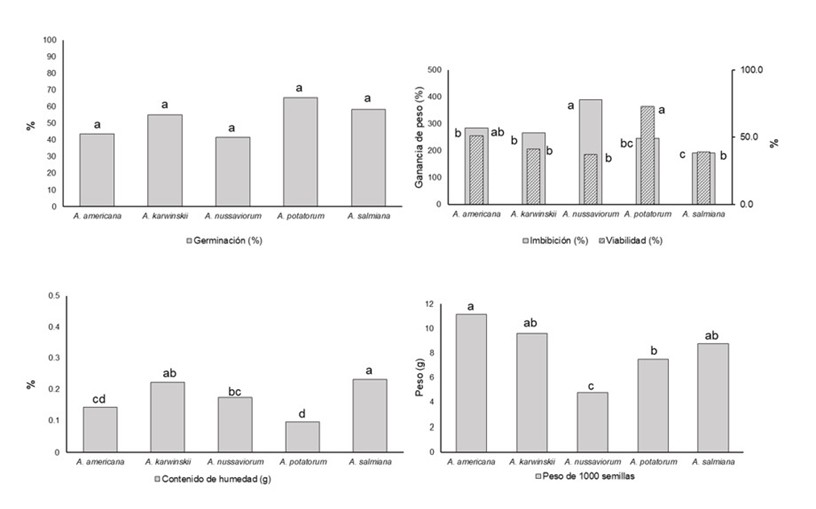
A. potatorum and A. salmiana presented the highest values (65.5% and 58.3%, respectively). A. americana and A. nussaviorum had lower percentages (43.8% and 41.6%, respectively); no significant differences were detected between species (p > 0.05). Fernandez et al. (2019) reported a high germination percentage for A. potatorum (>90%) without any pre-germination treatment, and they considered the time of seed harvest as a determining factor; that is, the shorter the storage time, the higher the germination percentage. The same germination pattern associated with storage time was observed by Martínez-Rodríguez et al. (2022) in A. marmorata, who reported germination of 90% and 77% for seeds with 12 and 18 months of storage, respectively. For their part, Ramírez-Tobias et al. (2012) also reported a high value in the germination of seeds of A. salmiana (> 60%) and associated it with the temperature of the water used in the imbibition, less than 15 °C (Figure 1).
Weight and moisture content
A. americana showed the highest weight of 1 000 seeds (11.2 g) significantly and A. nussaviorum had the lowest weight (4.8 g). This is because the first seeds are larger in size (length: 10.4 mm x width: 7.3 mm x thickness: 0.78 mm) and the second are smaller (length: 6.7 mm x width: 4.6 mm x thickness: 0.38 mm) (Figure 1). In their study, Hernández et al. (2023) reported a weight of 4.2 and 4.6 g for the same number of seeds of A. cupreata and 10.9 g for A. angustifolia; they also demonstrated a close association between seed weight and the amount of reserve substances, which could be reflected as an increase in germination capacity. The moisture content was less than 5% of the weight of each batch in the five species. A. salmiana and A. karwinskii showed significantly higher values, whereas A. potatorum presented the lowest value (Figure 1). The moisture percentage differs from that reported by Bejarano-León et al. (2011) for A. victoria-reginae (9%).
Imbibition and viability
A. nussaviorum presented the highest percentage of weight gain (389.4%), significantly higher than A. salmiana, which showed the lowest water absorption level (190.4%). This same behavior was observed in seeds of Opuntia sp. by Monroy-Vázquez et al. (2017) (Figure 1). The highest significant viability value was in A. potatorum (72.8%). Authors such as Gutiérrez-Hernández et al. (2020) classify A. potatorum seeds as recalcitrant due to the loss of lipid content and the decrease in the percentage of germination due to the time of collection (Lechuga-Campuzano et al., 2025) (Figure 1).
Mineral analysis in seeds
It was observed that K was at a higher concentration in A. salmiana, A. potatorum and A. nussaviorum and that Ca was at a higher concentration in A. karwinskii and Mg in A. americana. S was in second-to-last place only in A. potatorum, and in the other species, it ranked last (Table 1). Micronutrients were found in the following decreasing order: Zn> Fe> Na> Mn> Cu, in A. salmiana, A. potatorum, A. nussaviorum, and A. americana. In A. karwinskii, the decreasing order was Zn> Na> Fe> Cu> Mn (Table 1). Gutiérrez-Hernández et al. (2020) relate the chemical composition of agave seeds to germination capacity and reproductive viability.
Table 1 Concentration of minerals in seeds of five species of agave.
| Mineral | A. americana | A. karwinskii | A. nussaviorum | A. potatorum | A. salmiana |
|---|---|---|---|---|---|
| Macronutrients (mg kg-1) | |||||
| Ca | 16 969.7 a | 8 841.2 ab | 4 218.6 b | 1 601.4 b | 7 704 ab |
| Mg | 17 013 a | 6 281.7 a | 5 490.8 a | 4 998.6 a | 5 463 a |
| K | 7 951.1 b | 7 553.5 b | 13 863.8 a | 9 580.5 b | 8 411.2 b |
| P | 4 117.4 b | 4 214.1 b | 5 938.6 a | 5 437.3 a | 5 359.8 a |
| S | 2 084.2 b | 2 514.8 ab | 2 922.1 a | 2 517.7 ab | 2 615 ab |
| Micronutrients (mg kg-1) | |||||
| Cu | 9.8 c | 22.8 a | 13.8 bc | 16.7 ab | 23.4 a |
| Zn | 60.6 b | 72.9 b | 74.7 b | 60.5 b | 100.8 a |
| Mn | 18.8 b | 18.2 b | 24.5 b | 19.2 b | 39.3 a |
| Fe | 47.7 a | 36.4 a | 67.2 a | 47.5 a | 56.9 a |
| Na | 42.7 a | 43.2 a | 57.3 a | 45.5 a | 44.9 a |
Values with the same letter show no significant difference (Duncan, p ≤ 0.05) within each row.
Mineral analysis and soil properties
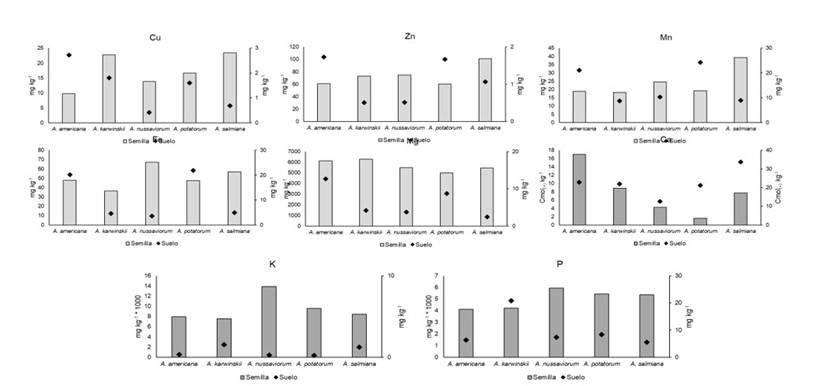
The soils of Ocotlán de Morelos (ODM) and San Martín Mexicapam (SMM) had alkaline pH values (8.2 and 8.3), and Santa Cruz Mixtepec site 2 (SCM 2) registered a moderately acidic pH value. Electrical conductivity (EC) was higher in SMM and lower in SCM 2 and San Vicente Nuñú (SVN) (0.2-0.3 dS m-1). Organic matter ranged between 1.4 and 4%. In texture, sandy-clay-loam soils predominated. Ca was found in concentrations similar to those reported by Ávila-Uribe et al. (2025) in soils of the district of Miahuatlán, Oaxaca. Calcium predominated in soils, followed by phosphorus and, to a lesser extent, potassium (Table 2). Ávila-Uribe et al. (2025) mention calcium as a predominant element in soils used for agave planting. Elements in optimal conditions provide an appropriate chemical environment for production (Echeverría et al., 2023). No relationship was found between the nutrient content of the soil and the nutrient content in the agave seeds (Figure 2).
Table 2 Physicochemical characteristics of the soil from the collection sites of five Agave species.
| Characteristic | A. americana | A. potatorum | A. karwinskii | A. nussaviorum | A. salmiana |
|---|---|---|---|---|---|
| pH | SCM: 6.3 / SCX: 8.3 | SCM: 5.7 / ODM: 8.1 | SMM: 8.3 | SVN: 7.4 | SVN: 7.1 |
| EC (dS m-1) | SCM: 0.7 / SCX: 0.6 | SCM: 0.3 / ODM: 0.72 | SMM: 1.03 | SVN: 0.3 | SVN: 0.3 |
| OM (%) | SCM: 3.9 / SCX: 1.3 | SCM: 2.4 / ODM: 3.3 | SMM: 1.7 | SVN: 1.9 | SVN: 2.4 |
| Texture (%) | |||||
| Sand | 68.7 / 80.5 | 76.7 / 47.7 | 67.28 | 36.6 | 26.5 |
| Clay | 18.3 / 6.1 | 7.4 / 30.3 | 19.44 | 36.8 | 55.2 |
| Silt | 12.9 / 13.2 | 15.9 / 21.6 | 13.28 | 26.5 | 18.2 |
| Classification | Sandy loam | Loamy sand / S.C.L. | S.C.L. | Clay loam | Clay |
EC= electrical conductivity; OM= organic matter; SCM= Santa Cruz Mixtepec; SCX= Santa Cruz Xoxocotlán; ODM= Ocotlán de Morelos; SMM= San Martín Mexicapam; SVN= San Vicente Nuñú; S.C.L.= Sandy clay loam.
Morphometry
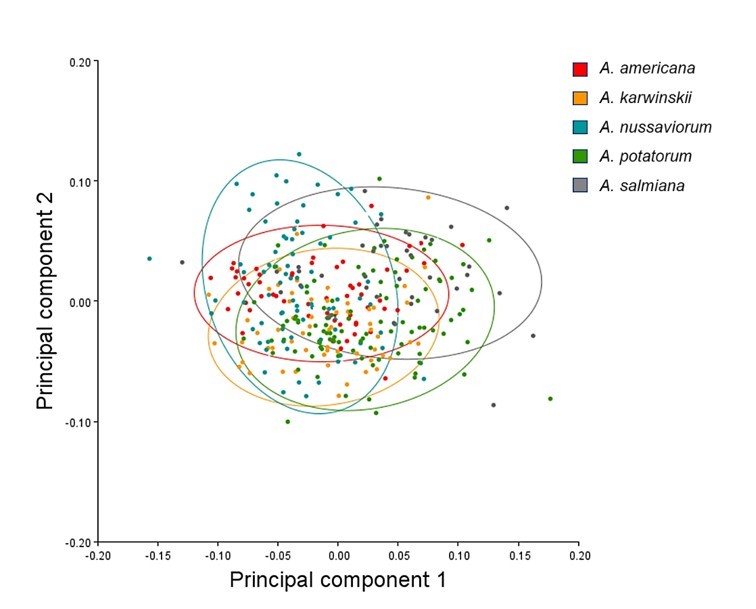
The morphometric analysis presented 61.1% of accumulated variation with the first two components (PC1 38.7% and PC2 22.4%) in the defined space. A scattered grouping was presented for each species with overlapping ellipses (Figure 3). Points far from the central zone were observed, which suggests the existence of differences in shape, but with insufficient loading to separate each species. This coincides with what was found by Hernández-Castro et al. (2021) and Villanueva-Castillo et al. (2021) in morphometric studies, where they indicate variation in agave seeds.
Principal component analysis
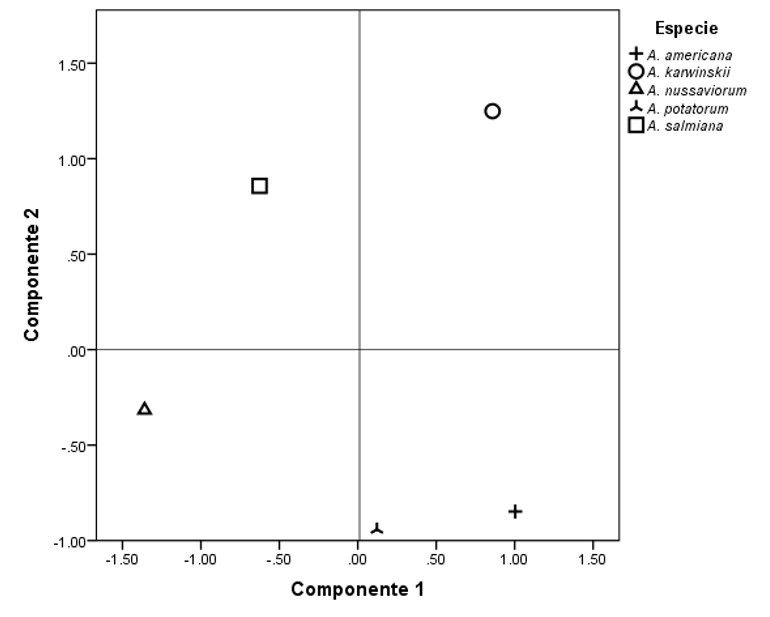
With the principal component analysis (PCA) applied to the quality variables, mineral content in seed and minerals in soil, it was demonstrated that the first two components reflected 71.4% of the total variance, and with the third component 89% was reached (PC1: 40.5%, PC2: 30.9%, PC3: 17.6%). PC1 was made up of the variables: copper in the substrate, sand, weight of 1 000 seeds, EC and iron content in the substrate; it separates A. karwinskii from the rest of the species, as it is mostly influenced by Cu and sand in the soil; this species was the one that presented a high concentration of this element (22.7 mg kg-1); in the positive quadrants, the species of agaves collected in the Central Valleys region were concentrated, and in the negative quadrants, the two species from the Mixteca region. PC2 is composed of potassium in substrate, moisture percentage in seed, copper in seed and sodium in substrate. A. americana and A. potatorum grouped in the quadrant with negative values of component 2, since they were the species with the lowest moisture content and intermediate Cu concentration in the soil (Figure 4).
Conclusions
The germination percentage did not differ significantly among the five agave species. The lowest germination level was observed in A. nussaviorum (41.6%), and the highest in A. potatorum (65.5%). The weight of the seeds is related to their size; that is, the largest seeds, which were those of A. americana, weighed 11.2 g per 1 000 seeds and the smallest seeds, which corresponded to A. nussaviorum, weighed 4.8 g, highly significant differences. The seed moisture in each species was less than 5%.
Weight gain in imbibition was significantly higher in A. nussaviorum (389.4%). The seeds of A. potatorum showed the highest viability (72.8%) significantly. In the seeds, K, Ca, Mg, and Zn were found at higher concentrations in all analyzed samples; the elements with the lowest concentrations were Cu and Mn.
The soils where the agaves grew showed diversity in pH, electrical conductivity, organic matter content and textures. It was found that Ca was the element that stood out across all these soils, followed by P and K. There is variation in the seed morphometry of the agave species. The proportion of minerals in the seed and soil did not show a positive or negative relationship. Using the principal component analysis (PCA) methodology, the variables that reduce dimensionality were identified, giving greater significance to P, S, Na, K and Fe concentrations in seeds.
Bibliografía
Al-Ansari, F. and Ksiksi, T. 2016. A quantitative assessment of germination parameters: the case of Crotalaria persica and Tephrosia apollinea. The Open Ecology Journal. 9(1):13-21. https://doi.org/10.2174/1874213001609010013. [ Links ]
AOAC. 1990. Official Methods of Analysis. 15th Ed. Association of Official Analytical Chemist, Washington, DC. [ Links ]
Ávila-Uribe, G.; Pérez-López, A. y Sánchez-Guzmán, P. 2025. Caracterización físico-química de suelo en dos zonas de producción de mezcal, en el Distrito de Miahuatlán, Oaxaca. Terra Latinoamericana. 43(1-12):e1985. https://doi.org/10.28940/terra.v43i.1985. [ Links ]
Bejarano-León, V. 2011. Preservación de semillas de agave Victoriae reginae (Agavaceae) y Glandulicactus uncinatus (Cactaceae) especies endémicas y en peligro de extinicón. Tesis de Maestría. Universidad Michoacana de San Nicolás Hidalgo. [ Links ]
Doria, J. 2010. Generalidades sobre las semillas: su producción, conservación y almacenamiento. Cultivos Tropicales. 31(1):74-81. http://scielo.sld.cu/pdf/ctr/v31n1/ctr11110.pdf. [ Links ]
Echeverría-Pérez, E. G.; Castañeda-Hidalgo, E.; Robles, C.; Martínez-Gallegos, V.; Santiago-Martínez, G. M. y Rodríguez-Ortiz, G. 2023. Indicadores de calidad como herramientas útiles para evaluar el estado de la fertilidad del suelo. Revista Mexicana de Agroecosistemas. 10(1). https://doi.org/10.60158/rma.v10i1.376. [ Links ]
Fernández, W. C.; Morales, G. I. y Sánchez, L. H. 2019. Tamaño de semilla y tratamientos pregerminativos en la germinación de Agave potatorum Zucc. Contribución al Conocimiento científico y tecnológico en Oaxaca. 5-11. https://es.scribd.com/document/830307030/4-tamano-de-semilla-y-tratamientos. [ Links ]
Gutiérrez-Hernández, G. F.; Ortiz-Hernández, Y. D. y Aquino-Bolaños, T. 2020. Composición química y germinación de semillas de tobalá (Agave potatorum). Interciencia. 45(5):223-228. https://www.interciencia.net/wp-content/uploads/2020/06/02-6712-Com-Ortiz-v45n5-6.pdf. [ Links ]
Hernández-Castro, E.; López-Sandoval, Y. Y.; Escobar-Álvarez, J. L.; Ramírez-Reynoso, O.; Maldonado-Peralta M. A. y Valenzuela-Lagarda, J. L. 2021. Análisis morfométrico de semilla y desarrollo de plántulas de maguey sacatoro (Agave angustifolia Haw.). Ecosistemas y Recursos Agropecuarios. 8(3):e2964. Doi: 10.19136/era.a8n3.2964. [ Links ]
Hernández, M. J. T.; Pineda, C. O.; Castro, E. H.; Nava, A. D.; Guzmán, A. J. C.; Campos, Z. M.; González, M. A. R. y Álvarez, D. V. 2023. Caracterización de semillas de Agave spp., por el método de ISTA South Florida Journal of Development. 4(1):438-453. https://doi.org/10.46932/sfjdv4n1-032. [ Links ]
Hernández-Mora, A. E.; Trejo-Téllez, L. I.; Herrera-Corredor, J. A. y Gómez-Merino, F. C. 2025. Minerales en semillas de cachichín (Oecopetalum mexicanum) sometidas a diferentes tratamientos térmicos. Revista Fitotecnia Mexicana. 47(4):377. https://doi.org/10.35196/rfm.2024.4.377. [ Links ]
ISTA. 2016. International Seed Testing Association. Reglas internacionales para el análisis de semillas, Zürichstr. 50, CH-8303 Bassersdorf, Suiza. https://efaidnbmnnnibpcajpcglclefindmkaj/https://backrepor.observatorioagro.gob.bo/server/api/core/bitstreams/630b5ae7-f70b-479c-b1b3-934da4efe45e/content. [ Links ]
Lechuga-Campuzano, J. L.; Arzate-Fernández, A. M.; García-Núñez, H. G.; Mariezcurrena-Berasaín, M. D. and Reyes-Díaz, R. D. 2025. Viability and morphometry in agave seeds as an initial study for sustainable management and genetic preservation. Tropical and Subtropical Agroecosystems. 28:1-10. http://doi.org/10.56369/tsaes.6193. [ Links ]
Martinez-Rodriguez, A.; Beltran-Garcia, C.; Valdez-Salas, B.; Santacruz-Ruvalcaba, F.; Di Mascio, P. y Beltran-Garcia, M. J. 2022. Micropropagation of seed-derived clonal lines of the endangered Agave marmorata Roezl and their compatibility with endophytes. biology. 11(10):1423. https://doi.org/10.3390/biology11101423. [ Links ]
Monroy-Vázquez, M. E.; Peña-Valdivia, C. B.; García-Nava, J. R.; Solano-Camacho, E.; Campos, H. y García-Villanueva, E. 2017. Imbibición, viabilidad y vigor de semillas de cuatro especies de Opuntia con grado distinto de domesticación. Agrociencia. 51:27-42. https://www.agrociencia-colpos.org/index.php/agrociencia/article/view/1276/1276. [ Links ]
NOM-021-RECNAT-2000. 2002. Norma Oficial Mexicana NOM-021-RECNAT-2000, Que establece las especificaciones de fertilidad, salinidad y clasificación de suelos. Estudios, muestreo y análisis. https://www.dof.gob.mx/nota-etalle.php?codigo=717582&fecha=31/12/2002#gsc.tab=0. [ Links ]
Ramírez-Tobías, H. M.; Peña-Valdivia, C. B.; Aguirre R., J. R.; Reyes-Agüero, J. A.; Sánchez-Urdaneta, A. B. y Valle G., S. 2012. Seed germination temperatures of eight Mexican Agave species with economic importance. Plant Species Biology. 27(2):124-137. https://doi.org/10.1111/j.1442-1984.2011.00341.x. [ Links ]
Temel, S. 2021. Determination of Mineral content of seeds belonging to different quinoa varieties and their evaluation for daily mineral requirements of laying hens. Alinteri Journal of Agriculture Sciences. 36(1):234-241. https://doi.org/10.47059/alinteri/V36I1/AJAS21034. [ Links ]
Villanueva-Castillo, D. M.; Velasco-Velasco, V. A.; Santon-Romero, R. B.; Ruiz-Luna, J. y Rodríguez-Ortíz, G. 2021. Variación morfométrica en semillas de agaves silvestres de Oaxaca. Revista Mexicana de Ciencias Agrícolas. 12(1):155-162. https://doi.org/10.29312/remexca.v12i1.2426. [ Links ]
Received: November 01, 2025; Accepted: February 01, 2026
 Este es un artículo publicado en acceso abierto bajo una licencia Creative Commons
